Year of Superman Week 52: And to All Things, an Ending

I’m writing this on Christmas morning, sitting amongst piles of wrapping paper and the mountain of Hot Wheels that Santa Claus brought Eddie, The Muppet Christmas Carol on TV because it’s not time for football yet. But it’s also the first day of the final chapter. After 51 weeks in which I have watched, read, or listened to at least one piece of Superman-related media every single day, no matter what life had in store for me, I’ve only got seven days left to reach the finish line. 

I’m going to think of this week as “the best of the rest.” I’m going to try to read and watch some of my favorite or some of the most significant stories remaining on the gargantuan list I started the year with. And make no mistake, that list is still pretty big. I haven’t gotten close to scratching off all of it. So perhaps, just perhaps, when I reach New Year’s Day, my journey with Superman won’t be ending, but merely evolving.

But time for that later. Let’s get started.

And as always, you can check out earlier blogs in the Year of Superman Archive!

Thur., Dec. 25

Comics: Superman Smashes the Klan #1-3, DC Go! Holiday Special #32

Notes: A few weeks ago I listened to the radio serial “Superman Versus the Clan of the Fiery Cross.” In 2019, writer Gene Luen Yang and artist Gurihiru loosely adapted that storyline into a three-issue miniseries, Superman Smashes the Klan, that kept the skeleton of the original story, but added some new elements that really made for one of those evergreen graphic novels that will be read for a very long time.

Set in the days after World War II, the story kicks off with a Golden Age-style Superman polishing off a leftover Nazi calling himself Atom Man. The fight is tougher than it should be, as Atom Man is powered by a glowing green crystal that Superman has encountered before, that makes him weak and sick. We soon discover that this is a very young Superman who does not yet know the truth of his alien origins. Something is nagging at him, and he sees an odd vision of himself in the mirror looking like a creature from outer space. Meanwhile the Lee family – Dr. Lee, his wife, and their children Tommy and Roberta – is moving from the Chinatown section of Metropolis to the city proper because Dr. Lee is starting a new job as Chief Bacteriologist of the Metropolis Health Department. Their new neighbor, Jimmy Olsen, stops by to introduce himself and invite them to the Unity House Community Center baseball practice. 

The story follows the plot of the radio show fairly well, but it adds in elements that weren’t present on the air. Superman learns in the course of this story that he’s an alien himself, giving an added dimension to the story of the Lees and their struggle to find acceptance in Metropolis. We’ve also got an original character, Tommy’s sister Roberta, who wasn’t in the original story but takes on a large part of the narrative. As the daughter of a Bacteriologist, Roberta is a bit of a germophobe, which only serves to enhance her existing awkward nature, making it much more difficult for her to acclimate to her new home. I like this angle a lot. Having Tommy fit in as a typical all-American boy worked well for the radio show. You didn’t even know that he WAS Chinese for the first few episodes, making the angle of the Klan come across as a surprise to the listener. But in a comic book, there’s no way to make that kind of thing a surprise. While Tommy is still that kid who everyone loves and blends in with the Unity House baseball team easily, Roberta gives us a character to depict the alienation that someone – especially a kid – can feel in this sort of situation. The idea in the original was just to point out how foolish the likes of the Klan were, and that’s all to the good, but Gene Luen Yang (himself a creator of Asian descent) brings a whole new dimension to the story by emphasizing the struggle of an immigrant family through Roberta’s perspective. Not to make it sound like she’s some damsel in distress, mind you. Roberta is Superman’s deuteragonist in this story. She overcomes her anxiety to help her brother, realizing very quickly that Chuck Riggs is involved with the Klan and using her knowledge to race to Tommy’s rescue. She also inspires Chuck’s change of heart much earlier than happens in the radio serial.

Tommy, on the other hand, perhaps tries a little TOO hard to fit in, leaning on his ethnicity in ways he didn’t in the original radio story. Once he becomes part of the Unity House baseball team he keeps dropping jokes about being Chinese (“Confucius says” references, for example), using what makes him different to enhance his popularity. Although he’s a good-natured kid, his insistence on drawing attention to being Chinese bothers his sister almost as much as the people who insult them.

Superman himself has yet another perspective on the immigrant experience. He knows he was adopted, and we see flashbacks of Jonathan showing him a strange device that was in the ship that brought him to Smallville, but it spoke a language they were never able to translate. He’s even gone so far as to mentally suppress some of his more fanciful powers, making for a nice explanation for why he goes from “leaping tall buildings” to outright flight.

Another addition to the story is the Atom Man subplot. After Superman captures Atom Man in the beginning, we see periodically that he’s not in police custody, but being studied by the Metropolis Health Department, a study that Dr. Lee clearly has misgivings about. Lois Lane – who had almost no presence in the original radio story – takes the lead on this one, cracking open the story about the “Health Department” which turns out to be a private enterprise conducting dubious research. Naturally, this turns out to dovetail with the story of the Klan in a rather unexpected way. This is one point I’m a little unsure about. Making the Klan a more high-tech organization, with “loftier” ideals than the simple bigotry of the original works for this version of the story, to be certain, but I’m not sure if it undermines the original point at all. Perhaps smarter people than I can answer that one.

The is a fantastic story – a bold, proud tale that does far more than simply adapt the original radio drama. Indeed, it ties the story of Tommy and Roberta Lee in with the core concept of Superman, making who they are as integral to the series as who he is. I can’t recommend this one highly enough. 

Fri., Dec. 26

TV Episodes: Superman and Lois Season 4, Episodes 6-10
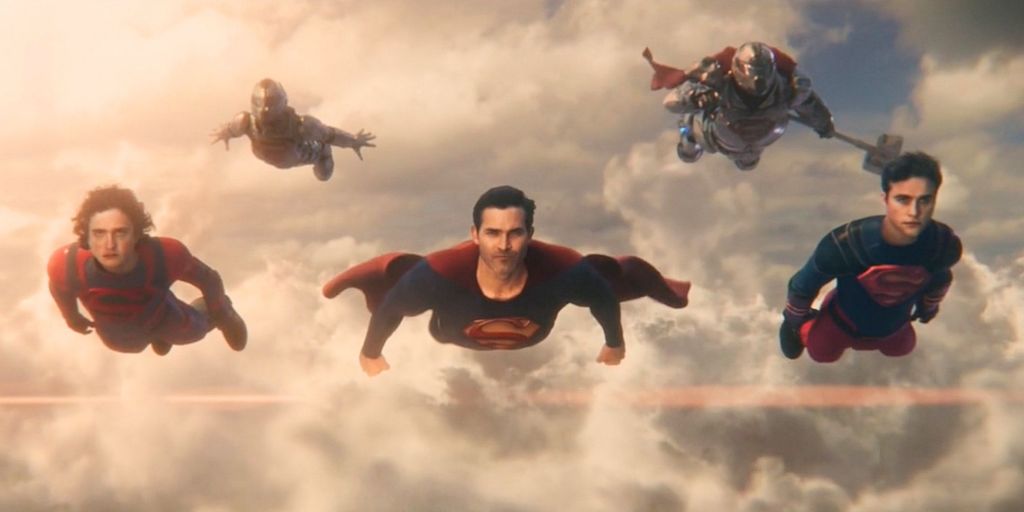
Notes: With my wife working and my son having a mountain of toys to play with and college football to watch, I decided that the day after Christmas was the time to finally finish the last season of Superman and Lois. I’m not going to to a play-by-play on these last five episodes, so let’s assume that you’ve watched these episodes that I’m watching for the first time, and I’m going to discuss my feelings about them as I watch.

In episode 6, we see Lex trying to tighten his grip on Smallville by buying up property and bribing the citizens, but they hold firm and resist – mostly because Clark wants them to do so. It’s a wonderful series of scenes in which Clark realizes something that viewers figured out several episodes ago: after seeing Lois and the boys run to Superman’s side after he was killed by Doomsday, the entire town of Smallville now knows that he’s really Superman. And best of all, every single one of them is willing to keep the secret and cover his back. It’s a great story beat, and actually one I’ve thought about several times over the years. Considering everything that he did for the town of Smallville, especially in those continuities where he had a career as Superboy, it would be utterly absurd if there weren’t a lot of people who deduced the truth. The fact that they keep the secret speaks to an inherent goodness in them, a loyalty to the hero who has saved them time and again. Plus, when we see him trying desperately to put the cat back in the bag, convincing people that he’s NOT Superman, it’s hilarious. 

Of course, there’s gotta be some drama, and the fact of his identity leaking out predictably causes some problems – kids who are resentful of Jonathan and Jordan, an antagonist from an earlier season that comes back and causes trouble. The scene where someone takes a shot at him in a diner, forcing him to reveal himself, is just glorious, and it leads to the secret being revealed to the world. When that happened in the comics I hated it, because I knew this was a genie that had to go back in the bottle and we’d seen it before. But here, when it happens on a TV series that only has three episodes left, it’s an opportunity to tell a story that hasn’t been told with Superman before, and the creators nailed it.

Beyond that, of course, another big arc in this season is the fact that Clark now has Sam Lane’s heart, and it’s reducing his powers, causing him to age. At the same time, Luthor is planning his final revenge with the combination of a new super-suit (stolen from John Henry and beefed up with Kryptonite) and the return of his Doomsday monster. It all collides in the final episode, “It Went By So Fast,” a title which I can only assume was a meta way for the writers to indicate the fact that they didn’t really want the show to end. I get it, too – this last half-season, lower on the soap opera dramatics and higher on the Superman stuff, was really fantastic, and it’s leaving me wanting more. 

They’ve done the Doomsday battle before in live action – in Smallville, in Batman V. Superman, and even before in this series…This is probably the best one I’ve ever seen. With Clark on the ropes, seeing Jonathan and Jordan step up to fight hits me in that parenting place that seems to dominate how I interpret stories these days. John Henry and Lana joining the fight as well shows how big Superman has become, how this world is rising up to meet him. He may have lost a step thanks to his heart transplant, but he’s also inspired another generation of heroes, meaning he doesn’t have to do it alone. 

And that’s just act ONE of the finale.

While Clark is chucking Doomsday into the sun, back on Earth Lex attacks the twins and Lois goes after him directly. As she shouts at him to stop attacking everyone around her when she’s the one he really wants, she yells the most Lois Lane line I’ve ever heard: “I am not afraid of you, but you’ve always been TERRIFIED of me,” then nails his warsuit with a mine. It’s not enough to stop him, but it slows him down enough for Clark to make it back to Earth and really start the final battle. It’s an epic, airborne spectacle that ends, inevitably, with Luthor taken down.

And now we’re only HALFWAY through the episode.

Next we get a time skip to about year later with Lana’s wedding to John Henry Irons (an event that would happen a few months later in the comics as well). Kyle and Chrissy are expecting a second child, and Kyle and Lana have reconciled into what appears to be a sincere friendship. Jordan and Sarah, similarly, seem to have finally buried the hatchet, and John Henry spends a tender moment with Natalie as Lois gets an important text about Lex’s future behind bars. 

In the final act, we get a voiceover from Clark about how Sam’s heart allowed him to live another 32 years, and how he wanted to leave behind a legacy, making the world a better place. Clark, along with the twins, John Henry, Natasha, even Bruno Mannheim, begin to make real change. Using the influence of Superman and Lois Lane, they start a foundation that accomplishes good throughout the world. The twins each marry and have kids of their own, and we get a nice scene of Grandma and Grandpa Lois and Clark (in admittedly dubious aging makeup). But eventually, Lois’s cancer returns, and Clark is left alone. He lasts for several more years before Sam Lane’s heart that had beat in his chest for so long finally gives out, passing away quietly with his sons next to him.

Clark sits up, young again, seeing his own body behind him. He embraces his sons – young again – and sees his grandchildren. He finds Luthor, of all people, sitting at his kitchen table, and offers him forgiveness…says goodbye to his friends one at a time, and in the end he sees a vision of Lois, waiting, to take him into the light.

Here’s the thing: the story of Superman doesn’t end. It just – it doesn’t. Five years from now, ten years, a hundred years from now, there will and should be new stories of Superman being told.

But if Superman DID end…this is the right way to do it. An ending that is happy in the life he and Lois get to lead, despite the fact that this life – like all those of mortals – must end. And the fact that a Superman left behind a better world than he arrived on in that spacecraft from Krypton. In the comic books, they can’t really do a story in which Superman changes the entire world this way, because they still need something to tell stories about next month and next year. But here, with a television series coming to an end and, with it, closing off the stories of that universe, they have the freedom to show what Superman is REALLY capable of. This season has been a buildup, showing how Superman inspires those around him – not only his own children or friends, but the people of Smallville who were willing to stand up for him, and the people of a world that grows to do the same. The ending of this episode is a tearjerker, but it’s left with a beautiful message of hope that is entirely appropriate for Superman.

But it’s not only hope. Superman is about hope, yes. But the thesis of this series is true as well: “[Love is] the thing that makes life worth living.” It’s what makes the story of Lois and Clark so powerful, in all its many iterations. A man from another world, a woman who represents the best of ours, and how they come together…this is a story worth telling. 

Comics: DC Go! Holiday Special #41

Sat. Dec. 27

Comics: DC Go! Holiday Special #43 (Cameo), Detective Comics #1103, Superman: The Kryptonite Spectrum #5, Superman Unlimited #8, Action Comics #1093, Superman Vol. 6 #33, Absolute Superman #14, Batman/Superman: World’s Finest #46, Supergirl Vol. 8 #8, Justice League Unlimited Vol. 2 #14, Justice League Red #4 (Power Girl), Justice League Vs. Godzilla Vs. Kong 2 #5

Notes: For the final time (this year), I’m going to do a roundup of recent Superman-related comics, starting – oddly enough – with Detective Comics #1103. One of the first comics I read this year, back in the first week of January, was an issue of Tom Taylor’s Detective that showed Superman helping Bruce through an existential crisis. This actually serves as a nice bookend, with Bruce teaming up with Lois to help with an investigation. Superman appears briefly, but most of the issue is concerned with Lois showing off how dang capable she is, and how much respect Bruce has for her. It’s the middle of an ongoing storyline, so it’s probably not something most people would read on its own, but it’s worth mentioning because it’s a great Lois guest appearance. 
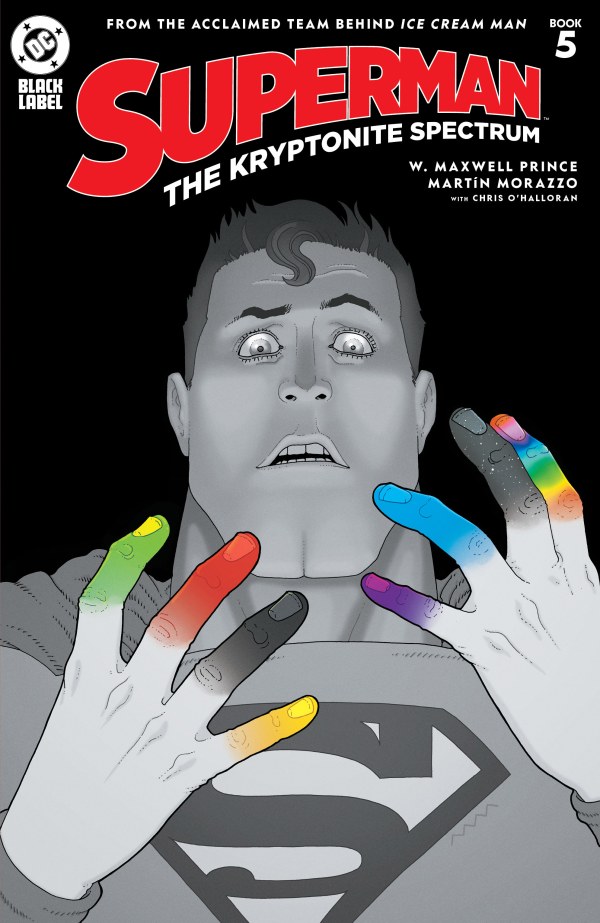
The final issue of Superman: The Kryptonite Spectrum wraps up W. Maxwell Prince and Martin Morazzo’s celebration of the Man of Steel in dynamite fashion. Lex Luthor has engineered a new Kryptonite Man, powered by the entire spectrum of the remnants of Superman’s home, and the battle between the two of them sends Superman on a spiral that leaves him questioning the very nature of the universe itself. Prince’s story leans heavily on metafiction, concentrating on Superman as a story and weaponizing that part of the character’s nature. The finale is entirely unexpected, but in its own way, as sincere a love letter to Superman as the likes of All Star Superman was – in fact, Prince and Morazzo lean heavily on Morrison and Quitely’s story here, and they do so in a way that’s both loving and triumphant. This is hands-down the miniseries of the year.
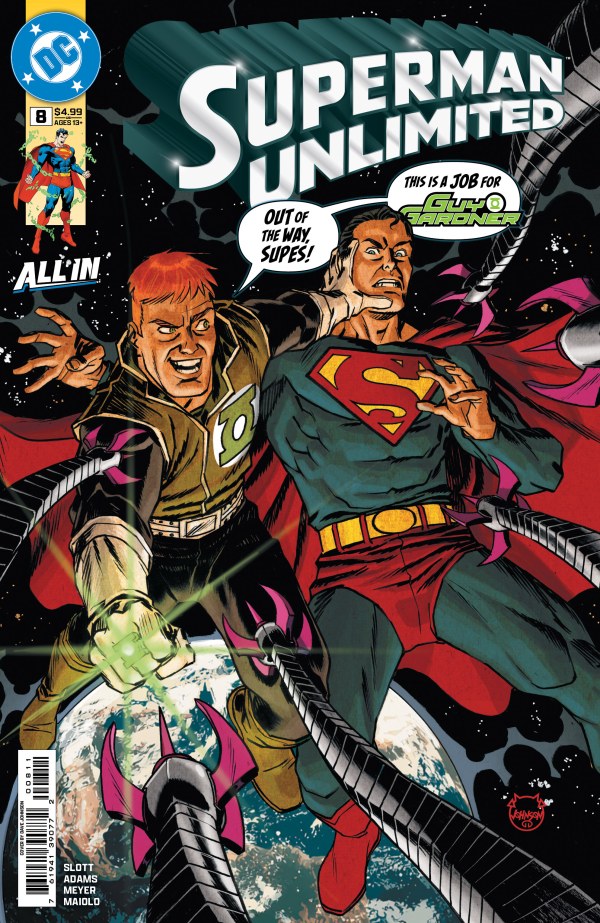
Superman Unlimited #8 gives us another of the one-off stories that this series has been doing so well. The influx of Kryptonite on Earth has changed a lot of things, including energy sources, and an experimental space flight is planning to make faster-than-light travel a commercial enterprise on Earth. With Lois Lane as a passenger on the maiden voyage, the Justice League assigns Guy Gardner to escort the flight in case something should happen. And wouldn’t you know it? Something happens. I have no doubt that Guy’s appearance in this issue is at least partially due to his guest-starring role in this summer’s big movie, but at the same time, it’s done exceptionally well. Guy is such a fun character – a rude, insufferable boor that is in every way diametrically the opposite of Superman…except for the fact that they’re both true heroes at heart. Seeing them together, both clashing and cooperating, pretty much always makes for a good time, and this issue is no exception. 
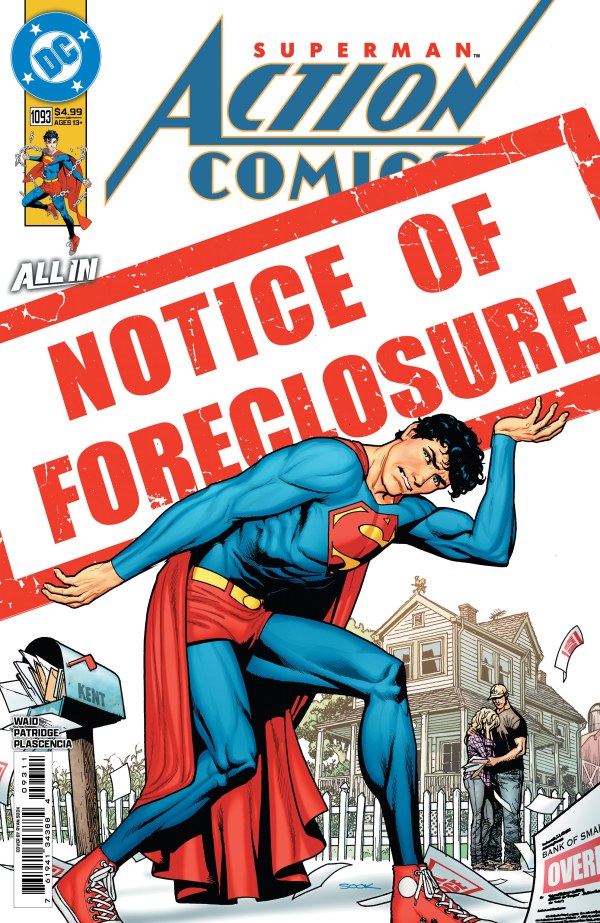
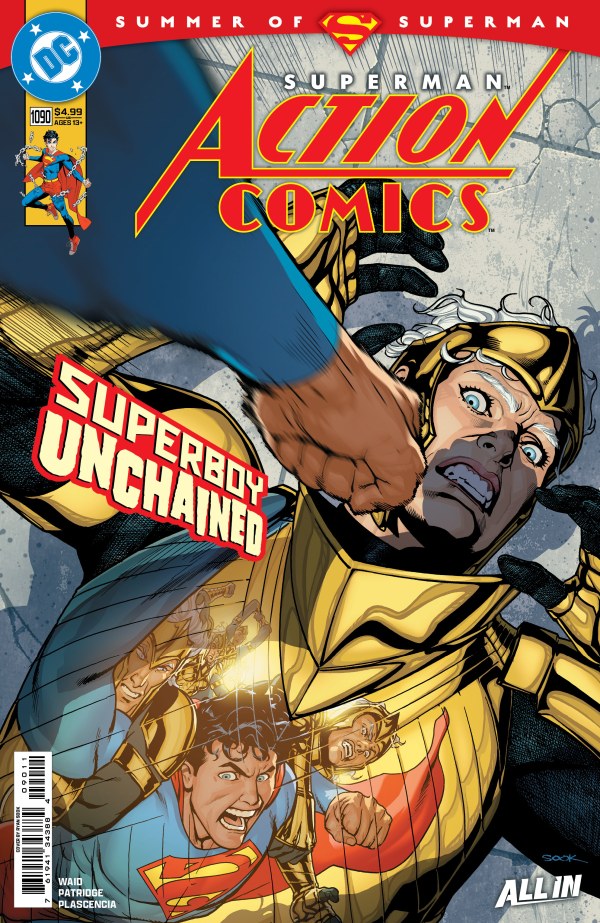
Action Comics #1093 is another one-off story, this time Mark Waid telling a Superboy tale that shows an event that’s fundamental to Superman’s moral core. Dozens of farmers throughout Smallville are given notices of foreclosure on their farms at the same time. The new owner of the bank assures them that if there’s an “error” they’ll figure it out, but the time it would take to do so would ruin every farm in Smallville. When Superboy contemplates using his power to “find” the money to save the town, it becomes a battle of wills between Clark and his parents, who think that using his powers for personal gain – even to save the town – isn’t the way to go. I’m sure that everyone who’s ever read a Superman comic has fantasized about having the power to hunt down undiscovered gold or some other get rich quick scheme, and Waid does a good job with the Kents of painting a picture of why such a thing should be above a Superman. I still have to confess that I’d probably go dig up the gold if I had Superboy’s powers, but in my defense, nobody has ever called me Earth’s greatest hero. 
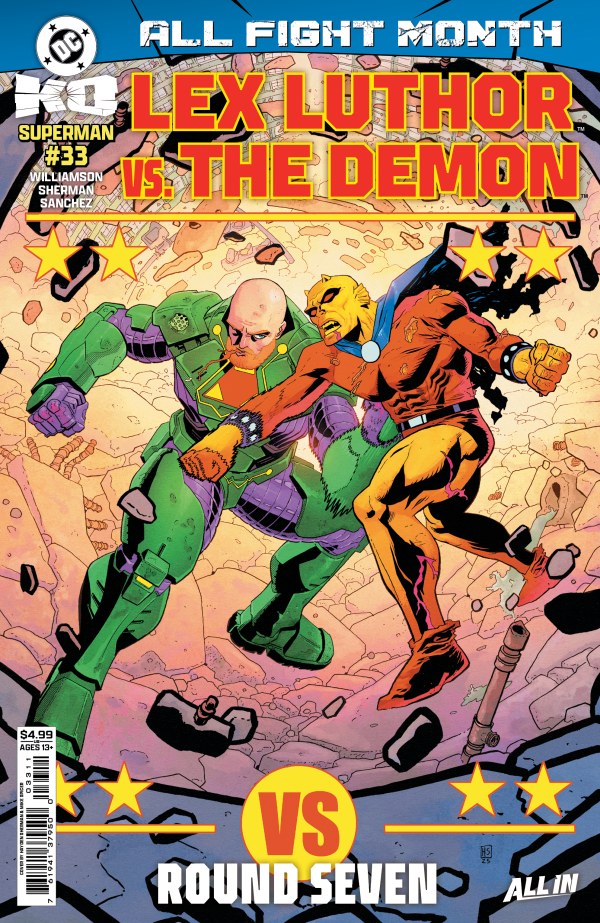
DC KO’s “All Fight Month” continues with Superman #33, with the unlikely battle between Lex Luthor and Etrigan the Demon. Throughout the month I’ve been impressed at just how well these battles have transcended being mere slugfests. Oh, there’s fightin’ a-plenty, but each of them has gone beyond that to telling a story that digs into the heart of the characters involved. We see who they are, why they do what they do, and what makes them worthy of the Omega Heart, even if it’s only in their own mind. Joshua Williamson taps into the blackness in Lex’s heart and simultaneously shines a light on him. By the end of the issue, you almost (aaaaalmost) want to root for him in his fight with the Demon, because damned if he doesn’t convince you that he’s earned the win. We also continue the storyline with Superboy-Prime and Lois, whose Superwoman powers have returned, in the Fortress of Solitude. Recent announcements about the state of the Superman titles after KO ends have made these pages a bit more relevant than we’d realized, and although I hate the fact that they keep spoiling things in the solicits, I’m very curious to see what’s coming next to this title. 

Absolute Superman #14 ends the current storyline with an epic battle between Kal-El and Ra’s Al Ghul for the heart of Smallville. As the two of them go at it, we see Lois facing off against the Peacemakers and Sol’s internal battle with Brainiac, all of which come to an amazing crescendo in this issue. Without going into a blow-by-blow, the ending of this one is probably the most hopeful thing I’ve seen yet in the Absolute Universe as a whole, although as suits this world tainted by Darkseid’s energy, the victory is bittersweet and not without a price. In many ways, it clears the table for this series, and it will be very interesting to see where the story goes from here. 

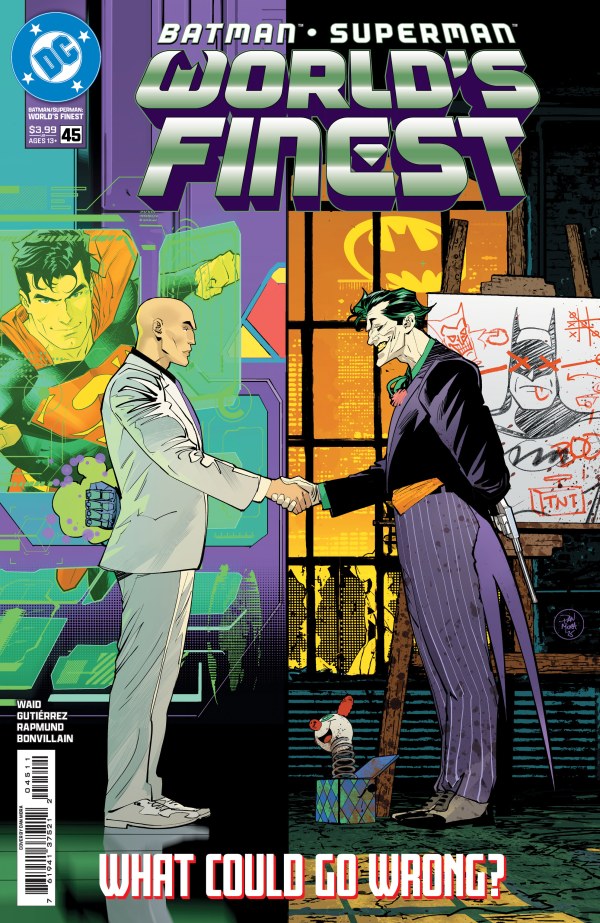
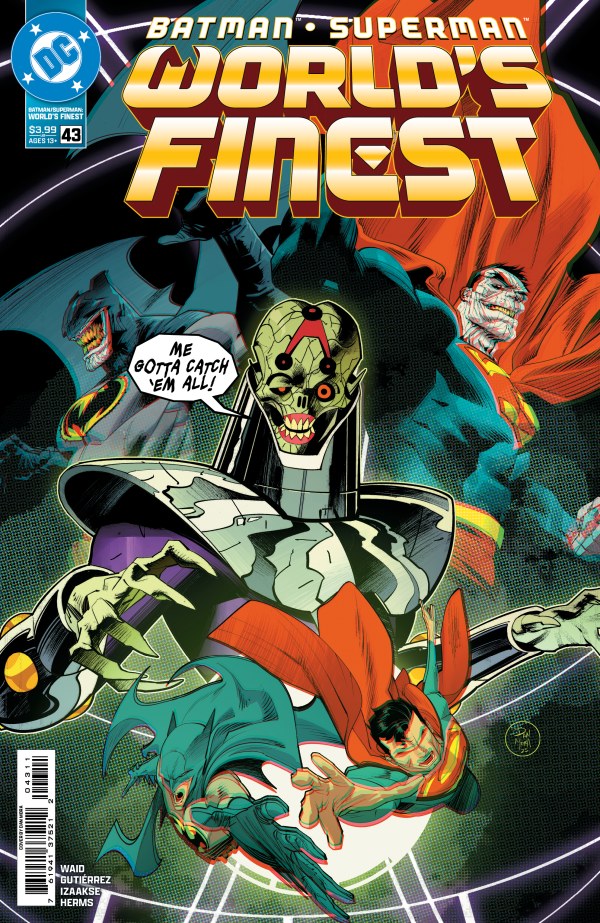
World’s Finest #46 continues the story of Lex Luthor and the Joker, fused into a single being and armed with the power of a device that gives them the sum total of all knowledge in the human race. Superman and Batman, naturally, have to step up and stop them, this time getting a little extra help from Green Lantern to juice them up in a way he’s done once before. The issue ends on a cliffhanger, and it’s a pretty good one, except for the fact that it suffers a bit from Prequelitis. Admittedly, even in the present day what happens at the end would likely be wiped out by the next issue, but when you’re dealing with a series set in the past, there’s really zero tension with the “shocking” ending. It’s still a great, fun story, though. 
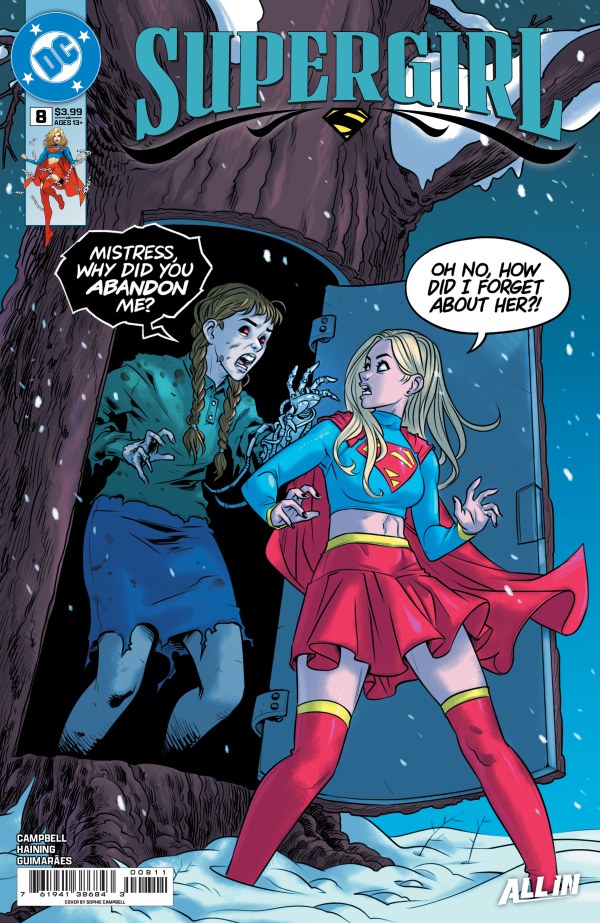
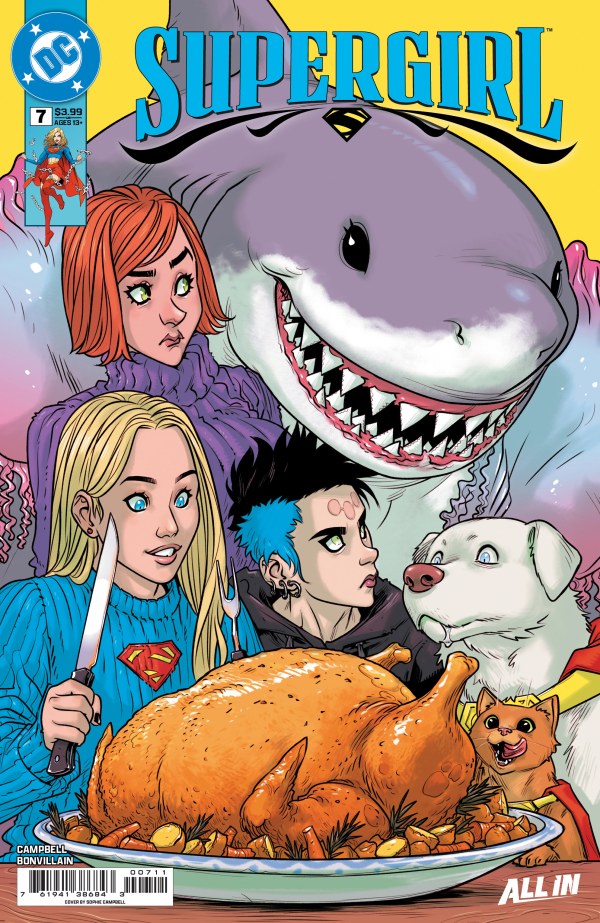
I’m going to end my tour of new comics with Supergirl #8. It’s Christmas in Midvale, but Supergirl isn’t feeling merry. The holidays, with their emphasis on family, always make her remember everything she lost in the destruction of Argo City. Still, the Danvers and Lesla-Lar do their best to cheer her up, even as they get a strange visitor from the past that Supergirl has neglected for far too long. Sophie Campbell’s Supergirl is probably my favorite new comic book title of the year, but this issue is a little atypical. While the series is usually very bright and uplifting, this issue is somewhat darker and more bittersweet, particularly for a Christmas story. That said, it works really well. Sophie takes Kara’s pain and shapes it into a valuable lesson for Lesla-Lar, whose journey to becoming a superhero is an important component of this title. The story is told well and propels the characters forward, while still giving us a little Christmas cheer in the process.

This is most likely the last I’ll talk about newly-released comics in the Year of Superman, and it’s bittersweet for me too. I’d be lying if I said I wasn’t looking forward to taking a break on January 1st, but at the same time, I’ve enjoyed pontificating about these new issues as they come out. It’s one of the main reasons I’m thinking about how to continue this blog into the new year.

Yeah, I’m teasing that again. Sue me. 

Sun. Dec. 28

Comics: Superman: Space Age #1-3
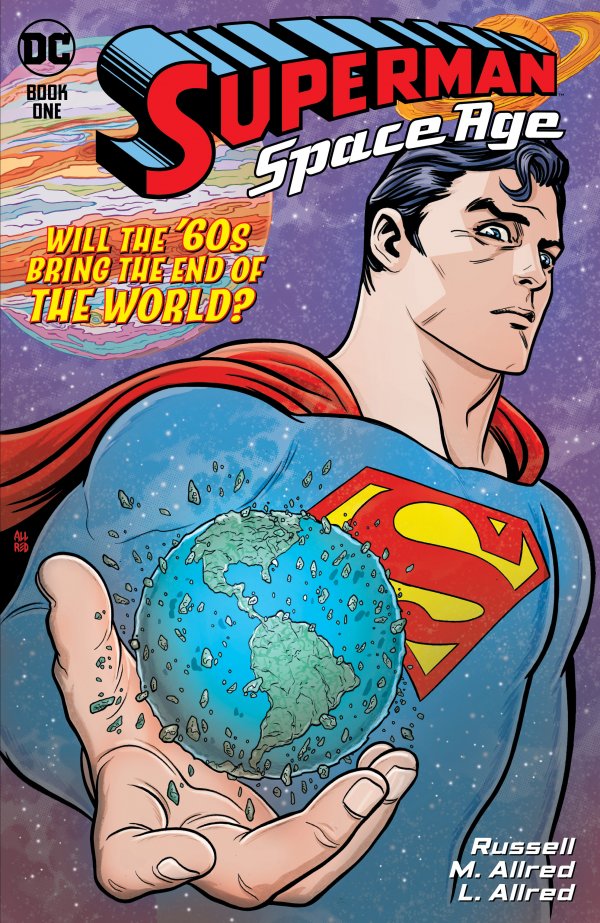
Notes: Continuing the theme of “Endings,” today I’ve decided to revisit the three-issue Space Age miniseries by Mark Russell and Michael Allred from 2022. Published as a Black Label series, like many of them, it really feels more like an Elseworlds. It’s set in a universe where Superman rises to prominence in the 1960s, with a Clark Kent that’s spurred to go out and find ways to save the world following the assassination of John F. Kennedy. Before he puts on his costume for the first time, though, he encounters a strange man called the Pariah, who warns him that the world will end in approximately twenty years. Pariah claims to have accidentally unleashed a great evil called the Anti-Monitor, an ancient being whose goal is to bring order to the Multiverse by destroying every positive-matter universe until only his own Antimatter universe remains. He tries to dismiss the Pariah as one of the “kranks” he’s assigned to cover as a Daily Planet cub reporter, but something about him sticks with Clark and he’s unable to shake it. On the other hand, he’s sometimes skeptical that the world will even last 20 years, as the arms race is intensifying and made worse by a false flag attack on Coast City orchestrated by Lex Luthor. The cataclysm turns out to bring heroes out of the woodwork: Batman captures Luthor, Abin Sur passes his ring on to Hal Jordan, Themiscyra sends Diana to the UN as an ambassador, and Superman makes his true debut disposing of American missiles before they can annihilate the Soviet Union. Book one ends with these four coming together at a new Hall of Justice.

In book two, we jump ahead to the 70s, where Superman is well-established, and the world is at peace following a nuclear disarmament treaty. But an interview with Lois leaves him questioning whether he’s doing all he can, and a similar disagreement drives a wedge in the Justice League. It’s a bad time for it too, as Green Lantern warns of the impending approach of a cosmic threat called Brainiac and, at the same time, a Superman from an alternate universe where all human life has been rendered extinct. It’s not all bad news, though – Clark is promoted to an editor’s desk at the Planet, Lois breaks Watergate, the two of them fall in love and she confesses that she knows he’s Superman just before he tells her. They even have time to get married and have a son before Brainiac arrives on Earth. But he’s not there to destroy the world, only to take its greatest resource before the Anti-Monitor can destroy it himself, hoping to use that resource in his battle against the Multiversal destroyer. That resource, as it turns out, is Kal-El of Krypton. The League drives Brainiac off the planet, but at the cost of Green Lantern’s life.

The final book in the trilogy takes us into the 80s where Clark finds Pariah again, who is impressed by his years of heroism, but still sees the end as inevitable. With less than two years before the Anti-Monitor arrives, the Brainiacs again ask Superman to join their fight, and this time, he considers it – but when a heart attack fells Johnathan Kent, he changes path, dedicating himself to saving the human race by eradicating disease by scanning their DNA. It turns out to be a ploy to record their genetic code. When the Anti-Monitor destroys the world, Superman makes for the Brainiacs’ portal, but instead of going into it he pushes through a crystal encoded with the DNA of every human he could collect, sending them to the empty world populated by the other Superman. He returns to his family just before the end, where on the other world the other Superman restores the human race on a new home.

In terms of “ending stories,” I kind of have mixed feelings about this one. On the one hand, it’s excellently done. The writing and storytelling are top-notch and the characters, even in the Elseworlds setting, still feel mostly true to the heroes we know and love. And I’ll pretty much always be on-board for artwork by Mike Allred, whose unique style is one of my favorites of all time. On the other hand, there’s an impending sense of doom that spreads across the entire thing. There are other dark “final” Superman stories, like Kingdom Come or Whatever Happened to the Man of Tomorrow?, but in both those cases we journey through the darkness with Superman and ultimately end in a place of hope. This one has a sense of nihilism that doesn’t quite befit the character. Even the ending, where the other Superman brings back humanity (starting, naturally, with Lois Lane), leaves us with the feeling that it’s only buying time. After all, the Anti-Monitor is still out there, the final battle has yet to be fought, let alone won.

The series raises some interesting questions as the different Leaguers look on things with different perspectives. Green Arrow views the world through the perspective of the “Trolley Problem,” whereas Batman’s point of view is that he just saves whoever he can, knowing he can’t save everyone. Superman, as fits the character, refuses to accept that, and is determined to find a way to save everyone even if doing so seems impossible. It’s a noble point of view that works in the regular DCU, but Russell shines a light on how unrealistic that perspective actually is. If I was looking for something realistic, though, I don’t think I’d be reading Superman in the first place. Superman is an ideal, and ideals don’t have to be realistic. They’re something to strive for, even if you know they can never really fall into your grasp, and that’s how Superman works best.

So is Space Age a good story? Yes. Absolutely. Without a doubt.

I don’t think it will ever be one of my favorites, though. 

Mon., Dec. 29

Comics: DC Go! Holiday Special #47 (Supergirl), Doomsday Clock #1-12
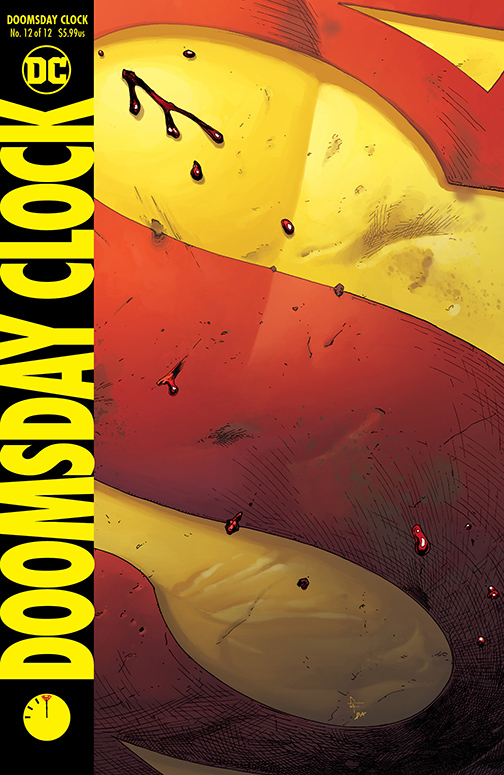
Notes: This is a controversial book, DC’s sequel to Watchmen which brings those characters into conflict with the heroes of the DC Universe, but I’m including it here for an important reason. In the end, this is very much a story about Superman. The first issue shows us the state of the world – since Ozymandias’s scheme was revealed by Rorschach’s journal, he has become the most wanted fugitive on the planet and the world has crept closer and closer to the very nuclear annihilation he was hoping to avoid. A new Rorschach has arisen, this time working with Ozymandias, who has a tumor growing in his skull. The two of them hope to find the only person in their universe with the power to change anything – Dr. Manhattan. Meanwhile, in another universe, Clark Kent wakes up from a nightmare, a horrible vision of the car crash that killed Jonathan and Martha Kent when he was only a teenager. It’s the first nightmare he’s ever had.

Ozymandias and Rorschach ally themselves with a pair of criminals – Marionette and Mime – who are seeking their missing son. They trace Dr. Manhattan to the DC Universe, where people are in upheaval following the popularization of the “Supermen Theory,” which posits the idea that the reason so many of Earth’s metahumans are American is because they have been deliberately created by the government since Superman’s first appearance. Faith in superheroes is eroding, with the only one who still has the public trust being Superman himself. 

Over the course of these twelve issues Geoff Johns and Gary Frank delve into the nature of the DC Universe itself, starting with the notion (from DC Rebirth) that it was Dr. Manhattan who was responsible for the New 52 reboot in the first place. Turns out, it’s more complicated than that. Manhattan did toy with the fabric of the universe, but the reason it was possible for him to do so is because the “Prime” DC Universe – the one that’s called Earth-0 these days – isn’t actually part of the multiverse as we know it. Manhattan calls it the “Metaverse” (take that, Mark Zuckerberg) because it’s a core reality that the others are all reflective of. In the Metaverse, Superman made his first appearance in 1938 and inspired the heroes of the Justice Society. Then reality snapped, moving Superman’s appearance to 1956. The JSA still existed, but now Clark Kent had an early career as Superboy, inspired BY the JSA, and it was that Superboy that in turn inspired the Legion of Super-Heroes 1000 years in the future. Another snap popped Superman’s first appearance to 1986, and–

–are you seeing the pattern here?

The idea is this: Superman is the center of the Metaverse. As time goes forward, his existence is the constant, and as such, the universe is in a constant state of change. But every time the universe shifts, the previous iteration is preserved in a different world in the Multiverse. The original Golden Age Superman’s world is Earth-2. Another was preserved as Earth-1985. The version Manhattan created is Earth-52, and so forth. Eventually, Superman’s timeline will catch up with the Legion a millennium in the future, and when that happens, the ideals of Superman will become universal, and create a lasting peace.

Man, that’s a nice thought, isn’t it?

This book – much like the original Watchmen – suffered from a lot of delays before it could be finished, and many of the larger concepts have been ignored since then. I don’t think the concept of the Metaverse has been explored since this book, for instance, and by its very nature it makes sense that they wouldn’t bring it up all that often. On the other hand, this book also established that Martin Stein was part of a government conspiracy to create superheroes, and Firestorm was the result of that, something that I’m almost positive has not come up again. But that’s the beauty of this book – it provides a framework that can be used to explain away virtually any discrepancy or change in continuity. That thing you remember that the heroes didn’t? It happened in a previous iteration of the Metaverse, and it’s still canon out there in the Multiverse…somewhere.

If you’re the kind of person who considers Watchmen sacrosanct, I can understand why you wouldn’t like this book. It does, in a way, undermine the conclusion of that story by answering the intentionally vague question of what would become of Rorschach’s journals, and (perhaps even more blasphemous) it allows for that world to have a happy ending. But as good as Watchmen is, I have no objection to the notion of returning to that universe. The HBO miniseries did it in excellent fashion. I like this one too, if for no other reason than because it confirms something very important: Superman is the most important hero in the entire universe.

Shoot, guys. I could have told you that. 

Tues. Dec. 30

Graphic Novel: It’s a Bird
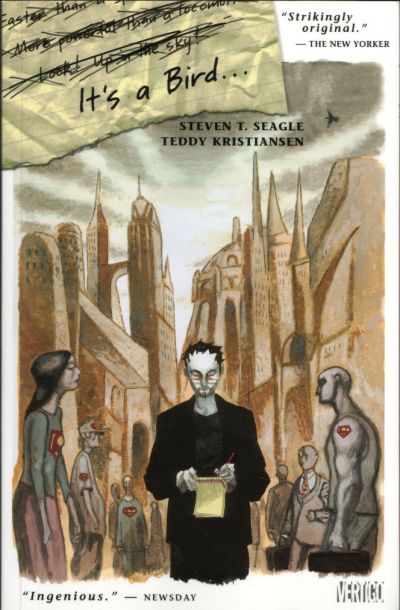
Notes: As with Doomsday Clock yesterday, I want to spend these last few days of the year with stories about Superman and about what he means. That quest led me back to It’s a Bird, the unique 2004 Vertigo graphic novel by Steven T. Seagle and Teddy Kristiansen. It’s perhaps the most unusual Superman story of them all in that Superman isn’t actually in it. 

The story, which is semi-autobiographical, starts with five-year-old Steve waiting in a hospital as his grandmother languishes. To placate him and his brother, their father brings them a Superman comic…after which, Steve swiftly rejects comics, as they remind him too much of the hospital, making it all the more ironic that he would grow up to write them. When an adult Steve is offered the job of writing Superman by his editor, he rejects it, unable to find the character relatable. 

The story is mostly about Steve trying to find his way into the Superman, and along the way he takes some interesting detours. His father goes missing, and fears of the disease that took his grandmother come back. Meanwhile, everyone he talks to about getting offered Superman is ecstatic for him and dumbfounded that he doesn’t want the job. These two threads are intercut with pages of Steve’s own musings on Superman, on who the character is and what he means – or at least, what he’s supposed to mean – as he tries to find something about the character that he can make believable in the real world. 

The interlacing storylines, of course, come together in the end, because such things always happen in fiction even if they almost never do in real life. His father’s disappearance turns out to be related to the death of Steve’s grandmother all those years ago, and in confronting his father and the disease that haunts his family, Steve starts to find a way in to Superman. 

It’s a good story, a powerful one, but it’s one whose inherent premise is one I somewhat disagree with. Steve’s quest is to find a way to make Superman “real.” I don’t think that’s necessary. Superman isn’t part of our real world any more than Mickey Mouse or Bugs Bunny or the food replicators on Star Trek. That doesn’t mean that he isn’t important, though, or that there’s nothing to be learned from them. In a lot of ways, I think the very fact of Superman’s fanciful nature is perhaps the most important thing about him.

Just as the story is very atypical for a Superman comic (such as it is), so is Teddy Kristiansen’s artwork. Kristiansen’s style is an odd halfway point between sketches and realism, in some ways making me think of Art Spiegleman…which is appropriate enough, as this book echoes Maus in various ways. Both stories are autobiographical, and with a frame narrative about the author struggling to relate to their fathers. In Maus, of course, the ghost that hangs between Art and his father is the spectre of the holocaust, while in this graphic novel it’s the shadow of the Huntington’s Disease that follows Steve’s family.

The book, of course, is specifically described as “semi-autobiographical.” Not really knowing much about Seagle himself, I wouldn’t presume to declare which parts are true and which ones aren’t, but regardless of any plot elements I tend to believe that all of the emotion in this book is genuine. The concerns, the fears, the anxieties that “Steve” expresses are almost certainly part of Seagle’s own psyche. Writers tend to do that, after all.

This is the Superman book for people who don’t understand Superman. I don’t know if, in the end, it will actually help them figure the character out – at least, not the way that I understand him – but it will at the very least help them find a path through someone else asking the same questions, and that’s a journey very much worth reading. 

Comics: Harley Quinn X Elvira #3 (Power Girl guest appearance), Justice League Red #5 (Team Member Power Girl), Justice League Vs. Godzilla Vs. Kong 2 #6 (Team Member)

Wed. Dec. 31

Comics: Superman #247, Kamandi: The Last Boy on Earth #29
Notes: Well glory be, here it is. 365 days later, and the journey I started back on January 1 with Action Comics #1 is about to end…or at least, to evolve. I’ll talk more about that (say it with me) later, but for now, it’s time for the final Superman reads of the year. I thought hard about what to read today. In the early part of the year I’d planned to end it with a classic “last” Superman story, like Whatever Happened to the Man of Tomorrow? or Kingdom Come, but I decided to add those when I did the week of comics that influenced James Gunn’s Superman. So how else to end it? I ultimately decided to go with two comic books about what Superman is, because that’s where this entire journey has led me anyway.

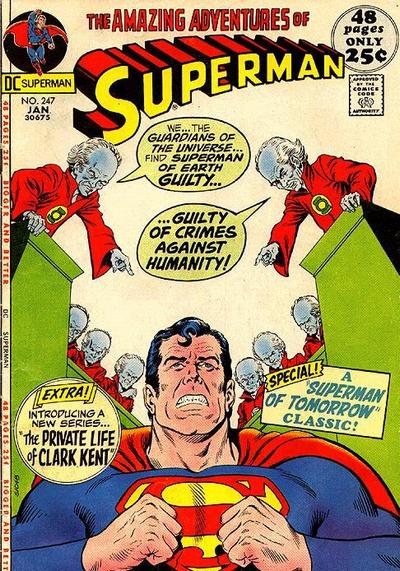
First is Superman #247, the Elliot S! Maggin/Curt Swan classic “Must There Be a Superman?” Like many of the stories I’ve read this year, I encountered this one for the first time when it was published in DC’s classic Greatest Superman Stories Ever Told collection. Let’s talk about why it qualifies. 

The story begins with Superman taking on a special task for the Guardians of the Universe – a pod full of deadly spores on a path to Earth, and as the spores are yellow the Green Lanterns are helpless to stop it. Superman creates an artificial planet to draw the spores away safely, but is injured in the process, rescued by Green Lantern Katma Tui and brought back to Oa to heal. As Superman is healing, the Guardians take advantage of his unconscious state to plant a notion in his mind that his influence on Earth may be impeding human progress. (If this had been the “Year of Green Lantern,” you would have found me discussing a LOT of stories that drive home an important point: the Guardians are pompous assholes.) When Superman wakes up, the Guardians give him a tour of Oa, continually dropping comments about him contributing to a “Cultural Lag” on Earth, and sending him home with the notion that if he steps back, Earth will be better off. 

As he returns to Earth, he stumbles on a child migrant worker being abused by his employer. Rescuing him, the child – Manuel – brings Superman back to his community where the residents begin begging him to help solve all their problems, such as fixing their crumbling houses. Superman refuses, saying that they need to know how to care for themselves, but an earthquake strikes just seconds later, destroying their homes. Superman blunts the quake and rebuilds their houses, but tries to convince them that they need to know how to care for themselves because no one – even Superman – can do anything. He returns to Metropolis only to get word of a cruise ship endangered by a waterspout, which he rushes off to save, even as the Guardians watch from afar.

Looking back at this story now, I feel like this was Maggin’s way of responding to people who asked why Superman didn’t just sweep in and fix all the problems in the world. After all, with his power, why couldn’t he just solve hunger, homelessness, war, famine, disease, and so forth? From a narrative standpoint, of course, the answer is obvious: if Superman were to do all these things, what stories would be left to tell? It would literally be the end of Superman, as a going storytelling concern. But what about in-universe? How do you explain it to a kid like Manuel, who’s getting beaten up by a man who basically controls his entire life? The answer is something that people who know Superman could have told you from the beginning: even with the best of intentions, having someone (like Superman) doing everything for them would hold them back, leave them unable to act or take care of themselves. It kind of reminds me of all those stupid ads begging me to use Google AI to write an email or a Facebook post as if I haven’t been perfectly capable of doing that for my entire life. 

Superman is there to take care of the things that we can’t. As far as the things we CAN take care of…we shouldn’t expect him to do it all for us. But that doesn’t mean we can’t take inspiration from him.
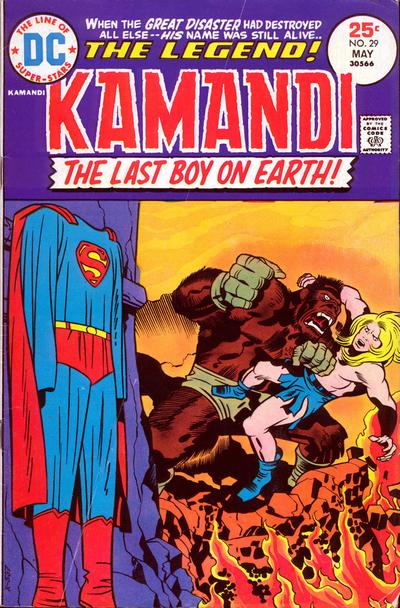
“Inspiration” is the theme of the final comic I’m going to read in this year of Superman, Jack Kirby’s Kamandi: The Last Boy on Earth #29. Kamandi, for the uninitiated, was a series about a post-apocalyptic world in which the human race is all but extinct, and the world is populated by anthropomorphized animals. In this issue Kamandi, one of the few remaining humans, finds the “Tablet of Revelation,” an ancient carving that prophesies the “return of the Mighty One,” a great warrior of the past. When the apes see Kamandi’s friend Ben Boxer, they believe him to be the returned “Mighty One.” One of the apes, Zuma, tries to engage him in combat, but the elder says that the Mighty One can only be revealed by demonstrating his powers against overwhelming odds. A catapult hurls claimants through the sky to prove that they can fly higher than the tallest building, an enormous boulder called the “Daily Planet” awaits the man who can move it, and so forth. Ben’s mutant powers convince some of the apes he’s the Mighty One, but a battle breaks out when they pledge to take him to his suit. In the fight, they come across a very familiar blue costume with a cape and a brilliant scarlet S-shield. Zuma tries to claim the costume, but perishes in battle as Kamandi defends the suit, saying “I know who owns it! I know that somewhere he’s still alive!” The suit is left, waiting until the true Mighty One returns.

This comic was released in 1975, some 30 years before the idea of the S-symbol standing for “hope” was put in place, but it’s hard not to think of it as you read this story. Kamandi’s faith that Superman is still out there is the sort of thing you’d expect, it feels like an appropriate place for the legend. The future of the DC Universe has been rewritten dozens of times, of course, with many of the various possibilities showing an immortal Superman, a legacy of heroes that lasts a millennia, or both. This feels like part of that, like the hero himself has left something behind with the promise that more is to come.

And that “promise of more to come” feels an appropriate place for me to stop.

Almost.

Movie: Superman (2025)

Notes: The first movie I watched this year was the original Christopher Reeve Superman from 1978. I’m going to end the year by revisiting the movie that inspired me to start this journey in the first place, James Gunn’s Superman. I’m not going to write it up again – Heavens knows you can find that on my original review. But I’m going to watch and enjoy.

One year later, and I have succeeded. I have watched, read, or listened to at least one thing starring or about Superman or a member of his family for an entire year. I’m actually quite stunned that I made it.

And I’ve still got so much to say.

But not yet. Come back Friday, friends, for my final thoughts on this year-long Odyssey, and my explanation of where I’m going from here.

Happy New Year. 

Blake M. Petitis a writer, teacher, and dad from Ama, Louisiana. His most recent writing project is the superhero adventure series Other People’s Heroes: Little Stars, volume one of which is now available on Amazon.

Year of Superman Week 49: Man of Steel, Kryptonite of Turquoise

In case you didn’t make it to the end of last week’s blog (I don’t blame you), I want to talk about what’s going on for the last month of the Year of Superman. I have plans for the last two weeks, including a week of holiday-themed stories and then wrapping it all up with a sort of “best of” week featuring classic stories I haven’t covered, as well as stories that kind of function as “endings” for the Man of Steel. In the last two weeks before then, it’s gonna be a free-for-all. I’m going to try to cross off as many things from my to-read and to-watch list as I possibly can, but there won’t necessarily be any rhyme or reason, pattern or theme. I’m going to get in whatever I can. As I write this, on Dec. 3, I know what I’m reading today, but I’ve got no idea what you’re going to get over the next six. Here’s hoping we can have some fun with it. 

And as always, you can check out earlier blogs in the Year of Superman Archive!

Wed., Dec. 3

Graphic Novel: Superman: Ending Battle (Collects Superman Vol. 2 #186-187, Adventures of Superman #608-609, Superman: The Man of Steel #130-131, and Action Comics #795-796)

Notes: About two years after the legendary Action Comics #775, “What’s So Funny about Truth, Justice, and the American Way?”,  the four Superman titles came in with a sequel story that lasted for two months across eight individual issues. In “Ending Battle,” written in turn by Geoff Johns, Joe Casey, Mark Schultz, and Joe Kelly, Clark Kent is in Washington, DC visiting his old friend Vice President Pete Ross (this was during the President Luthor era), when the White House is attacked by the Master Jailer and Neutron. They’ve been hired to kidnap Pete and his wife, Lana Lang – but not because he’s the Vice President. Superman stops them, but they manage to escape, and Pete gets a very cryptic call from President Luthor, asking him to tell Clark “You’re faster than a speeding bullet.”

Later that day (in part two), the Atomic Skull arrives in Kansas where he quickly takes down Superboy and is about to go after Jonathan and Martha before Superman arrives to save them. As the day continues, more villains attack people close to Clark Kent: Riot goes after his old high school coach, Quakemaster his dentist, Hellgramite one of his college professors, and so on. Superman races from scene to scene, capturing one B-list villain after another, piecing together that someone is targeting not Superman, but Clark. He also realizes that the villains that are being sent are deliberately sub-par – whoever is behind this isn’t actually trying to harm anyone, but rather to send the message that nobody close to Clark Kent is safe. The stakes are raised when King Shark goes after Jimmy Olsen. After Superman stops him, Shark claims that a voice in his head told him a name and location, and he didn’t have a choice but to attack. While Superman is cleaning up the Shark attack, someone attacks the Daily Planet.

In Part Three Superman arrives at the Planet to see it besieged by Green Lantern’s old enemy Evil Star. No seriously, that’s his name. But despite having a moniker that sounds like a third grader came up with it, Evil Star is a lot more dangerous than the bad guys so far. He’s powerful, and in control of dozens of inhuman monsters that make him very dangerous – but he has no more idea of why he’s attacking than King Shark did. The attacks are coming faster now – Rock and Terra-Man attacking Steelworks, the Metropolis Special Crimes Unit fighting Dr. Killgrave, and Superman has Lois gather everyone close to them at Steelworks, where Superman tells them that “Clark Kent” is in danger and that they’ve been targeted due to their association with him. Although many of them want to get out there and stand their ground, Lois convinces them that it’s better for them to stay there, safe, instead of dividing Superman’s attention by trying to rescue them all…and Bibbo (ah, but I love Bibbo) volunteers to make SURE everybody stays put. As he prepares to fight, a mental wave knocks Steel out of the battle and tells Superman to go to Lex Luthor.

In Part Four Superman finds Luthor hiding in a secret lair of his own, where he confesses that he knows Clark Kent is Superman…but he also says that he’s not the one responsible for the attacks. He doesn’t know who sent him Clark’s identity, and refuses to be a pawn in somebody else’s game (which is pretty damned Lex Luthor of him, you gotta admit). In the midst of their discussion, they’re attacked by the Elite. Superman quickly realizes that even THEY are being mentally controlled, and finally tracks down the source to the living interdimensional spacecraft called Bunny, whose consciousness has been destroyed and whose body is controlled by the Cyborg Superman. As he leaves the Cyborg in ruins, Superman declares war on the man he knows now to be responsible: Manchester Black.

In Part Five, Superman finds that the Master Jailer has converted Metropolis into the “largest prison on Earth,” and Manchester Black is waiting for him. But he still has a gauntlet of villains to get through: Prankster, a random Bizarro, a newbie called Puzzler, Neutron and Terra-Man again. (And in a beautiful one-page vignette, Mr. Mxyzptlk shows up. He’s planning to pursue his usual mischief, but when he sees just how royally pissed off Superman is, he voluntarily says his name backwards and disappears, realizing that this is “not a good time.”) As part six begins, Superman knocks the Kryptonite out of Metallo, declaring he doesn’t have time for this, and makes his way through a literal army of low-tier villains before stumbling upon the A-team: Bizarro #1, Mogul, and Silver Banshee working with the Master Jailer. The power goes out in the city and Lois decides she can’t stand sitting around in Steelworks anymore, sneaking out to investigate, only to find herself in the clutches of the man himself, Manchester Black.

Part seven takes Superman to the “boiling point” (to quote the cover) as he discovers that his four remaining foes are more dangerous than he realized. Black has tampered with Bizarro’s twisted mind, “clearing” it and making him far more capable than ever before, and after a full day of Superman running Black’s villain gauntlet, Bizarro and Mongul beat the tar out of him. Banshee, meanwhile, is also more dangerous now that Black has revealed Superman’s “true, genetic” name of Kal-El, giving her magic greater efficacy against him. Superman takes the fight to the tropics, where the sun refuels him, but even there, the Master Jailer has set snares for him, even spreading Kryptonite into the sand. He manages to defeat them and tracks Black back to Metropolis, where the villain has been mentally torturing Lois (in a series of profoundly disturbing scenes). When Superman arrives, he finds Black standing over her dead body.

In the grand finale, Black smugly reveals that the government let him out of prison to do dirty jobs for them, and he used that freedom to investigate, finding Clark’s identity by observing his affection for Lois Lane. He taunts Superman, saying that he’s finally shown him how the world “really works” – sending him on a day-long battle to “save the world,” and the only loss of life was the person who means the most to him. The battle is quick and fierce, and Superman annihilates Black’s body with a burst of heat vision – until that part is revealed to be another illusion. Superman refuses to dishonor Lois’s memory by killing his enemy. “Vengeance is not justice,” he says. In stunned astonishment, Black finally realizes – finally ACCEPTS – that Superman’s the real deal, that even after everything that’s been done to him, the armor will not break, and he won’t kill him, ever. The realization makes Black drop his illusions: Lois is alive, of course, Black’s suicide plan being to make Superman kill him and then discover Lois was alive…but he failed. Superman cannot be broken. He slinks away and wipes the minds of everyone he told Superman’s identity to, including Luthor (who, to his absolute fury, remembers that he USED to know who Superman really is, but CANNOT REMEMBER THE NAME). Then, seeing that he has indeed become the villain Superman called him, Black kills himself with a telekinetic bullet. 

I don’t know if I’ve read this storyline through since it was originally published back in 2002, but holy hand grenades, it was a humdinger. This was one of the darkest Superman stories of the period, putting our hero through a physical and emotional wringer like he’s never been through before. The only thing I can think of to compare it to is the first half of the Knightfall storyline, when Bane breaks all of the villains out of Arkham Asylum and has Batman run himself ragged trying to defeat them all before he steps in and snaps his spine. But Black’s real goal wasn’t physical, it was emotional. It was about tearing down who Superman is at his core, making him betray his truest convictions, turning him into the monster that Black is convinced everybody is deep inside. It doesn’t happen, though. The story takes a very long, roundabout, and upsetting path to get there, but in the end the result is the same: Superman is Superman. And he cannot be compromised, no matter what. This story precedes Injustice, but in a way it almost feels like a rebuttal to that. Even in his darkest moment, even when he believes he’s lost everything, Superman doesn’t bend.

It’s the kind of climax that makes you smile and say, “Ya gotta respect that,” and in a way, that’s what Manchester Black does at the end. He sees that he was wrong, and he makes up for it as much as he can – restoring the status quo in regards to Clark’s secret identity, and then taking himself off the playing field. This being a comic book, of course, he eventually got better, but when he appears now he’s more of an anti-hero than the anti-villain he was in these storylines. “Ending Battle” changed him, and that’s quite a testament to the story.

The harshest part of the entire run comes in chapter seven, when Black tortures Lois. We see it – mentally he breaks her down, showing her her worst memories and her worst fears (such as Clark cheating on her with Wonder Woman) in a tremendously uncomfortable sequence that can only be described as mind rape. And frankly, it’s all unnecessary – as his plan depended on Lois being alive at the end of it, what the hell was the point of torturing her? 

Fortunately, things work out at the end, and this was even a turning point for the Superman titles at the time. Following the events of the “Our Worlds at War” storyline (which coincided with the real-world tragedy of Sept. 11), Superman had changed his costume slightly, putting a black background in his S-shield, a black shield on his cape, and generally showing up in darker tones that were reflected in the stories of that period. After Black’s defeat, after he and Lois take time to heal, he goes back to the classic yellow, signaling that the period of mourning has ended and Superman is, indeed, Superman once again. 

The only thing about this story that’s kind of confusing is just how isolated it feels. Granted, it takes place in a 24-hour period, but it spans the entire planet, and the only other heroes to actually appear are Superboy and Steel, neither of which turn out to be much of a factor. They reference the Justice League a few times, but it seems like the moment Superman realized someone was targeting Clark’s loved ones, he would have activated the entire JLA – have the Flash evacuating people, Green Lantern shielding them, Batman and Wonder Woman fighting at his side. This could almost be set in a world where Superman is the only superhero there is, and while I can understand that making the other characters a part of the story may have complicated it, leaving them out entirely feels like a tremendous oversight. 

Comic: Justice League of America #49

Thur., Dec. 4

TV Episodes: Smallville Season One, Episode One, “Pilot;” Superman and Lois Season Three, Episode 7, “Forever and Always.”

Notes: It’s been a minute since I watched this one, but it’s time to sneak it in. Because the thing is, even though this show never calls our hero “Superman,” even though Clark never puts on the iconic costume until the last shot of the last episode, for an entire generation this is the gold standard of Superman on TV. As much as Christopher Reeve was fundamental to me, I know that people who came of age in the early 2000s latched on to this show. In fact, both David Corenswet and Nicholas Hoult identified this as their earliest exposure to Superman. And it lasted ten seasons for a reason: it’s a good show.

The pilot begins with an origin – a rocket in space falls to Earth in the little town of Smallville, Kansas, in 1989. In this version, though, it doesn’t fall by itself – along with the rocket comes a shower of meteors that causes untold havoc to the town, destroying buildings, striking cars and setting them ablaze, and horrifically killing the parents of little Lana Lang right in front of her eyes. As this is going on, industrialist Lionel Luthor (John Glover) is forced to land the helicopter he’s travelling in with his son, Lex, who runs into a cornfield in a blind panic during the shower. He stumbles on a young man lashed to a scarecrow with an “S” painted on his chest – a football initiation ritual – when a meteor streaks overhead and lays waste to the entire cornfield. When Lionel finds his son, the fallout of the meteors has caused his bright red hair to fall out. Oh yeah, and Jonathan and Martha Kent (John Schneider and Annette O’Toole) are tossed upside-down in their truck, only to find a little boy stumbling towards them through the wreckage. Martha, who has been praying for a child of their own, convinces her husband to adopt the boy. Because it wouldn’t be a Superman story otherwise, would it?

Twelve years later, young Clark Kent (Tom Welling) is now a student at Smallville High and he nervously asks his parents permission to try out for the football team. But Jonathan is hesitant, worried that there might be an “accident.” Clark doesn’t take it well, and when he realizes he missed the school bus carrying his friends Chloe Sullivan (Allison Mack) and Pete Ross (Sam Jones III), he dashes ahead, racing through the cornfields at super-speed to meet them at school. Clark catches a glimpse of Lana Lang (Kristen Kreuk), whom he approaches sheepishly before stumbling and falling flat on his face, a common occurrence. While he watches Lana and her boyfriend Whitney, Clark feels a surge of pain beyond his teen angst, and his eyes fall on the necklace Lana wears all the time, the one with a green meteor rock in it. That afternoon, as Clark walks home moping about everything, Lex Luthor (Michael Rosenbaum) loses control of his car when looking at his phone – let that be a lesson kids – and hits a roll of barbed wire that fell off a truck. Lex hits Clark head-on and his car plunges over the side of a bridge. Clark, unhurt, manages to pull the unconscious Lex from the wreck and perform CPR, saving his life. Lex is baffled at how Clark wasn’t hurt, especially when he sees the remains of his car, but is grateful to Clark for saving him. That same night, a local body shop is attacked by the young man that Lex saw in the cornfield 12 years ago. He seems to have electrical powers now, and he hasn’t aged a day. 

Lex sends Clark a new truck as a “thank you,” but when Jonathan refuses to allow him to accept it, they get into an argument over how Clark feels like he’ll never be normal. Jonathan decides that it’s time to tell his son the truth of his origins and shows him the rocket that brought him to Earth  on the day of the meteor shower. He rushes away in anger, eventually finding himself in a graveyard, where Lana Lang is visiting her parents. For the first time in his life, Clark is able to have a conversation with Lana without making a fool of himself. (It MAY have something to do with the fact that she gave Whitney her green meteor rock necklace for luck in the homecoming football game.) Although Clark is terribly non-specific, the two bond over their mutual trauma and he walks her home, getting a kiss on the cheek for his efforts and promising to save him a dance, even though she’s dating Whitney. Clark visits Lex to return the truck, and in the conversation it comes out that Jonathan doesn’t trust the Luthors because of Lionel’s shady business dealings. Despite the animosity of their fathers, Lex offers Clark his friendship, believing that their generation is the future. 

Chloe, meanwhile, sees an odd bystander at the site of an attack on a former football player and tracks him down to a hospital where he’d been comatose since the day of the meteor shower, having recently escaped, identifying him as Jeremy Creek. Chloe shows Clark her “Wall of Weird,” an enormous catalogue of all the strange, inexplicable, and bizarre things that have happened in the town of Smallville since the day of the fateful meteor shower – dozens of news clipping and photos, including a Time magazine cover featuring a weeping three-year-old Lana Lang, and Clark suddenly feels guilty for the death of her parents. As he leaves school, Whitney grabs him, declaring that Clark has been targeted for the scarecrow initiation this year. Clark staggers in pain, seeing the green necklace around Whitney’s neck, and Whitney puts the necklace on Clark, saying, “This is as close as you’re ever gonna get to her.”  While string up in the cornfield, Clark is approached by Jeremy Creek. He begs Jeremy to cut him loose, but Jeremy declares he’s safer where he is and leaves. Lex catches a glimpse of Jeremy in the field while driving to his father’s plant, then hears Clark calling for help in the field and cuts him down. The necklace falls from Clark’s neck and he feels his strength return, running from the field, and Lex finds the necklace in the dirt. Clark finds Jeremy about to use his powers to attack the Homecoming dance, and the two fight. Jeremy smashes a truck, getting sprayed with water that seems to short-circuit his electrical powers. When he awakens, he has no memory of the last 12 years. Clark goes home, watching from a distance as Whitney brings Lana home from the dance.

I was a faithful viewer of this series the entire time it was on the air, but I haven’t revisited it very much since the original run ended, and watching the pilot again after all this time is making me consider a full rewatch. (NEXT year.) I’d forgotten a lot of the little beats – how they tied in Lex and Lana’s respective status quo to the same meteor shower that brought Kal-El to Earth, for example, or the rather naked and shameless way Lana’s Aunt Nell thirsted after the very married Jonathan Kent. 

The show did a great job of framing what is essentially a Superboy series (minus the costume) in the early 2000s. The characters all felt really true to the classic versions, as well, with the dynamics and relationships fitting the traditional mold while still feeling modern. One of the best things about the show, especially in the early seasons, was the dynamic between Clark and Lex. Although the notion of Lex being a friend of Clark’s who went bad was old, going back at least to the Silver Age, there had been precious few stories that actually EXPLORED that friendship prior to this part. Starting the show on the day they BECAME friends gave the show a nice element of tragedy to it. Lex insists to Clark that their friendship is sincere, and he honestly means it, but every single person watching the show knows that something is going to happen sooner or later to make it go terribly. 

The elements that were added to the show are hit and miss. Using the meteors (Kryptonite, in case you didn’t pick up on it) as a sort of catch-all to create metahumans for the show made for a good source of villains, but it caused a “freak of the week” formula that started to get stale quickly. And although it is difficult to separate the character from the actress, Allison Mack’s Chloe Sullivan was a great new character, giving Clark a sort of confidant that he didn’t traditionally have. She was a fantastic character that added a new element unique to this version of the character. At one point they even added her to the comic books, in a Jimmy Olsen serial that ran in the pages of Action Comics during a period when DC was doing a lot of those backup serials. Unfortunately, she never showed up again after the Flashpoint/New 52 reboot, and considering the controversy surrounding Allison Mack, it seems unlikely that she’ll come back again any time soon. 

It’s funny, really, how I am remembering now how much I liked this show back in the day. I don’t have time in December, that’s for sure, but I think when January rolls around I’m going to try to find time to pencil episode two into my viewing schedule. 

Fri., Dec. 5

Comic: DC K.O.: Superman Vs. Captain Atom #1.

Notes: The “tournament” part of DC K.O. is hitting this month. With issue #2 of the main series narrowing the field down to 16 combatants, this month we’re getting a series of eight issues (four one-shots and four issues of existing ongoing series) that will feature one-on-one fights, and it all kicks off with Superman Vs. Captain Atom. Although he’s never really been an A-lister, Captain Atom is one of those characters like Firestorm, whose true potential is almost limitless if he really cut loose, and that makes him a suitable opponent for Superman. I won’t go through the play-by-play of the battle, but I will say that I was particularly satisfied with this issue. The fight was brutal and intense, but suitably, it was just as much a battle of ideology as it was a physical one. Captain Atom is ready to do whatever it takes to win, whereas Superman is desperately trying to hold on to his ideals even as the battle rages around him. Along the way, the story starts to pick up on the feel of a video game, with a strict set of rules, power ups, and alternate forms being laid out for the heroes as they go head-to-head. It’s rare that you see an all-fight issue that actually feels worthwhile, like it has weight to it, but if this is any indication of what the rest of the month is going to be, we’re in for some epic slugfests. I’m particularly looking forward to the last issue – the one-shot that will pit the Joker against his former victim, Jason Todd, the Red Hood.

Sat., Dec. 6

Movie: Man of Steel (2013)

Notes: I have to confess, I have deliberately dragged my feet when it comes to watching this movie in the Year of Superman project. But that should not be construed as a commentary on the film itself. No, my reluctance has nothing to do with the movie and everything to do with the toxicity of the fanbase that seems to have grown around it. With the possible exception of Star Wars, I have never seen a group of purported fans more whiny, obnoxious, delusional, or self-absorbed than adherents to Zack Snyder’s version of the DC Universe in the time since it was announced that James Gunn was going to reboot it. And in truth, I wasn’t totally in favor of the reboot when it was announced. I did – and still do – like Henry Cavill’s Superman, and I thought that a page-one restart was unnecessary. But that in no way excuses the abhorrent behavior from a small – but astonishingly vocal – segment of the fan base. So let me just say that if you’re one of the people who has spent the last few years online harassing James Gunn or the new cast, or fans of the new movies, or have attempted to review bomb or spread false narratives about the success of the film – if you’re one of these people, then please understand without a doubt that you suck, that you have made the rest of us who DID like the Snyder movies embarrassed to say so out of fear of being associated with you, and that Superman wouldn’t like you either.

Although he, of course, would give you a chance to redeem yourself, because that’s who Superman is.

Okay, that’s the last I’m going to say about that subject. Let’s talk about the movie. There were then – and still are – a lot of things about this incarnation of Superman that I really liked. Although I don’t feel like origin stories are necessary anymore, the opening sequence on Krypton is really dazzling, with a fascinating version of this world that’s unique and – although inspired by versions like John Byrne’s Krypton – isn’t exactly like anything else. 

Snyder’s version of Superman leans into him as an alien: he is not of Earth, and although he strives to protect it he doesn’t feel as though he belongs. Every aspect of this version of Clark Kent emphasizes this – the early scenes where he’s struggling to contain his vision and hearing powers, the later scenes where he’s roaming the world before he settles in Metropolis, and of course, the main conflict in the second half of the movie that’s all about Zod calling him out, forcing him to be seen as an alien the very first time the human race glimpses him at all.

This is not, I should stress, my preferred version of Superman. I like it when the character is inherently human, with the fact of his birth on Krypton being incidental to the man he actually is. But like all legendary heroes going back to antiquity, there are different interpretations of the character, and for this particular “Superman is an alien” interpretation, the movie is very well-done. 

Similarly, Henry Cavill’s Superman is the perfect fit for THIS interpretation. There’s a sadness and a longing to him, as he looks out on a world that he seems desperate to be a part of, but cannot connect with fully. Michael Shannon’s Zod has the anger and disdain that you want from the character, and he’s fantastic at what he does. Amy Adams as Lois Lane doesn’t quite have the ferocity that I usually like in my Loises, but she trades it for an intellectualism and demeanor where nothing quite phases her, and like many of the other things I’ve mentioned, it works for this version of the character.

There’s the score by Hans Zimmer to talk about as well. I absolutely love the music in this film – strong, bold, classical. Nothing will ever top the classic John Williams theme, of course, that music is etched into my soul. But Zimmer’s work is great, in particular the anthem that plays when we see Clark learning how to fly for the first time. That’s a fantastic sequence, and I never get tired of it.

Among detractors of this film, there are two major points of contention, one of which I think is justified, while the other is missing the point. First, the criticism I agree with: the portrayal of Jonathan Kent. I’m not wild about the fact that Jonathan tries to prevent Clark from using his powers to help people in this movie, although I think it’s more acceptable when you filter it through the lens of a father trying to protect his child. It’s not that he doesn’t care about the school bus full of kids that Clark risks his secret to save, it’s that in his mind HIS child is more important than any other, and he cannot abide the thought of what might happen to him if his secret were to become public. Speaking purely as a dad, I totally understand that perspective. But Jonathan Kent – and I’m going to be frank here – has to be the greatest father in the universe in order to raise a kid with Clark’s power who becomes a Superman instead of a Zod. This problem is especially clear when Jonathan allows himself to be taken by a tornado rather than letting Clark save him. It’s supposed to come across as heroic, in that he considers Clark’s secret more important than his own life, but when you think of the number of ways Clark could have saved his father and still protected his secret, then it just seems…foolish.

The other major criticism is one I disagree with wholeheartedly, and that’s the scene where Superman kills Zod. “Superman doesn’t kill!” they shout, and they’re right. But that’s not the same as saying he NEVER has. Snyder, again, seems to be taking his cue from John Byrne here, specifically the “Supergirl Saga,” in which Superman killed Zod and the two other Phantom Zone criminals to prevent them from finding a way to his Earth and destroying it. Doing so devastated Superman, causing a mental break and eventually steering him to dedicate himself to the protection of life, and never its destruction. The fact that Superman refuses to kill is MORE believable due to the fact that he did it ONCE.

And this film actually does the Byrne story one better. Rather than executing three helpless prisoners out of the fear of what they MIGHT do, in this film Superman kills Zod as he is ACTIVELY threatening the lives of innocent people. Even in a court of law, his actions at that moment would stand up as justifiable. But the lesson he takes away from it is the same – the agony on his face after Zod’s death shows just how deep a wound he’s created in himself. 

The other two movies in which Cavill portrays Superman, similarly, have their ups and downs. I’m not going to get too deeply into either of them, except to say that I think Batman V Superman: Dawn of Justice gets more derision than it deserves and that Zack Snyder’s Justice League is vastly superior to the theatrical cut of the film. But all that said, although I didn’t feel like the reboot was necessary when it happened, I have since come around on that one wholeheartedly. This movie was good at what it did, but what the James Gunn/David Corenswet movie does is simply much more like the Superman that means so damn much to ME. 

TV Episode: Superman and Lois Season 3, Episode 8, “Guess Who’s Coming to Dinner”

Sun., Dec. 7

Comic: Superman: The Kryptonite Spectrum #4

Notes: The penultimate issue of W. Maxwell Prince and Martin Morazzo’s Black Label miniseries is just as triumphant as the first three. In this one, Superman and Batman have figured out that the strange new varieties of Kryptonite they’ve been studying are actually the work of Mr. Mxyzptylk. In and of itself, this isn’t that surprising. What IS a bit of a shock, though, is the revelation that Mxy sent them as a distress signal – the Fifth Dimension is in serious danger, and only Superman can save them! But while he and Batman are doing their thing, Lex Luthor has plans for the new Kryptonite in his possession.

This issue is just a JOY to read. While it’s just as weirdly surrealistic as fans of Prince and Morazzo would come to expect, the tone is one that celebrates imagination and storytelling, focusing on how important these elements are to a character like Superman. It’s not at all what I expected from the two of them, and I couldn’t be happier with what we’ve been given. I should say, though, that it furthers the problem of DC not really knowing what “Black Label” should be, because it doesn’t seem to fit with anything else in that line at all.

There’s only one issue left, scheduled to drop next week, and I can’t wait for the finale. 

Mon., Dec. 8

Comic: Batman/Superman: World’s Finest #45, Supergirl Vol. 8 # 7, Superman’s Pal Jimmy Olsen #144, Justice League of America #50

Notes: Mark Waid’s string of hits continues with World’s Finest #45, in which our two titular heroes actually take a mostly supporting role. This month, the Joker has gotten wind of Hawkman’s “Absorbascon,” a device that’s familiar to the readers, but which he sells to Lex Luthor on the promise that it can bring the user “infinite knowledge.” The two of them plot to get their hands on it, and the issue ends with their game being upped in a tantalizing and potentially deadly way.

What I really like here is that Waid is pushing forward the story while, at the same time, finding room to do a lot of great little character beats. Lots of people have written the Luthor/Joker partnership before, a team-up that makes little sense in reality, but that keeps happening mostly on the strength of having the arch-foes of the DC Universe’s top two hanging around together. The idea that someone of Luthor’s cold, rational nature would team-up with the Joker is ridiculous, so it’s always fun when a writer finds a way to make it make sense. The Joker of COURSE would love to hang out with Lex – poking holes in his logic is probably the next best thing to tormenting Batman – so having him bring a MacGuffin to Lex that the latter couldn’t possibly resist is a good excuse to force them together against Luthor’s wishes.

Although Superman and Batman take a back seat for most of this issue, we DO get some good moments with them, particularly the opening scene, which features Clark hanging out with Bruce at the Batcave, watching a football game between the Metropolis Meteors and the Gotham Goliaths. It’s incredibly rare to see the two of them doing something so utterly normal, just sitting around like any two ordinary guys, munching popcorn and rooting for their respective teams. It seems almost absurd for Superman and Batman to engage in such an afternoon…but for once, despite their clothes, they aren’t being Superman and Batman. They’re just Clark and Bruce. I can count the number of stories that pull that off effectively on one hand, and I’m not drawn by AI, so that’s a pretty low number. 

I also want to call out the artwork by Adrian Gutierrez. I’ve made no secret of my love of Dan Mora’s work across the DC Universe, but Gutierrez has really stepped up and made this book his own. He handles the quiet character moments – like showing Superman wearing a football jersey over his uniform – just as real and perfectly in-character as the Big Damn Hero moments that come later in the issue. In other words, I’m a fan. 

In Supergirl #7, it’s Thanksgiving in Midvale, and you know what that means! It means I should have read this comic book two weeks ago. But it ALSO means it’s Lesla’s first holiday on Earth. As Kara’s parents host a Thanksgiving dinner for all of Kara’s friends and family – including Superman and Lois – Lesla gets worried because Kara hasn’t shown up. Turns out she’s under the sea, trying to save herself from being turned into a mermaid by turquoise Kryptonite. You know, like you do.

My love for this book under Sophie Campbell’s stewardship continues unabated. On the one hand, we’ve got Supergirl herself tied up in a plotline that could have fallen straight out of the Silver Age, and Campbell is handling those adroitly. On the other hand, Lesla’s story carries most of the character weight in this issue, and it’s every bit as entertaining and meaningful as the superhero stuff. Lesla is trying to understand Thanksgiving, Lena hates it, Luna doesn’t celebrate it but just wants to be with her friends…the Double-L Squad that Kara has built up around her in this title is already one of the best supporting casts in comics. There’s so much happening with them, with the clashing personalities that somehow still make perfect sense as a group of friends, and it makes the book feel very real, very genuine, and very heartfelt. It’s honestly almost TOO perfect – I’ve been reading comic books for way too long and now I’m almost positive that something horrible is coming that’s going to break up this whole happy surrogate family. In my defense, though, the last page seems to be pointing to that as well, so it’s not just my hardwired paranoia.

I do have one question, though – having Superman show up for Thanksgiving dinner at the Danvers? That’s fine, everybody there knows Supergirl’s secret identity. Having him show up with LOIS, though…is that necessarily the best choice? Lex Luthor’s daughter is right across the table from them, is she not going to piece things together? I mean, I know she’s not the biggest fan of her dad, but still. Seems risky to me. 

TV Episode: Superman and Lois Season 3, Episode 9, “The Dress.”

Tues., Dec. 9

Graphic Novel: Superman: Lois and Clark-Doom Rising

Notes: Dan Jurgens, of course, is one of the architects of Superman and who he is for the past 30-plus years, and when the Pre-Crisis Superman and Lois were brought back during the end of the New 52 era, he was called on to write the Lois and Clark miniseries that brought them and their young son Jonathan into regular DC continuity again. A few years later, he contributed this story as one of a series of back-up features that were running in Action Comics, specifically appearing in issues #1051-1057 of that series, along with the story from the Death of Superman 30th Anniversary Special that I read earlier this year. I love Jurgens’ take on Superman, and I love any story with Jonathan back when he was still a kid and interesting, so reading the collected edition of this serial felt like a nice way to wrap up this week.

Following the fight with Doombreaker from the special, Lois and Clark take Jon back to the California farm where they lived while in hiding (the New 52 version of Superman being the main one at the time). Jon’s powers are still new and burgeoning, and Clark is hoping to spend some time guiding the boy. 

Back in Metropolis, though, the creature called Doombreaker (originally a construction worker named Lloyd Crayton who kept a piece of Doomsday’s bone and was later transformed by it) has escaped. The bone that caused his transformation has gone missing too, and what even Lois and Clark don’t know is that Jon has kept it, hiding it so that no one else could use it to turn themselves into a Doomsday monster. While he’s secreting it in his treehouse, a spacecraft lands and a young woman steps out, Glyanna of the planet P’Luhnn, asking Jon to take her to the man she assumes to be Earth’s king – Superman. The two are attacked by a robot enforcer. Jon calls for help and Clark, with his super-hearing, races away. Just then, though, Doombreaker arrives at the Kents’ doorstep, seeking the piece of Doomsday Jon took with him.

Superman finds Glyanna’s spacecraft, but no sign of her or Jon. Glyanna and Jon, meanwhile, are being held captive on the Enforcer’s spacecraft, where he plans to return Glyanna home to stand trial for treason. Jon fights the Enforcer, but causes the ship to crash, barely pulling Glyanna from the wreckage in time. He again calls his father for help, but Superman is embroiled in battle with Doombreaker, who’s found the piece of bone. When the Enforcer again comes after Jon, Glyanna reveals she’s been controlling it all along, and puts Jon in stasis to use him as a bargaining chip to force Superman to help her. Lois uses a weapon from Glyanna’s ship to stop Doombreaker, then shows Clark the alien’s message – her planet is in the midst of a revolution, and all Superman needs to do to get his son back is put it down for her. 

Superman arrives on Glyanna’s planet and is given an ultimatum – stop the uprising or she’ll kill Jon, who is hidden inside one of 120 lead cells all over the planet. As he tries to buy time by holding the mob back, Jon pounds on the walls of his cell (in a manner nicely reminiscent of Doomsday’s first appearance), counting on his father to hear the vibrations, even if he can’t see him. When Glyanna realizes what Jon is doing, she cuts off the oxygen to his cell, but Clark has already located him and breaks him out. Superman finds Glyanna’s parents, the rightful rulers who were overthrown by their daughter, who explain that she was led to turn against them by an outside force. The story ends with Glyanna in space, her mysterious advisor telling her that she’s got a weapon of her own for the future: Doombreaker is in their clutches. 

This is exactly the kind of story I loved when Jon was younger – Superman and his son, interacting AS father and son. The boy is still trying to learn about his powers and learn how to be a hero – all of this is territory that very few comic books have covered before, and virtually none of them with as high a profile a character as Superman. Nor has there been a mainstream hero so perfectly suited to this kind of story – it was Superman as a father, something that in the 75-plus years of his existence (at the time) had never really been done before. It was a change of pace that fit the characters and worked beautifully. 

Yeah. I’m still salty about Bendis aging Jon up and putting an end to that era prematurely. The Superman books are good right now, but Jon has been a weak link in the franchise ever since that point, and stories like Doom Rising just serve to demonstrate the inherent potential in this formula that was left largely unrealized. 

It also makes me remember that – to the best of my knowledge – the cliffhanger at the end of this issue has never been resolved. Glyanna and Doombreaker are theoretically still out there somewhere, waiting for a time to return. Somebody call Jurgens up and get him on that.

Comics: Batman: Wayne Family Adventures #51 (Guest Appearance), DC Go! Holiday Special 2025 #2 (Cameo)

Only three weeks left, friends, it hardly seems real. See you for Week 50 in seven days.

Blake M. Petit is a writer, teacher, and dad from Ama, Louisiana. His most recent writing project is the superhero adventure series Other People’s Heroes: Little Stars, volume one of which is now available on Amazon. You can subscribe to his newsletter by clicking right here. You can join in the Kryptonian Konversation every day in the Year of Superman Facebook Group!

Year of Superman Week 38: Electric Boogaloo III-The Giant-Sized Finale

It feels like I just started yesterday, but here we are in the fourth week of my journey through the era of Electric Superman. The Man of Energy has been split into two – a red and a blue version of himself. But time is almost up, because we’re on the cusp of the crossover event that ended this era, the Millennium Giants. Let’s get into it!

And as always, you can check out earlier blogs in the Year of Superman Archive!

Wed., Sept. 17

Comics: Superman Vol. 2 #133, Adventures of Superman #556, Action Comics #743, Batman: Wayne Family Adventures #6 (Guest Appearance), Taste of Justice #11 (Supergirl and Krypto)

Notes: Superman #133 starts with Red and Blue bickering over which of them is going to go in to work and write their column, with Red winning the argument and banging out a piece that’s both more pointed and more jovial than his usual style, to the point that Perry asks him to rewrite it. An explosion summons Superman Red to Cadmus, where he finds Guardian beaten to hell and the three deities that Superman fought on Halloween proclaiming “The Time of the Millennium Giants is at hand!” In a backup story, Jimmy and Misa are still on the run from the Black Crucible. When they get pinned down, Misa uses a device to signal for help. Blue Clark, meanwhile, is back at the Planet office where he’s rewritten Red’s column, only to turn in one that’s too bland and analytical. He bolts away and saves Jimmy from the Crucible, whose leader says the Medallion Jimmy is carrying will signal the end of the world. Suddenly, the Medallion AND the members of the Black Crucible just…disappear.

Ominous, no?

Adventures #556 picks up right there with Red facing off against the Millennium Guard. They summon the Medallion to them (explaining where it went in Superman #133) and then take off in three different directions. Blue, meanwhile, is helping Jimmy and Misa fix up their vehicle when the three of them are attacked by a huge monster straight out of a Kirby sci-fi comic. The conclusion of that fight is ALSO the sort of supremely goofy thing that would have happened in a book of this era, but it’s actually pretty charming as well in its silliness. And even though at the end of the book Jimmy is still running for his life from Intergang, his standing up to the monster convinces Misa that maybe he’s not so lame after all – it’s a rare win for Jimmy in this era.

Action Comics #743 has Blue returning to Metropolis, where he encounters detective Slam Bradley, who’s chasing a nasty sort that calls himself the Inkling. Blue stops Inkling, who the reader learns is another product of Hunter Thompson’s experiments at S.T.A.R. Labs (the same ones that gave us the Ripper not long ago). He knows Thompson is bad news, but has no proof, which has gotta be frustrating for a guy as cool and logical as Superman Blue. Also, in space, the Millennium Guard has taken positions in orbit ready to “purge the Earth,” which always sounds like a good time.

In Red’s story, the Guard has bolted away, leaving Superman drained of energy. Jimmy and Misa find him and give him a lift back to Metropolis, where they stumble into the Intergang squad that’s been chasing Jimmy for months. Misa finds a dandy solution, using a device that makes Jimmy completely invisible to them and, in fact, making them forget he ever existed. That’s a quick little solution to that subplot just before things get wild next week.

These three issues all use the same format, with two different stories for the respective Red and Blue, and I have to say, I’m impressed with how well it works. The stories weave in and out of each other, connecting at various points and showing the consequences of one story in the other. It works so well, honestly, that I’m surprised it really only happened for three issues, plus the two issues we read at the tail end of last week, Action #742 and Man of Steel #77, which each devoted an entire issue to one of the Supermen but otherwise worked the same way.

I suppose time has shaped my perspective, but I could have sworn the Red/Blue era lasted longer. As it turned out, only about two or three months pass between the split and the story that’s going to end with the two of them re-forming and Superman’s powers going back to normal. Maybe it was the fact that back then I had to wait a week for each new issue to come out, whereas today I’m simply clicking “next issue” in the DC Universe app and bouncing ahead seven days to get the next installment. 

At any rate, I really liked the way these issues were told, and while I don’t want Superman to get split in half again, I’d like to see someone else use this trick. I’m not sure how, exactly – maybe Firestorm, whose whole gimmick is that he’s two people who fuse into one superhero would be a good candidate. Or perhaps a run about a couple of Green Lantern sector partners that used this formula. Or hell, do it with Jonathan and Conner Kent, the two Super-Brothers. That might actually give Jonathan something interesting to do for a change. But somehow, it’s a trick I would like to see done again.

Thurs., Sept. 18

Comics: Superman: The Man of Steel #78, Aquaman Vol. 5 #43, Challengers of the Unknown Vol. 3 #15, Superman Vol. 2 #135, Teen Titans Vol. 2 #19, Supergirl Vol. 4 #20, Jon Kent: This Internship is My Kryptonite #11

Notes: There are different degrees of crossover events. There are the bigs ones, the huge ones that have a main miniseries and spin-offs and chapters appearing in various different comics – from the original Crisis on Infinite Earths down to lesser examples like Genesis. There are the small-scale ones that only involve titles in the same group, like the Superman or Batman titles. Then there’s stuff in the middle like Millennium Giants. This one is clearly a Superman story and it plays out in the four main Superman titles, but it also brings in Steel and Supergirl, as well as a few books with no relation to Superman at all. They also did a neat thing with the covers of the first nine (out of 11) issues: they assemble into a sort of large puzzle featuring the giants and the respective heroes facing them, along with our two Supermen zipping around and appearing on every cover.

The fun starts off in Man of Steel #78. The three members of the Millennium Guard have taken their spots in three places on the globe, including the site of a volcanic eruption where the native religion sees them as a harbinger of the end of the world. Red and Blue, after a brief squabble, agree to split up and each take on one of the Guard. But as it turns out, the Guard are only there to facilitate the release of the Millennium Giants – three enormous deities who burst from the ground.

The story picks up in Aquaman #43. One of the giants is marching through the ocean on a beeline for the Atlantean city of Poseidonis. Aquaman and Tempest try to confront it when he takes out Superman Red, but the creature keeps walking, sending tidal waves towards nearby coastlines. As Tempest protects the shore, Aquaman tries to communicate with the giant telepathically, but he fails and it goes into battle against the heroes and the HEAVILY armed Poseidonis. Man, this really makes me want to go back and read Peter David’s Aquaman all the way through. Maybe next year. Anyway, Superman and Aquaman try their best to hold back the creature but it crushes an underwater city on its march across the ocean.

This is really how a crossover SHOULD work. It’s not a coincidence or shoehorned in – it makes PERFECT sense for Aquaman to get involved when a freaking giant is threatening his kingdom, and it brings him in to make him a player in the rest of the crossover too. Perfectly done.

The next installment brings us to Challengers of the Unknown #15. Classically, the Challengers were a group of daredevils and specialists who each survived a near-death experience and, believing themselves to be “living on borrowed time,” became adventurers. They weren’t QUITE superheroes, but they often ran across them. This series was one of DC’s periodic attempts to update the concept with new characters and a dash of X-Files style paranormal investigation. The Prime Minister of the UK summons the Challs to investigate the giant that erupted from Stonehenge and is marching across the countryside. This issue is more skippable than the Aquaman chapter, seeming to take place BEFORE that one (the English Giant is the one Aquaman and Superman Red fight in the ocean), and Superman doesn’t actually appear. It does end with the Challs uncovering some info that they want to bring to Superman’s attention, though.

In Superman #135, the two Supermen have reconvened in Mexico, where another Giant has climbed out of a volcano. Blue wants to evacuate, but the impetuous Red charges in headfirst, attacking. They manage to barely pull off a save, and Lois (who is there covering the Giants, of course) confronts her two husbands, both of whom now seem to be pretty happy with the ability to be in two places at one and have no intention of trying to fuse together again. The split up yet again, with Blue staying on the giant in Mexico and Red zipping to the Pacific. Back in Metropolis the Teen Titans (whose book, you may recall, was written by Dan Jurgens at the time) decide to head to Egypt to take on the third giant, while the Challengers are on their way to Mexico. Neither of the Supermen are effective in their attacks on the giants, though, with Red failing to save an entire pacific fleet of 200 American ships.  

Teen Titans #19 starts with Tempest saving Red after his failure in the Pacific before following the people whose comic it actually is as they attempt to hold off the Giant that’s threatening Egypt. The bulk of the issue is Superman Red and the Titans facing off against the Giant, failing time and again and finally accepting that they need to focus on saving the people in its path rather than fight it directly. That may not sound like the most exciting take for this issue, but Jurgens does a good job of painting it as the sensible route, showcasing his Titans to readers who may not have been exposed to them before and showing some hidden depths to a few of them as well. The issue ends with the Giant marching off to sea and the team planning to head to Markovia, where the third Giant is wreaking havoc. 

Supergirl #20 brings back Peter David again, kicking things off with a woman in a mental institution claiming to be Cassandra (the Greek one) and screaming with terror about the encroaching giants. And like Cassandra, her fears are dismissed. Supergirl, meanwhile, has just left her family in the midst of a personal crisis to help deal with the crisis of the Giants. She tries to use her powers as an “Earth Born Angel” (read everything Peter David ever wrote, really) to hold it off, but falls into the ocean where both she and “Cassandra” are saved by Superman Red. It’s kind of a quick chapter, really, but it showcases Supergirl well and it’s always a delight to read David’s stuff again.

Fri. Sept. 19

Comics: Adventures of Superman #557, Steel #50, Action Comics #744, Superman: The Man of Steel #79, Superman Vol. 2 #135, Superman Forever #1

Notes: In Adventures #557, Steel calls in Superboy and the Justice League to join the fight as Blue faces the Mexican Giant Cabraca while Geo-Force and Terra hold the line against Cerne in Markovia. Blue, Aquaman, and the Martian Manhunter face Cabraca while the others join the Titans, Supergirl, and Red in Markovia, where Cerne and Ronal are now converging. The giants lift an entire chunk of Markovia into the sky, the heroes only barely managing to evacuate it before it’s gone. And the icing on the cake comes when Cerne crosses the Atlantic to re-emerge in Metropolis harbor.

Steel #50 continues as John Henry – who has recently joined the Justice League and is eager to prove himself – works with J’onn J’onzz to construct a weapon to stop the Giants by disrupting their connection to Earth’s magnetic Ley Lines. The device seems to work, but John shuts it down, fearing that it will cause even greater destruction than the Giants if the field breaks down. He winds up fighting his own teammates over it, destroying the device and finding himself on the opposite side of the rest of the JLA. 

In Action #744, while Cerne approaches Metropolis, the Challengers of the Unknown come to Lois Lane in the hopes that she can get their findings to Superman. Their theory is that the Giants – who appear in myths from cultures all over the world – have arisen because of an anomaly in the Earth’s energy field. They believe that the two Supermen, working together, could drain the Giants of their energy and stop the rampage. Red draws all the power from Metropolis to turn himself into a giant, ripping Cabraca into space. The effort is fruitless, however – Cabraca crumbles, falls back to Earth as a meteor shower, and re-forms in Australia. His suit shredded, Red begins to dissipate. 

Blue zips into space to save Red in Man of Steel #79, but Red refuses his help, fearing that weaving the circuitry of their respective suits will cause them to re-merge. Blue saves him anyway, and although they don’t merge, the two Supermen are now tethered together. Steel has modified his device and gives it to the Supermen to try to trigger it in Cabraca’s heart – which they do but find themselves transported to the “Heart of the World,” where a strange being calling himself the Keeper of the Flame says that their alien energies awakened the giants. He can help them, but only at the cost of their lives. The Supermen trigger a chain reaction that topples the Giants, but their victory is short-lived. It turns out that stopping the Giants has also stopped the flow of the energy that binds Earth together, and it’s on the verge of a massive eruption that would duplicate the fate of a little world called Krypton.

It all comes to a head in Superman #135! An old Aboriginal man tells the Supermen that salvation can be found with the Medallion of the Damned, which is deep inside Cerne’s body. The three of them dive into the Giant’s form, where they find the Medallion on the body of an insectoid creature. Here they learn that the only way to restore Earth’s magnetic lines is for each of them to expel their energy, one at the center of the Earth and one from orbit. And although they have spent this entire time fighting and bickering one another, the two Supermen do it – because at the core, they’re still both Superman. The skies turn red, the ground turns blue, and Earth is saved…but when it’s over, J’onn J’onzz casts out a telepathic web to search for the men of energy…and finds nothing.

Are they gone? Are they dead?

Of course not. They’re in Superman Forever, a giant-sized one-shot with a fancy lenticular cover by Alex Ross to tie the whole thing up. The Kents are driving through their fields at night, worried about their missing son, when they see a meteor streak across the sky. It’s not the first time this has happened, and they rush to the site to see Clark lying in a crater: unconscious, naked, and burning with fever. They bring him back to their farmhouse where he sleeps for over 24 hours before waking up and realizing he can hear them speaking outside. Somehow, the expenditure of his energy powers made him fuse back into a single being with his original powers again. How? Clark himself theorizes that it was some kind of “reward.”

Who am I to argue?

Martha being Martha, she just happens to have one of his original costumes handy for him to put on,and he takes off to let the world know that Superman is back!

Of course, it’s only page 14, and there’s a lot left to go. Turns out Superman is being watched by Kismet, a cosmic entity he’s encountered a few times before, who sees (YET ANOTHER) threat on the horizon. Superman returns to Metropolis where he joins in with Supergirl, Superboy, and Steel saving an airplane from a crash… a plane that just happens to have Lois on it. The woman has the WORST luck when it comes to air travel, I tell you. 

Also in this special, Jimmy Olsen returns to the Planet with his tail between his legs to beg for his job back, only for Perry to give it to him without hesitation. While they’re celebrating, though, Lex Luthor barges into the office, furious that the Planet published a photo of his daughter. While he’s railing against Perry, he gets  call that Lena has been kidnapped.

The creative team on this book (like the Wedding Special and the Red/Blue special, it’s a mashup of the creators of the regular books with a few guests) took an interesting approach. There are really three different, almost totally unconnected sections of the book. The first act, where the Kents find Clark and he returns to Metropolis, is part one. Act two is the kidnapping storyline, with Superman doing everything he can to find the missing daughter of his worst enemy, because that’s the kind of man he is. This has virtually nothing to do with what happened before, except for the fact that every person who encounters him makes a comment about the fact that he’s gone back to his original powers and costume, then goes on with their day because they all live in Metropolis and they see more inexplicable stuff than that before their Pop-Tarts come out of the toaster in the morning. Then, after that story is resolved, we get four separate epilogues, each of them showing Superman in different eras that seem to roughly correspond to the Golden, Silver, and Bronze ages, and a third that is set 1000 years in the future. It’s a setup for the Dominus story that would consume the books for the next several months – which is totally fair, except for the fact that, again, it seems to have nothing to do with anything that’s come before it. In fact, I almost feel like I don’t need to read these books again , but it’s been a long time and I enjoy a good timey wimey story.

Besides, if I don’t read them, I’ll just be cliffhangering myself. And I promised me that I would treat me more nicely. 

Sat., Sept. 20

Comics: Marvel/DC: Deadpool/Batman #1, Superman: The Kryptonite Spectrum #2, Action Comics #1090, Krypto: The Last Dog of Krypton #4

Notes: I’m not going to get to Dominus just yet, though. After a couple weeks, I’ve once again liberated my new comics from my local shop and I’m going to spend today (and maybe tomorrow too) reading the new Superman-related books. And although only one of the back-up stories is Superman-related, I’ll start with the painfully-titled Marvel/DC: Deadpool/Batman #1.

I objectively got the best cover.

The main story and most of the back-ups are really quite good. Zeb Wells, who writes the Deadpool/Batman tale, finds a new spin on combining the universes that’s really quite suitable for Deadpool. Most of the others simply take the old-fashioned tactic of assuming the characters inhabit the same world. The Captain America/Wonder Woman story by Chip Zdarsky goes so far as to showing a whole history between the two characters that goes all the way back to World War II. There are also two pages by Frank Miller, the less is said about which, the better.

But mostly, I’m here to talk about the Krypto/Jeff the Land Shark story by Jeff’s usual creative team of Kelly Thompson and Gurihiru. This mostly-wordless story is set in the Arctic, as Krypto and Jeff romp and play games with one another outside the Fortress of Solitude. That’s it. That’s the whole story. And it’s really adorable. It fits perfectly in with the usual Jeff stories, and were it not for the fact that his co-star is an inhabitant of the DC Universe, it could easily be an issue of his own comic. 

Now I have to say, were you only buying this book for a Superman story, dropping $6.99 for a story co-starring Krypto is probably too much. But if you’re a fan of comics and crossovers in general, this really is a great package. 

The second issue of Superman: The Kryptonite Spectrum is next. Continuing from issue one, Superman and Batman are still experimenting with the new types of Kryptonite when one of them turns the man of steel into a giant. Batman thinks he can concoct a fix, but before it’s ready, Lex Luthor ups the ante by exposing the Kaiju-sized Superman to a dose of RED Kryptonite, sending him on a rampage that the Justice League has to come in and try to stop. Like the first issue, I’m tremendously impressed at how W. Maxwell Prince and Martin Morazzo are applying their signature style to the DC Universe. There’s still very much the same flavor of weirdness we get from Ice Cream Man, but the horror elements are replaced with a take on silver age-style superheroism that feels more like a loving parody than an attack. It’s a glorious little story with a climax and cliffhanger that literally made me laugh out loud. That doesn’t happen often, even with comics that are intended as straight-up comedies. This is rapidly climbing my list of best comics of the year. 

In Action #1090 Mark Waid and Skylar Partridge continue the story that – no matter what the eventual trade paperback is gonna be called – is essentially “Superboy: Year One.” Clark finally gets a date with Lana, only for two disasters to happen. First, she tells him how she REALLY feels, and second, Captain Comet summons him to a battle scene. Raze, the villain Superboy caught a few issues ago, has come back with some friends and he’s attacking the lab of noted AI specialist and metallurgist Will Magnus, and Superboy is needed to save the day. Turns out that Comet had a little surprise of his own, though. 

Waid is taking classic tropes of the Pre-Crisis Superboy and putting a modern spin on them, particularly in the context of Clark and Lana’s relationship. Although the writing is modern, the themes and tone could fit in just as well in the 1950s, and that’s really perfect. On the other hand, the more sinister Captain Comet is an interesting choice, although I imagine we’ll get some sort of revelation on his part before this story ends to keep from casting him as an outright villain. 

Krypto: The Last Dog of Krypton #4 starts with a content warning. It says “This is a sad one. Read it with someone to hug nearby.”

THIS is a sad one.

AS IF THE LAST THREE ISSUES DIDN’T ALL REDUCE ME TO A GIBBERING MESS.

Anyway, in this one the still-wandering Krypto befriends another stray dog, and together the two of them befriend a group of children, and together the kids and the dogs activate an alien intelligence that threatens all life on Earth. And Krypto is a very good boy. And so is his friend. And eventually, after I soak through a couple of Kleenex, we get to a last page that promises – FINALLY – a glimmer of hope in this terrible, heartbreaking, gut-wrenching, magnificent, beautiful series. 

Sun., Sept. 21

Comics: Supergirl Vol. 8 #5, Batman/Superman: World’s Finest #43, Justice League Red #2 (Team Member Power Girl)

Notes: Supergirl #5 is a largely one-off issue that focuses on the Super Pets. Supergirl and Lesla leave their respective superpowered animal pals with Lena, who loses them almost immediately, leading to two separate adventures. Krypto and Kandy the Super-Rabbit wind up in battle with Princess Shark, who has come to Midvale to get her revenge on Supergirl, while Streaky and the miniature Super-Ape Tinytano stumble across a litter of kittens who have inadvertently gained super powers. The story is light, airy, ridiculous, and charming. 

Sophie Campbell takes this issue off from the art chores, but she still writes the issue. Pencils instead are handed over to Paulina Ganucheau for the Krypto half of the issue and Rosi Kampe on the Streaky half. Both of their respective styles are fine, but they’re very different from one another. Ganucheau’s art is a little looser and cartoony, more in line with Campbell’s usual style. Kampe’s art is tighter and looks like a more traditional superhero comic. Again, neither of them are bad, but the switch halfway through the book is somewhat jarring. 

In World’s Finest #43, the Bizarro World storyline comes to a close. As we learned, the alien who infected the Bizarros with a pandemic that “fixed” their brains did so in the hopes that they would realize their planet was about to be destroyed by the physical laws that say a square planet can’t exist. This issue, our heroes struggle against the twin problems of the planet’s collapse and the pandemic, and in each case, a solution is found by a most unexpected mind. I really love the way Mark Waid plays these characters here, showing an intelligence in one of our heroes that he isn’t usually credited with having, and pulling a rabbit out of his hat with a new Bizarro that is hilarious and brilliant. This arc was an awful lot of fun, and that’s all we really want out of World’s Finest, isn’t it? 

The new Super-titles wrap up with Power Girl in Justice League Red #2. Power Girl, Green Lantern, and Cyborg are comparing notes, all of them realizing that the missions Red Tornado has been sending them on are less than savory, and they demand answers from their teammate. Red Tornado reveals that his actions are linked to another Leaguer in jeopardy, but none of that quite explains just how underhanded he’s been acting. The heroes don’t know what to make of it but, at the same time, they’re not going to abandon one of their own. I’m still not quite sure what to make of this title. I’ve enjoyed the first two issues, but I can’t tell where they’re going with Red Tornado here. If the miniseries ends with him becoming a villain I’m going to be pretty disappointed, but as I said after issue one, I think it’s going to turn out to be more nuanced than that when all is said and done. All that said, the cliffhanger at the end of this issue is just dandy.

Mon, Sept. 22

Comics: Adventures of Superman #558, Action Comics #745, Superman: The Man of Steel #80, Superman Vol. 2 #136, Adventures of Superman #559, Action Comics #746, Superman: The Man of Steel #81, Superman Vol. 2 #137

Notes: Welp, Superman is one person again and his powers are back to normal. You’d think his troubles are over, right? No, you silly person. Now it’s weirder than ever, because it seems as though there are FOUR Supermen (again), except this time, each of them is in a different era. In Adventures of Superman #558, we’re in a world that seems highly reminiscent of the Silver Age, with Superman and his family having a friendly game of baseball that spans the globe using a mine launched by an enemy submarine as the ball. We’ve got Steel on the top of Mt. Everest, Superboy (wearing an old-school costume) in France, and most surprising, a Kara Zor-El Supergirl in outer space. And the game stops when Krypto fetches the ”ball!” (I feel like we should remember that, at this point, the “Superman is the only Kryptonian survivor” edict was still in place – neither Kara nor Krypto existed in this continuity.) Jimmy Olsen, meanwhile, has stumbled into yet another of one of those transformations that seemed to happen to him so frequently in this era, this time drinking an alien isotope that turns him into a green-skinned spaceman. When word gets out that Alien Jimmy has been blessed – or cursed – with a Midas Touch, turning anything he touches into gold, he’s kidnapped by the world’s most ingenious criminal scientist, Lex Luthor.  

I can only imagine co-writers Karl Kesel and Jerry Ordway putting this one together, an issue that’s a wild and charming mashup of the modern Superman (with elements like Steel and Dabney Donovan) with a story that could very easily have been a lost plot from an issue published in 1955. Jimmy’s wild transformations were a staple of the time, and we see the old (and often frustrating) trope of Lois being desperate to marry a Superman who keeps resisting her advances. By the end of the issue, nothing has really been resolved – it comes across as an entertaining oddity, but as of yet there’s no clue as to what’s actually happening. 

Action Comics #745 takes a similar approach to what the writers call the “Polyester Age” in a story that roughly approximates the Superman comics of the late 70s. Superman comes in to save an unruly mob that has gathered on the collapsing Queensland Bridge, each of whom is carrying a bogus deed indicating they own it. Superman plans to investigate, but first he has to head to his job at WGBS to report the news with his co-anchor, Lana Lang. The story spins out into a fairly standard Prankster story, in which he takes over a cruise ship, kidnaps Lana Lang, places her in a trap that Superman can’t spring without exposing her to a deadly toxin, and in a script-flipping cliffhanger, asking Superman to officiate his and Lana’s MARRIAGE.

We journey back to the Golden Age with Man of Steel #80, and in the most literal way possible. The story begins reenacting a scene from Action Comics #1, with Superman barging into the governor’s mansion to demand a stay of execution for a woman he’s proven to be innocent of the crime for which she’s about to be electrocuted, then immediately bounding in to stop a man from beating his wife. It’s here, for the first time, that we really get a glimpse of what’s actually happening – a little girl with white hair appears briefly as Superman stops the wife-beater proclaiming “It’s all wrong! Everything’s wrong!” When Superman looks out the window to see that the police has arrived, the child vanishes. Superman doesn’t have time to solve the mystery, though – he’s expected by his editor, George Taylor, at the Daily Star. Lois and Clark are sent to cover an American Nazi rally that is eventually broken up by Superman, making Lois swoon. 

Louise Simonson’s writing on this issue evokes the tone of the Golden Age, especially with a cold, aloof Lois that doesn’t give Clark the time of day, while he is utterly smitten with her. On the other hand, she manages to avoid some of the more problematic tropes of the original stories – she recreates the wife-beater scene almost perfectly, but omits the infamous “You’re not dealing with a woman now!” line. Jon Bogdanove, for his part, is perhaps more in his element than ever before. He adjusts his art style just SLIGHTLY, and it becomes a perfect update of a Golden Age Superman. He even gives us a panel emulating the legendary cover to Action #1. Reading this issue makes me ache for a full Elseworlds-style series set in this time period with Bogs handling the pencils. 

Superman #136 takes us to the year 2999 (with yet another Action #1 homage cover, by Dan Jurgens this time). Years after the death of the last great champion, Superman XVIII, a new Superman appears saving a spaceship from disaster…or at least, he tries, but the rookie Superman winds up ripping off one of the ship’s stabilizers. Another craft manages to save the ship in a stasis field, including Lena Luthor, who gives us the infodump that Superman’s father died bringing Lena’s father to justice. We explore this future world, meeting “Klar Ken’s” coworkers, his younger sister Kara, and get information about the Superman legacy that has lasted a millennium. This one, too, ends with a cliffhanger, as Superman 2999 faces against a futuristic menace called Muto, and we get another glimpse of the girl with the white hair. 

Back to the Silver Age for Adventures of Superman #559, which kicks off with Superman busting Brainiac and his shrinking ray. The next morning, though, things get really bizarre as some mysterious force gives everyone in Metropolis super powers. And I do mean everyone – Perry, Lois, Jimmy, Maggie Sawyer, the Newsboy Legion – it’s an epidemic. Everyone, it seems, except for MCU Officer Dan Turpin. It comes in handy when Metallo attacks and his Kryptonite heart affects EVERYONE except for Dan and his bazooka. The reveal about where the powers came from is fantastic, perfectly in keeping with a Silver Age story, and it’s really nice to see Turpin get hailed as the hero for once…until the girl with the white hair shows up again on the last page repeating her warning: “Can’t you feel it? It is ALL WRONG!” And then poof – she’s gone. 

Things aren’t going great in Action Comics #746. Superman manages to save Lana from the Prankster, but she’s so angry that Clark bailed out on the situation (so he could be Superman) that she gets him fired from his job at WGBS. He’s doing the cardboard box walk of shame when the White Haired Girl AGAIN shows up and vanishes. They gotta start going somewhere with this soon, right?

And they do! Man of Steel #81 begins immediately with the White Haired Girl stuck on a railroad track as a train speeds towards her. Fortunately, ol’ “More Powerful Than a Locomotive” gets her away even as she keeps pleading “Everything is wrong.” She vanishes as soon as she appears, though, and we get to the main plot – Superman and Lois each stow away on a ship to Nazi Germany. The issue really does showcase the vast changes Superman underwent after the Golden Age. While for most of his history, Superman has been reluctant to involve himself in political situations (in fact, in the 1978 movie Jor-El specifically forbid that), here he actually thinks “Someone has got to settle these world affairs once and for all – and who else can do it but me?” 

This issue gets pretty bleak, as Superman and Lois each independently delve into the Nazi concentration camps. Simonson doesn’t hold back from showing the horrors of the era, and in the end we’re just left more unsettled as we end on a cliffhanger, with Lois in dire straights that make being caught by the Prankster seem like a tropical vacation.

I’ll end today with Superman #137, in which the man of tomorrow (that being 2999) faces Muto – a fight that’s going poorly before he’s rescued by some of the other heroes of the era: 2999’s Green Lantern, the future Aquaman, and from Gotham City, “The Bat.” Superman and the other heroes face Muto at his orbital Fortress of Solitude, and Dan Jurgens plays off of Despero’s chess set from Justice League of America #1 for the second time this year (the first being when we read Superman’s adventures with the JLA in the era just before Doomsday).

Tues., Sept. 23

Comics: Adventures of Superman #560, Action Comics #747, Superman: The Man of Steel #82, Superman Vol. 2 #138, Adventures of Superman #561, Action Comics #748, Superman: The Man of Steel #83, Superman Vol. 2 #139

Notes: Today I’m getting into the finale of the Dominus storyline (at least this one), starting with Adventures #560. Silver Age Superman is stunned to find out that Lois Lane – the girl he loves but keeps at arm’s length – has a date with his pal Batman. The story seems to be going in the same direction as the previous two issues – a kind of standard Silver Age type story involving Lois’s feelings, Batman, and a sliver of Red Kryptonite. Halfway through, though, there’s a turn, as Batman reveals – even to Superman – that the two of them were BOTH adopted by the Kents after their respective origin tragedies and grew up as brothers. From there we get a quick chain reaction as all of Superman’s dreams seem to be coming true: Emil Hamilton shows up with a cure for Red Kryptonite, Jor-El and Lara appear alive, promising to take him back to Krypton’s Hypersector with them, Lois professes her love and vows to go with him…but Batman transforms into the White Haired girl, who reveals herself to be Kismet. The universe fades as Superman and Lois embrace one another.

Action #747 goes in a very different direction. The story, free of dialogue, unfolds as we watch Clark return to the Daily Planet, Lois kidnapped by the Prankster, and Superman come to the rescue. Throughout, although there are no speech bubbles or conversations among the characters, an unseen narrator gives us a monologue about godhood, divinity, chaos, and order. The narrator is manipulating Lois, trying to bring her into a position where she kills Superman, but in the end she can’t do it. The dialogue finally comes back in the last few pages, when the White Haired girl  again reveals herself as Kismet and the narrator redoubles on his plan to control the universe, revealing himself as an entity called Dominus. This issue is really jarring, being SO different from the previous two (and, in fact, from the rest of this storyline altogether). I’m not sure if it entirely works, to be honest, especially since the girl’s reveal at the end was done in the previous week’s issue, and now I’m sure we’ll see it again two more times. 

Man of Steel #82 picks up with Golden Age Superman determined to halt a train laden with prisoners bound for the concentration camps, unaware that one of the prisoners is the captive Lois. Saving her from the train he kisses her and – just for a second – glimpses the real, modern world. Kismet (still as the White Haired Girl) hopes that putting the two of them together again will help them to break whatever Dominus has been doing, but Superman’s attention is focused on liberating the Nazi’s prisoners (because, you know, he’s Superman). Kismet tells Lois and Superman that their bond is the one thing Dominus can’t break, and when she brings them together again, the three of them find themselves back in Metropolis in the modern day. But the Nazi Commandant has come with them, revealing himself to be Dominus. Superman again recognizes the girl as Kismet, who helped lead him back to life back in Adventures of Superman #500, but Dominus attacks the girl and Superman is swallowed by nothingness.

The future ain’t what it used to be in Superman #138. Superman returns to Metropolis with his allies – and several new ones – announcing the formation of a Justice Alliance (with a logo that looks like an odd mashup of the Justice League and Legion of Super-Heroes emblems). But the ceremony is disrupted by the White Haired Girl, and we begin flashing between the four timelines we’ve been following. Kismet reveals that Dominus has trapped Superman in a sort of “reality prison” and split his consciousness into four separate simulated realities. As he breaks free from Dominus’s will, he returns to the real, modern Metropolis with Kismet. We discover that, in the last moments of Superman Forever, Dominus placed him in this “reality prison,” and Superman has been tearing through Metropolis ever since, acting out the scenarios we’ve been reading across the four titles. (It really makes you wonder what people were watching him do when he was carrying around his sad little box after being fired from WGBS.) Kismet brings Superman to a secluded place where she tells us that she thought Dominus was trying to control him, but it turns out that she’s his REAL target, and Dominus was using the false scenarios to draw her out of Superman so he can usurp her power. Dominus appears and attacks, hurling Superman away as Kismet flees.  

In Adventures #561 Waverider appears and implores Superman to help find Kismet, as if he needed to ask. The White Haired Girl reappears as Clark is having lunch with Jimmy and Lois, and he takes off after her. It turns out NOT to be Kismet, though, but rather the girl whose appearance Kismet adopted. And as Superman takes her home, Waverider reveals himself to be Dominus in disguise, using Superman to find the REAL Kismet. 

Incidentally, this issue also sets up the NEXT big story arc for the Superman titles, in which the Daily Planet is put up for sale. That’s an interesting arc in its own right, but I’m not going to get into the whole thing because…well geez, I gotta draw the line SOMEWHERE.

Action Comics #747 brings Dominus – disguised as Superman – to Smallville to talk about Kismet with Jonathan Kent, who also met her back in Adventures #500. He fails to draw her out, though and leaves. Dominus makes his next play against Superman, but his constant manipulation of reality leads the two of them into a conflict that spirals into some really cool page design by Stuart Immonen before finally – hopefully – bringing the REAL Waverider into the conflict. In Man of Steel #83, Waverider and the Linear Men try to break Superman from all the reality warping that Dominus has been putting Superman through, but by now he doesn’t trust his old allies, believing them all to be Dominus. Finally, in Superman #138, as Superman holds Dominus off Waverider – the real one – takes Kismet back in time and hides her inside a young girl from Smallville, Kansas. Dominus leaves, swearing his revenge, and the story finally ends…

For now, at least. Both Dominus and Kismet would return in later story arcs, but this is as good a place as any to draw the line and end the saga of Electric Superman, plus the Dominus epilogue. So let’s do a post-mortum of the era, shall we? When this saga was originally being published, back in 1996 and 1997, I remember having some rather uncharitable feelings about it. I knew even then that it was a temporary change, and I felt like it was disingenuous of DC to try to paint this as a new status quo for Superman. With age, I’m definitely wiser in that respect. I realize now that DC was never really trying to pretend this would be Superman “Forever,” and any comments to the contrary were nothing more than kayfabe. I think that accepting that sort of thing has made me more accepting of other, later long-form stories, like when Dr. Octopus took over Peter Parker’s body for a year or two, or when Captain America was revealed to be a Hydra Agent. I’ve gotten better about judging stories like these on their own merits, rather than having a knee-jerk reaction to any sort of change, and I think I enjoy comics better because of it.

As for the Electric Saga as a whole…I’m actually struck by how much I enjoyed reading these comics again. This time around I’ve really gained an appreciation for how intricately the stories of the Triangle Era were woven together. Even when I read the whole Death and Return of Superman earlier this year, it wasn’t as clear because EVERY storyline was put on hold at the time to serve the larger one. This time around, between the time Clark’s power changed and the time he split into two, the power thing was almost incidental. We were still getting Superman stories with the ongoing plots and subplots, with things being set up far in advance that would pay off much further down the line. It’s really impressive to me just how well these things were plotted, and frankly, I miss the days when a comic book like this could put out a new installment each and every week. These days, likely, will not come again.

Next, I think I’ll take a week to be random before I get back to themes. I’ve only got 14 weeks left, and I definitely have several categories that I intend to dig into before it’s all over…but for now, I’m going to give myself a teeny break and just spend a week with whatever Superman Stuff suits my fancy. 

Blake M. Petit is a writer, teacher, and dad from Ama, Louisiana. His most recent writing project is the superhero adventure series Other People’s Heroes: Little Stars, volume one of which is now available on Amazon. You can subscribe to his newsletter by clicking right here. You can join in the Kryptonian Konversation every day in the Year of Superman Facebook Group!