It’s going to be another pretty random week in the blog, folks. Having put the finishing touches on Krypto Week, I don’t have a particular theme to adhere to for the next seven days – I’ll read or watch whatever strikes my fancy on the day.
Wed., March 12
Comics: Superman #285, Flash #158 (Cameo)

Notes: If you’re anything like me, you love going to comic book stores and conventions or scouring eBay for old comics. I dive into dollar bins, I get lots of old, random comics, because I love finding strange, unusual books, things that aren’t on the radar of the collectors. And, of course, I also snare any Superman-related content I can get my hands on. I get it faster than I read them, to be frank, so I have a substantial “To Read” pile at home. Today I’m going to randomly pull out a book from that pile to kick off the week.
The winner is Superman #285 from 1975. I haven’t ever read this one before, but it’s got the legendary team of Elliot S! Maggin and Curt Swan, so it’s at least got that much going for it. In the story, Superman is deeply engrossed in the mystery of the missing Roy Raymond, TV Detective. Raymond is an old DC character who, even by ‘75, had faded into obscurity, and sending Superman out to search for him is a decent story. There’s also a fun subplot regarding WBGS gossip maven Lola Barnett, a semi-regular of the supporting cast at the time (and let’s give the creators a hand for resisting the urge to make her one more of Superman’s legendary “Double-Ls”). When Lola is challenge to keep a big, juicy secret for an entire week, she selects one given to her by Clark Kent, a secret the reader can’t read the ending of: “I am not who I seem to be. I’m really…”
Obviously, nobody thought that Clark was going to out himself to a gossip columnist to win a bet, but the last-page reveal of what the secret actually WAS turned out to be fun.
I don’t know if the intent behind this issue was to bring Roy Raymond back as an ongoing concern for the DC Universe, but if it was, it didn’t quite work. Ol’ Roy remains pretty obscure to this day. But kudos to Maggin and Swan for giving it a try.
Thur., April 10
Comics: Action Comics #761, Wonder Woman Vol. 2 #170, New Adventures of Superboy #33, Titans Vol. 4 #19 (Cameo), Flash Vol. 6 #19 (Guest Appearance)
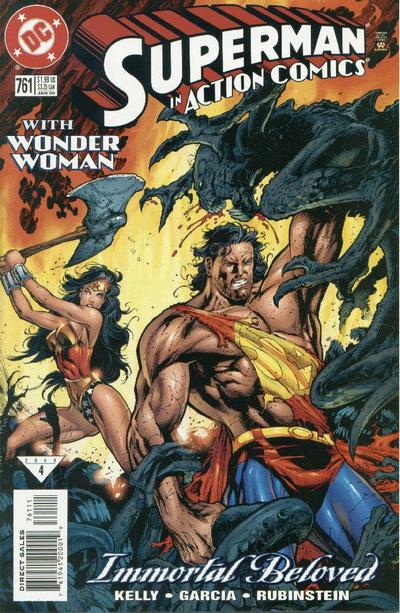
Notes: Joe Kelly is one of those writers who did a solid job on his tenure with Superman, and although I think few people would put him on their Mount Rushmore of Superman writers, he’s responsible for a couple of my favorite Superman stories of all time. The second one, Action Comics #775, will show up at some point this year when I pair it up with watching the movie that adapted it, Superman Vs. the Elite. But for today, I’m going to look at what I consider to be his second-best one-off story, a Superman/Wonder Woman story from Action #761. In a recent issue, a photographer caught a photograph of Superman in which he was clearly wearing a wedding band – Clark slipped up and forgot to take it off when switching identities – and the question of “Who is Mrs. Superman?” is dominating the celebrity news cycle. Lois and Clark are having a lazy morning, semi-joking about the situation, when Diana shows up and throws everything into turmoil.
Superman and Wonder Woman are whisked off to Asgard in this story, while Lois is stuck back on Earth, slightly smarting over the fact that her husband has been taken to another dimension with an Amazon princess. Clark and Diana are trapped in Asgard, helping the Aesir fight off an invasion of demons, for 1,000 years…their time. On Earth, only a day passes.
So much is written about the friendship of Superman and Batman, and with reason. But the Superman/Wonder Woman relationship is more complicated and, in a lot of ways, more interesting. Over the years there have been several stories that flirted with a romance between them. They even made their couplehood canonical during the New 52 era, and shared an ongoing series for a couple of years. But that pairing has never really sat right with me. Part of it, I guess, is that Lois and Clark are the permanent pairing in my brain. Nothing has ever been able to chip away at that, they were literally made for one another, and I reject any efforts to keep them apart.
But there’s also the fact that pairing off Superman and Wonder Woman seems, to a degree, too obvious. There have been plenty of superhero universes that do their own versions of these characters and make them a couple, and none of them have ever been particularly satisfying to me. Superman already has the perfect romantic partner, but what he doesn’t have is somebody with whom he can share the burden of being someone of immense power in a world that could crumble under his grip if he allowed it to do so. He doesn’t have someone else who understands what it means to control yourself and resist the urge to make things the way you believe they should be simply because you have the ability to do so. Even with the other members of the Superman family, like Kara, Conner, Jonathan, and so forth, he has to take on a role that is – if not fully parental – at least that of the fraternal authority. He’s either Dad or big brother to every other Kryptonian in his orbit.
Lois is his wife, and can be his confidante in many things. Batman is his partner in the neverending battle, and their friendship should be secure. But Wonder Woman is a peer that he needs. So the scene in this issue where, after a millennium of battle, Wonder Woman begins to crack and almost acts on her attraction to Superman, is one of my favorites ever written. Is the attraction mutual? Almost certainly. She’s Wonder Woman, for Zeus’s sake. But it cannot be acted on, for two very good reasons. First: even after 1,000 years apart, Clark’s devotion to Lois remains absolute. But second, and far more interesting, because he loves Diana so completely as – in his own words – “my best friend.”
There isn’t enough media out there that recognizes that friendship – genuine friendship – is possible between people, whether it’s members of opposite sex or any other compatible sexual orientation. It’s why slash fiction kind of gets on my nerves – it feels like a rejection of the notion that two people can be close without wanting to get down and dirty. These two characters seem awfully close – there MUST be something else going on, right? Or, “Oh, your wife’s friends with a dude? Obviously he’s trying to steal her from you.” Are there people like that? Sure. Even Lois feels a tinge of jealousy when Diana is around. But she needn’t, and that’s the point.
Friendship is real, and it’s important, and true friendship as an adult is something far too many people in this world live without. True love does not have to be romantic in nature to be true, and when I see a story that recognizes that fact, it always makes me want to celebrate it.

So yeah. I dig this issue very much. Reading it, in fact, put me in mind of another excellent Wonder Woman/Lois story, Wonder Woman Vol. 2 #170, which I wish I had read back in Lois Lane week. “A Day in the Life” was ALSO co-written by Joe Kelly, partnered here with magnificent Wonder Woman storyteller Phil Jimenez. In this one, Lois has requested an unexpected assignment from Perry White: a profile piece on Wonder Woman. After meeting up at the home of Steve Trevor and Etta Candy (married to one another in this continuity), Lois tags along with Diana over the course of a typical day. She goes to France where she gives a speech to a packed crowd of university students, zooms up to the Justice League Watchtower to check on an experiment, and zips down to Central City where Diana makes an appearance on the DC Universe equivalent of The View. She makes a stop with President Luthor in Washington, whisks away to disadvantaged areas all over the world, and visits with Donna Troy before making an appearance at the United Nations.
The gem of this issue is the final scene, which is just Lois and Diana in a bar, shooting pool, and kind of having it out. Although Diana has been nothing but gracious to her, something about her still rubs Lois the wrong way. This is a fantastic scene about each of the two women, as well as their respective relationship to Superman. The reporter in Lois is always looking at perfection and trying to find the flaws in it, which is one of the things that makes the flawless Diana so damned frustrating. But there’s also the fact, she admits, that her husband’s best friend is an Amazonian goddess, and not even Lois Lane is so secure that she isn’t at least a little rattled by that. Diana lays her cards on the table as well, talking about how much she respects Lois and how amazing a woman SHE must be for Superman to have chosen her (even, she points out, after their 1,000-year adventure in Asgard, which apparently Clark neglected to tell Lois about).
Relationships are a weird thing, and as a writer, you recognize that each person that becomes part of a relationship does not add to the complexity, it multiplies it. The Lois/Clark relationship is a thing, the Clark/Diana relationship is a thing, the Lois/Diana relationship is a thing. But this issue is about the gestalt of them all, the Lois/Clark/Diana relationship. It’s the best – and perhaps the only – comic I’ve ever read that is really about the THREE of them, and it’s really good.
And hell, Superman isn’t even IN it.
Fri., April 11
Comics: Justice League of America #20, Superman’s Girl Friend, Lois Lane #12, World’s Finest Comics #305
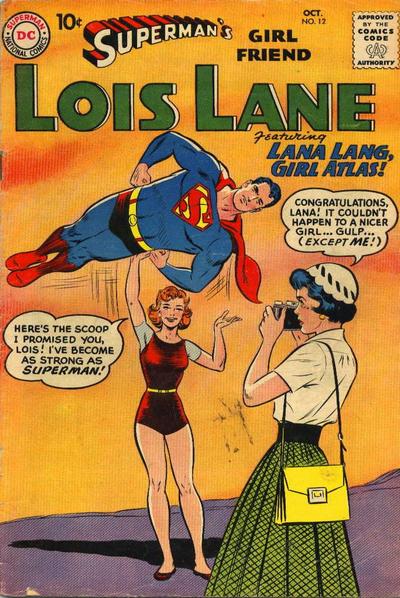
Notes: In the Silver Age, if Lois wasn’t busy trying to get Superman to marry her, she was spending the remainder of her time flirting with his teammates in the Justice League. In Lois Lane #12, it was Aquaman’s turn. When a freak accident crushes Lois’s legs and lungs, Aquaman brings her to a surgeon who determines the only way to save her life is to turn her into a mermaid.
Yeah, you can read that sentence as many times as you want, it’s still crazy.
Lois attempts to adjust to her new undersea life while preventing Superman from finding out what has happened to her, although presumably if she’d known about his previous fling with Lori Lemaris she would know that “mermaid” apparently wasn’t a deal-breaker for Superman. While beneath the ocean, she starts to have feelings for Aquaman, but then rejects him, knowing that it’s truly Superman she loves in her heart. After a second freak accident again leaves her on the brink of death, Superman rushes to the hospital library, memorizes every medical book in existence, swiftly passes a series of examinations to prove his medical knowledge, and performs surgery to give Lois her legs and lungs back.
The questions, both ethical and existential, are enormous.
So Superman – Silver Age Superman, at least – has the medical knowledge to transform a mermaid into a human being. And a HUMAN doctor possesses the knowledge to turn a human into a mermaid in the first place. I am banging my head against the wall trying to wrap my brain around what I just read and I cannot make it work. It may be the single most insane story I’ve read yet in this entire “Year of Superman.”
Five stars.
In this issue’s second story, Lana Lang swipes a formula Lois is supposed to give to Superman that supposedly can give anyone super-strength and invulnerability. Lana is using it to try to steal Superman from Lois, and when Lois finds out, she hatches a devious scheme that winds up making both her and Lana look like absolutely horrible human beings, and I can only thank Rao that this isn’t canon anymore.
Finally, we have “Lois Lane Loves Clark Kent,” except that of course she doesn’t. She catches Clark surviving a fall and determines that she’s been right in all her years of suspecting he’s really Superman. This time, though, she decides to trap him by “falling in love” with Clark and not telling him she’s learned her secret until after the Honeymoon. Superman decides to teach her a lesson. Dickishness ensues.
Sat., April 12
Animated Shorts: Electric Earthquake (1942), Volcano (1942)
Notes: It’s been a minute. How about another Fleischer short or two today?

In Electric Earthquake, a mad scientist has set up a device beneath Manhattan harbor that threatens to destroy the entire city with an earthquake. In and of itself, this shouldn’t be a huge surprise – from the cartoons I’ve watched so far it seems like at least 75 percent of the city’s population were mad scientists. But this particular scientist is a Native American, angry that the island was taken from his people and demanding it back. The cartoon leaves you with mixed feelings, honestly. On the one hand, it’s somewhat problematic to paint the Native American as the villain in this story. On the other hand, he’s oddly progressive in that he doesn’t wallow in any kind of stereotypes, and he’s obviously intelligent and crafty. If it weren’t for the whole “destroying the whole island and murdering everybody” thing, it would be one of the more positive portrayals of the time.
And as a Superman fan, I find it interesting that – at this point – it seems that the filmmakers at least still viewed Superman’s “Metropolis” as another name for New York, as the scientist quite clearly calls the island “Manhattan.” I wonder just when, exactly, they decided to definitively establish Metropolis as its own separate city.

Volcano, thankfully, breaks us free of the necessity of yet another mad scientist, and sets the man of steel loose against the danger of an erupting volcano. With word of an impending eruption making global headlines, Perry White sends Lois and Clark off to cover the event. Lois sneaks Clark’s press pass, though, leaving him frozen out of the danger zone so she can get the story herself – a decision that she may come to regret when the volcano begins to erupt before the scientists can blast the side of the mountain and divert the lava flow to an uninhabited area. Naturally, this looks like a job for Superman.
I’ve talked a lot about just how beautifully animated the Fleischer shorts are, and from that perspective, this may be one of the absolute best. The flowing lava, flickering flames, the waves crashing in the ocean…it’s all absolutely gorgeous to look at, and the movements of the characters all feel very realistic and authentic. When you think about how awfully stilted some animation was at the time, it’s astonishing that they pulled this off. Hell, there are cartoons being turned out today that don’t look this good. Plus, the lack of a human antagonist (especially yet another “mad scientist”) makes this cartoon a nice refresher from the others of the line.
Comics: Green Lantern Vol. 8 #20 (Guest Starring Superboy)
Sun., April 13
TV Episode: Superman and Lois Season 2, Episode 6, “Tried and True.”

Notes: You see, this is why I never finished watching Superman and Lois when it was on the air. I start watching it, and I get into a pretty good rhythm for a few days, then I get distracted by something shiny and the next thing I know I haven’t watched an episode in two months. I’m not blaming anybody else, it’s my fault. I’ll try to do better.
Oh wow, this episode starts with creepy-ass Bizarro with his creepy-ass eyes fighting a bunch of DOD agents. It’s odd that this version of Bizarro is as surprising as it is. I mean, the concept of an imperfect Superman, with all of his power but an inverted sense of his morality, SHOULD be pretty frightening. But instead, the character is almost always played for laughs, with joke stories or full of silly misunderstandings. There have been attempts to make him a bit more serious over the years, but this “reverse Superman” from a parallel dimension is the most chilling incarnation of the character I’ve ever seen.
We’ve also got the usual dose of Superman and Lois drama – Jordan and Jonathan dealing with the powers the latter got from his dose of X-Kryptonite, Sam having to play referee between Lois and Lucy, Lana’s marriage falling apart, and the mother of one of the DOD agents killed by “Inverted Superman” demanding justice. It’s probably because it’s been a little while since I watched an episode, but it feels like there’s just an enormous number of plots and subplots going on in here, and I’m kind of hoping that things are whittled down a bit. I’m seeing the reason a lot of people have called Tyler Hoechlin the best on-screen Superman ever (I don’t know that I’d necessarily agree, but he’s definitely very good). The show itself, though, at least at this point in season two, feels like standard CW fare.
Mon., April 14
Comics: Superman: Earth One Vol. 1
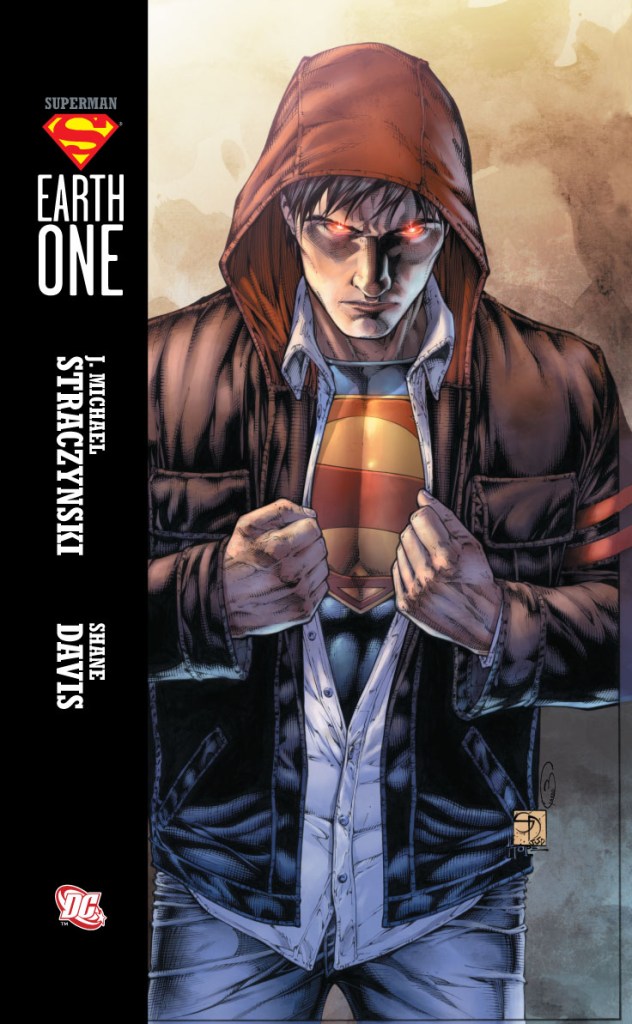
Notes: Back in 2010, DC began this “Earth One” experiment, a series of original graphic novels re-imagining the characters from the ground up. It was similar to Marvel’s Ultimate Universe, with the big exception being the fact that the stories were being told in graphic novel format rather than monthly comics. It was interesting, and some of the books were very good, but the line petered off somewhat. I don’t think DC ever really established “Earth One” as a cohesive universe the way Marvel did with the Ultimate line. There was little – if any – cross-pollination between the graphic novels, and in fact, some of them didn’t feel like they belonged to the same universe as the others at all. It’s been quite some time since there were any new Earth One books, even though DC does keep them still in print, but as far as launching a whole new UNIVERSE, the current Absolute line seems to be doing the job much more successfully.
All that said, let’s look at the first of the Earth One graphic novels anyway. Written by J. Michael Straczynski with art by Shane Davis, this is a pretty solid way to recontextualize Superman in the early 21st century. We begin with young Clark Kent, fresh from Smallville Junior College, moving to Metropolis to find himself. The trouble is, he isn’t quite certain who he wants to be. He tries several different jobs, all of which he excels at, none of which he finds fulfilling…everything except for his attempt to get a job at the Daily Planet, where Perry White basically tells him he’s not good enough yet, but there’s a high turnover rate, so they may give him a call. The whole question may be moot, though, when an alien invasion force attacks Earth, searching for the last child of Kryton, whom they have been chasing across the stars for twenty years. They are the race responsible for Krypton’s destruction…and they are here to finish the job.
I don’t remember noticing it at the time, but I’m a little shocked at how similar the story here is to the movie Man of Steel, which of course came out three years later. It’s not exactly the same, of course – in the movie the antagonists are Kryptonians hoping to rebuild their planet, not a new race hoping to complete their extermination – but the aspect of the alien invasion drawing out Kal-El, but instead being a facade to hide their true intentions for Earth – is spot-on. It’s different tonally, and it ends things pointing in a very different direction than the film, but I am sorely tempted to go back into the credits for Man of Steel to see if Straczynksi and Davis were among the comic book creators given special “acknowledgements” in the film. (“Acknowledgements” is Hollywood talk for “we used ideas from these guys but we’re probably not going to pay them. Kind of like ChatGPT.)
One of the things I like about this book is the way Straczynski addresses the fact that Superman doesn’t wear a mask. People with no imagination constantly harp on how the glasses are a bad disguise, but they’re missing the point. There’s a nice conversation where Martha tells Clark that he can’t wear a mask, that someone with that much power would be terrifying to people if they thought he had something to hide, and thus he has to allow them to trust him. We’ve seen echoes of this in countless Superman stories over the years. Dozens of antagonists, from Lex Luthor to Sam Lane, have all feared or hated Superman because they can’t conceive of a man with his kind of power using it for good. It’s the reason he wears bright colors, it’s the reason he operates in the light instead of the darkness. Supposedly David Corenswet himself, our new Superman (July 11th can’t come soon enough) lobbied hard to include the trunks for the costume because the trunks look like a circus performer, and he wants his Superman to be someone that nobody is afraid of. That’s PERFECT. That’s EXACTLY who Superman should be, and this graphic novel explains that pretty succinctly in a single page.
I know I’ve read the second volume in this series, but I can’t quite recall if I ever got around to the third one. If the story of the death of Krypton and the mysterious force behind it was resolved before the Earth One line kind of faded away. But hey, this is the Year of Superman, and I’ve still got 36 whole weeks left to go – that’s plenty of time to dig into the last two books in this line. I’m sure this isn’t the last we’ll see of this particular version of Superman.
Tues., April 15
Comics: Superman: For Tomorrow (From Superman Vol. 2 #204-215), Superman’s Pal, Jimmy Olsen #137
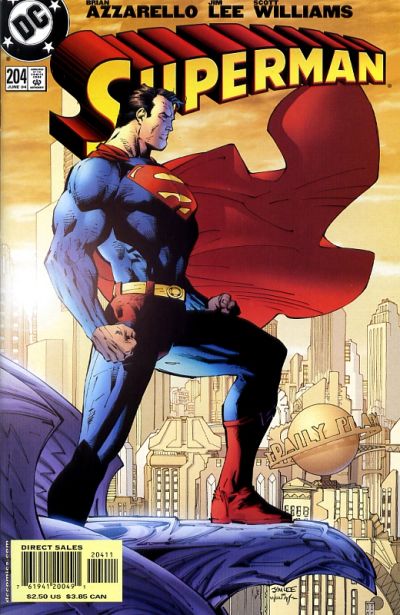
Notes: Coming pretty quickly on the heels of Batman: Hush, superstar artist Jim Lee (who would go on to be one of the heads of DC Comics) partnered up with writer Brian Azzarello for another year-long run on DC’s other flagship superhero. Lee and Loeb had turned out to be a magic team on Batman, but I wasn’t a huge fan of Azzarello’s take on Superman at the time. In truth, I don’t think I’ve re-read this story since it was first published in 2004, though, and it’s possible that the perspective of time – as well as reading it all at once instead of doling it out a month at a time – will make me more charitable towards it. Let’s find out together, shall we?
For Tomorrow begins with Superman visiting a Catholic priest, Daniel Leone, in a discussion that is clearly about absolution without ever actually using the word. We’re coming in after a year-long time-skip, and in that time something has happened called “The Vanishing.” Eventually, we determine that a year ago one million people across the globe simply disappeared, among them Lois Lane, and Superman is carrying great guilt over this event. However, it doesn’t seem like his guilt is the normal “wanting to save everybody” thing Superman carries with him, but rather something more specific.
I’m reminded immediately of why I struggled with this story the first time around. The entire first chapter is hints and veiled innuendo, not actually getting to what the story is about until the last couple of pages. That’s certainly something that works better in the collected format, but which can be infuriating if you’re waiting a month between installments. What’s more, Azzarello – who at the time was known for more noir comic books like 100 Bullets – brings that sensibility to Superman. We get glimpses of what’s going on, people talking AROUND the issue instead of actually discussing it, and while that works well for the style of story he’s accustomed to, it doesn’t really feel like a good fit for Superman, not to me at least.
As the story continues, Superman starts to regularly visit Father Leone, unburdening himself with the story of how he became embroiled in a conflict in the Middle East (obviously even more topical in 2004 than it is today) and his battles with a cybernetic monster called Equus, and of course, how these things tied into the Vanishing.
As the year goes on, Superman finds himself in conflict with the Justice League over the events that lead to the Vanishing, particularly Batman, in an exchange that I find particularly distasteful. This is in a period where tensions between DC’s Trinity were building up heavily, which eventually lead to Infinite Crisis, and while it fits in that context, that doesn’t make the scene where Superman says to Batman “You’re my friend, but I don’t like you” any more pleasant to read. Both heroes feel out of character here, Superman in particular. He even insists that Batman call him “Kal-El” instead of “Clark,” something that doesn’t feel natural or appropriate at all.

It goes on in the next chapter, when Wonder Woman attacks him at the Fortress of Solitude because he’s trying to do something about the Vanishing, which she calls “suicide.” Even Superman lampshades the fact that her using a deadly weapon against him (in this case, a magical sword) to prevent him from doing something that could kill him doesn’t make any damned sense. But like in the first chapter, Azzarello keeps dancing around exactly what IS going on, dodging the question of what Superman’s plan is and why Bruce and Diana oppose it. If you want to create conflict between heroes, fine, but that conflict works better when everybody has clear motivation – otherwise it’s just a frustrating fight that doesn’t seem to have any purpose other than to showcase Jim Lee’s (admittedly masterful) artwork.
But perhaps there’s no other moment so off the wall as the scene where Superman has a conversation with Clark Kent (for reasons) about retrieving Lois from whatever the Vanishing is. Clark tells Superman that Lois was “uncomfortable” seeing him because “I’m not the man she loves.”
The hell?
Granted, this isn’t really Clark, it’s a robot, but there’s a subtext here that’s painful and uncomfortable. There was an awful lot of shoe leather spent in the first 50 issues of this very title built around the fact that Clark Kent is EXACTLY the man that Lois Lane loves, and both characters are better for it than they ever were before. Furthermore, the notion that Superman and Clark are two different “people” is a similarly outdated Silver Age idea. Superman and Clark work best when they’re the same man wearing different clothes. Change my mind.
Azzarello delves heavily into musing about the nature of good and evil and what Superman’s place is in a world where these concepts are more concrete than abstract. In and of itself, there’s nothing wrong with that. There are some great Superman stories that have been written about that very topic. However, the style is far more ponderous than most Superman stories, with lines like “To be in the presence of evil is to be both utterly offended and absolutely afraid.” A line like this would feel right in place in a Vertigo comic book, but in Superman it gives the impression of someone working very hard to be serious. That’s not to say that a serious Superman story isn’t possible – in fact, I’ve got a week planned for later this year where I intend a deep-dive into Superman’s darkest hours – but at the same time, this isn’t math class. Azzarello is showing his work too much, and that distracts the reader from the story.
Once we finally get to the revelation of what the Vanishing was and why Superman is carrying around the responsibility for it…I’ll concede this much: it is a very Superman solution to a Superman problem. And it explains why the League was so antagonistic towards him. It doesn’t explain why Bruce and Diana were trying to prevent him from reversing it, though. And the truth is so massive that it should have left a stain on the character for years, but the story was rarely referenced after this, perhaps because of the way the world was reshaped relatively soon when Infinite Crisis kind of hit the reset button.
I wanted to like this story. I hoped that the years would have changed my perspective, but in the end I still just can’t feel it. But I’m glad I made the effort – there’s some fine artwork here, and I know that my perspective on some stories changes over time. It’s worth trying again, even if in the end, I land in the same place that I started.
Blake M. Petit is a writer, teacher, and dad from Ama, Louisiana. His most recent writing project is the superhero adventure series Other People’s Heroes: Little Stars, volume one of which is now available on Amazon. You can subscribe to his newsletter by clicking right here. You can join in the Kryptonian Konversation every day in the Year of Superman Facebook Group!
 Blake M. Petit