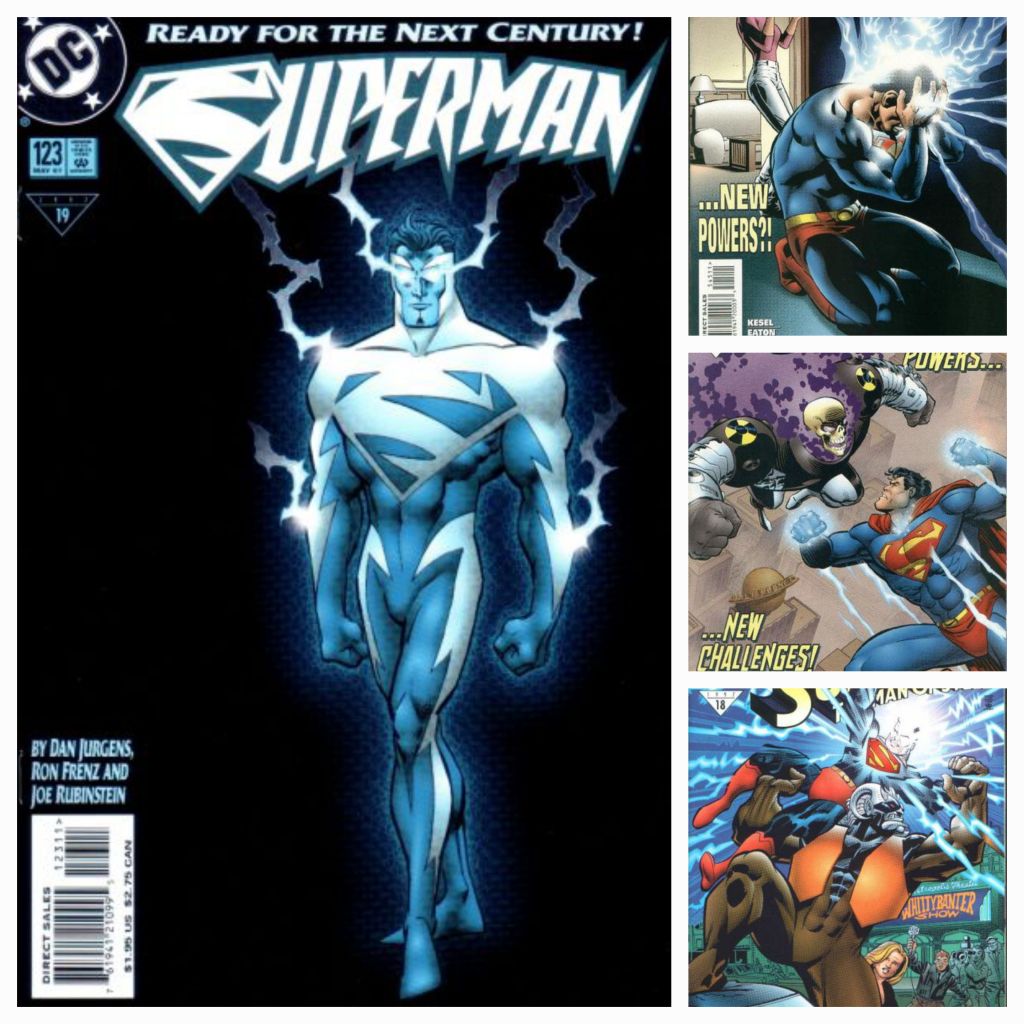
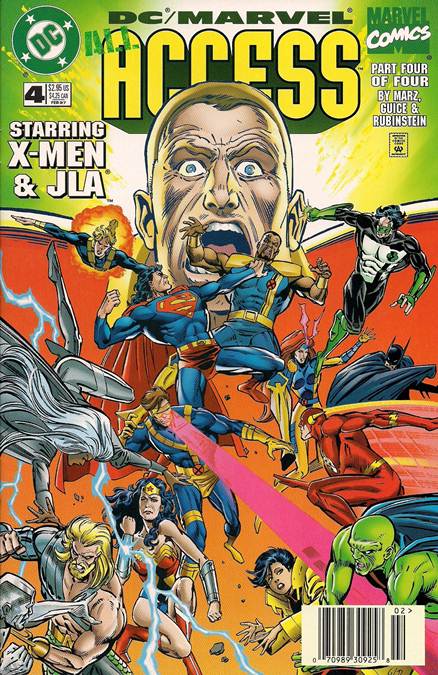
Year of Superman Week 38: Electric Boogaloo III-The Giant-Sized Finale

It feels like I just started yesterday, but here we are in the fourth week of my journey through the era of Electric Superman. The Man of Energy has been split into two – a red and a blue version of himself. But time is almost up, because we’re on the cusp of the crossover event that ended this era, the Millennium Giants. Let’s get into it!

And as always, you can check out earlier blogs in the Year of Superman Archive!

Wed., Sept. 17

Comics: Superman Vol. 2 #133, Adventures of Superman #556, Action Comics #743, Batman: Wayne Family Adventures #6 (Guest Appearance), Taste of Justice #11 (Supergirl and Krypto)

Notes: Superman #133 starts with Red and Blue bickering over which of them is going to go in to work and write their column, with Red winning the argument and banging out a piece that’s both more pointed and more jovial than his usual style, to the point that Perry asks him to rewrite it. An explosion summons Superman Red to Cadmus, where he finds Guardian beaten to hell and the three deities that Superman fought on Halloween proclaiming “The Time of the Millennium Giants is at hand!” In a backup story, Jimmy and Misa are still on the run from the Black Crucible. When they get pinned down, Misa uses a device to signal for help. Blue Clark, meanwhile, is back at the Planet office where he’s rewritten Red’s column, only to turn in one that’s too bland and analytical. He bolts away and saves Jimmy from the Crucible, whose leader says the Medallion Jimmy is carrying will signal the end of the world. Suddenly, the Medallion AND the members of the Black Crucible just…disappear.

Ominous, no?

Adventures #556 picks up right there with Red facing off against the Millennium Guard. They summon the Medallion to them (explaining where it went in Superman #133) and then take off in three different directions. Blue, meanwhile, is helping Jimmy and Misa fix up their vehicle when the three of them are attacked by a huge monster straight out of a Kirby sci-fi comic. The conclusion of that fight is ALSO the sort of supremely goofy thing that would have happened in a book of this era, but it’s actually pretty charming as well in its silliness. And even though at the end of the book Jimmy is still running for his life from Intergang, his standing up to the monster convinces Misa that maybe he’s not so lame after all – it’s a rare win for Jimmy in this era.

Action Comics #743 has Blue returning to Metropolis, where he encounters detective Slam Bradley, who’s chasing a nasty sort that calls himself the Inkling. Blue stops Inkling, who the reader learns is another product of Hunter Thompson’s experiments at S.T.A.R. Labs (the same ones that gave us the Ripper not long ago). He knows Thompson is bad news, but has no proof, which has gotta be frustrating for a guy as cool and logical as Superman Blue. Also, in space, the Millennium Guard has taken positions in orbit ready to “purge the Earth,” which always sounds like a good time.

In Red’s story, the Guard has bolted away, leaving Superman drained of energy. Jimmy and Misa find him and give him a lift back to Metropolis, where they stumble into the Intergang squad that’s been chasing Jimmy for months. Misa finds a dandy solution, using a device that makes Jimmy completely invisible to them and, in fact, making them forget he ever existed. That’s a quick little solution to that subplot just before things get wild next week.

These three issues all use the same format, with two different stories for the respective Red and Blue, and I have to say, I’m impressed with how well it works. The stories weave in and out of each other, connecting at various points and showing the consequences of one story in the other. It works so well, honestly, that I’m surprised it really only happened for three issues, plus the two issues we read at the tail end of last week, Action #742 and Man of Steel #77, which each devoted an entire issue to one of the Supermen but otherwise worked the same way.

I suppose time has shaped my perspective, but I could have sworn the Red/Blue era lasted longer. As it turned out, only about two or three months pass between the split and the story that’s going to end with the two of them re-forming and Superman’s powers going back to normal. Maybe it was the fact that back then I had to wait a week for each new issue to come out, whereas today I’m simply clicking “next issue” in the DC Universe app and bouncing ahead seven days to get the next installment. 

At any rate, I really liked the way these issues were told, and while I don’t want Superman to get split in half again, I’d like to see someone else use this trick. I’m not sure how, exactly – maybe Firestorm, whose whole gimmick is that he’s two people who fuse into one superhero would be a good candidate. Or perhaps a run about a couple of Green Lantern sector partners that used this formula. Or hell, do it with Jonathan and Conner Kent, the two Super-Brothers. That might actually give Jonathan something interesting to do for a change. But somehow, it’s a trick I would like to see done again.

Thurs., Sept. 18

Comics: Superman: The Man of Steel #78, Aquaman Vol. 5 #43, Challengers of the Unknown Vol. 3 #15, Superman Vol. 2 #135, Teen Titans Vol. 2 #19, Supergirl Vol. 4 #20, Jon Kent: This Internship is My Kryptonite #11

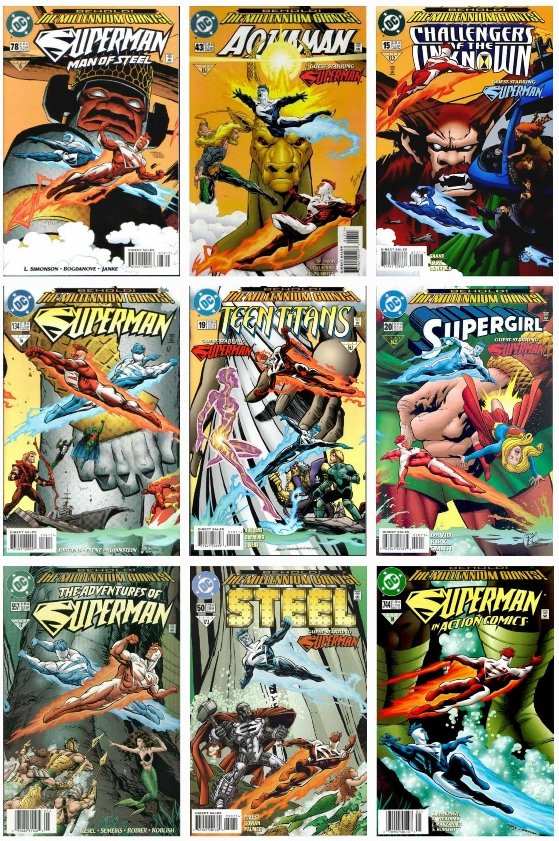
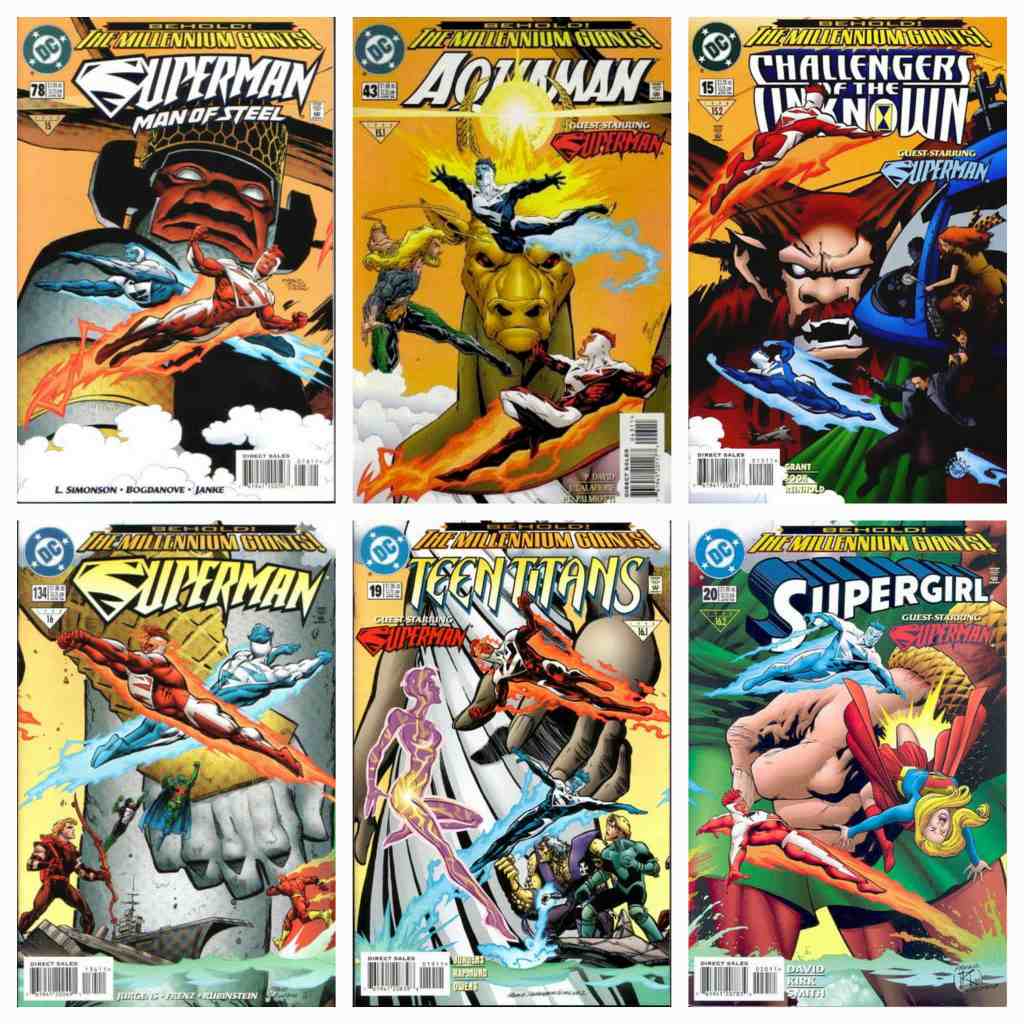
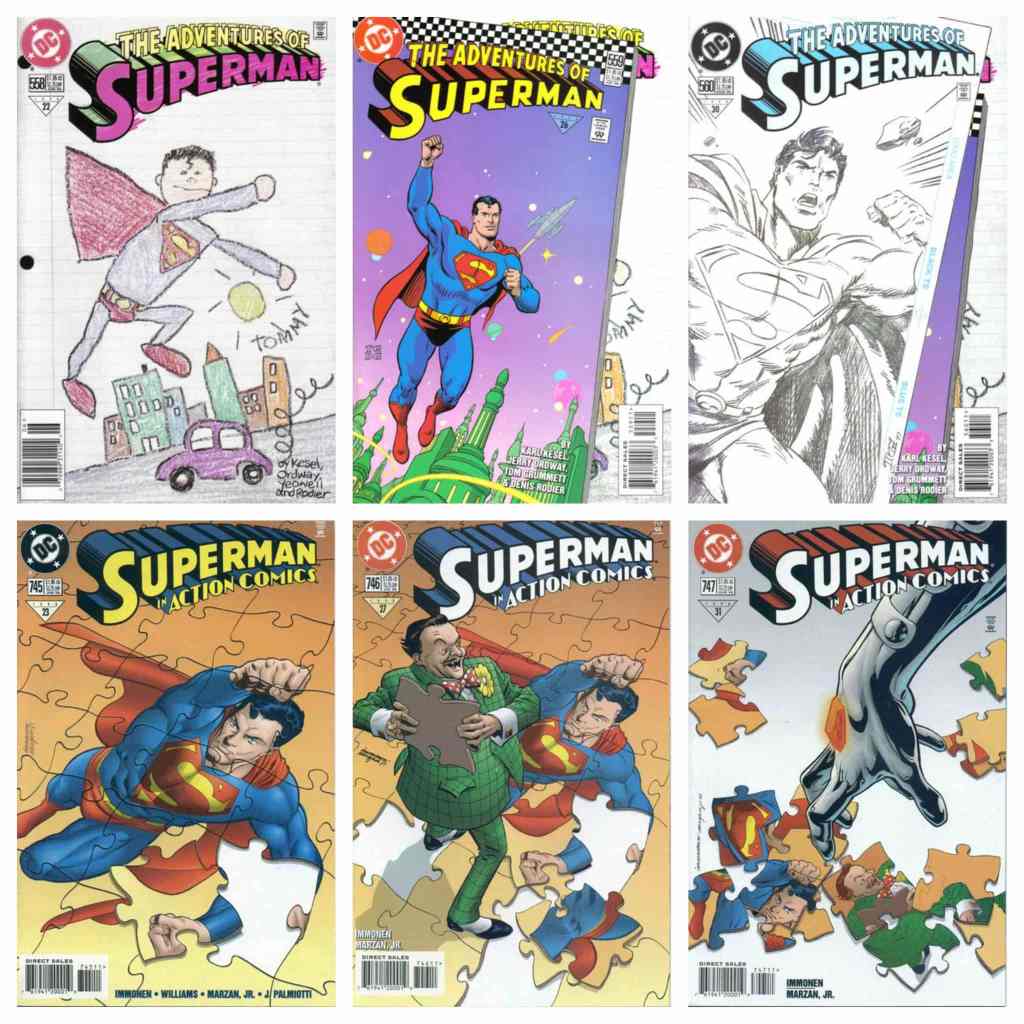
Notes: There are different degrees of crossover events. There are the bigs ones, the huge ones that have a main miniseries and spin-offs and chapters appearing in various different comics – from the original Crisis on Infinite Earths down to lesser examples like Genesis. There are the small-scale ones that only involve titles in the same group, like the Superman or Batman titles. Then there’s stuff in the middle like Millennium Giants. This one is clearly a Superman story and it plays out in the four main Superman titles, but it also brings in Steel and Supergirl, as well as a few books with no relation to Superman at all. They also did a neat thing with the covers of the first nine (out of 11) issues: they assemble into a sort of large puzzle featuring the giants and the respective heroes facing them, along with our two Supermen zipping around and appearing on every cover.

The fun starts off in Man of Steel #78. The three members of the Millennium Guard have taken their spots in three places on the globe, including the site of a volcanic eruption where the native religion sees them as a harbinger of the end of the world. Red and Blue, after a brief squabble, agree to split up and each take on one of the Guard. But as it turns out, the Guard are only there to facilitate the release of the Millennium Giants – three enormous deities who burst from the ground.

The story picks up in Aquaman #43. One of the giants is marching through the ocean on a beeline for the Atlantean city of Poseidonis. Aquaman and Tempest try to confront it when he takes out Superman Red, but the creature keeps walking, sending tidal waves towards nearby coastlines. As Tempest protects the shore, Aquaman tries to communicate with the giant telepathically, but he fails and it goes into battle against the heroes and the HEAVILY armed Poseidonis. Man, this really makes me want to go back and read Peter David’s Aquaman all the way through. Maybe next year. Anyway, Superman and Aquaman try their best to hold back the creature but it crushes an underwater city on its march across the ocean.

This is really how a crossover SHOULD work. It’s not a coincidence or shoehorned in – it makes PERFECT sense for Aquaman to get involved when a freaking giant is threatening his kingdom, and it brings him in to make him a player in the rest of the crossover too. Perfectly done.

The next installment brings us to Challengers of the Unknown #15. Classically, the Challengers were a group of daredevils and specialists who each survived a near-death experience and, believing themselves to be “living on borrowed time,” became adventurers. They weren’t QUITE superheroes, but they often ran across them. This series was one of DC’s periodic attempts to update the concept with new characters and a dash of X-Files style paranormal investigation. The Prime Minister of the UK summons the Challs to investigate the giant that erupted from Stonehenge and is marching across the countryside. This issue is more skippable than the Aquaman chapter, seeming to take place BEFORE that one (the English Giant is the one Aquaman and Superman Red fight in the ocean), and Superman doesn’t actually appear. It does end with the Challs uncovering some info that they want to bring to Superman’s attention, though.

In Superman #135, the two Supermen have reconvened in Mexico, where another Giant has climbed out of a volcano. Blue wants to evacuate, but the impetuous Red charges in headfirst, attacking. They manage to barely pull off a save, and Lois (who is there covering the Giants, of course) confronts her two husbands, both of whom now seem to be pretty happy with the ability to be in two places at one and have no intention of trying to fuse together again. The split up yet again, with Blue staying on the giant in Mexico and Red zipping to the Pacific. Back in Metropolis the Teen Titans (whose book, you may recall, was written by Dan Jurgens at the time) decide to head to Egypt to take on the third giant, while the Challengers are on their way to Mexico. Neither of the Supermen are effective in their attacks on the giants, though, with Red failing to save an entire pacific fleet of 200 American ships.  

Teen Titans #19 starts with Tempest saving Red after his failure in the Pacific before following the people whose comic it actually is as they attempt to hold off the Giant that’s threatening Egypt. The bulk of the issue is Superman Red and the Titans facing off against the Giant, failing time and again and finally accepting that they need to focus on saving the people in its path rather than fight it directly. That may not sound like the most exciting take for this issue, but Jurgens does a good job of painting it as the sensible route, showcasing his Titans to readers who may not have been exposed to them before and showing some hidden depths to a few of them as well. The issue ends with the Giant marching off to sea and the team planning to head to Markovia, where the third Giant is wreaking havoc. 

Supergirl #20 brings back Peter David again, kicking things off with a woman in a mental institution claiming to be Cassandra (the Greek one) and screaming with terror about the encroaching giants. And like Cassandra, her fears are dismissed. Supergirl, meanwhile, has just left her family in the midst of a personal crisis to help deal with the crisis of the Giants. She tries to use her powers as an “Earth Born Angel” (read everything Peter David ever wrote, really) to hold it off, but falls into the ocean where both she and “Cassandra” are saved by Superman Red. It’s kind of a quick chapter, really, but it showcases Supergirl well and it’s always a delight to read David’s stuff again.

Fri. Sept. 19

Comics: Adventures of Superman #557, Steel #50, Action Comics #744, Superman: The Man of Steel #79, Superman Vol. 2 #135, Superman Forever #1

Notes: In Adventures #557, Steel calls in Superboy and the Justice League to join the fight as Blue faces the Mexican Giant Cabraca while Geo-Force and Terra hold the line against Cerne in Markovia. Blue, Aquaman, and the Martian Manhunter face Cabraca while the others join the Titans, Supergirl, and Red in Markovia, where Cerne and Ronal are now converging. The giants lift an entire chunk of Markovia into the sky, the heroes only barely managing to evacuate it before it’s gone. And the icing on the cake comes when Cerne crosses the Atlantic to re-emerge in Metropolis harbor.

Steel #50 continues as John Henry – who has recently joined the Justice League and is eager to prove himself – works with J’onn J’onzz to construct a weapon to stop the Giants by disrupting their connection to Earth’s magnetic Ley Lines. The device seems to work, but John shuts it down, fearing that it will cause even greater destruction than the Giants if the field breaks down. He winds up fighting his own teammates over it, destroying the device and finding himself on the opposite side of the rest of the JLA. 

In Action #744, while Cerne approaches Metropolis, the Challengers of the Unknown come to Lois Lane in the hopes that she can get their findings to Superman. Their theory is that the Giants – who appear in myths from cultures all over the world – have arisen because of an anomaly in the Earth’s energy field. They believe that the two Supermen, working together, could drain the Giants of their energy and stop the rampage. Red draws all the power from Metropolis to turn himself into a giant, ripping Cabraca into space. The effort is fruitless, however – Cabraca crumbles, falls back to Earth as a meteor shower, and re-forms in Australia. His suit shredded, Red begins to dissipate. 

Blue zips into space to save Red in Man of Steel #79, but Red refuses his help, fearing that weaving the circuitry of their respective suits will cause them to re-merge. Blue saves him anyway, and although they don’t merge, the two Supermen are now tethered together. Steel has modified his device and gives it to the Supermen to try to trigger it in Cabraca’s heart – which they do but find themselves transported to the “Heart of the World,” where a strange being calling himself the Keeper of the Flame says that their alien energies awakened the giants. He can help them, but only at the cost of their lives. The Supermen trigger a chain reaction that topples the Giants, but their victory is short-lived. It turns out that stopping the Giants has also stopped the flow of the energy that binds Earth together, and it’s on the verge of a massive eruption that would duplicate the fate of a little world called Krypton.

It all comes to a head in Superman #135! An old Aboriginal man tells the Supermen that salvation can be found with the Medallion of the Damned, which is deep inside Cerne’s body. The three of them dive into the Giant’s form, where they find the Medallion on the body of an insectoid creature. Here they learn that the only way to restore Earth’s magnetic lines is for each of them to expel their energy, one at the center of the Earth and one from orbit. And although they have spent this entire time fighting and bickering one another, the two Supermen do it – because at the core, they’re still both Superman. The skies turn red, the ground turns blue, and Earth is saved…but when it’s over, J’onn J’onzz casts out a telepathic web to search for the men of energy…and finds nothing.

Are they gone? Are they dead?

Of course not. They’re in Superman Forever, a giant-sized one-shot with a fancy lenticular cover by Alex Ross to tie the whole thing up. The Kents are driving through their fields at night, worried about their missing son, when they see a meteor streak across the sky. It’s not the first time this has happened, and they rush to the site to see Clark lying in a crater: unconscious, naked, and burning with fever. They bring him back to their farmhouse where he sleeps for over 24 hours before waking up and realizing he can hear them speaking outside. Somehow, the expenditure of his energy powers made him fuse back into a single being with his original powers again. How? Clark himself theorizes that it was some kind of “reward.”

Who am I to argue?

Martha being Martha, she just happens to have one of his original costumes handy for him to put on,and he takes off to let the world know that Superman is back!

Of course, it’s only page 14, and there’s a lot left to go. Turns out Superman is being watched by Kismet, a cosmic entity he’s encountered a few times before, who sees (YET ANOTHER) threat on the horizon. Superman returns to Metropolis where he joins in with Supergirl, Superboy, and Steel saving an airplane from a crash… a plane that just happens to have Lois on it. The woman has the WORST luck when it comes to air travel, I tell you. 

Also in this special, Jimmy Olsen returns to the Planet with his tail between his legs to beg for his job back, only for Perry to give it to him without hesitation. While they’re celebrating, though, Lex Luthor barges into the office, furious that the Planet published a photo of his daughter. While he’s railing against Perry, he gets  call that Lena has been kidnapped.

The creative team on this book (like the Wedding Special and the Red/Blue special, it’s a mashup of the creators of the regular books with a few guests) took an interesting approach. There are really three different, almost totally unconnected sections of the book. The first act, where the Kents find Clark and he returns to Metropolis, is part one. Act two is the kidnapping storyline, with Superman doing everything he can to find the missing daughter of his worst enemy, because that’s the kind of man he is. This has virtually nothing to do with what happened before, except for the fact that every person who encounters him makes a comment about the fact that he’s gone back to his original powers and costume, then goes on with their day because they all live in Metropolis and they see more inexplicable stuff than that before their Pop-Tarts come out of the toaster in the morning. Then, after that story is resolved, we get four separate epilogues, each of them showing Superman in different eras that seem to roughly correspond to the Golden, Silver, and Bronze ages, and a third that is set 1000 years in the future. It’s a setup for the Dominus story that would consume the books for the next several months – which is totally fair, except for the fact that, again, it seems to have nothing to do with anything that’s come before it. In fact, I almost feel like I don’t need to read these books again , but it’s been a long time and I enjoy a good timey wimey story.

Besides, if I don’t read them, I’ll just be cliffhangering myself. And I promised me that I would treat me more nicely. 

Sat., Sept. 20

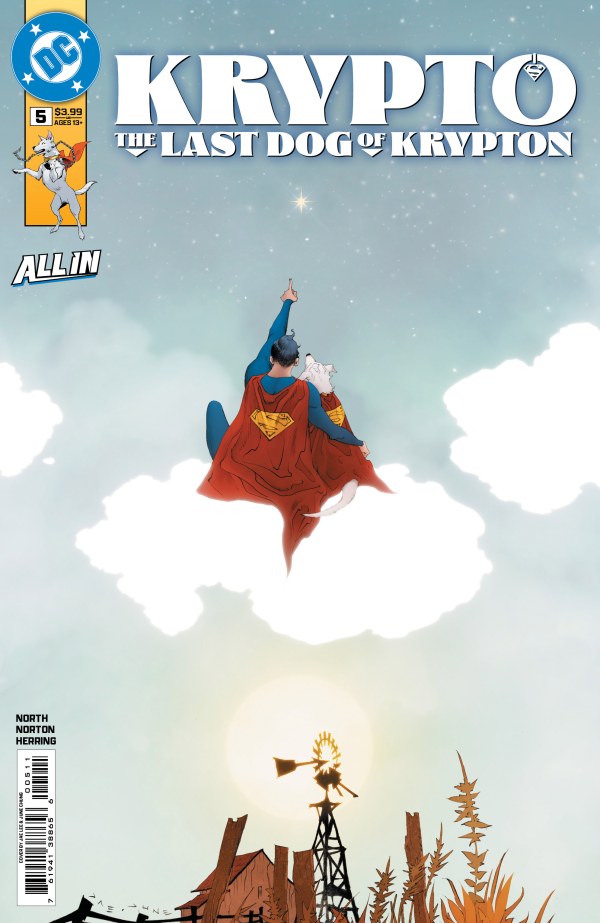
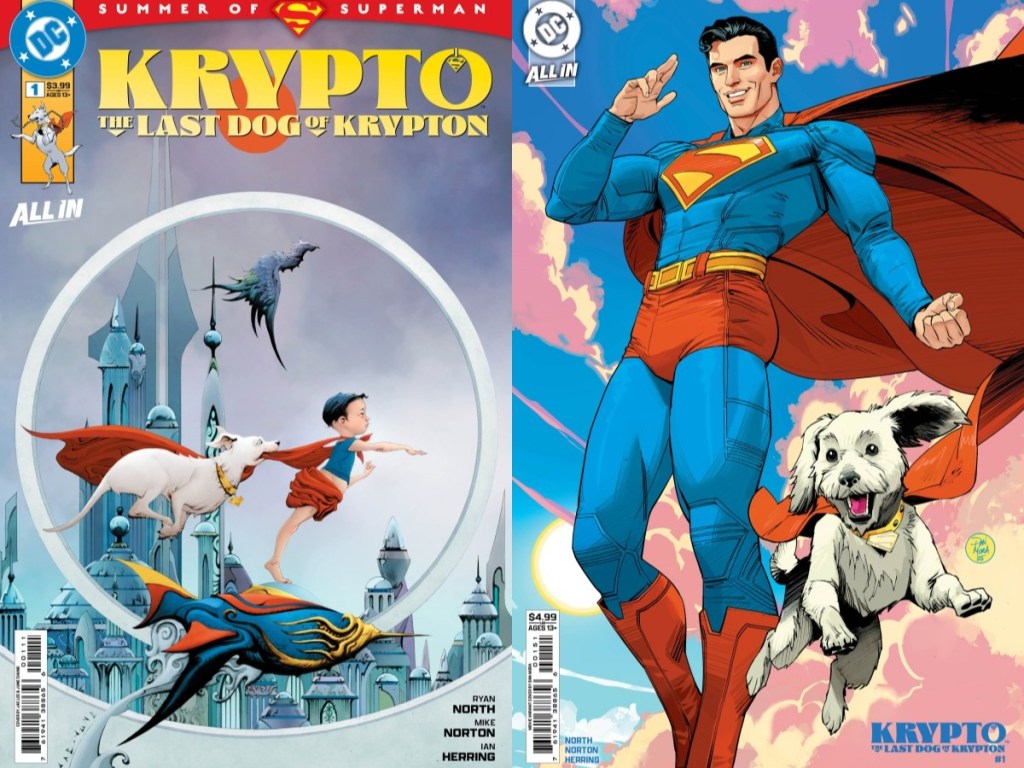
Comics: Marvel/DC: Deadpool/Batman #1, Superman: The Kryptonite Spectrum #2, Action Comics #1090, Krypto: The Last Dog of Krypton #4

Notes: I’m not going to get to Dominus just yet, though. After a couple weeks, I’ve once again liberated my new comics from my local shop and I’m going to spend today (and maybe tomorrow too) reading the new Superman-related books. And although only one of the back-up stories is Superman-related, I’ll start with the painfully-titled Marvel/DC: Deadpool/Batman #1.

I objectively got the best cover.

The main story and most of the back-ups are really quite good. Zeb Wells, who writes the Deadpool/Batman tale, finds a new spin on combining the universes that’s really quite suitable for Deadpool. Most of the others simply take the old-fashioned tactic of assuming the characters inhabit the same world. The Captain America/Wonder Woman story by Chip Zdarsky goes so far as to showing a whole history between the two characters that goes all the way back to World War II. There are also two pages by Frank Miller, the less is said about which, the better.

But mostly, I’m here to talk about the Krypto/Jeff the Land Shark story by Jeff’s usual creative team of Kelly Thompson and Gurihiru. This mostly-wordless story is set in the Arctic, as Krypto and Jeff romp and play games with one another outside the Fortress of Solitude. That’s it. That’s the whole story. And it’s really adorable. It fits perfectly in with the usual Jeff stories, and were it not for the fact that his co-star is an inhabitant of the DC Universe, it could easily be an issue of his own comic. 

Now I have to say, were you only buying this book for a Superman story, dropping $6.99 for a story co-starring Krypto is probably too much. But if you’re a fan of comics and crossovers in general, this really is a great package. 

The second issue of Superman: The Kryptonite Spectrum is next. Continuing from issue one, Superman and Batman are still experimenting with the new types of Kryptonite when one of them turns the man of steel into a giant. Batman thinks he can concoct a fix, but before it’s ready, Lex Luthor ups the ante by exposing the Kaiju-sized Superman to a dose of RED Kryptonite, sending him on a rampage that the Justice League has to come in and try to stop. Like the first issue, I’m tremendously impressed at how W. Maxwell Prince and Martin Morazzo are applying their signature style to the DC Universe. There’s still very much the same flavor of weirdness we get from Ice Cream Man, but the horror elements are replaced with a take on silver age-style superheroism that feels more like a loving parody than an attack. It’s a glorious little story with a climax and cliffhanger that literally made me laugh out loud. That doesn’t happen often, even with comics that are intended as straight-up comedies. This is rapidly climbing my list of best comics of the year. 

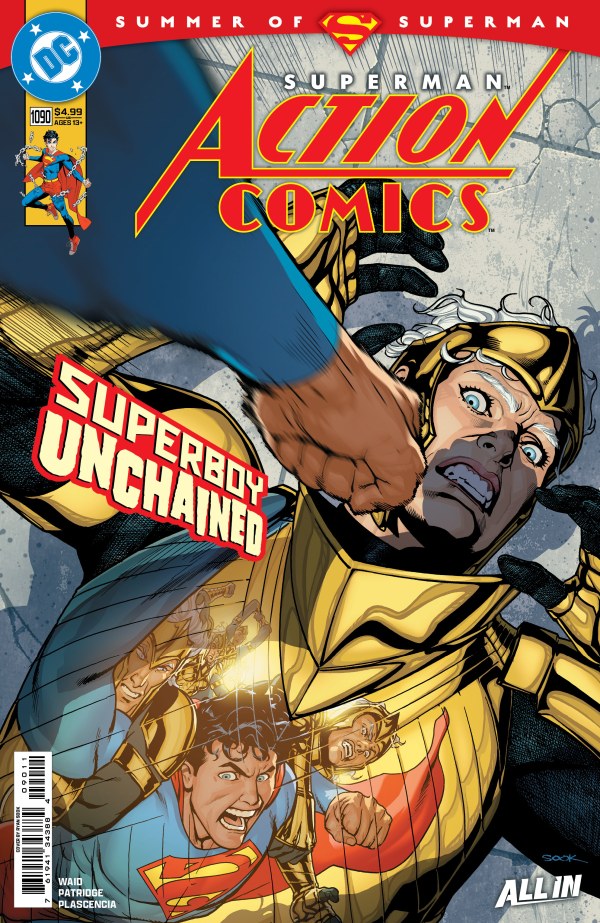
In Action #1090 Mark Waid and Skylar Partridge continue the story that – no matter what the eventual trade paperback is gonna be called – is essentially “Superboy: Year One.” Clark finally gets a date with Lana, only for two disasters to happen. First, she tells him how she REALLY feels, and second, Captain Comet summons him to a battle scene. Raze, the villain Superboy caught a few issues ago, has come back with some friends and he’s attacking the lab of noted AI specialist and metallurgist Will Magnus, and Superboy is needed to save the day. Turns out that Comet had a little surprise of his own, though. 

Waid is taking classic tropes of the Pre-Crisis Superboy and putting a modern spin on them, particularly in the context of Clark and Lana’s relationship. Although the writing is modern, the themes and tone could fit in just as well in the 1950s, and that’s really perfect. On the other hand, the more sinister Captain Comet is an interesting choice, although I imagine we’ll get some sort of revelation on his part before this story ends to keep from casting him as an outright villain. 

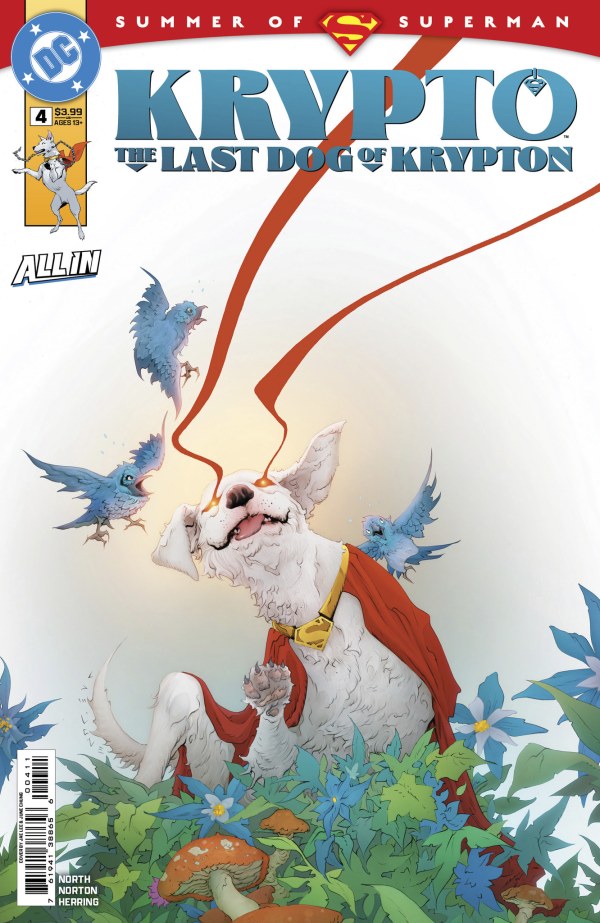
Krypto: The Last Dog of Krypton #4 starts with a content warning. It says “This is a sad one. Read it with someone to hug nearby.”

THIS is a sad one.

AS IF THE LAST THREE ISSUES DIDN’T ALL REDUCE ME TO A GIBBERING MESS.

Anyway, in this one the still-wandering Krypto befriends another stray dog, and together the two of them befriend a group of children, and together the kids and the dogs activate an alien intelligence that threatens all life on Earth. And Krypto is a very good boy. And so is his friend. And eventually, after I soak through a couple of Kleenex, we get to a last page that promises – FINALLY – a glimmer of hope in this terrible, heartbreaking, gut-wrenching, magnificent, beautiful series. 

Sun., Sept. 21

Comics: Supergirl Vol. 8 #5, Batman/Superman: World’s Finest #43, Justice League Red #2 (Team Member Power Girl)

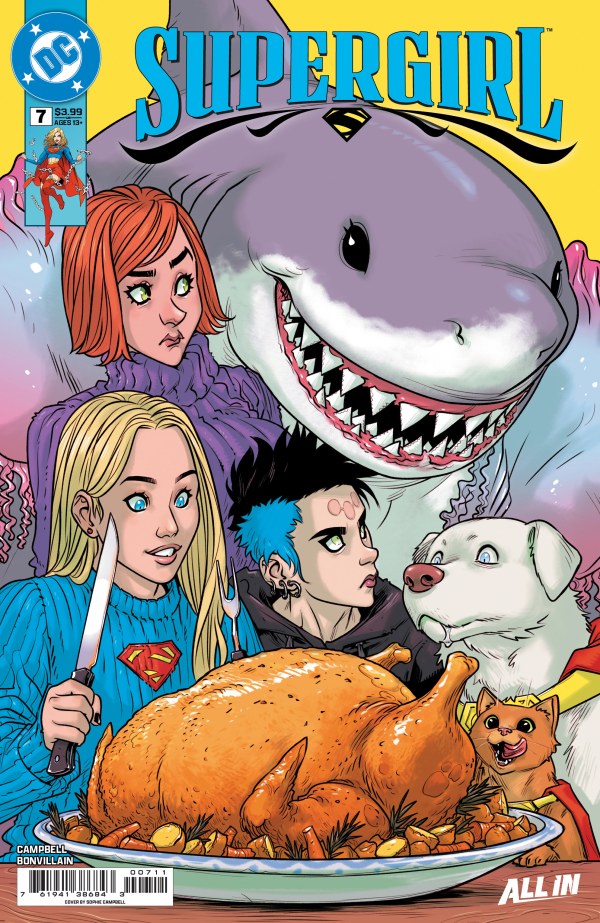
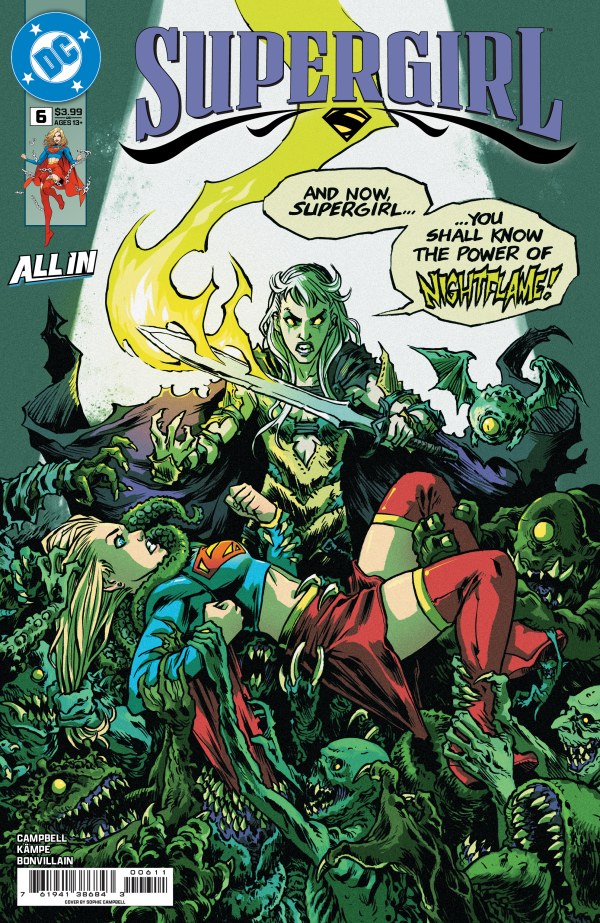
Notes: Supergirl #5 is a largely one-off issue that focuses on the Super Pets. Supergirl and Lesla leave their respective superpowered animal pals with Lena, who loses them almost immediately, leading to two separate adventures. Krypto and Kandy the Super-Rabbit wind up in battle with Princess Shark, who has come to Midvale to get her revenge on Supergirl, while Streaky and the miniature Super-Ape Tinytano stumble across a litter of kittens who have inadvertently gained super powers. The story is light, airy, ridiculous, and charming. 

Sophie Campbell takes this issue off from the art chores, but she still writes the issue. Pencils instead are handed over to Paulina Ganucheau for the Krypto half of the issue and Rosi Kampe on the Streaky half. Both of their respective styles are fine, but they’re very different from one another. Ganucheau’s art is a little looser and cartoony, more in line with Campbell’s usual style. Kampe’s art is tighter and looks like a more traditional superhero comic. Again, neither of them are bad, but the switch halfway through the book is somewhat jarring. 

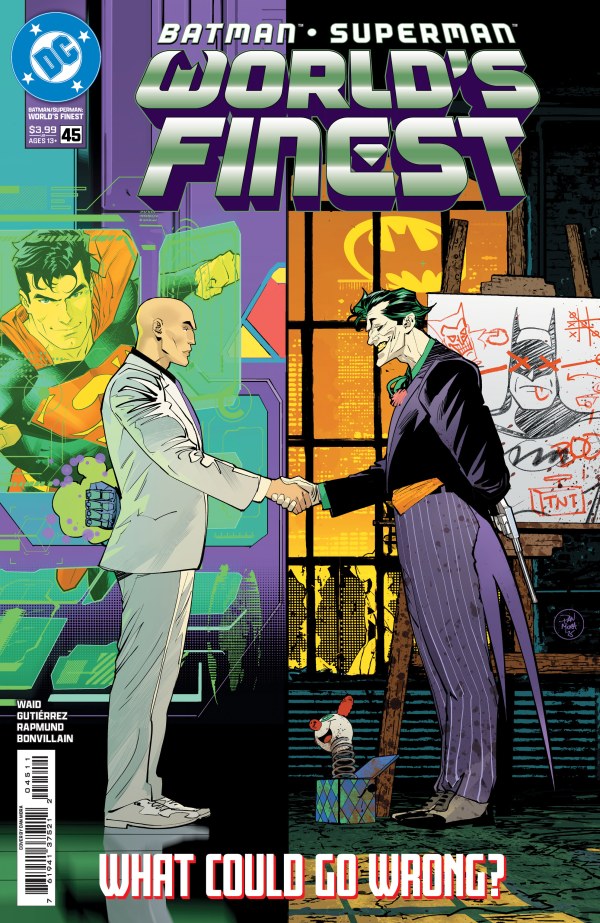
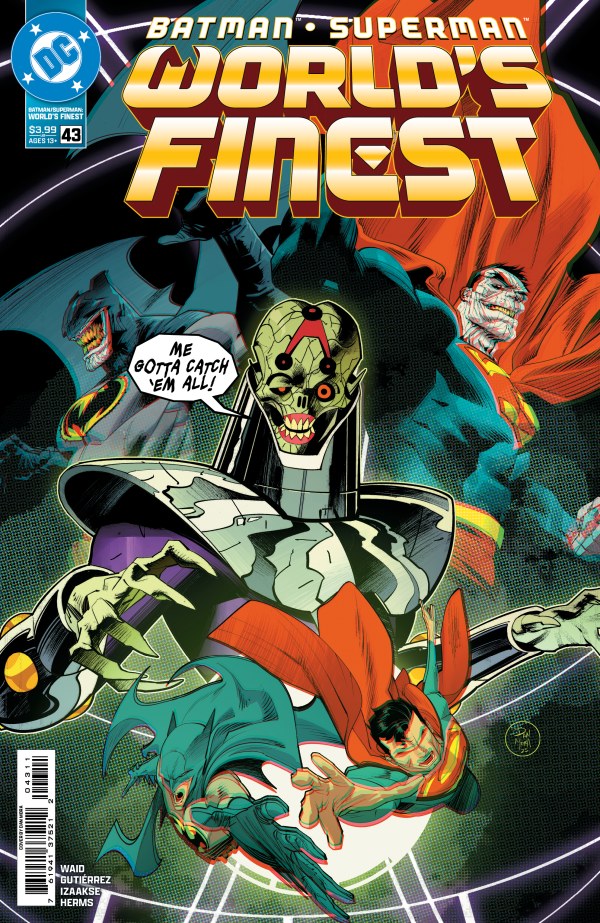
In World’s Finest #43, the Bizarro World storyline comes to a close. As we learned, the alien who infected the Bizarros with a pandemic that “fixed” their brains did so in the hopes that they would realize their planet was about to be destroyed by the physical laws that say a square planet can’t exist. This issue, our heroes struggle against the twin problems of the planet’s collapse and the pandemic, and in each case, a solution is found by a most unexpected mind. I really love the way Mark Waid plays these characters here, showing an intelligence in one of our heroes that he isn’t usually credited with having, and pulling a rabbit out of his hat with a new Bizarro that is hilarious and brilliant. This arc was an awful lot of fun, and that’s all we really want out of World’s Finest, isn’t it? 

The new Super-titles wrap up with Power Girl in Justice League Red #2. Power Girl, Green Lantern, and Cyborg are comparing notes, all of them realizing that the missions Red Tornado has been sending them on are less than savory, and they demand answers from their teammate. Red Tornado reveals that his actions are linked to another Leaguer in jeopardy, but none of that quite explains just how underhanded he’s been acting. The heroes don’t know what to make of it but, at the same time, they’re not going to abandon one of their own. I’m still not quite sure what to make of this title. I’ve enjoyed the first two issues, but I can’t tell where they’re going with Red Tornado here. If the miniseries ends with him becoming a villain I’m going to be pretty disappointed, but as I said after issue one, I think it’s going to turn out to be more nuanced than that when all is said and done. All that said, the cliffhanger at the end of this issue is just dandy.

Mon, Sept. 22

Comics: Adventures of Superman #558, Action Comics #745, Superman: The Man of Steel #80, Superman Vol. 2 #136, Adventures of Superman #559, Action Comics #746, Superman: The Man of Steel #81, Superman Vol. 2 #137

Notes: Welp, Superman is one person again and his powers are back to normal. You’d think his troubles are over, right? No, you silly person. Now it’s weirder than ever, because it seems as though there are FOUR Supermen (again), except this time, each of them is in a different era. In Adventures of Superman #558, we’re in a world that seems highly reminiscent of the Silver Age, with Superman and his family having a friendly game of baseball that spans the globe using a mine launched by an enemy submarine as the ball. We’ve got Steel on the top of Mt. Everest, Superboy (wearing an old-school costume) in France, and most surprising, a Kara Zor-El Supergirl in outer space. And the game stops when Krypto fetches the ”ball!” (I feel like we should remember that, at this point, the “Superman is the only Kryptonian survivor” edict was still in place – neither Kara nor Krypto existed in this continuity.) Jimmy Olsen, meanwhile, has stumbled into yet another of one of those transformations that seemed to happen to him so frequently in this era, this time drinking an alien isotope that turns him into a green-skinned spaceman. When word gets out that Alien Jimmy has been blessed – or cursed – with a Midas Touch, turning anything he touches into gold, he’s kidnapped by the world’s most ingenious criminal scientist, Lex Luthor.  

I can only imagine co-writers Karl Kesel and Jerry Ordway putting this one together, an issue that’s a wild and charming mashup of the modern Superman (with elements like Steel and Dabney Donovan) with a story that could very easily have been a lost plot from an issue published in 1955. Jimmy’s wild transformations were a staple of the time, and we see the old (and often frustrating) trope of Lois being desperate to marry a Superman who keeps resisting her advances. By the end of the issue, nothing has really been resolved – it comes across as an entertaining oddity, but as of yet there’s no clue as to what’s actually happening. 

Action Comics #745 takes a similar approach to what the writers call the “Polyester Age” in a story that roughly approximates the Superman comics of the late 70s. Superman comes in to save an unruly mob that has gathered on the collapsing Queensland Bridge, each of whom is carrying a bogus deed indicating they own it. Superman plans to investigate, but first he has to head to his job at WGBS to report the news with his co-anchor, Lana Lang. The story spins out into a fairly standard Prankster story, in which he takes over a cruise ship, kidnaps Lana Lang, places her in a trap that Superman can’t spring without exposing her to a deadly toxin, and in a script-flipping cliffhanger, asking Superman to officiate his and Lana’s MARRIAGE.

We journey back to the Golden Age with Man of Steel #80, and in the most literal way possible. The story begins reenacting a scene from Action Comics #1, with Superman barging into the governor’s mansion to demand a stay of execution for a woman he’s proven to be innocent of the crime for which she’s about to be electrocuted, then immediately bounding in to stop a man from beating his wife. It’s here, for the first time, that we really get a glimpse of what’s actually happening – a little girl with white hair appears briefly as Superman stops the wife-beater proclaiming “It’s all wrong! Everything’s wrong!” When Superman looks out the window to see that the police has arrived, the child vanishes. Superman doesn’t have time to solve the mystery, though – he’s expected by his editor, George Taylor, at the Daily Star. Lois and Clark are sent to cover an American Nazi rally that is eventually broken up by Superman, making Lois swoon. 

Louise Simonson’s writing on this issue evokes the tone of the Golden Age, especially with a cold, aloof Lois that doesn’t give Clark the time of day, while he is utterly smitten with her. On the other hand, she manages to avoid some of the more problematic tropes of the original stories – she recreates the wife-beater scene almost perfectly, but omits the infamous “You’re not dealing with a woman now!” line. Jon Bogdanove, for his part, is perhaps more in his element than ever before. He adjusts his art style just SLIGHTLY, and it becomes a perfect update of a Golden Age Superman. He even gives us a panel emulating the legendary cover to Action #1. Reading this issue makes me ache for a full Elseworlds-style series set in this time period with Bogs handling the pencils. 

Superman #136 takes us to the year 2999 (with yet another Action #1 homage cover, by Dan Jurgens this time). Years after the death of the last great champion, Superman XVIII, a new Superman appears saving a spaceship from disaster…or at least, he tries, but the rookie Superman winds up ripping off one of the ship’s stabilizers. Another craft manages to save the ship in a stasis field, including Lena Luthor, who gives us the infodump that Superman’s father died bringing Lena’s father to justice. We explore this future world, meeting “Klar Ken’s” coworkers, his younger sister Kara, and get information about the Superman legacy that has lasted a millennium. This one, too, ends with a cliffhanger, as Superman 2999 faces against a futuristic menace called Muto, and we get another glimpse of the girl with the white hair. 

Back to the Silver Age for Adventures of Superman #559, which kicks off with Superman busting Brainiac and his shrinking ray. The next morning, though, things get really bizarre as some mysterious force gives everyone in Metropolis super powers. And I do mean everyone – Perry, Lois, Jimmy, Maggie Sawyer, the Newsboy Legion – it’s an epidemic. Everyone, it seems, except for MCU Officer Dan Turpin. It comes in handy when Metallo attacks and his Kryptonite heart affects EVERYONE except for Dan and his bazooka. The reveal about where the powers came from is fantastic, perfectly in keeping with a Silver Age story, and it’s really nice to see Turpin get hailed as the hero for once…until the girl with the white hair shows up again on the last page repeating her warning: “Can’t you feel it? It is ALL WRONG!” And then poof – she’s gone. 

Things aren’t going great in Action Comics #746. Superman manages to save Lana from the Prankster, but she’s so angry that Clark bailed out on the situation (so he could be Superman) that she gets him fired from his job at WGBS. He’s doing the cardboard box walk of shame when the White Haired Girl AGAIN shows up and vanishes. They gotta start going somewhere with this soon, right?

And they do! Man of Steel #81 begins immediately with the White Haired Girl stuck on a railroad track as a train speeds towards her. Fortunately, ol’ “More Powerful Than a Locomotive” gets her away even as she keeps pleading “Everything is wrong.” She vanishes as soon as she appears, though, and we get to the main plot – Superman and Lois each stow away on a ship to Nazi Germany. The issue really does showcase the vast changes Superman underwent after the Golden Age. While for most of his history, Superman has been reluctant to involve himself in political situations (in fact, in the 1978 movie Jor-El specifically forbid that), here he actually thinks “Someone has got to settle these world affairs once and for all – and who else can do it but me?” 

This issue gets pretty bleak, as Superman and Lois each independently delve into the Nazi concentration camps. Simonson doesn’t hold back from showing the horrors of the era, and in the end we’re just left more unsettled as we end on a cliffhanger, with Lois in dire straights that make being caught by the Prankster seem like a tropical vacation.

I’ll end today with Superman #137, in which the man of tomorrow (that being 2999) faces Muto – a fight that’s going poorly before he’s rescued by some of the other heroes of the era: 2999’s Green Lantern, the future Aquaman, and from Gotham City, “The Bat.” Superman and the other heroes face Muto at his orbital Fortress of Solitude, and Dan Jurgens plays off of Despero’s chess set from Justice League of America #1 for the second time this year (the first being when we read Superman’s adventures with the JLA in the era just before Doomsday).

Tues., Sept. 23

Comics: Adventures of Superman #560, Action Comics #747, Superman: The Man of Steel #82, Superman Vol. 2 #138, Adventures of Superman #561, Action Comics #748, Superman: The Man of Steel #83, Superman Vol. 2 #139

Notes: Today I’m getting into the finale of the Dominus storyline (at least this one), starting with Adventures #560. Silver Age Superman is stunned to find out that Lois Lane – the girl he loves but keeps at arm’s length – has a date with his pal Batman. The story seems to be going in the same direction as the previous two issues – a kind of standard Silver Age type story involving Lois’s feelings, Batman, and a sliver of Red Kryptonite. Halfway through, though, there’s a turn, as Batman reveals – even to Superman – that the two of them were BOTH adopted by the Kents after their respective origin tragedies and grew up as brothers. From there we get a quick chain reaction as all of Superman’s dreams seem to be coming true: Emil Hamilton shows up with a cure for Red Kryptonite, Jor-El and Lara appear alive, promising to take him back to Krypton’s Hypersector with them, Lois professes her love and vows to go with him…but Batman transforms into the White Haired girl, who reveals herself to be Kismet. The universe fades as Superman and Lois embrace one another.

Action #747 goes in a very different direction. The story, free of dialogue, unfolds as we watch Clark return to the Daily Planet, Lois kidnapped by the Prankster, and Superman come to the rescue. Throughout, although there are no speech bubbles or conversations among the characters, an unseen narrator gives us a monologue about godhood, divinity, chaos, and order. The narrator is manipulating Lois, trying to bring her into a position where she kills Superman, but in the end she can’t do it. The dialogue finally comes back in the last few pages, when the White Haired girl  again reveals herself as Kismet and the narrator redoubles on his plan to control the universe, revealing himself as an entity called Dominus. This issue is really jarring, being SO different from the previous two (and, in fact, from the rest of this storyline altogether). I’m not sure if it entirely works, to be honest, especially since the girl’s reveal at the end was done in the previous week’s issue, and now I’m sure we’ll see it again two more times. 

Man of Steel #82 picks up with Golden Age Superman determined to halt a train laden with prisoners bound for the concentration camps, unaware that one of the prisoners is the captive Lois. Saving her from the train he kisses her and – just for a second – glimpses the real, modern world. Kismet (still as the White Haired Girl) hopes that putting the two of them together again will help them to break whatever Dominus has been doing, but Superman’s attention is focused on liberating the Nazi’s prisoners (because, you know, he’s Superman). Kismet tells Lois and Superman that their bond is the one thing Dominus can’t break, and when she brings them together again, the three of them find themselves back in Metropolis in the modern day. But the Nazi Commandant has come with them, revealing himself to be Dominus. Superman again recognizes the girl as Kismet, who helped lead him back to life back in Adventures of Superman #500, but Dominus attacks the girl and Superman is swallowed by nothingness.

The future ain’t what it used to be in Superman #138. Superman returns to Metropolis with his allies – and several new ones – announcing the formation of a Justice Alliance (with a logo that looks like an odd mashup of the Justice League and Legion of Super-Heroes emblems). But the ceremony is disrupted by the White Haired Girl, and we begin flashing between the four timelines we’ve been following. Kismet reveals that Dominus has trapped Superman in a sort of “reality prison” and split his consciousness into four separate simulated realities. As he breaks free from Dominus’s will, he returns to the real, modern Metropolis with Kismet. We discover that, in the last moments of Superman Forever, Dominus placed him in this “reality prison,” and Superman has been tearing through Metropolis ever since, acting out the scenarios we’ve been reading across the four titles. (It really makes you wonder what people were watching him do when he was carrying around his sad little box after being fired from WGBS.) Kismet brings Superman to a secluded place where she tells us that she thought Dominus was trying to control him, but it turns out that she’s his REAL target, and Dominus was using the false scenarios to draw her out of Superman so he can usurp her power. Dominus appears and attacks, hurling Superman away as Kismet flees.  

In Adventures #561 Waverider appears and implores Superman to help find Kismet, as if he needed to ask. The White Haired Girl reappears as Clark is having lunch with Jimmy and Lois, and he takes off after her. It turns out NOT to be Kismet, though, but rather the girl whose appearance Kismet adopted. And as Superman takes her home, Waverider reveals himself to be Dominus in disguise, using Superman to find the REAL Kismet. 

Incidentally, this issue also sets up the NEXT big story arc for the Superman titles, in which the Daily Planet is put up for sale. That’s an interesting arc in its own right, but I’m not going to get into the whole thing because…well geez, I gotta draw the line SOMEWHERE.

Action Comics #747 brings Dominus – disguised as Superman – to Smallville to talk about Kismet with Jonathan Kent, who also met her back in Adventures #500. He fails to draw her out, though and leaves. Dominus makes his next play against Superman, but his constant manipulation of reality leads the two of them into a conflict that spirals into some really cool page design by Stuart Immonen before finally – hopefully – bringing the REAL Waverider into the conflict. In Man of Steel #83, Waverider and the Linear Men try to break Superman from all the reality warping that Dominus has been putting Superman through, but by now he doesn’t trust his old allies, believing them all to be Dominus. Finally, in Superman #138, as Superman holds Dominus off Waverider – the real one – takes Kismet back in time and hides her inside a young girl from Smallville, Kansas. Dominus leaves, swearing his revenge, and the story finally ends…

For now, at least. Both Dominus and Kismet would return in later story arcs, but this is as good a place as any to draw the line and end the saga of Electric Superman, plus the Dominus epilogue. So let’s do a post-mortum of the era, shall we? When this saga was originally being published, back in 1996 and 1997, I remember having some rather uncharitable feelings about it. I knew even then that it was a temporary change, and I felt like it was disingenuous of DC to try to paint this as a new status quo for Superman. With age, I’m definitely wiser in that respect. I realize now that DC was never really trying to pretend this would be Superman “Forever,” and any comments to the contrary were nothing more than kayfabe. I think that accepting that sort of thing has made me more accepting of other, later long-form stories, like when Dr. Octopus took over Peter Parker’s body for a year or two, or when Captain America was revealed to be a Hydra Agent. I’ve gotten better about judging stories like these on their own merits, rather than having a knee-jerk reaction to any sort of change, and I think I enjoy comics better because of it.

As for the Electric Saga as a whole…I’m actually struck by how much I enjoyed reading these comics again. This time around I’ve really gained an appreciation for how intricately the stories of the Triangle Era were woven together. Even when I read the whole Death and Return of Superman earlier this year, it wasn’t as clear because EVERY storyline was put on hold at the time to serve the larger one. This time around, between the time Clark’s power changed and the time he split into two, the power thing was almost incidental. We were still getting Superman stories with the ongoing plots and subplots, with things being set up far in advance that would pay off much further down the line. It’s really impressive to me just how well these things were plotted, and frankly, I miss the days when a comic book like this could put out a new installment each and every week. These days, likely, will not come again.

Next, I think I’ll take a week to be random before I get back to themes. I’ve only got 14 weeks left, and I definitely have several categories that I intend to dig into before it’s all over…but for now, I’m going to give myself a teeny break and just spend a week with whatever Superman Stuff suits my fancy. 

Blake M. Petit is a writer, teacher, and dad from Ama, Louisiana. His most recent writing project is the superhero adventure series Other People’s Heroes: Little Stars, volume one of which is now available on Amazon. You can subscribe to his newsletter by clicking right here. You can join in the Kryptonian Konversation every day in the Year of Superman Facebook Group!
Year of Superman Week 35: A Spark of Change

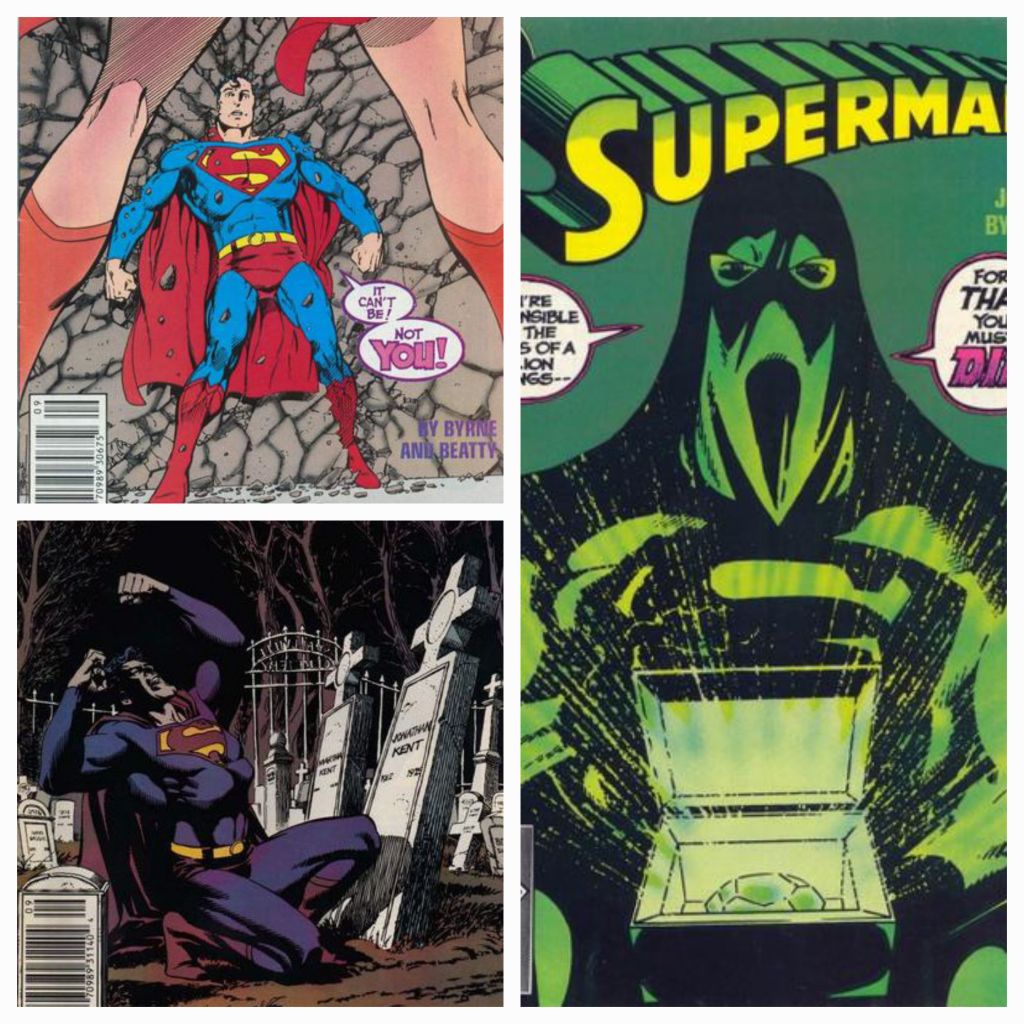
When I started the Year of Superman back in January, I decided early on that I wasn’t going to spend the entire year reading stories from the “Triangle Era,” even though that is hands-down my favorite period of Superman comics. I did decide, though, that I would allow myself two indulgences. I would give myself a few weeks to delve into the epic and game-changing Death and Return of Superman storyline in the early part of the year. Then, later, I would allow myself to read the longer and more divisive saga of “Electric” Superman. The period where Superman’s powers and costume changed so radically was a major point of contention for a lot of readers at the time, although I feel that — like many stories of the era — it is looked back upon more fondly than it was initially received. But I have never gone back and read that era as a whole since it first came out.

I think it’s time.

That said, there’s a question that must be answered: exactly WHEN does this saga begin and end? It’s not as cut-and-dried as the Death of Superman, beginning with Doomsday’s appearance in Man of Steel #18. This story doesn’t begin in the issue where he gets the new costume. Superman’s power change is at least partially a result of an attempt to restore his powers after they are lost during the Final Night crossover. And after he is returned to “normal,” that issue ends with a cliffhanger that dovetails into a time-travel adventure against the villain Dominus that lasts several months before things are finally reset. Along the way he participates in more than one crossover event, is a regular member of the Justice League, and makes multiple guest appearances in lots of comics, including the Ultimate Access miniseries I read last week. All told, were I to read EVERY comic book with Electric Superman, it would be more than double (possibly triple) the number of issues in the Death and Return saga. That’s a LOT.

So here’s what I’ve decided: 

I’m going to read all of the issues of the regular Superman titles from the beginning of Final Night to the end of the Dominus storyline. I’ll read the main issues of any crossover in which Electric Superman appears, as well as crossover chapters in which Superman or members of the family appear. I’ll also read the annuals with Electric Superman. I’m going to skip the JLA issues, because after all, it’s part of Grant Morrison’s run and that whole thing is really one massive story in and of itself. And I’m not going to get into every guest-appearance he makes just because I think it would be a pain to try to track them all down, but I reserve the right to sneak one in if I really want to.

Even shortened like this, it’s still going to be the single largest endeavor of the Year of Superman. And I’m kind of excited to get into it.

All of this is to say, buckle up. It’s time to get sparkly.

Wow, that was lame.

And as always, you can check out earlier blogs in the Year of Superman Archive!

Wed., Aug. 27

Comics: Final Night #0-4, Power of Shazam! #20, Superman Vol. 2 #117, Adventures of Superman #540, Supergirl Vol. 4 #3, Action Comics #727, Superboy Vol. 3 #33, Legion of Super-Heroes Vol. 4 #86, Superman: The Man of Steel #62, Green Lantern Vol. 3 #81

Notes: It was a weird time in DC Comics. Hal Jordan had gone mad after the destruction of Coast City and took on the villain name Parallax following Zero Hour. Kyle Rayner was Green Lantern. Half of the Legion of Super-Heroes was stranded in the 20th century. And Lois Lane had ended her engagement to Clark Kent. Then, as if things weren’t bad enough, some idiot turns out the lights.

In The Final Night, by Karl Kesel and Stuart Immonen, an alien identifying herself as Dusk crashes her ship into Metropolis, where she is confronted by Superman, the Special Crimes Unit, and the time-tossed Legion of Super-Heroes. Dusk warns that a Sun Eater is approaching Earth, and that she has rushed ahead of it from world to world, trying to save people from its devastation, but thus far she has always failed. Superman quickly rallies the world’s heroes (and even some of the villains – they’ve got just as much to lose if the sun is eaten as the heroes do) and they take to space to try to stop the Sun Eater, but despite their best efforts, at the end of the first issue, Earth’s sun is consumed and the world is plunged into darkness. 

Issue two begins in rather dramatic fashion, when Lex Luthor – who has been in hiding – appears to offer his aid to the Justice League and Earth’s heroes in saving the world, including a powerful splash page of Superman and his worst enemy shaking hands in the face of a common threat. Meanwhile, the worlds’ heroes are in overdrive trying to protect people both from the drastic climate crisis as well as from each other. It soon becomes apparent, however, that with the sun gone, Superman’s powers are declining rapidly. Amidst all of this a new hero appears: a young man calling himself Ferro. 

In issue three things go from bad to worse. Turns out the sun isn’t actually GONE, but cut off inside the Sun Eater, where it’s trying to heal itself, but Luthor and Brainiac 5 realize that they have less than 24 hours left before the sun goes hyper-nova, wiping out everything in the solar system. Dusk makes plans to leave Earth before the end, as she has so many times before, but the Phantom Stranger takes her on a whirlwind Ebenezer Scrooge-like tour of the Earth, allowing her to witness our heroes’ refusal to give up, even in what is literally the darkest of hours. And as everyone begins making preparations for the bitter end, Guy Gardner is surprised by the appearance of a bright, beautiful green. 

Final Night #4 brings us to the brink. Luthor and Brainiac 5 have constructed a series of force-field bombs they believe will contain the nova and destroy the Sun Eater, but their chosen pilot, Green Lantern, disappears. Superman insists on going himself, and takes a moment to write a farewell letter to Lois, from whom he was estranged at the time. As he’s writing, through, Ferro steals the ship with the intention of making the suicide run on his own. As they try to stop him, Parallax arrives and offers to save the sun. Despite the reservations of some of the heroes (especially Batman), he does so – at the cost of his own life. Hal Jordan, once and future Green Lantern, falls as he dispels the darkness within.

The end of the story doesn’t quite hit the same now as it did in 1996, knowing as we all do that Hal would eventually return and become Green Lantern again. But as a way to end the arc he had been on since the Death of Superman it was fitting. Also fitting was the reaction of the other heroes: Superman chooses to believe that Hal Jordan found redemption in the end for the atrocities of Parallax, whereas Batman believes a moment of good at the end can never erase the slate. It says quite a bit about each of these heroes, and the book seems to recognize that. At the end of the issue, as Clark and Bruce debate Hal’s sacrifice, Karl Kesel writes a caption that has always stuck with me: “They are the world’s finest heroes, and all the rest follow the lead of one or the other.”

It’s an interesting perspective on the philosophy of the DC Universe, isn’t it?

Let’s talk for a moment about the assorted spin-off chapters. As I said, I didn’t read all of the assorted spin-offs, only those featuring Superman or a member of the family, but that still added an additional nine books to the five-issue main series. I’ll hit the high points in order, as dictated by the reading list on the DC Infinite app:

Power of Shazam! #20: As the weather begins deteriorating with the loss of the sun, Superman and the Marvels go into first responder mode while the wizards Shazam and Ibis try to find a magical solution to the problem. Superman’s presence here is minor, but there are interesting notes. First, this happens right after the sun is lost, so Superman’s powers are only beginning to wane. Second, there’s an amusing moment where Captain Marvel promises Superman “I won’t be distracted like when I faced that Thunder God,” a funny and oblique reference to the events of DC Vs. Marvel

Superman #117: This one is a cheat. Despite the banner on the cover, it’s not really part of the crossover. The issue wraps up an ongoing story with Superman and Professor Hamilton in the Fortress of Solitude and advances a few subplots, but it only ties in to the Final Night on the last few pages, when Superman receives word that something is approaching Earth. If you’re doing a readthrough of the story, this is utterly skippable. 

Adventures of Superman #540: Perry White fights valiantly to put out an edition of the Daily Planet, reasoning that failure to do so would be like giving up and admitting defeat. Emil, still in the Fortress of Solitude, starts transmitting his own research to S.T.A.R. Labs in an attempt to help. And in Metropolis, as Superman’s powers continue to dwindle, Ferro gets a rather heartbreaking origin. The Perry stuff is great, and the Ferro stuff sets the character up nicely for his future with the Legion.

Supergirl #3: Peter David’s epic run was interrupted pretty early by this crossover appearance. Supergirl (this is the Matrix version, remember), has very recently found herself bound to a mortal girl named Linda Danvers, and in her new home of Leesburg, people are beginning to fall apart as they beg for the return of the sun. The issue is mostly spent developing subplots for the series in the context of the crossover, and skippable if you just want to read Final Night, but it reminds me as always just how good David’s run on this character was. I may not be able to fit it in before the end of the year (it’s a total of 80 issues, plus assorted crossovers, annuals, and specials), but so, so worth reading.

Action Comics #727: A somewhat quiet, subdued issue. As Metropolis is blanketed with snow, a Superman whose powers are nearly gone struggles to keep the peace. Meanwhile, a desperate man finds new hope. Inconsequential to the main story, but this is actually one of those times where I really feel a crossover event works well, telling an emotional self-contained tale against the backdrop of the greater events.

Superboy #33: In Superboy’s home of Hawaii, people are gathering at the base of an active volcano for warmth. Roxy Leech, his manager’s daughter and Superboy’s best friend, decides that with the world ending in 24 hours there’s nothing left to lose and confesses her love for him, which is kind of awkward, as his girlfriend Tana Moon is on TV reporting on the crisis just as the volcano erupts. Turns out it’s a monster with the inventive name of Lava causing trouble. The ending here is particularly bittersweet, and surprisingly effective. 

Legion of Super-Heroes Vol. 4 #86: Ferro proves his mettle (get it?) by offering to dive into the sun with an enormous bomb to get it going again. Luthor and Brainiac already have devised their plan to send Green Lantern instead, though, but when he mysteriously vanishes (whisked away by Parallax, as it happened), Superman steps up to do it instead…something that doesn’t sit too well with Ferro. 

Superman: The Man of Steel #62: An interesting little side-trip. Almost de-powered, Superman tries to help a power plant stay functional to keep people from freezing in the dark. Meanwhile, Hamilton discovers that imminent destruction of the sun and sends word to the Daily Planet, while learning about the last days of Krypton and how eerily reminiscent they are of the current situation.

Green Lantern #81: An epilogue to the Final Night story featuring the funeral of Hal Jordan. Kyle Rayner is nervous, finding himself in the position of being asked to speak the death of a man he never met until he turned bad. Superman begins the ceremony, calling Hal a hero, before calling up other speakers who knew him best: Guy Gardner, John Stewart, Black Canary (speaking in the stead of the also dead-at-the-time Oliver Queen), the Flash, Carol Ferris, and finally Kyle. The heroes travel to the Coast City memorial, where Alan Scott turns the eternal flame green, and then Swamp Thing (making a rare non-Vertigo appearance for the time period) brings life back to the desolated landscape. In the end, even Batman finds it within himself to forgive.

A lovely story, although of course, it wouldn’t be the end at all. Nor is it the end for Superman because – as you may have noticed – I haven’t mentioned anything about his powers coming BACK yet. After the sun was restored, he – and everyone else – assumed his powers would go back to normal. But as we’re going to see soon, that isn’t what happened at all.  

Thur., Aug 28

Comics: Superman Vol. 6 #29, Justice League Unlimited Vol. 2 #10, Justice League: Dark Tomorrow Special #1, Green Lantern Vol. 8 #25 (Superboy Guest Appearance)

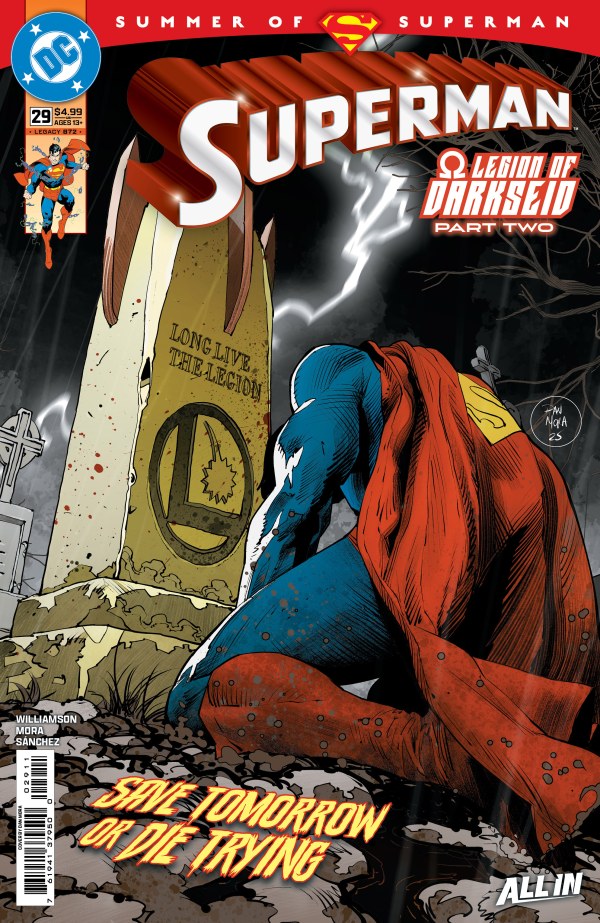
Notes: Gonna take a quick pause from the burgeoning Electric storyline to read some of the new Superman comics that dropped this week. Superman #29 continues the “Legion of Darkseid” story as Superman plans a trip to the future to save the Legion of Super-Heroes with the most unexpected partner of all time. 

It’s going to be hard to talk about this issue – I don’t really want to spoil anything, so can I just talk about vibes? As in, “I freaking love the vibes from this book”? Superman going into the future to save the Legion is exactly what I’ve been thirsting for. What’s more, writer Joshua Williamson is showing respect for EVERY incarnation of the Legion to date, weaving them all into this story (somehow) whilst still tying everything in to the ongoing “DC All In” saga. Again, without spoiling anything, if you haven’t read last year’s DC All-In Special or the Summer of Superman Special that came out in April, you’re missing out on the building blocks of this story. Superman even gets one of his trademark rousing speeches in which he espouses exactly what I’ve always felt is true: he may have been the inspiration for the Legion, but the Legion was every bit as much an inspiration to HIM.

Despite the darkness of this story, something about it is feeling…right. It rings true. And by the time the tale ends and the dust has settled, I feel like we just might finally have a true Legion again. 

Justice League Unlimited #10 actually takes place before the “Darkseid’s Legion” storyline, and involves the League trying to protect the Doomsday Time Trapper, who feels the encroachment of Darkseid and his Legion. Meanwhile, the Trinity have a little heart-to-heart about what happened with Air Wave (the whole “tricked by Grodd” thing) and how they need to approach Justice League recruitment in the future. As always, Mark Waid proves just how well he knows these characters, placing Superman and Batman at odds with one another on this matter, with Wonder Woman as the mediator between the two. Clark also gets in a pretty sharp jab at Bruce, which I don’t think he gets to do quite often enough.

Also, Dan Mora drew both of these issues, and he’s phenomenal. Really, any time these days I read a comic book where I don’t feel the artwork is up to snuff, I wish that they could clone Mora and have him do all of it. 

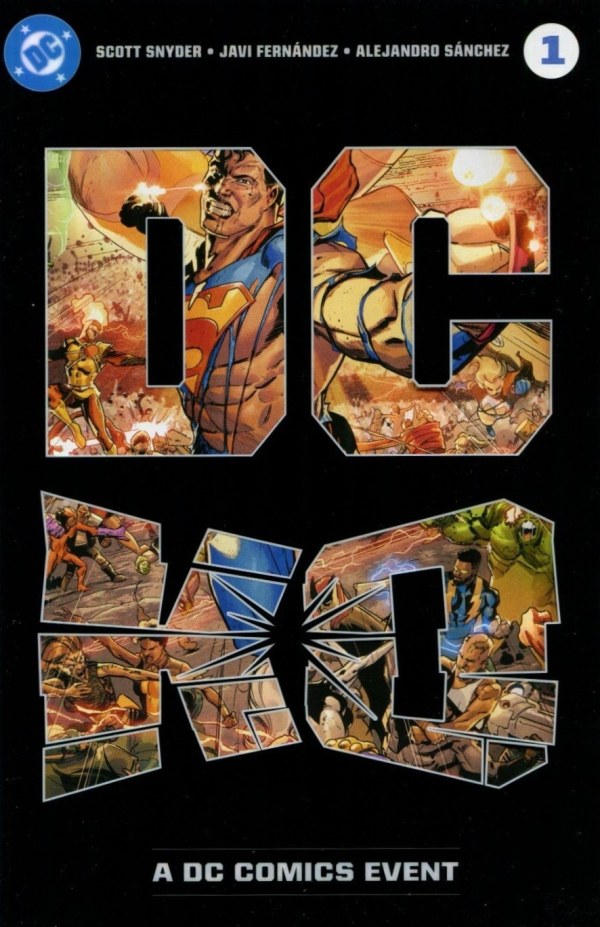
I also read the Justice League: Dark Tomorrow Special, which came out a few weeks ago but, somehow, I’d missed. I’m glad I grabbed it, though, because it feels pretty significant to this whole All In/Darkseid story that’s going on. Someone is hunting down and killing time travelers, which puts roughly half the Justice League at risk – especially those time-lost heroes from the “We Are Yesterday” crossover. A mysterious time-traveler calling himself “Legend” partners up with Air Wave and the lost heroes to try to save them. The issue is both an epilogue to “We Are Yesterday” and a prologue to future stories (including “Darkseid’s Legion” and the upcoming “DC KO”), and although the Super-family participation is minimal, it definitely feels significant, and if you’re following the ongoing saga of the DCU these days, you should pick it up.

Fri., Aug. 29

Comic Books: Superman Vol. 2 #118, Superman: The Wedding Album #1

Notes: I only briefly mentioned it when I read Final Night the other day, but at this point Lois and Clark were separated, she having called off their engagement and taken an assignment in Asia to get away from him. It was a bit of a delaying tactic – Warner Bros wanted corporate synergy and refused to allow DC Comics to have the two of them get married until they were also married on the then-running Lois and Clark: The New Adventures of Superman TV show. It was actually that edict that led to the Death of Superman in the first place, when they had to scrap their plans to marry them off in 1992. Here, four years later, after one delaying tactic after another, they finally got married on the show, and DC had to quickly follow suit.

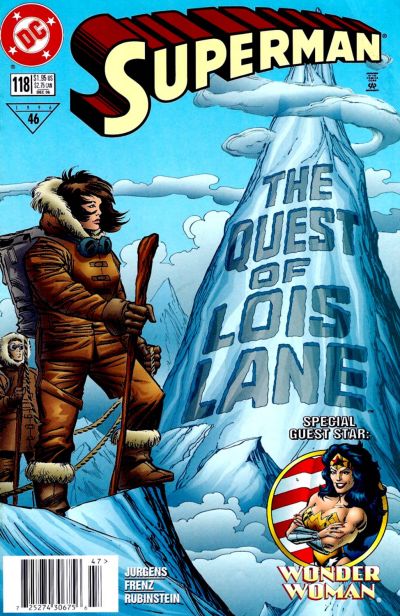
In Superman #118 we pick up on her, chasing down a heroin ring in the far East. Back in Metropolis, meanwhile, S.T.A.R. Labs is working on the fact that, despite the sun coming back, Superman’s powers are still gone. After a seemingly-pointless reiteration of his origin, Wonder Woman and Lori Lemaris convince Superman to try to get Lois back. Lois, meanwhile, encounters a young man who tells her a lesson he learned as a child from an American stranger. It’s pretty clear where this is going from the very beginning, but Lois is still taken by surprise when she learns who her new friend’s old friend happens to be, and she makes a decision to return to Metropolis. Short? Abrupt? Hell yeah. But DC wasn’t given a lot of time to get things back in order – they needed to have the wedding of the century align with the TV show.

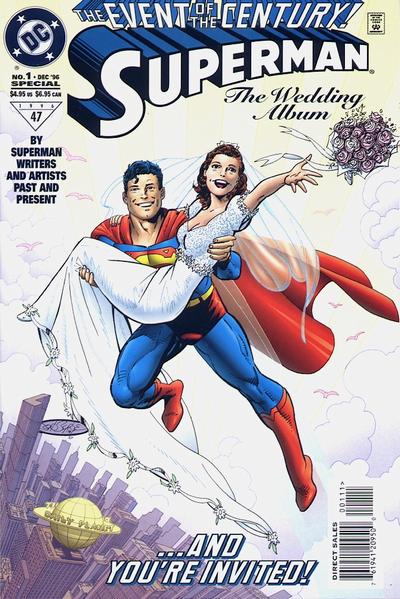
And this brings us to Superman: The Wedding Album, an event nearly 60 years in the making. This 88-page whopper told a hefty tale written by the five writers of the Superman comics of the era (Dan Jurgens, Karl Kesel, David Michelinie, Louise Simonson, and Roger Stern), with art by the regular teams and several other artists who had worked with Superman over the years, including John Byrne, Gil Kane, Paul Ryan, Tom Grummett, and a flashback sequence using pages by the great Curt Swan. It’s a nicely fitting tribute to the characters, kicking off with Lois being Lois – pretending to want to marry the head of the drug trafficking ring as a way to both bust him, at the same time, hitch a ride on his private jet back to Metropolis. She storms into the Daily Planet office wearing a ragged and torn wedding dress, then has it out with Clark. He fills her in on what’s been going on in her absence: he’s acting as Managing Editor of the Planet while Perry recovers from chemotherapy, oh yeah, and his powers are gone. (There’s a particularly funny line here: “Remember when the sun went out a while ago, Lois?” As if that’s the sort of thing a person could just forget.) The sequence ends with the entire Planet staff crowding around, trying to peek through the door, and seeing the two of them in an embrace, back where they belong.

The bulk of the special, after that, is all about wedding preparations: Lois’s bridal shower, the happy couple picking out their dress and tux, and house-hunting. And while it’s all fairly normal, non-superhero stuff, the writers manage to really infuse it with character. Lois’s mom is desperate to control things while her father makes no effort to disguise his distaste at his daughter’s choice of partner. Clark’s parents, meanwhile, do their best to play mediator. A fight breaks out at the Ace O’Clubs during the bachelor party, and Clark gets a visit from a friend to tell him that Metropolis will be taken care of during his honeymoon. Oh yeah – and the apartment that Lois fell in love with but couldn’t get is now theirs, courtesy of the building’s owner, one Bruce Wayne.

I’m really glad that they avoided the typical superhero wedding episode, where the ceremony is disrupted by a villain causing havoc or some natural disaster. The closest thing we get is Mr. Mxyzptlk popping in right before the blessed occasion to tell Clark he’s looking forward to screwing around with Mr. and Mrs. Kent very soon. Then it all closes off with a nice, simple, uneventful wedding that is heartfelt, sincere, and lavishly illustrated (with several members of the creative team in attendance). 

It’s a sweet issue, one that finally puts the will they/won’t they of six decades to rest and allows us to move on to something new.  

Turns out they were saving the chaos for the honeymoon.

Sat., Aug. 30

Podcast: Back to the Bins Episode #685: Superman S.C.O.R.E. III

Notes: It’s finally here! Regular blog readers may recall a while back when I joined Paul Spataro to record an episode of his Back to the Bins podcast, each of us discussing comics about the relationship between Superman and Wonder Woman. The episode has finally dropped, so make sure you check it out. It’s available on the Two True Freaks Podcast Network page, or you can find it on Spotify, Apple Podcasts, or wherever you download your podcasts. Join us for a chat about this unique super-couple. 

Comics: Taste of Justice #6, Adventures of Superman #541, Action Comics #728, Superman: The Man of Steel #63

Notes: A quick peek at Taste of Justice #6 – a short but fun story in which Martha Kent is injured (mildly – this series seems to specialize in minor mishaps most of the time), leaving Clark and Jonathan to try their hand at making her famous rhubarb pie. Interestingly, whereas most chapters of this online serial comic have led up to a triumphant dish being prepared, this one takes a different tack – the resultant pie isn’t up to Martha’s usual standards, a fact which she clearly finds somewhat amusing. I didn’t see that coming.

That done, it’s a dive back to 1996, where we’re going to read the comics that make up Lois and Clark’s honeymoon. After a surprisingly low-key and uneventful wedding, their trip to Hawaii makes up for it. Adventures of Superman #541 picks up at the wedding reception, after which the happy couple whisks off to the island paradise, where their celebrations are interrupted by an explosion. With Superman still powerless, fortunately, they happen to be on Superboy’s home turf. The explosion was caused by a creature that claims to be an island spirit called a Menehune, and the happy couple wind up meeting up with Superboy and his own reporter girlfriend, Tana Moon. The story is okay – more like we’re seeing a “Lower Decks” style peek in an issue of Superboy really. But the side quest is derailed on the last page, when Clark is shot and kidnapped by men in a speedboat. Of course, these guys don’t seem to realize that they’ve just made the biggest mistake of their lives: they’ve pissed off Lois Lane. 

Action Comics #728 picks up with Clark waking up in the custody of the brother of the very drug trafficker that Lois captured in the Wedding Album. Apparently Rajiv, as his name goes, holds something of a familial grudge. I have to admit, I found this issue kind of underwhelming. Clark spends most of the issue engrossed in a flashback to another time when his powers weren’t of any use, facing a terrorist armed with a chunk of Kryptonite. The flashback really adds nothing to the story, save for eventually reminding Clark that he has studied techniques to make it appear as though his heart has stopped beating – techniques that work just as well if he has powers or not. He uses his little trick to attempt an escape, only to learn that any such effort will be futile, as he’s being held captive on a submarine at the bottom of the Pacific Ocean. Good reveal, but it leaves us with about two pages of plot progression for the whole issue.

Superman: The Man of Steel #63 picks up with Clark being brought to a private island belonging to Rajiv as Lois begins the task of doing what she does best: following leads. In this case, she’s trying to track down her missing husband, which takes her all of four pages before she begins a guerilla assault on Rajiv’s compound. (And they call Batman the world’s greatest detective.) As she attempts her rescue, Clark learns that Rajiv isn’t tracking her out of petty revenge: when she bested his brother, Lois made off with a knife that, unbeknownst to her, has hidden in its hilt computer codes capable of hacking satellite technology and bringing down aircraft at will. As Clark stalls for time, trying to convince Rajiv that Lois found and sold the codes, she breaks in and saves the day.

The honeymoon arc as a whole is okay. You all should know by now how much I love a story where Lois has a chance to kick some ass, and she most certainly does that in the Man of Steel issue. For all the times Clark has saved her over the years, it’s really great to see how capable she is when the need arises. My beef really comes with how quick the whole thing is, especially the sequence where Lois tracks down Rajiv’s island. It just comes far too easily, even for someone as smart and capable as Lois. Considering that she only appeared on one page of Action #728, that issue feels even more superfluous than it does at first blush. It would have been far more satisfying, in my opinion, to truncate the flashback sequence in that issue and devote those pages to showing Lois hunting down Clark. It would make the Action issue feel far more relevant and the Man of Steel issue feel less rushed. It’s all about the pacing, people.

Still, kudos to Lois and Clark for having a honeymoon they could never forget. But when their vacation to paradise ends, it’s going to be time to get down to the real issue at hand: finding a way to restore Superman’s missing powers. 

Sun., Aug. 31

Comic Books: Superman Vol. 2 #119, Adventures of Superman #542, Action Comics #729, Superman: The Man of Steel #64

Notes: With the honeymoon over, it’s time to figure out what’s up with Clark’s powers. In Superman #119, Superman and the time-tossed Legion of Super-Heroes both arrive at LexCorp looking for help with their respective predicaments. They take a ship to the same orbital platform we saw back in the Superman/Aliens crossover (a rare instance of such a crossover being addressed as canon, helped no doubt by the fact that Dan Jurgens wrote both of them) and Brainiac 5 attempts to draw solar energy to jumpstart Clark’s powers…an effort met with failure. And in the midst of this Lex gets some surprising news: he’s going to be a daddy.

In Adventures #542, Superman heads to Project Cadmus for help but, again, finds himself stonewalled. Instead, he simply winds up on a brief psychedelic adventure with some of Jack Kirby’s stranger creations, the Hairies, before borrowing Guardian’s Whiz Wagon. He flies it down to Action Comics #729, where – en route to his Fortress in the Antarctic – he winds up at an energy research station where the crew has unwittingly unleashed a strange entity from the center of the Earth. Superman manages to best the creature even without his powers (paralleled with a subplot about Perry White going through chemotherapy) before finally making it to the Fortress where Emil Hamilton has been all this time. But even all his Kryptonian tech doesn’t restore his powers before Mr. Miracle and Big Barda pop in via Boom Tube, saying that the fate of the universe depends on Superman’s powers.

Finally, “Power Struggle” concludes in Man of Steel #64. The New Gods tell Superman that their world of New Genesis has somehow been destroyed, and the only hope of finding the truth is to retrieve the datacore in Metron’s suit…a datacore that can only be accessed by melting the suit in the heat of the sun itself. Metron assures Superman that their dive into the sun will recharge his powers quickly enough to pull them both out of the star before they’re killed…and miraculously, it works. Superman’s powers are restored, Metron is saved, and the data is retrieved. It all seems just so…neat and tidy. TOO neat and tidy, if you catch my drift.

Getting his powers back, as it would turn out, was just the beginning. 

Bonus: Comics in the wild!

Notes: Some time ago, DC announced that they were going to start selling comics at Dollar Tree locations. The comics would all be reprints, of course: most of them either the first issue in a story that is available in graphic novel form or a standalone comic, including many aimed at kids. The program expanded to reach various convenience stores, grocery stores, and other outlets. But today was the first time I ever actually saw any in the wild. After my son’s birthday party, we stopped for gas and I saw the rack inside the station. I had to go through it, fascinated by some of the choices for their reprint specials. The first appearance of the modern Supergirl from Superman/Batman is in the mix, as well as at least two current issues of Mark Waid’s World’s Finest series (each the beginning of a storyline, of course), and the first issue of Christopher Priest’s Superman: Lost. They weren’t ALL Superman comics, of course – there was the expected assortment of Batman comics, Harley Quinn comics, and Scooby-Doo comics, some of them all at the same time – but the very existence of this rack out there, outside of comic book stores where they can be seen by anybody…it was heartwarming to me.

Of course I had to get a couple. I picked up the reprint of John Byrne’s Superman #1 from 1987, as well as the reprint of the first issue of Batman Adventures Vol. 2. Like the Compact Comics, I feel like it’s important we support these things, friends.

Mon., Sept. 1

Comics: Superman Vol. 2 #120, Adventures of Superman #543, Action Comics #730, Superman: The Man of Steel #65, Superman Vol. 2 #121,  Adventures of Superman #544, Action Comics #731, Superman: The Man of Steel #66, Jon Kent: This Internship is My Kryptonite #6, Gotham City Sirens: Unfit For Orbit #5 (Power Girl guest appearance)

Notes: There was a bit of a lull in the Superman comics after he got his powers back but before they transformed. Let’s see what we can get through today. In Superman #120, Lex Luthor has a dream about his oncoming child idolizing Superman, a dream that chills him to the bone and opens up an issue of different characters talking about what they would do with Superman’s powers: Lex, Emil Hamilton, Jimmy Olsen, Cat Grant, Perry White, and a random kid who gets locked out of his house and needs Superman’s help. It’s a cute little breather of an issue, which was probably due at this point, although it had been entirely too long since we saw Lois. She hadn’t had a significant appearance since the honeymoon ended, and it’s time to really get into the adventures of Mr. and Mrs. Superman. There is one significant piece of foreshadowing, though: when Emil studies Superman to make sure that his powers are, indeed, back to normal, the scanner he’s using shorts out due to an unexpected electrical surge.

In the immortal words of C+C Music Factory, “Things That Make You Go Hmmmm…”

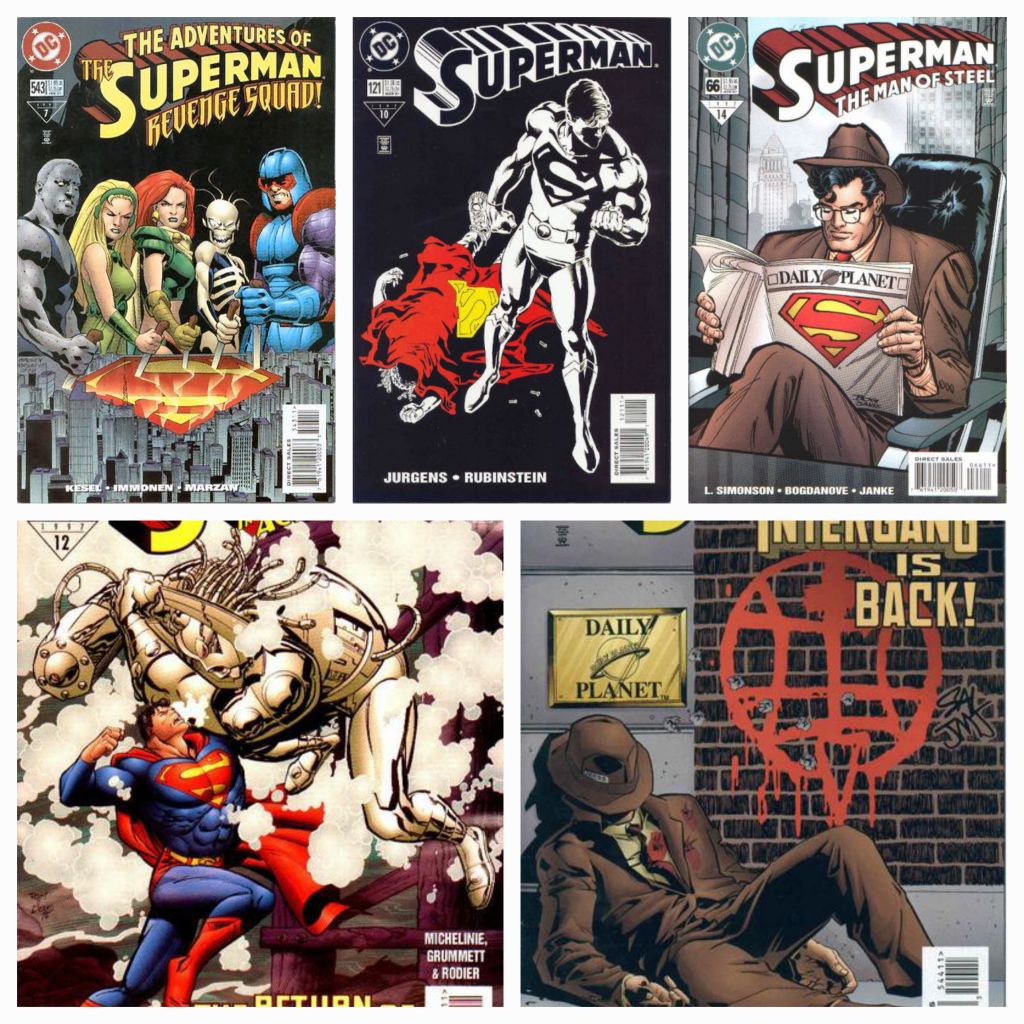
Adventures of Superman #543 shows us the newlyweds finally settling into their new apartment and Superman checking into a couple of escaped villains. Turns out the villains in question are being recruited for a new version of the good ol’ Superman Revenge Squad. A strange figure watching from the shadows has pulled together Anomaly, Barrage, Misa, Riot, and most troublingly, Maxima. When DC released this year’s Superman Treasury Edition I mentioned that I was disappointed to see Maxima reverting to her old villainous ways. I guess I’d forgotten that this wasn’t the first time she’d suffered from a bout of recidivism. The Squad makes its attack in Action Comics #730, but not before one of the very-frequent scenes of Superman flying over Metropolis pondering recent events to bring any casual readers up to speed. I never noticed until this read-through just how frequently that happened in the Triangle Era. I suppose they clung to the idea that any comic book could be somebody’s first, and they were doing their best to make sure that everyone knew what was going on. Admirable – but these days I’m very curious as to whether that old adage still bears any truth at all. Anyway, the fight goes poorly – the five villains, used to working on their own, wind up stumbling over each other and stabbing each other in the back, but by the last panel they manage to have Superman down, his head covered with a slime that Misa is using the block his powers. Geez, Misa, he JUST got them back. 

Man of Steel #65 wraps the story up as the Metropolis Special Crimes Unit arrives on the scene and joins the fight. For a full-issue fight scene, it’s not bad. It’s really nice to see the SCU used to the top of their intelligence, being legitimately effective in a fight against superpowered villains instead of just coming across as the useless cops that so often populate superhero comics. As the Revenge Squad is rounded up, their mysterious benefactor watches and plans his next move. I’ll tell you what I REALLY like here – it’s been so long since I read these issues that I’ve completely forgotten who the mysterious bad guy is that pulled the Revenge Squad together. I don’t know when the reveal is going to come, but I hope it lands. 

Superman #121 has writer Dan Jurgens once again pick up penciling duties (a rarity for this era) for a “very special issue” about Clark Kent befriending a ten-year-old girl who witnessed a gang shooting. When Superman tries to eliminate the guns from her housing project, thinking it will make it safe for her…well, let’s just say I’m kind of surprised that Jurgens would have written Superman as being so naive. 

Adventures #544 starts off with what I’m comfortable calling a controversial moment: Clark Kent is gunned down in the middle of a busy streetcorner. If that’s not confusing enough, it gets weirder when Lois arrives on the scene at the same time as…another Clark. Turns out the doppelganger is tied into the return of Intergang, which no doubt is going to cause trouble later on. Action #731 features another return: Lois and Clark are trying to enjoy an evening at home together when word comes of an attack by an old foe of his Cauldron – but he’s different than before. While Clark holds him off, Lois helps unravel the mystery of who is controlling the cyborg villain this time.

Finally (for today) let’s look at Superman: The Man of Steel #66. Remember Rajiv, the creep who messed up Lois and Clark’s honeymoon trying to get his hands on codes that would allow him to take over a satellite defense network? Well, seems like he got the codes, because in this issue he starts raining fire all over the world, demanding a billion-dollar ransom to stop. The story cuts between Superman taking to space to stop him and scenes on the ground where various people, including Bibbo, Jimmy Olsen, and Perry White’s family, try to help in their own way. It’s an interesting little experiment by Louise Simonson and Jon Bogdanove, a story ostensibly about how the S-shield itself stands for something to people and the power it has even on its own. It would be another decade before the concept of the shield being the Kryptonian word for “Hope” came about, but this has some of that same feel to it, and I like it on that level.

It’s odd, in retrospect, how these stories feel so disconnected from what’s coming. Except for the electric spark in Superman #120, there’s really been no buildup to the power switch. The news had already come out that the story was coming, of course, people knew that Superman was about to get a new costume and new power set, but they didn’t expend a lot of shoe leather on the concept for the first two months after the wedding storyline ended.

That’ll change very soon. 

Tues., Sept. 2

Comic Books: Superman Vol. 2 #122, Adventures of Superman #545, Action Comics #732, Superman: The Man of Steel #67, Superman Vol. 2 #123

Notes: The final month before the big switch begins in Superman #122. At this time, DC was still under the edict that Kal-El was to be the ONLY Kryptonian who survived the destruction of Krypton. That said, they had found ways around that with alternatives to the Kryptonian characters and concepts of the past: the Matrix Supergirl, an Earth dog Bibbo named “Krypto,” and most recently, a new version of the city of Kandor. In this continuity, Kandor was still a miniaturized city in a bottle that Superman was keeping safe in the Fortress of Solitude, but rather than a Kryptonian city, it was a town made of aliens from various worlds, all collected by an entity named Tolos before Superman saved them. In this issue, his powers start to go wild, causing electrical devices to explode and his body to phase in and out. Superman takes Lois to the Fortress to try to get to the bottom of it, wondering if the dimensional phase that had brought him to Kandor could be responsible, but inadvertently winds up releasing a blue-skinned, horned alien called Ceritak. In Adventures #545, things just get worse as Superman’s powers go out of control. He sparks uncontrollably, falling through walls and losing the ability to fly, all of which contribute to a power outage that goes across the city and frees the Atomic Skull from prison. The Skull, suffering from the delusion that he was the hero of an old movie serial and that Superman and everyone else were characters in the serial, winds up in battle against Superman, seeming to atomize him. 

Action #732 continues the battle because, obviously, Superman isn’t really dead. His energy was somehow dissipated by the skull, and he finds himself reconstituting at that Antarctic energy research station he stopped by when he was powerless a few issues back. Lois plays along with the Skull’s delusion as a delaying tactic and, making his way back to Metropolis, Superman starts to learn some of the capabilities of his new powers. He isn’t strong anymore and can’t fly, but he can bound around like energy, control magnetic waves, and access computer systems by touch. Eventually, he manages to bring the Skull down, but he has no idea what’s happening to him.

Superman: The Man of Steel #67 is next, although the title has become highly inaccurate at this point. (This is a good opportunity to talk about how, were this story to be told today, it would reach this point and then DC would likely cancel all four series and re-start them with new first issues, including changing the title of this one. Man of Energy doesn’t really have the same ring, though. I don’t know what they’d call it.) As news of Superman’s mutating powers starts to leak out, Lois clashes with the Planet’s new sensationalist circulation manager over their coverage. Meanwhile, Ceritak has made his way to Metropolis, where he’s inadvertently sewing some chaos. In the midst of the battle between the two Superman’s powers go absolutely haywire, causing a citywide blackout.

A quick aside before I move on to the main event: Jon Bogdanove. He’s one of my favorite Superman artists, mostly because his style has a sort of classic, old-fashioned sensibility that meshes perfectly with Superman. He gives us a huge, barrel-chested, squared-jawed hero that not only fits, but practically DEFINES the classic Superman mold. As Superman shifts from his traditional status quo to the electrical version, you’d think it would clash with his style…but somehow it doesn’t. Along with fine art and color work by Denis Janke and Digital Chameleon, he makes a creature of pure energy still invoke the core of Superman. That, along with several well-placed and highly amusing visual gags in this issue, call to mind some of his best work on Marvel’s Power Pack. I don’t think Bogs gets enough credit in general, and I wanted to call out this issue in particular as being a high point.

Finally, after a week of reading, we come to the book that I started this journey for: Superman #123. As Superman fights with the confused Ceritak (who Bibbo accidentally renames “Scorn”), he winds up in Hamilton’s lab, unable to control his new energy-body. Hamilton is approached by Erica del Portenza, wife (at the time) of Lex Luthor, who has an experimental cyber-woven polymer that she believes may be of assistance. Loath as they are to accept help from Luthor, Hamilton sees no choice and uses the fabric to create a containment suit. In his new duds, Superman finds that he can control his power while in energy-form as well as shift back to a fully human (and powerless) Clark Kent. As he says on the last page, “there’s a new Superman in town.”

This is such a wild story so far. After a rather slow buildup, we’ve got a Superman now with a completely different power set and costume, and while I don’t think I believed even then that this change was intended to be permanent, DC did their best to pretend this new status quo was going to last. So looking ahead to reading more of this, I’m expecting to see the sort of subplots and side-stories that defined the Triangle Era while, at the same time, continuing the story of the electro-Superman, leading up to the era of Superman-Red and Superman-Blue.

And despite feeling a bit of scorn (no pun intended) for this storyline for a very long time now, I find myself kind of looking forward to it. 

Blake M. Petit is a writer, teacher, and dad from Ama, Louisiana. His most recent writing project is the superhero adventure series Other People’s Heroes: Little Stars, volume one of which is now available on Amazon. You can subscribe to his newsletter by clicking right here. You can join in the Kryptonian Konversation every day in the Year of Superman Facebook Group!
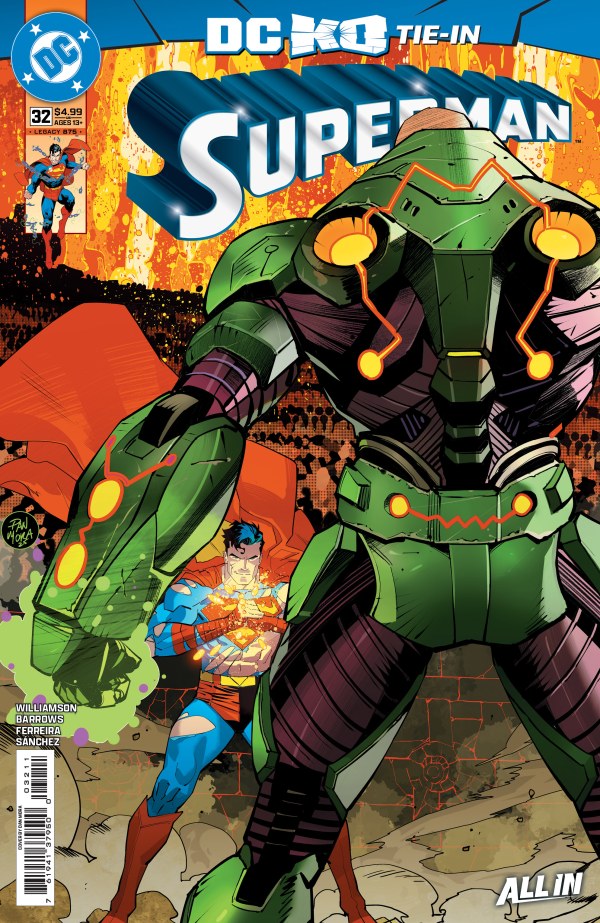
Year of Superman Week 34: Crossover Chaos Part III-The Final Amalgamation

I spent last week dipping my toes into the DC Vs. Marvel crossover, as well as the first wave of Amalgam Comics titles. But I’m not done yet: I’ve still got over half the huge Amalgam Age Omnibus to get through, including two sequel miniseries and the second wave of Amalgam Comics. Not only that, but after a few weeks where the beginning of the school year has kept me busy, I finally get a chance to sit down and catch up on more recent Superman comics. Oh yeah – and Peacemaker season two drops this week, and while I don’t expect to see Superman to show up, James Gunn has promised that the story of this season follow on from the film, so there’s a pretty good chance I’ll have some thoughts to share about that. Let’s begin, shall we? 

And as always, you can check out earlier blogs in the Year of Superman Archive!

Wed., Aug. 20

Comics: DC/Marvel: All-Access #1-4

I had the same look on my face as Access when I read Civil War II.

Notes: I’m going to say something that may be controversial here. I actually like the follow-up miniseries, like DC/Marvel: All-Access, better than the DC Vs. Marvel event itself. DC Vs. Marvel was a fun experiment, but the plot was really just a flimsy excuse to show off fights between the characters and frame the Amalgam specials. All-Access, on the other hand, has an actual STORY to it, and I appreciate that. Written by Ron Marz with art by Butch Guice, whom you may remember passed away earlier this year, All-Access starts out with Axel Asher, the man who straddles the line between the Marvel and DC Universes as Access. A psychic flash warns him that Venom has somehow hopped universes, and if anyone from either universe stays in the other one for too long it could cause the worlds to fuse into the Amalgam Universe again, so the cosmic hall monitor has to get to work. He comes across Venom in Metropolis, where he’s throwing down with Superman, and so Access decides to get some backup by calling in someone who knows what Venom’s deal is: Peter Parker, the Amazing Spider-Man.

This is all in the first issue of the miniseries, by the way, which almost works very well as a standalone Superman/Spider-Man team-up. There’s no gratuitous hero-on-hero fighting here, just two good men teaming up to take down one bad one, and Marz plays them both perfectly. Re-reading this issue is where I started to realize that this is kind of what I had hoped DC Vs. Marvel would have been all along.

Superman doesn’t show up again until the last page of issue #3, but in the meantime, Jubilee convinces Access to take her back to the DC Universe because when she and Robin were supposed to be fighting each other, they kind of fell in love. (To this day, it’s probably the best relationship Tim Drake has ever had.) Their reunion is interrupted by an encounter with Two-Face, then again when the Scorpion appears, once again mysteriously having been pulled from the other universe. Access recruits Batman to help him solve the mystery of the “crossovers,” and Batman suggests that they track down the man who, in the combined universe, was supposed to be its defender: Dr. Stephen Strange. Batman approaches Strange, suspecting that he’s causing the crossovers somehow, and Jubilee calls in the X-Men to hold him off. Issue three ends with Access once again calling in the cavalry, bringing in the rest of the Justice League.

Issue four is X-Men vs. JLA, at least at first. Things change when Access discovers that Dr. Strangefate has been hiding in Strange’s subconscious ever since the merger and used him to cause the crossovers in an attempt to restore the Amalgam Universe. He fuses Wonder Woman and Storm once again into their Amalgam counterpart, Amazon, but when he realizes he doesn’t have the right parts to put together anyone else, he starts creating NEW Amalgams: Superman and Bishop! Iceman and Aquaman! Jean Grey and the Martian Manhunter! Things get wild!

The story ends with a nice little promise, the Amalgam Universe restored as a sort of pocket universe where Strangefate is locked away, and the Marvel and DC Universes get to remain separate. But this miniseries was so much fun, seeing the characters actually interact in ways that didn’t go straight to the fisticuffs. The Robin/Jubilee stuff in particular was fantastic, and I loved seeing Superman and Spider-Man working together again. 

It’ll never happen, but I’d love to see a longer Access series, say a 12-issue event in which he’s trying to solve some sort of mystery that encompasses both worlds. And I’d love if, during this year, he appears not only in his own series, but in the ongoing comics of both companies, bringing surprise guest stars with him. But seeing as how the original plan was for DC Vs. Marvel to end with She-Hulk and Martian Manhunter swapping universes for a year until that plan was nixed by the lawyers, it’s doubtful that anything like that could happen. It’s not like the world has gotten LESS litigious since 1996, after all. 

Thur., Aug 21

Comic Books: Super-Soldier: Man of War #1

The amalgamated Snyder Brothers fans get SO angry that they gave Super-Soldier his trunks back.

Notes: A year after DC Vs. Marvel, a second wave of 12 Amalgam one-shots were released, six of them continuing adventures of the characters from the first, six of them with all-new Amalgamations. What’s interesting is that even the books that carried over didn’t continue the STORIES from the original. Some of them were unrelated stories, some made brief reference to the previous, and some went REALLY wild, like Dark Claw Adventures giving us an adventure of the Amalgamated Batman/Wolverine combo in a Batman: The Animated Series style. For our first visit with the Super family, Super-Soldier: Man of War dipped back in time to give us an adventure of the character from World War II. Mark Waid and Dave Gibbons reunite for this story, which kicks off with Super-Soldier at a meeting of the All-Star Winners Squadron. But he’s only there long enough for us to notice some new Amalagams (such as the Human Torch/Green Lantern mashup Human Lantern) before it’s off to join Jimmy Olsen for a special undercover Daily Planet assignment overseas. 

On the ship to Europe, Clark and Jimmy make the acquaintance of Sgt. Rock and the Howling Commandos, and Clark is later chagrined to find that Winston Churchill has fallen for the do-gooder act of his arch-nemesis, Lex Luthor, husband of Lois Lane. In a way, Luthor’s involvement actually makes this a prequel to the previous story, as the issue ends with him unveiling the plans for the Ultra-Metallo that Super-Soldier fought the first time we read one of his adventures. Kinda makes you wonder why it took Luthor 50 years to get it together.

As before, Waid and Gibbons do a great job lacing together the Superman and Captain America characters, this time bringing in the World War II-era heroes of Easy Company and the Howlers as well. Peggy Carter, for instance, shows up here as a member of the French Resistance (although I couldn’t figure out which member of Easy Company she was supposed to be mashed up with). The appearance of Major Zemo and his War Wheel pushes this over the top – silly and gleeful. These Amalgam books, when done well, are just an enormous amount of fun. Is it too much to hope that the new DC/Marvel crossover books that are about to come out will open the door for the return of this mixed-up universe? 

Fri., Aug 22

No, you give YOUR dog an invisible bone!

Last night was the premiere of Peacemaker season 2. I thought that meant I would be able to watch it when I got home from work, but apparently, it dropped at 8 p.m. EST, by which time my sports fanatic son was engrossed in a preseason game between two teams that nobody in our house has any personal connection to. But that was okay, I figured that I would just watch it the next day. I guess that was pretty stupid of me, though, to assume that I could wait a whole 20 hours and not have anything spoiled for me. Before the game was even over, though, posts were appearing on social media that spoiled something that really pissed me off. You see, season one was made BEFORE James Gunn was given the job of revamping the DCU, and was intended as part of the previous iteration of the DC Extended Universe. With the new DCU that began in Creature Commandos and continued into Superman, though, there were questions as to which parts of the season were still canon. Gunn has been exploring that in the official podcast for the show, but there was a moment in the finale that they were going to have to work a little bit to reconcile. 

Naturally, looking at Facebook last night, I was spammed with different pages that I don’t even follow sharing a screenshot that ruined a pretty amusing moment. How dare I assume that people wouldn’t make it into a headline? It had been an entire 180 minutes since the show dropped! What are they, made of stone?

Here’s the rule: If you’re posting spoilers about a show on the day it airs, you’re an asshole. That goes for individuals as well as all of those pages that I have since blocked.

By the time you read this it will have been nearly a week since that episode, and I STILL wouldn’t talk about it without giving you a warning. So in the next paragraph I’m going to spoil a few things about the end of Peacemaker season one and the beginning of season two. If you haven’t watched them and want to remain pure, skip ahead to Saturday.

TV Show: Peacemaker Season 2, Episode 1: “The Ties that Grind.”

Season one of Peacemaker ended with the titular hero and his team, the 11th Street Kids, saving the world from an invasion of alien butterflies. It’s more impressive than it sounds. But in the battle, Emelia Harcourt was nearly killed. Towards the end of the episode, Peacemaker is carrying her to safety when, lo and behold, the Justice League appeared – too late to do any good. The League, in this case, included silhouettes of Superman and Wonder Woman, as well as Jason Momoa as Aquaman and Ezra Miller as the Flash. It was a funny scene, but as that Justice League doesn’t exist, that scene clearly was no longer canon.

Gunn promised to explain it away and he did at the very beginning of the episode, in the “Previously on…” montage, where the League was replaced by the Justice GANG from the movie. The silhouettes of Superman, Mr. Terrific, and Supergirl all appeared, as well as a quick and the cameos have been replaced by Isabela Merced’s Hawkgirl and Nathan Fillion’s Guy Gardner. It was a funny bit. But I bet it would have been funnier if not for the asshats on the internet posting it the night before I got to watch it.

Fillion and Merced appear later in the episode as well, alongside Sean Gunn as Maxwell Lord allowing Peacemaker to audition for the Justice Gang. Watching the episode, it’s clear why DC put out the digital version of Superman last week – there are a lot of things in this show that build directly on that movie, although it’s still Peacemaker’s story of course. Rick Flagg shows up, worried about another dimensional rift like the “Luthor Incident” that happened this summer. Besides the connections to Superman, the show also starts trickling in new characters, like a surprising cameo by White Rabbit and references to the likes of the Ultra-Humanite and Captain Triumph. Rick Flagg is even working with Sasha Bordeaux, a supporting character from Greg Rucka’s Batman comics. Gunn seems to be using this season of Peacemaker to lay in chunks of the history of the DCU that Superman only hinted at, and I’m really quite excited by that. 

Look, it’s not a HUGE Superman link, and it’s DEFINITELY not a show I’m gonna watch with my seven-year-old like the movie, but this show is starting to look like it’s going to be part of the fundamental fabric of the new DCU, and that would make it worth watching even if it WEREN’T really good. 

Comics: Jon Kent: This Internship is My Kryptonite #5

Sat., Aug 23

Comic Books: Superman: The Kryptonite Spectrum #1, Superman Unlimited #4, Supergirl Vol. 8 #4

This is why you don’t watch whites with colors.

Notes: The beginning of a new school year traditionally keeps me busy, and today was the first time I’ve made it in to pick up my new comics in a few weeks. As such, I’ve got a hefty nine Superman or Superman-related comics sitting in my stack, waiting to read and discuss, including the much-anticipated Superman: The Kryptonite Spectrum #1. This Black Label series is by W. Maxwell Prince and Martin Morazzo, the creative team behind Image Comics’ incredible existential horror series Ice Cream Man. That’s the only thing of theirs that I’ve read before, however, and while I’m a big fan, I’ve been curious ever since this was announced as to just how their sensibilities would translate over to the Man of Steel.

As it turns out, they translate wonderfully.

In this story, Superman discovers four new strains of Kryptonite beyond the usual colors we’re aware of, and recruits Batman to help him experiment with them and find out what they do. The first, a Purple K, distorts Superman’s perception of time – something that is especially concerning as Lex Luthor chooses just that minute to unleash Solomon Grundy in Metropolis.

It would be fair for someone to question whether a creative team best known for a cosmic mind-tripping horror comic would be an appropriate choice for a Superman story, but Prince and Morazzo acquit themselves right away. The Kryptonite Spectrum isn’t a horror story by any stretch, but when Superman’s concept of linear time is skewed, we get a story that drifts into the kind of psychological twists that make Ice Cream Man so compelling while skipping the actual terror. Prince uses this conceit to play with the reader’s concept of time as well, and the script even twists Superman’s interactions with his friends, with a few scenes with Lois Lane dipping into the very real anxieties that Ice Cream Man so frequently mines for pure horror. Here, though, rather than terror, Prince uses them for character drama, displaying things about the relationships between the characters that feel very true, very human. This may not have the “Elseworlds” label, but the story clearly isn’t set in the mainstream DC Universe, with Superman and Lois’s relationship framed in a way that doesn’t fit that world, but feels quite appropriate for the story that Prince and Morazzo are telling. This is a great first issue of a very different kind of Superman story, and I enjoyed it heartily. 

Remember this the next time one of you wants to give me grief for putting up my Halloween decorations in September.

Dan Slott and Rafael Albuquerque are back with Superman Unlimited #4. With the Daily Planet expanding to a global operation, Jimmy Olsen has been tasked with helping set up their Gotham City office. While he’s in town, he and his ape city sidekick Tee-Nah run across Man-Bat and wind up summoning Superman for help. What they don’t know, though, is that this is a new Man-Bat, one who can transmit its curse via a bite…and a chance encounter with all the Kryptonite on Earth these days has left Superman just vulnerable enough to get nipped. Soon it’s Robin and the Birds of Prey vs. Superman-Bat! 

This book is really turning out to be just what I wanted. There’s an ongoing storyline – that of the Kryptonite meteor that fell to Earth and the consequences of that – however, each issue feels like it’s telling a complete and self-contained story. The A-plot, the “Superman-Bat” thing, is done in one and it’s over. The background story of the Kryptonite and the expanded operations of the Planet continue. Although it’s a single monthly comic, in a lot of ways it feels like the structure of the glorious “Triangle Era” of the Superman comics, and I love it for that. Slott also works in some nice tidbits regarding Superman’s interaction with the Batman family, which – coming right on the heels of having read The Kryptonite Spectrum #1 – makes it feel as if DC is using the month of August to make sure everyone remembers that Superman and Batman are best buds. Which, of course, I approve of wholeheartedly.

This is what happens when you don’t use fluoride.

Supergirl #4 continues Sophie Campbell’s new(ish) take on the Woman of Tomorrow. Having defeated her doppelganger Lesla-Lar last issue, this issue Supergirl takes her back to Kandor where she does something her cousin would most certainly approve of wholeheartedly: she goes to bat for her. Supergirl argues that Lesla has the drive to become a real hero, if only given the proper guidance, and volunteers to take that task upon herself. That’s the very beginning of the issue – afterwards we see Lesla make earnest attempts to prove her worth, leading up to a strange but entertaining encounter at a Goth club where she makes a mistake in judgment that winds up having the Supergirl squad face the forces of Decay. 

I just adore Campbell’s take on Supergirl. This issue in particular feels so true to the character – she comes off as someone who has demons in her past but, having largely conquered them, is sworn to help other people do the same. And following Lesla in this issue just magnifies that fact, demonstrating the effect that just being in proximity of someone like Supergirl can have on a soul that’s not truly evil, but merely lost. It’s such a good look for her and for the entire Superman family, and Campbell is nailing it in a delightful way. I also appreciate how Campbell is mining Supergirl’s past – the “new” villain, Decay, is a new version of an obscure character from Supergirl’s ‘80s series who, to the best of my knowledge, hasn’t reappeared since then. She knows this character’s history and she’s using it to her best advantage, which makes for a really rewarding read. 

Sun., Aug. 24

Comics: Krypto: The Last Dog of Krypton #3, Action Comics #1089, Justice League Red #1

Notes: After a busy Sunday of groceries, shoe shopping, making my weekly LitReel and, of course, a required stop at Spirit Halloween, it’s nearly 7 pm before I have a chance to sit down and read anything. Fortunately, I’ve still got six more new Superman-related books to dig into. Let’s see how many I get to this evening.

Beware the fetch.

Krypto: The Last Dog of Krypton #3 is first. Wandering alone after abandoning Lex Luthor, Krypto is stumbling through the woods when he comes across a little girl who’s as lost as he is. Roaming through the freezing woods, Krypto takes it upon himself to take care of the child, and in the process, proves just what a good boy he really is.

The first two issues of this miniseries blew me away. This one… DAMN it, Ryan North. Three issues in a row – THREE ISSUES IN A ROW – and you’ve got me in tears reading about KRYPTO THE SUPERDOG.

Honestly, if you’re not reading this comic book I don’t know what even is wrong with you.

When a teenager loses one of his contact lenses.

Action Comics #1089 may not have me sobbing over the adventures of a dog, but that doesn’t mean it’s not good. Last issue, young Clark Kent was surprised when his history teacher showed up on his doorstep and revealed that he knew Clark was Superboy. This issue, Mr. Blake has a reveal of his own and, frankly, I’m kind of irritated with myself for not picking up on who he was in the first place. Mark Waid is being Mark Waid here, tapping on his seemingly infinite awareness of the DC Universe to bring back a character who hasn’t been seen in a while and recontextualizing him in the world of Superboy’s Smallville. I can’t get much more specific without spoiling anything here, and in case you haven’t read the issue yet, I don’t want to do that But Waid is doing really interesting stuff in this issue.

My one complaint is actually the cover by Ryan Sook. It’s a great piece of art – evocative and certainly sure to get a reader’s attention…only it doesn’t seem to actually fit anything in the story. I hate when comic book covers are dull, generic pin-ups, but it may be even worse when the cover is of a scene that doesn’t even appear in the book.

Wait, some of these costumes need more red.

The last book I squeeze in before I’m alerted by my child that he’s hungry and he has expectations of something called “dinner” is the first issue of the latest DC All-In era Justice League spinoff, Justice League Red. Ever since the Justice League re-formed, Red Tornado has been serving as the computer intelligence running the operations for the team. This issue, Power Girl and Green Lantern Simon Baz get a red alert on their League ID cards that summon them to a satellite Red Tornado built without the knowledge of the rest of the League. His computer mind has been running millions of simulations and has determined that the new League is somehow going to lead to a catastrophe on Earth, and he needs a few trusted members to handle secret tasks the rest of the League cannot learn about in order to stop it.

Writer Saladin Ahmed is taking an interesting path in this book. The story leads us to believe that Red Tornado is unstable, and that all of these predictions and algorithms he’s run are unreliable. Even as Power Girl and Simon carry out their first mission, they’re skeptical as to whether they’re doing the right thing and whether they can trust their robot teammate. But to play that hand so early, to make it seem from the very beginning that Red Tornado may be going off the rails…it feels kind of like a feint to me. I’m willing to bet that we’re going to find out along the way that things are even worse than believing Red Tornado is wrong: we’re going to find out that somehow, he’s RIGHT. Interesting set-up, and I look forward to seeing where this goes. 

Mon. Aug. 25

Comics: Absolute Superman #10, Batman/Superman: World’s Finest #42, Justice League Vs. Godzilla Vs. Kong 2 #3

Confirmed: I still can’t see John Cena.

Notes: Time to wrap up my catch-up weekend (plus one day) with the final three Superman-related comics from my visit to the comic shop. I’m kicking it off with Absolute Superman #10. The battle continues between the Omega Men and Ra’s Al Ghul’s Peacemakers, with Peacemaker Smith on the front line in the hunt for Kal-El. With a Kryptonite bullet in Smith’s gun, Kal-El is faced with a decision, and a reflection onto a hard choice his father once made brings about a surprising result.

The conceit of the Absolute comics is that this is an entire universe tainted by Darkseid, where hope is the eternal underdog and the sort of values that characterize the traditional DC heroes are absent. This issue, Kal-El is faced with the kind of choice that Superman inevitably comes down to at some point in his career, and it’s a testament to Jason Aaron’s writing that, right up until the choice is made, I’m not entirely certain which way I think he’s going to go. 

I like the way the Absolute world plays with characters as well. Concepts like the Omega Men, Peacemaker, and especially Ra’s Al Ghul are not traditional elements of the Superman corner of the DC Universe, but they work in the story we’re getting here. Overall, it’s a good chapter in this saga. 

This am bad serious book.

In World’s Finest #42, Superman and the Dynamic Duo have been summoned to Bizarro World to help with a plague. The Bizarros (including Bizarro Superman #1 and Batzarro) who are infected find their minds realigned to a more Earth-like way of thinking. Such a danger can’t be allowed to spread, so they’ve turned to our heroes to save them…but together, they find that the danger may be greater than even the plague seemed to be.

Mark Waid is doing some really interesting things with the Bizarros here. He plays with the notion of how science and physics don’t really allow for something like a square planet and what the consequences of such a world would be. At the same time, he tackles the Bizarro philosophy of things being “backwards” as well, in a way that makes me feel slightly abashed for my criticism of the Bizarro story in the recent Kal-El-Fornia Love summer special. There’s also a great moment for Batman here – Robin (understandably) questions why it would be such a bad thing if the Bizarros all had their minds reversed to what we think of as “normal.” Batman’s response is a little unexpected, at least until he gives his reasoning, displaying a depth of compassion that Batman isn’t often given credit for. It’s a good look on Bruce.

So they’re sitting around watching Japanese movies, so what?

I finally get to the end of the new Superman titles (less than 48 hours before this week’s comics go on sale) with Justice League Vs. Godzilla Vs. Kong 2 #3. At the center of the Earth, Superman and Lex Luthor are forced into an uneasy alliance as they come across a herd of giant gorillas. (A herd? A pride? What are a group of gorillas called? I should probably look that up.) On the surface, meanwhile, Supergirl and Wonder Woman get to work liberating a Monarch base being held captive by Task Force X, and Harley Quinn gets involved in a rather…unique therapy session. 

Obviously, I love crossovers, and seeing the League facing off against the Kaiju of the Legendary Monsterverse is a lot of fun. I particularly like bringing in the Suicide Squad as an alternative antagonist in this story. But it’s the sort of thing that’s a little hard to hold in your head from month to month. Waiting for the trade isn’t a practice I care for, but this is probably a situation where the story will read better in collected form than issue-to-issue. Once it’s over, I’ll have to re-read the whole thing in a lump. 

Tues., Aug. 26

Comics: Spider-Boy Team-Up #1, Unlimited Access #1-4

They don’t call ’em “Legion” for nothing.

Notes: We’re going to end our journey through the Amalgam Universe and the DC/Marvel Omnibus today with Spider-Boy Team-Up #1, and the subsequent Unlimited Access miniseries. The final one-shot, written by Roger Stern and Karl Kesel (cleverly Amalgamated into R.K. Sternsel) with art by Jose Ladronn, features the return of the Arach-kid with a special guest appearance by his pals in the Legion of Galactic Guardians 2099, and that in and of itself should tell you that at this point they were going WILD with the Amalgamations. At Cadmus, as preparations are made for the Kid’s upcoming nuptials to Mary Jane Watson, aka the Insect Queen, the Kid is plucked from the timestream and brought to the far-flung future, where the Legion is about to elect a new leader. Will it be Vance Cosmic? Martinex 5? Cannonfire? Multiple Mai–you know what, there’s too many, I’m not going to list them all. But it’s pretty interesting to note that there are so many Legionnaires that there aren’t enough Guardians to Amalgamate them all (or at least, there weren’t at the time) so they wind up mashing together with virtually any Marvel character that fits: Dream Girl and Destiny made up Dream Date, Matter-Eater Lad and the Trapster made Paste-Eater Pete, and my personal favorite, Bouncing Boy and Speedball mashed into Bouncing Ball. Unfortunately, Spider-Boy’s time displacement is causing stress on the time stream, and he winds up falling into different time periods, meeting different incarnations of the Legion.

The book turns out to be a real celebration and gentle parody of the Legion, poking some lighthearted fun at the various reboots the team has undergone over the years, a topic with which I have some passing familiarity. Even Ladronn’s artwork works really well, emulating the different styles of Keith Giffen’s Five Years Later era just as neatly as he does the Chris Sprouse-inspired Reboot Legion. The ending is a really nice touch, tying together the “2099” part of the melding with the only Legionnaire that it could possibly have been. Even divorced from the rest of the Amalgam comics, Spider-Boy was a glorious, joyful, wild experiment. Man, I hope the upcoming facsimile edition is just a precursor of things to come.

Something about Thor-El is kinda…compelling…

The last gasp – both for the Amalgams and for the Access concept of Marvel/DC Crossovers, came in the 1998 miniseries Unlimited Access by Karl Kesel and Pat Olliffe. The story starts with Access, the “Cosmic Hall Monitor,” popping back to his home in Marvel’s New York after sorting out a recent encounter between Spider-Man and Batman. Kesel implies here that this particular crossover had Access looking on from the background trying to keep things straight. As a concept, it actually would work to explain EVERY Marvel/DC crossover – Access, or someone like him, keeping an eye on temporary fusions between the worlds, which the respective heroes forget after the fact. If they decided to run with it that way.

Access has to untangle the appearance of Mantis – one of Darkseid’s lesser goons – in battle with Spider-Man, a fight that gets escalated when Juggernaut and Wonder Woman wind up in the mix. Things get even crazier when he takes Diana home only to find himself tangled in a fight between a still-savage Hulk and Green Lantern Hal Jordan…who is DEAD.

Superman doesn’t actually show up in the first few issues of this miniseries, so I’ll cut to the chase: as it turns out, Access doesn’t just bounce back and forth between universes, but discovers he can bounce back and forth in TIME as well, allowing him to meet the different versions of the Marvel and DC heroes from any point in the timestream (including the “Days of Future Past” X-Men from the distant year 2012). He’s also got the ability to create Amalgams, merging characters from the two worlds into one, which comes in handy when it turns out he’s being tracked by Darkseid, who wants his ability to traverse the worlds. By issue three, Amazing Grace has hypnotized the original Avengers and Justice League into battling each other, and Access decides to reach out for the only hero who stands a chance of fixing this mess: big blue himself, Superman. And I mean Superman during his electric blue era. It takes literally seconds for Superman to jolt everyone back to their senses, then he and Captain America mobilize the two teams to fight off Darkseid’s invasion of the Marvel Earth. But the crazy just keeps coming with the Brotherhood of Evil Mutants, the original X-Men, and a group of teen heroes who – just months later – would wind up getting their own title as Young Justice. 

By issue four, Darkseid and Magneto are teaming up to take over the world (this is early Magneto, when he was still into that kind of thing) and the heroes decide to combine their powers – literally – into a single strikeforce of Amalgams. Black Canary and Jean Grey: Jean Black! Giant-Man and Green Lantern: Green Goliath! Captain America and Captain Marvel Jr.: Captain America Jr.! I know, I didn’t write it. And of course, Superman and Thor are fused together as Thor-El. 

The fun part here is seeing these new Amalgams throw out casual references to help the reader to understand what they’re like in their own minds: Captain America Jr. possessing the “wisdom of Lincoln,” for example, or Thor-El referencing the Valhalla Zone. The series, and the history of Access, end with him accepting the truth about himself, beating Darkseid, and swearing to prevent a future he doesn’t want to experience. 

Reading this story again now, there’s so much potential left in this concept, and thanks to the nature of Access’s powers, there’s no reason that Marvel and DC couldn’t pick up on it again at any time. With new crossovers (finally) on the horizon between the two of them, the chance is right there. I don’t know if they’ll take it – I certainly hope so.

But for now, at least, our journey with Superman and the heroes of other worlds has come to an end. And I think it’s time to rededicate myself to stories focused around Clark Kent himself. That in mind, next week, I’m going to embark upon my re-read of the longest Superman saga I’ll have yet tackled for the Year of Superman blog. See you then!

Blake M. Petit is a writer, teacher, and dad from Ama, Louisiana. His most recent writing project is the superhero adventure series Other People’s Heroes: Little Stars, volume one of which is now available on Amazon. You can subscribe to his newsletter by clicking right here. You can join in the Kryptonian Konversation every day in the Year of Superman Facebook Group!
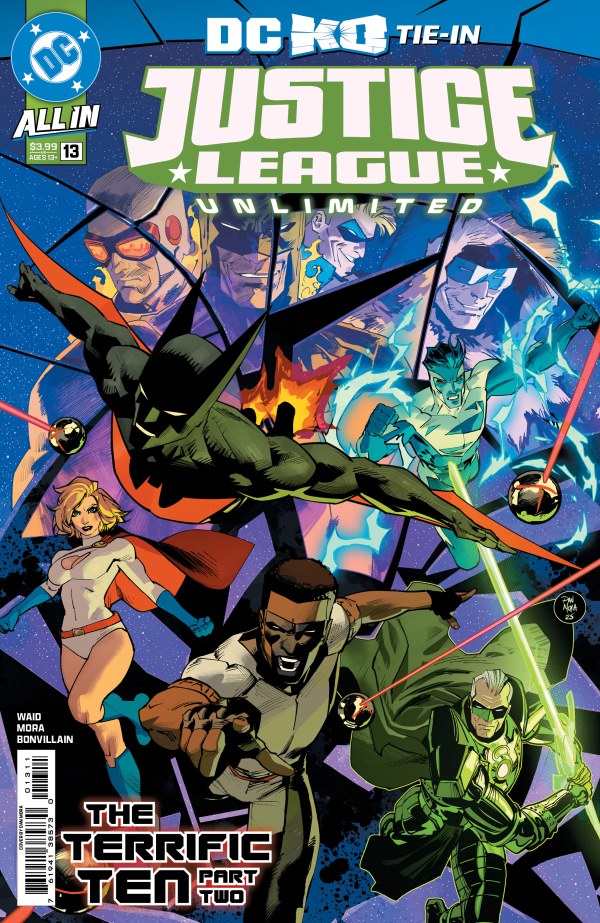
Year of Superman Week 26: Playing Catchup, Random Choices, and a Tribute to Jim Shooter

Back home from our trip, it’s time to play catch up. I hit the local comic shop on Wednesday to grab a few weeks’ worth of comics, and I’m going to start week 26 by going over the Superman-related titles in the mix. Let’s see what we’ve got!

And as always, you can check out earlier blogs in the Year of Superman Archive!

Wed., June 25

Comics: Action Comics #1087, Supergirl Vol. 8 #2, Superman Vol. 6 #27, Superman Unlimited #2

Notes: The Mark Waid era of Action begins! I’ve been excited for this one ever since they announced he was taking over this title with a feature on Superboy. Ever since 1986, DC has gone back and forth several times over whether Clark Kent ever had a career as Superboy in-continuity. It looks like this series is going to finally settle the question once and for all…or at least until some new editor comes in and decides to change it again. But until then, I’m psyched to enjoy the ride.

Let’s hear it for the Kid of Steel!

Action Comics #1087 has Clark Kent – as an adult – reminiscing about an “Expo of Tomorrow” he attended with his parents when he was 15 years old, and how an encounter with a villain on that day would shape the rest of his life. Have we seen the story of Superman’s public debut before? Yes, dozens of times. Does that make me any less thrilled with the comic I just read? Not in the slightest.

Like I said, we’ve seen the story of SuperMAN’s debut over and over again. This is different. This is SuperBOY – a Superboy whose powers are new to him, who has never been in a fight before, and who’s wearing red converse sneakers instead of boots. He’s determined to do good, but at this embryonic stage he’s still trying to learn how. Fortunately, he’s got Jonathan and Martha Kent in his corner. Jonathan has taught him about the lost heroes of the Golden Age, drilled him relentlessly on their feats and adventures, so he could get a feeling for the heroic ideal. And when the time comes to prove himself…well, it doesn’t go as smoothly as it might go today, but it’s an authentic, entertaining, and uplifting story. Waid – who is also currently restructuring the timeline of the DC Universe in another miniseries I’ll get to shortly – is the perfect person to reintroduce the adventures of Superman when he was a boy. 

So embarrassing when someone shows up wearing your outfit.

Sophie Campbell’s Supergirl #2 picks up where the first issue left off – there’s a second Supergirl in Midvale who seems to have captured the hearts of the town. And I have to admit I was pretty tickled when I realized that the fake Supergirl was actually a new incarnation of Lesla-Lar, the Kryptonian doppelganger that we read about back in Supergirl Week. This time around, Lesla is a Kandorian with something of an obsession with Supergirl who convinces herself that she could do the job better than the genuine article. She finds a way out of Kandor, mesmerizes the Danvers, and transforms herself into a near-duplicate of Kara Zor-El (which is much better than her being just a random lookalike as in the Silver Age). Lesla also manages to tamper with Kara’s costume, causing her to turn to a friend for help: Lena Luthor.

I’m already loving this version of Supergirl. There’s a sweetness to the book, a sense of humor that more recent versions of Supergirl haven’t had. Campbell is also already doing the legwork of building up Kara’s supporting cast, and Lena makes for a fantastic addition. The two of them acknowledge that things have gone kind of sideways between Superman and Lex, but they don’t let it affect them – and in a genre where stupid misunderstandings are used to cause conflict more often than a comic gets variant covers, that’s a wonderful change of pace. Campbell’s Supergirl is already one of my most-anticipated books from DC each month. 

Oh geez, he’s got that “I’m so disappointed” look on his face. I HATE that.

In Superman #27, Lois is still reeling from the loss of her Superwoman powers, while Superman is struggling with a sudden burst of Red Kryptonite energy. Meanwhile, Mercy and Lex have a heart-to-heart. This is kind of an odd issue – part two of “Superman Red” seems to be an epilogue of sorts. This issue, combined with the previous one, feels like it was intended to tie off some of the plotlines that have been running through this series since the first issue, clearing the table for next issue’s new storyline to dive headlong into the greater mystery of DC All In. That’s not necessarily a bad thing, but it does make the issue feel a little weak on its own. 

This is why you don’t go into bars in some of the seedier parts of Daxam.

Superman Unlimited #2 continues Dan Slott’s inaugural storyline. The enormous Kryptonite meteor that landed in the country of El Caldero has upended everything, making the tiny nation one of the most economically prosperous countries on Earth overnight. But black market Kryptonite is getting into the hands of villains everywhere, which I’m sure you can imagine causes some problems for the Man of Steel. Meanwhile, Lois is launching the new global Daily Planet initiative, and only one man seems to remember the fact that Kryptonite is NOT only harmful to Kryptonians – unfortunately that one man is Jack Ryder.

Slott is having a lot of fun with the pieces here. He finds a new angle on Superman’s little-used solar flare power, and in so doing manages to escalate the stakes of the Kryptonite storyline just a little (which is about all you want in chapter two of a storyline). I’m also glad that he hasn’t ignored the fact that Kryptonite is, in fact, radioactive. I don’t know that it’s necessarily public knowledge that it once gave Lex Luthor cancer, but that’s certainly the sort of thing that would become scuttlebutt and whispered rumors and make its way to a conspiracy theorist podcast, which seems to be how they’re casting Jack Ryder now. It’s a good fit, and it gives a good reason for the Creeper to show up at a crucial moment in the story that turns out to make things even more complicated. 

The strange thing is that, although the consequences of this storyline are obviously global, Slott manages to give us a perspective that keeps things smaller. It’s mostly about Superman and how he deals with the problem, and while all the seeds are here to make this a story that can (and, logically, should) impact the entire DC Earth, he’s building to that instead of going to planet-wide societal upheaval right from the jump. There’s a build here that I appreciate, and it makes it even more exciting to anticipate the next issue.

Thur., June 26

Comics: Justice League Unlimited Vol. 2 #8, Batman/Superman: World’s Finest #40, New History of the DC Universe #1, DC X Sonic the Hedgehog #4

No, Superman IS on this cover. Look between Aquaman and Wonder Woman. No, lower. There ya go.

Notes: Continuing today with the recent releases, I’m kicking it off with Justice League Unlimited #8, the end of Mark Waid’s “We Are Yesterday” crossover. With Grodd having absorbed the Omega Energy of the late Darkseid and scattered the Justice League throughout time, Air Wave has done his best to compensate – bringing heroes from across the time stream to the present to aid them in their battle. 

I don’t want to talk too much about what happens here – I hate spoilers, after all – but if you’re the kind of person who likes crazy superhero battles, this will be eminently satisfying to you. It’s an exciting book with gorgeous artwork and a genuinely surprising ending. I’ve got no idea where Waid is going with this, although its significance to the overall story arc that seems to be “DC All In” is abundantly clear. If you’re following what’s going on in the DC Universe, you really can’t afford not to be reading this book. 

It’s like that time King Kong interrupted Johnny Carson.

Waid is also doing his thing in Batman/Superman: World’s Finest #40. With “We Are Yesterday” over, this book settles back into its usual groove of telling stories of the World’s Finest heroes in the past. In this particular issue, Perry White and James Gordon are guests on a podcast together when a kaiju attacks, so Batman jumps into a giant robot he’s had prepared for just such an occasion and joins Superman in taking it down. And once again, friends, I would like to point out that occasionally this whole Year of Superman blog allows me to type sentences like the preceding, and that makes it all worth it.

I’ve got to be a little forgiving for the setup of this issue. The podcast in question is – like Jack Ryder’s show in Superman Unlimited – of the shock host variety. Jim Gordon is ostensibly there to defend Gotham from the hosts’s recent attacks, while Perry is there to defend print journalism, but that doesn’t really explain why they’re on the SAME episode, except to provide a (paper-thin) excuse to have Lois, Clark, and Bruce all in the same building when the giant monster shows up. But it still makes more sense than 90 percent of Silver Age contrivances, and the rest of the issue is a load of fun, so I give it a pass. 

This one is for all you Arion: Lord of Atlantis fans out there.

My Mark Waid triple feature continues with the first issue of New History of the DC Universe, a comic that is, frankly, a long time in coming. With reboots both hard and soft having plagued DC Comics for decades, I welcome an attempt at creating a definitive timeline, establishing which heroes and stories are canon to the current incarnation of the DCU. Now the pitfall of such a project is that canon only remains canon until the next person down the line decides to change it, but for now at least, I think we can accept this book as being THE history, and there’s no better person to write it than Mark Waid. 

The series is framed as a history of the universe as compiled by Barry Allen, who has a better idea than most of just how time has been monkeyed with over the years. And while the connection to Superman actually doesn’t come in until literally the last panel of the last page, I felt like it deserved mention here in the blog, if for no other reason than how impressive it is that Waid  and co-researcher Dave Wielgosz (who provides a remarkably detailed index at the end of the book) have crafted a timeline that works. There’s nothing here that doesn’t make sense, and Waid even takes the opportunity to canonize several characters whose existence in the current DCU may have been suspect, such as the original Red Tornado, the Alpha Centurion, and – strangely enough – Robin Hood. Yeah, that one. Pretty much the only thing he DIDN’T mention is Hugo Danner from Gladiator, who I mentioned a couple of weeks ago was the father of the Young All-Stars member Iron Munro (although Munro and the All-Stars DID merit inclusion). 

Most shocking of all, however, is a panel that places into the timeline the arrival of a Terminian alien who crashes to Earth and is adopted by a human couple – on a plantation in the American south in the 1800s. This baby will grow up to be Milestone Comics’ Icon, a character I’m planning to cover in a later week where I discuss characters clearly intended to be the Superman of their respective universes. This is the first I’ve heard of any plans to put the Milestone characters back in the DC Universe proper, and I’m very interested to see if Static, Blood Syndicate and the others show up when we reach their respective point in the timeline in future issues. 

At any rate, this book is essentially required reading for any fan of the DC Universe, and I can’t recommend it enough. 

Now HERE’S a race I wanna see.

Last but not least, Ian Flynn wrote DC X Sonic the Hedgehog #4 (instead of Mark Waid), but he did a great job with it. Last issue focused on Team Sonic stuck on the DC Earth, while this issue gives us the reverse of that, with the Justice League trying to keep things from falling apart during Apokalips’ attack on Sonic’s world. There’s a particularly entertaining exchange between Superman and Dr. Robotnik that I really enjoyed. As I’ve said when I wrote about this book in the past, it’s nothing groundbreaking, but darned if it isn’t fun. 

Fri., June 27

Movie: Superman Returns (2006)

Notes: After a cinematic absence of many years, Warner Bros poached a filmmaker who had success making films with Marvel Comics characters and handed him the reigns of the Man of Steel in the hopes of evoking the feel of the Richard Donner era, bridging Superman back to greatness. There’s a sentence that’s as accurate today as it was in 2006, when Brian Singer directed Superman Returns. Unlike James Gunn’s Superman or Zack Snyder’s Man of Steel, Returns was a direct sequel to the Christopher Reeve films, or at least the first two of them. The conceit here was that, some time shortly after the events of the second film, astronomers located the former location of Krypton amongst the stars, and Superman went into space in hopes of finding his heritage. He found, instead, only rubble, and returned to Earth five years later to a world that had changed greatly in his absence. 

This is one of those movies that was unfairly maligned in its day, although it’s also a movie that has grown dramatically in the estimation of the public since then. Brandon Routh did his best impression of Christopher Reeve, both as Superman and as Clark Kent, and created a character that both evoked and paid tribute to the hero so many of us had grown up with. And although Kevin Spacey has quite rightly been cancelled since the movie came out, it would be disingenuous not to admit that he did a magnificent job channeling Gene Hackman’s Lex Luthor.

Why, then, did this movie not land? There are a few reasons. I think the premise from which it begins is flawed in and of itself. It’s hard to imagine Superman abandoning Earth for such a long time, even in the name of seeking out Krypton. As much as this planet and its people mean to him, there’s no logical way he’d head out that way without some sort of concrete reason to. Looking at rubble isn’t good enough, and there’s nothing in the movie to indicate he was given ANY hope of finding something more substantial. To be fair, though, it’s possible that a more reasonable explanation was part of the story at some point but got filtered out by Hollywood’s classic “too many cooks” problem.

There are bigger problems in credulity when it comes to maintaining Clark Kent’s secret identity. There have always been jokes about how the glasses function as a disguise, but it’s even harder to imagine nobody – not even Lois Lane – would EVER question the fact that Clark went away at the same time that Superman left Earth then returned to the Planet at the same time that Superman returned to the…well… planet, with a lowercase “p.” 

But the big elephant in the room is Jason White, Lois’s little boy whom everyone believes is the child of her fiancé, Richard White, even though it’s blindingly obvious to the viewer that he’s actually the son of Superman. I don’t object to Superman being a father – I think that’s pretty clear from the stuff I’ve written about Jon Kent in the comics – but I have to draw the line at the TIMING. If Jason is Clark’s son, he obviously had to be conceived before he left Earth, and yet nobody – not even Richard – seems to question Lois when she says he’s Richard’s kid. That would mean she would have to have been involved with him at the same time as she was with Superman (presumably their dalliance in Superman II). So why does everybody in this movie act as if Richard is hands-down Jason’s father? Even if Richard knows Jason’s not his, there’s a moment where he questions if Lois was ever in love with Superman, subtly implying he wants to know IF she ever hooked up with him. So who does HE think Jason’s father is? It just doesn’t piece together. 

Of course, that leads me to the biggest problem I have with this movie: Kate Bosworth’s Lois Lane. I feel like I’ve made it profoundly clear how much I admire the character of Lois Lane when she’s written well – her intelligence, her integrity, her courage. Bosworth’s Lois doesn’t display ANY of that. There’s a softness to her that doesn’t belong to Lois Lane no matter how you slice it, and I never believe the chemistry between her and Routh.

All that said, the good in this movie outweighs the bad. Routh’s Clark Kent/Superman, Frank Langella’s Perry White, Sam Huntington’s Jimmy Olsen – all of them work. John Ottman’s score is a nice build on the classic John Williams themes. And there are some sequences in this movie that are legitimately stunning even 19 years later: the scene where Superman saves the plane (obviously inspired by John Byrne’s Man of Steel) is a total thrill ride throughout. Little moments, like when he gets shot in the eye and we see a close-up of the bullet crunching, or the scene where he holds up that famous green car from Action Comics #1 – all of that works for me, and works very, very well.

Wait, where’s the dude running away in a panic in the lower lefthand corner?

Despite its flaws, this movie and Brandon Routh deserved better than they got. A good sequel COULD have been made, even though Warner Bros. decided instead to go another way. I’m just glad that Routh got a shot at redemption during the Arrowverse’s Crisis on Infinite Earths event, where he showed off how good a Superman he was. 

Comics: Metamorpho: The Element Man #6 (Guest Appearance), Zatanna Vol. 3 #5 (Cameo)

Sat., June 28

Graphic Novels: Superman: Emperor Joker (Collects Superman Vol. 2 #160-161, Adventures of Superman #582-583, Superman: The Man of Steel #104-105, Action Comics #769-770, and Superman: Emperor Joker #1), Superman: The Last Son (Collects Action Comics #844-846, 851, Annual #11)

This is why I’d rather play Uno.

Notes: Although my Superman On-The-Go week is over, there were a few graphic novels I downloaded but didn’t get around to, so I thought I would dip into those today. First off was Emperor Joker, a two-month event from the four Superman titles in 2000. Superman wakes up in a world that has gone mad: he is imprisoned in Arkham, his powers diminished, and Bizarro is the leader of a JLA made up of amplified versions of villains. He can’t remember how the world got this way, nor does he remember what the world was like before, but it’s clear that something is wrong. Lois Lane is a corporate CEO, Superman is a fugitive on the run, and Mr. Mxyzptlyk is trying desperately to find him. 

I think it’s important to note that, although the storyline is known as “Emperor Joker” TODAY, that wasn’t the case when it first came out. The first four issues were published under the title “Superman: Arkham,” and the one-shot that comes in the middle (the fifth chapter of the story) was solicited as Superman: Emperor ?. This was back when things like the evil mastermind who has transformed the entire world were actually kept SECRET, instead of being published in Entertainment Weekly the day before the comic actually comes out. The reveal didn’t come until chapter four, when Mxyzptlk tells Superman that the world has been taken over by a godlike Joker. Turns out Mxy thought it would be fun to give the Joker a teeny bit of his own power – about 1 percent. But he didn’t reckon with the madman’s cunning, and Joker wound up taking 99 percent of Mxy’s fifth-dimensional abilities and reshaped the entire world in his own insane image. The real Justice Leaguers are pathetic creatures, hunted as villains, and only Mxy and Superman know what’s wrong. Superman manages to recruit this world’s versions of Superboy, Supergirl, and Steel to his cause, and they set out on a quest to find the one man who can defeat the Joker: Batman.

There’s good and bad in this story. It’s a nice change of pace, first of all, to put that much power in the Joker’s hands and have Superman have to deal with it. There’s also some meta-commentary in here about the power of faith and how it restores the changed heroes, as well as an interesting note about how the Joker’s obsession with Batman prevents him from eliminating his enemy entirely and, therefore, leaves the window open for his own defeat. 

But there are some moments of disconnect in here as well. This was in the waning days of the “Triangle Era,” and by this point all of the creators who had made that a golden age for Superman fans were gone. This isn’t to say that any of the creative teams of the time (Jeph Loeb and Ed McGuinness on Superman, J.M. DeMatteis and Mike S. Miller on Adventures, Mark Schulz and Doug Mahnke on Man of Steel, and Joe Kelly and Kano on Action) weren’t doing good work, but there was a disconnect and it showed. This was especially evident in the artwork: things like Lois’s hairstyle and Steel’s armor varied wildly from issue to issue. It would be easy to dismiss this as just part of the Joker’s madness manifesting itself visually, but if that’s the case, it should happen constantly and be noted in-story rather than just flip when a new penciller takes over the next chapter. 

It’s a good story, a story I remember enjoying when it was first published and I still enjoy now, but there are things that could have been better. 

“The Last Son” has a different meaning when it’s Superman than, say, the Duggars.

Next was Superman: The Last Son, a storyline from 2006. In this one, a spacecraft crashes in Metropolis and, inside, Superman finds a young boy who speaks Kryptonian. The child is initially sought out by the government (because duh), so Superman helps him escape into hiding and crafts a new identity for him – Christopher Kent, whom he tries to pass off as the child of a late cousin – and tries to convince Lois that they should adopt him. The point might become moot, however, when the child’s REAL parents arrive on Earth: General Zod and Ursa…and they want their son BACK.

Geoff Johns co-wrote this one with his former boss and mentor, a guy who’s somewhat familiar with Superman, director Richard Donner. This is probably most evident in the scenes where Superman consults the crystal with the memories of his late father, Jor-El. Artist Adam Kubert doesn’t go so far as to try to draw Jor-El to resemble Marlon Brando, but Johns and Donner absolutely write the character with Brando’s voice, with speech patterns and mannerisms that feel very on-mark for the version of Jor-El from the 1978 movie. 

This is one of those stories that I find most interesting in retrospect. It was a great story (if unforgivably delayed at the time), but there are a few things established here that are kind of hilarious in perspective of how the characters would change a decade later. When Clark tells Lois he wants to adopt the Kryptonian boy, she objects. He’s too busy being Superman, she says, whereas she’s too busy being a reporter. Neither of them, in her opinion, are meant to be parents. There are also moments where both Ursa and Jor-El insist that Lois, as a human, could not conceive a child with a Kryptonian. All of them, of course, would turn out to be wrong, as the Convergence event in 2015 gave us Jon Kent. (In fairness, Superman had no powers when Jon was conceived, so Lois’s pregnancy seemed relatively normal. But still.) 

This wasn’t the last story with Chris Kent – named, I should mention, in honor of the recently-departed Christopher Reeve. Like Jon, though, he’d turn up again later having aged and become a hero of his own. He’s back in the DCU these days, a kid again, but he now goes by his birth name of Lor-Zod and seems to be following his father in the family business (being evil), so it would seem that this story probably isn’t considered canon anymore. And that’s kind of too bad, because if you look at it from a certain angle you could see Lois’s experiences with Chris as changing her mind about motherhood, helping to shape her into the Supermom she would turn out to be. If nothing else, it’s cool to read a comic book that was shaped by Donner himself. 

Comics: Justice League of America #27, DC Vs. Vampires: World War V #9 (Supergirl, Steel appearances)

Sun., June 29

Comics: The Superman Monster #1

“Braaains…”
“That’s ZOMBIES, Klaus.”
“Oh — um — FIRE BAAAAAAD…”

Notes: On a rainy Sunday afternoon, I scroll through the DC Universe app looking for today’s Superman reading and – for no particular reason – I decide to click open The Superman Monster. This is an Elseworlds one-shot from 1999, written by Dan Abnett and Andy Lanning with art by Anthony Williams. As you may have guessed from the cover art or the title, this is a mashup of Superman with Mary Shelley’s Frankenstein. This is a fun little combo for me – my favorite superhero and my favorite monster. Two great tastes that taste great together.

In 19th century Ingolstadt, we meet Vicktor Luthor, a man of science. Vicktor is engaged to the lovely Eloise Edge, but he carries a dark hunger within him, an urge – since the untimely passing of his parents – to find a way to conquer death. That path is opened up to him when he finds a mysterious metal shell in the woods, a craft from another world. Inside are the skeletal remains of its only passenger, along with a holographic message from someone called Jor-El, father of the vessel’s deceased inhabitant, carrying with it the knowledge of an alien world. Luthor uses the alien remains and alien knowledge to bring to life a creature – a being of immense power, but who quickly spins out of Luthor’s control.

I’m a teacher (I may have mentioned that once or twice), and my honors seniors study Mary Shelley’s Frankenstein every year, so I have more than a passing knowledge with the book, which is really quite different from the Boris Karloff movie that most people think of when they think of the Frankenstein Monster. I’m surprised, then, to see just how good an adaptation of the novel this comic book actually is. Oh, obviously it’s not an exact 1-to-1 adaptation. There are no aliens or holograms in Shelley’s novel, for instance. But the comic actually brings in a lot of the little moments from the book that adaptations often leave out. The kindly family in the woods that the creature tries to find shelter with become the kindly older couple the Kants, mourning the loss of their son Klaus, who take the creature in. (It’s a happier relationship here than in the novel, but the ending is no less tragic.) Eloise becomes a substitute for the Bride of Frankenstein, who is built but never brought to life in the book.  In truth, Shelley’s themes mesh together with the Superman legend surprisingly well.

Then there are the odd moments, things that feel like a DC editorial mandate. The hologram that Luthor finds, for instance, is Jor-El wearing the clothing of the John Byrne era. Sure, that was the style of Jor-El in the comics at the time, but this is an Elseworlds – we’ve changed the inhabitants of Metropolis to German villagers in the 19th century and Superman into a walking corpse, but redesigning Jor-El was verboten for some reason. While the artwork throughout it pretty strong, little things like that take me out of it just a little bit. You don’t see stuff like that these days – look at a modern story like Dark Knights of Steel and there’s no attempt to adhere to current designs, nor should there be. 

This is the kind of thing that really sets DC’s Elseworlds apart from Marvel’s What If? series, at least back then. Whereas the What If? stories traditionally used the main Marvel Universe as a starting point and then spun out an alternate history, Elseworlds could (and usually did) posit a story that never could have happened in the comics and followed them to a conclusion. These days, the two franchises have kind of moved closer together, where either can be used for either type of story, but for 1999 this was a quintessential Elseworlds yarn. It’s not so far off the mark that you can’t recognize Superman for what he is, but at the same time, it’s a take from a different angle, a fun sort of combination with a different story, not unlike Superman’s Metropolis, Batman: Nosferatu, or Green Lantern: 1,001 Emerald Nights. It’s too bad, with all the other Elseworlds characters that have cropped up in the Multiverse, that we haven’t seen the Superman Monster again. 

I own this book, so I’m sure I’ve read it before, but it’s been long enough that I forgot most of it. I’m glad I read it again, but if I’m being honest, I kind of wish that I’d held off until October and worked it into some Super Halloween reading. Ah well, I’m sure I’ll find other seasonally appropriate stories when the time comes. 

Mon. June 30

TV Special: Superman’s 50th Anniversary: A Celebration of the Man of Steel

And he doesn’t look a day over 87.

Notes: With the movie (THE movie) coming out next week, I’ve got a list of very specific things I’m going to hit in the week preceding it…but I’m a bit aimless as to how to finish up THIS week. Not quite feeling like hitting the DC app this morning, I decided to scroll through my list of things to watch, and more or less randomly decided to go to YouTube, where I’ve found the 1988 CBS television special Superman’s 50th Anniversary: A Celebration of the Man of Steel. Sorry to all the Kate and Allie and Designing Women fans – the special makes it clear at the beginning that those shows won’t be airing tonight, but they’ll be back next week.

This special, celebrating Superman’s 50th, starts with a narrator telling us Superman’s origin overlaid on footage from the original Superman movie serial from 1948 – until the planet explodes and we shift to the 1978 Richard Donner/Christopher Reeve movie. Apparently, in the universe of this special, Krypton is in black and white, whereas Earth is in color. Then we meet Dana Carvey, “Chief Historian of the Junior Supermen of America,” who promises to explore Superman’s history and interview some of the people who know him best: “The Metropolotians.”

Oh man – this whole special is gonna be a bit, isn’t it? 

In fact, it turns out to be far more schizophrenic than that. The special is a bit of a history, using clips from pretty much every incarnation of the character at this point (Kirk Alyn, George Reeves, Christopher Reeve, and the Fleischer cartoons). And some of the narration is actually on-point – in a discussion of Superman’s powers, for instance, Dana Carvey mentions how Superman couldn’t actually fly in the early days, but instead jumped from place to place before he developed into – and I quote – “the Nijinsky of the air.”

We get interviews with people involved with Superman, like Christopher Reeve, but then it bounces to comedians in-character. Fred Willard, for instance, plays the Deputy Mayor of Metropolis desperately trying to emphasize that there are things in the city beyond JUST Superman – museums, for example. The Amazing Kreskin talks about how his powers are different than Superman’s. Hal Holbrook shows up in a (rather unimpressive) Superman costume preparing for his one-man show about Superman’s life, an apparent follow-up to his one-man show about Mark Twain. The golden moment here is Noel Neill appearing as Lois’s mother, Ella Lane, describing how she’s tried to talk her daughter out of chasing that Superman because he’s just never going to settle down. Then just seconds later, the goodwill is thrown out in a groan-inducing interview with Jan Hooks as a woman who claimed to have a fling with Superman and whose “hybrid” child is half-Superman. “He’s got X-Ray vision, but only in one eye, so he gets terrible headaches.”

I guess that’s supposed to be funny?

The special was produced by Lorne Michaels of Saturday Night Live, which is no doubt why so many SNL cast members past and present appear…but it doesn’t seem to know what it wants to BE. Is this a celebration of Superman or a parody? A sketch show or a documentary? It tries to be both, but it CAN’T.

There are some nice moments, though – a brief interview with Kirk Alyn where he talks about how much he loved playing Superman and how proud he was to be the FIRST Superman on screen. Jack Larson, the Jimmy Olsen from the George Reeves series, similarly gives a brief but sweet interview. John Byrne also gets an interview where he discusses how Siegel and Shuster pulled the character together and sold him to DC Comics – again, it’s a good moment, but far too short. 

There is, however, one moment that makes watching the entire special worthwhile for me: RALPH NADER. Remember back in “Super-Sponsor Week,” when I took to YouTube to find different Superman-related commercials, and I found a bit with Ralph Nader doing a sort of public service announcement warning people only to buy their Kryptonite from a legitimate dealer? I had no idea where that commercial came from or why it exists. So I hope you can imagine just how excited I was when it showed up as PART OF THIS SPECIAL. The mystery is solved. I can finally get a decent night’s sleep again. 

I’m not sure how I feel about this special, honestly. They tried to do a real dip into Superman’s history at some moments, which kind of undermine the in-universe comedy bits. The comedy bits, on the other hand, make the real world segments feel entirely out of place. I wish they had picked one path to take and stuck with it rather than this halfhearted attempt to have their cake and eat it too.

TV Episode: Super Mega Cakes Season 1, Episode 1: “Superman.”

Looks good enough to eat, right?

Notes: True confession time. I like TV baking shows, and when I saw the ad for this new one — Super Mega Cakes — scroll across my screen at some point, I realized I would have to watch at least the first episode. Celebrity baker Duff Goldman and his team is tasked with competing against six teams of non-celebrity bakers, baking six mega cakes in battle at the same time. And because this is a Food Network show and therefore part of the Warner Bros/Discovery umbrella, at least for the next five minutes, some of the themes are connected to specific IP. One baker’s theme is Classic Cartoons (with the Looney Tunes and Tom and Jerry specifically shown). Another gets an “ocean predators” theme, and I just BETCHA that episode will be airing during Shark Week. But for the first episode, the one that I’m talking about today, the pitch is Superman-themed cakes.  

The Superman battle pits Duff against baker Elizabeth Rowe, who decides to base her design on a scene in the trailer for the new movie (did I mention there was a new movie coming out?) in which a Kaiju attacks the Daily Planet office. Part of the requirements for the cake is that there has to be an animated element, so Rowe decides to have Clark, mid-change to Superman, turn his heat vision on the monster (although Rowe and her team constantly refer to his power as “laser eyes,” and part of me is rooting for her to lose just because of that). She’ll also have Lois brandishing a fire extinguisher, which is a cute touch. The final requirement that was mentioned is that the flavor of the cake has to be inspired by the theme, so Rowe decides to do a peanut butter filling because “Superman loves peanut butter.”

You know what? Superman used to SELL peanut butter, so I’m gonna allow that.

Team Duff, on the other hand, plans a three-foot tall Superman figure bursting out of the Fortress of Solitude made out of ice. Superman will be accompanied by Krypto, because Krypto is also in the new movie. (DID YOU KNOW THERE’S GOING TO BE A MOVIE?) But when Duff’s partner Ralph sees just how big Elizabeth’s kaiju is shaping up to be, he upscales the figures of Clark and Krypto to life-size. Duff’s tasting element is rhubarb jam, because Clark loves Martha’s rhubarb pie. (My wife: “Y’all nerds know way too much about this man.”) For his animated element, Supercake is going to use his (correctly-named) heat vision to carve an S-shield in the ice. 

I’m not going to go into a blow-by-blow of the whole episode. If you like these kinds of shows, you probably know how it goes – we watch the cake artists at work, we see them overcome unexpected obstacles, there’s a confessional segment where they tell about some sort of personal hardship that makes you want to root for them DESPITE the fact that they keep calling it “laser vision,” the music gets super-duper intense just before the timer runs out and then, BAM! There’s a ridiculously impressive cake. And I gotta tell ya, the cakes DO look amazing. 

Damn. Now I want cake. 

Comics: DC Vs. Vampires: World War Z #10 (Appearance by Supergirl, Lois Lane)

Tues., July 1

Comics: Adventure Comics #346-347

Notes: Once again, I find myself faced with the sad duty of eulogizing someone here in the Year of Superman blog, as yesterday afternoon we were told of the passing of Jim Shooter at the age of 73. Shooter was perhaps one of the most remarkable comic creators of all time – certainly possessing the most unique history. At the age of 13, he submitted a story to DC Comics featuring what he considered, at the time, one of DC’s weakest properties: the Legion of Super-Heroes. Not only did editor Mort Weisinger buy the story from Shooter, but at the age of 14 he was hired as the regular writer for the Legion’s tales in Adventure Comics. Shooter would go on to write other comics for DC, including – among many others – the very first ever race between Superman and the Flash from Superman #199. He wrote a variety of comics for DC, many of them part of the Superman family, for about a decade before he bounced over to Marvel Comics. There he eventually rose to the position of Editor-In-Chief, spearheading Marvel’s New Universe line and writing their first major crossover event, Marvel Super-Heroes Secret Wars. After leaving Marvel, Shooter founded Valiant Comics, as well as other enterprises that perhaps are not remembered as well.

Although sometimes a controversial figure (word has it that he wasn’t always the easiest editor to work with), Shooter is one of those figures whose stamp on the comic book landscape is undeniable. Both as a writer and an editor, he is responsible for some of the most significant and memorable stories and characters in comic book history.

So to commemorate him, I decided today to go back and read a story I didn’t get to back in Legion of Super-Heroes week: his first ever Legion story, a two-parter from Adventure Comics #346 and #347 – a story written by a 13-year-old boy. (Take THAT, 17-year-old Mary Shelley creating Frankenstein.) 

Hint: The traitor is the one who isn’t mentioned in any OTHER Legion stories of the past 60 years.

In the shockingly-titled “One of Us is a Traitor” Superboy, serving as interim leader, introduces four new young heroes all vying for Legion membership. Princess Projectra has the power to cast illusions! Nemesis Kid has a strange “alchemical” power that allows him to defend himself and defeat any foe! Ferro Lad can transform into living iron! And Karate Kid’s skill at Martial Arts is ALMOST enough to allow him to defeat Superboy! All four are unanimously accepted as members of the Legion. 

Before the Legion has even had a chance to welcome their newbies, though, a new threat rears its head: Garlak, warlord of the distant world of Khund, is threatening to invade Earth if the planet doesn’t surrender in one hour. And just in case Superboy gets any smart ideas, he warns them, he has a healthy supply of Kryptonite weapons. Superboy splits the Legion into three teams to protect Earth’s three defense towers, but in private, Garlak gloats that he’s already slipped a spy into the Legion ranks to guarantee his success. And in fact, when the first of the defense towers is attacked, Phantom Girl is left questioning Karate Kid’s loyalty to the team when he sends her away at a critical moment and the first of Earth’s three defense towers is destroyed.

In part two of the story, Superboy leads an air-squad to defend the second tower, but their Kryptonite weapons weaken him and the tower is lost. Checking on the Legionnaires who were supposed to defend it on the ground, they find their teammates unconscious, temporarily incapacitated by a gas attack, with one person missing – Karate Kid. Racing to Legion HQ, they find Karate Kid standing over the wreckage of the Legion’s arsenal, but when Superboy shouts out, “All right, Kid! The game’s up!” it is not Karate Kid who steps out to confess, but Nemesis Kid. He’s already signaled the Khund to attack, and plans to be richly rewarded as Earth perishes. But Superboy isn’t without his own tricks – he reveals a secret fourth defense tower that helps fend off the Khund as the Legion takes the fight to their spacecraft. Karate Kid proves his worth by singlehandedly capturing the Khund leader, but Nemesis Kid’s powers allow him to teleport away, and Superboy is left wondering if they’ll ever see him again.

He’s no Daniel LaRusso, but let’s see Jaden Smith’s Karate Kid do THAT.

First off, if you didn’t already know, there’s no way in hell you would EVER guess this story was written by a 13-year-old. Not only does it fit with the style of the other DC Comics of the 60s, it’s BETTER than most of them – a more intense story, sharper characterization, and while Karate Kid is obviously a red herring from the beginning, most red herrings at this time were obvious. The only knock I could give this story is the kind of lame way that Nemesis Kid reveals himself: “Oh, Superboy said ‘Kid.’ He must be talking to me and not the guy who’s literally standing over the destroyed arsenal, whose name also happens to have ‘Kid’ in it. Better give myself up.” But even THAT isn’t any lamer than most other stories of the time, and I can easily give it a pass.

What’s more, in his first story, Shooter has contributed SEVERAL lasting elements to the Legion of Super-Heroes: Projectra and Karate Kid would go on to have long, storied careers with the Legion (to date, Karate Kid and Mon-El, using the name Valor, are the only Legionnaires to ever get their own ongoing comic book series). Ferro Lad’s time as a Legionnaire was cut tragically short, but as the first Legionnaire to die (and stay dead) in battle, he left an indelible mark on the franchise. Kind of like Tasha Yar on Star Trek: The Next Generation, Ferro Lad turned out to be more important in death than it was in life. And even the bad guys from this story, the Khunds, would go on to be long-time alien antagonists not only for the Legion, but even in the DC comics set in the present day, although it should be noted that the Khunds would change to a more alien-like appearance, whereas in this story Shooter and artist Sheldon Moldoff (working off Shooter’s thumbnail sketches, no less!) kind of made Garlak look like Attila the Hun in space. 

Not a bad first day on the job for someone whose contemporaries made their money delivering newspapers.

Thank you, Mr. Shooter from the hearts of the fans of the Legion. And Superman. And major crossover events. And the Valiant Comics characters. Let’s face it, you had your hand in everything, and we’re all better for having your work in comics. 

Blake M. Petit is a writer, teacher, and dad from Ama, Louisiana. His most recent writing project is the superhero adventure series Other People’s Heroes: Little Stars, volume one of which is now available on Amazon. You can subscribe to his newsletter by clicking right here. You can join in the Kryptonian Konversation every day in the Year of Superman Facebook Group!

Year of Superman Week 25: Superman-On-the-Go

This will be a slightly odd week in the blog, at least for me. I’m loading up this morning (June 18th, as I write this) to take a trip with my wife and son to Pittsburgh to visit some family and friends, and it just so happens that our travel days (today through Tuesday the 24th) exactly match up with my Year of Superman weeks. In other words, for the next week I’m gonna be on the move. 

So to make certain that I’m going to be able to keep up, I’ve gone to the DC Universe Infinite app and downloaded several Superman-related graphic novels. As I’ve said before, I’ve got a massive list of comics I’m interested in reading before this year is out, but for this trip I’ve downloaded full trade paperbacks, most of which comprise a single story or theme. I’ve also deliberately selected books that don’t necessarily fit into one of the theme weeks I’ve got planned. So while this week may seem a little random to you, it’s going to be less random for me. 

And as always, you can check out earlier blogs in the Year of Superman Archive!

Wed., June 18

Graphic Novels: Superman: Kryptonite (Collects Superman Confidential #1-5, 11); Superman Unchained (Collects issues #1-9)

Notes: The plan for this trip, especially on travel days like this one, is to read the graphic novels I’ve downloaded on the DC app, which theoretically I should be able to do even once airborne, even if I stubbornly refuse to pay eight bucks for a wi-fi connection on the one-hour flight from New Orleans to Nashville. My flawless plan lasts until approximately four minutes after takeoff, when I discover that the book I chose to begin with — Superman: Kryptonite by the sadly late creative team of Darwyn Cooke and Tim Sale — failed to download properly and I can’t finish reading it. I know from experience that the only way to deal with this particular problem is to delete the book and attempt to re-download it once I have wi-fi, presumably in the Nashville airport. However, the moment I delete the book, the entire app crashes. I try multiple times to restart it, clearing the cache, even restarting my tablet,  but all efforts are met with failure. I know — also from experience — that it will be impossible to solve this problem in the air, so I surrender and return to the prose book I am currently reading, Teenagers From the Future, a collection of essays about the Legion of Super-Heroes edited by Timothy Callahan.

The DC app has existed, in some form or another, since 2018, and these kinds of technical problems have been constant. Through two phones and three tablets, I’ve never had a device for which this specific app wasn’t plagued by a morass of glitches and faulty downloads.  I continue to subscribe because I love DC Comics and I love having access to the library, but I am BEGGING whoever is in charge of the tech side of this app, GET YOUR SHIT TOGETHER.

In Nashville, we get to the gate with our connecting flight in just enough time for me to re-download Kryptonite, then check a few more of the downloaded books to make sure they’re downloaded properly. At some point, once I’m on hotel wi-fi, I’ll check them all, but as we lift off from the Music City I’m able to finish Cooke and Sale’s underrated gem. Both men are better remembered for other Superman or Superman-adjacent comics (New Frontier and Superman For All Seasons, respectively), and thus this book can be unfairly lost in the shuffle sometimes. Kryptonite is Cooke’s story of a young Superman, just months out from his public debut, who does not yet know his own origin. After having to break a date with Lois due to a volcanic eruption, she calls things off with him and begins dating Tony Gallo, a casino owner who turns out to have ties to organized crime. Gallo has something else as well: a ring with a green stone chipped from a much larger stone he has in his possession, composed of an unearthly mineral neither Superman nor anyone else has ever encountered. And it even has a surprise in the center, like an enormous, radioactive Kinder Egg.

I adore the Cooke/Sale perspective. This Superman isn’t just young, but also inexperienced in a way that few other stories have played with. He knows, for instance, that his powers make him resilient, but he hasn’t yet explored the limits of that invulnerability, so when he gets lost in a sea of molten lava he’s legitimately afraid he could die. Even more shocking, when he escapes relatively unharmed, Superman doesn’t rejoice in his power, but rather experiences an existential crisis, wondering what being indestructible means in terms of his humanity. When he finally encounters the Kryptonite and learns that there is something in the world capable of killing him, it actually triggers feelings of joy, as if he has regained a tether to the human race he was in danger of losing.

Although For All Seasons was written by Jeph Loeb, the continuity of Sale’s artwork and the themes therein really make this book a fine companion for that one. Sale’s work — both here and in many of his other works, such as he and Loeb’s storied Batman collaborations — is not truly timeless. Rather, it evokes times that don’t exist at all, with old art deco styles juxtaposed with modern technology. (The panel where Jimmy Olsen complains about the hassle of getting a new cell phone while dressed like a member of the cast of Newsies comes especially to mind.)

Compared to the other masterpieces its creators are associated with,  this book doesn’t get the love it deserves.  But I’m so,  so glad I read it again today.

After the damn app let me download it,  anyway. 

The good news is that I am capable of reading much faster in the distraction-free environment of an airplane, so despite the download dilemma, I had time to knock out a second graphic novel before we landed in Pittsburgh. This time I chose the New 52 era story Superman Unchained by Scott Snyder and Jim Lee. A terrorist group called Ascension is planning a major strike that could destabilize the entire world, and if that weren’t bad enough, our old pal Lex Luthor has plans to piggyback on their attack with a strike of his own. Fortunately, Superman isn’t alone – Batman and Wonder Woman are there to lend a hand, as well as his new best frenemy, Wraith, an alien who has been in the employ of the United States government since the 1930s. Wraith is even more powerful than Superman, but he admires the Man of Steel – which makes it all the more tragic that he’s going to have to kill him.

If you’ve been reading this blog all along – as well you should – you may remember that I didn’t particularly care for Jim Lee’s previous work with Superman on the Brian Azzarello-written Superman: For Tomorrow. This nine-issue story proves quite conclusively that the problem was the writer, not the artist. Unchained is a great action movie in comic book form, with Superman leaping from one threat to another with nary a moment to catch his breath. This isn’t a story about deep characterization or quiet, personal moments with Clark Kent and his friends, it’s about Superman in an insane race to save the world from one threat to another.

The best characterization, in fact, comes in the person of Sam Lane. Sam is in charge of the Wraith project (of course) and there’s one moment where he takes Superman to task that I liked a lot. In most continuities where Sam is put in the antagonist role, his hatred of Superman is either a result of pure xenophobia or just the fact that he resents having someone that powerful around that he can’t control. This version is different. His work with Wraith (he says) proves that he doesn’t have a problem with aliens. His beef with Superman is that he considers him a coward for not using his powers to stop the real threats to the world. Superman usually stays out of politics and military conflicts, and Sam believes he should be using his powers to deal with THAT kind of threat, the way that he uses Wraith. Of course, there are countless stories that demonstrate why Superman doesn’t (and shouldn’t) use his powers that way, but Sam Lane doesn’t have the luxury of having read, for example, Mark Waid’s Irredeemable. In real life, if somebody says that Superman should use his powers this way, it just proves that they don’t understand Superman. But Sam legitimately DOESN’T understand Superman, which makes this a very clever way to motivate the character that’s a little out of the norm.

Wraith is an interesting character as well – a nice foil to Superman who has very similar powers, but has chosen to use them in a different way. This is the only story Wraith has appeared in, and I guess it’s probably for the best, but I feel like there’s more story potential out there for him. And Lee’s artwork was perfectly matched to this kind of high-octane, never-catch-your-breath story. 

There isn’t anything particularly revelatory or world-changing for Superman in this graphic novel. It’s just, simply, a good Superman story. Perhaps the best of the New 52 Era, if I’m being honest. 

Thur., June 19

Comic: Man and Superman 100-Page Super Spectacular #1

Notes: For a few years, DC had a nice run of 100-Page Super Spectaculars, usually specials that collected comics or storylines that were connected to a recent media tie in or a new event story, as an inexpensive way for readers to catch up. In 2019, they published this one, though, the anomalous Man and Superman 100-Page Super Spectacular, which collected four issues that had never been previously published. Legendary writer Marv Wolfman and artist Claudio Castellini had been commissioned, about a decade prior, to do a four-issue run on the Superman Confidential anthology series (the same series that gave us Superman: Kryptonite), but even though their story was finished, Confidential was cancelled before it was published, and Man and Superman sadly languished in limbo. Why they decided to publish it in this format instead of as a miniseries or an original graphic novel I don’t know, but I’m glad it finally made it out there. In his introduction, Wolfman says he thinks this is the best thing he’s ever written, and this is coming from the man behind Crisis on Infinite Earths and The New Teen Titans, so that’s a hell of a statement. 

Having re-read the whole thing, do I think he’s right?

Well…calling it THE best may be a stretch. But it’s pretty damned good.

Wolfman’s story is his take on Superman coming to Metropolis for the first time. It is, of course, a story that has been told time and again. We looked at no less than seven different versions of that back in Origin Week, and honestly, I could have read this special back then and it would have fit. But this is Marv Wolfman’s take on it, and it’s good. Man and Superman is a character study, not an action movie. It’s about Clark Kent and who he was before he became Superman, about HOW he becomes Superman, and to a degree, it’s also about who Lois Lane is to him. As the story begins, Clark is moving to Metropolis for the first time, thirsty for a job as a reporter in a city that’s overcrowded with people trying to become reporters, desperate to find a way to make himself stand out. He and his parents have already made his uniform (insistent terminology in this book, too: it is a uniform, not a costume) but he isn’t quite ready to put it on yet. And thus Metropolis starts hearing reports of a mysterious “flying man.” Some people think he’s there to help, others are terrified of him, and Clark Kent is struggling to figure out how to be who he wants to be.

Lex Luthor is in the book too, because of course he is, but this is 100 percent Clark’s story. After two chapters of him trying to find his footing in a city that seems to be falling apart under the weight of a corrupt government and threats from a terrorist organization, Clark finally crosses paths with Lois Lane, and this is where the book really shines. Wolfman’s Lois is exactly who Lois is supposed to be – strong, brave, and dedicated to her craft as a journalist. When she meets Clark Kent, she doesn’t see him as either a mousey bookworm or a rival to be hated, as their early relationship is often depicted. Instead, Wolfman’s Lois relishes some healthy competition and is excited about the prospect of somebody else (FINALLY) showing up with the journalistic chops to present a real challenge to her. In Wolfman’s world, Clark Kent falls in love with Lois Lane not because she’s beautiful (although Castellini’s artwork makes it quite clear that she is), but because he finds in her the fire and inspiration he’s been lacking. She doesn’t know it, but it is the passion and courage of Lois Lane that gives Clark Kent the courage to put on his uniform and step out of the shadows. 

Like so many of the stories I’ve read this year, Man and Superman is not part of current Superman continuity, and in fact, I don’t think it ever was. But increasingly, I find that doesn’t matter. Superman – all of the great heroes from the likes of DC and Marvel – are part of our modern mythology. And just like the stories of Odysseus, Hercules, and Thor take many different forms over the centuries, so do the stories of Superman, Batman, and Captain America in the nearly 90 years we’ve been lucky enough to enjoy them. That doesn’t make any of them more important than another, that doesn’t mean that they don’t matter. It just means that different people tell these stories in different ways, and all that really counts is whether or not it’s a good one.

This is most definitely a good one. 

Fri., June 20

Graphic Novel: Superman/Batman: Public Enemies (Collects Superman/Batman #1-7)

Notes: Last week I watched the animated feature based on this graphic novel, so it felt like a good inclusion in my week of reading-on-the-go. I’m not going to get into a detailed recap, but here’s the quick one: a massive meteor made of Kryptonite is on a collision course for Earth, and President Lex Luthor is gaslighting the planet into thinking that Superman is responsible for it. Superman and Batman go on the run, chased by a squad of government-manipulated heroes led by Captain Atom, on a desperate chase to both clear Superman’s name and stop the meteor before it destroys all life on Earth.

The interesting thing, to me, is that while the movie did a pretty good job of adapting the overall plot including several bits where the dialogue was lifted straight from Jeph Loeb’s script, there was much more that was left OUT of the movie than I had remembered. For instance in the second chapter, while Superman is in the Batcave recovering from being shot by a Kryptonite bullet, he encounters and has a battle with a future version of himself. This older Superman has white at the temples and black in his costume – sort of an in-between step between his modern incarnation and the Superman people had come to embrace from Kingdom Come. (I have to remind myself that, at this period in DC history, Kingdom Come was still thought of as a possible future of the main DCU rather than a different world in the multiverse.) The movie also skips the sequence where the allies of the world’s finest attack the White House, believing Superman and Batman to be held hostage. I’m kind of disappointed they left that one out. There’s a good squad here: Nightwing, Robin, Batgirl, Huntress, Superboy, Supergirl (the mostly-forgotten Cir-El version), Steel, and Krypto all taking the fight to Luthor makes for a good sequence, and really helps cement who these two characters are to the rest of the DC Universe.

Mostly, though, the thing I appreciate about this graphic novel is how well Loeb writes this team. I’ve mentioned it before, both when I covered Batman: Hush and The Supergirl From Krypton in this blog, but Loeb is very good with both of these characters. When it comes to writing them TOGETHER, though, he may well be the best. I hadn’t necessarily intended to read his entire Superman/Batman run for this blog project, but I’m kind of starting to feel inclined to do so. Between this one and the Supergirl story, I’m nearly halfway there anyway. 

Sat. June 21

Graphic Novel: Superman/Batman: Saga of the Super-Sons (Collects World’s Finest Comics ##215-216, 221-222, 224, 228, 230, 231, 233, 238, 242, 263 and a story from Elseworlds 80-Page Giant #1)

Notes: Last week, during my discussion of Superman/Wonder Woman, I mentioned how often team-up comic book starring characters who have their own ongoing series can often feel somewhat irrelevant. World’s Finest Comics, during the later years when Superman and Batman’s individual comics became more episodic, definitely fell victim to that particular problem. Bob Haney found an interesting solution to that in 1972, when he started a serial in World’s Finest starring not Superman and Batman, but their sons, Clark Kent Jr. and Bruce Wayne Jr. This series ran through 12 (mostly non-consecutive) issues of World’s Finest, and right from the jump it’s a little hard to define this series. I suppose it’s an “imaginary tale,” as they were called at the time. There wasn’t really an effort to make the stories seem like a possible future, as the styles and slang felt very much of the late 60s and early 70s. Years later, it would even be established that this was yet another world in the DC Multiverse, although whether it’s a world that exists in the current multiverse or not, I’m honestly not sure.

The conceit is that both Superman and Batman marry and have sons who are virtually identical to them. When the Juniors reach adulthood, they decide to take up their fathers’ mantles as Superman Jr. and Batman Jr., despite Clark Jr. having only half of his father’s powers, as his mother is human. These adventures are, again, pretty of the time. There are a few issues where they roam the country like Green Lantern and Green Arrow, stumbling into different situations that need their help. In others they set out to solve a problem or a mystery, such as the issue where they wind up in alternate camps of a pair of sociologists trying to use a primitive tribe attempting to prove whether human nature is basically good (Clark’s perspective) or evil (Bruce’s). There’s even a particularly cruel issue in which Bruce Sr. is murdered, leading to a feud between Bruce Jr. and Dick Grayson over who deserves to take over as Batman, before ultimately revealing that Bruce Sr.’s death was a ruse to catch a criminal because of course it was, and he didn’t let anybody except for Superman Sr. know about it because of course he didn’t. 

The weird thing to me about these stories is just HOW wild they get, HOW inconsistent they are, despite all being from writer Bob Haney. Depending on which issue you’re reading, Clark and Bruce Senior are either loving, devoted fathers or cookie cutter stereotypes in the “Parents just don’t understand” vein. Similarly, the boys bounce back and forth between showing respect and disdain for their fathers. Even their origins vary wildly: in the first issue, Bruce Jr. resents his father for hiding the fact that he was Batman from him while he was growing up, but only a few issues later he tells Clark he believes humans are inherently evil because of all the times in his childhood that he saw his dad come home after nearly getting killed by the bad guys Batman was trying to clean up.

It’s also pretty amusing to me how Haney (perhaps due to editorial edict) constantly steps around the question of who Clark and Bruce’s respective mothers are. Both Clark and Bruce Sr. are happily married to the mothers of their sons in this series, but they are never addressed by name, and whenever they appear on-panel it’s either with their back turned, their faces obscured in shadow, or (my favorite) wearing comically oversized hats to try to hide their features. Which is kind of funny, as Dick Dillin (the usual artist) draws virtually the same face for Clark Sr., Clark Jr., Bruce Sr., and Bruce Jr. The only discernible differences are the glasses the Clarks wear, Clark Jr.’s slightly longer hair, and Bruce Jr.’s sideburns. What I’m getting at here is that showing the faces of the moms likely would be of no help as to determining who they were. As it is, we DO see Clark’s mom with very dark, Lois Lane-shaded locks, whereas Bruce’s mom has brown hair that could be any number of women that Bruce Sr. had dalliances with over the years, but I personally choose to believe it was Selina Kyle. 

The last two stories in this book are both bizarre and, in the case of the first one, almost insulting. Dennis O’Neil took over the writing chores for one last Super-Sons story nearly four years after Haney finished his run, claiming that the stories of the Super-Sons were just a simulation run on the computer in the Fortress of Solitude. Not sure why that was necessary, but okay… Then the simulated sons somehow are released from the computer and fight briefly alongside their super-dads before being made to disintegrate themselves for reasons. Haney did come back 20 years later for one final story in the Elseworlds 80-Page Giant, ignoring O’Neil’s story and substituting his own, in which Clark Sr. fakes HIS own death. This time, though, it’s not to catch a criminal, it’s for the much more reasonable and parental reason of teaching his son a dang lesson. 

The book is a curiosity. It’s fun and nostalgic, which I certainly appreciate, but it’s not necessarily great comics. The best part of its legacy, really, is the fact that it kind of paved the way for the eventual Jon Kent/Damian Wayne series by Peter Tomasi, which was excellent, and which I intend to read again before this year is out.  

Comic: Krypto: The Last Dog of Krypton #1

Notes: Whenever I travel, I like to hit local comic shops, and this week’s trip to Pittsburgh is no different. Although I already preordered Krypto #1 by Ryan North and Mike Norton at my local comic shop back home, BSI Comics, when we visited New Dimension Comics here in Pittsburgh I couldn’t resist picking up the variant cover by Dan Mora. I am not typically a variant guy, but I love Mora’s artwork and, as we get closer and closer to July 11th, my enthusiasm for the movie is reaching a fever pitch. So I picked up the comic and read it in the hotel room.

Damn it, Ryan North, you’re going to make me cry with every issue, aren’t you?

We all know the story of Krypto, of course: pet of Jor-El and Lara, sent to Earth in a prototype of the rocket that would eventually take Kal-El and make him Superman. North is telling that story from a different point of view – that of Krypto himself. This is not the super-smart Krypto of the Silver Age, with human-level intellect and thoughts. This is just Krypto, dog, who has no idea what kind of calamity his people are dealing with. North’s script takes us through the dying days of Krypton, as Jor-El and Lara make preparations to create the spacecraft they hope will allow them to escape Krypton’s destruction, ultimately leading to using Krypto as a test subject. Norton’s wonderful artwork, though, stays pretty much at dog-level, with the humans often talking above him. They even play a neat trick with the word bubbles – most of the dialogue is lowercase and faded, with only certain words showing up in typical comic book all caps and bold: words like Krypto’s name and other words the pup is likely to recognize. All this talk about the destabilization of the planet’s core, after all, is probably so much gibberish to even a very good boy like Krypto.

As much as Mora is my favorite artist in comics these days, Ryan North has been fighting his way to the top of my list of writers. His run on Fantastic Four has been incredible, his work on Star Trek: Lower Decks has been as funny and poignant as the show itself. I am not surprised at just how good, how MOVING this issue was. It’s a thing of beauty, and I can’t wait for the rest of the story. 

Sun., June 22

Graphic Novels: Superman ‘78; Superman ‘78: The Metal Curtain (Each collecting six issues of the respective miniseries)

Notes: A few years ago, DC Comics finally did something that fans have wanted for a long time and officially established certain movie and TV properties of theirs as part of the DC Multiverse. In particular, the Christopher Reeve Superman and Michael Keaton Batman movies (the first two of each, anyway) were canonized as happening on the same world, designated Earth-789, And to inaugurate them properly, each of them got a miniseries, then a later follow-up. Today, I reread the two Superman books that continued the adventures of the Richard Donner Superman world.

The first Superman ‘78, written by Robert Venditti with art by Wilfredo Torres, shows us this very familiar world’s first face-off against Brainiac. The computer intelligence from Colu comes to Earth, surprised to find a Kryptonian there. Overwhelmed by this new threat, Superman turns to an unlikely ally – the recently-paroled from prison criminal mastermind Lex Luthor. But Superman winds up in Brainiac’s clutches, startled to learn that before Krypton was destroyed he miniaturized its capital city, Kandor, and all the people who lived there – including Superman’s parents, Jor-El and Lara. 

The sequel was called Superman ‘78: The Metal Curtain, once again written by Venditti, with Gavin Guidry handling the artwork this time. A rain of Kryptonite meteors falls in the Soviet Union, spurring on the creation of a new armored “super man” of their own. Calling himself Metallo, the Soviet villain takes on Superman publicly in an effort to demonstrate Russian superiority. 

Both of these books are fantastic. Venditti has a natural feel for the world of the Donner movies, capturing the characters and their voices perfectly. Luthor has a line, for instance, where he casually insults Superman by saying “all of your muscles are BELOW the neck” – a quick way to call his hated foe stupid (which, of course, is not true) that absolutely rings with the voice of the late Gene Hackman. Luthor, Perry White, Lois Lane, and especially Clark Kent feel absolutely true to the actors who performed the roles and the lines that were written for them.

The stories, too, feel very indicative of the time period, especially the second one. Venditti plays on Cold War fears in a way that feels very natural for the era, but ends it in a way that maintains optimism and positivity that is so inherent in Superman. In truth, considering how it plays on some of the same themes, it’s a far better way of dealing with the politics of the 80s than Superman IV: The Quest For Peace

I also greatly appreciate the way these two miniseries expanded the world of the movies by bringing in other characters who hadn’t appeared. Brainiac and Metallo, of course, the two main villains fall into this category, but we also get the Superman ‘78 versions of Steve Lombard and Sam Lane, plus hints that indicate that this universe may not be without a Hawkman or a Green Lantern. The two Batman ‘89 miniseries (once they were finally over, after a series of egregious delays) did the same thing, adding new versions of the Scarecrow and Harley Quinn, plus versions of Robin, Two-Face, and Batgirl that fit better with this world than the versions from the Joel Schumaker films, which I think we can all be grateful to see excised from canon. Now that the second Batman ‘89 is FINALLY finished, I’m really hoping that DC will follow this up with an Earth-789 Justice League, bringing in the John Wesley Shipp version of the Flash and the Lynda Carter Wonder Woman (neither of which have been confirmed as taking place on Earth-789 yet, but there’s nothing saying that they DON’T take place on this Earth either). 

Wilfredo Torres’ artwork is good, but the first Superman ‘78 was originally created as a digital comic before being collected in print, and for some reason DC at the time insisted on a digital format that basically makes each digital “page” a half-page of a print comic. It’s not too bothersome when you read it on a tablet, but reading it in print gives you a gutter cutting right through the center of every page, which eventually becomes very noticeable and distracting. Guidry had no such limitation for the second volume and the artwork is much stronger for it. Both artists do a good job of capturing the likenesses of the actors who played the characters, and largely escape the problem that some artists fall into by trying to make them SO photorealistic that the images feel static and lifeless. That’s never a problem here. 

I’ll probably rewatch the other continuation of the Donner Universe, Superman Returns, some time in the next couple of weeks before the new movie drops. As much as I like that movie, though, these two books have totally supplanted it in my mind as the definitive continuation of the Reeve/Donner Superman, with all the wonder and glory that I’ve loved since I was a kid. I sincerely hope that we haven’t seen the last of this world. 

Comic Book: New Gods Vol. 5 #6 (Guest Appearance)

Mon. June 23

Graphic Novel: Superman: Red and Blue (Collects issues #1-6)

Notes: Today we’re tackling Superman: Red and Blue. This series has its genesis way back in 1996, when DC did a Batman: Black and White anthology series, in which a wealth of different writers and artists did short Batman stories without color. The idea has been resurrected several times, as backup stories in other comics and in subsequent miniseries, but oddly enough it took until 2021 before it occurred to them to try it with a different character. In Superman: Red and Blue, assorted teams told bite-sized Superman stories in which red and blue are usually the only colors used (although a few stories broke that rule, usually with skin tones). That was followed up by Wonder Woman: Black and Gold, then Marvel got in the game with their assorted Black, White, and Blood series, which to me kind of miss the point, as the DC books all focus creators telling personal stories indicating what the character means to them, whereas the Marvel books are kind of just an excuse to ramp up the violence.

But I digress.

Red and Blue is an anthology, and like all anthologies, the quality of the stories therein can vary greatly. Some of them are good, some of them are adequate, some of them are darn near masterpieces. And it can turn on a dime from one page to another, and different readers will invariably find themselves attached to different stories. I’m not going to go through a recap of the dozens of stories in this book, but some of my personal favorites include:

  • “Human Colors,” written by Dan Watters with art by Dani. A 5th dimensional imp of the Mxyzptlk variety not only steals color from Earth, but erases the concept from the collective minds of the human race. The story is an interesting meditation on color and what color means, with plenty of that symbolism crap we English teachers like so much.
  • “Into the Ghost Zone” by Chuck Brown and Denys Cowan, a story of Val-Zod, the Superman of DC’s Earth-2 series. He’s a good character that doesn’t turn up too often these days, and I really should try to find some of his greatest hits to cover in this blog before the year runs out.
  • “My Best Friend Superman” by Stephanie Phillips and Marley Zarconne. A little girl comes to school for show-and-tell with a memento of an encounter she had with Superman…but kids are kids, and not everyone believes her.
  • “Deadline” by Jesse J. Holland and Lauren Braga, has Bruce Wayne and Diana Prince at lunch making a wager over whether Clark is going to join them on time or if, as always seems to be the case, something is going to come up.
  • “A Man Most Saved” by Brandon Thomas and Berat Pekmezci shows a man whose life has been saved by Superman a dozen times – and who finally has a chance to return the favor.
  • “Namrepus” by Mark Waid and Audrey Mok is a charming story about Superman turning the tables on Mxyzptlk. 
  • “Prospect of Tomorrow” by Francis Manapul is a beautiful tale of Superman and Bizarro on the surface of Mars.
  • “Generations” by Daniel Warren Johnson, a quiet story about the love of a parent and how that love can save the world.
  • “Hissy Fit” by Sophie Campbell, who is now the writer/artist of the new Supergirl ongoing series. This wordless tale is a funny little yarn about Streaky.

And this is me trying to be abbreviated. I may have a problem.

The stories in this book cover pretty much every era of Superman. We have modern stories, stories of the Golden Age, stories of alternate continuities. (John Ridley kicks the series off with a sequel to a story from World’s Finest Comics from 1970.) And while the stories cover a lot of territory and a lot of perspectives, there are certain themes that turn up over and over again. Many writers choose to focus on Clark Kent’s early years – stories about his life in Smallville, or how Jonathan and Martha taught him valuable lessons. Other stories are about the relationships other characters have with him – Jimmy Olsen, Bizarro, various stories told from the perspective of people he’s saved. These stories, the best stories in this book, all seem to center around Superman as an ideal – a symbol of hope. But it’s not just a matter of seeing some far-off symbol in the sky and trusting that he’ll be there to stop Brainiac’s invasion or something. He’s there and present and a part of these people’s lives. He visits a little girl who’s being picked on because she believes in him. He has lunch with the guy whose life he’s saved over and over. Jimmy reveals that his favorite picture he’s ever taken of Superman isn’t one of the iconic shots of him in battle, but an accidental picture he took of the two of them together when he realized he’d forgotten to take the lens cap off his camera.  

There are very few big action scenes in this book. The stories, for the most part, are small and personal. And that’s what makes them special. If you want a story of the adventures of Superman, those stories are plentiful and easy to find. But the stories that really explain what makes Superman such a powerful symbol aren’t always the ones that get the attention. This book puts those kinds of stories in the spotlight for once, and I love it for that. 

Tues., June 24

Graphic Novels: Superman: Lost (Collects issues #1-10), Superman: Lois and Clark (Collects issues #1-8), Superman: The Final Days of Superman (Collects Superman Vol. 3 #51-52, Action Comics Vol. 2 #51-52, Batman/Superman #31-32, Superman/Wonder Woman #28-29), Superman Reborn (Collects Action Comics #973-976, Superman Vol. 4 #18-19)

Notes: My week of Superman-On-the-Go concludes today as the family hops a plane in Pittsburgh to wing our way back home to Louisiana. I’m writing this at the Atlanta airport during our layover, after having read two graphic novels on the flight from PA, with the intention of reading more on our final leg, assuming nothing goes wrong.

First was Superman: Lost, written by Christopher Priest with art by Carlo Pagulayan, (with a few pages assisted by others). In this story, Clark is called away from Lois for a routine mission with the Justice League, but when he returns home only a few hours later, he reveals that for him, twenty years have passed. Lois is shocked, of course, and her shock quickly turns to anger as she realizes how two decades in outer space have affected her husband.

The ten issues of this series bounce back and forth between Superman’s experiences during his twenty-year exile and how he deals with his return. After being pulled into a time anomaly, Superman finds himself in an unfamiliar galaxy on a world with a sun turning red and rapidly draining his powers. This part of the story is taken up with his efforts to get home, as well as his experiences on a world he calls “Newark,” and the people there he is forced to abandon. Back home, Superman struggles to cope with the trauma of his experiences in space, especially the notion that there is a world out there on the brink of destruction that he promised to help – and failed.

Priest loosely based this story on The Odyssey, with Superman in the role of the storm-tossed Odysseus and Lois playing one righteously angry Penelope. We also get a sort of Circe in the form of an alien woman whose name translates most closely to “Hope.” Hope has a Green Lantern ring, but no connection to the Corps or way to contact the Guardians, and it becomes clear early on that she would much rather keep Clark with her than help him find his way home.

For the most part, I really enjoy this story. Priest finds a way to prey on Superman’s greatest fear: that of being unable to help people. Every second he’s in space there are people on Earth he’s unable to save. Once he finds his way home, he is broken with the knowledge that he abandoned the people of Newark. The two desires cannot be reconciled, and while I’m no expert on the idea, the Earthbound side of this story (of which Lois is unabashedly the protagonist) comes across as an exploration of Post Traumatic Stress Disorder. Lois’s husband returned to her only hours after he left, but he isn’t her husband anymore, and the pain he’s going through takes its toll on her as well.

The book is great, but I have to be frank: I’m not really a fan of the ending. I feel like it’s kind of a cop-out, and I can’t explain why without spoiling it, so consider this your warning. If you don’t want to know how the story ends, skip the next two paragraphs.

Superman makes it home by finding a time warp in which he encounters an older version of himself. This older Superman, he is told, is one of several possible versions of himself who suffered from his Odyssey (sorry, but I couldn’t think of another word), but he eventually finds his way to the familiar planet Rann and returns to Earth with the help of Adam Strange. But after months of being unable to reacclimate to Earth, he returns to the time anomaly and realizes that the older version of himself he encountered before wasn’t a possible future, it was HIM in the future. He returns himself to Lois by altering the timestream and helping an earlier version of himself find his way home in just days rather than decades, then takes his place as the guardian of the anomaly.

In the end, Lois gets “her” Clark back, which is all well and good, but what this ultimately means is that the Superman we have at the end of the story didn’t experience any of the ordeals that we’ve read about. It’s not quite as bad as changing the timeline so that it never happened, but it’s CLOSE, and as an ending trope, I NEVER like that. It makes it feel as though everything we’ve just experienced is somehow inconsequential. I’m not saying I have a better way to restore the status quo, mind you – Priest is a great writer and I wouldn’t presume to tell him how to do his job. But it does leave me with a slightly sour taste in my mouth.

On the other hand, I had no problem enjoying the second book I read from beginning to end: Superman: Lois and Clark. The New 52 era, as I’ve mentioned before, erased Lois and Clark’s marriage from continuity. But in 2015, the Convergence event revealed that every version of the DCU still existed in the multiverse, including the pre-Flashpoint version I grew up reading and loving, and THAT Lois and Clark were still married and, moreover, had a child. At the end of Convergence, they wound up on the New 52 Earth, and decided to adopt new identities (Lois and Clark White) and raise their son Jonathan in privacy.

Of course, neither Lois nor Clark is content just sitting on the sidelines. Since the world already has a Superman, Clark  goes out and averts disasters, saves lives, and captures villains in secret, even going so far as to build a new Fortress, complete with prison. Lois, meanwhile, using the not-at-all suspicious pseudonym “Author X,” resumes her career as an investigative journalist, and is on the verge of publishing a new book exposing Intergang to the world  as the story begins in earnest.

Dan Jurgens, who writes this one, bounces back and forth between scenes from the lives of the “White” family and their current-day exploits, which include Clark fearing that this new universe’s version of Hank Henshaw is about to go down the path of the version he remembers, the one who became the horrific Cyborg Superman. Intergang, meanwhile, is trying to track down Author X, putting both Lois and Jon in danger – a danger that may only be survivable if a certain little boy finds the steel inside himself. 

Although he was born during Convergence, this is the book that really established Jon Kent as a character, beginning my love for him that didn’t end until Bendis Bendised the character in a way that only Bendis can Bendis. But my goodness, it was glorious to see Lois  and Clark as young parents, to watch Jonathan discover his father’s secret, and ESPECIALLY the scenes where Jon discovers his own powers. It’s no surprise that I enjoyed Dan Jurgens’ work so much – he’s been one of my favorite Superman creators for over 30 years now, and this was basically the Lois and Clark whose stories he guided for so long brought back to us. It’s a fun, exciting book that feels so authentic to the characters in a way that other books of the era did not. I loved it so much that when we sat down to wait for our flight in Atlanta, I hopped on the wifi and downloaded two more books that sort of complete a trilogy with this one, the stories that restored “my” Lois and Clark permanently: The Final Days of Superman and Superman Reborn, which I’ll read in the air between Atlanta and New Orleans. 

Now I’m back home in Louisiana, finishing this write-up and feeling really satisfied with the whole thing. The Final Days of Superman is one of the reasons why. DC Comics decided to end the New 52 era in favor of Rebirth, which was more of a soft reboot than the previous one. There weren’t any massive, sweeping continuity changes (yet), but rather an attempt to reset parts of the DCU that had gotten away from them back to what had worked before. In the case of the Superman books, that meant clearing the slate. The New 52 version of Superman, at this point, had gone through a period of losing his powers, regaining his powers, and then having his identity go public. In this story, which ran through the last two issues of each of the New 52-era Superman titles (Superman, Action Comics, Superman/Wonder Woman and Batman/Superman), Clark finds out he’s dying due to a combination of various traumas he recently encountered. With no hope for a cure, he decides to make peace with his friends and try to prepare a new champion for Earth. He asks Batman to help him track down the missing Supergirl and reluctantly tells Wonder Woman – who he’s dating at this point, remember – that he’s dying. At the same time, a strange man with unfathomable energy powers begins to cut a swath through Metropolis, claiming to be Superman. 

Without getting too much into the plot, this was a surprisingly good story, and it frankly had the deck stacked against it. Unlike the classic Death of Superman storyline, by the time this one started, DC Rebirth had already been announced. We all knew that the old-school Clark – the one from the Lois and Clark miniseries – was going to be the main Superman again. But that in no way stopped writer Peter J. Tomasi from giving the character a proper send-off. Superman is resigned to his fate, but doesn’t use that as an excuse to quit, fighting every step of the way. The fact that the story crossed over into the books he shared with Batman and Wonder Woman works in its favor as well, making them a major part of his “final days.” The climactic battle includes not only the two of them, but also Supergirl, Steel, Lois Lane, Lana Lang, and the pre-Flashpoint Superman, all of them at his side. And his death is quite surprising as well – not falling inert as Superman did after fighting Doomsday, but exploding into energy and turning into dust.

What was that all about?

We didn’t have to wait too long to find out. 

Superman Reborn came almost a year into the Rebirth era, but concluded the mystery of New 52 Superman’s death. What had happened in the interim, to summarize: New 52 Lois Lane and Lana Lang both mysteriously gained Superwoman powers, but Lois burned out and died, with the pre-Flashpoint Lois stepping into her role at the Daily Planet. At the same time, everyone forgot Superman’s identity, and a new, totally-human Clark Kent appeared at the Planet offices. Reborn (by Tomasi and Jurgens, writers of the two previous books) ties it all up in a neat little bow as we discover that much of this was due to the machinations of our old friend Mr. Mxyzptlk. Mxy was, in fact, the human Clark, and had taken the role (even going so far as to erase his own memories) in order to “help out” after Superman died. He even wiped the knowledge of his dual identity from the world in a way that fit neatly. 

The best thing, though, was the revelation that, despite what he’d been led to believe, this Earth was the one that Pre-Flashpoint Lois and Clark were from, and that a mysterious force had split them each into two. The New 52 Lois and Clark, both of whom are “dead,” are fused with the Pre-Flashpoint versions, reassembling their history and their place in the universe. Jurgens and Tomasi found a satisfying way to completely reinsert the old Lois and Clark without utterly dismissing what the creators of the New 52 era had done with the character. It was all “true,” it was all “real,” and it was really OUR Lois and Clark all along. It’s not often that you find a way to have your cake and eat it too, but they nailed it.

It was a long week, friends – not just for Superman, but also for me. But I’m home and happy now, and with our family trip for this summer behind me, there’s only one thing left on my radar. That’s right: the 40th anniversary of Back to the Future!

Nah, you know what I’m talking about. July 11th is right around the corner, and I’ve got so much more to watch and read and talk to you about before then. 

Blake M. Petit is a writer, teacher, and dad from Ama, Louisiana. His most recent writing project is the superhero adventure series Other People’s Heroes: Little Stars, volume one of which is now available on Amazon. You can subscribe to his newsletter by clicking right here. You can join in the Kryptonian Konversation every day in the Year of Superman Facebook Group!

Week 24: Wonder Woman, Batman, LEGO, and Father’s Day

I woke up early on June 11th, friends. It’s summer vacation, there is no reason for me to get up early, but I was wide awake at 6 am and refreshing the AMC Theaters app, looking every few minutes to see if it had begun yet. Today, you see, was the day that Superman tickets officially went on sale. 

At noon, it turns out. I found that out later.

But I was too excited to get back to sleep, and when the app finally opened up and allowed advance ticket sales to begin, I got the first three seats in an early screening for one month from today, July 11th. I showed the tickets to Eddie, and I told him how excited I am not just to see the movie, but specifically to watch it with him.

That’s more important to me than anything else, really. Taking my son to see a new Superman movie. It’s something I never thought would happen, especially after Justice League sloughed through theaters when Eddie was only three months old. Now? I couldn’t possibly be more excited.

But that’s still a whole month away. Time for a fairly random week in the Year of Superman.

And as always, you can check out earlier blogs in the Year of Superman Archive!

Wed., June 11

Comics: Young All-Stars #10

Iron Munro’s dad was bulletproof. Mine is hard of hearing. He wins.

Notes: The first comic I’m going to discuss this week is a surprise, even to me. I’ve mentioned before that – although I’m only writing about Superman comics here – there are lots of other comics that I’m reading, and as I made my way through a bundle of Roy Thomas’s Young All-Stars from the 80s, issue #10 stopped me in my tracks. Young All-Stars was Thomas’s attempt to rebuild the Golden Age of DC history post-Crisis, in a world in which the likes of Wonder Woman, Batman, and – yes – Superman had not yet existed. And Thomas was uniquely suited to that task, having a love for the Golden Age that I maintain is unsurpassed among any comic book creator that wasn’t actually working during that era. 

One of the members of that team was Arnold “Iron” Munro – a young man of incredible strength, speed, and resilience who kind of filled the “Superman” role in the team. Munro’s first appearance was in issue one of this title, and after a few adventures, he managed to get his hands on the diary of his late father. In this issue he sits down and reads it – the diary of one Hugo Danner.

I’ve read ABOUT this before in my vast studies of the DC Universe, but this was the first time I actually read this issue, the issue in which it was revealed that Iron Munro was the son of the main character of Philip Wylie’s novel Gladiator, which if you remember from the very first week of this Year of Superman project is believed by some to be at least partially where Jerry Siegel and Joe Shuster drew their inspiration for Superman. The issue is a straight-up adaptation of that novel, run through the frame story of Iron Munro reading the main narrative in his father’s diary. Thomas hits all the major beats, although he condenses the story greatly, and for the most part only makes minor changes.

There is one BIG change, though, and a necessary one. In the novel, Hugo Danner’s own father (whose experiments gave him his powers) informs Hugo that his process is not an inheritable trait, and that should Hugo ever have children they would not possess his power. In the comic, Dr. Danner says that he doesn’t KNOW if the process will be inherited, and Hugo replies that he always assumed he was infertile, else he’d have dropped litters of little Gladiators all over the world. (It was 1988 and Young All-Stars was a direct market title: I wonder if that comment would have snuck through if it had been made to adhere to the Comics Code.) The story of Iron Munro’s own birth is absent from this issue, and in fact, the way the diary ends it seem quite possible that Hugo didn’t know that he had successfully fathered a child before his own death, but with this completely unexpected Superman connection, I’m more excited than ever to continue reading this great series from the 80s.   

TV Episodes: Superman: The Animated Series Season 1, Episode 1-3, “The Last Son of Krypton” Parts 1-3

Up, up, and Animate!

Notes: With just a month to go before the big movie, I’m going to be ramping up how much Superman I share with my son, Eddie. My wife suggested that today we watch the pilot of Superman: The Animated Series together, a three-parter that was also released on DVD as the movie Superman: The Last Son of Krypton. I’ve seen this several times over the years, and I seem to find something else to appreciate about it every time. For example, this time around, we see Jor-El pleading with the Kryptonian Council that they have to put the entire population of the planet into the Phantom Zone before the planet is destroyed (a good idea that I’m surprised more versions of this story haven’t addressed). But the Council doesn’t listen, this time not out of pure hubris, but because the planet’s massive Brainiac computer is assuring them that Jor-El is mistaken and the planet is safe.

Keep that in mind, people: in the DC Animated Universe, the entire population of Krypton died because people trusted an evil A.I. It’s the lesson we ALL need to learn from this.

Although it isn’t as noticeable if you watch the movie version, the entire first episode of this series takes place on Krypton, with Jor-El first trying to convince the council, then turning against the ruling Brainiac computer before having to steal his own rocket prototype to send Kal-El to Earth. It’s kind of brave, really, to have an entire episode without any of the regular performers or characters, save for baby Kal-El himself, especially on a story that – even by 1996 – was pretty darn well known. But this was in an era where TV shows HAD to have a “proper” pilot episode to set everything up, and the creators brought the same love and attention to detail to the show that they did Batman: The Animated Series, so it’s hard to complain. 

Episode 2 begins with Kal-El’s rocket landing in Kansas and being found by the Kents. Martha, as usual, loves him right away, and after some minor persuasion, Jonathan agrees to take the starchild in. We get a timeskip to teenage Clark, who is excelling at school, but struggles to fit in, finally confessing to his best friend, Lana Lang, that he has incredible powers and abilities beyond those of mortal men. After he rescues a child from an explosion, Jonathan and Martha show him the rocket that brought him to Earth, where a message from Jor-El tells him about his origins. After a quick flight around Smallville, another time skip brings us to Metropolis, where people are reporting a “guardian angel” with red wings whisking around the city saving people from near-disasters. At the Daily Planet, Lois Lane is asked to take new hire Clark Kent to a LexCorp press conference unveiling a new military exosuit – a conference interrupted by a terrorist attack. As villains swarm LexCorp to steal the suit, Clark slips away and changes to his OWN special suit – Superman makes his debut, appropriately enough, saving Lois Lane. 

Back in Lois Lane week, I wrote about how good Dana Delany is as Lois Lane, and I want to reiterate it today. She’s brash, a little self-important, and utterly dumbfounded at how Clark manages to make it to LexCorp before her after she ditches him. It’s no wonder he falls in love with her. Tim Daly, meanwhile, makes his debut in this episode as well, and I’ve always liked his Superman. There’s a sort of quiet strength in his voice. He’s powerful, but confident, and he gives you the impression that being Earth’s greatest hero is effortless most of the time. These two, along with the deliciously oily Clancy Brown as Lex Luthor, were a real power trio in this show. 

Part three picks up right where part two ended, with Clark trying to save an airplane in the fallout of the terrorist attack. The Planet dubs him “Superman” and, after some advice from Jonathan and Martha (“I don’t want anybody thinking you’re like that nut in Gotham City,” she says), he swoops in to Lois to give her an interview. Later, as Clark, he tells Lois his theory that Luthor was behind the theft of his own exosuit in order to reap a windfall from the government building a better version, as well as selling the original suit to an enemy power. Lois being Lois, she tries to investigate on her own, only to get caught by the terrorists. Fortunately, in what will become quite the habit, Superman shows up in the nick of time. After cleaning up the bad guys and throwing Luthor a warning, Metropolis cheers for its new Man of Steel.

Meanwhile, in deep space, an alien craft picks up a probe with a familiar pattern – Brainiac lives.

Ah, what a great way to end the first episode of this new Superman. Even Eddie watched some of it, which is pretty good for a him. I’m going to be sharing more and more with him as we work our way up to July 11th. 

Thur., June 12

Movies: Superman/Batman: Public Enemies, Superman/Batman: Apocalypse

Notes: I didn’t necessarily plan for there to be an animated theme this week, but when it happens on its own, who am I to argue? Today I rewatched the two animated films that adapted the first two story arcs from Jeph Loeb’s Superman/Batman series, Public Enemies and Apocalypse.

Public enemies, but private besties.

In Public Enemies, after Lex Luthor has risen to the presidency, he drums up false charges against Superman and Batman, sending a task force of heroes (and Major Force) led by Captain Atom to take them down. The world’s finest team has to go on the run, prove their innocence, and defeat President Lex. Apocalypse, the sequel, is a pretty solid adaptation of the “Supergirl From Krypton” story arc I wrote about back in Supergirl Week

It’s so great to see Tim Daly, Kevin Conroy, and Clancy Brown reprising their roles from the DC Animated Universe, and this movie is full of great little moments, such a conversation between Superman and Batman after the former has been shot by a Kryptonite bullet and Bruce is trying to bring him to the Batcave for medical attention. Out of nowhere, Clark starts talking about Magpie, the first villain the two of them ever faced together. It’s a great little bit that serves no purpose other than to indicate that these two are, in fact, friends…which is how it should always be. 

When Kara started shopping at Hot Topic, Clark knew something was wrong.

The sequel, Apocalypse, is a little jarring at first. The animation style changes dramatically between the two movies, as each is trying to imitate the original artist – Ed McGuinnes for Public Enemies and Michael Turner for Apocalypse), but the continuity of having Daly and Conroy back helps. The story follows the comic book pretty closely, adding Summer Glau as Supergirl and Susan Eisenberg as Wonder Woman to round out our cast of heroes. 

As a whole, the film is a pretty straightforward adaptation of the comic book, from Kara’s discovery, to her training on Themiscyra, her abduction to Apokalips, her recovery in Smallville, and the final confrontation with Darkseid. It doesn’t tread any new ground, it just tells the story. Which is actually kind of refreshing, after you think of the way some of the more recent Batman animated movies have felt the need to change the ending (Hush, A Long Halloween, and Gotham By Gaslight all suffered from this remarkably stupid choice). While it’s true that SOME measure of change is almost always necessary to successfully adapt a story from print to film, there are too many films that seem to make the changes for no reason, and I love the fact that this one avoided that trap. 

Comics: Nightwing Vol. 4 #126 (Cameo)

Fri., June 13

Magazine: DC Comics Presents Superman

I never thought about it before, but I betcha in the DC Universe, it’s GREEN cars that have the highest insurance rates.

Notes: Last week my family stopped at Barnes & Noble for my wife’s birthday. After we had checked out, as we were walking towards the door, Erin suddenly perked up and rushed to the magazine rack. There she plucked the special edition I’d been hearing people online talking about: DC Comics Presents Superman. I knew it was out there, and I had to pick it up.

The magazine is on newsstands across America, there to serve as a sort of gateway for people who don’t read comics all the time but are interested in the movie. It reprints the first issues of three of the miniseries that James Gunn drew inspiration from for the new movie, specifically All-Star Superman by Grant Morrison and Frank Quitely, Superman For All Seasons by Jeph Loeb and Tim Sale, and Lex Luthor: Man of Steel by Brian Azzarello and Lee Bermejo. It’s also peppered with bits and pieces of Superman trivia, and some commentary by Gunn on each of the three stories and how they helped influence the movie.

Now let’s be clear here: if you’re a Superman superfan such as myself, there’s pretty much nothing new for this magazine to offer. I’ve read all three of the comics contained herein before. I knew almost all of the trivia tidbits. I’ve already got a DC Universe Infinite subscription, so the offer for a 30-day free trial on the back cover (so you can read the REST of the three miniseries that this magazine only samples) is useless to me. Even the cover – Dan Mora’s recreation of Action Comics #1 featuring the David Corenswet costume – isn’t new, as the same artwork was used on an Action #1 facsimile edition that came out last month. But there was absolutely no way I could let this book sit on the rack without swooping right back to the same Barnes and Noble clerk who had just checked me out and picking it up. 

I’m not going to get in-depth on the stories here, since I intend to read and discuss each of those three miniseries in the near future. I was, however, a little surprised to see the inclusion of the Lex Luthor issue. I’ve heard the other two mentioned often as being part of the inspiration for the movie, but I hadn’t heard about the Azzarello/Bermejo series before. Gunn’s commentary mentions that Nicholas Hoult’s Lex is going to be smarter and more menacing than the Luthors we’ve seen on the screen before, and with all due respect to the late Gene Hackman, I think it’s about time. It also helps to underline a point that Gunn has made on social media: that the core of the movie is going to be the three characters of Clark, Lois, and Lex Luthor. 

Simply as a Superman superfan, I’m glad to add this magazine to the collection. Functionally, the most important thing is that this alerts me that I need to move Lex Luthor: Man of Steel up in my planned reading order for the rest of this year. And for those of you who maybe AREN’T walking Superman encyclopedias such as myself, it’s a cool primer before the movie. 

Sat. June 14

TV Episodes: Superman and Lois Season 2, Eps. 12-15.

“OW. OW. OW. OW. OW. OW. OW. OW. OW.”

Notes: After getting some writing done on an unrelated project, I decided to burn the rest of season two of Superman and Lois this afternoon. Here’s the quick synopsis of all four of them: We pick up right as Clark tells Lana his big secret, a shock that drives a schism between the Kents and Lana’s family. Lana gets over her anger, but her fear of putting her own family in danger and the stress of keeping the secret wears on her. Clark and Tal manage to destroy the pendant that Ally Alston plans to use to merge people with their Bizarro-world counterparts, but a battle with Clark leaves him powerless. Before he can recover – a process he is warned may take years, Ally makes her next move, bringing a square Bizarro sun into orbit around Earth, flooding the world with red sunlight. Newly-minted Smallville mayor Lana tells the people about what’s going on, as John Henry and Natasha prepare his armor to continue the fight in Superman’s absence, but John is soon missing in action. Jordan has to reveal his powers to protect Lana and Sarah, and Sarah immediately figures out that her mother has been hiding the secret as well, proving that she’s the smart one in the family. And then, as if all that wasn’t bad enough, Earth and Bizarro World begin to flicker and merge, with Ally serving as a nexus between the two. 

The season finale begins with Chrissy Beppo of the Smallville Gazette announcing to the world that the planet is merging with its counterpart, everyone is screwed, and Superman isn’t around to save them. I guess the New York Times was reporting on the Met Gala that day. Tal hooks up again with the family to stand with them as Lois and Sam get bounced to Bizarro Earth and Bizarro Lois comes to ours. Tal tries to fight Ally in space, but his powers are drained as easily as Clark’s were, and he has to be saved by Jordan. Clark decides that the only thing to do is for Tal to throw him into the sun to jumpstart his powers and give him a fighting chance. Natasha puts together her own armor and heads to space, where she finds her father, but the odds of either of them making it home seem slim. Tal throws Clark into the sun. The plan works, and supercharged Superman races to Earth to face down Ally Alston. Knocking her from the sky, he flies around the two worlds to build up enough energy to – I am not making this up – PUNCH THEM APART. 

Of course it works. It might be absurd, but it’s still Superman. 

After the chaos ends, Jordan and Sarah have a heart-to-heart and mend fences. Then, in the most baffling moment of a TV series in which people have a conversation on the surface of the sun and a super-punch breaks apart two planets that are fusing together, Lois tells her boss Chrissy that Clark is Superman, because she’s tired of keeping secrets from her friend. Tal somehow winds up on Bizarro World and, even stranger, sends Jonathan and Jordan trucks. I…I don’t get it either. Clark takes the family out to the ocean to recreate a new Fortress of Solitude, this time for all of them and not just himself. And in a sequel hook for next season, John Henry gets evidence that Bruno Mannheim, head of Intergang, is the man who murdered his counterpart in this universe. 

Plenty of interesting things to talk about in this block of episodes. Let’s start with Tal – the bad guy of season one, as seems to be the trend in these CW shows, slowly creeps towards a redemption arc this season. He’s not a good guy, per se, but he doesn’t want to merge with his Bizarro self any more than anyone else, so he pitches in. That seems to be how these things always go, and while I usually enjoy a good redemption, sometimes it seems like the producers want to keep a good actor around after the logical course of his story is over, and this is the best way they can think of to do it. It’s also kind of weird that, considering the global consequences of this story, the only stuff we see outside of Smallville are some establishing shots of cities around the world. Yeah, it’s where the characters live and it’s kind of the home base of the series, but you’d think that maybe it would be important to impart this kind of information on to, say, the president, as opposed to the mayor of Smallville. 

Clark’s plan, meanwhile, is absurd on the face of it. Even if being chucked into the sun IS good enough to recharge his powers, there’s nothing that indicates that Ally wouldn’t be able to just steal them again when he goes back to face her. I mean, she DOESN’T, although there’s no explanation as to WHY. It’s a dumb idea and it seems idiotic to even try, but when he tells the boys that they have to hold onto hope…well damn if Tyler Hoechlin doesn’t sell that. He really is great in this role.

The Chrissy stuff is the hardest for me to deal with, though. Telling Lana Superman’s secret makes sense. The truth filtering down to Sarah works from a storytelling standpoint. But telling Chrissy just seems intended to include a comedy beat that’s pretty nonsensical and doesn’t feel earned in any way. 

There are good character moments throughout the episodes, especially the last one. Jordan and Jonathan get into a fight because Jordan is terrified their father will die, while Jonathan refuses to accept the possibility – a nice beat that’s indicative of both of them. There’s an even better moment a second later as Sam Lane, the guy who’s an antagonist half the time, gives them a speech about how lucky the world is to have their father – to have Superman. We even get to see a tearful reunion between Kyle, Lana, and the girls, that leaves me touched. And the John/Natasha stuff is just fantastic. There’s also a nice Easter Egg at the end, where the celebration of Superman’s triumph is dubbed “Miracle Monday,” which happens to be the title of a Superman novel by Elliot S! Maggin. 

The best thing about the second half of this season, though, is the greater emphasis on family. John and Natasha, by the end of the season, really do feel like members of the Kent family. Tal and Lucy both wind up closer to their respective siblings than they were when the season began. Even cluing Lana and Lucy in on the Big Secret all feels like an effort to create a true Superman family in this series. It may be CALLED Superman and Lois, but it’s becoming much more of an ensemble than I think anyone would have expected. 

The first half of this season wasn’t really my bag, but the second half – despite some moments in the finale – really brings it around. I’m feeling better about how it’s going and I’m looking forward to season three. 

Sun., June 15

Happy Father’s Day!

It’s Father’s Day here in the US, and boy, did my wife understand the assignment. This morning she and my son presented me with a Superbundle that started the day off right: the miniature figures from the new Superman movie, a DVD set of all the LEGO DC movies, a great Superman and Krypto shirt, and the best pajamas I’ve ever owned. I hope all the dads out there had a great one.

Comic: Action Comics #600

They made a statue of that like me once, but it just said “Commemorating 37 years of inventing brand-new neuroses.”

Notes: I’m reading this book for a specific purpose a little outside of the ordinary. I was invited to sit in on the excellent Back to the Bins podcast, where host Paul Sparato invites various geek pundits like myself to and discuss older comics. I’ve done the show a few times now, and I always have fun. When Paul asked me what I wanted to talk about, I just said “Something Superman-related,” because I kind of have a theme going right now. I settled on one of the books on my still-massive list of comics I hope to tackle before the end of the year, Action Comics #600, the conclusion of John Byrne’s run on this series. We’re set to record tomorrow morning, so I’m reading my pick today. 

The main story here picks up right where the previous issue left off – Superman has encountered Wonder Woman, and the two of them are engaging in a liplock that has her looking as surprised as the reader. The two first met a few months prior, during DC’s Legends crossover, and Superman has been harboring an attraction to Diana ever since. (Can you blame him?) But their “first date” is interrupted when Diana receives a distress call from Hermes on Mount Olympus. Superman goes with her to investigate, only to find that the home of the gods has been conquered by Darkseid. Although he tries to trick them into fighting each other, Superman and Wonder Woman are too clever to fall for it, and not only bring the fight to Darkseid, but show that his attempt at conquest, as Olympus is currently deserted.

None of that is why I like this story so much, good as it is. What I really like is the end, where Superman and Wonder Woman mutually realize that they’re better off as friends than lovers. To Superman, the visit to Olympus makes him realize that their worlds are simply too different to mesh, whereas Diana feels their personal philosophies are too different. 

All of this is true, but that’s not the reason I prefer Clark and Diana as friends. It’s not even because Lois and Clark are made for each other. But as I mentioned several weeks ago, Diana is, in many ways, the only person that Clark can truly relate to on this level – someone who understands the burden of his power and his struggle to do good with it. Very few people are ON his level, and most of the others are either villains or people who look up to Clark as a father figure. Diana gives him a confidant that he sorely needs, and I feel like this story kind of sets that up. 

There are also a few back-up stories, also written by Byrne, starring Wonder Woman, Lex Luthor, Jimmy Olsen, and – bizarrely – Man-Bat. Although none of these are quite as memorable as the main story, there’s some important stuff here, particularly Lex’s discovery that the Kryptonite ring he’s been wearing is making him sick, and a moment that we may be able to pinpoint as the scene where Lois’s affections start to swivel from Superman to Clark Kent, before she knew they were the same person. The Jimmy and Man-Bat stories, on the other hand, lead into a nice Mike Mignola story that I should read soon just because I remember it and I remember it being really good.

Movie: LEGO Batman: DC Super-Heroes Unite

They’re finally animated what’s been going on in my imagination since I was nine.

Notes: After I finished reading the Action Comics issue, Eddie and I spent the afternoon watching the first of the films in the boxed set they gave me, LEGO Batman: DC Super-Heroes Unite, which happens to co-star Superman. In this one, the Joker teams up with Lex Luthor to carry out his latest nefarious scheme. Batman is determined to stop the villains on his own, despite the fact that Superman keeps popping up and trying to help him. This movie set up a whole LEGO DC Universe that ran for about a decade, with several other shorts and films that all stem from this first story, where Superman has to teach Batman that it’s okay to have friends.

It also has the great fun of LEGO movies. There are a lot of silly moments, some great comedy, buoyed by the fact that they got Clancy Brown back to voice Lex again. Christopher Corey Smith does his best Mark Hammil impression as the Joker, and Troy Baker and Travis Willingham do a solid job as Batman and Superman, respectively. The movie also has plenty of Easter Eggs for the fans and liberal use of Danny Elfman’s score for Batman and John Williams’s Superman theme. I’ve always liked this movie, and I look forward to sharing the rest of them with my son. 

Mon. June 16

Comics: Superman/Wonder Woman #1, Green Lantern Vol. 8 #22 (Guest Starring Superboy), Superman Family #216

Most people just go out for coffee on a first date.

Notes: I’m recording with Paul this morning, so before I do, I go to the DC Universe Infinite app and pull up the book he selected for the podcast, Superman/Wonder Woman #1. (Paul, for the record, made his choice first, and was the reason I went with Action #600) This was a New 52-era comic, which I haven’t discussed that much this year yet, but it’s an interesting take on the characters. In the New 52, Superman and Lois weren’t together, she didn’t know his identity, and so forth. It was also a younger Superman – Tony Daniel’s artwork makes Clark look like he’s in his early 20s, and that feels appropriate here. In this issue, which picks up on a recent Justice League issue where the two of them start dating, Clark and Diana each grapple a little bit with their burgeoning relationship before getting into a fight to try to stop a device that’s causing chaotic weather.

I’ve made my feelings about the Superman/Wonder Woman relationship pretty clear here in the past, so I won’t belabor the point. I will say, however, that this series does a decent job with the concept. If you’re going to have Superman and Wonder Woman together, it makes sense to have conversations about what that means and how they mesh together, considering how different their respective worlds actually are. Unfortunately, these conversations always seem to have a trajectory that points towards the fact that this particular pairing just isn’t that good an idea. Writer Charles Soule does his best, but I’ve never read a Superman/Wonder Woman romance that didn’t feel like an organic relationship rather than an editorial mandate, with the exception of Kingdom Come.

I am impressed, however, at how well Soule meshes the book with the Superman and Wonder Woman titles of the time. This comic picks up on threads from both of the stars’ respective series and incorporates them in ways that make the book feel relevant. Far too often, when you’ve got a team-up book where one or both of the stars have their own ongoing titles, the team-up feels kind of irrelevant. Mark Waid manages to avoid that with his current World’s Finest series by having it set in the past, but I’ve read enough of the bronze age World’s Finest to know that was a serious flaw in that title. This book avoids that nicely, and in fact, by the time this particular series ended it was essentially as relevant to the ongoing story arcs as Superman and Action Comics.

I don’t love this book, but if I’m being honest, it’s mostly because I don’t love the concept itself. If you can divorce yourself from that, it’s really not bad. 

After I finish reading, Erin takes Eddie to the living room while I set up my laptop in our bedroom, and Paul and I have a lovely chat about these two issues. I do miss podcasting. I did it for a decade pretty consistently, and it was one of my favorite ways to get my voice out there. It only ended because we had a new baby in the house, and it was impossible to get time to record. Well, the new baby is almost eight now, but it still takes a lot of string-pulling to arrange our schedule in such a way that Erin can sequester him and give me enough quiet time to have these kinds of chats. It’s not something I think I’ll be able to do again regularly any time soon, but I’m really grateful whenever Paul or any of my other podcast pals are able to bring me along for the ride. I’ll be sure to drop the link to the episode once it’s posted. 

Tues. June 17

Comic: All New Collector’s Edition #C-54 (aka Superman Vs. Wonder Woman)

“I want YOU! To knock it off and stop fighting!”

Notes: To close out this week, I decided to take a peek into another classic Superman/Wonder Woman story, this one from All New Collector’s Edition. This treasury-sized special from 1977, by Gerry Conway and Jose Luis Garcia-Lopez, presents a lost tale of the Superman and Wonder Woman of Earth-2, and is set firmly in the grip of the second World War. Shortly after the battle of Midway, both Superman and Wonder Woman independently have adventures which alert them to the existence of the Manhattan Project. While Clark Kent tries to report on it, Wonder Woman’s discovery that “Man’s World” is pursuing atomic weaponry horrifies her to the point that she goes to the University of Chicago in the hopes of destroying it. When word reaches the Daily Planet that Wonder Woman has seemingly gone berserk, Superman rushes to Chicago to confront her. The two friends battle fiercely, destroying city blocks before they mutually decide to take their disagreement to a neutral playing field: the moon. While on the lunar surface, their battle is interrupted when they see the lights of the eastern seaboard of the United States begin blinking in Morse Code: an SOS. Putting aside their disagreement, the heroes report to Washington where they discover that the component pieces of the atomic bomb model have been stolen. Wonder Woman chases down one of them taken by the super-powered Japanese warrior called Sumo, while Superman faces the German Baron Blitzkrieg on the streets of New Orleans. They bring the villains – and the stolen pieces of the device – together on a Pacific Island, where Blitzkrieg activates the atomic weapon. He and Sumo begin to fight over who was going to take the technology back to their respective country, while Superman and Wonder Woman retreat to a safe distance just before the island they are on is annihilated by the world’s first atomic explosion. Returning to Washington, Franklin Roosevelt assures Wonder Woman that the atomic weapon was intended only as a display of power, and that the United States would NEVER use such a thing in war.

Subtle, Mr. Conway.

This is a great book, I must say. First of all, it’s always fun to see these heroes in the World War II setting. Roy Thomas was the master of this in the 80s, but this book preceded All-Star Squadron and really did a great job painting the two respective heroes in that world. The artwork is by Jose Luis Garcia-Lopez and is amazing, but I repeat myself. But mostly, it’s the twist on the formula that I appreciate the most. 

There are thousands of comic books about heroes – friends – who wind up fighting each other over stupid, contrived misunderstandings, battles that should and would never have happened if anybody were to just take two seconds to have a dialogue with one another before resorting to throwing punches. But the fight in this book actually makes sense in-character. Diana Prince may have worked for the United States Army, but she wasn’t really an American, and the idea of “Man’s World” having their hands on such a horrifically powerful weapon is something that cannot sit well with her. Her attack on the University of Chicago may be a little over the top, but it’s not out of character. Superman, meanwhile, is acting to defend the interests of the United States, showing a trust in his adopted country that he was raised with but Wonder Woman wasn’t. As such, the conflict feels real and natural, even to the point where Superman has to fight Wonder Woman once she’s started her attack. In modern comics, there would have been much greater consequences of this – imagine Tom King’s Wonder Woman run after she had launched an attack on an American University – but in this special it ends neatly. It’s a great, classic one-off story.

Next week I’m going to be traveling, friends, going on a trip to visit family, but that doesn’t mean the Year of Superman is taking a break. To the contrary, I’ve already got a plan to keep going while on the road. See you next time!

Blake M. Petit is a writer, teacher, and dad from Ama, Louisiana. His most recent writing project is the superhero adventure series Other People’s Heroes: Little Stars, volume one of which is now available on Amazon. You can join in the Kryptonian Konversation every day in the Year of Superman Facebook Group!
Year of Superman Week 23: Superman and the Legion of Super-Heroes

If you ask Joe Public what team Superman is a member of, pretty much everyone will bring up the Justice League. And they’re not wrong – Superman is a vital member of the League, and honestly, it doesn’t really feel like the JLA without the trinity of Superman, Batman, and Wonder Woman. (I love the Giffen/DeMatteis run, don’t get me wrong, but that’s the JLI.) But the thing is, the Justice League isn’t the FIRST team Clark Kent was a member of. And in truth, as far as his development as a character, I don’t think it’s even the most important. This week we’re going to look at the young people he inspired and who, in turn, helped shape him into the hero he is. Superman would still be Superman if he’d never joined the Justice League…but he’s not really the hero he is without the Legion of Super-Heroes. 

And the same goes for Superboy. And Supergirl. And Jonathan Kent, too. Because of reboot after reboot, there have been a lot of versions of the Legion over the years, and Clark, Conner, Kara, and Jon have each had their own incarnation. This week I’ll try to peek at each of them, talk about why the Legion matters so much to Superman, and discuss the best (and worst) of the 31st Century’s greatest heroes. 

The Legion is kind of complicated these days, thanks to DC’s constant rebooting of their timeline. If you aren’t already familiar with them and you’re looking for a little clarification, I wrote about their convoluted history in this Geek Punditry blog a couple of months ago. Please, go check it out. 

And as always, you can check out earlier blogs in the Year of Superman Archive!

Wed., June 4

Comics: Adventure Comics #247, Action Comics #276, Absolute Superman #8, Justice League Vs. Godzilla Vs. Kong 2 #1

The same thing happened to me when I tried to join the Webelos.

Notes: The Legion made its first appearance in Adventure Comics #247, during the period in which the headline character of that anthology series was Superboy. In this issue, beneath a Curt Swan cover that has become one of those legendary covers that gets “Homaged” again and again, Clark Kent is on the streets of Smallville when he is addressed as Superboy by a mysterious teenager he’s never met before. He switches to his other identity and zooms off, only to be met by another teenager calling him Clark, then a third. Horrified at first that his identity has been revealed, he is relieved when the teens tell him their secret: they are time-travelers. In their future, they are members of a club for superheroes inspired by the legendary exploits of Superboy, and they have come back in time to invite him to join. They bring him to the future, where he sees that Smallville has become a bustling…well…metropolis – but only by the standards of HIS time. In their time, it’s still considered a tiny community. The teens (Cosmic Boy, Saturn Girl, and Lightning Boy) put Superboy through a series of initiation tests, but each time he is distracted by a disaster that requires his attention. At first, he thinks he’s failed, but the heroes reveal that the disasters he stopped were of their own doing, and it was just an initiation stunt. Superboy joins the team and goes home, but joining them in the future soon becomes a recurring part of his adventures.

Like so many of the other characters I’ve looked at this year, this early version of the Legion feels terribly incomplete. Heck, it’s not even called the Legion of Super-Heroes yet, just the “Super-Hero Club.” The three founders are all there, but Lightning Boy would soon change his name to Lightning Lad, and all three would quickly adopt new uniforms that didn’t sport their full names across the chest like a Ben Cooper Halloween costume. The exact time period from which they hail vacillated over the next several stories before it finally, firmly, was set at 1,000 years in the future. And although only the three founders take active part in this first issue, we see other generic teens that I assume are intended to be other Legionnaires, including one that – in the digital version on DC Universe Infinite – appears to be re-colored to suggest that it’s Brainiac 5. But that’s kind of pointless, since we’ll see his first appearance shortly. 

There isn’t a ton of meat in this first appearance, but I guess the idea of Superboy having actual peers was too good, so they not only brought them back, but soon added Supergirl to the mix, even though she and Superboy were separated by about 20 years of time. But hey, it’s time travel, that’s not really an issue. The first time she encountered the Legion, she was rejected because she was suffering from Red Kryptonite exposure, which seems pretty mean when you consider they darn well should have known that Red K only lasts for 24 hours. But in Action Comics #276, she got her next chance.

This issue begins similar to Clark’s first encounter with the Legion. Linda Lee is walking around Midvale, lamenting the fact that she’s got no super-powered friends to hang out with. (I feel compelled to point out that this was 1961, and even the most embryonic form of the Teen Titans wouldn’t first appear until 1964, but isn’t it weird that they never had Supergirl join until the Matrix version in the 90s?) To her surprise, she’s soon approached by three girls with powers: one wearing a mask, one that can move through solid objects, and another who can split into three bodies. The girl with the mask removes it to reveal that she’s Saturn Girl, one of the members of the Legion Supergirl met before. If you need an explanation for why she bothered with the mask, the only answer I have is that in the Silver Age nobody was ever straightforward about ANYTHING. The girls – Saturn Girl, Phantom Girl, and Triplicate Girl – take her to the future for a second shot at joining the Legion, this time alongside fellow prospective members Sun Boy, Bouncing Boy, and Brainiac 5. She is shocked at first to find that a descendant of one of her cousin’s greatest enemies is trying to be a hero, but is won over by his tender affection towards her. Supergirl is given a time-traveling membership like the one Superboy had, while Brainiac becomes a permanent member. Then, for absolutely no reason, she has a brief encounter in Atlantis, which only serves to lead up to a final panel where Linda remarks on the fact that she may not have a boyfriend in Midvale, but there’s an alien 1,000 years in the future AND a merman in Atlantis crushing on her, so it ain’t so bad.

Abysmal epilogue sequence aside, this is an interesting issue. It introduces not one, but FIVE significant Legionnaires (both Bouncing Boy and Sun Boy joined the team by the next time they turned up), and gives Supergirl a peer group like her cousin – in fact, the SAME one as her cousin. And just in case you’re worried about any timey-wimey problems arising from the fact that Superboy and Supergirl were members of the same team, they found ways to play with it. They established, for instance, that Saturn Girl placed a telepathic block on each of them, so that when they returned to their respective time periods, they would lose any memories they’d gained that would be relevant to their own future. Practically, this meant that Superboy only remembered that one day his superpowered cousin would come to Earth when he was actually in the future. They also usually avoided having both of them appear in a Legion story at the same time, so it didn’t come up too often.

Over the years, they would each bond with the Legion, and this is where I really think this group becomes important. The JLA is Superman’s team, sure, and he is close to several of them. Superman, Batman, and Wonder Woman in particular are called the DC “Trinity,” and their friendship is important, the stuff of legend.

But those are the friends he has as an adult. The Legion are his childhood friends, and that’s important. That’s special. As we learned from stories such as Stand By Me and The Sandlot, the friends we have when we’re young are a fundamental part of shaping who we are as adults. And there’s been more than one story that demonstrates just how important the Legion of Super-Heroes is to making Superboy become the Superman of legend. 

At least, until Man of Steel in 1986 upended everything by that declaring that Clark Kent had never had a career as Superboy. That change in the timeline would have catastrophic consequences for the Legion of Super-Heroes. 

But I’ll read about that tomorrow. For now, why not join me in a look at the two Superman-related comics that hit the shops this week? 

Someone’s gonna pay for that window.

Absolute Superman #8 begins the second story arc of the series. Visiting Martha Kent in Smallville, Kal-El is approached by Lois Lane…unfortunately, she’s followed by the rest of Lazarus, the Peacemakers, the Omega Men, and – oh yeah – a sniper with Kryptonite bullets. Jason Aaron keeps mixing up the DC Universe here, taking familiar pieces and putting them in unfamiliar positions, like plucking a Lego brick from a castle set and using it to build a spaceship. It’s a fun exercise, though, and I keep enjoying the stuff they’re doing.  

We also get the first issue of Justice League Vs. Godzilla Vs. Kong 2. Picking up a few years after the end of the previous miniseries, it’s Barry Allen’s wedding day! Unfortunately, he still hasn’t told Iris his secret identity. As the League tries to coax him into doing so, Amanda Waller reactivates Task Force X to deal with a resurgence of Titans (not the Teen ones – that’s what they call Kaiju in the Legendary Monsterverse). I love these crossovers, and I think it’s very interesting that, for the next few months at least, Godzilla is going to feature in comics from no less than THREE American publishers: the Monsterverse version here, the Toho version fighting the Marvel Universe over there, and all the wild iterations in the regular Godzilla comics from IDW Publishing. 

Thur., June 5

Comics: Legion of Super-Heroes Vol. 3 #37, Superman Vol. 2 #8, Action Comics #591, Legion of Super-Heroes Vol. 3 #48, Secret Six Vol. 5 #3 (Super Son)

Who says you can’t go home and have a fight with another iteration of yourself from a parallel pocket dimension again?

Notes: I’ve written at length about John Byrne’s Man of Steel in 1986 and how that reboot changed the Superman mythos. But one aspect I haven’t talked about that much is the Legion. As a team who not only had Superboy and Supergirl as members, but whose entire existence was INSPIRED by Superboy, after DC changed their continuity to declare that Superboy and Supergirl never existed, how could they explain the Legion? The solution came in this four-part story from 1987, beginning in Legion of Super-Heroes Vol. 3 #37.

Cosmic Boy, having recently returned from a visit to the 20th century (in his own self-titled miniseries) reports that the past has been altered, and the Legion has to investigate. A time storm hurls them to the past, to a Smallville populated by Superboy – a time that Cosmic Boy has reported no longer exists. Arriving in Smallville, the team splits in half – one group making contact with Superboy, the others staying with the time bubble. Superboy ambushes the team, though, trapping them in a stasis-beam. When Pete Ross (an honorary Legionnaire) warns the others what Superboy has done, they attempt to flee. And in the distant future, the Legion’s old enemy the Time Trapper revels in the chaos he is sewing. Part two comes in Superman #8, set in the “present day” of 1987, where we begin with John Byrne’s Clark Kent using his powers to help Lana fix up the farm she is returning to after years away. His super-senses detect a time bubble with four super-powered teenagers appearing across Smallville, and they get into one of those required “heroes fight heroes over a misunderstanding” situations before Brainiac 5 calls an end to hostilities. Brainy tells Superman about their history with Superboy, a history he has no memory of, and as they prepare to seek answers, Superboy appears and captures the five of them in his stasis ray. 

Action Comics #591 gives us part three of the story: Superboy is being forced to attack his friends by the Time Trapper, who reveals that Superboy’s entire existence is part of a trap laid for the Legion. Over the centuries, stories of Superman’s legend had been changed, making the Legion believe in a “Superboy” era that never existed. When they first decided to time travel and meet Superboy (back in Adventures #247), the Trapper created an entire pocket universe that matched their skewed legends of Clark Kent. It was THIS Superboy that the Legion befriended, who joined them, and who they visited every time they traveled to the past. But unable to betray his friends, Superboy altered the stasis beam so Superman would escape and chase them, ultimately landing in the pocket universe. Superboy and the Legion reconcile and go to the future, returning Superman to his own universe – but this wouldn’t be his last encounter with the Pocket Universe.

We’ll get to that some other week.

The story ends tragically in Legion #38. As Superboy and the Legion confront the Time Trapper, he reveals that one of his machines has protected the Pocket Universe from the multiversal devastation that happened in Crisis on Infinite Earths. In the skies above Smallville, Superboy sacrifices his life to save his universe from destruction. The Legion brings his body back to the 30th century to mourn…with an eye towards revenge against the Time Trapper once and for all.

Paul Levitz, longtime Legion writer, had a tough task here. Remove Superboy from the board, recognize that the “real” Superman was never Superboy and never a member of the Legion, but do so in a way that was still respectful to the Legion’s history. I think he did as good a job as anybody possibly could. The “Pocket Universe” conceit manages to keep every story where Superboy, Supergirl, or the Super-Pets encountered the Legion canonical, even if they’re only canon to the Legion and not the rest of the DC Universe. Furthermore, even though Superboy may never have been “real” in the first place, Levitz gave him a sendoff worthy of the Man of Steel that he would never grow up to be — sacrificing himself to save his world is the kind of thing members of the House of El do. Kara did it in the Crisis, The Post-Crisis Superman would do it on the streets of Metropolis a few years later. Self-sacrifice is hardwired in the DNA of the Superman family, and this story demonstrated that nicely. 

Which makes it a little frustrating that six years later, Zero Hour would throw it all out the window.

Fri., June 6

Comics: “Future Tense” storyline: Superboy Vol. 3 #21, Legion of Super-Heroes Vol. 4 #74, Legionnaires #31; The Legion #25-33, Legion Secret Files 3003, Teen Titans Vol. 3 #16, Teen Titans/Legion Special

Be honest, are you Team Leather Jacket or Team T-Shirt?

Notes: The Crisis was intended to streamline the DC Multiverse, and while it was largely successful, there were loose ends that just…dangled. It caused problems for a while, and in 1993 Dan Jurgens tried to close off those issues in Zero Hour: A Crisis in Time. It was a good story, and one of the changes it wrought was a reboot of the Legion of Super-Heroes. As Man of Steel did for Superman, the Legion reboot started the characters over from page one – they were teens again, the names and costumes were made a little less “Silver Age-y” (Lightning Lad, for instance, became Live Wire, Triplicate Girl became Triad, and so forth), and in this continuity, the Legion was inspired generally by the heroes of the past, and not Superboy or Superman specifically.  Our new Superboy, the one we met in “Reign of the Supermen,” had his own title by now, and first encountered the Legion in a three-part story called “Future Tense” from 1995. 

The Legion travels back in time to rescue Valor, a rebooted version of their own Mon-El (it’s a long story) that Superboy had encountered a few issues ago in his title. After the requisite “fight over a misunderstanding” happens, Superboy tells the Legion how Valor had nearly died from lead poisoning until he entered a “zone where time stands still,” because there was NO way they would be allowed to call it the “Phantom Zone.” Brainiac 5 tries to reopen the zone until, frustrated by the technology of the time, he warps all of them – Superboy included – back to their home in the 30th century. Things get more complicated when Superboy accidentally lets it slip that Valor – who, in the past millennia, has become a religious figure – is returning, causing a massive upheaval among the millions of Valorites across the galaxy. The Legion makes it look as though their attempt to rescue Valor fails, getting his devotees to back off, then rescue him for real in private before sending Superboy home.

This story was pretty emblematic of both the Legion and Superboy of the time. They’re young and they’re highly emotional. In this version, for instance, Triad’s three different bodies each have different parts of her personality, and one of her immediately gets the hots for Superboy. Superboy, meanwhile, was in his hotheaded stage, and certain members of the Legion took severe umbrage to that, specifically Leviathan (this incarnation’s version of Colossal Boy) and Brainiac 5 himself. Still, he does manage to prove his worth, and at the end of the three issues Cosmic Boy (whose name did NOT get updated) makes him an honorary member of the Legion. The kid and the team would encounter each other occasionally over the next few years, through assorted time travel shenanigans, but we wouldn’t see Superboy as a full member until 2003. 

At this point, both the Legion and Superboy had gone through some dark times, the former having its series restarted as just The Legion, and the latter having his series cancelled and being jutted over into Teen Titans. So it was surprising to see him show up on the cover to The Legion #25, wearing a classic Superman costume rather than his own uniform, no less. The story was a bit different – after an issue largely spent recapping their recent tragedies and stacking the new status quo, they found Superboy drifting inexplicably through space. This kicks off the six-part “Foundations” storyline, in which Superboy and the Legion face off against Darkseid and wind up meeting a time-tossed Clark Kent, still a teenager, before he ever put on a superhero costume. It’s a great story, really, although it is HEAVILY mired in the stuff that had happened in the Legion in the last few years, and it would probably be unadvisable to read on its own – I feel like it would be really confusing to anyone who wasn’t familiar with “Legion of the Damned” or the stories that followed it. 

The important thing is that it showed Superboy maturing, becoming a better person and a better hero, and that’s all to the good. Superboy stuck around with the team for the rest of the run, which was all well and good…except that he was also appearing concurrently in Teen Titans with no explanation. After Legion ended with issue #38, we got a two-part story wrapping everything up. In Teen Titans #16, Conner is having lunch with Cassie (Wonder Girl) when he’s plucked up by the Stargate that sent him to the 31st Century. He reappears a moment later, now wearing his Legion uniform, telling Cassie that he needs the Titans to help save the future. So his entire tenure in the Legion, presumably, takes place between those two panels: pencil that in, continuity nerds. Anyway, they’re attacked by the Persuader, and Superboy brings the Titans to the 31st Century, where the Fatal Five have created a Legion of their own to attack Earth: an army of Fatal Fives from throughout the multiverse. Fortunately, Brainiac 5 has a plan, but it requires the work of TWO speedsters: the Legion’s XS and her cousin, Bart Allen, aka Kid Flash. They manage to defeat the Five, but the Legion is lost in the timestream, all except for Shikkari, who finds herself in another world, where the Legion is…different.

Yep. Time for another reboot.

This iteration of the Legion lasted 10 years, and it’s the first one I ever read as a regular reader. As such, I have great affection for it. The stories were solid, with a classic flavor that still felt modern, and the art was wonderful. I was really sorry to see it end, but I’m glad that when it went, at least there was a member of the House of El standing with them in what looked – at the time – like their final moments. But we would see this Legion again.

Just not yet. 

Sat., June 7

Graphic Novel: Supergirl and the Legion of Super-Heroes: Strange Visitor From Another Century (Collects Legion of Super-Heroes Vol. 5 #14, Supergirl and the Legion of Super-Heroes #16-19)

“Don’t ask ME, I thought she was DEAD.”

Notes: The “Threeboot” Legion that followed the Titans/Legion special was an interesting beast. Written by Mark Waid, with art by Barry Kitson, this newest iteration gave us a Legion inspired by stories of the heroes of the past that much of the population believed to be mere legends – nobody really BELIEVED that the likes of Superman, Batman, or Wonder Woman had ever existed. Society had grown increasingly distant and oppressive – people stayed home, alone, communicating electronically but rarely seeing one another in person. What’s more, the youth of the galaxy were particularly downtrodden, with free thinking suppressed to make sure everyone conformed. In this universe, the Legion were a group of super-powered teens who rejected this system. They adopted costumes and code-names inspired by the heroes of the past and started a movement, with other young people from across the galaxy joining them.

The volume I read today picks up after their first few adventures, where they’ve proven their worth and the United Planets has reluctantly deputized them as a peacekeeping force. As the Legion licks their wounds from a recent loss, things are tossed into upheaval when a young woman professing to be the legendary Supergirl appears. Much of the galaxy believes that she’s a hoax, because they think Supergirl is a fictional character. As for Supergirl herself, this is the Kara Zor-El who climbed out of a rocket in Gotham Harbor only a few months ago (by her reckoning, but not much longer in real time). Between her adventures with her cousin, Batman, and Wonder Woman, the devastation of the Crisis, and now finding herself 1000 years in the future, the trauma has begun to affect her mind and she believes that everything that has happened to her – including her existence in the Legion’s time – is a dream, and that any minute she’s going to wake up back on Krypton.

Waid had already created a world for the Legion dissimilar from the previous two, and this was a Supergirl that was different from any other Superman family member who’d ever joined the Legion. Despite that, though, it all worked. While the WORLD was different, the Legionnaires were staunchly themselves: Cosmic Boy was the consummate leader, Lightning Lad was impulsive, Brainiac 5 an arrogant jerk who was mainly tolerated because he actually WAS the smartest one in the room as opposed to just somebody who thought he was. There were some revisions, of course – previous iterations of Shrinking Violet had often been quiet and timid, but Waid reimagined her as the ass-kicking master of espionage that somebody with her power set would logically have the ability to be. 

Meanwhile, we’ve got this traumatized Supergirl floating around with this crew, somebody who doesn’t believe that anything happening around her is actually real. Which makes it all the more impressive, I think, that she continues to act every inch the hero. She saves lives, stops disasters, fights villains, even though she believes that it’s all a dream and that nothing around her will have any consequences. Perhaps it’s the level of her consciousness that knows it’s NOT a delusion, perhaps it’s just that Kara Zor-El can’t help but help people no matter the circumstances. Whatever it is, it made for a unique dynamic. Supergirl stayed with the book for a couple of years, going home in issue #36, and the series itself ended at issue #50.

But even before this version of the Legion went away, we got glimpses of what was next. 

Sun., June 8

Graphic Novel: Superman and the Legion of Super-Heroes, collects Action Comics #858-863

Now THIS is going home again.

Notes: I don’t mind telling you that Geoff Johns is one of my favorite comic book writers. His strengths, as I think he proved with his tenures on Flash and Green Lantern, come when he takes the framework of the past and expands upon them. He’s the writer, for instance, who used the existence of Sinestro’s yellow ring to extrapolate an entire Sinestro Corps, and from there, a different corps of Lanterns for each color of the spectrum. His runs on Superman have been short, but what he did with the six issues of “Superman and the Legion of Super-Heroes” from 2007 and 2008 is one of my favorite examples of his work. Although it was running concurrently with the Supergirl and the Legion series, in this storyline Johns brought back something that had been lost from Superman’s past, much as earlier writers had brought back Krypto, the Phantom Zone, and Supergirl: he was restoring Superman’s history with the Legion.

Johns and artist Gary Frank, who would reunite in 2009 for Superman: Secret Origin, kick things off with a bang. Superman is contacted by a probe from the future sent by Brainiac 5 reactivate suppressed memories of his past with the Legion. Suddenly, Superman remembers meeting the Legion founders, being invited to join the team, and losing contact with them after the Crisis. (I know there have been a LOT of Crises in the DCU – typically they’re referring to the original Crisis on Infinite Earths when they use the definite article, i.e. THE Crisis.) The probe brings him to the future where things have gone horribly wrong: Something has turned the sun red, diminishing Superman’s powers. Earth is being run by a xenophobic “Justice League” led by a fascist calling himself Earth-Man that has made the Legion, with its many alien members, outlaws. Oh yes – and Brainiac 5, the Legionnaire who brought Superman to the future, is missing. Earth-Man, as it turns out, is a Legion reject who can absorb powers from others. He built a following claiming that Superman was a human, not an alien, and in fact was staunchly opposed to the presence of aliens on Earth. He’s been capturing the non-human Legionnaires and stealing their powers in his quest for conquest. 

Superman and the few remaining Legionnaires manage to escape Earth and track Brainiac 5 to his homeworld of Colu, the only planet in the galaxy more xenophobic than Earth. They gather Brainy and a few others, including the Legion of Substitute Heroes, and together launch an assault on the Justice League on Earth, where they learn that Earth-Man has been using the captive Sun Boy to make our sun red, weakening Superman. In the climactic battle, a powerless Superman faces an Earth-Man with the power of the entire Legion flowing through him…but there’s one thing that Superman has that Earth-Man never will.

His friends.

I cannot express enough how much I love this story. There are plenty of stories of Superboy with the Legion, and those are great, but this is one of the few stories of the Legion fighting with an adult Superman, and that’s a dynamic I want to see more of. (Recent hints in the current Superman comic books are giving me hopes that we’ll see more of that soon, but I digress.) Like I said earlier this week, Superman with the Legion is a group of friends. The tone feels more like the Titans than the Justice League, a found family standing together rather than a group of disparate heroes united for a common cause. That “found family” trope is always something that resonates with me, and I love seeing Superman as a part of it.

It’s also good to see a story that makes its points without preaching or turning into a polemic. There’s a definite message here, with Earth-Man’s hatred of anyone not from Earth, but that message is secondary to the story. Not that Johns and Frank were subtle about it – Earth-Man’s costume is as close to a Nazi uniform as you can get without actually applying swastikas, and his real name is the egregiously German Kirt Niedrigh, juuuuuuuuuust in case we didn’t get what they were going for. But parallels to World War II aside, the story also has a point to make about being an outsider. Bringing the Subs in makes it even better, having them act as a foil for Earth-Man – they were rejected from the Legion just as he was, but rather than turning into monsters, they used their disappointment as fuel to become something good. 

There are plenty of questions raised by this story, of course. First of all, which Legion is this, exactly? It’s an older Legion: despite still having words like “Boy,” “Lad,” Kid,” and “Girl” in their code-names, they all appear to be roughly the same age as Superman. But the costumes and past they share with Clark seem to indicate this is a continuity that continued the characters from some point prior to the controversial “Five Years Later” era (which was the final era of the original Legion before the reboot in 1993, beginning between their second and third encounters with the time-traveling Superman in Time and Time Again). If that’s them, how are they coexisting with Supergirl’s Legion, which I remind you, was being published in their own series at this point? Who, or what, was the “real” Legion of Super-Heroes?

To answer that question, DC again turned to Geoff Johns, in what is my single favorite Legion story of all time. 

Mon., June 9

Comics: Final Crisis: Legion of 3 Worlds #1-5

Get ready for the most egregiously misnamed Crisis of them all!

Notes: In 2008, Geoff Johns and George Perez teamed up for this five-issue miniseries. While ostensibly a spin-off of Grant Morrison’s Final Crisis event, it really has nothing to do with the larger storyline of that series and can be read independently of it. I still may get to the main Final Crisis story at some point, since the conclusion is pretty Superman-centric, but for today I’m just going to focus on this Legion story. 

Superboy-Prime, insane survivor of Earth-Prime (see Crisis on Infinite Earths and Infinite Crisis for the full backstory if you don’t already know it) is plucked by the Time Trapper and hurled to the Legion’s time period. Finding the Superman Museum in Smallville, Prime is horrified to discover that he’s only a footnote in Superman’s Hall of Villains, and even worse, is pushed further over the edge by the veneration of Conner Kent, the Superboy that Prime murdered in Infinite Crisis. In Metropolis, meanwhile, the United Planets is turning against the Legion, whose members are in disarray. Brainiac 5 has been stripped of his Brainiac title by his home planet, Mon-El is suffering from the lead poisoning that plagues all Daxamites, and Sun Boy’s powers haven’t returned since his torture at the hands of Earth-Man. Things get progressively worse as Prime springs all of the Legion’s enemies from prison, creating an entire Legion of Super-Villains. The real Legion brings Superman back to their time to aid them, and Brainiac 5 reveals his plan: fight a Legion with a TRUE Legion – by summoning the Legions of two other worlds in the multiverse.

Brainy uses the Crystal Ball that the Justice League and Justice Society used for their very first team-up in the Silver Age to summon the other two Legions – the Reboot Legion that Conner had been a member of, and the Threeboot Legion that had welcomed Kara. Superman and the assembled Legions battle Prime’s army as Brainy enacts Stage Two of his plan: assembling all the electrical-powered Legionnaires to charge up XS and use her to pull her cousin, the presumed-dead Bart Allen, from the Speed Force to rejoin them as Kid Flash. Finally, the Brainiacs use Time Travel to implement Phase Three of their plan: a version of Starman in the 21st century robs a certain grave and transports its inhabitant to the Antarctic. A thousand years later, the Brainiacs unearth the body, which has been slowly healing and rebuilding for a millennia in the same Kryptonian device that brought Superman back after his battle with Doomsday. The final piece to restore him is a hair from one of his genetic donors – Lex Luthor (taken, naturally, from a point in the past BEFORE he went bald). After a thousand years, Conner Kent lives again. 

The battle rages on two fronts – Superboy, Kid Flash and the Legions versus Prime in the Arctic, Superman and the original founders versus the Time Trapper in deep space. It turns out the two battles are really one: this iteration of the Trapper is a future version of Superboy-Prime himself. But for all his power, all his anger, in the final battle, the Legion lives.

Ever since Man of Steel, the Legion’s continuity had become a mess, with two reboots failing to make things simpler, since their interactions with the heroes of the present kept contradicting each other. Legion of 3 Worlds finally solved the problem by establishing that each of the three Legions was from a different world of the Multiverse. The original Legion, the one that Clark had been a member of in his youth, was from the future of DC’s main universe. The Reboot Legion, Conner’s Legion, was from Earth-247, a world that had been destroyed in a Crisis, but not one of the ones that was restored when the Multiverse was brought back. And Kara’s Threeboot Legion, amazingly, was from the future of Earth-Prime, the world where all of the DC Comics heroes exist as fictional characters. All those times in Waid’s run when people had insisted to the Legion that the ancient stories about Superman and the Justice League weren’t real? In their universe, they were right

So not only was the Legion clarified in a way that made sense, but Johns used it to bring back two of the Teen Titans he’d written in an immensely satisfying way, and even used this miniseries as a springboard for the return of the Green Lantern Corps in the 31st century. The Legion was finally clear, established in a way that made sense, and ready for action. And it was done in a way that made all three Legions legitimate and viable, and set each of them up so that they could be used in different ways across the tales of the DC Multiverse. He even managed to codify the importance of the Legion in Superman’s history, explicitly stating (via R.J. Brande) that it was his interactions with Cosmic Boy, Saturn Girl, and Lightning Lad that taught young Clark Kent what it meant to be a hero, and that he would in turn become the inspiration for heroes for the next 1,000 years. It was the perfect fix and the perfect fit. 

Why, DC? WHY THE HELL DID YOU DECIDE TO REBOOT THEM YET AGAIN???

Tue., June 10

Comics: Superman Vol. 5 #14, 15

If you people ever doubt that I love you, remember that I read this comic again so I could write about it.

Notes: A few years post-Final Crisis, as we all know, DC rebooted their entire universe in the New 52 relaunch, including both Superman and the Legion. Once again, Superman was divorced from the roots of the Legion, but other than that, the Legion was one of the properties that was relatively unchanged. But it didn’t set sales on fire, either, and the New 52 version was quietly cancelled after two years. After that, their appearances became sporadic for a while until 2018, when Marvel superstar Brian Michael Bendis was hired by DC to take over the Superman comics.

I’m going to be blunt, guys, I’m not typically a fan of Bendis’s work. I don’t want to spend all day explaining the reasons why, but I don’t think I’ll need to, as my Legion-specific criticisms will make it clear. The biggest issue I had with his run was his treatment of Jon Kent. Lois and Clark’s son had been around in comics for a few years, and was about 10 years old. The stories of Clark raising his son were magnificent. They were fresh, they were original, they were something that we rarely saw in comics: an adult superhero teaching his child what it means to BE a hero is a dynamic that, somehow, had gone almost ignored in the 80 years that the superhero genre had been around. So when Bendis took over, of course, the first thing he did was have Jon fall into a spacehole with his grandfather and come out as a teenager. 

It’s more complicated than that, but the gist of it was that sweet and joyful Jon was now an angst-filled teenage superhero, of which we have thousands, and like most teenage superheroes his stories quickly began to drift towards “adults screw everything up, but kids MY age know better.” It’s a tired, stale trope that we’ve seen a billion times. But there is one good thing I can say about Bendis’s Superman comics: compared to his work on Legion of Super-Heroes, his Superman looks like Watchmen. 

It started in issue #14 of his Superman run, the tail end of a story arc about Superman, Supergirl, and Superboy teaming up with General Zod to capture an alien who has responsible for the destruction of Krypton. At the end of the story, the Kryptonians are brought before a coalition of alien races who were caught up in their battle, and Jon says something along the lines of, “On Earth, we have a thing called the United Nations…” Then, after his dad gives a brief speech about working together, a time portal opens. And the new, re-re-rebooted Legion of Super-Heroes spills out of it and offers Jon membership because he just invented the United Planets by saying ten words that point out something that already exists, and thus he’s the most important historical figure of the past 1,000 years.

I’m getting a headache.

In issue #15 of Superman, the word of Jon’s AMAAAAAZING insight starts to spread. Adam Strange even says “I can’t believe I’ve been out here this entire time and I didn’t think of it.” (Neither can anyone else, Adam – didn’t you ever watch Star Trek? For that matter, are we really supposed to believe that NOBODY had ever thought of this idea before in the ENTIRE GALAXY?) Then the Legion offers to take Jon to the future with them, because he’s so smart and awesome and cool and they wanna be friends with them. He winds up going and joins them for Bendis’s 12-issue Legion series which…I should read it again today. In the interest of fairness, I should read it again for this blog, but I just can’t bring myself to do it. It…it just wasn’t the Legion.

Yeah, the character names were mostly the same. So were the powers. And they were in the 31st century. But everything that makes the Legion entertaining was entirely absent. The characterizations were…I can’t even say they were WRONG, they were GONE. The members of this team had no life, no personality, other than being ASTONISHED that the GREAT JONATHAN KENT WAS THERE. It was like reading about Jon and the Legion of Sycophants. That’s another Bendisian trait, by the way – he introduces a younger version of the hero, then all of the other characters walk around and talk about how much better the new version is than the old one. (If you think I’m exaggerating, I offer the following as evidence: Miles Morales, Ironheart, and the teenage X-Men who were brought forward in time because Beast thought their adult versions sucked.) It was in full force here, with the Legion telling us how Jon – not Clark – would be remembered as THE Superman, as THE character who saved the galaxy. And I’m sorry, if you’re going to make a claim like that, you gotta convince me of it.

There were also a ton of arbitrary changes that drove me crazy, such as making Mon-El a Kryptonian descendant of Superman rather than a Daxamite like he’s been for his entire existence. And as usual, Bendis included his own characters (which is fair) like a new version of Dr. Fate (oooookay) and a Gold Lantern whose powers and history were ill-defined and didn’t really seem to add anything to the story. I made it through the 12 issues of his run, but when he closed it off with a six-issue Justice League Vs. the Legion of Super-Heroes miniseries I couldn’t even bring myself to buy the comics, reading it instead when it came to DC Universe Infinite and still feeling as though I’d overpaid. 

Since that miniseries ended, again, the Legion has returned to sporadic appearances. Some of them have reflected the Bendis Legion, but others evoke Legions of the past. Mark Waid himself went on the record recently to tell us that DC has plans for the Legion that he thinks will make everyone happy, and we’ve already seen glimpses of that in the DC All In Special and (appropriately) the Superman titles. We’ve been promised that Superman #29 (coming out in August) will feature Superman and a “mysterious ally” searching for the lost Legion of Super-Heroes. I’m anxious and I’m optimistic. For the most part, DC’s “All In” titles have been very satisfying, and if the new Legion (whatever it is) has Mark Waid’s stamp of approval, that gives me reason to hope. Because the Legion, at its best, is not JUST a team of heroes from the future. It’s about hope for the future, just as much as Superman is. And it’s a fundamental part of who and what Superman is. It’s one of the greatest concepts in comics, and it deserves to be treated as such.

So here’s hoping that, whatever begins in August, it ends with a story that leaves us all ready to slip on our flight rings, thrust our fists into the air, and join with a battle cry that will echo back ten centuries:

Even Brainiac 5 is irritated by Brainiac 5.

But you know, I can’t end it here. I can’t conclude my look at one of my favorite pieces of the entire Superman mythology with a discussion of their worst version. So how about a little bonus? Let’s join hands, hop in Brainiac 5’s Time Bubble, and zip back to 2006 so we can watch the first episode of the Legion of Super-Heroes animated series together, shall we?

TV Episode: Legion of Super-Heroes Season 1, Episode 1: “Man of Tomorrow”

It ain’t the Diniverse, but it’s still pretty dang good.

Notes: Young Clark Kent is about to leave home. He’s packing up and heading away from Smallville to go to Metropolis, where he’s got a job as a copy boy at the Daily Planet. On the night before he’s supposed to head to the big city, though, he’s approached by a group of super-powered teenagers from the future, teens who know about the powers he’s kept hidden his entire life. He won’t miss a thing, they promise, they can return him to the moment he left – and tantalized by the idea of not having to hide himself, he goes with them. Arriving in the future, he discovers that they need his help combatting their foes, the Fatal Five. In the end, Clark takes the costume he learns he’ll have someday and, as Superman, joins the Legion.

I love this cartoon. It’s the purest expression of my favorite thing about the Legion, namely that it helps shape Clark Kent into Superman while, at the same time, being inspired BY Superman. It’s a bit more literal in this version than others – the Clark that joins this Legion hasn’t ever really been in a fight and hasn’t learned how to use all of his powers yet. The Legion has plenty to teach him, and over the first season of the show, we see him grow and blossom. The second season takes place after a time skip, returning to the future after a few years away. It was an interesting retool, but ultimately the show only lasted for those two seasons. If you love the Legion like I do, though, it’s well worth seeking them out and watching them.

After all, we Legionnaires need SOMETHING to keep us occupied between now and August. 

Blake M. Petit is a writer, teacher, and dad from Ama, Louisiana. His most recent writing project is the superhero adventure series Other People’s Heroes: Little Stars, volume one of which is now available on Amazon. You can join in the Kryptonian Konversation every day in the Year of Superman Facebook Group!

Year of Superman Week 21: Supergirl Week

With her own movie coming out next year, DC Comics has wisely decided to bring back Supergirl’s ongoing series, and with the first issue hitting stands last week, I thought it would be appropriate to dedicate Week 21 of the Year of Superman to Kara Zor-El. This week I’ll be digging into some of the most important and best stories of the girl of steel in comics, television, movies, and more. I’m specifically going to limit myself to stories featuring the Kara Zor-El version of the character. There are other Supergirls, to be certain, and I’ll probably touch upon them at some point, but I’ve already got more Supergirl stories than I’ll likely have time to cover on my list even BEFORE I add stuff starring the Matrix/Linda Danvers version. So Peter David fans, just sit tight. I don’t know exactly when it’ll happen, but I’ll get to your Supergirl before the year is out.

And as always, you can check out earlier blogs in the Year of Superman Archive!

For now, though, let’s dig into the history of DC’s Maid of Might. 

Wed., May 21

Comics: Action Comics #252, Action Comics #275, Action Comics #279-285

Notes: I’ll start off, appropriately enough, with Supergirl’s first appearance from Action Comics #252, by Otto Binder and Al Plastino. Although as was often the case at the time, the cover story was not the FIRST story in the issue. It starts with the first appearance of Metallo. I won’t get too much into that story, except to note that one plot point involves Metallo being able to impersonate Superman merely by shaving off his mustache. In the Silver Age DC Universe, there were apparently only three faces that everyone had to share.

And a million pubescent boys felt an awakening…

After a Congorilla story, we finally get to the main event: “The Supergirl From Krypton.” Superman is summoned to the site of a crashing rocketship, where he is stunned to discover a teenage girl who has all the same powers as he does. It turns out that she’s a survivor of Krypton as well, from a city that escaped Krypton’s destruction and protected itself by covering the ground with lead to save them from the remains of their home turning into deadly Kryptonite. But when a meteor shower destroys the lead, the girl’s parents put her into a spacecraft and sent her to Earth, where they’d been watching the last son of Krypton through a space telescope. Superman and the girl, Kara, discover that their fathers were brothers, making them cousins, and just like a good cousin, Superman immediately puts a wig on her and drops her off at a local orphanage until she’s trained in using her powers. She randomly chooses the name “Linda Lee,” another “L.L.,” which at this point is so unlikely that even Superman himself has to point it out. 

This is kind of an embryonic version of Supergirl’s origin. There are several aspects that would later change and others that would be added – for instance, the original story doesn’t identify her home as “Argo City,” as later stories would, nor did it establish that the city escaped Krypton’s destruction because it was beneath a transparent dome. Instead it just sort of…made it somehow. Also, in this version, the Zor-El family peeked at Earth for years, but never connected the dots that Superman was the son of Jor-El. Later stories would make it clear that they knew that Superman was one of their family and that they sent Kara to him specifically for that reason.

The last thing that I have to point out is just how quickly Superman decides to drop his cousin off at an orphanage. It’s a bizarre situation – he doesn’t even make it to another PAGE before he brings her to Midvale. I get it – it was the Silver Age and DC Comics would never have allowed them to upset the status quo in such a way that Clark Kent now had a teenage girl living under his roof…but still, it feels kind of cold-hearted. Modern-day Clark Kent would NEVER do that. At this point, especially since the Warworld storyline a couple of years ago, he’s collecting new family members like he’s a Pokémon trainer. 

The next few stories I’m going to cover come from Supergirl’s early days, when she was living in hiding as Superman’s “Secret Weapon.” He decided to keep her existence a secret from the world for…reasons that I’ve frankly never understood. I guess it had something to do with not wanting her to go public until she had command of her abilities or something, but that sure never stopped Batman from throwing a Robin out onto the street with him. Action Comics #275 starts with the dandy Brainiac story “The Menace of Red-Green Kryptonite,” where an insidious device from Brainiac makes Superman start…stealing hats. He confides the truth about the ray to Supergirl and eventually beats Brainiac after only a minor international incident, covering the fact that the ray actually made him grow a third eye in the back of his head. It was the Silver Age, people, what’reya gonna do?

But the real reason I read this issue was for the second story, “Ma and Pa Kent Adopt Supergirl.” In what is essentially an “imaginary story” (although it doesn’t carry that label), Supergirl is sad because Superman was raised by a loving family while she’s stuck at an orphanage. (GO FIGURE, CLARK.) So that night, she has a dream in which she, not Kal-El, was the child of Jor-El and Lara, and was the first Kryptonian to come to Earth and be adopted by the Kents. Her early years are similar to those of Clark, until her teenage years where we start to see some curveballs. Her bestie, Lana Lang, winds up dating the guy “Linda” is crushing on, so she’s stuck with some dude named Lex Luthor. A Kryptonian rocket somes to Earth, but instead of Krypto the Superdog, she finds a super-parrot from Krypton to be her super-pet. The biggest change? Whereas young Clark Kent helps his father run his general store, young Linda Kent stays at home to help her mother clean. Because she’s a girl. 

I can’t even sometimes. 

It gets even wackier when Lex overhears Linda’s parrot “Squawky,” sitting on his perch, chirping “Linda Kent is Supergirl!” Lex, knowing Linda is crushing on Bob Benson, tells him her secret so that he’ll pay attention to her. The dream ends when Linda finds out that Bob is only interested in her now because she’s Supergirl, and she dumps him. 

As far as dream sequences go, it’s funny to note how even Kara’s subconscious has the same sort of inherent misogyny that so many Lois Lane stories of the time enjoyed. 

Supergirl finally gets her wish for parents in Action Comics #279…after a story in which Hercules and Sampson show up in Metropolis and try to court Lois Lane and Lana Lang. It’s such a ridiculous story, even by Silver Age standards, that I don’t even know what to say about it. So let’s move on to “Supergirl’s Secret Enemy.” In this one, a jealous girl from Krypton named Lesla-Lar…

Yes. Lesla-Lar.

I mean, I get it, in college I knew an inordinate number of girls whose first initial was “A,” but Superman makes it RIDICULOUS.

…has stolen Supergirl’s powers with a Kryptonite ray. Stuck as a normal human girl, Supergirl allows herself to be adopted, because apparently the existence of her super powers is what kept her from being adoptable before. She goes home with Mr. and Mrs. Fred Danvers, where her new dad immediately tells her to change her hair because she’s too old to be wearing pigtails, which if we’re being honest, is creepy as hell. Superman, meanwhile, vows to try to find a way to restore her powers, but Lesla-Lar isn’t finished yet. As Linda sleeps that night, Lesla teleports her to Kandor and brainwashes her, then switches places with her at the Danvers’ home, her own Kryptonian powers intact.

This nonsense goes on for several issues, with Lesla swapping with Linda while she’s asleep and Linda having no idea she’s being abducted and living a second life in Kandor. My favorite bit comes in Action #281. As Superman and the fake Supergirl prepare to reveal herself to the world, Krypto the Superdog figures out that she’s an imposter via his sense of super-smell recognizing that Lesla wears the wrong perfume. (I love that friggin’ dog.) With his super-vision, he sees the real Supergirl in Kandor. Krypto hits a switch to swap Linda and Lesla again, but the brainwashing continues. She has no memory of the swap and STILL Doesn’t have her powers. Testing a theory, Superman brings her back in time, where she discovers she still has her powers! That’s right! Science means NOTHING! So he LEAVES HER THERE, only for her to realize he’s dropped her off in the year 1692! She begins to use her powers openly, making people think she’s a witch, then gives up and uses her powers to return home…where her powers once again disappear, making this whole time-travel segment utterly meaningless and nonsensical.

Action Comics #282 begins with me being genuinely baffled at how this ridiculous story isn’t over yet. Superman has built Supergirl a replica of the Legion of Super-Heroes’ time machine so she can test out whether her powers will return if she goes to the future. He can’t go with her, though, because he’s busy with “urgent problems.” Hey Superman, you know what makes “urgent” problems less urgent? A FREAKING TIME MACHINE. Anyway, in the future, Linda discovers that her powers have once again returned, and starts superheroing again. She saves the Earth from a Martian invasion (has anyone talked to J’onn J’onzz about this?) but when she gets back her powers are gone again…UNTIL THEY RETURN. And now she’s even STRONGER than Superman! And in Kandor, Lesla-Lar is arrested! And in the end, we find out that Mr. Mxyzptlk is responsible for giving her powers back AND making her immune to Kryptonite! Did they have a DART BOARD with random plot points in the DC offices back in 1961? 

The next two issues each feature a pair of red Kryptonite stories, one each for Superman and Supergirl, at the end of which Mxyzptlk’s tampering wears off, leaving Supergirl again vulnerable to GREEN Kryptonite…but also, somehow, her regular powers are back. There is absolutely no explanation as to why her powers return to normal, but I don’t even care at this point, because the whole reason I read this little chain of bonkers was to get to issue #285, in which Superman FINALLY reveals Supergirl to the world.

“World’s greatest heroine?” Clark? She’s been on Earth for twelve seconds. Does Diana mean NOTHING to you?

It starts off with telling the Danvers that they adopted a Supergirl (something that would have been a little hard to disguise, as she had to catch their car when Fred drove off a bridge), then goes on to a televised announcement that makes the world so excited you’d think the McRib had come back. The first half of the issue is just showing how the entire world – nay, the UNIVERSE – has become #TeamSupergirl. In the second half, while Superman is in space, she fights a Kaiju. 

I think that’s enough Silver Age silliness. I make jokes, but I hope it’s also evident that I have a real soft spot for these stories. No matter how ridiculous or silly they may seem, there’s a heart to them that not all comic books have, and even the silliest elements (such as a dog wearing a cape) can bear the seeds of greatness. Plenty of that to come for the girl of steel. 

Thur., May 22

Comics: Crisis on Infinite Earths #7, Superman #415, Christmas With the Super-Heroes #2, Supergirl Vol. 8 #1, Superman Unlimited #1, Action Comics #1086, DC X Sonic the Hedgehog #3, Batman/Superman: World’s Finest #39

Notes: So yesterday we dug into the origins of the Silver Age Supergirl. Today we’re gonna look at her ending. After years of secret adventures, time-travel with the Legion of Super-Heroes, and attempts to modernize her in the 70s and 80s by making her a college student and, later, a teacher, when the decision was made to restructure the DC Universe in the mid-80s, Supergirl was going to be taken off the table. So Crisis on Infinite Earths #7 gave her a heroic send-off (with one of the most iconic comic book covers of all time).

I rank this cover right after Marvel’s Madballs #6.

I’m not going to dig TOO deeply into the lore of Crisis. (I’m actually still contemplating whether I’ll do a week or two dedicated to the assorted DC crisis events and the roles of the Supers in each one – it’s a good idea, I think, but kind of a daunting task when you look at it.) Here’s the TL:DR: the Anti-Monitor is causing the destruction of the Multiverse, and at this point, only five universes remain. After a discussion of how the Multiverse was created in the first place, the heroes launch an assault on the Anti-Monitor’s citadel. Superman and Dr. Light find an enormous solar collector, an engine that is reducing the vibrational differences between the multiple Earths, causing them to occupy the same space and destroy one another. Superman winds up in a head-to-head battle against the Anti-Monitor, a being so immensely powerful that he’s being beaten to death – until Supergirl swoops in to the rescue. With her cousin on the ropes, Supergirl drives the Anti-Monitor into his own solar collector. When she looks back to check on Superman and Dr. Light, the Anti-Monitor unleashes a fatal attack, then escapes to lick his wounds. Kara lives just long enough to know that she succeeded – the solar collector is destroyed and the remaining worlds are saved.

For now.

And then she dies in Kal-El’s arms. 

If there’s one thing that bristles me in these crisis events, it’s when a hero dies a meaningless death. And these days, the revolving door in comic book heaven has begun to swing so rapidly that it’s impossible to take ANY death seriously. That said, if the story itself is good, it can still be impactful. Marv Wolfman and George Perez gave Kara the send-off she deserved – dying not only to save the entirety of the Multiverse, but specifically, to save her cousin. In terms of sheer scope, not even the Death of Superman can match up to it.  

That wasn’t quite the end for the original Kara Zor-El, however. I also want to look at a pair of epilogues to her story. The first came shortly after her death, in Superman #415.

This issue was the direct inspiration for The Maury Povich Show.

With the knowledge that this entire continuity would soon be rendered moot by the Man of Steel anyway, the creative teams on the Superman books took some big swings in their last year, including this story by Cary Bates and Curt Swan. Superman’s fancy ears pick up on a hypersonic code used to access the Fortress of Solitude, and since the only other person who knew that code is the late Supergirl, he races there immediately, finding an extraterrestrial invader stealing something from his memorial to her. The alien identifies himself as Salkor, superhero of his planet, and regales us with the story of how, two years ago, he found Supergirl drifting in space suffering from Kryptonite poisoning. He saved her, but she awakened with no memory of who she was (another amnesia story – I should be taking a tally of these). Salkor dubs the beautiful stranger ”Jasma.” The two of them become partners in defending his world, quickly falling in love. They got married, and Salkor gave her a device called a Hokku, which can record memories. But Jasma vanished one day after battling a mercenary called Naxx, and Salkor eventually tracked her down to Earth, where the news of her death broke his heart. He went to the Fortress merely to retrieve the Hokku he gave her. 

But Naxx is there as well, seeking revenge against Supergirl for defeating him. The two men she loved the most team up to defeat the mercenary, then find a holographic message left for both of them. In it, Kara tells Salkor that she regained her memories, but lost knowledge of him, making her way back to Earth, her full memories not being restored until later. Superman and Salkor part as friends, united in their grief for the girl of steel. 

It’s kind of a wild story. Cary Bates is counting on the reader accepting that Kara – upon regaining her memory – wouldn’t tell Clark or anybody else about her marriage on another planet. (Although I guess keeping that kind of thing a secret would be sort of a Silver Age thing to do.) The other thing is that Kara supposedly got her memory back after a battle that happened in her own series, and having read that series, I gotta tell you that the issues after that battle do NOT read like a girl mourning her lost love from across the universe.

Still, none of that makes this a bad story. It’s a sad, bittersweet farewell to a beloved character that DC knew was about to be taken off the table very definitively, in that once Byrne’s reboot kicked in she wouldn’t exist at all. 

The most enduring epilogue to the story of Supergirl, however, didn’t come until 1989 and DC’s second Christmas With the Super-Heroes special…which I have to admit, I feel weird about reading in May, as I’m usually quite strict about limiting seasonal content to the appropriate season. But hey, this is Christmas with a purpose. There are several good stories in this issue, starting with an uncharacteristically dour Superman story by Paul Chadwick (but it’s got an optimistic ending). Then, after stories featuring Batman, Wonder Woman, Enemy Ace, Green Lantern and the Flash, we finally get to the real reason we’re including this in Supergirl week: the Deadman story!

Bear with me, I’m going somewhere with this.

In “Should Auld Acquaintance Be Forgot” by Alan Brennert and Dick Giordano, Deadman is drifting around having a very bitter Christmas. The lights, the music, the goodwill – to a ghost, denied even the pleasure of human touch unless he steals those moments away from someone who is living – well, it’s all kind of depressing. After a few brief encounters where he does just that, steals time from the living, a despondent Boston Brand rages against the goddess that trapped him in this state…until he’s suddenly approached by a young woman who can see him, hear him – even touch him, as evidenced when she whips off his mask. Deadman has been feeling sorry for himself, for the fact that for all the good he’s done, nobody even knows about it. The young woman looks him in the eye and says, “We do it because it needs to be done. Because if we don’t, no one else will. And we do it even if no one knows what we’ve done. Even if no one knows we exist. Even if no one remembers we EVER existed.” Having restored some of Boston’s faith, the woman turns to leave, but he stops her, saying “I don’t even know your name.”

Like fun it doesn’t.

It didn’t mean anything to Deadman, but it meant a hell of a lot to us. 

To this day, I’m kind of surprised that DC allowed this story to go through. The edict was that Superman was the sole survivor of Krypton, that he always had been, that we were supposed to pretend that Supergirl and Krypto and the Kandorians and all the rest just…never were. But Alan Brennert used that edict to surreptitiously pay tribute to a fallen hero and give all the fans a little wink at the camera.

Man, I love this story. 

But enough about the past – how about the present? I’m going to take a few paragraphs now to talk about some of the new Superman-family comics that have come out in the last couple of weeks, starting with the first issue of the new volume of Supergirl.

Remember when comics were fun? IT’S HAPPENING AGAIN, PEOPLE!

The new series, with story and art by Sophie Campbell, starts off with a great recap of Supergirl’s current status quo. Considering how much it’s changed and been warped over the years, this is pretty necessary, even for regular readers like me. Here’s the quick version: Supergirl (now a young adult who seems to have carried over some of the history of her pre-Crisis version) returns to Midvale, where the Danvers have returned to their old home. When she gets there, she finds that the town is obsessed with being the home of Supergirl, which sets Kara off a little bit…especially when she encounters another girl wearing a Supergirl costume who seems to have convinced the town that she’s the real deal. I absolutely LOVED this first issue. Campbell does a great job bringing new readers up to speed on who Kara is these days, including lots of little Easter Eggs like her hair color-changing comb, a reference to the late (apparently) Dick Malverne, and some of her old costumes. The art style is also awesome – it looks like it could have come from a cartoon, although not a SPECIFIC cartoon. It’s not aping Superman: The Animated Series or anything else, it’s just a kind of playful, lightly inked style that feels very much like a cartoon, and I hope everyone understands that I mean that as a compliment. I put this first issue down feeling very good about the future of the Girl of Steel.

Okay, it’s not Supergirl. But isn’t it pretty?

Also launching this week is Dan Slott and Rafael Albuquerque’s Superman Unlimited, which we got a preview of on Free Comic Book Day. The first act of this issue are the same pages from that book, in which we learn about the Daily Planet’s new status quo as a global news organization, then Superman flies into space where he finds an enormous Kryptonite meteor plummeting towards Earth. Superman’s life flashes before his eyes, providing a VERY handy recap of all the major points of his story in continuity for the sake of anybody who has never read Superman, or at least, hasn’t read him in a long time. (Most importantly to me: Slott establishes that Clark WAS, in fact, Superboy, and he WAS, in fact, a member of the Legion of Super-Heroes, and for reinstating that piece of continuity I believe he deserves, at minimum, the Nobel Prize.) 

The book ends on a nice little cliffhanger, and while most of it is set-up, it’s a really satisfying set-up. Slott has a good handle on the character, and Albuquerque’s artwork is great. DC is very much living up to their “Summer of Superman” pledge thus far. 

This is already shaping up to be the longest blog in the history of the Year of Superman (so far), so lemme rapid-fire the last few. Action Comics #1086 is the finale of “Solitude” by G. Willow Wilson and Gavin Guidry, finishing up Superman’s battle against the Kilg%re in the Arctic. Good issue, great art, and I still really like the Arctic costume Superman wears in this one. I want it on a Funko Pop. Issue #2 of DC X Sonic the Hedgehog ended with the Justice League trapped in Sonic’s world and Team Sonic on Earth. In issue 3, the Sonic characters have to step up and replace the Justice League, not only when it comes to protecting Earth, but also in finding the Chaos Emeralds needed to reopen the portal to return home. They do so while wearing the Justice League’s uniforms, and there will most certainly be action figures of these. Finally, Batman/Superman: World’s Finest #39 brings us part four of “We Are Yesterday.” The modern day Superman, Batman, and Nightwing get swapped with their respective counterparts from the World’s Finest era in a charming story. While the versions from the past keep getting glimpses of the future, the current versions are stuck trying not to alter anything from history. There are a few really great moments in this issue, and I’m psyched for the last two chapters. 

Fri., May 23

Comics: Superman/Batman #8-13, 19

“I’ve got a telegram from Will Smith. It says ‘Welcome to Earf.’ I know you don’t get it yet, but you’ve got a lot of human pop culture to catch up on.”

Notes: After nearly two decades of a Superman Status Quo that allowed for no other Kryptonians, the tide finally changed in the early 2000s. First came the restoration of Krypto, and then “The Supergirl From Krypton,” a six-issue story from Superman/Batman #8-13, written by Jeph Loeb with art by the late Michael Turner. With Superman in hiding as the rest of the world’s heroes try to gather up Kryptonite from a massive meteor that fell in the previous storyline (yeah, Unlimited isn’t the first time such a thing has been done), Batman is called upon to investigate an enormous chunk in Gotham Harbor. That chunk includes a rocket, and in that rocket turns out to be a confused teenage girl speaking Kryptonian. When she’s brought to Superman, the two converse in Kryptonian and he proudly introduces her to Bruce as Kara Zor-el, his cousin.

The two keep Supergirl in hiding for months, Batman in particular feeling skeptical as to the truth about who she says she is, before Wonder Woman demands to bring her to Themyscira. Kara trains there for a time, but the island is attacked by Darkseid’s forces (including Doomsday clones) who kidnap Kara and take her to Apokolips. The three heroes team up with Big Barda to mount a rescue effort, only to find that Kara has been brainwashed by Darkseid. Clark has to break her out of it, bringing her back to Earth. As he takes her to Smallville, though, Darkseid attacks again, seemingly killing Kara with his Omega Beams. Superman unleashes like never before, taking Darkseid to space and trapping him in the Source Wall, where he declares the Lord of Apokalips will never bother them again (spoiler alert: he was wrong). Kara, we then learn, was teleported to safety, and Superman introduces Supergirl to Earth’s heroes.

Hey, look at that. I CAN write a shorter recap.

Anyway, as far as modern interpretations of Kara’s origin go, this works out much better than finding her in a rocket and immediately taking her to the orphanage. It was inevitable that Batman would play a large part in the story (remember the title of the series, after all), but it’s nice to note how heavily they leaned on Wonder Woman in this too. If there’s anyone on Earth that Kara could relate to in her first few days on the planet, after all, it’s probably her. This is – more or less – the Kara that exists today, although there are some continuity questions that definitely arise, such as her having lived with the Danvers in her current series. 

There was also an epilogue of sorts a few issues later, issue #19, where we saw more of Kara trying to fit in and taking down bad guys. That issue was later reprinted as issue #0 of her next ongoing series (I believe it was Supergirl Vol. 4), which eventually established some things about Kara that have remained in continuity – such as the idea that she was actually OLDER than Kal-El, but trapped in suspended animation for decades as he grew up, and the notion that her powers are potentially greater than his. I rather like both of these conceits and I’m glad that DC, as well as most of the adaptations, have stuck with them over the years.

Sat., May 24

Comics: Supergirl: Woman of Tomorrow #1-8

“IIIIIII HAAAAAAAVE THE POWEEEEEEEEEER!”

Notes: Today I decided to jump to the most acclaimed Supergirl story of the modern era, and the inspiration for her upcoming movie, Supergirl: Woman of Tomorrow by Tom King and Bilquis Evely. In this 2021-2022 miniseries, Supergirl has taken Krypto on a little spaceflight to celebrate her 21st birthday, off for a party on a planet where a red sun diminishes her powers. On this world, she meets a child named Ruthye Marye Knoll, who tries to hire Supergirl to hunt down and kill an assassin named Krem of the Yellow Hills, the man who murdered Ruthye’s father. Supergirl initially refuses, but when a fight against Krem mortally wounds Krypto, Supergirl’s only hope is to track down Krem and get a sample of the poison that is killing our good, good boy. What follows is an eight-issue odyssey across the universe as Supergirl and Ruthye seek Krem and, in the process, learn where true power comes from.

Tom King is, as I’ve said before in this blog, a somewhat divisive writer. And honestly, I don’t agree with it. I’ve never read a story by Tom King that I really hated, even the ones that get the most vitriol online. In fact – here’s a confession for you – if you had asked me the summer of 2022 what my least-favorite King story was, I probably would have said Supergirl: Woman of Tomorrow.

And I would have been wrong.

Allow me to explain. This book is a slow burn. There’s some action, yes, but it’s only a superhero comic by a technicality. There are very few superhero elements to it, and even fewer science fiction elements. In fact, between the purple prose and the gorgeous artwork by Bilquis Evely, it reads more like a fantasy epic than either of the other more logical genres into which it is usually placed. And I don’t mind a slow burn at all, but slow burns don’t always work in monthly comic books. By the time each issue of Woman of Tomorrow came out, I had sort of forgotten and lost track of where the story was, and that made it a difficult read. I don’t like the process of “writing for the trade paperback” that some writers engage in, and this is a perfect example of why.

Last summer, though, on an airplane to Pittsburgh, I decided to give this story another chance. I read it in its entirety for the first time, and when I did THAT, it was a totally different ballgame. Suddenly I understood why it was so highly acclaimed. I understood why DC Studios had chosen it to be the inspiration for the upcoming movie, because when you read all eight chapters together, my friends, it’s a beautiful thing.

The story is told not through Supergirl’s eyes, but through a book written by Ruthye years after the events have taken place. So instead of hearing inner monologue from Kara about how misguided this poor, orphaned child is to seek revenge, we get Ruthye’s interpretation of events, and we get to see how she is shaped and changed by the presence of Supergirl in her life. This isn’t an action story, but a character study and a meditation on what is needed to bring peace to a troubled soul. The S-shield, as we all know, stands for hope, and that’s the characteristic that we all so often attribute to Superman. That’s fine. But when it comes to SuperGIRL, I think her strongest power is her compassion, her capacity to love, and her ability to impart those feelings on others. This story sells it without misstep. 

The ending of the book, I have to warn you, is oddly ambiguous. In fact, it wasn’t until my third reading that I really think I’ve fully grasped what happened. It’s a character moment that fits perfectly, and if my interpretation is correct, it’s actually one of the few spots of humor in what is otherwise a very dramatic tale. But there’s debate out there over what actually happened, so I’ll leave it to you to read and decide for yourself what you think is the final fate of Ruthye Marye Knoll and Krem of the Yellow Hills.

I’m also tremendously impressed that they’re going with this story, in particular, to base a MOVIE on. I’m not sure exactly HOW faithful it’ll be to the comic book. They have, of course, included both Ruthye and Krem in the cast (played respectively by Eve Ridley and Matthias Schoenaerts), but they’ve also thrown in Jason Momoa as Lobo, who doesn’t appear anywhere in the story. If they keep it MOSTLY faithful, though, it’s going to be quite a departure for superhero fans. We’ve gotten used to years of movies where the stakes just keep getting raised – gotta beat the villain becomes gotta win the war becomes gotta save the world becomes gotta save half the universe. Now we’ve even got multiple universes at risk. But at its core, the stakes for Woman of Tomorrow are relatively small. There are no universes, planets, or civilizations in danger. The struggles in this comic book are done for the sake of one dog wounded by poisoned arrows and one girl wounded by a shattered heart. Compared to your average superhero movie, that’s small potatoes. But I think that’s exactly what we need – a reminder that a story need not be about the sake of the entire universe to be compelling, and that the battle for a single soul is just as worthy of telling. It’s a beautiful comic book. Here’s hoping we get a beautiful movie, too. 

Sun., May 25

RIP Peter David, 1956-2025

Once again, we’ve got to pause the Year of Superman to pay tribute to a creator who has left us. Today it was announced that legendary comic book writer and novelist Peter David has passed away. David may have been one of the most prolific writers of the last half-century, having done epic runs on Marvel comics like Incredible Hulk , Captain Marvel, Spider-Man, and X-Factor, having co-created Spider-Man 2099, adapting Stephen King’s Dark Tower series, and work at DC on books like Young Justice, Aquaman, and Star Trek. David also wrote dozens of novels, including Star Trek adaptations and original stories, works adapting various other comics, movies, and TV shows, and his own original works such as Sir Apropos of Nothing. He wrote for TV and movies as well, including episodes of Babylon 5 and, with Bill Mumy, creating the Nickelodeon sci-fi series Space Cases. David never did an extended run on Superman, but his Supergirl series from the 90s took the Matrix version of that character and turned it on its ear, reinventing her, melding bits of classic Supergirl lore, and turning her into an entirely unique creation the likes of which neither DC nor anybody else had ever seen before. In fact, the only page of original comic book art I own is a page by Leonard Kirk from one of David’s Supergirl issues, in which she encounters Mary Marvel. I had already planned to cover at least the beginning of David’s Supergirl run in a later week, but I feel like it’s going to be sooner than I intended now. 

His characters were always rich and his prose was full of humor and imagination. He was a favorite of mine for a very long time, and although his output has dwindled in recent years as his health declined, the knowledge that there will never be more has me deeply saddened. 

RIP, “Writer of Stuff.” You are already missed. 

TV Episodes: Superman: The Animated Series Season 2, Episode 27-28, “Little Girl Lost” Parts 1 and 2

She pulls that shirt off better than I do, I’m not gonna lie.

Notes: Superman takes a craft into deep space, following the path of the rocket that brought him to Earth, in the hopes of finding some remnant of his destroyed homeworld. To his dismay, the planet is nothing but debris, but his spacecraft picks up a distress beacon from another world in the system. Superman arrives to find a frozen planet and a hologram telling him that this world was Argo, sister planet of Krypton, which was thrown out of its orbit when Krypton was destroyed. Superman finds a single survivor, a young girl in suspended animation. He brings the girl, Kara, back to Earth, where the Kents care for her as she acclimates to Earth. But Kara, anxious to explore the world, rushes to Metropolis in the hopes of “helping” Clark deal with his current Intergang problem. Instead of listening to Clark’s warning to wait in his apartment, though, Kara flirts her way into accompanying Jimmy Olsen on his own Intergang investigation. Part one of the two-parter ends with Jimmy and Kara going a bit too far and coming face-to-face with Granny Goodness and the Female Furies of Apokalips. In part two, as Supergirl throws down with the Furies, Superman shows up to help, but gets captured by the Furies. Supergirl finds a device in the rubble to open a portal to Apokalips and heads off to rescue him. She does, but destroys the machine that would have stopped a comet Darkseid has hurtled towards Earth. Superman tries stopping it the hard way, but the momentum is just too great, prompting Kara to fly into it at top speed, destroying it. You know – like Supergirls do. In the end, Jimmy gets the scoop of the year – Supergirl stops Intergang AND saves the world – and Earth gets a brand-new hero. 

I may be cheating here just a little bit. I said that this week I was only going to focus on Kara Zor-El, and TECHNICALLY, this Supergirl doesn’t qualify, as she’s actually Kara In-Ze of Argo. But I’m including it anyway for a few reasons. First: this was obviously the compromise Paul Dini and Bruce Timm came up with when DC wouldn’t allow them to have a Kryptonian Supergirl. Second: this two-part episode is too classic not to include. And third: It’s my blog, dammit. 

Kryptonian or not, in terms of personality, this is EXACTLY who I think Supergirl should be in her early days on Earth. She’s young, earnest, eager to help people, but also restless and impatient, faced with an entire new planet to explore in the hopes of finding a new home to replace the one that she lost. There have been times (lookin’ at YOU, New 52) where Supergirl has been played more angsty, more angry at having lost her homeworld…and while that may be justified, that doesn’t really feel like her character to me. Whereas Robin is the tempering influence to Batman, bringing light into the darkness of his world, I see Supergirl as a sort of conduit to Superman’s youth, a reminder that even to heroes with the power and responsibilities of gods, there is still room for joy. This, I think, is my favorite Supergirl, and the animated series captured that masterfully. 

TV Episode: Smallville, Season 7, Episode 2, “Kara”

Notes: I was a devoted viewer of Smallville during its TV run. I never missed an episode, and I enjoyed most of it. But I actually haven’t really revisited the show that much since the initial airing, so this is an interesting experience. I know I’ve seen this episode before, but watching it out of context like this, I’m trying to remember just what was going on in the show. Lois and Clark aren’t a couple yet, and she doesn’t seem to know about his powers, but where are all the 1,001 CW subplots at this point in season 7? Maybe it’s time to do a full rewatch.

Maybe not just yet, I’ve got a LOT of other Superman on my plate.

“STOP! In the NAAAAME of DOUBLE-L NAAAAAAMES!”

Anyway, in this episode Clark and Lois find a spacecraft and encounter a young woman who swiftly knocks out Lois and warns Clark not to touch her stuff before zooming into the sky and looking down into a token from the House of El with the image of a baby in it. Clark is stunned not only to face another Kryptonian, but one who – unlike him – can FLY. As Chloe tracks down a subplot (I’m gonna skip the non-Kara stuff in my recap or we’ll be here all day), Clark seeks out the flying girl, who is shocked to find that he has powers as well. Together they piece together their combined history: she is Kara, daughter of Zor-El, sent to Earth to protect her baby cousin and, with him, save Krypton from destruction. But when her ship landed on Earth in the same meteor shower that brought Kal-El to the Kents, she was buried and trapped in suspended animation for 18 years until a collapsing dam a few episodes ago set her free. Bigger problems, though – someone has taken her ship, and if they don’t get it back, the humans trying to open it up may well trigger a nuclear explosion.  

Unlike the animated Kara, this episode doesn’t actually end the story, but I don’t have time to down an entire season of Smallville, so let me just talk a little about Laura Vandervoot and her version of the character. Despite being the Supergirl actress with, objectively, the name that is most fun to say at parties, her version of the character is a bit angrier than I usually like. She’s got a little bit of a chip on her shoulder, angry at having been sent to a world that she clearly views as being primitive, perhaps even angrier at learning that the baby she was sent to protect is now older than she is. None of this is out of character, mind you, considering the way that the story is shaped in Smallville, and by the end of this episode we come around to the fact that much of her anger is based on grief over the loss of her homeworld. Vandervoot’s Supergirl isn’t my favorite, but it would be hard to argue that it isn’t perfect for this specific series. 

TV Episodes: My Adventures With Superman Season 2, Episodes 4-10

THIS Supergirl costume, on the other hand, I could rock.

Notes: I almost forgot that Supergirl made her debut in the second season of My Adventures With Superman – forgot mostly because I never got around to FINISHING that second season. So on a lazy Sunday afternoon with my wife at work, I decided to play a little catch-up. I’m not going to go into a deep recap of an entire half-season of the show, but here’s the quick version: Kara comes to Earth and brings Clark to her “Father,” who turns out to be not Zor-El, but Brainiac. Brainiac tries to use Clark’s body to take over Earth in the name of his “New Kryptonian Empire,” but Lois saves him with the Power of Love, and then all our heroes team up to fight Brainiac. 

I don’t mean for that to sound dismissive, because there’s really quite a lot about this show I like. But I’ll get more into that when I do “Pilot Week” or whatever the hell I’m going to wind up calling it. Today, let’s talk about Kara. This version of Kara has been manipulated by Brainiac for an unknown number of years, and she comes to Earth with an anger to her, even more than the Smallville version. As I’ve said before, I don’t like Angry Supergirl, but I did like watching how – over the course of this season – Clark and his friends chipped away and the shell Brainiac built around her and helped guide her to the light. Her interactions with Jimmy Olsen in particular are adorable, with both of them coming across as young people with a crush who don’t really know how to deal with it. 

The climactic battle, to be honest, is a little disappointing. What we get in the end is a Kara under Brainiac’s mind-control doing battle with Clark, who tries to turn things around using the standard “I know you’re still in there!” defense that superheroes always use on allies suffering from mind control. I won’t spoil the ending of the fight for you, but if you’re at all familiar with storytelling tropes, I probably don’t have to. That said, the execution of this very familiar trope is pretty good, and ultimately, we end the season with a new version of Supergirl that I hope to see more of in season three.  

Mon., May 26

Comics: Supergirl: Cosmic Adventures in the 8th Grade #1-6

I don’t remember the 8th grade being this much fun.

Notes: In 2008, writer Landry Q. Walker and artist Eric Jones gave us an utterly delightful young readers miniseries, Supergirl: Cosmic Adventures in the 8th Grade. This series gave us a ground-up reimagining for Supergirl in a format for younger readers. It was one of DC’s early attempts this century to start making headway into the YA market, and when they launched their YA graphic novel program a few years later, the paperback edition of this story was rightfully included.

In this version, Kara’s rocket crashes in Metropolis, where she accidentally thwarts a Lex Luthor plot. She tells Superman her story – she’s from Argo, a moon of Krypton in this continuity, and stowed away on a rocket her father was sending to Earth to contact Superman. Unfortunately, she passed through a dimensional barrier to get to Earth, and Superman has no idea how to send her back. A Supergirl who’s homesick is nothing new, but it’s pretty rare for that home to still exist, giving her a quest to find a way back.

Stuck on Earth, Superman supplies her with a secret identity and enrolls her in Stanhope Boarding School, where she struggles to fit in to this new Earth culture. She has difficulty controlling her powers and accidentally creates an evil duplicate of herself – Belinda Zee (who is not QUITE a Bizarro, but kind of like the Mean Girls version of that) who begins making her life a living hell. Things start to pick up when she finally makes a friend, an incredibly smart young woman named Lena Thorul. Things are starting to look better…but may get worse when Kara finds out her only friend is the sister of Lex Luthor.

Over the course of six issues, we’re treated to new versions of Comet and Streaky, we get teases about the Legion of Super-Heroes, and the revelation of the real villain of the piece still cracks me up all these years later. It was a truly magnificent series, one that I passed along to my nieces once they were old enough to start reading comics. The tragedy is that the book ends with multiple sequel hooks, and Walker and Jones tried for years to get the promised Cosmic Adventures in the 9th Grade underway. For some reason or another, though, it just never happened, and after the untimely passing of Eric Jones in 2022, it seems unlikely that it ever will. But this is without a doubt one of my favorite interpretations of Supergirl, one that even an old man like me enjoys coming back and revisiting every so often. The book has been reprinted several times, with a new edition scheduled for release in August (no doubt as part of the whole “Summer of Superman” foofarah). And if you’ve got kids around that middle school age, it’s a perfect book for them. 

Tues., May 27

Movie: Supergirl (1984)

Novel: Supergirl by Norma Fox Mazer

Comic: Supergirl: The Official Adaptation of the Movie #1

Notes: In 1984, the Salkinds decided to expand their Superman movie franchise with a spinoff featuring his cousin. And as luck would have it, I own not only the DVD, but also the novelization of the film AND the comic book adaptation of the same. So I thought it would be pretty fitting to close off Supergirl Week by taking a look at all three versions of this story.

“You will believe a franchise can spin-off.”

In the movie, we find ourselves on Argo City, last remnant of the planet Krypton, where young Kara (Helen Slater) is shown a powerful device called the Omegahedron by her teacher, Zaltar (Peter O’Toole). But Zaltar wasn’t supposed to have the Omegahedron, and an accident sends it beyond the shield that protects Argo from space. Turns out that the Omegahedron was the city’s power source, and without it, they have only days to live. Kara takes a ship to follow the Omegahedron to Earth, where it has fallen into the hands of a would-be witch named Selena (Faye Dunaway). The Omegahedron enhances Selena’s power’s greatly, taking her from the level of parlor tricks to being a potential world-conquering threat. Unfortunately for the world, Superman is on a mission in outer space.

In her search for the Omegahedron, Kara takes on the human identity of Linda Lee and enrolls in a local boarding school, where she forges a letter from her famous cousin, Daily Planet reporter Clark Kent, to vouch for her. She’s assigned a dorm room with Lucy Lane (Maureen Teefy), sister of Lois, who she quickly befriends and introduces her to her kinda-boyfriend Jimmy Olsen (Marc McClure, reprising his role from the Reeve movies). With the threat of utter destruction looming for Argo City, Linda proceeds to…take classes and play field hockey. Seriously, she spends a large chunk of this film acting like a normal Earth girl trying to hide her powers with absolutely no sense of urgency to save her family, friends, and entire civilization, for whom she is their only hope of survival. Selena, meanwhile, is practicing her magic, casting a spell that she intends to use to get the hunky handyman Ethan (Hart Bochner, whom you may remember as being the asshole John McClane doesn’t know in Die Hard) to fall in love with her. Instead, it accidentally makes him head-over-heels for Linda. For some reason, this also has the side-effect of making him talk the way that people who don’t understand Shakespeare think characters in Shakespeare plays talk.

Selena somehow manages to send Supergirl to the Phantom Zone, where she finds Zaltar has been exiled for his role in the loss of the Omegahedron. As Selena creates a mountain in the middle of Midvale to serve as her new fortress, Supergirl struggles to escape the Zone. Zaltar, who has fallen into despair in the Zone, leads her to the one way to escape, which makes you wonder why Zod and company never gave that one a shot. Zaltar perishes in the escape attempt, but Kara makes it through, returns to Earth, and defeats Selena, bringing the Omegahedron back to Argo City. And in the end, I’m just left wondering what the hell Clark Kent is gonna thnk when Jimmy gets back to Metropolis and says, “Hey, I met your cousin. Also I was briefly captured by a witch until a girl wearing a Superman costume beat her up.”

I’ll cut to the chase: this is not a good movie. The villain performances are hammy and overacted, the love potion subplot is just plain creepy (Selena’s fixation on the much younger Ethan has a nonconsensual “Mrs. Robinson” vibe, and even once it rebounds and he falls for Linda one should remember that he’s an adult and she’s a high school student), and there’s a lot of little nonsensical stuff that was probably necessitated by the low budget, such as Kara popping out of her spacecraft in a Supergirl costume with no explanation. And the abundance of cheese in this film just makes the stuff that IS good even more tragic, because so much of this movie deserved better than it got.

Helen Slater, first of all. She is perfectly cast – quiet and lovely, with an otherworldly charm that is entirely appropriate for the character. She pulls off the “stranger in a strange land” routine flawlessly, and she alone would make this movie worth watching. In the modern movie climate, they’d have had her make a cameo in Superman III or something before spinning her off into her own film, and this is one of the few times where I wish they HAD used modern techniques in the 80s, just because I wish we could have seen her play Supergirl more than once. (I’m not counting that scene in Flash.) As it is, the only real ties to the Christopher Reeve films are a poster of Superman in Lucy’s dorm and a totally superfluous appearance by Marc McClure as Jimmy Olsen, adding nothing to the plot. I would like to give them credit for adhering to canon by having him date Lucy Lane, but as with Ethan, in this continuity he’s way too old to be hooking up with a high school student. 

The score, by Jerry Goldsmith, also top-notch. Not John Williams good, of course, but it’s got a nice ethereal quality to it, less like a science fiction score and more like a fantasy film, which is appropriate for the tone of this movie. You could drop this score into something like Willow and it wouldn’t feel out of place at all. 

Even the special effects, considering the time period, are pretty good. And I love the design of Argo City, even if it doesn’t really match what Richard Donner’s version of Krypton looked like in the first Superman movie, but I can chalk that up to different cities having different styles. I mean, it’s not like New Orleans looks like San Francisco, right? 

“Are You There, Rao? It’s Me, Kara.”

As was often the case in the 80s, Supergirl got a novelization as well. I happened to pick it up on eBay some time back, in one of those moments where I snag weird stuff that I like. (By the way, if anyone wants to get me something for my birthday, just find a box of old movie and TV novelizations from the 80s on eBay. I have a strange fascination with those.) The novelization is by Norma Fox Mazer, whose body of work outside of this adaptation seems to be largely in the category of novels for children and teenage girls, which is pretty appropriate for adapting Supergirl. Her pedigree absolutely shows, too, filling the book with odd diversions and tangents that feel like the could have spilled from a Judy Blume novel, things like Kara feeling intimidated by her mother’s beauty, or interjections from Lucy’s point of view that work in the sort of slang that an adult novelist in the 80s probably thought that teenagers used, although as a child of the 80s myself I’m somewhat skeptical of their authenticity. 

The strangest thing about the book, though, is the timeline. The film makes it quite clear that Kara has only days to recover the Omegahedron before Argo is doomed, but the novel makes it seem as though Linda is enrolled at Stanhope for months before she recovers it and makes it home. It seems as though she’d return to a dead planet as far as the novel goes. But like I said, I have a weird fascination with these kinds of novelizations, especially since many of them were written before the film itself was finished, and I find the differences intriguing. This isn’t a great novel in the same way that the film isn’t a great movie, but like the movie, I still had fun reading it. 

I need you people to know that I exposed myself to three different versions of this story. THREE. Because I love you.

The comic book adaptation does a better job, I think. Written by Joey Cavlieri with art by Gray Morrow, it tells the story in a much more abbreviated way. This mostly eliminates the problem of making it seem like Kara is spending too much time on Earth while Argo is dying, and the art by Morrow is really lovely. He even does a good job of making the characters look like the actors, which isn’t easy. And even artists who do that well often do so at the expense of a certain liveliness, with art that looks like a static photographic rather than a dynamic comic book page. Morrow conquers that challenge. With the material they were given to work with, I think the comic did a superior job of adapting what was a weak screenplay. 

Originally I planned for Supergirl Week to include the pilot episode of Melissa Benoist’s TV series from 2015 as well, but fate had other plans, in the form of a power outage followed by an internet outage yesterday and into this morning that cut into the time that I planned to devote to the show. But you know, I’m pretty sure this is already the longest installment of the Year of Superman blog to date, so maybe it’s okay if I leave one thing for later. Besides, I’ve long planned a week where I watch the pilot episodes of all the assorted Superman TV shows, and I think I’ll have time to sneak in Melissa then. And if not, who knows? There may be time yet for Supergirl Week Part II. 

Blake M. Petit is a writer, teacher, and dad from Ama, Louisiana. His most recent writing project is the superhero adventure series Other People’s Heroes: Little Stars, volume one of which is now available on Amazon. You can subscribe to his newsletter by clicking right here. You can join in the Kryptonian Konversation every day in the Year of Superman Facebook Group!
Year of Superman Week 14: Krypto the Superdog Week!

It’s time for another theme week here in the ol’ Year of Superman blog, and once again, I’ve decided to spend seven days with one of the greatest characters in the Superman mythos. A trusted friend, a stalwart companion, a fearless champion of justice, and the goodest boy in the entire multiverse. That’s right – this week we’re going to focus on Krypto the Superdog! 

Krypto is one of those concepts that, on the face of it, is kind of ridiculous. You mean to tell me that Krypton not only evolved a race of sentient inhabitants that are identical to Earth humans (a common enough trope in science fiction but highly improbable in real life), but also evolved a species of animals who, upon being domesticated, are indistinguishable from Earth DOGS? Not only that, but they also gain the same powers as the human Kryptonians when they get under a yellow sun? Utterly preposterous.

But I do not care in the slightest how unlikely it is. I love Krypto with every fiber of my being. No matter how silly the notion is, the inherent wholesomeness in his character, the way a Krypto story inevitably becomes one of those stories of a boy and his dog, elevates him to a point of true celebration. Krypto is one of the brightest spots in Superman’s galaxy. I think it’s telling that, no matter how many times various writers have tried a “Superman gone bad” story, I don’t think we’ve EVER seen a serious attempt at a grim, gritty Krypto. It’s not because it would be silly – it’s because he is simply too pure for such a thing. There’s a reason that the first trailer to James Gunn’s Superman featured Krypto so prominently, a clear message that he was sending to the fans: this is about someone GOOD. 

Krypto stands for that.

Let’s check out some of his greatest hits, shall we?

Wed., April 1

Comics: Adventure Comics #210, Adventure Comics #293, Secret Six (2025) #1, Justice League of America #18

And all Superboy threw was a tennis ball.

Notes: We begin our journey through the life of Krypto the Superdog, appropriately enough, with his first appearance in Adventure Comics #210. We’re in Smallville, Kansas, in the era where Clark Kent is Superboy, and he is called upon to help deal with the most dangerous of crises – a dog catcher whose lot got loose. Superboy quickly rounds all the mutts up, with one exception – a white dog that apparently ripped a hole in the side of the truck. Later, a group of crooks (incredibly well-dressed crooks, in suits and ties) try to rob Kent’s General Store, only to be thwarted by the same dog. Clark later finds the pup chewing on one of the guns left behind by the robbers, and he takes off flying, with Superboy giving chase. The dog leads Superboy to a rocketship, where he discovers that Krypto (for that, of course, is his name) was sent into space in an experimental rocket by Superboy’s own father, Jor-El, and that the two of them are being reunited. The happy reunion is short, though, as Clark soon learns that even a super-dog is still a dog, and his antics (such as chasing an airplane or trying to play fetch with a steel girder) are apt to cause some problems. In the end, Krypto decides to roam his “backyard” – the galaxy. But Superboy hopes wistfully that he’ll come back to visit. Spoiler alert: he does. 

Krypto becomes a semi-regular after this point, showing up whenever convenient for the story and eventually showing much more personality. In most of the Silver Age stories, in fact, he had thought balloons demonstrating full human-level intelligence, like Snoopy, only with a cape. That’s one aspect of Krypto I’m kind of glad hasn’t come back. I find that I have a greater appreciation for the character when he’s “just” a superpowered dog. Although to be fair, some of the stories I plan to visit before this week is over will very much go against that grain. 

Krypto also became something of a trendsetter. After all, when something works once, why not try it again? So in his wake came a bevy of other superpowered animals, including Streaky the Supercat, Beppo the Supermonkey, and Comet the Superhorse. And they all converged in Adventure Comics #293, the first appearance of the Legion of Super-Pets!

The Legion’s hazing policy was still nebulous at this point.

Sometimes I wonder about the life choices that have led me writing things like the preceding paragraph. And then I realize that this is the result of choices that have gone RIGHT.

The story begins, again, in Smallville, when Superboy is summoned to rescue an airplane in trouble. But a strange urge overtakes him and, instead of rescuing the plane, he destroys one of its propellers. Fortunately, Krypto (by now sporting a cape and thought balloons) happens to be swooping in for a visit just as this happens, and he saves the plane himself. Superboy starts going through wild mood swings, briefly attempting to kill Krypto before regaining his senses. It gets worse when he’s suddenly attacked by his friends in the Legion of Super-Heroes, who attempt to kill him with Kryptonite. Turns out the whole thing is the scheme of the Brain-Globes of Rambat (there’s another sentence that could only come from the Silver Age), who are using their incredible mental powers to destroy the heroes so they can move Earth to a purple sun, allowing them to survive. But as it turns out, the Brain Balls can’t affect the minds of ANIMALS, and Krypto goes on the offensive…only to learn that if he goes after just ONE of the four Brains, the other three will destroy the Earth. The Legion uses their time machine to collect Streaky, Beppo, and Comet from Superboy’s future, and there’s some fun here in that this is actually Comet’s FIRST appearance, with the promise that “this is a preview glimpse of a super-pet Supergirl will own some day in the future!” It’s more complicated than that, but this ain’t “Comet Week.”

With Superboy out of commission, the Legionnaires team up with the super-pets to drive off the aliens, and make the animals an official branch of the Legion, then bring the other animals back home before Superboy can wake up and learn about the super-animals of the future. I suppose it’s okay for Krypto to know the future because he can’t talk, but the story isn’t really clear on that. 

If Krypto was a silly concept, the Super-Pets take it to the extreme, but it’s so much fun. A cat, a dog, a horse, a monkey, all with super powers, all fighting the forces of evil. Nobody would EVER introduce such a thing in a serious comic book in 2025, and more’s the pity. It’s like somewhere along the line people forgot that comic books can be FUN. I really hope that the Krypto Renaissance we are currently experiencing helps people remember what it’s really about. 

Thur., April 3

Comics: Action Comics #266, Action Comics #277, Adventure Comics #310, Adventure Comics #364, Superman’s Pal Jimmy Olsen #136, Supergirl Vol. 2 #22, Action Comics #557

Notes: When I announced this as Krypto Week, I asked (as usual) for suggestions about the best Krypto stories out there. I was not surprised that my pal Lew Beitz stepped up. Lew is a good guy, a great beta reader, and the most effusive dog-lover I know, and his love extends to pooches both fictional and non. He pointed me towards some classic Krypto stories, and I’m checking a few of those out today. 

In Metropolis, it really CAN rain cats and dogs! Ah? AAAAAH? I’ll see myself out.

Action Comics #266 kicks off with “The Captive of the Amazons,” a story about an alien princess who tries to force Superman into marrying her, and honestly, sometimes I wonder just where they got off putting stories like this into a magazine called “ACTION” Comics. No, I’m here for story number two, “The World’s Mightiest Cat.” This features the return of Supergirl’s cat, Streaky, an Earth cat with a lightning bolt-shaped patch of fur. Supergirl invented an isotope called X-Kryptonite in the hopes that it would act as a cure for Kryptonite poisoning. It didn’t, but when exposed to it, Streaky temporarily gains super powers. One of the other orphans in Midvale with Supergirl sees him performing super-feats, but is humiliated time and again when he brings other people in to witness them, only to find that Streaky’s powers have worn off in the interim. After several pages of the cat treating this poor kid like Michigan J. Frog, Supergirl figures out what’s going on and has Krypto come in to “help” Streaky with his super-feats, telling the boy that what he saw was Krypto playing pranks on the cat. It sounds kind of cruel to gaslight the kid, but everybody was starting to think he was a liar, so I guess it’s a bit more kind. Regardless, this is more of a Streaky story than a Krypto one, but it’s fun to watch the two of them involved in hijinks together.

It was this or get a couple of super-chickens to fight and…there were issues.

There were more Krypto and Streaky shenanigans 11 issues later in Action #277: “The Battle of the Super-Pets.” But first was “The Conquest of Superman,” in which Lex Luthor goes after the gold in Fort Knox, holding off Superman with a weapon that can synthesize different types of Kryptonite. As far as action stories go, it’s way better than Superman trying to avoid marrying a gorgeous alien Amazon princess. But that’s not why we’re here, is it? In the second story, Streaky gets jealous of Krypto when Supergirl praises him for helping her out of a jam that’s so preposterous it only could have happened in a Silver Age comic. But after Streaky gets his powers back from the X-Kryptonite in his ball of twine, he goes after Krypto with a vengeance. Superman decides to settle the dispute between the super-pets with a “contest of skills.” Supergirl takes the two of them to a planetoid where they can battle it out without causing any damage, but the planet…is not what it seems. This story is pure absurdity, and that’s really what I like about it. The stuff that happens on the planet is wild and goofy, and makes no sense until the reveal at the end, which in and of itself is even wilder and goofier. I find that DC stories of the Silver Age often fall into two categories – a kind of ridiculous that makes the characters look mean or stupid (sadly, most Lois Lane stories from the era kind of fall into this category) and those that are just absurdly delightful. This one most certainly falls into that latter category.

And “furry” culture immediately claimed him as their own.

Adventure Comics #310 takes us back to the Superboy days, following a dandy Legion of Super-Heroes story. By the way, have you noticed how often in these days it was the second – or even third – story that got the cover treatment? That wouldn’t happen today. The second story brings us “When Krypto Was Superboy’s Master.” Lana Lang’s father, a university professor, has a promotion jeopardized when he is accused of falsifying the translation of some ancient runes. When Superboy is called in to help verify the translation, the runes somehow swap his personality with Krypto’s, causing the dog to become the master and Superboy the pet. This is another of those silly stories that I enjoy, although it’s one where the ending turns out to be unnecessarily convoluted. I’ve mentioned in this blog before just how many of DC’s Silver Age stories were built on the backs of ridiculous misunderstandings or outright trickery that serves no logical purpose, and this turns out to be one of those.

Superboy gets the kick to the gut while Cosmic Boy just has to duplicate a Coppertone ad. Seems kinda lopsided.

The last classic story I’m going to dip into today comes from Adventure Comics #364, “The Revolt of the Super-Pets!” Yes, we’ve got Streaky, Beppo, and Comet back for this one. The pets are frolicking in space and then, for reasons, decide to recap their respective origins, including that of Chameleon Boy’s shapeshifting pet Proty II, who has joined them. As they talk about how great they respectively are, Beppo and Comet in particular start to resent being treated as pets (Comet, to be fair, was a Centaur in ancient Greece who is now trapped in the form of a horse – it’s a whole thing) and decide to abandon their masters. This is followed by some various betrayals and misunderstandings before they come back together to fight the issue’s bad guys. I like this story, but it actually does raise a good point – if the Super-Pets are, in fact, as intelligent as their humanoid masters, it seems pretty disrespectful to continue to treat them as pets. Modern stories usually avoid this – Krypto and Streaky don’t display human-level intelligence anymore, and Comet and Beppo are rarely, if ever seen these days. It’s another reason I like that iteration a little bit more. The “hero and pet” dynamic is more appealing to me than a “hero and another hero that they treat as a lesser being because they happen to be in the shape of an animal” dynamic. 

Fri., April 4

Comics: Superman: The Man of Steel #112, Superman Vol. 2 #170, Action Comics #373

By this logic, shouldn’t Supergirl’s best friend by a super-diamond?

Notes: After the Man of Steel reboot in 1986, the decision was made that Superman would be the ONLY surviving Kryptonian – no more Supergirl, Phantom Zone criminals…and no more Krypto. Obviously, this edict was eventually relaxed, but even as Supergirl and Zod and the like came back, it took some time before Krypto made his triumphant return. By the early 2000s, though, he was making appearances again, such as this one in Man of Steel #112. In this story, Krypto has recently arrived on Earth, where the yellow sun is slowly ramping up his powers and causing a good bit of destruction in Lois and Clark’s apartment. Superman decides to take him out for a spin to burn off some steam, leading to a nice sequence in which he contemplates his new pal. This version of Krypto came to Earth via the Phantom Zone, after a story which cast a little bit of doubt as to the true nature of Krypton. It was from a period in which Superman’s history was kind of in flux, as though DC was attempting to determine which of the many, many iterations of Superman’s origin was the “real” one, and bringing Krypto back was emblematic of that. None of that is what I like about this issue, though. I like that short sequence, just a few pages, where Superman flies around Metropolis with his pal, thinking about how awesome it is to have a super-powered dog to romp with. Seriously, more stories should be like that.

He’s a good boy until you give him a reason not to be.

Krypto became kind of a B-plot in the Superman titles for a few months, a story that bubbled over in Superman #170. Mongul – you guys remember him, right? – comes back to Earth. (It’s actually not the Mongul we read about before, he’s dead. This time it’s his identical son, Mongul. But that’s not important.) He’s here to take out Superman, and he’s got help! His sister, Mongal! No, really! That is her given, Christian name! As Superman battles the Mongul siblings, the story has a runner of a “children’s book” about Krypto, a “good dog,” written by Clark Kent with art by Kyle Rayner (Green Lantern). The fight is going the way Superman fights usually do, until Mongul makes the mistake of threatening Lois Lane. Krypto leaps to her defense, and…well…he acts like a dog. He goes straight for Mongul’s throat, ripping it open and leaving the alien conqueror on the brink of death. Superman realizes just how dangerous it can be to have a dog with that kind of power, and makes the hard choice to bring him to the Fortress of Solitude and leave him in the care of his robots.

This is such a bittersweet story, and I give a ton of credit to writer Jeph Loeb for making it work. This is the Krypto I prefer – the one who acts like a super-powered dog as opposed to a super-human in dog shape. But that said, it DOES bring up the issue of how potentially dangerous it would be. Sure, not many people would mourn if he had actually succeeded in murdering a member of the Yellow Outer Space Genocide Family, but Superman has that whole no-kill thing, and he’s pretty strict about it. What’s more, just like if a dog in real life attacks someone, it immediately raises the question of who else could potentially be in danger. And at no point does the story imply that Krypto is anything less than a good boy – but he’s still a good boy who “did a bad thing.” It’s heartbreaking, and I mean that as a compliment. Krypto’s exile would eventually end, of course, and these days when he shows up it seems taken as a given that he’s been better trained and won’t pose that kind of danger anymore, but I’m actually really glad that they told this story the way they did back in 2002.  

Sat., April 5

TV Episode: Krypto the Superdog, Season 1, Episodes 1-2, “Krypto’s Scrypto Parts 1 & 2”

This show is almost old enough to drink and I’m not okay with that.

Notes: I didn’t realize until I sat down to watch this cartoon that the Krypto the Superdog show on Cartoon Network debuted in 2005, a full twenty years ago. That is both absurd and wrong. But the show, aimed at a younger audience than the likes of Justice League Unlimited, was delightful then and it’s delightful now. In this pilot episode, Krypto recounts his origin – how he accidentally got sent to Earth in a rocket built by Jor-El, sadly leaving behind the child he loved. He lands on Earth and makes his way to the city of Metropolis, where he encounters a boy named Kevin. Kevin is new in town, struggling to make friends, and Krypto quickly befriends him. Kevin is startled to learn that the dog has powers just like Superman, that he’s even wearing a dog tag in the shape of Superman’s shield (that of the House of El, of course), and he’s carrying a device from his rocket that allows Kevin and Krypto to speak the same language. Kevin figures out that Krypto is from the same planet as Superman, telling him about their hero, and brings him home to live with his family. Things are going great until the news reports a cargo ship full of zoo animals is sinking, and Superman is off-planet on a mission. With no one else to rescue them (apparently there’s no Justice League in this universe), Krypto rushes off to save the day. Krypto’s rescue makes the news, and Superman soon tracks him down. The last sons of Krypton have a happy reunion, but Superman decides to allow Krypto to stay with Kevin. And thus, like any good pilot episode, the status quo is established. 

While I would have preferred a cartoon about Krypto and Clark, I get why the producers did this. They wanted Krypto to be the star, and if he was actually living with Superman, it would have turned into a Superman show WAY too frequently. Krypto was a show for kids, and it hits those beats as expected. Krypto can talk, sure, but so can the Earth animals he encounters (at least to other animals), such as the squirrel who has a panic attack upon seeing his spaceship land. It’s a pretty standard pilot episode as well – seriously, how many cartoons have begun with a dog/cat/platypus/alien being taken in by a normal human family? 

While the show isn’t a straight-up comedy, there are also a few good gags, too, such as when Krypto arrives on Earth and begins both exploring the world and discovering his powers simultaneously: “It’s so beautiful! So green! And the sun is so yellow! (GASP!) I can see in color!” 

That’s an A-plus dog joke, friends.

This isn’t in the upper echelon of DC cartoons, but in terms of an entry-level show for younger viewers, it’s pretty good. Now if I can only convince my son to turn off YouTube long enough to watch a few more episodes with me. 

Comic: Absolute Superman #6, Green Lantern Vol. 8 #19

Notes: Doesn’t matter what universe you’re in, Jonathan and Martha Kent are the best people in it. 

Sun., April 6

Comics: Teen Titans Vol. 3 #7, Superman #712, Super Sons Annual #1

Notes: Today I decided to get back to the classic stories of a boy and his dog – specifically a Superboy. Not Clark, though, but the other people who have used that name, Conner Kent and Jon Kent. Both of them have had a history with the Dog of Steel, although in the case of Conner, it wasn’t exactly smooth at first.

Logo humor.

Conner, it should be noted, had previously owned a different Krypto, an Earth dog that was taken in by our old buddy Bibbo when Superman was “dead.” The dog wound up in Superboy’s possession for most of his original series, although he and the pooch often didn’t get along. But by 2003, the original Krypto from Krypton was back. In this era, the Teen Titans gathered on the weekends, spending their weeks at home, and Teen Titans #7 shows each of them wrestling with various struggles during a week apart from one another. We’re going to focus on the Superboy storyline. At this point, he was living with the Kents in Kansas and struggling with his recent discovery that half of his DNA comes from Lex Luthor. Superman takes him out for a talk and a surprise: the kid needs a friend, and Krypto (as we saw when he nearly killed Mongul) needs the grounding of a real home. 

Superboy didn’t have his own series at the time, so the Teen Titans comic was his primary home and actually gave the character a lot of development, moving him away from the devil-may-care leather wearing Metropolis Kid we first encountered and into a young man with an identity crisis that, in some ways, he’s still wrestling with today. But having Krypto along in the mix was a good look for him. It ended too abruptly, when Superboy died in the Infinite Crisis crossover (he got better). However, some time after his death – even after his resurrection – Kurt Busiek and Rick Leonardi brought us the excellent “lost story’ of Superman #712. Superboy was dead and Superman, at the time, was missing. With his super sense of smell, Krypto sets out to find them.

Honestly, you might not be ready for this one.

Busiek is one of the greatest writers in comics, and if you don’t believe that, wait until we get to the week where I focus on “other” Supermen – the first issue of his Astro City series is a straight-up masterpiece. This issue hits some of the same notes in terms of melancholy. Krypto tracks down Conner’s scent and, in so doing, retraces the last few days before his death – getting wounded in battle, being saved by the Titans, sharing a tender moment with Wonder Girl, suffering a brutal thrashing at the hands of the maniacal Superboy-Prime. Krypto senses all of it, and the reader retraces those steps with him. When originally presented, these stories played out over several months (real time) and several different series, so seeing them all stacked together in this way paints a different picture of Conner’s final days than you would have had reading those books in context. “Lost Boy” has the same sort of bitter sadness as Futurama’s “Jurassic Bark,” the same sort of agonizing pain of watching a faithful dog waiting for a master who is not returning home. Fortunately, the Kent boys eventually had a happy ending.

The premature ending of this series was a crime.

Our last stop today comes from 2017 and Super Sons Annual #1. This is the era when Jonathan Kent was Superboy, he was ten years old, he was being written by Peter J. Tomasi, and basically, everything was right with the world. Little did we know how short that golden age would last. My love for Jon as a kid is matched only by my utter disinterest in him as a teenager…or young adult, or…I don’t even know how the hell old he’s supposed to be right now, and that’s only PART of the problem of his complete lack of identity ever since…

Sorry, sorry, this is supposed to be about Krypto.

Even though this title starred Jonathan and Damian Wayne, this issue is all super-pets. After Jon goes to bed, Krypto finds himself pondering a recent spate of missing animal reports across Metropolis. He sets out to round up his old teammates in the Super Pets – including Streaky, Titus and Ace the Bat-Hounds, Bat-Cow, Flexi (Plastic Man’s parrot), and a little nugget of Clayface. Together with an assist by Detective Chimp, the animal heroes are determined to find justice for their four-legged brethren. The issue is largely free of dialogue, save for the assorted grunts, growls, and tweets of the pets, but at no point is there any difficulty following the plot. Tomasi and artist Paul Pelletier perfectly create a charming story about animal heroes saving the day, but without going so far as to hit the “talking animal” trope of the silver age, or even of the cartoons. This, to me, is peak Super Pets, and if DC ever saw their way clear to bringing back this particular team, I would be the first to trample a path to the comic shop. 

Mon., April 7

Comics: Superman #677-680, Justice League of America #19, Infinity, Inc. #4, Superman #8

Notes: “The Coming of Atlas,” by James Robinson and Renato Guedes, isn’t completely a Krypto storyline, but it does lead to one of the most famous Krypto moments in modern history, so I thought it would be worthwhile to take a look at it. Plus, it’s just a good story and worth reading. It does START with Krypto, though – specifically, with Superman and Green Lantern in space, playing fetch with the Superdog, while discussing the things life does to people with super powers. The problem is, they’re out in space when a kaiju attacks Metropolis. The monster is quickly dispatched, not by Superman, but by an old and somewhat forgotten Jack Kirby character, Atlas. He’s back, he’s in Metropolis, and he’s calling out Superman – and soon, the Man of Steel answers at the end of part one. Parts two and three are a fight, and one the likes of which Superman hasn’t seen since the battle with Doomsday. Atlas has been sent and is being manipulated by an outside force, but that doesn’t make it hurt any less as he pounds into Superman. Others come to his aid, but Supergirl, Steel, and even Bibbo are quickly dispatched. Then, at the end of part three, the REAL hero makes his debut, and the Dog of Steel is ready to defend his master.

“Regal” is the word for this dog. Just plain “regal.”

Superman #680 is, really, the reason I chose to read this story this week. Over the previous two issues, we were given a flashback to Superman and Lois debating the wisdom of keeping Krypto (remember, this is the Krypto who destroyed the Kent apartment, nearly killed Mongul, and so forth). But in issue #680, that debate is well and truly put to rest. As Krypto toes the line and holds off Atlas, Superman deduces that his foe is being enhanced by magic (which, you may recall, he has a little trouble with). After picking up a magical solar boost from Zatanna’s cousin Zachary, Superman finishes the fight, then declares to Metropolis that Krypto, his dog, is a hero, and “now he’s your dog too!”

And Metropolis cheers.

Because c’mon, Krypto is a good boy.

This was a complicated time in the history of DC Comics. That era between Infinite Crisis and the New 52 reboot was, for many titles (including the Superman books) a constant period of reintroduction and reinvention. Old concepts would be brought back, new concepts would be pushed aside, things were in a constant state of flux, and this story reflects that. Just the next month the Superman titles would become embroiled in the “New Krypton” storyline that would guide them for the better part of the next two years. But here, right now, we got a spotlight on Krypto, and it couldn’t have been a better one. 

“CAN YOU SMELLLLL WHAT THE ROCK–“
“We’re dogs, Krypto. We can smell everything.”

Animated Feature: DC League of Super-Pets (2022)

Notes: There was a time when I hoped this movie, an animated feature starring Dwayne Johnson as Krypto and Kevin Hart as Ace, would be the first movie I took my son to a movie theater to watch. Unfortunately, that didn’t work out, but we’ve watched it at home since then, and we enjoy it. In this version, Krypto made it into baby Kal-El’s rocket as Krypton exploded, and the two of them have spent their lives together. Now, as Clark Kent is an adult on the verge of asking Lois Lane to marry him, Krypto is starting to feel some pangs of jealousy. A battle with Lex Luthor brings a chunk of orange Kryptonite to Earth, an isotope that Lex believes will give him super powers, but instead only works on animals. An evil Guinea Pig uses the Kryptonite to give herself and her minions incredible abilities, then goes on to capture the entire Justice League. Krypto and a group of rescue animals similarly dosed by the Kryptonite are all that’s left to save the world.

As far as kids’ entertainment goes, I really enjoy this movie. It’s similar, tonally, to other recent movies like Secret Life of Pets, with kid-friendly characters but plenty of jokes for the adults, such as when P.B. the pig discovers her powers and declares, “This is my origin story! And my uncle didn’t even have to die!” The Lois and Clark relationship is solid as well – they’re a young, loving couple, and the idea of the dog getting green eyes (metaphorically speaking) when he realizes his person now has a new person is actually a pretty realistic issue to throw in and complicate the Superman/Krypto relationship. 

The voice cast is also really impressive. Dwayne Johnson puts just the right amount of naive energy into Krypto to suit his characterization as a good – but slightly simpleminded – dog. John Kracznyski’s Superman is solid as well, and if you’re not going to get Will Arnett (LEGO Batman) back, having Keanu Reeves deadpan the character is about the best way to make that character funnier. But Natasha Lyonne as Merton, the super-speedster turtle, absolutely steals the show. I’d watch a whole movie starring her. 

My biggest beef with this movie is that it mostly uses brand-new characters rather than bringing in more of the actual super pets from DC canon. I get that they wanted them to all share the orange Kryptonite origin, but how great would it have been to see Wonder Woman’s Jumpa on the screen or something like that? Ah well – James Gunn clearly isn’t shying away from super pets on the screen. Maybe the day will come. 

Tues., April 8

Comics: Scooby-Doo Team-Up #9, #18

I need to know where Shaggy found that shirt in green.

Notes: I thought I would end Krypto week with a few encounters between the pup of tomorrow and the world’s foremost Great Dane Detective, Scooby-Doo. There’s nothing like a good team-up, and I’ve been a real fan of how closely DC has tied Scooby to the DC characters in comics over the last few years. He’s most frequently associated with Batman and Robin, of course, owing to that whole “detective” thing, but he’s partnered up with Krypto on more than one occasion.

Scooby-Doo Team-Up #9 (or issues #17 and 18 of the digital version) brings the gang from the Mystery Machine to Metropolis. When Perry White encounters the actual Great Caesar’s Ghost in the office of the Daily Planet, Superman decides to call in some experts at busting ghosts – Mystery, Inc. The ghost turns out to be a gag by Superman’s old foe the Prankster, who doses him with Red Kryptonite, transforming him into a super-monster who goes on a rampage. Krypto rushes to the scene, along with the super-serums that have given Lois and Jimmy powers in the past, but the voracious Scooby and Shaggy drink them down instead, giving Shaggy the power of Elastic Lad and Scooby the power of Superwoman. Scooby and Shaggy have to team up with Krypto to bring Superman’s uncontrollable rampage to an end. There’s not too much “detecting” in this story, to be honest, but there’s fun to be had in seeing Scooby-Doo trying to fly or Shaggy freaking out about his limbs suddenly turning to rubber. Perhaps the best bit is when Krypto refers to Shaggy as Scooby’s “sidekick,” a label the dogs embrace with great glee.

I’m not saying that the writer of this book looked in my dream journal, but I’m not NOT saying it either.

Krypto made a return appearance in Scooby-Doo Team-Up # 18 (#35 and #36 of the digital version). The story begins with the Scooby gang wrapping up a case where they teamed up with Wonder Dog. Before they can part ways, though, they’re approached by Krypto, Ace the Bat-Hound, and the canine Green Lantern G’Nort. Gnort scoops up Scooby and the other Super-Dogs, taking them into space for help with a case on an entire planet of dogs, where their local superhero team is being haunted by the ghosts of the first dog superheroes, the Canine Commandos. 

If I’m being honest, the main draw here is just the team-up aspect. Krypto is great and all, but having a story with him, and G’nort and Yankee Poodle and Rex the Wonder Dog…it’s like a smorgasbord of the sort of goofy characters I love so much. There’s even a neat little homage to the first JLA/JSA crossover in there. Writer Sholly Fisch and artist Dario Brizuela must have had the time of their lives putting this one together…or at least, I know I would have. 

Krypto’s greatest super-feat? Saving this movie from the WB accounting department.

Animated Feature: Scooby-Doo! And Krypto, Too! (2023)

Notes: The Justice League is missing, and if that’s not bad enough, there’s a ghost haunting the Hall of Justice. Without her usual hero to save the day, Lois Lane calls in Mystery, Inc. to break the case. When they arrive in Metropolis, they find the entire city besieged by supervillains taking advantage of the heroes’ absence, but that’s a bit above their pay grade. Nobody is expecting them to thwart Brainiac, Giganta, or General Zod – Lois and Jimmy send them to the Hall of Justice to try to solve the mystery of what happened to the Justice League. When they find themselves targeted by a fiery phantasm in the Hall of Justice, Krypto arrives to defend the detectives and lock the building down. Now it’s up to Krypto and the Scooby gang to find the phantom hiding somewhere in the building.  

There’s an unusual pedigree behind this film. For a hot minute, it looked it like it was going to be a victim of Warner Bros’s stupid rash of finished or nearly-complete products getting shelved as a tax break. Then something miraculous happened – SOMEBODY leaked the movie to the internet (nobody seems to know who, but I’m betting it was Scooby-Dum) and, lo and behold, it got a great response. Warner Bros somewhat reluctantly gave it the streaming and physical media release it deserved, and thank goodness, because it actually turned out to be good. I mean, it’s got the right kind of humor for a solid Scooby-Doo movie, first of all, but there are also of plenty of gags and in-jokes for the DC Comics fans as well, such as Lois and Jimmy being unable to recognize Velma when she takes off her glasses or Fred having an obvious crush on Harley Quinn. But perhaps the stupidest joke that made me laugh was Shaggy mistaking “Great Caesar’s Ghost” for a spectral salad. 

For a comic fan, though, the prize of this movie is the tour of the Justice League’s trophy room, which is loaded with wall-to-wall comic book and cartoon Easter Eggs that will have fans hitting the “pause” button trying to identify them all. Even the audio is full of Easter Eggs – most of the sound effects seem to have been clipped straight from the old Super Friends cartoon.

It’s a Scooby-Doo mystery, so as required we get the usual slate of suspects, including a disgruntled French Fry vendor who wasn’t allowed to park her truck outside the Hall of Justice, the Justice League’s valet who resents them for their fancy and dangerous vehicles, and Lex Luthor himself. (The funny thing is that, since this movie operates on Scooby-Doo rules, you can rule out Lex as a suspect immediately because he’s far too obvious.) Despite working on Scooby logic, though, we get the kind of Krypto I prefer – the one who is intelligent and heroic, but non-communicative and still behaves (mostly) like a dog rather than a human intellect in dog form. 

League of Super Pets was a good movie, but if I’m being honest, I like this one better. It’s funnier, first of all, and it’s got more going on in it for the fans of both the comic books and of the Scooby-Doo and Super Friends cartoons, and between the two of them that makes up roughly 20 percent of my childhood. If you haven’t checked this one out yet, track it down – the DVDs are already (absurdly) out of print, and it’s not streaming on MAX (even more absurdly), but you can still rent or buy the film digitally from all the usual retailers. With Krypto’s star rising thanks to the new movie, I really hope that they push this film a bit more as summer approaches.

That’s it for Krypto Week, guys, although it’s by no means the end for Krypto. We know he’s going to be in the movie this July, and DC has also announced a miniseries, Krypto: Last Dog of Krypton, launching in June. If I wasn’t excited enough, the miniseries is going to be by the team of Ryan North and Mike Norton. The latter is a great artist with a pedigree of doing swell comics about dogs (check out his Battlepug some time), but writer Ryan North has been absolutely CRUSHING Fantastic Four and Star Trek: Lower Decks for some time now. To have him joining the Superman family as well – well, it’s like he’s getting a chance to direct the fates of everything I love. And I couldn’t be happier about that. 

Blake M. Petit is a writer, teacher, and dad from Ama, Louisiana. His most recent writing project is the superhero adventure series Other People’s Heroes: Little Stars, volume one of which is now available on Amazon. You can subscribe to his newsletter by clicking right here. You can join in the Kryptonian Konversation every day in the Year of Superman Facebook Group!

Geek Punditry #118: How Do You Solve a Problem Like the Legion?

A few days ago, at WonderCon 2025, prolific comic book writer Mark Waid said something that has DC Comics fans a-buzzin’. According to Waid, DC will be bringing back the Legion of Super-Heroes “soon,” and in a form that he is “confident everyone will embrace.” Those are bold words. If there’s one thing you can be certain about in comic books, it’s that there’s NOTHING that EVERYONE will embrace – there’s always some jackass out there willing to complain about something that everybody else loves. (For example, anyone who says something bad about Krypto in the Superman trailer.) But even if we’re accepting that Waid didn’t mean “everyone” literally, that he just meant it would satisfy the majority of readers, that’s still a pretty tall order. Because the Legion is kind of a tough nugget to crack these days.

Aw c’mon, how hard could it be?

Let’s do a little history lesson, shall we? Who exactly ARE the Legion of Super-Heroes?

The Legion first appeared in Adventure Comics #247 back in 1958, in the time when the headliner for that anthology series was Superboy (Clark Kent as a boy). In their first appearance, Superboy meets three super-powered teenagers like himself: Cosmic Boy, with power over magnetism! Saturn Girl, with telepathic abilities! Lightning Lad, amazing in that he is the only founding member whose name makes his powers obvious! The three of them are from 1000 years in the future. They were inspired by the stories of the legendary Superboy to become heroes in their own time, and they’ve come back to the 20th century to invite him to join their club. 
Most kids in Smallville just joined the Mathletes.

The story turned out to be a hit, and Superboy’s time travel adventures with the Legion became a recurring feature. Pretty soon, DC realized that a team with just four members could hardly be called a “Legion,” and they started adding more and more characters: the shapeshifting Chameleon Boy, giant Colossal Boy, teeny-tiny Shrinking Violet, and more! Triplicate Girl, Bouncing Boy, Matter-Eater Lad – no, I am not making up those last two – and then eventually even characters who didn’t feel the need to announce their gender identity as part of their name like Wildfire, Dawnstar, and Blok. Even the descendent of one of Superman’s greatest enemies, Brainiac 5, became a heroic mainstay of the Legion. They spun out into their own feature and were a huge success for DC.

Then came 1986. Comic fans will remember this as the year that DC rebooted Superman entirely, and among the things that they changed was his history in Smallville. In the new continuity, Clark Kent’s powers didn’t fully develop until adulthood, and he had no career as Superboy. How, then, could Superboy have been the inspiration for – let alone a member of – the Legion of Super-Heroes? 

And if there IS no Superboy, who keeps tearing up our damned billboards?

The answer came in a story where the Legion learned that the “Superboy” they knew was the inhabitant of a pocket universe created by their old enemy the Time Trapper, who had been playing a long con on them for the entirety of their existence. That Superboy, though, was still a hero through and through, and sacrificed his life to save the Legion from the Trapper. And the Legion continued. 

But DC continuity started to get even more muddled, and in 1993 they decided to try to repair the timeline in their Zero Hour crossover, an effort to trim some of the more confusing contradictions in their history and make everything fit together. Although Zero Hour turned out to be a good story, I don’t know if anyone could claim it succeeded in making things easier to understand – Hawkman, for example, became more of a mess than ever. But in the case of the Legion, it was decided that the best way to clean things up was from a page-one reboot. The Legion started over from the beginning, this time without Superboy.

And billboards everywhere breathed a sigh of relief.

The history was wiped out and began anew. The characters – who had by now grown to adulthood – were teenagers again, and some of the names were “modernized.” (Lightning Lad became Live Wire, Colossal Boy became Leviathan, Matter-Eater Lad became…well, the team chef, with no superhero name, and so on.) This Legion again did pretty well for quite some time, and in fact, it’s the version that was dominant during my formative years, so it’s actually the one I remember most fondly. Eventually the current Superboy (Conner Kent, the one who spun out of the Reign of the Supermen storyline) would meet them and become a member. 

Then in 2004, for reasons I’ve never quite understood, DC decided to reboot the Legion AGAIN. This “Threeboot” Legion, which was written by the aforementioned Mark Waid, again started from the ground-up. Waid brought back the more old-fashioned names, but this time it was a plot point. In this new continuity, galactic society had become stagnant and isolated. People kept to themselves and communicated mainly through electronics. (Waid was sadly prescient on that fact.)

Turns out Brainiac 5 was a big Beyonce fan.

This Legion was a sort of teenage rebellion story, about young heroes rising up against a culture that tried to keep them apart from one another, using the historical records (aka comic books) of the 20th and 21st century as their inspiration, hence the old-school names. Eventually, through still more timey wimey stuff, Supergirl became a member. While I didn’t WANT a reboot, I thought Waid did a good job, and I enjoyed the new version as long as it lasted…which was right up until 2007, when all of a sudden, the ORIGINAL version of the Legion started popping up again in places like the Superman and Justice League comic books. 

I’m not being hyperbolic here — this is one of the greatest Legion stories of all time.

This eventually led to the Legion of Three Worlds miniseries by Geoff Johns and George Perez (which is technically a spinoff of the Final Crisis event, but can be read entirely independent of that larger story). This story revealed that each of the Legions was from a different world in the Multiverse – the original Legion, of which Clark Kent had been a member, was from the main DCU. Connor’s Reboot Legion was from a world that had been destroyed in one of the many, many crises that happen in DC Comics. Supergirl’s Legion – most interestingly of all – was actually from the distant future of Earth-Prime, ostensibly “our” universe, where all the stories of DC Comics are fictional. It turns out they misunderstood the ancient comic book stories and thought they were “real,” Galaxy Quest-style. I friggin’ love this miniseries. Aside from just being a great story, it also kind of “legitimized” all three Legions, and even when the Legion stories being told went back to focusing on the original, the other two were still “real.”

Then came the New 52 in 2011. :sigh: At this point, DC rebooted their ENTIRE universe, including the Legion. The newest version of the Legion (fourboot?) was pretty close to the original, although still perhaps a bit younger than they had been before their first reboot, and they were okay, but didn’t light the world on fire sales-wise. So in 2019 they decided to – you guessed it – reboot AGAIN.

In an effort to keep this blog as positive as possible, I shall simply confirm that this is in fact a comic book which was published, printed on paper made from trees, and then distributed to comic book stores for purchase by the general public.

This time Brian Michael Bendis took over, bringing in Superman’s son Jon Kent as a member. His was the wildest take on the Legion yet, making drastic changes and adding new characters alien to every previous version, such as a “Gold Lantern” and a future incarnation of Dr. Fate. Bendis’s Legion was…controversial. Many beloved characters were virtually unrecognizable, there was an uncomfortable emphasis on how everyone kept declaring that history would account Jon as the REAL Superman over his father. Perhaps most concerning of all, they turned popular member Mon-El into a Kryptonian descendant of Superman, which had never been the case in any previous continuity and didn’t really sit well with a lot of people.

Bendis’s Legion lasted only 12 issues, then a six-issue miniseries where they crossed over with the Justice League, and then they vanished. Since then, the Legion and its members have made only sporadic appearances, and there hasn’t really been a consistent version of “which” Legion showed up at any given time. But the fans, among whose number I enthusiastically include myself, want them back. The Legion may not have the largest fan base in comics, but I challenge you to find a more DEDICATED fan base. On average, I can’t think of a single character or IP in all of American comic books whose fans are more devoted than those of the Legion of Super-Heroes, so the fact that they’ve been sidelined for so long is really upsetting.

So how DO you bring the Legion back? What makes it work, as a property? What’s the core of the franchise that brings back the fans who are so, so dedicated? To a degree, I think the appeal of the Legion is similar to the appeal of Star Trek — it’s the promise of a better future, a hope that no matter how bad the world may seem at times, there will be days ahead where things aren’t quite so dark. What’s more, despite the fact that my formative era of the Legion is the Reboot era, which is the time that is least-connected to the Superman line, I still feel that the Legion is at its strongest with Superman at its core. It’s like the difference between your adult friends and the friends you grew up with. The Justice League are the friends Superman has as an adult, and you love those friends, but the Legion are the friends of his childhood, the ones who helped him become the man he would be.  And that bond is unique, and irreproducible as an adult. One thing the 2006 animated Legion of Super-Heroes cartoon really got right was the notion that, although the Legion was inspired by the stories of Superman, it was joining them in their future that taught Clark Kent how to be a hero.

Whenever I see the Legion, that’s the dynamic that means the most to me.

Sometimes the adaptation just…GETS it, y’know?

Waid’s statement is particularly interesting in light of his own recently-announced project, a miniseries called The New History of the DCU. There was a History of the DC Universe miniseries back in the 80s, explaining how the timeline was changed in the wake of the original Crisis on Infinite Earths, but there have been so many reboots and changes since then that a new history is probably well overdue. I can’t think of anybody better to write it than Mark Waid. He’s not only one of the best superhero writers of all time, but he’s a walking encyclopedia of comic book history. He knows everything about everything, and if there’s ANYONE who can make sense of it all, it’s gotta be him. In fact, it was only in 2019 that he wrote the six-issue History of the Marvel Universe, doing the same job for DC’s favorite rival. He streamlined that universe and showed how everything fit in, including the future.

Presumably, this new series will do the same thing for DC. And if he goes so far as to show us the future, that means Waid knows what the new status quo is going to be for the Legion of Super-Heroes. As far as what exactly that means and how exactly that will take a form “embraced by everyone”… well, I have no idea. But I do have high hopes. Since DC’s “All In” initiative last year, I’ve been really happy with most of the stories in the DCU, and Waid has written some of the best, including Batman/Superman: World’s Finest and Justice League Unlimited, and he’s about to take over Action Comics full-time, something that has me thrilled.

No one is suggesting that Waid will be writing a new Legion series himself – in fact there are comments that suggest that he only KNOWS what the plan is, not that he’s directly involved. But if it has his approval, that gives me hope. Like I said, the Legion fans are the most dedicated in comics, and I believe that Waid is truly one of us. Whatever is coming down the pipe, if it’s good enough for him, I have every reason to believe it will be good enough for me.

Blake M. Petit is a writer, teacher, and dad from Ama, Louisiana. His most recent writing project is the superhero adventure series Other People’s Heroes: Little Stars, volume one of which is now available on Amazon. You can subscribe to his newsletter by clicking right here. He’s also started putting his LitReel videos on TikTok. He’s got his own idea for how to fix the Legion, but as usual, nobody asked him.