Geek Punditry #150: The Year-End Cinema Scramble

Towards the end of last year, as my most stalwart of followers certainly remember, I wrote a column about all of the movies that had come out in 2024 that I hadn’t gotten around to seeing yet. To no one’s surprise, I still haven’t gotten to see most of them. There are just so many things to watch, so many movies and shows that are pulling at my attention, and I’ve got a kid running around that not only limits what I can watch while he’s awake and paying attention, but also means that there are a LOT of sports on TV in our house. Not to mention the fact that I’ve been doing my “Year of Superman” thing since January, so a not-inconsiderable amount of my viewing time has been devoted to that in one way or another.

To date, I have seen 50 percent of these films.

2025 has not been different from 2024: there are dozens of movies that hit the box office (or streaming services) this year that I sincerely intend to watch, but simply haven’t gotten around to yet. Before I delve into those, though, let’s do a quick list of those movies I DID watch from last year’s list and, ultimately, what I thought of them:

  • Venom: The Last Dance-Not bad, but probably the least impressive of the trilogy.
  • Deadpool and Wolverine-Funny and full of the kind of delicious meta-commentary that only Deadpool can make work. 
  • Red One-Cute, unremarkable, but not deserving of some of the hate it gets on the internet.
  • Despicable Me 4-Better than 3, but I still probably wouldn’t bother with these movies if my son didn’t like them.
  • Flow-Technologically and visually, a masterpiece, although I thought the story was weak.
  • Sonic the Hedgehog 3-Make it make sense that this series keeps being entertaining.
  • MoviePass, MovieCrash-Intriguing look at how a system that was always doomed to failure wound up failing.
  • Music By John Williams-Nothing particularly revelatory in this documentary, but still a lovely watch.
  • Godzilla/Kong: The New Empire-Much as I love giant monster movies, this one felt like more of the same.
  • Beetlejuice! Beetlejuice!-Not as good as the original, but as far as legacy sequels go, it’s a pretty good one.
  • A Quiet Place Day One-Probably the most character-driven film in this series so far, and that’s a plus.
  • The Substance-Incredible and absolutely worth every bit of praise it’s gotten.
  • The Ministry of Ungentlemanly Warfare-Made me want to read the book, which you can imagine, is high praise.
  • Alien: Romulus-If you’re going to keep making Alien movies you gotta find something new to do with them. I haven’t watched the new Hulu series, but I suspect that it was better than this film.
  • The 4:30 Movie-Tender, sweet, without being saccharine. When Kevin Smith really speaks from the heart, there are few that do it better.
  • Madame Web-The internet told me this was the worst movie ever made. They were wrong. It’s really more bland and generic than actively bad. 
  • Joker: Folie a Deux-This was a thing that happened.

You know, looking back, I actually got around to more of last year’s list than I would have expected, which is a nice feeling. Of course, while I was busy watching the movies that came out LAST year, movies from THIS year just started piling up on me. Most of the reasons I don’t go to the movies as much as I used to haven’t changed: price, time, availability, and so forth. One thing, however, HAS changed. My son is eight years old now, and he’s gotten better about making it through a movie, especially a movie he’s excited about. This year my wife and I managed to take him to both Superman (naturally) and Fantastic Four: First Steps, in addition to the usual assortment of kids’ animated movies. 

I consider it a legitimate moral failure that I haven’t seen this movie yet.

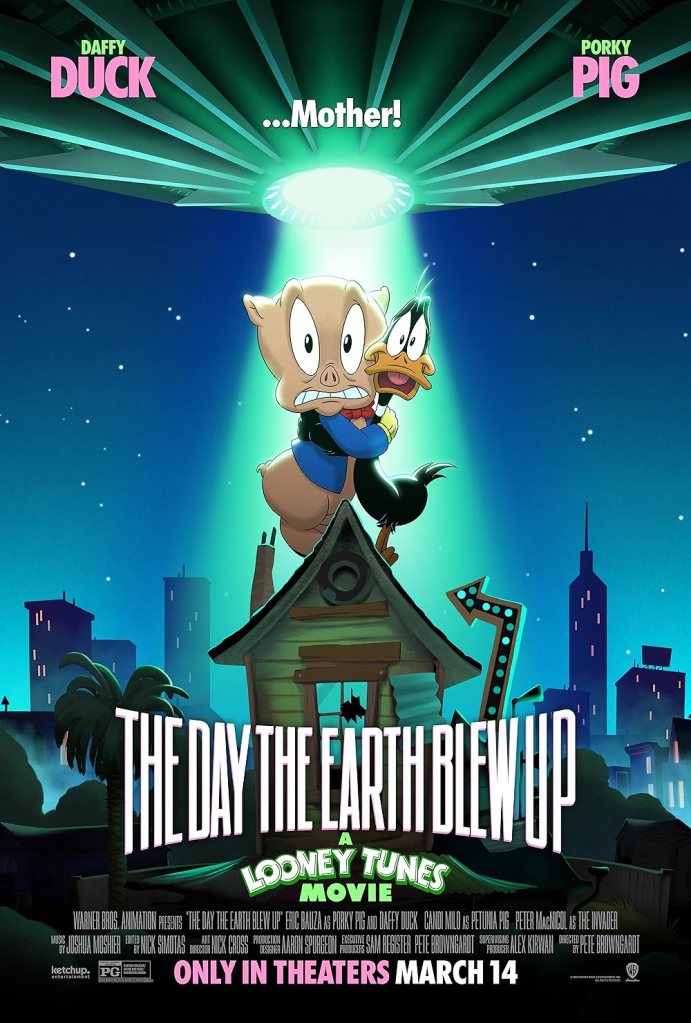
One such movie we did NOT get around to, though, was The Day the Earth Blew Up: A Looney Tunes Movie. Much as I wanted to support it in theaters, time was not on my side, and it’s still on my list of end-of-year films I haven’t gotten to yet. As is Pixar’s newest, Elio, a movie that seemed to come and go with no notice whatsoever. But I’ve heard from a few people who actually saw it that they liked it, and I’m hoping I can get Eddie to join me for a viewing before the year runs out. He’s also excited about Zootopia 2, so we may make a movie date out of that one. I would also like to show him director Steve Hudson’s Stitch Head, which looks to be kind of a kids’ take on Frankenstein. And although it doesn’t really seem like my kind of movie, everybody on the planet except for me seems to have gone wild over K-Pop Demon Hunters on Netflix, and I feel almost obligated to watch it out of curiosity, if nothing else. 

Stop trying to tell me this was a bad movie. You didn’t see this movie. NOBODY saw this movie.

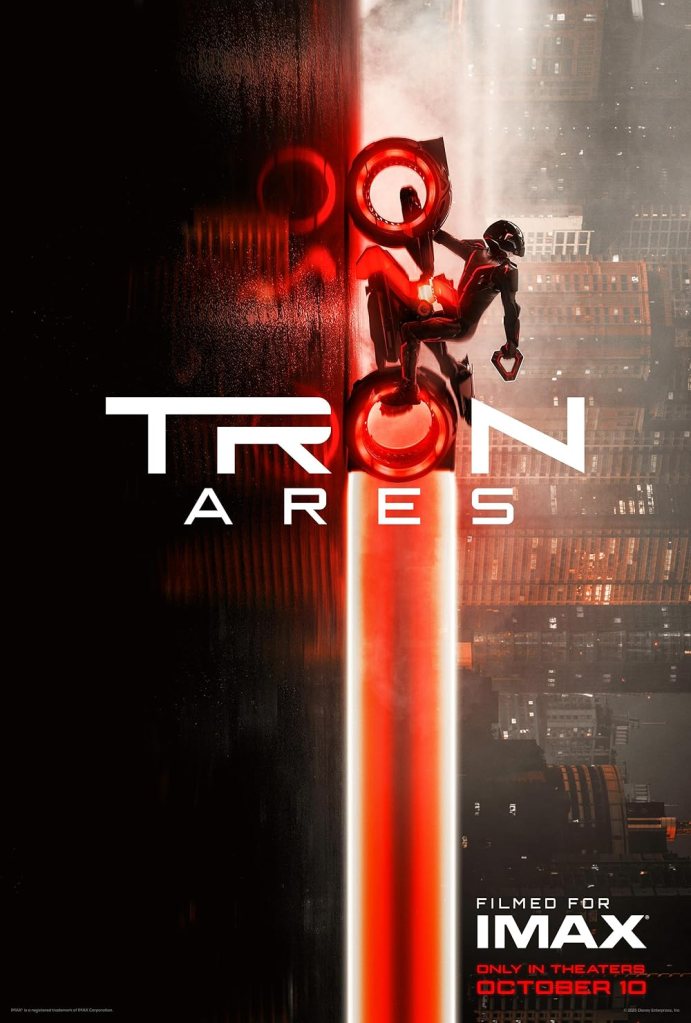
This year also brought – as years tend to do – a bunch of sequels. And if it’s a sequel to a movie I actually like, I’ll watch it. But I’m also the kind of nerd who prefers to re-watch the previous film (or films) in a series BEFORE watching the sequel, especially if it’s been a long time. So that, in addition to the usual problems of availability and time, are the reason I have yet to get to the “requel” of I Know What You Did Last Summer or the more direct sequels like 28 Years Later, Black Phone 2, Nobody 2, the Disney hit Freakier Friday, or the Disney flop Tron: Ares. A brief note about Tron: I love the original and I greatly enjoyed Tron: Legacy. I know Ares crashed and burned at the box office, but this has absolutely no impact on my desire to watch it. I don’t despise Jared Leto just because the Internet tells me to and, once this movie lands on Disney+, I fully intend to watch and evaluate it on its own merits. And you can’t stop me. Nyeah. 

There’s also Wake Up Dead Man: A Knives Out Movie, which hasn’t dropped on Netflix yet, but is on my list. The first Knives Out was absolutely astounding, one of the best mysteries I’ve seen in ages (and perhaps THE best mystery/comedy I’ve ever seen). Glass Onion, the second Benoit Blanc mystery, still entertained me, but I didn’t quite find it up to the level of the original. I’m hoping that Rian Johnson and Daniel Craig bounce back with this third installment. 

Netflix, as a studio, has absolutely loaded me with mystery movies this year that I just haven’t gotten to yet. In addition to Wake Up Dead Man, I’ve also got my eye on The Woman in Cabin 10. This one stars Keira Knightley as a journalist who sees a passenger go overboard on a cruise ship, then gets caught up in the question of what’s going on. Chris Columbus directed The Thursday Murder Club, a crime comedy about a group of senior mystery enthusiasts who get swept into a real life murder. The cast is incredible – Helen Mirren, Pierce Brosnan, Ben Kingsley, Celia Imrie, David Tennant, Naomi Ackie – why the hell haven’t I watched this yet?
It’s Netflix’s fault I haven’t watched this yet, not mine.

I can tell you exactly why I haven’t watched Netflix’s Frankenstein yet: because they dropped it in NOVEMBER. What a dumb move. I couldn’t be more excited to watch Guillermo del Toro’s take on my favorite monster of all time, but I’ve had my hands full the last few weeks. Why on Earth wouldn’t they put this out in October and play up the Halloween angle? Granted, they’re the ones running a billion-dollar streaming service and I’m the guy writing blogs about it for free, but I think we can all agree that I am far wiser than they are.

Speaking of horror, Frankenstein isn’t the only movie that slipped past me this year. Good Boy, the horror film told from the point of view of a loyal dog, has been on my radar for a few years now, ever since I heard the premise. It’s gotten rave reviews, and with a runtime of only 73 minutes, I’ll be kind of mad with myself if I don’t sneak it in before the end of the year. Similarly, I’m interested in the slasher throwback Marshmallow, the Shudder film Night of the Reaper, and the survival horror video game adaptation Until Dawn

I’m saving this one for a day where I want to reduce myself to a mewling infant.

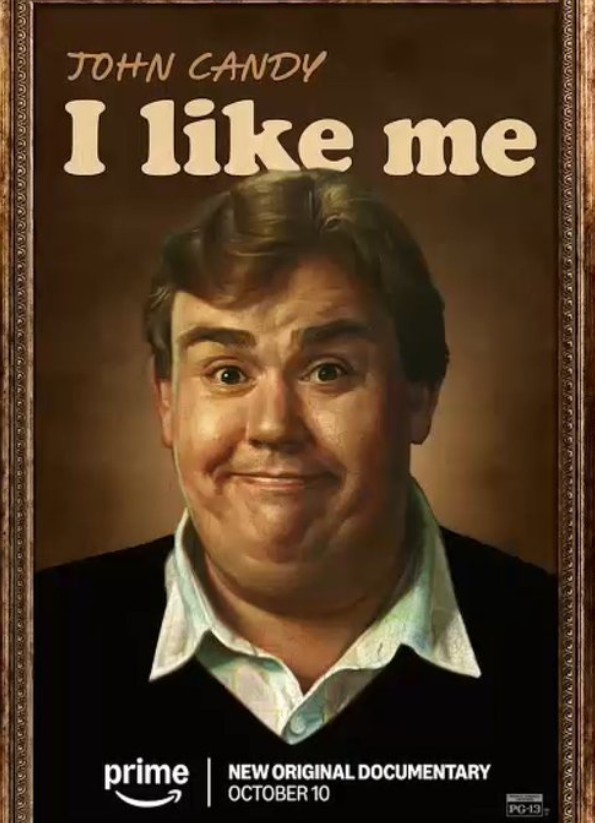
And the documentaries! I haven’t even GOTTEN to the documentaries yet! Prime Video has given us John Candy: I Like Me, a movie that seems to have left everybody who has watched it so far in tears. I’m probably going to wait until school lets out for Thanksgiving and then do a double feature of this one with the movie that gave us the title quote, the brilliant Planes, Trains, and Automobiles

I’ve got no such excuse, though, for sleeping on Jaws at 50, a documentary about one of the greatest movies ever made, or George A. Romero’s Resident Evil, which is a documentary about a movie that was NEVER made. That’s a relatively small subgenre of entertainment documentaries, but it’s one I’ve always enjoyed. Prime Video has also given us When We Went MAD!, a documentary about the history of the magazine that we all thought was hilarious when we were nine years old. I’ll be honest, I fell out of love with Mad Magazine ages ago (and re-reading some of their stories this summer during my Year of Superman did not reignite the love affair), but a documentary about comics is always going to get a view from me.

Saying that this one “aged like milk” may actually be considered a compliment.

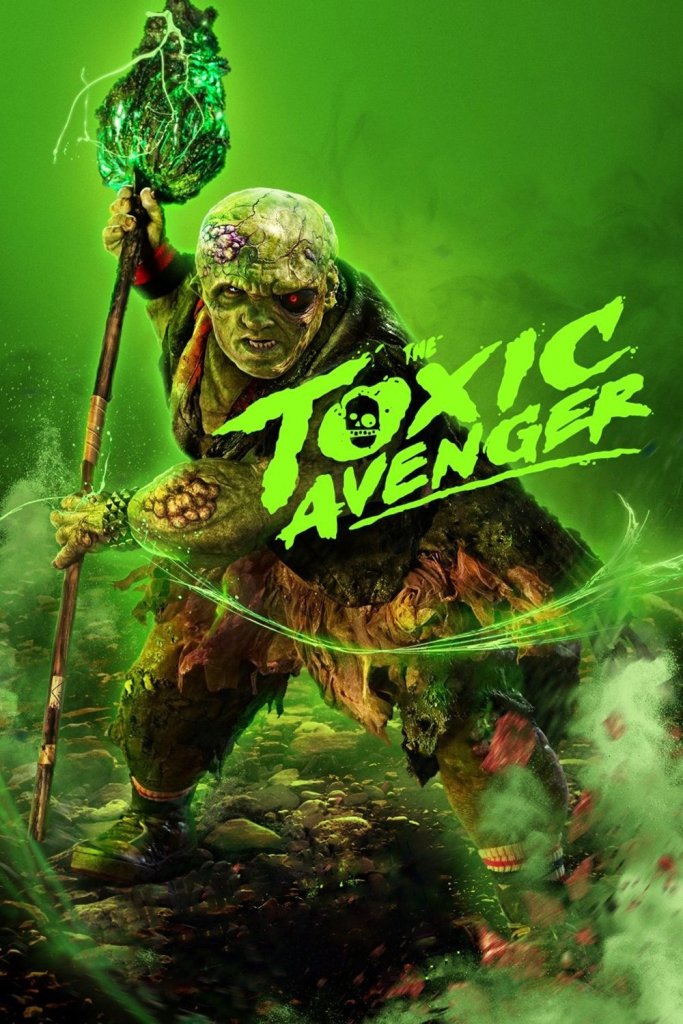
Speaking of comics, I did a lot better this year at watching the superhero movies that came out…well, either that or there just weren’t as many of them. But looking at my list of movies that I missed this year, there are only three superhero movies I didn’t get around too, two of which are animated Batman movies. Batman Ninja Vs. Yakuza League and Aztec Batman: Clash of Empires are both “Elseworlds”-style takes on the character, plucking him out of Gotham City and putting him into feudal Japan and the time of the Spanish conquistadors, respectively. The concept of Batman, in and of itself, is flexible enough that these things are usually at least interesting. Then there’s the long-awaited remake of The Toxic Avenger, which has finally been taken off the shelf and released after two or three years of languishing. I’m very curious to see if the legendarily cheesy Troma Studios hero will hold up to a larger budget.

OOOOH, because if you take the “e” out of the parentheses the title is — NOW I get it!

As for low budgets, there are several indie movies that got my attention this year, movies I read about online or heard discussed in podcasts, that I haven’t watched. Jonathan L. Bowen’s The Comic Shop, for example, or the British comedy Bad Apples about a teacher who accidentally abducts her worst student and then finds that suddenly her class is more manageable. Dropout comedian Isabella Roland wrote and starred in the comedy D(e)AD, about a woman whose family is haunted by her father’s ghost – everyone except for her. There’s also Hamnet, a drama about the tragedy BEHIND William Shakespeare’s Hamlet, and John-Michael Powell’s crime drama Violent Ends. I can’t tell you too much about any of these because I don’t KNOW much, except that I heard enough about them to have my curiosity piqued and put them on my watchlist. 

Whatever bastard designed this did the human equivalent of putting a dog on the poster. You know what you’re in for.

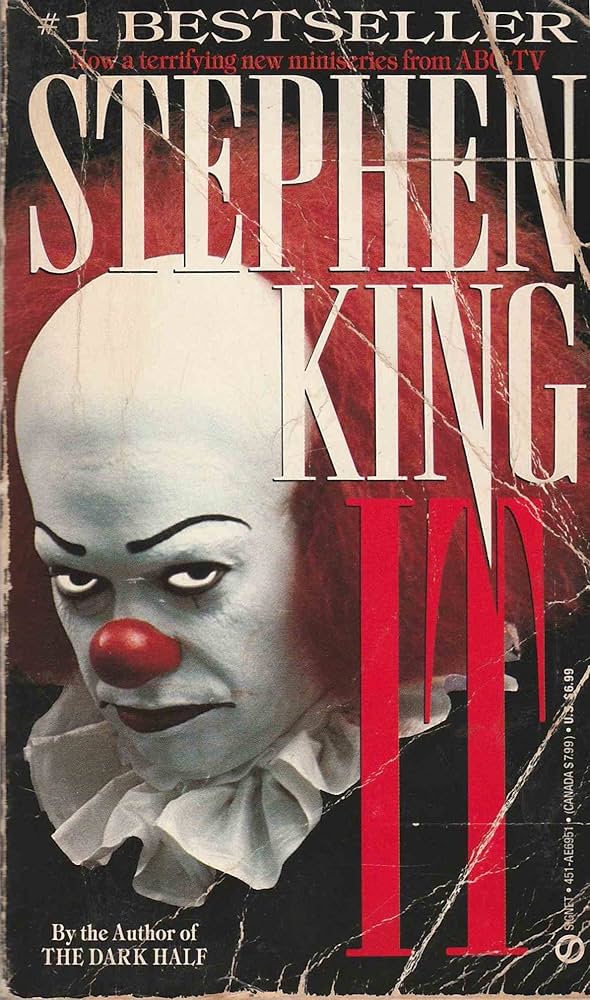
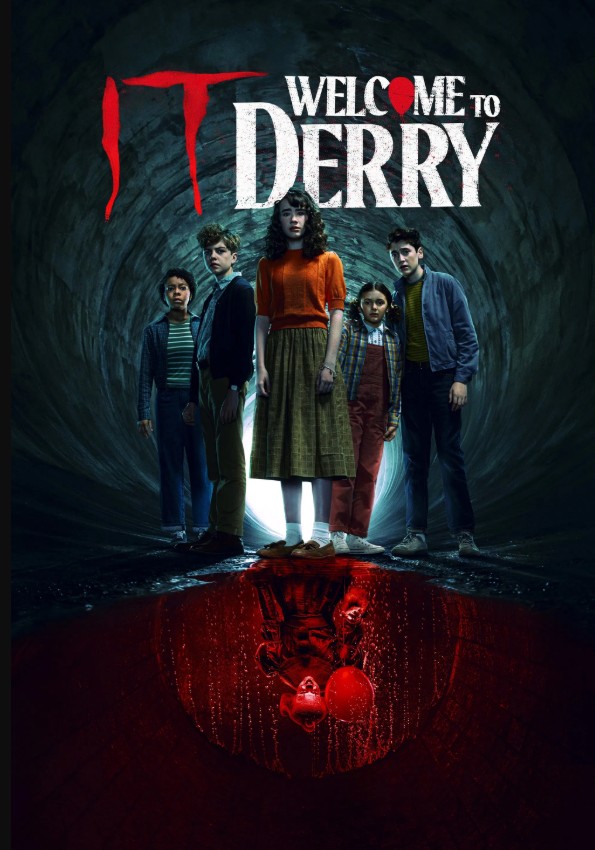
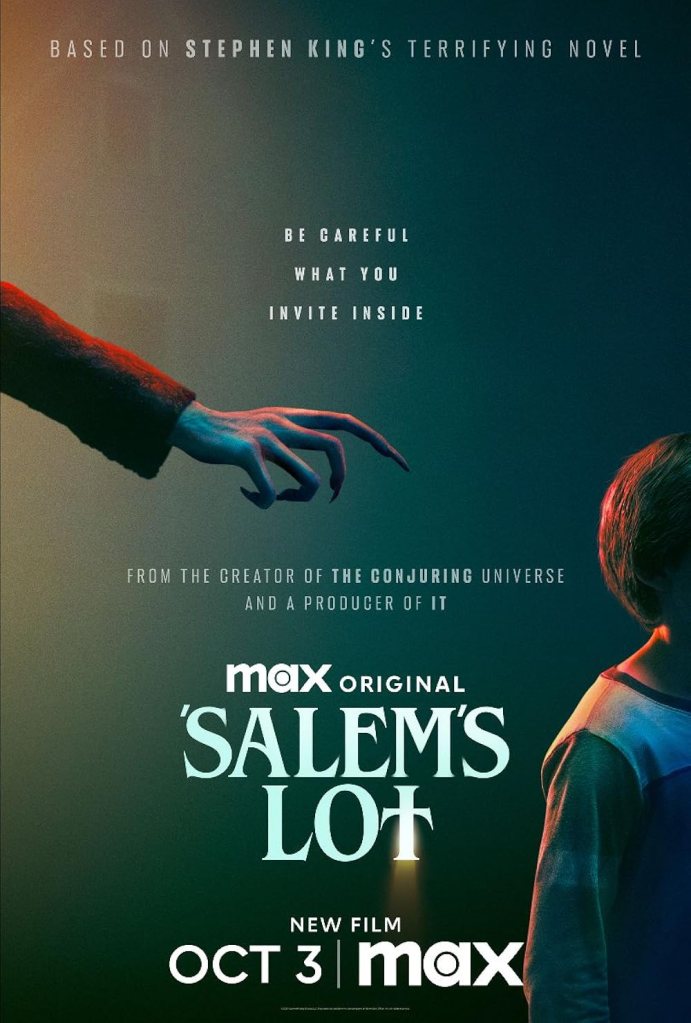
Finally, in case you didn’t know, I’m kind of a fan of Stephen King. And this year has been awash in King content, with the new It TV prequel Welcome to Derry now running on HBO Max and no less than FOUR big-screen adaptations of his work, of which I have seen exactly one. The Monkey. Which I liked, but which was VERY different from the short story it’s based on. That means I still need to get to The Life of Chuck, based on a novella that I thought was pretty good, but the film is directed by Mike Flanagan, which means it’s probably brilliant. Francis Lawrence directed The Long Walk, an adaptation of one of King’s bleakest stories (originally published under his Richard Bachman pseudonym), and I look forward to seeing Mark Hamill playing the bad guy again – because despite most people thinking of him as Luke Skywalker, real ones know he’s actually the best Joker. And lest I forget Edgar Wright directed a remake of another Bachman book, The Running Man, a sci-fi action film rather than horror, but with trailers that look like an awful lot of fun.

The point is, I DO NOT HAVE ENOUGH TIME TO WATCH ALL OF THE MOVIES.

As always, I’m going to do my best to get through as many of these (and the two dozen or so other movies that are on my list that I didn’t mention) between now and the time my Christmas vacation ends in early January, but who knows how many I’ll actually get to? In the meantime, if there are any particularly good movies that came out this year that I didn’t mention that you think I haven’t seen yet, let me know. What’s adding a few more films to a list I’m never going to reach the end of anyway?

Blake M. Petit is a writer, teacher, and dad from Ama, Louisiana. His most recent writing project is the superhero adventure series Other People’s Heroes: Little Stars, volume one of which is now available on Amazon. You can subscribe to his newsletter by clicking right here. He’s also started putting his LitReel videos on TikTok. He needs to go to the opposite of that planet from Interstellar, some place where he can be there for five minutes and have time to watch 12 month’s worth of movies. He hears Detroit feels like that sometimes. 

Geek Punditry #147: It’s Not Halloween (But Who Cares?)

The whole “What Qualifies as a Christmas Movie” debate has been at a fever pitch for several years now. Die Hard, Lethal Weapon, Iron Man 3 – each of these has defenders ranging from people who genuinely appreciate their holiday content for what it is to edgelords who think they’re somehow better than other people by picking Riggs and Murtaugh over Rudolph and Frosty. Strangely, though, Halloween has never really fallen victim to this sort of heated, brutal, occasionally family-schisming battle royale. People are eager to accept certain movies as part of their standard Halloween fare even if nothing in the film has any direct ties to the holiday. And I think we should embrace that philosophy.

Art.

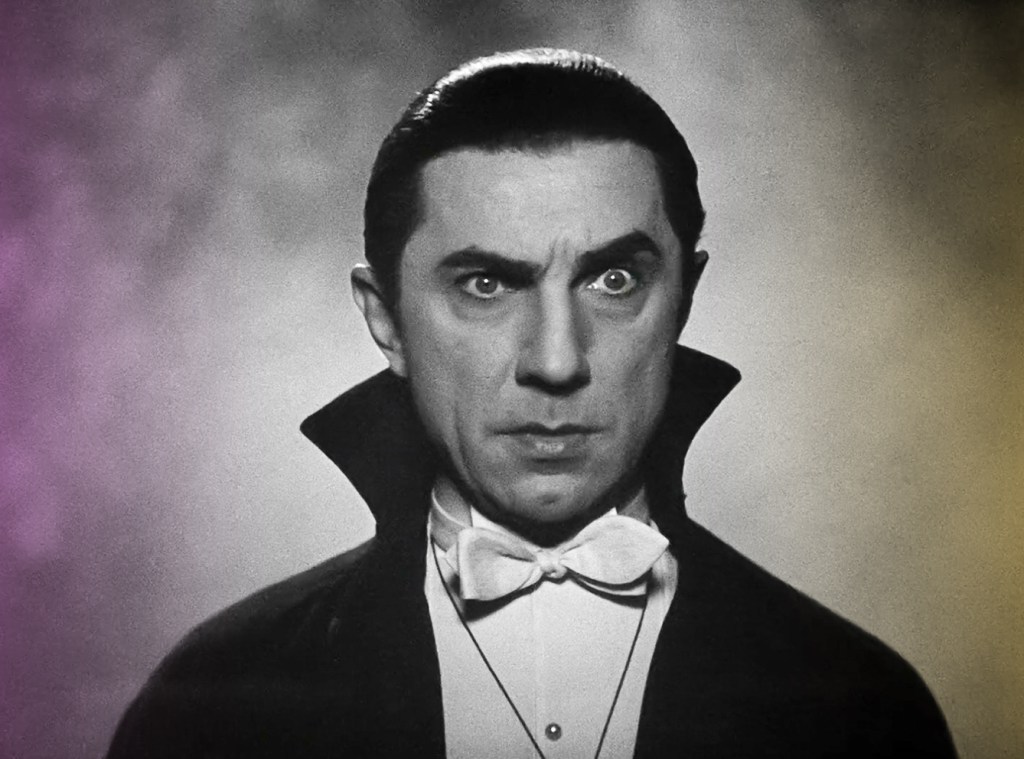
Some of my favorite movies fall into this category. As anyone who has seen the posters in my living room knows, one of my favorite movies of all time is Abbott and Costello Meet Frankenstein. I love the Universal Monsters, I love Bud and Lou, and this film fused those two brands at their respective heights into a hilarious film that nevertheless holds up the Universal Monsters as icons that they are. Bela Lugosi’s Dracula! Lon Chaney Jr.’s Wolfman! Glenn Strange’s Frankenstein Monster! (Okay, it stinks that they couldn’t get Boris Karloff to come back to the play the monster one last time, but of all the actors who wore the makeup for Universal, Strange was #2 after Karloff.) And I watch this movie at LEAST once every October as part of my Halloween wind-up. There’s a masquerade party in the third act, but it’s not specifically noted as being a Halloween party, and the film doesn’t seem to have any indication of what time of year it takes place. But the gestalt of having the finest incarnations of the Universal Monsters is enough to place it on my list.

That’s one of the great things about Halloween – the inclusivity of the concept. You can get away with almost anything as a Halloween costume, even if what you’re dressing as has no Halloween link. You can be a superhero or a princess, you can make a costume based on a pun, you can be a character from your favorite TV show or you can dress up as your friend who you know is going to be at the same party and watch them stew about it as you imitate their mannerisms flawlessly. All of it counts. And because of that, it’s much easier for a character or a movie to be elevated to iconic Halloween status even if there’s nothing strictly Halloweenish about them.

My other top two movie franchises that fall into this category are, of course, Ghostbusters and Scream. None of the Ghostbusters films take place at Halloween, and Scream didn’t touch upon the holiday until the sixth installment, but both of them are eagerly accepted as standard Halloween costumes now, much like any other Universal Monster, 80s slasher, or Beetlejuice. And, in fact, I try to work them into my Halloween viewing rotation almost every year. (If I don’t get around to Ghostbusters I’ll save it for December – Ghostbusters II is a New Year’s movie, after all.)

Halloween movies are like pumpkin spice. Pumpkin spice doesn’t actually taste like pumpkin, it tastes like cinnamon and the other assorted ingredients you add to a squash to make it taste like a pie instead of…well…a squash. Similarly, there are a lot of great movies that may not have any Halloween ingredients to them, but nevertheless, deliver hard on the Halloween flavor. 

The Stuff (1985)

Still can’t get enough.

I remember seeing the poster for this in the video store every time my parents took us there to pick out a few movies when I was a kid. I knew my mom would never let me rent stuff like this, but it never stopped me from looking at the poster and wondering what it was all about. Once I was old enough to seek out the movies I wanted myself, I found that this Larry Cohen film was ridiculous and delightful at the same time. “Mo” Rutherford (Michael Moriarity) is hired by a dairy company to investigate a new product called “The Stuff,” a creamy substance that is obliterating sales of ice cream and other traditional desserts. Nobody knows what’s in it or what it’s made of, and when Mo learns the truth, the answers are horrifying. The Stuff has the feel of a 50s sci-fi alien invasion movie, it’s like Invasion of the Body Snatchers mixed with The Blob mixed with a Baskin-Robbins commercial. The tone is perfectly appropriate to blend in with your Halloween viewing – silly and over-the-top with an antagonist that is absurd on the face of it. As far as Halloween costume potential goes, there’s not really an iconic character for you to dress up as, but if you were to whip up a costume that looks like a “Stuff” carton, you’ll immediately figure out who the cool kids at your Halloween party are. If nothing else, this movie is the quintessential argument for food nutrition labels.

Killer Klowns From Outer Space (1988)

Pictured: 2016.

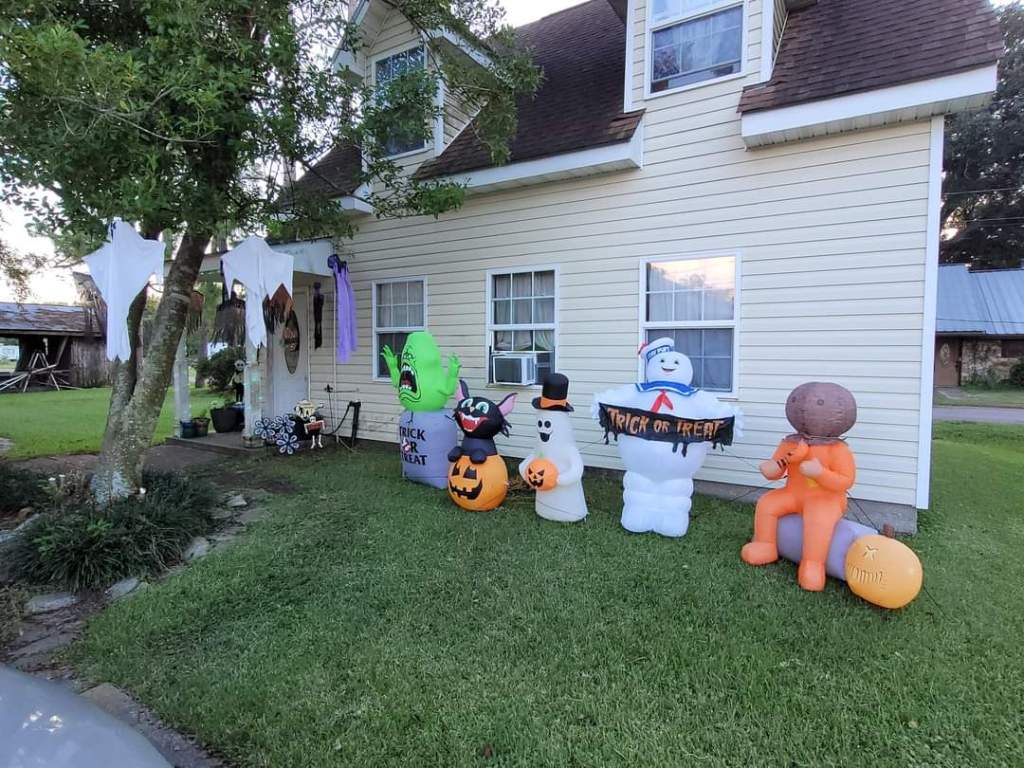
True story: Last year on November 1st, after Spirit Halloween put everything at 50 percent off, my wife picked up the 12-foot inflatable Jumbo the Clown from this, one of her favorite cheesy movies. Jumbo sat in his box in the closet until this September, when I told her it was time to test out our Halloween decorations to make sure they still worked and she remembered buying this thing. It wasn’t until he was plugged in for the first time that we realized just how tall 12 feet actually is.

Eddie for scale.

Totally worth it, though, because this movie is a delight. In Killer Klowns, alien clowns come to Earth and begin abducting people in cotton candy traps and taking them to their ship, which happens to resemble a circus tent. The story is ostensibly about a bunch of young people who band together to fight them off, but nobody is watching the movie for the humans. The clowns are the stars, lovingly created by the Chiodo Brothers in a fashion that evokes the finest puppet work of the Jim Henson company. The Chiodos actually repainted and reused some of the clowns a few years later for the trolls in a legit Halloween classic, Ernest Scared Stupid.

It may not be a Halloween movie per se, but there are few things in the world that feel more Halloweenish than a good ol’ creepy clown, and the ones from this movie are some of the best. The iconic looks make for great costumes, and the movie itself is a ton of fun.

It (All versions)

Georgie for scale.

Similar to the Killer Klowns, Stephen King’s Pennywise the Dancing Clown is one of those characters that feels as perfectly suited to Halloween as Ebenezer Scrooge does to Christmas. The Creepy Clown Coefficient is in full effect here, whether you’re looking at Tim Curry from the 1990 TV miniseries or Bill Skarsgard from the 2017 and 2019 films and the new Welcome to Derry streaming series. Pennywise isn’t silly like the Killer Klowns, of course. He’s a much darker threat and can be legitimately frightening, whereas it’s hard to imagine anyone being anything but charmed by the Chiodos’ creations. The movies lean on the darker side of Halloween, but that’s okay. The darker side is more pronounced here than in any other holiday, and that’s kind of what we love about it. 

The Addams Family (All Versions)

If Taylor Swift had referenced Gomez and Morticia in her songs instead of Romeo and Juliet, maybe she would have made something of herself.

I wonder what Charles Addams would think if he could see the cultural phenomenon his little one-panel gag comics have become. The original Addams family came from a series of comic strips that mixed comedy with macabre elements of a monster movie, and although some of the characters became regulars, they didn’t have names or distinct personalities until they were adapted into a TV series in 1964. While it was a popular enough show, and fondly remembered, Addams died before the property really exploded with the 1991 film starring Raul Julia, Anjelica Huston, Christopher Lloyd, and Christina Ricci. Since then we’ve had multiple cartoons, three live action films, two animated movies, a Broadway musical, and a new streaming series focusing on the Addams’ daughter Wednesday. But although Wednesday may be the breakout star, virtually every member of the family has become iconic. Gomez, Morticia, Uncle Fester, Cousin It, even Pugsley all have a distinct, unique look to them, and you can throw on any of the movies or any of the assorted TV shows and get a beautiful blend of creepy and comedy that is a perfect fit for the season. 

Shaun of the Dead (2004)

Because this is what it feels like going to WORK, amirite?

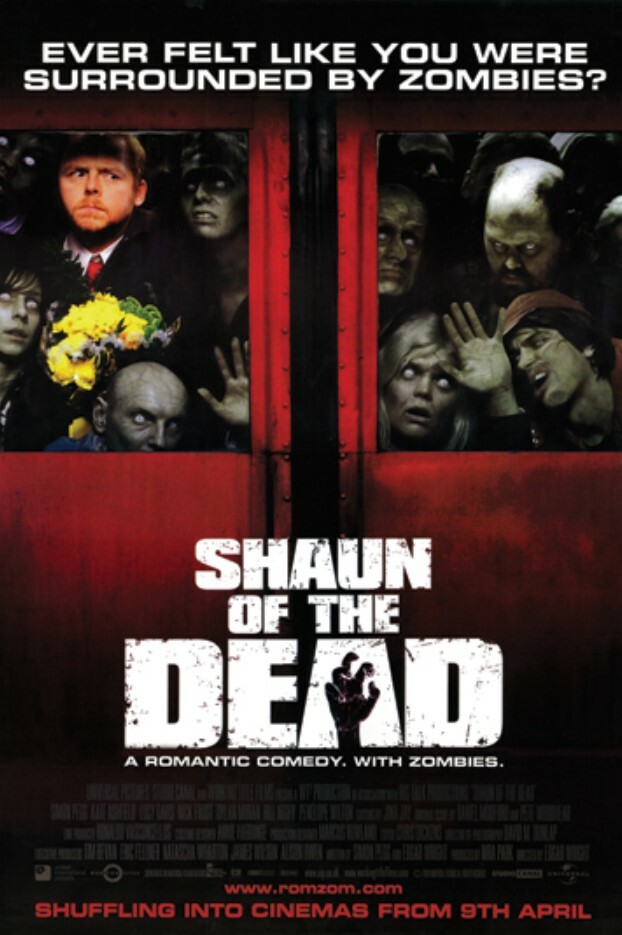
Edgar Wright’s comedic send-up of zombie movies has the perfect sense of scary and silly that you’re looking for. Shaun (Simon Pegg) is a retail jockey struggling with a girlfriend who wants more out of life than he seems willing to give, a mother whose husband he constantly clashes with, and a best friend who is enabling his arrested development more than anything else. He’s ALREADY living like a zombie even before the dead start to rise. Like a lot of the all-time great horror/comedies, Shaun works because the zombies themselves are played absolutely straight – nothing silly or goofy about them. The human characters, however, are funny and highly relatable. One could make an argument for virtually any zombie movie as being part of your Halloween rotation, but I’ve always felt that the more comedic ones fit in more with the fun of the holiday. And although there are plenty of zombie comedies out there, I don’t think it’s controversial to say that this is probably the best. It’s definitely the most iconic. Zombie costumes are easy, but cosplaying as the HERO of a zombie movie is often tough – they are, by the standards of the genre, usually kind of dull, generic, everyman types. But you can cosplay Shaun easily – a white shirt, crimson tie, a nametag, and a cricket bat are all you need. And make sure to get a little red on you.

Labyrinth (1986)

Where the hell is Fozzie?

Jim Henson’s fantasy film from 1986 may have flopped at the box office, but today the fans are devoted, dedicated, and legion. A young Jennifer Connelly plays Sarah, a teenage girl whose frustration at babysitting her infant brother inadvertently leads to his abduction by Jareth, the Goblin King (David Bowie). But Jareth offers her a chance to get him back – make her way to the Goblin City at the center of his remarkable Labyrinth before time runs out and she can take him home. The film is lavish and gorgeous. The characters, too, are memorable and loveable, with some of the finest work Jim Henson’s creature shop ever did. Even the bad guys have distinct personalities and witticisms that make them a joy to watch. And as the movie, technically, is all about monsters, it gives off those Halloween vibes any time of year.

There you have it, friends, a few non-Halloween flicks that you can throw into your rotation and feel perfectly seasonal. What are some of your favorites?

Blake M. Petit is a writer, teacher, and dad from Ama, Louisiana. His most recent writing project is the superhero adventure series Other People’s Heroes: Little Stars, volume one of which is now available on Amazon. You can subscribe to his newsletter by clicking right here. He’s also started putting his LitReel videos on TikTok. He didn’t mention the Munsters because lord knows he doesn’t feel like stirring up THAT can of worms yet again. The scars still haven’t healed from the last time. 

Geek Punditry #145: What Makes an Icon?

Matt Groening, creator of The Simpsons, famously said he believes one of the keys to an iconic cartoon character design is whether the character is recognizable just from their silhouette. Think about it – if you show pretty much anybody anywhere in the world the mouse-ear shape, they’ll instantly recognize Mickey Mouse. The same can be said for characters like SpongeBob Squarepants, Phineas and Ferb, Bugs Bunny, and a lot of the other cartoon all-stars. And Groening himself is legendary for utilizing this tactic with the signature nine spikes on Bart Simpson’s head or the trademark antenna on the top of Futurama’s robot character Bender Bending Rodriguez. But as insightful as this piece of wisdom is, I don’t think it applies only to cartoons. In truth, any truly great design should have elements that make it instantly recognizable. And with Halloween only three weeks away, this week I’m going to help you all make your costuming decisions by applying this reasoning to horror movie icons.

Of course, the silhouette isn’t the only thing that makes for a horror icon. There are several factors to take into consideration. The overall design, in addition to just the silhouette, needs to be memorable. The characters themselves should be interesting and unique. A character should be popular enough that people will recognize them and you won’t have to spend the entire Halloween party explaining what your costume is. And when you’re talking about Halloween costumes, above all else, they should be fun to play. So let’s go over some of the all-time great horror movie icons and see just how they stack up to this metric before you suit up for your Halloween party. 

Every one is a winner.

We’re gonna start old-school with the Universal Monsters. The great thing about these characters is that they are all INSTANTLY recognizable, even to children who were born 90 years after the movies were released and have never seen any of them. Characters like Dracula, the Frankenstein Monster, and the Invisible Man are all based on classic literature and are not Universal originals, but when you ask somebody to picture them, they invariably envision the versions popularized by Bela Lugosi, Boris Karloff, and Claude Rains, respectively. In fact, those designs are all copyrighted (at least for the next few years). If you were to make a movie about Frankenstein, you couldn’t give your monster the flattop or neck-bolts, because those are all owned by Universal Studios even though the monster himself isn’t. So these classic horrors all meet the standard of memorability and recognizability. The only caveat comes with the Mummy and the Wolfman. Although those are, of course, classic monsters, the designs here (while still amazing for the time) aren’t as immediately attributable to the Universal designs specifically. It’s very easy to mistake Im-Ho-Tep or Larry Talbot for a generic mummy or werewolf. And of course, there’s nothing wrong with being a generic werewolf. But if you want to be the Lon Chaney Jr. Wolfman specifically, you may need something like a silver wolf-headed cane as an accessory to drive the point home. 

I don’t think even a mother could love that face.

The 70s and 80s gave us our next great wave of horror movie icons, and many of them have persevered. Leatherface, the killer from Texas Chainsaw Massacre, was probably the first great iconic character of the era. He’s got an easily-identifiable apron, a mask made of human skin, and – of course – a chainsaw to whip around his intended victims. He arguably started the trend of slasher movie icons that would explode in popularity in later years. He wouldn’t necessarily be my first choice to cosplay as, however. To be blunt, his appearance is a lot scarier than some of his successors. That’s not always a deal-breaker, of course, but you have to consider your audience. I’m a dad, and if I’m going to any sort of Halloween event there’s a 99 percent chance that there will be children in attendance. Leatherface is immediately frightening in a way that even the likes of Freddy and Jason are not. Of course, if you’re going to an adults-only event or to something like a horror convention, that’s less of a concern, but you should always keep in mind who’s going to see your costume. There’s also his signature weapon to consider. Having a prop to use as part of your costume is a plus, but you have to remember that you’re going to be keeping track of the thing all night long. Do you really want to spend the entire party looking for places to put your chainsaw? 

Eh, my money is still on the Gorn.

Michael Myers from Halloween is a really simple costume – all you need is a jumpsuit and a mask. A bladed weapon is recommended, but optional. And that’s all it will take to be a character that 99 percent of people will recognize whether they’ve ever seen one of his movies or not. The question now becomes: how dedicated are you to staying in character? Michael is a silent killer. He stalks and he tracks you like an unstoppable monolith, and he never says a word. The closest thing you get to an emotion from him is when he tilts his head quizzically to look at the victim he’s just pinned to the wall. If you’re the type of costumer who enjoys not only dressing up, but also embodying the character that you’re playing (minus the actual murder part, of course), you have to be prepared to spend the evening being very restrained, slow, and deliberate with your movements. It’s not a dealbreaker, but you should definitely check if four out of five dentists recommend Michael Myers or somebody else.

“Yeah, I slept on Mario Lemieux’s couch for like six months after I got drafted…”

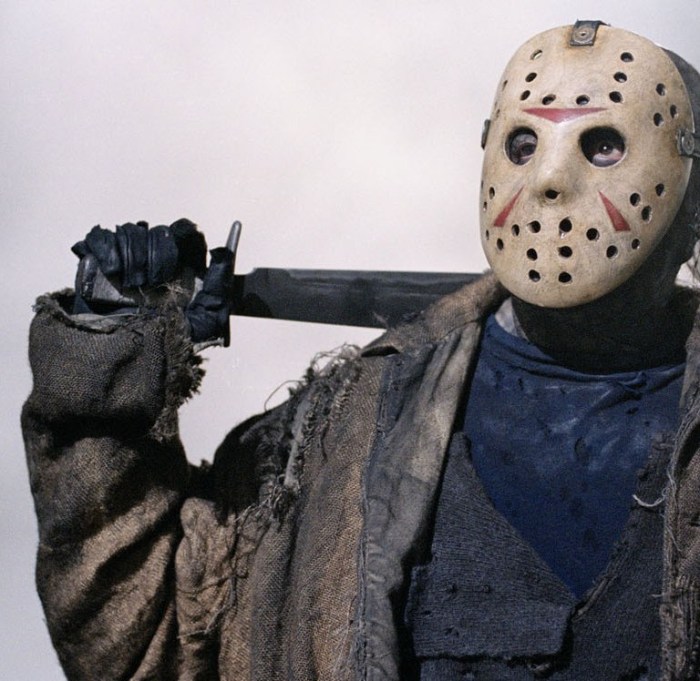
Jason Voorhees of Friday the 13th has a similar concern. Again, the costume is pretty simple – virtually any ragged, ratty slacks and shirt will be suitable as his clothing, and an easy-to-aquire mask and machete will complete the ensemble. And as far as iconic characters go, I would say that Jason is perhaps even more recognizable to the general public than Michael Myers is. Michael has a William Shatner mask that’s spray-painted white, but almost ANY hockey mask will evoke feelings of Jason. Like Michael, Jason doesn’t talk. Unlike Michael, though, he’s much faster and more brutal, expressing his emotion through his actions rather than words. It can be a fun part to play depending on how willing you are to commit.

The absolute worst dream analyst in the phone book.

The great slasher triumvirate is completed with Freddy Krueger of A Nightmare on Elm Street. Iconic, indeed. Everybody knows Freddy on sight, with his classic red-and-green sweater, fedora, and bladed glove. The tricky thing with Freddy is his face. The character is a burn victim, and although he’s so ubiquitous in pop culture that I don’t really have the same concerns about him being too scary for kids that I have with Leatherface, the burns present a different problem. You see, Freddy – unlike Jason or Michael – is a talker. His quick, dark sense of humor is integral to the character, and if you’re gonna dress up like Freddy you’re going to want to throw out bon mots all night long, with an emphasis on extra “bitch”es should you encounter anybody at the party dressed like Rick and Morty. If you wear a Freddy mask, though, that talkiness becomes more difficult and cumbersome. Wearing a rubber mask makes it more difficult for people to understand what you’re saying, and actually speaking under the mask increases the temperature beneath the rubber roughly ten degrees per “bitch.” If you live in a climate like I do in Louisiana, that ten degrees may be the difference between life or death. The alternative to a mask is makeup, which can be time-consuming, difficult to apply, and easy to mess up. Please understand, I’m not saying any of this to discourage someone from playing Freddy – I just want to point out some of the possible concerns that come with such a costume.

“Chuck, look, I’ve thought it over and… well… I’ve decided that, no, I do NOT want to play.”

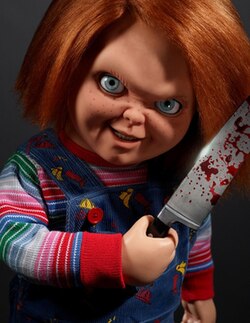
The last great slasher icon of the 80s is probably Chucky from the Child’s Play franchise. When my son was five years old, we took him to Spirit Halloween and we toured all the costumes before finally asking him which one he wanted. He jumped in delight and exclaimed “CHUCKY JUMPSUIT!” I actually took out my phone and recorded him saying it because I knew nobody would ever believe he picked it on his own.

My wife Erin and I are both horror movie fans, but we’re not idiots – our five-year-old son had never seen any of the Child’s Play movies, and the 8-year-old he is now STILL hasn’t seen any of them. But that doesn’t matter – Chucky is one of those ubiquitous characters that even kids recognize. His bright blue overalls and multicolor sweater, a shock of red hair, and freckles across his nose all give us a nice, friendly image that kids enjoy. That is, of course, the point of the character – he’s a child’s doll that is possessed by the spirit of a serial killer, so of COURSE his image is something that would be appealing to children. However, this also leads to a problem: it’s hard to wear this costume as an adult without coming across as creepy, and not in the right way. Five-year-old Eddie was the most adorable little serial killer ever, but if a 35-year-old puts on the jumpsuit, he needs to be DARN sure he’s got a receptive audience before he shows up, or he’s going to be getting strange looks all night.

Still groovy after all these years.

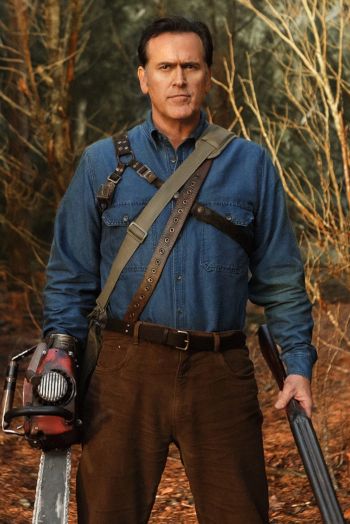
Not every horror icon is a villain, of course. Ash Williams, Bruce Campbell’s hero from the Evil Dead franchise, is another solid costume choice. Most of the costume is relatively simple too – slacks, a blue shirt, a bandolier, and some blood splattered across your face. The most iconic part of Ash’s appearance, though, is the most difficult: in Evil Dead 2, Ash’s hand becomes possessed by a Deadite and he is forced to amputate it, then top off the stump with a chainsaw. Now you’ve got all the same problems as cosplaying Leatherface with the added difficulty of finding a way to keep a chainsaw attached to your hand all night. Alternatively, you could go with Ash from the third film, Army of Darkness, in which he replaces the chainsaw with a mechanical hand. It’s certainly easier than the chainsaw, but it’s FAR less iconic and less likely to be recognized. And honestly, even WITH the chainsaw, Ash doesn’t have the cultural penetration of a Freddy or a Jason. If you’re wearing the costume to a horror convention, people will know you immediately, but for the office Halloween party, be prepared to explain your costume over and over again. 

Greenscreen backdrop of an 80s New York skyline sold separately.

Of course, as far as 80s monster movie heroes go, there’s nothing more iconic than the Ghostbusters. This has become a classic choice for a Halloween costume because it ticks all the boxes: it’s simple, it’s recognizable, and it’s fun. You need two things: a jumpsuit with a Ghostbusters patch and a name tag, and a proton pack. The jumpsuit is readily available in any costume shop and easy to make if you’re so inclined. The proton pack is more difficult, but there are inflatable ones that are lightweight and are usually included with commercial costumes, or more expensive and detailed ones that you can buy or assemble yourself. It’s also a highly adaptable costume. There are the classic khaki jumpsuits from the first movie, the gray variants from Ghostbusters II, the 2016 jumpsuits, multicolored costumes from The Real Ghostbusters cartoon, the red parkas from the Frozen Empire movie, versions from other cartoons, video games, toys…the list goes on. And fans often come up with their own original variants and designs. In fact, similar to the 501st Stormtrooper Legion (a Star Wars fan collective that has expanded far beyond just cosplay to things like public appearances and charity work), there are Ghostbusters chapters all over the world of fans who enjoy this sort of thing. I don’t have the time, talent, or money to be a really good cosplayer, but I’ve always said that if I DID have the opportunity to join such a group, it would be the Louisiana Ghostbusters.

“Stabbity-Stab-Stab-Stab!” -Ghostface in Scream 7, probably.

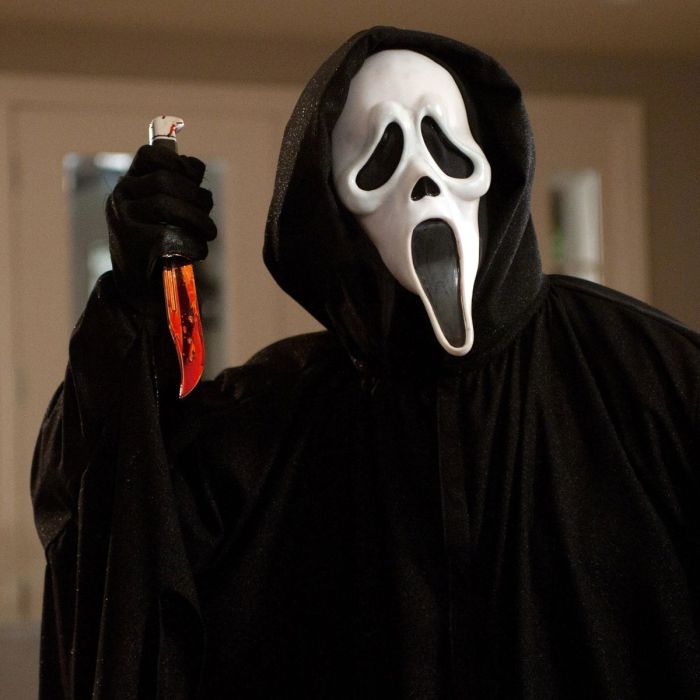
Moving on from the 80s, let’s look at the most iconic horror character of the 90s: Ghostface. The killer from the Scream movies is unique in that the costume is the only constant – a different set of villains wears it in every movie. In fact, over the six Scream movies to date, over a dozen different characters have donned the mask to engage in murderous shenanigans. But this lack of uniformity hasn’t been an obstacle for Ghostface becoming an icon – in fact, it’s probably the STRENGTH behind it. More so than any other character, anybody can wear the Ghostface mask.

It’s also unique in that the costume itself didn’t actually originate with the movies. It was part of a line of Halloween masks produced by a company called Fun World. Director Wes Craven liked the mask, put the character in black robes, and entered into a licensing deal with Fun World that has had them rolling in cash for nearly 30 years now. Not everybody may know the name “Ghostface,” of course, but we all recognize “the guy from Scream.” A few weeks ago my sister told me that my 11-year-old nephew – who is even less likely to have seen the movies than my 5-year-old was, because my sister is NOT a horror fan – has declared his intention to be Ghostface for Halloween this year. I’m very proud as an uncle and I can’t wait to see him when my sister and I take our kids trick-or-treating together. I just wish the boys had collaborated on being movie killers in the same year, because that would have been cute. (Eddie isn’t going as a murderer this year – he wants to be Superman. This is the proudest moment of my entire life.)

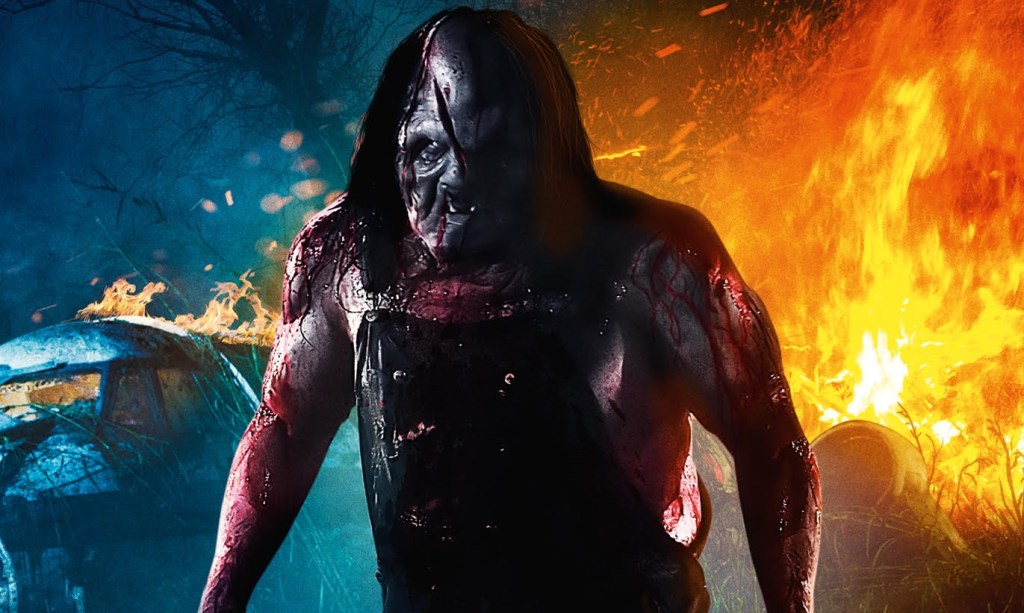
Since the turn of the century there have been several efforts at creating new horror icons. And while characters like Victor Crowley of the Hatchet franchise, Trick ‘r Treat’s Sam, and Leslie Vernon of the woefully underrated Behind the Mask are great and have many of the trademarks that make for a classic icon, the only recent monsters that have reached the degree of cultural penetration that the classics enjoy are a pair of clowns. 

Nope, no nightmare fuel here.

In 2017 we got a theatrical version of Stephen King’s It. The first dramatization of It, a TV miniseries from 1990, featured Tim Curry as Pennywise the Clown, and he was magnificent. Curry in general is magnificent, of course, and his makeup as Pennywise is suitably creepy when Tim Curry is wearing it. But Bill Skarsgard from the 2017 version – let’s be honest here – has broken into the mainstream in a way that Tim Curry’s never quite did. The design of the makeup is creepier, and Skarsgard’s performance is unsettling in a more insidious way. A lot of people would recognize you if you dressed as Tim Curry’s Pennywise, but EVERYBODY recognizes the Skarsgard version. Either version is relatively easy to cosplay – you need the costume and the wig, which are readily available. Skarsgard’s makeup is more complicated, though, and if you don’t want to subject yourself to the same masking problems you’d have with Freddy, make sure that you – or someone you trust – is capable of making that transformation.

Llllllllllllllllllladies.

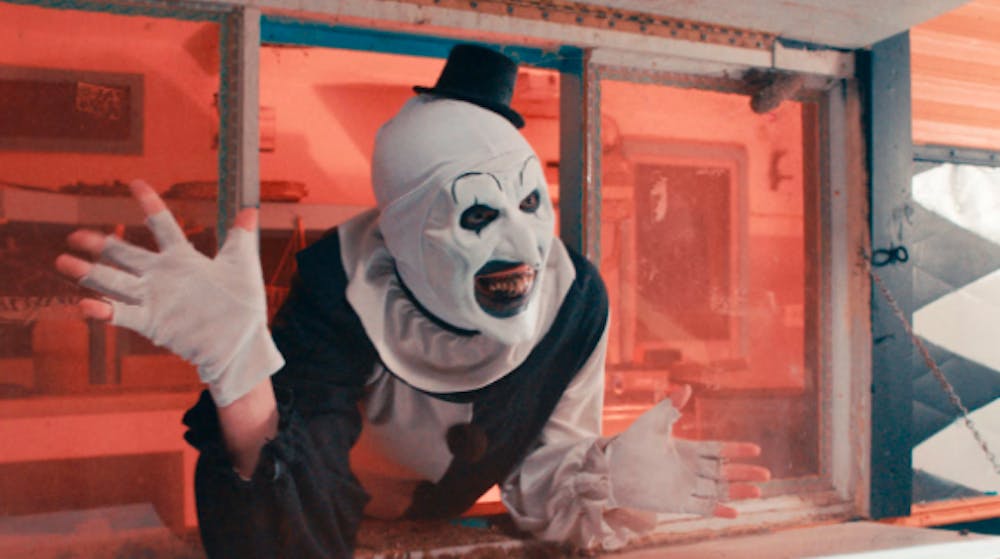
The most recent character to break into the echelon of horror icons, though, is probably Art the Clown of the Terrifier franchise. Art was originally played by Mike Giannelli in a series of short films and anthology segments, but Giannelli retired from acting and the role was taken over by David Howard Thornton for the first full-length Terrifier film in 2016. A malevolent clown with a stark black-and-white costume and makeup that is immediately recognizable, Art has risen to iconic status faster than anybody since Ghostface. As far as horror icons go, Art is perhaps the darkest, most brutal, most sadistic character ever to crack into the public consciousness. He’s more violent, more aggressive, and while the voiceless beast DOES still have a sense of humor, it’s so dark that it makes the likes of Freddy Krueger look like an episode of Bluey by comparison. 

Naturally, he’s become a huge favorite among horror fans. 

In terms of costuming, again, Art is relatively easy. Costumes and masks are available, and since Art doesn’t talk you don’t have to worry about being muffled. On the other hand, makeup is more expressive and less restrictive than a mask, so if you’ve got the skill (or someone with the skill to help you) I would always prefer the makeup approach. Something else to consider is that Art – while huge among horror fans – is not necessarily someone that the average person on the street will recognize, at least not YET. On the other hand, even if your audience doesn’t know ART the Clown, the general appearance of the character is more than sufficient to give the idea that this is NOT a funny clown, and the mystique is preserved.

There are plenty of other characters that we didn’t quite touch on, of course, and you should always go with whatever is comfortable and fun for you. Hopefully I’ve given you a few tools you can use to evaluate your own costume choices when you’re making the decision. You’ve got three weeks left, folks – get started.

Blake M. Petit is a writer, teacher, and dad from Ama, Louisiana. His most recent writing project is the superhero adventure series Other People’s Heroes: Little Stars, volume one of which is now available on Amazon. You can subscribe to his newsletter by clicking right here. He’s also started putting his LitReel videos on TikTok. Since Eddie is Superman this year, he’ll be wearing his own Kryptonian pajamas come Halloween night. Scary can wait. 

Geek Punditry #129: Fact and Fiction

Statistics are a funny thing, and by “funny” I mean “likely to make my brain sad.” I recently read a statistic that claims only about 46 percent of American women read fiction (novels, short stories) on a regular basis. It’s a lower number than I would like, but reading rates in general seem to always be declining, so it can’t be that surprising. What WAS surprising is that the rate of MEN who read fiction, as of 2022 when this study was conducted, is about 27 percent. That’s appalling to me. That means that if I line up four guys, odds are only one of them will have read anything more inventive than the sports page in the past year. And THAT guy is just reading Brony fanfic. 

“Fluttershy slipped out of her fishnet holster…” good grief, people are deranged…

I don’t want it to sound like I’m against nonfiction, mind you. You can read any genre you want, as long as you’re reading. I constantly beg my students to find SOMETHING to read every day, be it a video game magazine or Crime and Punishment, I don’t care. But it leaves me confused, baffled, as to what exactly it is that drives so many men away from fiction. They go to movies, they watch TV shows – but when it comes to picking up a book, they’re more likely to turn to history or how-to. I guess it goes back to the old joke about men, upon reaching a certain age, having to choose whether they’re going to get really into either grilling or World War II. (I am past that certain age, by the way, and I am obsessed with many things, but not those.)

That’s not to say I don’t read nonfiction, I do, but the funny thing is that most of the nonfiction I read is nonfiction ABOUT fiction. For instance, the current book I’m finally chopping off my To Be Read pile is Teenagers From the Future, a collection of essays edited by Tim Callahan about DC Comics’ Legion of Super-Heroes. That’s the kind of nerd I am. I like to read the analysis of fiction written by other nerds. I’ve read books about the history of Universal Studios, specifically their monster movies from the 1920s to the 50s. I’ve read books about the making of Alfred Hitchcock’s Psycho and the life of Edgar Allan Poe. Not long ago, when making one of my world-famous, soon-to-be sponsored by Netflix LitReels (this part is absolutely not true), I was doing a little research about movie novelizations from the 1980s. In the course of that research I discovered that Ryan North, the writer behind the current excellent runs of Fantastic Four and Star Trek: Lower Decks comic books, has written an entire book analyzing the differences between the film Back to the Future and its movie novelization. This made me realize that I needed to read the novelization again, then read North’s book, B^F.

An all new way to go back in time.

If I’m going to read a memoir, it’s not going to be one written by a former president or supreme court justice, but an actor or a writer. Stephen King’s On Writing: A Memoir of the Craft, for example, is one of my favorite books. I go back and read it again every few years, if for no other reason than to remind myself that the best-selling writer on the planet suffers from many of the same struggles as any other schmuck who dedicates themselves to figuring out the proper order to put words in on a daily basis. I really enjoyed Growing Up With Manos: The Hands of Fate by Jackey Neyman Jones, daughter of the director of one of the worst movies ever made, about the journey to create that cinematic oddity and the strange way it has impacted her life. And actor, comedian, and talk show host Craig Ferguson’s American on Purpose is an uplifting, magnificent exploration of what my country can mean to somebody looking at it from the outside, with all the wit and humor that you would expect from Ferguson. 

That’s not to say that I stick with just feel-good stuff. I’ve read, for instance, Matthew Perry’s Friends, Lovers, and the Big Terrible Thing and Jeanette McCurdy’s I’m Glad My Mom Died, both of which dig into the lives of actors, both of which are deeply tragic in very different ways. And let’s not forget Maus, Art Spiegelman’s haunting graphic novel (yes, nonfiction graphic novels do exist) detailing his father’s experiences in Auschwitz. Spiegelman makes the interesting narrative choice of depicting the Jews as mice and the Germans as cats, with other nationalities occasionally popping up as other animals (Americans, for instance, are dogs, from the old “dogface” nickname). The result is a book that looks like a sort of hybrid of Watership Down and history’s greatest nightmare. These aren’t books that make me feel better about the world, but I’m certainly glad that I read them.

These books have one thing in common: none of them will cheer you up.

More often than that, though, I like reading books about the creation of movies, comics, television, and even other books. A few years ago, for example, I found a pair of books by Dustin McNeill and Travis Mullins called Taking Shape and Taking Shape II. The first was a deep dive into the creation of all the different movies in the Halloween horror franchise, which was cool. The sequel, however, was far more interesting: an exploration of all the scripts, pitches, and abandoned ideas for Halloween sequels and reboots that were NOT made for one reason or another. McNeil also has a solo effort, Slash of the Titans, about the long and twisted road that eventually led to the movie Freddy Vs. Jason, including discussion of some abandoned story ideas that, frankly, I think showed more potential than the final film we actually got. I’m fascinated by the creative process, and exploring the different ways these stories have been told, or even not told, is something that really compels me.

These books, paradoxically, make a delightful little romp.

If you want me to get into history (of the two I’m far more likely to get into grilling, but let’s stick with history for now), I prefer it to be couched it in the world of fiction. Do I want to read a book about life in Victorian England? No. Do I want to read Les Standiford’s The Man Who Invented Christmas, about how life in Victorian England eventually led to the creation and legacy of Charles Dickens’ A Christmas Carol? Absolutely. Am I particularly interested in investing any more time than I already have into McCarthyism and the moral crusading of the 1950s and 60s? That’s a no from me, dawg. but if you hand me David Hadju’s The Ten-Cent Plague: The Great Comic Book Scare and How it Changed America, now you have my attention.

Often, when I write these Geek Punditry pieces, I’m trying to show people the universality of what I’m writing about. The thesis of this column is to discuss things I like and urge others to share in my joy. But I have to wonder if, in this instance, I’m a little too unique for that. The real world is scary enough, friends, and I sometimes think we all spend too much time immersed in it anyway, with 24-hour news networks dedicated to showing us the worst possible angle on everything that happens and 24-hour doomscrolling on social media dedicated to making the worst even more horrific. I prefer spending my time in worlds of the imagination, and I make no apology for that. So I guess what makes me a little different is that, even if I’m exploring reality, I’m doing so out of a thirst to find the paths to fantasy. 

Blake M. Petit is a writer, teacher, and dad from Ama, Louisiana. His most recent writing project is the superhero adventure series Other People’s Heroes: Little Stars, volume one of which is now available on Amazon. You can subscribe to his newsletter by clicking right here. He’s also started putting his LitReel videos on TikTok. If you were surprised at the fact that he didn’t bring up Star Trek this week, that’s because there ARE nonfiction books about Star Trek, but frankly, not enough of them.

Geek Punditry #123: TBR Terrors

Warning: This week’s Geek Punditry might be disturbing for people who love books, because this week I’m going to be discussing the three most terrifying letters for a bibliophile: TBR.

Almost as scary as IRS.

TBR, if you aren’t a reader, stands for “To Be Read,” and it’s something that will chill the blood of anyone who actually enjoys reading, because the TBR is the most intimidating thing in the universe. Some of us have actual, physical piles of TBR books. For others, it’s just a list. Still more have a sizeable section of our e-reader’s memory taken up with books that they’re going to read, and I quote, “someday, I swear to God.” But no matter what form your TBR takes, the existence of the TBR is a constant reminder that there are more books deserving of our time than we can possibly devote that time to.

It’s so easy to make that TBR bigger. All it takes is for you to become aware of a book that sounds good. Your favorite author has a new release? It goes into the TBR. Your friend tells you about something great they read on a recent beach trip? TBR. You’re wandering through one of those bookstores that you somehow keep stumbling into when you’re supposed to be buying groceries or perhaps extinguishing a fire, and some book catches your eye? TBR. There’s a new cover on this one? T.B.R. 

A NEW FOREWORD? By HAROLD BLOOM?

Adding a book to your TBR is easy, almost effortless, especially if you just maintain a list. But getting them electronically is easy too – after all, ebooks are usually mostly text (unless you’re talking about graphic novels, but that is a different – albeit similar – conversation). Text files don’t take up nearly as much space on a storage disc as music, videos, or photographs, so you can store a LOT more books on your phone or tablet than anything else, and you can add more…and more…and more.

Then there are the physical book readers, those who have overflowing shelves of books they’ve read and three times as many shelves of books in the TBR. For some of us, we display books the way a hunter or a fisherman will have a prize kill mounted and placed on the wall.

“Here we are, Under the Dome by Stephen King. Hardcover, 1074 pages. I brought this bad boy down back in 2011.”

“Cool. Say, what are all these books on these shelves over here?”

“We’re not gonna talk about those.”

So yes, adding a book to the TBR is effortless. But removing it is a torture the likes of which should seriously have been studied by the Geneva Convention, because it requires you to actually READ the book.

Oh, what fresh Hell is THIS?

“But Blake,” you’re saying, “I thought you said that the whole TBR thing is only relevant to people who LIKE to read.”

Oh, you silly person. Just because you LIKE to read doesn’t mean you actually get to DO it. We live in a world of chaos and terror and reality television, and although reading is a pastime that we book lovers dearly enjoy engaging in, the universe frequently colludes to deny us the time to do it. What’s more, even if you find the time, the little things that chip away at you day in and day out may sometimes leave you too emotionally exhausted to actually do the thing that you do to relax. If you just like, for example, watching baseball, then when you get home you can turn on a baseball game and the extent of your intellectual engagement will be formulating your Facebook post explaining why the umpire is an idiot. But reading is, ipso facto, a more mentally demanding pastime than many of these others, and after a long day at work or with the kids or just dealing with the avalanche of depression that social media has somehow convinced us to plug directly into our veins, the idea of picking up that novel about the vampire apocalypse may start to seem a little daunting, no matter how good the writing is.

The point is, stuff is added to the TBR much, much faster than it can feasibly be removed unless you physically drag your bookshelf into a sterile room with no connection to the outside world. The closest thing many of us get to that sort of distraction-free environment is reading on an airplane, which is actually where I achieved some of my greatest TBR accomplishments before I started traveling with a child, at which point even that avenue was largely closed to me. 

“I don’t actually want to go to Taipei, but how else am I supposed to finish reading the new Hunger Games prequel?”

To make matters worse, although you CAN eventually get a book off the TBR by reading it, a lot of us also like to…this is insane, but listen to me here…we like to read books AGAIN. 

We’re crazy, I know. But there are legitimate reasons for doing so. Perhaps the next book in the series is about to come out, but it’s been 17 years since George R.R. Martin released the last one, so you need to read it again to refresh your memory. Perhaps the last time you read To Kill a Mockingbird was in high school and you have come to recognize that your perspective as an adult is vastly different than that of the 16-year-old who previously read the book and it may be worth re-evaluating it from this new point of view. Maybe it’s just a comfort book, and you feel the need to return to it every so often to sort of ground yourself and remind yourself of the things in the world that you actually like and make you happy as opposed to…well…everything else. No matter the reason, the practical result is that even a book once removed from the TBR can be returned to the TBR at any moment and without warning, and then once again, your only shot at removing it is to read it all over. 

People who don’t read books are listening to this and assuming that I’ve lost my mind, whereas book readers are nodding at me and trying to remember if To Kill a Mockingbird is already on their TBR and, if not, adding it. 

The sheer volume of books that exist doesn’t help. No matter how old you currently are, people were writing books thousands of years before you were born, and at least seven of them are worth reading. What’s worse, there are a bunch of assholes out there right now casually writing even more great books that deserve to be read, as if you didn’t already have enough on your plate, the inconsiderate jerks. There is a point where most book readers have to face the fact that yes, they own more books than they can ever hope to finish reading in their lifetime, but they’re still reluctant to get rid of any of them, because any of these books MIGHT be called up to the major league at any given moment. 

“Well, Blake,” you continue, having this dialogue despite the fact that I wrote this several days before it was posted online and your ability to speak back through the time-space continuum is uncanny, “At least if you’ve got a massive TBR, you never have to worry about what you’re going to read next, right?” Ha ha ha! What an idiot! No, having a TBR makes it even HARDER to choose your next read. Think of it this way, if you have lunch at Raising Cane’s, you really only have one choice to make: will you substitute your cole slaw with extra fries or extra toast? But if you go to, say, the Cheesecake Factory, they hand you a menu so thick that, at first glance, you may think it should be added to your TBR. So let me ask you, my friends, at which restaurant will you have an easier time making a decision? 

Exactly.

The last book I took off my TBR was The Final Girl Support Group by Grady Hendrix. It was a great book, about a group of survivors of slasher-type murderers (the characters are very thinly veiled homages to the final girls of movies like Friday the 13th, Scream, Silent Night Deadly Night, and many others) who have an therapy group they attend together until someone starts trying to kill them. This is the third of Hendrix’s books I have read and I’ve really become a fan of the way he blends plots right out of a scary movie with a dark and sharp sense of humor. Unfortunately for me, after three hits in a row from him, I’ve pretty much decided that every book he’s ever written deserves to be on my TBR. I’m looking at Horrorstör next, billed as “a haunted house story set in a furniture store.” It sounds ridiculous and amazing, and there’s no telling how long it will be on the TBR before I get to it.

“Look at me, Song of Achilles! Take in my glory, The Redemption of Time! THE TBR CAN BE ESCAPED!”

But the point is, I FINISHED Support Group, so I got to take it off the TBR. Great! Go me! So…what next? More horror? Do I want another horror story so quickly, or do I want to mix it up a little bit? A little comedy? There was definitely humor in Support Group, but it wasn’t a laugh riot, so something a little lighter might be welcome. I’ve got a ton of Star Trek novels I haven’t gotten around to yet…but it hasn’t been THAT long since I read one. Maybe I should go back and pick up one of the Ruth Plumly Thompson Oz books I haven’t gotten around to, except that I didn’t really care for the last one I read, Grampa in Oz, and while I intend to eventually read all of the Famous Forty, I’ve put her on probation for a while. I read the first book of that trilogy by Gwenda Bond a couple of months ago and I really liked that, so perhaps I should pick up book two. Or maybe…

And my mind goes around like this for hours at a time until a friend of mine on Facebook posts that she just started reading Hail Mary by Andy Weir which, of course, makes me think that it’s time to finally go back and read The Martian for a second time.

Not even joking, this is the most scientifically-accurate book I’ve read since my second year of college.

Again, non-readers are ready to send me to an asylum. Book lovers know EXACTLY what I’m going through. 

So my friends, be kind to those of us who love to read. We have chosen a recreational activity that frequently includes as much planning and careful mental preparation as getting another job, except that instead of getting paid for it, we just get more books to put on the TBR. It’s a curse.

A lovely, wonderful-smelling curse that none of us would give up even if we could. 

Blake M. Petit is a writer, teacher, and dad from Ama, Louisiana. His most recent writing project is the superhero adventure series Other People’s Heroes: Little Stars, volume one of which is now available on Amazon. You can subscribe to his newsletter by clicking right here. He’s also started putting his LitReel videos on TikTok. He added six books to his TBR while writing this. Shut up. 

Geek Punditry #117: The Unexpected Virtue of Ignorance

If you teach for a while, you start to learn certain things that students like and dislike. For example, they usually like stickers. Even fully-grown high school seniors have a nigh-childlike reaction if you offer them a sticker for something. On the converse, they dislike when you use certain phrases, such as “please take your earbuds out before class” or “hey, remember when I told you to take out your earbuds?” or “I know you still have your earbuds in, nobody sits casually with their ear pressed against their shoulder at a 60-degree angle.”

I don’t know who invented wireless earbuds, but I guarantee they were not a classroom teacher.

Anyway, something else students tend to not like are unanswered questions. This isn’t a bad quality, in and of itself. Education is the pursuit of knowledge, and asking questions is the best way to gain knowledge. However, some kids take it to an extreme, with an almost pathological hatred for any question that doesn’t have a clear-cut, inarguable answer. This can be difficult when you’re teaching literature, because a lot of great works of literature deliberately leave unanswered questions. For example, I’ve seen kids walk away from the short story “The Lady or the Tiger?” with a harsh, bitter hatred of Frank Stockton. You probably read it in school yourself – it’s the story about a kingdom where an accused criminal’s guilt or innocence is determined by a random test. He chooses between two doors: behind one is a beautiful woman, behind the other a ravenous tiger. If he chooses the one with the woman, he is declared innocent and is allowed to take her for his wife. If he chooses the tiger, he is declared guilty and the tiger is rewarded with a very fresh meal. Of course, the accused has no way of knowing which fate lies behind each door. The story ends before the door is opened, and the reader is left wondering whether the character they’ve been following is going to be devoured or be sent off on his honeymoon.

The kids HATE this.

His editor rejected the original title of “The Babe or the Big, Thicc Chonky Boi?”

“That’s not an ending!” they will shout, and to be fair, they’re right. It’s a story that is famous for its lack of an ending. In fact, Stockton even wrote a far less-known SEQUEL to the story, “The Discourager of Hesitancy,” which is about people trying to find out the ending of the first story. Not only do they NOT learn the answer, though, but they are left with ANOTHER unanswered question at the end of THAT story.

If you’re the type of person who demands closure, this sort of thing will drive you up the wall.

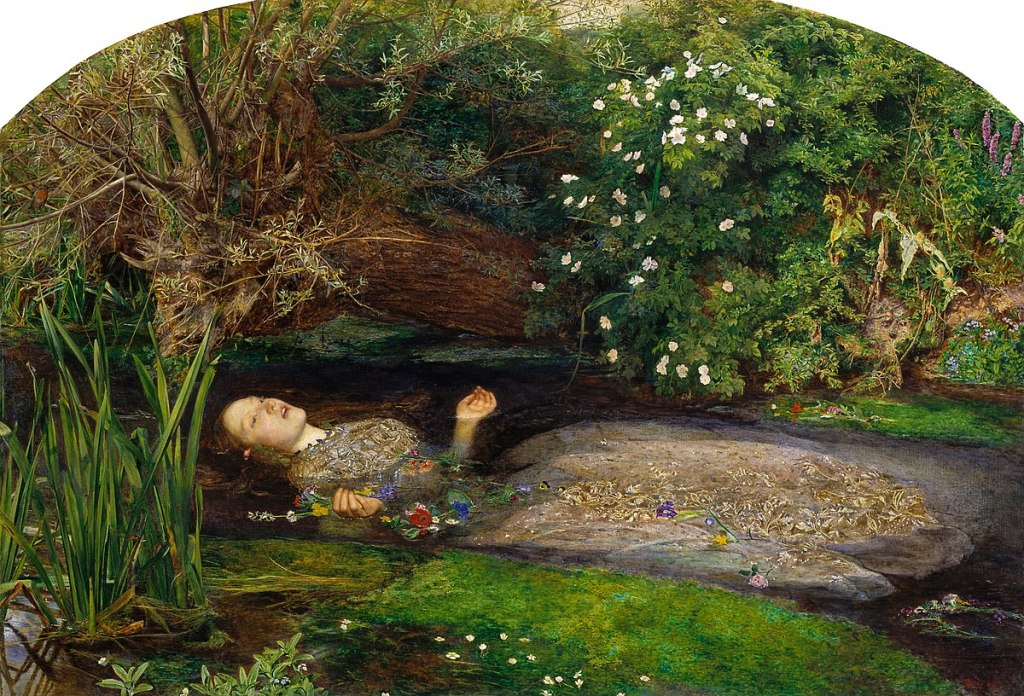
The questions don’t have to be quite that dramatic to draw their ire, either. In act IV of Hamlet – and here I apologize for spoiling a 400 year-old-play – Ophelia drowns. However, her off-stage death is framed in such a way that it’s not entirely clear whether it is accidental or whether she – stricken with grief over the murder of her father by the man she loved – intentionally allowed herself to die. The play does not offer an easy answer to this question. Even the characters IN the play have a debate over it. And when a student asks me to clarify it for them, begs me to tell them if Ophelia’s death was an accident or not, they get really mad when I reply, “Well, what do YOU think?”

She watched a six-hour Marvel Studios feed of empty director chairs and was reduced to this.

The thing is, there are cases (especially in fiction) where the act of ASKING a question is more important than the answer itself. There is more value, I believe, in debating the nature of Ophelia’s character than there would be had Shakespeare given her a soliloquy before her death explaining her intentions to the audience. And had Stockton told us what came out of that door in “The Lady or the Tiger?”, the story would have been reduced to a rather unremarkable fairy tale, one that would no doubt be mostly forgotten today. 

This isn’t to say that solid endings aren’t important. You’ve no doubt read my diatribe against spoiler culture and why I hate so, so much the way social media devalues the ability of the audience to be surprised. When I say that sometimes it’s okay if a story doesn’t have an ending, that sometimes it’s the journey that matters, it may seem contradictory to that earlier rant. But the truth is, they both come from the same place: a desire to allow a storyteller to tell the story that they intend. If the story is structured in such a way that it builds up to some sort of powerful twist ending, then the polite thing to do is shut up about that ending and let them tell it. However, if a story is NOT intended to build towards a specific ending and, instead, is about exploring the ideas and questions that the story presents, it’s okay if some questions – even MOST of the questions – are left unanswered.

The reason I’m thinking about all this today is because I recently finished re-reading a novel that demonstrates this idea wonderfully, Stephen King’s 2005 book The Colorado Kid. It’s a fantastic book that so, SO many of my students would despise. Published by the Hard Case Crime imprint, The Colorado Kid has none of the trappings of horror or the supernatural that people often associate with King’s work. It is, as the name of the imprint implies, a crime drama, a mystery, but it is a mystery that is left unsolved at the end. If you pick up that book hoping to unravel the clues and decipher the ending, you’re going to be left disappointed. Despite that, I love this little book.

To be fair, though, in terms of misleading covers, it’s up there with the original The Princess Bride.

The story, such as it is, focuses on a young woman with an internship at a small-town newspaper, and an afternoon she spends with two much older gentlemen, the paper’s editor and owner, during which they tell her all about the greatest unsolved mystery they ever came across. Back in 1980, a dead body was found on the beach, propped up against a barrel, its previous occupant having choked to death on a piece of steak. His identity was a mystery, why he was on the beach was a mystery, even the piece of steak turned out to be a mystery. 

The entire book is a conversation between these three people, the two old men telling the girl about their investigation, the girl asking questions, and the discovery of one clue after another that led only to more questions. There are theories, but nothing definitive or convincing, and when you finish the book you’re no more certain about what really happened to the “Colorado Kid” than the old newspapermen are.

What, then, is the point of the book? It’s the obvious question to ask – why would you read a mystery novel with no solution?

Because in this case – and it’s an exceptionally rare case, for a mystery novel – finding the answer is not the point. The death of the Colorado Kid is not the point. The question of how and why he crossed the country in only a matter of hours, abandoning his life on the west coast for what turned out to be his death on the east, is not the point. The point of the story, and the lesson that the young reporter has to learn, is that even when life doesn’t supply us with answers, there’s still a virtue in just ASKING  the questions and seeking the truth. You might not always find the answer – and even if you do, the answer you find may not be the one you wanted – but there’s still satisfaction inherent in searching for them. 

Not everybody appreciates that. Many of my students wouldn’t. Even die-hard Stephen King fans I know found the book disappointing because of its lack of ending, even though no effort is made to hide the fact that it is left unresolved. The old men tell us at the very beginning of the book that the mystery is unsolved, we know that going in, but STILL people got angry. And I suppose I understand why – we’re so used to genre conventions that it’s hard to accept a book that subverts them this way. I’m sure a great many people picked up this book expecting some sort of brilliant insight at the end. Maybe the young reporter would suddenly ask a question that the two old men had never considered, maybe her perspective of time and distance would shed light that would reveal a clue that had gone unnoticed in a quarter of a century, and suddenly we would spiral headlong to the resolution of the mystery, finally tying things up in a neat little bow like we expect from a mystery novel.

But that doesn’t happen. That isn’t this novel. 

Like I said, it’s a book about an IDEA, not a book about a plot, and it’s an idea that I happen to really like.

If you’ve never read this one, give it a try. It’s one of the shortest books King ever wrote – the paperback printing comes in at a brisk 184 pages, and I know a lot of dedicated readers who could get through it almost in real time, spending the afternoon with the newspaper trio. And even if Stephen King isn’t the kind of writer you usually read, this one is so atypical of his usual output that I think a whole different audience can tap into it and enjoy it. 

Provided you go into it looking for the right things, of course.

Blake M. Petit is a writer, teacher, and dad from Ama, Louisiana. His most recent writing project is the superhero adventure series Other People’s Heroes: Little Stars, volume one of which is now available on Amazon. You can subscribe to his newsletter by clicking right here. He’s also started putting his LitReel videos on TikTok. He knows that some people can’t handle leaving something unfinished, but the thing to remember is

Geek Punditry #108: Blake’s Five Favorite Frigid Fables

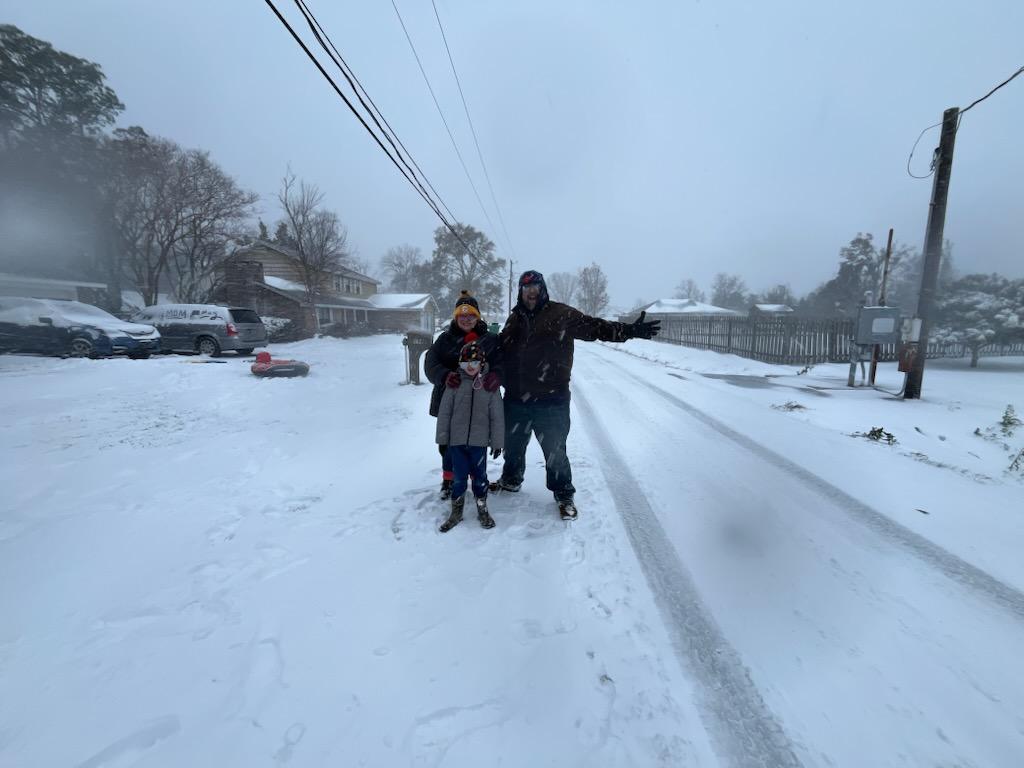
Here in Southern Louisiana, we’re known for a few things: food, music, and a general manager that none of the best potential head football coaches in the country want to work with. But this week, we got put on the map for something pretty unusual for us: snow. On Tuesday, we were hit with a snowstorm that dumped more of the white stuff than anybody alive has ever seen in the state of Louisiana before, as much as 10 inches in some areas. I know some of you in the north are scoffing at that – ten inches of snow is nothing to you if you live in North Dakota, for example, but this is insane for us. We don’t get snow like this. Every few years we get a dusting that makes us giggle until we have enough to make a snowman roughly the size of a Funko Pop and then we hope it happens again before we’re drawing social security. But this was more snow than Louisiana has had since 1895. That’s not a typo, it’s more than we’ve had in 130 years, and pretty much everything was shut down: roads, schools, businesses…everything except the Waffle House. As a result, I got three days to spend with my wife and son in a winter wonderland.

Seriously, this NEVER happens.

So naturally, I’m thinking about horror movies.

Well, not exactly. But spending so many days unable to leave the house because of ice and snow got me thinking about stories with that premise: people stranded together due to cold weather. And the fact is, most of those are scary movies. (Or Hallmark Christmas movies, but I’m not gonna write about those in January.) Pretty much every great example I could think of qualifies as a thriller, if not an outright horror film, and I guess it makes sense. Being forced in a confined space with people over a period of time can start to wear on you, the edges can be chipped off, and before long you’re staring at each other like Daffy Duck does when Porky Pig starts to look like a steamed ham. 

So in honor of this once-in-a-lifetime event, I decided to break out my Five Favorite Frigid Fables, five great movies about people stuck together in the cold. As always, these lists are highly subjective. They’re the five best movies I thought about that fit my criteria, and it’s always possible that if I made this list tomorrow I’d pick five totally different movies. I’m going to go from the most well-known movie on this list to the least, at least, according to the viewing numbers on Letterboxd. The first three are movies that will make most of you say, “Well obviously,” but I’m hoping by the end you’ll find something you may not have heard of before.

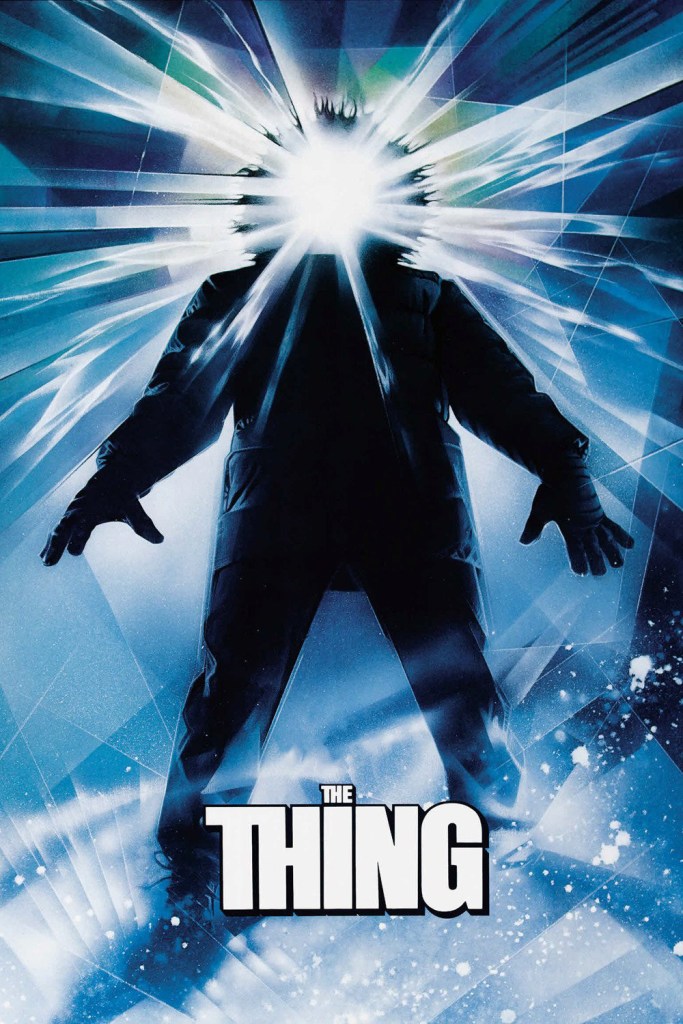
The Thing (1982), directed by John Carpenter

My family made it through the Louisiana Sneauxmageddon pretty easily, but if I hadn’t included this movie on the list my wife may have left me anyway. This is probably the defining example of a cold weather confined area horror movie, as well as being one of the best sci-fi/horror mashups ever made. In this film, if you’re one of the three people on the planet who aren’t aware of it, a group of researchers at an Antarctic base uncover an alien creature that has been buried under the ice for hundreds of thousands of years. Although it is literally never a good idea to thaw one of these out, the alien escapes and begins to prey on the men.

Making matters worse, they discover that the alien is a shapeshifter. Not only is it a murderous beast, but it has the ability to transform and look like any one of them, so they can’t even trust each other. The resultant film is a masterpiece about fear, mistrust, and paranoia, a world where even your best friend may be the thing that’s out to kill you. The ending in particular is wickedly clever and absolutely perfect for this film. The movie is a remake of the 1951 film The Thing From Another World, itself based on the novella “Who Goes There?” by John W. Campbell, thereby simultaneously proving that sometimes the remakes are better than the original and sometimes the adaptation is better than the book. On the other hand, the remake/prequel of THIS movie from 2011 is…well, it’s just okay. But of the four iterations of this story, John Carpenter is the one who did it best.

The Hateful Eight (2015) directed by Quentin Tarantino

I feel like this is kind of a “forgotten” film. It’s not so much that people don’t know about it, but it rarely seems to make the conversation when people talk about their favorite Tarantino movies, which is surprising to me, because I’d easily place it in my top three. (The others are Inglorious Basterds and Once Upon a Time in Hollywood, since you asked.) In some ways, you could almost call this a western version of The Thing. Several travellers are snowbound at a haberdashery during an intense blizzard, including some bounty hunters, a condemned murderer, a sheriff, a cowboy, and a former Confederate general. As the storm rages outside, inside the lodge we start to learn that all of these people may not be the strangers that we assumed. These are people with deep wounds, some of them caused by the others that they’re now trapped with, and there is a hunger for revenge.

Even for Tarantino, this is a dark film. There is a rage and anger brimming beneath the surface, and there really aren’t any “good guys.” The movie is about bad people, badly damaged people, and the things they do to one another. The entertainment factor comes from trying to unravel the mystery of exactly how all of these people are connected and who has a past with whom. In that way, it may be the most well-written of Tarantino’s movies, with a complex plot that rewards multiple viewings as you try to untangle the web. There’s also an extended version, released via Netflix as a four-part miniseries, which I never got around to watching, but writing about it now is making me want to do so. 

Misery (1990) directed by Rob Reiner

Do you ever stop to think about how weird the career trajectory of some people turns out to be? Rob Reiner, the guy who played Meathead on All in the Family, grows up to direct two of the best Stephen King adaptations of all time (this one and Stand By Me) along with stuff like The Princess Bride and When Harry Met Sally. Go figure. 

Anyway, in this magnificent movie based on one of King’s best stories, novelist Paul Sheldon (James Caan) gets in a car accident in the snow and is rescued by a former nurse named Annie Wilkes (Kathy Bates). Annie tells Paul that she’s his biggest fan and is delighted to help nurse him back to health, but from the very beginning things feel…off. Things get much worse when Annie discovers Paul killed off her favorite character in his newest book, and the two enter into a deranged battle of wills as Annie fights for the survival of the fictional Misery Chastain, while Paul has to fight for his life. 

The movie is incredible – taut, tense, and full of legitimate chills. This was Kathy Bates’ breakout role, and garnered her an Oscar for Best Actress back when the Academy Awards still actually meant something. Everybody involved in this movie is at the top of their game, and it’s just as engaging and exciting today as when it was released 35 years ago.

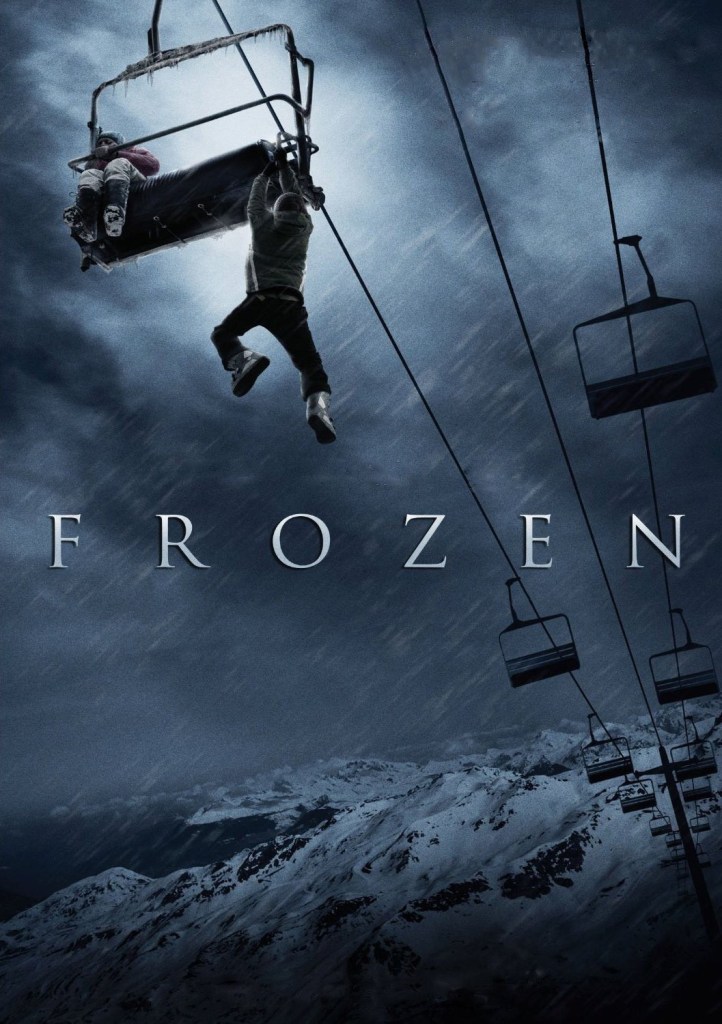
Frozen (2010) directed by Adam Green

Elsa is going to be crowned the queen of Arendelle and her sister–wait, wrong Frozen. No, this movie came out three years before that other one, and it is most definitely NOT a beloved musical about the power of familial love. This film involves a trio of young skiers (Shawn Ashmore, Emma Bell, and Kevin Zegers) who – through a series of mishaps that make Kevin McCallister getting left behind in Home Alone seem plausible – get stuck on a ski lift as the weekend mountain resort they’re visiting shuts down for the week. 

Although the circumstances necessary to get the three of them trapped up there admittedly stretch credulity a little bit, once you get past that the movie is fantastic. You’d think a movie about three people stuck on a ski lift would run out of steam quickly, but the way the situation rapidly escalates into a life-or-death battle against the elements is totally gripping. It’s the kind of movie that makes you question what you would do in that situation, forcing you to wonder if you could possibly survive such an experience, dangling from an immobile ski lift with no hope of rescue for days as the temperature keeps falling and wolves begin to prowl in hard-packed snow beneath you. This was actually the first Adam Green movie I watched, before I discovered his signature Hatchet franchise, and it’s usually the one I recommend to people first. I love this movie.

Scare Me (2020) directed by Josh Ruben

The final film on this list is the most recent and least well-known, but by god, it deserves an audience. Writer/director Josh Ruben plays Fred, a writer on a retreat in the mountains. While taking a jog one morning he encounters Fanny (Aya Cash), a fellow writer who’s also on vacation. When a storm knocks out the power to their cabins, Fred and Fanny decide to ride out the weather together, passing the time by telling chilling stories as they challenge one another to – well, as the title says – “scare me.”

This is a movie that’s so simple, but absolutely brilliant. Almost the entire film is simply these two in a cabin talking to one another, but it’s done in such a way that you get sucked right in from the very beginning. The tales they tell are inventive and entertaining, but also slowly reveal things about the two main characters that lead you to question the entire situation. As good as the writing is, though, it wouldn’t be anything without the performances by Ruben and Cash. Both of them are probably better known for their comedic work (although after this movie, Cash hit it big on The Boys), but as I’ve said many times, the line between comedy and horror is very thin and the two disciplines rely on a lot of the same skills. That is to say, a great comedic actor very often has the chops to be a great horror actor, and these two prove it with this movie. They’re both wonderfully funny, but on a dime they can turn the entire situation around and scare the pants off of you. If you haven’t watched this movie, it’s currently available on Shudder and Hoopla, as well as the usual digital rental services. This movie proves how possible it is to tell a killer scary story without relying on gore and special effects, but just great performances. In fact, it could very easily be turned into a stage play, and it would be amazing.

There you have it, guys – five stories about people trapped in the cold. If it’s your thing, I hope you check them out. And if you’ve got suggestions for other such movies beyond these five, let’s hear it! Drop your own suggestions in the comments.

Blake M. Petit is a writer, teacher, and dad from Ama, Louisiana. His most recent writing project is the superhero adventure series Other People’s Heroes: Little Stars, volume one of which is now available on Amazon. You can subscribe to his newsletter by clicking right here. He’s also started putting his LitReel videos on TikTok. He briefly considered including the 2002 Cuba Gooding Jr. terror film Snow Dogs, but he thought that might be a bit too much.

Geek Punditry #93: The Narrative Chain of ‘Salem’s Lot

Welcome to The Narrative Chain, the newest of my many column-within-a-columns here at Geek Punditry Global Headquarters. In The Narrative Chain, I’m going to take a look at a story that has been told multiple times and examine some of the different versions, whether this be books that have been turned into movies, comics that have been adapted to television, remakes, reboots, or adaptations, we’re going to pick into them here. And I thought that, for October, we would start with the second published novel by Stephen King, as well as the various adaptations thereof (including the one that dropped just last week): the vampire drama ‘Salem’s Lot.

You wouldn’t think a book about Sabrina’s cat would be that scary, but…

The original novel, published in 1975, tells the story of an old-world European vampire named Kurt Barlowe (no, really) who comes to the little town of Jerusalem’s Lot, Maine, and begins to worm his dark tendrils into the citizens thereof. The novel focuses mostly on a small group of citizens who come together to fight back against the vampire, including Ben Mears (a novelist, because as early as his second book Stephen King was establishing patterns), local woman Susan Norton, 12-year-old Mark Petrie, Father Donald Callahan of the local Catholic Church, and a few more. But interspersed between the scenes with our heroes are many chapters detailing the activities of the other citizens of the ‘Lot as they fall prey to the darkness.

Although his first novel, Carrie, was a hit in his own right, I feel like this is the book where we really started to see the Stephen King who would become a literary juggernaut. It’s much longer (although still a drop in the bucket compared to the likes of The Stand or It), and the first of his books to establish a large cast of characters that he bounces between as he tells the story of a community under siege. These are things that King does better than almost anyone, and you really see it as he paints the citizens of Jerusalem’s Lot, warts and all. 

In an introduction to an anniversary edition of the book years later, King said that his goal with this novel was to create a sort of marriage between the storytelling of Bram Stoker’s Dracula and the American style of horror he grew up with in EC Comics like Tales From the Crypt. In practice, I’m not sure that he completely succeeded in that particular goal. Although not utterly hopeless, the ending of ‘Salem’s Lot is considerably bleaker than the ending of Stoker’s novel (and King himself says that the story ends in a more hopeful place than he originally intended). Similarly, it doesn’t quite have the sort of bitter sense of humor or twisted concept of justice that the EC Comics brought to the table, both elements that would be more visible in some of King’s later works. There’s also an odd sentimentality to the book – the characters seem to meet and immediately form lifelong bonds (not that “lifelong” is a particularly lengthy period in a vampire novel) in just hours. It’s a way to drive up the tension and make you feel for the characters a bit more, but there are times where it feels a tad unearned.

That said, I don’t want you to give the impression that I don’t like this book. I very much do – the atmosphere King creates is magnificent, and the way he treats his vampires is as evocative as anything Stoker does, even though he DOES borrow some non-Stoker elements that really gained prominence thanks to vampire MOVIES, such as the vampires’ vulnerability to sunlight. I re-read the book last month in anticipation of the new movie, and I found it just as engaging as I did the first time I read it years ago. It’s not my favorite Stephen King novel – heck, it probably wouldn’t make my Top Five. But when you consider just how many books the man has written, Top Ten is nothing to sneeze at. 

There have been three adaptations of ‘Salem’s Lot to date, all of which I watched (or re-watched) after reading the book, and I’m going to break them down in order to discuss the pros and cons of each, beginning with the original CBS miniseries from 1979. This version starred Starsky and Hutch’s David Soul as Ben Mears, Die Hard’s Bonnie Bedelia as Susan Norton, and…um…Enemy Mine’s Lance Kerwin as Mark Petrie. Directed by Texas Chainsaw Massacre director Tobe Hooper, this is the version of the story that a lot of people grew up with and most of the old-school fans consider the best. I have to say, though, I was only two years old when this miniseries came out. I didn’t watch it until I was an adult, and the nostalgia glasses weren’t on, and I have to say…to me it’s just kind of okay.

It was the 70s, so the government mandated that you were either watching this or Three’s Company.

You have to take into account that it’s a TV movie from the 70s, and by the standards of a TV movie from the 70s, it’s not bad. The vampire makeup is pretty effective, especially that of Reggie Nadler, who plays Barlow. Beefy David Soul doesn’t quite pull off the skinny, contemplative Ben Mears of the novel, but if you aren’t trying to reconcile him with the character from the book he gives a pretty solid performance, with appropriate dread on his face during his encounters with the undead. Bonnie Bedelia is absolutely charming as Susan as well, and it’s easy to see why John McClai– I mean, Ben Mears would fall in love with her so quickly.

This miniseries, with its three-hour run time, just goes to prove something that’s true of a lot of Stephen King adaptations, and not just of this book. When he creates a world full of rich, engaging characters, trying to squeeze them into three hours or less just doesn’t cut it. Father Callahan’s role in this film is reduced to little more than a cameo, and several of the other characters are merged or done away with entirely. I understand the demands of different media, and I know that you’ll never be able to translate a book to a movie with 100 percent accuracy. I’m okay with most changes, provided that the spirit of the original work is left intact. But when so much of what makes the book work is the enormous cast and the way King shows life in all the different corners of the ‘Lot, the way the story and characters are pruned becomes a serious disadvantage to the film. Worst of all is Barlow himself – while he LOOKS scary enough, this version never speaks, losing all the sly, hideous charm of the character in the novel and becoming more of an analogue for Nosferatu than Dracula. 

Another issue comes in the prologue to the story. In the novel, we open with a “boy” and a “man” on the run in a flash-forward to the time after the main events of the story. It isn’t until much later in the book that it becomes clear exactly which two members of our sizable cast they are. In a movie, though, you see them on screen from the first minute, completely erasing the question as to which characters are going to survive the vampyric rampage that consumes the town and losing the thing that makes the prologue worthwhile.

There’s a sequel to this miniseries, A Return to ‘Salem’s Lot (1987), which I’ve never seen – and from the comments of even the most stringent of admirers of the ‘79 version, I don’t think I’m missing anything. I’m not immune to nostalgia. If you get me started talking about cheesy movies and TV shows of the 1980s, I can wax poetically for hours about the things I love in films that – objectively speaking – really aren’t that great. So I appreciate the deep affection a lot of people have for this rendition of ‘Salem’s Lot. But I don’t SHARE that nostalgia, and the warts stand out to me a little bit more. This first attempt at adapting the story isn’t disappointing, but it’s not a sacrosanct film that should never be attempted again, so I wasn’t particularly upset when a new version was announced in 2004. 

“These vampires are out to drink LITERALLY all of my blood.”

This remake, a TNT miniseries, stars Rob Lowe as Ben Mears, Donald Sutherland as Richard Straker (Barlowe’s familiar), and James Cromwell as Father Callahan, so already it’s off to a better start than the version from the 70s. It takes far more liberties with the original story, but I feel like some of them are for the better. For example, the original prologue is done away with for one that is more effective in leaving the viewer questioning what’s going to happen next, with a nice misdirect that Constant Readers may believe is pointing towards another King novel where one of these characters appears. 

Mears is, once again, quite different from his portrayal in the book, taking on a dark detective persona early on in a quest to seek out the truth about the ‘Lot. He’s changed from a novelist to a journalist, with a thirst that makes him more proactive (if a bit of a cliche). His relationship with Susan Norton (Samantha Mathis) is also different – not as fairy tale/star-crossed tragic lovers as the older version or the novel. Rutger Hauer’s Kurt Barlow, however, is a bit more in keeping with the original. He may not look like he spilled out of the pages of an EC Comic, but neither did Barlowe in the book. They sacrificed his “European-ness” for the sake of the actor they wanted, but the result was a more interesting character. One of the more positive changes in this version is the greatly increased role of Father Callahan – not just compared to the original miniseries, but even in comparison to the book. James Cromwell isn’t somebody who should be wasted on five minutes of screentime, and screenwriter Peter Filardi and director Mikael Salomon make very good use of him.

One of the best things about this version, though, is that it does a much better job of bringing in the expansive cast of the book. It’s not a perfect adaptation, of course. There are still some merged and missing characters, as is pretty much always the case in an adaptation, but for the most part I feel like it captures the “town” aspect of the novel much better than the 1979 iteration.

I’m not wild about the ending, which doesn’t really fit the novel at all, but I at least have to concede that it fits this particular adaptation. If I hadn’t read the book or watched the earlier miniseries, I probably would have thought it was appropriate. As such, though, while I liked this better than the first miniseries, I was hopeful for the new version, a movie that dropped on the Max streaming service earlier this month.

“Wait, we’re actually releasing this? I thought it was just a tax dodge.” –Warner Bros Executive, probably

The 2024 movie has had a bit of a troubled pedigree. Originally slated for theatrical release in 2022, it seemed to get caught up in the chaos of the Warner Bros/Discovery merger and tossed around in the same cataclysmic atmosphere that led to the loss of the Batgirl and Acme Vs. Coyote movies. As it sat on the shelf for two years, many people were skeptical that it would ever see the light of day, and when it was finally announced that it would be released on Max, many people were skeptical that it SHOULD. As soon as it premiered it seemed like half the internet came out in force to hate it, but that doesn’t actually mean anything. Half the internet hates EVERYTHING. It can’t help it, it’s a reflex action like breathing or screwing Oreos open to eat the creme first, so I didn’t put any stock in the initial reaction, determined to make up my own mind.

The cast for this movie, I must say, is effective. Lewis Pullman as Ben Mears and Makenzie Leigh as Susan Norton both feel quite natural in the roles, and while I wouldn’t go so far as to say they have great chemistry, the stark atmosphere in director Gary Dauberman’s telling doesn’t really demand the gooey, doe-eyed love of the book anyway. Alfre Woodard as Dr. Cody gives a solid performance because she’s not capable of any less, and it’s always nice to see Stephen King adaptation veteran William Sadler, this time as Sheriff Parkins Gillespie. But the standout in this cast is Jordan Preston Carter as Mark Petrie. He’s not only the first actor to play Mark that’s actually a child instead of a teenager, but he’s also the first that has the sort of cool disposition and intensity that the character has in the book. Novel Mark Petrie is wise and level-headed beyond his years. Neither of the other two adaptations pulled that off, but Carter lands it perfectly.

I also appreciate the mood Dauberman has created. While the 2004 version was a little too clean and the 1979 version was a little too…well, “70s TV movie,” this version of ‘Salem’s Lot really has a good atmosphere, a dark tone, with some great effects as the townspeople turning into vampires delve into the shadows or attack an unsuspecting victim. Dauberman doesn’t shy away from some of the more spiritual aspects either – in the book, crosses and crucifixes actually glow with power when used against a vampire. This is the first version of the story to do that, and we get a fantastic visual when it does. This version of Barlow (Alexander Ward) again has a very Nosferatu-like style, but he’s got more life and animation than the ‘79 version, including a — sadly abbreviated – version of the novel’s epic face-off with Father Callahan (John Benjamin Hickey). 

The ending, like the 2004 version, is greatly changed from the book, but I like this one better. There’s a fun set piece that I don’t want to spoil because it’s just nicely creative idea for how to stage the finale, although some of the special effects are wanting (we’re in the age of CGI artists being rushed instead of given the time to do the job properly, my friends). It also seems like the sun sets abnormally fast…but come on, am I really gonna complain about a scientific inaccuracy in a vampire flick? There’s a lot to like about this movie.

Unfortunately, in one vital aspect, the internet is correct: this movie is clearly chopped to hell. The pacing is a mess and there are huge gaps in the narrative as the story leaps from one high point to another without taking the time for the slower character moments in-between that make the best of Stephen King’s stories so good. Most of the intriguing side characters are missing altogether; the few that remain are reduced in scale to minor cameos, and it’s only our Vampire Squad that gets any attempt at development at all. And at 113 minutes – less than two hours – it can’t really be a surprise. Even the two miniseries, with three hours each (after commercials, of course) didn’t feel like there was enough time to tell the story properly. Perhaps the most frustrating thing, though, is that there is reportedly a three-hour cut of this film that New Line Cinema whittled down to the dismally insufficient running time. And for the love of Father Callahan: WHY? I could at least understand the financial incentive – if not the creative one – when the movie was slated for a theatrical release. The shorter the movie, the more times it can be shown per day, the more money the movie will theoretically make. But none of those factors apply to a movie on a streaming service. There are so many good PARTS to this movie, that I have to think a longer version with proper pacing would be the best of the adaptations to date. I’m not the sort of guy to start a website and start demanding the studio “Release the Dauberman Cut,” but if somebody else starts doing that, I’m not gonna disagree with them. 

As it stands, the best version of this story is still the book – which honestly should come to no surprise to anybody: I’ve only ever seen two movies I feel definitely improve upon the book they were based on, and neither of those were Stephen King adaptations. As far as the film version goes – people will hate me for this, but I honestly place the 1979 version at the bottom of the pile. It’s harder to choose between the other two. The 2024 version has better pieces, the 2004 has a better construction. Flip a coin – either way you’ll get some good things and some bad. But to date, I don’t think we’ve had a definitive ‘Salem’s Lot on film. We’ve gotten enough chunks to prove that it’s possible, but it hasn’t happened yet. I can only hope, after he finishes his adaptations of The Dark Tower, that Mike Flanagan continues on his obvious life’s calling of adapting all of Stephen King’s works the way Kenneth Branaugh tried to do with Shakespeare. If anybody can really nail this story, he’s probably our best hope. 

Blake M. Petit is a writer, teacher, and dad from Ama, Louisiana. His most recent writing project is the superhero adventure series Other People’s Heroes: Little Stars, volume one of which is now available on Amazon. You can subscribe to his newsletter by clicking right here. The Godfather and Jaws. He knows you were wondering what the two movies were that are better than the book they were based on. It’s those two. But he’s never read Psycho, which is currently in his to-be-read pile, so he’ll let you know if that changes. 

Geek Punditry #90: The Mount Rushmore of Monsters

Yesterday, September 19, when I got home from work, my wife was ready and waiting for something we’ve been looking forward to for months: putting up the Halloween decorations. Oh I know, some people may scoff. Some may say it’s too early. Some may say that preparing for Halloween before October is a terrible breach of seasonal etiquette. To these people I say, bite my gourd. Halloween is one of my favorite times of the year, and I’ve been waiting for this day since I went back to work from summer vacation on August 1. It is well past time, as far as I am concerned.

Our decorations aren’t terribly complex, because we can’t afford anything terribly complex. Nor are they terribly scary, because we have a seven-year-old and we don’t want to give him nightmares. But Eddie does love monsters and creepy crawlies, so we’re not above hanging a few ghosts from the trees, wrapping the posts in front of our door with LED lights, and setting up inflatables of the likes of Slimer and the Stay-Puft Marshmallow Man. We’d have more if we could, but we’re happy with what we got.

Pictured: Not Complex Decorations

As we were decorating, though, I started to think about just which horror icons I would adorn our home with if money was no object. If I could grab the icons of terror from any time period, who would they be? In short, what creatures belong on the Mount Rushmore of Monsters?

It was honestly too hard to narrow down all the different monsters from throughout history to a simple quartet, so I decided instead to do three different mountains dedicated to three different eras: the Universal Monsters, 80s Slashers, and 21st Century Terrors. Obviously there are plenty of other ways I could subdivide things, but restricting myself to these three keeps me from going overboard (and gives me an excuse to return to this topic later, should I so choose). 

I’m making my decisions based on how iconic I think the monsters are – how far have they come in terms of penetrating popular culture? For example, no matter how good a movie I think Behind the Mask: The Rise of Leslie Vernon is (and it IS a GREAT movie, and you should all watch it) the fact that he’s kind of faded away since then is going to keep Leslie off the list.

But enough of that. Who HAS made the cut?

Universal Monsters

Universal Studios didn’t invent the horror movie, and in fact, most of their iconic creatures came not from them, but from the annals of public domain. That said, when people think of these classic monsters, the average member of the public is picturing the versions that came from the Universal monster flicks. The Universal Monsters are still known worldwide, a valuable brand that even kids will recognize without ever having seen a single one of their films. Their versions of Dracula, Frankenstein, the Wolfman, the Invisible Man, and many more are absolute legends. How in the world do you narrow it down to just four?

Well, you do it by deciding which ones are the MOST iconic, which ones are known by EVERYBODY – even people who hate monster movies or don’t like Halloween. And for that reason, I think the first two spots have to go to the Frankenstein Monster and his lovely Bride, as portrayed by Boris Karloff and Elsa Lanchester, respectively. Karloff wasn’t the only actor to play the creature for Universal (Lon Chaney Jr., Bela Lugosi, and Glenn Strange each had turns as well), but he was the first and there can be no denying that he was the most memorable. It’s his picture that you see on the merch, his face that the Halloween masks are based on, and his rendition that has informed pretty much everything from his three successors to Frankenberry cereal. As for the Bride, despite the fact that she only appeared in the one film – and only in the final scene of the movie at that – she has become as iconic as the Monster himself. The tall hair with the white streak, the bandage-wrapped body draped in gossamer, and Lanchester’s wide eyes and legendary scream have earned a permanent place in pop culture.

“Still a better love story than–” Ah, you know the joke.

Spot #3 on the mountain couldn’t possibly be given to anybody but Bela Lugosi as Dracula. People don’t often realize that Lugosi only played the count twice, in the original 1931 Dracula, then not again until 1948 in Abbott and Costello Meet Frankenstein. But like Karloff’s Frankenstein Monster, his is the most recognizable version of Bram Stoker’s bloodsucker. Everything we accept about Dracula’s hairstyle, his clothes, and his accent (a remnant of Lugosi’s own Hungarian background) come from this version of the creature. Even today, when you watch a Hotel Transylvania movie, it’s Lugosi that Adam Sandler is doing a parody of. Like Karloff, his depiction of the monster is so famous that anybody who tried to do a novel-accurate version of Dracula would probably be met with confused looks as people asked why the hell he has a mustache.

“Sometimes I do, in fact, say ‘Blah, blah, blah’.”

And then there’s the final spot and…guys, this is hard for me. REALLY hard. Not because there isn’t an obvious choice, but because it means I’m going to have to sideline one of my favorites. I love Lon Chaney Jr. as the Wolfman. I think he’s got some of the best, most nuanced performances in the entire Universal monster canon, and if this mountain was just my favorites, he’d be right up there. But in terms of how ICONIC he is…well…there are a lot of werewolves in movieland, and he doesn’t quite have the complete dominance over his version of the monster that Karloff and Lugosi do. But you know which monster IS instantly recognizable as the one and only Universal creation? The Creature From the Black Lagoon.

He’s not my favorite of the monsters (in fact, a few years ago I actually ranked him as my LEAST favorite of the iconic Universal Monsters), but EVERYBODY knows the Creature. And since this is the only iconic Universal Monster that is a wholly original creation, not based on an existing book or folklore, there’s not even any real competition for him to have to crush. He’s the one and only. (Although the most famous knock-off happened to win the Academy Award for Best Picture. Go figure, Universal exec who turned down Guillermo Del Toro.)   

And he never needs a moisturizer either. Guy is legit.

80s Slashers

It has been said by many a horror fan that the slashers of the 80s are the spiritual successors to the Universal Monsters. Granted, they’re far gorier and less kid-friendly than the classics; I’ll sit down and watch a Universal classic with my son, but we’re not going to be sharing a Nightmare on Elm Street marathon any time soon. But at the same time, many of these creatures have achieved the same level of cultural awareness as the creatures of the golden age of cinema. In other words, although not everybody may have watched all of – or ANY of – the Friday the 13th movies, I don’t think there is anyone in the western world who can see somebody wear a hockey mask and pick up a knife without thinking, “JASON!”

Which is why, by the way, he gets the first spot on the 80s Mount Rushmore. Jason Voorhees is synonymous with slasher movies. Even though he wasn’t the bad guy in the first movie and he didn’t get his iconic hockey mask until the third, the version of Jason we’ve had since then has made his mark on our culture. It’s a go-to Halloween costume for bigger dudes (guilty) because it’s so simple – the mask, a weapon, some old clothes and everybody knows who you are. He’s a lumbering monument to the iconic nature of the 80s slasher. Also, the question of which version of Jason is most iconic is largely moot, since no matter who plays him, the mask makes him look pretty much the same. Besides, the best one was Kane Hodder and you know it. 

The downfall of the summer camp industry began here.

Next to him will be his one-time sparring partner, Freddy Krueger, and this time the creature IS permanently associated with one actor, Robert Englund. (Jackie Earle Haley played him in the Nightmare on Elm Street remake, and although I don’t think anyone really blames that movie’s failure on his performance, it’s still a version we’d rather forget.) In an era where most of the slasher icons were silent killers – hulking brutes who were just as capable of breaking your bones as slitting your throat – Englund’s Freddy is svelte, agile, and with a wonderfully wicked sense of humor that has made him as beloved in the real world as he is terrifying to the teens of Elm Street. Even before the two characters faced off in the movie Freddy Vs. Jason, people would often say their names in a single breath as the two most well-known movie monsters of the era.

The only guy on this list to have recorded a song with Will Smith.

The third slot belongs to another quiet killer, Michael Myers from the Halloween franchise. (I know, the first movie came out in 1978, but he’s part of that 80s echelon of horror regardless.) Like Jason, many actors have played the role, but unlike Jason I don’t know that there’s necessarily a consensus as to who did it the best. That said, the creepy killer in a William Shatner mask painted white is indelibly linked to the holiday of Halloween. If you weren’t afraid he might stick a knife in their stomach, you might be sending your kids to sit on his lap for a picture like we do Santa Claus and the Easter Bunny. Jason and many other killers over the decades have taken their cues from John Carpenter’s creation, and few have done it better.

The original strong silent type.

The fourth spot is a little tougher this time. There’s an argument to be made for Leatherface, gruesome titan of the Texas Chainsaw Massacre franchise, but A) only ONE of his films actually came out in the 80s, and B) I don’t think he’s nearly as recognizable to the general public as Freddy, Jason, or Michael. But you know who is? CHUCKY. 

“Chucky, I appreciate your offer, but I’ve considered the situation and…well…I have decided that I do not, in fact, ‘wanna play’.”

Charles Lee Ray, the bloodthirsty serial killer played by Brad Dourif who has possessed the body of a child’s “Good Guy” doll and, in the process, made us all afraid of our kid’s toys, has earned his spot on my Mount Rushmore. Okay, only one of Chucky’s movies (the original Child’s Play) came out in the 80s, but he’s a MUCH more recognizable figure than Leatherface. In addition to his film series, he’s the star of a TV series that is currently on the air and – let’s face it: the merch. Chucky’s as much a brand as he is a character at this point. Everybody knows who he is and what he looks like, and the name “Chucky” is now permanently associated with a red-haired pint-sized whelp who brings chaos and despair in his wake, although part of that may be attributable to the cartoon Rugrats. 

21st Century Terrors

This last mountain of mine is going to be the most challenging, mostly because the pop culture penetration part is a little harder to say for sure with modern monsters. Lots of things are popular when they’re NEW, but will they still be instantly recognized 40 to 90 years later like the monsters I’ve talked about already? Only time will tell. That said, these are the four that I would currently put on the mountain, based on how popular they are NOW and how popular I think they are likely to remain. I’ll go in chronological order of their first films for this batch.

First up is Victor Crowley, the hatchet-wielding killer of Adam Green’s…well…Hatchet series. Victor is a good ol’ Louisiana swamp boy, accidentally killed by his own father as the result of a cruel Halloween prank gone tragically wrong and transformed into a murderous, vengeful spirit that allows no one to leave his home in Honey Island Swamp alive should they be so foolish as to venture there after dark. 

“No, Victor, you’re still a…a handsome young man…”

I admit to a little bias on this first choice – I’m a big fan of Adam Green and his work in general, so I’m always ready to promote it a little bit. Regardless, I think Victor (who has ONLY been played by Kane Hodder) is highly deserving of this spot. The first Hatchet movie, in 2006, came at a time when virtually all horror was a remake or reboot, either of an older franchise or of a Japanese horror film. Green had the guts to come out with an 80s-style slasher in a time when they weren’t in vogue and created a popular, beloved franchise. It’s been a few years since his last outing (in 2017’s Victor Crowley) but he’s still filling toy stores and turning out new comic books from American Mythology, keeping him alive until Green and Hodder are ready to polish up their hatchets and bring him back to the screen.

Next, from 2009, I’m picking Sam from writer/director Michael Dougherty’s anthology film Trick ‘r Treat. This is one of my favorite Halloween movies, an annual must-watch featuring four delightfully scary stories that all center around the same small town on the same Halloween night, with the diminutive orange-and-burlap clad creature called Sam serving as the common element to all four of them. The movie has a highly devoted fan base, and every few years we get our hearts broken all over again as news of a sequel is announced and then, sadly, nothing happens. Despite that, though, Sam has only become more and more popular as an icon, with costumes, decorations, and toys filling the shelves of a Spirit Halloween near you even as we speak – and really, is there a better measure of an iconic monster than that?

The cutest lil’ lunatic of the season.

The psycho that gets the third spot comes from 2016’s Terrifier by writer/director Damien Leone: Art the Clown. (And let me just say for the benefit of those readers who happen to be my wife that I intended to include Art BEFORE you looked over my shoulder and saw the title of this column and said, “You better include Art the Clown.” You’re welcome.) Art actually appeared in a couple of short films and the 2013 anthology All Hallow’s Eve, played then by Mike Gianelli. But it wasn’t until the 2016 Terrifier, when David Howard took over the role, that the character really started to get stratospheric popularity.

If you weren’t scared of clowns already, this guy will change that.

What is it, exactly, that makes Art so creepy? I suppose part of it is just our cultural fear of clowns, which has only gotten worse in the last decade. Part of it is the unnerving design of the character and his ghastly makeup. But a lot of the credit has to go to Howard’s performance. His Art is lithe, quiet, menacing, and probably the single most brutal horror to yet appear on my list. Seriously, if one of my Mount Rushmore Monsters was coming after me, there’s nobody I’ve mentioned that I would be more disturbed by than Art the Clown. Art, like Sam, has begun to ascend that Mount Rushmore of Merchandise as well, with costumes, decorations, and tchotchkes appearing everywhere this Halloween season in anticipation of the upcoming Terrifier 3 which, amusingly enough, is going to be a Christmas film. My wife got a stuffy of him when we made our first Spirit trip this year. It’s adorable.

The last monster on my last mountain? It’s going to be a controversial choice, I know, but I challenge anyone to make an argument that Bill Skarsgård’s rendition of Pennywise the Dancing Clown doesn’t belong there. Like Art, the villain of Stephen King’s It has that creepy vibe to him, but unlike Art, he’s a chatterbox. He’s as likely to talk the terror into you as he is to jump out from a closet. Whereas Art is an anomaly, a creature of unknown origins who is all the more horrible for it, we know what the deal is with Pennywise. He’s a nightmare out of time, a beast from another universe that preys on our fears and surfaces every 27 years to do so. And Skarsgård is flawless in the role – sly, charming, compelling, and an absolute terror every second he’s on the screen.

This is the guy who WOULD say “yes,” when Chucky asks if he wants to play.

I know some of my Stephen King purist friends will turn on me for this one. And look, I love Tim Curry as much as anybody. But he’s be honest here, Skarsgård’s version of the character has completely eclipsed Tim Curry in terms of cultural awareness. Children of the 80s and 90s remember Curry as Pennywise, but if you ask anyone who didn’t see that miniseries in their formative years, the vision of the character they come away with is Bill Skarsgård. 

And damned if I don’t think he earned it.

There you have it, friends, three Mountains of Malevolence. But lists like this one are intended to INSPIRE discussion, not settle a debate. So tell me, who would YOU put on each of those mountains? And what other mountains would you build? Let me hear all about your Quartets of Corruption! 

Blake M. Petit is a writer, teacher, and dad from Ama, Louisiana. His most recent writing project is the superhero adventure series Other People’s Heroes: Little Stars, volume one of which is now available on Amazon. You can subscribe to his newsletter by clicking right here. Other mountains he considered were Hammer Horror, Final Girls, Horror Heroes…ah well. Next time. 

Geek Punditry #78: In the Name of the Faithful

I think the movie Holes is pretty good.

I know, it’s unusual for me to kick off one of these columns with something so overtly political, but bear with me here.

Holes, which came out in 2003, is an adaptation of Louis Sachar’s young adult novel of the same name. The story is about a kid named Stanley Yelnats who is falsely accused of stealing a pair of very expensive celebrity shoes from a charity auction and sentenced to 18 months at a juvenile detention facility called Camp Green Lake. As it turns out there’s nothing green about the camp, nor is there a lake there anymore – just the desert remains of a dried lakebed where the detainees are forced to dig five-foot holes day after day in an effort to “build their character.” The film bounces around three different timelines: Stanley’s story is intercut with that of his great-great-grandfather, who accidentally brought a curse down on five generations of his family, and the origin story of a brutal outlaw named “Kissin’” Kate Barlow, who terrorized the Green Lake community a century ago. 

Trigger warning: may offend people with holes.

I remembered enjoying the movie when it first came out, but a few days ago I watched it for the first time in several years and I was really impressed by how tightly plotted the film is. Even with juggling three timelines there is virtually no fat in the plot. Everything in the story turns out to be significant in the end, either to revealing the truth about the two timelines that take place in the past or to bringing the storyline of the present day to a satisfying conclusion. It’s a really good movie, and I’m not even kidding when I say that screenwriters could do worse than to study it when it comes to learning how to put a story together.

Part of the reason for the tightness of the story, I think, is because the screenplay was written by Louis Sachar himself, adapting his own novel. True, sometimes when this happens the original writer can be a tad too precious about keeping their favorite bits or not understand the necessities of adaptation, but Sachar did a stellar job. However, as I often do when I watch a movie I really enjoy, I spent a little time online afterwards looking into the history of the film and learned something I hadn’t known before: Sachar’s script was NOT the first attempt to adapt the book. The first attempt at adapting the story was written by Richard Kelly, who is probably best known as the writer and director of Donnie Darko, which film scholars among you will recognize as being one of the last movies one would think about when drawing comparisons to Holes. Furthermore, that Kelly script – as it turns out – is freely available online, and I clicked on it to take a look.

The beloved children’s classic reimagined by…this guy.

Kelly’s version begins with a narrator described as an “elderly voice” saying – and I swear, I am transcribing this verbatim: “Once…when it was still early in the twenty-first century…there existed a prison in a sea of sand.”

Holy crap.

It continues. 

“All signs of life in this place had been destroyed by something terrible…and that something had dried up into the earth…and the earth was a prison for all mankind.”

HOLY.

CRAP.

Had Kelly even read the book?

Incidentally, the ellipses you’re seeing in these passages were there originally, I didn’t omit anything. This is HOW IT IS WRITTEN.

At this point I saved the link so I could go back and read it later, because something this completely bonkers has to be examined slowly, carefully. When Stanley “Kramer” shows up later on the page, the narrator continues by telling us “He did not feel sorry for what he had done…but feeling sorrow is not adequate punishment for such a crime. Feeling sorrow does not absolve the crime from the memory of the victims…if the victims are still breathing.”

Was Kelly even aware of the fact that there is a book?

Adaptations are not a new art form, guys. The Greeks borrowed from existing myths and legends when they invented modern theater. Virtually all of Shakespeare’s most famous plays are based on history, mythology, or earlier poetry that he expanded in his own way. The Lego Movie was based on the works of Eudora Welty. So it’s not that I have any objection to adapting a work from one medium to another. But at SOME point, it seems like someone has to ask the question: if I’m changing the story this much, is it even still really an adaptation?

Change is inevitable when changing from one medium to another, and for any of a thousand reasons. In The Hunger Games, for instance, the novel is written from the first-person point of view of Katniss Everdeen and is heavily loaded with her internal monologue. This is difficult to do well in a movie, and thus the information we learn in monologue – whether it’s plot-driven or character-driven – has to be imparted to the audience in a different way. Sometimes the changes are pragmatic. Back to Holes for a moment – in the novel, Stanley begins the story as a fat boy who gradually loses weight due to the physical labor he’s forced to undergo. The filmmakers decided to drop this and cast the relatively slim Shia LaBoeuf under the reasoning that it would be too difficult to make a 14-year-old actor gain and lose weight so drastically over the course of filming, not to mention potentially dangerous to his health. That is a 100 percent acceptable change. 

Sometimes changes are just a matter of understanding what the audience can handle. I’ll give you two examples from Stephen King. Cujo is a book about a mother and her child trapped in an increasingly hot car by a violent and rabid St. Bernard. In the book – spoiler alert here for a 43-year-old novel – the child dies of heatstroke. But in the movie, the filmmakers let the kid live, thinking his death would be too much for the audience. There’s a similar change in the film version of Misery, about a writer who gets in a terrible car accident and is rescued by his “biggest fan,” who turns out to be a deranged lunatic. In the book, to prevent Paul Sheldon from escaping, the insane Annie Wilkes cuts off his feet. If that sentence shocked you it’s probably because you are more familiar with the famous scene in the movie, where she “only” hobbles him by breaking his ankles with a sledgehammer. Reportedly, the producers felt like audiences would never forgive the actress, Kathy Bates, if she went so far as to actually cut his feet off. And if you think that audiences are smart enough to know the difference between the actor and the behavior of their character, look up the way “fans” treated Anna Gunn for the things Skyler White did on Breaking Bad.

If social media had existed in 1990, Kathy Bates might still be in hiding for this.

When it comes to these changes, the filmmakers chose to lessen the tragedy of the book. I don’t think that we’re saying that book readers are more accepting of gore or death than people who watch movies, though. I think the lesson here is that it is more difficult – more disturbing – to watch certain tragedies than to read about them. On the other hand, there’s the adaptation of King’s novella The Mist, which is a book with an ambiguous ending. The film, however, goes in the OPPOSITE direction, making the ending OVERTLY tragic. In this case, though, making the ending far worse than the original actually works. Stephen King himself has reportedly said he prefers the ending of the movie to the that of the story he wrote. 

Time is also a big factor when it comes to adaptation. If you’re adapting a doorstopper novel, especially into a film intended for theatrical distribution, it’s virtually impossible to squeeze in everything. Lord of the Rings fans have elevated the absence of Tom Bombadil from the film version of the beloved trilogy to meme status. To a lesser degree, the same is true for the Scouring of the Shire. As much as I appreciate those sequences in the book, though, when we’re talking about movies that already have a running time that’s longer than the first marriages of certain people I went to college with, I can forgive Peter Jackson for laying those pieces aside.

Changes from one medium to another are a necessity, because no two types of storytelling have exactly the same requirements or demands. I don’t mind changes, provided that making the change does not alter or pervert the spirit or intent of the original work, and here’s where I’m going to piss some people off, because Starship Troopers. It’s one of those movies that flopped when it came out but has grown a devoted following in recent years. That seems to happen a lot – something people disliked when it came out is rediscovered years later and lauded or, conversely, something that was once popular is hit with backlash and people suddenly declare that they never thought it was that good in the first place and they only saw it in the theaters 27 times “ironically.” I don’t do that a lot, honestly. I’ve certainly reevaluated movies after the fact, sometimes enjoying them more, sometimes less, but I don’t think I’ve ever done a complete 180 on a film. Which brings us back to Starship Troopers. 

My friends, I’m here to tell ya that I thought it sucked then and I think it sucks now. 

I’m going to pause here so the type of person who writes angry responses without bothering to read my point can write an angry response without bothering to read my point.

Fans of the movie praise Paul Verhoeven for making a witty sci-fi anti-war satire, a movie in which the entire human military is thinly painted as Nazis in training. However, none of this is applicable to the book, which is most certainly not anti-war, nor is it in the practice of making the humans into the bad guys. In fact, the book – which I should admit I was already a fan of before the movie was made – isn’t really plot-driven at all, but is more of an examination of the life of a soldier in a hypothetical science fiction future. The war against the insectoid aliens is there, but it’s more of a backdrop, a way of examining the world that author Robert Heinlein created. It’s no surprise, then, to find out that Verhoeven admittedly never even finished reading the book, finding it too “boring” and “militaristic.” 

Sir, I must say this: if you can’t even finish reading the source material of an adaptation, I submit that you are not the right person to adapt it. 

Here’s the thing, folks: I have no objection to Verhoeven making an anti-war movie, or a satire, or a movie in which humans are thinly-disguised bad guys. This is his right as a filmmaker, and there are plenty of good movies that do just this. I do, however, have a strong objection to him doing so by trading in on a novel by Robert Heinlein which is none of those things. I simply don’t think it’s fair, either to readers of the novel or to Heinlein himself, and in disputes of this nature I’m pretty much always going to side with the original author’s intent. If Verhoven had made a virtually identical movie, changing the names and calling it something like Spaceship Soldiers instead, we would not be having this conversation right now…but it’s also possible that we wouldn’t be talking about the movie AT ALL, that without the connection to Heinlein, the film would have been forgotten entirely.

It’s not a question of which of these men I agree with more, it’s a question of whether it is ethically right of Verhoven to use Heinlein’s story to espouse views that Heinlein’s story clearly disagreed with. Personally, I don’t think it is. I know that this is an area in which a lot of people will disagree with me. Hell, maybe Heinlein himself would disagree with me. But I ask you this: Arlo Guthrie’s 18-minute song “Alice’s Restaurant,” which was essentially a protest against the Vietnam war, was made into a similarly anti-war film. Had Guthrie not been involved in the film, but rather it was made by somebody else who painted Guthrie’s character as a fool and his protest against the war as misguided, would that have been fair to Guthrie?

What I’m getting at, friends, is this: if you’re a fan of Starship Troopers, is your acceptance of the adaptation process based on which political viewpoint you agree with? If that’s the case, I’m afraid that we will not be able to meet halfway on this one, and I hope that we can still be friends and that you’ll still come back next week when I’m writing about how awesome the theme from DuckTales is or something.

Adapting a story from one medium to another should be done for one of two reasons. First, if it is an exceptionally good story and you want to retell it for a different audience. Great! Do it! But if it IS an exceptionally good story, then why do you want to change it?

The second, more cynical reason, is because the story is popular, and you’re hoping to make money by appealing to the pre-existing audience. Okay, I can live with that. But if the story IS already popular and has a pre-existing audience, WHY DO YOU WANT TO CHANGE IT?

The answer, by the way, is because writers can be a vain bunch (yes, I am including myself in that number) and a good number cannot resist the urge to put their own stamp on something. This is what Richard Kelly did (remember him?) in his Holes adaptation. He wasn’t writing an adaptation of Louis Sachar’s novel Holes, he was writing a Richard Kelly movie that was vaguely suggested by a novel by Louis Sachar. And for a fan of Louis Sachar’s novel, that would have been MASSIVELY disappointing. 

But writers do this anyway, because for some people it’s more important that something is “theirs” than it is that they treat the source material faithfully. Sometimes that means they’ve created a brand-new breakout character, like the people who gave us Scrappy Doo. Sometimes that means “updating” a story for a whole new audience, the way the smash hit film Barb Wire “updated” the story of Casablanca to become beloved by the ages. And sometimes it’s because the author is just trying to trade on somebody else’s work to spread their own message to the masses, which makes me wonder how strong a storyteller you actually are if you can’t get your message out without borrowing somebody else’s name.

I’m not saying it’s impossible to do a complete re-imagining of a work and do it well. The Netflix miniseries Fall of the House of Usher is an excellent example. Writer/director Mike Flanagan didn’t even TRY to do a straight adaptation of Edgar Allan Poe’s short story. Instead, what he did was grab bits and pieces of dozens of DIFFERENT Poe stories and reassemble them into something totally original and unique. It was as if he had gotten his hands on ten different Edgar Allan Poe Lego kits, threw away the instructions, and used the bricks to create his own thing. It was fantastic, and is one of the projects I point to when I say that Flanagan is, in fact, the right man to adapt Stephen King’s The Dark Tower if anyone ever has the guts to give him the money to do it. But he didn’t do it by twisting or changing Poe’s work into something unrecognizable. Quite the opposite – he did something that was totally his and slipped in recognizable elements to help us see the larger picture. 

Definitely the weirdest Lego movie.

Then there’s the wild movie that actually gets its name from the process we’re talking about, Adaptation, which is ostensibly an adaptation of Susan Orlean’s nonfiction book The Orchid Thief. The book is a portrait of a horticulturalist who was arrested for poaching flowers, but that’s not the movie screenwriter Charlie Kaufman wrote. Instead, he wrote a movie about how he (Kaufman himself, as a character in the movie) struggled with adapting the book. He fictionalizes Orlean and John Leroche, the subject of the book, and creates a fictional twin brother for himself – both Charlie and “Donald” Kaufman are played by Nicolas Cage in one of those movies that earns him his reputation of doing kind of insane movies. Orlean herself was understandably taken aback when she read the script, but in more recent interviews has said she’s come around and now loves the movie, which was in no way a literal adaptation of her work but still successfully communicated the book’s themes of longing and obsession. Also there’s a car chase.

Most adaptations, I think, usually fall somewhere in-between the highly faithful Holes and the bonkers left turns of Adaptation. I always point to The Wizard of Oz here – most people’s version of Oz is the one we saw in 1939, the Judy Garland movie that has become a legitimate cultural classic. It’s a lovely movie, it’s beautifully filmed, and the music is timeless. As an adaptation, though, it’s mid. The film leaves out lots of sequences from the book, compresses two good witches into one (making Glinda seem like kind of a jerk for not telling Dorothy that the Ruby Slippers could send her home at the beginning, whereas in the original book those are two entirely different witches and the first apparently doesn’t know), and changes a few things – most egregiously the ending, which implies that Dorothy’s journey to Oz was just a dream. This is not at all suggested by the book, but the ending of the film has become so iconic that it’s inspired a thousand other “all just a dream” endings, which – speaking as a writer – is a crime I consider only slightly worse than lighting an orphanage full of puppies on fire and chaining the doors on your way out. But even then, the sense of wonder and awe that the film gives us DOES successfully communicate the wonder and awe of the book, and for that reason I can still love it. 

A good adaptation has the potential to breathe new life into an existing work. A bad one, though, has the power to choke a work to death. If it ever comes down to a choice between one or the other, I know which side I’m going to be on.

Blake M. Petit is a writer, teacher, and dad from Ama, Louisiana. His most recent writing project is the superhero adventure series Other People’s Heroes: Little Stars, volume one of which is now available on Amazon. You can subscribe to his newsletter by clicking right here. He’s not kidding about the theme from DuckTales, you know. As TV themes go, he dares you to name more of a banger.