Year of Superman Week 12: After the End

Another week, and finally some good news. For those of you who follow along in the blog and know about the car troubles that have been weighing me down the last couple of weeks, the car has been fixed and it’s on the road again. So I’m recharged and ready to get back into it. Let’s get started, shall we?

Wed., March 19

Animated Feature: Superman/Doomsday (2007)

Notes: Back in 2007, the big news was that Warner Bros. animation was starting a series of direct-to-DVD movies based on DC comics, starting with this one, the animated adaptation of the Death and Return saga. It was the first of an initiative that lasted (as far as I can tell) right up until last year, when the two-part Watchmen adaptation was released. I haven’t heard about any new films since then, though, save for a Japanese-produced sequel to Batman: Ninja. I hope that this series isn’t a casualty of the new James Gunn universe.

Anyway, when this movie first released, it was a big deal. We were psyched for it, excited to see a more adult animated version of the DC Universe. Don’t misunderstand, the Diniverse (home of Batman: The Animated Series, Superman: The Animated Series, Justice League Unlimited, Static Shock and more) was and remains a favorite…but within the constraints of a TV-PG rating. We wanted something a little more. The fact that it was a big deal that this movie was rated PG-13 is actually kind of quaint, considering we now live in a world where Wolverine drops F-bombs like Kanye West being dropped by his managers. 

In 2007, we thought this was groundbreaking.

All that said, although I remember enjoying this movie at the time, it doesn’t hold up that well. Condensing the Death and Return trilogy into a scant 77 minutes was probably the first mistake. The battle with Doomsday is actually pretty well done, but it feels too brief considering the gravity of the situation. Then, the movie jettisons most of the “Funeral” and “Reign” storylines entirely, going from Superman’s death to a new Superman popping up to take in a bizarre version of Toman that even the great John DiMaggio can’t make entertaining. The result is that it feels like Superman is “dead” for about 20 minutes. Of course, it’s not the real Superman at this point, something that soon becomes evident as Lois realizes that he has none of Superman’s memories. Nope, this is a clone – but it ain’t Superboy. It’s a clone created by Lex Luthor (a clone he gets off on abusing under red solar lamps in one particularly squicky scene), crafted to give him the chance to ruin Superman’s reputation from beyond the grave. It starts to work when he begins getting more violent with the criminals he thwarts, going to extremes that even the Eradicator wouldn’t. But no problem, the REAL Superman wakes up in the Fortress of Solitude because…he can. Really, it’s just that on Earth, he can come back from death. That’s the only explanation we get. 

The relationship between Superman and Lois is weird here too. The two of them are dating – he even takes her off at the beginning of the film for a romp at the Fortress of Solitude that, while not explicit, would certainly have strained the limits of a kid-friendly rating. But at the same time, she’s dating SUPERMAN, and still doesn’t know that he’s Clark Kent (although she has her suspicions). I guess it’s a more of a modernized take on the old Silver Age status quo, but that was a bad look then and it’s a bad look now. To be fair, they do work it into the plot, as she goes to seek out Martha Kent after Superman dies, trying to share her grief with the only person on Earth who MIGHT understand what she’s going through, but it could have been served just as well having a more traditional Lois/Clark relationship.

The casting has its ups and downs. Adam Baldwin is a decent Superman, and James Marsden is a great Lex Luthor, but Anne Heche is sorely miscast as Lois Lane. She doesn’t have the steel in her voice (excuse the pun) that Lois should have, and the way she goes after Superman to badger his secret identity out of him is an awful way to write the character. Plus, it makes HIM look bad for not trusting her with the secret. They even try to work around the fact that Clark goes missing after Superman dies because he was on assignment in Afghanistan, which is far too neat a solution. 

I get it. It was their first attempt not only at adapting this storyline, but at making an animated DC superhero movie. There was a pretty steep learning curve that needed to be addressed. But man, am I glad that they came back a few years ago and took another swing at this storyline, because the two-parter was much, much better. I watched Part One, The Death of Superman, back in Week Nine of this project. I’ll try to tackle Reign of the Supermen before week 12 ends. 

Comics: Black Lightning Vol. 4 #4 (Guest Appearances by Superman, John Henry & Natasha Irons), Jenny Sparks #7 (Guest Appearance)

Thur., March 20
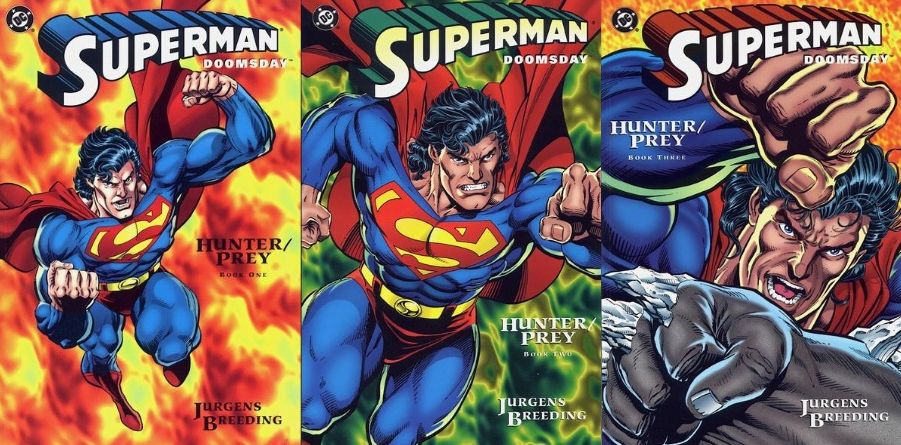
I hear Spielberg used these covers as inspiration for that scene in Jaws.

Comics: Superman/Doomsday: Hunter/Prey #1-3

Notes: About a year after his return from the grave, Dan Jurgens gave us this three-issue miniseries featuring what fans were clamoring for: a rematch between Superman and Doomsday. Apparently, since he came back, Clark has been suffering from recurring nightmares about the battle with Doomsday, worried about the fact that the Cyborg threw his body into space and parts unknown. The fears are justified – a space cruiser picks up the rock the Cyborg strapped him to and Doomsday wakes up, resuming his quest of slaughter amongst the crew. The ship brings him to Apokalips, where he begins a rampage that causes even Darkseid’s minions terror, and then it gets worse – the Cyborg himself returns, having transferred his consciousness onto a device he slipped onto Doomsday, where he just bided his time until he had the opportunity to construct a new body. 

On Earth, Superman hunts down Waverider and the Linear Men, hoping they will tell him Doomsday’s secrets, but all he gets is a cryptic clue that points him to Apokalips. Oberon of the Justice League hooks him up with a Mother Box, and he sets out, just in time to see the Cyborg and Doomsday causing untold destruction, even beating down the mighty Darkseid.

This is the series that gives us the origin of Doomsday, and it turns out to be as horrific as one would expect. Millennia ago, an alien scientist strove to create a “perfect” being. And what better way to do that then by going to a planet so violent and inhospitable that virtually nothing could survive on the surface, jettison an infant to be brutally slaughtered, and then cloning him over and over again to find new ways to survive? The ultimate result of this experiment, after decades of violence and torture, was Doomsday, a creature who has the ability to evolve and recover from any injury. In short, he can never be killed the same way twice. Unfortunately for the scientists, he also evolved to consider literally any form of life a threat. He kills them all, then hitches a ride into space to begin a reign of terror. Oh yes, and the planet where all this happened? It was in the ancient past of a little world called Krypton. Eventually he was defeated by the Radiant, an energy being from another world, and was “buried” on an asteroid that, after untold centuries, crash landed on Earth.

Ah, you know the rest.

Issue three of this series is almost pure fight scene. By the end of it, Darkseid has trapped the Cyborg’s consciousness in a little ball, and Superman and Waverider throw Doomsday through time to be swallowed up by the end of the universe itself. He got better. 

Jurgens takes advantage of the “prestige format” of this miniseries, free from the constraints of the comics code. While still relatively mild compared to a “mature readers” comic book, he really amps up the violence this time around. We see Doomsday’s victims ripped in half, their heads pulled off, and all manner of gore that was pretty intense compared to the typical Superman comic of the Triangle Era. Keeping the bulk of the story on Apokalips also nicely sidesteps the consequences of fitting this story into the regular Triangle books. Had the rematch happened on Earth, there would have had to have been a whole new subplot about the destruction, the devastation, the PTSD everyone suffered from Doomsday’s return. This way, only a handful of people on Earth even know that it happened, and it’s taken care of with everybody none the wiser. It’s well-constructed.

It’s also a nice showcase of the way that Jurgens – like many creators – shows off his pet creations. There are a few characters that Jurgens created or co-created that he keeps coming back to time and time again. Booster Gold is probably the most famous of these, but he also loved to keep coming back to Waverider and the Linear Men. I’m a big fan of them as well – to this day, I think Waverider has one of the coolest designs of any character that came out of the 90s (not a single pouch or pocket, even), and I also like a good time travel story. He fits in nicely, and on those rare occasions he shows up nowadays, I always like seeing him. 

Of course, this wasn’t the end for Doomsday. Even throwing him into the heat death at the end of the universe wouldn’t be enough to take such a lucrative character off the table forever. But it would be a little while before he showed up in continuity again. In fact, the next time we saw him, it wouldn’t be set in the regular timeline at all. 

Literature.

Novel: The Death and Life of Superman by Roger Stern (finished)

Notes: I wrote about the bulk of this novel in last week’s blog recap, so I don’t have too much more to say, other than to note how Roger Stern tweaked the ending. He left out Green Lantern’s involvement in the finale, which seems like an odd choice, considering how meticulously he stuck to the story in the earlier scenes with the Justice League. There’s also a bit of a change at the end: in the comic book, Superman’s powers were restored when the Cyborg tried to hit him with Kryptonite, but the Eradicator dove in front of the beam. The mingling of the Kryptonite and the Eradicator’s energy was what it took to bring Superman back to full power. In the novel, though, the Eradicator chooses to pour his energy into Superman and recharge him. I have to say, I like the comic book version better. Either way the Eradicator gets his heroic sacrifice, but somehow it’s more satisfying if he dies trying to SAVE Superman, rather than dying just to give him back his powers. Even more than the Green Lantern omission, I’m not sure what spurred this change in the story. All that said, none of this ruins the book. It’s a fun read, especially for completists like myself, and I suggest you poke around and find yourself a copy if you’re so inclined.

Fri., March 21

Comic: Doomsday Annual #1

You know, technically, there’s no such thing as “first annual.” Something can’t be a yearly event until it happens twice. This one didn’t happen twice. Please enjoy “Doomsday Not-Really-An-Annual #1.”

Notes: By 1995, DC had stopped doing annual crossover storylines like Bloodlines and, instead, began doing annual THEMES instead. This year, the annual theme was “Year One,” with every annual telling an early story of the character in question. Not a bad way to do it, really, I wish that modern annuals had any sort of rhyme or reason to them. Over at Marvel their Annual editors don’t even know there are numbers higher than “one.” But most interesting was how they would occasionally drop an “annual” for a character who didn’t even have a regular series, such as this. On the anniversary of Superman’s death, people have made a pilgrimage to the site where the monster first broke free from his confinement. As it turns out, the gathering was arranged by our old friend Mitch Anderson, he whose home was destroyed by Doomsday during the original rampage. The crowd and a group of soldiers guarding the area nearly come to blows until Superman arrives, settling things down, and begins to regale the people with stories of Doomsday’s past. The anthology issue includes the creature’s first battle against Darkseid, an ancient encounter with the Green Lantern Corps, and an epilogue of sorts to Hunter/Prey. It’s not bad – the Darkseid story especially is good, no doubt bolstered by the writing and artwork of Dan Jurgens – but compared to most of the other appearances of Doomsday, it’s a little forgettable. 

Sat. March 22

Comics: Absolute Superman #5, Action Comics #1084, Batman/Superman: World’s Finest #37, DC X Sonic the Hedgehog #1

Notes: It’s that time again, friends. Once again, I’m going to spend a Saturday afternoon checking in on the recent Superman comics – most of them, anyway. This week we got the long-delayed release of the second issue of Superman: The Last Days of Lex Luthor, a Black Label comic by Mark Waid and Bryan Hitch. The first issue, as I recall, was magnificent…but it came out nearly two years ago. I’ve got no idea what the cause was for the gargantuan wait, but I’ve frankly sort of forgotten what happened in issue one. I could go back and read it, but the third and final issue is supposedly going to come out next month. I think, instead, I’ll just hold off on reading #2 and hit all three of them when the final issue is released. So here are the other Superman and Superman-adjacent comics from the past few weeks:

The weird thing is that this image was originally drawn for a Pepto-Bismol commercial.

Absolute Superman #5: The newest DC Universe continues to reveal its secrets, with this issue telling the story of the last days of Krypton. I’ve said many times that I don’t really need origin stories anymore – we’ve seen them a billion times and there’s not really a need for them anymore, especially in terms of the most popular characters. I never again need to see the murder of Thomas and Martha Wayne, I never need to see Peter Parker get bitten by a spider, and I never need to see Krypton explode. The exception to this rule is the rare story that does it differently. In the Absolute Universe, Kal-El wasn’t sent to Earth as a baby. Here, as a child, he is one of a group of Kryptonians that Jor-El has gathered in an effort to escape Krypton’s destruction – not even a fraction of her population, but more than the sole survivor their son usually is. I’ve really been enjoying what they’ve done with the Absolute line. I wouldn’t want this to be the “main” DC Universe, but as an alternate reality, it works, and it’s working quite well.

Action Comics #1084: John Ridley’s “Force Majeure” arc ends this issue, and it does – to be fair – address my biggest issue with the arc. I’ve said before, I hate recidivism stories. No matter how realistic they may be, once I’ve watched a former villain go through a redemption arc I don’t like seeing them backslide, and Major Disaster is no exception. As this story ends, we at least get a slightly more palatable reason for his reversion to a crook. It helps, but it’s still just not the kind of story I want to read, especially in a Superman book. There’s enough darkness in the world, Action Comics is a place where I want to see the light shine through.

Batman/Superman: World’s Finest #37: Although this title is ostensibly a Batman/Superman book, there are times where Mark Waid really uses it as his playground to touch upon the entire DC Universe. Batman and Superman are almost side characters in this issue, with the bulk of the story landing on the shoulders of Aquaman, Swamp Thing, and Lori Lemaris. Lori kissed Superman at the end of last issue, her old feelings for him resurfacing, and in this issue her husband is understandably having issues dealing with it. They work through their issues while the heroes fight to, y’know, save the world, as they do. Nobody knows the DC Universe like Mark Waid does, and it’s great to know that they’ve tapped him to write the upcoming New History of the DC Universe miniseries.

It’s another “who’s faster, the blue guy or the red guy?” situation.

DC X Sonic the Hedgehog #1: Man, do I love a ridiculous crossover event, and this most certainly qualifies. In this issue, Darkseid has invaded the world of Sonic the Hedgehog aboard his “Ragna Rock,” a mobile battlestation that can cross dimensions. The Justice League follows him, and join forces with Sonic and friends to take him down. This is surprisingly refreshing for one of these crossover events. For starters, whenever there’s a crossover between two universes that can’t mix as easily as, say, DC and Marvel, it’s usually the characters from the less-grounded world coming to the more-grounded one – the DC/Looney Tunes crossover from years back being a prime example. Here we get the reverse, which is a nice change of pace. Second, there’s never even an iota of the usual “heroes get into a misunderstanding and fight before they team up against the bad guy” nonsense that we see time and time again. The League and Team Sonic immediately recognize each other as heroes and quickly not only partner up, but pair off, with the members of each team gravitating towards their most logical counterpart on the other. Superman winds up with Knuckles, the “strongest” of the Sonic heroes, and while their personalities are very different, there’s a mutual respect from the outset. I suspect at least part of this is because the comic is written by longtime Sonic writer Ian Flynn, who probably knows those characters better than anybody alive, and finds it fairly easy to integrate them with the world-famous Justice League. It’s a silly book, to be certain, but you know what? I like silly. 

Sun., March 23

These covers, on the other hand, inspired a scene from Paddington 2.

Comics: Superman: The Doomsday Wars #1-3

Notes: The second Superman/Doomsday rematch, once again a Dan Jurgens joint, came in 1998. In another three-issue miniseries, we see Superman wrestling with his failures – specifically the death of Cat Grant’s son Adam at the hands of the Toyman. He keeps flashing back to a failure of his as a teenager, in which his family’s entire herd of cows froze to death while he was helpless to save them, and the dual failures are eating at him. Things are compounded when he learns that Lana Lang – who at this point was married to Pete Ross – has given birth, but the baby came prematurely and is near death. As Superman races to bring the child to medical attention, Doomsday returns and begins tearing through the Justice League…and this time, he’s not the mindless brute Superman faced before.

I have to say, as a sequel to the original Doomsday fight, I actually prefer this one to Hunter/Prey. The stakes are much more personal here, with Lana and Pete’s child hanging in the balance, and with Doomsday himself (spoiler) being propelled by Brainiac’s intelligence, making him far more dangerous. The story also takes place during the Grant Morrison era of the Justice League, so Doomsday is fighting a far more experienced and more powerful team than he did the first time. We don’t see the entire fight, but the stuff we see is really good, and in some instances (such as what he does to Plastic Man) downright chilling.

The one thing I’m not really down with is the characterization of Pete Ross. In the classic Superboy stories from the Silver Age, Pete was Clark’s best friend and the only one outside of the Kents who knew his secret identity, although Clark didn’t know that Pete knew it. After the Man of Steel reboot, the Superboy years never happened and the role of secret-keeper was switched to Lana, which was fine, but there are moments where Pete just doesn’t feel right. He’s outraged at Lana when she asks to speak to Clark privately (so she can ask him to have Superman save her son), and while a little insecurity about her speaking to the man Lana was in love with for so many years may be understandable, the blind rage he shows when he finds out that Superman is trying to save his child doesn’t make any sense at all. To be fair, Pete comes around by the end of the miniseries, but it’s a journey he never should have really been on in the first place.

Mon., March 24

Imagine this guy showing up on the bridge of the Cerritos.

Feature Film: Reign of the Supermen (2019)

Notes: The sequel to The Death of Superman picks up six months after the end of the first film, which in and of itself is an improvement over Superman/Doomsday, which made it seem as though the big guy was dead for about the length of an episode of Bluey. Almost simultaneously, four different people show up wearing the s-shield, and…oh, what the hell am I doing? You know how this story goes by now.

Instead of wasting time on a recap, let’s just talk about how this animated film works as an adaptation. The changes, for the most part, seem to be in service of making the story fit the animated DCU they were working with at the time. For example, in the absence of both Cadmus and WGBS, Superboy is a creation of LexCorp, although he still maintains his essentially good heart. In fact, his debut is interrupted by the Eradicator, showing up to eliminate “known criminal” Lex Luthor and winding up fighting the Kid, Steel, AND the Cyborg. It works pretty well – if there was anybody watching this who somehow didn’t know the story, it’s a good misdirect as far as hiding the Cyborg’s true nature. They also tie Superboy’s origin into the reconned version from his Teen Titans era – making him a mix of Superman and Lex’s DNA – which works better in this universe. An odd tweak has Henshaw, the Cyborg, initially working for Darkseid (deliciously voiced by the late, great Tony Todd) as part of his status as this DCU’s Big Bad. Instead of an attack on Coast City, Henshaw builds an army by offering them the same technology that “resurrected” him – really Apokalips tech. The end of the story isn’t quite as dramatic – we don’t get anything like the devastation of Coast City – but they manage to make the battle deeply personal, with the Cyborg’s rage being a bit more focused and less megalomaniacal. 

There’s really good stuff with Lois in here, such as a nice early scene where she and Wonder Woman commiserate over Superman’s absence. Later, she deduces John Henry’s secret identity, then teams up with him to uncover who the Cyborg is – funny for a character who, in her own words, is “the worst with secret identities.” But it makes Lois look smarter, more capable, and gives her an agency that she lacked even in the original story. She’s also present for the finale this time, taking an active role in the battle with the Cyborg, and I love seeing it. 

There are also nice Easter Eggs in this movie as well, such as newspaper cover photos that are based on the covers to the Reign of the Supermen comics. It’s the sort of thing that only the hardcore fans might notice but…well, if you haven’t noticed by now, I’m a hardcore fan. 

I don’t want to spend too much more time talking about the casting of this one, as there isn’t much more to say this time around than I said when I watched the first one a few weeks ago, but I do need to point out Rainn Wilson’s Lex Luthor again. While still slick and serpentine, Wilson plays him a bit funnier this time around. There’s a dismissive conversation with Superboy about how a clone is no different than a biological child that left me laughing, for instance, and he carries that same sensibility throughout the film.

This is a far superior adaptation of the story than the animated DC’s first attempt. It’s not totally faithful, but it works well for the world in which it is set, and that’s what I’m asking for here. 

Tues., March 25

I bought a bunch of these balloons once. My niece said I ruined her sixth birthday.

Comic Books: Superman: Day of Doom #1-4

Notes: To all things there must come an ending…even the saga of Superman’s death and return. I’m going to wrap up this surprisingly long dive into that storyline with the four-issue miniseries Superman: Day of Doom from 2002, published to coincide with the 10th anniversary of the story, written by Dan Jurgens with art by Jurgens and Bill Sienkiewicz. It’s the anniversary of Superman’s death in the DCU too (which anniversary isn’t really made explicit) and Daily Planet newbie Ty Duffy is tasked with writing a piece about people’s feelings about that monumental event. Despite not seeing the newsworthiness in a story that’s been told time and again, Duffy starts to dig, beginning with an interview with Blue Beetle and Booster Gold. (Remember what I said about Booster being one of Jurgens’s pet characters? This isn’t a complaint, I love seeing Booster Gold.) From there he begins an Odyssey that takes him to all walks of life in Metropolis, finding the stories that haven’t been told before.

The strength of this series, honestly, comes in those scenes where we hear new perspectives. Duffy talks to Perry White and Jimmy Olsen, but we saw them on the day. We know how they felt. It’s far more impactful when he talks to a random bystander who was left in a wheelchair thanks to Doomsday’s rampage, a priest who ministered to the suffering after the Coast City disaster, or uncovers the undisguised glee the Prankster felt when he heard that Superman was dead. 

There’s a running thread throughout the series as well, about someone causing disasters along a path that perfectly mirrors Doomsday’s trail of destruction. As the trail reaches Metropolis at the end of the third issue, the two storylines finally collide, with Duffy laying in to Superman with the truth about why he resents the hero’s return from the dead so much, just pages before he too is taken by the mystery villain. 

The story is surprisingly open-ended. Superman is forced to confront the tragedies that so many other people suffered during the battle with Doomsday and beyond, but the villain gets away and his true nature goes unrevealed. Even Duffy, who is the crux of this story’s emotional journey, doesn’t seem to really get the catharsis one would expect at the end. There’s a bitterness here that’s surprising. Don’t misunderstand – it’s pretty realistic. Even at the time of the original Doomsday storyline, the writers made it a point to refer to how many people Doomsday had killed, but they’d never really dug into those stories before. Even the most prominent Doomsday victims in the comics of the time – Mitch Anderson and his family – survived the rampage with the loss of their home, but no loss of life. And the Justice League showed up and built them a new house at Christmas, so where was the tragedy?

I have to wonder if writing this was a kind of catharsis for Jurgens himself. It feels almost like the writer is performing an act of penance, trying to atone for all the hundreds of fictional people that he killed (to say nothing of the seven million of Coast City) in the service of the story of the life and death of one man. It’s certainly the way that Duffy views the event, and it’s so odd that the comic book gives you the impression that – at least on some level – Dan Jurgens feels the same way.

The story of Superman’s death was tragic. The story of his return was triumphant. Day of Doom is a somewhat dark attempt to reconcile the two. It’s probably not something to be read in the immediate aftermath of the Death of Superman – after the upbeat ending of that story, it’s something that’ll bring you right down.

But it is most certainly a story that should be read.

Other Comics: Superman’s Girl Friend, Lois Lane #11,

And thus, finally, we reach the end of the epic saga of the Death and Life of Superman, and I am reminded why I decided not to do TOO many of these extended storylines over the course of this year. I do have one more planned, but it’s going to be a few months before I’m ready to tackle it. Starting tomorrow I’m planning to get a little more random again…but I’m also looking for some help. I’m asking you, dear readers, to suggest some of the best single-issue Superman stories ever written for me to dig into. After spending nearly a month with one story, I want shorts. So hit me in the comments with your suggestions. They can come from any era, any continuity, any Superman you want. They don’t even have to be from a Superman comic book – if you can find a really great story from an issue of Blue Devil or something, I’m down for it. Preference will be given to stories available on the DC Universe Infinite app, but that doesn’t mean I’ll automatically reject stories that aren’t. Next week, it’s gonna be SUPERMAN BY REQUEST!

Blake M. Petit is a writer, teacher, and dad from Ama, Louisiana. His most recent writing project is the superhero adventure series Other People’s Heroes: Little Stars, volume one of which is now available on Amazon. You can subscribe to his newsletter by clicking right here. You can join in the Kryptonian Konversation every day in the Year of Superman Facebook Group!

Year of Superman Week 11: The End of the Return

This week we’ll reach the end of the “Reign of the Supermen” storyline (probably – I’m writing this on the afternoon of March 12 before I start reading any of them, so I suppose anything might happen). After that, I intend to touch upon some of the stories that follow and some of the ways that the Death and Return storyline were reflected in other media. Being such a fundamental part of the Superman mythology at this point, it shouldn’t be surprising to anyone to see that it’s been revisited many times. We won’t get to them all, but there’s plenty coming up. 

Wed., March 12

Comics: Action Comics #690, Superman: The Man of Steel #25, Superman Vol. 2 #81, Adventures of Superman #504, Adventures of Superman Annual #5

“Eradication”? Get It? GET IT?

Notes: Let’s start with Action Comics #690. The Last Son of Krypton, close to death, returns to the Fortress of Solitude only to learn that his “power source” is gone – he’d been using the real Superman’s body to generate the energy he needed. The process has helped to resurrect him, though, and now Superman is on his way to Metropolis, charging across the ocean floor in a Kryptonian mech. The Kryptonian, meanwhile, sends what amounts to a deep fake video to the Justice League, blaming Coast City’s destruction on the Eradicator and sending the League and their most powerful allies on a wild goose chase into outer space to track him down. After all, it won’t be great for his plans if Earth’s most powerful heroes are still on Earth. 

Two things of note in this issue. First of all, the robots in the Fortress help repair the Eradicator’s damaged memory, revealing to him (and the reader) his true identity. It’s been a long time, but I’m pretty sure I figured this one out ahead of this issue. You see, at this time I voraciously re-read my favorite comics. I’d start with the Man of Steel miniseries, read every subsequent Superman comic in order (I had begun – but not completed – the process of filling in the gaps) until I reached the most recent, then go back and start from the beginning. So I’d read the Eradicator story maybe five or six times, it was pretty fresh in my memory, and Roger Stern dropped a LOT of clues (unlike Dan Jurgens, who was pretty good at holding the Cyborg’s true identity close to the vest). The other thing I want to point out concerns Superboy, captive of the Cyborg, struggling to get free and save Metropolis from being destroyed like Coast City. Up until this point, Superboy had been motivated largely by his thirst for fame and adoration. There were glimpses of the good core of Superman in him, but this is the point where it really starts to come out, when he REALLY starts to see the big picture and find himself willing to put himself on the line. It’s a good look for the Kid.

That’s a face only a Martha could love.

In Man of Steel #25 Superboy is still being held by the Cyborg in the enormous engine built over the ruins of Coast City, unable to figure out why his powers don’t work the way he expects them to. He manages to escape, rushing back to Metropolis just as Supergirl, Steel, Lex Luthor, and Lois all converge at the Metropolis airport, where the Kryptonian mech we’ve been following for a few issues now emerges from the ocean. After a brief fight, Lois holds the others back, recognizing the Kryptonian battlesuit. It cracks open and spills open its precious cargo: a black-clad Superman, ready to put his life on the line for Metropolis once again. There’s so much to love about this issue. We get Lois back, for one thing: after her creepy friend Jeb Friedman makes a move on her she has a moment of crisis and realizes she’s lost herself, then is determined to make her way to Coast City to blow the lid off the Cyborg. Superboy continues gaining more of an awareness of himself as well, and bringing all of our heroes (and Lex) together again leads up to a really inspiring last page. From here, it’s a roller coaster to the end of the story, and I’m there for it.

Lois: “Superman never wore black like some executioner.”
DC: But this will sell a LOT of action figures.
Lois: I withdraw my objection.

Superman #81 picks up right here, as the others face off against this newest guy wearing Superman’s face, with nobody sure what to make of him — especially since he has no powers. He’s saying the same thing as everyone else: Ms. Lane, you know me, you’re the one who gave me my name, so forth, and Lois is struggling until he pulls out To Kill a Mockingbird. The mention of Clark Kent’s favorite movie gives Lois pause – could this actually be the real deal? After a brief conversation, he borrows a pair of flight boots from one of Team Luthor and he, Superboy, and Steel take off for Coast City. Meanwhile, one of the Cyborg’s minions fills in another one of the truth about their master – the former Hank Henshaw, reduced to a computer intelligence, conquered Mongul and is using him to destroy Earth in Superman’s name. The wraparound sequences are best here, with Clark and Lois, all touching moments even now. The middle of the book, with the Cyborg’s origin, is less interesting once you already know the story. At the time, though, it was necessary – Henshaw had been a relatively obscure character who had only made a few prior appearances, and they were actually just before I became a regular Superman reader, so I had to go back and learn who he was after the fact. I wonder if I would have picked up on who Henshaw was earlier had I already read those comics. Probably not, if I’m being honest, but I’m still curious. 

Does anyone else remember the action figure line that came out after this with the slogan “Don’t mess with the S”? Wasn’t that an AWFUL slogan?

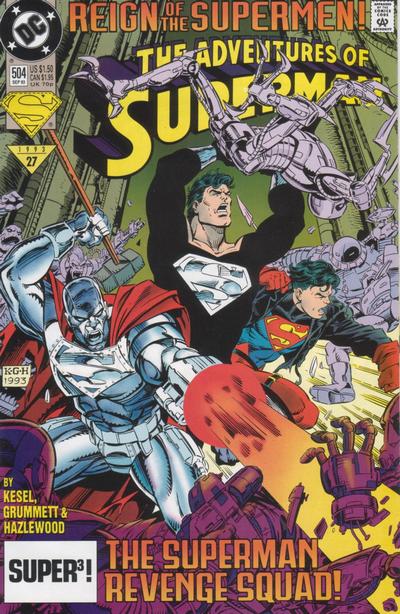
In Adventures #504, the trio lands in Coast City, where the powerless Superman scavenges weapons from the Warworlders as they fight their way to the heart of the engine. Cyborg’s got another missile prepared, though, and Superman and Steel watch helplessly as it blasts off for Metropolis, realizing only after the launch that Superboy is clinging to the side. He rides the missile across the country, trying to take it apart, before deflecting it from Metropolis at the last second, arcing it into the air where it explodes…seemingly taking the Kid with it. Spoiler alert: Superboy survived, but man I love this issue. If the Kid was going to stick around (as he did) he really needed a Hero Moment in this story, something to show that he was worthy of wearing the shield. I would say saving Metropolis from total destruction, possibly at the cost of his own life, does the trick.

Fortunately Superboy’s sense of timing got better later.

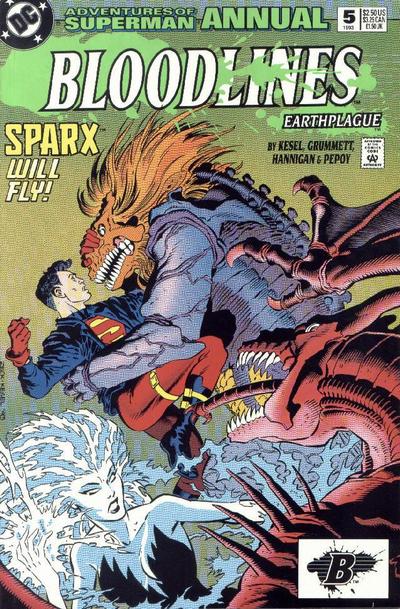
Of course, this DOES take us to Adventures of Superman Annual #5, our final Bloodlines check-in. Superboy wakes up in the hospital, having just stopped the missile, and is approached by Maggie Sawyer for help in hunting down the alien serial killers from the previous three Superman (and a dozen other) annuals. Meanwhile we meet the improbably named Donna Carol “D.C.” Force, youngest of the Force family. Everyone in D.C.’s fam has the metagene, but hers hasn’t activated yet, and she comes to Metropolis with her Uncle Harry chasing rumors of the alien killers who are making new metahumans. She winds up getting attacked, of course, and a paramedic’s defibrillators seem to give her the final ingredient, activating her gene and giving her electrical powers. D.C. teams up with Superboy to fight the aliens as Sparx. 

Sparx was easily the most successful of the four New Bloods that came from the Superman books, becoming a series regular in Superboy and the Ravers a few years later and having assorted appearances in the years since. I really like the concept of a kid who comes from a family of metas who just wants to be a superhero, too – it’s a nice, kind of sweet idea. The real issue with this book is TIMING. Superman and Steel are back in Engine City on the other side of the country trying to prevent the Cyborg from destroying the entire planet, and Superboy takes time out for a SIDE QUEST? You’ve gotta be kidding me. 

Thur., March 13

Comics: Action Comics #691, Superman: The Man of Steel #26, Green Lantern Vol. 3 #46, Superman Vol. 2 #82

Dammit, Clark, stop breaking the covers. Do you have any idea how expensive these are?

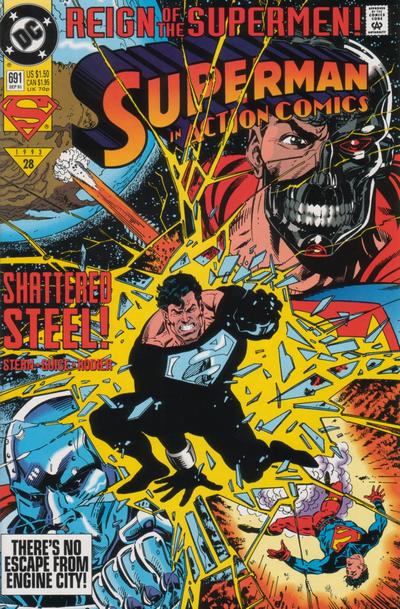
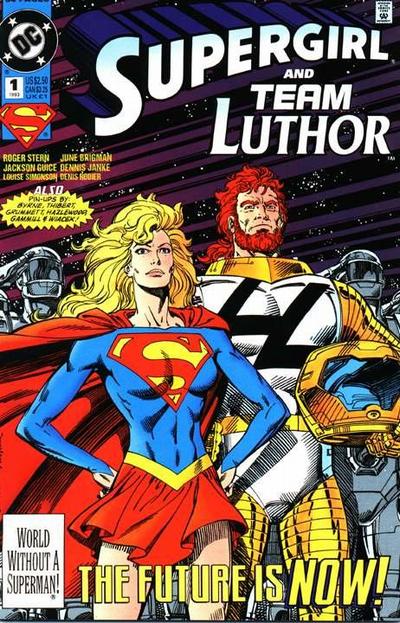
Notes: As Superman and Steel fight their way to the heart of Engine City in Action Comics #691, we discover that Supergirl has been following them since leaving Metropolis, using her invisibility to act as Superman’s “secret weapon” (a nice little nod to the original status quo of the original Supergirl). In the Fortress of Solitude, the Eradicator drains the power from the Fortress’s devices, leaving both the systems and robots dead, in order to recharge himself enough to return to the fight. And in the heart of the Engine, Mongul finds himself planning to turn on the Cyborg, while revealing that the Engine is powered by a gargantuan piece of Kryptonite. Good stuff in here. The book leans heavily on “If Lois believes he’s really Superman, that’s good enough for me,” and the man in black’s actions back it up. By the end of this issue, Steel is fully convinced that it’s the real deal, and even Mongul recognizes that this new enemy has far greater honor than the Cyborg, whose version of events must be twisted. 

Speaking of the “man in black,” I wanted to point out something regarding the covers for these issues. You notice how, although they had Superman in the black recovery suit (which has become a fan favorite alternate Superman look) they gave him his usual short hair instead of the long hair he came out of the Kryptonian mech with and would keep for the next few years? I’ve never quite understood that. I wonder if it was a case of the covers being drawn far enough ahead of time that the long hair hadn’t been decided upon yet when they were released. It’s an interesting little artifact though, isn’t it?

I would totally wear this cover on a T-shirt.

In Man of Steel #26, Mongul reveals his plan: since Superboy stopped the missile from turning Metropolis into a second engine, which would have made Earth into a new Warworld, he’s going to content himself with firing the existing engine and just, y’know, destroying the world. As a powerless Superman faces Mongul, Steel plunges into the heart of the engine. And in a moment that will change the DCU forever, Green Lantern returns from space to investigate what has happened to his city. There are two great bits in this issue for me. First of all, the Cyborg underestimating Steel’s ability to stop the engine. No way a mere human could possibly throw a wrench into his plans, right? But Mama Irons didn’t name him after the steel-drivin’ man for no reason. The allegory of John Henry vs the Machine may be a bit on-the-nose, but holy crap, is it a fantastic story beat. The other thing, which doesn’t really have a ton of significance but I’ve always thought was funny, was Lois’s scuzzy friend Jeb Friedman watching her concern over the battle in California and asking her if her late finance Clark Kent ever realized she was really in love with Superman.

That caption would prove to be far more prophetic than anybody would have guessed.

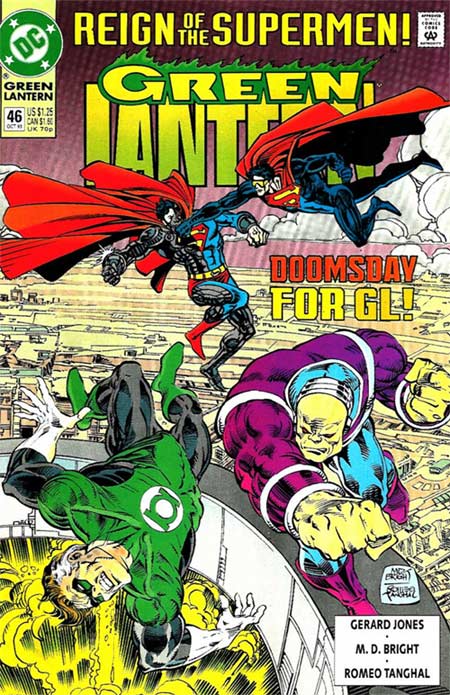
Green Lantern #46 is next. As Hal Jordan returns from space to see the wreckage of his home, he dives into the heart of the engine to do battle with Mongul. It’s a brutal fight, Hal hampered not only by Mongul’s yellow skin, but by the fact that if he really cuts loose he’ll unleash the Kryptonite powering the engine, but in the end there’s a hell of a beatdown. You don’t usually find this issue in the collected editions anymore, and for two reasons. One, the more important of the two, is because DC (and Marvel) are reluctant to reprint any of the work of this issue’s writer, who was convicted a few years back of some rather unsuperhero-like behavior. (I’m not going to elaborate – if you don’t already know, Google will tell you.) The other reason you don’t see it is a story reason – the issue runs concurrently with Superman #82, the end of the storyline, and reveals how the reign ends, which is kind of a problem if someone hasn’t read it yet. 

You know it’s special because CHROMIUM.

And here we are, Superman #82, the grand finale of “Reign of the Supermen.” Superboy and the Eradicator return to Coast City to rejoin the battle, but the others are cut off by the Cyborg, leaving him to face Superman and the Eradicator alone. In the depths of the Engine, they battle the Cyborg to a standstill. In a last-ditch effort, the Cyborg unleashes the power of the Kryptonite engine, draining it entirely in a massive power-blast, but the Eradicator hurls himself in front of Superman. The Kryptonite kills the Eradicator, but as the radiation passes through his body it transforms, restoring Superman’s powers. The other heroes break into the engine room just in time to see him defeat the Cyborg, and the true Superman stands revealed once and for all.

This really is a fantastic end to this storyline. Sure, neither the Eradicator nor the Cyborg turned out to be truly dead, and even Superman says in this issue that he doesn’t think Henshaw really CAN die, but try to forget the 30 years of comic book history that have passed since then. It’s Dan Jurgens at his finest, writing and drawing a fight for the ages. Images like the Cyborg inhabiting Steel’s armor and turning it against him are striking, as is the sight of the jawless Cyborg staggering around in pain before the end. Even the Eradicator gets his hero moment, sacrificing himself to save Superman, having been transformed by their psychic bond and abandoning his previous goal of restoring Krypton in favor of restoring her last son. Even now, all these years later, having read this story a dozen times, it’s awesome. 

But although this is the finale of “Reign of the Supermen,” it’s not the end of the Death and Life saga. The next few issues of the Superman books would all feature epilogues of one sort or another and there were several follow-up miniseries such as Superman/Doomsday: Hunter/Prey, which I’ll be tackling over the next several days. There’s still a lot of fun to come from our favorite hero biting the dust. 

Fri., March 14

Comics: Adventures of Superman #505, Action Comics #692, Superman: The Man of Steel #27, Superman Vol. 2 #83, Adventures of Superman #506, Action Comics #693

You know it’s special because HOLOFOIL.

Notes: Now for what I’m gonna call “epilogue month” (and a half). After the Cyborg was defeated and the Reign of the Supermen ended, there were a LOT of loose ends left to tie up. Adventures #505 starts with Superman returning to Lois Lane, who had at this point spent several days worried about what was happening in Coast City. After a happy reunion, they start brainstorming – after all, Superman’s resurrection is one thing, but how are they going to explain Clark Kent being found alive after all this time? The issue continues with several other happy reunions – with Jimmy and Perry, Maggie Sawyer, and best of all, with Bibbo. There’s a good bit of set-up here, mapping out how things are going to go for Clark and Superboy in the coming months, but mostly it’s kind of a down issue in terms of action. Even the supervillain who briefly shows up, “Loophole,” is disposed of quickly and in a rather comical way. It’s like the writers knew that – after the emotional roller coaster we’d been on since Doomsday first cracked open his shell – we needed a break. 

“It’s weird, when Clark was missing the broom closet was never locked…”

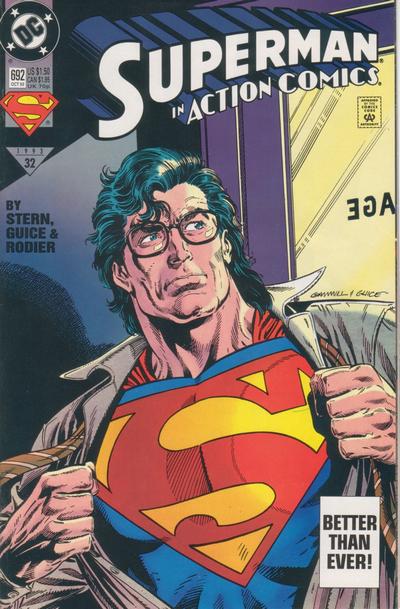
But just a week later, Action Comics #692 picks up right from that point, with Superman clearing away more Doomsday rubble and finding…CLARK KENT? Well no – not really. Turns out, Supergirl has used her shapeshifter powers to help complete the masquerade that brings Clark back from the dead. Although for everybody who ever complains about Clark’s glasses being an inadequate disguise, you have to wonder how nobody ever mentioned the fact that both he and Superman got long hair at the same time or how they both got it cut a few years later (comic book time) when Clark and Lois finally got married. 

We also get more loose end-tying. Here we learn that the Eradicator’s body has been taken to STAR Labs, where a heartbeat is detected, and Steel is expected to make a full recovery. There’s also a really cute moment where Lex Luthor confronts Superman about how absent Supergirl has been lately. When Superman deftly tells him off for acting as if he owns the girl, even Lex Luthor has to smile, realizing the real Superman is back. Sure, it’s just because that means he’s still got a chance to kill him himself, but it’s still oddly sweet. 

The issue ends with an unexpected visit from lesser-known DC Comics mystic Dr. Occult, whom Superman had met before. Occult is there to tell them just how close Superman got to dying, and that only a combination of several factors (including the efforts to revive him on the scene, the Eradicator’s interference, and Jonathan stopping his spirit from crossing over to the other side) managed to successfully bring about his resurrection. The point of this sequence is obviously to add back a little more dramatic tension in the future – DC no doubt felt that they HAD to convince the readers that Superman wasn’t immortal, even though later comics would pretty much say, “No, actually, he kinda is.” The issue ends with Occult dropping Lois and Clark off in Smallville for a joyful reunion with the Kents.

It’s just who he is, folks.

Man of Steel #27 shows us Clark’s welcome return to the Daily Planet, while Jonathan and Martha Kent go on a bit of a health kick that will ultimately redefine and modernize the characters a bit. Martha, from the John Byrne days onward, had been drawn as kind of a plumper version of Peter Parker’s Aunt May, and the makeover she soon undergoes makes her more youthful and vibrant, which was a welcome change. But the whole subplot is worth it for the panel where Jon Bogdanove draws Jonathan Kent pouting over the changes, hands stuffed in his pockets like a disappointed child. It’s like Power Pack, the Golden Years here. We also get the first hint that John Henry is going to relocate to Washington, D.C., which would be the setting when he got his own spinoff series later that year. Oh, and in the main plot, Lex throws a “Welcome Back” party for Superman that gets caught in the battle between the Underworlders (and their new leader) and Project Cadmus. This is set-up for future storylines that we won’t be covering from this blog, but it shows you how forward-thinking the writers were in this era. 

“Yeah, this way we don’t have to do another cover design.”

Superman #83 is the most literal epilogue to the saga (it even says it on the cover) as the heroes of the DCU gather to mourn the devastation of Coast City. I’m really glad they did this issue – with the joy over the return of Superman, it would have been really easy to forget that seven million (fictional) people died, but they didn’t pull away from it here. Obviously it would become a much, MUCH bigger plot point in Green Lantern, but it needed to be addressed in the Superman titles as well. The memorial gets disrupted when Lex Luthor shows up and the heroes nearly come to blows over what to do with the Engine: Green Lantern wants to let the atrocity crumble into the ocean, but Aquaman points out that such a thing would be toxic to the seas. Oh yeah, and a few of the Warworld stragglers are still there, causing trouble. The ensuing battle causes the Engine to crumble, but the Lanterns use their powers to sterilize the remnants and make them safe to settle in the ocean. In the end, Superman uses pieces of the engine to construct an eternal flame in memorial to those lost. 

Although the ramifications of the death and return storyline would be felt in the Superman books for a very long time, at this point they started to become a little less prominent as new storylines moved in and took their place. It only makes sense, of course, if you’re doing an ongoing serial like the four Superman titles were at the time, you never really get to call anything “the end.” More stuff always has to come in, and the Death and Return was, at this point, giving way to the stories of the future. But there are two last bits I want to mention. Adventures #505 brings back Superboy, where he learns the truth about himself and his powers. They’re based on Superman’s “aura” that gives him his invulnerability, but this causes Superboy’s powers to differ from the man himself in some interesting ways. The Kid finally accepts the Superboy name, and just like Steel, elements are put in place for his spinoff series. Finally, Action #693 brings Superman to STAR Labs, where the Eradicator’s body is still alive, but there is no spark of consciousness within him. A terminally ill doctor named David Connor is in charge of examining the body, but somehow (through comic booky science) winds up transferring his consciousness into it, thus making David Conner the new Eradicator. At this point, the status quo is more or less established for the foreseeable future – all of the remaining “Supermen” have a new lease on life and the cleanup of his death is more or less complete.

Sat., March 15

Essay: “The Superman Mythology: A Mini-Tribute to Edmond Hamilton by Jack Williamson” from The Krypton Companion

Notes: I don’t think I realized today was going to be a hard day earlier in the week. It’s been a rough few weeks for me, guys, the kind of period where having things like this blog to complete are what keeps me interacting with the universe instead of curling up into a ball, but March 15 is different even than that. March 15th is my mother’s birthday. We lost her in 2017, just ten days before Erin and I found out we were going to be parents. My son never knew his grandmother, and she never knew he was going to be born. I miss her a lot, and when times are bad I miss her even more. The point of all this is to say that I just did not have it in me to continue on today with “Death of Superman” stuff, even the aftermath.

Pictured: literature.

So instead, I turned to TwoMorrows’ excellent book of Superman minutia, The Krypton Companion and read a short piece about science fiction writer Edmond Hamilton and his connection to the Superman mythos. I’d heard of Hamilton before, but I’d never before connected him with our own Emil Hamilton, who Jerry Ordway confirmed was named for him. Emil was originally brought in as a one-off villain in Adventures of Superman, but Ordway pushed to rehabilitate him when John Byrne wanted a scientist-type friend for our hero. Ordway says he likes stories of bad guys being reformed. Me too – which is why it still ticks me off when they make Emil bad again.

Sorry I didn’t have more to say today, guys. I hope I’ll be in a better head space tomorrow.

March 16 & 17

Novel: The Death and Life of Superman by Roger Stern (Unfinished)

Notes: I’ve been riding the struggle bus lately. A few weeks ago I started having some car troubles and, frankly, the market ain’t great to replace it right now. This has had me under some greater-than-usual stress and, if I’m being honest, on those days when the stress gets particularly bad it’s been difficult to do even the things I want to do. One of the reasons behind “The Year of Superman” was to immerse myself in things that bring me joy, but when I’m in a bad headspace it’s hard to tackle that. All of that said, I haven’t missed a day of Superman content, I’ve just spent the last few days with Roger Stern’s novelization of The Death and Life of Superman, which was published back in 1993. I haven’t finished it yet – well, not this time around, anyway – but I’ve been enjoying it. 

There are lots of novels based on comic book superheroes, but novels adapting specific storylines are a bit more rare. I guess once DC realized just how big an impact this storyline was having, they started looking for more ways to monetize it. So Stern wrote this novel, while Louise Simonson wrote a “Junior Novelization” called Superman: Doomsday and Beyond, which I’ve actually never found a copy of. This isn’t the first time I’ve read this book, of course. I got it when it first came out, and in fact, it was originally released on my birthday (a fact I remember because I still see the original ad for it when I look through comics of the time) so it’s likely I requested it as a birthday present that year. I remember enjoying it quite a bit at the time, and it must have sold pretty well because DC did another novelization the next year, this time Batman: Knightfall by Dennis O’Neil, which I also enjoyed. I’ve still got that hardback copy, but I also snagged a paperback last year in a used bookstore, having no notion at the time that I’d be using it for such a worthy cause as the Year of Superman. It’s my first time reading it in at least 20 years.

Totally not posting this just so that everyone knows when my birthday is.

Reading it concurrently with the comics has been a fun experience, and showcases just how closely Stern’s manuscript adheres to the originals. Much of the dialogue is left intact, and even minor scenes such as Lois seeing a man in a hat and mistakenly thinking it’s Clark back from the dead remain. The only large swaths Stern skips over (at least in the portion of the book I’ve read so far) are the subplots regarding the Underworlders and Keith from the Superman: The Man of Steel issues, which were great for ongoing readers of the books, but didn’t have any real impact on the story of Superman’s death, so their absence isn’t really felt.

Stern keeps the same Justice League lineup from the comics, even going into explanations of Superman’s history with the team (which, if you’ll recall, was relatively new at the time) and the backstory of Guy Gardner’s expulsion from the Green Lantern Corps. Most adaptations would gloss over these things, or change the team to a more “traditional” lineup (as was done in the Death of Superman animated film I watched not long ago), so there’s a sort of purity in this incarnation. 

I also like how Stern brings in the backstory of the main cast – Superman, his relationship with Lois, and so forth. He plucks scenes from earlier comics, especially John Byrne’s Man of Steel miniseries, and uses them to fill in the world in which the story takes place. It’s really impressive how well the world is built up. Someone who has only a cursory knowledge of Superman can pick it up and pretty quickly get up-to-speed on everything they need to know about THIS incarnation of Superman. It’s pretty impressive, although I’m forced to wonder if anyone who isn’t familiar with the comics of the era would think it’s too much.

Like I said, I’m not quite done with the novel yet. I’ve got about a quarter of the book left to go, and I haven’t even gotten to the Cyborg’s big reveal yet, so I’ll have to come back when I get there to report on how well Stern sticks the landing. As of right now, I’m really quite happy with how good the adaptation has been.

Tues., March 18

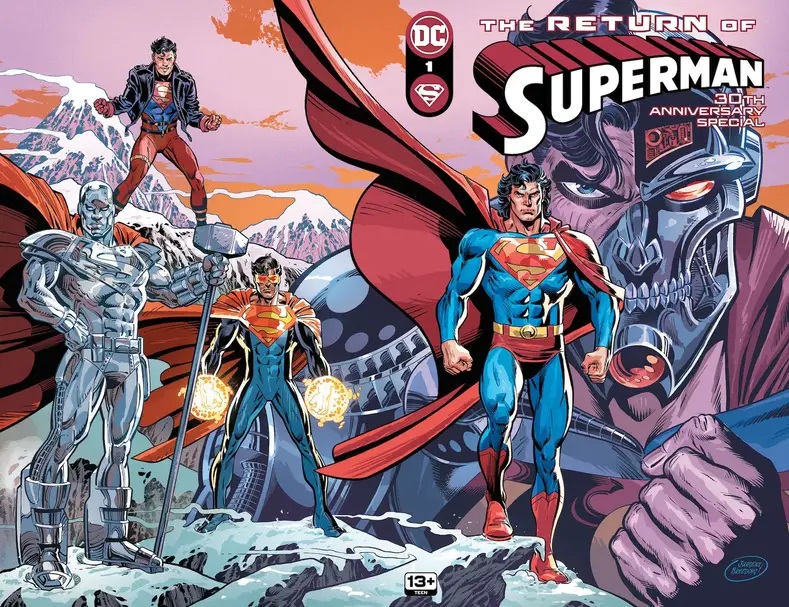
Comic: Return of Superman 30th Anniversary Special

“Return” doesn’t look a day over 29, does it?

Notes: As they did with his death, in 2023 DC Comics came to us with an anniversary special for Superman’s return. And like that previous book, this one was a blend of then and now. The main story is set in the present, with Lois Lane adjusting to becoming the new editor of the Daily Planet, as Perry White was in a coma at the time. (Long story. It was Lex Luthor’s fault. Him and Brian Michael Bendis.) On the day of the frame story, Superman is occupied elsewhere, when the Cyborg Superman returns, once again attacking Metropolis. With the real deal out of the picture, Superboy, Steel, and the Eradicator return to clean up the pretender. Meanwhile, Lois and Ron Troupe go through Perry’s journals of the time when the would-be Supermen first appeared and reflect.

I really like the structure here. Perry White is, in my opinion, an underused character. We see Lois all the time, of course, and Jimmy had his own series that lasted a really long time, but I’ve always seen Perry as sort of a second (or third, depending on how you count) father figure to Clark and Lois both, and we don’t see his insights enough. Even though he was literally unconscious at the time of this story, using his journal for the frame to the flashback stories works really well to tap into his mindset. 

The first of the four flashback sequences focuses on Steel and his effort to get the infamous Toastmaster guns off the streets of Metropolis. It’s a fine story, once again reuniting Louise Simonson and Jon Bogdanove to show off their character and what he came to mean to the less-affluent sections of Metropolis. In the Eradicator story, written and drawn by Jerry Ordway, Perry plays witness as he faces off against one of Ordway’s oft-used foes from his time on the Superman comics, mad scientist Thaddeus Killgrave. The story leaves Perry uncertain about the visored hero, and with good reason. Karl Kesel and Tom Grummett are together again for the Superboy story, and this may be my favorite of the bunch. The Kid is definitely playing the part he did back in 1993 – arrogant and thirsting for fame – but Perry is able to see the good in him. A sweet interlude at a skateboard park reveals the child inside, something few of the stories of the time bothered to do, and it works really well. 

The last story, by Dan Jurgens, deals with Perry’s skepticism over the Cyborg Superman and how he tortured himself for publishing Ron Troupe’s story (from Superman #79) that indicated he was the real deal after the Cyborg’s true colors were shown. I love the angle we get here, how Perry never quite forgives himself for that mistake. He’s the editor of the Daily Planet, damn it, and his responsibility is to the truth. To have made such an egregious error eats at him. This is honestly pretty refreshing – the idea of a journalist in the modern day having the sort of integrity to take personal responsibility for what was an honest mistake…dang, when’s the last time you saw anything even close to that in the real world? 

The special as a whole is fun. The thing that surprises me most of all is that, in the end, while it serves perfectly well as a spotlight on the four Supermen that rose up to take Clark’s place, it’s really kind of a celebration of Perry White.

Thus ends week 11. In week 12, I’ve still got some “Death of Superman” epilogues and odds and ends I intend to tackle, but I’m looking ahead to week 13. What I would like to do, friends, if you can help me, is try a sort of “Reader’s Choice” week. What are some of your favorite one-off stories about Superman? They can be from any time period, any continuity, and don’t even have to be from a Superman comic (maybe he makes a memorable guest appearance in Firestorm or something). I’d like to get a bunch of done-in-one stories to cover over a few days. Bonus points if the issue is available via the DC Universe app, but if it isn’t, that’s not necessarily a dealbreaker. I’ve got a pretty hefty collection, after all, and odds are that your favorites will be among mine as well. So head to the comments and hit me with your suggestions!

Blake M. Petit is a writer, teacher, and dad from Ama, Louisiana. His most recent writing project is the superhero adventure series Other People’s Heroes: Little Stars, volume one of which is now available on Amazon. You can subscribe to his newsletter by clicking right here. You can join in the Kryptonian Konversation every day in the Year of Superman Facebook Group!

Year of Superman Week Nine: The Beginning of the End…

As I have said many times, the golden age of Superman comics – for me at least – was the late 80s and early 90s, the period we now wax nostalgically for as the “Triangle Era.” I could honestly have just spent this year reading John Byrne’s Man of Steel miniseries (that’s still coming – at some point I’m going to do an “origins” week) and then continuing on until the triangles ended ‘round about 2000 or so. But instead, I made a list of some of the most important stories and high points of the time and, those that don’t necessarily fit into another theme I have planned, I’m trying to hit in roughly chronological order. And as of now, I’m only planning to read two of the longer storylines from the era (although I reserve the right to add more later if I feel I’ve got the room), and having moved forward appropriately in the timeline, it’s time to get into one of the defining storylines of the character. 

It’s October of 1992. I’m a 10th grade student with a subscription to the four Superman comics, eagerly awaiting their arrival each week and getting pretty darn mad when the US Postal service delivers them out of order (which happened, I must tell you, more than once). And even though I knew it was coming, even though it had been bandied about on TV and in newspapers for weeks prior to the beginning of the story, I didn’t know if I was really prepared for the story that — at the time – was called “Doomsday,” but that these days we typically refer to as “The Death of Superman.”

This was pretty much all I thought about for two months in the fall of 1992.

Wed., Feb. 26

Comics: Superman: The Man of Steel #18, Justice League America #69, Superman Vol. 2 #74, Adventures of Superman #497, Action Comics #684, Superman: The Man of Steel #19, Superman Vol. 2 #75

Notes: After a month of one-page prologues, the creature who would be known as Doomsday burst free from his subterranean prison in Man of Steel #18, and spends this issue stomping through the countryside, ripping up landscape and crushing animals before finding civilization. But the surprising thing, if you’re reading this for the first time, may be that Doomsday is the B-plot of this first issue. Most of the pages are used to deal with a running story from this particular series regarding a community of monsters in Metropolis’s underground. In the 90s, although the four separate Superman comics of the era continued into one another each week, each series tended to have its own subplots and stories to focus on, including the Underworlders. This issue also features Keith, an orphan who has befriended Superman and hopes to find his lost mother, and who would eventually be adopted by Perry and Alice White. 

I really love the Keith sequences in particular. The creative team on this book of Louise Simonson and Jon Bogdanove had previously done a wonderful run together on Marvel’s Power Pack, a comic book about a group of brothers and sisters who are all given powers by a benevolent alien. It was one of Marvel’s best comics of the era, and whenever Simonson writes children she brings a really authentic feel to them. Her children are inexperienced and naive at times, but never stupid or foolish. There is an inherent realism to her kids that I absolutely love. Keith was out of focus in the comics for a very long time, and with all the reboots that have happened over the years I wasn’t even sure he still existed in the DCU until recently, when Perry White was running for mayor and Keith showed up at an event with him. I hope, now that Perry is the mayor of Metropolis, we see a little more of Keith White.

Next up was what essentially was the end of Superman’s tenure with the Justice League, which had begun only nine issues before. The JLA is called in to stop Doomsday’s rampage, but Superman is on live TV doing an interview on the Cat Grant show and unaware of their battle, leaving his teammates to face the beast without their most powerful member. As Superman talks to a group of high school students, the League – if we’re being candid – gets their asses handed to them. Guy Gardner is hurt, Bloodwynd is chucked into a fire, and Blue Beetle is rendered comatose just as he was about to crack the mystery of who Bloodwynd really is. (If you remember a few weeks ago from the Justice League issues I read, that was Beetle’s primary preoccupation in this period, and if I may toot my own horn a mite, I remember solving that mystery myself when I read this issue, using the same clue that made it click for Blue Beetle. It wasn’t confirmed in the comics for several months, though.) The fight is intense, and rolls right into the next issue of Superman, #74. 

In fact, this was a running theme through the rest of this storyline. Each issue from this point on flowed seamlessly into the next and, starting with Adventures of Superman #497, each issue began to reduce the number of panels per page. Every page in that issue had four panels, the next three, then two, and in the final chapter the entire issue is told in full-page splash panels. What this does, essentially, is give the story a sense of ACCELERATION. Fewer panels means the story goes more quickly, each issue faster than the last, until we get to the final showdown on the streets of Metropolis in Superman #75. 

Superman #74: Superman joins the League to take on Doomsday. In the battle, Booster’s power suit is destroyed, Fire burns out her powers, Guy Gardner’s face is swollen so badly he can’t see, and Ice and Bloodwynd are taken down. The only one to escape unscathed is Maxima, and only because she leaves early to bring the near-death Blue Beetle to a hospital. 

Adventures of Superman #497: When Superman has to go back to rescue a family and his teammates from the house Doomsday destroyed in the previous issue, he gets a head start and starts creating havoc, taking down military helicopters and smashing into a small town before Superman can catch up to him. Supergirl (the Matrix version) sees the destruction on TV and wants to help, but her boyfriend Lex Luthor Jr. (long story, just read the Wikipedia explanation) holds her back. Maxima returns but is taken out in short order, and Superman vows to defeat the beast alone. 

Action Comics #684: The fight with Doomsday crashes into a department store, where a TV ad for an upcoming pro wrestling match at the Metropolis Area causes the beast to take notice of his destination: “Mhh-Trr-Plss…” A road sign that matches the advertisement points him towards Superman’s city as the Daily Planet helicopter – carrying Lois Lane and Jimmy Olsen – arrives to report on the carnage. The battle destroys an abandoned territory called Habitat, but the creature escapes and bounds towards Metropolis.

What it feels like being a teacher the week before a holiday.

Superman: The Man of Steel #19: Doomsday arrives in Metropolis. Cameras broadcast the battle across the world, including Smallville, where the Kents watch their son’s battle for his life on television. Supergirl finally is sent to help, but one blow from Doomsday disrupts her synthetic body and takes her out. Emil Hamilton and Bibbo (perhaps the greatest supporting character ever) bring a laser cannon to the roof to try to help, but to no avail. The Metropolis Special Crimes Unit open fire with everything they have, but they don’t even chip his hide. And in the end, Superman vows to draw the line in Metropolis.

When I read this story in high school, this issue was a great fight scene, sure, but like so many things it hits different for me now, as a parent. It seems quite telling to me that most people, like Jimmy, have the attitude that he’ll be OKAY. He’s SUPERMAN. He always comes out of it okay. But his parents, Jonathan and Martha, voice the fears of parents: “They don’t think anything bad can really happen to him.” The implication, obviously, is that the Jimmys of the world are wrong…and wrong he is.

Superman #75: The end. 

I remember distinctly the day this issue arrived in the mail. I got home from school before either of my parents got home from work, before the school bus dropped off my younger brother and sister, and I found this issue sitting in the mailbox. I brought it into the house, didn’t turn on the TV, didn’t even turn on the lights. The window in the living room gave me all the sunlight I needed as I slit open the plastic bag and opened the pages to witness the end of Earth’s greatest hero in quiet and solitude.

The story is swift, as befits an issue where every page is a single panel. Superman and Doomsday tear through Metropolis, trading blows until finally, with one last all-powerful punch, each of them collapse on the street. Lois rushes to his side and cradles him, his last words asking if Doomsday is defeated, his last thought for the city he was trying to protect, before the light fades from his eyes.

Yeah, I will admit, I cried when I read that. I still get misty today, even knowing that this was just the beginning of a much longer storyline it still hits like a kick to the gut. And even in 1992, when this was released, nobody really believed that Superman would stay dead. It was a story, and at the end of the story the status quo would be restored. That’s how these things went. 

It didn’t make it hurt any less.

This BROKE me.

And that’s what makes it one of the all-time great comic book epics, that I can read it again today and still feel that pang of loss I had when I was 15 years old. 

Man, this is a heavy way to start the week.

Thur., Feb. 27

When I woke up this morning, I went through my usual routine of showering, dressing, getting together a lunch for work, and then popping online for a few minutes until it was time to leave. Usually I want to see what the weather is going to be, if there’s any traffic snarls I should be aware of, that sort of thing.

I did not expect to begin the day with the news of the death of Gene Hackman.

1930-2025

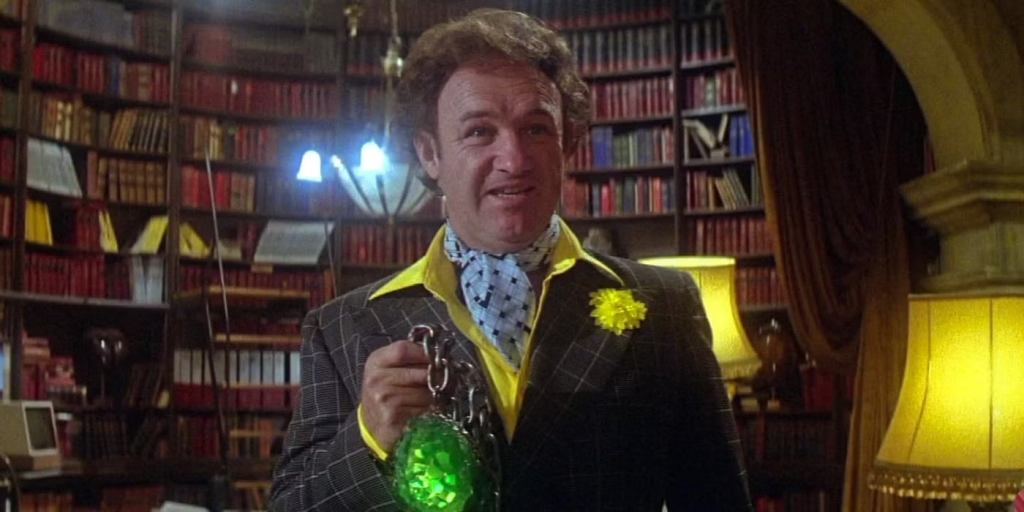
Hackman, of course, was a legendary actor, known for countless roles in dozens of classic films, but to me (and, I suspect, most people around my age) he is indelibly linked to the role of Lex Luthor. His Luthor was smooth, slimy, cheerfully manipulative and yet prone to brief outbursts of rage when faced with incompetence, which makes you wonder why he so often surrounded himself with incompetence. As much as Christopher Reeve shaped our perception of Superman and Margot Kidder our Lois Lane, so too did Gene Hackman shape our Lex Luthor.

As of when I write this, Thursday morning, the news is reporting that Hackman, his wife, and their dog were all found dead in their home in Arizona. Although foul play is not suspected, no cause of death has been determined. It goes without saying that my heart goes out to their families, those who knew and loved them personally. But also, it feels like a moment to raise a glass in tribute as another little piece of our childhood has left us forever. And at my age, it feels like we lose one of those pieces every other day. 

RIP, Mr. Hackman. See you in Otisburg. 

Comics: Death of Superman 30th Anniversary Special #1

Ah yes, “Death,” the traditional 30th anniversary theme.

Notes: Am I going a little out of order? Absolutely. But it feels more appropriate to read this now than to do so chronologically. In 2022, DC released this special with new stories by the same writers and artists behind the original Death of Superman event, followed up the next year with a special for the 30th anniversary of his return. I’ll get to that one too.

In the first story, Lois and Clark’s son Jon (still 10 years old, this is set before the Bendis aging controversy) in school when a familiar survivor of the Doomsday attack comes to talk to his class. This, as it turns out, is the first time Jon learns that his father died before Jon was born. I love this story – Lois’s talk with Jon is a nice sort of postmortem for everybody who read that story back when it was first published, encapsulating the feeling and emotion of the day while maintaining a bit of hope for the future. But as if that weren’t enough, we get a hell of a fight scene as well, as a construction worker who kept a chunk of Doomsday’s shattered bone all these years is suddenly transformed into a new version of the monster. The battle scene in the streets of Metropolis is pretty epic, and shows that Dan Jurgens hasn’t lost a step. It could have been published in 1992 and fit right in. It just makes it feel like more and more of a crime that he was bumped from Action Comics after issue #1000 when the status quo was upended. DC, I plead with you, find some way to have Jurgens writing and drawing Superman regularly again, preferably doing stories of Lois, Clark, and Jon in the past, like this one.

We also get three more stories, the first reuniting Adventures of Superman creators Jerry Ordway and Tom Grummett for a focus on Jonathan and Martha Kent. In the original “Death of Superman” we saw glimpses of the two of them watching the fight on TV. This story expands upon that, as they talk about some of the dark places and brutal battles their son had been in over the years. It’s a pretty good recap of the ‘86-’92 era of Superman through the eyes of the people who made Clark Kent the hero that he is. Martha’s Superman scrapbook is legendary, but this issue takes that concept one step further, showing the invisible impact Superman has on the world. It’s a really nice look at the character from a different angle. 

The third story brings back Roger Stern and Butch Guice, then the creative team on Action Comics, for a story starring Guardian at Project Cadmus, which was one of their ongoing subplot. The story shows the events of the day of Superman’s death from Guardian’s perspective, and although it doesn’t really offer any new insight into the story, it’s really great to see Guardian, Dubbilex, Dan Turpin, and some of the characters that were so important to the books at the time.

Finally, Man of Steel creators Louise Simonson and Jon Bogdanove return for a story about John Henry Irons, the man who will be Steel, and what happened to him during the Doomsday rampage. Having recently been saved from falling to his death by Superman, John Henry is determined to help him fight Doomsday, but as he follows the path of destruction, he find himself stopping at one disaster after another, pausing to save other people even as Superman fights for his life. This is why I love John Henry as a character so much – out of the four “new” Supermen that rose after his death, he was always the one who most embodied the spirit of Superman. With no powers, no weapons, without even the armor he would soon build, John Henry risks his life again and again to save others. And that’s what a Superman is for. 

Fri., Feb. 28

Legitimately some of the best stories of the era.

Comics: Justice League America #70, Adventures of Superman #498, Action Comics #685, Superman: The Man of Steel #20, Superman Vol. 2 #76, Adventures of Superman #499, Action Comics #686, Superman: The Man of Steel #21, Superman Vol. 2 #77

Notes: Although I can’t recall quite where, I remember reading an interview once with the creators behind the Death of Superman saga where one of them (probably Dan Jurgens) said that the stories that they were really interested in telling, the ones they found most compelling, were those from the “Funeral For a Friend” storyline. How does the world cope with the loss of Superman? How do we move on? How do we choose to honor his memory? The Doomsday story was a necessity to get them to that point, the “Reign of the Supermen” was the necessity to bring him back, but these stories are the heart of the saga.

Justice League America #70 picks up moments after the end of the battle with Doomsday, picking up the same dialogue – even the same narration – from the final pages of Superman #75. (And let’s hear it for Dan Jurgens, getting paid to write the same pages twice. Nice trick, sir!) The League is in a shambles: Blue Beetle comatose, Fire’s powers burned out and not returning, Ice injured, and Booster Gold’s future technology completely destroyed. As they try to pick up the pieces, the rest of the DCU’s heroes begin to assemble at JLA headquarters in New York to pay their respects to the fallen hero. It’s a touching book, with words of deep mourning and emotion that fit the grim day. For all intents and purposes, this was the end of Superman’s tenure with the League until it was restructured a few years later by Grant Morrison, but for what it was and when it was, this was a suitable ending.

Adventures of Superman #498 also picks up on the heels of Superman #75, showing the efforts to resuscitate the Man of Steel, and the ultimate futility of the attempt. This issue takes us everywhere: Supergirl tries to pull herself back together, Gangbuster is angry at himself for not being there, and in Smallville Jonathan and Martha Kent cling to one another and pray for a miracle. Somehow, even now, the thing that hits me hardest is the scene of Bibbo strapping on one of Professor Hamilton’s force field belts so he can withstand the jolt as he tried to hit Superman with hyper-charged defibrillator paddles. Bibbo is just one of those characters that’s too wholesome for the world – a big, gruff bruiser with the brains of a kid and the heart of a prince. The inherent goodness in him, in a man that the world would have cast aside, is what makes him such a perfect member of the Superman supporting cast. He’s another one we don’t see nearly enough nowadays. 

Action Comics #685 picks up that evening, as a Daily Planet extra edition announces the news no one wants to hear: “SUPERMAN–DEAD: METROPOLIS MARVEL KILLED IN ACTION.” Paul Westfield and Project: Cadmus get into a fight with Guardian and Supergirl over the right to claim the body, while everywhere else we see the world beginning to mourn. Meanwhile, at the Daily Planet, people are starting to worry about Lois. In the wake of the fight with Doomsday, thousands of people are missing – and one of them is her fiancé, Clark Kent. When they say that this is the section of the story the creators were most interesting in telling, this is the issue that I always come back to. The final page is one of the single most affecting pages I’ve ever read in a comic book, as Bibbo – having cleared out his bar so he can be alone – gets down on one knee, says a “Hail Mary,” and prays…not for Superman, but for the protection of the world he left behind. 

If this page doesn’t rip at your heart I’m not sure how to talk to you.

Superman: The Man of Steel #20 gives us the funeral. On a rainy day in Metropolis, millions of people line the streets to watch the processional as his body is brought to a hastily-erected monument in Centennial Park. In Kansas, meanwhile, the Kents hold a solemn, quiet ceremony of their own. Again, this issue shows us the impact of Superman on the world – people recalling the times he saved them, Batman deciding to take care of a guy with a bomb “Superman’s way,” and so on. We also get more of those Simonson-written kids that I like so much. 

In issue #76 of Superman, it’s Christmas! Doesn’t quite feel that way, though, with Superman gone. So in his memory the Justice League and a few others gather in Metropolis to carry out one of Superman’s annual traditions – reading and answering letters from people in need. This is a great issue, a sequel to an earlier story where we saw how Superman spends Christmas, and which I’ll no doubt read and write about this December. We also get a pair of subplots: Jimmy Olsen and Bibbo help out Mitch Anderson, the kid whose house Doomsday destroyed, and the Kents come to Metropolis with Lana Lang to hold a private wake with Lois, as four of the only people who knew who Superman really was. 

After this issue the stories take a turn. The immediate aftermath of his death and the period of mourning over, the story now becomes the struggle over his remains. In Adventures #499 we see that Westfield – defeated on the day Superman died – has burrowed into his tomb to steal his body for genetic experimentation. Action Comics #686 shows us that Cadmus is hoping to clone Superman, a storyline that obviously would become prominent later. Superman: The Man of Steel #21 takes us back to Smallville, where Jonathan’s memories of his lost son become overwhelming. In Metropolis, flooding helps Lois uncover the theft of Superman’s body, and takes the story to the front page. Finally, in Superman #77, after Supergirl and Lois recover Superman’s body and put it back where it belongs, Lex Luthor II (Lex pretending to be his own son) takes a moment to gloat in the tomb. In Smallville, though, Jonathan has been rushed to the hospital after collapsing in his field. After an issue of memories of his son, “Funeral For a Friend” ends with a chilling flatline.

The second half of “Funeral For a Friend” isn’t bad at all, but it’s there largely for setup. It plants a lot of seeds that would bear fruit in the upcoming “Reign” storyline. For pure emotional impact, the first half is one tearjerker after another, with a few more coming in the final two issues as Jonathan’s personal grief overtakes him. I know I say this a lot, but reading these issues as a parent makes them far, far more powerful than they were when I was a kid. As painful as it is to see Superman fall, seeing the utter devastation to the father who helped shape him into the hero he is may be the most heartbreaking part of the entire saga. 

Other Comics: Justice League of America #17, New Adventures of Superboy #32

Sat. March 1

Animated Film: The Death of Superman (2018)

Notes: Everywhere else, it’s just Saturday, but here in Louisiana it’s the weekend before Mardi Gras. And while I’m not a particularly enthusiastic paradegoer, my son is, and as such I make the effort to take him. Today was the Krewe of Lul parade, a nice little family-friendly small-town parade local to my community, and even better, I’ve got a cousin who lives on the parade route and always invites us to watch the parade there. It was a great day, and someone on one of the floats threw my son a ridiculously large stuffed snake, which my wife doesn’t yet know about as she had to work today, and I cannot WAIT to see her face when she gets home.

It’s got nothing to do with Superman, but c’mon, LOOK at this thing.

Parades are a little exhausting, though, especially when it’s hot outside, and I’m still a little too sun-dazzled to want to read anything today. So my Year of Superman continues at the moment with the 2018 The Death of Superman animated movie. This was actually the second attempt at animating the story, but as the first condensed the entire trilogy into one film rather than splitting it into two like this one, I’m waiting until after I finish reading the whole thing before I rewatch it. It’ll come soon enough.

Clearly, this is traditional carnival viewing.

This film was made during the period of DC animation where the movies were all set in a single universe largely based on the New 52 incarnations of the characters. As such, the story is tweaked appropriately to make it fit: the Justice League that faces Doomsday is that incarnation of the team rather than the Jurgens-era lineup, for example. And while Lois and Clark weren’t a couple in the New 52 era, here they’re in the early stages of a budding romance. Lois wants to keep their relationship a secret from their coworkers at the Planet, she hasn’t met his parents yet, and – probably most importantly – she does not yet know the secret of his duel identity. Other changes aren’t necessarily New 52 related, but help to condense the story: Doomsday’s coming to Earth, for example, is connected to the disaster that kills Hank Henshaw’s crew and sets him on the path of villainy he’ll occupy in the next movie. 

I’ve always been a fan of the voice cast here. It’s a little bit of stunt casting, placing real-life husband and wife Jerry O’Connell and Rebecca Romijn as Clark and Lois, but I like them both in their assigned roles. Rainn Wilson, meanwhile, is a deliciously wicked Lex Luthor, and Patrick Fabian has always sort of straddled the line between clean-cut and white collar crook, which somehow fits Hank Henshaw very well. We also get Rosario Dawson as a highly convincing Wonder Woman and Nathan Fillion as Hal Jordan, the Green Lantern that a lot of us thought he should have played in live action (although I have every confidence he’ll nail Guy Gardner). 

Pictured: First Officers Jack Ransom of the USS Cerritos and Una Chin-Riley of the USS Enterprise. (Colorized)

There’s a considerable amount of buildup here – it’s almost halfway into the movie before Doomsday’s rampage begins – but I think it’s necessary. This movie leans more heavily on the developing Lois/Clark romance, and that buildup is focused largely on that. We see Clark agonizing over whether to tell her his secret, Diana berating him for not telling Lois who he really is yet, even asking for advice from the soon-to-be-married Barry Allen about his relationship with Iris. That buildup to what should be the happiest moment of their lives, the engagement (and the reveal of the secret) is well-done, and thus when the battle with Doomsday begins and the inevitable happens, the whole thing feels even more tragic. The reveal is handled well too – I love the fact that Lois’s first reaction, once the shock wears off, is “This is so unethical! You’ve been writing stories about yourself!” The emotional resonance echoes after the battle too, as we see the Kents unable to get close to their son’s funeral, then see Bibbo’s beautiful prayer sequence recontextualized into a montage over the city in mourning. 

The animation isn’t my favorite, to be honest. The characters are a bit too blocky, and they’re using the New 52-era designs, which means excessive lines EVERYWHERE, and Superman’s suit is too dark and kind of bland. But once we finally get to the fight with Doomsday it’s brutal and pretty epic. The killing blow is actually far more graphic than I expected, with Superman actually hitting Doomsday hard enough to make his head spin around, and it doesn’t look “cartoony” at all. 

Also, Bibbo is in this movie. So, y’know, I like it. 

Sun. March 2

Comics: Superman Vol. 6 #23, Justice League Unlimited Vol. 2 #4, Power Girl Vol. 3 #18

But certainly, Doomsday must have mellowed out in the last 30 years, right?

Notes: I’m taking a quick break from the Death and Return saga to check in on this week’s new Superman-related titles. First up: Superman Vol. 6 #23, the latest in Joshua Williamson and Dan Mora’s ongoing saga. Doomsday is now the Time Trapper, and his control over the timestream is giving Lois a chance to pause while the contemporary Doomsday and Radiant battle it out in Metropolis as the Superman family tries to hold the line. I like what Williamson is doing here, using the original Death of Superman storyline (so I guess I’m not TOTALLY taking a break) as the framework for this new story, and giving us a neat focus on the characters . There’s a great speech from Lois when she talks about how she wept on the day Superman died, and how her tears may not have been for exactly the reasons one may have expected. It’s not a retcon, but rather a subtle recontextualization of the moment that I think actually works really well. And as usual, Dan Mora is killing it. I can’t say enough good things about his artwork. Over the past few years he’s become probably my favorite current artist in comics, and he’s earning his place on the Superman Mt. Rushmore with the likes of Curt Swan, John Byrne, and Dan Jurgens.

I’m not done with Mora yet, though – he also drew this week’s Justice League Unlimited Vol. 2 #4, this time teamed up with writer Mark Waid. The terrorist group called Inferno is unleashing havoc all over the world, with global fires crippling the Martian Manhunter and perhaps even killing Swamp Thing. In response, Mr. Terrific tries to recruit Alec Holland’s daughter Tefe, while Batman sees to the fallen J’onn J’onzz. Superman’s actual participation in this issue is minimal, appearing in just a few panels helping with the evacuation efforts from the wildfires while the big brains and the magic users try to solve the problem, but that’s actually one of the reasons I like this book so much. Waid has really stacked the deck by including virtually every hero in the DCU. It would be really tempting to still spend most of the time with the Big Guns, but Waid has done a great job crafting a story that allows for the lesser-known characters to rise to the front lines instead of Superman and Wonder Woman to be the A-team every single issue. It may be tangential to my “Year of Superman,” but it’s still maybe the best book DC is publishing right now.

Last but not least, Power Girl Vol. 3 18 continues Leah Williams and David Baldeon’s tale of the housewarming from hell. The grand opening celebration for the new Star building, complete with a bunch of guests from Asgard, is disrupted when a strange barrier traps everyone inside. Superman and Steel (John Henry) try to crack it open from the outside, while inside, Power Girl, Omen, and Steel (Natasha) attempt to get to the bottom of their predicament. This is an issue that feels very much like a middle chapter, incomplete and with a lot of questions. In and of itself, there’s nothing wrong with that, but I don’t know if they structure the story quite enough to get us started before the story begins. We kick it off with the barrier already in place, then after several pages, flash back to how we got there. I don’t object to in medias res, but I don’t know if it really works well for this issue. Hopefully the next chapter of this particular story will clarify things a bit. 

Mon., March 3

Comics: Legacy of Superman #1, Supergirl/Team Luthor Special #1

Notes: After the conclusion of the “Funeral For a Friend” storyline, DC took the rather bold – for the time – step of ceasing publication of the four Superman titles for a few months. They resumed in the spring with Adventures of Superman #500, and I have to give them credit for not doing what they would do today – namely, restart each series with a new first issue. Actually, in the gap they would have published four separate miniseries for the four Supermen who took his place, THEN restarted each series with a new first issue. But I digress. In the gap, they published a few specials about what was happening in Metropolis in the wake of the Death of Superman

Don’t get too attached to that kid in the upper right-hand corner.

Legacy of Superman includes five short stories about different defenders of Metropolis. First was a Guardian story, set during the time before Lois and Supergirl retrieved Superman’s body from Cadmus, about their efforts to map Kryptonian DNA. As several of the characters wrestled with the ethics of the situation, we are introduced to the hyper-advanced Guardian clone called Auron, a character who, as I recall, seemed like he was going to be more important that he eventually turned out to be. Next was a story that brought back the old character(s) Rose and Thorn. Rose Forrest is secretly the vigilante called Thorn – a secret that even she herself does not know. It’s what at the time was called Multiple Personality Disorder, or at least a comic book-level understanding of it. With Superman dead, crime in Metropolis is on the rise, and Thorn comes back to help out. It’s a perfectly fine story, but other than reintroducing Thorn, it’s not particularly significant. Of more significance is the Gangbuster story. The longtime Superman supporting cast member is trying to step up and fill his shoes, but the fight against Metropolis’s criminals is getting harder on him, wearing him down, and making him more brutal. Story number four features Sinbad, a young boy with telekinetic powers who had appeared in a three-issue storyline a few years prior. This story, like the issues that introduced him, was by the creative team of William Messner-Loeb and Curt Swan, and I’m pretty sure it’s the last time the character ever appeared. 

The last story features Waverider, and for reasons I cannot fathom, it is not included in the DC Universe Infinite edition of this comic book. I swear that app seems less and less Infinite all the time. Fortunately, I’ve got the week off work and I’ve got the issue in my collection. Waverider (from the Armageddon 2001 storyline) has at this point joined the Linear Men (from the Time and Time Again storyline) and, upon learning of Superman’s death, is determined to use their time travel powers to save him. That is until their leader, Matthew Ryder (an alternate-timeline variant of Waverider himself) starts listing people whose contributions to history could have been greater had they lived longer and asking where they drew the line. It’s a good argument, but I’ve always wondered why Dan Jurgens didn’t take it a step further to the logical conclusion – that manipulating time for your own ends is as dangerous as the enemies to the timestream you fight, and that doing so (even with good intentions) has rarely ended well.

Laugh if you want, but do YOU have hair that magnificent?

The Supergirl/Team Luthor Special has two stories. The first, by Roger Stern and June Brigman, focuses on Supergirl and “Lex Luthor II”’s private police force stepping up to help fight crime in Metropolis, similar to some of the stories in the previous volume. Louise Simonson writes the second story, where Supergirl encounters some of the Underworlders whose story has been one of the major plots in Superman: The Man of Steel. Both of these stories, while perfectly fine, seemed somewhat insignificant at the time. With the benefit of hindsight, though, I see that they were planting seeds for stories that would play out in the next Supergirl miniseries and the accompanying Superman titles featuring the collapse of Project: Cadmus, the fall of the Underworld, and the end of Luthor’s charade – stories that, I’m fairly certain, wouldn’t be published for nearly a year. They plotted things REALLY well, those Triangle Era Superman writers. 

Tues., March 4

Magazines: Newstime, Wizard Superman Tribute Edition

Did Jimmy win a Pulitzer for this photo, or am I just imagining things?

Notes: In addition to the two one-shot comics published during the Superman Gap, DC also released a one-off edition of Newstime, a fictional news magazine that Clark Kent worked for briefly in the comics. The magazine, featuring a “photograph” on the cover taken by Jimmy Olsen as Superman lay dying, is a sort of defictionalized artifact of a news magazine from the DC Universe, giving us in the real world a glimpse into how the DCU reacted to Superman’s death. There are, as expected, news articles written about the battle with Doomsday, the reaction of the world to Superman’s death, and the chaos that the Justice League was left in with Superman dead and so many of their members injured or powerless. The magazine fits really nicely in with the comics, with bits updating the status of some of the celebrities that were reported missing in the comic books after Doomsday’s rampage. Baseball player Hank “The Hammer” Halloran, you’ll be happy to note, survived the attack, but comedian and actor Morty Beckman died in a collapsing building. Daily Planet reporter and former Newstime editor-in-chief Clark Kent is still among the missing. 

Other things in the magazine are somewhat odd, like the article featuring quotes from assorted famous people about the death of Superman. Many of them are DC characters like Bruce Wayne, Lex Luthor II, Wonder Woman, and so on. Others, though, are from real-world figures, and they don’t all seem to be written from an in-universe perspective. A quote from William Shatner tells about how he used to dress as Superman when he was a child, Penn Jillette comments that Superman will have to die a few more times before he’ll be impressed, and John Goodman regales us with a bizarre story of his own personal encounter with Mr. Mxyzptlk following Superman’s death. I’m forced to wonder if some of these are legitimate comments they got from these people. After all, Superman’s death is one of the few comic book stories (especially back then) that made the major news cycles. 

The book finishes off with a few pages of fake movie and music reviews and lots of fake ads, and I have to give the DC crew credit for how well it’s all put together. Except for the fact that the “photos” are mostly panels taken from the comics, this looks and feel like a real news magazine, albeit much thinner than most of them. And just in case anyone thought that they’d let a book like this go without any foreshadowing, there’s a two-page ad early in the book that was meaningless when the magazine was originally published, but became quite jarring in hindsight just a few months later. 

😬

There’s one last thing I wanted to read from the “Death of Superman” era before we begin with the return tomorrow, and that’s this special Wizard Magazine tribute edition. I was a big fan of Wizard in its early years and was a subscriber for quite a long time. Eventually I got rid of all my old issues, a move which I now deeply regret, especially in the case of those few issues in which they published letters I wrote. But I held on to this Superman special, a nice little package released after the Death storyline but before the return really wrapped up. I haven’t read it in many years, though, and it’s interesting to go back and look at what the contents include.

Do you think anyone in comics has drawn versions of the same scene as many times as Dan Jurgens has this one?

There’s a piece by legendary Superman artist Curt Swan about his time with the character, to start. Jack Curtain provides a fairly comprehensive (although somewhat cynical) history of Superman, while Joel W. Tscherne gives us a good piece of the history of the post-Crisis Superman to date. Reading this article again, I’m jarred to realize that more time has passed for the most recent incarnation of Superman (the one we’ve had since DC Rebirth sort of merged the 90s Superman with the New 52 version) than had passed between John Byrne’s Man of Steel and the Doomsday story. Good grief, somebody get Waverider in here to make time slow down.

We get a retrospective on great Superman artists throughout history, a piece that is dying for a contemporary update to include all the greats who have worked on the character since then (including Stuart Immonen, Barry Kitson, Ron Frenz, Jim Lee, Ed McGuinness, Tim Sale, Frank Quitely, Alex Ross, Patrick Gleason, Jamal Campbell, and my current favorite Dan Mora – and that’s just off the top of my head). Next is a look ahead at the return of Superman, including interviews with the creators, especially Jerry Ordway, who ended his tenure as a Superman writer with Adventures of Superman #500. Then the writers for “Reign of the Supermen” talk about the four characters we’re going to meet very soon. Action Comics’s Roger Stern says that their Superman will be more “Kryptonian,” but cautions us that it’s not going to be someone trying to turn Earth INTO Krypton, like in the Eradicator storyline. Stern, you cheeky monkey. Ordway’s successor Karl Kesel talks about how Adventures of Superman will give us a more “modern” Superboy (he didn’t like being called that) who ties himself to WGBS, a TV station, rather than a stodgy old newspaper. Dan Jurgens talks a bit about the Cyborg Superman, although to me the part of this section that stands out is where he discusses Lois’s skepticism. Good for you, Lois. And Louise Simonson talks about John Henry Irons, even giving a lot of backstory about his family that I don’t know has ever been explored very much in the comic books, which is a shame. 

There’s a lot more in here, including a piece from Elliot S! Maggin about Superman as a pop icon, Andy Mangels talking about Superman’s history on TV and in film, and lots of other articles about various pieces of Superman’s history. I’ve gotten psyched to go back and read more of these, and I probably will in the coming weeks, but hopefully the stuff I’ve talked about will give you the impetus to dust off your copy (or find one on eBay) to go back and revisit this interesting time capsule of who and what Superman was in those months between his death and his return.

And speaking of his return…

…well, I’ll see you tomorrow. 

Blake M. Petit is a writer, teacher, and dad from Ama, Louisiana. His most recent writing project is the superhero adventure series Other People’s Heroes: Little Stars, volume one of which is now available on Amazon. You can subscribe to his newsletter by clicking right here. You can join in the Kryptonian Konversation every day in the Year of Superman Facebook Group!