Year of Superman Week 30: A Little of This, a Little of That

As I sit down to write this, a little after 7 pm on the evening of July 23rd, I’m exhausted. My wife got three days off work in a row and so we decided to take a quick trip to Gulfport and Biloxi, Mississippi. We visited the beach, took in a Biloxi Shuckers baseball game, visited the excellent Mississippi Aquarium, and I even managed to squeeze in a visit to 3 Alarm Comics, one of the shops in the area. Now, Wednesday evening, I haven’t read anything Superman-related yet today, so I’m going to dig into the pile and pick something pretty much at random to pontificate about. I suspect the rest of this week will be kind of random too. Hope that’s okay with everybody out there. 

And as always, you can check out earlier blogs in the Year of Superman Archive!

Wed., July 23

Comics: Action Comics #560
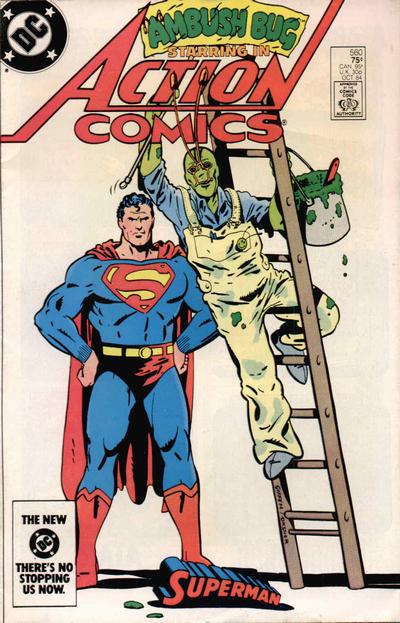
I hate when somebody knocks my logo down.

Notes: Off the top of my head, I can’t remember if I’ve mentioned Ambush Bug here in the Year of Superman before. I know I wrote about him a couple of months ago, when I suggested that DC collect his early appearances in their new Compact Comics line, but that’s a whole different animal, even if it is on the same website. Ambush Bug was a co-creation of Paul Kupperberg and Keith Giffen. Originally a villain, he was really more of an annoyance than a threat to Superman, and he got even MORE annoying when he decided to go straight and become a hero. Ambush Bug also beat Deadpool to the fourth wall breaking schtick by well over a decade (maybe more – I don’t know exactly when Deadpool started doing that bit). He’s fully aware that he’s a comic book character and had frequent conversations with his creators in the later issues in which he appeared. 

Although he gets the cover of this issue of Action, Ambugh Bug doesn’t actually show up until the second story. The first one, “Meet John Doe” by Kupperberg and artist Alex Saviuk, features Superman facing off a villain calling himself…well…John Doe. The story kicks off with Doe escaping prison, then deciding to take out his frustration on the various institutions that kept him incarcerated for over two decades. When Superman encounters him he starts suffering from bizarre bouts of amnesia, temporarily forgetting things like his dual identity or some of his powers, and Doe gleefully takes credit for his sudden selective memory loss.

  It’s a pretty standard early-80s Superman story, taking down a villain with a little bit of misdirection. Doe also isn’t even a memorable villain (although I suppose that’s appropriate enough), and I don’t believe he ever showed up again. The most interesting thing about this story is that Doe appears to be sponsored by a mysterious figure in a satellite calling himself the Monitor. The DC Universe, at this point in 1984, was already trying to put together the pieces for what would eventually be Crisis on Infinite Earths, but some of these early Monitor appearances really don’t make much sense in the context of who the character would eventually become.

Giffen flies solo on the Ambush Bug back-up story. In “Police Blotter,” the recently “reformed” Ambush Bug has moved to Metropolis and set up a private detective agency. Getting word of this, Clark Kent decides to investigate the investigator, only for Ambush Bug to suss out his secret identity before they even reach the bottom of the second page. From there, the rest of the pages are less of a cohesive story and more like assorted glimpses of Ambush Bug making his way through Metropolis by doing things like arresting a car with an expired parking meter and dragging it to the steps of the police station, then popping into the Daily Planet offices to pay his best pal Superman a visit.

I’ve read this story before. It was one of the earliest Superman stories I read as a child (I would have been six or seven when it was published and, while I don’t think I read it quite that young, I don’t think I was much older than that), and it was certainly my first exposure to what we now call meta humor. (Yes, meta humor was a thing back then. Meta humor has been a thing for hundreds — maybe thousands — of years, it’s only recently that we started to CLASSIFY it.) I know I didn’t get the joke about Ambush Bug not doing something particularly gruesome because Giffen had drawn him behind an office door – I don’t think I even knew who Giffen was at the time. I knew, vaguely, that somebody had to write and draw comic books, but I wasn’t particularly paying attention to the credits yet to see who those people were. Now, as an adult, I love this kind of stuff, and Giffen was one of the greats. The story is really funny, highly bizarre, and just the kind of thing that makes me want to read more Ambush Bug. The character still pops up from time to time, but nobody has really had a great handle on him since Giffen’s last go-round. I know that the way comics work he won’t remain in limbo forever, but I hope that someone who’s half as good as Giffen was gets their hands on Irwin Schwab someday. 

Thur., June 24

Comics: Superman #327
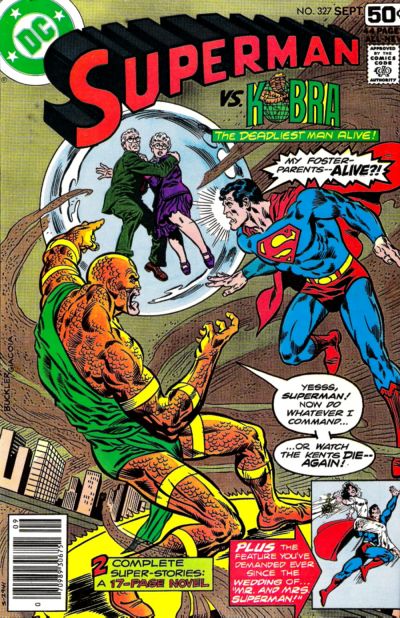
And you thought your family reunion was rough.

Notes: You know how you can get home from a trip and then the next day you feel like you’re in over your head? Even though our Mississippi sojourn was only three days, that’s what today has been like for me, catching up on a dozen different things and not realizing I still had to clock in the Year of Superman entry for today until late afternoon. But it’s been 205 days since I started this whole thing, and I haven’t missed a day yet. Being busy sure as hell isn’t going to do it to me. So I did the same thing I did yesterday, digging into my unread pile and choosing a fairly random book, in this case, Superman #327 from 1978. I picked this one, I don’t mind admitting, based on the cover. Kobra has captured Jonathan and Martha Kent! Superman has to do his bidding or they’re doomed! I was so surprised to see this cover, in which Kobra has clearly learned Superman’s secret identity, that I totally forgot that the pre-Crisis Ma and Pa Kent were actually already dead by the time Clark became Superman.

Anyway, the story begins with Clark Kent returning home to his apartment only to be attacked by Kobra and some of his stooges. Superman has never faced Kobra before (although some of his fellow Justice Leaguers have), but he has in his possession one of Kobra’s weapons, a teleportation gun, with a homing beacon that Kobra followed to Clark’s apartment, revealing his secret identity, which actually automatically puts him in the top 0.3 percent of every villain Superman had ever battled in terms of awareness. Kobra escapes, but later kicks up a sandstorm to draw Superman out. There he reveals that he’s plucked the late Jonathan and Martha Kent from the timestream about a week before their deaths, and if Superman doesn’t obey his every whim, he’ll…kill them!

It’s kind of a strange plan, isn’t it? Superman’s reaction is that he has to save the Kents because if they were to die it would change his personal history. And…I mean…it WOULD, but would having them die one week sooner really made that much of a difference? Don’t get me wrong, Superman should save them regardless, but the logic doesn’t necessarily track. Wouldn’t it have made more sense for Kobra, since he apparently can do this sort of thing, to pull the Kents out of time when Clark was a baby? Or when THEY were babies? The consequences would be much more profound, I think.

Anyway, Superman beats Kobra because Superman beats Kobra, but Kobra gets away and, at the end of the story, still knows Superman is Clark Kent. I really wonder where I have to follow this story to see how the cat got back in the bag. 

The back-up story in this issue is a tale of “Mr. and Mrs. Superman,” the Lois and Clark of Earth-2, who periodically showed up in tales of their life as a married couple at this time. The newlyweds are moving into a new apartment when they’re nearly crushed by their own couch. Clark, naturally, saves the day, but it soon becomes apparent that their brush with death was no accident – Clark is being targeted by members of a criminal organization called the Colonel Future Gang for a series of expose’s he’s been writing, and they’re trying to take him out for good.

I’m gonna keep my lips shut on how this one ends because it’s actually really good. But what I WILL say is that it’s actually Lois and her razor-sharp brain that solves the problem this time around, and you guys all know how much I love it when Lois is played to the top of her intelligence. It wasn’t always the default back in the era when this story was written, and it was even rarer for the Golden Age Lois, who this story stars. It’s great to see her outsmarting the bad guys here, and I’m really pleased with this story. I don’t think these “Mr. and Mrs. Superman” stories have ever been collected anywhere, and DC should do something about that. 

There’s actually a lot of stuff from this era that has been kind of lost. I suppose it’s a consequence of the fact that DC’s stories weren’t always on fire then. This was the period when Marvel was making moves with new characters that pushed the limits like Ghost Rider, Dracula, Power Man and Iron Fist, and the like. DC, on the other hand, was kind of coasting on the same characters they’d brought in during the Silver Age, with only Firestorm being notable as a new addition to the lineup in this period. And except for some of the Batman stories of the age, a lot of it has been forgotten. But that doesn’t mean that there aren’t stories from the 70s and 80s worth reading. 

Fri., July 25

Comics: Jon Kent: This Internship is My Kryptonite #1, Green Lantern Vol. 8 #24

Hot take: don’t read this book.

Notes: Late last year, DC Comics kicked off their “DC Go!” program on the app. It’s basically the same thing as the Infinity Comics Marvel has been publishing online for some years now. The idea here is that rather than breaking the comic book story into traditional panels, the story flows straight down from one panel to another in an “infinite” scroll. It’s something that’s been tossed around and done for years, but the Big Two are fairly new in the game. I’m lukewarm on the format, if I’m being honest. It’s an interesting idea, but it’s rare that the creators actually use it to its utmost potential. Every so often you have an artist do something interesting or innovative with the format, or at the very least use it to do an extended panel (most often somebody falling or climbing down a great distance). For the most part, though, it’s just a less-convenient way to read a story. The worst is when they take a comic that was traditionally published and chop it up to rearrange it in the Infinity format. It’s like colorizing a movie – you take something that was perfectly good in the first place and make it worse.

That said, even when they don’t use the format to its greatest potential, that doesn’t mean that there aren’t some really good stories told in the format.

However, This Internship is My Kryptonite is not one of them. The story here is that Jon Kent is getting an internship at the Daily Planet, and in this first issue, he meets his coworkers.

That’s…that’s it. That’s pretty much all that happens. And the thing is that those coworkers, and pretty much everybody else in the comic for that matter, are all the most annoying human beings ever put on a comic book page. Seriously, there is nobody likable in this comic book. Even Clark Kent, showing up briefly in a cameo, is just there for an “embarassing dad” joke. 

Look, I give them credit for at least TRYING to do something with Jon. The character has been aimless for too long. But this is a poor fit. What they’re doing here is conceptually no different than a dozen other “young Superman” stories that were done with Clark. Furthermore, it doesn’t even appear to be canon, as in this story Lois Lane is NOT in charge of the Planet, as she is in the comics these days. So even if this WERE a good story (which, I must reiterate, it is not), it wouldn’t actually fix any of the problems we’re having with mainstream Jon Kent.

I don’t mind a little experimentation with comic book formats, but this particular experiment didn’t even make me want to read the second issue. 

Sat. July 26
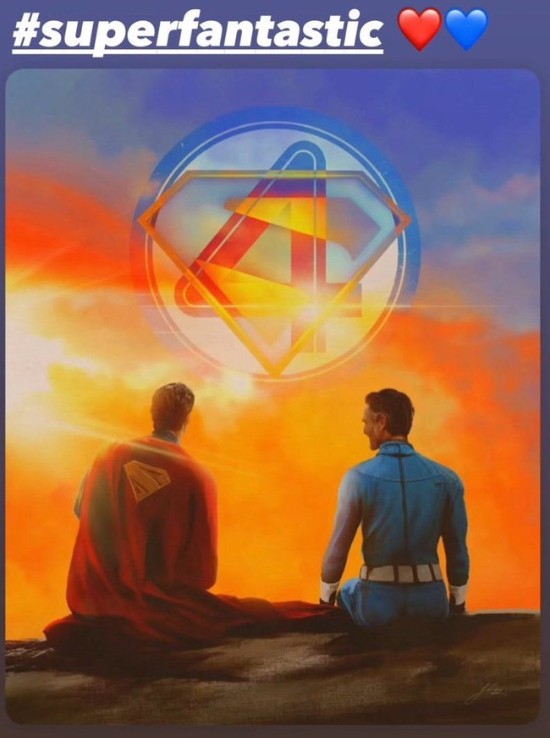
It truly was a Superfantastic July.

I just got back from taking my family to see Fantastic Four: First Steps. As I’ve made abundantly clear, my love for the Fantastic Four is second only to my devotion to Superman, and I’ve been waiting even longer for a good FF movie than I have for the rebirth of the Man of Steel. I also think it’s profoundly stupid, the way some people want to pit these movies against one another. There is room for both and I think that the success of one will only feed the other.

I don’t want to spend too much time talking about First Steps, as this isn’t the “Year of the Fantastic Four.” But I’ll definitely say this much: it is currently possible to go down to your local cinema and treat yourself to a double-feature of a great Superman movie followed by a great Fantastic Four movie. I never thought I’d see the day.

Comic Books: Superman Vol. 6 #28, Justice League Unlimited Vol. 2 #9, New History of the DC Universe #2. 

Notes: After the movie, we rolled by the comic shop to pick up this week’s Superman-related titles. First up is Superman #28, the beginning of the “Darkseid’s Legion” story arc. Last year, in the DC All-In Special, we got a glimpse of a universe corrupted by Darkseid’s energy (the universe we’re seeing in the “Absolute” comics) and populated by a horrifying Legion of Super-Heroes. This issue promises to begin unravelling the mystery. 

You know when you meet up with old friends that you haven’t seen in a while and they’ve all been transformed into acolytes of Darkseid?

The story, by Joshua Williamson and Dan Mora, picks up after the Validus attack from the Summer of Superman special. Worried about his friends in the future, Superman returns to Smallville to retrieve his Legion flight ring before he sets out to visit them. Before he can depart from Smallville, though, he finds himself face-to-face with a Saturn Girl who – much like the Absolute Universe – has been inspired not by Superman, but by Darkseid himself. 

The issue is a hell of a start to this storyline, with an insidious version of the Legion acting as the bad guys even as Clark reflects on the REAL Legion, what it means to him, and how it pains him that the future is always somehow in flux. Perhaps DC is finally planning to address the ways they keep warping this history of the Legion? It would be nice to settle it once and for all. 

Justice League Unlimited continues with its ninth issue, an epilogue to the recent “We Are Yesterday” storyline. The League is trying to cope with the dual problems of restoring the time-lost heroes to their respective proper eras and, in a storyline that mostly follows Mr. Terrific, trying to find and rescue the lost and duped Air Wave, who the heroes now know was conned into turning against them in the battle with Grodd. It’s more Mark Waid goodness, with the League finding mistakes it’s made and the heroes trying to compensate. We’re also starting to draw together a few different threads here, with the appearance of the Doomsday/Time Trapper hybrid that’s been popping up in Superman and the return of the World Forger, a Justice League frenemy from a couple of relaunches back who is responsible for the creation of our specific world in the multiverse. 

Waid has so much on his plate right now – this title, World’s Finest, Action Comics, Batman and Robin: Year One, and the miniseries I’m going to talk about next. With all of these pieces combined it really feels as though he has become the primary architect of the modern DCU. At the very least, it seems that everybody else has to run their respective pieces by him to make sure they all fit. 

MY history textbook had a picture of a bunch of bison on it. What a rip-off.

That other Waid project is New History of the DC Universe, the second issue of which hit this week. This issue starts with Kal-El’s spacecraft landing in Smallville and goes straight through to the original Crisis on Infinite Earths. Without spending hours recapping the specifics, it’s really impressive how Waid has managed to piece together the different continuities in ways that make sense. For example, he establishes that Victor Stone (aka Cyborg) WAS part of the team that fought back Darkseid and eventually became the Justice League, as seen in the New 52 version of the Justice League’s origin, but his injuries were so great that he had to be placed in suspended animation to heal. When he awoke years later, he joined the Teen Titans, as in his original origin. It’s a neat little workaround that manages to keep both of Cyborg’s “origins” mostly intact. The real test is going to come next issue, though. At the end of this one, Waid gives us the Great Crisis, including the death of both Barry Allen (who is narrating the series) and Supergirl. Explaining Barry will be simple enough – his resurrection story was part of the terribly inaccurately-named Final Crisis, but Supergirl? She never GOT a resurrection story. She died in Crisis, then the Man of Steel reboot happened and she never existed at all, then she came back in an updated version of her original origin. So I’m very eager to see what kind of slight-of-hand Waid intends to use to bring her back from the dead. 

Sun. July 27

It’s back to Krypton today, folks!

Essays: “The Kryptonian Alphabet: A Real-World Historical Tale” (2006) by Al Turniansky, “Superboy and the Legion of Super-Heroes” (2006) by Mark Waid, “The Superman Mythology: Animal Planet-Legion of Super-Pets” (2006), “Al Plastino Interview” (2003) by Glen Cadigan, “The Superman Mythology: Krypton Meets Camelot” (2006), all from The Krypton Companion.

Notes: It is a busy and scorching Sunday here in southern Louisiana. Early this afternoon, my family and I went to see a performance of Willy Wonka Kids, a half-hour reduction of the stage play that happened to star my niece, Maggie, in her stage debut (as Grandma Josephina, an Oompa Loompa, and the best squirrel I’ve seen since the Superman movie). Afterwords, we went out for lunch and did some grocery shopping before we came home and I filmed my LitReel for the week. I then took my usual hour to edit all the takes down to a tight three and a half minutes and set it to upload. FINALLY, I had time to sit back and pull out the DC Universe app to look for a Superman comic to read today.

Naturally, that’s when the internet went out.

It’s still out as I write this. My reel still hasn’t uploaded. It’s irritating as hell.

So I had a few options here. I could wait for the internet to come back – which isn’t really an option, as when this happens (and it happens far too often) there’s really no way of telling how long it will take to come back on. Could be 30 seconds, could be Tuesday. I could try to read a comic on my phone, but I hate reading comics on my phone. The screen is too small. I could dip into my stack of unread comics, as I’ve already done twice in this pretty random week in the Year of Superman, but like I said, I already did that twice this week and I didn’t really want to do it again.

So I went with option four and I pulled out The Krypton Companion again, the excellent book of essays and interviews about the history of the Superman mythology. I’ve read essays from this book before this year but it’s been a few months, so let’s dig in again.

Al Turniansky gives us “The Kryptonian Alphabet,” an interesting little story about the creation of…well, it’s right there in the title. Back in the 50s, he said, they would frequently receive letters from readers (kids, usually) trying to submit their own Kryptonian alphabet, which usually just consisted of 26 different “squiggles” that corresponded exactly to the standard English alphabet, much like modern Interlac as has been used in DC Comics for quite some time. In an effort to put a rest to that practice, editor E. Nelson Bridwell replied in a letter column that the Kryptonian alphabet actually had 118 characters, thinking that this would stop the kids from trying to come up with them. E. Nelson Bridwell clearly did not understand the fanaticism of the average comic book fan.

Mark Waid himself chimes in with an essay regarding Superman’s history with the Legion of Super-Heroes. There’s nothing particularly revelatory in this piece, it’s mostly just a discussion of how the Legion contributes to the Superman mythos itself, but it’s nice to hear some of the details from such an expert. This essay, in fact, was actually originally published in 2006, when Waid was the writer of Supergirl and the Legion of Super-Heroes, so he’s pretty much THE expert. 

I also read through a nice short piece on the Legion of Super-Pets and an interview with classic artist Al Plastino, but the best thing I read today was “Krypton Meets Camelot,” a discussion of the famous story in which Superman works with President John F. Kennedy to promote his physical fitness program. Although it was written while Kennedy was still alive and scheduled for publication for Superman #168, it was promptly shelved upon Kennedy’s assassination. It didn’t actually see print until #170, at the request of the Johnson administration. The essay also briefly discusses some of the other appearances of Kennedy and other presidents (especially Abraham Lincoln) in comics. This reminds me that I haven’t actually re-read that Kennedy story for the Year of Superman, and I probably should.

I would check right now to see if it’s available on the DC Universe Infinite App but…well, you know. No internet. 

But with summer coming to an end entirely too soon – I return to work to begin preparing for this new school year on Friday, August 1 – I suspect I may be turning to the Kryptonian Companion a bit more often when I’ve got a day where I’m short on time and I need a quick dose of Superman to keep my streak alive. 

Mon. July 28

Friday is getting closer whether I like it or not. Today, the last Monday of my summer, my wife and I took Eddie down to the school where they helped me start putting my classroom together for the new school year. Rearranging furniture, unpacking and re-shelving books, putting up decorations, and most of all, getting together my Geek Corner. I think everybody needs something like my Geek Corner. It’s the little section of my classroom by my desk where I surround myself by my own nerdy stuff. Erin always puts together a collage of pictures – mostly comic book characters – that I’ve clipped out of Previews and other assorted catalogs and magazines over the past year. Then, on the bookshelf behind my desk, I put up a worthy collection of Superman stuff.

A collection so worthy it could lift Mjolnir.

There are, it’s safe to say, a couple of dozen Funko Pops of various sizes, other figures, figurines, and statues, a plush doll, some Hot Wheels and Corgi Cars, and probably other things that I’ve forgotten about but that you can enjoy in the pictures I’m sharing here. The prize addition to the collection this year, though, is the Daily Planet popcorn “bucket” I picked up the day we saw Superman in theaters. I’d hoped to squeeze in a second viewing of the film before school starts up, but it seems pretty unlikely that will happen, with our schedule for the next few days being what it is. But I hope the rest of you guys keep seeing it again and again, and you can be assured I’ll be preordering the Blu-Ray as soon as it’s available.

Getting home from school in the mid-afternoon, it’s time to find some Superman stuff to read today. 

Comic Book: Superman #170
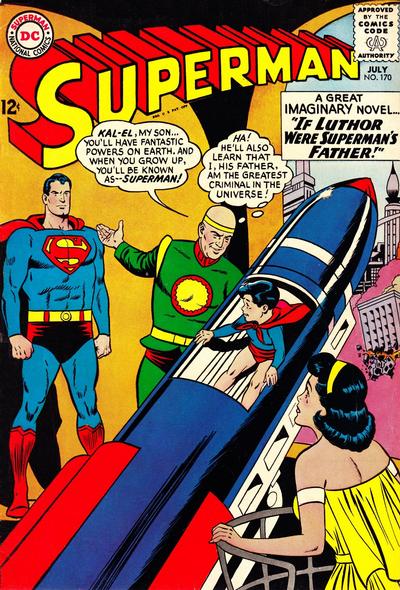
And you thought your family reunion was — wait, I already did that joke this week?

Notes: Still thinking about the essay I read yesterday regarding the Superman/Kennedy comic, I thought it would be interesting to go back and read that one again. The story, frankly, is kind of dull. Superman saves a group of international hikers trapped by an avalanche, upon which Lana Lang realizes the European survivors are peppy and ready to move, whereas the Americans are slow and sluggish. Superman meets with Kennedy about helping to promote the President’s physical fitness program, which turns into Perry White forcing the staff of the Daily Planet to join him in assorted exercise activities, which causes Clark to constantly have to find ways to fake feeling more exhausted than he actually does. The ultimate comes when the crew is caught by a cave-in. When Perry, Lois, and Jimmy see Clark lifting the boulder effortlessly, they realize he’s been fooling them for years and is, of course, secretly Superman.

Haha! Just kidding. No, Perry immediately assumes that his noodle-armed schlep of an employee has been so beefed up by the new Daily Planet fitness regimen that he has – in just a few days of exercise – gained the ability to heft an enormous chunk of rock. That is one hell of a program, Perry. Just…astonishing.

The story is of greater interest as a historical footnote than as an actual story, to be honest. The back-up story is a bit more entertaining: “If Lex Luthor Were Superman’s Father.” In this story Luthor comes up with what I think we can all agree is the greatest evil scheme in the history of evil schemes. Settle down, this one is a doozy:

Step One: Escape from jail.

Step Two: Travel back in time and journey to the planet Krypton BEFORE Jor-El and Lara get married.

Step Three: Pretend to be a hero, “Luthor the Noble.” 

Step Four: Make Jor-El look bad and make Lara fall in love with and marry HIM instead.

Step Five: Sire Kal-El (why he would be named -El if Jor-El isn’t his father is beyond me) and then wait a few years for Krypton to blow up.

Step Six: Return to his own time where Superman, being a dutiful son, cannot arrest his own father, allowing Luthor free reign to commit crimes.

The wildest thing is that this plan almost WORKS. He makes it all the way up to Step Five and has Lara on the altar (which apparently was a giant wedding jewel on Krypton) before a special device he’s wearing to protect him from Krypton’s greater gravity suddenly runs out of power, pinning him to the floor. Before he can be rescued, he confesses that he’s actually from Earth. He manages to hop into his time machine and escape back to Earth before he can be thrown into the Phantom Zone, only to immediately be picked up by Superman and returned to jail. 

This is a truly insane plan, even by Silver Age standards. And despite the fact that the cover calls it an “imaginary story,” the way it ends (with Jor-El and Lara reconciling) it still quite easily fits into the actual canon of the Silver Age comics. And if I may be a little crude, it’s ridiculous how funny it is that Luthor’s ultimate plot to render Superman ineffective forever boils down to being able to say “Hey, Kal-El, I banged your mom!” 

Tues., July 29

It is a million and twelve degrees outside and I’ve got two days left before I go back to school. My drive, if I’m being perfectly honest, is absolutely drained. I want to read Superman, but I don’t want to dig into anything that’s going to take me all day either, because I’ve got to bring my son to the library and to a therapy appointment and then, right after that, I’m taking my wife out for one last dose of summer fun – a Weird Al Yankovic concert that we bought tickets to nearly a year ago. So I’m going to find something quick today. Ah – here we go! 

Comic Book: Superman Vol. 2 #1

The first day is always rough, isn’t it Clark?

Notes: I, of course, wrote about John Byrne’s Man of Steel reboot back during “Origins Week,” and some of his other Superman stories have peppered the blog, but I have not, previously, taken the time to look at his first issue as the regular, ongoing Superman writer and artist. And as it’s a mostly self-contained story, and the fact that it’s got “First Issue” stamped on the cover in big, red letters, it feels like this would be a good quickie to dig into today. 

Whereas Man of Steel took long gaps in-between issues, skipping years to get to the “present day” of the DC Universe, Byrne’s first issue of Superman picked up only weeks after the final issue of his miniseries. Superman has only recently discovered the truth of his Kryptonian heritage, and now he’s seeking the rocket that brought him to Earth, which was stolen from the Kent farm. He eventually tracks it down to an empty warehouse, where its sole inhabitant has been dead for weeks. 

Later, as Clark meets Lois for a jogging date, they literally run into a bank robbery being committed by a towering bull of a man who introduces himself as Metallo, the man who will kill Superman thanks to his Kryptonite heart. Metallo, it turns out, was built by the dead man Superman had tracked down earlier and was powered by a chunk of Kryptonite that had hitched a ride on Kal-El’s rocket (which you can see strike the rocket on–panel in Man of Steel #1 – give Byrne credit for planning ahead). Metallo has Superman on the ropes before he’s picked up by a strange craft. Superman survives the encounter but is more nervous than ever about his unknown rescuer…as well he should be, as the readers are aware that Metallo has been taken by Lex Luthor, who has the attitude that nobody is allowed to kill Superman but him.

I’m reminding myself, as I read this, that this was the first issue of Superman following the relaunch, and there’s a fair possibility that a lot of people who picked it up hadn’t read the miniseries. So what if this was somebody’s first exposure to Superman? If that’s the case, there are some VERY interesting choices in here. First of all, let’s talk about Lois and Clark’s relationship. Lois is still bitter about Clark scooping her on the day Superman first arrived in Metropolis, but his persistence seems to have worn her down. She as much as admits she finds him attractive, but pushes back against his advances. Clark, to his credit, is adamant that he wants to win Lois’s heart, but he wants to do it as HIMSELF, not as Superman. If all you knew about Superman before reading this was Silver Age stories or the dynamic from the Christopher Reeve movies, you get a sharp change in what is expected. This is a dynamic that I greatly prefer, and Byrne is building up these two characters really nicely.

Metallo’s re-imagining is handled well. He’s constructed specifically to take out Superman, built by a man who has convinced himself that Superman is an alien invader. It’s the standard excuse for anti-Superman villains, of course, but I don’t think it was quite as overused in 1987 when this was published, so I won’t take points off for that. Even if it were cliched, it’s still a huge step up from Metallo’s original Silver Age origin, in which he was made into a cyborg by a well-meaning scientist who just happened to let it slip that Kryptonite was an element that could power his heart. Oh, and that Metallo himself was one of those ridiculously convenient dopplegangers of the era, somebody who just HAPPENED to look almost exactly like Superman. That happened inexcusably often in that period, and it frankly irritates the hell out of me every time I see that trope turn up.

The fight scene is really unexpected, if you think of it from a historical perspective. Once Metallo turns up the juice on his Kryptonite, it’s a curb-stomp battle, and it doesn’t look like Superman stands a chance. Byrne! What were you doing? It was Superman’s first issue and you had him get his ass handed to him by Metallo, only to be saved by LEX LUTHOR! It’s ridiculous! And impossible! Isn’t Superman ALWAYS supposed to be completely infallible and indestructible? He’s NEVER been hurt in nearly 90 years of his recorded history! He has absolutely NO vulnerabilities!

At least, that’s what those three guys still whining about the James Gunn movie would lead me to believe.

No, it IS surprising that Byrne starts off his series with an inarguable loss, but it fits into the arc he’s telling, which began in Man of Steel and continues on into the next issue. I considered reading issue #2 today as well, but I’m actually planning a Lex Luthor week at some point, and it’s just too good an issue not to include when that happens.

“Singin’ byyyye, byyyye Miss Kryptonian pie…”

I also returned to the DC app this week to read the first issue of another of the DC Go! comics, Taste of Justice. In this one, set in the early days of Lois and Clark’s relationship, it’s Clark Kent’s birthday (and they’re sticking with the Feb. 29 date, as in Alan Moore’s work), so Lois Lane decides she wants to do something special and cook his favorite meal, Beef Bourguignon. The only problem is, for all the things she’s great at, Lois Lane can’t cook, so she calls in Perry White to help her out. 

This is a cute story. In large part, it’s about how to cook the specific dish, and I assume that’s going to be the format of this series: each issue showcasing a DC character cooking something for some reason. It’s a weird format, but it makes as much sense as the Superman Vs. Meshi manga series where he literally spends every issue talking about his favorite food at different Japanese chain restaurants. Anyway, while I wouldn’t necessarily try to cook the dish based on the instructions in this comic (Perry frequently neglects to mention things like the quantity of ingredients or cook times), I can definitely see myself looking up real recipes for foods I read about here. The story itself has a sweetness to it, with Lois trying to do something nice for the guy she’s falling in love with and being willing to reach out for help from someone she trusts when she needs help. There’s a vulnerability there that she doesn’t usually show, and it makes sense that Perry White is the one who would get to see it.

It was a low-key week, guys, but honestly, I kind of feel like that’s what I needed. I hope you enjoyed it anyway, and here’s hoping I’ve got something more exciting next Wednesday. 

Blake M. Petit is a writer, teacher, and dad from Ama, Louisiana. His most recent writing project is the superhero adventure series Other People’s Heroes: Little Stars, volume one of which is now available on Amazon. You can subscribe to his newsletter by clicking right here. You can join in the Kryptonian Konversation every day in the Year of Superman Facebook Group!

Year of Superman Week 11: The End of the Return

This week we’ll reach the end of the “Reign of the Supermen” storyline (probably – I’m writing this on the afternoon of March 12 before I start reading any of them, so I suppose anything might happen). After that, I intend to touch upon some of the stories that follow and some of the ways that the Death and Return storyline were reflected in other media. Being such a fundamental part of the Superman mythology at this point, it shouldn’t be surprising to anyone to see that it’s been revisited many times. We won’t get to them all, but there’s plenty coming up. 

Wed., March 12

Comics: Action Comics #690, Superman: The Man of Steel #25, Superman Vol. 2 #81, Adventures of Superman #504, Adventures of Superman Annual #5

“Eradication”? Get It? GET IT?

Notes: Let’s start with Action Comics #690. The Last Son of Krypton, close to death, returns to the Fortress of Solitude only to learn that his “power source” is gone – he’d been using the real Superman’s body to generate the energy he needed. The process has helped to resurrect him, though, and now Superman is on his way to Metropolis, charging across the ocean floor in a Kryptonian mech. The Kryptonian, meanwhile, sends what amounts to a deep fake video to the Justice League, blaming Coast City’s destruction on the Eradicator and sending the League and their most powerful allies on a wild goose chase into outer space to track him down. After all, it won’t be great for his plans if Earth’s most powerful heroes are still on Earth. 

Two things of note in this issue. First of all, the robots in the Fortress help repair the Eradicator’s damaged memory, revealing to him (and the reader) his true identity. It’s been a long time, but I’m pretty sure I figured this one out ahead of this issue. You see, at this time I voraciously re-read my favorite comics. I’d start with the Man of Steel miniseries, read every subsequent Superman comic in order (I had begun – but not completed – the process of filling in the gaps) until I reached the most recent, then go back and start from the beginning. So I’d read the Eradicator story maybe five or six times, it was pretty fresh in my memory, and Roger Stern dropped a LOT of clues (unlike Dan Jurgens, who was pretty good at holding the Cyborg’s true identity close to the vest). The other thing I want to point out concerns Superboy, captive of the Cyborg, struggling to get free and save Metropolis from being destroyed like Coast City. Up until this point, Superboy had been motivated largely by his thirst for fame and adoration. There were glimpses of the good core of Superman in him, but this is the point where it really starts to come out, when he REALLY starts to see the big picture and find himself willing to put himself on the line. It’s a good look for the Kid.

That’s a face only a Martha could love.

In Man of Steel #25 Superboy is still being held by the Cyborg in the enormous engine built over the ruins of Coast City, unable to figure out why his powers don’t work the way he expects them to. He manages to escape, rushing back to Metropolis just as Supergirl, Steel, Lex Luthor, and Lois all converge at the Metropolis airport, where the Kryptonian mech we’ve been following for a few issues now emerges from the ocean. After a brief fight, Lois holds the others back, recognizing the Kryptonian battlesuit. It cracks open and spills open its precious cargo: a black-clad Superman, ready to put his life on the line for Metropolis once again. There’s so much to love about this issue. We get Lois back, for one thing: after her creepy friend Jeb Friedman makes a move on her she has a moment of crisis and realizes she’s lost herself, then is determined to make her way to Coast City to blow the lid off the Cyborg. Superboy continues gaining more of an awareness of himself as well, and bringing all of our heroes (and Lex) together again leads up to a really inspiring last page. From here, it’s a roller coaster to the end of the story, and I’m there for it.

Lois: “Superman never wore black like some executioner.”
DC: But this will sell a LOT of action figures.
Lois: I withdraw my objection.

Superman #81 picks up right here, as the others face off against this newest guy wearing Superman’s face, with nobody sure what to make of him — especially since he has no powers. He’s saying the same thing as everyone else: Ms. Lane, you know me, you’re the one who gave me my name, so forth, and Lois is struggling until he pulls out To Kill a Mockingbird. The mention of Clark Kent’s favorite movie gives Lois pause – could this actually be the real deal? After a brief conversation, he borrows a pair of flight boots from one of Team Luthor and he, Superboy, and Steel take off for Coast City. Meanwhile, one of the Cyborg’s minions fills in another one of the truth about their master – the former Hank Henshaw, reduced to a computer intelligence, conquered Mongul and is using him to destroy Earth in Superman’s name. The wraparound sequences are best here, with Clark and Lois, all touching moments even now. The middle of the book, with the Cyborg’s origin, is less interesting once you already know the story. At the time, though, it was necessary – Henshaw had been a relatively obscure character who had only made a few prior appearances, and they were actually just before I became a regular Superman reader, so I had to go back and learn who he was after the fact. I wonder if I would have picked up on who Henshaw was earlier had I already read those comics. Probably not, if I’m being honest, but I’m still curious. 

Does anyone else remember the action figure line that came out after this with the slogan “Don’t mess with the S”? Wasn’t that an AWFUL slogan?

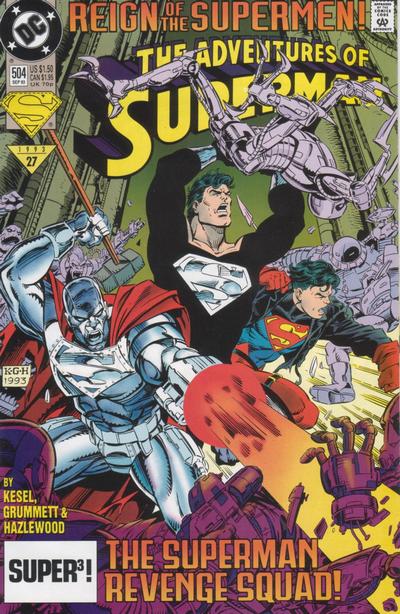
In Adventures #504, the trio lands in Coast City, where the powerless Superman scavenges weapons from the Warworlders as they fight their way to the heart of the engine. Cyborg’s got another missile prepared, though, and Superman and Steel watch helplessly as it blasts off for Metropolis, realizing only after the launch that Superboy is clinging to the side. He rides the missile across the country, trying to take it apart, before deflecting it from Metropolis at the last second, arcing it into the air where it explodes…seemingly taking the Kid with it. Spoiler alert: Superboy survived, but man I love this issue. If the Kid was going to stick around (as he did) he really needed a Hero Moment in this story, something to show that he was worthy of wearing the shield. I would say saving Metropolis from total destruction, possibly at the cost of his own life, does the trick.

Fortunately Superboy’s sense of timing got better later.

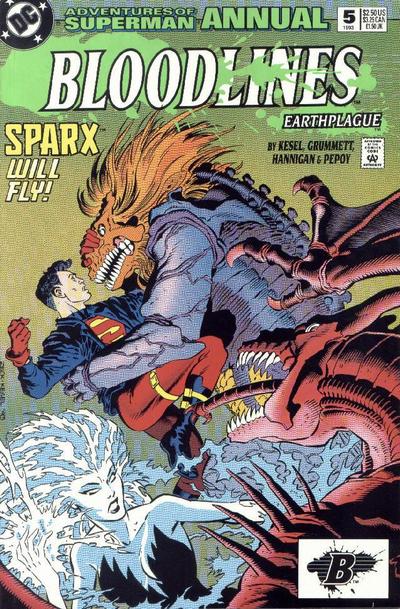
Of course, this DOES take us to Adventures of Superman Annual #5, our final Bloodlines check-in. Superboy wakes up in the hospital, having just stopped the missile, and is approached by Maggie Sawyer for help in hunting down the alien serial killers from the previous three Superman (and a dozen other) annuals. Meanwhile we meet the improbably named Donna Carol “D.C.” Force, youngest of the Force family. Everyone in D.C.’s fam has the metagene, but hers hasn’t activated yet, and she comes to Metropolis with her Uncle Harry chasing rumors of the alien killers who are making new metahumans. She winds up getting attacked, of course, and a paramedic’s defibrillators seem to give her the final ingredient, activating her gene and giving her electrical powers. D.C. teams up with Superboy to fight the aliens as Sparx. 

Sparx was easily the most successful of the four New Bloods that came from the Superman books, becoming a series regular in Superboy and the Ravers a few years later and having assorted appearances in the years since. I really like the concept of a kid who comes from a family of metas who just wants to be a superhero, too – it’s a nice, kind of sweet idea. The real issue with this book is TIMING. Superman and Steel are back in Engine City on the other side of the country trying to prevent the Cyborg from destroying the entire planet, and Superboy takes time out for a SIDE QUEST? You’ve gotta be kidding me. 

Thur., March 13

Comics: Action Comics #691, Superman: The Man of Steel #26, Green Lantern Vol. 3 #46, Superman Vol. 2 #82

Dammit, Clark, stop breaking the covers. Do you have any idea how expensive these are?

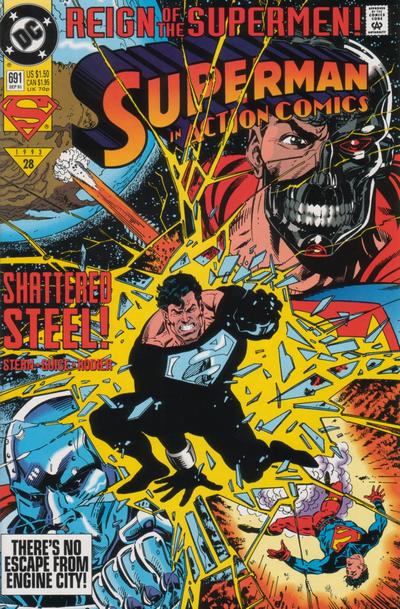
Notes: As Superman and Steel fight their way to the heart of Engine City in Action Comics #691, we discover that Supergirl has been following them since leaving Metropolis, using her invisibility to act as Superman’s “secret weapon” (a nice little nod to the original status quo of the original Supergirl). In the Fortress of Solitude, the Eradicator drains the power from the Fortress’s devices, leaving both the systems and robots dead, in order to recharge himself enough to return to the fight. And in the heart of the Engine, Mongul finds himself planning to turn on the Cyborg, while revealing that the Engine is powered by a gargantuan piece of Kryptonite. Good stuff in here. The book leans heavily on “If Lois believes he’s really Superman, that’s good enough for me,” and the man in black’s actions back it up. By the end of this issue, Steel is fully convinced that it’s the real deal, and even Mongul recognizes that this new enemy has far greater honor than the Cyborg, whose version of events must be twisted. 

Speaking of the “man in black,” I wanted to point out something regarding the covers for these issues. You notice how, although they had Superman in the black recovery suit (which has become a fan favorite alternate Superman look) they gave him his usual short hair instead of the long hair he came out of the Kryptonian mech with and would keep for the next few years? I’ve never quite understood that. I wonder if it was a case of the covers being drawn far enough ahead of time that the long hair hadn’t been decided upon yet when they were released. It’s an interesting little artifact though, isn’t it?

I would totally wear this cover on a T-shirt.

In Man of Steel #26, Mongul reveals his plan: since Superboy stopped the missile from turning Metropolis into a second engine, which would have made Earth into a new Warworld, he’s going to content himself with firing the existing engine and just, y’know, destroying the world. As a powerless Superman faces Mongul, Steel plunges into the heart of the engine. And in a moment that will change the DCU forever, Green Lantern returns from space to investigate what has happened to his city. There are two great bits in this issue for me. First of all, the Cyborg underestimating Steel’s ability to stop the engine. No way a mere human could possibly throw a wrench into his plans, right? But Mama Irons didn’t name him after the steel-drivin’ man for no reason. The allegory of John Henry vs the Machine may be a bit on-the-nose, but holy crap, is it a fantastic story beat. The other thing, which doesn’t really have a ton of significance but I’ve always thought was funny, was Lois’s scuzzy friend Jeb Friedman watching her concern over the battle in California and asking her if her late finance Clark Kent ever realized she was really in love with Superman.

That caption would prove to be far more prophetic than anybody would have guessed.

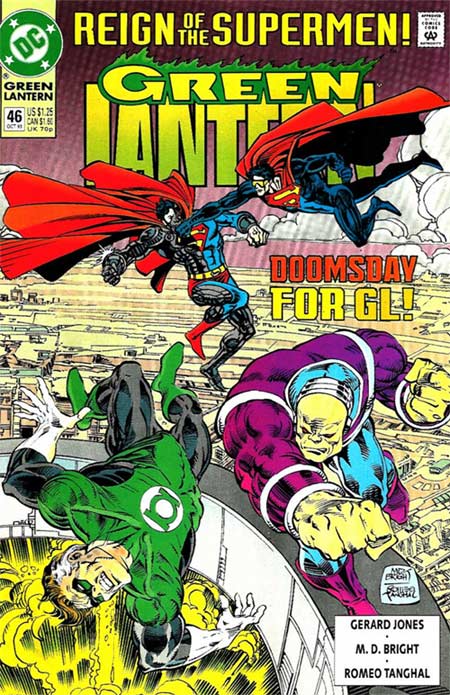
Green Lantern #46 is next. As Hal Jordan returns from space to see the wreckage of his home, he dives into the heart of the engine to do battle with Mongul. It’s a brutal fight, Hal hampered not only by Mongul’s yellow skin, but by the fact that if he really cuts loose he’ll unleash the Kryptonite powering the engine, but in the end there’s a hell of a beatdown. You don’t usually find this issue in the collected editions anymore, and for two reasons. One, the more important of the two, is because DC (and Marvel) are reluctant to reprint any of the work of this issue’s writer, who was convicted a few years back of some rather unsuperhero-like behavior. (I’m not going to elaborate – if you don’t already know, Google will tell you.) The other reason you don’t see it is a story reason – the issue runs concurrently with Superman #82, the end of the storyline, and reveals how the reign ends, which is kind of a problem if someone hasn’t read it yet. 

You know it’s special because CHROMIUM.

And here we are, Superman #82, the grand finale of “Reign of the Supermen.” Superboy and the Eradicator return to Coast City to rejoin the battle, but the others are cut off by the Cyborg, leaving him to face Superman and the Eradicator alone. In the depths of the Engine, they battle the Cyborg to a standstill. In a last-ditch effort, the Cyborg unleashes the power of the Kryptonite engine, draining it entirely in a massive power-blast, but the Eradicator hurls himself in front of Superman. The Kryptonite kills the Eradicator, but as the radiation passes through his body it transforms, restoring Superman’s powers. The other heroes break into the engine room just in time to see him defeat the Cyborg, and the true Superman stands revealed once and for all.

This really is a fantastic end to this storyline. Sure, neither the Eradicator nor the Cyborg turned out to be truly dead, and even Superman says in this issue that he doesn’t think Henshaw really CAN die, but try to forget the 30 years of comic book history that have passed since then. It’s Dan Jurgens at his finest, writing and drawing a fight for the ages. Images like the Cyborg inhabiting Steel’s armor and turning it against him are striking, as is the sight of the jawless Cyborg staggering around in pain before the end. Even the Eradicator gets his hero moment, sacrificing himself to save Superman, having been transformed by their psychic bond and abandoning his previous goal of restoring Krypton in favor of restoring her last son. Even now, all these years later, having read this story a dozen times, it’s awesome. 

But although this is the finale of “Reign of the Supermen,” it’s not the end of the Death and Life saga. The next few issues of the Superman books would all feature epilogues of one sort or another and there were several follow-up miniseries such as Superman/Doomsday: Hunter/Prey, which I’ll be tackling over the next several days. There’s still a lot of fun to come from our favorite hero biting the dust. 

Fri., March 14

Comics: Adventures of Superman #505, Action Comics #692, Superman: The Man of Steel #27, Superman Vol. 2 #83, Adventures of Superman #506, Action Comics #693

You know it’s special because HOLOFOIL.

Notes: Now for what I’m gonna call “epilogue month” (and a half). After the Cyborg was defeated and the Reign of the Supermen ended, there were a LOT of loose ends left to tie up. Adventures #505 starts with Superman returning to Lois Lane, who had at this point spent several days worried about what was happening in Coast City. After a happy reunion, they start brainstorming – after all, Superman’s resurrection is one thing, but how are they going to explain Clark Kent being found alive after all this time? The issue continues with several other happy reunions – with Jimmy and Perry, Maggie Sawyer, and best of all, with Bibbo. There’s a good bit of set-up here, mapping out how things are going to go for Clark and Superboy in the coming months, but mostly it’s kind of a down issue in terms of action. Even the supervillain who briefly shows up, “Loophole,” is disposed of quickly and in a rather comical way. It’s like the writers knew that – after the emotional roller coaster we’d been on since Doomsday first cracked open his shell – we needed a break. 

“It’s weird, when Clark was missing the broom closet was never locked…”

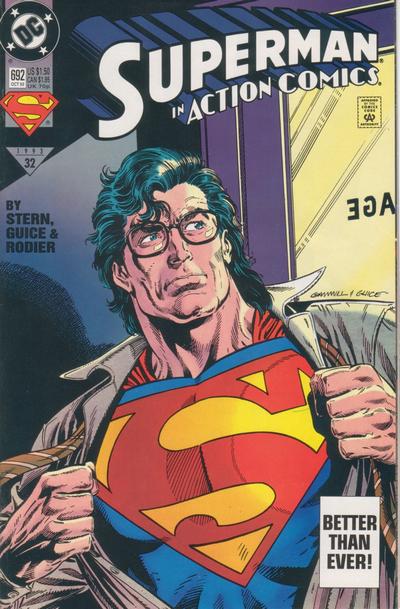
But just a week later, Action Comics #692 picks up right from that point, with Superman clearing away more Doomsday rubble and finding…CLARK KENT? Well no – not really. Turns out, Supergirl has used her shapeshifter powers to help complete the masquerade that brings Clark back from the dead. Although for everybody who ever complains about Clark’s glasses being an inadequate disguise, you have to wonder how nobody ever mentioned the fact that both he and Superman got long hair at the same time or how they both got it cut a few years later (comic book time) when Clark and Lois finally got married. 

We also get more loose end-tying. Here we learn that the Eradicator’s body has been taken to STAR Labs, where a heartbeat is detected, and Steel is expected to make a full recovery. There’s also a really cute moment where Lex Luthor confronts Superman about how absent Supergirl has been lately. When Superman deftly tells him off for acting as if he owns the girl, even Lex Luthor has to smile, realizing the real Superman is back. Sure, it’s just because that means he’s still got a chance to kill him himself, but it’s still oddly sweet. 

The issue ends with an unexpected visit from lesser-known DC Comics mystic Dr. Occult, whom Superman had met before. Occult is there to tell them just how close Superman got to dying, and that only a combination of several factors (including the efforts to revive him on the scene, the Eradicator’s interference, and Jonathan stopping his spirit from crossing over to the other side) managed to successfully bring about his resurrection. The point of this sequence is obviously to add back a little more dramatic tension in the future – DC no doubt felt that they HAD to convince the readers that Superman wasn’t immortal, even though later comics would pretty much say, “No, actually, he kinda is.” The issue ends with Occult dropping Lois and Clark off in Smallville for a joyful reunion with the Kents.

It’s just who he is, folks.

Man of Steel #27 shows us Clark’s welcome return to the Daily Planet, while Jonathan and Martha Kent go on a bit of a health kick that will ultimately redefine and modernize the characters a bit. Martha, from the John Byrne days onward, had been drawn as kind of a plumper version of Peter Parker’s Aunt May, and the makeover she soon undergoes makes her more youthful and vibrant, which was a welcome change. But the whole subplot is worth it for the panel where Jon Bogdanove draws Jonathan Kent pouting over the changes, hands stuffed in his pockets like a disappointed child. It’s like Power Pack, the Golden Years here. We also get the first hint that John Henry is going to relocate to Washington, D.C., which would be the setting when he got his own spinoff series later that year. Oh, and in the main plot, Lex throws a “Welcome Back” party for Superman that gets caught in the battle between the Underworlders (and their new leader) and Project Cadmus. This is set-up for future storylines that we won’t be covering from this blog, but it shows you how forward-thinking the writers were in this era. 

“Yeah, this way we don’t have to do another cover design.”

Superman #83 is the most literal epilogue to the saga (it even says it on the cover) as the heroes of the DCU gather to mourn the devastation of Coast City. I’m really glad they did this issue – with the joy over the return of Superman, it would have been really easy to forget that seven million (fictional) people died, but they didn’t pull away from it here. Obviously it would become a much, MUCH bigger plot point in Green Lantern, but it needed to be addressed in the Superman titles as well. The memorial gets disrupted when Lex Luthor shows up and the heroes nearly come to blows over what to do with the Engine: Green Lantern wants to let the atrocity crumble into the ocean, but Aquaman points out that such a thing would be toxic to the seas. Oh yeah, and a few of the Warworld stragglers are still there, causing trouble. The ensuing battle causes the Engine to crumble, but the Lanterns use their powers to sterilize the remnants and make them safe to settle in the ocean. In the end, Superman uses pieces of the engine to construct an eternal flame in memorial to those lost. 

Although the ramifications of the death and return storyline would be felt in the Superman books for a very long time, at this point they started to become a little less prominent as new storylines moved in and took their place. It only makes sense, of course, if you’re doing an ongoing serial like the four Superman titles were at the time, you never really get to call anything “the end.” More stuff always has to come in, and the Death and Return was, at this point, giving way to the stories of the future. But there are two last bits I want to mention. Adventures #505 brings back Superboy, where he learns the truth about himself and his powers. They’re based on Superman’s “aura” that gives him his invulnerability, but this causes Superboy’s powers to differ from the man himself in some interesting ways. The Kid finally accepts the Superboy name, and just like Steel, elements are put in place for his spinoff series. Finally, Action #693 brings Superman to STAR Labs, where the Eradicator’s body is still alive, but there is no spark of consciousness within him. A terminally ill doctor named David Connor is in charge of examining the body, but somehow (through comic booky science) winds up transferring his consciousness into it, thus making David Conner the new Eradicator. At this point, the status quo is more or less established for the foreseeable future – all of the remaining “Supermen” have a new lease on life and the cleanup of his death is more or less complete.

Sat., March 15

Essay: “The Superman Mythology: A Mini-Tribute to Edmond Hamilton by Jack Williamson” from The Krypton Companion

Notes: I don’t think I realized today was going to be a hard day earlier in the week. It’s been a rough few weeks for me, guys, the kind of period where having things like this blog to complete are what keeps me interacting with the universe instead of curling up into a ball, but March 15 is different even than that. March 15th is my mother’s birthday. We lost her in 2017, just ten days before Erin and I found out we were going to be parents. My son never knew his grandmother, and she never knew he was going to be born. I miss her a lot, and when times are bad I miss her even more. The point of all this is to say that I just did not have it in me to continue on today with “Death of Superman” stuff, even the aftermath.

Pictured: literature.

So instead, I turned to TwoMorrows’ excellent book of Superman minutia, The Krypton Companion and read a short piece about science fiction writer Edmond Hamilton and his connection to the Superman mythos. I’d heard of Hamilton before, but I’d never before connected him with our own Emil Hamilton, who Jerry Ordway confirmed was named for him. Emil was originally brought in as a one-off villain in Adventures of Superman, but Ordway pushed to rehabilitate him when John Byrne wanted a scientist-type friend for our hero. Ordway says he likes stories of bad guys being reformed. Me too – which is why it still ticks me off when they make Emil bad again.

Sorry I didn’t have more to say today, guys. I hope I’ll be in a better head space tomorrow.

March 16 & 17

Novel: The Death and Life of Superman by Roger Stern (Unfinished)

Notes: I’ve been riding the struggle bus lately. A few weeks ago I started having some car troubles and, frankly, the market ain’t great to replace it right now. This has had me under some greater-than-usual stress and, if I’m being honest, on those days when the stress gets particularly bad it’s been difficult to do even the things I want to do. One of the reasons behind “The Year of Superman” was to immerse myself in things that bring me joy, but when I’m in a bad headspace it’s hard to tackle that. All of that said, I haven’t missed a day of Superman content, I’ve just spent the last few days with Roger Stern’s novelization of The Death and Life of Superman, which was published back in 1993. I haven’t finished it yet – well, not this time around, anyway – but I’ve been enjoying it. 

There are lots of novels based on comic book superheroes, but novels adapting specific storylines are a bit more rare. I guess once DC realized just how big an impact this storyline was having, they started looking for more ways to monetize it. So Stern wrote this novel, while Louise Simonson wrote a “Junior Novelization” called Superman: Doomsday and Beyond, which I’ve actually never found a copy of. This isn’t the first time I’ve read this book, of course. I got it when it first came out, and in fact, it was originally released on my birthday (a fact I remember because I still see the original ad for it when I look through comics of the time) so it’s likely I requested it as a birthday present that year. I remember enjoying it quite a bit at the time, and it must have sold pretty well because DC did another novelization the next year, this time Batman: Knightfall by Dennis O’Neil, which I also enjoyed. I’ve still got that hardback copy, but I also snagged a paperback last year in a used bookstore, having no notion at the time that I’d be using it for such a worthy cause as the Year of Superman. It’s my first time reading it in at least 20 years.

Totally not posting this just so that everyone knows when my birthday is.

Reading it concurrently with the comics has been a fun experience, and showcases just how closely Stern’s manuscript adheres to the originals. Much of the dialogue is left intact, and even minor scenes such as Lois seeing a man in a hat and mistakenly thinking it’s Clark back from the dead remain. The only large swaths Stern skips over (at least in the portion of the book I’ve read so far) are the subplots regarding the Underworlders and Keith from the Superman: The Man of Steel issues, which were great for ongoing readers of the books, but didn’t have any real impact on the story of Superman’s death, so their absence isn’t really felt.

Stern keeps the same Justice League lineup from the comics, even going into explanations of Superman’s history with the team (which, if you’ll recall, was relatively new at the time) and the backstory of Guy Gardner’s expulsion from the Green Lantern Corps. Most adaptations would gloss over these things, or change the team to a more “traditional” lineup (as was done in the Death of Superman animated film I watched not long ago), so there’s a sort of purity in this incarnation. 

I also like how Stern brings in the backstory of the main cast – Superman, his relationship with Lois, and so forth. He plucks scenes from earlier comics, especially John Byrne’s Man of Steel miniseries, and uses them to fill in the world in which the story takes place. It’s really impressive how well the world is built up. Someone who has only a cursory knowledge of Superman can pick it up and pretty quickly get up-to-speed on everything they need to know about THIS incarnation of Superman. It’s pretty impressive, although I’m forced to wonder if anyone who isn’t familiar with the comics of the era would think it’s too much.

Like I said, I’m not quite done with the novel yet. I’ve got about a quarter of the book left to go, and I haven’t even gotten to the Cyborg’s big reveal yet, so I’ll have to come back when I get there to report on how well Stern sticks the landing. As of right now, I’m really quite happy with how good the adaptation has been.

Tues., March 18

Comic: Return of Superman 30th Anniversary Special

“Return” doesn’t look a day over 29, does it?

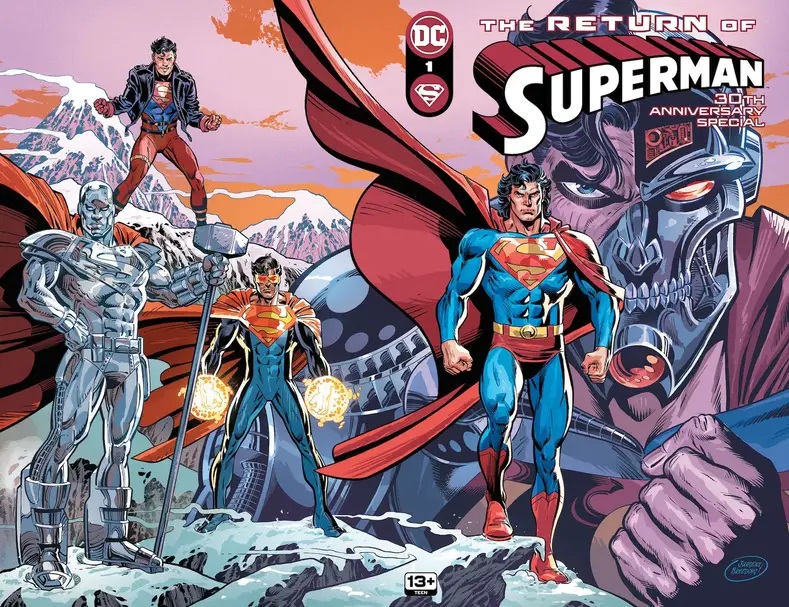
Notes: As they did with his death, in 2023 DC Comics came to us with an anniversary special for Superman’s return. And like that previous book, this one was a blend of then and now. The main story is set in the present, with Lois Lane adjusting to becoming the new editor of the Daily Planet, as Perry White was in a coma at the time. (Long story. It was Lex Luthor’s fault. Him and Brian Michael Bendis.) On the day of the frame story, Superman is occupied elsewhere, when the Cyborg Superman returns, once again attacking Metropolis. With the real deal out of the picture, Superboy, Steel, and the Eradicator return to clean up the pretender. Meanwhile, Lois and Ron Troupe go through Perry’s journals of the time when the would-be Supermen first appeared and reflect.

I really like the structure here. Perry White is, in my opinion, an underused character. We see Lois all the time, of course, and Jimmy had his own series that lasted a really long time, but I’ve always seen Perry as sort of a second (or third, depending on how you count) father figure to Clark and Lois both, and we don’t see his insights enough. Even though he was literally unconscious at the time of this story, using his journal for the frame to the flashback stories works really well to tap into his mindset. 

The first of the four flashback sequences focuses on Steel and his effort to get the infamous Toastmaster guns off the streets of Metropolis. It’s a fine story, once again reuniting Louise Simonson and Jon Bogdanove to show off their character and what he came to mean to the less-affluent sections of Metropolis. In the Eradicator story, written and drawn by Jerry Ordway, Perry plays witness as he faces off against one of Ordway’s oft-used foes from his time on the Superman comics, mad scientist Thaddeus Killgrave. The story leaves Perry uncertain about the visored hero, and with good reason. Karl Kesel and Tom Grummett are together again for the Superboy story, and this may be my favorite of the bunch. The Kid is definitely playing the part he did back in 1993 – arrogant and thirsting for fame – but Perry is able to see the good in him. A sweet interlude at a skateboard park reveals the child inside, something few of the stories of the time bothered to do, and it works really well. 

The last story, by Dan Jurgens, deals with Perry’s skepticism over the Cyborg Superman and how he tortured himself for publishing Ron Troupe’s story (from Superman #79) that indicated he was the real deal after the Cyborg’s true colors were shown. I love the angle we get here, how Perry never quite forgives himself for that mistake. He’s the editor of the Daily Planet, damn it, and his responsibility is to the truth. To have made such an egregious error eats at him. This is honestly pretty refreshing – the idea of a journalist in the modern day having the sort of integrity to take personal responsibility for what was an honest mistake…dang, when’s the last time you saw anything even close to that in the real world? 

The special as a whole is fun. The thing that surprises me most of all is that, in the end, while it serves perfectly well as a spotlight on the four Supermen that rose up to take Clark’s place, it’s really kind of a celebration of Perry White.

Thus ends week 11. In week 12, I’ve still got some “Death of Superman” epilogues and odds and ends I intend to tackle, but I’m looking ahead to week 13. What I would like to do, friends, if you can help me, is try a sort of “Reader’s Choice” week. What are some of your favorite one-off stories about Superman? They can be from any time period, any continuity, and don’t even have to be from a Superman comic (maybe he makes a memorable guest appearance in Firestorm or something). I’d like to get a bunch of done-in-one stories to cover over a few days. Bonus points if the issue is available via the DC Universe app, but if it isn’t, that’s not necessarily a dealbreaker. I’ve got a pretty hefty collection, after all, and odds are that your favorites will be among mine as well. So head to the comments and hit me with your suggestions!

Blake M. Petit is a writer, teacher, and dad from Ama, Louisiana. His most recent writing project is the superhero adventure series Other People’s Heroes: Little Stars, volume one of which is now available on Amazon. You can subscribe to his newsletter by clicking right here. You can join in the Kryptonian Konversation every day in the Year of Superman Facebook Group!

Year of Superman Week One: Early Versions and Meetings With a Dark Knight

Welcome to the first week of my grand “Year of Superman” experiment. Over the next 12 months, I’m going to do my best to read, watch, or listen to at least one piece of Superman-related media every day. As I go along, I’ll keep a journal of each day’s entries as well as thoughts on some of the stories I’ve read or watched, then I’ll try to share them here with you on Wednesdays. Please keep in mind that my thoughts on these pieces of Superman history are likely to contain spoilers, so if there’s anything you’re trying to remain spoiler-free on, you may want to skip that specific entry. 

As the year began, I wanted to focus a bit on the earliest days of Superman. I read the first Superman story as it appeared in the first two issues of Action Comics (and thank goodness for the DC Universe Infinity app for making that possible). I also read Gladiator, the 1930 novel that many people believe was a direct influence on Jerry Siegel and Joe Shuster when they created Superman. And I re-watched the movie that started my love affair with Superman, the first Christopher Reeve movie from 1978, directed by Richard Donner. Here, then, are my thoughts on Week 1 of the Year of Superman.

Wed., Jan. 1

Comics: Action Comics #1, 2, 1079

Notes: (On Action #1, 2) The embryonic Superman is so different from who he eventually becomes. He’s snarkier than usual, and much more ruthless, doing things like throwing an abusive husband against a wall, carrying a man along electrical poles, and forcing a munitions manufacturer to join the army and put his own life at stake. But even here, with methods that would seem very out of place in today’s stories, the moral core is there — a steadfast belief that, as Mark Waid wrote sixty years later in Kingdom Come, “There is a right and a wrong in the universe, and that distinction is not difficult to make.” The real world, of course, is infinitely more complicated than that, and there are a great many times when it IS difficult to figure out the right thing to do for mere mortals like you and me, but Superman doesn’t — and shouldn’t — have that problem. 

Thur., Jan. 2

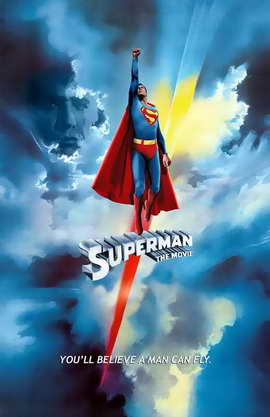
Movie: Superman (1978)

Notes: The 1978 film with Christopher Reeve will always be the gold standard, won’t it? The tagline was “You’ll believe a man can fly,” but that’s hardly the most impressive thing about the movie. In his performance, Reeve created a Superman that was warm, compassionate, and kind, all of which are things that we need even more today than when this movie was first made. This movie still has one of my single favorite moments in film history: the part where Lois falls from a helicopter. Superman reveals himself to Metropolis for the first time, gliding into the air and catching her in one hand and the helicopter in the other. He places them both on the roof of the Daily Planet building and Lois, in her shock, asks him, “Who are you?” 

His reply is simple, elegant, and perfect: “A friend.”

And although my steadfast belief is and will remain that Clark Kent is the real person, that Superman is just another name that he uses and that the reason he is the greatest hero in the world is because of the upbringing of Jonathan and Martha Kent…despite that, there is a moment in this movie that shows Jor-El knew who his son was destined to be as well. The line in the Fortress of Solitude, during the tutelage montage: “They can be a great people, Kal-El, they wish to be. They lack only the light to show them the way.”  

That’s who Superman is. They knew it in 1978. And if nothing else with this little experiment, I hope to remind people of that today. 

Comics: Black Canary: Best of the Best #1 (Lois, Clark, and Krypto cameo), Superman/Fantastic Four, Absolute Superman #3, Incredible Hulk Vs. Superman

Notes: (On Absolute Superman #3) Young Kal-El refuses to use generative AI to write. Further evidence that he’s the greatest hero there is.

Fri., Jan. 3

Omnibus: DC Versus Marvel Omnibus

Comics: Detective Comics #1091 (Guest appearance), Action Comics #1080

Notes: (On Detective #1091) A surprisingly Superman-relevant guest spot in this issue. Batman has been offered an experimental medical treatment with the potential to greatly increase his lifespan, so he does something he very rarely does: he turns to Superman for advice. Assorted comics over the years have established that Superman ages very slowly and is, compared to the humans around him, functionally immortal, but it’s not something they talk about much in the mainstream comics. Writer Tom Taylor brings that to the forefront with a lovely speech about how Clark carries that knowledge, with an emphasis on the fact that he trusts Bruce Wayne to find a way to use this gift for the greatest good. Frank Miller was wrong. The world is better when Superman and Batman are friends. 

Movie: Music by John Williams (Documentary, includes segment on Superman ’78)

Sat. Jan. 4

Novel: Gladiator (1930) by Philip Wylie

Notes: In the late 19th century, a reclusive scientist develops a treatment that gives incredible power to his unborn son. As the child, Hugo Danner, grows to manhood, he develops remarkable strength and speed, finds himself impervious to injury, and must then go out into the world to discover what place – if any – he will have in it.

This is the first time I’ve read this book, although I’ve long heard it cited as being a likely inspiration for Superman. Jerry Siegel and Joe Shuster – to my knowledge – never confirmed that this book was on their minds when they were conceiving the character, but the similarities are too striking to ignore. Hugo Danner’s powers are virtually the same as those of Superman in the early days, before he developed flight or super-senses or some of the more outlandish abilities he has today. What’s more, the sort of ethical struggles he faces are virtual mirrors of those that later writers would apply to the man of steel. Hugo is a one-of-a-kind human being, Clark Kent is a last-of-his-kind alien. Hugo has to learn lessons about the danger of his powers, if they go unchecked, which is a lesson that we frequently see in Superman origin stories. Hugo has to deal with the fact that, despite all of his power, there are some things in the world he simply cannot change, which of course is a typical theme in Superman’s stories.

What really sets things apart is how the two characters deal with the circumstances of their lives. In many ways, the way Wylie develops Hugo Danner is the opposite of what happens with Superman. As Clark learns to believe in and have faith in humanity, Hugo finds himself growing increasingly cynical and bitter as the story goes on. Clark transforms himself into a hero, but Hugo has thoughts of anger and rage that, at times, tread the line of outright villainy. We’ve seen so many stories with “evil” versions of Superman in recent years – things like The Boys or Irredeemable, which show the consequences of a character with Superman-like power but without the Superman ethos. The odd thing about Gladiator is that it feels very much like it could have served as an origin story for Homelander or Plutonian, rather than our own Superman.

I’m impressed by the writing style in some ways. Wylie is sharper and snappier, less consumed with fluff than other writers of his time, and the book is a very easy read. That said, “easy” doesn’t always mean “pleasant.” The book is a novel only in the technical definition of the term. There’s no singular antagonist, save perhaps for Hugo’s powers themselves, and there’s not a singular plot, either. Rather, we get the story of Hugo’s life, from his childhood, to his college years, to his exploits during World War I, and then beyond. We don’t get cohesion, except for a throughline of seeing how the world wears him down to the point of turning against humanity as a whole. The end of the book is particularly unsatisfying – it seems as though Wylie felt like he’d said everything he had to say and then found a quick (and, frankly, unbelievable) way to end things without actually having to resolve the ethical questions he’d addressed in the book.

It’s interesting, particularly from a historical standpoint, to see this prototypical Superman, but I’m very glad that the writers who helped turn Clark Kent into the hero he is didn’t draw quite as much from this early version as they might have.

Comic: DC Vs. Vampires: World War V #5 (Supergirl appearance)

Article: “Superman’s Editor Mort Weisinger” by Will Murray, essay in The Krypton Companion

Sun, Jan. 5 

Graphic Novel: Superman: Dark Knight Over Metropolis. (Collects Action Comics Annual #1, Adventures of Superman #466, Action Comics #653, Superman Vol. 2 #44, Adventures of Superman #467, Action Comics #654.)

Notes: Having read the scene in Detective Comics #1091 a few days ago, today I decided to go back to one of the early encounters between Superman and Batman in the post-Crisis continuity. The 90s was the era when I got into Superman comics big-time, the era that I still feel represents some of the best storytelling the character has ever had, and it’s always fun to revisit it. Oddly, one of the few things I’m NOT crazy about is the somewhat antagonistic relationship between Superman and Batman at the time. In this story, a former employee of Lex Luthor who has found evidence that Clark Kent is Superman confronts him with the knowledge, as well as Luthor’s Kryptonite ring. She flees and is murdered, and the ring makes its way to Gotham City and Batman, who comes to Metropolis to unravel the mystery.

The story is solid – Dan Jurgens, Jerry Ordway, and Roger Stern were the writers of the three Superman books at the time and they had already seamlessly forged the flow that would come to define what we now call the “Triangle Era” of Superman, with the story moving from one title and creative team to another seamlessly. It still jars me to see a Superman and Batman that don’t quite get along and constantly question one another’s methods. On the other hand, this book DOES start to forge a respect between the two of them. The two of them recognize that their respective methods work for their respective cities. Most importantly, at the end of the story Clark visits Bruce in Gotham, giving him the Kryptonite ring with the reasoning that he’s worried that someday someone may take control of him and turn him against humankind, and if that ever happens he wants the only sure way to stop him to be in the hands of someone he trusts. It would be some time before Superman and Batman regained the Super BFF status that they enjoyed in the Silver and Bronze ages, but I feel like it began here.

Also of note, the issues collected in this graphic novel include a bit of a relationship upgrade for Lois and Clark, who had flirted (literally and figuratively) with being a couple for some time. In these issues, Clark pushes to make it official. One of the many things I love about the 90s Superman is what they did with the relationship between these two. Lois Lane, when written properly, is a powerful and dynamic character in her own right, and it suits the couple much more to have this version, where she falls in love with Clark Kent BEFORE she knows he’s Superman. It’s far, far preferable to the stories of the 50s, where she’s out to trick the Man of Steel into marrying her or – failing that – revealing his secret identity. This is the genesis of MY Lois and Clark, and it’s the pairing that we still see in the comics today.

Mon., Jan. 6

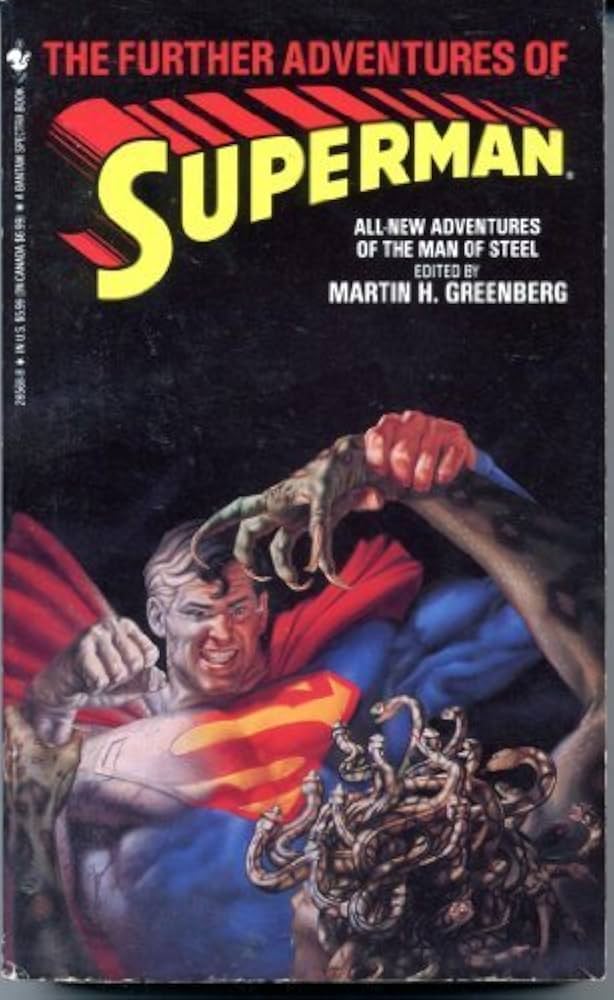
Short Story: “Lucifer Over Lancaster” by Elizabeth Hand & Paul Witcover (from the 1993 anthology The Further Adventures of Superman)

Notes: It’s been ages since I read this book, full of short stories about Superman, many of them by writers you don’t usually associate with the character. This one, for example, is about a doctor who experiments with a strange alien creature that residents of his home in Lancaster begin to suspect of being the Devil himself. I have to admit, I’m not wild about this one. The story has a long diatribe about how Superman and Clark Kent are both disguises and Kal-El is the “real” personality, associating himself more with Krypton than Earth. I don’t get this take on the character at all. Granted, he’s the last son of Krypton, but in virtually every incarnation of the character, he’s sent to Earth as a baby. It just doesn’t make sense that he would identify that strongly with his alien heritage to the point of considering his other two identities secondary. The character is a little cold in this story, too, speaking to a clearly remorseful Dr. Rule with what feels like unnecessary aggression. I’ve set myself up for a long journey this year, and I suppose it’s inevitable that I’ll run across versions of Superman that don’t quite jive with me. I guess this is the first. 

TV Episode: Superman and Lois Season 1, Episode 7, “Man of Steel”

Notes: I know it’s going to shock people, but I totally missed out on Superman and Lois when it was on the air. It wasn’t deliberate. I watched the first two episodes and I enjoyed it, but then other things started to steal my attention and I just got further and further behind, always intending to come back and give it a chance. I finally made it back a few months ago, when every other Superman fan I knew was talking about how amazing the series finale was. Well, I figured, if the show is over, what better time to start binging the entire thing? I made it through the first six episodes before the end of 2024, and now that the Year of Superman is upon me, I’m getting back in with the intention of getting through the rest of the show this year.

Anyway, in this episode we see Lois and Clark’s son Jordan struggling to control his newfound hearing powers, while Lois tries to unravel the mystery of this mysterious visitor called “Captain Luthor,” who seems to hail from another universe in which he and Lois were a couple and where Superman turned bad. I know a lot of people have gotten burned out on the multiverse concept in the last few years, but I’ve always been a fan of it when it’s done well. This one is pretty interesting – as Lois and Clark are certain that this stranger is an alternate version of Clark’s arch-nemesis, but as we see flashbacks to this stranger building a suit of daughter with his and Lois’s daughter “Nat,” it becomes increasingly clear (long before Lois finds his actual name) that this is REALLY an alternate of one of Clark’s greatest ALLIES, Steel.

The DC Universe Steel, John Henry Irons, has been one of my favorite Superman spinoff characters ever since his debut back in 1993 during the “Death of Superman” arc. Steel in the comics is a good man with a great mind who uses Superman as an inspiration to redeem a mistake. This John is different – just as smart, and with what seem to be good intentions, but his experience with an evil Superman has turned him into an antagonist. It’s a pretty surprising take on a character I love, but I’m not upset at all. John is opposed to Superman here, but there’s a long way to go in this series, and I feel like this character, somehow, is going to lead to a version of the John Henry Irons that I’m such a fan of.

Nobody tell me if I’m right or not. I’m looking forward to finding out for myself.  

It’s particularly nice to see Clark’s sons, especially the powerless Jonathan, get to play the cavalry in this episode. The relationship between Clark and Jonathan Kent in the comics is the best addition to the Superman mythos since he and Lois finally got married back in the 90s. This show adds a second son and changes the dynamic between the two considerably, but I’m really enjoying seeing where they go with it. 

Tue. Jan. 7

Comic: Superman #76

Notes: Having read Dark Knight Over Metropolis a few days ago, I got the idea to go back to the first story showing Superman and Batman discovering one another’s identities. Although they had been shown as partners in stories prior to 1952’s Superman #76, this is the story that showed HOW they discovered one another’s identities and…well, it’s baffling that this is the sort of storytelling they got away with in that time period. Having basically eradicated crime in Gotham City, Batman decides to take a vacation, booking a spot on a cruise ship. Meanwhile, Clark Kent is booked on that same ship because…well, because he had accrued time off. In one of those wacky coincidences, Bruce Wayne and Clark Kent are assigned one another as roommates. In an even wackier coincidence, an emergency breaks out on the ship and they both decide to change into their superhero uniforms after turning off the lights. And then, wackiest coincidence, a light shines through the porthole, revealing their true identities to one another.

It’s the most ridiculous secret identity reveal of all time, and I read Marvel’s Civil War.

The rest of the story is pretty standard 50s fodder. The two of them team up to thwart a criminal on the ship, Lois Lane happens to be along for the ride, and Superman – I swear to you, they did this kind of stuff all the time in the 1950s – convinces Batman to flirt with her as a distraction so she wouldn’t try to solve the crime herself and put herself into danger. I don’t know what’s crazier, that Superman would come up with a plan so bafflingly stupid or that the world’s greatest detective went along with it.

But I do have a soft spot for this story. I first read it when I was a kid, when I feverishly checked out the book Superman: From the 30s to the 70s from my local library over and over again, and I remember this story fondly. Does it hold up? No. But I can forgive that, as a relic of the time.

Speaking of relics, the way they depicted Lois Lane back then is mad. This is just one of many stories from the era where Superman straight-up gaslights her either to “protect her from harm” or to prevent her from getting too close to him, even though they were publicly dating. (Lois and Superman, that is, not Lois and Clark.) In fact, the last story in this issue is another Lois Lane Lovetrap, where SHE comes up with the brilliant plan to get Clark Kent to marry her friend Lorraine because…that…will make Superman…marry Lois? I know it doesn’t make any sense. I read the story two minutes ago and I can’t make it make sense. All I can say is, thank God for Margot Kidder, because she really was the blueprint for how Lois has been depicted from the 80s on, and the world is so much better for it. 

Thus ends Week One of the Year of Superman. I wanted to tell you that, although I have a list of stories I plan to revisit, it’s not nearly extensive enough to last a whole year. So I’m open for requests! Do you have a specific Superman comic book, story, or TV episode you’d like me to weigh in on? Go ahead and drop your requests in the comments!

Blake M. Petit is a writer, teacher, and dad from Ama, Louisiana. His most recent writing project is the superhero adventure series Other People’s Heroes: Little Stars, volume one of which is now available on Amazon. You can subscribe to his newsletter by clicking right here. He’s also started putting his LitReel videos on TikTok.