“Evil Superman” has become a popular trope. In movies, video games, and – of course – comic books, people love to pick into the greatest hero in fiction and postulate what would happen in a world where he WASN’T a hero. I suppose it’s an extension of the Lex Luthor mindset, really – some people simply cannot fathom the notion that somebody with Superman’s powers would REALLY use them to do good. As such, they instead rewrite the world so that the hero is the bad guy. When done poorly, it’s tiresome and stale. But that doesn’t mean it can’t be done well. This week, we’re going to take a look at some of the stories that have turned Superman bad and others where we see a faux Superman that goes down the wrong path.

And as always, you can check out earlier blogs in the Year of Superman Archive!
Wed., Oct. 15
TV Episodes: Justice League Season 2, Episodes 11-12, “A Better World” Parts 1 and 2.
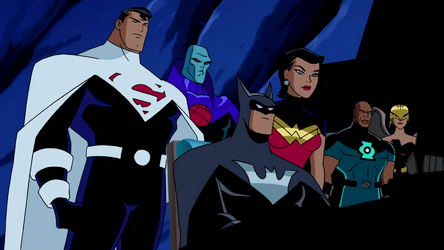
Notes: In this classic two-parter, we begin with the Superman, Batman, and Wonder Woman assaulting the White House where President Lex Luthor is in control. After battling his way to Oval Office, Superman hesitates as Luthor mocks him, telling him that he’s never had the guts to stop him the only way that could work for sure. Downstairs, Batman and Wonder Woman catch a whiff of something burning. When they find Superman in the slag of Luthor’s office, the president dead, Superman smiles and says he feels “great.”
We realize quickly that this isn’t OUR League, but we watch this group – the Justice Lords – as they take over their world and impose a strict, fascistic regime without the time for luxuries like elections. As they impose their will, their Batman finds a portal to other dimensions, glimpsing our world, where they’re surprised to see that the Flash is still alive, unlike in their universe. They decide to “help” the other world by extending their regime, and cut into our universe to capture our Justice League, leaving their Batman behind to keep things in line. With our League taken out of the picture, the Justice Lords begin to impose their own version of justice on a second world.
Our League manages to escape on the Lords’ world and begins looking for a way home, which finally comes when our Batman convinces theirs to turn. Their Batman concedes that the death of their Flash was a turning point, and that losing their group’s conscience sent them the wrong way. The League returns to their own world, engaging their counterparts in battle. As the League and the Lords battle, the evil Superman hesitates when he’s confronted by the Flash. Although he’s ready to kill this remnant of his conscience, he’s stopped when our Superman arrives with the concession he decided to make rather than lethal force – he’s brought his Lex Luthor along with a power disruptor that allows them to stop the Lords and send them home. The kicker is that, in exchange for his help, Luthor has been given a full pardon for his crimes. At the end of the episode, he announces that he’s given thought to trying his hand as politics.
This is an excellent two-parter, and it really does have Superman at the core of it. The Justice Lords version of the character is cold and bitter, but at the same time you get the sense that he was once not that different from the Superman that we know. That’s the trick that a lot of the “evil Superman” stories miss – they start out with a character so removed from the real Superman that any commentary they’re attempting to make falls flat. Although we don’t actually see the Flash’s death in their world, it’s easy enough to imagine that moment of darkness (in a universe that is otherwise relatively bright, Batman: The Animated Series notwithstanding) would be a breaking point for a Justice League that had been forced to endure too much. We wouldn’t ever accept a “real” Superman behaving this way, but the story is structured such that we buy it from the “other” Superman.
There are other nice moments in here as well. I’d forgotten that this was the episode that specifically pointed Lex Luthor down the road to his presidential run in this version of the DC Universe. It’s also kind of fun, I have to admit, to watch the Justice Lords facing off against the likes of Doomsday. The glimpses of the villains of the other world – a Joker and Poison Ivy who seem to have been essentially lobotomized – are really chilling when you compare them to the versions of the characters we know. It’s the old morality debate here – this brainwashed Joker is inarguably less dangerous than the one we usually see, but is it worth the price of a hero’s soul to make it happen? (This two-parter, it should be mentioned, originally aired in 2003 – one year before the main DC Universe would grapple with this same question in-continuity in the Identity Crisis storyline.)
But I think the gold star for this episode has to go to – you know it – the second-greatest character in the whole Superman mythology. Even before people realize that the Justice League has been replaced by their evil counterparts, Lois Lane sniffs out that something is wrong and, bold as brass, gives Justice Lord Superman a verbal cutdown that shows what she’s really made of. I’d like to think that even Justice Lord Superman admired her a little bit for that.
All that said…despite the fact that he’s a Superman gone wrong, I have to admit that Justice Lord Superman’s black-and-white costume is actually pretty sharp.
Comics: Aquaman Vol. 9 #9 (Guest-Star)
Thur., Oct. 16
Comics: Injustice: Gods Among Us #1-6
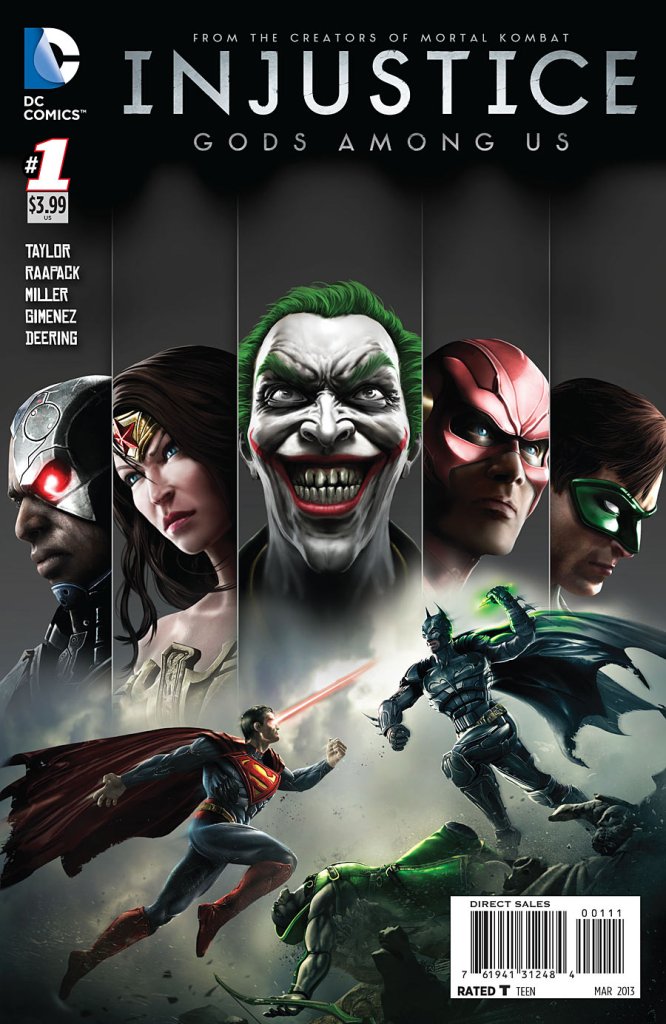
Notes: In 2013 we got the video game Injustice: Gods Among Us, and while it would be kind of neat to include a video game playthrough here in the Year of Superman, I’m not really a gamer. I don’t own a console and I wouldn’t even know where to look for this game 12 years later. But I read the tie-in comic written by Tom Taylor, which turned out to be way better than it really had any right being.
I don’t have time to read the entire five years’ worth of the comic for this project, so I’m going to stick to the six issues (or 18 of the digital comic, where it actually premiered) collected in the first trade paperback. It’s worth noting, though, that the entire first year of the series is available in DC’s handy-dandy Compact Comics edition, and it’s worth checking out.
The story begins as tragically as you can possibly imagine. On the night that Superman tells Batman that Lois Lane is pregnant, she is abducted (while working on a case, of course) by the Joker and Harley Quinn. They also murder Jimmy Olsen, but people forget that part. Batman mobilizes the League to try to track them down and Superman finds them on a submarine, where somehow they’ve managed to corral Doomsday. As Superman battles his foe, the rest of the League arrives and Batman unlocks the Joker’s real scheme: he’s blended some of the Scarecrow’s fear toxin with Kryptonite, making Superman susceptible. Superman believes he’s bringing Doomsday into orbit, but it’s really his own wife. The icing on the cake is that the Joker rigged a nuclear device in Metropolis to Lois’s heart. When she dies in outer space, Superman’s entire city is engulfed in a mushroom cloud.
This is, arguably, the nastiest Joker of any world in the Multiverse. And it just gets worse from there.
In issue two, Superman gives Lois’s body to Diana and takes off to Gotham, where Batman has taken the Joker. The rage has overtaken Superman, and he rips the Joker’s heart out in front of the Dark Knight. Green Arrow, meanwhile, finds Harley and takes her captive in his Arrowcave. Superman, consumed with grief and guilt, decides to never allow any tragedy to happen again. He starts in the country of Bialya, stopping a war and bringing its president to the United Nations, where he reveals his “Earth name” WAS Clark Kent, and that he’s going to stop all hostilities everywhere in the world, whether the world likes it or not.
Issue three shows us the government response: worried about Superman overreaching, they recruit Mirror Master to abduct Jonathan and Martha Kent. Rather than keeping Superman in check, though, the League mobilizes behind him in a rescue attempt. In Quaraq, meanwhile, one of the few places that has ignored Superman’s call for a cease-fire, Ares makes himself known in battle against Wonder Woman, a battle that does not go well for the God of War. Issue four is where things really start to go wrong – as Superman confronts Batman over the years he let the Joker live, a Japanese whaling fleet is attacked by forces of Atlantis. The League faces off against Aquaman, who intends to resist what he calls Superman’s coming reign, but Superman replies by having the League uproot Atlantis and drop it in the middle of the Sahara Desert. Aquaman buckles, and Superman has Batman’s Justice League communicator disconnected. The message is clear.
Issue five has the League put down a protest in Australia in a way that leaves the Flash shaken to his core, then decide it’s time to get rid of the Arkham inmates for the good of the world. When they arrive, Batman and Nightwing stand against them, but Robin decides to join Superman’s cause. As the two sides face off, Batman activates a virus he implanted in Cyborg years ago to immobilize him and reduce the League’s advantage. At the same time, Green Arrow has decided to bring Harley back to Arkham, but she takes advantage of the chaos to break out and start a prison riot. Robin, lashing out in the midst of the riot, accidentally killing Nightwing. This is, in many ways, the point of no return. Up until now, there was still the possibility of a peaceful resolution, but Dick Grayson’s death causes a schism that cannot be bridged. Superman and his Justice League – including Robin – begin consolidating power across the world, while Batman and Catwoman begin gathering a resistance movement against him.
Tom Taylor is a pretty big name in comics now, having a legendary run writing Nightwing under his belt, amongst his other triumphs. But I think it was his work on this series that really got him the attention he deserved. This story shares a lot of DNA with Kingdom Come, having virtually the same inciting incident, only amplified. But whereas Mark Waid and Alex Ross’s story showed a Superman who retreated from the world, Taylor’s version (the video game version, to be clear) decides to push his agenda forwards. That’s how “bad Superman” stories usually go, of course. They take what Lex Luthor claims is his greatest fear about Superman and make it fact, showing him imposing his will on a world that is helpless to resist.
What makes Taylor’s story better than most of those is the nuance. His Injustice is a remarkably slow burn, beginning five years before the events of the video game and showing everything that leads up to it. What’s more, Superman (at least at this point) is still a sympathetic character. Like Magneto and Dr. Doom, one of the things that makes him a compelling antagonist is the fact that the reader can understand his motivations, even if they can’t condone his actions. And as Superman’s humanity is slowly chipped away, we get moments where he keeps trying to bring it back. For example, after Nightwing’s death, Superman is the one who goes to Catwoman and urges her to go to Batman, knowing that he’ll need someone. It’s subtext, but the story feels like Superman is trying to get her to save Bruce before he loses his own humanity the way that Clark Kent has. Batman, on the flipside, isn’t painted as flawless – he makes his own errors in judgment — such as the virus he uses against Cyborg — which may not contribute to the tragedy directly, but at the very least hastenes it.
Of all the “dark Superman” stories that have been told, this is one of the smartest, most intelligent ones, one of the ones that goes down the dark path without utterly betraying the character. And if you’re the kind of person who wants to sit down for a long read, there’s plenty here – a full five years of comics, plus assorted annuals, spin-offs, and a sequel that went with the second video game. I haven’t even finished them all, but re-reading this first volume has put them back on my radar to get to the end of the story. Because despite preferring my Superman in the light, this story is honestly very good.
Fri. Oct. 17
Movie: Brightburn (2019)

Notes: Today we’re going to get to one of the first Superman “analogues” I’m going to be covering this week. While DC can – and obviously has – told their own stories of a Superman gone wrong, that hasn’t stopped other storytellers from putting their own spin on the concept with characters that aren’t REALLY Superman, but come on, let’s be honest here. One such character is Brandon Breyer, the main character of director David Yaroevsky’s 2019 film Brightburn. The story starts out in a VERY familiar way: a farm couple in Brightburn, Kansas, Kyle and Tori Breyer (David Denman and Elizabeth Banks), find a baby that seems to have fallen from the stars, and as they’ve been unable to conceive a child of their own, they take him in as their own. When Brandon (Jackson A. Dunn) is about 12 years old, though, he begins acting oddly – mumbling in strange tongues as he struggles to open a door in the floor of the cellar, then waking up with no memory of what he was doing. Later, as he struggles with the motor of a stubborn lawnmower, Brandon finds himself strong enough to hurl it across the pasture and suffers no injury when he places his hand in the spinning blade.
The first real sign of trouble is when his aunt and uncle give him a rifle for his birthday. When his father takes the gift away, insisting that he doesn’t want him to have a gun at that age, Brandon pounds the table, disrupting the entire restaurant, and they bring him home. Later, after finding some disquieting literature under his mattress, Kyle tries to have “the talk” with him. It doesn’t go well. Brandon begins using his powers to stalk and harass a girl from school, later breaking her hand, and the chickens on the farm are found mutilated, although Tori insists it must be the work of a wolf. Although Tori continues to defend him, Kyle is growing increasingly terrified of his son, who has never been hurt, but now seems to be hurting others.
Finding a spacecraft in the cellar, Brandon insists Tori tell him the truth about where he came from, and she tells him a story that could have come word-for-word from Martha Kent. But rather than accepting his truth with the usual grace we’ve come to expect from Clark, Brandon lashes out, outraged at his parents for lying to him for his entire life. A message from the spacecraft echoes in Brandon’s head until he finally translates it into English: “Take the world.”
This moment happens a little less than halfway into the film, and from there, it’s a straight slide into darkness. Brandon uses his powers to begin taking his revenge on those he views as having wronged him, wearing a hand-stitched hood and cape he designed himself, but which makes him look more like a horror movie icon than a superhero. And this, to me, is where it really gets interesting. The film takes the familiar superhero tropes and approaches them from a completely different angle. Just how terrifying WOULD it be if someone – especially a petulant child – had Clark Kent’s powers but not Clark Kent’s ETHICS? The result is a movie that takes the elements of a superhero origin and instead applies them to a story that plays out like a slasher movie instead. Nobody is safe, not even Brandon’s parents. The whole package is suitably and appropriately chilling, and it leaves you coming away with an appreciation for the character we actually have. I’ve often said that the luckiest thing that ever happened in the DC Universe is that Kal-El’s rocket was found by Jonathan and Martha Kent instead of somebody else. This movie really drives that point home.
This movie has a very interesting pedigree, but only in retrospect. It’s written by Mark and Brian Gunn, cousin and brother (respectively) of one James Gunn, who also produced this movie several years before he got the job of running DC Studios and making what is perhaps the brightest, most optimistic Superman movie of all time. The film also includes a lot of James Gunn’s usual staple of actors – he’d worked with Elizabeth Banks and Michael Rooker before in Slither, Denman and Rooker appeared in season two of Peacemaker, Stephen Blackehart and Terence Rosemore played some of Lex Luthor’s entourage in Superman, and future Peacemaker regulars Steve Agee and Jennifer Holland (who married James Gunn a few years later) both have small roles in this one. As a fan of Gunn’s work in general, I always enjoy seeing members of his entourage turn up.
The first part of the film clings pretty close to the Superman pattern. If you filmed the scenes with less ominous lighting or more upbeat music, you could use the same dialogue in a Superman origin movie. What’s more, they take pains to show that the Breyers aren’t bad people. They’re parents trying to do the best they can in what turn out to be truly unprecedented circumstances. Tori even talks about how her own parents neglected her, and how she’s determined not to let her own child feel that way. But the child they’re trying to raise is unlike any other, and once his powers begin to develop, it quickly spins out of their control. The Breyers, from what we could see, weren’t BAD parents, although once Kyle starts realizing how bad things are, he starts to freak out and make some…let’s say “questionable” decisions. But the Kents were EXCEPTIONAL parents, capable of taking a godling and making him a force for good. There also seems to be an element of Bad Seed-ism in here as well. Although the psychic influence of his spacecraft was certainly a factor, the film gives us the impression that Brandon was fated for darkness no matter what.
Ultimately, the difference between Brandon Breyer and Clark Kent is that Brandon views himself as “special,” and in his mind, that places him above everybody else. Clark, on the other hand, views himself as human first, and doesn’t consider himself above ANYBODY, which makes the things he’s capable of all the more miraculous and amazing.
The film ends with a bit of a sequel hook, implying that this universe also plays home to dark, twisted versions of Wonder Woman, Aquaman, and possibly others. It’s a little surprising that it hasn’t been followed up anywhere. I suppose the notion of a superhuman serial killing child is a bit of a non-starter for a major franchise, which is probably why most of these dark Supermen wait until adulthood to break bad. It seems unlikely that James Gunn would touch this world again any time soon – he’s a little too busy shepherding the real DC Universe to spend much time on its evil mirror counterpart. But if someone were to come back to this world, I enjoyed this movie enough to want to see where it would go next.
Comics: Jon Kent: This Internship is My Kryptonite #15, Action Comics #3, Justice League of America #32, DC Comics Presents #72
Sat., Oct. 18
Comics: The Boys #19-22
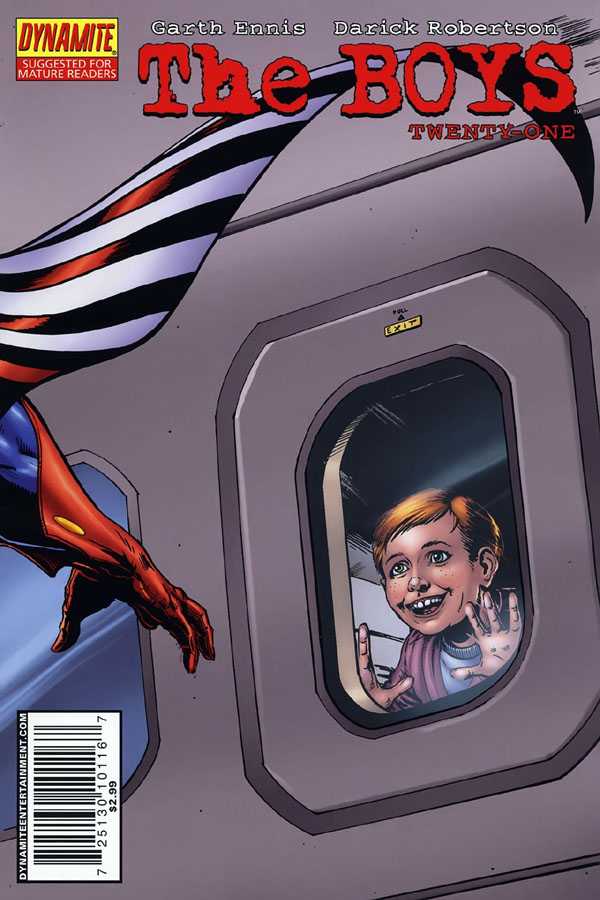
Notes: Garth Ennis is kind of an odd duck. An acclaimed comic book writer, he also has a very vocal and open disdain for superheroes. In fact, most of his superhero work has been intended to deconstruct and mock the genre. Despite this, though, he DOES have an affection for a very small number of characters, among them, Superman. Early this year, in fact, I covered an issue of his DC series Hitman, which was as tender and effusive a love letter to Superman as you could ever want to read.
However, his series The Boys is as brutal a condemnation of the superhero genre as one could ever want to read. Both the comic and the hit Amazon Prime franchise based on it are about a group of super-powered “heroes” that are as petty, cruel, and evil as any villain you can name, and the titular outsider group that is dedicated to destroying them is only barely better. Many of the “heroes” in the book are clear parodies of DC or Marvel characters, including the leader, an obvious Evil Superman type called Homelander. Due to the popularity of the TV show, Homelander is probably the best-known of all the bad Supermen out there, and I felt like I had to include him, but it’s not easy to distil exactly what makes him such a miserable excuse for a human being into one comic or story – to get the full picture of what a bastard he is you really need to read the entire series. But for the sake of discussion, I decided to go with the four-part “I Tell You No Lie, G.I.” from The Boys #19-22.
In this four-parter Hughie – the newest member of the Boys and the point of view character for most of the series – is told the history of superpowers in their universe. Without getting too deep into the lore of a series you may not have read, here’s the short version. Although the public is told stories of standard superhero origin stories, the truth is that Homelander and the rest of his team, the Seven, are powered by a substance called Compound V developed by their corporate sponsor, Vought-American. Rather than using their powers to rule the world, though, Vought is smart enough to use them for corporate supremacy – more money and less resistance. But the plan is angling towards weaponizing supers for the military, which we’re told is related to one of the big questions of the series to date – the reason there’s no more Brooklyn Bridge. In this universe, the events of Sept. 11, 2001 went somewhat differently. While some of the planes that were on their murderous trajectory were shot down, the Seven were sent in to divert one of them – and that turned out to be a disaster.
Homelander and Queen Maeve (this world’s answer to Wonder Woman) go into one plane to stop the terrorists, and instead just prove how utterly incompetent they are. Homelander, spewing racist slurs, pulverizes the terrorists in the cockpit into paste, but realizes too late that nobody there knows how to land an airplane. What’s more, attempts to catch the plane don’t work because the world of The Boys adheres at least somewhat more closely to actual physics than your usual comic book universe. And while things like saving the spaceplane in John Byrne’s Man of Steel or Brandon Routh’s rescue of the plane in Superman Returns make for great stories, the truth is that a real airplane would completely fall apart if someone tried to “catch” it the way that superheroes do so frequently. As the passengers on the plane plead for help, Homelander abandons them to their fate of spiraling into the doomed bridge.
The history lesson is intercut with scenes in the present day of the series, where Homelander is having a bit of a summit with Butcher, leader of the Boys, over some of the recent hostilities between the two groups and how their peace accords have been breached. In the course of this, Homelander is trying to find out why Butcher seems to hate him so much – not supers in general, but him SPECIFICALLY. Turns out that Homelander had a history with Butcher’s wife, something that ended poorly to say the least and gave him the fuel for Butcher’s hatred of Supes that was one of the building blocks of the entire series.
Although I don’t typically agree with Ennis’s pessimistic, nihilist stories, that doesn’t mean I can’t appreciate the fact that he’s good at what he does. The Boys is a well-crafted, brilliantly-scripted takedown of the superhero concept in general. Homelander specifically, though, doesn’t feel like Ennis is attacking Superman. Sure, in the world of the comic (and TV show) the public looks at him the same way that the people of Metropolis look up to Superman, but the character himself shares little with our hero except for a powerset. He never had a real childhood, as he’s just a product of Vought-American. Despite his power, he never really had much agency of his own, never really had a chance at heroism. He was only what his corporate masters made out of him. While Brightburn showed us how a Superman could go bad, Homelander is more of an amplification of what nihilistic people THINK Superman would be in the real world, as opposed to who he really is. Fans love to debate what would happen if Superman and Homelander ever got into a fight. The answer is really simple: Superman would stop Homelander from doing whatever it is that needs to be stopped, the entire time consumed with disappointment that somebody with such incredible gifts would waste them on being so selfish.
Sun., Oct. 19
Comic Book: Batman: The Devastator #1

Notes: In 2017 DC had one of Its frequent crisis events. This one, Dark Knights: Metal, revealed the existence of a “dark multiverse,” in which the different worlds played host to alternate versions of our DC heroes, but these were versions that specifically went “wrong.” I always found that concept sort of funny– there are plenty of worlds in the “bright” multiverse that aren’t exactly a basket full of kittens, after all. But this series gave DC a chance to take some wild swings. This included a series of one-shots starring Batman (because that’s where the money is) “merging” with different characters in some way or another, and those mergers had some gut-wrenching consequences. The Devastator was the book that gave us a dark knight that influenced by a man of steel (sort of) to disastrous results.
In the world featured in this issue (Earth Minus One), Superman went bad. Nobody ever found out how or why, which the Batman playing narrator tells us is the most frightening thing of all, but he went on a murderous rampage, slaughtering not only his world’s heroes, but even his own wife, that world’s Lois Lane. This, Batman tells us, is the point where hope was lost, and Batman decided the only way to stop Superman was to transform himself into the only one who’d ever beaten him: Doomsday. His plan succeeds – he kills the evil, rampaging Superman. But the transformation leeches any vestiges of hope and compassion from him, leaving a creature who – like Doomsday – sees reality purely in terms of threats that need to be eliminated. It gets worse when he’s approached by the Batman Who Laughs, another dark multiversal denizen who is a hideous amalgamation of Bruce Wayne and the Joker. He asks the Devastator Batman if he would like a shot at a world where people still think Superman is a hero, someone to admire…our world.
The Devastator comes to Earth-0 and, pretending to be our Bruce Wayne, infects our Lois with the same Doomsday virus that he used to transform himself. As she struggles against her transformation, she throws her son Jon (still ten years old at this point) into a Kryptonian-proof panic room she and Clark had built in preparation for the worst. The Devastator, meanwhile, goes to war against Supergirl, Superwoman (Lana Lang) and other heroes, while our Superman remains missing.
This story is only a fragment of the Dark Knights: Metal storyline, and honestly, the whole thing is far too detailed and intricate for me to really get into here. I’m more interested in the Superman angle anyway, after all. I find it interesting that the writers decided to avoid the question of WHAT made this Superman go bad. And for the purposes of the story, it makes sense. Their focus is on what happens to Earth Minus One’s Bruce Wayne, so the exact circumstances of their Superman’s corruption aren’t necessarily pertinent. I’ve got a different agenda, though, and it’s hard for me to conceive of a Superman so like our own going so totally, irrevocably bad, especially to the point of murdering Lois. It’s simply not any Superman that I can conceive. On the other hand, that’s probably the point. At any rate, the reaction to this evil Superman is suitable, I suppose. One of the hallmarks of a modern Batman is the way he’s so ridiculously overprepared for any given circumstance, so the idea that he would have devised a way to transform himself into Doomsday for just such an occasion isn’t farfetched at all. The idea of a Superman so evil that such a transformation would be necessary is the chilling part, the kind of thing that will keep you up at night.
Geez, maybe it’s for the best that we don’t know what exactly happened here.
Mon, Oct. 20

Comics: Irredeemable #1, Justice League of America #33
Notes: If you’ve been following this blog with the religious fervor it so richly deserves, you already know of my love and appreciation of the work of Mark Waid. Waid is currently shepherding Superman in three separate ongoing DC titles – Action Comics, Batman/Superman: World’s Finest, and Justice League Unlimited. He’s also literally rewriting history with the New History of the DC Universe miniseries, doing the best job anybody could hope to do of making some sense out of the past nine decades of continuity. Back in 2009, though, during a time when he was estranged from the current editorial leaders at DC Comics, he did his own take on the “evil Superman” trope with his masterful Boom! Studios comic book, Irredeemable. The series is 37 issues long, along with a spinoff series called Incorruptible. Both are excellent reads and well worth diving into – but as with The Boys, I just don’t have time to do the whole thing justice. So today I’m going to read the first issue of Irredeemable again, then discuss in broad strokes the series as a whole.
The story begins with the Plutonian – the bright, bold, caped hero that everyone knows and loves, engaged in an act of stalking and murder. He sweeps into the home of a hero called the Hornet (kind of this universe’s answer to Batman) and kills Hornet’s wife and infant child. Hornet and his older daughter flee to the cave beneath the house, but Plutonian finds them quickly. Although Hornet begs for his daughter’s life, Plutonian makes quick work of him, then turns to the daughter and says to her, “Do you know who I am, Sarah? I’m a super-hero.” The page turns and we see him flying away from the home, which has been reduced to cinders.
A quick time jump takes us to a week later, when the world’s remaining heroes are interrogating the Plutonian’s partner, Samsara, trying to figure out what could have gone wrong. Sam struggles with his memories, recalling a few times when Plutonian started to seem off, like he was going to unravel, but the pain of trying to access the memories proves to be too great. The camera pulls back to reveal that Sam is in his grave, dead, murdered by the Plutonian, who also seems to have carved out parts of Sam’s brain that access the memories of what made him go bad. One of the other heroes managed to briefly reanimate Sam for the interrogation, but as they realize it’s fruitless, they allow him to return to peace. As they begin to debate their next course of action, Plutonian finds them and attacks. They flee into a set of portals, but Plutonian smiles as they escape, and a comic book fan’s favorite words scroll across the bottom of the page: “To Be Continued…”
There’s so much to unpack in this series that it’s hard to know exactly where to begin. Let’s start, I guess, with a brief comparison to The Boys. Although both series have a similar conceit – heroes gone wrong – they approach it from very different angles. Garth Ennis’s series is a takedown of superheroes as a concept, a disdain for the very idea. Mark Waid, on the contrary, clearly loves superheroes (one need only read a few issues of his runs on comics like The Flash, Captain America, or JLA to fully embrace that supposition). Irredeemable, then, is less of a condemnation of superheroes and more of an examination of some of the darker possibilities.
As the series goes on we learn more and more about the Plutonian and what made him go wrong, and Waid plays up the parallels to Superman FAR more than Ennis does. Plutonian, like Superman, is not from Earth. He’s got a “human” secret identity and a human “girlfriend” that both factor into the story. And like Superman, he was considered by most to be the apex of what a hero should be. But there’s an incompleteness in Plutonian, a hole in him that doesn’t exist in the Man of Steel. And whereas Superman doesn’t do what he does for applause or accolades, we come to realize that Plutonian’s “Start of Darkness” is triggered by a growing realization (thanks to hearing and vision powers similar to Superman’s) that not EVERYBODY loves and cherishes him. He hears these mere humans talking about him behind his back, and those that are less than complimentary start to wear on him. How dare they – how DARE these pathetic mortal creatures show him anything less than pure adoration?
To be fair, this is by no means the ONLY factor in what makes the Plutonian turn bad, but I think it’s the one that shows most clearly just what makes him distinct from Superman. There have been plenty of stories over the years where public opinion has turned on Superman, but never once (at least not in an in-continuity story) has there been one where he’s considered breaking bad over it. It bothers him sometimes, but in a very human way. Rereading this comic now, it actually makes me think of the interview scene in James Gunn’s Superman, where Lois jibes Clark just a little about the way the trolls on the internet talk about him. It bothers Clark, even though he pretends it doesn’t, but there’s never a point where you’re afraid that he’s going to go out and turn his heat vision on the Justice Gang.
I find that each of these “dark Supermen” – the ones that aren’t Kal-El, at least – succeed in revealing some of the things that make Superman who he is. In Brightburn, Brandon’s initial flaw is embracing the idea that his powers make him better than other people. Plutonian’s need to be worshipped causes his undoing. Homelander is, in many ways, a soulless homunculus given Superman-like powers but without any of his humanity. Each of them proves something that I’ve always believed wholeheartedly, and that Superman detractors just can’t seem to accept. The powers do not make the hero. Kryptonian strength, heat vision, flight…these aren’t the things that gave us Superman. It’s the soul of Clark Kent, the child reared by Jonathan and Martha to be completely selfless and giving, that is the foundation of Superman. Every single Superman gone wrong is fueled by the absence of at least PART of that, and the consequences are disastrous. This week, for me at least, has proven that more than ever.
Irredeemable really is a great series, and I recommend reading it in concert with its spinoff. Incorruptible is its opposite – one of the Plutonian’s most bitter enemies sees what the hero has become and decides to try to balance out the scales by becoming a hero, only he doesn’t exactly know how to do it. The two books tell different stories, but interact nicely. And when you reach the end of it all, in the final issue of Irredeemable, there can be no doubt that this was written not as a condemnation of Superman, but as a tribute to who and what Superman actually is. It’s a love letter composed by Superman’s biggest fan.
Tues., Oct. 21
Graphic Novel: JLA: Earth 2, Tales of the Legion of Super-Heroes #314 (Supergirl, Team Member), Justice League of America #34 (Team Member)

Notes: For a week all about Superman gone bad, it wouldn’t seem right not to include perhaps the first such character, Ultraman. In the original DC Multiverse, Ultraman was a member of the Crime Syndicate of Earth-3, a world where the heroes of our world were reimagined as villains. Superman’s counterpart was Ultraman, Batman was Owlman, Wonder Woman was Superwoman, and so on. The tricky part is that there aren’t really any great stories ABOUT Ultraman. He, and most of the Crime Syndicate, rarely appear outside of their ensemble. And in the early days of the characters, when they appeared as occasional antagonists in the annual Justice League/Justice Society storylines, they weren’t exactly fleshed out and well developed.
So to get a solid look at what makes this evil Superman cook, I decided to go with Grant Morrison and Frank Quitely’s 1999 graphic novel JLA: Earth 2. Years before this creative team would bring us the remarkable All Star Superman, Morrison wrote this one-shot graphic novel as a spinoff of the main JLA comic. This was still during the period where DC’s “official” policy was that the multiverse no longer existed, except of course for when they wanted it to, so the “Earth 2” moniker was both a nod to the past and a reflection of the fact that no other worlds had TECHNICALLY been discovered in this continuity. In fact, in the story the title is only dropped as the name the Luthor from another universe uses to classify OURS. Nice reversal. Let’s get into the book, shall we?
After a pair of vignettes – one at a Watchtower that’s not quite like our own and a second where a ship crashes into a cornfield only to crack open to reveal a battle suit-wearing Lex Luthor – the story begins with the Justice League trying to avert a plane crash. Despite their best efforts, they find that everyone on the plane is already dead. Even more strange, several things on the plane don’t make sense – they carry money where George Washington’s picture has been replaced by Benedict Arnold, for example, and a cursory examination shows that their hearts are all on the wrong sides of their bodies. Perhaps most startling, when Aquaman recovers the tail of the plane from the ocean, he finds an insignia of a burning cross.
The League visits Lex Luthor for information, but he’s engaged in some – for him at least – unusual activity, such as diverting funding from his arms division to charities and giving his employees gargantuan raises. A quick interrogation reveals that this is NOT the Lex Luthor they know, but Alexander Luthor of another universe, a world he says is the reverse of our own – the sun orbits in the other directions, seasons are reversed, and the heroes of one world are the villains of the other. Ultraman, he reveals, was the first superhuman in his world: a human astronaut whose ship was damaged in hyperspace. An alien force rebuilt him with a superhuman body, but he returned to Earth with a horrific, twisted perspective that he used to raise up his Crime Syndicate to take over his world. Alexander is here to ask the League to return with him and overthrow the Crime Syndicate, but the League is divided. Batman feels that they need to focus on their own world, but Alexander promises that his plan will take only 48 hours to change his entire world.
Back on that world, the CSA have discovered that Luthor escaped to another universe, which they see as another world to conquer. The CSA isn’t the united front that the JLA is, though. Their Flash analogue, Johnny Quick, is essentially a drug addict, hooked on the compound that gives him his speed. Green Lantern’s counterpart Power Ring is a cowardly sleaze that’s possessed by the spirit called Volthoom that powers him. And Owlman and Superwoman are carrying out an affair behind Ultraman’s back. The League, meanwhile, is horrified by conditions on this world and quickly prepare their assault. They trap the CSA in their space station, and Wonder Woman goes on TV to announce that they have arrived to free the people of this earth from the tyranny of the Crime Syndicate: disarming hostile nations, providing food for the hungry, and in Gotham City, helping Commissioner Thomas Wayne Sr. finally try to clean up the streets.
In captivity, though, Owlman is cool and collected, having figured out that the plane crash we saw at the beginning was actually a swap between the two universes. The universes HAVE to balance themselves, and 24 hours after the JLA arrived on their world, the CSA vanishes and is sent to ours. Aquaman and J’onn J’onzz, who stayed behind, are toeing the line against the entire CSA as they attack Washington, DC. Both teams come to the same conclusion – the “good” characters cannot sustain a victory in the “evil” universe, and vice versa. Meanwhile, with Ultraman gone, his stooge Brainiac escapes – a computer conscience, he lies beyond the concepts of “Good” and “Evil,” and is poised to destroy both worlds by making them collide. The only way to win finally comes in the most unlikely gambit of all.
Ultraman is still part of an ensemble here as opposed to a solo star, but Morrison gives much greater depth and detail to this iteration of the Crime Syndicate than any previous version. We get a long look at this world and how diseased it is: “Boss” Gordon being the mafia lord of Gotham City, for example, or the horrific way that Lois Lane – aka Superwoman – treats her Jimmy Olsen. The conceit is unusual too, the idea that the JLA is incapable of victory in the CSA’s world just as the CSA can’t win in our own. Morrison treats “good” and “evil” not as abstract concepts here, but as something tangible. Morality almost has agency and is treated as though it were a law of physics rather than a philosophy. This is actually pretty in-keeping with a lot of Morrison’s work, and it’s executed well. In a way – and I know this is an odd comparison to make – it almost makes me think of the Final Destination films, where Death is not a physical being but an inexorable, invisible force that one way or another will have its due.
Hope you enjoyed “Superman Gone Wrong” week, friends. Next week is the last one before Halloween, and I’m going to have fun with it. Be back in seven days for “Superman Meets the Monsters!”
Blake M. Petit is a writer, teacher, and dad from Ama, Louisiana. His most recent writing project is the superhero adventure series Other People’s Heroes: Little Stars, volume one of which is now available on Amazon. You can subscribe to his newsletter by clicking right here. You can join in the Kryptonian Konversation every day in the Year of Superman Facebook Group!
 Blake M. Petit