A few days ago, at WonderCon 2025, prolific comic book writer Mark Waid said something that has DC Comics fans a-buzzin’. According to Waid, DC will be bringing back the Legion of Super-Heroes “soon,” and in a form that he is “confident everyone will embrace.” Those are bold words. If there’s one thing you can be certain about in comic books, it’s that there’s NOTHING that EVERYONE will embrace – there’s always some jackass out there willing to complain about something that everybody else loves. (For example, anyone who says something bad about Krypto in the Superman trailer.) But even if we’re accepting that Waid didn’t mean “everyone” literally, that he just meant it would satisfy the majority of readers, that’s still a pretty tall order. Because the Legion is kind of a tough nugget to crack these days.
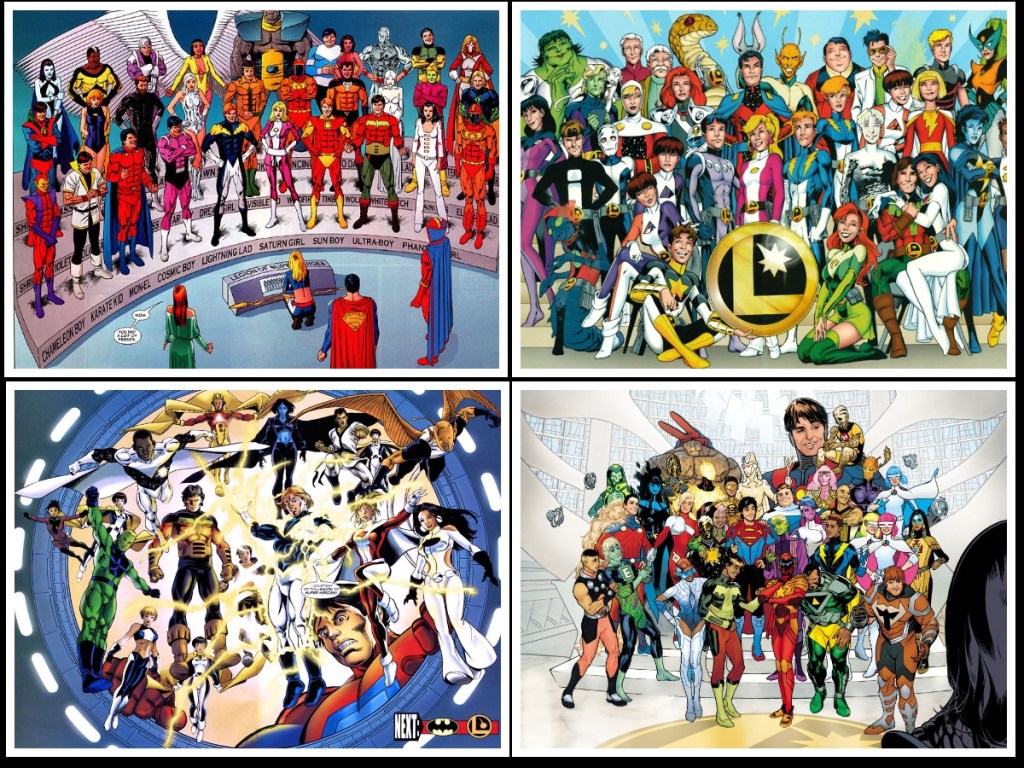
Let’s do a little history lesson, shall we? Who exactly ARE the Legion of Super-Heroes?
The Legion first appeared in Adventure Comics #247 back in 1958, in the time when the headliner for that anthology series was Superboy (Clark Kent as a boy). In their first appearance, Superboy meets three super-powered teenagers like himself: Cosmic Boy, with power over magnetism! Saturn Girl, with telepathic abilities! Lightning Lad, amazing in that he is the only founding member whose name makes his powers obvious! The three of them are from 1000 years in the future. They were inspired by the stories of the legendary Superboy to become heroes in their own time, and they’ve come back to the 20th century to invite him to join their club.

The story turned out to be a hit, and Superboy’s time travel adventures with the Legion became a recurring feature. Pretty soon, DC realized that a team with just four members could hardly be called a “Legion,” and they started adding more and more characters: the shapeshifting Chameleon Boy, giant Colossal Boy, teeny-tiny Shrinking Violet, and more! Triplicate Girl, Bouncing Boy, Matter-Eater Lad – no, I am not making up those last two – and then eventually even characters who didn’t feel the need to announce their gender identity as part of their name like Wildfire, Dawnstar, and Blok. Even the descendent of one of Superman’s greatest enemies, Brainiac 5, became a heroic mainstay of the Legion. They spun out into their own feature and were a huge success for DC.
Then came 1986. Comic fans will remember this as the year that DC rebooted Superman entirely, and among the things that they changed was his history in Smallville. In the new continuity, Clark Kent’s powers didn’t fully develop until adulthood, and he had no career as Superboy. How, then, could Superboy have been the inspiration for – let alone a member of – the Legion of Super-Heroes?

The answer came in a story where the Legion learned that the “Superboy” they knew was the inhabitant of a pocket universe created by their old enemy the Time Trapper, who had been playing a long con on them for the entirety of their existence. That Superboy, though, was still a hero through and through, and sacrificed his life to save the Legion from the Trapper. And the Legion continued.
But DC continuity started to get even more muddled, and in 1993 they decided to try to repair the timeline in their Zero Hour crossover, an effort to trim some of the more confusing contradictions in their history and make everything fit together. Although Zero Hour turned out to be a good story, I don’t know if anyone could claim it succeeded in making things easier to understand – Hawkman, for example, became more of a mess than ever. But in the case of the Legion, it was decided that the best way to clean things up was from a page-one reboot. The Legion started over from the beginning, this time without Superboy.

The history was wiped out and began anew. The characters – who had by now grown to adulthood – were teenagers again, and some of the names were “modernized.” (Lightning Lad became Live Wire, Colossal Boy became Leviathan, Matter-Eater Lad became…well, the team chef, with no superhero name, and so on.) This Legion again did pretty well for quite some time, and in fact, it’s the version that was dominant during my formative years, so it’s actually the one I remember most fondly. Eventually the current Superboy (Conner Kent, the one who spun out of the Reign of the Supermen storyline) would meet them and become a member.
Then in 2004, for reasons I’ve never quite understood, DC decided to reboot the Legion AGAIN. This “Threeboot” Legion, which was written by the aforementioned Mark Waid, again started from the ground-up. Waid brought back the more old-fashioned names, but this time it was a plot point. In this new continuity, galactic society had become stagnant and isolated. People kept to themselves and communicated mainly through electronics. (Waid was sadly prescient on that fact.)
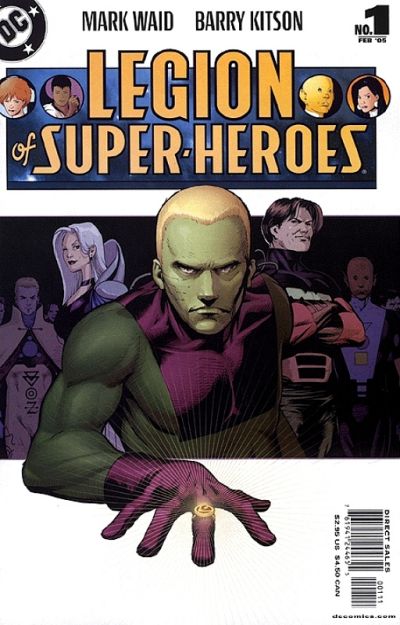
This Legion was a sort of teenage rebellion story, about young heroes rising up against a culture that tried to keep them apart from one another, using the historical records (aka comic books) of the 20th and 21st century as their inspiration, hence the old-school names. Eventually, through still more timey wimey stuff, Supergirl became a member. While I didn’t WANT a reboot, I thought Waid did a good job, and I enjoyed the new version as long as it lasted…which was right up until 2007, when all of a sudden, the ORIGINAL version of the Legion started popping up again in places like the Superman and Justice League comic books.
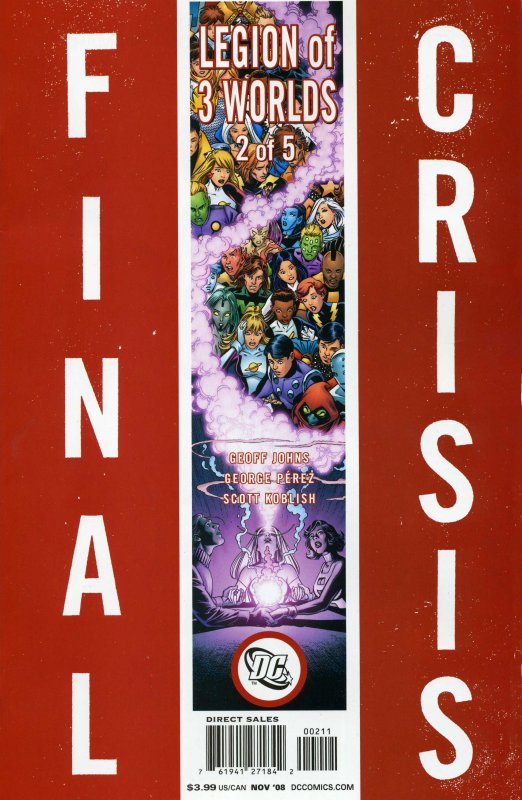
This eventually led to the Legion of Three Worlds miniseries by Geoff Johns and George Perez (which is technically a spinoff of the Final Crisis event, but can be read entirely independent of that larger story). This story revealed that each of the Legions was from a different world in the Multiverse – the original Legion, of which Clark Kent had been a member, was from the main DCU. Connor’s Reboot Legion was from a world that had been destroyed in one of the many, many crises that happen in DC Comics. Supergirl’s Legion – most interestingly of all – was actually from the distant future of Earth-Prime, ostensibly “our” universe, where all the stories of DC Comics are fictional. It turns out they misunderstood the ancient comic book stories and thought they were “real,” Galaxy Quest-style. I friggin’ love this miniseries. Aside from just being a great story, it also kind of “legitimized” all three Legions, and even when the Legion stories being told went back to focusing on the original, the other two were still “real.”
Then came the New 52 in 2011. :sigh: At this point, DC rebooted their ENTIRE universe, including the Legion. The newest version of the Legion (fourboot?) was pretty close to the original, although still perhaps a bit younger than they had been before their first reboot, and they were okay, but didn’t light the world on fire sales-wise. So in 2019 they decided to – you guessed it – reboot AGAIN.

This time Brian Michael Bendis took over, bringing in Superman’s son Jon Kent as a member. His was the wildest take on the Legion yet, making drastic changes and adding new characters alien to every previous version, such as a “Gold Lantern” and a future incarnation of Dr. Fate. Bendis’s Legion was…controversial. Many beloved characters were virtually unrecognizable, there was an uncomfortable emphasis on how everyone kept declaring that history would account Jon as the REAL Superman over his father. Perhaps most concerning of all, they turned popular member Mon-El into a Kryptonian descendant of Superman, which had never been the case in any previous continuity and didn’t really sit well with a lot of people.
Bendis’s Legion lasted only 12 issues, then a six-issue miniseries where they crossed over with the Justice League, and then they vanished. Since then, the Legion and its members have made only sporadic appearances, and there hasn’t really been a consistent version of “which” Legion showed up at any given time. But the fans, among whose number I enthusiastically include myself, want them back. The Legion may not have the largest fan base in comics, but I challenge you to find a more DEDICATED fan base. On average, I can’t think of a single character or IP in all of American comic books whose fans are more devoted than those of the Legion of Super-Heroes, so the fact that they’ve been sidelined for so long is really upsetting.
So how DO you bring the Legion back? What makes it work, as a property? What’s the core of the franchise that brings back the fans who are so, so dedicated? To a degree, I think the appeal of the Legion is similar to the appeal of Star Trek — it’s the promise of a better future, a hope that no matter how bad the world may seem at times, there will be days ahead where things aren’t quite so dark. What’s more, despite the fact that my formative era of the Legion is the Reboot era, which is the time that is least-connected to the Superman line, I still feel that the Legion is at its strongest with Superman at its core. It’s like the difference between your adult friends and the friends you grew up with. The Justice League are the friends Superman has as an adult, and you love those friends, but the Legion are the friends of his childhood, the ones who helped him become the man he would be. And that bond is unique, and irreproducible as an adult. One thing the 2006 animated Legion of Super-Heroes cartoon really got right was the notion that, although the Legion was inspired by the stories of Superman, it was joining them in their future that taught Clark Kent how to be a hero.
Whenever I see the Legion, that’s the dynamic that means the most to me.

Waid’s statement is particularly interesting in light of his own recently-announced project, a miniseries called The New History of the DCU. There was a History of the DC Universe miniseries back in the 80s, explaining how the timeline was changed in the wake of the original Crisis on Infinite Earths, but there have been so many reboots and changes since then that a new history is probably well overdue. I can’t think of anybody better to write it than Mark Waid. He’s not only one of the best superhero writers of all time, but he’s a walking encyclopedia of comic book history. He knows everything about everything, and if there’s ANYONE who can make sense of it all, it’s gotta be him. In fact, it was only in 2019 that he wrote the six-issue History of the Marvel Universe, doing the same job for DC’s favorite rival. He streamlined that universe and showed how everything fit in, including the future.
Presumably, this new series will do the same thing for DC. And if he goes so far as to show us the future, that means Waid knows what the new status quo is going to be for the Legion of Super-Heroes. As far as what exactly that means and how exactly that will take a form “embraced by everyone”… well, I have no idea. But I do have high hopes. Since DC’s “All In” initiative last year, I’ve been really happy with most of the stories in the DCU, and Waid has written some of the best, including Batman/Superman: World’s Finest and Justice League Unlimited, and he’s about to take over Action Comics full-time, something that has me thrilled.
No one is suggesting that Waid will be writing a new Legion series himself – in fact there are comments that suggest that he only KNOWS what the plan is, not that he’s directly involved. But if it has his approval, that gives me hope. Like I said, the Legion fans are the most dedicated in comics, and I believe that Waid is truly one of us. Whatever is coming down the pipe, if it’s good enough for him, I have every reason to believe it will be good enough for me.
Blake M. Petit is a writer, teacher, and dad from Ama, Louisiana. His most recent writing project is the superhero adventure series Other People’s Heroes: Little Stars, volume one of which is now available on Amazon. You can subscribe to his newsletter by clicking right here. He’s also started putting his LitReel videos on TikTok. He’s got his own idea for how to fix the Legion, but as usual, nobody asked him.
 Blake M. Petit