Despite the fact that it’s April already, I’ve only read a handful of novels so far this year. The reason for this, I should point out, is that I spent a good two months on a trio of absolute doorstoppers: first Stephen King’s It, followed by the first two books in Scott Sigler’s Crypt series, both of which are sizable in their own right. After these satisfying – but weighty – tomes, I wanted to tackle something quicker and lighter next. And the choice I made has me laughing in all the ways the writer did not intend.
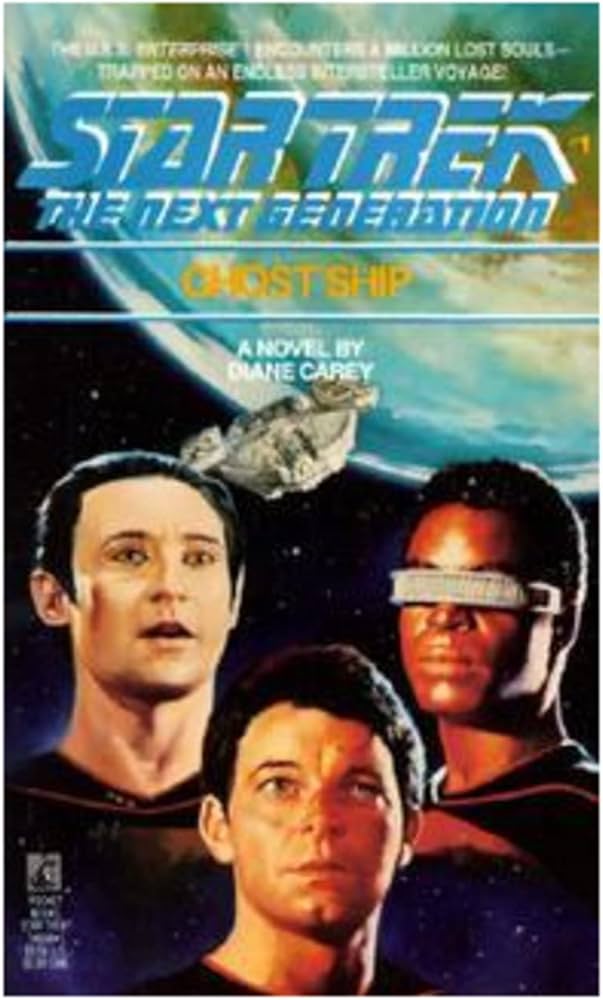
I’ve written before about “Extended Universes,” those non-canonical stories that are set in the fictional universes that we know and love. These are things like the comic book or novel series that spin out of popular movies and TV shows (Star Wars perhaps being the most famous of these), but it also works the other way around – movies and TV shows that adapt or spin out of comics and novels. Looking for a quick read, I decided to go old-school and enjoy the 1988 novel Ghost Ship by Diane Carey, a quaint little historical curiosity in that it was the first novel ever published based on the then-new TV series Star Trek: The Next Generation. And while I can’t necessarily blame Carey for the novel, holy CRAP, is this one a doozy.
The story – set during the first season of the TV show – regards an alien creature that absorbed the life-essences of the crew of a Soviet aircraft carrier 300 years earlier, and who is now endangering the Enterprise. Complicating the matter is that Deanna Troi, the ship’s empathic counselor, can sense the tortured spirits of the Russians inside the alien beast. It’s a perfectly reasonable sci-fi concept, the kind of stuff that we’ve seen in various Star Trek series several times. And it certainly isn’t Carey’s fault that the Soviet Union collapsed prior to 1995, when the sailors in her book were attacked by the alien. The book even tackles some heavy concepts like the nature of life and spirituality, with an interesting side-conversation about whether releasing the “essences” of the sailors from the beast would count as euthanizing them and, if so, if that would be morally acceptable.
But it’s really hard to take any of that seriously, because the characters in this novel are so far removed from those that we know from the TV series that it’s like reading about an entirely different crew. Captain Picard is stern, overbearing, foul-tempered, and expresses constant regret over the fact that he allowed Wesley Crusher to become an acting ensign. Data’s concerns about his own humanity (or lack thereof) are taken to a nearly pathological level. Troi calls William Riker “Bill.” Perhaps the most egregious line in the novel is a point where Riker glances at Tasha Yar and thinks that her soft features and wide eyes make her look like a “Disney drawing.”
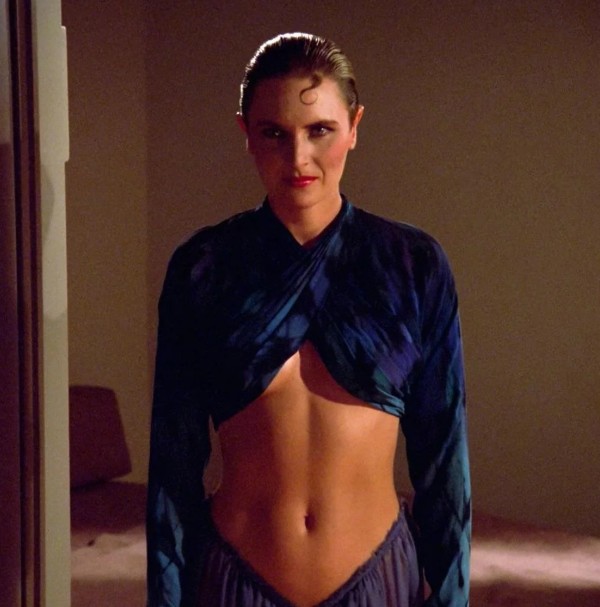
For people who love the TV show, the whole thing comes across as patently absurd. But again, I don’t think that this is necessarily Carey’s fault, but rather a consequence of the way that books like this are written…or at least, the way they were written back then. In order to get novels like this one in bookstores at the same time that the TV series made it to the airwaves, writers had to start working from early drafts of the screenplays. Even though Carey was telling an original story rather than adapting a specific episode, she had to base her characterizations and mannerisms on what was written in the series bible and early scripts. It’s likely that there were no episodes of the show available for her to watch yet as she wrote the book – hell, it’s possible that none had even been filmed yet. She had to make assumptions based on what she was given. But characters in an ongoing serial like a TV series change and evolve over time, especially in the early seasons. There would have been no way for her to know how they would wind up being played when she started working on this first book. Because of all this, Ghost Ship is even harder to reconcile with TV canon than many of the other novels, not because it blatantly contradicts any plot or world-building elements, but just because the characters are so unrecognizable.
This sort of thing tends to happen a lot when you’re creating extended universe material based on “official” works that aren’t finished yet. At least one early novel from the Star Trek: Voyager series, for example, refers to the holographic doctor on the ship as “Zimmerman.” People who know the canon of the series know that Zimmerman was the name of the doctor who programed the Emergency Medical Hologram and based its appearance on his own, but may NOT know that at one point in the planning stage of the series the plan was for the holographic doctor to adopt his “father’s” name. That plan was dropped in favor of a sort of running character arc about him trying to choose his own name, but eventually, even that went away and he just went by “The Doctor” for the entirety of the series.
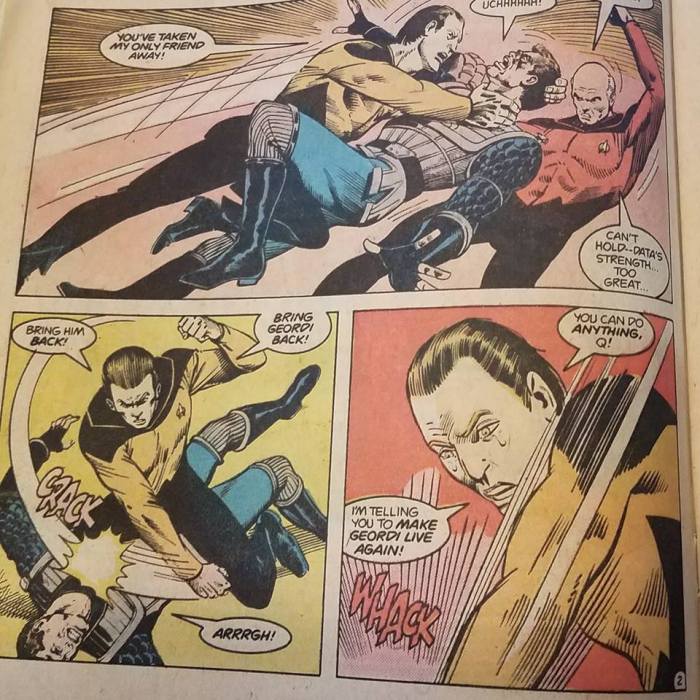
It also happens in comic book adaptations. DC released a Next Generation miniseries to coincide with the first season of the show, and it featured some wildly out-of-character moments. There’s a scene where Geordi LaForge is (mistakenly, of course) presumed to be killed by Q, and Data flies into a violent rage. Data. The character who is famously emotionless. Now I’ve always believed that even Season One Data isn’t TRULY emotionless – there’s just no way to reconcile a lot of the character beats with someone who genuinely has no emotions, let alone the fact that his dominant character trait is that he WANTS emotions. (Desire, itself, is an emotion, in case you don’t understand the contradiction.) I think it’s better to think of Data as somebody who does not UNDERSTAND his emotions or how to process them, and therefore mistakenly believes he does not have them at all. All that said, Data’s willingness to throw hands just simply does not jive with the character he was in Season One. Hell, it wouldn’t even match who he became by the last season of Star Trek: Picard.
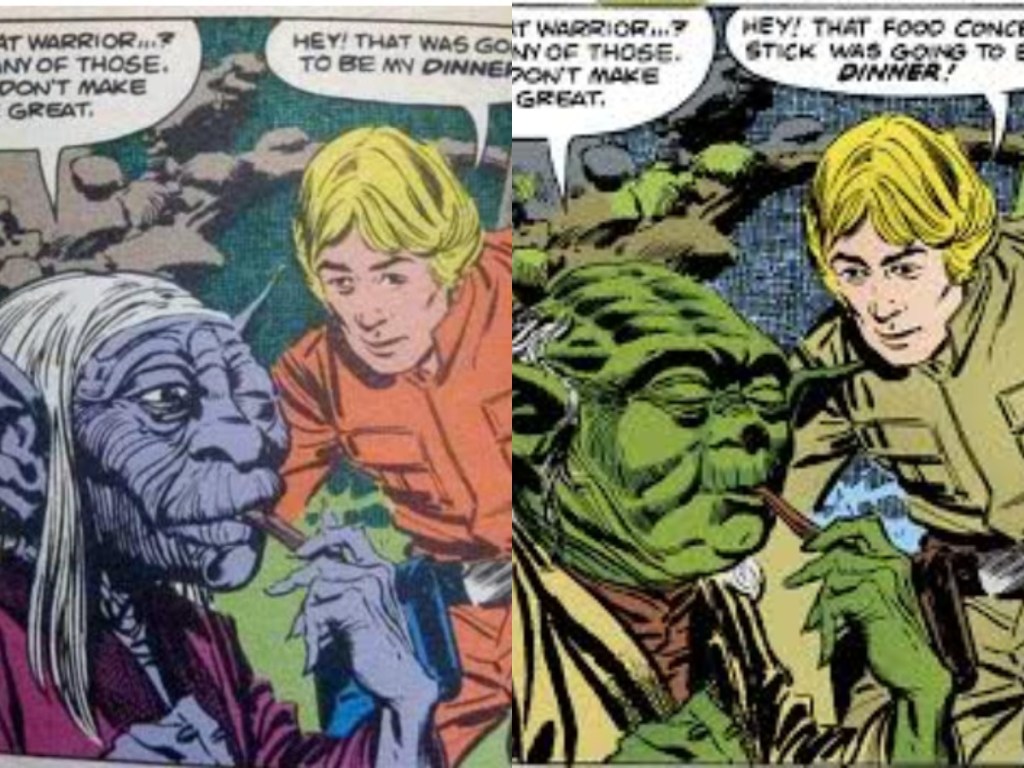
Sometimes, especially with comic books, the differences are visual. One of the most famous examples comes from the Marvel Comics adaptation of The Empire Strikes Back. After adapting the original Star Wars movie, Marvel continued the comic book as an ongoing series, which itself would cause several continuity snarls when the sequels came around, such as encounters with Darth Vader that don’t really make sense in later canon, or scenes that hinted at a romance blossoming between Luke Skywalker and Princess Leia that would later turn out to be particularly squicky for…obvious reasons. But one of the most hilarious of these changes is Yoda, whose first appearance was in Empire. When the Star Wars comic adapted that storyline, artists Al Williamson and Carlos Garzon either weren’t given a photo reference of Yoda to work from or the design of the puppet was changed later. I’m not sure which, but either way the result was a short little goblin with blue skin and long, flowing white hair, a far cry from the Yoda that fans who bought the comic book could see in the movie that was in theaters at the same time that the comic was being published. For later reprintings of the comic, Yoda was re-drawn to more closely match his cinematic appearance, but it’s not hard to find the original panels online for the sake of comparison and – let’s be honest here – mockery.
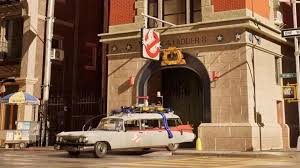
Movie novelizations are typically based on early drafts of the script, which can make it fun to read them and find things that were cut out of the film, then try to determine WHY they were left out. The Goonies novelization, for example, contains a long sequence in which the kids take a ride on a raft along an underground river, making it more plausible just how far away their final destination is from their point of origin. There are a lot of really good character moments in this scene, as the kids talk and discuss their various fears and anxieties, but you can totally understand why such a relatively slow sequence was never filmed for the lighthearted adventure film that the final Goonies became. Similarly, we all remember the scene in Ghostbusters in which Ray Stantz talks about having to mortgage his family home in order to afford the iconic Ghostbusters Firehouse. If you ever want to get into the intricacies of the Stantz family and just how he came to inherit the property in the first place, there’s a whole sequence in the novelization that details just that information, and it would have been boring as hell to relate on screen.
You don’t see as many of these adaptational oddities as you used to. The lead time for producing movies and TV shows gets ever longer, and not only are there fewer novelizations and comic book adaptations than there used to be, but there seems to be less of an urgency to get them onto the shelves at the same time as the movie or TV show is released. You still have tonal problems at times, of course. Last year David Newton released Welcome to Metropolis, a “prequel” novel to the new James Gunn Superman movie, and although it doesn’t have any glaring contradictions to the finished film, the characters and world just feel “off,” as though they were written by somebody who knew ABOUT the movie, but didn’t actually KNOW the movie.
Kinda like the Diane Carey novel that started this whole thing in the first place, actually.
But although I suppose having these books – when they happen – fit the canon a little better is TECHNICALLY a good thing, I kind of miss the days of wild inaccuracies and scenes where the cold, emotionless Data goes into a blind rage. It was weird, but it was also fun.
Blake M. Petit is a writer, teacher, and dad from Ama, Louisiana. His most recent writing project is the superhero adventure series Other People’s Heroes: Little Stars, volume one of which is now available on Amazon. He’s also started putting his LitReel videos on TikTok. After Ghost Ship, based on the recommendations of several friends, he has moved on to begin reading Dungeon Crawler Carl. You people are deranged.




 Blake M. Petit