Back home from our trip, it’s time to play catch up. I hit the local comic shop on Wednesday to grab a few weeks’ worth of comics, and I’m going to start week 26 by going over the Superman-related titles in the mix. Let’s see what we’ve got!

And as always, you can check out earlier blogs in the Year of Superman Archive!
Wed., June 25
Comics: Action Comics #1087, Supergirl Vol. 8 #2, Superman Vol. 6 #27, Superman Unlimited #2
Notes: The Mark Waid era of Action begins! I’ve been excited for this one ever since they announced he was taking over this title with a feature on Superboy. Ever since 1986, DC has gone back and forth several times over whether Clark Kent ever had a career as Superboy in-continuity. It looks like this series is going to finally settle the question once and for all…or at least until some new editor comes in and decides to change it again. But until then, I’m psyched to enjoy the ride.

Action Comics #1087 has Clark Kent – as an adult – reminiscing about an “Expo of Tomorrow” he attended with his parents when he was 15 years old, and how an encounter with a villain on that day would shape the rest of his life. Have we seen the story of Superman’s public debut before? Yes, dozens of times. Does that make me any less thrilled with the comic I just read? Not in the slightest.
Like I said, we’ve seen the story of SuperMAN’s debut over and over again. This is different. This is SuperBOY – a Superboy whose powers are new to him, who has never been in a fight before, and who’s wearing red converse sneakers instead of boots. He’s determined to do good, but at this embryonic stage he’s still trying to learn how. Fortunately, he’s got Jonathan and Martha Kent in his corner. Jonathan has taught him about the lost heroes of the Golden Age, drilled him relentlessly on their feats and adventures, so he could get a feeling for the heroic ideal. And when the time comes to prove himself…well, it doesn’t go as smoothly as it might go today, but it’s an authentic, entertaining, and uplifting story. Waid – who is also currently restructuring the timeline of the DC Universe in another miniseries I’ll get to shortly – is the perfect person to reintroduce the adventures of Superman when he was a boy.

Sophie Campbell’s Supergirl #2 picks up where the first issue left off – there’s a second Supergirl in Midvale who seems to have captured the hearts of the town. And I have to admit I was pretty tickled when I realized that the fake Supergirl was actually a new incarnation of Lesla-Lar, the Kryptonian doppelganger that we read about back in Supergirl Week. This time around, Lesla is a Kandorian with something of an obsession with Supergirl who convinces herself that she could do the job better than the genuine article. She finds a way out of Kandor, mesmerizes the Danvers, and transforms herself into a near-duplicate of Kara Zor-El (which is much better than her being just a random lookalike as in the Silver Age). Lesla also manages to tamper with Kara’s costume, causing her to turn to a friend for help: Lena Luthor.
I’m already loving this version of Supergirl. There’s a sweetness to the book, a sense of humor that more recent versions of Supergirl haven’t had. Campbell is also already doing the legwork of building up Kara’s supporting cast, and Lena makes for a fantastic addition. The two of them acknowledge that things have gone kind of sideways between Superman and Lex, but they don’t let it affect them – and in a genre where stupid misunderstandings are used to cause conflict more often than a comic gets variant covers, that’s a wonderful change of pace. Campbell’s Supergirl is already one of my most-anticipated books from DC each month.
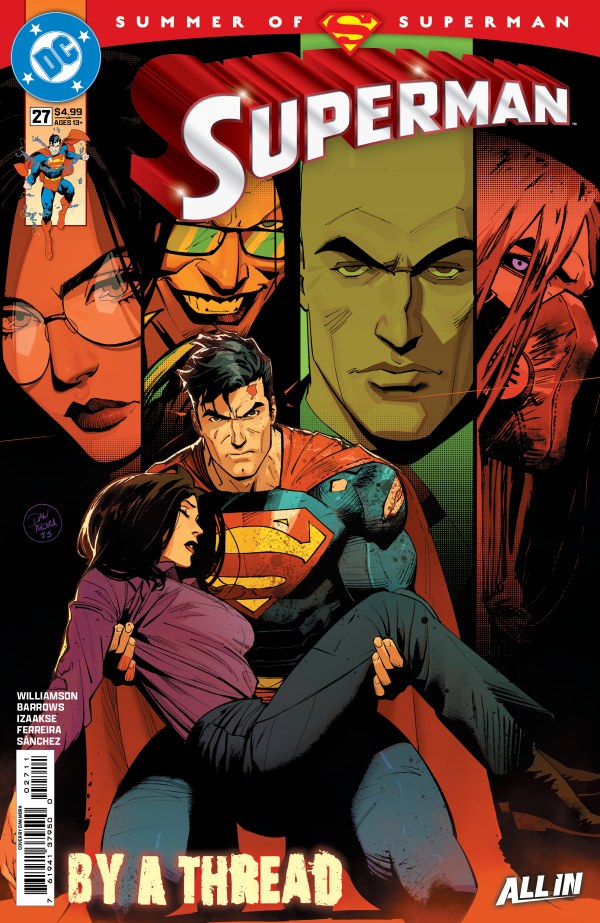
In Superman #27, Lois is still reeling from the loss of her Superwoman powers, while Superman is struggling with a sudden burst of Red Kryptonite energy. Meanwhile, Mercy and Lex have a heart-to-heart. This is kind of an odd issue – part two of “Superman Red” seems to be an epilogue of sorts. This issue, combined with the previous one, feels like it was intended to tie off some of the plotlines that have been running through this series since the first issue, clearing the table for next issue’s new storyline to dive headlong into the greater mystery of DC All In. That’s not necessarily a bad thing, but it does make the issue feel a little weak on its own.

Superman Unlimited #2 continues Dan Slott’s inaugural storyline. The enormous Kryptonite meteor that landed in the country of El Caldero has upended everything, making the tiny nation one of the most economically prosperous countries on Earth overnight. But black market Kryptonite is getting into the hands of villains everywhere, which I’m sure you can imagine causes some problems for the Man of Steel. Meanwhile, Lois is launching the new global Daily Planet initiative, and only one man seems to remember the fact that Kryptonite is NOT only harmful to Kryptonians – unfortunately that one man is Jack Ryder.
Slott is having a lot of fun with the pieces here. He finds a new angle on Superman’s little-used solar flare power, and in so doing manages to escalate the stakes of the Kryptonite storyline just a little (which is about all you want in chapter two of a storyline). I’m also glad that he hasn’t ignored the fact that Kryptonite is, in fact, radioactive. I don’t know that it’s necessarily public knowledge that it once gave Lex Luthor cancer, but that’s certainly the sort of thing that would become scuttlebutt and whispered rumors and make its way to a conspiracy theorist podcast, which seems to be how they’re casting Jack Ryder now. It’s a good fit, and it gives a good reason for the Creeper to show up at a crucial moment in the story that turns out to make things even more complicated.
The strange thing is that, although the consequences of this storyline are obviously global, Slott manages to give us a perspective that keeps things smaller. It’s mostly about Superman and how he deals with the problem, and while all the seeds are here to make this a story that can (and, logically, should) impact the entire DC Earth, he’s building to that instead of going to planet-wide societal upheaval right from the jump. There’s a build here that I appreciate, and it makes it even more exciting to anticipate the next issue.
Thur., June 26
Comics: Justice League Unlimited Vol. 2 #8, Batman/Superman: World’s Finest #40, New History of the DC Universe #1, DC X Sonic the Hedgehog #4

Notes: Continuing today with the recent releases, I’m kicking it off with Justice League Unlimited #8, the end of Mark Waid’s “We Are Yesterday” crossover. With Grodd having absorbed the Omega Energy of the late Darkseid and scattered the Justice League throughout time, Air Wave has done his best to compensate – bringing heroes from across the time stream to the present to aid them in their battle.
I don’t want to talk too much about what happens here – I hate spoilers, after all – but if you’re the kind of person who likes crazy superhero battles, this will be eminently satisfying to you. It’s an exciting book with gorgeous artwork and a genuinely surprising ending. I’ve got no idea where Waid is going with this, although its significance to the overall story arc that seems to be “DC All In” is abundantly clear. If you’re following what’s going on in the DC Universe, you really can’t afford not to be reading this book.

Waid is also doing his thing in Batman/Superman: World’s Finest #40. With “We Are Yesterday” over, this book settles back into its usual groove of telling stories of the World’s Finest heroes in the past. In this particular issue, Perry White and James Gordon are guests on a podcast together when a kaiju attacks, so Batman jumps into a giant robot he’s had prepared for just such an occasion and joins Superman in taking it down. And once again, friends, I would like to point out that occasionally this whole Year of Superman blog allows me to type sentences like the preceding, and that makes it all worth it.
I’ve got to be a little forgiving for the setup of this issue. The podcast in question is – like Jack Ryder’s show in Superman Unlimited – of the shock host variety. Jim Gordon is ostensibly there to defend Gotham from the hosts’s recent attacks, while Perry is there to defend print journalism, but that doesn’t really explain why they’re on the SAME episode, except to provide a (paper-thin) excuse to have Lois, Clark, and Bruce all in the same building when the giant monster shows up. But it still makes more sense than 90 percent of Silver Age contrivances, and the rest of the issue is a load of fun, so I give it a pass.

My Mark Waid triple feature continues with the first issue of New History of the DC Universe, a comic that is, frankly, a long time in coming. With reboots both hard and soft having plagued DC Comics for decades, I welcome an attempt at creating a definitive timeline, establishing which heroes and stories are canon to the current incarnation of the DCU. Now the pitfall of such a project is that canon only remains canon until the next person down the line decides to change it, but for now at least, I think we can accept this book as being THE history, and there’s no better person to write it than Mark Waid.
The series is framed as a history of the universe as compiled by Barry Allen, who has a better idea than most of just how time has been monkeyed with over the years. And while the connection to Superman actually doesn’t come in until literally the last panel of the last page, I felt like it deserved mention here in the blog, if for no other reason than how impressive it is that Waid and co-researcher Dave Wielgosz (who provides a remarkably detailed index at the end of the book) have crafted a timeline that works. There’s nothing here that doesn’t make sense, and Waid even takes the opportunity to canonize several characters whose existence in the current DCU may have been suspect, such as the original Red Tornado, the Alpha Centurion, and – strangely enough – Robin Hood. Yeah, that one. Pretty much the only thing he DIDN’T mention is Hugo Danner from Gladiator, who I mentioned a couple of weeks ago was the father of the Young All-Stars member Iron Munro (although Munro and the All-Stars DID merit inclusion).
Most shocking of all, however, is a panel that places into the timeline the arrival of a Terminian alien who crashes to Earth and is adopted by a human couple – on a plantation in the American south in the 1800s. This baby will grow up to be Milestone Comics’ Icon, a character I’m planning to cover in a later week where I discuss characters clearly intended to be the Superman of their respective universes. This is the first I’ve heard of any plans to put the Milestone characters back in the DC Universe proper, and I’m very interested to see if Static, Blood Syndicate and the others show up when we reach their respective point in the timeline in future issues.
At any rate, this book is essentially required reading for any fan of the DC Universe, and I can’t recommend it enough.

Last but not least, Ian Flynn wrote DC X Sonic the Hedgehog #4 (instead of Mark Waid), but he did a great job with it. Last issue focused on Team Sonic stuck on the DC Earth, while this issue gives us the reverse of that, with the Justice League trying to keep things from falling apart during Apokalips’ attack on Sonic’s world. There’s a particularly entertaining exchange between Superman and Dr. Robotnik that I really enjoyed. As I’ve said when I wrote about this book in the past, it’s nothing groundbreaking, but darned if it isn’t fun.
Fri., June 27
Movie: Superman Returns (2006)
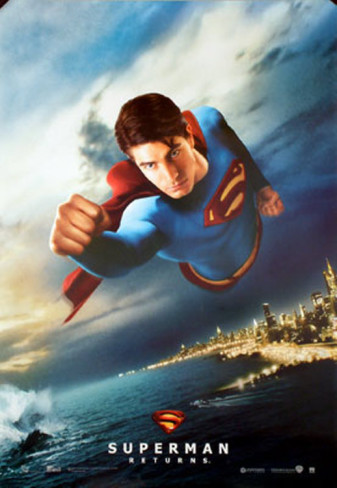
Notes: After a cinematic absence of many years, Warner Bros poached a filmmaker who had success making films with Marvel Comics characters and handed him the reigns of the Man of Steel in the hopes of evoking the feel of the Richard Donner era, bridging Superman back to greatness. There’s a sentence that’s as accurate today as it was in 2006, when Brian Singer directed Superman Returns. Unlike James Gunn’s Superman or Zack Snyder’s Man of Steel, Returns was a direct sequel to the Christopher Reeve films, or at least the first two of them. The conceit here was that, some time shortly after the events of the second film, astronomers located the former location of Krypton amongst the stars, and Superman went into space in hopes of finding his heritage. He found, instead, only rubble, and returned to Earth five years later to a world that had changed greatly in his absence.
This is one of those movies that was unfairly maligned in its day, although it’s also a movie that has grown dramatically in the estimation of the public since then. Brandon Routh did his best impression of Christopher Reeve, both as Superman and as Clark Kent, and created a character that both evoked and paid tribute to the hero so many of us had grown up with. And although Kevin Spacey has quite rightly been cancelled since the movie came out, it would be disingenuous not to admit that he did a magnificent job channeling Gene Hackman’s Lex Luthor.
Why, then, did this movie not land? There are a few reasons. I think the premise from which it begins is flawed in and of itself. It’s hard to imagine Superman abandoning Earth for such a long time, even in the name of seeking out Krypton. As much as this planet and its people mean to him, there’s no logical way he’d head out that way without some sort of concrete reason to. Looking at rubble isn’t good enough, and there’s nothing in the movie to indicate he was given ANY hope of finding something more substantial. To be fair, though, it’s possible that a more reasonable explanation was part of the story at some point but got filtered out by Hollywood’s classic “too many cooks” problem.
There are bigger problems in credulity when it comes to maintaining Clark Kent’s secret identity. There have always been jokes about how the glasses function as a disguise, but it’s even harder to imagine nobody – not even Lois Lane – would EVER question the fact that Clark went away at the same time that Superman left Earth then returned to the Planet at the same time that Superman returned to the…well… planet, with a lowercase “p.”
But the big elephant in the room is Jason White, Lois’s little boy whom everyone believes is the child of her fiancé, Richard White, even though it’s blindingly obvious to the viewer that he’s actually the son of Superman. I don’t object to Superman being a father – I think that’s pretty clear from the stuff I’ve written about Jon Kent in the comics – but I have to draw the line at the TIMING. If Jason is Clark’s son, he obviously had to be conceived before he left Earth, and yet nobody – not even Richard – seems to question Lois when she says he’s Richard’s kid. That would mean she would have to have been involved with him at the same time as she was with Superman (presumably their dalliance in Superman II). So why does everybody in this movie act as if Richard is hands-down Jason’s father? Even if Richard knows Jason’s not his, there’s a moment where he questions if Lois was ever in love with Superman, subtly implying he wants to know IF she ever hooked up with him. So who does HE think Jason’s father is? It just doesn’t piece together.
Of course, that leads me to the biggest problem I have with this movie: Kate Bosworth’s Lois Lane. I feel like I’ve made it profoundly clear how much I admire the character of Lois Lane when she’s written well – her intelligence, her integrity, her courage. Bosworth’s Lois doesn’t display ANY of that. There’s a softness to her that doesn’t belong to Lois Lane no matter how you slice it, and I never believe the chemistry between her and Routh.
All that said, the good in this movie outweighs the bad. Routh’s Clark Kent/Superman, Frank Langella’s Perry White, Sam Huntington’s Jimmy Olsen – all of them work. John Ottman’s score is a nice build on the classic John Williams themes. And there are some sequences in this movie that are legitimately stunning even 19 years later: the scene where Superman saves the plane (obviously inspired by John Byrne’s Man of Steel) is a total thrill ride throughout. Little moments, like when he gets shot in the eye and we see a close-up of the bullet crunching, or the scene where he holds up that famous green car from Action Comics #1 – all of that works for me, and works very, very well.

Despite its flaws, this movie and Brandon Routh deserved better than they got. A good sequel COULD have been made, even though Warner Bros. decided instead to go another way. I’m just glad that Routh got a shot at redemption during the Arrowverse’s Crisis on Infinite Earths event, where he showed off how good a Superman he was.
Comics: Metamorpho: The Element Man #6 (Guest Appearance), Zatanna Vol. 3 #5 (Cameo)
Sat., June 28
Graphic Novels: Superman: Emperor Joker (Collects Superman Vol. 2 #160-161, Adventures of Superman #582-583, Superman: The Man of Steel #104-105, Action Comics #769-770, and Superman: Emperor Joker #1), Superman: The Last Son (Collects Action Comics #844-846, 851, Annual #11)

Notes: Although my Superman On-The-Go week is over, there were a few graphic novels I downloaded but didn’t get around to, so I thought I would dip into those today. First off was Emperor Joker, a two-month event from the four Superman titles in 2000. Superman wakes up in a world that has gone mad: he is imprisoned in Arkham, his powers diminished, and Bizarro is the leader of a JLA made up of amplified versions of villains. He can’t remember how the world got this way, nor does he remember what the world was like before, but it’s clear that something is wrong. Lois Lane is a corporate CEO, Superman is a fugitive on the run, and Mr. Mxyzptlyk is trying desperately to find him.
I think it’s important to note that, although the storyline is known as “Emperor Joker” TODAY, that wasn’t the case when it first came out. The first four issues were published under the title “Superman: Arkham,” and the one-shot that comes in the middle (the fifth chapter of the story) was solicited as Superman: Emperor ?. This was back when things like the evil mastermind who has transformed the entire world were actually kept SECRET, instead of being published in Entertainment Weekly the day before the comic actually comes out. The reveal didn’t come until chapter four, when Mxyzptlk tells Superman that the world has been taken over by a godlike Joker. Turns out Mxy thought it would be fun to give the Joker a teeny bit of his own power – about 1 percent. But he didn’t reckon with the madman’s cunning, and Joker wound up taking 99 percent of Mxy’s fifth-dimensional abilities and reshaped the entire world in his own insane image. The real Justice Leaguers are pathetic creatures, hunted as villains, and only Mxy and Superman know what’s wrong. Superman manages to recruit this world’s versions of Superboy, Supergirl, and Steel to his cause, and they set out on a quest to find the one man who can defeat the Joker: Batman.
There’s good and bad in this story. It’s a nice change of pace, first of all, to put that much power in the Joker’s hands and have Superman have to deal with it. There’s also some meta-commentary in here about the power of faith and how it restores the changed heroes, as well as an interesting note about how the Joker’s obsession with Batman prevents him from eliminating his enemy entirely and, therefore, leaves the window open for his own defeat.
But there are some moments of disconnect in here as well. This was in the waning days of the “Triangle Era,” and by this point all of the creators who had made that a golden age for Superman fans were gone. This isn’t to say that any of the creative teams of the time (Jeph Loeb and Ed McGuinness on Superman, J.M. DeMatteis and Mike S. Miller on Adventures, Mark Schulz and Doug Mahnke on Man of Steel, and Joe Kelly and Kano on Action) weren’t doing good work, but there was a disconnect and it showed. This was especially evident in the artwork: things like Lois’s hairstyle and Steel’s armor varied wildly from issue to issue. It would be easy to dismiss this as just part of the Joker’s madness manifesting itself visually, but if that’s the case, it should happen constantly and be noted in-story rather than just flip when a new penciller takes over the next chapter.
It’s a good story, a story I remember enjoying when it was first published and I still enjoy now, but there are things that could have been better.

Next was Superman: The Last Son, a storyline from 2006. In this one, a spacecraft crashes in Metropolis and, inside, Superman finds a young boy who speaks Kryptonian. The child is initially sought out by the government (because duh), so Superman helps him escape into hiding and crafts a new identity for him – Christopher Kent, whom he tries to pass off as the child of a late cousin – and tries to convince Lois that they should adopt him. The point might become moot, however, when the child’s REAL parents arrive on Earth: General Zod and Ursa…and they want their son BACK.
Geoff Johns co-wrote this one with his former boss and mentor, a guy who’s somewhat familiar with Superman, director Richard Donner. This is probably most evident in the scenes where Superman consults the crystal with the memories of his late father, Jor-El. Artist Adam Kubert doesn’t go so far as to try to draw Jor-El to resemble Marlon Brando, but Johns and Donner absolutely write the character with Brando’s voice, with speech patterns and mannerisms that feel very on-mark for the version of Jor-El from the 1978 movie.
This is one of those stories that I find most interesting in retrospect. It was a great story (if unforgivably delayed at the time), but there are a few things established here that are kind of hilarious in perspective of how the characters would change a decade later. When Clark tells Lois he wants to adopt the Kryptonian boy, she objects. He’s too busy being Superman, she says, whereas she’s too busy being a reporter. Neither of them, in her opinion, are meant to be parents. There are also moments where both Ursa and Jor-El insist that Lois, as a human, could not conceive a child with a Kryptonian. All of them, of course, would turn out to be wrong, as the Convergence event in 2015 gave us Jon Kent. (In fairness, Superman had no powers when Jon was conceived, so Lois’s pregnancy seemed relatively normal. But still.)
This wasn’t the last story with Chris Kent – named, I should mention, in honor of the recently-departed Christopher Reeve. Like Jon, though, he’d turn up again later having aged and become a hero of his own. He’s back in the DCU these days, a kid again, but he now goes by his birth name of Lor-Zod and seems to be following his father in the family business (being evil), so it would seem that this story probably isn’t considered canon anymore. And that’s kind of too bad, because if you look at it from a certain angle you could see Lois’s experiences with Chris as changing her mind about motherhood, helping to shape her into the Supermom she would turn out to be. If nothing else, it’s cool to read a comic book that was shaped by Donner himself.
Comics: Justice League of America #27, DC Vs. Vampires: World War V #9 (Supergirl, Steel appearances)
Sun., June 29
Comics: The Superman Monster #1

“That’s ZOMBIES, Klaus.”
“Oh — um — FIRE BAAAAAAD…”
Notes: On a rainy Sunday afternoon, I scroll through the DC Universe app looking for today’s Superman reading and – for no particular reason – I decide to click open The Superman Monster. This is an Elseworlds one-shot from 1999, written by Dan Abnett and Andy Lanning with art by Anthony Williams. As you may have guessed from the cover art or the title, this is a mashup of Superman with Mary Shelley’s Frankenstein. This is a fun little combo for me – my favorite superhero and my favorite monster. Two great tastes that taste great together.
In 19th century Ingolstadt, we meet Vicktor Luthor, a man of science. Vicktor is engaged to the lovely Eloise Edge, but he carries a dark hunger within him, an urge – since the untimely passing of his parents – to find a way to conquer death. That path is opened up to him when he finds a mysterious metal shell in the woods, a craft from another world. Inside are the skeletal remains of its only passenger, along with a holographic message from someone called Jor-El, father of the vessel’s deceased inhabitant, carrying with it the knowledge of an alien world. Luthor uses the alien remains and alien knowledge to bring to life a creature – a being of immense power, but who quickly spins out of Luthor’s control.
I’m a teacher (I may have mentioned that once or twice), and my honors seniors study Mary Shelley’s Frankenstein every year, so I have more than a passing knowledge with the book, which is really quite different from the Boris Karloff movie that most people think of when they think of the Frankenstein Monster. I’m surprised, then, to see just how good an adaptation of the novel this comic book actually is. Oh, obviously it’s not an exact 1-to-1 adaptation. There are no aliens or holograms in Shelley’s novel, for instance. But the comic actually brings in a lot of the little moments from the book that adaptations often leave out. The kindly family in the woods that the creature tries to find shelter with become the kindly older couple the Kants, mourning the loss of their son Klaus, who take the creature in. (It’s a happier relationship here than in the novel, but the ending is no less tragic.) Eloise becomes a substitute for the Bride of Frankenstein, who is built but never brought to life in the book. In truth, Shelley’s themes mesh together with the Superman legend surprisingly well.
Then there are the odd moments, things that feel like a DC editorial mandate. The hologram that Luthor finds, for instance, is Jor-El wearing the clothing of the John Byrne era. Sure, that was the style of Jor-El in the comics at the time, but this is an Elseworlds – we’ve changed the inhabitants of Metropolis to German villagers in the 19th century and Superman into a walking corpse, but redesigning Jor-El was verboten for some reason. While the artwork throughout it pretty strong, little things like that take me out of it just a little bit. You don’t see stuff like that these days – look at a modern story like Dark Knights of Steel and there’s no attempt to adhere to current designs, nor should there be.
This is the kind of thing that really sets DC’s Elseworlds apart from Marvel’s What If? series, at least back then. Whereas the What If? stories traditionally used the main Marvel Universe as a starting point and then spun out an alternate history, Elseworlds could (and usually did) posit a story that never could have happened in the comics and followed them to a conclusion. These days, the two franchises have kind of moved closer together, where either can be used for either type of story, but for 1999 this was a quintessential Elseworlds yarn. It’s not so far off the mark that you can’t recognize Superman for what he is, but at the same time, it’s a take from a different angle, a fun sort of combination with a different story, not unlike Superman’s Metropolis, Batman: Nosferatu, or Green Lantern: 1,001 Emerald Nights. It’s too bad, with all the other Elseworlds characters that have cropped up in the Multiverse, that we haven’t seen the Superman Monster again.
I own this book, so I’m sure I’ve read it before, but it’s been long enough that I forgot most of it. I’m glad I read it again, but if I’m being honest, I kind of wish that I’d held off until October and worked it into some Super Halloween reading. Ah well, I’m sure I’ll find other seasonally appropriate stories when the time comes.
Mon. June 30
TV Special: Superman’s 50th Anniversary: A Celebration of the Man of Steel
Notes: With the movie (THE movie) coming out next week, I’ve got a list of very specific things I’m going to hit in the week preceding it…but I’m a bit aimless as to how to finish up THIS week. Not quite feeling like hitting the DC app this morning, I decided to scroll through my list of things to watch, and more or less randomly decided to go to YouTube, where I’ve found the 1988 CBS television special Superman’s 50th Anniversary: A Celebration of the Man of Steel. Sorry to all the Kate and Allie and Designing Women fans – the special makes it clear at the beginning that those shows won’t be airing tonight, but they’ll be back next week.
This special, celebrating Superman’s 50th, starts with a narrator telling us Superman’s origin overlaid on footage from the original Superman movie serial from 1948 – until the planet explodes and we shift to the 1978 Richard Donner/Christopher Reeve movie. Apparently, in the universe of this special, Krypton is in black and white, whereas Earth is in color. Then we meet Dana Carvey, “Chief Historian of the Junior Supermen of America,” who promises to explore Superman’s history and interview some of the people who know him best: “The Metropolotians.”
Oh man – this whole special is gonna be a bit, isn’t it?
In fact, it turns out to be far more schizophrenic than that. The special is a bit of a history, using clips from pretty much every incarnation of the character at this point (Kirk Alyn, George Reeves, Christopher Reeve, and the Fleischer cartoons). And some of the narration is actually on-point – in a discussion of Superman’s powers, for instance, Dana Carvey mentions how Superman couldn’t actually fly in the early days, but instead jumped from place to place before he developed into – and I quote – “the Nijinsky of the air.”
We get interviews with people involved with Superman, like Christopher Reeve, but then it bounces to comedians in-character. Fred Willard, for instance, plays the Deputy Mayor of Metropolis desperately trying to emphasize that there are things in the city beyond JUST Superman – museums, for example. The Amazing Kreskin talks about how his powers are different than Superman’s. Hal Holbrook shows up in a (rather unimpressive) Superman costume preparing for his one-man show about Superman’s life, an apparent follow-up to his one-man show about Mark Twain. The golden moment here is Noel Neill appearing as Lois’s mother, Ella Lane, describing how she’s tried to talk her daughter out of chasing that Superman because he’s just never going to settle down. Then just seconds later, the goodwill is thrown out in a groan-inducing interview with Jan Hooks as a woman who claimed to have a fling with Superman and whose “hybrid” child is half-Superman. “He’s got X-Ray vision, but only in one eye, so he gets terrible headaches.”
I guess that’s supposed to be funny?
The special was produced by Lorne Michaels of Saturday Night Live, which is no doubt why so many SNL cast members past and present appear…but it doesn’t seem to know what it wants to BE. Is this a celebration of Superman or a parody? A sketch show or a documentary? It tries to be both, but it CAN’T.
There are some nice moments, though – a brief interview with Kirk Alyn where he talks about how much he loved playing Superman and how proud he was to be the FIRST Superman on screen. Jack Larson, the Jimmy Olsen from the George Reeves series, similarly gives a brief but sweet interview. John Byrne also gets an interview where he discusses how Siegel and Shuster pulled the character together and sold him to DC Comics – again, it’s a good moment, but far too short.
There is, however, one moment that makes watching the entire special worthwhile for me: RALPH NADER. Remember back in “Super-Sponsor Week,” when I took to YouTube to find different Superman-related commercials, and I found a bit with Ralph Nader doing a sort of public service announcement warning people only to buy their Kryptonite from a legitimate dealer? I had no idea where that commercial came from or why it exists. So I hope you can imagine just how excited I was when it showed up as PART OF THIS SPECIAL. The mystery is solved. I can finally get a decent night’s sleep again.
I’m not sure how I feel about this special, honestly. They tried to do a real dip into Superman’s history at some moments, which kind of undermine the in-universe comedy bits. The comedy bits, on the other hand, make the real world segments feel entirely out of place. I wish they had picked one path to take and stuck with it rather than this halfhearted attempt to have their cake and eat it too.
TV Episode: Super Mega Cakes Season 1, Episode 1: “Superman.”

Notes: True confession time. I like TV baking shows, and when I saw the ad for this new one — Super Mega Cakes — scroll across my screen at some point, I realized I would have to watch at least the first episode. Celebrity baker Duff Goldman and his team is tasked with competing against six teams of non-celebrity bakers, baking six mega cakes in battle at the same time. And because this is a Food Network show and therefore part of the Warner Bros/Discovery umbrella, at least for the next five minutes, some of the themes are connected to specific IP. One baker’s theme is Classic Cartoons (with the Looney Tunes and Tom and Jerry specifically shown). Another gets an “ocean predators” theme, and I just BETCHA that episode will be airing during Shark Week. But for the first episode, the one that I’m talking about today, the pitch is Superman-themed cakes.
The Superman battle pits Duff against baker Elizabeth Rowe, who decides to base her design on a scene in the trailer for the new movie (did I mention there was a new movie coming out?) in which a Kaiju attacks the Daily Planet office. Part of the requirements for the cake is that there has to be an animated element, so Rowe decides to have Clark, mid-change to Superman, turn his heat vision on the monster (although Rowe and her team constantly refer to his power as “laser eyes,” and part of me is rooting for her to lose just because of that). She’ll also have Lois brandishing a fire extinguisher, which is a cute touch. The final requirement that was mentioned is that the flavor of the cake has to be inspired by the theme, so Rowe decides to do a peanut butter filling because “Superman loves peanut butter.”
You know what? Superman used to SELL peanut butter, so I’m gonna allow that.
Team Duff, on the other hand, plans a three-foot tall Superman figure bursting out of the Fortress of Solitude made out of ice. Superman will be accompanied by Krypto, because Krypto is also in the new movie. (DID YOU KNOW THERE’S GOING TO BE A MOVIE?) But when Duff’s partner Ralph sees just how big Elizabeth’s kaiju is shaping up to be, he upscales the figures of Clark and Krypto to life-size. Duff’s tasting element is rhubarb jam, because Clark loves Martha’s rhubarb pie. (My wife: “Y’all nerds know way too much about this man.”) For his animated element, Supercake is going to use his (correctly-named) heat vision to carve an S-shield in the ice.
I’m not going to go into a blow-by-blow of the whole episode. If you like these kinds of shows, you probably know how it goes – we watch the cake artists at work, we see them overcome unexpected obstacles, there’s a confessional segment where they tell about some sort of personal hardship that makes you want to root for them DESPITE the fact that they keep calling it “laser vision,” the music gets super-duper intense just before the timer runs out and then, BAM! There’s a ridiculously impressive cake. And I gotta tell ya, the cakes DO look amazing.
Damn. Now I want cake.
Comics: DC Vs. Vampires: World War Z #10 (Appearance by Supergirl, Lois Lane)
Tues., July 1
Comics: Adventure Comics #346-347
Notes: Once again, I find myself faced with the sad duty of eulogizing someone here in the Year of Superman blog, as yesterday afternoon we were told of the passing of Jim Shooter at the age of 73. Shooter was perhaps one of the most remarkable comic creators of all time – certainly possessing the most unique history. At the age of 13, he submitted a story to DC Comics featuring what he considered, at the time, one of DC’s weakest properties: the Legion of Super-Heroes. Not only did editor Mort Weisinger buy the story from Shooter, but at the age of 14 he was hired as the regular writer for the Legion’s tales in Adventure Comics. Shooter would go on to write other comics for DC, including – among many others – the very first ever race between Superman and the Flash from Superman #199. He wrote a variety of comics for DC, many of them part of the Superman family, for about a decade before he bounced over to Marvel Comics. There he eventually rose to the position of Editor-In-Chief, spearheading Marvel’s New Universe line and writing their first major crossover event, Marvel Super-Heroes Secret Wars. After leaving Marvel, Shooter founded Valiant Comics, as well as other enterprises that perhaps are not remembered as well.
Although sometimes a controversial figure (word has it that he wasn’t always the easiest editor to work with), Shooter is one of those figures whose stamp on the comic book landscape is undeniable. Both as a writer and an editor, he is responsible for some of the most significant and memorable stories and characters in comic book history.
So to commemorate him, I decided today to go back and read a story I didn’t get to back in Legion of Super-Heroes week: his first ever Legion story, a two-parter from Adventure Comics #346 and #347 – a story written by a 13-year-old boy. (Take THAT, 17-year-old Mary Shelley creating Frankenstein.)

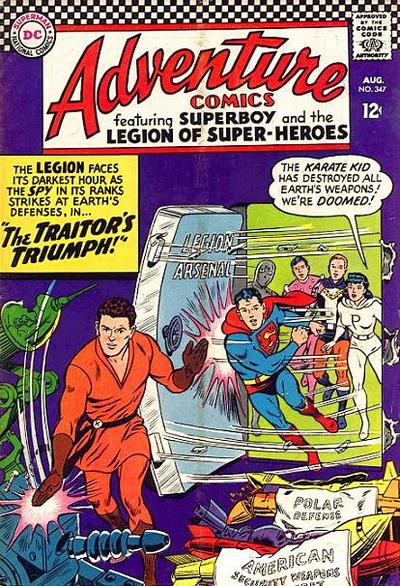
In the shockingly-titled “One of Us is a Traitor” Superboy, serving as interim leader, introduces four new young heroes all vying for Legion membership. Princess Projectra has the power to cast illusions! Nemesis Kid has a strange “alchemical” power that allows him to defend himself and defeat any foe! Ferro Lad can transform into living iron! And Karate Kid’s skill at Martial Arts is ALMOST enough to allow him to defeat Superboy! All four are unanimously accepted as members of the Legion.
Before the Legion has even had a chance to welcome their newbies, though, a new threat rears its head: Garlak, warlord of the distant world of Khund, is threatening to invade Earth if the planet doesn’t surrender in one hour. And just in case Superboy gets any smart ideas, he warns them, he has a healthy supply of Kryptonite weapons. Superboy splits the Legion into three teams to protect Earth’s three defense towers, but in private, Garlak gloats that he’s already slipped a spy into the Legion ranks to guarantee his success. And in fact, when the first of the defense towers is attacked, Phantom Girl is left questioning Karate Kid’s loyalty to the team when he sends her away at a critical moment and the first of Earth’s three defense towers is destroyed.
In part two of the story, Superboy leads an air-squad to defend the second tower, but their Kryptonite weapons weaken him and the tower is lost. Checking on the Legionnaires who were supposed to defend it on the ground, they find their teammates unconscious, temporarily incapacitated by a gas attack, with one person missing – Karate Kid. Racing to Legion HQ, they find Karate Kid standing over the wreckage of the Legion’s arsenal, but when Superboy shouts out, “All right, Kid! The game’s up!” it is not Karate Kid who steps out to confess, but Nemesis Kid. He’s already signaled the Khund to attack, and plans to be richly rewarded as Earth perishes. But Superboy isn’t without his own tricks – he reveals a secret fourth defense tower that helps fend off the Khund as the Legion takes the fight to their spacecraft. Karate Kid proves his worth by singlehandedly capturing the Khund leader, but Nemesis Kid’s powers allow him to teleport away, and Superboy is left wondering if they’ll ever see him again.
First off, if you didn’t already know, there’s no way in hell you would EVER guess this story was written by a 13-year-old. Not only does it fit with the style of the other DC Comics of the 60s, it’s BETTER than most of them – a more intense story, sharper characterization, and while Karate Kid is obviously a red herring from the beginning, most red herrings at this time were obvious. The only knock I could give this story is the kind of lame way that Nemesis Kid reveals himself: “Oh, Superboy said ‘Kid.’ He must be talking to me and not the guy who’s literally standing over the destroyed arsenal, whose name also happens to have ‘Kid’ in it. Better give myself up.” But even THAT isn’t any lamer than most other stories of the time, and I can easily give it a pass.
What’s more, in his first story, Shooter has contributed SEVERAL lasting elements to the Legion of Super-Heroes: Projectra and Karate Kid would go on to have long, storied careers with the Legion (to date, Karate Kid and Mon-El, using the name Valor, are the only Legionnaires to ever get their own ongoing comic book series). Ferro Lad’s time as a Legionnaire was cut tragically short, but as the first Legionnaire to die (and stay dead) in battle, he left an indelible mark on the franchise. Kind of like Tasha Yar on Star Trek: The Next Generation, Ferro Lad turned out to be more important in death than it was in life. And even the bad guys from this story, the Khunds, would go on to be long-time alien antagonists not only for the Legion, but even in the DC comics set in the present day, although it should be noted that the Khunds would change to a more alien-like appearance, whereas in this story Shooter and artist Sheldon Moldoff (working off Shooter’s thumbnail sketches, no less!) kind of made Garlak look like Attila the Hun in space.
Not a bad first day on the job for someone whose contemporaries made their money delivering newspapers.
Thank you, Mr. Shooter from the hearts of the fans of the Legion. And Superman. And major crossover events. And the Valiant Comics characters. Let’s face it, you had your hand in everything, and we’re all better for having your work in comics.
Blake M. Petit is a writer, teacher, and dad from Ama, Louisiana. His most recent writing project is the superhero adventure series Other People’s Heroes: Little Stars, volume one of which is now available on Amazon. You can subscribe to his newsletter by clicking right here. You can join in the Kryptonian Konversation every day in the Year of Superman Facebook Group!
 Blake M. Petit