Geek Punditry #55: Terry, the Turtle, and a World Full of Magic

Stephen King’s Dark Tower series, as I’ve mentioned many times, is one of my favorite stories ever written. King is often thought of as a horror novelist, and he is, but The Dark Tower is more of a fantasy series, encompassing multiple worlds, wizards, magic artifacts, and a cowboy. And it was because of my love for his series that I was interested in Robert Silverberg’s Legends anthology when it was released way back in 1998. In this anthology, several popular writers were invited to contribute a novella set in their most famous fantasy universe. King contributed The Little Sisters of Eluria, a prequel that told a story about Roland of Gilead in the early years of his quest. There were other writers involved, of course, some I was familiar with and others I wasn’t. I loved Orson Scott Card’s sci-fi novel Ender’s Game, but I hadn’t read any of his Tales of Alvin Maker before. I’d heard of The Wheel of Time, but I’d never touched on Robert Jordan. And while the name George R.R. Martin was totally unfamiliar to me, I rather liked The Hedge Knight, the prequel to something called Game of Thrones, and I thought I would have to check it out some time.

I can’t help but think that, were this published today, Raymond E. Feist would be bumped off the cover to make room for that Martin fella.

But of the new (to me) writers that I discovered via the Legends anthology, none resonated so clearly as the unique and inimitable voice of Terry Pratchett. In The Sea and Little Fishes, a group of witches tried to dissuade a force of nature named Granny Weatherwax from participating in their annual “witch trials” because everyone was tired of losing to her. The concept was far sillier than the other books in the anthology. As it turned out, it was more memorable too. 

The Sea and Little Fishes, I learned, belonged to Pratchett’s Discworld series, and over the next few years, I would find myself drawn to the Disc time and time again. The Discworld is exactly what it sounds like: a planet that’s actually flat, carried through the endless expanse of space upon the backs of four enormous elephants, which in turn stand upon the back of a gargantuan turtle, the Great A’Tuin, that drifts through the cosmos. On Discworld, magic is so plentiful as to be almost a tangible element, and is far more dangerous because of that. The Discworld is what you get when you line up every fantasy universe, mythology, and religion in existence, break them with a hammer, and don’t pay attention to what you’re doing when you’re putting the pieces back together. It is an absolute delight.

This is the world as Kyrie Irving imagines it.

After reading the installment from Legends, Pratchett’s name stood out to me, and I kept it in mind the next time I went to the mall (kids, ask your parents) and rushed down to B. Dalton Bookseller (kids, ask your parents). When I went to the fantasy section, I was taken aback to realize that there were over a dozen Discworld novels, and I had no idea where to begin. Remember, this was 1998, and we didn’t all have a device in our pockets that we can use to access the full totality of human knowledge but instead use to watch stupid videos of morons doing a “spontaneous” dance routine in a grocery store. Unsure of where to start, I picked the book that looked most appealing. It was nearly Christmas at the time, the novel was called Hogfather, and the cover had red and white stripes and a guy in a sleigh. It was worth a shot.
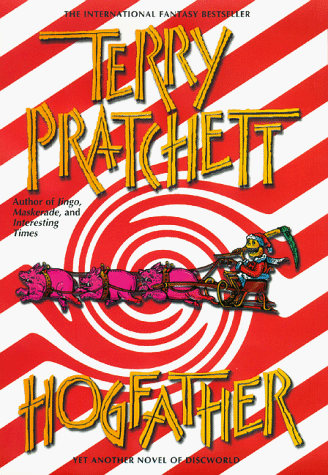
HO. HO. HO.

I mentioned Hogfather here last month, calling the TV adaptation one of the best fantasy Christmas movies there is. What I had no way of knowing was that Hogfather was totally the wrong book to begin my Discworld journey. The story was about the Hogfather (Fantasy Santa Claus) getting murdered by a guy named Teatime and replaced by Death himself (HUH?), while Death’s granddaughter (DOUBLE HUH?) Susan (QUADRUPLE HUH?) tries to solve the mystery of what happened to the ol’ fat man. I would learn later that this was actually the twentieth book in the Discworld series and the fourth in which Death was one of the principal characters. It was insane. It was confusing. I had no idea what was going on.

And yet, I loved every page.

Terry Pratchett had a gift for words, a way of turning a phrase that no other writer in my experience can match. Hogfather, for instance, included the following exchange when Death tried to leave a small child a weapon as a present:

‘You can’t give her that!’ she screamed. ‘It’s not safe!’
IT’S A SWORD, said the Hogfather. THEY’RE NOT MEANT TO BE SAFE.
‘She’s a child!’ shouted Crumley.
IT’S EDUCATIONAL.
‘What if she cuts herself?’
THAT WILL BE AN IMPORTANT LESSON.

See? Genius.

Other bon mots that Pratchett provided us with over the years include “Multiple exclamation marks are a sure sign of a diseased mind,” “That just goes to show that you never know, although what it is we never know I suspect we’ll never know,” and “A good bookshop is just a genteel Black Hole that knows how to read.” The man painted with words the way Van Gogh used colors, and his paintings were no less elaborate. 

I learned, eventually, that while it was true that Hogfather was the wrong book to begin reading Discworld, it’s also true that EVERY book is the wrong book to begin reading Discworld. The entire universe – which expanded to a full 41 books by the time Pratchett died in 2015 – is an enormous, brilliant, glorious mess of time and space and trolls and vampires and witches and wizards and monsters and a set of luggage that runs behind its owner on hundreds of tiny little legs. There is absolutely no correct order to read these books in, and you’re just as well off throwing a dart in the fantasy section as you would be attempting to read the books in publication order.

This image is different every time you look at it.

When I first began to wade into the Discworld books, my immediate response was to compare them to the works of Douglas Adams, writer of the Hitchhiker’s Guide to the Galaxy series. It was a fair enough comparison – they were both British authors, they both used a sort of parody of a traditional genre universe as a setting for satire, and they seemed to have a lot of overlap in their senses of humor. It also didn’t hurt that Adams was the only other British humorist I was familiar with in those days, having devoured all of the Hitchhiker’s books time and again. In fact, in conversation it was not uncommon for me to describe Discworld as the fantasy equivalent of Hitchhiker’s Guide.

As I got older and read deeper into Pratchett’s catalog, though, that comparison felt less and less apt. The truth was – much as it would pain high school Blake to hear this – Pratchett’s work outpaces Adams in a lot of ways. And one of the biggest reasons for that, I believe, is that Pratchett branched out, whereas Adams did not. In the Hitchhiker’s series, Adams stuck pretty closely to the adventures of Arthur Dent and the assorted weirdos who came into his orbit. (The only Adams-penned Hitchhiker’s story I’m aware of in which Arthur is not the central character is the short story “Young Zaphod Plays it Safe,” although I’m sure someone will correct me if there are others.) And after a while, it became clear that Adams was getting kind of tired of it. The first two books in the series were essentially adaptations of Adams’s radio drama of the same name upon which the series was based. The third book – as I would learn many years later – was a reworking of one of his scripts for Doctor Who that had not been produced. Book four was pretty good, with a more personal story for Arthur that brought him to a kind, sweet conclusion, and then came a fifth book that undid Arthur’s happy ending in the same sense that an 18-wheeler barrelling down the highway will “undo” a tower of playing cards that someone inconveniently left out in the middle of the road. Adams was a cynical person, and a certain bitterness crept into that last book in a way that ended the series on an unsatisfying note. Even Adams himself wasn’t satisfied with it and was planning a sixth book when he passed away, which is really the only reason I accept Eoin Colfer’s follow-up, And Another Thing…, as series canon.

(This, by the way, will not happen to Pratchett. Upon his death his daughter – as per his request – took his hard drive full of his notes and unfinished stories and had it crushed by a steamroller to make sure no one else could continue his work. No, really. So that’s it for new Discworld stuff, at least until the far future when it comes face to face with our old pal Public Domain.)

Most writers only think about using one of these on the critics.

But back to Pratchett. Whereas Adams seemed to get bored with his creation, stagnating with Arthur Dent and company despite having all of time and space to play with, Pratchett realized by book three that he should take advantage of his entire sandbox. After two books about the wizard Rincewind, the third novel in the series, Equal Rites, was an adventure of Granny Weatherwax, she who would later turn up in the novella that introduced me to Pratchett in the first place. This was followed by Mort, the first story where Death was a main character, although he’d appeared in the others. Over the course of the 41 books, Pratchett developed at least seven different subsets of characters that he would follow from time to time, as well as devoting several novels to one-off characters and storylines. And while these various subsets could and did cross over and interact, there were so many of them that it would have been impossible to grow bored. Unlike the Hitchhiker’s series, there is no one single “main character” in the Discworld, and that’s all to the good. 

In fact, the only character that I think even appears in every novel is Death, and I’m not even 100 percent sure about that. You see, I haven’t read all the books yet. I’ve gotten through roughly half of them. It’s a common problem of mine – when I get into something I really like I try to read (or watch or whatever) everything that’s available, but it’s only a matter of time before I come across something ELSE I really like, and now I’ve got TWO series I’m trying to keep up with, and then I discover another author, and then there’s a new book in a series that I thought was over ten years ago, and before you know it, there’s so many things I haven’t read that I’m never going to finish before I go off to follow Pratchett to the land beyond the Disc. Regular book readers know exactly what I’m talking about, but in case anyone thinks I’m exaggerating, I actually keep a spreadsheet of what series and authors I am currently reading and what books I haven’t gotten to yet. At the moment I am alternating between going through all of the Discworld novels, all of Rick Riordan’s Percy Jackson universe, Scott Sigler’s Galactic Football League and assorted spinoffs, every official Oz novel, every UNofficial Oz novel, Orson Scott Card’s Enderverse, the Wild Card novels, the various series that connect to Isaac Asimov’s Foundation series, approximately 4000 Star Trek books, and the complete works of Stephen King. Fans of George R.R. Martin don’t realize how lucky they are. Sure, you may never finish the series, but that’s gonna be GEORGE’S fault, not because YOU were poor at managing your time. 

If I’ve got any shot at finishing my reading list this year, this is going to have to be June.

But Sir Terry (given the Order of the British Empire in 1998, the same year I discovered him, although admittedly, this was probably a coincidence) deserves all of the attention. He was a genius, he was an artist, and he’s probably the funniest British human being to never be a member of Monty Python. So it’s time I buckle down and finish my trip across the Disc.

The good news is, that just got a little bit easier. You may be familiar with Humblebundle, the online retailer that offers digital packages of books, games, and software at a massive markdown with some of the money earmarked for assorted charities. It’s a way to get a lot of content for a low price, and I’ve purchased many a selection of books and graphic novels there, which only exacerbates my problem of having entirely too many things to read and not nearly enough time to do it, although I maintain that as vices go, that one is far preferable to, say, methamphetamines. Humblebundle is currently offering a bundle of almost the entire Discworld series, $400 worth of books, for as low as $18 (although you have the option to pay less for fewer books or pay more to give more support). The money for this bundle is going towards Room to Read, a charity that promotes literacy amongst young children, and if you can name a better use for that money I’ll jump off the edge of the Disc. If you haven’t experienced the glory of Terry Pratchett before, here’s your chance to do so for pennies. And if you have, here’s a way to finish the journey, or start it all over again. But the bundle is only available until Feb. 1, so don’t get stuck like the water in the River Ankh. It’s a good cause, and it’s a great read – get to it.

Blake M. Petit is a writer, teacher, and dad from Ama, Louisiana. His current writing project is the superhero adventure series Other People’s Heroes: Little Stars, a new episode of which is available every Wednesday on Amazon’s Kindle Vella platform. He thinks maybe he’ll read Snuff next. Or maybe Unseen Academicals. Or maybe A Hat Full of Sky.Ugh, this is hard. 

Geek Punditry #50: Playing Favorites With Christmas Part Two

Roast your chestnuts and deck your halls, folks! It’s time once again for Playing Favorites, the Geek Punditry recurring feature in which I ask my pals on social media for categories of some kind of storytelling and I talk about my favorites in those categories. This time around I’m Playing Favorites with Christmas stories. Last week, in part one of this feature that will go down in history with the works of Charles Dickens, Frank Capra, and Quincey Magoo, I talked about some of my favorite Christmas comedies, my favorite Christmas horror movies, my favorite Christmas stories from a preexisting IP, and my favorite songs written specifically for a Christmas movie. This week we’re cracking open the suggestions and looking at a few more different categories. So cinch up your comically-oversized black leather belt! Just like Santa Claus when you leave out an assortment of cookies on Christmas Eve, it’s time to Play Favorites!

Rankin and Bass

Duane Hower asked me for my favorite Rankin and Bass Christmas special. This is a toughie, guys. Rankin and Bass is the studio that I think is most associated with Christmas, the people that gave us Frosty the Snowman, Santa Claus is Comin’ to Town, Rudolph the Red-Nosed Reindeer, and that weird Smokey the Bear movie that nobody ever remembers. They branched out to other holidays as well, with Here Comes Peter Cottontail and the Halloween epic Mad Monster Party. They even lent Rudolph to other holidays with Rudolph’s Shiny New Year and Rudolph and Frosty’s Christmas in July. They made their own version of The Hobbit, and in the 80s they gave us afterschool masterpieces such as Thundercats and Silverhawks. What I’m getting at here is…well…I really like the works of Rankin and Bass. So picking a singular favorite would be nearly impossible.

This is what Christmas looked like when we were kids.

The good news is, it’s my dang column and I don’t need to limit myself to just one choice if I don’t want to. I think we can all agree that the best-known and most-beloved of the Rankin and Bass catalog are the best-known and most-beloved for a reason:  Frosty the Snowman, Santa Claus is Comin’ to Town, and Rudolph the Red-Nosed Reindeer. Each of these took a legendary song and extrapolated an entire world based on it. Rudolph’s special created whole new characters that have become a welcome addition to any Christmas village such as Yukon Cornelius, Bumble the Abominable Snowman, and Hermey the Elf (who wants to be a dentist). From Santa Claus is Comin’ to Town we have the Burgermeister Meisterburger – the most fun Yuletide villain since King Herod – and a worthy origin story for the character at the center of the Rankin and Bass universe. And while I don’t know if anyone would argue that Frosty’s arch-enemy Professor Hinkle is as iconic as those others, everybody loves that cartoon and will gladly watch it every year.

Having said all that, let me talk a little bit about some of the other Rankin and Bass specials that may not be as iconic, but that I still enjoy. A couple of weeks ago I mentioned The Life and Adventures of Santa Claus, an adaptation of the novel by L. Frank Baum that gives Santa a more fantastic origin than most, and which I am an avowed fan of due to its (tenuous but real) connection to the universe of Baum’s Oz novels, which I’ve mentioned before I really enjoy. And just as last week I marked “The Snow Miser Song/The Heat Miser Song” from The Year Without a Santa Claus as one of the best pieces of music composed for a Christmas film, I also love the special as a whole. Like many a superhero franchise, with Santa’s origin out of the way Rankin and Bass were free to just tell a charming story with the character, expand his world, and keep the magic alive.

“Ten bucks if you eat the yellow snowball, Young Santa.”

‘Twas the Night Before Christmas is another one I deeply enjoy. A VERY loose adaptation of the poem by Clement Clarke Moore, in this half-hour an entire city is in danger of being put on Santa’s naughty list because of one anonymous citizen who wrote a letter to the newspaper claiming that Santa is a fraud. You’ve got to wonder why the editor actually chose to run that letter in the first place, or at the very least why he failed to include the disclaimer that the letter only represents the opinion of its writer and not necessarily the opinions of the newspaper, the town, or the National Football League, but at that point the damage was done and it’s up to a clockmaker and his mouse buddy to fix it. If you haven’t watched this one in a while give it a spin this year – I promise when the special’s featured song begins you’ll recognize it. 

Rankin and Bass also did a few religious specials in addition to all the secular ones. Nestor the Long-Eared Christmas Donkey isn’t really anything to write home about (it’s really Rudolph plus Bambi times Jesus, and Don Bluth did a much better job telling essentially the same story for Disney in Small One), but I have a fondness for their version of The Little Drummer Boy, and it’s certainly worth putting into your Christmas rotation. 

Claymation

Amber Foret wanted to know my favorite Claymation Christmas films. I’m not sure if she, too, was thinking of Rankin and Bass, but I’m going to treat it as a separate category, because they’re two different things. While both are examples of stop motion animation, Rankin and Bass used puppets made of wood or metal with real fabric clothing and the like, whereas “Claymation” specifically refers to stop motion created using malleable substances like plasticine. Aardman Animation, creators of the Wallace and Gromit cartoons and Chicken Run films, use the clay technique. I know that a lot of people don’t really care about the difference, but I’m going to differentiate them for two very important reasons.

1: I’m a pedantic son of a bitch that way.

2: It gives me another category.

And there are two Claymation projects that rise to the top. The first, from 1987, is Will Vinton’s Claymation Christmas Celebration. Vinton – who actually trademarked the term “Claymation” for his own studio – became prominent in the 80s for his work in animation, particularly the California Raisins commercials. In this half-hour special a pair of dinosaurs, Rex and Herb, host a presentation of classic Christmas carols, all while the gluttonous Herb tries to discover the true meaning of the word “wassail.” It’s a great special, with several segments having a bizarre, surreal quality to them. Many, such as the “Carol of the Bells” number, are really funny. Others, like “Joy to the World,” use different techniques to do animation that looks very different than you’d expect. And their rendition of “Oh Christmas Tree” is simply lovely. The special also includes the California Raisins with their legendary rendition of “Rudolph the Red-Nosed Reindeer,” and a jazzy version of “We Three Kings” that still springs immediately to my mind whenever I hear the song.

Christmas: Bringing together carnivores and herbivores since 65,000,000 B.C.

The other Claymation special I want to talk about is a British production from 1999: Robbie the Reindeer in Hooves of Fire. Robbie is the son of a very, very famous reindeer (some may even call him the most famous reindeer of all) who, trapped in his dad’s shadow, is trying to make a name for himself. His goal is to become Santa’s navigator, thanks to a nose that has a built-in GPS function, but the only way he’s going to pull it off is by conquering some rather malevolent rivals in the Reindeer Games. Although not an Aardman production, this special is full of the weird, dry British humor that makes me love Aardman, Monty Python, Fawlty Towers and the like. There were also two sequels to the special, Legend of the Lost Tribe and Close Encounters of the Herd Kind. The first one is the best, but all three are worth watching. Do your best to find the original British versions, though, rather than the American versions where the voices were all re-dubbed by the likes of Ben Stiller and Brittney Spears. Nothing against them, but come on – if you’ve got Jane Horrocks, Mark Gatiss, and Rhys Ifans doing the voices, why the hell would you replace them? 

You know it’s brilliant because they don’t even need to specify which award it won.

A Christmas Without a Lesson

Rene Gauthreaux decided to make things hard on me by asking the biggest stumper of the bunch: my favorite Christmas movie where no one learns a lesson.

Project ALF.

Because y’see, by now he had ALREADY learned that you shouldn’t eat cats.

This one is tough, guys, because the essence of Christmas is redemption. If you think back to the religious meaning of the holiday, it’s baked right into the story. Even if you ignore that, the vast majority of truly great Christmas stories involve somebody finding a way to make peace with their past and embrace their future – A Christmas Carol, It’s a Wonderful Life, Violent Night, and so forth. So picking a Christmas movie where no lesson is learned, let alone a really GOOD such film, is a rather gargantuan task. I thought hard about this one. I wracked my brain. I even went to Letterboxd and scoured over my list of every Christmas movie I’ve ever watched. (What, you mean you don’t have one?)

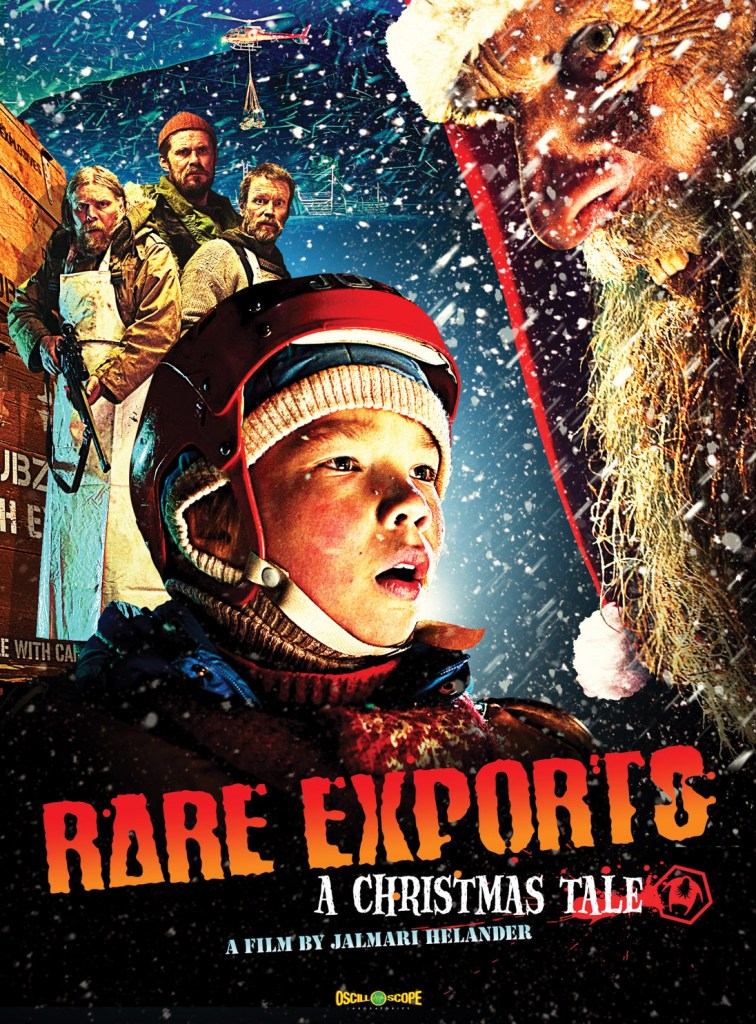
Finally, I came to the conclusion that the best lesson-free Christmas movie ever made is the wonderfully bizarre Rare Exports: A Christmas Tale. This 2010 film from Finland is about a research team and a family that get embroiled in a task to capture the most dangerous game there is, a unique species that is prized by hunters for its strange properties and remarkable abilities, and which are terribly dangerous, but utterly indispensable at the holidays. I don’t want to say too much more, because if you haven’t seen it I don’t want to ruin the surprise, but the movie is really funny, totally messed-up, and absolutely not to show the kids if you’re just trying to get them to stop watching Santa Buddies for the 900th time. But if you like weird, you don’t mind  little gore, and you can handle a movie with tongue planted firmly in its cheek, Rare Exports is worth checking out.

If there IS a lesson to learn here, it’s probably about that hat.

Christmas Fantasy

Kylie Wells hit me with another toughie: my favorite Christmas fantasy. You wouldn’t think this one would be too difficult, as by rights almost any Christmas story that recognizes the reality behind Santa or Rudolph would inherently count as fantasy, but Kylie specified that she was talking about the sort of “high fantasy” that inhabits the worlds of J.R.R. Tolkien or C.S. Lewis, and once you apply that filter the list gets much shorter. People have tried to tackle this very specific subgenre several times, and to be honest, most of the efforts have kind of fallen flat. The best one that comes to mind is the Rankin and Bass adaptation of L. Frank Baum’s The Life and Adventures of Santa Claus, but I’ve written about that a lot this month, so I don’t want to go back to that well again.

For some reason, the magic of Christmas and the magic of high fantasy just don’t mix very well. In fact, a lot of the efforts are laughable – the 2014 film The Christmas Dragon was actually spoofed in the most recent season of Mystery Science Theater 3000. Then a few years ago, while looking for a Christmas movie with my wife, my father, my sister, and her kids, we stumbled upon the 2018 Italian film Legend of the Christmas Witch. When I say this movie is bad…guys, I think it may be safe to call this the Troll 2 of Christmas movies. In fact, although it is not my pick to answer Kylie’s question, I’m gonna recommend you all go and watch this movie just to see for yourself how amazingly, wonderfully bad it is. Every so often Erin, Heather and I talk about seeing if it’s still streaming anywhere (I just checked – as of this writing it’s on FreeVee, Tubi TV, and the Roku Channel) and watching it again with someone else who has not yet had the pleasure. In fact, I’m just going to quote my own review of the film I wrote at the time to give you a taste of what you’re in for:

“At one point in this movie the witch’s boyfriend has to take off his dinosaur mask so he can tell her students to steal a bunch of toy bicycles to ride into the mountains while he distracts the dragonfly drones, and if that doesn’t make you want to watch it I don’t even know what to tell you.”

You have been warned.

Seriously, this is one of the worst movies I’ve ever seen. Watch it twice.

But for an actual good movie that embraces the elements of fantasy, the best example I can think of is Hogfather, the 2006 miniseries that adapts the late, great Terry Pratchett’s Discworld novel of the same name. If you’ve never read a Discworld book you’re missing out – it’s a fantasy series that brilliantly satirizes not only the tropes of fantasy, but also modern culture, with different aspects targeted by the different books. Hogfather isn’t TECHNICALLY a Christmas movie, as Christmas doesn’t exist on the Disc, but it’s about their equivalent: Hogswatch, a holiday in which the good children of the Disc are visited by the Hogfather…except this year, the Hogfather is missing, the entire fabric of belief on the Disc is in jeopardy, and the only person who can possibly save Hogswatch (and the world) is Death. No, like literally, Death. The Grim Reaper. Guy with the scythe. The big “Th-th-th-that’s all, folks!” He’s the guy who’s gotta save the world.

Him and his granddaughter.

Anyway, it’s a great book and a great miniseries, and damned if I can think of a better fantasy movie for the Christmas season.

I AM HERE TO SAVE THE HOLIDAYS AND DRINK EGG NOG. AND I AM ALL OUT OF EGG NOG.

Atypical Christmas

We’re going to wrap things up by talking about the category I’m sure you’ve all been waiting for. Jon McCarthy wanted to know my favorite “atypical” Christmas movie (Jon, by the way, is an awesome comic book writer and creator of the comics Endangered and Comic Book Trivia. His newest comic, a New Orleans-based horror one-shot called Loup Garou, was released just this past Wednesday, and you should all run out to your local comic shop and buy a copy, or demand they order one for you if they foolishly failed to have one in stock.) Liese Aucoin, similarly, asked about my favorite “Non-Christmas Christmas Stories, other than Die Hard.” (Liese, to the best of my knowledge, has not written any comic books about werewolves in New Orleans.)

Since I think Jon and Liese are basically asking the same thing, I’m going to combine my answer, especially since it gives me a chance to tackle the greatest Christmas controversy since “Who spiked the egg nog?” Namely: what exactly constitutes a Christmas movie? Die Hard, of course, is the originator of this particular meme, when it became popular among a certain part of the population to call it their “favorite Christmas movie” ironically, as it’s an action movie SET at Christmas, but doesn’t really have the usual trappings of Yuletide cheer. Since then, people have stacked up dozens of movies that fit the same criteria: a Christmas setting, but not really a Christmasy story: films in this category include (but are not limited to) Lethal Weapon, Batman Returns, Kiss Kiss Bang Bang, and Rambo

This has become a surprisingly delicate subject, with some people who get violently angry when you suggest one of these films counts as a Christmas movie. (Ironically, in this instance they are behaving more like Martin Riggs from Lethal Weapon than Bob Crachit.) On the other hand, sometimes the people who are in favor of such movies are so obnoxiously smug about it that it can be embarrassing to admit you agree with them lest you be considered a douche by association.

So let me settle this once and for all. First of all: watch whatever you want, whenever you want, and who the hell cares if somebody else agrees with you if something is a Christmas movie or not? Gatekeeping is stupid, life is too short, so enjoy yourself.

Second: I’m going to explain what I PERSONALLY think makes for a Christmas movie, something I outlined in more detail a few years ago, but I have to stress that this is MY criteria. Go ahead and create your own. Doesn’t upset me in the slightest. 

For me to count something as a Christmas movie it needs to fit any TWO of the following THREE criteria:

  1. It must take place PRIMARILY during the Christmas season. (Movies with only one scene set at Christmas, like Toy Story or Star Trek: Generations don’t count.)
  2. It must feature a traditional Christmas character in a prominent role. (Santa Claus, Rudolph, the Grinch, Ernest P. Worrell, Jesus…y’know, the usual.)
  3. It must include a traditional Christmas theme such as family, love, fear (that “ghost stories” thing I mentioned last week) or, of course, redemption.

So by my criteria, of COURSE Die Hard counts as a Christmas movie, as it meets criteria #1 and #3. (It’s about the redemption of John McClain and the real hero of the film, Sgt. Al Powell.) 

Each of these films meet two out of the three criteria, and are therefore equally Christmasy. It’s just science, people.

All right, all that out of the way, what am I picking as my FAVORITE atypical Christmas movies? With Die Hard removed from the equation and taken as a given? Well, there are still several others to choose from. Sure, I like Lethal Weapon and Batman Returns and Iron Man 3 (I honestly think it’s underrated in the Marvel Cinematic Universe pantheon), but I don’t often work those into my Christmas rotation. One movie I DO like watching this time of year? Well obviously it’s the one about that cheerful guy in the red suit with the power to fly all around the world. I’m talkin’ 2019’s Shazam! 

The bubble gum even kinda makes it look like he has a very shiny nose.

Based on the DC Comic, we’re treated to the story of young Billy Batson (played by Asher Angel), a foster kid who has been bouncing from one home to another for years in a quest to find his birth mother, whom he was separated from as a small child. He’s recently been placed in a new home when an encounter with an ancient wizard gives him the power to transform into the world’s mightest mortal, Shazam (with his adult form played to perfection by Zachary Levi). The movie is set at Christmastime – the final battle, in fact, takes place at a Christmas festival – so it meets criteria #1. And family is one of the major themes of great Christmas stories, so this film lands criteria #3, telling a truly touching story about “found families,” and how the bonds that forge a true family are based not on blood, but on love. It’s a sweet, exciting movie that I sincerely enjoy. Hell, may be the only person out there who liked the sequel – although admittedly, not as much as the first one.

Wow, guys, I have gone on for a WHILE on this one, but hopefully I’ve given you all some movies to check out in the last ten days until Christmas. I know I’m going to be diving into at least some of these films before Santa drops by on Christmas Eve. Thanks to everyone who gave me a suggestion – once again, it was a lot of fun. And I’ll see you again next time I decide to Play Favorites!

Blake M. Petit is a writer, teacher, and dad from Ama, Louisiana. His current writing project is the superhero adventure series Other People’s Heroes: Little Stars, a new episode of which is available every Wednesday on Amazon’s Kindle Vella platform. You know what else you should watch this December? The Rocketeer. It’s not a Christmas movie, Blake just doesn’t think it gets enough love.