Superman Stuff #8: Digital MIA

Sometimes people ask me, “Blake, have you read every Superman story there is?” And I smile and laugh because I can totally understand why they might think such a thing. I’ve got a whole shelf of Superman toys and knicknacks, I own approximately 97 Superman shirts, socks, and other assorted articles of clothing, I spent an entire year of my life reading or watching a different Superman story every single day, and although I do not personally HAVE a tattoo, if I ever were to get one, you can probably guess what image I would choose. So you may be surprised when I tell you that the answer to the question “have you read every Superman story?” is a definitive NO.
The thing to remember, friends, is that despite my age, Superman is considerably older than me. Earth’s greatest hero is coming up on his 90th birthday in two years, and I am not quite there yet. There are mountains of Superman stories that were published before I was born. And to be certain, I’ve read a lot of them. His first appearance in Action Comics #1 has been reprinted frequently, as have many of the most popular and memorable stories, stories that introduced important characters and concepts, and so forth. But the truth is, there are a lot of Superman stories – especially from the Golden and Silver Ages – that have never been reprinted. In this day of digital comics, one would think that it would be simple enough for DC to put them all on their DC Universe Infinite app, to which I subscribe and use almost daily. But if you go into the archives and start poking around, you see massive swaths of comics that simply aren’t there.

There are reasons for that, of course. It’s NOT as simple as just pushing a button and putting them online. Many of those comics, especially the older ones, have never existed in a digital form. They were drawn, colored, and printed on paper before the advent of computers, and to digitize them today would require someone to take the old prints, scan them in, and remaster them into a readable format, and that is assuming copies of the books are available (which is often not the case with Golden Age comics, especially the more obscure ones). If there are available copies it’s not an impossible task – a great many classic comics have been preserved this way – but it IS a time-consuming and sometimes expensive task, which is why those older comics that ARE available digitally are the ones that are the most popular and most significant.

All that said, I wish that DC would put more effort into preserving their older comics. On a whim, I went through the app and looked at the assorted Superman titles to see which ones have missing issues, and the results are, frankly, alarming. Of the 904 issues of Action Comics Vol. 1, DCUI lists 463 of them available digitally. (Actually, that number isn’t exactly accurate, as the 463 includes annuals and specials that DC places in the run of the main title, but the number is close enough to make my point.) As of when I checked the app on Feb. 23, the following issues of Action Comics are unavailable digitally: 106-251, 253-266, 268-283, 285-307, 360-363, 377-456, 458-520, 522-551, 560-582, 603-617, 627-642, 653-658, 660, 663-668, and, bizarrely, 729. 

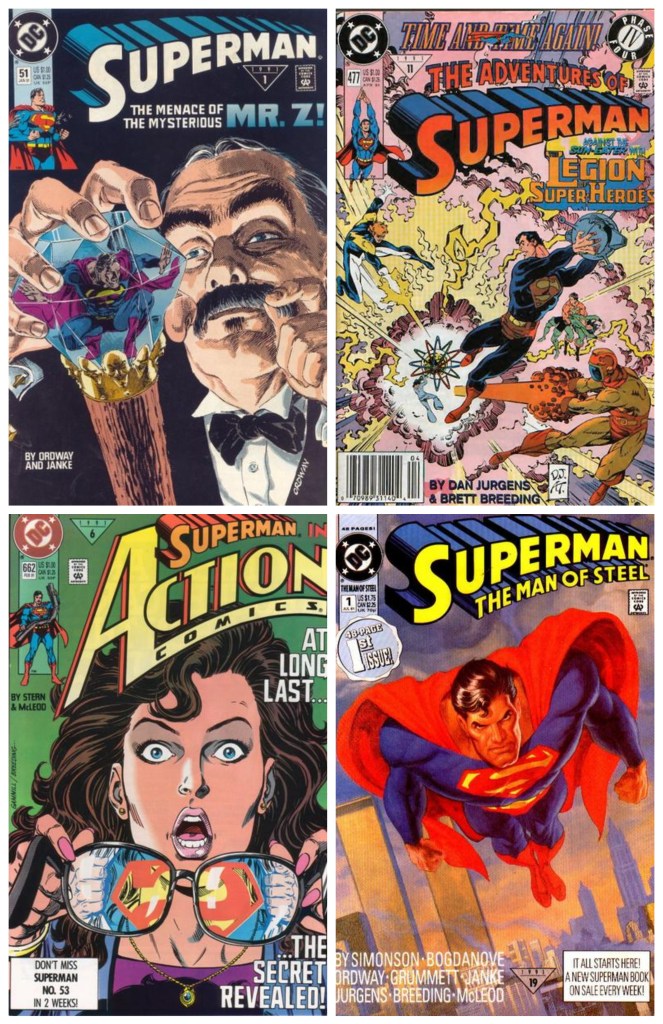
It’s interesting to note which books ARE available as well. There’s an enormous hole at the end of the Golden Age and beginning of the Silver Age, stretching almost completely from 106 through 360. In that run there are only three issues that pop up: issue #252 (the first appearance of Supergirl), issue #267 (an early Legion of Super-Heroes story with the first appearance of several key members), and issue #284 (I have no idea what makes this issue special enough to warrant inclusion). 
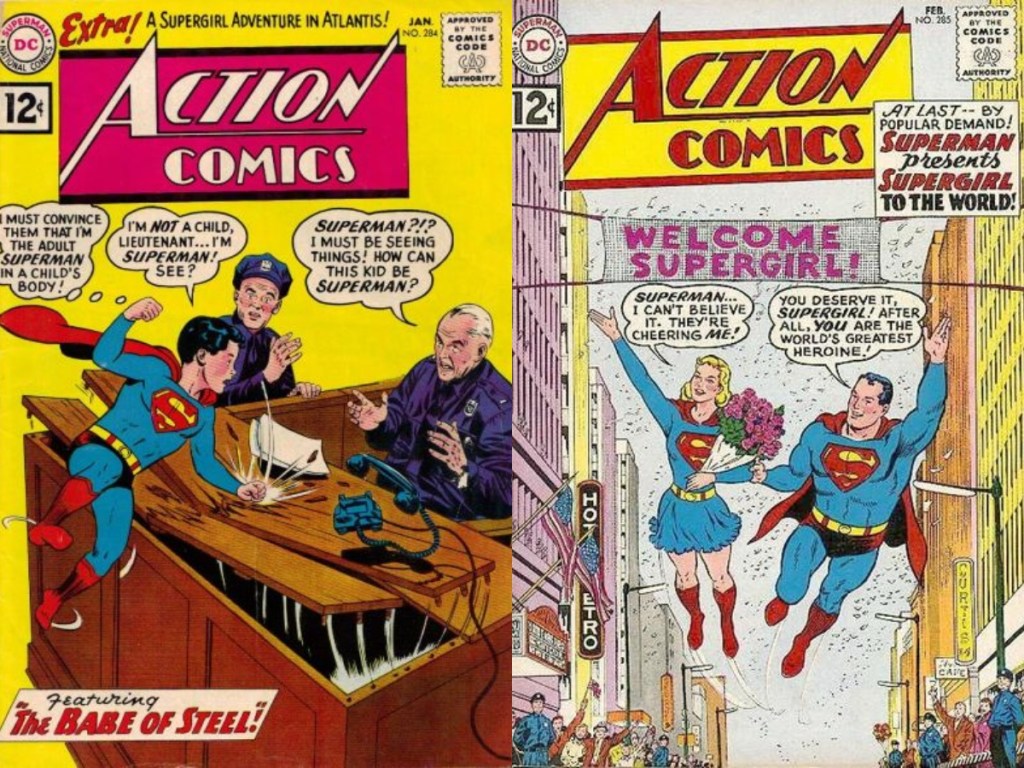
Left: Worthy of digitizing.
Right: Somehow, NOT worthy of digitizing.

Also missing are most, but not all, of the Action Comics Weekly run, from issues #601-642. For those who don’t know, at this time DC experimented with changing Action from a monthly title starring Superman to a weekly anthology book with several ongoing stories, of which Superman was only one of them. What’s bizarre to me is that they have issues #618-626, which I have to assume contains some serialized story they deem significant enough to include. 

Speaking of anthologies, it should also be noted that the early Golden Age issues of Action are incomplete. The series was originally an anthology before Superman (or his spin-off characters, like Supergirl) eventually took over the entire book, for but many of those anthology issues, ONLY the Superman story is online. Granted, that’s probably the part of the book of greatest interest, but that still leaves huge gaps in DC history. The same is true for the other Golden Age anthologies that are remembered mostly for their main character, such as the Batman stories in Detective Comics or the Wonder Woman stories in Sensation Comics

Reading this period is going to be like rolling the dice.

I kept looking. Volume 1 of Superman is missing issues 25-27, 29, 31-33, 44-75, 77-121, 132-232, 239, 243-247, 249-256, 258-265, 267-304, 309-337, 339-364, 366-409, and 416-422. That series didn’t end there, but the title was changed to Adventures of Superman, which is missing issues 580-581, 599-607, 610-638, 640-641, and 643-649. During that time, the book ran concurrently with Superman Vol. 2, which is missing a relative few issues (178-185, 188-203), and Superman: The Man of Steel, which seems to only be lacking 121-129. The baffling thing is that these three titles, along with the post-Weekly era of Action Comics, were part of what fans fondly recall as the Triangle Era, that period in the 90s and early 2000s when the four Superman titles fed into each other week to week, essentially making one glorious serial. Anybody attempting to read this era in its entirety on the app will find bizarre and baffling gaps in the story. 

These are the main Superman titles, of course, but the spin-off books have fared little better. Superman’s Girl Friend Lois Lane ran for 137 issues between 1958 and 1974. Of those, only issues #1-21 and, randomly, #93 are available digitally. Superman’s Pal Jimmy Olsen ran for 163 issues before the title was changed to Superman Family and it became an anthology with stories featuring assorted characters in the…well, the title makes it clear. Of the original Jimmy Olsen run, we have only the first eight issues, then issues 133-148, the seminal Jack Kirby run on the title. The series continued as Superman Family from issues #164 until it was cancelled with #222, but the only one available on the app is #182, again, for reasons I can’t fathom.

Finally, let’s talk about the Superman team-up book of the late 70s and early 80s, DC Comics Presents. This series has fared much better than many of the others we’ve covered here. Of the 97 issues in the run, only three are missing: issue #47, which guest starred He-Man and the Masters of the Universe and is therefore no longer available to DC due to licensing issues, and issues 70 and 71, which guest-star the Metal Men and Bizarro, respectively, and don’t seem to have any particular reason they should be discluded. 
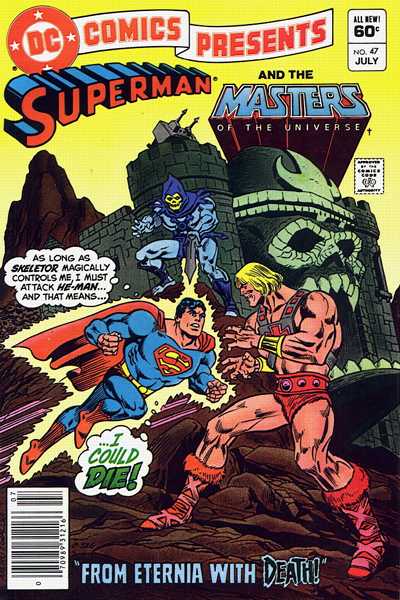
“By the Power of Lawyers! YOOOU CANNOT REEEEEAD MEEEEEEEE!”

This is not a comprehensive examination, of course. I haven’t checked in on most of the annuals, specials, or miniseries, although it should be noted that only the first issue of the Superman: The Secret Years miniseries from 1985 is included, which is totally perplexing to me. Why bother to digitize ONLY part one of a four-part story? 

I should also note that this is not a problem unique to the Superman comics. If you go through the back catalogues of most DC books prior to the modern era, you’ll see similar gaps in the libraries of Batman, Wonder Woman, Flash, Green Lantern, etc. I also stopped looking after the New 52 reboot of 2011, at which point digital comics had become relatively common, and I feel mostly certain that everything one could reasonably expect to be available is so. But what I’ve laid out here should be enough to make it clear how big this problem is. 

Again, digitizing the thousands of comics that have not been scanned would be a daunting task. It would be time-consuming and expensive. Some of the books – such as the aforementioned He-Man crossover – would run into rights issues that prevent them from being reprinted or added to the app. Others may cause some sort of confusion in terms of royalty payments to the creators involved. And a few – a scant few, but a few – books have been deliberately left out because one of the creators involved would later go on to infamy for reasons entirely unrelated to their comic book career. (If you don’t know what I mean, look up who originally wrote the 1990 Green Lantern title and Justice League Europe and you’ll quickly discover why those books are mostly off the DC website and out of print.) 

And of course, DC Comics is a business, and it’s not likely that they will undertake all of these endeavors unless they see a profit in it. What would the profit be, then, in having employees spend thousands of hours scanning in and remastering the thousands of comics that are currently AWOL? Would they be able to sell enough collected editions to justify it? Would it draw in a mountain of new subscribers to the app? The honest truth is, even if it WERE as simple as hitting a switch that allowed DC to say “Every Superman comic ever is now on the DC Universe Infinite app!” it probably wouldn’t generate enough new users to fully justify the cost.

But that doesn’t mean it isn’t worth doing.

DC Comics is a business, sure, but comic books are an art form, and art should be preserved. And increasingly, in this modern age, digital preservation for older comics, books, movies, music recordings, and other works of art is proving to be the best way to make sure that it is available to future generations. Public domain helps with this. Once a work is available to the public, there are a lot of people who have a vested interest in seeing that it is preserved. The first Action Comics issues – and by extension, the first appearances of Superman – will enter the public domain in 2034. Every year after that, a new batch will be added to that list. If DC doesn’t do it themselves, eventually somebody else will make these classic books available. There’s a comfort to that, but it also begs the question of whether that’s what DC really wants. Is it actually in their best interest to keep these things buried until everybody ELSE can get their hands on them and put them out there for the world?

I’m not speaking objectively, obviously. I want very much for all these missing works to be available there for me to read here and now, although I’m willing to wait for DC to do it right…provided they’re actually doing it. In the earlier years of the app, DC had a relatively regular schedule of adding older comics to the library, but that has largely dried up. Every Wednesday DC adds the most recent NEW comics to the app, but the older back catalogue hasn’t had a substantial update in a very long time. It’s a shame.

And it’s time DC did something about it.

Blake M. Petit is a writer, teacher, and dad from Ama, Louisiana. His most recent writing project is the superhero adventure series Other People’s Heroes: Little Stars, volume one of which is now available on Amazon. Don’t forget, you can check out earlier blogs in the Year of Superman/Superman Stuff Archive! Got a request for a future “Superman Stuff”? Drop it in the comments!

Geek Punditry #144: Now Where Do We Find Our Comics Part II

In last week’s column, a work of foundational literary greatness which has already replaced things like the Magna Carta in terms of historical significance, we discussed the collapse of Diamond Distribution and the way its disintegration has disrupted things for the comic book world in North America. But that’s only part of the story. Like traditional books, the digital market for comic books has become a significant player. True, comic fans (even more so than readers of regular books) have a strong collector’s mindset and will probably never outgrow the desire for physical copies. But for comic readers, the convenience of digital is appealing to many. 

REMEMBER. REMEMBER WHAT THEY TOOK FROM US.

Once upon a time, there was a great little app called Comixology. It wasn’t the only game in digital comics, but it quickly became the dominant one because it cut deals with virtually every major publisher and almost every minor one you could name. It had a gargantuan catalogue to choose from. There were a mountain of comics available for free as well – lots of first issues and special one-shots in addition to simple previews – enough to let you try almost anything before you started to think about whether you wanted to buy anything or not. There were sales every week, where tons of comics were reduced in price and others were made freebies temporarily. One time, Marvel had an event in which the first issue of EVERY MARVEL TITLE was free for a few days, and the response from people “purchasing” the digital comics was so great that the app crashed and they had to issue rain checks. They even had a program in which independent comic book creators – those making comics on their own without the benefit of a publisher – could submit their work to Comixology and make it available for sale on the biggest digital comic book platform in existence. 

It was popular, is what I’m saying.

“Sounds great, Blake,” you’re saying. “What happened to it?”

Amazon bought it, of course. 

Don’t you smile at me like you don’t know what you did.

Look, I’m not going to get into the various reasons that people hate Amazon. I’m not going to get into politics or the abusive nature of how they treat their workforce. I’m certainly not going to point out the fact that Jeff Bezos really, really looks like Lex Luthor. I’m going to focus on what’s actually pertinent to this column, namely the fact that when Amazon purchased Comixology, they turned it from a fun, easy app to use to read and collect digital comics into a system that – and here I am directly quoting St. Francis of Assissi – “sucks.” 

Like many things Amazon buys, nothing changed…at first. But they slowly began to integrate Comixology’s functions with their own. They married your Comixology library with the library from the Amazon Kindle store, their own digital platform, and eventually they did away with the simple, easy-to-use, easy-to navigate Comixology website. By forcing you to access the digital comics via Amazon’s own website, they absolutely crippled its usefulness. 

On Comixology, it was easy to track comics in various ways – title, publisher, creators. One could simply click on a single title – Amazing Spider-Man, for example – and add each issue that you wanted to your cart, then buy them. Amazon’s interface does NOT make this simple. When you do a search on Amazon your results are determined by algorithm, a word I am beginning to despise in much the same way I despise words like “smallpox” or “cauliflower crust pizza.” So instead of simply searching for Spider-Man and finding the various series of Spider-Man comics, now when I search for Spider-Man I get a dozen “sponsored” results, a couple hundred Funko pops and t-shirts, some movies and TV shows, and EVENTUALLY I’ll find individual comic books that have no logical sequence or arrangement that can be detected by the human brain. It’s an utter mess and nearly impossible to keep track of what you already own or to find what you’re looking for. 

Even worse, Amazon eventually abandoned the Comixology app as well, fusing it with the Kindle Reader. The Kindle Reader is adequate for books, but as a platform for keeping track of thousands of individual comic books amongst hundreds of series, it is an absolute nightmare. I still have my “collection,” but it’s so rare now that I get a digital comic from Amazon that if they shut down the entire system tomorrow, it would be weeks before I would even notice. I DO use the Kindle Reader frequently, mind you, but I have to “hide” the comic books to prevent the app from crushing under the weight loading the ridiculous number of comics I accumulated during the years of Comixology’s existence. When Amazon killed Comixology, they abandoned one good app and made an adequate app less easy to use even when I’m not reading comics

This is not to say that I’ve stopped reading comics digitally. Far from it – in any given week I probably read more comics on my tablet than I do on paper (especially with the whole Year of Superman thing I’ve been doing since January). It’s just that I’ve found other ways to do it. And in many ways, these alternatives are far preferable if your ultimate goal is not just to have a paper copy of every conceivable comic in the universe sealed in plastic. There are so many X-Men titles, for example, that trying to collect them all could bankrupt the average American. But with an affordable subscription to Marvel’s digital app, you can read as many of the books as you want if you’re willing to wait a few months.

Marvel and DC both have similar apps with a subscription that lets you read their massive back catalogue, but I think they’re the only two individual publishers that have such a thing. And that makes sense, honestly. The other players in the comic book game are either too small to have a bench deep enough to justify the subscription model (you could potentially read every comic Abstract Studios has ever produced in a couple of months, for example, and then why would you maintain the subscription?) or they are heavily reliant on comics that are owned by their creators (such as Image Comics) and IPs licensed from TV, movies, toys, and so forth (Dark Horse, Dynamite, IDW, and many other publishers have a long list of these). Having so many books owned by different copyright holders makes arranging a digital subscription service difficult and subject to having huge swaths of their catalogues suddenly vanish if their deal with the owner of the IP is not renewed. 

Tunnel, meet light.

There are alternatives, however. GlobalComix, for example, is a service that has a lot of comics – including new comics – available for purchase, as well as a subscription service that gives you access to their entire library for $6.99 a month or $69 for a yearly pass. Their catalogue includes publishers including (but not limited to) Dark Horse, Image, Mad Cave Studios, IDW, anime publisher Kodasha, TONS of small publishers, and even selections from DC and (beginning on Oct. 15) Marvel. It’s not immune to the problems I mentioned before, of course. If a deal with a certain publisher or rightsholder expires and isn’t renewed, then the readers’ access will be cut off. But in this case, GlobalComix has deals with enough different publishers that the loss of any one specific publisher isn’t likely to cause the whole system to collapse. 

You can purchase individual comics to read if you don’t want the subscription, similar to how we all once built up our huge Comixology libraries, but the notion of a digital “collection” seems weird when a subscription is available. If it would cost more to buy two new comics this month than it would cost to buy an unlimited monthly subscription, why the hell buy the two comics? It’s not like you actually “own” them. As we’ve learned with things like licensed movies and music, you never really “own” digital content unless you’ve got it on a hard drive somewhere. All you “own” is a license to read it, and that can be revoked. I guess the only kind of digital exception to that would be something like an NFT, but the whole concept of NFTs is – and once again I’m going to quote St. Francis – “as stupid as a pig touring the Hormel plant.” 

That said, there does seem to be a small niche appearing for digital “collectibles” of a sort, and that’s the concept of personalization. This summer, comic publisher DSTLRY announced that they were launching a new digital comics platform called Neon Ichiban. DSTLRY, it should be noted, was founded by David Steinberger and Chip Mosher, the guys who founded Comixology in the first place before selling it to Amazon in 2014. I guess after their decade-long non-compete clause expired, they decided that something had to be done about the mess that was made of their baby.

“We got out of our beds stuffed with Amazon money because SOMEBODY has gotta fix this mess.” — Steinberg and Mosher, probably.

The program is still in beta at the moment, but I’ve signed up for it and some of the things I’ve seen have been pretty promising. It’s not hard to find what you’re looking for on the site, or to add it to your collection. Technically, I should say, I haven’t actually purchased anything from Neon Ichiban yet. I’m a little reluctant to do so while it’s still in beta, even though I’m sure they intend to roll any beta purchases over into the finished version of the site. I have, however, “bought” several of the free comics available in order to test out the functionality, and it’s not bad.

There are definitely things that need to be improved, primarily the fact that they need to roll out a dedicated app for the service. At present there is no app, and customers have to read their comics through the Neon Ichiban website. The interface is okay, but not nearly as convenient as having an app will be, especially when reading on mobile (which is preferable – to me, at least – to reading on a computer screen). The service is also still fairly new, the Beta only launching in August, so they’re working on building up their back catalogue. I’m impressed by some of the publishers they’ve already partnered with, though, including the juggernauts of Marvel and DC, as well Dark Horse, Vault Comics, Kodansha, and others, with the promise of more to come in the near future. Each week since the Beta has launched they’ve added that week’s new comics from the participating publishers to the service, and they’ve all been slowly adding older books to the library as well. The last time I checked Marvel (not surprisingly) had the largest back catalogue on the site, and although it’s not nearly the number of comics available on Marvel’s own app, it’s not inconsiderable either.

Still, all of this is similar enough to GlobalComix that it would be hard to recommend one service over the other, at least as far as purchasing individual comics goes. And for those who don’t care about “owning” a digital copy, Global’s subscription model gives them the edge. But Neon Ichiban has something that I haven’t heard of before that will probably get people’s attention: some of the comics in their catalogue are labeled “Remarque-able.” Spelling aside, I dug around trying to figure out what the hell that actually means, and from what I can tell, it’s an interesting idea. It seems that “Remarque-able” books will be available to be digitally altered, adding things like digital autographs or commissioned sketches to the comic, similar to the way you can get an artist to sketch on a blank comic book cover now. The idea of a digital autograph seems a little silly to me, to be honest, but if I could commission – for example – Dan Jurgens to draw a one-of-a-kind sketch of Superman on a digital copy of Action Comics #1000…well, I’m not saying I would do it OFTEN, but I admit I understand how such a thing would be appealing to a portion of the audience. There is the question of what – if any – restrictions are in place. If I pay an artist to draw Batman on the cover of a blank Spider-Man, most of them would do it (even if such a request seems odd). Would the same thing apply to a Remarque-able comic, or would they have tighter restrictions on what could be drawn there? Would there be limitations regarding graphic or adult content? And if so, what would they be? I don’t know yet, and those questions need to be answered. Whether I ever did it myself would depend entirely on what artists and books are available and how much it would cost, but it’s something I would at least consider.

So while people in the real world are falling over each other trying to figure out how to get comic books in stores again, there are fortunately already systems in place to keep the digital flow going, and many of them are far superior to what we’re seeing from Amazon. That is, of course, an extremely low bar, but it’s a bar that’s being hurtled nonetheless. 

The future of comics is in flux, I can’t deny that, but I’m not one of those people who think the future is fading either. Comics aren’t going away. They’re evolving in several areas, but people are doing things to get them to the readers, which is where they belong. And like in the physical distribution front, I think having a few different competing digital services is probably a good idea. As much as I liked Comixology, had there been any serious competitors at the time, it wouldn’t have been such a disaster when Amazon ruined it. I haven’t gone all-in on either GlobalComix or Neon Ichiban yet, but knowing that they’re both out there is honestly pretty comforting.

At the moment, though, I’ve still got 90 years of Superman comics to get through first. 

Blake M. Petit is a writer, teacher, and dad from Ama, Louisiana. His most recent writing project is the superhero adventure series Other People’s Heroes: Little Stars, volume one of which is now available on Amazon. You can subscribe to his newsletter by clicking right here. He’s also started putting his LitReel videos on TikTok. Now he’s thinking of commissioning Scott Shaw! to draw a Spider-Ham/Captain Carrot mashup. Really, people, the time has come.