Year of Superman Week 34: Crossover Chaos Part III-The Final Amalgamation

I spent last week dipping my toes into the DC Vs. Marvel crossover, as well as the first wave of Amalgam Comics titles. But I’m not done yet: I’ve still got over half the huge Amalgam Age Omnibus to get through, including two sequel miniseries and the second wave of Amalgam Comics. Not only that, but after a few weeks where the beginning of the school year has kept me busy, I finally get a chance to sit down and catch up on more recent Superman comics. Oh yeah – and Peacemaker season two drops this week, and while I don’t expect to see Superman to show up, James Gunn has promised that the story of this season follow on from the film, so there’s a pretty good chance I’ll have some thoughts to share about that. Let’s begin, shall we? 

And as always, you can check out earlier blogs in the Year of Superman Archive!

Wed., Aug. 20

Comics: DC/Marvel: All-Access #1-4
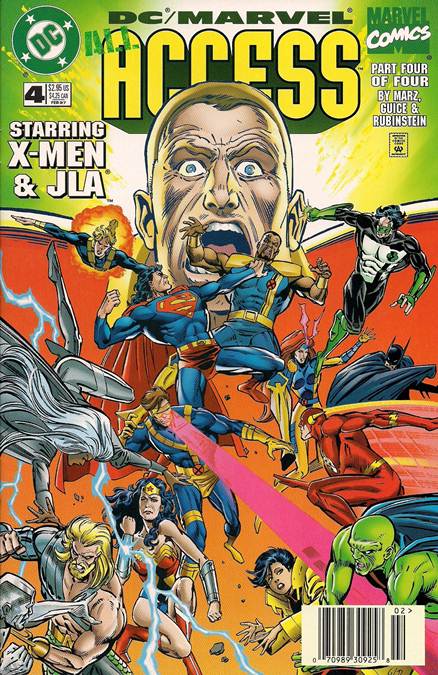
I had the same look on my face as Access when I read Civil War II.

Notes: I’m going to say something that may be controversial here. I actually like the follow-up miniseries, like DC/Marvel: All-Access, better than the DC Vs. Marvel event itself. DC Vs. Marvel was a fun experiment, but the plot was really just a flimsy excuse to show off fights between the characters and frame the Amalgam specials. All-Access, on the other hand, has an actual STORY to it, and I appreciate that. Written by Ron Marz with art by Butch Guice, whom you may remember passed away earlier this year, All-Access starts out with Axel Asher, the man who straddles the line between the Marvel and DC Universes as Access. A psychic flash warns him that Venom has somehow hopped universes, and if anyone from either universe stays in the other one for too long it could cause the worlds to fuse into the Amalgam Universe again, so the cosmic hall monitor has to get to work. He comes across Venom in Metropolis, where he’s throwing down with Superman, and so Access decides to get some backup by calling in someone who knows what Venom’s deal is: Peter Parker, the Amazing Spider-Man.

This is all in the first issue of the miniseries, by the way, which almost works very well as a standalone Superman/Spider-Man team-up. There’s no gratuitous hero-on-hero fighting here, just two good men teaming up to take down one bad one, and Marz plays them both perfectly. Re-reading this issue is where I started to realize that this is kind of what I had hoped DC Vs. Marvel would have been all along.

Superman doesn’t show up again until the last page of issue #3, but in the meantime, Jubilee convinces Access to take her back to the DC Universe because when she and Robin were supposed to be fighting each other, they kind of fell in love. (To this day, it’s probably the best relationship Tim Drake has ever had.) Their reunion is interrupted by an encounter with Two-Face, then again when the Scorpion appears, once again mysteriously having been pulled from the other universe. Access recruits Batman to help him solve the mystery of the “crossovers,” and Batman suggests that they track down the man who, in the combined universe, was supposed to be its defender: Dr. Stephen Strange. Batman approaches Strange, suspecting that he’s causing the crossovers somehow, and Jubilee calls in the X-Men to hold him off. Issue three ends with Access once again calling in the cavalry, bringing in the rest of the Justice League.

Issue four is X-Men vs. JLA, at least at first. Things change when Access discovers that Dr. Strangefate has been hiding in Strange’s subconscious ever since the merger and used him to cause the crossovers in an attempt to restore the Amalgam Universe. He fuses Wonder Woman and Storm once again into their Amalgam counterpart, Amazon, but when he realizes he doesn’t have the right parts to put together anyone else, he starts creating NEW Amalgams: Superman and Bishop! Iceman and Aquaman! Jean Grey and the Martian Manhunter! Things get wild!

The story ends with a nice little promise, the Amalgam Universe restored as a sort of pocket universe where Strangefate is locked away, and the Marvel and DC Universes get to remain separate. But this miniseries was so much fun, seeing the characters actually interact in ways that didn’t go straight to the fisticuffs. The Robin/Jubilee stuff in particular was fantastic, and I loved seeing Superman and Spider-Man working together again. 

It’ll never happen, but I’d love to see a longer Access series, say a 12-issue event in which he’s trying to solve some sort of mystery that encompasses both worlds. And I’d love if, during this year, he appears not only in his own series, but in the ongoing comics of both companies, bringing surprise guest stars with him. But seeing as how the original plan was for DC Vs. Marvel to end with She-Hulk and Martian Manhunter swapping universes for a year until that plan was nixed by the lawyers, it’s doubtful that anything like that could happen. It’s not like the world has gotten LESS litigious since 1996, after all. 

Thur., Aug 21

Comic Books: Super-Soldier: Man of War #1

The amalgamated Snyder Brothers fans get SO angry that they gave Super-Soldier his trunks back.

Notes: A year after DC Vs. Marvel, a second wave of 12 Amalgam one-shots were released, six of them continuing adventures of the characters from the first, six of them with all-new Amalgamations. What’s interesting is that even the books that carried over didn’t continue the STORIES from the original. Some of them were unrelated stories, some made brief reference to the previous, and some went REALLY wild, like Dark Claw Adventures giving us an adventure of the Amalgamated Batman/Wolverine combo in a Batman: The Animated Series style. For our first visit with the Super family, Super-Soldier: Man of War dipped back in time to give us an adventure of the character from World War II. Mark Waid and Dave Gibbons reunite for this story, which kicks off with Super-Soldier at a meeting of the All-Star Winners Squadron. But he’s only there long enough for us to notice some new Amalagams (such as the Human Torch/Green Lantern mashup Human Lantern) before it’s off to join Jimmy Olsen for a special undercover Daily Planet assignment overseas. 

On the ship to Europe, Clark and Jimmy make the acquaintance of Sgt. Rock and the Howling Commandos, and Clark is later chagrined to find that Winston Churchill has fallen for the do-gooder act of his arch-nemesis, Lex Luthor, husband of Lois Lane. In a way, Luthor’s involvement actually makes this a prequel to the previous story, as the issue ends with him unveiling the plans for the Ultra-Metallo that Super-Soldier fought the first time we read one of his adventures. Kinda makes you wonder why it took Luthor 50 years to get it together.

As before, Waid and Gibbons do a great job lacing together the Superman and Captain America characters, this time bringing in the World War II-era heroes of Easy Company and the Howlers as well. Peggy Carter, for instance, shows up here as a member of the French Resistance (although I couldn’t figure out which member of Easy Company she was supposed to be mashed up with). The appearance of Major Zemo and his War Wheel pushes this over the top – silly and gleeful. These Amalgam books, when done well, are just an enormous amount of fun. Is it too much to hope that the new DC/Marvel crossover books that are about to come out will open the door for the return of this mixed-up universe? 

Fri., Aug 22

No, you give YOUR dog an invisible bone!

Last night was the premiere of Peacemaker season 2. I thought that meant I would be able to watch it when I got home from work, but apparently, it dropped at 8 p.m. EST, by which time my sports fanatic son was engrossed in a preseason game between two teams that nobody in our house has any personal connection to. But that was okay, I figured that I would just watch it the next day. I guess that was pretty stupid of me, though, to assume that I could wait a whole 20 hours and not have anything spoiled for me. Before the game was even over, though, posts were appearing on social media that spoiled something that really pissed me off. You see, season one was made BEFORE James Gunn was given the job of revamping the DCU, and was intended as part of the previous iteration of the DC Extended Universe. With the new DCU that began in Creature Commandos and continued into Superman, though, there were questions as to which parts of the season were still canon. Gunn has been exploring that in the official podcast for the show, but there was a moment in the finale that they were going to have to work a little bit to reconcile. 

Naturally, looking at Facebook last night, I was spammed with different pages that I don’t even follow sharing a screenshot that ruined a pretty amusing moment. How dare I assume that people wouldn’t make it into a headline? It had been an entire 180 minutes since the show dropped! What are they, made of stone?

Here’s the rule: If you’re posting spoilers about a show on the day it airs, you’re an asshole. That goes for individuals as well as all of those pages that I have since blocked.

By the time you read this it will have been nearly a week since that episode, and I STILL wouldn’t talk about it without giving you a warning. So in the next paragraph I’m going to spoil a few things about the end of Peacemaker season one and the beginning of season two. If you haven’t watched them and want to remain pure, skip ahead to Saturday.

TV Show: Peacemaker Season 2, Episode 1: “The Ties that Grind.”

Season one of Peacemaker ended with the titular hero and his team, the 11th Street Kids, saving the world from an invasion of alien butterflies. It’s more impressive than it sounds. But in the battle, Emelia Harcourt was nearly killed. Towards the end of the episode, Peacemaker is carrying her to safety when, lo and behold, the Justice League appeared – too late to do any good. The League, in this case, included silhouettes of Superman and Wonder Woman, as well as Jason Momoa as Aquaman and Ezra Miller as the Flash. It was a funny scene, but as that Justice League doesn’t exist, that scene clearly was no longer canon.

Gunn promised to explain it away and he did at the very beginning of the episode, in the “Previously on…” montage, where the League was replaced by the Justice GANG from the movie. The silhouettes of Superman, Mr. Terrific, and Supergirl all appeared, as well as a quick and the cameos have been replaced by Isabela Merced’s Hawkgirl and Nathan Fillion’s Guy Gardner. It was a funny bit. But I bet it would have been funnier if not for the asshats on the internet posting it the night before I got to watch it.

Fillion and Merced appear later in the episode as well, alongside Sean Gunn as Maxwell Lord allowing Peacemaker to audition for the Justice Gang. Watching the episode, it’s clear why DC put out the digital version of Superman last week – there are a lot of things in this show that build directly on that movie, although it’s still Peacemaker’s story of course. Rick Flagg shows up, worried about another dimensional rift like the “Luthor Incident” that happened this summer. Besides the connections to Superman, the show also starts trickling in new characters, like a surprising cameo by White Rabbit and references to the likes of the Ultra-Humanite and Captain Triumph. Rick Flagg is even working with Sasha Bordeaux, a supporting character from Greg Rucka’s Batman comics. Gunn seems to be using this season of Peacemaker to lay in chunks of the history of the DCU that Superman only hinted at, and I’m really quite excited by that. 

Look, it’s not a HUGE Superman link, and it’s DEFINITELY not a show I’m gonna watch with my seven-year-old like the movie, but this show is starting to look like it’s going to be part of the fundamental fabric of the new DCU, and that would make it worth watching even if it WEREN’T really good. 

Comics: Jon Kent: This Internship is My Kryptonite #5

Sat., Aug 23

Comic Books: Superman: The Kryptonite Spectrum #1, Superman Unlimited #4, Supergirl Vol. 8 #4

This is why you don’t watch whites with colors.

Notes: The beginning of a new school year traditionally keeps me busy, and today was the first time I’ve made it in to pick up my new comics in a few weeks. As such, I’ve got a hefty nine Superman or Superman-related comics sitting in my stack, waiting to read and discuss, including the much-anticipated Superman: The Kryptonite Spectrum #1. This Black Label series is by W. Maxwell Prince and Martin Morazzo, the creative team behind Image Comics’ incredible existential horror series Ice Cream Man. That’s the only thing of theirs that I’ve read before, however, and while I’m a big fan, I’ve been curious ever since this was announced as to just how their sensibilities would translate over to the Man of Steel.

As it turns out, they translate wonderfully.

In this story, Superman discovers four new strains of Kryptonite beyond the usual colors we’re aware of, and recruits Batman to help him experiment with them and find out what they do. The first, a Purple K, distorts Superman’s perception of time – something that is especially concerning as Lex Luthor chooses just that minute to unleash Solomon Grundy in Metropolis.

It would be fair for someone to question whether a creative team best known for a cosmic mind-tripping horror comic would be an appropriate choice for a Superman story, but Prince and Morazzo acquit themselves right away. The Kryptonite Spectrum isn’t a horror story by any stretch, but when Superman’s concept of linear time is skewed, we get a story that drifts into the kind of psychological twists that make Ice Cream Man so compelling while skipping the actual terror. Prince uses this conceit to play with the reader’s concept of time as well, and the script even twists Superman’s interactions with his friends, with a few scenes with Lois Lane dipping into the very real anxieties that Ice Cream Man so frequently mines for pure horror. Here, though, rather than terror, Prince uses them for character drama, displaying things about the relationships between the characters that feel very true, very human. This may not have the “Elseworlds” label, but the story clearly isn’t set in the mainstream DC Universe, with Superman and Lois’s relationship framed in a way that doesn’t fit that world, but feels quite appropriate for the story that Prince and Morazzo are telling. This is a great first issue of a very different kind of Superman story, and I enjoyed it heartily. 
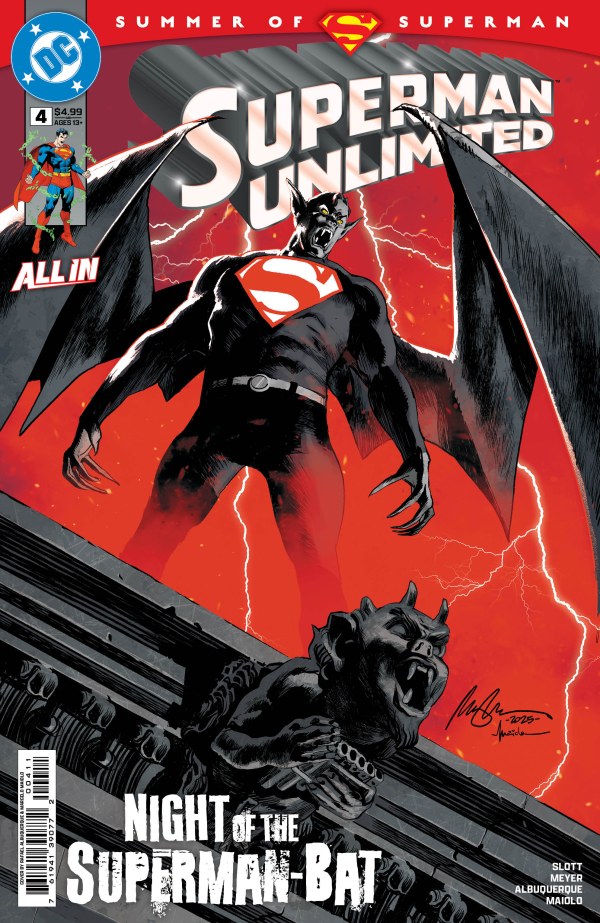
Remember this the next time one of you wants to give me grief for putting up my Halloween decorations in September.

Dan Slott and Rafael Albuquerque are back with Superman Unlimited #4. With the Daily Planet expanding to a global operation, Jimmy Olsen has been tasked with helping set up their Gotham City office. While he’s in town, he and his ape city sidekick Tee-Nah run across Man-Bat and wind up summoning Superman for help. What they don’t know, though, is that this is a new Man-Bat, one who can transmit its curse via a bite…and a chance encounter with all the Kryptonite on Earth these days has left Superman just vulnerable enough to get nipped. Soon it’s Robin and the Birds of Prey vs. Superman-Bat! 

This book is really turning out to be just what I wanted. There’s an ongoing storyline – that of the Kryptonite meteor that fell to Earth and the consequences of that – however, each issue feels like it’s telling a complete and self-contained story. The A-plot, the “Superman-Bat” thing, is done in one and it’s over. The background story of the Kryptonite and the expanded operations of the Planet continue. Although it’s a single monthly comic, in a lot of ways it feels like the structure of the glorious “Triangle Era” of the Superman comics, and I love it for that. Slott also works in some nice tidbits regarding Superman’s interaction with the Batman family, which – coming right on the heels of having read The Kryptonite Spectrum #1 – makes it feel as if DC is using the month of August to make sure everyone remembers that Superman and Batman are best buds. Which, of course, I approve of wholeheartedly.
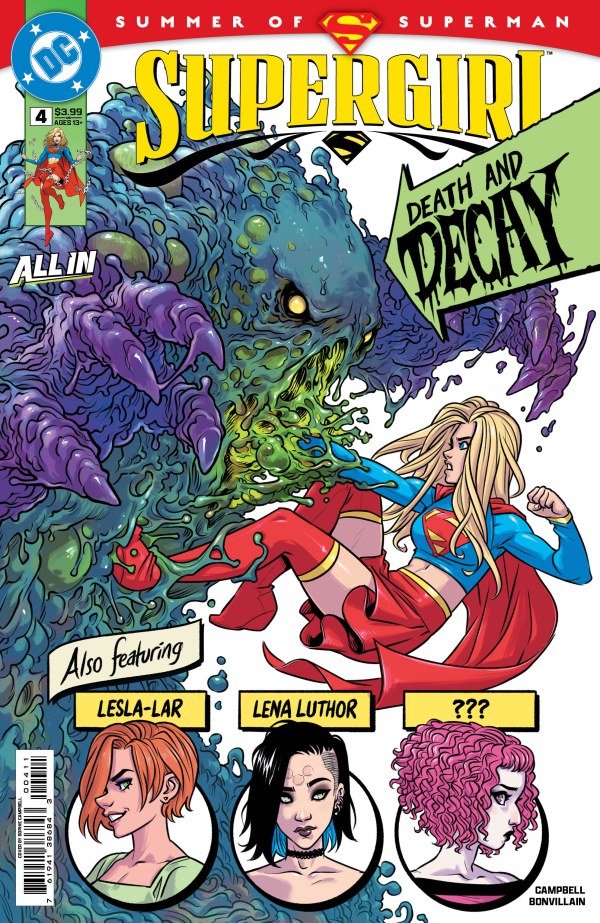
This is what happens when you don’t use fluoride.

Supergirl #4 continues Sophie Campbell’s new(ish) take on the Woman of Tomorrow. Having defeated her doppelganger Lesla-Lar last issue, this issue Supergirl takes her back to Kandor where she does something her cousin would most certainly approve of wholeheartedly: she goes to bat for her. Supergirl argues that Lesla has the drive to become a real hero, if only given the proper guidance, and volunteers to take that task upon herself. That’s the very beginning of the issue – afterwards we see Lesla make earnest attempts to prove her worth, leading up to a strange but entertaining encounter at a Goth club where she makes a mistake in judgment that winds up having the Supergirl squad face the forces of Decay. 

I just adore Campbell’s take on Supergirl. This issue in particular feels so true to the character – she comes off as someone who has demons in her past but, having largely conquered them, is sworn to help other people do the same. And following Lesla in this issue just magnifies that fact, demonstrating the effect that just being in proximity of someone like Supergirl can have on a soul that’s not truly evil, but merely lost. It’s such a good look for her and for the entire Superman family, and Campbell is nailing it in a delightful way. I also appreciate how Campbell is mining Supergirl’s past – the “new” villain, Decay, is a new version of an obscure character from Supergirl’s ‘80s series who, to the best of my knowledge, hasn’t reappeared since then. She knows this character’s history and she’s using it to her best advantage, which makes for a really rewarding read. 

Sun., Aug. 24

Comics: Krypto: The Last Dog of Krypton #3, Action Comics #1089, Justice League Red #1

Notes: After a busy Sunday of groceries, shoe shopping, making my weekly LitReel and, of course, a required stop at Spirit Halloween, it’s nearly 7 pm before I have a chance to sit down and read anything. Fortunately, I’ve still got six more new Superman-related books to dig into. Let’s see how many I get to this evening.

Beware the fetch.

Krypto: The Last Dog of Krypton #3 is first. Wandering alone after abandoning Lex Luthor, Krypto is stumbling through the woods when he comes across a little girl who’s as lost as he is. Roaming through the freezing woods, Krypto takes it upon himself to take care of the child, and in the process, proves just what a good boy he really is.

The first two issues of this miniseries blew me away. This one… DAMN it, Ryan North. Three issues in a row – THREE ISSUES IN A ROW – and you’ve got me in tears reading about KRYPTO THE SUPERDOG.

Honestly, if you’re not reading this comic book I don’t know what even is wrong with you.

When a teenager loses one of his contact lenses.

Action Comics #1089 may not have me sobbing over the adventures of a dog, but that doesn’t mean it’s not good. Last issue, young Clark Kent was surprised when his history teacher showed up on his doorstep and revealed that he knew Clark was Superboy. This issue, Mr. Blake has a reveal of his own and, frankly, I’m kind of irritated with myself for not picking up on who he was in the first place. Mark Waid is being Mark Waid here, tapping on his seemingly infinite awareness of the DC Universe to bring back a character who hasn’t been seen in a while and recontextualizing him in the world of Superboy’s Smallville. I can’t get much more specific without spoiling anything here, and in case you haven’t read the issue yet, I don’t want to do that But Waid is doing really interesting stuff in this issue.

My one complaint is actually the cover by Ryan Sook. It’s a great piece of art – evocative and certainly sure to get a reader’s attention…only it doesn’t seem to actually fit anything in the story. I hate when comic book covers are dull, generic pin-ups, but it may be even worse when the cover is of a scene that doesn’t even appear in the book.

Wait, some of these costumes need more red.

The last book I squeeze in before I’m alerted by my child that he’s hungry and he has expectations of something called “dinner” is the first issue of the latest DC All-In era Justice League spinoff, Justice League Red. Ever since the Justice League re-formed, Red Tornado has been serving as the computer intelligence running the operations for the team. This issue, Power Girl and Green Lantern Simon Baz get a red alert on their League ID cards that summon them to a satellite Red Tornado built without the knowledge of the rest of the League. His computer mind has been running millions of simulations and has determined that the new League is somehow going to lead to a catastrophe on Earth, and he needs a few trusted members to handle secret tasks the rest of the League cannot learn about in order to stop it.

Writer Saladin Ahmed is taking an interesting path in this book. The story leads us to believe that Red Tornado is unstable, and that all of these predictions and algorithms he’s run are unreliable. Even as Power Girl and Simon carry out their first mission, they’re skeptical as to whether they’re doing the right thing and whether they can trust their robot teammate. But to play that hand so early, to make it seem from the very beginning that Red Tornado may be going off the rails…it feels kind of like a feint to me. I’m willing to bet that we’re going to find out along the way that things are even worse than believing Red Tornado is wrong: we’re going to find out that somehow, he’s RIGHT. Interesting set-up, and I look forward to seeing where this goes. 

Mon. Aug. 25

Comics: Absolute Superman #10, Batman/Superman: World’s Finest #42, Justice League Vs. Godzilla Vs. Kong 2 #3
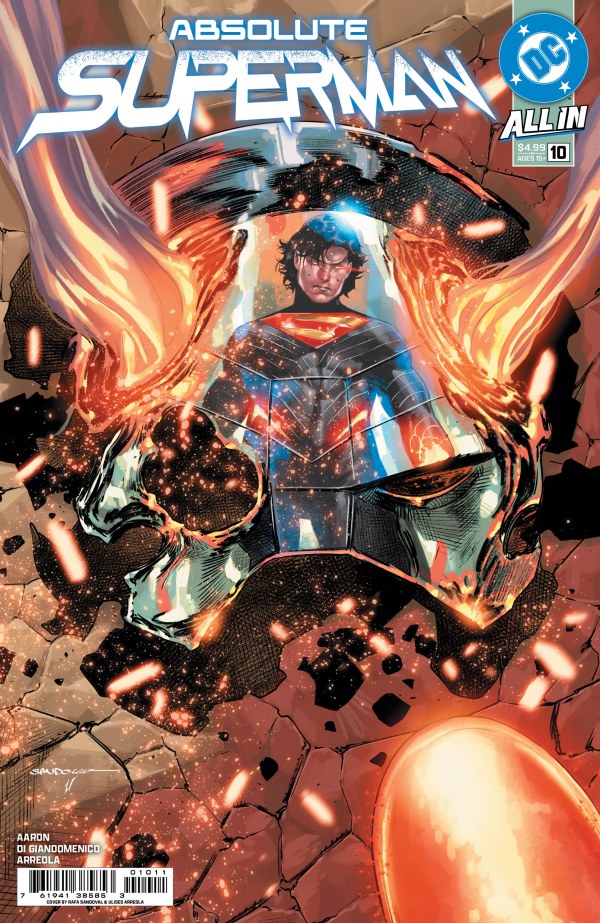
Confirmed: I still can’t see John Cena.

Notes: Time to wrap up my catch-up weekend (plus one day) with the final three Superman-related comics from my visit to the comic shop. I’m kicking it off with Absolute Superman #10. The battle continues between the Omega Men and Ra’s Al Ghul’s Peacemakers, with Peacemaker Smith on the front line in the hunt for Kal-El. With a Kryptonite bullet in Smith’s gun, Kal-El is faced with a decision, and a reflection onto a hard choice his father once made brings about a surprising result.

The conceit of the Absolute comics is that this is an entire universe tainted by Darkseid, where hope is the eternal underdog and the sort of values that characterize the traditional DC heroes are absent. This issue, Kal-El is faced with the kind of choice that Superman inevitably comes down to at some point in his career, and it’s a testament to Jason Aaron’s writing that, right up until the choice is made, I’m not entirely certain which way I think he’s going to go. 

I like the way the Absolute world plays with characters as well. Concepts like the Omega Men, Peacemaker, and especially Ra’s Al Ghul are not traditional elements of the Superman corner of the DC Universe, but they work in the story we’re getting here. Overall, it’s a good chapter in this saga. 

This am bad serious book.

In World’s Finest #42, Superman and the Dynamic Duo have been summoned to Bizarro World to help with a plague. The Bizarros (including Bizarro Superman #1 and Batzarro) who are infected find their minds realigned to a more Earth-like way of thinking. Such a danger can’t be allowed to spread, so they’ve turned to our heroes to save them…but together, they find that the danger may be greater than even the plague seemed to be.

Mark Waid is doing some really interesting things with the Bizarros here. He plays with the notion of how science and physics don’t really allow for something like a square planet and what the consequences of such a world would be. At the same time, he tackles the Bizarro philosophy of things being “backwards” as well, in a way that makes me feel slightly abashed for my criticism of the Bizarro story in the recent Kal-El-Fornia Love summer special. There’s also a great moment for Batman here – Robin (understandably) questions why it would be such a bad thing if the Bizarros all had their minds reversed to what we think of as “normal.” Batman’s response is a little unexpected, at least until he gives his reasoning, displaying a depth of compassion that Batman isn’t often given credit for. It’s a good look on Bruce.

So they’re sitting around watching Japanese movies, so what?

I finally get to the end of the new Superman titles (less than 48 hours before this week’s comics go on sale) with Justice League Vs. Godzilla Vs. Kong 2 #3. At the center of the Earth, Superman and Lex Luthor are forced into an uneasy alliance as they come across a herd of giant gorillas. (A herd? A pride? What are a group of gorillas called? I should probably look that up.) On the surface, meanwhile, Supergirl and Wonder Woman get to work liberating a Monarch base being held captive by Task Force X, and Harley Quinn gets involved in a rather…unique therapy session. 

Obviously, I love crossovers, and seeing the League facing off against the Kaiju of the Legendary Monsterverse is a lot of fun. I particularly like bringing in the Suicide Squad as an alternative antagonist in this story. But it’s the sort of thing that’s a little hard to hold in your head from month to month. Waiting for the trade isn’t a practice I care for, but this is probably a situation where the story will read better in collected form than issue-to-issue. Once it’s over, I’ll have to re-read the whole thing in a lump. 

Tues., Aug. 26

Comics: Spider-Boy Team-Up #1, Unlimited Access #1-4

They don’t call ’em “Legion” for nothing.

Notes: We’re going to end our journey through the Amalgam Universe and the DC/Marvel Omnibus today with Spider-Boy Team-Up #1, and the subsequent Unlimited Access miniseries. The final one-shot, written by Roger Stern and Karl Kesel (cleverly Amalgamated into R.K. Sternsel) with art by Jose Ladronn, features the return of the Arach-kid with a special guest appearance by his pals in the Legion of Galactic Guardians 2099, and that in and of itself should tell you that at this point they were going WILD with the Amalgamations. At Cadmus, as preparations are made for the Kid’s upcoming nuptials to Mary Jane Watson, aka the Insect Queen, the Kid is plucked from the timestream and brought to the far-flung future, where the Legion is about to elect a new leader. Will it be Vance Cosmic? Martinex 5? Cannonfire? Multiple Mai–you know what, there’s too many, I’m not going to list them all. But it’s pretty interesting to note that there are so many Legionnaires that there aren’t enough Guardians to Amalgamate them all (or at least, there weren’t at the time) so they wind up mashing together with virtually any Marvel character that fits: Dream Girl and Destiny made up Dream Date, Matter-Eater Lad and the Trapster made Paste-Eater Pete, and my personal favorite, Bouncing Boy and Speedball mashed into Bouncing Ball. Unfortunately, Spider-Boy’s time displacement is causing stress on the time stream, and he winds up falling into different time periods, meeting different incarnations of the Legion.

The book turns out to be a real celebration and gentle parody of the Legion, poking some lighthearted fun at the various reboots the team has undergone over the years, a topic with which I have some passing familiarity. Even Ladronn’s artwork works really well, emulating the different styles of Keith Giffen’s Five Years Later era just as neatly as he does the Chris Sprouse-inspired Reboot Legion. The ending is a really nice touch, tying together the “2099” part of the melding with the only Legionnaire that it could possibly have been. Even divorced from the rest of the Amalgam comics, Spider-Boy was a glorious, joyful, wild experiment. Man, I hope the upcoming facsimile edition is just a precursor of things to come.
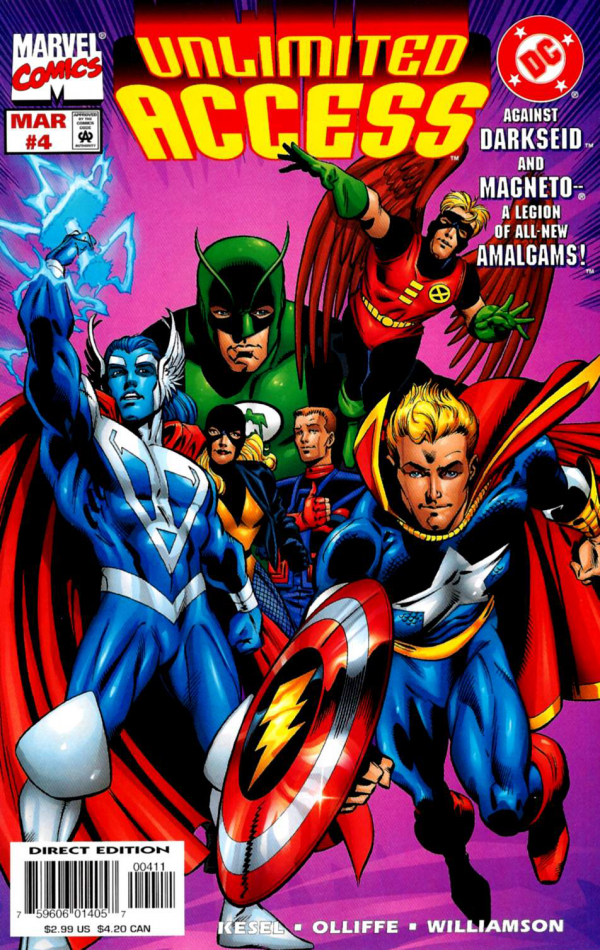
Something about Thor-El is kinda…compelling…

The last gasp – both for the Amalgams and for the Access concept of Marvel/DC Crossovers, came in the 1998 miniseries Unlimited Access by Karl Kesel and Pat Olliffe. The story starts with Access, the “Cosmic Hall Monitor,” popping back to his home in Marvel’s New York after sorting out a recent encounter between Spider-Man and Batman. Kesel implies here that this particular crossover had Access looking on from the background trying to keep things straight. As a concept, it actually would work to explain EVERY Marvel/DC crossover – Access, or someone like him, keeping an eye on temporary fusions between the worlds, which the respective heroes forget after the fact. If they decided to run with it that way.

Access has to untangle the appearance of Mantis – one of Darkseid’s lesser goons – in battle with Spider-Man, a fight that gets escalated when Juggernaut and Wonder Woman wind up in the mix. Things get even crazier when he takes Diana home only to find himself tangled in a fight between a still-savage Hulk and Green Lantern Hal Jordan…who is DEAD.

Superman doesn’t actually show up in the first few issues of this miniseries, so I’ll cut to the chase: as it turns out, Access doesn’t just bounce back and forth between universes, but discovers he can bounce back and forth in TIME as well, allowing him to meet the different versions of the Marvel and DC heroes from any point in the timestream (including the “Days of Future Past” X-Men from the distant year 2012). He’s also got the ability to create Amalgams, merging characters from the two worlds into one, which comes in handy when it turns out he’s being tracked by Darkseid, who wants his ability to traverse the worlds. By issue three, Amazing Grace has hypnotized the original Avengers and Justice League into battling each other, and Access decides to reach out for the only hero who stands a chance of fixing this mess: big blue himself, Superman. And I mean Superman during his electric blue era. It takes literally seconds for Superman to jolt everyone back to their senses, then he and Captain America mobilize the two teams to fight off Darkseid’s invasion of the Marvel Earth. But the crazy just keeps coming with the Brotherhood of Evil Mutants, the original X-Men, and a group of teen heroes who – just months later – would wind up getting their own title as Young Justice. 

By issue four, Darkseid and Magneto are teaming up to take over the world (this is early Magneto, when he was still into that kind of thing) and the heroes decide to combine their powers – literally – into a single strikeforce of Amalgams. Black Canary and Jean Grey: Jean Black! Giant-Man and Green Lantern: Green Goliath! Captain America and Captain Marvel Jr.: Captain America Jr.! I know, I didn’t write it. And of course, Superman and Thor are fused together as Thor-El. 

The fun part here is seeing these new Amalgams throw out casual references to help the reader to understand what they’re like in their own minds: Captain America Jr. possessing the “wisdom of Lincoln,” for example, or Thor-El referencing the Valhalla Zone. The series, and the history of Access, end with him accepting the truth about himself, beating Darkseid, and swearing to prevent a future he doesn’t want to experience. 

Reading this story again now, there’s so much potential left in this concept, and thanks to the nature of Access’s powers, there’s no reason that Marvel and DC couldn’t pick up on it again at any time. With new crossovers (finally) on the horizon between the two of them, the chance is right there. I don’t know if they’ll take it – I certainly hope so.

But for now, at least, our journey with Superman and the heroes of other worlds has come to an end. And I think it’s time to rededicate myself to stories focused around Clark Kent himself. That in mind, next week, I’m going to embark upon my re-read of the longest Superman saga I’ll have yet tackled for the Year of Superman blog. See you then!

Blake M. Petit is a writer, teacher, and dad from Ama, Louisiana. His most recent writing project is the superhero adventure series Other People’s Heroes: Little Stars, volume one of which is now available on Amazon. You can subscribe to his newsletter by clicking right here. You can join in the Kryptonian Konversation every day in the Year of Superman Facebook Group!

Year of Superman Week 18: Supermen of Other Worlds

Over the last few weeks, I’ve found myself dipping into stories of Supermen of Other Worlds. Not just Elseworlds, although those certainly apply, but other stories of other Supermen as well…books that were published during the time that DC wasn’t using the Elseworlds imprint or special event comics such as Just Imagine or the Tangent universe. This week, I decided it would be fun to get in and explore some of those other worlds. So for Week 18 – with a slight detour coming on Saturday – we’re going to spend some time with these Other Supermen. 

I’ve kind of had the “other worlds” in my head since I read the first volume of Earth One a few weeks ago. Reading that sent me towards Origin Week, which was fun, but it didn’t quite scratch the itch I have in my mind right now. I want to dig into the stories of Supermen from different worlds, reimagined from the ground up. Some of them, naturally, will be similar to our own, but not all of them. 

Wed., April 30

Comics: Superman: Earth One Vol. 2-3, DC Comics Presents #71, Secret Six Vol. 5 #2, Batman/Superman: World’s Finest 2025 Annual

What the Snyderbros wish they could do with the David Corenswet costume.

Notes: Since Earth One is what started me on this little trek, I decided to begin the Supermen of Other Worlds week by finishing that particular trilogy. At the end of volume one, if you’ll recall, Superman had driven off an invasion by the same force responsible for the destruction of Krypton, and Clark Kent used his exclusive ties to the Man of Steel to write an interview that landed him his job at the Daily Planet. In Volume 2, Clark finds a new apartment with a particularly friendly neighbor named Lisa LaSalle (because it doesn’t matter where in the multiverse you are, Kal-El is a magnet for L.L. names). As she tries to cozy up to him, Lois begins a deep dive into the past of her mysterious new coworker, the military makes plans for how to deal with an invulnerable man, and the Parasite is on the rise.

Volume 3 continues these stories – Lisa and Clark get closer, the fallout of Superman’s geopolitical actions in Volume 2 begin to reverberate, the most unique version of Lex Luthor in the entire multiverse is developed, and…oh yeah. Zod.

Reading these two books in tandem, it really strikes me how J. Michael Straczynski structured the graphic novels the way you would a season of a TV show. That shouldn’t be surprising, of course. Straczynski has a long history in television, including creating and writing most of the episodes of one of my favorite science fiction series of all time, Babylon 5. And although he’d written a great number of comic books at this point and brought some of those storytelling habits over, this is his work that most clearly feels like television. Each volume has an A-plot (the invasion of Earth in Vol. 1, the Parasite in Vol. 2, Zod in Vol. 3). Also, just like a TV show, there are several running B-plots of a more personal nature, such as Clark’s relationship with Lisa and Lois’s pursuit of Clark’s past. Then there are the ongoing subplots that build and develop along with the A-plot, such as the way the world’s governments are trying to figure out the “Superman Problem.” In a seasonal TV show format, it’s these third types of plots that run concurrently which usually wind up comprising the main arc of the season, gaining in prominence until they become the primary focus of the last episode or two. And I feel like this is exactly what Straczysnki had planned, had this series continued past Vol. 3. 

That’s the tragedy of it, I think. I really enjoyed all three of these books. And each of them was satisfying in the way that a single episode of a television series is satisfying. But Strazynski’s TV-writing style is evocative of the current style of longer arcs and stories (in truth, he pioneered that style with Babylon 5). There’s so much left to explore in this universe. I genuinely want to see what becomes of Clark’s relationship with Lisa. I want to know what this universe’s Lex Luthor has up her sleeve (yes, that’s the correct pronoun). And – given the sort of world-building Straczynski has proven himself capable of time and time again, not just with Babylon 5, but with his comic book work like Rising Stars, I want to see just how far this particular corner of the DC Multiverse diverges from the worlds we’re all more familiar with.

After volume three of this book, Straczynski stepped away from comics for a while. He’s back now, and doing work for AWA and Marvel, and I hope that the prospects of him returning to this series are still there, because I fully believe there’s more story left to tell. 

In terms of new comics, hitting stores today, we have Batman/Superman: World’s Finest 2025 Annual, part three of the “We Are Yesterday” crossover with Justice League Unlimited. In this one, Grodd has gone back in time to gather up younger, purer versions of the Legion of Doom to help him combat the new unlimited Justice League of today, but winds up fighting the League in two different timelines. Mark Waid is the co-plotter of this issue, along with scripter Christopher Cantwell. Together, they progress the story well, leading up to a great cliffhanger ending. I’m really excited for the second part of this crossover, the first in DC’s “All In” era. 

Thur., May 1

Comics: Just Imagine Stan Lee Creating Superman #1, Superman #9, Supergirl Vol. 2 #23

“And he needs to have an alliterative name, too, like ‘Clark… Clark…’ dang it, what name starts with the same sound as ‘Clark’?”

Notes: Back in 2001, the comic book world was shocked by the news that Stan Lee, the public face and most effusive promoter of Marvel Comics, was going to do his first-ever work for their Distinguished Competition. Lee, along with co-writer Michael Uslan and a plethora of top-notch artists, produced 12 one shots under the Just Imagine banner. In each one-shot, Lee took a different DC property and – using the name as inspiration – did his own take on the concept. Some of the new versions weren’t all that different from the original, while others had nothing in common except for the title. Stan Lee’s Superman was kind of in the middle. 

In Lee’s Superman, with art by his long-time legendary collaborator John Buscema, we are introduced to an alien police officer named Salden. When Salden’s wife, Lyella, is murdered by an escape convict, Salden chases the killer onto a hijacked spacecraft. The two of them crash on Earth, and Salden realizes that the planet’s lesser gravity has given him great strength, speed, and endurance. Trying to blend in, he takes a job at a circus using names he pulled off an ice cream truck and street sign: “Clark Kent.” “Clark”’s circus act is such a hit that he’s approached by a talent agent, Lois Lane, who dubs him “Superman” and begins booking him gigs. With his spacecraft destroyed, Salden has no way off Earth, and decides to use his abilities to fight the injustices of the world that he sees as distractions from the pursuit of science, hoping that if he can bring about world peace, the world will advance to the point where it can invent a craft capable of bringing him home. 

Like I said, as far as the Just Imagine books go, this one is about halfway between the “fairly similar” books like Wonder Woman and those that are utterly unrecognizable, like Green Lantern. This new Superman carries over his human name, and a new version of Lois Lane comes with him. His powers are very similar to the earliest Golden Age Superman, diluted compared to the Superman we’re all familiar with, but incredible to a populace that would have never seen such a thing before. And he’s still an alien, although the name of his planet is never revealed (Grant Morrison would later declare it to be this universe’s version of Krypton in the Multiversity series). 

Other things, however, are quite different. His motivation, first of all, starts with the very Stan Lee-ish goal of avenging his dead wife. (And although the people of Salden’s world don’t seem to have surnames, it’s worth noting that even Lee couldn’t resist the lure of the multiple-L supporting characters with Lyella.) His motive to become a hero is because he can’t think of any other way to get home. And his dialogue and behavior is kind Ben Grimm-ish in presentation. If Ben had gotten the strength of the Thing without his orange, rocky exterior, I think he would have been very close to Salden’s Superman. 

The Just Imagine characters haven’t turned up as often as some of the others we’ll glimpse this week, although they turned up here and there in various multiverse stories. In fact, I think Salden and several of this world’s other inhabitants were killed in one of them – Death Metal, maybe? I’m honestly not sure, and considering that the multiverse has been jerked around a few times since then, it may not even be relevant anymore. I do know that all of these characters turned up once more after that, in a special tribute edition DC published after Stan Lee’s death. He’s not the most memorable version of Superman, to be fair, but if I was the kind of person who dealt in puns the way an artist deals in paint, I might say he is the most “Marvelous” of all Supermen in the multiverse.

Okay, I’m exactly that kind of person.

In addition to the “Year of Superman” reading I do for this blog, I’ve also got several old and new comic book series I’m reading through via the DC and Marvel apps. I mentioned them in the log here, if there’s a Superman-family character involved, but I don’t always write about them. Today brought me to Superman #9, a Golden Age issue which I’m only bringing up for one reason. In the final story in this issue, Lois is captured by criminals, but they don’t immediately recognize her for who she is? Why not? Because she’s wearing a pair of glasses.

Man, whoever wrote that issue got jokes. 

Fri., May 2

Comics: Tangent Comics: The Superman #1, New Adventures of Superboy #34, Legion of Super-Heroes Vol. 2 #313, Superman’s Girl Friend Lois Lane #13

RIP, Jackson “Butch” Guice”

Notes: I didn’t think about this before I began this whole “Year of Superman” project, but in retrospect, I suppose I should have. It seems inevitable that, over the course of an entire year, somebody that we all closely relate to Superman would leave us. It happened a few months ago with Gene Hackman, and it happened again on May 1 with Jackson “Butch” Guice. Guice was a great artist, with work for lots of publishers over the years. He co-created Resurrection Man for DC Comics, and was doing variant covers for the current miniseries featuring the character. To Superman fans, though, he’ll be remembered most warmly for his run on Action Comics in the 90s, a run that included the Death of Superman saga. 

Guice’s artwork was pretty unique among Superman artists. His work tended to have a more photographic quality to it – poses and angles that looked like they had been pulled from the walls of a gallery. His men – Superman in particular – had a hardness to them. It was as if John Buscema’s characters somehow came to life and were captured on camera. It was a darker, harsher style than many of the other artists of the day, and that turned out to be perfect for the book documenting the Last Son of Krypton, aka the Eradicator.

It’s something in the eyes, I think.

I’d already planned on reading this book for Supermen of Other Worlds Week, but when I found out that Guice had passed away, I thought that moving Tangent Comics: The Superman to the front of the line was appropriate. Tangent Comics was a DC event in 1997 and 1998, each wave producing a series of nine one-shots set in an alternate universe in which the names of the DC characters, places, and various hangers-on still existed, but virtually everything else was different. The Superman starred Harvey Dent, a cop who had been born in a secret facility built by the spy agency known as Nightwing. Part of an experiment, Dent’s mother died in childbirth and he grew up an orphan. He eventually became a cop and led a fairly ordinary life until the day he tried to stop a jumper named Carter Hall from taking a plunge off a skyscraper. Dent failed to save Hall and, in fact, was pulled off the building WITH him. Rather than dying on impact, though, crashing to the ground unlocked something in his mind. As he recovered, he found he was developing mental powers – telepathy, telekinesis, precognition, and an intelligence that, once normal, was now skyrocketing off the charts. As his powers grew stronger, Dent grew colder, divorcing himself more and more from the humanity of which he had once belonged.

The idea behind Tangent was that only the name would be the same, and damned if that doesn’t live up to the concept here. THE Superman is absolutely nothing like OUR Superman. He strikes me more as a sort of Dr. Manhattan from Watchmen – a man whose power sets him apart from humanity instead of making him learn to respect it. By the end, he’s still acting as a hero, but there’s a darkness to him. This would become clearer in the later Tangent: Superman’s Reign miniseries, in which the Tangent heroes and the main DCU characters would collide and The Superman became the main antagonist. In truth, the Superman he resembles most closely is the one from Jerry Siegel’s original short story, “Reign of the Superman,” about a villain with great mental powers, before he came back and gave the name to a hero.

Mark Millar wrote the issue (more with him in a few days), with art by Guice, and the team was perfect. The dark story played to both of their sensibilities, creating a Superman that doesn’t match with any other in the multiverse, but still makes for a compelling read. I may have to dip my toes back into Superman’s Reign at some point.

For now, though, RIP, Mr. Guice. 

Sat., May 3

Comics: Free Comic Book Day Specials: DC All In 2025 Special Edition, Superman’s Good Guy Gang

My production assistant and I hope you had a great Free Comic Book Day.

Notes: Today is one of my favorite days of the entire year, Free Comic Book Day. My local shop, BSI Comics, graciously hosts me along with several other local writers and artists. I sell a few books, I talk to fellow nerds, I’ve made a lot of friends at FCBD. It’s the best. And also – free comics! DC’s offerings this year include a pair of Superman-related comics, so why don’t we take a look at them?

How many covers do you think Superman has punched through over the years? Twelve? Gotta be at least twelve.

First up is the DC All In 2025 Special Edition, a flipbook that gives us a look at DC’s Absolute Universe on one side and a preview of the upcoming Superman Unlimited on the other. The Absolute story is a devilish tease, as we watch a mysterious figure observing the heroes of this new universe, specifically Batman, Superman, and Wonder Woman. There are cryptic comments about some major danger approaching, then we get one of those double-page spreads DC loves to do from time to time where we see lots of notes and scribbles that all seem to point towards future storylines. DC’s been doing this kind of thing at least as far back as the 52 series in 2007, and it’s always fun, but also kind of frustrating. I feel like they overreach with these, often teasing stories that wind up never happening. Time will tell if these play out for us, but the final panel is a great little surprise that promises an upcoming major story.

The other side of the book is the one I’m more excited about, the preview of Dan Slott and Rafael Albuquerque’s upcoming Superman Unlimited series. The story opens up with the news of a massive expansion of the Daily Planet. There’s a new boss over the company that owns it, and she’s planning to expand the Planet from a “great Metropolitan newspaper” into a massive global media enterprise. This happens every so often – has been happening as far back as the Bronze Age, really, when Clark began to split his time between reporting for the Planet and being a news anchor for WGBS. Newspapers have had to evolve constantly since Siegel and Shuster chose that profession for Clark Kent back in 1938, and every few years DC tries to modernize the concept while still keeping true to the core of who Clark Kent is. I’ve got no problem with them handling it the way they’re doing here, but that’s not what’s most interesting to me.

I’m really here for the middle part of this story, which is where we get a feel for Slott’s take on the character. And I have to say, I like it. We see several vignettes of Superman averting disasters, saving lives, and making people simply feel better. He captures a crook who stops to thank him for saving Star City from Titano because his aunt lives there. A pilot in a plane that’s falling out of the sky tells his passengers that everything is going to be okay, and all they need to do to know that is look out the window. Little things that show the pureness of the character and the effect he has on people. It’s sweet, and it’s a great start. The story ends with a cliffhanger that leads into the first issue of the new series coming later this month and, as if there was any doubt, I’m there for it. 

The haircut on Guy looks just as good on a 9-year-old as it does on an adult.

DC’s other offering this year, as usual, is a preview of one of their all-ages graphic novels. This time, it’s Rob Justus’s upcoming book Superman’s Good Guy Gang. In this one, child incarnations of Superman and Green Lantern (Guy Gardner) find a strange winged woman stealing puppies and swoop in to stop her, unaware that a much bigger problem is looming. It’s a super quick read (no pun intended), and full of silly moments like Superman and Guy arguing over what the name of their superhero team is going to be. It is absolutely no coincidence that the characters chosen for this book also happen to be the ones who are going to be in James Gunn’s Superman movie, but that’s fine. This is a book for  beginning readers, and it’s great that they’re doing it, but it would be foolish to ignore the characters that are going to be in their next huge media event. It’s a charming little read, and I’ll be happy to pick up the full version for my son when it comes out in July.

Sun., May 4

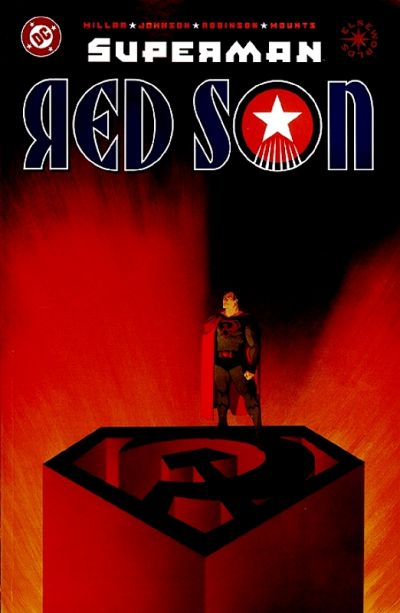
Comics: Superman: Red Son #1-3

“No, not Red SUN, Red SON. SON. S-O– It’s a PUN, David!”

Notes: I admittedly have a complicated relationship with the work of writer Mark Millar. When he does his own characters, with comics like Kick-Ass or Wanted, I find him hit or miss. When he works with established characters, I find that I rarely care for his stories. He often completely disregards characterization in favor of whatever story he’s planning to tell, and while that approach is okay when dealing with your own, original characters and you have the freedom to shape the characterization how you please, I am far less charitable when the work throws away decades of who a character is in favor of a plot point, the most egregious examples of which can be found in Marvel’s Civil War.

However, I find that he often does a good job with Superman. Early in his career he did a very entertaining run on Superman Adventures, the comic book based on Superman: The Animated Series. He wrote the aforementioned Tangent one-shot. And then there’s Superman: Red Son, perhaps the most acclaimed Superman Elseworlds series of all time. The supposition here is that the rocket that brought Superman to Earth landed not in the Kansas heartland, but somewhere in the Soviet Union. The child who would become Superman grew up indoctrinated with Socialist values, rather than American ones, and the world is rocked to its core as a result.

Millar does a lot of interesting things here. With Superman as a Soviet, the US government recruits its brightest mind – Dr. Lex Luthor, of course – to try to create some sort of countermeasure. With the U.S.S.R. completely ascendant, Princess Diana of Themiscyra makes contact with the outside world via the Russians rather than the Americans. And although we don’t know if there’s a little boy in America named Bruce Wayne, in Russia we see a tragedy that turns one of her citizens into this world’s version of the Batman.

The thing I find most fascinating is Millar’s take on who Superman is. In the prime DC Universe – and in most other iterations of the character – his personality boils down to someone who will always try to do what’s right, always stand up for injustice, and never turn his back on a cry for help. The Red Son Superman shares these traits, with the major difference being that his perspective on what is “right” is colored by socialist values rather than democratic ones. He’s still going to be there to save anyone – even an American – from a disaster like the falling globe from the top of the Daily Planet building, but when he sees the injustice of children standing in bread lines, he decides to use his power to put a stop to that by taking the control of the government that had been offered him after the death of Stalin, but that he had heretofore resisted. 

This whole thing is especially interesting to me from a sociological perspective. Superman at first rejects the notion of succeeding Stalin as the Soviet Premier because he knows people only want him because of his abilities, and the idea that his powers make him special goes against Socialist doctrine. But just like in the real world, he sees the inequities that have happened under Soviet rule and decides at the end of issue one to use his powers to fix them anyway. 

Book two takes the idea further. Superman has been in charge of the USSR for 20 years, and its influence has swallowed nearly the entire world. Only the USA and Chile remain holdouts, and both are hanging on by a thread. But there’s a mysterious Batman fighting against Superman’s rule, while back in the USA, Dr. Luthor is introduced to an alien power source that crashed on American soil decades before – a green one. While good-intentioned, Superman’s influence is beginning to atrophy human progress. People are growing careless, expecting their super-savior to take care of everything. Seatbelts go unused in cars, ships stop providing live preservers, all predicated on the idea that President Superman is going to take care of everything. When someone in his own government approaches Batman with an opportunity to take Superman down, Batman recognizes that the humans who would fill the void might be worse, but stopping him now may be the only way to prevent Super-rule that would last thousands or even millions of years.

There’s another time skip to book three. The Soviets have grown even more powerful and America is on the verge of collapse – until it elects Dr. Luthor President of the United States. Luthor’s unparalleled genius turns the country around overnight and Superman, who has been waiting for the US to finally collapse under its own weight and join their Soviet collective, realizes that it’s not going to happen. The climax of the story comes in a battle between Superman’s forces, Wonder Woman’s Amazons, and the American Green Lantern Corps, all of which coalesce in a turnaround for Superman that proves, even in this corner of the multiverse, he’s still the same man at his core. 

In a way, this entire story is a rebuttal to the whole “Nature versus Nurture” argument, demonstrating that BOTH aspects are of importance to the arc of a person’s life. And honestly, if that’s what Millar was trying to say here, it’s a sentiment I’ve always agreed with. Using Superman to put that idea forth works for me, and very well.

The end of the story is the real genius part of it though, and if you’ve never read Red Son, I don’t want to spoil it for you. Suffice it to say, it’s one of those conclusions that leaves you laughing ironically and calling the writer a magnificent bastard for coming up with such a thing. This isn’t my FAVORITE Superman of another world, but it’s hard to argue that it’s not, objectively speaking, one of the best stories of that sort that has been told. 

Mon., May 5

Comics: Superman: Secret Identity #1-4

Why DC based a comic on an obscure Jerry O’Connell TV show from the 1980s I’ll never know.

Notes: I’ve talked quite a bit in this blog about Mark Waid and how great a superhero writer he is, but although I eagerly place him at the top of the pyramid, he’s not there alone. Right up there, in my estimation, is Kurt Busiek. He’s the author of the phenomenal series Marvels and the creator of Astro City, which you’ll hear about again later when I do the week on heroes inspired by Superman. He also had a run on Superman’s regular title and he’s done work with the Justice League, most notably the JLA/Avengers crossover, in which Superman got to wield Thor’s hammer. Man, I should read that again before this year is out.

But his greatest work with Superman isn’t with “our” Superman at all, but rather the miniseries Superman: Secret Identity. An Elseworlds comic in all but name, this 2004 series was done with former Adventures of Superman artist Stuart Immonen, and was about a young man named Clark Kent from a small town in Kansas, but in a world where there are no superheroes and Superman is a fictional character. Whereas Waid is better than anybody at showing the wild, fun, grandeur of a superhero universe, Busiek’s greatest strength comes in humanizing superhero stories. Marvels was the history of the Marvel Universe through the perspective of a bystander. Astro City shows what it’s like to live in a superhero universe from a different perspective in every story. And Secret Identity is about being a hero in a world that doesn’t have them.

The concept is almost identical to the original version of Superboy-Prime, who showed up during Crisis on Infinite Earth as an inhabitant of Earth-Prime, which in the older DC Comics had ostensibly been the “real” world where the readers and creators of DC Comics live. This was before he changed to become a meta-commentary on toxic fandom, which I have to admit, was actually a pretty clever take. But Secret Identity takes the initial concept and keeps it contained, pure.

Clark Kent’s parents gave him the name because their last name was “Kent,” they lived in Kansas, and they thought it would be cute. Clark is not as enamored of his name as they are, having grown up being taunted for the famous name and spending every birthday getting laden with Superman-themed presents he couldn’t be less interested in. The boy grows up introverted, without any close friends and preferring to spend time alone. It’s on a solitary hiking trip that he suddenly, inexplicably begins to manifest the powers of his namesake. He begins using his powers to help people in secret, but it doesn’t take long before word of the flying “Superboy” begins to leak out. 

The four issues track Clark’s entire life story – growing into becoming a writer, although not a reporter, falling in love with a woman (naturally) named Lois, becoming a father. The government tries to track him early on, even capturing him at one point, before they settle into an uneasy alliance and “Superman” becomes a hidden force for good. Slowly, we watch how the world changes under his influence. More importantly, though, we see how HE changes over the course of a lifetime. 

This is a beautiful book. It’s almost not even accurate to call it a “superhero” comic. Yes, he has powers, and yes, he even wears the costume, but there are no supervillains, no world-threatening cataclysms…there’s not even really an antagonist. It’s a story about a life, with ups and downs and pitfalls and triumphs and success and tragedies. It’s a story about someone who is just like everybody else, with the obvious exception of being faster than a speeding bullet. It’s Busiek doing what Busiek does best. 

It’s also Immonen at his peak. I was always a fan of his work on the mainstream Superman, but this version is different. It’s still unmistakably his work, but there’s a softness to it that you don’t usually see when he’s drawing a mainstream story about Superman punching out Metallo or something. Looking at these panels, you see a different quality, a lighter touch. It looks almost like a fantasy world, which is rather fitting from the perspective of this Clark Kent, living what must seem to him to be a fantasy life. 

And unlike some of the other alternate Supermen we’ve looked at over the last few days, this is a Superman who hasn’t shown up again. In fact, I’m not even certain that this “world” has a specific designation in the current DC Multiverse the way the others we’ve looked at has. And if it doesn’t, that’s okay. There’s room for more stories of the Earth-One Superman, the Just Imagine Superman, or the Tangent Superman. But the Secret Identity Superman’s story is complete in these four volumes – complete and beautiful. This is one of my favorites. 

Tues., May 6

Animated Feature: Justice League: Gods and Monsters

Wait, which ones are the gods and which ones are the monsters?

Notes: Here’s a REALLY different Superman of another world. Bruce Timm, one of the architects of the DC Animated Universe that began with Batman: The Animated Series, returned to the characters with this film. It too was essentially an Elseworlds, even though it didn’t have the brand and wasn’t based on any pre-existing story. In this world, in the minutes before the destruction of Krypton, Jor-El and Lara are prevented from sending Kal-El into space by the sudden interruption of General Zod, who places his own son in the spacecraft bound to Earth. It is the Zod child, not Kal-El, who makes the journey across the stars, and the world becomes a very different place.

In this world, the Justice League is comprised of Zod’s son, now called Superman; Kirk Langstrom, a vampire Batman; and the New God Bekka, who has taken the name Wonder Woman. This Justice League is more brutal and far less forgiving than the League we’re accustomed to, and public opinion on the team is tearing the public down the middle. Things get worse when top scientists such as Victor Stone, John Henry Irons, Ray Palmer, and others are targeted by mysterious assassins with methods that seem to imitate those of the Justice League.

In a lot of ways, I’m surprised that this movie was even made. Granted, the whole “multiverse” concept has become mainstream now, but this is SUCH a different take on the concept that I feel relatively certain only Bruce Timm’s sway with Warner Bros Animation ever got this one off the ground. And it follows the classic Elseworlds pattern perfectly: it begins by showing what makes this world diverse from ours, it continues with an exploration of that world, and then it it follows a main plot that both tells a strong story and reveals corners of the world that are both similar to and very different from the one we’re accustomed to. 

Benjamin Bratt voices Superman in this one, with an edge that the Clark Kent versions of the character usually doesn’t have, but it works quite well in this one. We also get Tamara Taylor as Wonder Woman and, in what I have to assume was a meta joke in the casting department, we get Dexter star Michael C. Hall once again obsessed with blood as the vampire Batman. 

As this is the Year of Superman, though, rather than the Year of the Justice League, let’s focus on this movie’s version of our hero. Baby Zod lands in Latin America rather than Kansas, and is named Hector Guerra. As he grows up, he knows very little of his heritage on Krypton, unaware of where exactly he came from. And while he’s darker and more brutal than our Superman, he’s not his father either. Knowing more about his true parentage than he does, it’s natural for the viewer to expect some sort of face-heel turn, becoming the bad guy before the film ends. Well, spoiler alert – he doesn’t. He’s not OUR Superman, but he is A Superman, and like most of them, he’s there to protect people. It’s actually refreshing that he DOESN’T become the bad guy at any point.

The film ends on a hook that clearly leaves the door open to revisit this universe, but to date, it hasn’t happened yet. There were a few prequel comic books and a webseries that preceded it, but unless I missed something somewhere, we’ve yet to explore this world following the conclusion of the film. While I’m not exactly itching for more of the Gods and Monsters universe the way I am Earth-One, I wouldn’t be opposed to it either. It’s an interesting place, and there are more stories to tell. 

This was a fun week, looking at different, non-mainstream versions of our hero. And you know, there are an awful lot of other worlds out there in the multiverse. I may do this again before the year is up.

Blake M. Petit is a writer, teacher, and dad from Ama, Louisiana. His most recent writing project is the superhero adventure series Other People’s Heroes: Little Stars, volume one of which is now available on Amazon. You can subscribe to his newsletter by clicking right here. You can join in the Kryptonian Konversation every day in the Year of Superman Facebook Group!

Year of Superman Week Nine: The Beginning of the End…

As I have said many times, the golden age of Superman comics – for me at least – was the late 80s and early 90s, the period we now wax nostalgically for as the “Triangle Era.” I could honestly have just spent this year reading John Byrne’s Man of Steel miniseries (that’s still coming – at some point I’m going to do an “origins” week) and then continuing on until the triangles ended ‘round about 2000 or so. But instead, I made a list of some of the most important stories and high points of the time and, those that don’t necessarily fit into another theme I have planned, I’m trying to hit in roughly chronological order. And as of now, I’m only planning to read two of the longer storylines from the era (although I reserve the right to add more later if I feel I’ve got the room), and having moved forward appropriately in the timeline, it’s time to get into one of the defining storylines of the character. 

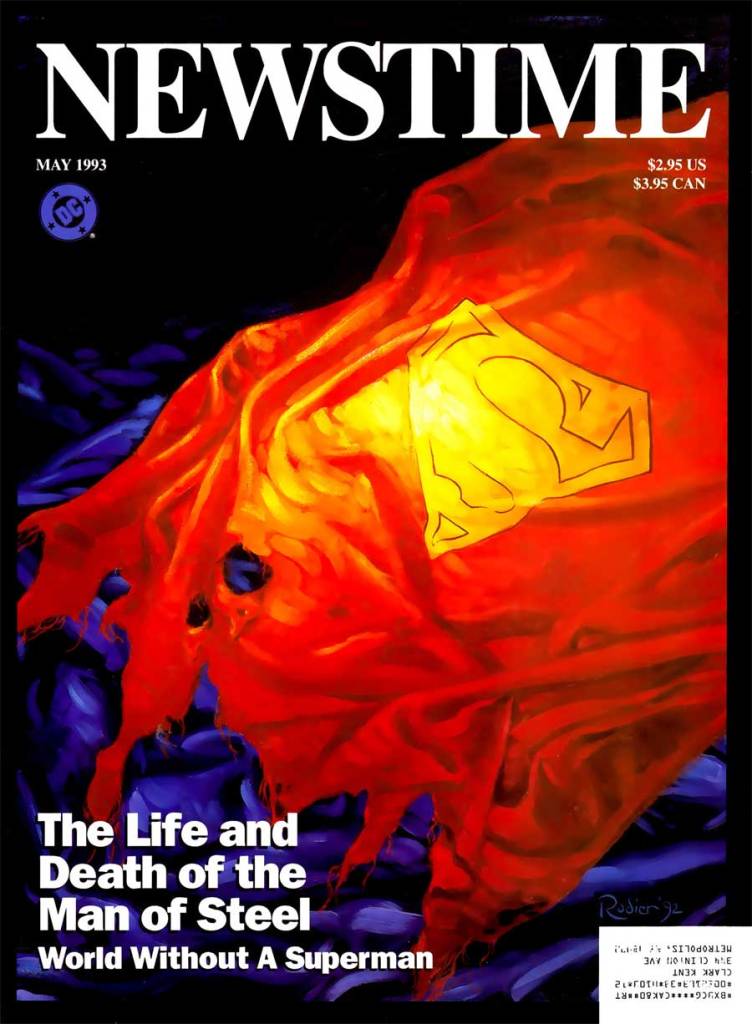
It’s October of 1992. I’m a 10th grade student with a subscription to the four Superman comics, eagerly awaiting their arrival each week and getting pretty darn mad when the US Postal service delivers them out of order (which happened, I must tell you, more than once). And even though I knew it was coming, even though it had been bandied about on TV and in newspapers for weeks prior to the beginning of the story, I didn’t know if I was really prepared for the story that — at the time – was called “Doomsday,” but that these days we typically refer to as “The Death of Superman.”

This was pretty much all I thought about for two months in the fall of 1992.

Wed., Feb. 26

Comics: Superman: The Man of Steel #18, Justice League America #69, Superman Vol. 2 #74, Adventures of Superman #497, Action Comics #684, Superman: The Man of Steel #19, Superman Vol. 2 #75

Notes: After a month of one-page prologues, the creature who would be known as Doomsday burst free from his subterranean prison in Man of Steel #18, and spends this issue stomping through the countryside, ripping up landscape and crushing animals before finding civilization. But the surprising thing, if you’re reading this for the first time, may be that Doomsday is the B-plot of this first issue. Most of the pages are used to deal with a running story from this particular series regarding a community of monsters in Metropolis’s underground. In the 90s, although the four separate Superman comics of the era continued into one another each week, each series tended to have its own subplots and stories to focus on, including the Underworlders. This issue also features Keith, an orphan who has befriended Superman and hopes to find his lost mother, and who would eventually be adopted by Perry and Alice White. 

I really love the Keith sequences in particular. The creative team on this book of Louise Simonson and Jon Bogdanove had previously done a wonderful run together on Marvel’s Power Pack, a comic book about a group of brothers and sisters who are all given powers by a benevolent alien. It was one of Marvel’s best comics of the era, and whenever Simonson writes children she brings a really authentic feel to them. Her children are inexperienced and naive at times, but never stupid or foolish. There is an inherent realism to her kids that I absolutely love. Keith was out of focus in the comics for a very long time, and with all the reboots that have happened over the years I wasn’t even sure he still existed in the DCU until recently, when Perry White was running for mayor and Keith showed up at an event with him. I hope, now that Perry is the mayor of Metropolis, we see a little more of Keith White.

Next up was what essentially was the end of Superman’s tenure with the Justice League, which had begun only nine issues before. The JLA is called in to stop Doomsday’s rampage, but Superman is on live TV doing an interview on the Cat Grant show and unaware of their battle, leaving his teammates to face the beast without their most powerful member. As Superman talks to a group of high school students, the League – if we’re being candid – gets their asses handed to them. Guy Gardner is hurt, Bloodwynd is chucked into a fire, and Blue Beetle is rendered comatose just as he was about to crack the mystery of who Bloodwynd really is. (If you remember a few weeks ago from the Justice League issues I read, that was Beetle’s primary preoccupation in this period, and if I may toot my own horn a mite, I remember solving that mystery myself when I read this issue, using the same clue that made it click for Blue Beetle. It wasn’t confirmed in the comics for several months, though.) The fight is intense, and rolls right into the next issue of Superman, #74. 

In fact, this was a running theme through the rest of this storyline. Each issue from this point on flowed seamlessly into the next and, starting with Adventures of Superman #497, each issue began to reduce the number of panels per page. Every page in that issue had four panels, the next three, then two, and in the final chapter the entire issue is told in full-page splash panels. What this does, essentially, is give the story a sense of ACCELERATION. Fewer panels means the story goes more quickly, each issue faster than the last, until we get to the final showdown on the streets of Metropolis in Superman #75. 

Superman #74: Superman joins the League to take on Doomsday. In the battle, Booster’s power suit is destroyed, Fire burns out her powers, Guy Gardner’s face is swollen so badly he can’t see, and Ice and Bloodwynd are taken down. The only one to escape unscathed is Maxima, and only because she leaves early to bring the near-death Blue Beetle to a hospital. 

Adventures of Superman #497: When Superman has to go back to rescue a family and his teammates from the house Doomsday destroyed in the previous issue, he gets a head start and starts creating havoc, taking down military helicopters and smashing into a small town before Superman can catch up to him. Supergirl (the Matrix version) sees the destruction on TV and wants to help, but her boyfriend Lex Luthor Jr. (long story, just read the Wikipedia explanation) holds her back. Maxima returns but is taken out in short order, and Superman vows to defeat the beast alone. 

Action Comics #684: The fight with Doomsday crashes into a department store, where a TV ad for an upcoming pro wrestling match at the Metropolis Area causes the beast to take notice of his destination: “Mhh-Trr-Plss…” A road sign that matches the advertisement points him towards Superman’s city as the Daily Planet helicopter – carrying Lois Lane and Jimmy Olsen – arrives to report on the carnage. The battle destroys an abandoned territory called Habitat, but the creature escapes and bounds towards Metropolis.

What it feels like being a teacher the week before a holiday.

Superman: The Man of Steel #19: Doomsday arrives in Metropolis. Cameras broadcast the battle across the world, including Smallville, where the Kents watch their son’s battle for his life on television. Supergirl finally is sent to help, but one blow from Doomsday disrupts her synthetic body and takes her out. Emil Hamilton and Bibbo (perhaps the greatest supporting character ever) bring a laser cannon to the roof to try to help, but to no avail. The Metropolis Special Crimes Unit open fire with everything they have, but they don’t even chip his hide. And in the end, Superman vows to draw the line in Metropolis.

When I read this story in high school, this issue was a great fight scene, sure, but like so many things it hits different for me now, as a parent. It seems quite telling to me that most people, like Jimmy, have the attitude that he’ll be OKAY. He’s SUPERMAN. He always comes out of it okay. But his parents, Jonathan and Martha, voice the fears of parents: “They don’t think anything bad can really happen to him.” The implication, obviously, is that the Jimmys of the world are wrong…and wrong he is.

Superman #75: The end. 

I remember distinctly the day this issue arrived in the mail. I got home from school before either of my parents got home from work, before the school bus dropped off my younger brother and sister, and I found this issue sitting in the mailbox. I brought it into the house, didn’t turn on the TV, didn’t even turn on the lights. The window in the living room gave me all the sunlight I needed as I slit open the plastic bag and opened the pages to witness the end of Earth’s greatest hero in quiet and solitude.

The story is swift, as befits an issue where every page is a single panel. Superman and Doomsday tear through Metropolis, trading blows until finally, with one last all-powerful punch, each of them collapse on the street. Lois rushes to his side and cradles him, his last words asking if Doomsday is defeated, his last thought for the city he was trying to protect, before the light fades from his eyes.

Yeah, I will admit, I cried when I read that. I still get misty today, even knowing that this was just the beginning of a much longer storyline it still hits like a kick to the gut. And even in 1992, when this was released, nobody really believed that Superman would stay dead. It was a story, and at the end of the story the status quo would be restored. That’s how these things went. 

It didn’t make it hurt any less.

This BROKE me.

And that’s what makes it one of the all-time great comic book epics, that I can read it again today and still feel that pang of loss I had when I was 15 years old. 

Man, this is a heavy way to start the week.

Thur., Feb. 27

When I woke up this morning, I went through my usual routine of showering, dressing, getting together a lunch for work, and then popping online for a few minutes until it was time to leave. Usually I want to see what the weather is going to be, if there’s any traffic snarls I should be aware of, that sort of thing.

I did not expect to begin the day with the news of the death of Gene Hackman.

1930-2025

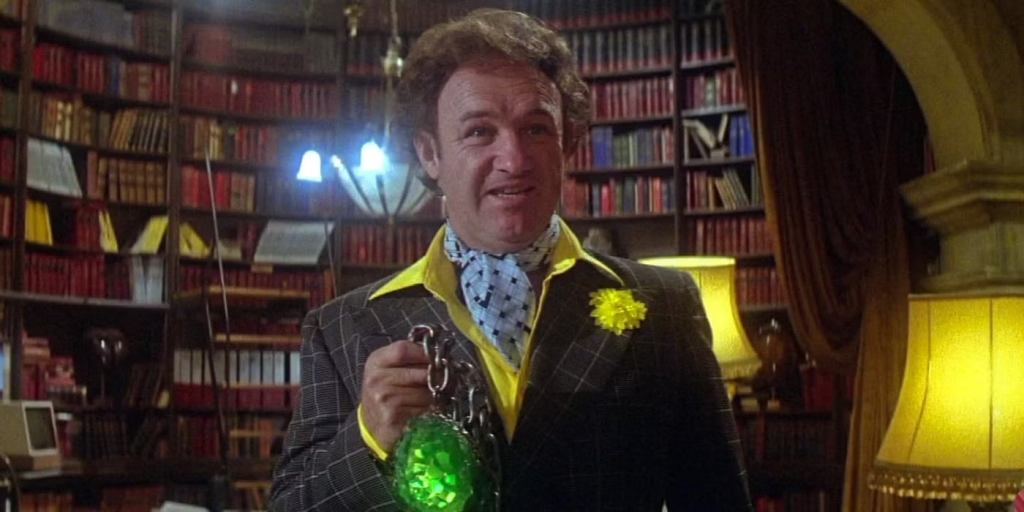
Hackman, of course, was a legendary actor, known for countless roles in dozens of classic films, but to me (and, I suspect, most people around my age) he is indelibly linked to the role of Lex Luthor. His Luthor was smooth, slimy, cheerfully manipulative and yet prone to brief outbursts of rage when faced with incompetence, which makes you wonder why he so often surrounded himself with incompetence. As much as Christopher Reeve shaped our perception of Superman and Margot Kidder our Lois Lane, so too did Gene Hackman shape our Lex Luthor.

As of when I write this, Thursday morning, the news is reporting that Hackman, his wife, and their dog were all found dead in their home in Arizona. Although foul play is not suspected, no cause of death has been determined. It goes without saying that my heart goes out to their families, those who knew and loved them personally. But also, it feels like a moment to raise a glass in tribute as another little piece of our childhood has left us forever. And at my age, it feels like we lose one of those pieces every other day. 

RIP, Mr. Hackman. See you in Otisburg. 

Comics: Death of Superman 30th Anniversary Special #1

Ah yes, “Death,” the traditional 30th anniversary theme.

Notes: Am I going a little out of order? Absolutely. But it feels more appropriate to read this now than to do so chronologically. In 2022, DC released this special with new stories by the same writers and artists behind the original Death of Superman event, followed up the next year with a special for the 30th anniversary of his return. I’ll get to that one too.

In the first story, Lois and Clark’s son Jon (still 10 years old, this is set before the Bendis aging controversy) in school when a familiar survivor of the Doomsday attack comes to talk to his class. This, as it turns out, is the first time Jon learns that his father died before Jon was born. I love this story – Lois’s talk with Jon is a nice sort of postmortem for everybody who read that story back when it was first published, encapsulating the feeling and emotion of the day while maintaining a bit of hope for the future. But as if that weren’t enough, we get a hell of a fight scene as well, as a construction worker who kept a chunk of Doomsday’s shattered bone all these years is suddenly transformed into a new version of the monster. The battle scene in the streets of Metropolis is pretty epic, and shows that Dan Jurgens hasn’t lost a step. It could have been published in 1992 and fit right in. It just makes it feel like more and more of a crime that he was bumped from Action Comics after issue #1000 when the status quo was upended. DC, I plead with you, find some way to have Jurgens writing and drawing Superman regularly again, preferably doing stories of Lois, Clark, and Jon in the past, like this one.

We also get three more stories, the first reuniting Adventures of Superman creators Jerry Ordway and Tom Grummett for a focus on Jonathan and Martha Kent. In the original “Death of Superman” we saw glimpses of the two of them watching the fight on TV. This story expands upon that, as they talk about some of the dark places and brutal battles their son had been in over the years. It’s a pretty good recap of the ‘86-’92 era of Superman through the eyes of the people who made Clark Kent the hero that he is. Martha’s Superman scrapbook is legendary, but this issue takes that concept one step further, showing the invisible impact Superman has on the world. It’s a really nice look at the character from a different angle. 

The third story brings back Roger Stern and Butch Guice, then the creative team on Action Comics, for a story starring Guardian at Project Cadmus, which was one of their ongoing subplot. The story shows the events of the day of Superman’s death from Guardian’s perspective, and although it doesn’t really offer any new insight into the story, it’s really great to see Guardian, Dubbilex, Dan Turpin, and some of the characters that were so important to the books at the time.

Finally, Man of Steel creators Louise Simonson and Jon Bogdanove return for a story about John Henry Irons, the man who will be Steel, and what happened to him during the Doomsday rampage. Having recently been saved from falling to his death by Superman, John Henry is determined to help him fight Doomsday, but as he follows the path of destruction, he find himself stopping at one disaster after another, pausing to save other people even as Superman fights for his life. This is why I love John Henry as a character so much – out of the four “new” Supermen that rose after his death, he was always the one who most embodied the spirit of Superman. With no powers, no weapons, without even the armor he would soon build, John Henry risks his life again and again to save others. And that’s what a Superman is for. 

Fri., Feb. 28

Legitimately some of the best stories of the era.

Comics: Justice League America #70, Adventures of Superman #498, Action Comics #685, Superman: The Man of Steel #20, Superman Vol. 2 #76, Adventures of Superman #499, Action Comics #686, Superman: The Man of Steel #21, Superman Vol. 2 #77

Notes: Although I can’t recall quite where, I remember reading an interview once with the creators behind the Death of Superman saga where one of them (probably Dan Jurgens) said that the stories that they were really interested in telling, the ones they found most compelling, were those from the “Funeral For a Friend” storyline. How does the world cope with the loss of Superman? How do we move on? How do we choose to honor his memory? The Doomsday story was a necessity to get them to that point, the “Reign of the Supermen” was the necessity to bring him back, but these stories are the heart of the saga.

Justice League America #70 picks up moments after the end of the battle with Doomsday, picking up the same dialogue – even the same narration – from the final pages of Superman #75. (And let’s hear it for Dan Jurgens, getting paid to write the same pages twice. Nice trick, sir!) The League is in a shambles: Blue Beetle comatose, Fire’s powers burned out and not returning, Ice injured, and Booster Gold’s future technology completely destroyed. As they try to pick up the pieces, the rest of the DCU’s heroes begin to assemble at JLA headquarters in New York to pay their respects to the fallen hero. It’s a touching book, with words of deep mourning and emotion that fit the grim day. For all intents and purposes, this was the end of Superman’s tenure with the League until it was restructured a few years later by Grant Morrison, but for what it was and when it was, this was a suitable ending.

Adventures of Superman #498 also picks up on the heels of Superman #75, showing the efforts to resuscitate the Man of Steel, and the ultimate futility of the attempt. This issue takes us everywhere: Supergirl tries to pull herself back together, Gangbuster is angry at himself for not being there, and in Smallville Jonathan and Martha Kent cling to one another and pray for a miracle. Somehow, even now, the thing that hits me hardest is the scene of Bibbo strapping on one of Professor Hamilton’s force field belts so he can withstand the jolt as he tried to hit Superman with hyper-charged defibrillator paddles. Bibbo is just one of those characters that’s too wholesome for the world – a big, gruff bruiser with the brains of a kid and the heart of a prince. The inherent goodness in him, in a man that the world would have cast aside, is what makes him such a perfect member of the Superman supporting cast. He’s another one we don’t see nearly enough nowadays. 

Action Comics #685 picks up that evening, as a Daily Planet extra edition announces the news no one wants to hear: “SUPERMAN–DEAD: METROPOLIS MARVEL KILLED IN ACTION.” Paul Westfield and Project: Cadmus get into a fight with Guardian and Supergirl over the right to claim the body, while everywhere else we see the world beginning to mourn. Meanwhile, at the Daily Planet, people are starting to worry about Lois. In the wake of the fight with Doomsday, thousands of people are missing – and one of them is her fiancé, Clark Kent. When they say that this is the section of the story the creators were most interesting in telling, this is the issue that I always come back to. The final page is one of the single most affecting pages I’ve ever read in a comic book, as Bibbo – having cleared out his bar so he can be alone – gets down on one knee, says a “Hail Mary,” and prays…not for Superman, but for the protection of the world he left behind. 

If this page doesn’t rip at your heart I’m not sure how to talk to you.

Superman: The Man of Steel #20 gives us the funeral. On a rainy day in Metropolis, millions of people line the streets to watch the processional as his body is brought to a hastily-erected monument in Centennial Park. In Kansas, meanwhile, the Kents hold a solemn, quiet ceremony of their own. Again, this issue shows us the impact of Superman on the world – people recalling the times he saved them, Batman deciding to take care of a guy with a bomb “Superman’s way,” and so on. We also get more of those Simonson-written kids that I like so much. 

In issue #76 of Superman, it’s Christmas! Doesn’t quite feel that way, though, with Superman gone. So in his memory the Justice League and a few others gather in Metropolis to carry out one of Superman’s annual traditions – reading and answering letters from people in need. This is a great issue, a sequel to an earlier story where we saw how Superman spends Christmas, and which I’ll no doubt read and write about this December. We also get a pair of subplots: Jimmy Olsen and Bibbo help out Mitch Anderson, the kid whose house Doomsday destroyed, and the Kents come to Metropolis with Lana Lang to hold a private wake with Lois, as four of the only people who knew who Superman really was. 

After this issue the stories take a turn. The immediate aftermath of his death and the period of mourning over, the story now becomes the struggle over his remains. In Adventures #499 we see that Westfield – defeated on the day Superman died – has burrowed into his tomb to steal his body for genetic experimentation. Action Comics #686 shows us that Cadmus is hoping to clone Superman, a storyline that obviously would become prominent later. Superman: The Man of Steel #21 takes us back to Smallville, where Jonathan’s memories of his lost son become overwhelming. In Metropolis, flooding helps Lois uncover the theft of Superman’s body, and takes the story to the front page. Finally, in Superman #77, after Supergirl and Lois recover Superman’s body and put it back where it belongs, Lex Luthor II (Lex pretending to be his own son) takes a moment to gloat in the tomb. In Smallville, though, Jonathan has been rushed to the hospital after collapsing in his field. After an issue of memories of his son, “Funeral For a Friend” ends with a chilling flatline.

The second half of “Funeral For a Friend” isn’t bad at all, but it’s there largely for setup. It plants a lot of seeds that would bear fruit in the upcoming “Reign” storyline. For pure emotional impact, the first half is one tearjerker after another, with a few more coming in the final two issues as Jonathan’s personal grief overtakes him. I know I say this a lot, but reading these issues as a parent makes them far, far more powerful than they were when I was a kid. As painful as it is to see Superman fall, seeing the utter devastation to the father who helped shape him into the hero he is may be the most heartbreaking part of the entire saga. 

Other Comics: Justice League of America #17, New Adventures of Superboy #32

Sat. March 1

Animated Film: The Death of Superman (2018)

Notes: Everywhere else, it’s just Saturday, but here in Louisiana it’s the weekend before Mardi Gras. And while I’m not a particularly enthusiastic paradegoer, my son is, and as such I make the effort to take him. Today was the Krewe of Lul parade, a nice little family-friendly small-town parade local to my community, and even better, I’ve got a cousin who lives on the parade route and always invites us to watch the parade there. It was a great day, and someone on one of the floats threw my son a ridiculously large stuffed snake, which my wife doesn’t yet know about as she had to work today, and I cannot WAIT to see her face when she gets home.

It’s got nothing to do with Superman, but c’mon, LOOK at this thing.

Parades are a little exhausting, though, especially when it’s hot outside, and I’m still a little too sun-dazzled to want to read anything today. So my Year of Superman continues at the moment with the 2018 The Death of Superman animated movie. This was actually the second attempt at animating the story, but as the first condensed the entire trilogy into one film rather than splitting it into two like this one, I’m waiting until after I finish reading the whole thing before I rewatch it. It’ll come soon enough.

Clearly, this is traditional carnival viewing.

This film was made during the period of DC animation where the movies were all set in a single universe largely based on the New 52 incarnations of the characters. As such, the story is tweaked appropriately to make it fit: the Justice League that faces Doomsday is that incarnation of the team rather than the Jurgens-era lineup, for example. And while Lois and Clark weren’t a couple in the New 52 era, here they’re in the early stages of a budding romance. Lois wants to keep their relationship a secret from their coworkers at the Planet, she hasn’t met his parents yet, and – probably most importantly – she does not yet know the secret of his duel identity. Other changes aren’t necessarily New 52 related, but help to condense the story: Doomsday’s coming to Earth, for example, is connected to the disaster that kills Hank Henshaw’s crew and sets him on the path of villainy he’ll occupy in the next movie. 

I’ve always been a fan of the voice cast here. It’s a little bit of stunt casting, placing real-life husband and wife Jerry O’Connell and Rebecca Romijn as Clark and Lois, but I like them both in their assigned roles. Rainn Wilson, meanwhile, is a deliciously wicked Lex Luthor, and Patrick Fabian has always sort of straddled the line between clean-cut and white collar crook, which somehow fits Hank Henshaw very well. We also get Rosario Dawson as a highly convincing Wonder Woman and Nathan Fillion as Hal Jordan, the Green Lantern that a lot of us thought he should have played in live action (although I have every confidence he’ll nail Guy Gardner). 

Pictured: First Officers Jack Ransom of the USS Cerritos and Una Chin-Riley of the USS Enterprise. (Colorized)

There’s a considerable amount of buildup here – it’s almost halfway into the movie before Doomsday’s rampage begins – but I think it’s necessary. This movie leans more heavily on the developing Lois/Clark romance, and that buildup is focused largely on that. We see Clark agonizing over whether to tell her his secret, Diana berating him for not telling Lois who he really is yet, even asking for advice from the soon-to-be-married Barry Allen about his relationship with Iris. That buildup to what should be the happiest moment of their lives, the engagement (and the reveal of the secret) is well-done, and thus when the battle with Doomsday begins and the inevitable happens, the whole thing feels even more tragic. The reveal is handled well too – I love the fact that Lois’s first reaction, once the shock wears off, is “This is so unethical! You’ve been writing stories about yourself!” The emotional resonance echoes after the battle too, as we see the Kents unable to get close to their son’s funeral, then see Bibbo’s beautiful prayer sequence recontextualized into a montage over the city in mourning. 

The animation isn’t my favorite, to be honest. The characters are a bit too blocky, and they’re using the New 52-era designs, which means excessive lines EVERYWHERE, and Superman’s suit is too dark and kind of bland. But once we finally get to the fight with Doomsday it’s brutal and pretty epic. The killing blow is actually far more graphic than I expected, with Superman actually hitting Doomsday hard enough to make his head spin around, and it doesn’t look “cartoony” at all. 

Also, Bibbo is in this movie. So, y’know, I like it. 

Sun. March 2

Comics: Superman Vol. 6 #23, Justice League Unlimited Vol. 2 #4, Power Girl Vol. 3 #18

But certainly, Doomsday must have mellowed out in the last 30 years, right?

Notes: I’m taking a quick break from the Death and Return saga to check in on this week’s new Superman-related titles. First up: Superman Vol. 6 #23, the latest in Joshua Williamson and Dan Mora’s ongoing saga. Doomsday is now the Time Trapper, and his control over the timestream is giving Lois a chance to pause while the contemporary Doomsday and Radiant battle it out in Metropolis as the Superman family tries to hold the line. I like what Williamson is doing here, using the original Death of Superman storyline (so I guess I’m not TOTALLY taking a break) as the framework for this new story, and giving us a neat focus on the characters . There’s a great speech from Lois when she talks about how she wept on the day Superman died, and how her tears may not have been for exactly the reasons one may have expected. It’s not a retcon, but rather a subtle recontextualization of the moment that I think actually works really well. And as usual, Dan Mora is killing it. I can’t say enough good things about his artwork. Over the past few years he’s become probably my favorite current artist in comics, and he’s earning his place on the Superman Mt. Rushmore with the likes of Curt Swan, John Byrne, and Dan Jurgens.

I’m not done with Mora yet, though – he also drew this week’s Justice League Unlimited Vol. 2 #4, this time teamed up with writer Mark Waid. The terrorist group called Inferno is unleashing havoc all over the world, with global fires crippling the Martian Manhunter and perhaps even killing Swamp Thing. In response, Mr. Terrific tries to recruit Alec Holland’s daughter Tefe, while Batman sees to the fallen J’onn J’onzz. Superman’s actual participation in this issue is minimal, appearing in just a few panels helping with the evacuation efforts from the wildfires while the big brains and the magic users try to solve the problem, but that’s actually one of the reasons I like this book so much. Waid has really stacked the deck by including virtually every hero in the DCU. It would be really tempting to still spend most of the time with the Big Guns, but Waid has done a great job crafting a story that allows for the lesser-known characters to rise to the front lines instead of Superman and Wonder Woman to be the A-team every single issue. It may be tangential to my “Year of Superman,” but it’s still maybe the best book DC is publishing right now.

Last but not least, Power Girl Vol. 3 18 continues Leah Williams and David Baldeon’s tale of the housewarming from hell. The grand opening celebration for the new Star building, complete with a bunch of guests from Asgard, is disrupted when a strange barrier traps everyone inside. Superman and Steel (John Henry) try to crack it open from the outside, while inside, Power Girl, Omen, and Steel (Natasha) attempt to get to the bottom of their predicament. This is an issue that feels very much like a middle chapter, incomplete and with a lot of questions. In and of itself, there’s nothing wrong with that, but I don’t know if they structure the story quite enough to get us started before the story begins. We kick it off with the barrier already in place, then after several pages, flash back to how we got there. I don’t object to in medias res, but I don’t know if it really works well for this issue. Hopefully the next chapter of this particular story will clarify things a bit. 

Mon., March 3

Comics: Legacy of Superman #1, Supergirl/Team Luthor Special #1

Notes: After the conclusion of the “Funeral For a Friend” storyline, DC took the rather bold – for the time – step of ceasing publication of the four Superman titles for a few months. They resumed in the spring with Adventures of Superman #500, and I have to give them credit for not doing what they would do today – namely, restart each series with a new first issue. Actually, in the gap they would have published four separate miniseries for the four Supermen who took his place, THEN restarted each series with a new first issue. But I digress. In the gap, they published a few specials about what was happening in Metropolis in the wake of the Death of Superman

Don’t get too attached to that kid in the upper right-hand corner.

Legacy of Superman includes five short stories about different defenders of Metropolis. First was a Guardian story, set during the time before Lois and Supergirl retrieved Superman’s body from Cadmus, about their efforts to map Kryptonian DNA. As several of the characters wrestled with the ethics of the situation, we are introduced to the hyper-advanced Guardian clone called Auron, a character who, as I recall, seemed like he was going to be more important that he eventually turned out to be. Next was a story that brought back the old character(s) Rose and Thorn. Rose Forrest is secretly the vigilante called Thorn – a secret that even she herself does not know. It’s what at the time was called Multiple Personality Disorder, or at least a comic book-level understanding of it. With Superman dead, crime in Metropolis is on the rise, and Thorn comes back to help out. It’s a perfectly fine story, but other than reintroducing Thorn, it’s not particularly significant. Of more significance is the Gangbuster story. The longtime Superman supporting cast member is trying to step up and fill his shoes, but the fight against Metropolis’s criminals is getting harder on him, wearing him down, and making him more brutal. Story number four features Sinbad, a young boy with telekinetic powers who had appeared in a three-issue storyline a few years prior. This story, like the issues that introduced him, was by the creative team of William Messner-Loeb and Curt Swan, and I’m pretty sure it’s the last time the character ever appeared. 

The last story features Waverider, and for reasons I cannot fathom, it is not included in the DC Universe Infinite edition of this comic book. I swear that app seems less and less Infinite all the time. Fortunately, I’ve got the week off work and I’ve got the issue in my collection. Waverider (from the Armageddon 2001 storyline) has at this point joined the Linear Men (from the Time and Time Again storyline) and, upon learning of Superman’s death, is determined to use their time travel powers to save him. That is until their leader, Matthew Ryder (an alternate-timeline variant of Waverider himself) starts listing people whose contributions to history could have been greater had they lived longer and asking where they drew the line. It’s a good argument, but I’ve always wondered why Dan Jurgens didn’t take it a step further to the logical conclusion – that manipulating time for your own ends is as dangerous as the enemies to the timestream you fight, and that doing so (even with good intentions) has rarely ended well.

Laugh if you want, but do YOU have hair that magnificent?

The Supergirl/Team Luthor Special has two stories. The first, by Roger Stern and June Brigman, focuses on Supergirl and “Lex Luthor II”’s private police force stepping up to help fight crime in Metropolis, similar to some of the stories in the previous volume. Louise Simonson writes the second story, where Supergirl encounters some of the Underworlders whose story has been one of the major plots in Superman: The Man of Steel. Both of these stories, while perfectly fine, seemed somewhat insignificant at the time. With the benefit of hindsight, though, I see that they were planting seeds for stories that would play out in the next Supergirl miniseries and the accompanying Superman titles featuring the collapse of Project: Cadmus, the fall of the Underworld, and the end of Luthor’s charade – stories that, I’m fairly certain, wouldn’t be published for nearly a year. They plotted things REALLY well, those Triangle Era Superman writers. 

Tues., March 4

Magazines: Newstime, Wizard Superman Tribute Edition

Did Jimmy win a Pulitzer for this photo, or am I just imagining things?

Notes: In addition to the two one-shot comics published during the Superman Gap, DC also released a one-off edition of Newstime, a fictional news magazine that Clark Kent worked for briefly in the comics. The magazine, featuring a “photograph” on the cover taken by Jimmy Olsen as Superman lay dying, is a sort of defictionalized artifact of a news magazine from the DC Universe, giving us in the real world a glimpse into how the DCU reacted to Superman’s death. There are, as expected, news articles written about the battle with Doomsday, the reaction of the world to Superman’s death, and the chaos that the Justice League was left in with Superman dead and so many of their members injured or powerless. The magazine fits really nicely in with the comics, with bits updating the status of some of the celebrities that were reported missing in the comic books after Doomsday’s rampage. Baseball player Hank “The Hammer” Halloran, you’ll be happy to note, survived the attack, but comedian and actor Morty Beckman died in a collapsing building. Daily Planet reporter and former Newstime editor-in-chief Clark Kent is still among the missing. 

Other things in the magazine are somewhat odd, like the article featuring quotes from assorted famous people about the death of Superman. Many of them are DC characters like Bruce Wayne, Lex Luthor II, Wonder Woman, and so on. Others, though, are from real-world figures, and they don’t all seem to be written from an in-universe perspective. A quote from William Shatner tells about how he used to dress as Superman when he was a child, Penn Jillette comments that Superman will have to die a few more times before he’ll be impressed, and John Goodman regales us with a bizarre story of his own personal encounter with Mr. Mxyzptlk following Superman’s death. I’m forced to wonder if some of these are legitimate comments they got from these people. After all, Superman’s death is one of the few comic book stories (especially back then) that made the major news cycles. 

The book finishes off with a few pages of fake movie and music reviews and lots of fake ads, and I have to give the DC crew credit for how well it’s all put together. Except for the fact that the “photos” are mostly panels taken from the comics, this looks and feel like a real news magazine, albeit much thinner than most of them. And just in case anyone thought that they’d let a book like this go without any foreshadowing, there’s a two-page ad early in the book that was meaningless when the magazine was originally published, but became quite jarring in hindsight just a few months later. 

😬

There’s one last thing I wanted to read from the “Death of Superman” era before we begin with the return tomorrow, and that’s this special Wizard Magazine tribute edition. I was a big fan of Wizard in its early years and was a subscriber for quite a long time. Eventually I got rid of all my old issues, a move which I now deeply regret, especially in the case of those few issues in which they published letters I wrote. But I held on to this Superman special, a nice little package released after the Death storyline but before the return really wrapped up. I haven’t read it in many years, though, and it’s interesting to go back and look at what the contents include.

Do you think anyone in comics has drawn versions of the same scene as many times as Dan Jurgens has this one?

There’s a piece by legendary Superman artist Curt Swan about his time with the character, to start. Jack Curtain provides a fairly comprehensive (although somewhat cynical) history of Superman, while Joel W. Tscherne gives us a good piece of the history of the post-Crisis Superman to date. Reading this article again, I’m jarred to realize that more time has passed for the most recent incarnation of Superman (the one we’ve had since DC Rebirth sort of merged the 90s Superman with the New 52 version) than had passed between John Byrne’s Man of Steel and the Doomsday story. Good grief, somebody get Waverider in here to make time slow down.

We get a retrospective on great Superman artists throughout history, a piece that is dying for a contemporary update to include all the greats who have worked on the character since then (including Stuart Immonen, Barry Kitson, Ron Frenz, Jim Lee, Ed McGuinness, Tim Sale, Frank Quitely, Alex Ross, Patrick Gleason, Jamal Campbell, and my current favorite Dan Mora – and that’s just off the top of my head). Next is a look ahead at the return of Superman, including interviews with the creators, especially Jerry Ordway, who ended his tenure as a Superman writer with Adventures of Superman #500. Then the writers for “Reign of the Supermen” talk about the four characters we’re going to meet very soon. Action Comics’s Roger Stern says that their Superman will be more “Kryptonian,” but cautions us that it’s not going to be someone trying to turn Earth INTO Krypton, like in the Eradicator storyline. Stern, you cheeky monkey. Ordway’s successor Karl Kesel talks about how Adventures of Superman will give us a more “modern” Superboy (he didn’t like being called that) who ties himself to WGBS, a TV station, rather than a stodgy old newspaper. Dan Jurgens talks a bit about the Cyborg Superman, although to me the part of this section that stands out is where he discusses Lois’s skepticism. Good for you, Lois. And Louise Simonson talks about John Henry Irons, even giving a lot of backstory about his family that I don’t know has ever been explored very much in the comic books, which is a shame. 

There’s a lot more in here, including a piece from Elliot S! Maggin about Superman as a pop icon, Andy Mangels talking about Superman’s history on TV and in film, and lots of other articles about various pieces of Superman’s history. I’ve gotten psyched to go back and read more of these, and I probably will in the coming weeks, but hopefully the stuff I’ve talked about will give you the impetus to dust off your copy (or find one on eBay) to go back and revisit this interesting time capsule of who and what Superman was in those months between his death and his return.

And speaking of his return…

…well, I’ll see you tomorrow. 

Blake M. Petit is a writer, teacher, and dad from Ama, Louisiana. His most recent writing project is the superhero adventure series Other People’s Heroes: Little Stars, volume one of which is now available on Amazon. You can subscribe to his newsletter by clicking right here. You can join in the Kryptonian Konversation every day in the Year of Superman Facebook Group!