As I sit down to write this, a little after 7 pm on the evening of July 23rd, I’m exhausted. My wife got three days off work in a row and so we decided to take a quick trip to Gulfport and Biloxi, Mississippi. We visited the beach, took in a Biloxi Shuckers baseball game, visited the excellent Mississippi Aquarium, and I even managed to squeeze in a visit to 3 Alarm Comics, one of the shops in the area. Now, Wednesday evening, I haven’t read anything Superman-related yet today, so I’m going to dig into the pile and pick something pretty much at random to pontificate about. I suspect the rest of this week will be kind of random too. Hope that’s okay with everybody out there.

And as always, you can check out earlier blogs in the Year of Superman Archive!
Wed., July 23
Comics: Action Comics #560
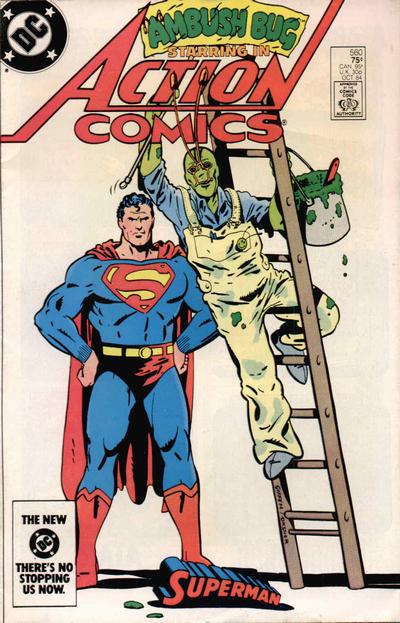
Notes: Off the top of my head, I can’t remember if I’ve mentioned Ambush Bug here in the Year of Superman before. I know I wrote about him a couple of months ago, when I suggested that DC collect his early appearances in their new Compact Comics line, but that’s a whole different animal, even if it is on the same website. Ambush Bug was a co-creation of Paul Kupperberg and Keith Giffen. Originally a villain, he was really more of an annoyance than a threat to Superman, and he got even MORE annoying when he decided to go straight and become a hero. Ambush Bug also beat Deadpool to the fourth wall breaking schtick by well over a decade (maybe more – I don’t know exactly when Deadpool started doing that bit). He’s fully aware that he’s a comic book character and had frequent conversations with his creators in the later issues in which he appeared.
Although he gets the cover of this issue of Action, Ambugh Bug doesn’t actually show up until the second story. The first one, “Meet John Doe” by Kupperberg and artist Alex Saviuk, features Superman facing off a villain calling himself…well…John Doe. The story kicks off with Doe escaping prison, then deciding to take out his frustration on the various institutions that kept him incarcerated for over two decades. When Superman encounters him he starts suffering from bizarre bouts of amnesia, temporarily forgetting things like his dual identity or some of his powers, and Doe gleefully takes credit for his sudden selective memory loss.
It’s a pretty standard early-80s Superman story, taking down a villain with a little bit of misdirection. Doe also isn’t even a memorable villain (although I suppose that’s appropriate enough), and I don’t believe he ever showed up again. The most interesting thing about this story is that Doe appears to be sponsored by a mysterious figure in a satellite calling himself the Monitor. The DC Universe, at this point in 1984, was already trying to put together the pieces for what would eventually be Crisis on Infinite Earths, but some of these early Monitor appearances really don’t make much sense in the context of who the character would eventually become.
Giffen flies solo on the Ambush Bug back-up story. In “Police Blotter,” the recently “reformed” Ambush Bug has moved to Metropolis and set up a private detective agency. Getting word of this, Clark Kent decides to investigate the investigator, only for Ambush Bug to suss out his secret identity before they even reach the bottom of the second page. From there, the rest of the pages are less of a cohesive story and more like assorted glimpses of Ambush Bug making his way through Metropolis by doing things like arresting a car with an expired parking meter and dragging it to the steps of the police station, then popping into the Daily Planet offices to pay his best pal Superman a visit.
I’ve read this story before. It was one of the earliest Superman stories I read as a child (I would have been six or seven when it was published and, while I don’t think I read it quite that young, I don’t think I was much older than that), and it was certainly my first exposure to what we now call meta humor. (Yes, meta humor was a thing back then. Meta humor has been a thing for hundreds — maybe thousands — of years, it’s only recently that we started to CLASSIFY it.) I know I didn’t get the joke about Ambush Bug not doing something particularly gruesome because Giffen had drawn him behind an office door – I don’t think I even knew who Giffen was at the time. I knew, vaguely, that somebody had to write and draw comic books, but I wasn’t particularly paying attention to the credits yet to see who those people were. Now, as an adult, I love this kind of stuff, and Giffen was one of the greats. The story is really funny, highly bizarre, and just the kind of thing that makes me want to read more Ambush Bug. The character still pops up from time to time, but nobody has really had a great handle on him since Giffen’s last go-round. I know that the way comics work he won’t remain in limbo forever, but I hope that someone who’s half as good as Giffen was gets their hands on Irwin Schwab someday.
Thur., June 24
Comics: Superman #327
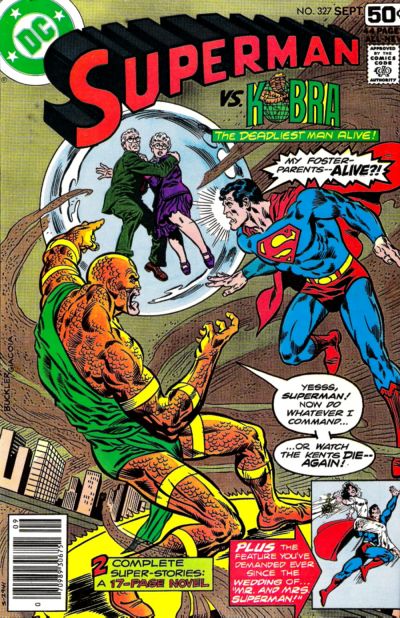
Notes: You know how you can get home from a trip and then the next day you feel like you’re in over your head? Even though our Mississippi sojourn was only three days, that’s what today has been like for me, catching up on a dozen different things and not realizing I still had to clock in the Year of Superman entry for today until late afternoon. But it’s been 205 days since I started this whole thing, and I haven’t missed a day yet. Being busy sure as hell isn’t going to do it to me. So I did the same thing I did yesterday, digging into my unread pile and choosing a fairly random book, in this case, Superman #327 from 1978. I picked this one, I don’t mind admitting, based on the cover. Kobra has captured Jonathan and Martha Kent! Superman has to do his bidding or they’re doomed! I was so surprised to see this cover, in which Kobra has clearly learned Superman’s secret identity, that I totally forgot that the pre-Crisis Ma and Pa Kent were actually already dead by the time Clark became Superman.
Anyway, the story begins with Clark Kent returning home to his apartment only to be attacked by Kobra and some of his stooges. Superman has never faced Kobra before (although some of his fellow Justice Leaguers have), but he has in his possession one of Kobra’s weapons, a teleportation gun, with a homing beacon that Kobra followed to Clark’s apartment, revealing his secret identity, which actually automatically puts him in the top 0.3 percent of every villain Superman had ever battled in terms of awareness. Kobra escapes, but later kicks up a sandstorm to draw Superman out. There he reveals that he’s plucked the late Jonathan and Martha Kent from the timestream about a week before their deaths, and if Superman doesn’t obey his every whim, he’ll…kill them!
It’s kind of a strange plan, isn’t it? Superman’s reaction is that he has to save the Kents because if they were to die it would change his personal history. And…I mean…it WOULD, but would having them die one week sooner really made that much of a difference? Don’t get me wrong, Superman should save them regardless, but the logic doesn’t necessarily track. Wouldn’t it have made more sense for Kobra, since he apparently can do this sort of thing, to pull the Kents out of time when Clark was a baby? Or when THEY were babies? The consequences would be much more profound, I think.
Anyway, Superman beats Kobra because Superman beats Kobra, but Kobra gets away and, at the end of the story, still knows Superman is Clark Kent. I really wonder where I have to follow this story to see how the cat got back in the bag.
The back-up story in this issue is a tale of “Mr. and Mrs. Superman,” the Lois and Clark of Earth-2, who periodically showed up in tales of their life as a married couple at this time. The newlyweds are moving into a new apartment when they’re nearly crushed by their own couch. Clark, naturally, saves the day, but it soon becomes apparent that their brush with death was no accident – Clark is being targeted by members of a criminal organization called the Colonel Future Gang for a series of expose’s he’s been writing, and they’re trying to take him out for good.
I’m gonna keep my lips shut on how this one ends because it’s actually really good. But what I WILL say is that it’s actually Lois and her razor-sharp brain that solves the problem this time around, and you guys all know how much I love it when Lois is played to the top of her intelligence. It wasn’t always the default back in the era when this story was written, and it was even rarer for the Golden Age Lois, who this story stars. It’s great to see her outsmarting the bad guys here, and I’m really pleased with this story. I don’t think these “Mr. and Mrs. Superman” stories have ever been collected anywhere, and DC should do something about that.
There’s actually a lot of stuff from this era that has been kind of lost. I suppose it’s a consequence of the fact that DC’s stories weren’t always on fire then. This was the period when Marvel was making moves with new characters that pushed the limits like Ghost Rider, Dracula, Power Man and Iron Fist, and the like. DC, on the other hand, was kind of coasting on the same characters they’d brought in during the Silver Age, with only Firestorm being notable as a new addition to the lineup in this period. And except for some of the Batman stories of the age, a lot of it has been forgotten. But that doesn’t mean that there aren’t stories from the 70s and 80s worth reading.
Fri., July 25
Comics: Jon Kent: This Internship is My Kryptonite #1, Green Lantern Vol. 8 #24

Notes: Late last year, DC Comics kicked off their “DC Go!” program on the app. It’s basically the same thing as the Infinity Comics Marvel has been publishing online for some years now. The idea here is that rather than breaking the comic book story into traditional panels, the story flows straight down from one panel to another in an “infinite” scroll. It’s something that’s been tossed around and done for years, but the Big Two are fairly new in the game. I’m lukewarm on the format, if I’m being honest. It’s an interesting idea, but it’s rare that the creators actually use it to its utmost potential. Every so often you have an artist do something interesting or innovative with the format, or at the very least use it to do an extended panel (most often somebody falling or climbing down a great distance). For the most part, though, it’s just a less-convenient way to read a story. The worst is when they take a comic that was traditionally published and chop it up to rearrange it in the Infinity format. It’s like colorizing a movie – you take something that was perfectly good in the first place and make it worse.
That said, even when they don’t use the format to its greatest potential, that doesn’t mean that there aren’t some really good stories told in the format.
However, This Internship is My Kryptonite is not one of them. The story here is that Jon Kent is getting an internship at the Daily Planet, and in this first issue, he meets his coworkers.
That’s…that’s it. That’s pretty much all that happens. And the thing is that those coworkers, and pretty much everybody else in the comic for that matter, are all the most annoying human beings ever put on a comic book page. Seriously, there is nobody likable in this comic book. Even Clark Kent, showing up briefly in a cameo, is just there for an “embarassing dad” joke.
Look, I give them credit for at least TRYING to do something with Jon. The character has been aimless for too long. But this is a poor fit. What they’re doing here is conceptually no different than a dozen other “young Superman” stories that were done with Clark. Furthermore, it doesn’t even appear to be canon, as in this story Lois Lane is NOT in charge of the Planet, as she is in the comics these days. So even if this WERE a good story (which, I must reiterate, it is not), it wouldn’t actually fix any of the problems we’re having with mainstream Jon Kent.
I don’t mind a little experimentation with comic book formats, but this particular experiment didn’t even make me want to read the second issue.
Sat. July 26
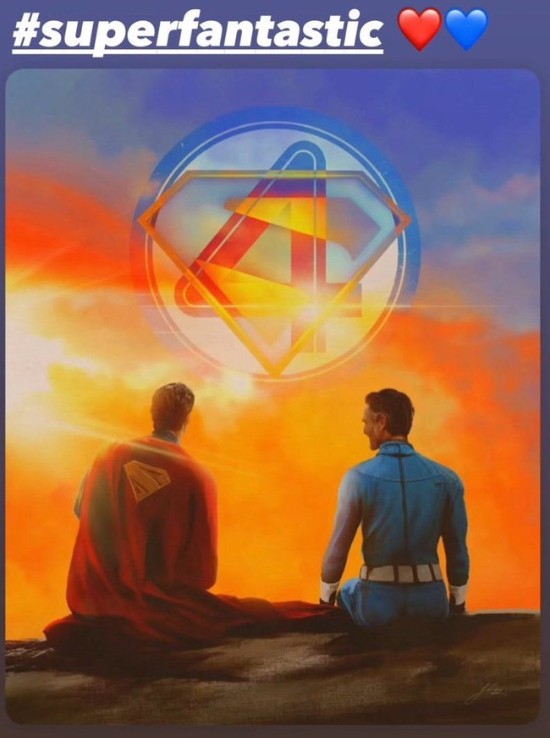
I just got back from taking my family to see Fantastic Four: First Steps. As I’ve made abundantly clear, my love for the Fantastic Four is second only to my devotion to Superman, and I’ve been waiting even longer for a good FF movie than I have for the rebirth of the Man of Steel. I also think it’s profoundly stupid, the way some people want to pit these movies against one another. There is room for both and I think that the success of one will only feed the other.
I don’t want to spend too much time talking about First Steps, as this isn’t the “Year of the Fantastic Four.” But I’ll definitely say this much: it is currently possible to go down to your local cinema and treat yourself to a double-feature of a great Superman movie followed by a great Fantastic Four movie. I never thought I’d see the day.
Comic Books: Superman Vol. 6 #28, Justice League Unlimited Vol. 2 #9, New History of the DC Universe #2.
Notes: After the movie, we rolled by the comic shop to pick up this week’s Superman-related titles. First up is Superman #28, the beginning of the “Darkseid’s Legion” story arc. Last year, in the DC All-In Special, we got a glimpse of a universe corrupted by Darkseid’s energy (the universe we’re seeing in the “Absolute” comics) and populated by a horrifying Legion of Super-Heroes. This issue promises to begin unravelling the mystery.

The story, by Joshua Williamson and Dan Mora, picks up after the Validus attack from the Summer of Superman special. Worried about his friends in the future, Superman returns to Smallville to retrieve his Legion flight ring before he sets out to visit them. Before he can depart from Smallville, though, he finds himself face-to-face with a Saturn Girl who – much like the Absolute Universe – has been inspired not by Superman, but by Darkseid himself.
The issue is a hell of a start to this storyline, with an insidious version of the Legion acting as the bad guys even as Clark reflects on the REAL Legion, what it means to him, and how it pains him that the future is always somehow in flux. Perhaps DC is finally planning to address the ways they keep warping this history of the Legion? It would be nice to settle it once and for all.

Justice League Unlimited continues with its ninth issue, an epilogue to the recent “We Are Yesterday” storyline. The League is trying to cope with the dual problems of restoring the time-lost heroes to their respective proper eras and, in a storyline that mostly follows Mr. Terrific, trying to find and rescue the lost and duped Air Wave, who the heroes now know was conned into turning against them in the battle with Grodd. It’s more Mark Waid goodness, with the League finding mistakes it’s made and the heroes trying to compensate. We’re also starting to draw together a few different threads here, with the appearance of the Doomsday/Time Trapper hybrid that’s been popping up in Superman and the return of the World Forger, a Justice League frenemy from a couple of relaunches back who is responsible for the creation of our specific world in the multiverse.
Waid has so much on his plate right now – this title, World’s Finest, Action Comics, Batman and Robin: Year One, and the miniseries I’m going to talk about next. With all of these pieces combined it really feels as though he has become the primary architect of the modern DCU. At the very least, it seems that everybody else has to run their respective pieces by him to make sure they all fit.

That other Waid project is New History of the DC Universe, the second issue of which hit this week. This issue starts with Kal-El’s spacecraft landing in Smallville and goes straight through to the original Crisis on Infinite Earths. Without spending hours recapping the specifics, it’s really impressive how Waid has managed to piece together the different continuities in ways that make sense. For example, he establishes that Victor Stone (aka Cyborg) WAS part of the team that fought back Darkseid and eventually became the Justice League, as seen in the New 52 version of the Justice League’s origin, but his injuries were so great that he had to be placed in suspended animation to heal. When he awoke years later, he joined the Teen Titans, as in his original origin. It’s a neat little workaround that manages to keep both of Cyborg’s “origins” mostly intact. The real test is going to come next issue, though. At the end of this one, Waid gives us the Great Crisis, including the death of both Barry Allen (who is narrating the series) and Supergirl. Explaining Barry will be simple enough – his resurrection story was part of the terribly inaccurately-named Final Crisis, but Supergirl? She never GOT a resurrection story. She died in Crisis, then the Man of Steel reboot happened and she never existed at all, then she came back in an updated version of her original origin. So I’m very eager to see what kind of slight-of-hand Waid intends to use to bring her back from the dead.
Sun. July 27

Essays: “The Kryptonian Alphabet: A Real-World Historical Tale” (2006) by Al Turniansky, “Superboy and the Legion of Super-Heroes” (2006) by Mark Waid, “The Superman Mythology: Animal Planet-Legion of Super-Pets” (2006), “Al Plastino Interview” (2003) by Glen Cadigan, “The Superman Mythology: Krypton Meets Camelot” (2006), all from The Krypton Companion.
Notes: It is a busy and scorching Sunday here in southern Louisiana. Early this afternoon, my family and I went to see a performance of Willy Wonka Kids, a half-hour reduction of the stage play that happened to star my niece, Maggie, in her stage debut (as Grandma Josephina, an Oompa Loompa, and the best squirrel I’ve seen since the Superman movie). Afterwords, we went out for lunch and did some grocery shopping before we came home and I filmed my LitReel for the week. I then took my usual hour to edit all the takes down to a tight three and a half minutes and set it to upload. FINALLY, I had time to sit back and pull out the DC Universe app to look for a Superman comic to read today.
Naturally, that’s when the internet went out.
It’s still out as I write this. My reel still hasn’t uploaded. It’s irritating as hell.
So I had a few options here. I could wait for the internet to come back – which isn’t really an option, as when this happens (and it happens far too often) there’s really no way of telling how long it will take to come back on. Could be 30 seconds, could be Tuesday. I could try to read a comic on my phone, but I hate reading comics on my phone. The screen is too small. I could dip into my stack of unread comics, as I’ve already done twice in this pretty random week in the Year of Superman, but like I said, I already did that twice this week and I didn’t really want to do it again.
So I went with option four and I pulled out The Krypton Companion again, the excellent book of essays and interviews about the history of the Superman mythology. I’ve read essays from this book before this year but it’s been a few months, so let’s dig in again.
Al Turniansky gives us “The Kryptonian Alphabet,” an interesting little story about the creation of…well, it’s right there in the title. Back in the 50s, he said, they would frequently receive letters from readers (kids, usually) trying to submit their own Kryptonian alphabet, which usually just consisted of 26 different “squiggles” that corresponded exactly to the standard English alphabet, much like modern Interlac as has been used in DC Comics for quite some time. In an effort to put a rest to that practice, editor E. Nelson Bridwell replied in a letter column that the Kryptonian alphabet actually had 118 characters, thinking that this would stop the kids from trying to come up with them. E. Nelson Bridwell clearly did not understand the fanaticism of the average comic book fan.
Mark Waid himself chimes in with an essay regarding Superman’s history with the Legion of Super-Heroes. There’s nothing particularly revelatory in this piece, it’s mostly just a discussion of how the Legion contributes to the Superman mythos itself, but it’s nice to hear some of the details from such an expert. This essay, in fact, was actually originally published in 2006, when Waid was the writer of Supergirl and the Legion of Super-Heroes, so he’s pretty much THE expert.
I also read through a nice short piece on the Legion of Super-Pets and an interview with classic artist Al Plastino, but the best thing I read today was “Krypton Meets Camelot,” a discussion of the famous story in which Superman works with President John F. Kennedy to promote his physical fitness program. Although it was written while Kennedy was still alive and scheduled for publication for Superman #168, it was promptly shelved upon Kennedy’s assassination. It didn’t actually see print until #170, at the request of the Johnson administration. The essay also briefly discusses some of the other appearances of Kennedy and other presidents (especially Abraham Lincoln) in comics. This reminds me that I haven’t actually re-read that Kennedy story for the Year of Superman, and I probably should.
I would check right now to see if it’s available on the DC Universe Infinite App but…well, you know. No internet.
But with summer coming to an end entirely too soon – I return to work to begin preparing for this new school year on Friday, August 1 – I suspect I may be turning to the Kryptonian Companion a bit more often when I’ve got a day where I’m short on time and I need a quick dose of Superman to keep my streak alive.
Mon. July 28
Friday is getting closer whether I like it or not. Today, the last Monday of my summer, my wife and I took Eddie down to the school where they helped me start putting my classroom together for the new school year. Rearranging furniture, unpacking and re-shelving books, putting up decorations, and most of all, getting together my Geek Corner. I think everybody needs something like my Geek Corner. It’s the little section of my classroom by my desk where I surround myself by my own nerdy stuff. Erin always puts together a collage of pictures – mostly comic book characters – that I’ve clipped out of Previews and other assorted catalogs and magazines over the past year. Then, on the bookshelf behind my desk, I put up a worthy collection of Superman stuff.

There are, it’s safe to say, a couple of dozen Funko Pops of various sizes, other figures, figurines, and statues, a plush doll, some Hot Wheels and Corgi Cars, and probably other things that I’ve forgotten about but that you can enjoy in the pictures I’m sharing here. The prize addition to the collection this year, though, is the Daily Planet popcorn “bucket” I picked up the day we saw Superman in theaters. I’d hoped to squeeze in a second viewing of the film before school starts up, but it seems pretty unlikely that will happen, with our schedule for the next few days being what it is. But I hope the rest of you guys keep seeing it again and again, and you can be assured I’ll be preordering the Blu-Ray as soon as it’s available.
Getting home from school in the mid-afternoon, it’s time to find some Superman stuff to read today.
Comic Book: Superman #170
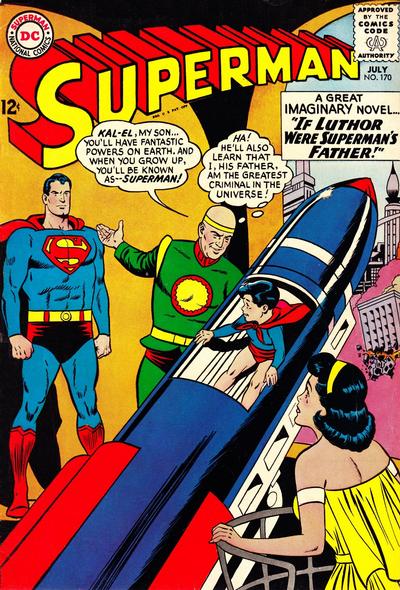
Notes: Still thinking about the essay I read yesterday regarding the Superman/Kennedy comic, I thought it would be interesting to go back and read that one again. The story, frankly, is kind of dull. Superman saves a group of international hikers trapped by an avalanche, upon which Lana Lang realizes the European survivors are peppy and ready to move, whereas the Americans are slow and sluggish. Superman meets with Kennedy about helping to promote the President’s physical fitness program, which turns into Perry White forcing the staff of the Daily Planet to join him in assorted exercise activities, which causes Clark to constantly have to find ways to fake feeling more exhausted than he actually does. The ultimate comes when the crew is caught by a cave-in. When Perry, Lois, and Jimmy see Clark lifting the boulder effortlessly, they realize he’s been fooling them for years and is, of course, secretly Superman.
Haha! Just kidding. No, Perry immediately assumes that his noodle-armed schlep of an employee has been so beefed up by the new Daily Planet fitness regimen that he has – in just a few days of exercise – gained the ability to heft an enormous chunk of rock. That is one hell of a program, Perry. Just…astonishing.
The story is of greater interest as a historical footnote than as an actual story, to be honest. The back-up story is a bit more entertaining: “If Lex Luthor Were Superman’s Father.” In this story Luthor comes up with what I think we can all agree is the greatest evil scheme in the history of evil schemes. Settle down, this one is a doozy:
Step One: Escape from jail.
Step Two: Travel back in time and journey to the planet Krypton BEFORE Jor-El and Lara get married.
Step Three: Pretend to be a hero, “Luthor the Noble.”
Step Four: Make Jor-El look bad and make Lara fall in love with and marry HIM instead.
Step Five: Sire Kal-El (why he would be named -El if Jor-El isn’t his father is beyond me) and then wait a few years for Krypton to blow up.
Step Six: Return to his own time where Superman, being a dutiful son, cannot arrest his own father, allowing Luthor free reign to commit crimes.
The wildest thing is that this plan almost WORKS. He makes it all the way up to Step Five and has Lara on the altar (which apparently was a giant wedding jewel on Krypton) before a special device he’s wearing to protect him from Krypton’s greater gravity suddenly runs out of power, pinning him to the floor. Before he can be rescued, he confesses that he’s actually from Earth. He manages to hop into his time machine and escape back to Earth before he can be thrown into the Phantom Zone, only to immediately be picked up by Superman and returned to jail.
This is a truly insane plan, even by Silver Age standards. And despite the fact that the cover calls it an “imaginary story,” the way it ends (with Jor-El and Lara reconciling) it still quite easily fits into the actual canon of the Silver Age comics. And if I may be a little crude, it’s ridiculous how funny it is that Luthor’s ultimate plot to render Superman ineffective forever boils down to being able to say “Hey, Kal-El, I banged your mom!”
Tues., July 29
It is a million and twelve degrees outside and I’ve got two days left before I go back to school. My drive, if I’m being perfectly honest, is absolutely drained. I want to read Superman, but I don’t want to dig into anything that’s going to take me all day either, because I’ve got to bring my son to the library and to a therapy appointment and then, right after that, I’m taking my wife out for one last dose of summer fun – a Weird Al Yankovic concert that we bought tickets to nearly a year ago. So I’m going to find something quick today. Ah – here we go!
Comic Book: Superman Vol. 2 #1

Notes: I, of course, wrote about John Byrne’s Man of Steel reboot back during “Origins Week,” and some of his other Superman stories have peppered the blog, but I have not, previously, taken the time to look at his first issue as the regular, ongoing Superman writer and artist. And as it’s a mostly self-contained story, and the fact that it’s got “First Issue” stamped on the cover in big, red letters, it feels like this would be a good quickie to dig into today.
Whereas Man of Steel took long gaps in-between issues, skipping years to get to the “present day” of the DC Universe, Byrne’s first issue of Superman picked up only weeks after the final issue of his miniseries. Superman has only recently discovered the truth of his Kryptonian heritage, and now he’s seeking the rocket that brought him to Earth, which was stolen from the Kent farm. He eventually tracks it down to an empty warehouse, where its sole inhabitant has been dead for weeks.
Later, as Clark meets Lois for a jogging date, they literally run into a bank robbery being committed by a towering bull of a man who introduces himself as Metallo, the man who will kill Superman thanks to his Kryptonite heart. Metallo, it turns out, was built by the dead man Superman had tracked down earlier and was powered by a chunk of Kryptonite that had hitched a ride on Kal-El’s rocket (which you can see strike the rocket on–panel in Man of Steel #1 – give Byrne credit for planning ahead). Metallo has Superman on the ropes before he’s picked up by a strange craft. Superman survives the encounter but is more nervous than ever about his unknown rescuer…as well he should be, as the readers are aware that Metallo has been taken by Lex Luthor, who has the attitude that nobody is allowed to kill Superman but him.
I’m reminding myself, as I read this, that this was the first issue of Superman following the relaunch, and there’s a fair possibility that a lot of people who picked it up hadn’t read the miniseries. So what if this was somebody’s first exposure to Superman? If that’s the case, there are some VERY interesting choices in here. First of all, let’s talk about Lois and Clark’s relationship. Lois is still bitter about Clark scooping her on the day Superman first arrived in Metropolis, but his persistence seems to have worn her down. She as much as admits she finds him attractive, but pushes back against his advances. Clark, to his credit, is adamant that he wants to win Lois’s heart, but he wants to do it as HIMSELF, not as Superman. If all you knew about Superman before reading this was Silver Age stories or the dynamic from the Christopher Reeve movies, you get a sharp change in what is expected. This is a dynamic that I greatly prefer, and Byrne is building up these two characters really nicely.
Metallo’s re-imagining is handled well. He’s constructed specifically to take out Superman, built by a man who has convinced himself that Superman is an alien invader. It’s the standard excuse for anti-Superman villains, of course, but I don’t think it was quite as overused in 1987 when this was published, so I won’t take points off for that. Even if it were cliched, it’s still a huge step up from Metallo’s original Silver Age origin, in which he was made into a cyborg by a well-meaning scientist who just happened to let it slip that Kryptonite was an element that could power his heart. Oh, and that Metallo himself was one of those ridiculously convenient dopplegangers of the era, somebody who just HAPPENED to look almost exactly like Superman. That happened inexcusably often in that period, and it frankly irritates the hell out of me every time I see that trope turn up.
The fight scene is really unexpected, if you think of it from a historical perspective. Once Metallo turns up the juice on his Kryptonite, it’s a curb-stomp battle, and it doesn’t look like Superman stands a chance. Byrne! What were you doing? It was Superman’s first issue and you had him get his ass handed to him by Metallo, only to be saved by LEX LUTHOR! It’s ridiculous! And impossible! Isn’t Superman ALWAYS supposed to be completely infallible and indestructible? He’s NEVER been hurt in nearly 90 years of his recorded history! He has absolutely NO vulnerabilities!
At least, that’s what those three guys still whining about the James Gunn movie would lead me to believe.
No, it IS surprising that Byrne starts off his series with an inarguable loss, but it fits into the arc he’s telling, which began in Man of Steel and continues on into the next issue. I considered reading issue #2 today as well, but I’m actually planning a Lex Luthor week at some point, and it’s just too good an issue not to include when that happens.

I also returned to the DC app this week to read the first issue of another of the DC Go! comics, Taste of Justice. In this one, set in the early days of Lois and Clark’s relationship, it’s Clark Kent’s birthday (and they’re sticking with the Feb. 29 date, as in Alan Moore’s work), so Lois Lane decides she wants to do something special and cook his favorite meal, Beef Bourguignon. The only problem is, for all the things she’s great at, Lois Lane can’t cook, so she calls in Perry White to help her out.
This is a cute story. In large part, it’s about how to cook the specific dish, and I assume that’s going to be the format of this series: each issue showcasing a DC character cooking something for some reason. It’s a weird format, but it makes as much sense as the Superman Vs. Meshi manga series where he literally spends every issue talking about his favorite food at different Japanese chain restaurants. Anyway, while I wouldn’t necessarily try to cook the dish based on the instructions in this comic (Perry frequently neglects to mention things like the quantity of ingredients or cook times), I can definitely see myself looking up real recipes for foods I read about here. The story itself has a sweetness to it, with Lois trying to do something nice for the guy she’s falling in love with and being willing to reach out for help from someone she trusts when she needs help. There’s a vulnerability there that she doesn’t usually show, and it makes sense that Perry White is the one who would get to see it.
It was a low-key week, guys, but honestly, I kind of feel like that’s what I needed. I hope you enjoyed it anyway, and here’s hoping I’ve got something more exciting next Wednesday.
Blake M. Petit is a writer, teacher, and dad from Ama, Louisiana. His most recent writing project is the superhero adventure series Other People’s Heroes: Little Stars, volume one of which is now available on Amazon. You can subscribe to his newsletter by clicking right here. You can join in the Kryptonian Konversation every day in the Year of Superman Facebook Group!



 Blake M. Petit