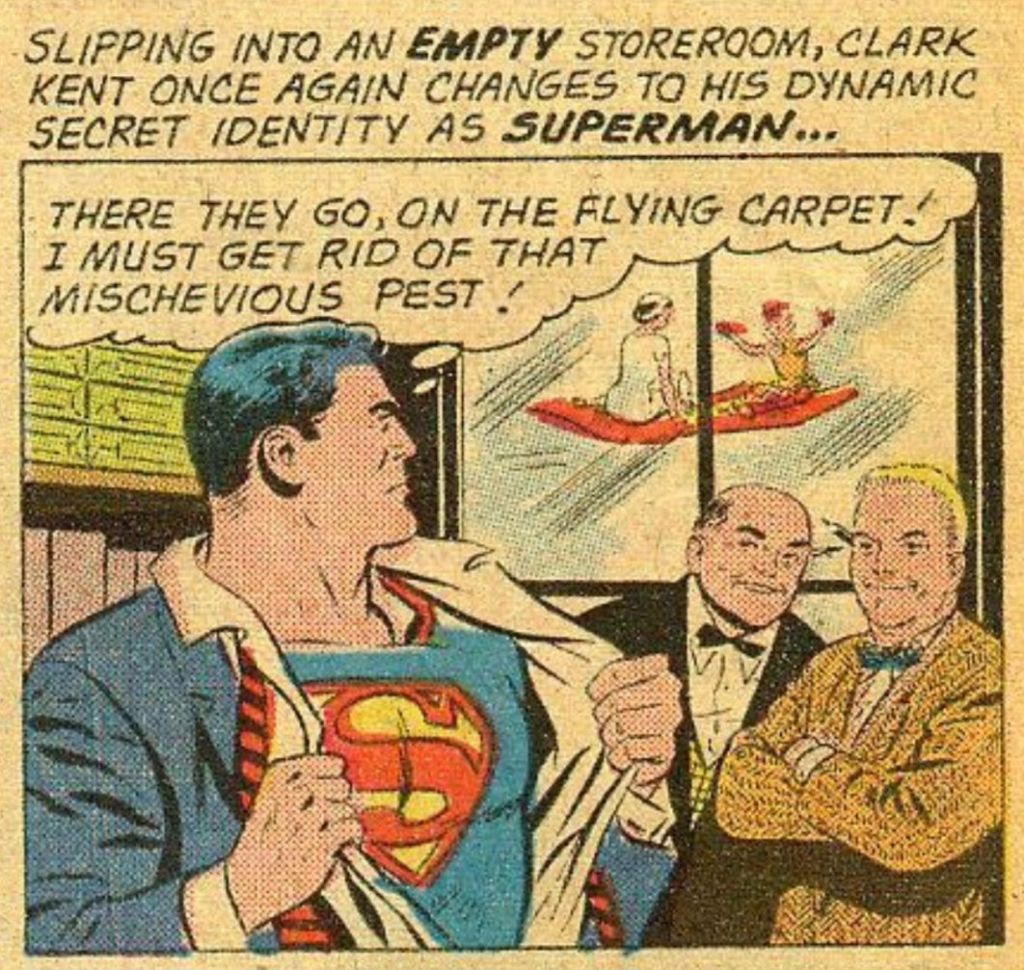
Year of Superman Week 23: Superman and the Legion of Super-Heroes

If you ask Joe Public what team Superman is a member of, pretty much everyone will bring up the Justice League. And they’re not wrong – Superman is a vital member of the League, and honestly, it doesn’t really feel like the JLA without the trinity of Superman, Batman, and Wonder Woman. (I love the Giffen/DeMatteis run, don’t get me wrong, but that’s the JLI.) But the thing is, the Justice League isn’t the FIRST team Clark Kent was a member of. And in truth, as far as his development as a character, I don’t think it’s even the most important. This week we’re going to look at the young people he inspired and who, in turn, helped shape him into the hero he is. Superman would still be Superman if he’d never joined the Justice League…but he’s not really the hero he is without the Legion of Super-Heroes. 
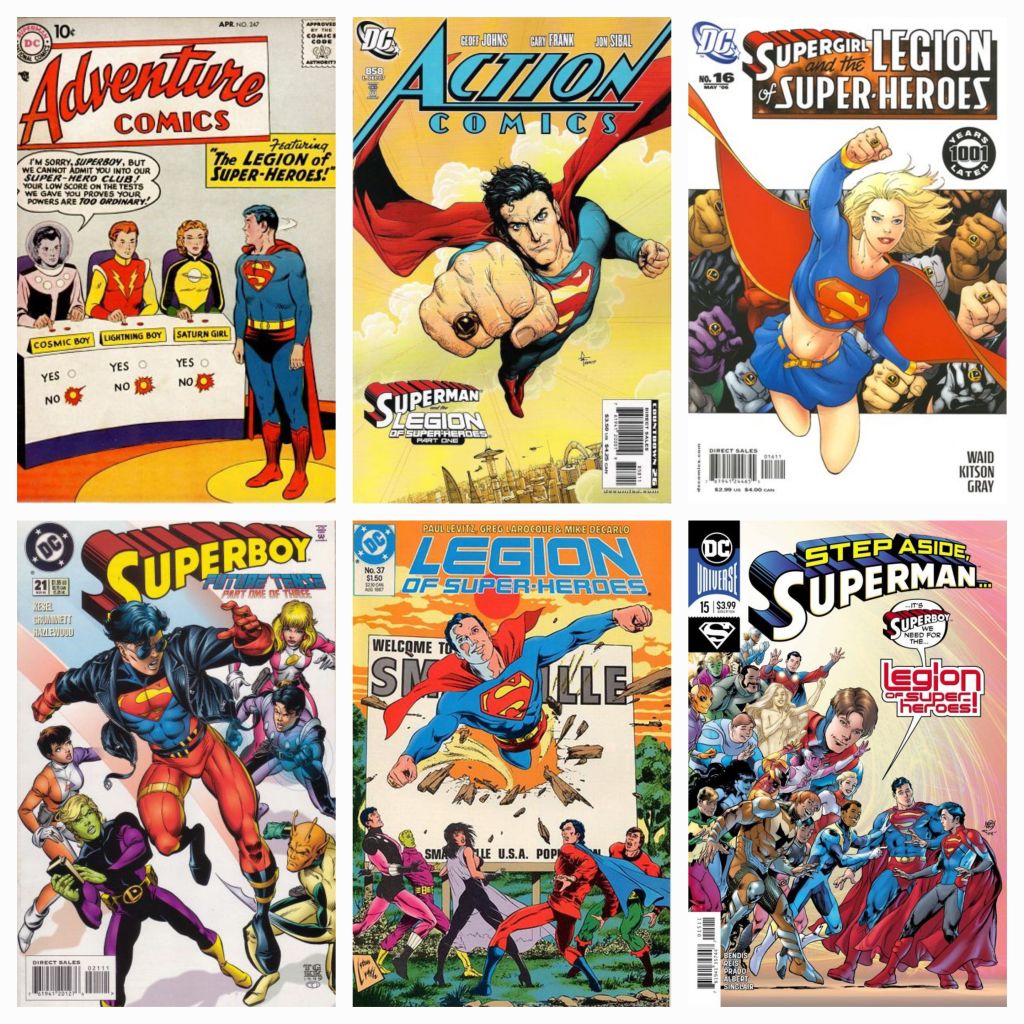
And the same goes for Superboy. And Supergirl. And Jonathan Kent, too. Because of reboot after reboot, there have been a lot of versions of the Legion over the years, and Clark, Conner, Kara, and Jon have each had their own incarnation. This week I’ll try to peek at each of them, talk about why the Legion matters so much to Superman, and discuss the best (and worst) of the 31st Century’s greatest heroes. 

The Legion is kind of complicated these days, thanks to DC’s constant rebooting of their timeline. If you aren’t already familiar with them and you’re looking for a little clarification, I wrote about their convoluted history in this Geek Punditry blog a couple of months ago. Please, go check it out. 

And as always, you can check out earlier blogs in the Year of Superman Archive!

Wed., June 4

Comics: Adventure Comics #247, Action Comics #276, Absolute Superman #8, Justice League Vs. Godzilla Vs. Kong 2 #1
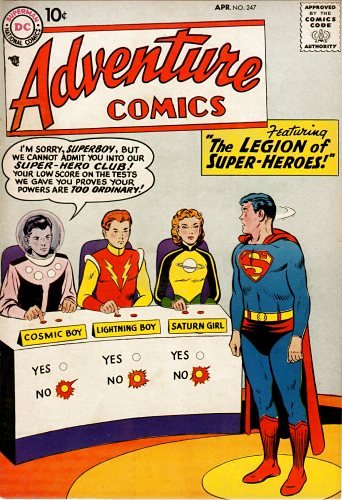
The same thing happened to me when I tried to join the Webelos.

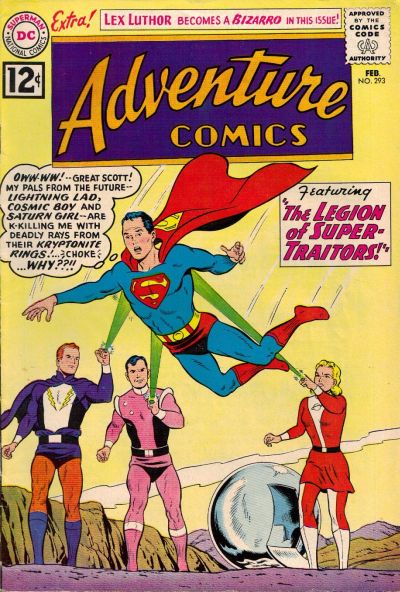
Notes: The Legion made its first appearance in Adventure Comics #247, during the period in which the headline character of that anthology series was Superboy. In this issue, beneath a Curt Swan cover that has become one of those legendary covers that gets “Homaged” again and again, Clark Kent is on the streets of Smallville when he is addressed as Superboy by a mysterious teenager he’s never met before. He switches to his other identity and zooms off, only to be met by another teenager calling him Clark, then a third. Horrified at first that his identity has been revealed, he is relieved when the teens tell him their secret: they are time-travelers. In their future, they are members of a club for superheroes inspired by the legendary exploits of Superboy, and they have come back in time to invite him to join. They bring him to the future, where he sees that Smallville has become a bustling…well…metropolis – but only by the standards of HIS time. In their time, it’s still considered a tiny community. The teens (Cosmic Boy, Saturn Girl, and Lightning Boy) put Superboy through a series of initiation tests, but each time he is distracted by a disaster that requires his attention. At first, he thinks he’s failed, but the heroes reveal that the disasters he stopped were of their own doing, and it was just an initiation stunt. Superboy joins the team and goes home, but joining them in the future soon becomes a recurring part of his adventures.

Like so many of the other characters I’ve looked at this year, this early version of the Legion feels terribly incomplete. Heck, it’s not even called the Legion of Super-Heroes yet, just the “Super-Hero Club.” The three founders are all there, but Lightning Boy would soon change his name to Lightning Lad, and all three would quickly adopt new uniforms that didn’t sport their full names across the chest like a Ben Cooper Halloween costume. The exact time period from which they hail vacillated over the next several stories before it finally, firmly, was set at 1,000 years in the future. And although only the three founders take active part in this first issue, we see other generic teens that I assume are intended to be other Legionnaires, including one that – in the digital version on DC Universe Infinite – appears to be re-colored to suggest that it’s Brainiac 5. But that’s kind of pointless, since we’ll see his first appearance shortly. 

There isn’t a ton of meat in this first appearance, but I guess the idea of Superboy having actual peers was too good, so they not only brought them back, but soon added Supergirl to the mix, even though she and Superboy were separated by about 20 years of time. But hey, it’s time travel, that’s not really an issue. The first time she encountered the Legion, she was rejected because she was suffering from Red Kryptonite exposure, which seems pretty mean when you consider they darn well should have known that Red K only lasts for 24 hours. But in Action Comics #276, she got her next chance.

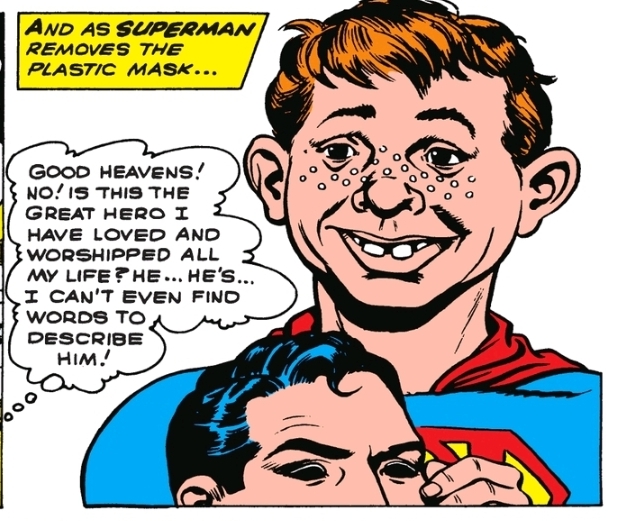
This issue begins similar to Clark’s first encounter with the Legion. Linda Lee is walking around Midvale, lamenting the fact that she’s got no super-powered friends to hang out with. (I feel compelled to point out that this was 1961, and even the most embryonic form of the Teen Titans wouldn’t first appear until 1964, but isn’t it weird that they never had Supergirl join until the Matrix version in the 90s?) To her surprise, she’s soon approached by three girls with powers: one wearing a mask, one that can move through solid objects, and another who can split into three bodies. The girl with the mask removes it to reveal that she’s Saturn Girl, one of the members of the Legion Supergirl met before. If you need an explanation for why she bothered with the mask, the only answer I have is that in the Silver Age nobody was ever straightforward about ANYTHING. The girls – Saturn Girl, Phantom Girl, and Triplicate Girl – take her to the future for a second shot at joining the Legion, this time alongside fellow prospective members Sun Boy, Bouncing Boy, and Brainiac 5. She is shocked at first to find that a descendant of one of her cousin’s greatest enemies is trying to be a hero, but is won over by his tender affection towards her. Supergirl is given a time-traveling membership like the one Superboy had, while Brainiac becomes a permanent member. Then, for absolutely no reason, she has a brief encounter in Atlantis, which only serves to lead up to a final panel where Linda remarks on the fact that she may not have a boyfriend in Midvale, but there’s an alien 1,000 years in the future AND a merman in Atlantis crushing on her, so it ain’t so bad.

Abysmal epilogue sequence aside, this is an interesting issue. It introduces not one, but FIVE significant Legionnaires (both Bouncing Boy and Sun Boy joined the team by the next time they turned up), and gives Supergirl a peer group like her cousin – in fact, the SAME one as her cousin. And just in case you’re worried about any timey-wimey problems arising from the fact that Superboy and Supergirl were members of the same team, they found ways to play with it. They established, for instance, that Saturn Girl placed a telepathic block on each of them, so that when they returned to their respective time periods, they would lose any memories they’d gained that would be relevant to their own future. Practically, this meant that Superboy only remembered that one day his superpowered cousin would come to Earth when he was actually in the future. They also usually avoided having both of them appear in a Legion story at the same time, so it didn’t come up too often.

Over the years, they would each bond with the Legion, and this is where I really think this group becomes important. The JLA is Superman’s team, sure, and he is close to several of them. Superman, Batman, and Wonder Woman in particular are called the DC “Trinity,” and their friendship is important, the stuff of legend.

But those are the friends he has as an adult. The Legion are his childhood friends, and that’s important. That’s special. As we learned from stories such as Stand By Me and The Sandlot, the friends we have when we’re young are a fundamental part of shaping who we are as adults. And there’s been more than one story that demonstrates just how important the Legion of Super-Heroes is to making Superboy become the Superman of legend. 

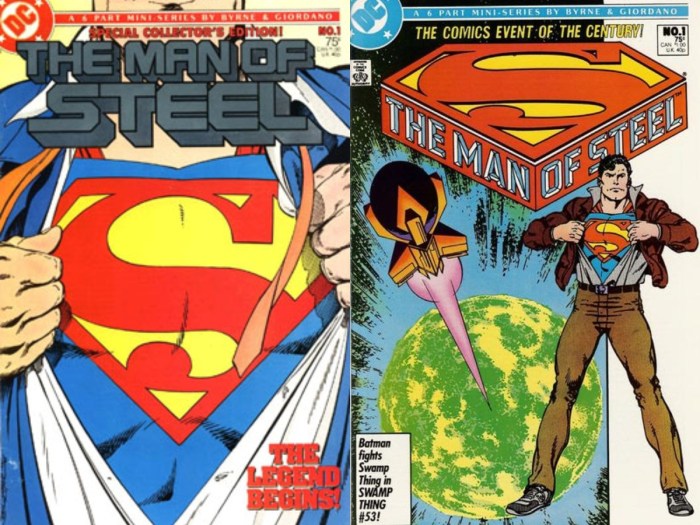
At least, until Man of Steel in 1986 upended everything by that declaring that Clark Kent had never had a career as Superboy. That change in the timeline would have catastrophic consequences for the Legion of Super-Heroes. 

But I’ll read about that tomorrow. For now, why not join me in a look at the two Superman-related comics that hit the shops this week? 
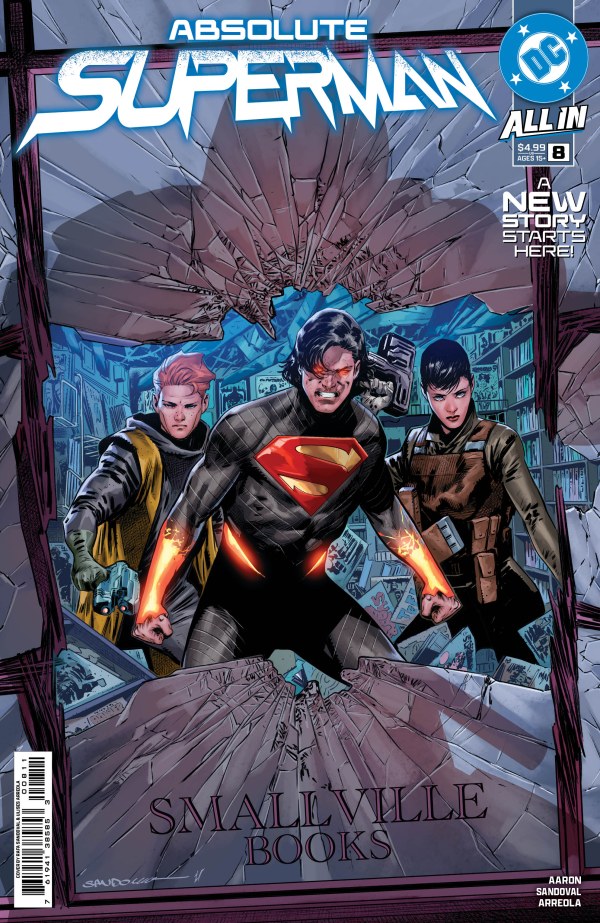
Someone’s gonna pay for that window.

Absolute Superman #8 begins the second story arc of the series. Visiting Martha Kent in Smallville, Kal-El is approached by Lois Lane…unfortunately, she’s followed by the rest of Lazarus, the Peacemakers, the Omega Men, and – oh yeah – a sniper with Kryptonite bullets. Jason Aaron keeps mixing up the DC Universe here, taking familiar pieces and putting them in unfamiliar positions, like plucking a Lego brick from a castle set and using it to build a spaceship. It’s a fun exercise, though, and I keep enjoying the stuff they’re doing.  

We also get the first issue of Justice League Vs. Godzilla Vs. Kong 2. Picking up a few years after the end of the previous miniseries, it’s Barry Allen’s wedding day! Unfortunately, he still hasn’t told Iris his secret identity. As the League tries to coax him into doing so, Amanda Waller reactivates Task Force X to deal with a resurgence of Titans (not the Teen ones – that’s what they call Kaiju in the Legendary Monsterverse). I love these crossovers, and I think it’s very interesting that, for the next few months at least, Godzilla is going to feature in comics from no less than THREE American publishers: the Monsterverse version here, the Toho version fighting the Marvel Universe over there, and all the wild iterations in the regular Godzilla comics from IDW Publishing. 

Thur., June 5

Comics: Legion of Super-Heroes Vol. 3 #37, Superman Vol. 2 #8, Action Comics #591, Legion of Super-Heroes Vol. 3 #48, Secret Six Vol. 5 #3 (Super Son)

Who says you can’t go home and have a fight with another iteration of yourself from a parallel pocket dimension again?

Notes: I’ve written at length about John Byrne’s Man of Steel in 1986 and how that reboot changed the Superman mythos. But one aspect I haven’t talked about that much is the Legion. As a team who not only had Superboy and Supergirl as members, but whose entire existence was INSPIRED by Superboy, after DC changed their continuity to declare that Superboy and Supergirl never existed, how could they explain the Legion? The solution came in this four-part story from 1987, beginning in Legion of Super-Heroes Vol. 3 #37.

Cosmic Boy, having recently returned from a visit to the 20th century (in his own self-titled miniseries) reports that the past has been altered, and the Legion has to investigate. A time storm hurls them to the past, to a Smallville populated by Superboy – a time that Cosmic Boy has reported no longer exists. Arriving in Smallville, the team splits in half – one group making contact with Superboy, the others staying with the time bubble. Superboy ambushes the team, though, trapping them in a stasis-beam. When Pete Ross (an honorary Legionnaire) warns the others what Superboy has done, they attempt to flee. And in the distant future, the Legion’s old enemy the Time Trapper revels in the chaos he is sewing. Part two comes in Superman #8, set in the “present day” of 1987, where we begin with John Byrne’s Clark Kent using his powers to help Lana fix up the farm she is returning to after years away. His super-senses detect a time bubble with four super-powered teenagers appearing across Smallville, and they get into one of those required “heroes fight heroes over a misunderstanding” situations before Brainiac 5 calls an end to hostilities. Brainy tells Superman about their history with Superboy, a history he has no memory of, and as they prepare to seek answers, Superboy appears and captures the five of them in his stasis ray. 

Action Comics #591 gives us part three of the story: Superboy is being forced to attack his friends by the Time Trapper, who reveals that Superboy’s entire existence is part of a trap laid for the Legion. Over the centuries, stories of Superman’s legend had been changed, making the Legion believe in a “Superboy” era that never existed. When they first decided to time travel and meet Superboy (back in Adventures #247), the Trapper created an entire pocket universe that matched their skewed legends of Clark Kent. It was THIS Superboy that the Legion befriended, who joined them, and who they visited every time they traveled to the past. But unable to betray his friends, Superboy altered the stasis beam so Superman would escape and chase them, ultimately landing in the pocket universe. Superboy and the Legion reconcile and go to the future, returning Superman to his own universe – but this wouldn’t be his last encounter with the Pocket Universe.

We’ll get to that some other week.

The story ends tragically in Legion #38. As Superboy and the Legion confront the Time Trapper, he reveals that one of his machines has protected the Pocket Universe from the multiversal devastation that happened in Crisis on Infinite Earths. In the skies above Smallville, Superboy sacrifices his life to save his universe from destruction. The Legion brings his body back to the 30th century to mourn…with an eye towards revenge against the Time Trapper once and for all.

Paul Levitz, longtime Legion writer, had a tough task here. Remove Superboy from the board, recognize that the “real” Superman was never Superboy and never a member of the Legion, but do so in a way that was still respectful to the Legion’s history. I think he did as good a job as anybody possibly could. The “Pocket Universe” conceit manages to keep every story where Superboy, Supergirl, or the Super-Pets encountered the Legion canonical, even if they’re only canon to the Legion and not the rest of the DC Universe. Furthermore, even though Superboy may never have been “real” in the first place, Levitz gave him a sendoff worthy of the Man of Steel that he would never grow up to be — sacrificing himself to save his world is the kind of thing members of the House of El do. Kara did it in the Crisis, The Post-Crisis Superman would do it on the streets of Metropolis a few years later. Self-sacrifice is hardwired in the DNA of the Superman family, and this story demonstrated that nicely. 

Which makes it a little frustrating that six years later, Zero Hour would throw it all out the window.

Fri., June 6

Comics: “Future Tense” storyline: Superboy Vol. 3 #21, Legion of Super-Heroes Vol. 4 #74, Legionnaires #31; The Legion #25-33, Legion Secret Files 3003, Teen Titans Vol. 3 #16, Teen Titans/Legion Special

Be honest, are you Team Leather Jacket or Team T-Shirt?

Notes: The Crisis was intended to streamline the DC Multiverse, and while it was largely successful, there were loose ends that just…dangled. It caused problems for a while, and in 1993 Dan Jurgens tried to close off those issues in Zero Hour: A Crisis in Time. It was a good story, and one of the changes it wrought was a reboot of the Legion of Super-Heroes. As Man of Steel did for Superman, the Legion reboot started the characters over from page one – they were teens again, the names and costumes were made a little less “Silver Age-y” (Lightning Lad, for instance, became Live Wire, Triplicate Girl became Triad, and so forth), and in this continuity, the Legion was inspired generally by the heroes of the past, and not Superboy or Superman specifically.  Our new Superboy, the one we met in “Reign of the Supermen,” had his own title by now, and first encountered the Legion in a three-part story called “Future Tense” from 1995. 

The Legion travels back in time to rescue Valor, a rebooted version of their own Mon-El (it’s a long story) that Superboy had encountered a few issues ago in his title. After the requisite “fight over a misunderstanding” happens, Superboy tells the Legion how Valor had nearly died from lead poisoning until he entered a “zone where time stands still,” because there was NO way they would be allowed to call it the “Phantom Zone.” Brainiac 5 tries to reopen the zone until, frustrated by the technology of the time, he warps all of them – Superboy included – back to their home in the 30th century. Things get more complicated when Superboy accidentally lets it slip that Valor – who, in the past millennia, has become a religious figure – is returning, causing a massive upheaval among the millions of Valorites across the galaxy. The Legion makes it look as though their attempt to rescue Valor fails, getting his devotees to back off, then rescue him for real in private before sending Superboy home.

This story was pretty emblematic of both the Legion and Superboy of the time. They’re young and they’re highly emotional. In this version, for instance, Triad’s three different bodies each have different parts of her personality, and one of her immediately gets the hots for Superboy. Superboy, meanwhile, was in his hotheaded stage, and certain members of the Legion took severe umbrage to that, specifically Leviathan (this incarnation’s version of Colossal Boy) and Brainiac 5 himself. Still, he does manage to prove his worth, and at the end of the three issues Cosmic Boy (whose name did NOT get updated) makes him an honorary member of the Legion. The kid and the team would encounter each other occasionally over the next few years, through assorted time travel shenanigans, but we wouldn’t see Superboy as a full member until 2003. 

At this point, both the Legion and Superboy had gone through some dark times, the former having its series restarted as just The Legion, and the latter having his series cancelled and being jutted over into Teen Titans. So it was surprising to see him show up on the cover to The Legion #25, wearing a classic Superman costume rather than his own uniform, no less. The story was a bit different – after an issue largely spent recapping their recent tragedies and stacking the new status quo, they found Superboy drifting inexplicably through space. This kicks off the six-part “Foundations” storyline, in which Superboy and the Legion face off against Darkseid and wind up meeting a time-tossed Clark Kent, still a teenager, before he ever put on a superhero costume. It’s a great story, really, although it is HEAVILY mired in the stuff that had happened in the Legion in the last few years, and it would probably be unadvisable to read on its own – I feel like it would be really confusing to anyone who wasn’t familiar with “Legion of the Damned” or the stories that followed it. 

The important thing is that it showed Superboy maturing, becoming a better person and a better hero, and that’s all to the good. Superboy stuck around with the team for the rest of the run, which was all well and good…except that he was also appearing concurrently in Teen Titans with no explanation. After Legion ended with issue #38, we got a two-part story wrapping everything up. In Teen Titans #16, Conner is having lunch with Cassie (Wonder Girl) when he’s plucked up by the Stargate that sent him to the 31st Century. He reappears a moment later, now wearing his Legion uniform, telling Cassie that he needs the Titans to help save the future. So his entire tenure in the Legion, presumably, takes place between those two panels: pencil that in, continuity nerds. Anyway, they’re attacked by the Persuader, and Superboy brings the Titans to the 31st Century, where the Fatal Five have created a Legion of their own to attack Earth: an army of Fatal Fives from throughout the multiverse. Fortunately, Brainiac 5 has a plan, but it requires the work of TWO speedsters: the Legion’s XS and her cousin, Bart Allen, aka Kid Flash. They manage to defeat the Five, but the Legion is lost in the timestream, all except for Shikkari, who finds herself in another world, where the Legion is…different.

Yep. Time for another reboot.

This iteration of the Legion lasted 10 years, and it’s the first one I ever read as a regular reader. As such, I have great affection for it. The stories were solid, with a classic flavor that still felt modern, and the art was wonderful. I was really sorry to see it end, but I’m glad that when it went, at least there was a member of the House of El standing with them in what looked – at the time – like their final moments. But we would see this Legion again.

Just not yet. 

Sat., June 7

Graphic Novel: Supergirl and the Legion of Super-Heroes: Strange Visitor From Another Century (Collects Legion of Super-Heroes Vol. 5 #14, Supergirl and the Legion of Super-Heroes #16-19)
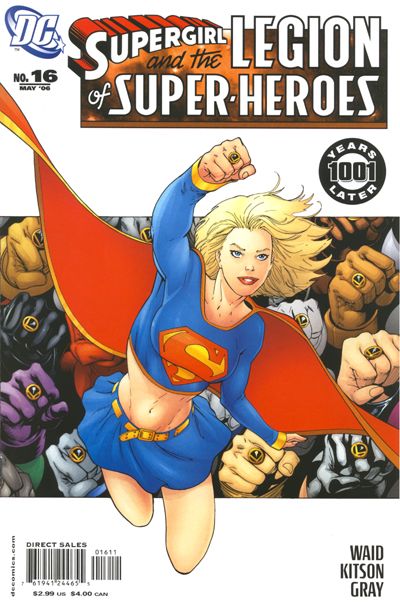
“Don’t ask ME, I thought she was DEAD.”

Notes: The “Threeboot” Legion that followed the Titans/Legion special was an interesting beast. Written by Mark Waid, with art by Barry Kitson, this newest iteration gave us a Legion inspired by stories of the heroes of the past that much of the population believed to be mere legends – nobody really BELIEVED that the likes of Superman, Batman, or Wonder Woman had ever existed. Society had grown increasingly distant and oppressive – people stayed home, alone, communicating electronically but rarely seeing one another in person. What’s more, the youth of the galaxy were particularly downtrodden, with free thinking suppressed to make sure everyone conformed. In this universe, the Legion were a group of super-powered teens who rejected this system. They adopted costumes and code-names inspired by the heroes of the past and started a movement, with other young people from across the galaxy joining them.

The volume I read today picks up after their first few adventures, where they’ve proven their worth and the United Planets has reluctantly deputized them as a peacekeeping force. As the Legion licks their wounds from a recent loss, things are tossed into upheaval when a young woman professing to be the legendary Supergirl appears. Much of the galaxy believes that she’s a hoax, because they think Supergirl is a fictional character. As for Supergirl herself, this is the Kara Zor-El who climbed out of a rocket in Gotham Harbor only a few months ago (by her reckoning, but not much longer in real time). Between her adventures with her cousin, Batman, and Wonder Woman, the devastation of the Crisis, and now finding herself 1000 years in the future, the trauma has begun to affect her mind and she believes that everything that has happened to her – including her existence in the Legion’s time – is a dream, and that any minute she’s going to wake up back on Krypton.

Waid had already created a world for the Legion dissimilar from the previous two, and this was a Supergirl that was different from any other Superman family member who’d ever joined the Legion. Despite that, though, it all worked. While the WORLD was different, the Legionnaires were staunchly themselves: Cosmic Boy was the consummate leader, Lightning Lad was impulsive, Brainiac 5 an arrogant jerk who was mainly tolerated because he actually WAS the smartest one in the room as opposed to just somebody who thought he was. There were some revisions, of course – previous iterations of Shrinking Violet had often been quiet and timid, but Waid reimagined her as the ass-kicking master of espionage that somebody with her power set would logically have the ability to be. 

Meanwhile, we’ve got this traumatized Supergirl floating around with this crew, somebody who doesn’t believe that anything happening around her is actually real. Which makes it all the more impressive, I think, that she continues to act every inch the hero. She saves lives, stops disasters, fights villains, even though she believes that it’s all a dream and that nothing around her will have any consequences. Perhaps it’s the level of her consciousness that knows it’s NOT a delusion, perhaps it’s just that Kara Zor-El can’t help but help people no matter the circumstances. Whatever it is, it made for a unique dynamic. Supergirl stayed with the book for a couple of years, going home in issue #36, and the series itself ended at issue #50.

But even before this version of the Legion went away, we got glimpses of what was next. 

Sun., June 8

Graphic Novel: Superman and the Legion of Super-Heroes, collects Action Comics #858-863

Now THIS is going home again.

Notes: I don’t mind telling you that Geoff Johns is one of my favorite comic book writers. His strengths, as I think he proved with his tenures on Flash and Green Lantern, come when he takes the framework of the past and expands upon them. He’s the writer, for instance, who used the existence of Sinestro’s yellow ring to extrapolate an entire Sinestro Corps, and from there, a different corps of Lanterns for each color of the spectrum. His runs on Superman have been short, but what he did with the six issues of “Superman and the Legion of Super-Heroes” from 2007 and 2008 is one of my favorite examples of his work. Although it was running concurrently with the Supergirl and the Legion series, in this storyline Johns brought back something that had been lost from Superman’s past, much as earlier writers had brought back Krypto, the Phantom Zone, and Supergirl: he was restoring Superman’s history with the Legion.

Johns and artist Gary Frank, who would reunite in 2009 for Superman: Secret Origin, kick things off with a bang. Superman is contacted by a probe from the future sent by Brainiac 5 reactivate suppressed memories of his past with the Legion. Suddenly, Superman remembers meeting the Legion founders, being invited to join the team, and losing contact with them after the Crisis. (I know there have been a LOT of Crises in the DCU – typically they’re referring to the original Crisis on Infinite Earths when they use the definite article, i.e. THE Crisis.) The probe brings him to the future where things have gone horribly wrong: Something has turned the sun red, diminishing Superman’s powers. Earth is being run by a xenophobic “Justice League” led by a fascist calling himself Earth-Man that has made the Legion, with its many alien members, outlaws. Oh yes – and Brainiac 5, the Legionnaire who brought Superman to the future, is missing. Earth-Man, as it turns out, is a Legion reject who can absorb powers from others. He built a following claiming that Superman was a human, not an alien, and in fact was staunchly opposed to the presence of aliens on Earth. He’s been capturing the non-human Legionnaires and stealing their powers in his quest for conquest. 

Superman and the few remaining Legionnaires manage to escape Earth and track Brainiac 5 to his homeworld of Colu, the only planet in the galaxy more xenophobic than Earth. They gather Brainy and a few others, including the Legion of Substitute Heroes, and together launch an assault on the Justice League on Earth, where they learn that Earth-Man has been using the captive Sun Boy to make our sun red, weakening Superman. In the climactic battle, a powerless Superman faces an Earth-Man with the power of the entire Legion flowing through him…but there’s one thing that Superman has that Earth-Man never will.

His friends.

I cannot express enough how much I love this story. There are plenty of stories of Superboy with the Legion, and those are great, but this is one of the few stories of the Legion fighting with an adult Superman, and that’s a dynamic I want to see more of. (Recent hints in the current Superman comic books are giving me hopes that we’ll see more of that soon, but I digress.) Like I said earlier this week, Superman with the Legion is a group of friends. The tone feels more like the Titans than the Justice League, a found family standing together rather than a group of disparate heroes united for a common cause. That “found family” trope is always something that resonates with me, and I love seeing Superman as a part of it.

It’s also good to see a story that makes its points without preaching or turning into a polemic. There’s a definite message here, with Earth-Man’s hatred of anyone not from Earth, but that message is secondary to the story. Not that Johns and Frank were subtle about it – Earth-Man’s costume is as close to a Nazi uniform as you can get without actually applying swastikas, and his real name is the egregiously German Kirt Niedrigh, juuuuuuuuuust in case we didn’t get what they were going for. But parallels to World War II aside, the story also has a point to make about being an outsider. Bringing the Subs in makes it even better, having them act as a foil for Earth-Man – they were rejected from the Legion just as he was, but rather than turning into monsters, they used their disappointment as fuel to become something good. 

There are plenty of questions raised by this story, of course. First of all, which Legion is this, exactly? It’s an older Legion: despite still having words like “Boy,” “Lad,” Kid,” and “Girl” in their code-names, they all appear to be roughly the same age as Superman. But the costumes and past they share with Clark seem to indicate this is a continuity that continued the characters from some point prior to the controversial “Five Years Later” era (which was the final era of the original Legion before the reboot in 1993, beginning between their second and third encounters with the time-traveling Superman in Time and Time Again). If that’s them, how are they coexisting with Supergirl’s Legion, which I remind you, was being published in their own series at this point? Who, or what, was the “real” Legion of Super-Heroes?

To answer that question, DC again turned to Geoff Johns, in what is my single favorite Legion story of all time. 

Mon., June 9

Comics: Final Crisis: Legion of 3 Worlds #1-5

Get ready for the most egregiously misnamed Crisis of them all!

Notes: In 2008, Geoff Johns and George Perez teamed up for this five-issue miniseries. While ostensibly a spin-off of Grant Morrison’s Final Crisis event, it really has nothing to do with the larger storyline of that series and can be read independently of it. I still may get to the main Final Crisis story at some point, since the conclusion is pretty Superman-centric, but for today I’m just going to focus on this Legion story. 

Superboy-Prime, insane survivor of Earth-Prime (see Crisis on Infinite Earths and Infinite Crisis for the full backstory if you don’t already know it) is plucked by the Time Trapper and hurled to the Legion’s time period. Finding the Superman Museum in Smallville, Prime is horrified to discover that he’s only a footnote in Superman’s Hall of Villains, and even worse, is pushed further over the edge by the veneration of Conner Kent, the Superboy that Prime murdered in Infinite Crisis. In Metropolis, meanwhile, the United Planets is turning against the Legion, whose members are in disarray. Brainiac 5 has been stripped of his Brainiac title by his home planet, Mon-El is suffering from the lead poisoning that plagues all Daxamites, and Sun Boy’s powers haven’t returned since his torture at the hands of Earth-Man. Things get progressively worse as Prime springs all of the Legion’s enemies from prison, creating an entire Legion of Super-Villains. The real Legion brings Superman back to their time to aid them, and Brainiac 5 reveals his plan: fight a Legion with a TRUE Legion – by summoning the Legions of two other worlds in the multiverse.

Brainy uses the Crystal Ball that the Justice League and Justice Society used for their very first team-up in the Silver Age to summon the other two Legions – the Reboot Legion that Conner had been a member of, and the Threeboot Legion that had welcomed Kara. Superman and the assembled Legions battle Prime’s army as Brainy enacts Stage Two of his plan: assembling all the electrical-powered Legionnaires to charge up XS and use her to pull her cousin, the presumed-dead Bart Allen, from the Speed Force to rejoin them as Kid Flash. Finally, the Brainiacs use Time Travel to implement Phase Three of their plan: a version of Starman in the 21st century robs a certain grave and transports its inhabitant to the Antarctic. A thousand years later, the Brainiacs unearth the body, which has been slowly healing and rebuilding for a millennia in the same Kryptonian device that brought Superman back after his battle with Doomsday. The final piece to restore him is a hair from one of his genetic donors – Lex Luthor (taken, naturally, from a point in the past BEFORE he went bald). After a thousand years, Conner Kent lives again. 

The battle rages on two fronts – Superboy, Kid Flash and the Legions versus Prime in the Arctic, Superman and the original founders versus the Time Trapper in deep space. It turns out the two battles are really one: this iteration of the Trapper is a future version of Superboy-Prime himself. But for all his power, all his anger, in the final battle, the Legion lives.

Ever since Man of Steel, the Legion’s continuity had become a mess, with two reboots failing to make things simpler, since their interactions with the heroes of the present kept contradicting each other. Legion of 3 Worlds finally solved the problem by establishing that each of the three Legions was from a different world of the Multiverse. The original Legion, the one that Clark had been a member of in his youth, was from the future of DC’s main universe. The Reboot Legion, Conner’s Legion, was from Earth-247, a world that had been destroyed in a Crisis, but not one of the ones that was restored when the Multiverse was brought back. And Kara’s Threeboot Legion, amazingly, was from the future of Earth-Prime, the world where all of the DC Comics heroes exist as fictional characters. All those times in Waid’s run when people had insisted to the Legion that the ancient stories about Superman and the Justice League weren’t real? In their universe, they were right

So not only was the Legion clarified in a way that made sense, but Johns used it to bring back two of the Teen Titans he’d written in an immensely satisfying way, and even used this miniseries as a springboard for the return of the Green Lantern Corps in the 31st century. The Legion was finally clear, established in a way that made sense, and ready for action. And it was done in a way that made all three Legions legitimate and viable, and set each of them up so that they could be used in different ways across the tales of the DC Multiverse. He even managed to codify the importance of the Legion in Superman’s history, explicitly stating (via R.J. Brande) that it was his interactions with Cosmic Boy, Saturn Girl, and Lightning Lad that taught young Clark Kent what it meant to be a hero, and that he would in turn become the inspiration for heroes for the next 1,000 years. It was the perfect fix and the perfect fit. 

Why, DC? WHY THE HELL DID YOU DECIDE TO REBOOT THEM YET AGAIN???

Tue., June 10

Comics: Superman Vol. 5 #14, 15
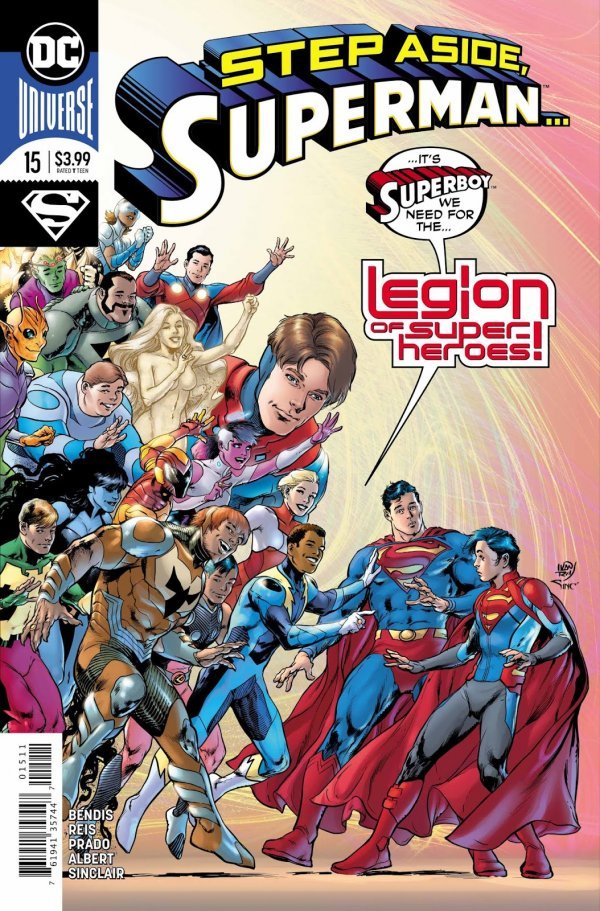
If you people ever doubt that I love you, remember that I read this comic again so I could write about it.

Notes: A few years post-Final Crisis, as we all know, DC rebooted their entire universe in the New 52 relaunch, including both Superman and the Legion. Once again, Superman was divorced from the roots of the Legion, but other than that, the Legion was one of the properties that was relatively unchanged. But it didn’t set sales on fire, either, and the New 52 version was quietly cancelled after two years. After that, their appearances became sporadic for a while until 2018, when Marvel superstar Brian Michael Bendis was hired by DC to take over the Superman comics.

I’m going to be blunt, guys, I’m not typically a fan of Bendis’s work. I don’t want to spend all day explaining the reasons why, but I don’t think I’ll need to, as my Legion-specific criticisms will make it clear. The biggest issue I had with his run was his treatment of Jon Kent. Lois and Clark’s son had been around in comics for a few years, and was about 10 years old. The stories of Clark raising his son were magnificent. They were fresh, they were original, they were something that we rarely saw in comics: an adult superhero teaching his child what it means to BE a hero is a dynamic that, somehow, had gone almost ignored in the 80 years that the superhero genre had been around. So when Bendis took over, of course, the first thing he did was have Jon fall into a spacehole with his grandfather and come out as a teenager. 

It’s more complicated than that, but the gist of it was that sweet and joyful Jon was now an angst-filled teenage superhero, of which we have thousands, and like most teenage superheroes his stories quickly began to drift towards “adults screw everything up, but kids MY age know better.” It’s a tired, stale trope that we’ve seen a billion times. But there is one good thing I can say about Bendis’s Superman comics: compared to his work on Legion of Super-Heroes, his Superman looks like Watchmen. 

It started in issue #14 of his Superman run, the tail end of a story arc about Superman, Supergirl, and Superboy teaming up with General Zod to capture an alien who has responsible for the destruction of Krypton. At the end of the story, the Kryptonians are brought before a coalition of alien races who were caught up in their battle, and Jon says something along the lines of, “On Earth, we have a thing called the United Nations…” Then, after his dad gives a brief speech about working together, a time portal opens. And the new, re-re-rebooted Legion of Super-Heroes spills out of it and offers Jon membership because he just invented the United Planets by saying ten words that point out something that already exists, and thus he’s the most important historical figure of the past 1,000 years.

I’m getting a headache.

In issue #15 of Superman, the word of Jon’s AMAAAAAZING insight starts to spread. Adam Strange even says “I can’t believe I’ve been out here this entire time and I didn’t think of it.” (Neither can anyone else, Adam – didn’t you ever watch Star Trek? For that matter, are we really supposed to believe that NOBODY had ever thought of this idea before in the ENTIRE GALAXY?) Then the Legion offers to take Jon to the future with them, because he’s so smart and awesome and cool and they wanna be friends with them. He winds up going and joins them for Bendis’s 12-issue Legion series which…I should read it again today. In the interest of fairness, I should read it again for this blog, but I just can’t bring myself to do it. It…it just wasn’t the Legion.

Yeah, the character names were mostly the same. So were the powers. And they were in the 31st century. But everything that makes the Legion entertaining was entirely absent. The characterizations were…I can’t even say they were WRONG, they were GONE. The members of this team had no life, no personality, other than being ASTONISHED that the GREAT JONATHAN KENT WAS THERE. It was like reading about Jon and the Legion of Sycophants. That’s another Bendisian trait, by the way – he introduces a younger version of the hero, then all of the other characters walk around and talk about how much better the new version is than the old one. (If you think I’m exaggerating, I offer the following as evidence: Miles Morales, Ironheart, and the teenage X-Men who were brought forward in time because Beast thought their adult versions sucked.) It was in full force here, with the Legion telling us how Jon – not Clark – would be remembered as THE Superman, as THE character who saved the galaxy. And I’m sorry, if you’re going to make a claim like that, you gotta convince me of it.

There were also a ton of arbitrary changes that drove me crazy, such as making Mon-El a Kryptonian descendant of Superman rather than a Daxamite like he’s been for his entire existence. And as usual, Bendis included his own characters (which is fair) like a new version of Dr. Fate (oooookay) and a Gold Lantern whose powers and history were ill-defined and didn’t really seem to add anything to the story. I made it through the 12 issues of his run, but when he closed it off with a six-issue Justice League Vs. the Legion of Super-Heroes miniseries I couldn’t even bring myself to buy the comics, reading it instead when it came to DC Universe Infinite and still feeling as though I’d overpaid. 

Since that miniseries ended, again, the Legion has returned to sporadic appearances. Some of them have reflected the Bendis Legion, but others evoke Legions of the past. Mark Waid himself went on the record recently to tell us that DC has plans for the Legion that he thinks will make everyone happy, and we’ve already seen glimpses of that in the DC All In Special and (appropriately) the Superman titles. We’ve been promised that Superman #29 (coming out in August) will feature Superman and a “mysterious ally” searching for the lost Legion of Super-Heroes. I’m anxious and I’m optimistic. For the most part, DC’s “All In” titles have been very satisfying, and if the new Legion (whatever it is) has Mark Waid’s stamp of approval, that gives me reason to hope. Because the Legion, at its best, is not JUST a team of heroes from the future. It’s about hope for the future, just as much as Superman is. And it’s a fundamental part of who and what Superman is. It’s one of the greatest concepts in comics, and it deserves to be treated as such.

So here’s hoping that, whatever begins in August, it ends with a story that leaves us all ready to slip on our flight rings, thrust our fists into the air, and join with a battle cry that will echo back ten centuries:

Even Brainiac 5 is irritated by Brainiac 5.

But you know, I can’t end it here. I can’t conclude my look at one of my favorite pieces of the entire Superman mythology with a discussion of their worst version. So how about a little bonus? Let’s join hands, hop in Brainiac 5’s Time Bubble, and zip back to 2006 so we can watch the first episode of the Legion of Super-Heroes animated series together, shall we?

TV Episode: Legion of Super-Heroes Season 1, Episode 1: “Man of Tomorrow”

It ain’t the Diniverse, but it’s still pretty dang good.

Notes: Young Clark Kent is about to leave home. He’s packing up and heading away from Smallville to go to Metropolis, where he’s got a job as a copy boy at the Daily Planet. On the night before he’s supposed to head to the big city, though, he’s approached by a group of super-powered teenagers from the future, teens who know about the powers he’s kept hidden his entire life. He won’t miss a thing, they promise, they can return him to the moment he left – and tantalized by the idea of not having to hide himself, he goes with them. Arriving in the future, he discovers that they need his help combatting their foes, the Fatal Five. In the end, Clark takes the costume he learns he’ll have someday and, as Superman, joins the Legion.

I love this cartoon. It’s the purest expression of my favorite thing about the Legion, namely that it helps shape Clark Kent into Superman while, at the same time, being inspired BY Superman. It’s a bit more literal in this version than others – the Clark that joins this Legion hasn’t ever really been in a fight and hasn’t learned how to use all of his powers yet. The Legion has plenty to teach him, and over the first season of the show, we see him grow and blossom. The second season takes place after a time skip, returning to the future after a few years away. It was an interesting retool, but ultimately the show only lasted for those two seasons. If you love the Legion like I do, though, it’s well worth seeking them out and watching them.

After all, we Legionnaires need SOMETHING to keep us occupied between now and August. 

Blake M. Petit is a writer, teacher, and dad from Ama, Louisiana. His most recent writing project is the superhero adventure series Other People’s Heroes: Little Stars, volume one of which is now available on Amazon. You can join in the Kryptonian Konversation every day in the Year of Superman Facebook Group!
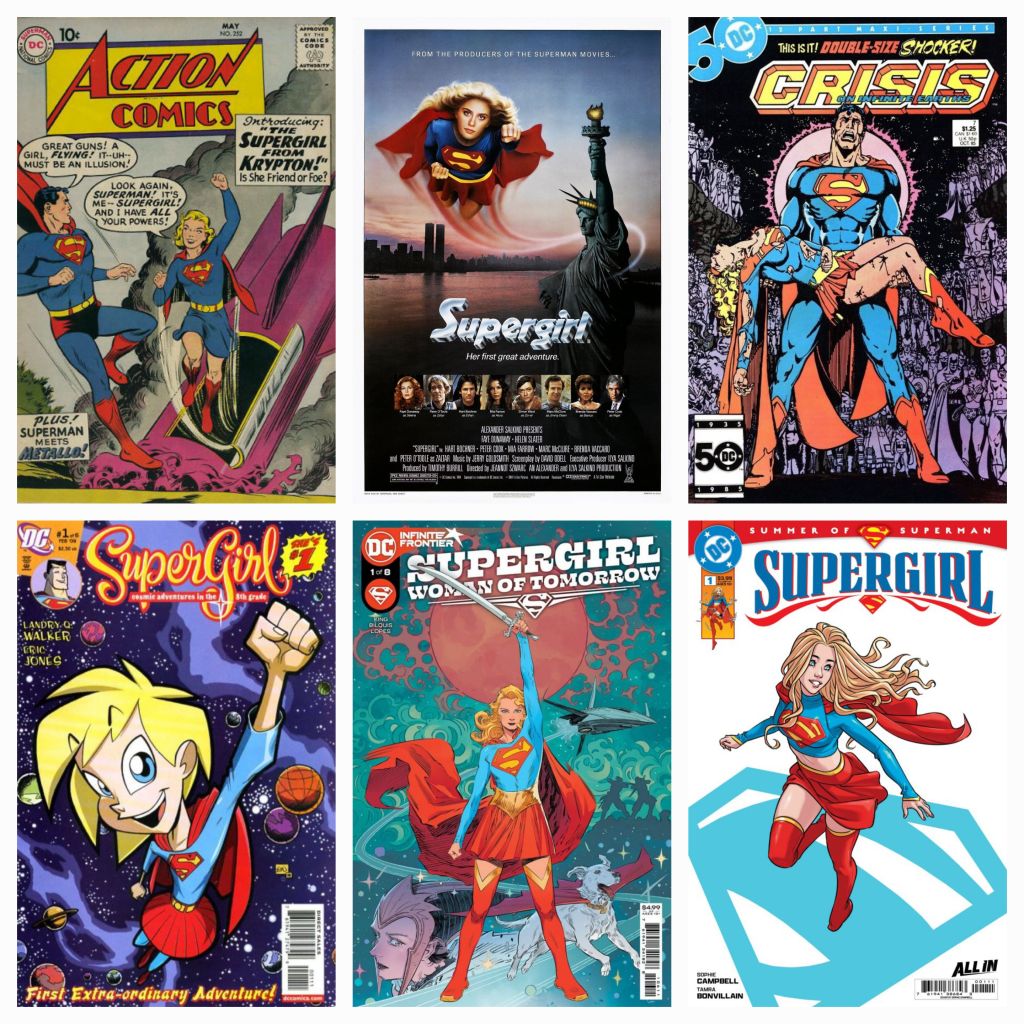
Year of Superman Week 21: Supergirl Week

With her own movie coming out next year, DC Comics has wisely decided to bring back Supergirl’s ongoing series, and with the first issue hitting stands last week, I thought it would be appropriate to dedicate Week 21 of the Year of Superman to Kara Zor-El. This week I’ll be digging into some of the most important and best stories of the girl of steel in comics, television, movies, and more. I’m specifically going to limit myself to stories featuring the Kara Zor-El version of the character. There are other Supergirls, to be certain, and I’ll probably touch upon them at some point, but I’ve already got more Supergirl stories than I’ll likely have time to cover on my list even BEFORE I add stuff starring the Matrix/Linda Danvers version. So Peter David fans, just sit tight. I don’t know exactly when it’ll happen, but I’ll get to your Supergirl before the year is out.

And as always, you can check out earlier blogs in the Year of Superman Archive!

For now, though, let’s dig into the history of DC’s Maid of Might. 

Wed., May 21

Comics: Action Comics #252, Action Comics #275, Action Comics #279-285

Notes: I’ll start off, appropriately enough, with Supergirl’s first appearance from Action Comics #252, by Otto Binder and Al Plastino. Although as was often the case at the time, the cover story was not the FIRST story in the issue. It starts with the first appearance of Metallo. I won’t get too much into that story, except to note that one plot point involves Metallo being able to impersonate Superman merely by shaving off his mustache. In the Silver Age DC Universe, there were apparently only three faces that everyone had to share.

And a million pubescent boys felt an awakening…

After a Congorilla story, we finally get to the main event: “The Supergirl From Krypton.” Superman is summoned to the site of a crashing rocketship, where he is stunned to discover a teenage girl who has all the same powers as he does. It turns out that she’s a survivor of Krypton as well, from a city that escaped Krypton’s destruction and protected itself by covering the ground with lead to save them from the remains of their home turning into deadly Kryptonite. But when a meteor shower destroys the lead, the girl’s parents put her into a spacecraft and sent her to Earth, where they’d been watching the last son of Krypton through a space telescope. Superman and the girl, Kara, discover that their fathers were brothers, making them cousins, and just like a good cousin, Superman immediately puts a wig on her and drops her off at a local orphanage until she’s trained in using her powers. She randomly chooses the name “Linda Lee,” another “L.L.,” which at this point is so unlikely that even Superman himself has to point it out. 

This is kind of an embryonic version of Supergirl’s origin. There are several aspects that would later change and others that would be added – for instance, the original story doesn’t identify her home as “Argo City,” as later stories would, nor did it establish that the city escaped Krypton’s destruction because it was beneath a transparent dome. Instead it just sort of…made it somehow. Also, in this version, the Zor-El family peeked at Earth for years, but never connected the dots that Superman was the son of Jor-El. Later stories would make it clear that they knew that Superman was one of their family and that they sent Kara to him specifically for that reason.

The last thing that I have to point out is just how quickly Superman decides to drop his cousin off at an orphanage. It’s a bizarre situation – he doesn’t even make it to another PAGE before he brings her to Midvale. I get it – it was the Silver Age and DC Comics would never have allowed them to upset the status quo in such a way that Clark Kent now had a teenage girl living under his roof…but still, it feels kind of cold-hearted. Modern-day Clark Kent would NEVER do that. At this point, especially since the Warworld storyline a couple of years ago, he’s collecting new family members like he’s a Pokémon trainer. 

The next few stories I’m going to cover come from Supergirl’s early days, when she was living in hiding as Superman’s “Secret Weapon.” He decided to keep her existence a secret from the world for…reasons that I’ve frankly never understood. I guess it had something to do with not wanting her to go public until she had command of her abilities or something, but that sure never stopped Batman from throwing a Robin out onto the street with him. Action Comics #275 starts with the dandy Brainiac story “The Menace of Red-Green Kryptonite,” where an insidious device from Brainiac makes Superman start…stealing hats. He confides the truth about the ray to Supergirl and eventually beats Brainiac after only a minor international incident, covering the fact that the ray actually made him grow a third eye in the back of his head. It was the Silver Age, people, what’reya gonna do?

But the real reason I read this issue was for the second story, “Ma and Pa Kent Adopt Supergirl.” In what is essentially an “imaginary story” (although it doesn’t carry that label), Supergirl is sad because Superman was raised by a loving family while she’s stuck at an orphanage. (GO FIGURE, CLARK.) So that night, she has a dream in which she, not Kal-El, was the child of Jor-El and Lara, and was the first Kryptonian to come to Earth and be adopted by the Kents. Her early years are similar to those of Clark, until her teenage years where we start to see some curveballs. Her bestie, Lana Lang, winds up dating the guy “Linda” is crushing on, so she’s stuck with some dude named Lex Luthor. A Kryptonian rocket somes to Earth, but instead of Krypto the Superdog, she finds a super-parrot from Krypton to be her super-pet. The biggest change? Whereas young Clark Kent helps his father run his general store, young Linda Kent stays at home to help her mother clean. Because she’s a girl. 

I can’t even sometimes. 

It gets even wackier when Lex overhears Linda’s parrot “Squawky,” sitting on his perch, chirping “Linda Kent is Supergirl!” Lex, knowing Linda is crushing on Bob Benson, tells him her secret so that he’ll pay attention to her. The dream ends when Linda finds out that Bob is only interested in her now because she’s Supergirl, and she dumps him. 

As far as dream sequences go, it’s funny to note how even Kara’s subconscious has the same sort of inherent misogyny that so many Lois Lane stories of the time enjoyed. 

Supergirl finally gets her wish for parents in Action Comics #279…after a story in which Hercules and Sampson show up in Metropolis and try to court Lois Lane and Lana Lang. It’s such a ridiculous story, even by Silver Age standards, that I don’t even know what to say about it. So let’s move on to “Supergirl’s Secret Enemy.” In this one, a jealous girl from Krypton named Lesla-Lar…

Yes. Lesla-Lar.

I mean, I get it, in college I knew an inordinate number of girls whose first initial was “A,” but Superman makes it RIDICULOUS.

…has stolen Supergirl’s powers with a Kryptonite ray. Stuck as a normal human girl, Supergirl allows herself to be adopted, because apparently the existence of her super powers is what kept her from being adoptable before. She goes home with Mr. and Mrs. Fred Danvers, where her new dad immediately tells her to change her hair because she’s too old to be wearing pigtails, which if we’re being honest, is creepy as hell. Superman, meanwhile, vows to try to find a way to restore her powers, but Lesla-Lar isn’t finished yet. As Linda sleeps that night, Lesla teleports her to Kandor and brainwashes her, then switches places with her at the Danvers’ home, her own Kryptonian powers intact.

This nonsense goes on for several issues, with Lesla swapping with Linda while she’s asleep and Linda having no idea she’s being abducted and living a second life in Kandor. My favorite bit comes in Action #281. As Superman and the fake Supergirl prepare to reveal herself to the world, Krypto the Superdog figures out that she’s an imposter via his sense of super-smell recognizing that Lesla wears the wrong perfume. (I love that friggin’ dog.) With his super-vision, he sees the real Supergirl in Kandor. Krypto hits a switch to swap Linda and Lesla again, but the brainwashing continues. She has no memory of the swap and STILL Doesn’t have her powers. Testing a theory, Superman brings her back in time, where she discovers she still has her powers! That’s right! Science means NOTHING! So he LEAVES HER THERE, only for her to realize he’s dropped her off in the year 1692! She begins to use her powers openly, making people think she’s a witch, then gives up and uses her powers to return home…where her powers once again disappear, making this whole time-travel segment utterly meaningless and nonsensical.

Action Comics #282 begins with me being genuinely baffled at how this ridiculous story isn’t over yet. Superman has built Supergirl a replica of the Legion of Super-Heroes’ time machine so she can test out whether her powers will return if she goes to the future. He can’t go with her, though, because he’s busy with “urgent problems.” Hey Superman, you know what makes “urgent” problems less urgent? A FREAKING TIME MACHINE. Anyway, in the future, Linda discovers that her powers have once again returned, and starts superheroing again. She saves the Earth from a Martian invasion (has anyone talked to J’onn J’onzz about this?) but when she gets back her powers are gone again…UNTIL THEY RETURN. And now she’s even STRONGER than Superman! And in Kandor, Lesla-Lar is arrested! And in the end, we find out that Mr. Mxyzptlk is responsible for giving her powers back AND making her immune to Kryptonite! Did they have a DART BOARD with random plot points in the DC offices back in 1961? 

The next two issues each feature a pair of red Kryptonite stories, one each for Superman and Supergirl, at the end of which Mxyzptlk’s tampering wears off, leaving Supergirl again vulnerable to GREEN Kryptonite…but also, somehow, her regular powers are back. There is absolutely no explanation as to why her powers return to normal, but I don’t even care at this point, because the whole reason I read this little chain of bonkers was to get to issue #285, in which Superman FINALLY reveals Supergirl to the world.

“World’s greatest heroine?” Clark? She’s been on Earth for twelve seconds. Does Diana mean NOTHING to you?

It starts off with telling the Danvers that they adopted a Supergirl (something that would have been a little hard to disguise, as she had to catch their car when Fred drove off a bridge), then goes on to a televised announcement that makes the world so excited you’d think the McRib had come back. The first half of the issue is just showing how the entire world – nay, the UNIVERSE – has become #TeamSupergirl. In the second half, while Superman is in space, she fights a Kaiju. 

I think that’s enough Silver Age silliness. I make jokes, but I hope it’s also evident that I have a real soft spot for these stories. No matter how ridiculous or silly they may seem, there’s a heart to them that not all comic books have, and even the silliest elements (such as a dog wearing a cape) can bear the seeds of greatness. Plenty of that to come for the girl of steel. 

Thur., May 22

Comics: Crisis on Infinite Earths #7, Superman #415, Christmas With the Super-Heroes #2, Supergirl Vol. 8 #1, Superman Unlimited #1, Action Comics #1086, DC X Sonic the Hedgehog #3, Batman/Superman: World’s Finest #39

Notes: So yesterday we dug into the origins of the Silver Age Supergirl. Today we’re gonna look at her ending. After years of secret adventures, time-travel with the Legion of Super-Heroes, and attempts to modernize her in the 70s and 80s by making her a college student and, later, a teacher, when the decision was made to restructure the DC Universe in the mid-80s, Supergirl was going to be taken off the table. So Crisis on Infinite Earths #7 gave her a heroic send-off (with one of the most iconic comic book covers of all time).

I rank this cover right after Marvel’s Madballs #6.

I’m not going to dig TOO deeply into the lore of Crisis. (I’m actually still contemplating whether I’ll do a week or two dedicated to the assorted DC crisis events and the roles of the Supers in each one – it’s a good idea, I think, but kind of a daunting task when you look at it.) Here’s the TL:DR: the Anti-Monitor is causing the destruction of the Multiverse, and at this point, only five universes remain. After a discussion of how the Multiverse was created in the first place, the heroes launch an assault on the Anti-Monitor’s citadel. Superman and Dr. Light find an enormous solar collector, an engine that is reducing the vibrational differences between the multiple Earths, causing them to occupy the same space and destroy one another. Superman winds up in a head-to-head battle against the Anti-Monitor, a being so immensely powerful that he’s being beaten to death – until Supergirl swoops in to the rescue. With her cousin on the ropes, Supergirl drives the Anti-Monitor into his own solar collector. When she looks back to check on Superman and Dr. Light, the Anti-Monitor unleashes a fatal attack, then escapes to lick his wounds. Kara lives just long enough to know that she succeeded – the solar collector is destroyed and the remaining worlds are saved.

For now.

And then she dies in Kal-El’s arms. 

If there’s one thing that bristles me in these crisis events, it’s when a hero dies a meaningless death. And these days, the revolving door in comic book heaven has begun to swing so rapidly that it’s impossible to take ANY death seriously. That said, if the story itself is good, it can still be impactful. Marv Wolfman and George Perez gave Kara the send-off she deserved – dying not only to save the entirety of the Multiverse, but specifically, to save her cousin. In terms of sheer scope, not even the Death of Superman can match up to it.  

That wasn’t quite the end for the original Kara Zor-El, however. I also want to look at a pair of epilogues to her story. The first came shortly after her death, in Superman #415.

This issue was the direct inspiration for The Maury Povich Show.

With the knowledge that this entire continuity would soon be rendered moot by the Man of Steel anyway, the creative teams on the Superman books took some big swings in their last year, including this story by Cary Bates and Curt Swan. Superman’s fancy ears pick up on a hypersonic code used to access the Fortress of Solitude, and since the only other person who knew that code is the late Supergirl, he races there immediately, finding an extraterrestrial invader stealing something from his memorial to her. The alien identifies himself as Salkor, superhero of his planet, and regales us with the story of how, two years ago, he found Supergirl drifting in space suffering from Kryptonite poisoning. He saved her, but she awakened with no memory of who she was (another amnesia story – I should be taking a tally of these). Salkor dubs the beautiful stranger ”Jasma.” The two of them become partners in defending his world, quickly falling in love. They got married, and Salkor gave her a device called a Hokku, which can record memories. But Jasma vanished one day after battling a mercenary called Naxx, and Salkor eventually tracked her down to Earth, where the news of her death broke his heart. He went to the Fortress merely to retrieve the Hokku he gave her. 

But Naxx is there as well, seeking revenge against Supergirl for defeating him. The two men she loved the most team up to defeat the mercenary, then find a holographic message left for both of them. In it, Kara tells Salkor that she regained her memories, but lost knowledge of him, making her way back to Earth, her full memories not being restored until later. Superman and Salkor part as friends, united in their grief for the girl of steel. 

It’s kind of a wild story. Cary Bates is counting on the reader accepting that Kara – upon regaining her memory – wouldn’t tell Clark or anybody else about her marriage on another planet. (Although I guess keeping that kind of thing a secret would be sort of a Silver Age thing to do.) The other thing is that Kara supposedly got her memory back after a battle that happened in her own series, and having read that series, I gotta tell you that the issues after that battle do NOT read like a girl mourning her lost love from across the universe.

Still, none of that makes this a bad story. It’s a sad, bittersweet farewell to a beloved character that DC knew was about to be taken off the table very definitively, in that once Byrne’s reboot kicked in she wouldn’t exist at all. 

The most enduring epilogue to the story of Supergirl, however, didn’t come until 1989 and DC’s second Christmas With the Super-Heroes special…which I have to admit, I feel weird about reading in May, as I’m usually quite strict about limiting seasonal content to the appropriate season. But hey, this is Christmas with a purpose. There are several good stories in this issue, starting with an uncharacteristically dour Superman story by Paul Chadwick (but it’s got an optimistic ending). Then, after stories featuring Batman, Wonder Woman, Enemy Ace, Green Lantern and the Flash, we finally get to the real reason we’re including this in Supergirl week: the Deadman story!

Bear with me, I’m going somewhere with this.

In “Should Auld Acquaintance Be Forgot” by Alan Brennert and Dick Giordano, Deadman is drifting around having a very bitter Christmas. The lights, the music, the goodwill – to a ghost, denied even the pleasure of human touch unless he steals those moments away from someone who is living – well, it’s all kind of depressing. After a few brief encounters where he does just that, steals time from the living, a despondent Boston Brand rages against the goddess that trapped him in this state…until he’s suddenly approached by a young woman who can see him, hear him – even touch him, as evidenced when she whips off his mask. Deadman has been feeling sorry for himself, for the fact that for all the good he’s done, nobody even knows about it. The young woman looks him in the eye and says, “We do it because it needs to be done. Because if we don’t, no one else will. And we do it even if no one knows what we’ve done. Even if no one knows we exist. Even if no one remembers we EVER existed.” Having restored some of Boston’s faith, the woman turns to leave, but he stops her, saying “I don’t even know your name.”

Like fun it doesn’t.

It didn’t mean anything to Deadman, but it meant a hell of a lot to us. 

To this day, I’m kind of surprised that DC allowed this story to go through. The edict was that Superman was the sole survivor of Krypton, that he always had been, that we were supposed to pretend that Supergirl and Krypto and the Kandorians and all the rest just…never were. But Alan Brennert used that edict to surreptitiously pay tribute to a fallen hero and give all the fans a little wink at the camera.

Man, I love this story. 

But enough about the past – how about the present? I’m going to take a few paragraphs now to talk about some of the new Superman-family comics that have come out in the last couple of weeks, starting with the first issue of the new volume of Supergirl.

Remember when comics were fun? IT’S HAPPENING AGAIN, PEOPLE!

The new series, with story and art by Sophie Campbell, starts off with a great recap of Supergirl’s current status quo. Considering how much it’s changed and been warped over the years, this is pretty necessary, even for regular readers like me. Here’s the quick version: Supergirl (now a young adult who seems to have carried over some of the history of her pre-Crisis version) returns to Midvale, where the Danvers have returned to their old home. When she gets there, she finds that the town is obsessed with being the home of Supergirl, which sets Kara off a little bit…especially when she encounters another girl wearing a Supergirl costume who seems to have convinced the town that she’s the real deal. I absolutely LOVED this first issue. Campbell does a great job bringing new readers up to speed on who Kara is these days, including lots of little Easter Eggs like her hair color-changing comb, a reference to the late (apparently) Dick Malverne, and some of her old costumes. The art style is also awesome – it looks like it could have come from a cartoon, although not a SPECIFIC cartoon. It’s not aping Superman: The Animated Series or anything else, it’s just a kind of playful, lightly inked style that feels very much like a cartoon, and I hope everyone understands that I mean that as a compliment. I put this first issue down feeling very good about the future of the Girl of Steel.

Okay, it’s not Supergirl. But isn’t it pretty?

Also launching this week is Dan Slott and Rafael Albuquerque’s Superman Unlimited, which we got a preview of on Free Comic Book Day. The first act of this issue are the same pages from that book, in which we learn about the Daily Planet’s new status quo as a global news organization, then Superman flies into space where he finds an enormous Kryptonite meteor plummeting towards Earth. Superman’s life flashes before his eyes, providing a VERY handy recap of all the major points of his story in continuity for the sake of anybody who has never read Superman, or at least, hasn’t read him in a long time. (Most importantly to me: Slott establishes that Clark WAS, in fact, Superboy, and he WAS, in fact, a member of the Legion of Super-Heroes, and for reinstating that piece of continuity I believe he deserves, at minimum, the Nobel Prize.) 

The book ends on a nice little cliffhanger, and while most of it is set-up, it’s a really satisfying set-up. Slott has a good handle on the character, and Albuquerque’s artwork is great. DC is very much living up to their “Summer of Superman” pledge thus far. 

This is already shaping up to be the longest blog in the history of the Year of Superman (so far), so lemme rapid-fire the last few. Action Comics #1086 is the finale of “Solitude” by G. Willow Wilson and Gavin Guidry, finishing up Superman’s battle against the Kilg%re in the Arctic. Good issue, great art, and I still really like the Arctic costume Superman wears in this one. I want it on a Funko Pop. Issue #2 of DC X Sonic the Hedgehog ended with the Justice League trapped in Sonic’s world and Team Sonic on Earth. In issue 3, the Sonic characters have to step up and replace the Justice League, not only when it comes to protecting Earth, but also in finding the Chaos Emeralds needed to reopen the portal to return home. They do so while wearing the Justice League’s uniforms, and there will most certainly be action figures of these. Finally, Batman/Superman: World’s Finest #39 brings us part four of “We Are Yesterday.” The modern day Superman, Batman, and Nightwing get swapped with their respective counterparts from the World’s Finest era in a charming story. While the versions from the past keep getting glimpses of the future, the current versions are stuck trying not to alter anything from history. There are a few really great moments in this issue, and I’m psyched for the last two chapters. 

Fri., May 23

Comics: Superman/Batman #8-13, 19

“I’ve got a telegram from Will Smith. It says ‘Welcome to Earf.’ I know you don’t get it yet, but you’ve got a lot of human pop culture to catch up on.”

Notes: After nearly two decades of a Superman Status Quo that allowed for no other Kryptonians, the tide finally changed in the early 2000s. First came the restoration of Krypto, and then “The Supergirl From Krypton,” a six-issue story from Superman/Batman #8-13, written by Jeph Loeb with art by the late Michael Turner. With Superman in hiding as the rest of the world’s heroes try to gather up Kryptonite from a massive meteor that fell in the previous storyline (yeah, Unlimited isn’t the first time such a thing has been done), Batman is called upon to investigate an enormous chunk in Gotham Harbor. That chunk includes a rocket, and in that rocket turns out to be a confused teenage girl speaking Kryptonian. When she’s brought to Superman, the two converse in Kryptonian and he proudly introduces her to Bruce as Kara Zor-el, his cousin.

The two keep Supergirl in hiding for months, Batman in particular feeling skeptical as to the truth about who she says she is, before Wonder Woman demands to bring her to Themyscira. Kara trains there for a time, but the island is attacked by Darkseid’s forces (including Doomsday clones) who kidnap Kara and take her to Apokolips. The three heroes team up with Big Barda to mount a rescue effort, only to find that Kara has been brainwashed by Darkseid. Clark has to break her out of it, bringing her back to Earth. As he takes her to Smallville, though, Darkseid attacks again, seemingly killing Kara with his Omega Beams. Superman unleashes like never before, taking Darkseid to space and trapping him in the Source Wall, where he declares the Lord of Apokalips will never bother them again (spoiler alert: he was wrong). Kara, we then learn, was teleported to safety, and Superman introduces Supergirl to Earth’s heroes.

Hey, look at that. I CAN write a shorter recap.

Anyway, as far as modern interpretations of Kara’s origin go, this works out much better than finding her in a rocket and immediately taking her to the orphanage. It was inevitable that Batman would play a large part in the story (remember the title of the series, after all), but it’s nice to note how heavily they leaned on Wonder Woman in this too. If there’s anyone on Earth that Kara could relate to in her first few days on the planet, after all, it’s probably her. This is – more or less – the Kara that exists today, although there are some continuity questions that definitely arise, such as her having lived with the Danvers in her current series. 

There was also an epilogue of sorts a few issues later, issue #19, where we saw more of Kara trying to fit in and taking down bad guys. That issue was later reprinted as issue #0 of her next ongoing series (I believe it was Supergirl Vol. 4), which eventually established some things about Kara that have remained in continuity – such as the idea that she was actually OLDER than Kal-El, but trapped in suspended animation for decades as he grew up, and the notion that her powers are potentially greater than his. I rather like both of these conceits and I’m glad that DC, as well as most of the adaptations, have stuck with them over the years.

Sat., May 24

Comics: Supergirl: Woman of Tomorrow #1-8

“IIIIIII HAAAAAAAVE THE POWEEEEEEEEEER!”

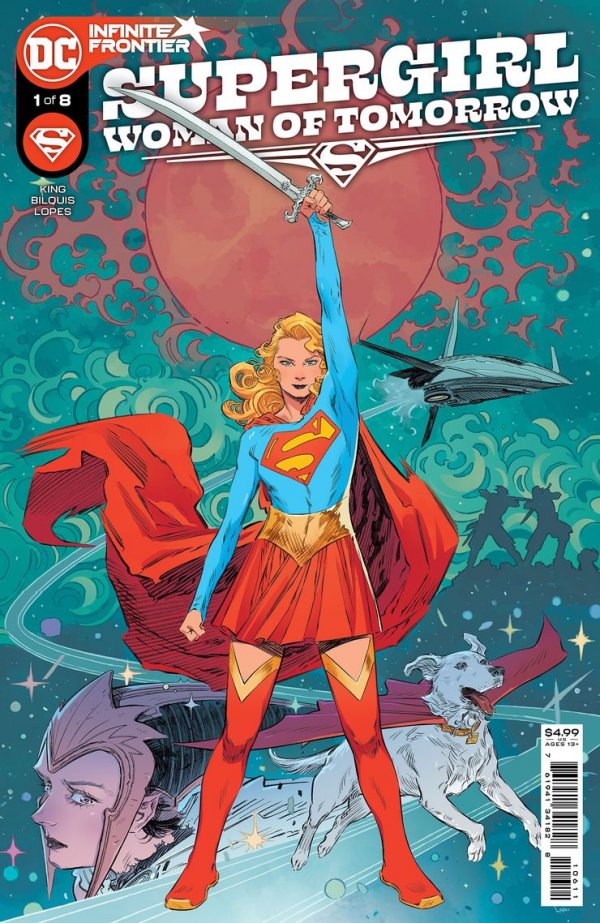
Notes: Today I decided to jump to the most acclaimed Supergirl story of the modern era, and the inspiration for her upcoming movie, Supergirl: Woman of Tomorrow by Tom King and Bilquis Evely. In this 2021-2022 miniseries, Supergirl has taken Krypto on a little spaceflight to celebrate her 21st birthday, off for a party on a planet where a red sun diminishes her powers. On this world, she meets a child named Ruthye Marye Knoll, who tries to hire Supergirl to hunt down and kill an assassin named Krem of the Yellow Hills, the man who murdered Ruthye’s father. Supergirl initially refuses, but when a fight against Krem mortally wounds Krypto, Supergirl’s only hope is to track down Krem and get a sample of the poison that is killing our good, good boy. What follows is an eight-issue odyssey across the universe as Supergirl and Ruthye seek Krem and, in the process, learn where true power comes from.

Tom King is, as I’ve said before in this blog, a somewhat divisive writer. And honestly, I don’t agree with it. I’ve never read a story by Tom King that I really hated, even the ones that get the most vitriol online. In fact – here’s a confession for you – if you had asked me the summer of 2022 what my least-favorite King story was, I probably would have said Supergirl: Woman of Tomorrow.

And I would have been wrong.

Allow me to explain. This book is a slow burn. There’s some action, yes, but it’s only a superhero comic by a technicality. There are very few superhero elements to it, and even fewer science fiction elements. In fact, between the purple prose and the gorgeous artwork by Bilquis Evely, it reads more like a fantasy epic than either of the other more logical genres into which it is usually placed. And I don’t mind a slow burn at all, but slow burns don’t always work in monthly comic books. By the time each issue of Woman of Tomorrow came out, I had sort of forgotten and lost track of where the story was, and that made it a difficult read. I don’t like the process of “writing for the trade paperback” that some writers engage in, and this is a perfect example of why.

Last summer, though, on an airplane to Pittsburgh, I decided to give this story another chance. I read it in its entirety for the first time, and when I did THAT, it was a totally different ballgame. Suddenly I understood why it was so highly acclaimed. I understood why DC Studios had chosen it to be the inspiration for the upcoming movie, because when you read all eight chapters together, my friends, it’s a beautiful thing.

The story is told not through Supergirl’s eyes, but through a book written by Ruthye years after the events have taken place. So instead of hearing inner monologue from Kara about how misguided this poor, orphaned child is to seek revenge, we get Ruthye’s interpretation of events, and we get to see how she is shaped and changed by the presence of Supergirl in her life. This isn’t an action story, but a character study and a meditation on what is needed to bring peace to a troubled soul. The S-shield, as we all know, stands for hope, and that’s the characteristic that we all so often attribute to Superman. That’s fine. But when it comes to SuperGIRL, I think her strongest power is her compassion, her capacity to love, and her ability to impart those feelings on others. This story sells it without misstep. 

The ending of the book, I have to warn you, is oddly ambiguous. In fact, it wasn’t until my third reading that I really think I’ve fully grasped what happened. It’s a character moment that fits perfectly, and if my interpretation is correct, it’s actually one of the few spots of humor in what is otherwise a very dramatic tale. But there’s debate out there over what actually happened, so I’ll leave it to you to read and decide for yourself what you think is the final fate of Ruthye Marye Knoll and Krem of the Yellow Hills.

I’m also tremendously impressed that they’re going with this story, in particular, to base a MOVIE on. I’m not sure exactly HOW faithful it’ll be to the comic book. They have, of course, included both Ruthye and Krem in the cast (played respectively by Eve Ridley and Matthias Schoenaerts), but they’ve also thrown in Jason Momoa as Lobo, who doesn’t appear anywhere in the story. If they keep it MOSTLY faithful, though, it’s going to be quite a departure for superhero fans. We’ve gotten used to years of movies where the stakes just keep getting raised – gotta beat the villain becomes gotta win the war becomes gotta save the world becomes gotta save half the universe. Now we’ve even got multiple universes at risk. But at its core, the stakes for Woman of Tomorrow are relatively small. There are no universes, planets, or civilizations in danger. The struggles in this comic book are done for the sake of one dog wounded by poisoned arrows and one girl wounded by a shattered heart. Compared to your average superhero movie, that’s small potatoes. But I think that’s exactly what we need – a reminder that a story need not be about the sake of the entire universe to be compelling, and that the battle for a single soul is just as worthy of telling. It’s a beautiful comic book. Here’s hoping we get a beautiful movie, too. 

Sun., May 25

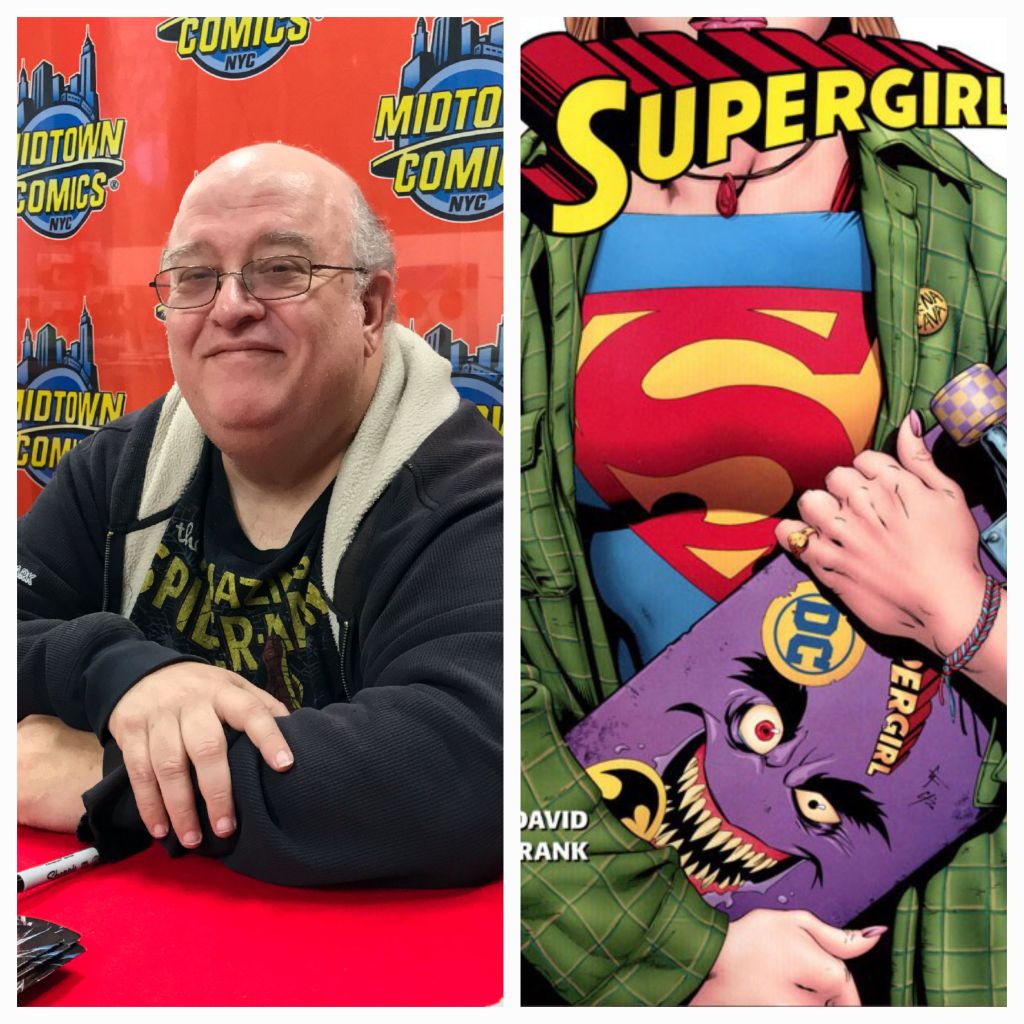
RIP Peter David, 1956-2025

Once again, we’ve got to pause the Year of Superman to pay tribute to a creator who has left us. Today it was announced that legendary comic book writer and novelist Peter David has passed away. David may have been one of the most prolific writers of the last half-century, having done epic runs on Marvel comics like Incredible Hulk , Captain Marvel, Spider-Man, and X-Factor, having co-created Spider-Man 2099, adapting Stephen King’s Dark Tower series, and work at DC on books like Young Justice, Aquaman, and Star Trek. David also wrote dozens of novels, including Star Trek adaptations and original stories, works adapting various other comics, movies, and TV shows, and his own original works such as Sir Apropos of Nothing. He wrote for TV and movies as well, including episodes of Babylon 5 and, with Bill Mumy, creating the Nickelodeon sci-fi series Space Cases. David never did an extended run on Superman, but his Supergirl series from the 90s took the Matrix version of that character and turned it on its ear, reinventing her, melding bits of classic Supergirl lore, and turning her into an entirely unique creation the likes of which neither DC nor anybody else had ever seen before. In fact, the only page of original comic book art I own is a page by Leonard Kirk from one of David’s Supergirl issues, in which she encounters Mary Marvel. I had already planned to cover at least the beginning of David’s Supergirl run in a later week, but I feel like it’s going to be sooner than I intended now. 

His characters were always rich and his prose was full of humor and imagination. He was a favorite of mine for a very long time, and although his output has dwindled in recent years as his health declined, the knowledge that there will never be more has me deeply saddened. 

RIP, “Writer of Stuff.” You are already missed. 

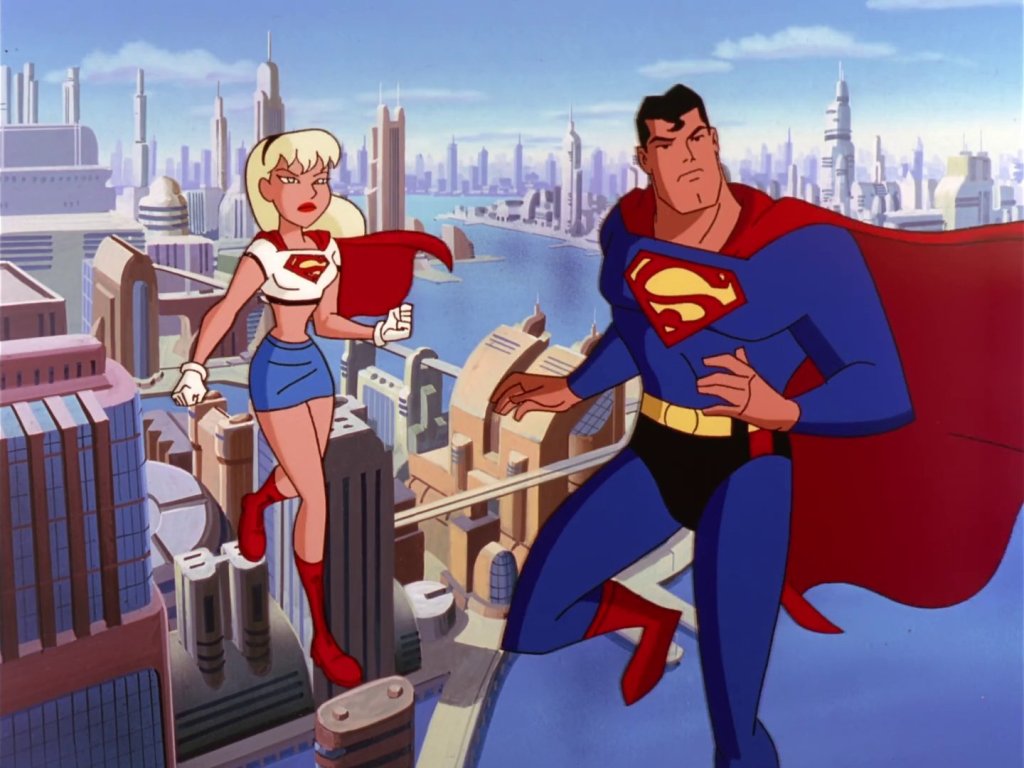
TV Episodes: Superman: The Animated Series Season 2, Episode 27-28, “Little Girl Lost” Parts 1 and 2

She pulls that shirt off better than I do, I’m not gonna lie.

Notes: Superman takes a craft into deep space, following the path of the rocket that brought him to Earth, in the hopes of finding some remnant of his destroyed homeworld. To his dismay, the planet is nothing but debris, but his spacecraft picks up a distress beacon from another world in the system. Superman arrives to find a frozen planet and a hologram telling him that this world was Argo, sister planet of Krypton, which was thrown out of its orbit when Krypton was destroyed. Superman finds a single survivor, a young girl in suspended animation. He brings the girl, Kara, back to Earth, where the Kents care for her as she acclimates to Earth. But Kara, anxious to explore the world, rushes to Metropolis in the hopes of “helping” Clark deal with his current Intergang problem. Instead of listening to Clark’s warning to wait in his apartment, though, Kara flirts her way into accompanying Jimmy Olsen on his own Intergang investigation. Part one of the two-parter ends with Jimmy and Kara going a bit too far and coming face-to-face with Granny Goodness and the Female Furies of Apokalips. In part two, as Supergirl throws down with the Furies, Superman shows up to help, but gets captured by the Furies. Supergirl finds a device in the rubble to open a portal to Apokalips and heads off to rescue him. She does, but destroys the machine that would have stopped a comet Darkseid has hurtled towards Earth. Superman tries stopping it the hard way, but the momentum is just too great, prompting Kara to fly into it at top speed, destroying it. You know – like Supergirls do. In the end, Jimmy gets the scoop of the year – Supergirl stops Intergang AND saves the world – and Earth gets a brand-new hero. 

I may be cheating here just a little bit. I said that this week I was only going to focus on Kara Zor-El, and TECHNICALLY, this Supergirl doesn’t qualify, as she’s actually Kara In-Ze of Argo. But I’m including it anyway for a few reasons. First: this was obviously the compromise Paul Dini and Bruce Timm came up with when DC wouldn’t allow them to have a Kryptonian Supergirl. Second: this two-part episode is too classic not to include. And third: It’s my blog, dammit. 

Kryptonian or not, in terms of personality, this is EXACTLY who I think Supergirl should be in her early days on Earth. She’s young, earnest, eager to help people, but also restless and impatient, faced with an entire new planet to explore in the hopes of finding a new home to replace the one that she lost. There have been times (lookin’ at YOU, New 52) where Supergirl has been played more angsty, more angry at having lost her homeworld…and while that may be justified, that doesn’t really feel like her character to me. Whereas Robin is the tempering influence to Batman, bringing light into the darkness of his world, I see Supergirl as a sort of conduit to Superman’s youth, a reminder that even to heroes with the power and responsibilities of gods, there is still room for joy. This, I think, is my favorite Supergirl, and the animated series captured that masterfully. 

TV Episode: Smallville, Season 7, Episode 2, “Kara”

Notes: I was a devoted viewer of Smallville during its TV run. I never missed an episode, and I enjoyed most of it. But I actually haven’t really revisited the show that much since the initial airing, so this is an interesting experience. I know I’ve seen this episode before, but watching it out of context like this, I’m trying to remember just what was going on in the show. Lois and Clark aren’t a couple yet, and she doesn’t seem to know about his powers, but where are all the 1,001 CW subplots at this point in season 7? Maybe it’s time to do a full rewatch.

Maybe not just yet, I’ve got a LOT of other Superman on my plate.

“STOP! In the NAAAAME of DOUBLE-L NAAAAAAMES!”

Anyway, in this episode Clark and Lois find a spacecraft and encounter a young woman who swiftly knocks out Lois and warns Clark not to touch her stuff before zooming into the sky and looking down into a token from the House of El with the image of a baby in it. Clark is stunned not only to face another Kryptonian, but one who – unlike him – can FLY. As Chloe tracks down a subplot (I’m gonna skip the non-Kara stuff in my recap or we’ll be here all day), Clark seeks out the flying girl, who is shocked to find that he has powers as well. Together they piece together their combined history: she is Kara, daughter of Zor-El, sent to Earth to protect her baby cousin and, with him, save Krypton from destruction. But when her ship landed on Earth in the same meteor shower that brought Kal-El to the Kents, she was buried and trapped in suspended animation for 18 years until a collapsing dam a few episodes ago set her free. Bigger problems, though – someone has taken her ship, and if they don’t get it back, the humans trying to open it up may well trigger a nuclear explosion.  

Unlike the animated Kara, this episode doesn’t actually end the story, but I don’t have time to down an entire season of Smallville, so let me just talk a little about Laura Vandervoot and her version of the character. Despite being the Supergirl actress with, objectively, the name that is most fun to say at parties, her version of the character is a bit angrier than I usually like. She’s got a little bit of a chip on her shoulder, angry at having been sent to a world that she clearly views as being primitive, perhaps even angrier at learning that the baby she was sent to protect is now older than she is. None of this is out of character, mind you, considering the way that the story is shaped in Smallville, and by the end of this episode we come around to the fact that much of her anger is based on grief over the loss of her homeworld. Vandervoot’s Supergirl isn’t my favorite, but it would be hard to argue that it isn’t perfect for this specific series. 

TV Episodes: My Adventures With Superman Season 2, Episodes 4-10

THIS Supergirl costume, on the other hand, I could rock.

Notes: I almost forgot that Supergirl made her debut in the second season of My Adventures With Superman – forgot mostly because I never got around to FINISHING that second season. So on a lazy Sunday afternoon with my wife at work, I decided to play a little catch-up. I’m not going to go into a deep recap of an entire half-season of the show, but here’s the quick version: Kara comes to Earth and brings Clark to her “Father,” who turns out to be not Zor-El, but Brainiac. Brainiac tries to use Clark’s body to take over Earth in the name of his “New Kryptonian Empire,” but Lois saves him with the Power of Love, and then all our heroes team up to fight Brainiac. 

I don’t mean for that to sound dismissive, because there’s really quite a lot about this show I like. But I’ll get more into that when I do “Pilot Week” or whatever the hell I’m going to wind up calling it. Today, let’s talk about Kara. This version of Kara has been manipulated by Brainiac for an unknown number of years, and she comes to Earth with an anger to her, even more than the Smallville version. As I’ve said before, I don’t like Angry Supergirl, but I did like watching how – over the course of this season – Clark and his friends chipped away and the shell Brainiac built around her and helped guide her to the light. Her interactions with Jimmy Olsen in particular are adorable, with both of them coming across as young people with a crush who don’t really know how to deal with it. 

The climactic battle, to be honest, is a little disappointing. What we get in the end is a Kara under Brainiac’s mind-control doing battle with Clark, who tries to turn things around using the standard “I know you’re still in there!” defense that superheroes always use on allies suffering from mind control. I won’t spoil the ending of the fight for you, but if you’re at all familiar with storytelling tropes, I probably don’t have to. That said, the execution of this very familiar trope is pretty good, and ultimately, we end the season with a new version of Supergirl that I hope to see more of in season three.  

Mon., May 26

Comics: Supergirl: Cosmic Adventures in the 8th Grade #1-6

I don’t remember the 8th grade being this much fun.

Notes: In 2008, writer Landry Q. Walker and artist Eric Jones gave us an utterly delightful young readers miniseries, Supergirl: Cosmic Adventures in the 8th Grade. This series gave us a ground-up reimagining for Supergirl in a format for younger readers. It was one of DC’s early attempts this century to start making headway into the YA market, and when they launched their YA graphic novel program a few years later, the paperback edition of this story was rightfully included.

In this version, Kara’s rocket crashes in Metropolis, where she accidentally thwarts a Lex Luthor plot. She tells Superman her story – she’s from Argo, a moon of Krypton in this continuity, and stowed away on a rocket her father was sending to Earth to contact Superman. Unfortunately, she passed through a dimensional barrier to get to Earth, and Superman has no idea how to send her back. A Supergirl who’s homesick is nothing new, but it’s pretty rare for that home to still exist, giving her a quest to find a way back.

Stuck on Earth, Superman supplies her with a secret identity and enrolls her in Stanhope Boarding School, where she struggles to fit in to this new Earth culture. She has difficulty controlling her powers and accidentally creates an evil duplicate of herself – Belinda Zee (who is not QUITE a Bizarro, but kind of like the Mean Girls version of that) who begins making her life a living hell. Things start to pick up when she finally makes a friend, an incredibly smart young woman named Lena Thorul. Things are starting to look better…but may get worse when Kara finds out her only friend is the sister of Lex Luthor.

Over the course of six issues, we’re treated to new versions of Comet and Streaky, we get teases about the Legion of Super-Heroes, and the revelation of the real villain of the piece still cracks me up all these years later. It was a truly magnificent series, one that I passed along to my nieces once they were old enough to start reading comics. The tragedy is that the book ends with multiple sequel hooks, and Walker and Jones tried for years to get the promised Cosmic Adventures in the 9th Grade underway. For some reason or another, though, it just never happened, and after the untimely passing of Eric Jones in 2022, it seems unlikely that it ever will. But this is without a doubt one of my favorite interpretations of Supergirl, one that even an old man like me enjoys coming back and revisiting every so often. The book has been reprinted several times, with a new edition scheduled for release in August (no doubt as part of the whole “Summer of Superman” foofarah). And if you’ve got kids around that middle school age, it’s a perfect book for them. 

Tues., May 27

Movie: Supergirl (1984)

Novel: Supergirl by Norma Fox Mazer

Comic: Supergirl: The Official Adaptation of the Movie #1

Notes: In 1984, the Salkinds decided to expand their Superman movie franchise with a spinoff featuring his cousin. And as luck would have it, I own not only the DVD, but also the novelization of the film AND the comic book adaptation of the same. So I thought it would be pretty fitting to close off Supergirl Week by taking a look at all three versions of this story.

“You will believe a franchise can spin-off.”

In the movie, we find ourselves on Argo City, last remnant of the planet Krypton, where young Kara (Helen Slater) is shown a powerful device called the Omegahedron by her teacher, Zaltar (Peter O’Toole). But Zaltar wasn’t supposed to have the Omegahedron, and an accident sends it beyond the shield that protects Argo from space. Turns out that the Omegahedron was the city’s power source, and without it, they have only days to live. Kara takes a ship to follow the Omegahedron to Earth, where it has fallen into the hands of a would-be witch named Selena (Faye Dunaway). The Omegahedron enhances Selena’s power’s greatly, taking her from the level of parlor tricks to being a potential world-conquering threat. Unfortunately for the world, Superman is on a mission in outer space.

In her search for the Omegahedron, Kara takes on the human identity of Linda Lee and enrolls in a local boarding school, where she forges a letter from her famous cousin, Daily Planet reporter Clark Kent, to vouch for her. She’s assigned a dorm room with Lucy Lane (Maureen Teefy), sister of Lois, who she quickly befriends and introduces her to her kinda-boyfriend Jimmy Olsen (Marc McClure, reprising his role from the Reeve movies). With the threat of utter destruction looming for Argo City, Linda proceeds to…take classes and play field hockey. Seriously, she spends a large chunk of this film acting like a normal Earth girl trying to hide her powers with absolutely no sense of urgency to save her family, friends, and entire civilization, for whom she is their only hope of survival. Selena, meanwhile, is practicing her magic, casting a spell that she intends to use to get the hunky handyman Ethan (Hart Bochner, whom you may remember as being the asshole John McClane doesn’t know in Die Hard) to fall in love with her. Instead, it accidentally makes him head-over-heels for Linda. For some reason, this also has the side-effect of making him talk the way that people who don’t understand Shakespeare think characters in Shakespeare plays talk.

Selena somehow manages to send Supergirl to the Phantom Zone, where she finds Zaltar has been exiled for his role in the loss of the Omegahedron. As Selena creates a mountain in the middle of Midvale to serve as her new fortress, Supergirl struggles to escape the Zone. Zaltar, who has fallen into despair in the Zone, leads her to the one way to escape, which makes you wonder why Zod and company never gave that one a shot. Zaltar perishes in the escape attempt, but Kara makes it through, returns to Earth, and defeats Selena, bringing the Omegahedron back to Argo City. And in the end, I’m just left wondering what the hell Clark Kent is gonna thnk when Jimmy gets back to Metropolis and says, “Hey, I met your cousin. Also I was briefly captured by a witch until a girl wearing a Superman costume beat her up.”

I’ll cut to the chase: this is not a good movie. The villain performances are hammy and overacted, the love potion subplot is just plain creepy (Selena’s fixation on the much younger Ethan has a nonconsensual “Mrs. Robinson” vibe, and even once it rebounds and he falls for Linda one should remember that he’s an adult and she’s a high school student), and there’s a lot of little nonsensical stuff that was probably necessitated by the low budget, such as Kara popping out of her spacecraft in a Supergirl costume with no explanation. And the abundance of cheese in this film just makes the stuff that IS good even more tragic, because so much of this movie deserved better than it got.

Helen Slater, first of all. She is perfectly cast – quiet and lovely, with an otherworldly charm that is entirely appropriate for the character. She pulls off the “stranger in a strange land” routine flawlessly, and she alone would make this movie worth watching. In the modern movie climate, they’d have had her make a cameo in Superman III or something before spinning her off into her own film, and this is one of the few times where I wish they HAD used modern techniques in the 80s, just because I wish we could have seen her play Supergirl more than once. (I’m not counting that scene in Flash.) As it is, the only real ties to the Christopher Reeve films are a poster of Superman in Lucy’s dorm and a totally superfluous appearance by Marc McClure as Jimmy Olsen, adding nothing to the plot. I would like to give them credit for adhering to canon by having him date Lucy Lane, but as with Ethan, in this continuity he’s way too old to be hooking up with a high school student. 

The score, by Jerry Goldsmith, also top-notch. Not John Williams good, of course, but it’s got a nice ethereal quality to it, less like a science fiction score and more like a fantasy film, which is appropriate for the tone of this movie. You could drop this score into something like Willow and it wouldn’t feel out of place at all. 

Even the special effects, considering the time period, are pretty good. And I love the design of Argo City, even if it doesn’t really match what Richard Donner’s version of Krypton looked like in the first Superman movie, but I can chalk that up to different cities having different styles. I mean, it’s not like New Orleans looks like San Francisco, right? 

“Are You There, Rao? It’s Me, Kara.”

As was often the case in the 80s, Supergirl got a novelization as well. I happened to pick it up on eBay some time back, in one of those moments where I snag weird stuff that I like. (By the way, if anyone wants to get me something for my birthday, just find a box of old movie and TV novelizations from the 80s on eBay. I have a strange fascination with those.) The novelization is by Norma Fox Mazer, whose body of work outside of this adaptation seems to be largely in the category of novels for children and teenage girls, which is pretty appropriate for adapting Supergirl. Her pedigree absolutely shows, too, filling the book with odd diversions and tangents that feel like the could have spilled from a Judy Blume novel, things like Kara feeling intimidated by her mother’s beauty, or interjections from Lucy’s point of view that work in the sort of slang that an adult novelist in the 80s probably thought that teenagers used, although as a child of the 80s myself I’m somewhat skeptical of their authenticity. 

The strangest thing about the book, though, is the timeline. The film makes it quite clear that Kara has only days to recover the Omegahedron before Argo is doomed, but the novel makes it seem as though Linda is enrolled at Stanhope for months before she recovers it and makes it home. It seems as though she’d return to a dead planet as far as the novel goes. But like I said, I have a weird fascination with these kinds of novelizations, especially since many of them were written before the film itself was finished, and I find the differences intriguing. This isn’t a great novel in the same way that the film isn’t a great movie, but like the movie, I still had fun reading it. 

I need you people to know that I exposed myself to three different versions of this story. THREE. Because I love you.

The comic book adaptation does a better job, I think. Written by Joey Cavlieri with art by Gray Morrow, it tells the story in a much more abbreviated way. This mostly eliminates the problem of making it seem like Kara is spending too much time on Earth while Argo is dying, and the art by Morrow is really lovely. He even does a good job of making the characters look like the actors, which isn’t easy. And even artists who do that well often do so at the expense of a certain liveliness, with art that looks like a static photographic rather than a dynamic comic book page. Morrow conquers that challenge. With the material they were given to work with, I think the comic did a superior job of adapting what was a weak screenplay. 

Originally I planned for Supergirl Week to include the pilot episode of Melissa Benoist’s TV series from 2015 as well, but fate had other plans, in the form of a power outage followed by an internet outage yesterday and into this morning that cut into the time that I planned to devote to the show. But you know, I’m pretty sure this is already the longest installment of the Year of Superman blog to date, so maybe it’s okay if I leave one thing for later. Besides, I’ve long planned a week where I watch the pilot episodes of all the assorted Superman TV shows, and I think I’ll have time to sneak in Melissa then. And if not, who knows? There may be time yet for Supergirl Week Part II. 

Blake M. Petit is a writer, teacher, and dad from Ama, Louisiana. His most recent writing project is the superhero adventure series Other People’s Heroes: Little Stars, volume one of which is now available on Amazon. You can subscribe to his newsletter by clicking right here. You can join in the Kryptonian Konversation every day in the Year of Superman Facebook Group!
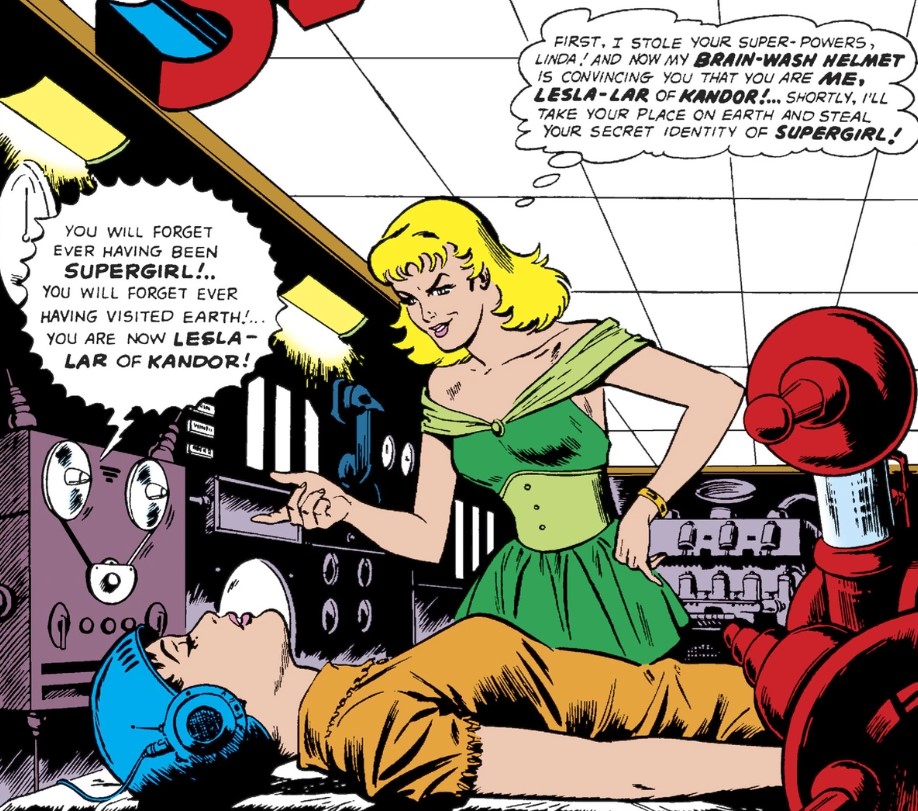
Year of Superman Week 20: Super-Sponsor

I’ve seen a few people online worry that, with only two months left until the debut of James Gunn’s Superman, there hasn’t been enough marketing yet. They’re worried that it shows a lack of confidence in the film. But to the contrary, I think we’re about to see Warner Bros repeat what they did two years ago with Barbie. Just like Superman, up until May there wasn’t an awful lot of official chatter yet. Then there was an AVALANCHE. New trailers, merch, a website where you could turn yourself into a Barbie meme. There was no escaping it and, in case you didn’t notice it, it turned out to be the highest grossing movie of the year. I think we’re at the beginning of that same push, and it started this week.

The debut of the new Superman trailer makes this the perfect week to kick off “Super-Sponsor,” a look at some commercials and comics that have featured the Man of Steel over the years. It’s always amused me, how fictional characters get pulled in to make a pitch for things like dog food, and I’m sure that this week is going to trigger some core memories for people. But first…

Wed., May 14

Official Superman Trailer

This guy is James Gunn’s self-insert for the entire DCU.

Notes: It’s funny, as the previous Superman trailer is what actually made me decide to start this whole “Year of Superman” blog in the first place, but now James Gunn is telling us that wasn’t a trailer at all. It was a “teaser,” he says, and the first real trailer is the one that hit today, May 14. What’s the difference between the two, you ask? I’m honestly not sure. If I were to guess, I would say that the first “teaser” just gave us glimpses, flavor. The trailer gives us a little more meat – in other words, the first real clue of what the story is gonna be. And of course, as it should, it starts with Lois Lane. In the trailer, Clark agrees to allow her to interview her as Superman about some recent actions that have apparently caused no small amount of controversy. Superman, he insists, has stopped a war. But Lois is questioning if that was the right thing, on the international level.

Oh, how I LOVED this. First of all, the interplay between David Corenswet and Rachel Brosnahan was spot-on. They are charming and affectionate, but at the same time, she’s a reporter, dammit, and she’s not going to blanch away from asking the hard questions. He went into a foreign country. He went without permission. “You seemingly acting as a representative of the United States–”

“I wasn’t representing anybody except for me!”  

The way the tension is sculpted here is flawless. Superman going in to save lives regardless of laws or treaties? Lois refusing to back down as he has to answer for it? This is who BOTH of these characters are. 

I know that some people have been concerned about the tone, afraid that Gunn (whose Guardians of the Galaxy films and The Suicide Squad both leaned heavily on comedy) would be too jokey, too flippant. This new trailer shows us a Superman who is good, decent, and pure, and struggling against a world that has difficulty accepting these things, and while it isn’t bereft of humor, it isn’t leaning on it the way those other films either. (And come on, people, even Guardians of the Galaxy mixed in the humor with real pathos. If you watched Guardians of the Galaxy Vol. 3 and didn’t shed a tear, I don’t know what I can even say to you.”  

We also see María Gabriela de Faría as the Engineer, working with Lex, storming the Fortress of Solitude. We hear a nice monologue from Nicholas Hoult as Lex Luthor, explaining how he can’t handle this alien dominating the conversation around the world. (It almost sounds like Superman is still new in town, the way Lex is talking here. We know this movie won’t be an origin story, but it remains to be seen just how far removed from the origin we’re actually going to be.)

We see more of Mr. Terrific, Guy Gardner, and Hawkgirl. We see Krypto stealing the show a few more times.

We see a movie that promises to be about a hero trying to do the right thing and a world that doesn’t know how to handle it.

I’ve been optimistic about this movie from the beginning. As of the teaser back in December, I’ve been gung-ho. Now? Now I’m…

I don’t know. What’s the next level up from gung-ho?

I’m overjoyed, and I cannot wait for July 11. 

Commercial: Milk-Bone Dog Biscuits: “For Honor” 

I don’t even have a dog and this almost worked on me.

Notes: As I said, I think this is where the marketing avalanche begins, and after Krypto became the star of the first teaser trailer, I’m not surprised to see it begin with Milk-Bone. Aside from a little Krypto footage we’ve already seen from the teaser, the trailer, and the sneak peek, we also get a scene of Mr. Terrific playing with Krypto and giving him treats, which I believe is my wife’s favorite part, as she squealed adorably with glee. I don’t own a dog, so this isn’t going to make me purchase anything, but if I did…I gotta admit, this ad would work.

Comic: Superman: A Friendship Unleashed #1 

“Unleashed?” Oh, I get it. It’s a pun, right?

Notes: In addition to the Milk-Bone commercial, we also got a new digital comic book, also sponsored by Milk-Bone. It’s a pretty simple 10-page story by Ivan Cohen and Travis Mercer, starting with Superman and Krypto playing fetch and then winding up having to save a dog park from an out-of-control fire engine, then working together to stop a S.T.A.R. Labs disaster that the fire truck was racing to prevent. Also, there are prominent Milk-Bone logos whenever it was easy to sneak it into the artwork. Is it a great comic book? No. But it’s cute enough, and it gives Krypto a little bit of a spotlight. Historically, this is mostly notable as – except a brief prophetic vision in an episode of Creature Commandos – the first actual story appearance of David Corenswet’s Superman…well…anywhere. 

Thur., May 15

Comic: Superman Meets the Quik Bunny #1

Much better than when Superman arrested the Trix Rabbit for stalking kids.

Notes: Hailing from 1986, this one-shot brings Superman face-to-face with his greatest ally: a cartoon rabbit!

No, wait, they did that in Captain Carrot and His Amazing Zoo Crew #1. I guess the big difference here is that Cap gets his power from eating irradiated carrots, whereas the Quik Bunny gets his from chocolate milk.

ANYHOO…In this comic, the Weather Wizard attacks Washington, D.C., and Superman leaps into action to stop him. Why Superman instead of, say, the Flash (Weather Wizard’s usual sparring partner) or Wonder Woman (who actually lived in D.C. at the time)? Because Quik paid for Superman, dammit. Superman is quickly (no pun intended) joined by the Bunny and his friends, the Quik Club – four genius kids who are there to problem-solve and catch the Weather Wizard.

It’s a ridiculous story, but there are a couple of things for which I really do give them credit. First of all, the product placement is surprisingly kept to a minimum. The Quik Bunny and the kids are introduced while drinking chocolate milk, then it isn’t mentioned again until the climax, where the Bunny is feeling down and the kids give him a jolt of Quik to get his head back in the game. There’s one last mention on the final page, when Superman joins the Bunny and the kids for a glass, but I can allow that. After all, once you’ve saved the nation’s capital from a bad guy with control over the fundamental elements of the climate, a cool glass of chocolate milk probably WOULD hit the spot.

The other thing I like about this comic is that it’s not JUST a comic. Every two or three pages, we get a little activity that ties into the story – mazes, word scrambles, connect-the-dots, and other such games that make the book a little more interactive. Granted, modern comic book nerds would find the notion of taking a pencil to the pages of a comic book to be horrifying, but comics like this weren’t made for people who were just planning to put ‘em in plastic, they were made to give away to KIDS (and entice them to beg their parents for Nestle Quik), and kids like that sort of thing. Or at least, they did back in the 80s. Maybe it wouldn’t work now, I don’t know, but as a kid of the 80s, I for one appreciated this silly little comic book. 

Fri. May 15

Comics: Superman: The Computers That Saved Metropolis

This is the worst Legion of Super-Heroes reboot ever.

Notes: Remember Radio Shack? That little store where you could buy all the computer and electronic components that you needed? My dad was an early adopter to computer technology, and I liked accompanying him to Radio Shack because sometimes – SOMETIMES – they had these free giveaway comic books. I didn’t care that they were kind of dumb, that the “Tandy Computer Whiz Kids” were ridiculous characters, and that every book they produced were blatant commercials for Radio Shack’s TRS-80 line of personal computing devices. You know what I cared about? FREE COMICS, that’s what.

By the time I was going to Radio Shack with Dad, the comics they were producing were mostly published by Archie and starred the Whiz Kids in their own adventures, but there were three comics from before I got into them that I had to hunt down later, because they featured Superman. The first was The Computers That Saved Metropolis from 1980. The story kicks off with Superman taking time out of his busy schedule to give a guest lesson to an elementary school class about the history of computers, because apparently there were no crimes, natural disasters, or multidimensional incursions that could be a better use of his time. He begins lecturing the kids – and the reader – on the history of the computer, with a kid named Alec acting as an audience surrogate in that he finds the lecture kind of boring, despite the fact that it’s being given by Superman. 

At the end of the lecture, the kids sit down to practice using the computers just as Superman is called away to stop a freak tornado that appeared out of nowhere in the middle of Metropolis. Rather than investigating this meteorological anomaly, Superman instead goes back to school where they have a little contest to see if the computer can complete math problems faster than he can. (Spoiler alert: It ends in a tie. The most ridiculous and improbable tie since the first time Superman raced the Flash.) A second test ends in Superman’s defeat, but only because (we learn) that freak tornado was the work of Major Disaster, who used it to release millions of microscopic Kryptonite fragments all over the city. The tiny crystals aren’t enough to take Superman out entirely, but they’re fogging his brain and making it hard to control his powers. With Superman operating on reduced efficiency, Disaster starts his REAL plan, screwing up the city’s computers. So Superman, of course, calls in the Justice League to take care of the situation.

HAHA! Just kidding! No, that would make sense. No, instead he burrows under the elementary school (it’s too dangerous for him to fly), bursts through the floor, and then has children use the two computers he brought in earlier that Disaster didn’t have a chance to monkey with to help guide him through averting Major Disaster’s major disasters. In the end, of course, Major Disaster is captured, the Kryptonite passes out of Superman’s system, and Alec and Shanna wind up on the news talking about how awesome computers are. 

We just saw the origin story of the Tandy Computer Whiz Kids, folks. And yeah, it’s silly, and it’s ridiculous, and it is utterly illogical that Superman would allow children to guide him in the control of his powers when hundreds of thousands of lives are at stake. But ask yourself this question: is it any less plausible than the fact that Adventure Bay has outsourced its entire first responder system to a child and his six dogs? Or that virtually every law enforcement organization in the world accepts the help of the gang in the Mystery Machine? The children are our future, people. Time we accepted that. 

Sat., May 17

Comics: Superman: Victory By Computer, Superman: The Computer Masters of Metropolis

This is becoming a habit.

Notes: Superman followed up his first adventure with the TRS-80 Whiz Kids a year later in another special, Victory By Computer. In this one, Superman and Supergirl both appear in Alec and Shanna’s classrooms, at which point the students are immediately disappointed because the all-powerful superheroes from another planet didn’t bring new computers with them. Man, and I thought MY students had attitude sometimes.

But it’s okay! Turns out that Superman and Supergirl DID bring computers – the brand-new TRS-80 POCKET computer, small enough to fit in the little pouches under their capes! As in the first special, we launch into an educational lesson, but instead of the history of computers, this time it’s about programming and modern technology. I give Radio Shack credit for at least not repeating themselves, and there is an amusing sequence where the kids are walking across a giant keyboard that looks like they got it out of the Batcave.

Oh yeah, and Lex Luthor is up to some shenanigans, this time summoning Supergirl and trapping her in a room with red sun lamps which – as we all know – negate Kryptonian powers. Fortunately, Alec and Shanna are there once again to lend a hand, aiding Superman in his cousin’s rescue with the help of an ancient and mystical creation known as…the MODEM. 

“Ah man, not THESE weiners again.” –Superman, probably.

In the third and final team-up with the TRS-80 kids, The Computer Masters of Metropolis, we get a new guest-star. This time, it’s Wonder Woman who shows up in Alec and Shanna’s classroom. (Meanwhile, across town at another elementary school, these visits from the fire department are seeming lamer and lamer.) After the lesson, it’s time for a surprise field trip – Wonder Woman is taking the kids down to the Metropolis World’s Fair to check out the computer exhibition. Their old pal Superman, meanwhile, is already at the fair, where he’s standing guard after Lex Luthor threatened to destroy the fair because they refused to showcase any of his scientific achievements. (Golly, I wonder why?)

There’s more Wonder Woman than Superman in this book, and she spends the first half of it giving the kids a tour of the fair, talking a little bit more about the history of computers, and impressing upon them just how integrated they have become in our daily lives. It’s actually pretty quaint to read this sort of thing – in 1982, computers were still a novelty. If they were to try to write a story today talking about how everybody uses computers, it would seem as ridiculous as telling them how important cars or, like, refrigerators are. After the kids go home, Wonder Woman sticks around in her Diana Prince identity, unaware that Luthor has tricked Superman into yet another Red Sun trap. The guy must keep the factory that makes those bulbs in business all by himself.

Superman is stuck in an auditorium bathed in the red bulbs, and Luthor has rigged the place with explosives to prevent him from escaping. But he’s made a mistake, as villains do – he forgot to remove the TELEPHONE. So Superman calls the Daily Planet and…gets a busy signal. So who does he call next? Batman? Supergirl? The Inferior Five ?Ambush Bug?

HE CALLS ALEC. THE SIXTH GRADER WITH A COMPUTER.

And Alec calls Shanna.

And Shanna calls the World’s Fair and has them page Wonder Woman, who saves Superman from the trap, and they capture Luthor.

These books are wild, guys.

Like I said when I wrote about the first of these three comics, they’re silly and quaint, and just as a nerd who loves both Superman and weird comics, I enjoy having these. But there’d never be any danger of them turning up in any collected edition of the Greatest Superman Stories ever told.

On the other hand, I wonder who actually owns the TRS-80 Whiz Kids now that Radio Shack doesn’t exist anymore. Is that valuable IP floating around somewhere? Could Alec and Shanna turn up in some gritty Black Label series, probably by Tom King? And if so, would they still be…the Computer Masters of Metropolis?

I’m just kidding, guys, this is never gonna happen. 

A quick note that has nothing to do with the Whiz Kids, guys, but that I thought was interesting. If you’ll recall, I started this week’s blog writing about the new Milk-Bone comic book, and at the time, I thought it was digital-only. Looks like I was wrong, though – there WAS a print run, and you could order it from Milk-Bone with a box of dog biscuits. Apparently this was ridiculously popular, so popular that the website had to be taken down and the print version of this book is now showing up on eBay for upwards of $80. It was absurd to me, and I couldn’t figure out why people were going so crazy for it – then it hit me.

Like I said then, TECHNICALLY, that Milk-Bone comic book is the first appearance of David Corenswet’s Superman. And I bet the speculators are pouncing on it for that reason.

I’ll check eBay again in six months. It’ll probably be more reasonable then. 

Sun. May 18

Commercials: “Superman Peanut Butter,” “Superman Vs. Nick O’Teen”

Notes: Over the years, Superman has occasionally turned up in commercials for products or services that didn’t really have any relevance to him personally. In fact, in one case, they even NAMED a product after him for truly astonishing reasons. Back in the early 80s, Sunnyland Refining Co. had a new brand of Peanut Butter it was planning to launch, and so of course they asked the obvious question: who is the obvious spokesman? Peter Pan was popular, of course, so maybe another flying hero. Condorman? Casper the Friendly Ghost? Tweety Bird? No. The obvious answer, of course, was Superman. 

Or something like that, I have no idea how Sunnyland wound up making Superman Peanut Butter, and Google has not been particularly helpful in my research, but I sure as hell REMEMBER Superman Peanut Butter. I remember it, I miss it, and I firmly believe that if we could bring it back today the world would be at least a little bit better for everybody except for people like my nephew who have nut allergies. (Sorry, Grant.)

“Lex? Could you — could you not make that face in front of the kids, please?”

There were a few commercials over the years for Superman Peanut Butter, but the one I remember most fondly was this one from 1983, in which Superman has been captured by Lex Luthor. Luthor, demonstrating the primary concern of most supervillains, wanted Superman to tell him the secret of why Superman Peanut Butter tastes so great: “So fresh roasted,” Lex intones, “So creamy!” As he berates the Man of Steel for his refusal to share his legume-spread secrets, a bunch of random kids peek in through a glassless window, drop a rope, and swing Lex’s Kryptonite to a lead box that has been left conveniently open, allowing Superman to burst out of his cell and capture him. I don’t know exactly which level of the DC Multiverse this commercial takes place in, but this is clearly not the smartest Lex Luthor we’ve got. On the other hand, this Superman was willing to die in order to protect his peanut butter secret, so maybe he isn’t the smartest Supes, either.

At any rate, this goofy commercial has stuck with me for all these years, and darn it, I DO still long for a slice of toast with a thick layer of Superman Brand Peanut butter. A few weeks ago, in the Comic Book Collecting Facebook Group I help moderate, someone asked the question of whether anyone ever REALLY bought Superman Peanut Butter just because of the association with the character. 

Yes, sir. I assure you. We did. 

The same year that Superman Peanut Butter launched, we also got a trio of anti-smoking ads starring the man of tomorrow. All three ads follow the same basic pattern. A bunch of kids are being approached by a hideous villain called Nick O’Teen who tries to entice them to try cigarettes. Superman shows up. Superman kind of brutalizes Nick. Then he crushes the cigarettes with his Kryptonian might and stares at the camera.

Not since Patty O’Furniture has a villain had such a stereotypical name.

That is not to suggest that the commercials are identical, of course. In one of them, Superman destroys the cigarettes in front of Nick’s face as he begs, pathetically, for a fix. In another, Nick is disguised as a wizard teaching the kids magic tricks with cigarettes before Superman stops him. And in one, Superman just gets so fed up that he hurls Nick O’Teen far enough away that – as my wife commented as she watched the commercial with me – “he straight-up murdered him.” 

Maybe, but who’s gonna cry for the guy trying to give cigarettes to kids?

To say that these ads are poorly made is an understatement. Superman is constantly off-model, and he doesn’t even seem to have a consistent voice in the three of them. In fact, in the first it almost sounds like someone was trying to do an impression of Arnold Schwarzenneger before he began to speak the flawless English he is known for today. But the question remains: were these commercials EFFECTIVE?

Well, the message we seem to take away from them is, “If you try cigarettes, you will be brutally killed by Superman.” And I gotta admit, that’s enough to make me never want to take a puff.

In 2004 we once again saw Superman grace American televisions to shill a product. This time, though, he wasn’t alone. Superman (voiced by Patrick Warburton) is joined by none other than Jerry Seinfeld in an ad called “A Uniform Used to Mean Something” by American Express. Although most of us saw the 30- or 60-second truncated versions of this ad campaign, there’s a full five minute short film on YouTube that you can – and should – watch right now. 

“And what’s the deal with the bottle city of Kandor?”

Seinfeld (who of course CLAIMS to be a huge Superman fan, but ask yourself, where’s HIS “Year of Superman” blog? Huh? HUH?) and Superman are going out to lunch. They engage in a series of conversations that would have fit in perfectly on his self-titled sitcom – complaining about the amount of mayonnaise on a sandwich, discussing how great the surround sound on Jerry’s new DVD player will be (“What do you care? You’ve got super-hearing.” “Yeah, but it’s not SURROUND SOUND.”) And then, as Superman is stuck reading the reviews for a new musical, a crook rushes past and steals Jerry’s DVD player right out from under him. Superman stops him, of course, but not before the criminal throws it at Superman and it breaks.

WHAT DO WE DO?

Superman’s suggestion, of course, is that he fly around the world so fast that he goes back in time and stops the DVD player from being damaged. Jerry has a simpler idea – his American Express card protects his purchases from theft, damage, or being bounced off a superhero’s chest for 90 days after purchase, and he easily gets a new one.

If somebody wanted to create a time capsule of pop culture in the early years of the 21st century, they would pretty much HAVE to include this ad. It was ridiculously ubiquitous back in 2004, it seemed like it was on the air every other commercial break…and what’s more, it also serves well as a bite-sized taste of the Seinfeld TV show, as well as the kind of stunts credit card companies used to use to draw in customers. 

Man, Super-Sponsor week is a ride, my friends. 

Mon., May 19

Short Film: Stamp Day For Superman (1954)

Superman, of course, doesn’t need stamps. He sends everything big AIR mail. Heh. Get it?

Notes: Remember those days in school when the teacher would pull out a filmstrip, the VCR, or the DVD player, depending on how old you are? (If you’re too young to remember the DVD player, I’m not even sure why you’re reading this blog.) Weren’t those days the best? Well, in 1954, the people behind the TV show The Adventures of Superman made an 18-minute short film to promote US Savings Bonds. Superman (George Reeves) and Lois Lane (Noel Neill) are on a stroll down the streets of Metropolis when they’re alerted to a robbery. Lois goes off to get the story, while Clark goes after the robbers. One of them gets away, but the other turns himself in to Superman, confessing that the only reason he turned to crime is because he’s never been able to save his money, which makes you wonder how somebody from 2025 made it to the 1950s. 

Back at the Daily Planet office, Jimmy Olsen (Jack Larson) shows off the brand-new typewriter he bought when some of the US Savings Bonds he bought back when he was a kid finally matured, because even in the 50s Jimmy was one wild and crazy guy. His glittering purchase gives Clark the idea of having Superman visit Jimmy’s old school to help promote “Stamp Day,” the day to buy savings bonds. As Clark and Jimmy go to the school to help set up for the promotion, Lois gets a phone call from an informant who confesses that he’s the missing robber – he knows he’s going to get caught, and he’ll only surrender to Lois Lane, alone. 

I want to offer a US Savings Bond to anybody who can guess what happens to Lois next, but I’m a public school teacher and there’s no way in hell I can afford that many.

Thaaaaat’s right – Lois gets caught and tied up, and it’s going to be up to Superman to get her out of yet another one. This time, though, he’s got the added difficulty of setting her free in time for Stamp Day!

I haven’t gotten around to talking about the Adventures of Superman show yet, although I fully intend to do so when I do the planned week where I watch the first episodes of all the assorted Superman TV shows. But I’m delighted that this goofy little short exists, giving me a chance to wax poetically about it here during “Super-Sponsor” week. Although the story is, naturally, a blatant propaganda film promoting the purchase of savings bonds (to the film’s credit, it never tries to claim otherwise), you still get to see Reeves and Neill at their best. Reeves is square-jawed and charming, and although his Clark and Superman have very little difference in how he plays the characters, he’s like a Wayne Boring Superman climbed right off the page and came to life. And while Noel Neill’s Lois frequently had to play the damsel in distress, I don’t remember a single episode where she lost her cool, pleaded with her captors, or hatched some hare-brained scheme to entrap Superman in marriage. No, even while she’s tied up by the dubiously-named robber “Blinky,” she’s clever and snarky. Honestly, she’s got the best traits of the era’s Lois Lane and none of her foibles. 

If you extract the scenes about Stamp Day (which honestly wouldn’t be difficult to do) you would have a pretty standard – albeit short – episode of the TV show. What’s more, because the movie was made for the federal government, it’s in the public domain. And yet somehow, I wasn’t aware of its existence until 2016, when it got goofed on as the finale of the RiffTrax Live: Mystery Science Theater 3000 Reunion Show. As I’m almost as big a fan of RiffTrax and MST3K as I am of Superman, watching this film with almost every MST3K host, bot, or mad throwing out their bon mots was just a delight. It’s not a bad episode on its own, but if I’m being honest, I enjoy it more with the riff treatment.

Comics: New Gods Vol. 5 #5 (Cameo)

Tues., May 20

Commercials: Ralph Nader Kryptonite Commercial, Superman for the US Air Force

Notes: Kids, once upon a time, there was a guy named Ralph Nader. Nader is a lawyer who kind of became a celebrity through advocating for consumer protection and environmental causes. In fact, a book he wrote in the 60s pushed public opinion to the point that the government began to enforce stronger safety regulations for the automobile industry, so hey, thanks Ralph. He also ran for president several times, although he never made it as a major party candidate, but he’s still kicking it at 91 years old, so there’s still time, right?

“I’m Ralph Nader, and I have no idea why I’m giving this message.”

“Blake, why the hell are you talking about Ralph Nader?” you may be asking. And for once, Presumptuous Disembodied Voice From the Back of the Auditorium, I am in complete agreement with you. Ralph Nader showing up here in my Year of Superman blog makes no sense. But neither does what I’m about to talk to you about. In the 1980s, Nader appeared in a one-minute television spot talking about the various colors of Kryptonite. Normally, when I link to something off my site, I just kind of drop the link in the middle of a paragraph and trust that you’re smart enough to click on it, but I’m not going to do that this time. No, I need to draw attention to it, because I think everybody needs to see this. Go ahead. Click the link below and watch this commercial with me.

Ralph Nader Kryptonite Commercial on YouTube

Back? Okay, let’s talk about what we all just shared. Ralph Nader – PRESIDENTIAL CANDIDATE RALPH NADER – spends 60 seconds telling you about the various versions of Kryptonite that exist, and warns you to be careful not to be scammed when purchasing your Kryptonite from some sort of sleazy backroom dealer. “Gold Kryptonite robs you of your powers! Green Krytonite makes you drowsy, inert, and eventually destroys you! Red Kryptonite…now that’s the unpredictable stuff.” Then he closes off the spot by telling you that if your Kryptonite is not properly and clearly labeled, you should take your business elsewhere.

This. Is. BONKERS.

And the thing that’s MOST bonkers about this is that I have NO IDEA WHY THIS COMMERCIAL EXISTS. There’s no tag on the end that points you to a product, a service, a movie. There are clips from the old Adventures of Superman TV show with George Reeves, but if the commercial is intended to promote reruns of that show, why don’t they tell us what time and channel to tune in? And what’s more, why show panels from the comic books, or footage of the Superman balloon in the Macy’s Thanksgiving Day Parade? Neither of those would promote the TV show at all. It’s almost like a Saturday Night Live bit, but there’s no audience laughter to indicate as such, and I can’t think of any other TV show of the era that would have made a spot like this…nor does it really go wacky enough to suggest that it was intended as a comedy sketch. So what IS it? WHY WAS THIS COMMERCIAL MADE? WHY DOES IT EXIST?

If you know, friends, please tell me before it drives me insane. 

The last commercial I’m going to talk about is a recruiting spot from 1974, in which baseball player and manager Dick Williams talks about how the Air Force is like a baseball team – all about people working together and learning skills.

He’d make a hell of a wingman though, right? Ha? Ha? Okay, I’m done with the puns. For now.

As he walks through a baseball stadium, he encounters Superman (or, rather, an actor wearing a rather shoddy Superman costume) pouting because they won’t let him play baseball with them. “They say I’m too good.”

“I know how you feel,” Williams said. “Why don’t you try the Air Force?”

I mean, let’s be honest here, if Superman WERE to join the military, the Air Force makes the most sense. 

While not as completely nonsensical as the Nader spot, this one is kind of depressing, seeing a schlumpy kind of guy in a Superman costume moping around a baseball diamond. He should have cheered up anyway – he was only six years away from getting consistently shown up by a pair of sixth graders using a Radio Shack TRS-80 computer.

Comics: Challengers of the Unknown Vol. 5 #5 (Guest Appearance)

Super-Sponsor week comes to a close, friends. This was a weird one. I would have had many more commercials to choose from if I’d used actual Superman products, like the action figures, and maybe I’ll come back and do that some other time. There are also a few other giveaway comics I managed to identify – such as one from the 90s or early 2000s in which Superman and Supergirl talk about energy conservation – but I don’t actually have a copy to review. (Yet. But as long as eBay exists, the possibility stands.) At any rate, this was a bizarre spin around the world of Superman, and next week I’ll be getting back to some more traditional stuff, with TWO new Superman-related titles making their debut this month to talk about. And since one of them stars Superman’s famous cousin, I think I’ll go ahead and declare next week SUPERGIRL WEEK.

See ya then. 

Blake M. Petit is a writer, teacher, and dad from Ama, Louisiana. His most recent writing project is the superhero adventure series Other People’s Heroes: Little Stars, volume one of which is now available on Amazon. You can subscribe to his newsletter by clicking right here. You can join in the Kryptonian Konversation every day in the Year of Superman Facebook Group!
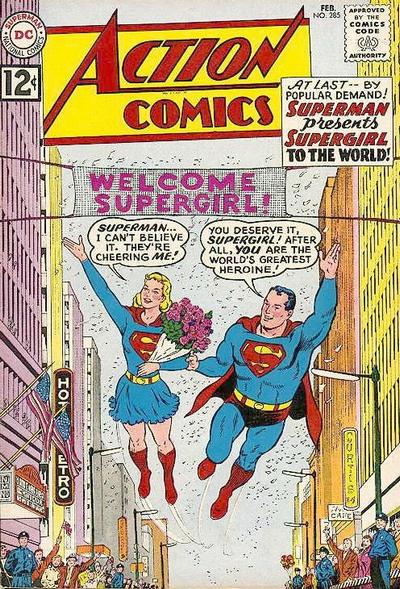
Year of Superman Week 19: Superman Who?

We’re here approaching the middle of May already, and for me that means the end of a school year. This week is the last week for my 12th graders, while my 11th graders are gearing up for their last two weeks. All of this boils down to less time for me, so I don’t think I’m going to work too hard to maintain any sort of theme this week. Let’s just take it as it comes and see what turns up.

Wed., May 7

Comics: Action Comics #558, Superman’s Pal Jimmy Olsen #138, Justice League of America #23

Ironically, this is what I feel like when I get an ice cream headache.

Notes: Here’s another one of those semi-random issues that turns up in my classic comic read-throughs, and it really illustrates something about the middle years of Superman. After the Silver Age silliness started to die down, there was a long period where it didn’t quite seem that the writers knew what to do with him. He only had a few great villains, like Luthor and Brainiac, and it’s not like he could face off against them twice every month, or they’d be overused. Attempts at creating new villains tended to turn out losers with little meat behind them, such as Terra-Man, or else random alien or mystical opponents who were only good for one story each. Other than that, they had him facing off against natural disasters or some sort of personal mishap that made Superman himself (temporarily) dangerous or otherwise imperiled without having an actual antagonist. 

As for his personal relationships – the perpetual Second Act of ongoing comic books is on no greater display than it was here. They didn’t want Clark to get married, they kept Lois as a hanger-on, they didn’t add any characters, they didn’t remove any, and that’s how things were for decades. They finally made a slight shift in the late 70s and early 80s: moving Clark to WGBS added a few characters to the cast, and bringing back an adult Lana Lang who was finally infatuated with Clark Kent rather than Superboy changed up the classic Superman/Lois/Clark love triangle. Ultimately, though, these changes were largely cosmetic, and the actual plots didn’t change all that much. When somebody calls Superman boring I disagree with them vehemently, but I have to assume that the majority of their exposure to the character probably comes from this era.

All of this is to say, “The All-Searing Eyes” from Action Comics #558 is another example of a Superman story that’s low on threat and doesn’t really have any reaching impact. Superman is brought into contact with a scientist attempting to solve the world’s energy problems, and he thinks he’s found the way to do it: Superman’s heat vision. He believes if he can discern how Superman’s heat vision works, he may potentially be able to harness that energy for the benefit of the people of the world. Superman, being Superman, agrees to have his heat vision tested, but he’s forced to end the experiment prematurely to avert a disaster, and as a result, he finds himself unable to turn the heat vision off.

Is there story potential here? Sure. A Superman unable to turn off his heat vision would be horribly dangerous, something that was actually addressed in a 90s storyline in which his powers went out of control for a while. But true to the time period, there wasn’t much room for real drama here. Superman realizes he’s in a pickle, he causes a small amount of trouble but no lasting damage, and at the end of 12 pages the scientist manages to get his heat vision back to normal. Ultimately this – like a lot of the comics of the era – feels pretty inconsequential. It has no lasting impact for any of our characters, and nothing that happens is ever referenced again. This isn’t to say that every single Superman story (or every story for any ongoing character, for that matter) HAS to have long-reaching consequences, but if they don’t, they should at least reveal something about the characters or, at bare minimum, be original and fun. This story, and many of them of the era, just don’t tick any of those boxes. In a modern age where it seems like comic books are rebooted every twenty minutes and it never matters anymore, you can look at books like this one – books that happened in the years before the first major reboot – and you can understand why DC felt like it was necessary. 

Thur., May 8

Comics: Superman #126, Blue Devil #3 (Guest Appearance), Action Comics #375, Infinity, Inc. #5 (Power Girl)

And this is what it takes to get RID of an ice cream headache.

Notes: As I’ve said before, on weeks when I’m not pursuing a particular theme, there’s little rhyme or reason to the choices I make as to which Superman content I’ll explore. For example, Superman #126? It’s on the docket for today solely because I was scrolling through the DC Universe Infinity app, the cover caught my eye, and I don’t think I’ve ever read this story before.

I should clarify: I’ve never read the story presented in this PARTICULAR issue before…but I have most CERTAINLY read stories about Superman with amnesia. They were strikingly common in the Silver Age, and even as late as the early 90s there was the “Blackout” five-parter, in which Superman’s memory was accidentally wiped by an experiment Emil Hamilton was working on and he wound up on a tropical island almost marrying a native princess. (Hmm. Should I read that one next? It’s been a while.)

But for now, I’m focusing on “Superman’s Hunt For Clark Kent.” While experimenting for a possible antidote to Kryptonite radiation at the Fortress of Solitude, an accident causes Superman to lose his memory…but fortunately not his powers, which he needs to fly down to Metropolis to start piecing together his missing life. He gets clothes from a British chap who is literally giving them away to the first person he sees who’ll fit them and who seems to have no idea who Superman is, then decides to adopt a “secret identity.” He disguises himself as a Brit, bleaches his hair blond, takes the name “Clarence Kelvin,” and applies for a job at the Daily Planet

You know, there’s an adage in writing that goes something like, “In real life, we expect coincidence. In fiction, we do not stand for it.” I imagine that adage was coined in response to stories like this one. Superman’s behavior is completely absurd and preposterous, and seems to happen only to keep him from telling literally anybody on the planet the predicament he’s in, at which point every scientist in the world (except for Lex Luthor) would be falling over themselves to try to cure his amnesia. But instead he…fights a whale. 

Eventually, he learns who he really is by flying into space far enough to overtake the rays of light coming from Earth and using his telescopic vision to watch himself, in the past, changing his clothes, making him realize he’s Clark Kent – and that may be the LEAST scientifically implausible thing about this story. At the end, everything goes back to normal, with Clark settling in at the Planet again…but something about this is bothering me. He discovers that he’s really Clark Kent. He resumes his life as Clark Kent. But at NO POINT does the story actually say that his MEMORY returns. Does that mean that Superman technically had amnesia for the rest of the Silver Age?

Where’s that grim and gritty follow-up?

As usual for this era, there are three stories in the issue. The second one isn’t particularly memorable, but the third one made me do a double-take. In “The Two Faces of Superman,” Lois deliberately makes herself unattractive to ward off a blind date and Clark, catching wind of this, decides to teach her a lesson. He decided to do that a LOT in the Silver Age, in and of itself there would be nothing noteworthy about this. But as Superman, he whisks her off on a date, at the end of which he “confesses” that he always wears a rubber mask as Superman and wants to finally show her his true face. And when he does…well…see for yourself.

“What, me Kryptonian?”

Yep. Superman decides to turn himself into the spitting image of Mad Magazine’s Alfred E. Neuman. 

And this, it should be noted, was long BEFORE Mad was published by DC Comics. 

Anyway, to her credit, Lois is smart enough to figure out Superman’s ruse (after a few pages of angst and soul-searching) and calls his bluff by accepting a marriage proposal he never thought she would go for. In the end, both of them put their cards on the table and admit the truth, and Lois even concedes that it was wrong of her to blow off her blind date in such a way, then goes right back to dreaming about wanting to marry Superman – but NOT by tricking him. I guess that’s the sort of thing that passed for noble aspirations in 1959. 

Fri., May 9

Comic: Absolute Superman #7

This is what it felt like when I got an ant farm in 4th grade.

Notes: Only one new Superman-related comic hit the stands this week, although I did get the Dan Mora variant cover for the Action Comics #1 facsimile, because I’m a sucker. The one new book, Absolute Superman #7, is our introduction to the Brainiac of this dark universe. In fact, Superman doesn’t technically appear at all. Instead we spend the entire issue exploring this new incarnation of the villain and his obsession with the Superman that has somehow appeared on Earth. This version of Brainiac has a bit in common with Geoff Johns’ re-imagining of the character several years ago, but there’s a madness to him that I’ve never seen in a Brainiac before. It suits the grimmer universe that the Absolute titles occupy quite well, and I’m looking forward to seeing where it goes next.

Most interestingly, though, is the cover. I have to talk about my love for this cover, by Rafa Sandoval. It’s not just that it’s a good piece of art, although, it is, but look at it. Word balloons. How often do comic book covers have word balloons these days? It’s a lost art, and when it IS used, it’s usually used for comedic purposes. To see it done this way is both unexpected and exciting. Good on ya, DC. 

Sat., May 10

TV Episode: Superman and Lois, Season 2, Episode 8, “Into Oblivion”; Episode 9, “30 Days and 30 Nights.”

After I make it to work on a day like this I usually text my wife and say “Careful, the fog is crazy this morning.”

Notes: The assorted subplots that have defined this season continue in episode 8. Jonathan, expelled from school, is given permission to complete his coursework online and is forced to get a job. Jordan discovers that the reason his brother has refused to tell anyone about his sources for X-Kryptonite is because he’s trying to protect Candice, the girl he’s been seeing, who’s trying to support her family. John Henry is recovering from amnesia (more amnesia?) and has forgotten that he’s not married to Lois in this universe, and his recovery is triggering Natalie, who remembers how the Superman of her original universe murdered her mother. Lana’s husband Kyle – despite their estrangement – tries to help her prepare for her upcoming debate in the race for Mayor of Smallville, while Sarah tries to convince Jordan to become friends with the girl she hooked up with in summer camp. 

Sometimes the synopsis of these episodes make me long for the quiet subtlety of a Silver Age issue of Superman’s Girl Friend, Lois Lane.

In episode 9, cult leader Ally Allston (the one who sucked Lucy Lane into her web) breaks DOD custody and manages to hop into a portal to another dimension. Superman goes after her and winds up trapped in that other dimension for…well, the name of the episode IS “30 Days and 30 Nights.” In that time, disasters go unchecked and lives are lost as the world cries out, “Where is Superman?” As John Henry sets out in his Steel armor to fill in the gaps, Jordan tries to use his super-senses to find his absent father. Ah yes – and the Smallville mayoral election happens, and lest we forget, Lana is on the ballot. 

As much as I want to enjoy this series, in episode 8 there’s just too much going on, and it’s not connecting with me as a result. I feel like I need a scorecard to keep track of all the storylines, and for somebody who navigated the entire Triangle Era of Superman comics with no issues, that’s saying something. That said, there are a few things that I liked here. Jonathan taking the fall for Candice, for example, feels like a very Kent thing to do. He’s protecting someone and taking the heat on his own, and while he’s doing it in a stupid way, he’s also a teenage boy and thus a certain level of stupidity is to be expected when girls are concerned. I also like the way that Clark tries to mend fences with Natalie, someone he has never wronged, but at the same time, someone who may be the only person on Earth with a legitimate reason to be traumatized by Superman. There are a few good scenes with the two of them, and I like the development of her character.

I’m not wild about the continued development with Lucy and the cult leader who sucked her in, and the end of the episode has Lucy taking a turn that not only marks her as a bit of a villain, but a way bigger idiot than even Jonathan. It does lead into Episode 9, though, which improves over 8 considerably. It starts with John Henry suiting up in his armor and trying to fill in the gaps left by Clark’s absence. There’s also a great bit where Kyle – a firefighter – is trapped in a burning building and Jordan has to use his powers to save him. Lois is outraged, but Jordan stands his ground and insists that he did the right thing. And damn it, Lois, you know he’s right. Finally – FINALLY – we get some of the stuff I’ve been wanting to see in this series. Jordan uses his powers to save somebody’s life. Lois argues that he should have let John Henry handle it, but Jordan points out that John wouldn’t have made it in time and Kyle would have died. Jordan is 100 percent right – he used his super powers to save somebody’s life, and that is ESPECIALLY important while his father is missing. On the other hand, Lois isn’t approaching this as someone who is desperate for a new superhero in the world. She looks at it from the perspective of a wife whose husband is missing and whose son just did something incredibly dangerous, sparking her fears of losing him too. Lois is totally in the wrong, and yet, her reaction is entirely understandable and in-character. And that, my friends, is what makes for a compelling conflict.

This episode also finally gives us a little forward momentum on the X-Kryptonite storyline, as Jonathan breaks down and tells his mother where to find the distributor, sending Lois, Sam Lane, and Jordan on a stakeout that goes bad. (There’s a cute bit here where Lois’s knowledge of the kind of knots used to keep them in check makes her father question just how many times his daughter has been tied up over the years.) Despite Lois’s protests, Jordan comes in to save his mother and grandfather, and maybe for the first time in this whole series, we see a glimpse of the Superboy he just may be destined to be. I love what they do with him in this episode, it’s the best we’ve seen from Jordan yet. 

Although Sarah dumping him at the end of the episode because he keeps disappearing and won’t tell her what’s going on is more of a Peter Parker consequence than a Clark Kent one. Ah well. He’s got the powers, best he learn what it takes to be a superhero now. 

It ends on a hell of a cliffhanger, and it’s probably the best episode of the season so far. And Superman isn’t even actually IN it. Go figure. 

Sun. May 11

Comics: World of Smallville #1-4

Notes: It’s Mother’s Day here in the US, and in the Year of Superman I thought I should devote my reading today to that mom of moms, Martha Kent. Let’s face it, Martha and Jonathan are probably the greatest parents in all fiction. They took a child with the power of the gods and raised him to a man who uses that power only to help people. That is A-plus parenting no matter how you slice it.

Nobody else even comes close. No disrespect to May Parker, but look at the little bundle of neuroses SHE raised. And sure, Susan Richards’s son is plenty powerful, but they actually put a mental block on him to prevent him from accessing his abilities. I mean, I get it – when Eddie was little we put a lock on our oven because it was too dangerous to allow him to open it at will. Same thing. But still, Martha had no such protections, and she STILL knocked it out of the park.

Problem is…there aren’t really a ton of great comic book stories ABOUT Martha. Sure, she appears a lot, especially since the Man of Steel reboot, but she’s almost always in a supportive capacity. There have been a few stories about Jonathan, but Martha almost always appears to impart a little wisdom like a midwestern Yoda, to fuss over her son like any other mom even if he IS Superman, or to bake.

So even though it’s really more about Jonathan and Martha as a couple, today I decided to read the World of Smallville miniseries from 1988. This was actually the middle part of a trilogy of miniseries written by John Byrne expanding upon Superman’s corner of the DC Universe after his reboot, preceded by World of Krypton and concluding with World of Metropolis. In this one, Clark comes home to Smallville to visit with his parents, but a slip of the tongue by Jonathan sends him probing into family secrets he never heard before.

You know how they tell you if you find an old videotape in your parents’ closet you shouldn’t watch it? Well, this is nothing at all like that, you sicko.

Although Jonathan Kent and Martha Clark were sweethearts from a young age, their lives were shattered he was missing and presumed dead in World War II (I assume that, were they to reference this story today, they’d update it, perhaps to the first Gulf War). By the time Jonathan was found alive, Martha had married Daniel Fordman, a member of Smallville’s wealthiest family, although she never stopped loving him. Jonathan comes home to find yet another shock – Dan is dying of cancer, and he wants Jonathan to take Martha from him. Jonathan is shocked at the idea and, despite his sister’s encouragement, is planning to reject Daniel’s proposal. It turns out to be a moot point, though, as when he arrives at the Fordman house to do so, he’s there just in time to see Daniel fighting with his sister – a fight that drives him to his death. Jonathan and Martha, we learn, were engaged six months later.

It’s not exactly Romeo and Juliet, but that’s a good thing, since those two both ended up dead.

After the first two issues, which tell that story and a re-telling of how the Kents learned they couldn’t conceive a child and then, miracle of miracles, found one in a rocket ship, issue three brings in Lana Lang to talk about a little of the trauma SHE was subjected to by John Byrne. To be fair, it wasn’t entirely his fault. At least part of the blame has to go to Steve Englehart, author of DC’s 1988 crossover event, Millennium. In that story we learned that the Manhunters – the failed android race that preceded the Green Lantern Corps as peacekeepers in the universe – had stationed agents all over Earth to spy on its burgeoning superhero population. The editorial edict was that each comic had to have someone revealed to be a Manhunter spying on their respective hero. Byrne went one better – in the Superman titles it turned out the Manhunter was Doctor Whitney, Smallville’s pediatrician, who was sent to watch the child from Krypton. Whitney implanted a device into the spinal column of every child he delivered for the next two decades, turning every kid in Smallville into a sleeper agent that was to be activated to report on the actions of Clark Kent. 

They got better after Millennium, fortunately. In fact, Lana was the only one who even remembered the ordeal. But these last two issues deal with what happened to her as a result. It’s a dark story, and the miniseries as a whole serves mostly to fill in blanks from Man of Steel and to connect the dots to the Millennium revelations. It’s good, and it’s worth including if you do a read of the Byrne era Superman. It’s a shame, though, that there just aren’t a lot of other great Martha stories out there.  

Mon., May 12

Comics: “Blackout,” from Adventures of Superman #484, Action Comics #671, Superman: The Man of Steel #6, Superman Vol. 2 #62, Adventures of Superman #485

Notes: Ever since I got that dose of Super-amnesia from the reading I did a few days ago, that concept has stayed with me, and I decided to go ahead and read the old “Blackout” storyline again. This was 1991, about a year before the Death of Superman, but after Lois and Clark got engaged and she learned about his double life, and this was deep into my formative years as a Superman reader. I was about two years into being a regular and any time I went to a comic shop or convention I scoured the back issue bins for everything post-1987 Superman that I could find. What’s more, when the new Man of Steel series launched, DC ran ads offering a discounted subscription rate for all four of the Superman titles for a year, and I asked my parents to buy me the subscription for my birthday, ensuring (in this era before I had a pull folder at a local comic shop) that I would never be in danger of missing an issue. It was a present they renewed for the next several years. It was a sweet time for me.

Something something ice cream headache.

“Blackout” begins in Adventures #484, when the mysterious Mr. Z reads in a newspaper about Superman’s friendship with Professor Emil Hamilton. Mr. Z was a villain Superman had faced a few times before (first in Superman #51, then during his jaunt into World War II during the “Time and Time Again” storyline I wrote about waaaaaaay back in Week Three) – seemingly immortal, with the ability to mesmerize others. When Superman visits Hamilton to test a remote apparatus he’s developing to help monitor the Antarctic Fortress of Solitude, he learns that Mr. Z hypnotized Emil, turning the viewing device into a trap. Z learns that the magic gem Superman confiscated from him during their previous encounter is being held in the Fortress, and commands Superman to bring him to it. Hamilton, freed from Z’s commands, tries to override the device remotely, but the enormous power drain not only plunges Metropolis into a blackout, but winds up wiping out both Superman AND Mr. Z’s memories.

In Part Two (Action Comics #671), Metropolis struggles to deal with the blackout. Gangbuster is doing his best to pick up the slack, and the chaos in the streets prompts Rose Forrest’s alternate personality, the Thorn, to come out of retirement. Then, in the midst of the blackout, a figure appears to try to bring the city some sense of normalcy: Lex Luthor II, “son” of the “late” industrialist. Meanwhile, after a brief stopover at an Antarctic research base, the mind-wiped Superman and Mr. Z wind up on an uncharted island full of prehistoric beasties. 

Fair warning, guys, telling your wife, “It wasn’t my fault I had amnesia” does NOT work. Don’t ask me how I know.

Man of Steel #6 gives us part three. Superman and Z discover that they’re not alone on the island with the dinosaurs – there’s a tribe of natives there as well. Most of them, it seems, are fairly neanderthal in appearance. The notable exception, naturally, is their princess, an exotic bombshell that immediately falls for Superman. The princess, Lola-La (BECAUSE OF COURSE THERE’S A DOUBLE-L) arranges for her marriage to Superman, but despite his amnesia, he resists her advances, a voice in the back of his head telling him that it’s not right. Back in Metropolis, Hamilton and Lois (source of the voice in his head we mentioned before) meet up with Guardian, who takes them out in the Whiz Wagon to look for the missing Superman.

Part Four: Superman #62! In addition to having a Lois Lane vs. Lola-La cover that no doubt inspired a LOT of fanfiction, there’s a story here as well. Lois, Hamilton, and Guardian find Superman JUST in time to stop the wedding. After a tussle with Lola-La, Lois sparks upon a method that juuuuuust might bring back Superman’s memory. Oh yeah – and in Metropolis, Agent Liberty shows up to help fight the rioting from the blackout.

Some anthropologists theorize the modern internet was invented just so people would write their own versions of how this scene played out.

The story wraps up in Adventures #485, which picks up where the previous part left off – with Lois trying to kiss Superman’s memories back. It doesn’t quite work, but Superman is convinced to return to Metropolis with her. They leave, Mr. Z staying behind, having found some peace in his tropical paradise. Guardian whips them back to Metropolis, arranging for Project: Cadmus’s resident telepath Dubbilex to help try to restore Superman’s memory. 

I’ve always enjoyed this storyline. There’s a degree of tonal whiplash going on here, but I think it’s justified. The scenes in Metropolis, with the blackout and the riots, are played seriously, but the stuff on the island is a straight-up comedy. There’s misunderstanding, coquettish flirtation, and lots of silly jokes (including a Gilligan’s Island gag) that make it a joy to read. There’s little that happens in this storyline of future relevance, though, except for the abandonment of the Mr. Z storyline. I don’t remember off the top of my head if he ever came back after this issue, it may well be that he’s still living a happy life out there on his tropical island, his memory of the atrocities he committed in the past completely wiped away. And it’s always pleasant to see Lois taking such a proactive role, leading the quest first to find Superman, then restore his memory. The final sequence, where Dubbilex leads Superman through his own mind, also has the added fun of making his mental “fortress” look like the classic Arctic Fortress of Solitude, which in this continuity had never existed, complete with the giant golden door and key. 

The Metropolis stuff, on the other hand, had pretty major significance for the next several years of the Superman titles. First, it’s the on-panel debut of Lex Luthor the Second. We (the readers) didn’t know it yet, but this would turn out to be the original Luthor, having faked his death and cloned a new body to pass off as his own son, and it was a substantial part of the Superman comics for quite some time. We also got the return of Rose and Thorn, a Bronze age vigilante who had the unique condition of being what at the time was called a multiple personality. Rose had no idea that a vigilante called Thorn took over her body to fight crime, spurred by the hatred of the mafia ties in her own family. Thorn became a semi-regular character in the Superman comics for a while, similar to Gangbuster and Guardian. Finally, this story gave us one of the earliest appearances of Agent Liberty, one of those government-sponsored superheroes that you hear about all the time. He, too, became a pretty big part of the supporting cast for a while, even joining the Justice League briefly after Superman’s death. 

Mostly, though, I just like this story. There’s enough meat to make it feel substantial and juuuuust enough silliness to keep the whole thing feeling like a lot of fun. And sometimes, that’s all you want. 

Tues., May 13

Comic: World’s Finest Comics #90

Notes: It’s been a day, guys. If you’ve had day where it’s just “a day,” you know what I mean, and with the end of the school year rapidly approaching, I feel like these “days” are going to be coming fast and furious over the next couple of weeks. And frankly, on “a day” I usually don’t want to do any more than find a hole to crawl into and hope that tomorrow is NOT – with apologies to Scarlett O’Hara – “another day.”

“If you think this is irritating, Bruce, wait’ll I tell you about the Alfred E. Neuman mask I had to use on Lois the other day…”

Still, I made a promise to myself that I was going to find some Superman every day this year, and that includes “days,” so I carved out enough time to read an oldie, World’s Finest Comics #90. Modern readers may forget this, but there actually was a Batwoman and Bat-Girl in the Silver Age, Kathy Kane and her niece Bette, respectively. Although the modern Batwoman kind of shares the original’s name (she goes by “Kate” these days), that’s pretty much where the resemblance ends – old school Batwoman was a socialite who embarked upon a crimefighting career specifically in the hopes of snaring Batman into marriage. It doesn’t say specifically, but I would guess she was a big fan of Lois Lane’s column. Anyway, for most of the stories in the era, that was Batwoman’s primary motivation. In this particular story, Batman had recently discovered her secret identity and forced her into retirement, reasoning that if he could figure out who she really was, so could the bad guys. But things get more complicated when a criminal escapes from prison boasting that he’s got a capsule that will give him Superman’s powers for 24 hours. Superman, hearing about this on the news, immediately recognizes this as a capsule invented by his father, Jor-El, back on Krypton, and reasons that the box must have crashed on Earth, so he zips over to Gotham City to lend a hand.

This set-up raises any number of questions. 

First of all, if Jor-El could give anyone super powers for 24 hours, why didn’t he use those pills to empower some people to maybe stop the planet from exploding? Or at the LEAST, to help with the evacuation?

Second, is there ANY piece of the destroyed planet Krypton that did NOT eventually make its way to the Earth? Was our planet just bombarded with their leftovers for decades? How is it more people weren’t killed by falling Kryptonite meteors? 

Third, how did the crook know that the capsule would give him super powers? Did Jor-El label the box? In English?

FOURTH, if you have a capsule like that in your possession, why would you HIDE it? 

And FINALLY, even if you have a good reason to hide it, why would you TELL EVERYBODY ABOUT IT?

Anyway, Batwoman disobeys Batman’s retirement order because he…needs her help… and beats the crook to the capsule, taking it and giving herself Superman’s powers for 24 hours. What would you do with Superman’s powers for a day, friends? Fight crime? Try to solve world hunger? Read every book in the library? Grab a sack of coal and just start turning out diamonds? 

Well, that’s because you’re not insane. But Batwoman apparently was, because when she gets powers the ONLY thing she wants to do with them is figure out Batman’s secret identity. Her first attempt – looking through his and Robin’s masks with X-Ray vision – fails, because as soon as Batman found out she had powers, he and Robin lined their masks with lead. Say what you will, but as the saying goes, you’re not paranoid if they really ARE out to get you.

As Batman and Superman try to hatch a plan to discourage Batwoman, she has plans of her own. She trails Batman and Robin back to the Batcave and, upon seeing whose house it’s under, is satisfied that she’s solved the riddle of their dual identities. Then she turns her attention to figuring out Superman’s identity because…reasons. Her plan is simple: just stick to him like glue until she sees him change his clothes. He tries to shake her by flying through a lightning storm, through Niagara Falls…nothing. That is, until he walks into an old decrepit house, which scares off a Batwoman with Kryptonian powers because – I swear to Christ I am not making this part up – THERE MIGHT BE MICE INSIDE.

But she keeps on following him, even to the Daily Planet, where Superman is pleasantly surprised to find Clark Kent waiting for him. It’s actually Batman in disguise, of course, helping a brother out. But as Batwoman’s powers fade away, she reveals she’s found Batman’s true identity: JOHN MARTIN!

Actually, the Batcave she saw him drive into was a fake that Superman carved. Helping a brother out. 

But in the end, Batman decides that Batwoman’s acts of stalking, childishness, and mice-fearing “showed such cleverness and courage that I can’t ask you to drop your career completely.”

My friends. Today is May 13th. As of this writing, I have read 377 separate comic books featuring Superman or a member of the Superman family. And that’s just in 2025. And that’s just the SUPERMAN comics I’ve read. And I can say with full sincerity and conviction that this issue contains the stupidest portrayal of an adult female human being I have yet to come across.

On the other hand, I guess it’s nice to know that Lois Lane isn’t the only woman the writers of the era mistreated ever so badly. 

I’m hoping that tomorrow will help break my recent chain of “a day”s. The first full trailer for the new Superman movie is supposed to drop (will already have dropped by the time you read this), and I’m sure I’ll have stuff to say about it. And in honor of both that new trailer and what appears to be the beginning of the movie merchandising blitz – starting with an ad for Milkbone dog biscuits – I’ve decided that next week will be the week of Superman: The Super-Sponsor! I’ll be looking at commercials and comic books where Superman is there to sell ya something. This should be fun. 

Blake M. Petit is a writer, teacher, and dad from Ama, Louisiana. His most recent writing project is the superhero adventure series Other People’s Heroes: Little Stars, volume one of which is now available on Amazon. You can subscribe to his newsletter by clicking right here. You can join in the Kryptonian Konversation every day in the Year of Superman Facebook Group!
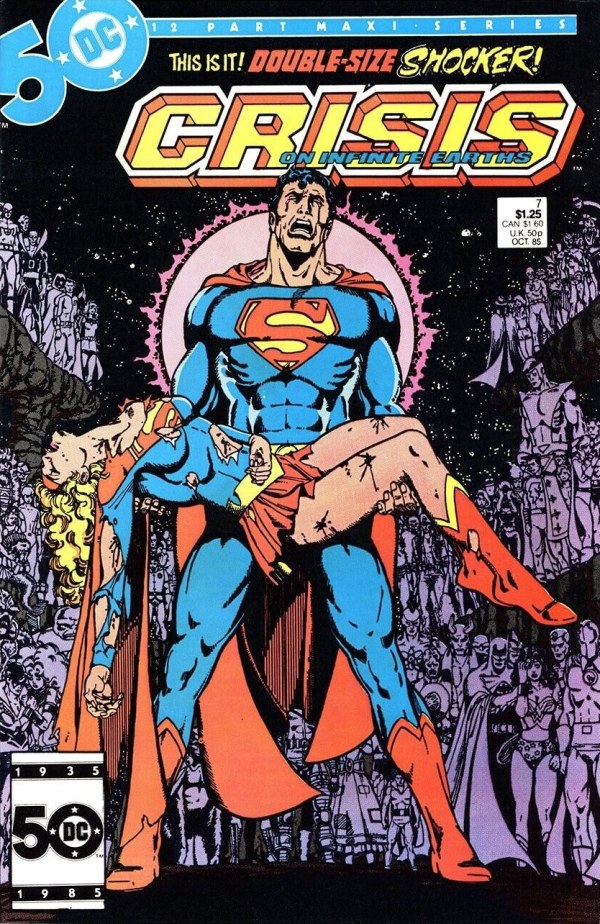
Year of Superman Week 18: Supermen of Other Worlds

Over the last few weeks, I’ve found myself dipping into stories of Supermen of Other Worlds. Not just Elseworlds, although those certainly apply, but other stories of other Supermen as well…books that were published during the time that DC wasn’t using the Elseworlds imprint or special event comics such as Just Imagine or the Tangent universe. This week, I decided it would be fun to get in and explore some of those other worlds. So for Week 18 – with a slight detour coming on Saturday – we’re going to spend some time with these Other Supermen. 

I’ve kind of had the “other worlds” in my head since I read the first volume of Earth One a few weeks ago. Reading that sent me towards Origin Week, which was fun, but it didn’t quite scratch the itch I have in my mind right now. I want to dig into the stories of Supermen from different worlds, reimagined from the ground up. Some of them, naturally, will be similar to our own, but not all of them. 

Wed., April 30

Comics: Superman: Earth One Vol. 2-3, DC Comics Presents #71, Secret Six Vol. 5 #2, Batman/Superman: World’s Finest 2025 Annual

What the Snyderbros wish they could do with the David Corenswet costume.

Notes: Since Earth One is what started me on this little trek, I decided to begin the Supermen of Other Worlds week by finishing that particular trilogy. At the end of volume one, if you’ll recall, Superman had driven off an invasion by the same force responsible for the destruction of Krypton, and Clark Kent used his exclusive ties to the Man of Steel to write an interview that landed him his job at the Daily Planet. In Volume 2, Clark finds a new apartment with a particularly friendly neighbor named Lisa LaSalle (because it doesn’t matter where in the multiverse you are, Kal-El is a magnet for L.L. names). As she tries to cozy up to him, Lois begins a deep dive into the past of her mysterious new coworker, the military makes plans for how to deal with an invulnerable man, and the Parasite is on the rise.

Volume 3 continues these stories – Lisa and Clark get closer, the fallout of Superman’s geopolitical actions in Volume 2 begin to reverberate, the most unique version of Lex Luthor in the entire multiverse is developed, and…oh yeah. Zod.

Reading these two books in tandem, it really strikes me how J. Michael Straczynski structured the graphic novels the way you would a season of a TV show. That shouldn’t be surprising, of course. Straczynski has a long history in television, including creating and writing most of the episodes of one of my favorite science fiction series of all time, Babylon 5. And although he’d written a great number of comic books at this point and brought some of those storytelling habits over, this is his work that most clearly feels like television. Each volume has an A-plot (the invasion of Earth in Vol. 1, the Parasite in Vol. 2, Zod in Vol. 3). Also, just like a TV show, there are several running B-plots of a more personal nature, such as Clark’s relationship with Lisa and Lois’s pursuit of Clark’s past. Then there are the ongoing subplots that build and develop along with the A-plot, such as the way the world’s governments are trying to figure out the “Superman Problem.” In a seasonal TV show format, it’s these third types of plots that run concurrently which usually wind up comprising the main arc of the season, gaining in prominence until they become the primary focus of the last episode or two. And I feel like this is exactly what Straczysnki had planned, had this series continued past Vol. 3. 

That’s the tragedy of it, I think. I really enjoyed all three of these books. And each of them was satisfying in the way that a single episode of a television series is satisfying. But Strazynski’s TV-writing style is evocative of the current style of longer arcs and stories (in truth, he pioneered that style with Babylon 5). There’s so much left to explore in this universe. I genuinely want to see what becomes of Clark’s relationship with Lisa. I want to know what this universe’s Lex Luthor has up her sleeve (yes, that’s the correct pronoun). And – given the sort of world-building Straczynski has proven himself capable of time and time again, not just with Babylon 5, but with his comic book work like Rising Stars, I want to see just how far this particular corner of the DC Multiverse diverges from the worlds we’re all more familiar with.

After volume three of this book, Straczynski stepped away from comics for a while. He’s back now, and doing work for AWA and Marvel, and I hope that the prospects of him returning to this series are still there, because I fully believe there’s more story left to tell. 

In terms of new comics, hitting stores today, we have Batman/Superman: World’s Finest 2025 Annual, part three of the “We Are Yesterday” crossover with Justice League Unlimited. In this one, Grodd has gone back in time to gather up younger, purer versions of the Legion of Doom to help him combat the new unlimited Justice League of today, but winds up fighting the League in two different timelines. Mark Waid is the co-plotter of this issue, along with scripter Christopher Cantwell. Together, they progress the story well, leading up to a great cliffhanger ending. I’m really excited for the second part of this crossover, the first in DC’s “All In” era. 

Thur., May 1

Comics: Just Imagine Stan Lee Creating Superman #1, Superman #9, Supergirl Vol. 2 #23

“And he needs to have an alliterative name, too, like ‘Clark… Clark…’ dang it, what name starts with the same sound as ‘Clark’?”

Notes: Back in 2001, the comic book world was shocked by the news that Stan Lee, the public face and most effusive promoter of Marvel Comics, was going to do his first-ever work for their Distinguished Competition. Lee, along with co-writer Michael Uslan and a plethora of top-notch artists, produced 12 one shots under the Just Imagine banner. In each one-shot, Lee took a different DC property and – using the name as inspiration – did his own take on the concept. Some of the new versions weren’t all that different from the original, while others had nothing in common except for the title. Stan Lee’s Superman was kind of in the middle. 

In Lee’s Superman, with art by his long-time legendary collaborator John Buscema, we are introduced to an alien police officer named Salden. When Salden’s wife, Lyella, is murdered by an escape convict, Salden chases the killer onto a hijacked spacecraft. The two of them crash on Earth, and Salden realizes that the planet’s lesser gravity has given him great strength, speed, and endurance. Trying to blend in, he takes a job at a circus using names he pulled off an ice cream truck and street sign: “Clark Kent.” “Clark”’s circus act is such a hit that he’s approached by a talent agent, Lois Lane, who dubs him “Superman” and begins booking him gigs. With his spacecraft destroyed, Salden has no way off Earth, and decides to use his abilities to fight the injustices of the world that he sees as distractions from the pursuit of science, hoping that if he can bring about world peace, the world will advance to the point where it can invent a craft capable of bringing him home. 

Like I said, as far as the Just Imagine books go, this one is about halfway between the “fairly similar” books like Wonder Woman and those that are utterly unrecognizable, like Green Lantern. This new Superman carries over his human name, and a new version of Lois Lane comes with him. His powers are very similar to the earliest Golden Age Superman, diluted compared to the Superman we’re all familiar with, but incredible to a populace that would have never seen such a thing before. And he’s still an alien, although the name of his planet is never revealed (Grant Morrison would later declare it to be this universe’s version of Krypton in the Multiversity series). 

Other things, however, are quite different. His motivation, first of all, starts with the very Stan Lee-ish goal of avenging his dead wife. (And although the people of Salden’s world don’t seem to have surnames, it’s worth noting that even Lee couldn’t resist the lure of the multiple-L supporting characters with Lyella.) His motive to become a hero is because he can’t think of any other way to get home. And his dialogue and behavior is kind Ben Grimm-ish in presentation. If Ben had gotten the strength of the Thing without his orange, rocky exterior, I think he would have been very close to Salden’s Superman. 

The Just Imagine characters haven’t turned up as often as some of the others we’ll glimpse this week, although they turned up here and there in various multiverse stories. In fact, I think Salden and several of this world’s other inhabitants were killed in one of them – Death Metal, maybe? I’m honestly not sure, and considering that the multiverse has been jerked around a few times since then, it may not even be relevant anymore. I do know that all of these characters turned up once more after that, in a special tribute edition DC published after Stan Lee’s death. He’s not the most memorable version of Superman, to be fair, but if I was the kind of person who dealt in puns the way an artist deals in paint, I might say he is the most “Marvelous” of all Supermen in the multiverse.

Okay, I’m exactly that kind of person.

In addition to the “Year of Superman” reading I do for this blog, I’ve also got several old and new comic book series I’m reading through via the DC and Marvel apps. I mentioned them in the log here, if there’s a Superman-family character involved, but I don’t always write about them. Today brought me to Superman #9, a Golden Age issue which I’m only bringing up for one reason. In the final story in this issue, Lois is captured by criminals, but they don’t immediately recognize her for who she is? Why not? Because she’s wearing a pair of glasses.

Man, whoever wrote that issue got jokes. 

Fri., May 2

Comics: Tangent Comics: The Superman #1, New Adventures of Superboy #34, Legion of Super-Heroes Vol. 2 #313, Superman’s Girl Friend Lois Lane #13

RIP, Jackson “Butch” Guice”

Notes: I didn’t think about this before I began this whole “Year of Superman” project, but in retrospect, I suppose I should have. It seems inevitable that, over the course of an entire year, somebody that we all closely relate to Superman would leave us. It happened a few months ago with Gene Hackman, and it happened again on May 1 with Jackson “Butch” Guice. Guice was a great artist, with work for lots of publishers over the years. He co-created Resurrection Man for DC Comics, and was doing variant covers for the current miniseries featuring the character. To Superman fans, though, he’ll be remembered most warmly for his run on Action Comics in the 90s, a run that included the Death of Superman saga. 

Guice’s artwork was pretty unique among Superman artists. His work tended to have a more photographic quality to it – poses and angles that looked like they had been pulled from the walls of a gallery. His men – Superman in particular – had a hardness to them. It was as if John Buscema’s characters somehow came to life and were captured on camera. It was a darker, harsher style than many of the other artists of the day, and that turned out to be perfect for the book documenting the Last Son of Krypton, aka the Eradicator.

It’s something in the eyes, I think.

I’d already planned on reading this book for Supermen of Other Worlds Week, but when I found out that Guice had passed away, I thought that moving Tangent Comics: The Superman to the front of the line was appropriate. Tangent Comics was a DC event in 1997 and 1998, each wave producing a series of nine one-shots set in an alternate universe in which the names of the DC characters, places, and various hangers-on still existed, but virtually everything else was different. The Superman starred Harvey Dent, a cop who had been born in a secret facility built by the spy agency known as Nightwing. Part of an experiment, Dent’s mother died in childbirth and he grew up an orphan. He eventually became a cop and led a fairly ordinary life until the day he tried to stop a jumper named Carter Hall from taking a plunge off a skyscraper. Dent failed to save Hall and, in fact, was pulled off the building WITH him. Rather than dying on impact, though, crashing to the ground unlocked something in his mind. As he recovered, he found he was developing mental powers – telepathy, telekinesis, precognition, and an intelligence that, once normal, was now skyrocketing off the charts. As his powers grew stronger, Dent grew colder, divorcing himself more and more from the humanity of which he had once belonged.

The idea behind Tangent was that only the name would be the same, and damned if that doesn’t live up to the concept here. THE Superman is absolutely nothing like OUR Superman. He strikes me more as a sort of Dr. Manhattan from Watchmen – a man whose power sets him apart from humanity instead of making him learn to respect it. By the end, he’s still acting as a hero, but there’s a darkness to him. This would become clearer in the later Tangent: Superman’s Reign miniseries, in which the Tangent heroes and the main DCU characters would collide and The Superman became the main antagonist. In truth, the Superman he resembles most closely is the one from Jerry Siegel’s original short story, “Reign of the Superman,” about a villain with great mental powers, before he came back and gave the name to a hero.

Mark Millar wrote the issue (more with him in a few days), with art by Guice, and the team was perfect. The dark story played to both of their sensibilities, creating a Superman that doesn’t match with any other in the multiverse, but still makes for a compelling read. I may have to dip my toes back into Superman’s Reign at some point.

For now, though, RIP, Mr. Guice. 

Sat., May 3

Comics: Free Comic Book Day Specials: DC All In 2025 Special Edition, Superman’s Good Guy Gang

My production assistant and I hope you had a great Free Comic Book Day.

Notes: Today is one of my favorite days of the entire year, Free Comic Book Day. My local shop, BSI Comics, graciously hosts me along with several other local writers and artists. I sell a few books, I talk to fellow nerds, I’ve made a lot of friends at FCBD. It’s the best. And also – free comics! DC’s offerings this year include a pair of Superman-related comics, so why don’t we take a look at them?

How many covers do you think Superman has punched through over the years? Twelve? Gotta be at least twelve.

First up is the DC All In 2025 Special Edition, a flipbook that gives us a look at DC’s Absolute Universe on one side and a preview of the upcoming Superman Unlimited on the other. The Absolute story is a devilish tease, as we watch a mysterious figure observing the heroes of this new universe, specifically Batman, Superman, and Wonder Woman. There are cryptic comments about some major danger approaching, then we get one of those double-page spreads DC loves to do from time to time where we see lots of notes and scribbles that all seem to point towards future storylines. DC’s been doing this kind of thing at least as far back as the 52 series in 2007, and it’s always fun, but also kind of frustrating. I feel like they overreach with these, often teasing stories that wind up never happening. Time will tell if these play out for us, but the final panel is a great little surprise that promises an upcoming major story.

The other side of the book is the one I’m more excited about, the preview of Dan Slott and Rafael Albuquerque’s upcoming Superman Unlimited series. The story opens up with the news of a massive expansion of the Daily Planet. There’s a new boss over the company that owns it, and she’s planning to expand the Planet from a “great Metropolitan newspaper” into a massive global media enterprise. This happens every so often – has been happening as far back as the Bronze Age, really, when Clark began to split his time between reporting for the Planet and being a news anchor for WGBS. Newspapers have had to evolve constantly since Siegel and Shuster chose that profession for Clark Kent back in 1938, and every few years DC tries to modernize the concept while still keeping true to the core of who Clark Kent is. I’ve got no problem with them handling it the way they’re doing here, but that’s not what’s most interesting to me.

I’m really here for the middle part of this story, which is where we get a feel for Slott’s take on the character. And I have to say, I like it. We see several vignettes of Superman averting disasters, saving lives, and making people simply feel better. He captures a crook who stops to thank him for saving Star City from Titano because his aunt lives there. A pilot in a plane that’s falling out of the sky tells his passengers that everything is going to be okay, and all they need to do to know that is look out the window. Little things that show the pureness of the character and the effect he has on people. It’s sweet, and it’s a great start. The story ends with a cliffhanger that leads into the first issue of the new series coming later this month and, as if there was any doubt, I’m there for it. 

The haircut on Guy looks just as good on a 9-year-old as it does on an adult.

DC’s other offering this year, as usual, is a preview of one of their all-ages graphic novels. This time, it’s Rob Justus’s upcoming book Superman’s Good Guy Gang. In this one, child incarnations of Superman and Green Lantern (Guy Gardner) find a strange winged woman stealing puppies and swoop in to stop her, unaware that a much bigger problem is looming. It’s a super quick read (no pun intended), and full of silly moments like Superman and Guy arguing over what the name of their superhero team is going to be. It is absolutely no coincidence that the characters chosen for this book also happen to be the ones who are going to be in James Gunn’s Superman movie, but that’s fine. This is a book for  beginning readers, and it’s great that they’re doing it, but it would be foolish to ignore the characters that are going to be in their next huge media event. It’s a charming little read, and I’ll be happy to pick up the full version for my son when it comes out in July.

Sun., May 4

Comics: Superman: Red Son #1-3

“No, not Red SUN, Red SON. SON. S-O– It’s a PUN, David!”

Notes: I admittedly have a complicated relationship with the work of writer Mark Millar. When he does his own characters, with comics like Kick-Ass or Wanted, I find him hit or miss. When he works with established characters, I find that I rarely care for his stories. He often completely disregards characterization in favor of whatever story he’s planning to tell, and while that approach is okay when dealing with your own, original characters and you have the freedom to shape the characterization how you please, I am far less charitable when the work throws away decades of who a character is in favor of a plot point, the most egregious examples of which can be found in Marvel’s Civil War.

However, I find that he often does a good job with Superman. Early in his career he did a very entertaining run on Superman Adventures, the comic book based on Superman: The Animated Series. He wrote the aforementioned Tangent one-shot. And then there’s Superman: Red Son, perhaps the most acclaimed Superman Elseworlds series of all time. The supposition here is that the rocket that brought Superman to Earth landed not in the Kansas heartland, but somewhere in the Soviet Union. The child who would become Superman grew up indoctrinated with Socialist values, rather than American ones, and the world is rocked to its core as a result.

Millar does a lot of interesting things here. With Superman as a Soviet, the US government recruits its brightest mind – Dr. Lex Luthor, of course – to try to create some sort of countermeasure. With the U.S.S.R. completely ascendant, Princess Diana of Themiscyra makes contact with the outside world via the Russians rather than the Americans. And although we don’t know if there’s a little boy in America named Bruce Wayne, in Russia we see a tragedy that turns one of her citizens into this world’s version of the Batman.

The thing I find most fascinating is Millar’s take on who Superman is. In the prime DC Universe – and in most other iterations of the character – his personality boils down to someone who will always try to do what’s right, always stand up for injustice, and never turn his back on a cry for help. The Red Son Superman shares these traits, with the major difference being that his perspective on what is “right” is colored by socialist values rather than democratic ones. He’s still going to be there to save anyone – even an American – from a disaster like the falling globe from the top of the Daily Planet building, but when he sees the injustice of children standing in bread lines, he decides to use his power to put a stop to that by taking the control of the government that had been offered him after the death of Stalin, but that he had heretofore resisted. 

This whole thing is especially interesting to me from a sociological perspective. Superman at first rejects the notion of succeeding Stalin as the Soviet Premier because he knows people only want him because of his abilities, and the idea that his powers make him special goes against Socialist doctrine. But just like in the real world, he sees the inequities that have happened under Soviet rule and decides at the end of issue one to use his powers to fix them anyway. 

Book two takes the idea further. Superman has been in charge of the USSR for 20 years, and its influence has swallowed nearly the entire world. Only the USA and Chile remain holdouts, and both are hanging on by a thread. But there’s a mysterious Batman fighting against Superman’s rule, while back in the USA, Dr. Luthor is introduced to an alien power source that crashed on American soil decades before – a green one. While good-intentioned, Superman’s influence is beginning to atrophy human progress. People are growing careless, expecting their super-savior to take care of everything. Seatbelts go unused in cars, ships stop providing live preservers, all predicated on the idea that President Superman is going to take care of everything. When someone in his own government approaches Batman with an opportunity to take Superman down, Batman recognizes that the humans who would fill the void might be worse, but stopping him now may be the only way to prevent Super-rule that would last thousands or even millions of years.

There’s another time skip to book three. The Soviets have grown even more powerful and America is on the verge of collapse – until it elects Dr. Luthor President of the United States. Luthor’s unparalleled genius turns the country around overnight and Superman, who has been waiting for the US to finally collapse under its own weight and join their Soviet collective, realizes that it’s not going to happen. The climax of the story comes in a battle between Superman’s forces, Wonder Woman’s Amazons, and the American Green Lantern Corps, all of which coalesce in a turnaround for Superman that proves, even in this corner of the multiverse, he’s still the same man at his core. 

In a way, this entire story is a rebuttal to the whole “Nature versus Nurture” argument, demonstrating that BOTH aspects are of importance to the arc of a person’s life. And honestly, if that’s what Millar was trying to say here, it’s a sentiment I’ve always agreed with. Using Superman to put that idea forth works for me, and very well.

The end of the story is the real genius part of it though, and if you’ve never read Red Son, I don’t want to spoil it for you. Suffice it to say, it’s one of those conclusions that leaves you laughing ironically and calling the writer a magnificent bastard for coming up with such a thing. This isn’t my FAVORITE Superman of another world, but it’s hard to argue that it’s not, objectively speaking, one of the best stories of that sort that has been told. 

Mon., May 5

Comics: Superman: Secret Identity #1-4

Why DC based a comic on an obscure Jerry O’Connell TV show from the 1980s I’ll never know.

Notes: I’ve talked quite a bit in this blog about Mark Waid and how great a superhero writer he is, but although I eagerly place him at the top of the pyramid, he’s not there alone. Right up there, in my estimation, is Kurt Busiek. He’s the author of the phenomenal series Marvels and the creator of Astro City, which you’ll hear about again later when I do the week on heroes inspired by Superman. He also had a run on Superman’s regular title and he’s done work with the Justice League, most notably the JLA/Avengers crossover, in which Superman got to wield Thor’s hammer. Man, I should read that again before this year is out.

But his greatest work with Superman isn’t with “our” Superman at all, but rather the miniseries Superman: Secret Identity. An Elseworlds comic in all but name, this 2004 series was done with former Adventures of Superman artist Stuart Immonen, and was about a young man named Clark Kent from a small town in Kansas, but in a world where there are no superheroes and Superman is a fictional character. Whereas Waid is better than anybody at showing the wild, fun, grandeur of a superhero universe, Busiek’s greatest strength comes in humanizing superhero stories. Marvels was the history of the Marvel Universe through the perspective of a bystander. Astro City shows what it’s like to live in a superhero universe from a different perspective in every story. And Secret Identity is about being a hero in a world that doesn’t have them.

The concept is almost identical to the original version of Superboy-Prime, who showed up during Crisis on Infinite Earth as an inhabitant of Earth-Prime, which in the older DC Comics had ostensibly been the “real” world where the readers and creators of DC Comics live. This was before he changed to become a meta-commentary on toxic fandom, which I have to admit, was actually a pretty clever take. But Secret Identity takes the initial concept and keeps it contained, pure.

Clark Kent’s parents gave him the name because their last name was “Kent,” they lived in Kansas, and they thought it would be cute. Clark is not as enamored of his name as they are, having grown up being taunted for the famous name and spending every birthday getting laden with Superman-themed presents he couldn’t be less interested in. The boy grows up introverted, without any close friends and preferring to spend time alone. It’s on a solitary hiking trip that he suddenly, inexplicably begins to manifest the powers of his namesake. He begins using his powers to help people in secret, but it doesn’t take long before word of the flying “Superboy” begins to leak out. 

The four issues track Clark’s entire life story – growing into becoming a writer, although not a reporter, falling in love with a woman (naturally) named Lois, becoming a father. The government tries to track him early on, even capturing him at one point, before they settle into an uneasy alliance and “Superman” becomes a hidden force for good. Slowly, we watch how the world changes under his influence. More importantly, though, we see how HE changes over the course of a lifetime. 

This is a beautiful book. It’s almost not even accurate to call it a “superhero” comic. Yes, he has powers, and yes, he even wears the costume, but there are no supervillains, no world-threatening cataclysms…there’s not even really an antagonist. It’s a story about a life, with ups and downs and pitfalls and triumphs and success and tragedies. It’s a story about someone who is just like everybody else, with the obvious exception of being faster than a speeding bullet. It’s Busiek doing what Busiek does best. 

It’s also Immonen at his peak. I was always a fan of his work on the mainstream Superman, but this version is different. It’s still unmistakably his work, but there’s a softness to it that you don’t usually see when he’s drawing a mainstream story about Superman punching out Metallo or something. Looking at these panels, you see a different quality, a lighter touch. It looks almost like a fantasy world, which is rather fitting from the perspective of this Clark Kent, living what must seem to him to be a fantasy life. 

And unlike some of the other alternate Supermen we’ve looked at over the last few days, this is a Superman who hasn’t shown up again. In fact, I’m not even certain that this “world” has a specific designation in the current DC Multiverse the way the others we’ve looked at has. And if it doesn’t, that’s okay. There’s room for more stories of the Earth-One Superman, the Just Imagine Superman, or the Tangent Superman. But the Secret Identity Superman’s story is complete in these four volumes – complete and beautiful. This is one of my favorites. 

Tues., May 6

Animated Feature: Justice League: Gods and Monsters

Wait, which ones are the gods and which ones are the monsters?

Notes: Here’s a REALLY different Superman of another world. Bruce Timm, one of the architects of the DC Animated Universe that began with Batman: The Animated Series, returned to the characters with this film. It too was essentially an Elseworlds, even though it didn’t have the brand and wasn’t based on any pre-existing story. In this world, in the minutes before the destruction of Krypton, Jor-El and Lara are prevented from sending Kal-El into space by the sudden interruption of General Zod, who places his own son in the spacecraft bound to Earth. It is the Zod child, not Kal-El, who makes the journey across the stars, and the world becomes a very different place.

In this world, the Justice League is comprised of Zod’s son, now called Superman; Kirk Langstrom, a vampire Batman; and the New God Bekka, who has taken the name Wonder Woman. This Justice League is more brutal and far less forgiving than the League we’re accustomed to, and public opinion on the team is tearing the public down the middle. Things get worse when top scientists such as Victor Stone, John Henry Irons, Ray Palmer, and others are targeted by mysterious assassins with methods that seem to imitate those of the Justice League.

In a lot of ways, I’m surprised that this movie was even made. Granted, the whole “multiverse” concept has become mainstream now, but this is SUCH a different take on the concept that I feel relatively certain only Bruce Timm’s sway with Warner Bros Animation ever got this one off the ground. And it follows the classic Elseworlds pattern perfectly: it begins by showing what makes this world diverse from ours, it continues with an exploration of that world, and then it it follows a main plot that both tells a strong story and reveals corners of the world that are both similar to and very different from the one we’re accustomed to. 

Benjamin Bratt voices Superman in this one, with an edge that the Clark Kent versions of the character usually doesn’t have, but it works quite well in this one. We also get Tamara Taylor as Wonder Woman and, in what I have to assume was a meta joke in the casting department, we get Dexter star Michael C. Hall once again obsessed with blood as the vampire Batman. 

As this is the Year of Superman, though, rather than the Year of the Justice League, let’s focus on this movie’s version of our hero. Baby Zod lands in Latin America rather than Kansas, and is named Hector Guerra. As he grows up, he knows very little of his heritage on Krypton, unaware of where exactly he came from. And while he’s darker and more brutal than our Superman, he’s not his father either. Knowing more about his true parentage than he does, it’s natural for the viewer to expect some sort of face-heel turn, becoming the bad guy before the film ends. Well, spoiler alert – he doesn’t. He’s not OUR Superman, but he is A Superman, and like most of them, he’s there to protect people. It’s actually refreshing that he DOESN’T become the bad guy at any point.

The film ends on a hook that clearly leaves the door open to revisit this universe, but to date, it hasn’t happened yet. There were a few prequel comic books and a webseries that preceded it, but unless I missed something somewhere, we’ve yet to explore this world following the conclusion of the film. While I’m not exactly itching for more of the Gods and Monsters universe the way I am Earth-One, I wouldn’t be opposed to it either. It’s an interesting place, and there are more stories to tell. 

This was a fun week, looking at different, non-mainstream versions of our hero. And you know, there are an awful lot of other worlds out there in the multiverse. I may do this again before the year is up.

Blake M. Petit is a writer, teacher, and dad from Ama, Louisiana. His most recent writing project is the superhero adventure series Other People’s Heroes: Little Stars, volume one of which is now available on Amazon. You can subscribe to his newsletter by clicking right here. You can join in the Kryptonian Konversation every day in the Year of Superman Facebook Group!

Year of Superman Week 17: Lex, Batman, Power Girl, Batman, Elseworlds, Batman, and Spam

Another week, another round of the Year of Superman! It’s going to be another random week, a week where I’m not going to be adhering to any particular theme or category, and just reading or watching whatever catches my fancy. And there’s some fancy, fancy stuff coming down the pipe this week, from the big 25th issue of Joshua Williamson’s run on Superman to the completed three-part Last Days of Lex Luthor miniseries, and…well, I don’t even know what else will come up, because I’m writing this at the beginning of the week and I’ve got no idea where the solar winds of Rao will take me. Join me and let’s find out!

Wed., April 23

I feel like Perry is kinda burying the lede here…

Comic: Superman Vol. 6 #25

Notes: Since Williamson kicked off his run on the main Superman comic about two years ago, he’s been building up a pretty epic storyline involving Lex Luthor. It began after Lex was taken into custody, turning over his company to Superman and making it “SuperCorp.” As one of the few people on Earth whose memory of Superman’s double identity remained (it was because of him that it was wiped out anyway), he decided that if he couldn’t destroy Superman, he would force him to work WITH him, and it was a strategy that worked pretty well for some time. Along the way, though, Lex lost his memory, leaving him a man who wasn’t quite as brilliant as before, but who had a genuine benevolence to him, seeming to want to atone for the crimes of his former self. It was a change for the better for everyone – except for Mercy Graves.

In this climactic issue, Mercy has let loose one of Lex’s failed experiments, X-El, a Luthor/Kryptonian hybrid clone, that she’s hoping to have supplant the “new” Luthor, and it’s Superman, Superwoman, and Lex vs. X-El. I loved this issue – it feels like a real culmination of the story so far, with everything that’s been happening building up to an incredible fight that lasts for most of the extra-sized issue. What’s more, the usual penciler Jamal Campbell (who has been doing a bang-up job on this series) is joined by a murderer’s row of talent, including Eddy Barrows, Eber Ferreira, and Dan Mora. Campbell and Alejandro Sanchez are credited as colorists as well, and although you don’t often discuss the colorists when you’re talking about comic books, this is one issue where it really stand out to me. Every page has at least one panel that could be turned into a poster I’d expect to see in any comic shop. 

Although the issue is, like I said, kind of a culmination of the storyline in that it has brought everything together, it would be a mistake to imply that it’s the END of the story. In fact, this issue ends in a cliffhanger that’s really got me itching for issue #26. But man, I can’t say enough good things about this run and this creative team. 

Thur., April 24

I just wish that Bryan Hitch would have the guts to put a little symbolism into his artwork.

Comics: Superman: The Last Days of Lex Luthor #1-3

Notes: About a month ago, when the long-delayed second issue of this miniseries finally came out, I decided to wait to read it until I had the third and final issue in my hands. I don’t know if the story would have been less impactful had I not chosen to wait, but I DO know that it would have driven me crazy to have to wait for the final installment, because ultimately, this is one of the finest Superman stories I have ever read.

And if you haven’t noticed, I’ve read a LOT of them.

In the first issue (which, again, came out nearly two years ago, and that’s the last time I’ll reference the delay), Superman is attacked once again by his greatest enemy…but this time, Luthor’s goal is not the death of the man of steel. No, for once, he needs his HELP. Lex Luthor, it seems, is dying. Some strange, exotic radiation is attacking his cells, and he knows that Superman is the one being in the universe who will stop at nothing to find a cure, because Superman…well…Superman is the man who saves everybody.

I don’t want to say too much more about the story, because there are some incredible twists and surprises throughout this miniseries. But that doesn’t mean there isn’t still a LOT to say. The reason Luthor turns to Superman, again, is because he knows that Superman will absolutely refuse to quit as long as there is a life in jeopardy, and the fact that the life in question belongs to his greatest enemy makes no difference whatsoever. Luthor sees this as foolishness, as a weakness on Superman’s part, but throughout this story, Mark Waid demonstrates why this is actually his greatest strength. Superman is confronted by friends who cannot fathom why he would risk so much to help Luthor. The quest to save his enemy becomes public knowledge, making some of the public turn against him. His quest takes him to Kandor, Atlantis, Themiscyra, and even the 31st Century, before the final reveal of what’s really going on turns everything on its ear and seals the fate of the two characters.

It’s an odd choice, to make this a Black Label book. Black Label is ostensibly a “mature reader’s” imprint, but there’s nothing in this book that warrants that marker. It’s out of continuity, to be certain, and I wonder if this would have been listed as Elseworlds, had that label been resurrected when the first issue appeared. But no matter what imprint this story falls under, it’s a masterpiece. It’s Mark Waid’s dissertation on who Superman is and why he has to be who he is. We learn the same things about Lex Luthor, in fact, and the relationship between these two characters has never been laid out so bare, so stark, so clean as in this story.

This story is brilliant. This is one of the best Superman stories I’ve ever read. 

Fri., April 25

Comics: Justice League Unlimited Vol. 2 #6

Notes: The second part of “We are Yesterday” in Justice League Unlimited doesn’t have a ton of Super-action, but it’s a great issue nonetheless. In this issue, we see Grodd hatching his plan to infiltrate the past and collect purer versions of his former compatriots in the Legion of Doom to act as a countermeasure to the now-larger League. We also get a glimpse of the moment when Superman recruited Air Wave – who has become a surprisingly important character in this series – to join the League. Air Wave is an interesting character – a D-lister for years, and Waid has already found a way to make him compelling and sympathetic through a comparatively small number of pages in the first six issues of this title. I really hope that we get to see more of his story after this crossover with World’s Finest reaches its conclusion. 

Graphic Novel: Batman: Hush (Collects Batman #608-619, Superman appears in #611, 612, and 619)

“Say it, Bruce! SAY THAT GLASSES ARE A PERFECTLY ADEQUATE DISGUISE!”

Notes: With “Hush 2” currently running in the ongoing Batman comic book, I wanted to go back and re-read the original, as it’s been a while. I’m not going to dig into it too deeply, as this ain’t the “Year of Batman,” and Superman’s appearances are brief. But brief or not, they ARE impactful, and I wanted to point out a few things. 

First comes in Chapter 4 (issue #611 of the ongoing), in which Bruce Wayne visits Metropolis and, specifically, the offices of the Daily Planet. At this time, Bruce actually OWNED the Planet. I’m not sure if he still does or not. Hey, DC, give us a ruling. But regardless, in this issue he’s been finding himself growing more and more drawn to Catwoman, with whom he’s always had a “will they/won’t they” relationship. At the Planet office, he watches Lois and Clark together and marvels at how Clark has found someone with whom he’s willing to trust his greatest secret. A few chapters later (kinda spoilers, in case you’ve never read “Hush” before), Bruce reveals his own identity to Selina for the first time. It’s one of those rare status quo changes – like Lois and Clark getting married – that has stuck, and I find it very interesting that writer Jeph Loeb decided to use the Lois and Clark relationship as a way of sort of justifying that relationship upgrade for Selina and Bruce.

Superman has a bigger presence in Chapter 5 (issue #612), in which he’s being controlled by Poison Ivy and comes to blows with Batman in the sewers of Metropolis. (Side note: it’s VERY odd to see the way Catwoman fights both Ivy and Harley Quinn in this storyline, considering the way that the three of them would become the “Gotham City Sirens” just a few years later.) It’s a pretty good fight, all things considered. Bruce has his Kryptonite ring, and he’s counting on both that and the fact that he knows Superman is actively fighting against Ivy’s mind control to keep him alive. I think the most interesting thing about this fight, though, comes from a two-page spread in the middle, where Bruce’s inner narration makes a comment that the internet has elevated to meme status: “Deep down, Clark’s essentially a good person…and deep down, I’m not.” People love to use this quote, but I think a lot of them miss the point. The way I read it, this is something that Bruce sincerely believes…but he’s wrong. Not about Clark, of course, but about himself. And Clark would be the first one to tell him that.

Also, in this issue, Poison Ivy gets captured by Krypto, and that’s just adorable.

Superman then dips out of the rest of the story until the denouement in Chapter 12 (issue #619). The mysterious Hush has been defeated and Bruce turns once again to Superman…not just because he needs a friend, but also because he needs someone with X-Ray vision to make sure that Hush didn’t do anything inside of his head…and literally, not the way the Joker does it. The three appearances of Superman in this story really speak strongly towards the bond between these two heroes and the trust that they share. At the same time as this storyline was winding down, Loeb was launching the ongoing Superman/Batman series, and I don’t believe for a second that this was a coincidence. He writes both heroes well. He writes them TOGETHER excellently. 

Sat., April 26

Comic: Power Girl Vol. 4 #20

“Meet Kara who’s never had a home
From Argo City to the Phantom Zone
But PAIGE HAS MADE FRIENDS LEFT AND RIGHT
TO GO WITH HER KRYTPONIAN MIGHT!
Whaaaat a crazy pair…”

Notes: This volume of Power Girl ends with this issue and, much as I hate to say it, I’m not really upset to see it go. It had a promising start, but the series seemed to be all about trying to figure out who Power Girl is and…frankly…I’m tired of that. A lack of identity has been Power Girl’s defining characteristic for the past 40 years, and that’s at least 39 years too long for that to be interesting in any individual character. At first, it seemed as though this series was going to lock her in to a true identity, but as evidenced by the cover of this last issue, it never really felt like it gelled. The book built up her world, built up her supporting cast, but didn’t really build up HER. I get it. It’s difficult. The elevator pitch of the character is “older Supergirl from Earth-2,” and since we’ve already got the “Prime” Supergirl, that doesn’t seem to leave room for her. But if all you do with the character is point out that she seems superfluous without redefining her in a satisfying way…well, what have you actually done? I hope somebody else gets their hands on Power Girl soon. I don’t care if it’s as a supporting player in the Superman titles or if she rejoins the Justice Society or what, but I want somebody, ANYBODY to take Kara Zor-L and finally, after all these years, say “This is who she is and this is what makes her unique, and can we please stop having the same conversation?”

Is that so much to ask? 

Sun., April 27

Comics: Batman Vol. 3 #36-37

Part one: Bromance. Part two: Romance.

Notes: When I read Hush a few days ago, I noticed a scene in the chapter where Superman is controlled by Poison Ivy where Catwoman tries to break him out of it by threatening Lois Lane’s life. She didn’t mean it, of course, she did it because Batman told her that Superman was close to the people who worked at the Daily Planet and that endangering one of them would help him break from Ivy’s control. Nor did she know specifically that Lois was Clark’s wife – Bruce also told her that Jimmy Olsen and Perry White would have been suitable for this purpose. But the scene put me in mind of a more recent meeting between these four, and I wanted to read it today.

Tom King’s run on Batman is controversial for reasons I’m not going to get into here, but the two-part “Super Friends” story from Batman Vol. 3 #36 and 37 is one of the best stories about Superman and Batman I have ever read. Batman and Catwoman have recently become engaged, and in the first issue Bruce and Clark each have conversations with their respective significant others about the fact that they haven’t spoken to one another about the engagement yet. Clark is convinced that the fact that Bruce hasn’t called him is evidence that they’re not really that close, Bruce says he shouldn’t have to call Clark because his best friend is actually Jim Gordon (who doesn’t know his real name) or Alfred (who Selina points out is on his payroll, and therefore doesn’t count). The bulk of the issue is taken up with cutting back and forth between these two conversations, and the quick realization that Lois and Selina know Clark and Bruce far better than either of the world’s two greatest heroes know themselves. At the end of the first issue, the two couples come together in one of the most charming meet-cutes I’ve ever seen. You’ve probably seen the page on the internet even if you’ve never read the issue.

Yeah, that’s the stuff.

In part two, the foursome go on a double date to an amusement park which is celebrating “Superhero Night” – you have to have on a superhero costume to get in. Under the ladies’ suggestions, Bruce and Clark wear each other’s costumes and enter the park to enjoy an extremely rare night for themselves. 

Tom King’s depiction of this relationship is spot-on. They’re best friends, even though neither one of them really wants to admit it. Their differences are what make them work together, not something that drives them apart. And the scenes of Lois and Selina bonding with one another are absolutely joyous. We fans talk quite a bit about how difficult it must be for superheroes to hide the secret of their dual lives, but we don’t talk enough about the toll it might take on those who love them. Giving Lois a new friend in Selina really feels natural. I was, I admit, disappointed when the Batman/Catwoman wedding didn’t go through, because I thought that DC would finally have the guts to push Batman’s status quo in a new direction permanently. I still think that it would have been better if they’d remained together. But mostly, I miss the chance to have more issues like this one, with Clark and Lois and Selina and (however begrudgingly) Bruce just being friends.

Don’t we all need that? 

Mon., April 28

TV Episode: Superman and Lois, Season 2, Episode 7, “Anti-Hero”

Or the “Lana’s Trauma Conga Express.”

Notes: Superman has been taken into custody by the DOD, who are holding him under a red sun lamp to negate his powers. As Lois and Sam try to figure out a way to navigate his release, Jordan is still angry at his brother for lying about the source of his newfound powers, and Lana and Sarah are dealing with the fallout of Lana’s impending separation from her husband.

Did you notice how each plot point I recapped there got progressively less superhero-y and more soap opera-ish? To be fair, there has been overlap in the kind of storytelling done by superheroes and soap operas for a very long time. Even as far back as the Golden Age you had the occasional unrequited love runner that punctuated early superheroes. Then, once Stan Lee brought in the Marvel Age of comics, the greater emphasis of serialized storytelling made it virtually inevitable that elements like Spider-Man’s disastrous love life would become an ongoing story point. But at times, Superman and Lois feels far more like a teen drama than a superhero show. It’s not fair to criticize the show on that point – for what it’s doing, it seems to do it just fine. But it isn’t exactly what I’m looking for here.

Some of the soap opera stuff is done well. For instance, there’s a nice scene where Lois and Lana are bonding over their respective family struggles – Lana with the fact that her husband cheated on her, Lois with the fact that her son got caught with a backpack full of drugs. The odd thing is that they’re treating X-Kryptonite as if it was any other drug. Jonathan’s bag had 20 vials, each of which could turn a teenager into a walking weapon of mass destruction, but the conversation they have could have been ripped straight out of a 70s After School Special about a mom who caught her son with a joint. 

That’s not to say that there’s no superhero stuff going on, of course. The story of Clark in custody, held under the red lamps with his half-brother Morgan Edge, is exactly what I’m hoping to see. The DOD even weaponizes Superman’s compassion, threatening to harm Edge if he doesn’t give them information that they want, which he does despite the fact that his brother is also his enemy. I even like the way the two of them put their differences aside and work together. The CW has a tradition of villains slowly reforming and joining the heroes that goes back to when they were the WB network and it happened every season on Buffy the Vampire Slayer, so if that turns out to be the long game with Morgan Edge’s character, I’m used to it. Once they meet up with the hologram of Lara and the Alternate-Superman (can we PLEASE just call him Bizarro?), there’s some good action stuff here. 

But none of that addresses the real problem I’ve been having with this show in season two. I love Hoechlin’s Superman, but the problem here is that they’ve isolated him. The show is stronger when he’s paired with Lois or where he’s working with his sons and their struggles with Jordan’s powers and Jonathan’s typical lack thereof. If you’re not doing that kind of thing, if you have him segregated from the rest of the main cast, you may as well be watching two entirely different shows. 

Clark, fortunately, returns to Lois at the end of the episode. But before that we get one more little scene I liked. Edge is still in custody, still the bad guy, but at the end of it Clark addresses him as “Brother.” This actually goes directly against something said earlier in the episode, when she tells Jonathan that his father would never forgive him for his involvement with X-K. But as the end of this episode shows you, Superman’s forgiveness is infinite. You mean to tell me, Lois, that you don’t think he would forgive his SON? Come on, you know him better than that.  

Then again, the episode ends with Clark tearing into Jonathan and not allowing him the opportunity to talk, so what do I know? 

Tues., April 28

Comic: Superman: Speeding Bullets #1, Action Comics #374

When the dry cleaner at the Hall of Justice mixes up the bags.

Notes: I’ve got a new writing project I’m working on today, so I needed something quick to slip in to the Year of Superman. The classic Elseworlds one-shot Superman: Speeding Bullets seemed like just the thing. Written by J.M. DeMatteis with art by Eduardo Barreto, this is about as close to the old Marvel What If? format as Elseworlds got, basically asking the question, “What if Kal-El was found by Thomas and Martha Wayne instead of Jonathan and Martha Kent?” Thomas and Martha – childless in this universe – find the rocket ship and adopt the child much like the Kents did, naming him Bruce and raising him as their own. Kal-El’s life in Gotham is pretty similar to the mainstream Bruce Wayne until the night of his parents’ murder, when – seeing the people he loved most in the world gunned down in front of him – his head vision activated and he roasted Joe Chill to death. In shock, Bruce developed a mental block about that night, forgetting his powers until – as a young adult – robbers break into Wayne Manor. His heat vision – and memories – come back, and he becomes a much more brutal version of Batman and the one in our universe.

When I say this was close to a What If?, I don’t just mean in premise, but also in execution. The classic What If? stories tended to end in one of two ways: either the universe attempts to “course correct,” resulting in a world as close to the original as possible, or things go so dark and bleak that it may as well be the apocalypse, at least for the characters involved, if not literally. Some of the ways we see that here are Bruce deciding to buy the Gotham Gazette and hiring Perry White and Lois Lane, falling in love with the latter, and Lex Luthor suffering an accident in a chemical plant, transforming him into this world’s version of the Joker. Since this is a world that can’t have both a Superman and a Batman, we watch Bruce Wayne transform from one to another. Lois’s influence cools his rage, getting him to pull back on his bloodlust, and eventually abandoning the Batman identity to become his world’s Superman. It’s an interesting book, and it works well as an Elseworlds. I have to admit, though, I’m surprised that this version of Bat/Superman hasn’t turned up the way other Elseworlds versions like Red Son or the Vampire Batman have once the Multiverse was opened up again. 

Blake M. Petit is a writer, teacher, and dad from Ama, Louisiana. His most recent writing project is the superhero adventure series Other People’s Heroes: Little Stars, volume one of which is now available on Amazon. You can subscribe to his newsletter by clicking right here. You can join in the Kryptonian Konversation every day in the Year of Superman Facebook Group!

Year of Superman Week 16: Origin Week

It’s a big week for Superman fans – DC’s “Summer of Superman” initiative is kicking off this week with the Summer of Superman Special. Not only that, but April 18th is the anniversary of the release of Action Comics #1 back in 1938, and therefore DC has declared it “Superman Day.” It also happens to be the first day of my spring break, so I’m intending to put my son in his Superman t-shirt (matching my own) and going down to BSI Comics that day to celebrate.

And since this week marks the Man of Steel’s anniversary, it feels like a good time for another one of those themes that I had marked off at the beginning of the year: it’s gonna be Origins Week. Superman’s origin has been told many, many times over the years, and in many different continuities. Last week, for instance, I read the first Earth One graphic novel, which was such a take on Superman’s origin. But I’m going to focus on the ways his origin has been told in-continuity. DC’s continuity has been retold and rebooted a ridiculous number of times over the years, of course, but this week I’m going to plant my flag on stories that were considered the definitive origin of the “Prime Universe” Superman at the time of publication. And even then, I’ve got plenty to choose from.

Wed., April 16

Comics: Superman #53, Superman #146, Challengers of the Unknown Vol. 5 #4 (Guest Appearance)

Notes: I read Action Comics #1 back on January 1st, so I’m not going to include it again in Origins Week. Besides, there wasn’t a lot of detail in that first iteration of the origin anyway – so many of the details, including the name of his home planet, weren’t filled in until later. The origin presented in Superman #1 wasn’t much better, expanding to a whopping two pages before jumping into the issue’s first story. So I’m going to look instead at a couple of later issues that filled out the story, beginning with Superman #53 from 1948, a special “tenth anniversary” story. To be honest, I’m not 100 percent sure that this is the first time the origin was told in full, but the text on the first page DOES say “Now, at last, you’ll know all the answers,” so at the very least not all of this stuff was yet common knowledge.

Don’t you love how quaint the old blurbs were? “World Greatest Adventure Character!” The Fantastic Four was just waiting to jump in on the hyperbole bandwagon.

The story begins on Krypton, with Jor-El warning that the planet’s uranium core is breaking down, transforming the planet into an enormous atomic bomb. The planet’s rulers, of course, don’t believe his warnings, and Jor-El makes it home just as the final cataclysm begins. He has room in his prototype rocket for his wife and child, but Lara insists her place is with her husband, and thus they send their baby to Earth alone. His rocket lands in the American heartland, where he is found by an elderly couple who bring him to an orphanage. The super baby causes chaos in the orphanage, and when the older couple returns hoping to adopt the child, the orphanage rushes through the paperwork to get rid of him quickly. Bringing them home, he is named Clark Kent. He grows up, gradually discovering more and more powers, until as a young adult his foster mother dies, followed by his father, who urges Clark on his deathbed to use his powers for good. 

As you can see, the basic framework of Superman’s origin is all here, the skeleton which has provided the structure of his story for the past 87 years. But the story cuts off before he goes to Metropolis, joins the Daily Planet, first encounters Lois…in other words, a lot of the stuff that really helps make Superman who he is. There are also an awful lot of details that haven’t been filled in yet. Jor-El and Lara are both named, but their baby is not specifically called Kal-El in this story. The Kents’ first names aren’t mentioned until the scene where Clark stands by his graves, and then the names inscribed as “John” and “Mary,” before they were codified as Jonathan and Martha. And even though he clearly grows up in a small town, the location is not specified as Kansas, and the name “Smallville” is never mentioned.

You could honestly do this same experiment with any of the Golden Age heroes who have stood the test of time – go back and read their earliest stories and see which elements were missing, which pieces of their mythology that seem so critical to us now were in fact later additions. And “mythology” really is the appropriate word – you could do this same task with the stories of Thor, of Odysseus, of any character from classical mythology. Stories grow and build and evolve over time, and our modern stories are no different. It’s a process that honestly fascinates me, which is one of the reasons I’m approaching this week the way that I am. 

And they didn’t even put the kid into a five-point harness? Kypton deserved what it got.

We got a more complete version of the origin in Superman #146 from 1961. In “The Story of Superman’s Life,” a lot of those little details that hadn’t solidified yet in ‘48 had come into focus. Once again we see Jor-El warning the people of Krypton of the planet’s impending doom, but only his brother, Zor-El, believes him. In this version, he first uses Krypto as a test subject, sending him into space first before the final cataclysm that causes him and Lara to send Kal-El (now named) to the stars. This version also covers how the nuclear reaction transformed the fragments of the planet into Kryptonite, then shows Kal-El’s rocket landing in Smallville, where he is found by Jonathan and Martha Kent. This time, the Kents leave the baby on the orphanage doorstep, coming back to adopt him after a few days of superbaby hijinks. He grows up, gaining power as he does, and the Kents eventually discover that the blankets he was wrapped in when they found him are just as invulnerable as their son. 

As Clark gets older, Martha unravels the threads of the blankets (because they can’t be cut) and re-weaves them into his first Superboy costume. Clark adopts his glasses – made from glass from his rocket ship which is impervious to his head vision – to help protect his secret identity from the likes of his nosy next-door neighbor Lana Lang. In fact, he even builds his first robot duplicate in order to trick Lana. We get his reunion with Krypto  and how he uses the information he learns to determine his true origin, coming from Krypton, and how the Earth’s yellow sun and lower gravity give him his powers. His first interaction with Kryptonite is rather benign – Jonathan brings home a rock for his son’s mineral collection that instead makes him sick. The next stage of his life comes when his foster parents again die, with his father again urging him to use his powers for good before he’s gone, and Superboy decides to leave Smallville to come to Metropolis. 

Clearly, this is much more detailed than the previous version, including a lot of the bits and pieces that had become standard by then. However, because of this, the comic book doesn’t read so much as a story as a checklist ” here are the things that we know about Superman, so let’s make sure that we mark them off along the way. There are even a few elements that are covered in footnotes – such as how Zor-El (who would become Supergirl’s father) escaped Krypton’s destruction and how a pack of green Kryptonite meteors were transformed into red Kryptonite. And even though this story ends with Clark Kent working for the Planet, we don’t actually get the story of HOW that happened. 

It’s more detailed, but honestly, I like the story from issue #53 better.

That said, this story pretty much laid out the important details, and it would be 25 years before there was any serious revision again. That would be John Byrne’s Man of Steel, and that’s what I’ll tackle next. 

Thur., April 18

Comics: Man of Steel #1-6, Detective Comics #1095 (Guest Appearance), Justice League of America #21

TWO! TWO! TWO covers in one!

Notes: If I were to take a guess as to which Superman comic I’ve read more than any other…well, it would be impossible to say for sure, but I would wager that Man of Steel #1 is a close contender. I don’t remember exactly when I got this first issue or how, but I know that it was in my collection even before I became an adamant Superman reader a couple of years later. I read that issue many times, I liked that first issue quite a bit, and I know that I’ve returned to it over and over again in the years since. Man of Steel was DC (via writer/artist John Byrne) attempting to update Superman for the 80s, and on that note, it succeeded beyond all measure. Superman was reinvigorated, given new life. It made Clark Kent the character’s heart and Superman the mask, as opposed to the reverse dynamic which most older stories had employed. It crumbled up and threw away the lovelorn man-chasing Lois Lane once and for all, replacing her with a fearless reporter who was every bit the equal of the Man of Steel – a portrayal more than a little inspired by Margot Kidder’s performance. And perhaps the greatest change, at least in my opinion, was that unlike every version of Superman that had come before, in this version Jonathan and Martha Kent were still alive, still able to be family and confidants to the adult Superman, giving him something he had never had before.

This isn’t to say that I love everything about his version of Superman. My biggest beef is the enforced notion that Kal-El be the ONLY survivor of Krypton, which did away with such things as Krypto, Supergirl, the bottled city of Kandor, and so forth. These elements would drip back in over the years, fortunately. But for the most part, this is the origin of Superman that is most firmly etched in my brain, and when I think of the architecture of Krypton or the clothing that Jor-El and Lara wore, this is still the version that comes to mind most fervently.

Let’s break it down, shall we?

Man of Steel #1 begins on a Krypton that is dying. Millions are succumbing to a plague they are calling the “green death,” but only Jor-El has been able to uncover the truth. A chain reaction in the core of the planet is transmuting the entire world into a new, radioactive metal that is killing them all, and what’s worse, that same reaction is soon going to destroy the planet. Jor-El takes the gestation matrix carrying his unborn son and outfits it with a hyperdrive to send it to another world, which he does so mere moments before Krypton’s death. With his final breath, he expresses his love to Lara, something that on this Krypton – a cold world devoid of emotion and feeling – is strictly forbidden. 

Byrne skips ahead now to Clark Kent’s senior year of high school, where he wins the final football game of the season virtually singlehandedly. Slightly disappointed, Jonathan Kent reveals to his son that he is not their natural born child, but rather that he was found in a spacecraft 18 years prior. Clark decides to leave Smallville and begin using his gifts to help other people. Another time skip sends us ahead seven years, where Martha Kent has compiled a scrapbook of newspaper clippings of all manner of disasters that were averted – a puzzle solved when the newest headline reads “Mysterious Superman Saves Space Plane.” Clark comes home and tells his parents how he was forced to use his powers openly for the first time, preventing the crash of an experimental spacecraft that happened to include among its crew a reporter for the Daily Planet – one Lois Lane. Together, the Kents decide that in order to operate freely, Clark needs a new identity. They craft a costume, design a symbol, and Superman is born.

A few other things of note in this first issue: besides the dramatic change to Krypton, Byrne also canonizes the idea that Superman’s first public appearance is saving Lois Lane from an air disaster – in essence a much more dramatic version of the helicopter rescue from the first Richard Donner/Christopher Reeve movie – as well as that it is Lois who dubs him “Superman” in the press. There have been lots of revamps to Superman’s origin over the years, lots of versions that have bled into other media, but I always like it when they keep these two particular elements. It just feels right. It doesn’t quite work in versions where he was SuperBOY before he grew up, of course, but I’m willing to pick my battles.

This issue also set the tone for the rest of the five-issue miniseries that preceded Byrne’s runs on Superman and Action Comics. DC wanted a new Superman, but they didn’t want to have to tell an ongoing story where he’s still brand new and unknown to the world. So like this first issue, the rest of the miniseries skips ahead to high points in Superman’s career, important first encounters, that sort of thing, before finally catching up to a “modern day” at the end of issue six. This was, I think, probably the best way to handle it, and it left room for Byrne and future writers to fill in some blanks, which of course they did.

I’ve never thought about it before, but it must be hell for Lois Lane to get an insurance quote.

Issue two probably has the briefest time skip of the series, picking up shortly after Superman has gone public. As he makes his first appearances in uniform, Lois finds herself determined to get the story of this remarkable newcomer to Metropolis. She spends days following him from one encounter to another, always showing up just after he’s finished saving someone or thwarting a crime, but never getting close enough to talk to him. Lois decides to get his attention by driving her car off the pier, prompting him to swoop in and save her for the second time, and she manages to pressure him into an interview, although he isn’t too forthcoming. As he takes off, he casually asks her if she always drives around with an aqualung under the front seat of her car. Lois, clearly smitten, rushes the story of Superman, bringing it in to Perry White’s office, only to have all the wind blown out of her sails when Perry reveals that the Planet has already gotten the same story from their newest reporter: Clark Kent.

This issue nails the Lois Lane that I love – unflinching, brave, willing to do anything for her story. It also sets the gait for their relationship: Superman knowing full well that she was never in any danger but playing along anyway is just the perfect dynamic for the two of them. If anyone asks me who Lois Lane is, I can’t think of a better way to answer that question than to just show them this issue.

Man of Steel #3 reintroduces another of Superman’s most important relationships: that with Batman. But this isn’t the best friend he had in the Silver Age, or even the slightly strained friendship they enjoyed in the early 80s. Superman comes to Gotham City to round up the vigilante who has been making the news, only to be told by Batman that he’s rigged a device that will set off an explosion somewhere in Gotham City, killing an innocent person, if Superman touches him. With Superman temporarily helpless, Batman explains that Gotham requires a different approach – for example, he’s tracking down a thief and murderer called Magpie who has been terrorizing the city. Superman reluctantly goes along and helps capture Magpie, only to learn at the end that Batman’s “bomb” was in his utility belt the entire time – the “innocent” person in danger was himself. The two leave not as friends, but at least with a truce and the understanding that their different worlds require different methods.

This issue illustrates the other thing from this era of Superman that bothers me – the antagonistic relationship he had with Batman. Frank Miller loves to take credit for destroying their friendship (via The Dark Knight Returns), and DC ran with that dynamic for far too long. That’s not to say that this isn’t a good issue – Byrne does a fine job – but it set Superman and Batman at odds with one another for quite some time before the relationship finally began to soften, becoming allies again, and eventually the friends that they should be. 

Issue four brings Superman, for the first time, in conflict with his greatest enemy. Byrne’s revamp of Lex Luthor transformed him from the evil mad scientist of the old days into a ruthless, brilliant, corrupt businessman. Rather than operating out of a secret lair, he’s got a huge building shaped like his own initials, and he controls Metropolis fairly openly – until Superman shows up. He hires thugs to fake a terrorist attack on his cruise ship, horrifying Lois and seemingly “killing” Clark Kent. (Spoiler alert: Clark isn’t really dead.) Superman rounds up Lex and arrests him for the first time, setting the tone for their relationship from then on. LexCorp (sometimes “LuthorCorp”) would become a permanent addition to the Superman mythology, and the current iteration of Lex is somewhere between this one and the old version – still a ruthless businessman, but ALSO with the incredible scientific mind that Superman mourns whenever he uses it for evil. One other element added here is Lex’s pursuit of Lois Lane. This is a bit that’s come and gone over the years, but for this version of Lex, it works just fine. This was the perfect Lex for the time, but I think the gestalt version we have these days is probably the ultimate form of Lex Luthor.

I hate it when my imperfect duplicate shows up and punches me in the face.

The fifth issue gives us another time skip, and this time, the creation of a new Bizarro. This time around, an effort by Lex to clone Superman results in a duplicate that is slowly deteriorating. Meanwhile, Lois’s sister Lucy is dire straits, contemplating the futility of her life as the result of a terrorist attack that left her blind. This is a really odd way to reintroduce Lucy Lane into continuity, although I suppose it does somewhat continue the trend of Lucy being treated like the universe’s punching bag. This is perhaps the oddest of the six issues. The others all have a specific point or person in Superman’s life that they focus on: his origin, Lois Lane, Batman, Lex Luthor, and in the final issue we’ll see him learn about his heritage. The creation of a new Bizarro – particularly one that doesn’t even survive the issue – is an odd choice. It does show a bit more just how crafty Lex can be, but issue four already established that pretty handily. There’s nothing wrong with it, of course, but it’s always felt a bit out of place among the other five chapters. 

In the final issue of this miniseries, Superman returns to Smallville to visit his parents and comes face-to-face with Lana Lang. Lana had only been mentioned briefly back in issue one, so this is a pretty big deal – we learn that before Clark left Smallville, he told Lana about his powers. To him, he was confiding in a friend, but Lana – who had always harbored dreams of a future as Mrs. Clark Kent – saw it as the end of the future she had always imagined. This was a totally new dynamic for Clark and Lana, and it lasted for some years as Lana slowly evolved as a character. I like this as a chapter in her past, but I’m glad it’s behind her and she’s taken her place as one of Clark’s closest friends. In fact, she’s even – you know what? I’ll wait until tomorrow to talk more about what Lana is up to these days.

The other big thing about Clark’s return to Smallville is his interaction with the matrix that brought him to Earth. A hologram of Jor-El downloads the history of Krypton into Clark’s brain, telling him the truth of his origin for the first time. He knows the history of Krypton, can speak its languages, knows of its great literature…but in the end, decides that it isn’t important. He may be the last son of Krypton, but it is Earth that made him who he was.

Little bit louder for Quentin Tarantino and Max Landis.

Yeah, that’s pretty much my thesis on Superman too. Thanks for confirming, Mr. Byrne. 

Fri. April 18

Feature Film: Superman III (1983)

The recasting of Lois Lane was controversial at the time.

Notes: I decided to pause “Origin Week” just for today, Superman Day, so that I could celebrate it properly. I put a little video on TikTok explaining what’s so darn great about Superman. I put my son in his Superman T-shirt and I put on mine. (Well, I put on ONE of mine. I have…several.) We went out to our local comic shop, BSI Comics in Metairie, Louisiana, and we came home to watch a Superman movie. It may not be the most obvious choice for this most glorious of occasions, but I’ve already rewatched the first two Christopher Reeve Superman movies for this blog experiment, so I decided to continue on with the infamous Superman III. In this one, a man named Gus Gorman (Richard Pryor) struggling to keep employment suddenly finds a talent for computer programming . His skills – and the use of those skills to defraud the company – brings him to the attention of his boss (Robert Vaughn) who, rather than throwing Gus in jail, decides to use his skills for the benefit of them both. Meanwhile, Clark Kent returns to Smallville for a high school reunion, bringing him back into the orbit of Lana Lang (Annette O’Toole), the girl he left behind.

I hate to admit it, but I do have something of a soft spot for this movie. It’s not great, of course. Lois Lane is reduced to a cameo, the villain quite clearly SHOULD have been Brainiac – but for some reason, wasn’t – and the attempts to make it into a comedy so as to justify Richard Pryor’s presence are…well…strained.

But despite that, there are things about this movie I enjoy. Richard Pryor was funny. Even when the material he was working with wasn’t great, he had a talent to elevate it and make it more entertaining, and it’s fun to watch him on screen. Then there’s Annette O’Toole, an absolutely radiant Lana Lang. She’s sweet and gentle, the polar opposite of everything Margot Kidder’s Lois Lane is, and while everyone knows that Lois and Clark is the endgame, watching O’Toole as Lana for a few minutes is enough to make you believe he could be reconsidering it. 

But the best thing about this movie comes after Gus hits Superman with a chunk of synthetic Kryptonite that slowly turns him bad. In what is honestly one of the best scenes in the entire Reeve Superman series, he splits into two people – an Evil Superman vs. a Good Clark Kent. The scene – a battle in a junkyard where Christopher Reeve battles himself – is well shot and has impressive effects, but it also really works thematically. Even in an era where “Clark” being the real guy and “Superman” the mask was perhaps a minority opinion, this movie kind of puts forth that thesis, and I love that about it.

Comics: Superman Day 2025: Jimmy Olsen’s Supercyclopedia Special Edition #1, DC X Sonic the Hedgehog #2, Batman/Superman: World’s Finest #38, Action Comics #1085, Summer of Superman Special #1

Notes: I also sat down this afternoon to read the last couple of weeks of Superman comics, so let’s run through those together, shall we? 

I love the high holidays.

There were several free Superman comics available today, but I already had most of them (All-Star Superman #1, Superman For All Seasons #1, and so forth), so I passed on those in the hopes that they would pass into the hands of people who haven’t read them a dozen times before. I did, however, get the preview edition of Gabe Soria and Sand Jarrell’s graphic novel Jimmy Olsen’s Supercyclopedia. The hook of this graphic novel, it seems, is that Jimmy Olsen is getting a little tired of living in Superman’s shadow. Not that he blames the big guy, but it’s easy to get lost when the world only thinks of you as “Superman’s pal.” Then someone shows up who seems interested in Jimmy himself, and that changes things. It’s an interesting concept, but I have to admit, it didn’t totally grab me. Although I could see myself reading the rest of the book via DC Universe Infinite, I don’t know that I’d buy it.

DC X Sonic the Hedgehog #2: The crossover event of the century continues with Sonic and the Flash chasing after Darkseid to try to wrest the Chaos Emerald from him. When he manages to escape, the Justice League and Team Sonic manage to chase him down to the Ragna Rock for a fateful confrontation – with a shocking ending. I don’t have a lot more to say about this book other than what I said about the first issue – it’s so much fun to see these characters together, and really refreshing to have a crossover that bypasses the requisite “heroes fighting heroes” tropes and just gets to the fun stuff. Once this series is over, the collected edition is going to be a perfect book to get for my son and my nephew. 

Batman/Superman: World’s Finest #38 begins the “We Are Yesterday” crossover in earnest. Clark Kent is covering the test flight of a Wayne Aeronautics jet plane – piloted by one Hal “Highball” Jordan – when the plane is destroyed and Jordan abducted by Gorilla Grodd. Superman, Batman, and the Flash take off to rescue Hal from the superintelligent simian, whose sights are higher than ever. This is the beginning of the time travel story Mark Waid is weaving between this series and Justice League Unlimited, with the modern-day Grodd interacting with his past self. It’s a great start to the story, full of superheroics, great artwork, and lots of monkeys. These are all good things.

Action Comics #1085 is the beginning of the two-part “Solitude” arc by G. Willow Wilson and Gavin Guidry (who previously did a great stint on the Superman ‘78 comic, and I’m happy to see him here). Clark is sent to the arctic to cover an experiment at a research station. Shortly after his arrival, though, the local wildlife takes undue interest in the station – they’re attacked by cyborg polar bears! And lemme tell ya, that sentence is as much fun to write as it is to read about. Anyway, it’s a good first half of the story, plus Guidry gets to design a new white and blue “polar” costume for Superman. It’s odd that Superman has so comparatively few variants, as opposed to Batman, but I have no doubt that we’ll be seeing this outfit in action figure or Funko Pop form sometime soon. 

Yet there’s no scene where anybody says, “Cool suit, Superman!” What a waste.

And of course, the big release this week was Summer of Superman Special #1, a one-shot that sets the stage for the next several months of Superman comics. The book is co-written by Joshua Williamson (regular writer on Superman), Mark Waid (who’s about to take over as the regular Action Comics writer), and Dan Slott (who will launch a third ongoing Superman title, Superman Unlimited, soon). “The Past, the Present, the Future,” begins in…well…the past. Validus, one of the foes of the Legion of Super-Heroes, is attacking Smallville, and Clark – as Superboy – and Krypto have to leap into action to stop him. There’s a really interesting bit here about how the Legion has placed a mental block to prevent Superboy from remembering things about his own future (this was well established in dozens of classic Legion stories, that’s not the clever bit), but nevertheless, he glimpses something that gives him a lingering memory that will change his entire life.

Summer, huh? (Glances at the title of the blog) Amateurs.

The story then jumps to the present day, and it’s a joyous day – it’s the wedding of Lana Lang and John Henry Irons. Lana is worried about some sort of super-chicanery messing things up, but that’s silly, right? RIGHT? Oh, no, Validus is back. This time, though, there’s a whole Superman family to take him on. The whole issue is great, and it’s highly successful at setting a tone for the upcoming storylines – especially the epilogue, which ties in to a story that started last year in the DC All-In Special and that we’ve been left dangling on for months now. The end of the issue also gives us the lowdown on several new books coming – not just Slott’s new title, but new books for Supergirl and Krypto, a treasury-sized one-shot by Dan Jurgens, and more. 

The summer of 2025 is already shaping up to be a great time to be a Superman fan. 

Sat., April 19

Comics: Superman: Birthright #1-12

When he flies in FRONT of Clark, you see, nobody suspects them of being the same dude.

Notes: By 2004, Superman had changed enough that DC decided it was time to revamp the origin again. That job went to the phenomenal writer Mark Waid, whom they paired off with a rising star named Leinil Francis Yu. The result, Superman: Birthright, is a solid Superman origin story that’s kind of been lost to time. A few years later, Geoff Johns would revamp the origin yet again (we’ll read his version in a couple of days), and then the New 52 hit and everything was upturned. But in these 12 issues, Waid did some really interesting things, a few of which have managed to stick.

The story begins – act surprised here – with the destruction of Krypton. This version is neither like the Silver Age version nor the cold, sterile world that John Byrne created. There’s a more modernistic sci-fi bent to it, and this time around it’s Lara who urges Jor-El to send their child to Earth when the latter begins to bend. Waid carries this theme forward after a time skip, when we see a Clark at age 25, covering news stories freelance in Africa and finding himself in a position to use his mysterious abilities to help people. Again, it’s Mom who turns out to be the impetus here – Martha pushes the creation of the Superman identity, while Jonathan is upset that Clark wants to hide his true name. Don’t worry, Jonathan comes around.

From there, from the point where Clark goes to Metropolis for the first time and saves Jimmy Olsen and Lois Lane from a helicopter disaster (NEVER get into an aircraft of any sort with Lois Lane, you’re just asking for trouble), the story takes a turn. While the elements of the Daily Planet staff are still there and still important, from here on out the story becomes largely about Superman vs. Lex Luthor. Waid brings back the Silver Age conceit of the character, in which Superboy and Lex had been friends, but he modernizes it. Since there never was a Superboy in this continuity, Lex was friends with Clark Kent (I feel like this was a deliberate effort to echo the popular Smallville TV show, which isn’t a bad thing). Waid puts a different light on the unique friendship – although Lex’s arrogance existed even then, both young men carried with them an air of alienation that made them bond. Lex, of course, didn’t know what exactly made Clark different from everybody else, but it was Lex’s intelligence that set HIM apart. 

In the Silver Age, Lex had the worst supervillain motivation of all time – Superboy saved him from a failed experiment, but the fumes released made him lose his hair. So he decided to become a criminal mastermind. And that’s terrible. Waid brings back the basic idea of Lex’s villain turn coming from a disaster that involves Clark, but he does it in a much more believable way. The adult Lex in this story is the fusion of super scientist and super businessman that he still mostly is today, and he carries that brilliance and anger with him as he cracks the secret of Superman’s heritage – discovering that Superman is an alien from the distant planet Krypton, which even Clark doesn’t know yet. Lex decides to turn the world against its new hero by faking an invasion from Krypton to draw him out, culminating in a fantastic battle scene that includes, among other things, a fantastic moment where the S-shield becomes literally that.

“I dunno, Leinil, do you think anybody will get the symbolism here?”

Like I said, this origin has been largely pushed aside by DC, but there are a few elements that I think are worth mentioning, at least one of which has become a staunch part of canon. One is the explanation for Clark’s glasses. Waid clearly decided to address the old (tired) complaint that the glasses aren’t enough of a disguise by establishing that Clark’s eyes are a truly unearthly shade of blue, a color that no one not from Krypton would have seen before. Superman still has those eyes, but Clark’s glasses dull the color and make his eyes seem more mundane, helping with the disguise. I don’t know if that tidbit is still canon, but with Waid about to take over Action Comics, I hope he brings it back.

The other thing that we get here is – as far as I can tell – this is the story that first established the concept that the Superman symbol stands for hope. As Clark studies the holograms sent to Earth with him, he doesn’t understand the Kryptonian language, so he tries to unlock his past by watching the images and videos sent by his parents. The S-shield of the House of El is a persistent image, and it comes to represent hope to Clark, something he pushes forth when he adopts the symbol as Superman. The idea that it was literally the Kryptonian character for their word meaning “hope” isn’t there yet – that, I believe, came a few years later during DC’s 52 series (which Waid co-wrote), but I think that we’ve found the genesis of one of my favorite little details of Superman lore.

It’s a good story, and even if it isn’t canon anymore, it’s still an enjoyable read. 

Sun., April 20

Comics: Secret Origins Vol. 3 #1

Superman HATES green cars.

Notes: It’s Easter Sunday here, and Easter is a big family day for us, so I knew I would need something quick for today’s Origins Week installment. How handy, then, that back in 1985 DC Comics relaunched their old Secret Origins series, re-presenting the genesis of heroes from the Golden Age to the Bronze, and kicking it off with an issue dedicated to the Golden Age Superman. The series was the brainchild of Roy Thomas, who also wrote this issue, and frankly there couldn’t have been a better candidate. I don’t think there’s a human being on the planet with a greater love for Golden Age comics than Roy Thomas, as evidenced by his All-Star Squadron from DC, Invaders from Marvel, the Alter Ego miniseries he wrote for First Comics and the subsequent comic book magazine he produces that carries the same title. Mark Waid is kind of a spiritual successor to him, in that both men are walking encyclopedias of comic book history, and it shows through in their work.

This issue is a pretty straightforward adaptation of the “origin” story I mentioned from Superman #53 grafted together with the story of Superman’s first adventure from Action Comics #1. Thomas, along with classic Superman penciler Wayne Boring and inks by Jerry Orway, re-tells the story that we’re all intimately familiar with, and does so almost beat-for-beat. Even panel compositions and little tidbits like a ticking clock in the corner of the panel to count down to an innocent man’s execution are carried over from the original Siegel and Shuster panels to the new ones. As such, it’s a retelling of the original story, but not really an update. The oddest thing, though, is the fact that Thomas makes reference several times to the fact that this Superman and – in fact – his entire universe no longer even existed, following the events of the recently-concluded Crisis on Infinite Earths. It’s an odd take, to build a series built on what, at that point, had essentially been relegated to “imaginary” stories. Still, if you’re looking for an old-school origin of Superman with a slightly more modern bent, this issue is worth reading. The whole series is, actually. I was always a fan of Secret Origins, and it’s a shame that anthology books like this one just don’t seem to have legs in a modern market. 

Mon., April 21

Comics: Superman: Secret Origin #1-6

It’s like a Christmas card with an alien from another planet on it.

Notes: Six years after Birthright, and following another reset in Infinite Crisis, DC handed Geoff Johns the reigns to do his own take on Superman’s origin. Johns was one of DC’s top writers at the time, having taken both The Flash and Green Lantern and expanded their respective corners of the DC Universe exponentially, making them more exciting and (frankly) more significant than they had been in years, if not decades. Johns had also cut his teeth working as an assistant to Richard Donner, director of the first Christopher Reeve movie (and most of the second), and the two of them even wrote a run of Action Comics together. It’s not really a surprise, then, that Johns’ version of the origin borrows as much from the classic movie as it does from the classic comics, right down to artist Gary Frank drawing a Clark Kent that looks so much like Reeve you’d think he was doing a straight-up adaptation of the film. In the scene in issue #3 where he first arrives at the Daily Planet, it’s even more pronounced. Frank draws Clark with Reeve’s physical mannerisms and characteristics, the bumbling fake persona that he wore in his “disguise.” It’s so effective that every line you read goes through your head in Reeve’s own voice.

Johns merges a lot of elements from the various Superman eras and blends in some of his own. His version was, in fact, Superboy, and had been a member of the Legion of Super-Heroes. His costume was made from his Kryptonian blankets, and Clark’s glasses were made from glass taken from the spacecraft to help him control his heat vision. To help reconcile some of the elements that work better with Superman making his debut as an adult, Johns has Clark keep “Superboy” a secret, operating as privately as possible and being considered little more than an urban legend in Smallville. That way he maintains the big moment of his public introduction later in Metropolis where he…oh, look at that. He saves Lois Lane from a helicopter accident.

NEVER. GO. NEAR. AN. AIRCRAFT. WITH. LOIS. LANE.

Unique to this version, Lana Lang knows about Clark’s powers since childhood, having been saved by him from a wheat thresher (a scene quite reminiscent of Superman saving Lana’s son from a similar fate in Superman III). Lex, once again, is from Smallville, and a few years older than Clark, but still friend-ish with him. I particularly like Lex’s introduction, where he asks Clark if he’s smart, reasoning that wearing glasses either means you’re genetically inferior or you read a lot. 

I’ve read this series more than once, but reading it all together creates some interesting juxtapositions. In issue #2, for instance, when Superboy first meets the Legion, I’m struck by how Johns writes Brainiac 5. His intelligence leads to incredible arrogance and condescension towards everyone around him…which seems pretty darn familiar if you flip back a few pages to a scene where Clark is talking to Lex in the school library. Johns writes Brainiac as Lex Luthor with a fundamentally good core – but “good” doesn’t necessarily mean “nice.” It’s pretty funny, and really spot-on in terms of characterization.

It’s not just the people whose characterization changes, though, it’s the whole city of Metropolis. When Clark first arrives it’s a cynical place, a place where nobody ever looks up, where everybody is out for themselves, where the Planet is on the brink of ruin, and where people line up for hours in the hopes of catching a few scraps from their oh-so-benevolent top citizen, Lex Luthor. The presence of Superman chances the whole town, making it a bolder, more optimistic place, a town where the potential for the future seems real and not just a pipe dream. Lex, naturally, hates it. I love it. 

Lois is Lois as Lois should be – smart unflinching. When given a chance, she goes for Lex’s throat without a second of hesitation. But what I really love is how she sees through Clark’s bumbling facade almost instantly. The same day he comes to work at the Planet, she sizes him up and calls him out on the false humility and ill-fitting clothes, declaring quite correctly that he obviously wants people to underestimate him. That insight is perfect for her…which actually makes it even funnier when she encounters Superman and fails to put two and two together. She continues being impressed by Clark throughout the miniseries, but even at the end she hasn’t dovetailed into the whole “is Clark really Superman?” bit from the Silver Age, and I’m glad for that.

In addition to Luthor, Johns brings in the Parasite, Metallo, and even Sam Lane as secondary antagonists, but when you get right down to it, this is a story about four characters: Superman, Lois, Luthor, and Metropolis herself. And Johns serves all four of them very, very well. 

Tues., April 22

Comics: Action Comics Vol. 2 #1-8

This is the one time where Superman and I could literally wear the same outfit.

Notes: I’m going to close off Origin Week with what I believe is the most recent revamp of Superman’s full origin, from the New 52 reboot of the entire DC Universe that happened in 2011. Ironically, despite being the most recent, it’s also one that was sponged from continuity most completely. Still, it’s written by Grant Morrison, and I’ve never read anything by Grant Morrison that didn’t have at least SOME reading value in it. Let’s see how the New 52 handled our boy Clark.

Morrison’s Action Comics begins six months after Superman’s public debut in Metropolis (thus robbing us of the opportunity to see him save Lois Lane from a helicopter crash), and the inspiration here is clearly the earliest Superman stories of Siegel and Shuster. He’s not as powerful as he would become, he’s not flying yet, and he shows bruises and abrasions from some of his tougher battles. He’s also doing the “fighting for the little guy” thing that we saw so much of in the earliest tales, going after corrupt businessmen and politicians…which has made him the target of corrupt businessmen the likes of Lex Luthor. He’s not even wearing a proper costume at this point, prancing around the city in trousers, a t-shirt, and a cape. It’s a wild look, and if Morrison’s intention was to show that this was a Superman starting from scratch, it worked. 

The story sees Superman being captured by Luthor and Sam Lane, fighting against them, and rescuing Metropolis from Brainiac. Along the way, we discover that – although Couluan – Brainiac had a presence on Krypton and has one here on Earth. Clark also gets his hands on the Kryptonian armor that became the uniform of the New 52 Superman, and by the end of the story, he’s made enough of a name for himself to take a job at the Daily Planet.

What also works is John Henry Irons – in a world where the Doomsday fight never happened (although this would be reversed, like most of the New 52 changes) they made John one of the scientists working on the project that studied Superman with Luthor, then had him show his heroic side by turning on Luthor and Sam Lane, building his suit of armor in the process. If there’s no “Death of Superman” in the continuity to contend with, this is a decent enough way to get a Steel. 

But the thing is, there isn’t much else that works for me here. I get that the idea here was a whole new Superman, a whole new universe, but as turned out to be the case with much of the New 52, they threw out the baby with the bathwater. This is an origin that doesn’t just update the classic elements that make Superman who he is, it throws out many of them. We see only glimpses of Krypton, and we get more of the Kents through some of the back-up stories written by Sholly Fisch than the main stories written by Morrison. We only get a few pages each with Lois Lane and Jimmy Olsen, and although the attitude Morrison crafts for Superman works for a young man trying to find himself, ultimately, it’s somewhat unsatisfying.

I hate to say this, because Morrison has done excellent work with the Man of Steel. I’ve always enjoyed DC One Million and the Final Crisis tie-in Superman Beyond, and let’s be honest here, All-Star Superman absolutely deserves a place on the Mount Rushmore of Greatest Superman Stories Ever Told. But the New 52 Action Comics origin just falls flat for me. It would be one thing if this were an alternate universe – an “Ultimate” or “Absolute” Superman – but as the origin for the Prime DC Universe Man of Steel, it just doesn’t click. Out of all the different iterations of Superman’s origins I’ve read this week, I’m afraid I saved my least favorite for last.

This all begs the question, of course, of what exactly Superman’s origin is today. Like I said, I doubt that many remnants of the New 52 version have stuck with us. The Superman we read about in 2025 is kiiiiinda the New 52 Superman mashed together with the Post-Crisis John Byrne Superman, but even that Superman has had no less than three different versions of his origins over the years. And since DC Rebirth gave us the current iteration of Superman beginning in 2016, they haven’t really done a retelling of the origin again. But maybe Mark Waid will tackle that in his upcoming New History of the DCU. If he does, I’ll be sure to share with you my thoughts on his newest take. 

Blake M. Petit is a writer, teacher, and dad from Ama, Louisiana. His most recent writing project is the superhero adventure series Other People’s Heroes: Little Stars, volume one of which is now available on Amazon. You can subscribe to his newsletter by clicking right here. You can join in the Kryptonian Konversation every day in the Year of Superman Facebook Group!

Year of Superman Week 15: Highs and Lois (Rimshot)

It’s going to be another pretty random week in the blog, folks. Having put the finishing touches on Krypto Week, I don’t have a particular theme to adhere to for the next seven days – I’ll read or watch whatever strikes my fancy on the day.

Wed., March 12

Comics: Superman #285, Flash #158 (Cameo)

This guy went on to a promising career as a referee in the National Football League.

Notes: If you’re anything like me, you love going to comic book stores and conventions or scouring eBay for old comics. I dive into dollar bins, I get lots of old, random comics, because I love finding strange, unusual books, things that aren’t on the radar of the collectors. And, of course, I also snare any Superman-related content I can get my hands on. I get it faster than I read them, to be frank, so I have a substantial “To Read” pile at home. Today I’m going to randomly pull out a book from that pile to kick off the week.

The winner is Superman #285 from 1975. I haven’t ever read this one before, but it’s got the legendary team of Elliot S! Maggin and Curt Swan, so it’s at least got that much going for it. In the story, Superman is deeply engrossed in the mystery of the missing Roy Raymond, TV Detective. Raymond is an old DC character who, even by ‘75, had faded into obscurity, and sending Superman out to search for him is a decent story. There’s also a fun subplot regarding WBGS gossip maven Lola Barnett, a semi-regular of the supporting cast at the time (and let’s give the creators a hand for resisting the urge to make her one more of Superman’s legendary “Double-Ls”). When Lola is challenge to keep a big, juicy secret for an entire week, she selects one given to her by Clark Kent, a secret the reader can’t read the ending of: “I am not who I seem to be. I’m really…”

Obviously, nobody thought that Clark was going to out himself to a gossip columnist to win a bet, but the last-page reveal of what the secret actually WAS turned out to be fun. 

I don’t know if the intent behind this issue was to bring Roy Raymond back as an ongoing concern for the DC Universe, but if it was, it didn’t quite work. Ol’ Roy remains pretty obscure to this day. But kudos to Maggin and Swan for giving it a try. 

Thur., April 10

Comics: Action Comics #761, Wonder Woman Vol. 2 #170, New Adventures of Superboy #33, Titans Vol. 4 #19 (Cameo), Flash Vol. 6 #19 (Guest Appearance)

Well, not WITH Wonder Woman. That’s kinda the point of the story.

Notes: Joe Kelly is one of those writers who did a solid job on his tenure with Superman, and although I think few people would put him on their Mount Rushmore of Superman writers, he’s responsible for a couple of my favorite Superman stories of all time. The second one, Action Comics #775, will show up at some point this year when I pair it up with watching the movie that adapted it, Superman Vs. the Elite. But for today, I’m going to look at what I consider to be his second-best one-off story, a Superman/Wonder Woman story from Action #761. In a recent issue, a photographer caught a photograph of Superman in which he was clearly wearing a wedding band – Clark slipped up and forgot to take it off when switching identities – and the question of “Who is Mrs. Superman?” is dominating the celebrity news cycle. Lois and Clark are having a lazy morning, semi-joking about the situation, when Diana shows up and throws everything into turmoil.

Superman and Wonder Woman are whisked off to Asgard in this story, while Lois is stuck back on Earth, slightly smarting over the fact that her husband has been taken to another dimension with an Amazon princess. Clark and Diana are trapped in Asgard, helping the Aesir fight off an invasion of demons, for 1,000 years…their time. On Earth, only a day passes. 

So much is written about the friendship of Superman and Batman, and with reason. But the Superman/Wonder Woman relationship is more complicated and, in a lot of ways, more interesting. Over the years there have been several stories that flirted with a romance between them. They even made their couplehood canonical during the New 52 era, and shared an ongoing series for a couple of years. But that pairing has never really sat right with me. Part of it, I guess, is that Lois and Clark are the permanent pairing in my brain. Nothing has ever been able to chip away at that, they were literally made for one another, and I reject any efforts to keep them apart.

But there’s also the fact that pairing off Superman and Wonder Woman seems, to a degree, too obvious. There have been plenty of superhero universes that do their own versions of these characters and make them a couple, and none of them have ever been particularly satisfying to me. Superman already has the perfect romantic partner, but what he doesn’t have is somebody with whom he can share the burden of being someone of immense power in a world that could crumble under his grip if he allowed it to do so. He doesn’t have someone else who understands what it means to control yourself and resist the urge to make things the way you believe they should be simply because you have the ability to do so. Even with the other members of the Superman family, like Kara, Conner, Jonathan, and so forth, he has to take on a role that is – if not fully parental – at least that of the fraternal authority. He’s either Dad or big brother to every other Kryptonian in his orbit. 

Lois is his wife, and can be his confidante in many things. Batman is his partner in the neverending battle, and their friendship should be secure. But Wonder Woman is a peer that he needs. So the scene in this issue where, after a millennium of battle, Wonder Woman begins to crack and almost acts on her attraction to Superman, is one of my favorites ever written. Is the attraction mutual? Almost certainly. She’s Wonder Woman, for Zeus’s sake. But it cannot be acted on, for two very good reasons. First: even after 1,000 years apart, Clark’s devotion to Lois remains absolute. But second, and far more interesting, because he loves Diana so completely as – in his own words – “my best friend.”

There isn’t enough media out there that recognizes that friendship – genuine friendship – is possible between people, whether it’s members of opposite sex or any other compatible sexual orientation. It’s why slash fiction kind of gets on my nerves – it feels like a rejection of the notion that two people can be close without wanting to get down and dirty. These two characters seem awfully close – there MUST be something else going on, right? Or, “Oh, your wife’s friends with a dude? Obviously he’s trying to steal her from you.” Are there people like that? Sure. Even Lois feels a tinge of jealousy when Diana is around. But she needn’t, and that’s the point.

Friendship is real, and it’s important, and true friendship as an adult is something far too many people in this world live without. True love does not have to be romantic in nature to be true, and when I see a story that recognizes that fact, it always makes me want to celebrate it.

I tend to imagine Diana is giving Lois that speech you just read.

So yeah. I dig this issue very much. Reading it, in fact, put me in mind of another excellent Wonder Woman/Lois story, Wonder Woman Vol. 2 #170, which I wish I had read back in Lois Lane week. “A Day in the Life” was ALSO co-written by Joe Kelly, partnered here with magnificent Wonder Woman storyteller Phil Jimenez. In this one, Lois has requested an unexpected assignment from Perry White: a profile piece on Wonder Woman. After meeting up at the home of Steve Trevor and Etta Candy (married to one another in this continuity), Lois tags along with Diana over the course of a typical day. She goes to France where she gives a speech to a packed crowd of university students, zooms up to the Justice League Watchtower to check on an experiment, and zips down to Central City where Diana makes an appearance on the DC Universe equivalent of The View. She makes a stop with President Luthor in Washington, whisks away to disadvantaged areas all over the world, and visits with Donna Troy before making an appearance at the United Nations. 

The gem of this issue is the final scene, which is just Lois and Diana in a bar, shooting pool, and kind of having it out. Although Diana has been nothing but gracious to her, something about her still rubs Lois the wrong way. This is a fantastic scene about each of the two women, as well as their respective relationship to Superman. The reporter in Lois is always looking at perfection and trying to find the flaws in it, which is one of the things that makes the flawless Diana so damned frustrating. But there’s also the fact, she admits, that her husband’s best friend is an Amazonian goddess, and not even Lois Lane is so secure that she isn’t at least a little rattled by that. Diana lays her cards on the table as well, talking about how much she respects Lois and how amazing a woman SHE must be for Superman to have chosen her (even, she points out, after their 1,000-year adventure in Asgard, which apparently Clark neglected to tell Lois about). 

Relationships are a weird thing, and as a writer, you recognize that each person that becomes part of a relationship does not add to the complexity, it multiplies it. The Lois/Clark relationship is a thing, the Clark/Diana relationship is a thing, the Lois/Diana relationship is a thing. But this issue is about the gestalt of them all, the Lois/Clark/Diana relationship. It’s the best – and perhaps the only – comic I’ve ever read that is really about the THREE of them, and it’s really good.

And hell, Superman isn’t even IN it. 

Fri., April 11

Comics: Justice League of America #20, Superman’s Girl Friend, Lois Lane #12, World’s Finest Comics #305

Based on the rules of Silver Age comics, I half-expected that the story would be Superman just flying in place to screw with Lana’s head.

Notes: In the Silver Age, if Lois wasn’t busy trying to get Superman to marry her, she was spending the remainder of her time flirting with his teammates in the Justice League. In Lois Lane #12, it was Aquaman’s turn. When a freak accident crushes Lois’s legs and lungs, Aquaman brings her to a surgeon who determines the only way to save her life is to turn her into a mermaid. 

Yeah, you can read that sentence as many times as you want, it’s still crazy.

Lois attempts to adjust to her new undersea life while preventing Superman from finding out what has happened to her, although presumably if she’d known about his previous fling with Lori Lemaris she would know that “mermaid” apparently wasn’t a deal-breaker for Superman. While beneath the ocean, she starts to have feelings for Aquaman, but then rejects him, knowing that it’s truly Superman she loves in her heart. After a second freak accident again leaves her on the brink of death, Superman rushes to the hospital library, memorizes every medical book in existence, swiftly passes a series of examinations to prove his medical knowledge, and performs surgery to give Lois her legs and lungs back.

The questions, both ethical and existential, are enormous.

So Superman – Silver Age Superman, at least – has the medical knowledge to transform a mermaid into a human being. And a HUMAN doctor possesses the knowledge to turn a human into a mermaid in the first place. I am banging my head against the wall trying to wrap my brain around what I just read and I cannot make it work. It may be the single most insane story I’ve read yet in this entire “Year of Superman.” 

Five stars. 

In this issue’s second story, Lana Lang swipes a formula Lois is supposed to give to Superman that supposedly can give anyone super-strength and invulnerability. Lana is using it to try to steal Superman from Lois, and when Lois finds out, she hatches a devious scheme that winds up making both her and Lana look like absolutely horrible human beings, and I can only thank Rao that this isn’t canon anymore.

Finally, we have “Lois Lane Loves Clark Kent,” except that of course she doesn’t. She catches Clark surviving a fall and determines that she’s been right in all her years of suspecting he’s really Superman. This time, though, she decides to trap him by “falling in love” with Clark and not telling him she’s learned her secret until after the Honeymoon. Superman decides to teach her a lesson. Dickishness ensues. 

Sat., April 12

Animated Shorts: Electric Earthquake (1942), Volcano (1942)

Notes: It’s been a minute. How about another Fleischer short or two today? 

When I was a kid, all we had were wood-burning earthquakes.

In Electric Earthquake, a mad scientist has set up a device beneath Manhattan harbor that threatens to destroy the entire city with an earthquake. In and of itself, this shouldn’t be a huge surprise – from the cartoons I’ve watched so far it seems like at least 75 percent of the city’s population were mad scientists. But this particular scientist is a Native American, angry that the island was taken from his people and demanding it back. The cartoon leaves you with mixed feelings, honestly. On the one hand, it’s somewhat problematic to paint the Native American as the villain in this story. On the other hand, he’s oddly progressive in that he doesn’t wallow in any kind of stereotypes, and he’s obviously intelligent and crafty. If it weren’t for the whole “destroying the whole island and murdering everybody” thing, it would be one of the more positive portrayals of the time.

And as a Superman fan, I find it interesting that – at this point – it seems that the filmmakers at least still viewed Superman’s “Metropolis” as another name for New York, as the scientist quite clearly calls the island “Manhattan.” I wonder just when, exactly, they decided to definitively establish Metropolis as its own separate city.  

“Dammit, for the last time, I am NOT doing an R. Kelly joke.”

Volcano, thankfully, breaks us free of the necessity of yet another mad scientist, and sets the man of steel loose against the danger of an erupting volcano. With word of an impending eruption making global headlines, Perry White sends Lois and Clark off to cover the event. Lois sneaks Clark’s press pass, though, leaving him frozen out of the danger zone so she can get the story herself – a decision that she may come to regret when the volcano begins to erupt before the scientists can blast the side of the mountain and divert the lava flow to an uninhabited area. Naturally, this looks like a job for Superman.

I’ve talked a lot about just how beautifully animated the Fleischer shorts are, and from that perspective, this may be one of the absolute best. The flowing lava, flickering flames, the waves crashing in the ocean…it’s all absolutely gorgeous to look at, and the movements of the characters all feel very realistic and authentic. When you think about how awfully stilted some animation was at the time, it’s astonishing that they pulled this off. Hell, there are cartoons being turned out today that don’t look this good. Plus, the lack of a human antagonist (especially yet another “mad scientist”) makes this cartoon a nice refresher from the others of the line.  

Comics: Green Lantern Vol. 8 #20 (Guest Starring Superboy)

Sun., April 13

TV Episode: Superman and Lois Season 2, Episode 6, “Tried and True.”

“Golly, Blake, how nice of you to remember we exist.”

Notes: You see, this is why I never finished watching Superman and Lois when it was on the air. I start watching it, and I get into a pretty good rhythm for a few days, then I get distracted by something shiny and the next thing I know I haven’t watched an episode in two months. I’m not blaming anybody else, it’s my fault. I’ll try to do better.

Oh wow, this episode starts with creepy-ass Bizarro with his creepy-ass eyes fighting a bunch of DOD agents. It’s odd that this version of Bizarro is as surprising as it is. I mean, the concept of an imperfect Superman, with all of his power but an inverted sense of his morality, SHOULD be pretty frightening. But instead, the character is almost always played for laughs, with joke stories or full of silly misunderstandings. There have been attempts to make him a bit more serious over the years, but this “reverse Superman” from a parallel dimension is the most chilling incarnation of the character I’ve ever seen. 

We’ve also got the usual dose of Superman and Lois drama – Jordan and Jonathan dealing with the powers the latter got from his dose of X-Kryptonite, Sam having to play referee between Lois and Lucy, Lana’s marriage falling apart, and the mother of one of the DOD agents killed by “Inverted Superman” demanding justice. It’s probably because it’s been a little while since I watched an episode, but it feels like there’s just an enormous number of plots and subplots going on in here, and I’m kind of hoping that things are whittled down a bit. I’m seeing the reason a lot of people have called Tyler Hoechlin the best on-screen Superman ever (I don’t know that I’d necessarily agree, but he’s definitely very good). The show itself, though, at least at this point in season two, feels like standard CW fare. 

Mon., April 14

Comics: Superman: Earth One Vol. 1

It doesn’t matter the universe, this pose is a requirement.

Notes: Back in 2010, DC began this “Earth One” experiment, a series of original graphic novels re-imagining the characters from the ground up. It was similar to Marvel’s Ultimate Universe, with the big exception being the fact that the stories were being told in graphic novel format rather than monthly comics. It was interesting, and some of the books were very good, but the line petered off somewhat. I don’t think DC ever really established “Earth One” as a cohesive universe the way Marvel did with the Ultimate line. There was little – if any – cross-pollination between the graphic novels, and in fact, some of them didn’t feel like they belonged to the same universe as the others at all. It’s been quite some time since there were any new Earth One books, even though DC does keep them still in print, but as far as launching a whole new UNIVERSE, the current Absolute line seems to be doing the job much more successfully.

All that said, let’s look at the first of the Earth One graphic novels anyway. Written by J. Michael Straczynski with art by Shane Davis, this is a pretty solid way to recontextualize Superman in the early 21st century. We begin with young Clark Kent, fresh from Smallville Junior College, moving to Metropolis to find himself. The trouble is, he isn’t quite certain who he wants to be. He tries several different jobs, all of which he excels at, none of which he finds fulfilling…everything except for his attempt to get a job at the Daily Planet, where Perry White basically tells him he’s not good enough yet, but there’s a high turnover rate, so they may give him a call. The whole question may be moot, though, when an alien invasion force attacks Earth, searching for the last child of Kryton, whom they have been chasing across the stars for twenty years. They are the race responsible for Krypton’s destruction…and they are here to finish the job.

I don’t remember noticing it at the time, but I’m a little shocked at how similar the story here is to the movie Man of Steel, which of course came out three years later. It’s not exactly the same, of course – in the movie the antagonists are Kryptonians hoping to rebuild their planet, not a new race hoping to complete their extermination – but the aspect of the alien invasion drawing out Kal-El, but instead being a facade to hide their true intentions for Earth – is spot-on. It’s different tonally, and it ends things pointing in a very different direction than the film, but I am sorely tempted to go back into the credits for Man of Steel to see if Straczynksi and Davis were among the comic book creators given special “acknowledgements” in the film. (“Acknowledgements” is Hollywood talk for “we used ideas from these guys but we’re probably not going to pay them. Kind of like ChatGPT.)  

One of the things I like about this book is the way Straczynski addresses the fact that Superman doesn’t wear a mask. People with no imagination constantly harp on how the glasses are a bad disguise, but they’re missing the point. There’s a nice conversation where Martha tells Clark that he can’t wear a mask, that someone with that much power would be terrifying to people if they thought he had something to hide, and thus he has to allow them to trust him. We’ve seen echoes of this in countless Superman stories over the years. Dozens of antagonists, from Lex Luthor to Sam Lane, have all feared or hated Superman because they can’t conceive of a man with his kind of power using it for good. It’s the reason he wears bright colors, it’s the reason he operates in the light instead of the darkness. Supposedly David Corenswet himself, our new Superman (July 11th can’t come soon enough) lobbied hard to include the trunks for the costume because the trunks look like a circus performer, and he wants his Superman to be someone that nobody is afraid of. That’s PERFECT. That’s EXACTLY who Superman should be, and this graphic novel explains that pretty succinctly in a single page. 

I know I’ve read the second volume in this series, but I can’t quite recall if I ever got around to the third one. If the story of the death of Krypton and the mysterious force behind it was resolved before the Earth One line kind of faded away. But hey, this is the Year of Superman, and I’ve still got 36 whole weeks left to go – that’s plenty of time to dig into the last two books in this line. I’m sure this isn’t the last we’ll see of this particular version of Superman. 

Tues., April 15

Comics: Superman: For Tomorrow (From Superman Vol. 2 #204-215), Superman’s Pal, Jimmy Olsen #137

Do you think Jim Lee knew he was designing DC fans’ favorite bookends when he drew these covers?

Notes: Coming pretty quickly on the heels of Batman: Hush, superstar artist Jim Lee (who would go on to be one of the heads of DC Comics) partnered up with writer Brian Azzarello for another year-long run on DC’s other flagship superhero. Lee and Loeb had turned out to be a magic team on Batman, but I wasn’t a huge fan of Azzarello’s take on Superman at the time. In truth, I don’t think I’ve re-read this story since it was first published in 2004, though, and it’s possible that the perspective of time – as well as reading it all at once instead of doling it out a month at a time – will make me more charitable towards it. Let’s find out together, shall we?

For Tomorrow begins with Superman visiting a Catholic priest, Daniel Leone, in a discussion that is clearly about absolution without ever actually using the word. We’re coming in after a year-long time-skip, and in that time something has happened called “The Vanishing.” Eventually, we determine that a year ago one million people across the globe simply disappeared, among them Lois Lane, and Superman is carrying great guilt over this event. However, it doesn’t seem like his guilt is the normal “wanting to save everybody” thing Superman carries with him, but rather something more specific.

I’m reminded immediately of why I struggled with this story the first time around. The entire first chapter is hints and veiled innuendo, not actually getting to what the story is about until the last couple of pages. That’s certainly something that works better in the collected format, but which can be infuriating if you’re waiting a month between installments. What’s more, Azzarello – who at the time was known for more noir comic books like 100 Bullets – brings that sensibility to Superman. We get glimpses of what’s going on, people talking AROUND the issue instead of actually discussing it, and while that works well for the style of story he’s accustomed to, it doesn’t really feel like a good fit for Superman, not to me at least.

As the story continues, Superman starts to regularly visit Father Leone, unburdening himself with the story of how he became embroiled in a conflict in the Middle East (obviously even more topical in 2004 than it is today) and his battles with a cybernetic monster called Equus, and of course, how these things tied into the Vanishing. 

As the year goes on, Superman finds himself in conflict with the Justice League over the events that lead to the Vanishing, particularly Batman, in an exchange that I find particularly distasteful. This is in a period where tensions between DC’s Trinity were building up heavily, which eventually lead to Infinite Crisis, and while it fits in that context, that doesn’t make the scene where Superman says to Batman “You’re my friend, but I don’t like you” any more pleasant to read. Both heroes feel out of character here, Superman in particular. He even insists that Batman call him “Kal-El” instead of “Clark,” something that doesn’t feel natural or appropriate at all. 

“Look, Cla–Kal…just tell us what name to put on your locker in the Watchtower.”

It goes on in the next chapter, when Wonder Woman attacks him at the Fortress of Solitude because he’s trying to do something about the Vanishing, which she calls “suicide.” Even Superman lampshades the fact that her using a deadly weapon against him (in this case, a magical sword) to prevent him from doing something that could kill him doesn’t make any damned sense. But like in the first chapter, Azzarello keeps dancing around exactly what IS going on, dodging the question of what Superman’s plan is and why Bruce and Diana oppose it. If you want to create conflict between heroes, fine, but that conflict works better when everybody has clear motivation – otherwise it’s just a frustrating fight that doesn’t seem to have any purpose other than to showcase Jim Lee’s (admittedly masterful) artwork. 

But perhaps there’s no other moment so off the wall as the scene where Superman has a conversation with Clark Kent (for reasons) about retrieving Lois from whatever the Vanishing is. Clark tells Superman that Lois was “uncomfortable” seeing him because “I’m not the man she loves.”

The hell? 

Granted, this isn’t really Clark, it’s a robot, but there’s a subtext here that’s painful and uncomfortable. There was an awful lot of shoe leather spent in the first 50 issues of this very title built around the fact that Clark Kent is EXACTLY the man that Lois Lane loves, and both characters are better for it than they ever were before. Furthermore, the notion that Superman and Clark are two different “people” is a similarly outdated Silver Age idea. Superman and Clark work best when they’re the same man wearing different clothes. Change my mind.  

Azzarello delves heavily into musing about the nature of good and evil and what Superman’s place is in a world where these concepts are more concrete than abstract. In and of itself, there’s nothing wrong with that. There are some great Superman stories that have been written about that very topic. However, the style is far more ponderous than most Superman stories, with lines like “To be in the presence of evil is to be both utterly offended and absolutely afraid.” A line like this would feel right in place in a Vertigo comic book, but in Superman it gives the impression of someone working very hard to be serious. That’s not to say that a serious Superman story isn’t possible – in fact, I’ve got a week planned for later this year where I intend a deep-dive into Superman’s darkest hours – but at the same time, this isn’t math class. Azzarello is showing his work too much, and that distracts the reader from the story. 

Once we finally get to the revelation of what the Vanishing was and why Superman is carrying around the responsibility for it…I’ll concede this much: it is a very Superman solution to a Superman problem. And it explains why the League was so antagonistic towards him. It doesn’t explain why Bruce and Diana were trying to prevent him from reversing it, though. And the truth is so massive that it should have left a stain on the character for years, but the story was rarely referenced after this, perhaps because of the way the world was reshaped relatively soon when Infinite Crisis kind of hit the reset button. 

I wanted to like this story. I hoped that the years would have changed my perspective, but in the end I still just can’t feel it. But I’m glad I made the effort – there’s some fine artwork here, and I know that my perspective on some stories changes over time. It’s worth trying again, even if in the end, I land in the same place that I started. 

Blake M. Petit is a writer, teacher, and dad from Ama, Louisiana. His most recent writing project is the superhero adventure series Other People’s Heroes: Little Stars, volume one of which is now available on Amazon. You can subscribe to his newsletter by clicking right here. You can join in the Kryptonian Konversation every day in the Year of Superman Facebook Group!

Year of Superman Week 14: Krypto the Superdog Week!

It’s time for another theme week here in the ol’ Year of Superman blog, and once again, I’ve decided to spend seven days with one of the greatest characters in the Superman mythos. A trusted friend, a stalwart companion, a fearless champion of justice, and the goodest boy in the entire multiverse. That’s right – this week we’re going to focus on Krypto the Superdog! 

Krypto is one of those concepts that, on the face of it, is kind of ridiculous. You mean to tell me that Krypton not only evolved a race of sentient inhabitants that are identical to Earth humans (a common enough trope in science fiction but highly improbable in real life), but also evolved a species of animals who, upon being domesticated, are indistinguishable from Earth DOGS? Not only that, but they also gain the same powers as the human Kryptonians when they get under a yellow sun? Utterly preposterous.

But I do not care in the slightest how unlikely it is. I love Krypto with every fiber of my being. No matter how silly the notion is, the inherent wholesomeness in his character, the way a Krypto story inevitably becomes one of those stories of a boy and his dog, elevates him to a point of true celebration. Krypto is one of the brightest spots in Superman’s galaxy. I think it’s telling that, no matter how many times various writers have tried a “Superman gone bad” story, I don’t think we’ve EVER seen a serious attempt at a grim, gritty Krypto. It’s not because it would be silly – it’s because he is simply too pure for such a thing. There’s a reason that the first trailer to James Gunn’s Superman featured Krypto so prominently, a clear message that he was sending to the fans: this is about someone GOOD. 

Krypto stands for that.

Let’s check out some of his greatest hits, shall we?

Wed., April 1

Comics: Adventure Comics #210, Adventure Comics #293, Secret Six (2025) #1, Justice League of America #18

And all Superboy threw was a tennis ball.

Notes: We begin our journey through the life of Krypto the Superdog, appropriately enough, with his first appearance in Adventure Comics #210. We’re in Smallville, Kansas, in the era where Clark Kent is Superboy, and he is called upon to help deal with the most dangerous of crises – a dog catcher whose lot got loose. Superboy quickly rounds all the mutts up, with one exception – a white dog that apparently ripped a hole in the side of the truck. Later, a group of crooks (incredibly well-dressed crooks, in suits and ties) try to rob Kent’s General Store, only to be thwarted by the same dog. Clark later finds the pup chewing on one of the guns left behind by the robbers, and he takes off flying, with Superboy giving chase. The dog leads Superboy to a rocketship, where he discovers that Krypto (for that, of course, is his name) was sent into space in an experimental rocket by Superboy’s own father, Jor-El, and that the two of them are being reunited. The happy reunion is short, though, as Clark soon learns that even a super-dog is still a dog, and his antics (such as chasing an airplane or trying to play fetch with a steel girder) are apt to cause some problems. In the end, Krypto decides to roam his “backyard” – the galaxy. But Superboy hopes wistfully that he’ll come back to visit. Spoiler alert: he does. 

Krypto becomes a semi-regular after this point, showing up whenever convenient for the story and eventually showing much more personality. In most of the Silver Age stories, in fact, he had thought balloons demonstrating full human-level intelligence, like Snoopy, only with a cape. That’s one aspect of Krypto I’m kind of glad hasn’t come back. I find that I have a greater appreciation for the character when he’s “just” a superpowered dog. Although to be fair, some of the stories I plan to visit before this week is over will very much go against that grain. 

Krypto also became something of a trendsetter. After all, when something works once, why not try it again? So in his wake came a bevy of other superpowered animals, including Streaky the Supercat, Beppo the Supermonkey, and Comet the Superhorse. And they all converged in Adventure Comics #293, the first appearance of the Legion of Super-Pets!

The Legion’s hazing policy was still nebulous at this point.

Sometimes I wonder about the life choices that have led me writing things like the preceding paragraph. And then I realize that this is the result of choices that have gone RIGHT.

The story begins, again, in Smallville, when Superboy is summoned to rescue an airplane in trouble. But a strange urge overtakes him and, instead of rescuing the plane, he destroys one of its propellers. Fortunately, Krypto (by now sporting a cape and thought balloons) happens to be swooping in for a visit just as this happens, and he saves the plane himself. Superboy starts going through wild mood swings, briefly attempting to kill Krypto before regaining his senses. It gets worse when he’s suddenly attacked by his friends in the Legion of Super-Heroes, who attempt to kill him with Kryptonite. Turns out the whole thing is the scheme of the Brain-Globes of Rambat (there’s another sentence that could only come from the Silver Age), who are using their incredible mental powers to destroy the heroes so they can move Earth to a purple sun, allowing them to survive. But as it turns out, the Brain Balls can’t affect the minds of ANIMALS, and Krypto goes on the offensive…only to learn that if he goes after just ONE of the four Brains, the other three will destroy the Earth. The Legion uses their time machine to collect Streaky, Beppo, and Comet from Superboy’s future, and there’s some fun here in that this is actually Comet’s FIRST appearance, with the promise that “this is a preview glimpse of a super-pet Supergirl will own some day in the future!” It’s more complicated than that, but this ain’t “Comet Week.”

With Superboy out of commission, the Legionnaires team up with the super-pets to drive off the aliens, and make the animals an official branch of the Legion, then bring the other animals back home before Superboy can wake up and learn about the super-animals of the future. I suppose it’s okay for Krypto to know the future because he can’t talk, but the story isn’t really clear on that. 

If Krypto was a silly concept, the Super-Pets take it to the extreme, but it’s so much fun. A cat, a dog, a horse, a monkey, all with super powers, all fighting the forces of evil. Nobody would EVER introduce such a thing in a serious comic book in 2025, and more’s the pity. It’s like somewhere along the line people forgot that comic books can be FUN. I really hope that the Krypto Renaissance we are currently experiencing helps people remember what it’s really about. 

Thur., April 3

Comics: Action Comics #266, Action Comics #277, Adventure Comics #310, Adventure Comics #364, Superman’s Pal Jimmy Olsen #136, Supergirl Vol. 2 #22, Action Comics #557

Notes: When I announced this as Krypto Week, I asked (as usual) for suggestions about the best Krypto stories out there. I was not surprised that my pal Lew Beitz stepped up. Lew is a good guy, a great beta reader, and the most effusive dog-lover I know, and his love extends to pooches both fictional and non. He pointed me towards some classic Krypto stories, and I’m checking a few of those out today. 

In Metropolis, it really CAN rain cats and dogs! Ah? AAAAAH? I’ll see myself out.

Action Comics #266 kicks off with “The Captive of the Amazons,” a story about an alien princess who tries to force Superman into marrying her, and honestly, sometimes I wonder just where they got off putting stories like this into a magazine called “ACTION” Comics. No, I’m here for story number two, “The World’s Mightiest Cat.” This features the return of Supergirl’s cat, Streaky, an Earth cat with a lightning bolt-shaped patch of fur. Supergirl invented an isotope called X-Kryptonite in the hopes that it would act as a cure for Kryptonite poisoning. It didn’t, but when exposed to it, Streaky temporarily gains super powers. One of the other orphans in Midvale with Supergirl sees him performing super-feats, but is humiliated time and again when he brings other people in to witness them, only to find that Streaky’s powers have worn off in the interim. After several pages of the cat treating this poor kid like Michigan J. Frog, Supergirl figures out what’s going on and has Krypto come in to “help” Streaky with his super-feats, telling the boy that what he saw was Krypto playing pranks on the cat. It sounds kind of cruel to gaslight the kid, but everybody was starting to think he was a liar, so I guess it’s a bit more kind. Regardless, this is more of a Streaky story than a Krypto one, but it’s fun to watch the two of them involved in hijinks together.

It was this or get a couple of super-chickens to fight and…there were issues.

There were more Krypto and Streaky shenanigans 11 issues later in Action #277: “The Battle of the Super-Pets.” But first was “The Conquest of Superman,” in which Lex Luthor goes after the gold in Fort Knox, holding off Superman with a weapon that can synthesize different types of Kryptonite. As far as action stories go, it’s way better than Superman trying to avoid marrying a gorgeous alien Amazon princess. But that’s not why we’re here, is it? In the second story, Streaky gets jealous of Krypto when Supergirl praises him for helping her out of a jam that’s so preposterous it only could have happened in a Silver Age comic. But after Streaky gets his powers back from the X-Kryptonite in his ball of twine, he goes after Krypto with a vengeance. Superman decides to settle the dispute between the super-pets with a “contest of skills.” Supergirl takes the two of them to a planetoid where they can battle it out without causing any damage, but the planet…is not what it seems. This story is pure absurdity, and that’s really what I like about it. The stuff that happens on the planet is wild and goofy, and makes no sense until the reveal at the end, which in and of itself is even wilder and goofier. I find that DC stories of the Silver Age often fall into two categories – a kind of ridiculous that makes the characters look mean or stupid (sadly, most Lois Lane stories from the era kind of fall into this category) and those that are just absurdly delightful. This one most certainly falls into that latter category.

And “furry” culture immediately claimed him as their own.

Adventure Comics #310 takes us back to the Superboy days, following a dandy Legion of Super-Heroes story. By the way, have you noticed how often in these days it was the second – or even third – story that got the cover treatment? That wouldn’t happen today. The second story brings us “When Krypto Was Superboy’s Master.” Lana Lang’s father, a university professor, has a promotion jeopardized when he is accused of falsifying the translation of some ancient runes. When Superboy is called in to help verify the translation, the runes somehow swap his personality with Krypto’s, causing the dog to become the master and Superboy the pet. This is another of those silly stories that I enjoy, although it’s one where the ending turns out to be unnecessarily convoluted. I’ve mentioned in this blog before just how many of DC’s Silver Age stories were built on the backs of ridiculous misunderstandings or outright trickery that serves no logical purpose, and this turns out to be one of those.

Superboy gets the kick to the gut while Cosmic Boy just has to duplicate a Coppertone ad. Seems kinda lopsided.

The last classic story I’m going to dip into today comes from Adventure Comics #364, “The Revolt of the Super-Pets!” Yes, we’ve got Streaky, Beppo, and Comet back for this one. The pets are frolicking in space and then, for reasons, decide to recap their respective origins, including that of Chameleon Boy’s shapeshifting pet Proty II, who has joined them. As they talk about how great they respectively are, Beppo and Comet in particular start to resent being treated as pets (Comet, to be fair, was a Centaur in ancient Greece who is now trapped in the form of a horse – it’s a whole thing) and decide to abandon their masters. This is followed by some various betrayals and misunderstandings before they come back together to fight the issue’s bad guys. I like this story, but it actually does raise a good point – if the Super-Pets are, in fact, as intelligent as their humanoid masters, it seems pretty disrespectful to continue to treat them as pets. Modern stories usually avoid this – Krypto and Streaky don’t display human-level intelligence anymore, and Comet and Beppo are rarely, if ever seen these days. It’s another reason I like that iteration a little bit more. The “hero and pet” dynamic is more appealing to me than a “hero and another hero that they treat as a lesser being because they happen to be in the shape of an animal” dynamic. 

Fri., April 4

Comics: Superman: The Man of Steel #112, Superman Vol. 2 #170, Action Comics #373

By this logic, shouldn’t Supergirl’s best friend by a super-diamond?

Notes: After the Man of Steel reboot in 1986, the decision was made that Superman would be the ONLY surviving Kryptonian – no more Supergirl, Phantom Zone criminals…and no more Krypto. Obviously, this edict was eventually relaxed, but even as Supergirl and Zod and the like came back, it took some time before Krypto made his triumphant return. By the early 2000s, though, he was making appearances again, such as this one in Man of Steel #112. In this story, Krypto has recently arrived on Earth, where the yellow sun is slowly ramping up his powers and causing a good bit of destruction in Lois and Clark’s apartment. Superman decides to take him out for a spin to burn off some steam, leading to a nice sequence in which he contemplates his new pal. This version of Krypto came to Earth via the Phantom Zone, after a story which cast a little bit of doubt as to the true nature of Krypton. It was from a period in which Superman’s history was kind of in flux, as though DC was attempting to determine which of the many, many iterations of Superman’s origin was the “real” one, and bringing Krypto back was emblematic of that. None of that is what I like about this issue, though. I like that short sequence, just a few pages, where Superman flies around Metropolis with his pal, thinking about how awesome it is to have a super-powered dog to romp with. Seriously, more stories should be like that.

He’s a good boy until you give him a reason not to be.

Krypto became kind of a B-plot in the Superman titles for a few months, a story that bubbled over in Superman #170. Mongul – you guys remember him, right? – comes back to Earth. (It’s actually not the Mongul we read about before, he’s dead. This time it’s his identical son, Mongul. But that’s not important.) He’s here to take out Superman, and he’s got help! His sister, Mongal! No, really! That is her given, Christian name! As Superman battles the Mongul siblings, the story has a runner of a “children’s book” about Krypto, a “good dog,” written by Clark Kent with art by Kyle Rayner (Green Lantern). The fight is going the way Superman fights usually do, until Mongul makes the mistake of threatening Lois Lane. Krypto leaps to her defense, and…well…he acts like a dog. He goes straight for Mongul’s throat, ripping it open and leaving the alien conqueror on the brink of death. Superman realizes just how dangerous it can be to have a dog with that kind of power, and makes the hard choice to bring him to the Fortress of Solitude and leave him in the care of his robots.

This is such a bittersweet story, and I give a ton of credit to writer Jeph Loeb for making it work. This is the Krypto I prefer – the one who acts like a super-powered dog as opposed to a super-human in dog shape. But that said, it DOES bring up the issue of how potentially dangerous it would be. Sure, not many people would mourn if he had actually succeeded in murdering a member of the Yellow Outer Space Genocide Family, but Superman has that whole no-kill thing, and he’s pretty strict about it. What’s more, just like if a dog in real life attacks someone, it immediately raises the question of who else could potentially be in danger. And at no point does the story imply that Krypto is anything less than a good boy – but he’s still a good boy who “did a bad thing.” It’s heartbreaking, and I mean that as a compliment. Krypto’s exile would eventually end, of course, and these days when he shows up it seems taken as a given that he’s been better trained and won’t pose that kind of danger anymore, but I’m actually really glad that they told this story the way they did back in 2002.  

Sat., April 5

TV Episode: Krypto the Superdog, Season 1, Episodes 1-2, “Krypto’s Scrypto Parts 1 & 2”

This show is almost old enough to drink and I’m not okay with that.

Notes: I didn’t realize until I sat down to watch this cartoon that the Krypto the Superdog show on Cartoon Network debuted in 2005, a full twenty years ago. That is both absurd and wrong. But the show, aimed at a younger audience than the likes of Justice League Unlimited, was delightful then and it’s delightful now. In this pilot episode, Krypto recounts his origin – how he accidentally got sent to Earth in a rocket built by Jor-El, sadly leaving behind the child he loved. He lands on Earth and makes his way to the city of Metropolis, where he encounters a boy named Kevin. Kevin is new in town, struggling to make friends, and Krypto quickly befriends him. Kevin is startled to learn that the dog has powers just like Superman, that he’s even wearing a dog tag in the shape of Superman’s shield (that of the House of El, of course), and he’s carrying a device from his rocket that allows Kevin and Krypto to speak the same language. Kevin figures out that Krypto is from the same planet as Superman, telling him about their hero, and brings him home to live with his family. Things are going great until the news reports a cargo ship full of zoo animals is sinking, and Superman is off-planet on a mission. With no one else to rescue them (apparently there’s no Justice League in this universe), Krypto rushes off to save the day. Krypto’s rescue makes the news, and Superman soon tracks him down. The last sons of Krypton have a happy reunion, but Superman decides to allow Krypto to stay with Kevin. And thus, like any good pilot episode, the status quo is established. 

While I would have preferred a cartoon about Krypto and Clark, I get why the producers did this. They wanted Krypto to be the star, and if he was actually living with Superman, it would have turned into a Superman show WAY too frequently. Krypto was a show for kids, and it hits those beats as expected. Krypto can talk, sure, but so can the Earth animals he encounters (at least to other animals), such as the squirrel who has a panic attack upon seeing his spaceship land. It’s a pretty standard pilot episode as well – seriously, how many cartoons have begun with a dog/cat/platypus/alien being taken in by a normal human family? 

While the show isn’t a straight-up comedy, there are also a few good gags, too, such as when Krypto arrives on Earth and begins both exploring the world and discovering his powers simultaneously: “It’s so beautiful! So green! And the sun is so yellow! (GASP!) I can see in color!” 

That’s an A-plus dog joke, friends.

This isn’t in the upper echelon of DC cartoons, but in terms of an entry-level show for younger viewers, it’s pretty good. Now if I can only convince my son to turn off YouTube long enough to watch a few more episodes with me. 

Comic: Absolute Superman #6, Green Lantern Vol. 8 #19

Notes: Doesn’t matter what universe you’re in, Jonathan and Martha Kent are the best people in it. 

Sun., April 6

Comics: Teen Titans Vol. 3 #7, Superman #712, Super Sons Annual #1

Notes: Today I decided to get back to the classic stories of a boy and his dog – specifically a Superboy. Not Clark, though, but the other people who have used that name, Conner Kent and Jon Kent. Both of them have had a history with the Dog of Steel, although in the case of Conner, it wasn’t exactly smooth at first.

Logo humor.

Conner, it should be noted, had previously owned a different Krypto, an Earth dog that was taken in by our old buddy Bibbo when Superman was “dead.” The dog wound up in Superboy’s possession for most of his original series, although he and the pooch often didn’t get along. But by 2003, the original Krypto from Krypton was back. In this era, the Teen Titans gathered on the weekends, spending their weeks at home, and Teen Titans #7 shows each of them wrestling with various struggles during a week apart from one another. We’re going to focus on the Superboy storyline. At this point, he was living with the Kents in Kansas and struggling with his recent discovery that half of his DNA comes from Lex Luthor. Superman takes him out for a talk and a surprise: the kid needs a friend, and Krypto (as we saw when he nearly killed Mongul) needs the grounding of a real home. 

Superboy didn’t have his own series at the time, so the Teen Titans comic was his primary home and actually gave the character a lot of development, moving him away from the devil-may-care leather wearing Metropolis Kid we first encountered and into a young man with an identity crisis that, in some ways, he’s still wrestling with today. But having Krypto along in the mix was a good look for him. It ended too abruptly, when Superboy died in the Infinite Crisis crossover (he got better). However, some time after his death – even after his resurrection – Kurt Busiek and Rick Leonardi brought us the excellent “lost story’ of Superman #712. Superboy was dead and Superman, at the time, was missing. With his super sense of smell, Krypto sets out to find them.

Honestly, you might not be ready for this one.

Busiek is one of the greatest writers in comics, and if you don’t believe that, wait until we get to the week where I focus on “other” Supermen – the first issue of his Astro City series is a straight-up masterpiece. This issue hits some of the same notes in terms of melancholy. Krypto tracks down Conner’s scent and, in so doing, retraces the last few days before his death – getting wounded in battle, being saved by the Titans, sharing a tender moment with Wonder Girl, suffering a brutal thrashing at the hands of the maniacal Superboy-Prime. Krypto senses all of it, and the reader retraces those steps with him. When originally presented, these stories played out over several months (real time) and several different series, so seeing them all stacked together in this way paints a different picture of Conner’s final days than you would have had reading those books in context. “Lost Boy” has the same sort of bitter sadness as Futurama’s “Jurassic Bark,” the same sort of agonizing pain of watching a faithful dog waiting for a master who is not returning home. Fortunately, the Kent boys eventually had a happy ending.

The premature ending of this series was a crime.

Our last stop today comes from 2017 and Super Sons Annual #1. This is the era when Jonathan Kent was Superboy, he was ten years old, he was being written by Peter J. Tomasi, and basically, everything was right with the world. Little did we know how short that golden age would last. My love for Jon as a kid is matched only by my utter disinterest in him as a teenager…or young adult, or…I don’t even know how the hell old he’s supposed to be right now, and that’s only PART of the problem of his complete lack of identity ever since…

Sorry, sorry, this is supposed to be about Krypto.

Even though this title starred Jonathan and Damian Wayne, this issue is all super-pets. After Jon goes to bed, Krypto finds himself pondering a recent spate of missing animal reports across Metropolis. He sets out to round up his old teammates in the Super Pets – including Streaky, Titus and Ace the Bat-Hounds, Bat-Cow, Flexi (Plastic Man’s parrot), and a little nugget of Clayface. Together with an assist by Detective Chimp, the animal heroes are determined to find justice for their four-legged brethren. The issue is largely free of dialogue, save for the assorted grunts, growls, and tweets of the pets, but at no point is there any difficulty following the plot. Tomasi and artist Paul Pelletier perfectly create a charming story about animal heroes saving the day, but without going so far as to hit the “talking animal” trope of the silver age, or even of the cartoons. This, to me, is peak Super Pets, and if DC ever saw their way clear to bringing back this particular team, I would be the first to trample a path to the comic shop. 

Mon., April 7

Comics: Superman #677-680, Justice League of America #19, Infinity, Inc. #4, Superman #8

Notes: “The Coming of Atlas,” by James Robinson and Renato Guedes, isn’t completely a Krypto storyline, but it does lead to one of the most famous Krypto moments in modern history, so I thought it would be worthwhile to take a look at it. Plus, it’s just a good story and worth reading. It does START with Krypto, though – specifically, with Superman and Green Lantern in space, playing fetch with the Superdog, while discussing the things life does to people with super powers. The problem is, they’re out in space when a kaiju attacks Metropolis. The monster is quickly dispatched, not by Superman, but by an old and somewhat forgotten Jack Kirby character, Atlas. He’s back, he’s in Metropolis, and he’s calling out Superman – and soon, the Man of Steel answers at the end of part one. Parts two and three are a fight, and one the likes of which Superman hasn’t seen since the battle with Doomsday. Atlas has been sent and is being manipulated by an outside force, but that doesn’t make it hurt any less as he pounds into Superman. Others come to his aid, but Supergirl, Steel, and even Bibbo are quickly dispatched. Then, at the end of part three, the REAL hero makes his debut, and the Dog of Steel is ready to defend his master.

“Regal” is the word for this dog. Just plain “regal.”

Superman #680 is, really, the reason I chose to read this story this week. Over the previous two issues, we were given a flashback to Superman and Lois debating the wisdom of keeping Krypto (remember, this is the Krypto who destroyed the Kent apartment, nearly killed Mongul, and so forth). But in issue #680, that debate is well and truly put to rest. As Krypto toes the line and holds off Atlas, Superman deduces that his foe is being enhanced by magic (which, you may recall, he has a little trouble with). After picking up a magical solar boost from Zatanna’s cousin Zachary, Superman finishes the fight, then declares to Metropolis that Krypto, his dog, is a hero, and “now he’s your dog too!”

And Metropolis cheers.

Because c’mon, Krypto is a good boy.

This was a complicated time in the history of DC Comics. That era between Infinite Crisis and the New 52 reboot was, for many titles (including the Superman books) a constant period of reintroduction and reinvention. Old concepts would be brought back, new concepts would be pushed aside, things were in a constant state of flux, and this story reflects that. Just the next month the Superman titles would become embroiled in the “New Krypton” storyline that would guide them for the better part of the next two years. But here, right now, we got a spotlight on Krypto, and it couldn’t have been a better one. 

“CAN YOU SMELLLLL WHAT THE ROCK–“
“We’re dogs, Krypto. We can smell everything.”

Animated Feature: DC League of Super-Pets (2022)

Notes: There was a time when I hoped this movie, an animated feature starring Dwayne Johnson as Krypto and Kevin Hart as Ace, would be the first movie I took my son to a movie theater to watch. Unfortunately, that didn’t work out, but we’ve watched it at home since then, and we enjoy it. In this version, Krypto made it into baby Kal-El’s rocket as Krypton exploded, and the two of them have spent their lives together. Now, as Clark Kent is an adult on the verge of asking Lois Lane to marry him, Krypto is starting to feel some pangs of jealousy. A battle with Lex Luthor brings a chunk of orange Kryptonite to Earth, an isotope that Lex believes will give him super powers, but instead only works on animals. An evil Guinea Pig uses the Kryptonite to give herself and her minions incredible abilities, then goes on to capture the entire Justice League. Krypto and a group of rescue animals similarly dosed by the Kryptonite are all that’s left to save the world.

As far as kids’ entertainment goes, I really enjoy this movie. It’s similar, tonally, to other recent movies like Secret Life of Pets, with kid-friendly characters but plenty of jokes for the adults, such as when P.B. the pig discovers her powers and declares, “This is my origin story! And my uncle didn’t even have to die!” The Lois and Clark relationship is solid as well – they’re a young, loving couple, and the idea of the dog getting green eyes (metaphorically speaking) when he realizes his person now has a new person is actually a pretty realistic issue to throw in and complicate the Superman/Krypto relationship. 

The voice cast is also really impressive. Dwayne Johnson puts just the right amount of naive energy into Krypto to suit his characterization as a good – but slightly simpleminded – dog. John Kracznyski’s Superman is solid as well, and if you’re not going to get Will Arnett (LEGO Batman) back, having Keanu Reeves deadpan the character is about the best way to make that character funnier. But Natasha Lyonne as Merton, the super-speedster turtle, absolutely steals the show. I’d watch a whole movie starring her. 

My biggest beef with this movie is that it mostly uses brand-new characters rather than bringing in more of the actual super pets from DC canon. I get that they wanted them to all share the orange Kryptonite origin, but how great would it have been to see Wonder Woman’s Jumpa on the screen or something like that? Ah well – James Gunn clearly isn’t shying away from super pets on the screen. Maybe the day will come. 

Tues., April 8

Comics: Scooby-Doo Team-Up #9, #18

I need to know where Shaggy found that shirt in green.

Notes: I thought I would end Krypto week with a few encounters between the pup of tomorrow and the world’s foremost Great Dane Detective, Scooby-Doo. There’s nothing like a good team-up, and I’ve been a real fan of how closely DC has tied Scooby to the DC characters in comics over the last few years. He’s most frequently associated with Batman and Robin, of course, owing to that whole “detective” thing, but he’s partnered up with Krypto on more than one occasion.

Scooby-Doo Team-Up #9 (or issues #17 and 18 of the digital version) brings the gang from the Mystery Machine to Metropolis. When Perry White encounters the actual Great Caesar’s Ghost in the office of the Daily Planet, Superman decides to call in some experts at busting ghosts – Mystery, Inc. The ghost turns out to be a gag by Superman’s old foe the Prankster, who doses him with Red Kryptonite, transforming him into a super-monster who goes on a rampage. Krypto rushes to the scene, along with the super-serums that have given Lois and Jimmy powers in the past, but the voracious Scooby and Shaggy drink them down instead, giving Shaggy the power of Elastic Lad and Scooby the power of Superwoman. Scooby and Shaggy have to team up with Krypto to bring Superman’s uncontrollable rampage to an end. There’s not too much “detecting” in this story, to be honest, but there’s fun to be had in seeing Scooby-Doo trying to fly or Shaggy freaking out about his limbs suddenly turning to rubber. Perhaps the best bit is when Krypto refers to Shaggy as Scooby’s “sidekick,” a label the dogs embrace with great glee.

I’m not saying that the writer of this book looked in my dream journal, but I’m not NOT saying it either.

Krypto made a return appearance in Scooby-Doo Team-Up # 18 (#35 and #36 of the digital version). The story begins with the Scooby gang wrapping up a case where they teamed up with Wonder Dog. Before they can part ways, though, they’re approached by Krypto, Ace the Bat-Hound, and the canine Green Lantern G’Nort. Gnort scoops up Scooby and the other Super-Dogs, taking them into space for help with a case on an entire planet of dogs, where their local superhero team is being haunted by the ghosts of the first dog superheroes, the Canine Commandos. 

If I’m being honest, the main draw here is just the team-up aspect. Krypto is great and all, but having a story with him, and G’nort and Yankee Poodle and Rex the Wonder Dog…it’s like a smorgasbord of the sort of goofy characters I love so much. There’s even a neat little homage to the first JLA/JSA crossover in there. Writer Sholly Fisch and artist Dario Brizuela must have had the time of their lives putting this one together…or at least, I know I would have. 

Krypto’s greatest super-feat? Saving this movie from the WB accounting department.

Animated Feature: Scooby-Doo! And Krypto, Too! (2023)

Notes: The Justice League is missing, and if that’s not bad enough, there’s a ghost haunting the Hall of Justice. Without her usual hero to save the day, Lois Lane calls in Mystery, Inc. to break the case. When they arrive in Metropolis, they find the entire city besieged by supervillains taking advantage of the heroes’ absence, but that’s a bit above their pay grade. Nobody is expecting them to thwart Brainiac, Giganta, or General Zod – Lois and Jimmy send them to the Hall of Justice to try to solve the mystery of what happened to the Justice League. When they find themselves targeted by a fiery phantasm in the Hall of Justice, Krypto arrives to defend the detectives and lock the building down. Now it’s up to Krypto and the Scooby gang to find the phantom hiding somewhere in the building.  

There’s an unusual pedigree behind this film. For a hot minute, it looked it like it was going to be a victim of Warner Bros’s stupid rash of finished or nearly-complete products getting shelved as a tax break. Then something miraculous happened – SOMEBODY leaked the movie to the internet (nobody seems to know who, but I’m betting it was Scooby-Dum) and, lo and behold, it got a great response. Warner Bros somewhat reluctantly gave it the streaming and physical media release it deserved, and thank goodness, because it actually turned out to be good. I mean, it’s got the right kind of humor for a solid Scooby-Doo movie, first of all, but there are also of plenty of gags and in-jokes for the DC Comics fans as well, such as Lois and Jimmy being unable to recognize Velma when she takes off her glasses or Fred having an obvious crush on Harley Quinn. But perhaps the stupidest joke that made me laugh was Shaggy mistaking “Great Caesar’s Ghost” for a spectral salad. 

For a comic fan, though, the prize of this movie is the tour of the Justice League’s trophy room, which is loaded with wall-to-wall comic book and cartoon Easter Eggs that will have fans hitting the “pause” button trying to identify them all. Even the audio is full of Easter Eggs – most of the sound effects seem to have been clipped straight from the old Super Friends cartoon.

It’s a Scooby-Doo mystery, so as required we get the usual slate of suspects, including a disgruntled French Fry vendor who wasn’t allowed to park her truck outside the Hall of Justice, the Justice League’s valet who resents them for their fancy and dangerous vehicles, and Lex Luthor himself. (The funny thing is that, since this movie operates on Scooby-Doo rules, you can rule out Lex as a suspect immediately because he’s far too obvious.) Despite working on Scooby logic, though, we get the kind of Krypto I prefer – the one who is intelligent and heroic, but non-communicative and still behaves (mostly) like a dog rather than a human intellect in dog form. 

League of Super Pets was a good movie, but if I’m being honest, I like this one better. It’s funnier, first of all, and it’s got more going on in it for the fans of both the comic books and of the Scooby-Doo and Super Friends cartoons, and between the two of them that makes up roughly 20 percent of my childhood. If you haven’t checked this one out yet, track it down – the DVDs are already (absurdly) out of print, and it’s not streaming on MAX (even more absurdly), but you can still rent or buy the film digitally from all the usual retailers. With Krypto’s star rising thanks to the new movie, I really hope that they push this film a bit more as summer approaches.

That’s it for Krypto Week, guys, although it’s by no means the end for Krypto. We know he’s going to be in the movie this July, and DC has also announced a miniseries, Krypto: Last Dog of Krypton, launching in June. If I wasn’t excited enough, the miniseries is going to be by the team of Ryan North and Mike Norton. The latter is a great artist with a pedigree of doing swell comics about dogs (check out his Battlepug some time), but writer Ryan North has been absolutely CRUSHING Fantastic Four and Star Trek: Lower Decks for some time now. To have him joining the Superman family as well – well, it’s like he’s getting a chance to direct the fates of everything I love. And I couldn’t be happier about that. 

Blake M. Petit is a writer, teacher, and dad from Ama, Louisiana. His most recent writing project is the superhero adventure series Other People’s Heroes: Little Stars, volume one of which is now available on Amazon. You can subscribe to his newsletter by clicking right here. You can join in the Kryptonian Konversation every day in the Year of Superman Facebook Group!

Year of Superman Week 13: Superman By Request

It’s a new week and, for the first time in a month, I’m NOT going to be spending it with the Death of Superman storyline. As much as I love that story, I’m happy to move on to something else…but I’m also not really interested in doing anything “structured” this week. I kind of want to bounce around, hit all quarters, and read lots of different things. To that end, I asked folks on Social Media to suggest their favorite single-issue Superman stories. I already have my own list of these, but I wanted to do a little crowd sourcing and maybe find some stories that I wouldn’t have thought of, or maybe have never even read before. There are some interesting choices in here, so I’m going to spend a few days sifting through them. This week, it’s SUPERMAN BY REQUEST!

Wed., March 26

Comics: Justice League of America #194, Superman Annual #11

Next time, stick to Go Fish.

Notes: I’m starting off with this suggestion, an issue of the original Justice League run I’ve never read before. This one intrigued me, because although many of those old Justice League comics are great, there are few that I’ve seen that I would specifically mark off as a great SUPERMAN story. Let’s see what it is about this one that makes it stand out.

It starts at a carnival in Metropolis, where Lois Lane is racking up prizes on the midway and forcing Clark to carry them. Clark encounters a fortune teller who reveals his double identity, then casts some sort of spell rapidly turning him into an old man. Over the course of the issue we check in on other members of the League – Flash, Elongated Man, Green Lantern, Black Canary, and Zatanna – each of whom has an encounter with a different figure ripped from a deck of tarot cards before they all converge on the Justice League Satellite and track down the source of their woes: their old foe Amos Fortune.

This is kind of perplexing. It’s a perfectly good issue, and I enjoyed reading it. Gerry Conway had a decent run on Justice League and this story, with lovely art and an eye-popping cover by George Perez, comes from the high point of the era. But I specifically asked for great single-issue Superman stories, and he only really appears in the first few pages and the last few pages. Sure, he’s the one that takes down Fortune at the end, but this isn’t so much a “great single-issue Superman story” as it is a “good single-issue Justice League story featuring Superman.” But y’know, when I decided to crowdsource, I knew that I would be seeing different people’s takes on what makes for a good Superman story. I imagine the person who recommended this one did so because of Superman’s good standing at the end. 

Worst birthday since that time I didn’t get the G.I. Joe aircraft carrier.

Having gone with one of the Internet’s suggestions, I’m going to move on to one of the issues that was on my own list, a comic that is frequently cited among the greatest Superman stories ever told (and was, in fact, included in the trade paperback anthology of that name): Alan Moore and Dave Gibbons’ “For the Man Who Has Everything” from Superman Annual #11. It’s Superman’s birthday, and Wonder Woman, Batman, and Robin (Jason Todd) are meeting him at the Fortress of Solitude for a little party. When they arrive, though, they find Superman tangled in the snares of the Black Mercy, an alien parasite that traps its host in a hallucination of their own deepest desires. As they try to free him, they are attacked by Mongul, who sent the creature in the first place, and their only chance to survive is to free the Man of Steel.

There are a lot of layers here to peel apart, starting with Superman’s hallucination. The Black Mercy shows him a world where Krypton was never destroyed, where he grew up there, married, and had children…however, in the decades since, a movement has arisen protesting the use of the Phantom Zone as a punishment for criminals. And since the Phantom Zone was discovered by Jor-El, the House of El is the target of their ire. It’s an intriguing sort of political debate, and it’s kind of sad to see that in his “deepest desire,” Superman still has to watch Krypton self-destruct, even if it’s metaphorical this time. This is, however, very much a product of its time. In the early 80s, it’s easy enough to imagine that Superman’s greatest dream would be a world where Krypton never was destroyed. In the post-Byrne era, he didn’t have that nostalgic love for Krypton (which makes more sense, since he has no memories of it), and even through all the changes that the character has undergone over the years, that aspect has never really come back, at least not to the degree it was in the Silver Age. Were this story to be told today, I think it’s more likely Clark’s dream would be a perfect Earth, free of crime and disaster, where a Superman was no longer needed.

I also love the interaction of Mongul with the others. Moore gets some great little witticisms, like asking Batman to make the “yellow creature” stop shuffling, or the point where he recognizes that human society makes distinctions based on age and gender and, therefore, asks them to tell him which one of them is the polite one for him to kill first. If this story had never happened, I think Mongul would have been just one of many would-be alien conquerors that litter the DC Universe. This is what made him stand out, made him memorable.

Once Superman is released, the fight is great too. The rage that Gibbons places in his eyes is both righteous and frightening. He really cuts loose, telling Mongul to “burn” as he blasts him with his heat vision – which was rare at the time. Heat vision was almost never used as an offensive weapon then, certainly not directly against the bad guy. It’s something that became more common later, and I think this is most likely where that came from.

This is a brilliant comic book, and deservedly considered one of the greatest Superman stories ever. It’s even the source for the ONLY adaptation of Alan Moore’s work that the man himself signs off on – an episode of Justice League Unlimited. I should watch that soon. 

Thur., March 27

Comics: Superman Vol. 6 #26, Justice League Unlimited Vol. 2 #5, Power Girl Vol. 3 #19, Shazam! Vol. 4 #20

Those two fronts, oddly enough, are a Nor’easter and the facade at the entrance to the Magic Kingdom at Disney World.

Notes: It’s another recent recap day for me. There were three Superman-adjacent books that his the stands this week, and I’m ready to pick into them, beginning with Superman #26, which I loved. Lex Luthor’s memory is slowly returning (since the events of the Lex Luthor Special, specifically). While this is good, in that he may be regaining the knowledge of how to deal with the stasis field holding Doomsday and the Radiant, it also opens us up to the danger of the old Luthor returning. Meanwhile, Lois “Superwoman” Lane goes on her first Justice League mission and winds up finding out something shocking about Supercorp. Everything builds up to a last scene and especially a last PAGE reveal that knocks your socks off. It’s the kind of issue that makes you want to go back and re-read the issues beforehand to admire how well the writer, Josh Williamson, has set everything up. I won’t be doing that today, exactly, but it feels like it may be in the cards before the 25th issue finale next month.

Mark Waid and Dan Mora come back for Justice League Unlimited #5, continuing the saga of the mysterious terrorist group called Inferno. The super terrorists attack globally at once, not only targeting power plants, but somehow kidnapping the attendees of the annual G20 summit, including dozens of world leaders and several members of the Justice League. And among the missing, only Supergirl has a clue where they’ve been taken. This issue kicks off the crossover event between this title and Waid’s Batman/Superman: World’s Finest, and it’s a story I’ve been looking forward to. It’s got time travel, it’s got oodles and oodles of heroes, and it’s linking two of the three best DC Universe books being published right now (the third being Superman itself). 

Finally, Power Girl #19 shows us the missing heroes coming home just in time for Power Girl to get a pretty major surprise on the news. This issue, frankly, feels rushed, and I suspect that’s at least in part because next month appears to be the end of the series. There’s a sense here that Leah Williams was told the book was ending at issue #20 when she had a lot more planned, and she’s trying to race towards a satisfying conclusion. If that’s the case, I can’t really hold her accountable for that – it’s happened to a lot of good books over the years, and sometimes the first casualty of that kind of thing is coherence. That seems to be the case here. 

Fri., March 28

I just have answer keys from old tests in MY file cabinet.

Comics: Action Comics #399

Notes: Action Comics #399 is an old favorite of mine. It’s one of those books that has a cover that can’t help but grab you – Superman in a morgue next to a guy in a suspiciously short skirt, with drawers containing two dead and pickled Supermen, telling him that the third empty drawer is waiting for him. This is a cover that DEMANDS answers. Why are there two other Supermen? Why is ours called “Superman III?” Why are they in jars? Where’s Richard Pryor?

Sometimes, you get a cover like this and wind up disappointed in the story inside. That happened frequently in the silver age – there was a period where the editor (usually the great Julius Schwartz) would have the cover artist whip up the wildest image he could think of, frequently involving some sort of monkey or gorilla, and then task the poor writer with coming up with some kind of story to justify that image. I don’t know that this is the case here, but where it was the script or the cover that came first, this is one where Leo Dorfman’s story lives up to the artwork.

It begins with Superman rushing off to stop a power generator explosion, something so volatile that is has the potential to ignite Earth’s atmosphere. Before he can deal with it, though, he is suddenly kidnapped, whisked away by a mysterious force and finding himself in a strange room with men who appear to be George Washington, Abraham Lincoln, and George Custer. Superman quickly realizes his fellow captives are not imposters, but that they – and he – have been transported through time. He escapes and confronts his abductors, who turn out to be historians that have taken each of them from a point in time immediately before their deaths for study. Superman is then given an even greater shock: he is, in fact, the third Superman. After Superman died battling a “space vampire,” he was cloned, with the duplicate having no memory of his death. The clone, then, met a similar fate, making our Superman, in fact, Superman III – but the cloning will no longer be stable if another copy is needed, thus Superman III will be the last, and he is destined to die stopping the power generator from destroying the world. 

At first, Superman is reluctant to take the trip back, but concedes when he realizes that staying in the future would result in the destruction of the timeline and the deaths of billions…but he somehow survives the explosion. It is then that he discovers the truth – he was taken not only through time, but to an alternate universe, where his fate and those of his fellow captors was different than in our own world. He lives on, but somewhere in the multiverse, Superman III is lying in state.

Man, I still can’t get away from the death of Superman, can I?

Anyway, I read this story in Superman From the 30s to the 70s, a book that I used to check out from the library religiously as a child. A few years ago, I was lucky enough to find a copy at a used bookstore, and it’s a treasure to me now. It’s full of great stories like this one and, in fact, is probably responsible for the bulk of my exposure to Superman before I became a full-time reader in those nascent days just before the Triangle Era began. I haven’t read this story in years, but I find it just as entertaining now as I did back then – a great sci-fi concept with the expected twist (Superman wasn’t REALLY going to die, even as a child I knew that), but the twist is done in such a way that it still carries weight. A Superman died, just not our Superman.

Hmm. I wonder if that universe still exists out there somewhere in the oft-rebooted and rebuilt DC Multiverse? That would be a fun project – a story that looks in on some of these one-shot alternate worlds from the Silver and Bronze Ages. Who at DC do I pitch that idea to?

Sat., March 29

Comic: Hitman #34

They say you should never meet your heroes, but when your hero is Superman, I think it’s okay.

Notes: This is such an odd book, on the outside, to include in this project. Hitman is by far the most successful alumni of DC’s Bloodlines crossover, and he had an ongoing series that lasted quite a while and still has a large fan base. The thing is, Hitman was created – and his series was written – by Garth Ennis, creator of The Boys, who you may know has a pretty vocal and heated distaste for superheroes. He doesn’t like ‘em. He created The Boys specifically to tear them down. But the one exception to that rule seems to be Superman. And it’s obvious when you read this comic, because it’s as tender and effusive a love letter to the Man of Steel as any comic book I’ve ever read. 

In this issue, Tommy Monaghan – the titular Hitman – is on a rooftop in Gotham City when suddenly, inexplicably, he comes across Superman, brooding into the night sky. Monaghan turns into a stumbling fanboy for a moment until he realizes that something is bothering Superman. He convinces the hero to open up and he tells a story about a mission in space, a tragic failure, and how it’s eating away at him.

And then the most improbable thing in comic book history happens: Tommy Monaghan helps Superman.

The vast majority of this issue is simply a conversation between the two men on the rooftop. Superman tells the story of a doomed space flight and he confesses how he struggles sometimes with living up to what people expect him to be. Then Monaghan turns it all around, explaining what the idea of Superman means to people and framing him as a metaphor for America itself. “You’re everything that’s great about this country an’ you don’t even know it,” he says, and then goes on to explain a pretty singular philosophy that is just as true today as it was when this issue came out in 1998. In the end, he’s shared what he thinks Superman – and America itself – is really about, and Earth’s greatest hero returns to the sky, his failure no longer weighing on him quite as heavily as it did a few moments before.

Then, because it’s still an issue of Hitman, Tommy murders somebody, but you don’t really mind so much.

People talk often about Superman For All Seasons and All Star Superman (specifically the issue where Superman talks the girl off the ledge) as some of the stories that most perfectly exemplify who and what Superman is, and they’re right. Those are amazing stories, brilliant stories, stories I fully intend to revisit before the movie hits screens this July. But if someone wants to know what there is to love about Superman, I can’t think of any single issue of any comic book more suited to the task than this one.

And the fact that the guy who understands Superman so incredibly well has such a deep hatred of every other superhero still makes me chuckle. 

Sun., March 30

“I’m sorry…I can’t do that, Clark…”
(It’s a 2001 joke. Get some culture, people.)

Comic: Superman #300

Notes: Ah, another beloved classic. Once again it’s an “imaginary story,” as one can probably tell by the cover, and one that is particularly indicative of its time. In this alternate world, the destruction of Krypton happened much later, and baby Kal-El’s rocket came to Earth in the “present” of 1976. And rather than landing in a Kansas cornfield, it made a splashdown in the ocean as both American and Soviet vessels raced to snag it. The rocket – and the baby inside – was claimed by the Americans, and thus did the Cold War enter a new stage on this planet.

The story takes us through two more “acts.” In 1990, the teenage Kal-El (called “Skyboy” by the US military) is revealed to the world and tensions between nations almost precipitate World War III, sparking the young man to flee and go into hiding. Then in 2001, an imposter makes a move, claiming to be the star-child, and the boy – now a man – has to come out of hiding to save the world.

Whether you call them Elseworlds or Imaginary Stories or something else entirely, it’s always interesting to me how often these DC stories tweak things, then twist them around to make them fit the original universe. For instance, the “Skyboy” costume the military gives Kal-El is, of course, identical to the traditional “Superman” uniform, right down to the S-shield, even though in these days the symbol wasn’t a Kryptonian glyph that came to Earth with him like it’s usually portrayed these days. Nope, just a crazy coincidence. Second, when Kal-El goes into hiding, he decides to borrow the names of two of his father-figures, one Thomas Clark and Kent Garrett, making him…oh, come on, you can guess, right? And as this Clark Kent grows up…well whaddaya know…he becomes a reporter. It’s almost like the philosophy of these stories is that there are just some constants in the multiverse, and no matter what details are changed, the end result will be kind of the same. When you consider the thesis of more recent stories like Doomsday Clock (I’ll probably read that again at some point this year) it actually makes sense. Superman is, not only metaphorically, but literally, the center of the DC Universe. Everything revolves around him in one way or another, and it seems kind of fitting that the universe itself will take pains to make that path consistent.

Mon., March 31

Comics: DC Comics Presents #83, Superman #127

Seriously, you’re never gonna guess who they’re all grimacing at.

Notes: Let’s kick off Monday with another recommended comic, DC Comics Presents #83. I think I’ve mentioned it before, but DC Comics Presents was, essentially, the Superman team-up book of the era. Every issue had Superman pair off with a different guest star, and in this one, he’s joining up with Batman and the Outsiders. That team has an interesting pedigree as well – Batman has quit the Justice League over its refusal to get involved in an international incident, and winds up leading a new team of offbeat characters: Black Lightning, Geo-Force, Katana, Metamorpho, and Halo. As a result of his actions, tensions between Batman and Superman were rather high at this period, with the two best friends finding themselves at odds. This issue kicks off with the return of the ORIGINAL Outsider – Alfred Pennyworth. The Outsider was an evil and powerful alter-ego of his that apparently can be unleashed to wreak havoc on the world due to a simple bump on the head. Ah, it was a simpler time.

When the Outsider turns himself into a tornado (seriously, he was freakishly powerful) and attacks a farming community, Superman joins in the hunt. He winds up joining the OutsiderS to battle the OutsideR in the Batcave, while Batman himself chases down the issue’s real villain, his foe Ira “I.Q.” Quimby. 

I’d have to check the timeline, but this issue appears to take place after Superman and Batman have buried the hatchet. There’s no trace of that earlier animosity over Batman quitting the League, and I recall that they specifically addressed it and came to terms in the book that starred both of them, World’s Finest Comics. So what you have here is a simple team-up. In fact, considering that it’s written by Batman and the Outsiders creator Mike W. Barr, it really feels more like an issue of that comic that guest-stars Superman than the other way around. It’s a good issue, and I find it interesting that someone out there declared it their favorite. 

Jack Black played Superman in the 2005 version.

Let’s dive further back in time to Superman #127 from 1959. This issue kicks off with “When There Was NO Clark Kent!” In this one, Superman recalls a time when an accident led Lois to believe that Clark Kent had been killed in an explosion. Superman decides that his life will be less complicated if he just does away with being Clark and remains Superman full-time… then he asks Jimmy Olsen if he can be his roommate.

What the hell was going on in 1959?

Anyway, Superman’s new address gets leaked to the public by means of Jimmy Olsen being stupid enough to put Superman’s name on the buzzer in the apartment building, and he’s soon inundated with the demands of his adoring public 24/7, to say nothing of the demands of his Kryptonite-bearing enemies. By the end of the story, he finds a convoluted way to bring Clark back to life. This is a really funny story from a modern perspective, from years of reading a Superman who understands and even CRAVES the normality of Clark Kent’s life and who will do anything to preserve it. It’s so bizarre that back then he would have considered Clark so disposable.

“The Make-Believe Superman” is story #2 in this issue. In this one, a suburban dad – embarrassed at his pedestrian life – decides to tell his son’s class at school that he’s really Superman, because there is absolutely no flaw in this plan. Except, of course, when he gets caught up in a scheme by some robbers who have taken Clark Kent hostage and threaten to kill him unless “Superman” goes along with their scheme.

Hilarity ensues.

It’s really the third story in this issue that’s most significant, the first appearance of Titano the Super-Ape. A gentle ape named Toto is sent into outer space, where a burst of strange radiation turns him into a giant and gives him the power to shoot Kryptonite rays from his eyes. In true King Kong fashion, he falls in love with Lois Lane, who somehow has the presence of mind to re-named him “Titano” even as she’s afraid she’s going to get killed. That Lois, she gives new meaning to the term “clear-headed.” Titano would become a recurring foil for Superman, although most of the time he’s portrayed in much the way that his obvious cinematic inspiration is – a force of nature, an animal acting out his own nature, and not specifically evil. As far as the story itself goes, it’s cute. 

Tues., April 1

Comic: Superman #145, DC Comics Presents #70

Remember that time Superman fought a Robert Frost poem?

Notes: It seemed appropriate to read this particular issue today, although the pertinent reason doesn’t turn up until three stories deep. The first story, “The Secret Identity of Superman,” deals once again with Lois’s turmoil over the fact that Superman won’t marry her. (Really, they did Lois SO dirty in these stories.) This time, she thinks it’s because he’s afraid she couldn’t keep his secret identity a secret if she ever knew about it, so Jimmy Olsen decides to “help” by telling her Superman’s secret: he’s really science fiction writer Rock Stirling! Actually, Jimmy is just testing Lois to see if she CAN keep the secret, thinking that knowing the answer one way or another will be a favor to both of them. People who were alive in the 1950s – did you really pull this kind of crap on your friends back then? 

Anyway, Lois turns out to be so hilariously bad at keeping the secret that four pages later, she’s inadvertently announced that Stirling is Superman on national television, prompting the real Superman to race to his rescue when some crooks come after the writer with Kryptonite. Stirling actually saves Superman by throwing his lead typewriter over the meteor, allowing Superman to melt it and get his strength back long enough to stop the crooks. In the end, Jimmy tells Lois to cheer up – “Superman thinks a lot of you! Maybe he’ll marry you some day even if you CAN’T keep a secret.”

There’s a reason the comic wasn’t called Superman’s Girl Friend Lois Lane’s Pal Jimmy Olsen.

Story #2 features Superman in “The Interplanetary Circus.” An alien circus comes to Earth to put on a show, and Lois and Clark head out to the big top. Lois – and virtually everyone else – thinks that the “alien” bit is just a gimmick and the fabulous creatures they see are all robots (which raises the question of just how good they thought robots could be at the time, because this is WAY beyond Pirates of the Caribbean), but Clark’s super-senses indicate that it’s all real. In fact, when Superman has to prevent a disaster at the circus, the ringmaster offers him a job. When he declines, he tries to take Superman by force, which of course works out about as well as you expect.

The Silver Age was such an odd time for Superman. After spending the Golden Age beating dangerous criminals, going into war zones, and stopping domestic violence, we got about a 20-year period where his major concerns seemed to be things like convincing aliens to leave Earth and preventing Lois Lane from marrying him. Different sensibilities, I suppose. These stories do have charm, but there’s a limit.

It’s the final story in this issue that made me decide to read it today. In “The Night of March 31st,” Clark Kent writers in his diary that “Nothing exciting happened today – will patrol Metropolis, as usual, tomorrow. Supergirl isn’t ready yet to have her existence revealed to the world.” Then, after writing all this stuff in a paper diary in plain English where anybody could read it, Clark goes to sleep. In the morning, he’s awakened by an urgent call from Perry White asking him to get Superman to meet him at the Daily Planet, only to find that Perry has somehow been transformed to a Bizarro. From there things only get wilder – he rushes to an oceanic observatory only to find his old girlfriend Lori Lemaris, the mermaid, with legs and drowning. Then Supergirl — at the time still acting as Superman’s “secret weapon” — shows up to put out a fire in broad daylight, revealing her existence to the world. Krypto and Streaky burst in at the Planet offices to play with Jimmy and Lois, Mr. Mxyzptlk shows up to take Lois out to lunch…every panel is full of strange occurrences and even stranger sight gags. We see Superman with no cape, wearing slacks over his costume, wearing Clark’s glasses, with a backwards S-shield, and dozens of other little visual oddities. Nothing about the story seems to make any sense whatsoever, even up to the point where Lex Luthor, Bizarro, and Brainiac team up to save him from a Kryptonite-wielding Lana Lang.

Why is all of this crazy stuff happening, you ask? It’s simple – we began with Clark writing his March 31st entry, then going to sleep, so then what day is it when he wakes up?

I personally hate April Fool’s Day, at least the way it exists today. It should be a day for gentle, harmless jokes and pranks, but far too many people use it as an excuse to pull mean-spirited gags and then brush it off with “Can’t you take a joke?” Social media has made it even worse – it’s hard enough these days to sort the truth from the nonsense online, and April Fool’s Day annually bombards us with an avalanche of garbage that gullible people panic over because they think it’s real. It’s gotten so bad that when Marvel Studios announced Spider-Man: Brand New Day as the title for the next movie, I went to Google and started looking for other sources to corroborate that it wasn’t just a joke.

All that said, though, this is actually a fun story. It’s completely ridiculous, and there’s a lot of fun to be had in going through it a panel at a time and picking out all of the ridiculous things that the writers and artists work in – things like the Leaning Tower of Pisa being in Metropolis, Lois’s hair changing from panel to panel, and Clark changing to Superman in front of a pair of onlookers that give off a kind of vibe that…well, see for yourself, I guess. 

I honestly can’t decide which joke to go with here, friends, write one yourself.

Anyway, the story is utterly ridiculous, but it’s harmless fun, and that’s what April Fool’s Day SHOULD be. 

The only kind of AI I’ll allow on this blog.

DC Comics Presents #70 has no seasonal contribution to make but it does have a personal connection for me. The Metal Men are some of my favorite B-list (or, even C-list, if we’re being honest here) DC characters, and this is the first story featuring them I ever read. I always just loved the concept – a team of robots, each of which is comprised of a single metal (Gold, Tin, Mercury, Lead, Steel, and Platinum), with personalities and powers associated with that metal. I suppose it was that I was also a huge Isaac Asimov fan, and as such anything with robots was really entertaining to me. 

In this story, the robot heroes are abducted by a mysterious enemy and put through a series of trials, some of them being “eliminated” and removed along the way. Mercury and Tin, for example, can’t make the cut in severe cold, and Lead is bounced when he starts to melt in great heat. As their trials go on, an image flashes on Clark Kent’s computer at the Daily Planet, alerting him to their plight, and it’s Superman to the rescue…but the heat melting Lead is being powered by red solar energy, reducing Superman’s powers and making it a real fight. 

I haven’t read this issue in quite a while, but I’ve always enjoyed this sort of “And Then There Were None” tale, where characters get picked off one by one. The only real strike against it comes when the villain finally stands revealed – a sort of standard mad scientist who is doing these trials out of fear of some ill-defined apocalypse that would eliminate the human race, hoping to find a way to preserve life. Superman himself points out how stupid his plan is, and that’s gotta smart. 

And thus ends the first “Superman By Request” week. I may do more later in the year, especially if I need another break from longer storylines or themes as I did this week. But you know, I think I’m ready for a new theme next week…so in honor of the goodest boy in the universe and the REAL star of James Gunn’s first Superman trailer, I hereby declare April 2-April 8 to be KRYPTO WEEK. See you next Wednesday!

Blake M. Petit is a writer, teacher, and dad from Ama, Louisiana. His most recent writing project is the superhero adventure series Other People’s Heroes: Little Stars, volume one of which is now available on Amazon. You can subscribe to his newsletter by clicking right here. You can join in the Kryptonian Konversation every day in the Year of Superman Facebook Group!