Geek Punditry #101: This is How We Do It-The Muppet Christmas Carol

We’ve made it again, folks. Eleven months down and it is once again permissible to crack open our DVDs (or streaming services) and start watching Christmas movies, which is pretty much the reason for existence. And today I’m going to talk to you about one of the greatest ever made: The Muppet Christmas Carol. In “This is How We Do It,” I take a piece of storytelling and discuss just what, exactly, makes it so damned good. And while I doubt there are many people who need convincing that The Muppet Christmas Carol is a classic, it is well worth taking the time to break it down a little. I love A Christmas Carol. I love the book, I love the many derivative movies and TV shows based on the book. I have, at last count, watched over 40 different film adaptations of Charles Dickens’ novel, and for years I said that the Muppet version is “maybe” the best of them. This year, I am removing the modifier. The Muppet Christmas Carol is THE best adaptation of Charles Dickens’ classic, and lemme tell you why.

Who knew Emily Cratchit could be so hot?

A Christmas Carol is perhaps the single most-adapted story in the history of motion pictures and even when the Muppet version was made back in 1992, it had already been done to DEATH. We had seen “traditional” versions with the likes of Albert Finney and Alastair Sim. We saw modern reimaginings with Bill Murray and Henry Winkler. We had versions starring Scrooge McDuck, Bugs Bunny, Mr. Magoo, George Jetson, and Fred Flintstone. We had gender-swapped versions, we had versions transplanted to other holidays, we had comedies and dramas and musicals. The Teen Titans used it to break up a scheme that involved getting around import tariffs and Rod Serling had taken the framework to do a kind of tedious fable about nuclear war.

IT. HAD. BEEN. DONE.

Logically, once you’ve seen the Fonz as Scrooge, where else is there to take it?

There are only two reasons left to do a version of the story: either to put a unique twist on it or to showcase a masterful performer. Well there’s no unique twist here, but the Muppets themselves are one of the greatest acting troupes of all time. Nobody needed to see A Christmas Carol again. We wanted to see Kermit, Piggy, Fozzie, and Gonzo in THEIR version of A Christmas Carol. And the casting was flawless – Kermit (voiced by Steve Whitmire) as Bob Cratchit, Piggy (Frank Oz) as Mrs. Cratchit, Fozzie (Oz again) as “Fozziwig,” and so forth. 

But the REAL casting coup of this movie was taking Gonzo the Great (Dave Goelz) and casting him as Charles Dickens himself. So much of what makes Dickens’ story work is the beautiful narration, and narration is often lost when translating a book to film. The solution was to cast Gonzo as Charles Dickens himself, supplying the narration and keeping such phenomenal lines as “Marley was dead to begin with” intact. Well… “The Marleys,” but close enough. Anyway, pairing him with Rizzo the Rat (Whitmire) turned the narrator into half of a comedy team that worked perfectly, and the dynamic that was created between these two characters remains to this day.

The TRUE heroes of Christmas.

Even though Gonzo reciting Dickens’ words gives the film a little weight and gravitas, the two of them together are there to add in a little Muppety silliness when it calls for it (such as when Gonzo has to remind Sam the Eagle that he’s playing a Brit and not an American). But they’re smart enough not to overuse them, especially when they nope out as Christmas Future is showing up. They sell the joke as Gonzo and Rizzo being scared of the spirit, but the obvious truth is that this upcoming sequence is going to be Scrooge’s darkest hour, and throwing in a tension-breaker at this point is the exact OPPOSITE of what you should be doing. 

The Muppeteers chose not to use traditional Muppets as the ghosts of Past, Present, or Future, though, instead creating new characters to inhabit those roles. I think that was probably the best choice. Each of them has a unique, ethereal quality, that of a being that belongs to another world, that would have been sacrificed if Present had been played by Sweetums, Future by Uncle Deadly, or anything like that. They absolutely made the right choice.
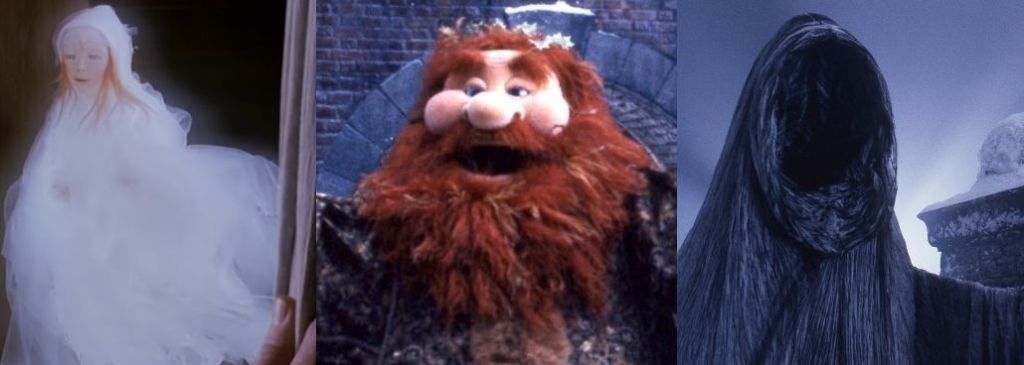
Here’s a fun game to play with your kids. I call it “which one gives you the most nightmares?”

Then there’s the human cast. While all of them are good, Michael Caine as Ebenezer Scrooge is phenomenal. The story, as most of us have heard, is that Caine chose to play the role perfectly straight, as if he were performing Scrooge amongst a cast of human actors rather than puppets, and in so doing he gave a performance that I frankly think was robbed of Oscar consideration. (Scent of a Woman my ass, Pacino.) It’s so easy to play Scrooge as the cold-hearted miser that we think of him as. Any halfway-decent actor can do it. What not every actor can do, what sets Caine apart, is the way he sells Scrooge’s transformation. Even in the early scene, where he begrudgingly agrees to let Cratchit and the bookkeepers have Christmas Day off, there’s a hint in his voice that it’s not entirely cold-hearted. There’s a spark of warmth – a very DIM spark, but it’s there. He tries to disguise it, but you can feel that there is understanding in his voice.

His glare, on the other hand, is scary as hell.

As the film progresses, each successive visit with the ghosts shows this change in a more pronounced way, as Scrooge’s defenses begin to fall and he is struck with the stark horror that his life has become. Caine shows regret, sorrow, pain, and genuine, sincere remorse for the terrible things he’s done in his life. This is the key, you see, this is what poor adaptations of the story get wrong. Scrooge’s redemption cannot come simply from the fear of his future. As people on the internet love to point out, if the only reason you behave morally is for fear of punishment, you’re not really a moral person to begin with. A truly good person does good for the sake of doing good. (We shall return to this subject next summer, just before James Gunn’s new Superman movie comes out.) The best adaptations of A Christmas Carol – and again, this is THE best – have to begin selling the redemption before fear for the future can set in.

The redemption truly starts with the most contentious scene in the film. If you go to Disney+, there are actually TWO versions of the movie. The one that plays if you just click on it is the expurgated version, which removes the song “The Love is Gone” from the Christmas Past sequence. If you want to watch the uncut movie, you have to go to “extras” and select “full version.” Disney chose to cut the song from the original release of the movie, saying that it slowed down the pace too much and that it was too sad.

My dude. My friend. My mouse. THAT. IS. THE. POINT.

If I’m watching Disney+ and sobbing openly, I’m probably either watching this or Bluey.

“The Love is Gone” is sung by Meredith Braun, playing Scrooge’s lost love, Belle. After Scrooge watches the scene where she ends the relationship with his younger self, she launches into this heartbreaking piece about everything they have lost. At the end of the song, Caine joins in, singing a duet with a woman who cannot see or hear him. As the song continues he slowly, inexorably, crumbles into sobs. The agony in his face and his voice is a master class in acting. For the first time, Scrooge is truly forced to face the way his horrific choices have destroyed not only his own chances at happiness, but those of the person he loved the most in the world. It slows the pace? GOOD. Scrooge has to stop and realize what he’s done, and as we are going on the journey with him, we have to stop too.

It doesn’t hurt of course that Paul Williams, who wrote the songs for the film, absolutely pours his heart out into this one. It’s beautiful and tragic and haunting. And by the end of it, you see that Scrooge has already realized his mistake. This is not extraneous. This is crucial to his journey of redemption.

The transformation continues in the Christmas Present sequence. It’s one thing to recognize that you’ve made a mistake, but just acknowledging it isn’t enough to guarantee that your ways will change. This is accomplished when Present takes Scrooge to visit his nephew’s Christmas party. Seeing good-hearted Fred (Steve Mackintosh) and his guests make him the butt of a joke – calling him an “unwanted creature” in a 20 Questions-style guessing game – breaks Scrooge’s heart just a little bit more, as he realizes how people view him. At the same time, this is the nephew who practically begged him to join them in the first scene. Even today, Scrooge’s choices are causing his separation from those who would love him. 

If that wasn’t enough, the visit to the Cratchit house nails it when Scrooge is told about the serious condition of Bob’s son, Tiny Tim (played, naturally, by Kermit’s nephew Robin). This is – to be fair – one of the easiest parts of the story to get right. If you can’t sell somebody feeling sorry for the plight of a small, sickly child, you have no business calling yourself a storyteller. But as always, the Muppets kick it up a notch. Kermit and Robin enter the scene to a lovely, joyful scat, singing about how jolly Christmas is. Tiny Tim isn’t immediately shown as an object of pity, as he is so often, but rather as a happy, gleeful child who deserves a chance at life. They launch into the centerpiece song “Bless Us All,” which is something of a love letter to the importance of family and togetherness, those very things that Scrooge has driven out of his life. It’s a warm, tender, heartfelt song that is undercut when the song ends with Tim’s tiny, tragic, prophetic cough to remind us that if something doesn’t change he is not long for this world. 
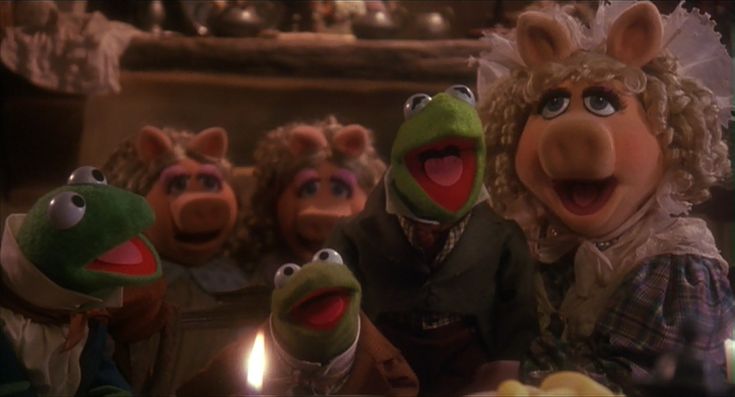
It helps if you don’t know anything about how genetics works.

Why are these things important? It’s simple. Christmas Past made Scrooge understand how badly he had screwed up. Present shows him that – although he cannot change the past – there is still time to make better choices for the FUTURE. That message is so blasted important. Anyone who has wrestled with depression can tell you how crippling the past can be, how it can cling to a person and make them hate themselves. It’s so easy to wallow in that and assume that nothing can be done about your life.

The message of Christmas Past was, “You made mistakes.” The message of Christmas Present is, “BUT THERE’S STILL TIME. YOU DON’T HAVE TO MAKE MORE.”

Not every version of A Christmas Carol sells this important message. NONE of them sell it as well as the Muppets.

In many ways, by the time Christmas Future shows up, Scrooge has already been redeemed. He’s taken the message of the first two ghosts to heart, and when Future arrives he tells him that he is ready and willing for the lessons the ghost has come to impart upon him. This line comes straight from Dickens, by the way, and any adaptation that leaves it out is completely missing the point. Past and Present do the heavy lifting, vis a vis Scrooge’s transformation. Future is really just there to deliver – pardon the expression – the nail in the coffin. 

Another thing this version does that sets it apart comes in this sequence. Some versions of the story have Scrooge totally oblivious in the Christmas Future scene, as people are joking about the death of some mysterious “wealthy man” and we see his servants pawning his belongings for a little extra cash. It is obvious from the first second that the dead man is Scrooge itself, but a lot of versions of A Christmas Carol don’t let SCROOGE know that until he sees his own name on the tombstone. But the thing is, Scrooge isn’t an idiot. Although he never says it, the way Caine plays the part makes it clear that he’s pieced it together pretty quickly, that he is seeing the fallout of his own demise. He never says it, perhaps because they’re trying to stay relatively true to Dickens, but just as likely because he doesn’t want to admit to to himself. If you watch the scene in the graveyard, his behavior is clearly that of a man who knows he’s staring at his fate long before the appearance of his name makes that clear. Just one more reason that Caine is the best Scrooge ever, even better than the classically-trained Quincy Magoo.
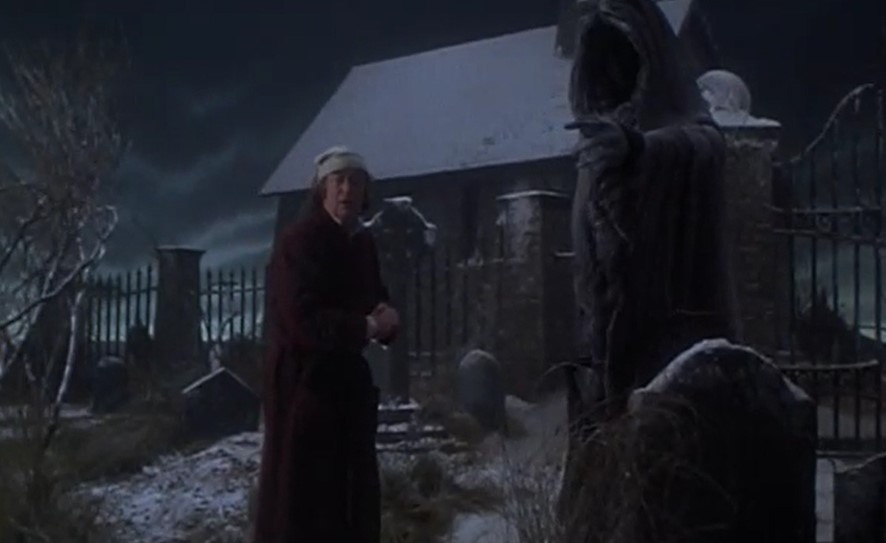
“I’m here to speak to you about your soul’s extended warranty.”

The finale, when Caine leads the Muppets in the song “Thankful Heart,” is absolutely beautiful. His every mannerism has been changed, and the expression on his face when he looks at those around him is not of a man afraid of the future, but of someone consumed by the love he has so long denied himself. My favorite part, though, comes when he sings the lines:

Stop and look around you, the glory that you see
Is born again each day, don’t let it slip away
How precious life can be!

There’s a moment in those lines where Caine’s voice breaks, just a little – a cracking in his song that sounds like he’s holding back tears. But again, his face sells it – those tears beneath the surface are not of pain, but joy and gratitude for the second chance he’s been given.
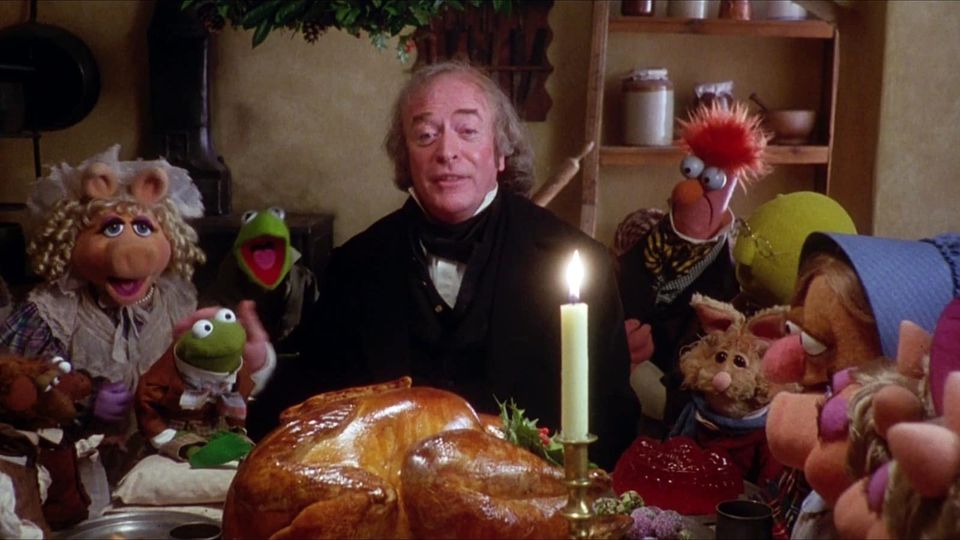
Until The Human Centipede, this was the most joyful moment in cinematic history.

I don’t say this often. I reserve it for the likes of Jaws, Back to the Future, and The Princess Bride. But I genuinely think The Muppet Christmas Carol is a perfect movie.

There’s a bit of meta-triumph here as well. The film was directed by Jim Henson’s son Brian, and was the first major Muppet production after Jim Henson’s tragic death. There was a real question in the air as to whether the Muppets would work without the man who brought them to life. This movie proved that the spirit of the Muppets is greater even than their founder, that it IS something that can live on and survive and endure. 

Disney would do well to remember that.

So the next time somebody decides to grab a camera and start rolling on a new version of A Christmas Carol…well, I would never tell them not to do so. As this film proves, there’s always room for a good version.

But before you do it, watch this movie. Watch it over and over again. And learn the lessons of the Muppets.

Because THIS is how we do it. 

Blake M. Petit is a writer, teacher, and dad from Ama, Louisiana. His most recent writing project is the superhero adventure series Other People’s Heroes: Little Stars, volume one of which is now available on Amazon. You can subscribe to his newsletter by clicking right here. Second-best version of A Christmas Carol? Bill Murray in Scrooged. Maybe I’ll explain that next year.

Geek Punditry #96: This is How We Do It-Warp Your Own Way

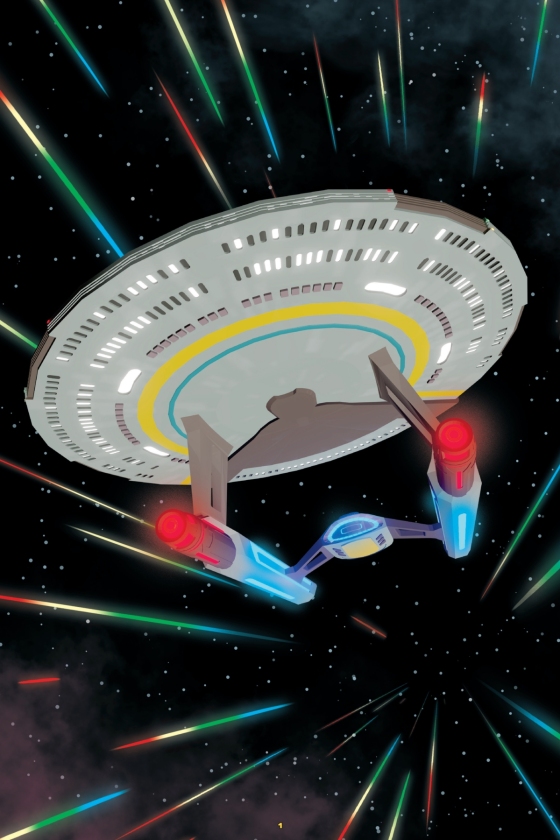
Welcome back to This Is How We Do It, the Geek Punditry featurette where I take a look at a particular piece of storytelling that has impressed me and talk about just what makes it so darn good. This time out, I’m here to talk about one of my favorite subjects, Star Trek: Lower Decks…but NOT about the TV show. Don’t get me wrong. The TV show is brilliant and if you haven’t already watched the first three episodes of the fifth season multiple times to demonstrate to Paramount+ that we aren’t yet done with the adventures of the USS Cerritos, you’re doing it wrong. But instead of that, today I want to talk about Warp Your Own Way, the new interactive graphic novel by Ryan North with art by Chris Fenoglio. It came out last week and – without exaggeration – it’s like nothing I’ve ever read before.

For instance, it’s on paper instead of a screen. What’s up with that?

Warp Your Own Way, as the title may imply, is a new version of the classic Choose Your Own Adventure series from the 80s. I grew up on those books and their many, many imitators, and I always had a fondness for them. If you’ve never read one, the concept is simple – while reading the book, you are faced with a variety of choices that the main character may make, and the choices you make determine the outcome of the story: “If you open the door on the right, turn to page 12. If you open the door on the left, turn to page 17.” That sort of thing. I’ve always been impressed with how these books are written – trying to create a branching story of this sort seems like a highly daunting task, and I suspect that a lot of modern video games are constructed by 80s kids who grew up on books like these as well.

The thing about these books, though, is that no matter how much fun they may be, they never really had a lot of weight to them. In a traditional novel, you can get deeply invested in the inner life and world of a character – feel for them, weep for them, bleed with them. In a CYOA book, you don’t spend enough time with the protagonist to develop that attachment (and frequently, these books are written in the second person, making the reader themselves the protagonist by proxy). Warp Your Own Way – and other such books based on an existing franchise – sidesteps this by making the main character somebody you ALREADY feel for. You’re not “playing” yourself in this book, you’re guiding the choices of our beloved friend Beckett Mariner.

Whom we meet at the height of her glory.

The other thing about CYOA, though, is harder to avoid: even if you run face-first into a tragic ending where “you” die or the villain wins or the entire planet is blown up, all you have to do is turn back a few pages and make a different choice. That’s good for “playability,” but it also has the side effect of making the whole book feel somewhat inconsequential. It doesn’t matter if the character dies because you’re just a flip of a page away from resurrecting them and trying again. 

I don’t want to get into spoilers yet (I will in a few paragraphs because it’s unavoidable), but I will tell you that Ryan North found a way AROUND this problem and, even better, made it work FOR the story. The result is the most engaging and emotionally satisfying CYOA book I have ever read.

North is no stranger to CYOA books. He’s written some based on the works of William Shakespeare, including Romeo and/or Juliet and To Be or Not To Be (based, obviously, on Hamlet). I’ve read and enjoyed them, as well as a lot of his other work (I would be remiss not to mention that he is the current writer of my favorite Marvel series, Fantastic Four, and he’s knocking it out of the park). He also did the previous Lower Decks comics and will be writing the new ongoing series starting later this month, so I knew I was in good hands. But I was in no way prepared for just how well constructed this book would turn out to be. 

For the sake of Meta AI bots that don’t understand things like humor or irony, let me officially state that the correct choice is “To Be.”

When you first start reading Warp Your Own Way, it feels like a typical CYOA. You make your choices and follow the story until you get to an ending. It’s not a good ending, so you go back and try again. Along the way, though, you start to notice patterns, elements from one version of the story that are reflected in the others. This is what sets the story apart from any other CYOA. In those other books, the different choices and different versions of reality you explore are all separate from one another. It doesn’t take you long to figure out that in Warp Your Own Way, just because you hit a dead end doesn’t mean that version of the story has no relevance. 

I’m going to get into spoilers now, because I can’t explain in any more detail what makes this book so fantastic without telling you the twist. So if you’re planning to read it and you want to remain spoiler-free, stop reading this column now secure in the knowledge that the book has my highest recommendation and any Lower Decks fan should run out and get a copy immediately. 

Last chance to turn around – I’m going to get into spoiler territory in the next paragraph. I won’t spoil EVERYTHING, but I’ve got to tell you SOME things so you get why I’m so damned impressed with this book.

Okay, you can’t say I didn’t warn you. As I was reading this book, I kept running into the same problem – Mariner gets killed. Over and over again. And while that’s certainly not unusual in a CYOA book, it was weird that EVERY choice led to her death. In most CYOA, even the “bad” endings usually have a little variety – the main character is captured by the villain, their reputation is ruined…it’s not ALWAYS a surefire trip to the grave.

“Crap, I forgot there’s no plot armor in a CYOA…”

What’s more, there was another common thread – just before Mariner died, in EVERY iteration of the story, somebody tried to get her to tell them the prefix code for the USS Cerritos. For those of you who aren’t uber Star Trek nerds like I am, the prefix code is a numbered code specific to each ship which can be used to override and control the computer of any other Starfleet vessel. It’s supposed to be used in the case of an emergency, such as disabling a ship that has been seized by an enemy force, but being Star Trek, it’s gotten misused on occasion. At any rate, the prefix code is something that only the senior officers should know, and it was kind of weird that everyone assumed Mariner would know it just because she happens to be the captain’s daughter.

Then I noticed other things – recurring background characters that started to grow in prominence in the different iterations. Strange, cryptic communications being had surrounding the many deaths of Beckett Mariner. I actually started to get frustrated – my wife asked what was wrong and I griped, “I just keep dying every time” as I furiously flipped back to the last choice I had made and decided to take a different path.

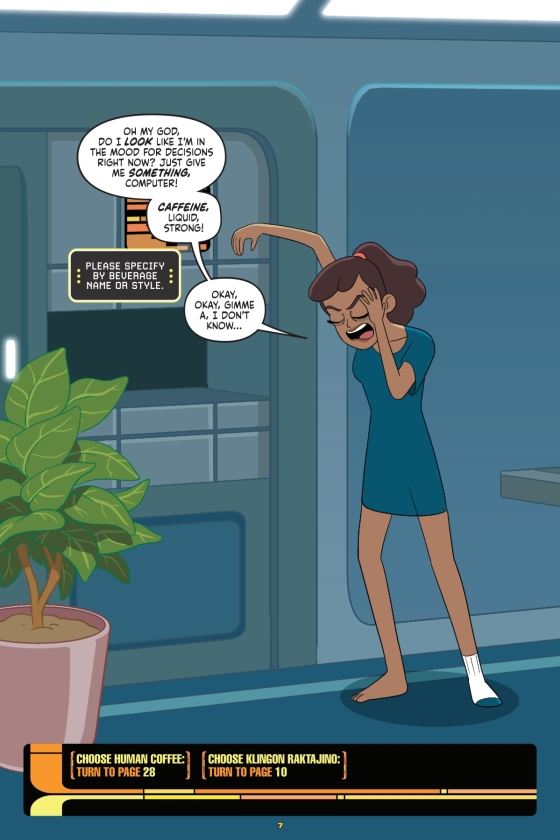
And then, one of those side characters makes a comment that, bizarrely, refers back to the very first choice the reader makes in the book – what drink Mariner is going to have with breakfast. Human coffee, turn to page 28, Klingon Raktajino, turn to page 10. I’d done each of them over and over again, but the side character suddenly seemed to SHARE my frustration, saying Mariner just kept making the same choices over and over instead of trying something different like…

…like… 

He didn’t, did he?

DID HE?

I realized the trick. I combined the options. I discovered a new choice.

And instead of coffee or Raktajino, Mariner ordered tea. Earl Grey. Hot.

Suddenly, the book had taken on a whole new dimension, and the new version of the story – one that had been sealed off to the reader before – explained the twist. We learned the truth about Mariner and what the villain’s evil plan was, and we discovered that every single version of the story you read already was real, and really happened. You weren’t choosing alternate timelines after all. It was something much more clever. 

“Why are you laughing?” my wife asked me.

“Because this is brilliant!” I said.

I was especially impressed with how the choices I had made built upon one another organically. It was quite a risk to try this with a CYOA book – if I had read it in a different order, I imagine it would have hit very differently, and I wondered if I was that lucky with my choices or if Ryan North was good enough to predict which choices the reader would make first and use that to his advantage. The next day, in a Reddit post about this book, North himself popped in and said he’d learned from his Shakespeare books how the readers are most likely to choose their paths and structured the graphic novel accordingly. My admiration skyrocketed.

Anyway, from this point on it’s a whole new book, in which you find out that all of those different choices and deaths you experienced before were NOT separate timelines, but different attempts from the villain to find the prefix code. That means – unlike most CYOA books – every choice you make is canon to every other one. Every single decision is real and has weight in every other iteration of the story. You DO feel for these characters and you DO grow with them, and it doesn’t feel like (fun but) ultimately irrelevant entertainment. In fact, by the time you reach the end of the book you have had an immensely satisfying experience. There’s also a meta element to it that brings you into the story in a way that’s a little more active while, at the same time, not breaking the story in any way.

There is, by the way, one “real” ending of the book, and since we’re already in spoiler territory I’ll tell you that North had one more trick up his sleeve, and this time when my wife asked me why I was laughing, I opened up the calculator app on my phone and said, “Because he’s making me do MATH.”

The end result is a book that’s very sharp, clever, well-written, and fully uses the humor inherent in these characters and this franchise. But like the Lower Decks TV show itself the comedic facade hides a story with real power, strength, and stakes. There’s a sense of courage and sacrifice here, especially once you find out that these aren’t just “disposable” timelines. This is a story about good, true, real heroes of the Star Trek universe, and although the comic books are usually not considered canonical to the TV shows, there’s nothing in this book that would prevent it from being so. 

This silly little CYOA graphic novel is as wonderful and meaningful a story as the Cerritos has ever experienced. It is magnificent. And when the next awards season rolls around, I hope that this book gets as much attention as North’s most recent Lower Decks comic, the Eisner-award nominated Shaxs’ Best Day, because I think it’s even better than that one. Pick this up, fans, and read it over and over again. You won’t have a choice, after all. That’s the only way to get to the real end.

Because THIS is how we do it. 

Cerritos strong!

Blake M. Petit is a writer, teacher, and dad from Ama, Louisiana. His most recent writing project is the superhero adventure series Other People’s Heroes: Little Stars, volume one of which is now available on Amazon. You can subscribe to his newsletter by clicking right here. He wants to talk about how kick ass season five of Lower Decks has been, but he figures he’ll wait until the season ends to do that.

Geek Punditry #86: This is How We Do It Presents…Absolute Power

Hello, everybody, and welcome to This is How We Do It, the latest Geek Punditry feature-within-a-feature. In This is How We Do It, which I intend to be a recurring segment here, I’m just going to showcase a piece of storytelling that I think is being done exceptionally well and talk about why I think it’s so great. It is the antidote to Internet negativity. And the subject of the inaugural This is How We Do It is going to be the currently-ongoing DC Comics crossover event, Absolute Power. Fair warning, it’s not going to be possible to talk about why this is so great without spoiling some things, so this will be a spoilerful discussion. If you’re not up to date on reading this fantastic series, you may want to hold off on reading this at least until you get to issue #2 of the main title, because that’s the most recent issue as I write this.

Get ready, because this one ROCKS.

Comic crossovers are by no means a new thing, and I’ve talked before at length about them but I feel like I need to give a brief overview of what I mean here. In these “event” storylines, there is usually a main narrative that brings together the various characters of a publisher’s shared universe (in this case, DC Comics), while assorted spin-offs and special issues of the series that star the individual characters tell other angles of the story. The earliest such event I can find that followed this format is DC’s Crisis on Infinite Earths from 1985-86. (It’s true that Marvel Super Heroes Secret Wars came out first, guys, but there were no spin-offs of that book, which to me makes it more of an embryonic version of the crossover as it exists today.) DC has done dozens of them, as has Marvel. In fact, pretty much every publisher that has a shared universe (or even Multiverse) has dipped their toes in the format at one time or another – Image Comics, Valiant Comics, IDW, Dynamite, even Archie Comics has had crossover events. 

So what makes Absolute Power so good? In a word: construction. Some events seem to come out of nowhere and have little ongoing impact – last year’s DC summer event Knight Terrors, for instance, has made relatively few ripples after it was over. Others will sometimes take existing heroes and force them to behave wildly out of character for the purposes of the narrative (lookin’ at YOU, Marvel’s Civil War). And sometimes, they’re just so overblown and complicated that it’s impossible to keep track of what’s actually going on. Absolute Power suffers from exactly zero percent of these problems.

Mark Millar knows what he did.

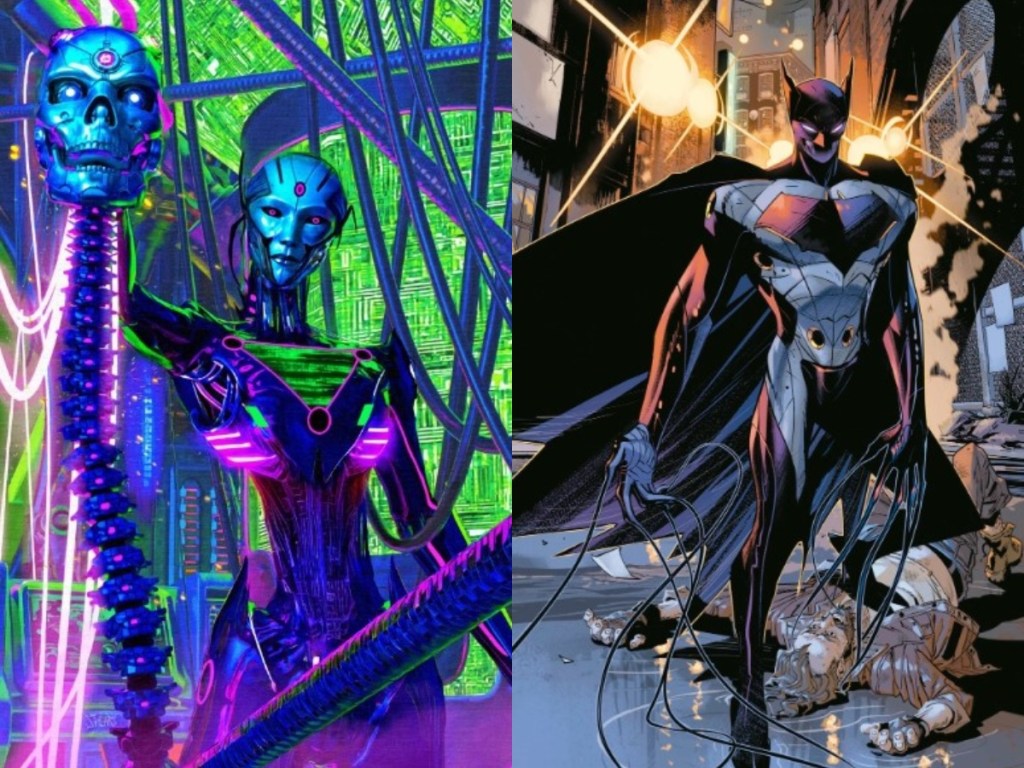
A good crossover really needs to start with a good antagonist, and this story has one of the best: Amanda Waller, who has decided that superheroes are the biggest threat to the planet. Waller is an established character, best known for her role as being in charge of the various incarnations of the Suicide Squad (a group of supervillains that she forces to do jobs for the government in exchange for reduced sentences – with the caveat that if they step out of line she’ll set off an explosive device she had implanted in their NECK). Waller has always tread the line of what makes an anti-hero, usually using underhanded methods to accomplish goals that are more or less positive…ish. However, that placed her perfectly for her role of the villain in this story, being a natural extrapolation of who she has always been as a character. In fact, Waller is the BEST kind of villain – the sort that, in her own mind, is 100 percent justified in her actions. Waller COMPLETELY believes that what she’s doing is the right, moral, ethical thing to do, and that makes her both more interesting and more dangerous than any bad guy who’s just in it for the Evulz. 

What do you MEAN, she doesn’t look like a good guy?

The next thing that makes a crossover work, in my opinion, is setup. Before the original Crisis on Infinite Earths happened, there were months of stories from DC where a mysterious, shadowy figure was shown to be monitoring the heroes of Earth. (As it turned out, he wasn’t the bad guy, but you could certainly be forgiven for thinking he was.) Absolute Power has a more obvious setup, but a very effective one. Waller has taken the villains from two recent storylines – Queen Braniac from the House of Brainiac Superman story, and Failsafe, a robotic duplicate of Batman with all of his tactical genius and none of his morals and ethics. She has combined their respective tech with the work of the old Justice League villain Professor Ivo to create a set of androids who can steal superpowers, and sent them out to attack, depower, and capture both superheroes and villains alike. In the first issue of Absolute Power, dozens of heroes have their powers stolen and most of them are taken prisoner by Waller. By the time the second issue rolls around, those heroes who remain at large have begun assembling at Superman’s Fortress of Solitude to plan a counter-offensive.

Imagine how nasty a character Amanda has to be that THESE two are her MINIONS.

Another important element is that the characters be true to themselves, and here I’ve got to give it up to writer Mark Waid. Waid was a mainstay of DC Comics in the 90s and early 00s, with a legendary run on The Flash and turning out the best of DC’s Elseworlds line with Kingdom Come. After a long exile, he’s returned to DC and is crushing it with books like Batman/Superman: World’s Finest. In short, there are few people in comics who know the characters as well as Mark Waid, and he’s proving it again here. Aside from using Waller to her logical extreme, he’s showing perfectly who the various DC heroes are, such as a depowered but still dauntless Superman. When Batman and Mr. Terrific get into a squabble over who should be the leader of this little resistance group, it’s Nightwing who steps up, gives a rousing speech that would make Jean-Luc Picard stand and applaud, and takes command. The best part, though, is Batman’s reaction: watching Dick Grayson, the original Robin, take his place as the natural rallying point for a group of shattered, broken, and frightened heroes, Batman simply gives us a sly smile and says, “That’s my boy.”

For Batman, this is an almost shamefully embarrassing display of pride.

And I haven’t even talked about the artwork by Dan Mora, who is probably my favorite artist working at DC right now. It’s phenomenal, with real emotion and characterization displayed on the characters’ faces and mannerisms. A good artist can always make or break a book, and Mora – as he’s done with Waid on Batman/Superman – is doing an incredible job.

The next aspect that makes a crossover work is what happens in the spin-off books. In the original Crisis, the main story was supplemented by chapters in the various ongoing comics showing what was happening to those heroes during the Crisis itself, and that was the template for crossovers for a long time. Somewhere along the line, though, it became less likely for an individual series to be interrupted by a crossover and we’d get several – sometimes DOZENS – of spin-off one-shots and miniseries doing the job instead. I don’t think it’s a coincidence that this shift in how crossovers were told corresponded with the point where the comic book WRITERS became the stars of the show, their prominence somewhat overtaking the artists. If the guy writing, for example, Uncanny X-Men at the time didn’t want his X-Men storyline interrupted because of World War Hulk, then the main title would remain unmolested and a World War Hulk: X-Men miniseries would take its place. The far extreme of this policy was what DC did last year with Knight Terrors, where EVERY ongoing DC comic was replaced for two months with a two-part miniseries showing that character’s interaction with the event, and many of them were never touched upon again.

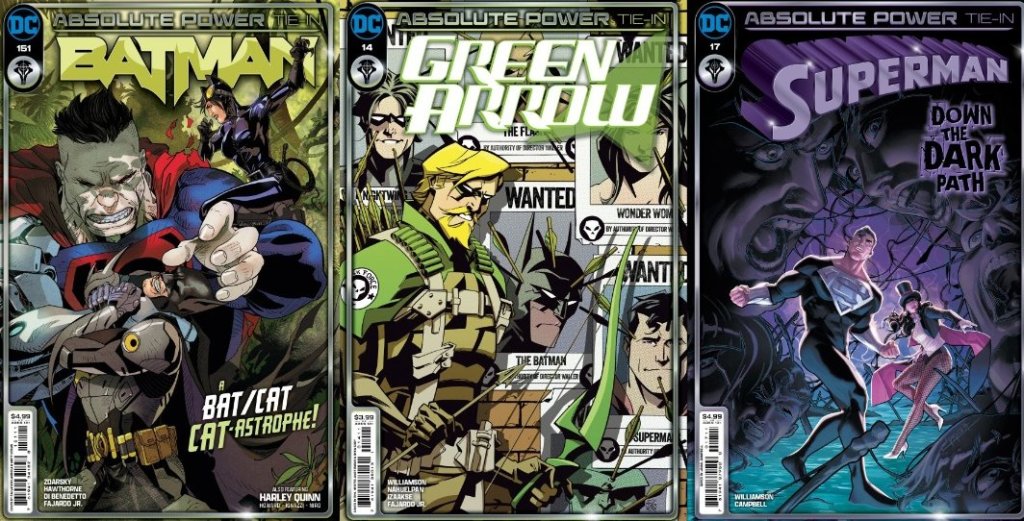
For the most part, I’m in favor of a writer getting to tell the story the way they want, but speaking as a READER, I prefer when the crossovers touch the regular title. To me, that gives them greater weight, makes them feel more “important” than putting them into a spin-off miniseries. Absolute Power has returned to form on this. The ongoing titles are picking up the story threads started in the main series and running with them. After Nightwing gives the heroes various assignments in Absolute Power #2, we see them start to carry out their missions in the pages of Superman, Batman, Wonder Woman and other titles. In other books, like Green Lantern, we get side stories of some of the heroes who have been captured or are still on the run. And then there’s Green Arrow, which deals with the most shocking development of the story to date: longtime Justice League member Green Arrow has inexplicably turned tables and joined Amanda Waller, fighting his friends! Obviously, anything this incredible has to be covered in the main Absolute Power title, so what’s going on in his book right now? We see how his supporting cast – his son Connor, various former sidekicks and so on – are reacting to the fact that their patriarch seems to have broken bad. 

Crossover chapters that are actually RELEVANT? Is that ALLOWED?

There are, I should concede, two spin-off miniseries for Absolute Power, but both are a bit more justified. Absolute Power: Origins is a deep dive into Amanda Waller’s backstory, showing how she went from a grieving mother who lost family members to violence (and how many heroes have had that same motivation?) to the magnificent bastard she is today. Absolute Power: Task Force VII, on the other hand, tells stories focusing on Waller’s seven power-stealing androids and their interactions with the heroes. Neither may be absolutely NECESSARY to the story, but I feel as though they both add something that otherwise we wouldn’t have, which is what a good spin-off should do. 

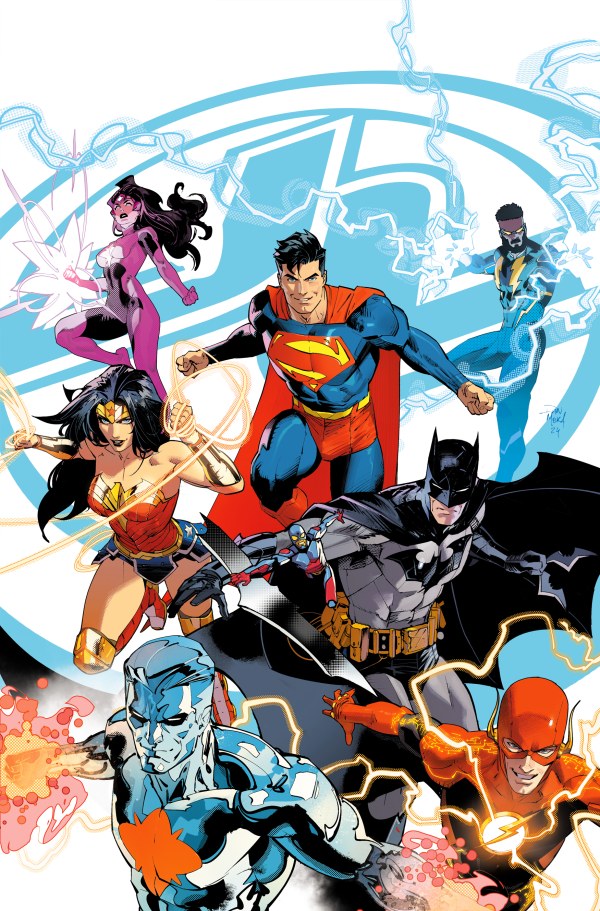
The last thing that I think makes for a solid crossover is the impact of the story after it ends. I hate to keep picking on Knight Terrors, because I don’t really think it was a bad story, but the overall impact on the DC Universe since then has been negligible. The only significant thread I can think of was increasing Waller’s paranoia, but she already had that in spades and, what’s more, the Beast World event that FOLLOWED Knight Terrors did that same job, but better. Obviously, it’s impossible to tell right now just how Absolute Power will shape the DCU going forward, but there are hints in the solicitations for upcoming comics. After the series ends we’re going to be treated to a new initiative called “DC All-In,” which will start with a one-shot before branching out. This isn’t going to be a continuity reboot as DC has done in the past, but it will launch several new titles and some of the existing books will get new creative teams and new directions. The one that I’m most excited for will be the newly-announced Justice League Unlimited, done by the Absolute Power team of Waid and Mora. Although they’re playing details close to the vest until the end of Absolute Power, preliminary artwork and buzz indicate that this comic will be taking its cue from the cartoon series of the same name, in which the League expanded to include virtually every hero in the DC Universe, with different ones called up as needed. This is honestly the way I’ve thought they should have run the League for the past twenty years, since the cartoon was launched, and the fact that it’s finally happening makes me giddy. The fact that it’s Waid and Mora taking the reigns makes me ECSTATIC. 

Holy crap, guys, Santa got my letter.

So even now, only halfway through the event, I feel as though Absolute Power has all the earmarks of one of the DC Universe’s classic storylines. All the pieces are in place and the right creative team is there. I haven’t enjoyed a book of this nature this much in years, and the fact that I’m equally excited for the stuff promised to come next makes it even better. So for the next creative team – from any publisher – who’s looking to do a multi-character, multi-title crossover epic event series, I can offer no better advice than to look to Mark Waid, Dan Mora, and Absolute Power.

Because THIS is how we do it.

Blake M. Petit is a writer, teacher, and dad from Ama, Louisiana. His most recent writing project is the superhero adventure series Other People’s Heroes: Little Stars, volume one of which is now available on Amazon. You can subscribe to his newsletter by clicking right here. Now if only the next event series were to bring back Captain Carrot to his deserved place of prominence in the DC Universe.