It’s the last somewhat “random” week of the year, my friends. With only three of these blogs left before the Year of Superman ends, I’ve got plans for weeks 51 and 52 – that means I’ve got seven days to scratch as many other items off my list as possible. And you know, I’ve narrowed down that list substantially over the last 49 weeks, but there are still a lot of things I haven’t gotten around to and, frankly, I know that I WON’T get around to before the year is out.

But you know, that’s okay. Just because the year is ending doesn’t mean I’ll stop talking about Superman.
More about that later, but for now, let’s jump into this week’s journey, shall we?
And as always, you can check out earlier blogs in the Year of Superman Archive!
Wed., Dec. 10
Graphic Novel: Superman: The World

Notes: This is, I believe, the third installment in DC’s “The World” series of graphic novels, following Batman and the Joker. The concept here is that different creative teams from all over the world are invited to contribute short stories about the title character of the anthology. It’s a neat idea that, in the first two volumes, showed us some interesting perspectives on the titular characters. Let’s take a look at what creators from all over do with the man of steel.
The book starts with Dan Jurgens and Lee Weeks (who also did the Doom Rising graphic novel I read yesterday) contributing the American story, “Let Slip the Dogs of War.” Lois and Clark are on a flight into Metropolis (a tedious and frustrating enterprise for Clark) when their plane is diverted due to what appears to be a kaiju attacking the city. Superman, of course, gets out to do his thing, and discovers that the creature may not be the threat people take it for. It’s a very Jurgens-esque story, with a great big honkin’ alien and Superman being Superman in the most Superman way possible. I’ve made it abundantly clear that I don’t think there’s a creator in comics who gets Superman better than Dan Jurgens, and this is one more example of that.
Spain’s Jorge Jimenez contributes “Superman in Granada.” After stopping a meteorite from hitting Earth, Superman’s powers are neutralized and he finds himself stuck in Spain for about six hours before the effects wear off and he can get home. The story is partially a travelog about how beautiful and welcoming the city of Granada is (and Jimenez and colorist Alejandro Sanchez 100 percent sell you on that concept), while the rest of it is about Superman getting by in a place where people don’t quite believe who he is, because let’s be honest, if you saw a guy in a Superman costume walking around and trying to explain that he can’t fly at the moment, you probably wouldn’t believe him either. This one is really very sweet.
“Superman’s Inferno” comes from Italian writer Marco Nucci and artist Fabio Celoni. Lois and Clark are in Italy on the 700th anniversary of the death of Dante, author of the Divine Comedy, a day in which it was prophesied that a portal to Hell would open and flood the world with demons unless a lost incantation is recited. Lois dismisses it as legend, but Clark is uneasy, and when the clock strikes midnight – sure enough – the city is hit by an earthquake. The story traces Superman’s journey through the nine circles of hell – nice, if a little on-the nose. And the revelation of the “incantation” is perhaps just a shade too cute, but still clever. The artwork is top-notch, though, a journey through Hell that’s perhaps a little on the cartoonish side, but tells the story very well.
From Serbia, writer/artist Stevan Subic gives us “My Choice, Protecting the Light.” With his super-hearing, Superman picks up someone in Serbia threatening violence against another person who describes themself as “Superman’s friend,” trying to prevent the other from obtaining Kryptonite. This story is a little weak. Although Subic goes out of his way to say that the people of Serbia are Superman’s friends and to have Superman call them honorable, we don’t really SEE any of them, except a brief glimpse of the guards protecting the Kryptonite. It’s very much a case of telling instead of showing. The story would have been served better had the people taken a more active role in the fight scene, interacting with Superman and his mystery adversary a little bit more, rather than keep it so contained.
Cameroon’s writer Dr. Ejob Gauis and artist E.N. Ejob are the creators of “Chariot of the Gods.” A week after Superman stops a villain in Cameroon, damaging an ancient statue in the process, he is being forced into a battle against one of their champions. By breaking the statue, Superman cut the people off from their gods, and only a judgement by combat can complete the restoration ritual. The story is a bit of a treatise about respecting the boundaries and traditions of other cultures. It’s a little disjointed – like, why couldn’t anybody TELL Superman what the big deal was about the statue BEFORE they started punching each other? – but overall it works.
Rana Daggubati and Sid Koitan give us India’s entry, “To Be a Hero.” A young Superman, just a year into his career, is in India as Clark Kent when he gets invited into an expedition to find a lost civilization. When they come across it, though, they’ve been beaten by outsiders looting the temple of sacred artifacts. I really liked this one – a short, simple story of Superman doing the right thing with great artwork and a color scheme that feels like this was originally produced for the Red and Blue series, which of course is magnificent all around.
Mauro Mantella and Augustin Alessio are the creators of Argentina’s “The Last Seed of Krypton.” While Clark is in Argentina chasing a story, an energy-creature from what turns out to be a yellow Kryptonite meteor bursts free and attacks Superman, disrupting his powers as yellow Kryptonite does. The creature turns out to be a Kryptonian equivalent to Swamp Thing, hoping to merge with Earth’s Green. There are good ideas in this story, and I quite like the contradictory narration of Superman trying to find a way to defeat a foe whilst that foe sees him as a “Kryptonian brother” trying to bring him a gift. But it’s never quite clear why they’re fighting in the first place, other than the creature frightening people. There doesn’t seem to be any THREAT in allowing it to merge with the Green, or if there is, it isn’t made explicit. There’s also a point where Superman – his powers dwindling – has to find a way to amplify moonlight to recharge himself. Cool idea, except that nobody seemed to let the colorist know that this scene was supposed to take place at night – it seems to be broad daylight outside. There’s something here, but the execution falls kind of flat.
Turkish writer/artist Ethem Onur Bilgic’s story is “The Hero and the Bull.” Lois and Clark – who are seriously piling up Daily Planet travel expenses in this book – are in Turkey for a history symposium. A group of mercenaries is going after some sacred stones in this one, which can be used to summon a being from antiquity. This one is pretty cut-and-dried – bad guys want to use an old artifact to do a bad thing, Superman stops the bad thing. No twists or surprises, but it’s well done and the art is great.
“Superman in Paris” is by Sylvain Runberg and Marcial Toledano Vargas. Clark has taken Lois on a trip to France to visit an exhibit by her favorite artists, but King Shark swims up the Seine looking for a meal on the logic that French food is the best food in the world, the French people eat French food every day, therefore French people should be the most delicious prey on the planet. I mean…I can’t really fault that logic. It’s a funny story with a fairly standard Superhero fight in the middle of it. Again, though, the artwork by Vargas is top-notch.
Brazil’s Jefferson Costa writes and draws “The Red Mantle.” Clark is in Rio seeking an ancient artifact – the titular “red mantle” – that has been stolen from a museum exhibit. He winds up getting into a philosophical debate with the thief. It’s okay, but I’m starting to wish that DC had put a cap on the number of stories that deal with “an ancient artifact” in this book. I get it, the point is to showcase the culture of the creator’s country of origin, but how many times in a row can that fall on some sort of piece of antiquity being either misused or misunderstood?
“Marzanna” is Poland’s contribution, written by Bartosz Sztybor with art by Marek Oleksicki. In Poland, on the last day of winter, an effigy of the winter goddess Marzanna is drowned in effigy to signal the beginning of spring. But Clark Kent is there because for decades now, every year, a woman has gone missing on that day only to be found later, drowned in the river. You’d think somebody would have pieced together the link between the two before then, don’t you? Anyway, Superman finds some people trying to kill a live woman, believing that the effigy is not enough to prevent eternal winter, and he ends up fighting Marzanna herself. Now this is a good example of what I’m talking about – the story is deeply rooted in Polish culture, but it’s totally different from “watch out for that ancient artifact.” More of these, please.
Bernando Fernandez of Mexico is the creator of “To the Left of the Hummingbird.” In a story with delightfully cartoonish artwork, Clark is in Mexico City to write about the local street food scene (I really want his job), when the city is rocked by a series of Earthquakes. The quakes turn out to be the result of Huitzilopochtli, god of War, sending his harbinger beasts (which look an awful lot like elephants) to prepare the people for doom. You know, as good as “Marzanna” was, this story is making me realize that “Superman fights local god” is just as prevalent in this volume as “Superman deals with ancient artifact.” In some of the stories, like “The Hero and the Pull,” there’s even overlap. Come on, guys, how about a little variety? All that said, this story is really well done, and the ending has a nice, clever little twist that sets it apart.
“Man of Kruppstahl” is next, from German cartoonist Flix. (“Stahl” is German for “steel.” I checked.) Perry White gets a letter from Heinrich Rupp claiming that he’s invented steel stronger than Superman, and has even sent three plane tickets so they can send a team to check it out. For the first time in this book, someone other than Perry is footing the bill. That’s nice. Anyway, he sends Lois, Clark, and Jimmy Olsen to Germany to investigate the “K-Ruppsteel.” Rupp unveils a giant cage and has a “randomly selected lady” (Lois) tossed into it to demonstrate how tough it is, claiming that Superman MUST be afraid of his invention, or else he would be there. This flawless logic aside, Superman of course shows up to show his “metal.” Get it? Ah? Anyway, it’s a cute little story with wonderful artwork, provided you don’t think too hard about the logic behind it.
Stepan Kopriva and Michael Suchanek of the Czech Republic are behind “If Nihilism is the Answer, What is the Question?” which sounds like the title of an original series Star Trek episode. And in fact, the story takes place in the far future aboard a Czech space station, when an older Superman is summoned to protect the station from a meteor swarm. He becomes embroiled in a conflict between residents of the station who are happy to have him there and others who see him as a symbol of imperialism there to subjugate their autonomy. I admit, I don’t know much about Czech politics, but I get the distinct impression that this story is intended to be a satire of some common issues in that country. If anyone out there knows more about the topic than I do, let me know if the satire lands. That said, I like this story and I especially liked Suchanek’s design for the older Superman. It’s a great look.
The last story is the fifth chapter of the Japanese Manga series “Superman Vs. Meshi” by Satoshi Miyagawa and Kai Kitago. I covered the first chapter of this series earlier in the year. If you missed that blog, the story – and in fact, the entire series – is about the fact that Clark Kent loves Japanese chain restaurants and ducks over to Japan for lunch whenever possible. I’ve read this entire series on the DC Infinity app and I do enjoy it, but it’s still one of the most bizarre Superman projects I’ve ever seen. In this issue specifically, he gets there a little too late to go to his favorite restaurant, and instead discovers the wonders of Japanese convenience store food.
As with any anthology, the quality varies from story to story. Some of them are great, and none of them are true duds, although as I said, I would have liked a little more variety in the basic premise for some of them. Boy, the Japanese entry averts that problem, though.
TV Episode: Superman and Lois Season 3, Episode 10-11.
Thur., Dec. 11

Comics: World of Metropolis #1-4, DC Go! Holiday Special #3 (Supergirl and Superwoman of Earth-11), Justice League of America #52
Notes: Earlier this year, I covered John Byrne’s four-issue World of Smallville miniseries for Mother’s Day, as it was (sadly) one of the few stories I could find that gave a real focus to Martha Kent. But this was actually just the middle series in a trilogy that Byrne wrote in order to flesh out the new continuity he’d crafted for Superman with the oft-mentioned Man of Steel reboot. The first miniseries was World of Krypton (which took its title from one of DC’s early miniseries in the pre-Crisis days), and the trilogy wrapped up with World of Metropolis, written by Byrne with art by Win Mortimer. I’m going to dip my toes into this one today, four issues that each focus on a different member of Superman’s Metropolitan cast, beginning with Perry White in “A Reporter’s Story.”
After praising Jimmy Olsen for bringing in a front-page story about Superman beating one of those hulking bad guys that show up all the time, Perry comes across another story about LexCorp expanding into Ho Chi Minh city. Lex Luthor’s continued success bristles Perry, triggering a flashback to the time when Perry White, a young reporter at the time, came home after a year and a half away covering stories in an overseas warzone. Perry has a happy reunion with his girlfriend, Alice Spencer, not knowing that during his absence she’d been romanced by Lex, who deliberately kept her in the dark about Perry’s whereabouts or even if he was still alive. Perry is distraught when he learns his old friend Lex is planning to sell the Daily Planet. Luthor offers Perry a job anchoring the news on his TV station, but Perry demands that he’s a newspaper man. As he’s leaving, Lex has one of his many female assistants bring Alice an earring she left there before, revealing their dalliance. Perry and Alice reconcile and he finds an investor to buy the Planet and keep it open, but Lex still considers the victory his when Alice announces that she’s pregnant.
The story of Jerry White, Alice’s son whose fatherhood is somewhat ambiguous for a while, would become a running subplot in the late Byrne and post-Byrne comics for a while. The discovery that Lex was Jerry’s true father drove a wedge between Perry and Alice, and Jerry’s subsequent death only made it worse. Their marital woes became a running subplot for years in real time, and eventually led to them bonding over adopting a young boy, Keith. It’s interesting how something that was such a big element of the comics for so long started here in this spinoff.
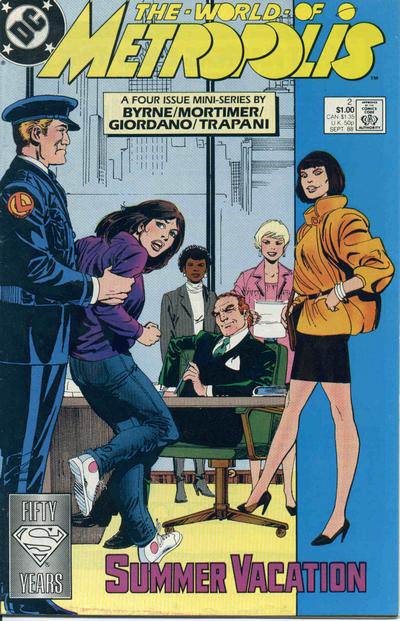
Issue #2 is the Lois Lane spotlight, “How I Spent My Summer Vacation.” In flashback 15-year-old Lois Lane dragged her little sister with her to the Daily Planet office and tried to get a job out of Perry White, now the managing editor of the paper. He tells her to come back in about ten years, but on the way out Lois hears some men discussing something happening at LexCorp, and how anyone who scores that story will get major points with Perry White. Lois sneaks out that night and breaks into Luthor’s tower to try to find some sort of evidence. Although she’s captured with relative ease, Luthor is impressed by the fire he sees in the girl. She manages to sneak out a single slip of paper with information that impresses Perry as well, and she lands her first job.
Let’s hear it again, folks: “THIS is the way Lois should be written.” She’s smart and she’s gutsy, but at 15 she isn’t yet wise. In fact, it’s that teenage illusion of immortality that fuels this story, showing how she stumbles into a situation that could very well have gotten her killed in other hands. Byrne’s Lois kept her gumption when she grew up, but added the experience that would have kept her from ever making such childish mistakes. It’s a good look on her.
Lex comes across much worse, though, practically salivating over video footage of Lois having her clothes shredded and searched by one of his employees. It would be bad enough if he did that with adult Lois, but doing it to the 15-year-old adds an additional level of creepyness that I suppose has far greater weight today than it did when this was written in 1988. And while I often make the point that villains in fiction should be expected to do villainous things, this was perhaps a bridge too far. I don’t know that this particular plot point was ever referenced outside of this issue, and I doubt that it ever would have passed editorial if the comic came out today.
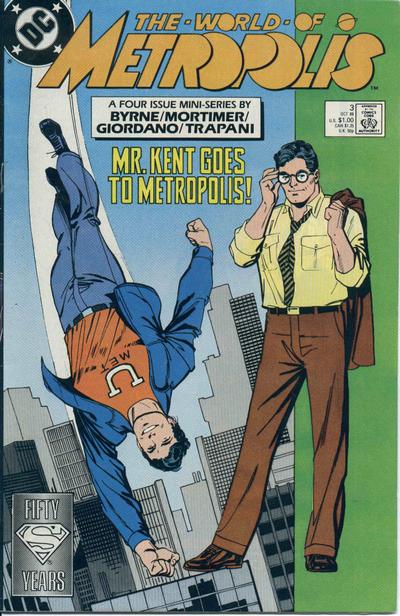
Clark Kent steps up in issue #3, “Mr. Kent Goes to Metropolis.” When he first arrives in Metropolis, young Clark Kent notices a shootout between the police and some criminals with heavy ordinance, holed up in an apartment building. Not yet having adopted his Superman identity, he tries to stop the shootout discreetly before he has to make it for an interview to enroll in Metropolis University. One night he spots a woman being chased by a car, but she escapes without his help. He does happen to overhear her name and where she works, though – it’s Lois Lane of the Daily Planet, and seeing her inspires Clark to pursue journalism.
This issue isn’t as solid or direct a story as the first two, with a large portion given over to a subplot about Clark getting a job at a diner through college, a waitress there getting a crush on him, and the fact that in the modern day they’ve remained friends, with her kids (with her husband Ed) even calling him “Uncle Clark.” Sweet story, very humanizing, but kind of forgettable. We’ve definitely seen this kind of thing with Clark Kent before.

Jimmy Olen gets the last story with “Friends in Need.” After Jimmy gets into one of those scrapes he’s always getting himself into, he summons Superman with his signal watch for a little help. After he’s safe, Jimmy remembers four years ago, when he came up with the idea for the watch in the first place. Only 14 at the time, Jimmy has a job as a copy boy at the Planet, sneaking out of his house to prove himself to folks like Lois and Clark, who is celebrating his one-year anniversary at the paper. The sneaking out gets him in trouble with his mom, but as she’s chewing him out Jimmy is visited by a troubled classmate, Chrissy, who has taken a bottle of pills and is fading fast. Jimmy’s mother tries to call emergency services, but she can’t get through, and Jimmy breaks the phone in frustration. As his mother rushes out to try to hail a car for help, Jimmy uses his radio kit to send out an ultrasonic signal that Superman hears, summoning him to get Chrissy to the hospital just in time. Jimmy, of course, adapted the technology into his signal watch, and today Chrissy has been taken out of her abusive home, giving her a happy ending of her own.
There’s some nice stuff in here, particularly in showing how clever Jimmy Olsen can be. For instance, a conversation with Lois has them questioning why Superman’s face is always blurry in photos, and just how it is that Clark gets so many Superman stories. Jimmy floats an…interesting idea that Lois quickly shoots down (in a fun reversal of the old Silver Age paradigm of Lois trying to prove that Clark is Superman). And of course, his quick thinking to save Chrissy’s life helps show off some technological skills that help flesh out the character as well. Too many writers forget that and just write Jimmy as some boneheaded kid, and “Superman’s pal” deserves better.
TV Episodes: Superman and Lois Season 3, Episode 12-13.
Fri., Dec. 12
Comics: Action Comics #309, DC Go! Holiday Special #4 (Bizarro and Earth-23 Superman)
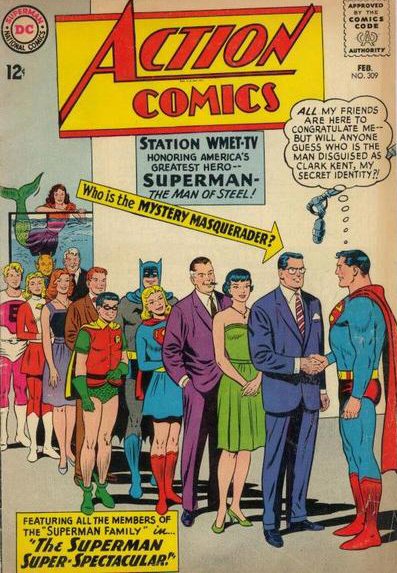
Notes: I’m gonna be honest, I’m swamped today. I had work, of course, and working in a school in those three weeks between Thanksgiving and Christmas is like working backstage on the Muppet Show, only less organized. Later, I’ve got to take my son to basketball practice, and we’re following that up with our annual trip to Lafreniere Park and their lovely family Christmas Light display. So I need something quick to read. I choose Action Comics #309 from the remains of my list, the famous story where Superman tells his identity to – well, I’ll do my recap.
The story begins with Clark receiving a letter for Superman from the President of the United States, who is asking him to recover the nose cone from a recent spaceflight to be presented as a gift to an astronaut on a TV show. This begins a series of chores where he’s asked to find different items to give to the honorees of the TV show, but when he arrives at the studio he discovers that everyone – even the President – was bamboozling him to keep him busy, as HE, Superman, is the first honoree on Our American Heroes. The show goes off as sort of a take on This is Your Life, as Superman is visited by friends such as Richard Parker (retired Smallville police chief whom he worked with as Superboy). Next come the three LLs in his life – Lois Lane, Lana Lang, and Lori Lemaris, then Supergirl and the Super-Pets. Before Superman can summon a robot from his fortress to appear on the show as “Clark Kent,” he overhears Lois and Lana planning to use a device that detects electronics to prove that he and Clark are the same person. As the show goes on, Superman meets more and more of his friends: the Kandorians, Pete Ross, Jimmy Olsen, the Legion of Super-Heroes, and Batman and Robin. But every possible replacement “Clark” is scratched off the list since they’re already there: his Kandorian double, the shapeshifting Chameleon Boy, Batman…even Pete (who Superman doesn’t know knows his dual identity) assumes that Superman will just summon a robot.
But sure enough, at the last minute, Clark Kent walks across the stage, baffling Lois and Lana when their device fails to register him as a robot. As the show ends, Superman takes “Clark” backstage, where he removes the makeup to reveal the one man that Superman recently did a favor for that he knows he can trust with his identity: President John F. Kennedy.
It was a more innocent time, friends.
The story is fun, but as often happened in the Silver Age the writers took some wild swings to justify cancelling out anybody who could have helped Clark in his predicament. The Legion has to go home to deal with an emergency, so Chameleon Boy couldn’t stick around. (They have a TIME MACHINE. Why do they have to go NOW?) Batman takes off his mask to show that he’s wearing Bizarro makeup because he thought it would be funny to show Lois Lane what a Bizarro-Batman would look like. After all, we all know just what a wacky prankster the Batman can be. Unfortunately, it would take far too long to take off the makeup and replace it with a Clark Kent disguise, so he’s no good either. It’s just a symptom of the storytelling – when you start with the end, that being “Superman needs the president to pretend to be Clark Kent,” you might just have to jump through some ridiculous hoops to make it work.
We also get a Supergirl story in this issue, “The Untold Story of Argo City.” After a visit to the Midvale Orphanage were she lived before she was adopted by the Danvers, Supergirl has dreams of her parents Zor-El and Allura, pleading with her and telling her they’re alive. Frightened by the dream, Supergirl ventures into the Phantom Zone, believing them to be there. The hordes of Kryptonian villains who inhabit the Zone taunt her, telling her that her parents ARE there, but they refuse to help. Leaving the Zone, she uses an invention of Superman’s that allows her to see the past to view Argo City’s destruction. As it turns out, before Argo died of the Kryptonite radiation from the ground beneath them, Zor-El found a different frequency of the Phantom Zone which he called the Survival Zone, but only he and Allura made it there in time. Now that they have found a way to contact their daughter, Supergirl vows to help her parents get free some day.
And she did, eventually, but that’s all pre-Crisis stuff. It didn’t happen that way anymore. Still fun to read, though.
Sat., Dec. 13
TV Episodes: Superman and Lois Season 4, Episodes 1-5.
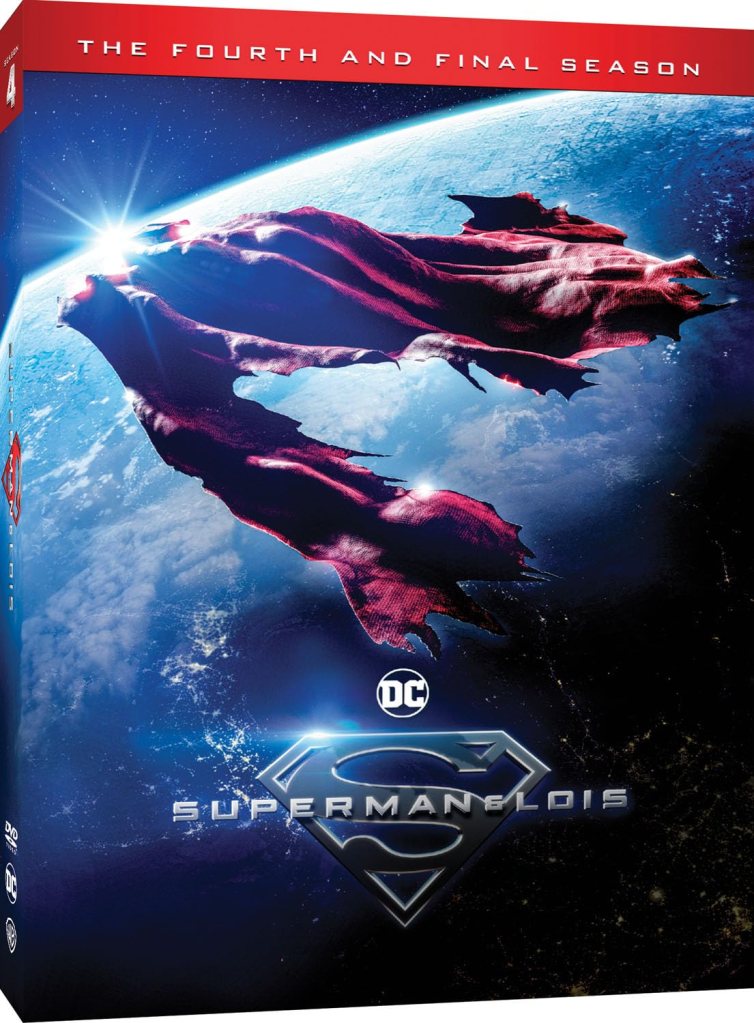
Notes: My goal, I don’t mind telling you, is to include the final episode of this series in the last week of 2025. It’s going to be a week of endings, and I’ve heard a lot of great stuff about the finale of the series as a whole, so I’ve got high hopes.
I haven’t written too much about the last several episodes, even as I was watching them, but starting the final season feels like a good place to do a sort of recap. The Big Bad of season 3 of Superman and Lois actually turned out to be cancer, as the bulk of the season was taken up with Lois battling the disease. This ran parallel with a subplot about mobster Bruno Mannheim, who happened to own the hospital where Lois was being treated. She also befriended a fellow patient that turned out to be Bruno’s wife, and Natalie started dating a really nice, charming guy who turned out to be his son. It’s the sort of string of coincidences that we only accept in TV Land.
The Lois storyline, I admit, was effective. There was a good amount of sincere emotion built into it, with everything building up to a crescendo a few episodes before the finale. Then in the last two episodes the season went into a totally different direction: Mannheim’s downfall revealed information that exonerated Lex Luthor, who has been in jail for 17 years following an expose that Lois wrote about him. In those last two episodes he was released, threatening Lois. The last episode ended with a cliffhanger – Sam was kidnapped and Superman wound up fighting an awfully Doomsday-esque monster that was created through the systematic torture of the awfully Bizarro-esque Superman from another world from season two.
The third season kicks off with Luthor continuing to spread his threats, Sam in Luthor’s captivity, and Superman missing – the last glimpse we got of him is his tattered cape floating on the surface of the moon. If they’re going for another version of the Death of Superman story, they deserve credit for taking it in a very different direction than any of the previous iterations. But as they go through it, things get DARK. Sam is beaten and tortured by Lex, and he’s tossed into a grave to be buried alive with Lex giving the order to keep the sand wet to make it more painful. The boys are desperately looking for any sign of their father or grandfather, and Lois confronts Lex again, where he expresses his plan to move to Smallville permanently. Fortunately, Jordan’s super-hearing picks up on Sam choking and he and Lois manage to save him just in time. Still no sign of Clark, though. Not until the final moments of the episode, where Doomsday (is he officially Doomsday? Imma call him Doomsday) beats him into submission, then brings him back to Smallville and drops him in the middle of the street in front of Lois and the twins, then bounds away to give Luthor Superman’s heart as ordered to do. Lois, Jonathan, and Jordan fall to their knees in tears as the people of Smallville watch.
The opening of this final season is nicely tense, but there’s something seriously missing: the rest of the cast. After building a strong group of characters with John Henry, Natalie, and Lana Lang’s family in the first three seasons, the producers relegated everybody except for Lois, Clark, and the twins to “recurring” status, none of them having more than a handful of the ten episodes to their credit. It feels like a cheap money-saving measure, honestly, and while the episodes I’ve watched thus far aren’t bad, there’s a definite sense that things are missing. I’m hoping that their few remaining appearances will be enough to give their respective stories a sense of closure.
The second episode begins with Lana getting everyone in town to back off as Jordan brings his father to the Fortress, pleading with the AI of Lara to save him. Despite the fact that he’s literally missing his heart, she promises to do all she can and puts him into stasis. When he returns home, he tells Jonathan that the only way to save their father is to find the heart that Doomsday ripped from his chest. The whole episode is a cat-and-mouse game between Luthor and the Kents, and…
It’s definitely not going in any direction I could have predicted. I’m looking forward to how this shakes out.
Sun., Dec. 14
Comic Book: Superman: Under a Yellow Sun #1
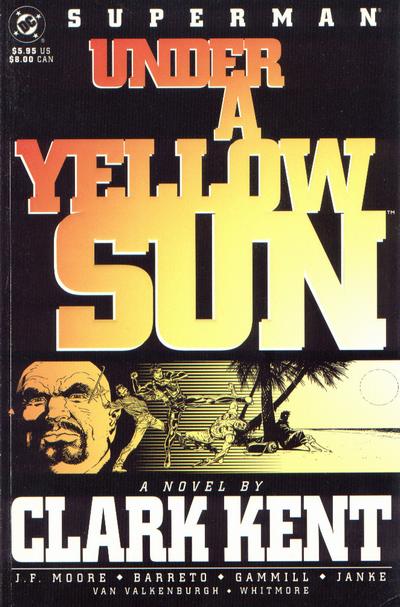
Notes: Although it doesn’t come up very often these days, in the early years of post-Crisis continuity, John Byrne and other, later writers occasionally mentioned that Lois and Clark both had side hustles writing fiction in addition to their careers as journalists. I even recall one issue, although I don’t remember which one, in which Clark bemoans seeing one of his novels in a bookstore placed on a remainder table next to the horror novel Fear Book, which was written by – nice meta joke here – John Byrne. This 1994 one-shot by John Francis Moore takes the metafictional aspect a bit further by presenting Under a Yellow Sun, a novel by Clark Kent. The one-shot cuts between scenes from the novel illustrated by Eduardo Barreto and a subplot featuring Clark Kent’s adventures in “real” life that inspire the novel, with art by Kerry Gammill.
Clark is struggling to produce his novel, dodging his agent and throwing himself into a news story, something he’s more comfortable with. Gangs in Metropolis are getting their hands on high-tech ordinance that seems like it could only have come from LexCorp, and Clark gets entangled with a LexCorp executive named Joanna DaCosta, who may have the key to unlocking the mystery. Joanna, Luthor, and Clark’s usual supporting cast all bleed into the novel he’s working on, a potboiler about a former special forces agent named David Guthrie who’s caught up in an arms trafficking scheme in what seems to be an island paradise.
It’s fun to see Clark struggling with a problem that Superman cannot possibly help him with – writer’s block. And it’s fun to see the story bounce back and forth between Clark’s imagination and the stuff that feeds it. There are good bits with Lois as well – where she’s concerned about Clark’s relationship with Joanna (although published in 1994, this story is set before Lois and Clark were engaged or she knew his secret identity), and where she helps him at the end when his frustration over his failure to catch Luthor in the act leads him to write a bitter nihilistic ending that Lois rightly declares is unfitting for him.
It’s a romanticized version of a writer’s life, to be certain, but come on…it’s still Superman’s writer’s life. There are bound to be some liberties taken. But it’s a great opportunity to get eyes on a corner of Superman’s life that we rarely get to see.
Mon., Dec. 15

Comic: Superman Vol. 2 #9, DC Go! Holiday Special #6 (Team Member, Superdemon of the League of Shadows), Justice League of America #53 (Team Member)
Notes: ‘Tis the Monday before Christmas break, and for a teacher, that means it’s crunch time. I’ve got essays to assign, papers to grade…and as much as I hate to skimp, I think the next few days I’ll be looking at relatively quick things. Fortunately, after Friday hits I’ll be off work for the remainder of the Year of Superman, so hopefully I’ll be free to tackle a lot of the meatier stuff that’s still on my plate. For today, though, why don’t we take a look at the first meeting – post-Crisis, that is – between Superman and the Clown Prince of Crime? “To Laugh and Die in Metropolis” comes from John Byrne’s Superman #9.
Superman casually wanders into a jewelry store in Metropolis, but he’s uncharacteristically silent and unresponsive, despite a smile on his face. That smile grows deadly, though, peeling into a rictus as his face is bleached white and his hair turns green. Gas spews out of his ears, killing everyone in the store, and he loots a massive diamond. Opening the case triggers a silent alarm, though, and the REAL Superman hears it, zipping in to stop what turns out to be a robot – with a nuclear bomb in its chest cavity. He flies the robot into orbit before it explodes. The blast knocks Superman to the Mojave Desert, while back in Metropolis the Special Crimes Unit starts to clean up the victims. When Superman returns, he picks up a signal from Jimmy Olsen’s famous watch, only to find it attached to a balloon with a note from the Joker claiming he’s kidnapped Jimmy, Lois Lane, and Perry White, and sealed them in lead-lined coffins across the city with less than a half hour of air.
The Joker, meanwhile, is gloating in his secret hideout – a mobile tanker car – in which he’s got all three captives tied up. His plan is to have Superman waste time looking for them while he makes his escape, gleeful at the vacation from matching wits with Batman and only having to deal with a “muscle-bound clod” like Superman. The smile (literally) is wiped off his face seconds later when Superman lifts up the truck and brings him straight to prison.
The story is quick and fun, with Byrne taking the opportunity both to show that Superman is NOT – as the Joker assumed – just dumb muscle, and also to demonstrate something about his powers. The Joker thought that Superman not being able to see the lead coffins would make them impossible to find, when in fact, it made it easier. He simply swept the city with his X-Ray vision and quickly found and opened each coffin he COULDN’T see through. I feel as though Byrne wrote this story as much to clarify that aspect of Superman’s powers as he did for the sake of the story itself.
Although the main story is self-contained, Byrne had a lot of subplots going during his tenure, and this issue followed up on one of the main ones. In an earlier issue, someone had stolen Martha Kent’s scrapbook of Superman activity, and in this one it arrives at Clark Kent’s desk at the Planet. It’s part of the Amanda McCoy storyline – the Luthor employee who deduced Clark’s identity – that we’ve seen in bits and pieces across the year. There’s also a one-page vignette with Lana Lang that set up the later Millennium crossover.
The gem of the issue, though, is the short back-up story, “Metropolis 900 Miles.” Lex Luthor stops in at a random diner 900 miles from Metropolis (hence the title), where he meets an attractive young waitress named Jenny and invites her to spend a month with him in Metropolis. When she tells him she’s married, he doesn’t blink an eye and offers her a cool million dollars to be his for 30 days. After coldly telling her how meaningless her life is, he tells her he’ll wait for ten minutes in his car for her decision. Jenny has a few pages of pondering the offer, arguing with her coworkers and calling her husband, before looking out the window and seeing that Luthor is gone. In the final panels we see Luthor gloating with his driver, saying that Jenny will spend the rest of her life wondering what her answer would have been.
This is a particularly sadistic game to play, even for the likes of Lex Luthor, but that’s kind of what makes it work so well. Byrne was still in the mode of demonstrating the ruthless billionaire incarnation of Lex, the classic Mad Scientist being so close to people’s hearts for so long. I think this story went a long way to demonstrating just how cold, cruel, and manipulative the character actually was. It’s the kind of thing that makes you despise him even more…which is, ironically, also the very thing that makes him an interesting, compelling character, and which makes this story some of the best character building work Byrne ever did with the character. And all in a scant seven pages.
One of these days I’ve got to get around to doing a full readthrough of the Byrne era of Superman.
Don’t worry. I’ll let you know when I do.
Tues., Dec. 16
Comic: Adventures of Superman: House of El #4
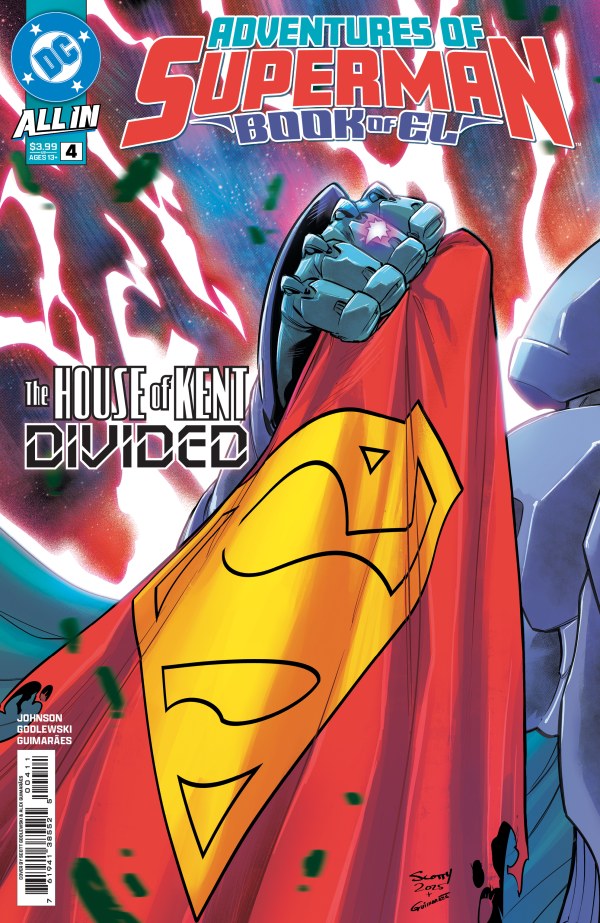
Notes: Circumstances suck. We all have to deal with them at times, and they’re really never a good thing. Circumstances severely limited my time to do much of anything today, friends, and I admit, I dropped in a book that I knew I could read quickly without thinking too much about it. Adventures of Superman: House of El #4.
Still in the distant future, Superman is seeking his lost adoptive children, Otho and Osul, with the help of his descendant, Ronan Kent. The path leads them to a world called Lanternholm, where they’re going to have to confront Ronan’s estranged twin sister, Rowan, who is apparently part of a distant evolution of the many-colored Lantern Corps that we’re familiar with in our time. I have to say, this is probably the most interesting issue of the series for me so far. I’ve mentioned before how the fact that we know Superman will return to his own time kind of deflates the consequences for his book. There are a few more inasmuch as the fates of Otho and Osul, unlike Superman himself, are NOT written in stone…but at the same time, those two characters have been so out of focus in the comic since Kennedy’s original run ended that I’m not sure anybody would have even noticed if they were just never mentioned again.
Rowan and Lanternholm, on the other hand, are a different story There’s some interesting stuff happening here, with Rowan using what appear to be Star Sapphire powers in a different way than we’re used to, and implications that the Lanterns of this era are vastly different from those of our time. I’d like more exploration of this, to see what Lanternholm is and how it grew to that point, but I don’t know if we’ll get much more of that before this miniseries ends.
This week, I’m sorry to say, is ending on a bit of a low note. It was a rough day. But with only two weeks left until the end of the year, I’m hoping I’ll be able to latch on to some stuff that will bring some much-needed holiday joy into our household.
Blake M. Petit is a writer, teacher, and dad from Ama, Louisiana. His most recent writing project is the superhero adventure series Other People’s Heroes: Little Stars, volume one of which is now available on Amazon. You can subscribe to his newsletter by clicking right here. You can join in the Kryptonian Konversation every day in the Year of Superman Facebook Group!
 Blake M. Petit