
If you ask Joe Public what team Superman is a member of, pretty much everyone will bring up the Justice League. And they’re not wrong – Superman is a vital member of the League, and honestly, it doesn’t really feel like the JLA without the trinity of Superman, Batman, and Wonder Woman. (I love the Giffen/DeMatteis run, don’t get me wrong, but that’s the JLI.) But the thing is, the Justice League isn’t the FIRST team Clark Kent was a member of. And in truth, as far as his development as a character, I don’t think it’s even the most important. This week we’re going to look at the young people he inspired and who, in turn, helped shape him into the hero he is. Superman would still be Superman if he’d never joined the Justice League…but he’s not really the hero he is without the Legion of Super-Heroes.
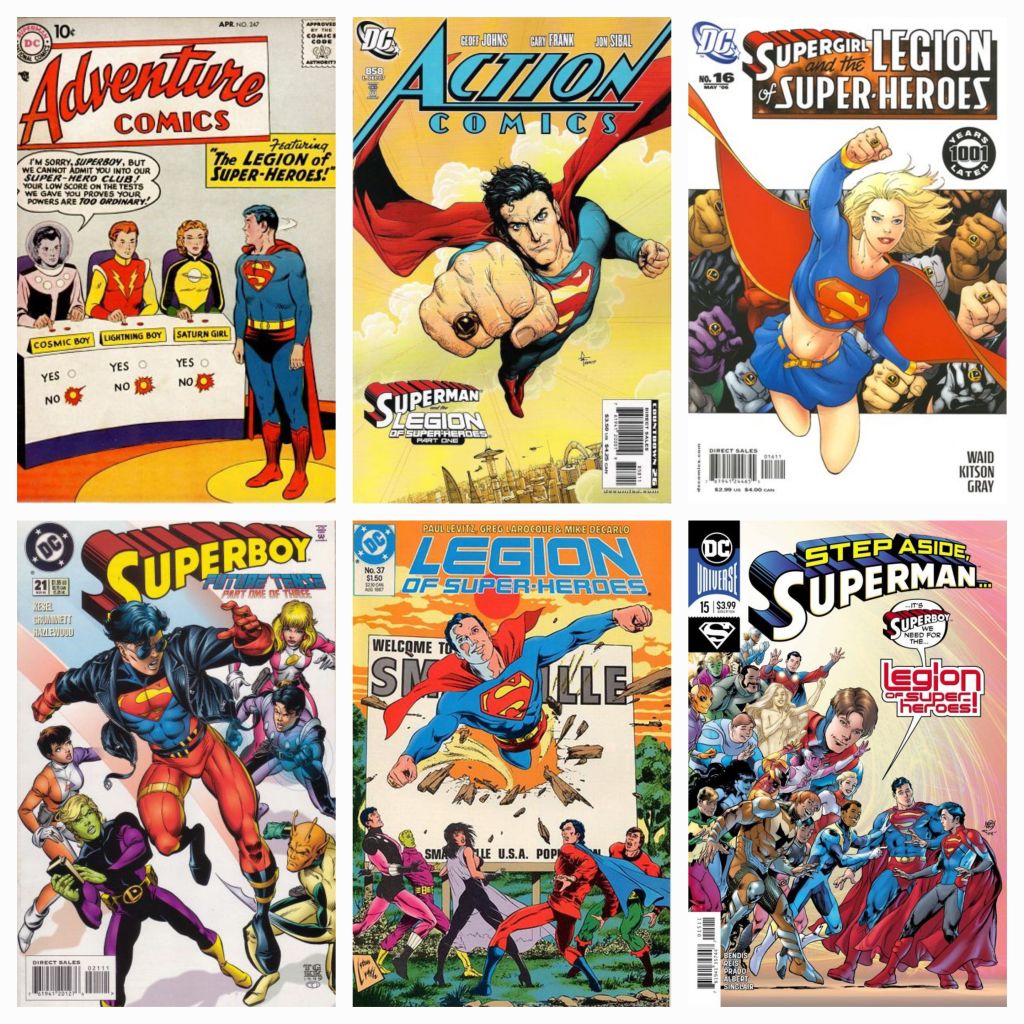
And the same goes for Superboy. And Supergirl. And Jonathan Kent, too. Because of reboot after reboot, there have been a lot of versions of the Legion over the years, and Clark, Conner, Kara, and Jon have each had their own incarnation. This week I’ll try to peek at each of them, talk about why the Legion matters so much to Superman, and discuss the best (and worst) of the 31st Century’s greatest heroes.
The Legion is kind of complicated these days, thanks to DC’s constant rebooting of their timeline. If you aren’t already familiar with them and you’re looking for a little clarification, I wrote about their convoluted history in this Geek Punditry blog a couple of months ago. Please, go check it out.
And as always, you can check out earlier blogs in the Year of Superman Archive!
Wed., June 4
Comics: Adventure Comics #247, Action Comics #276, Absolute Superman #8, Justice League Vs. Godzilla Vs. Kong 2 #1
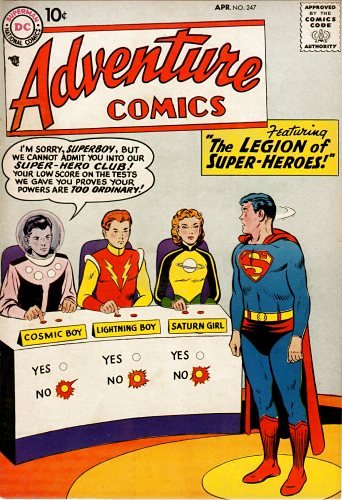
Notes: The Legion made its first appearance in Adventure Comics #247, during the period in which the headline character of that anthology series was Superboy. In this issue, beneath a Curt Swan cover that has become one of those legendary covers that gets “Homaged” again and again, Clark Kent is on the streets of Smallville when he is addressed as Superboy by a mysterious teenager he’s never met before. He switches to his other identity and zooms off, only to be met by another teenager calling him Clark, then a third. Horrified at first that his identity has been revealed, he is relieved when the teens tell him their secret: they are time-travelers. In their future, they are members of a club for superheroes inspired by the legendary exploits of Superboy, and they have come back in time to invite him to join. They bring him to the future, where he sees that Smallville has become a bustling…well…metropolis – but only by the standards of HIS time. In their time, it’s still considered a tiny community. The teens (Cosmic Boy, Saturn Girl, and Lightning Boy) put Superboy through a series of initiation tests, but each time he is distracted by a disaster that requires his attention. At first, he thinks he’s failed, but the heroes reveal that the disasters he stopped were of their own doing, and it was just an initiation stunt. Superboy joins the team and goes home, but joining them in the future soon becomes a recurring part of his adventures.
Like so many of the other characters I’ve looked at this year, this early version of the Legion feels terribly incomplete. Heck, it’s not even called the Legion of Super-Heroes yet, just the “Super-Hero Club.” The three founders are all there, but Lightning Boy would soon change his name to Lightning Lad, and all three would quickly adopt new uniforms that didn’t sport their full names across the chest like a Ben Cooper Halloween costume. The exact time period from which they hail vacillated over the next several stories before it finally, firmly, was set at 1,000 years in the future. And although only the three founders take active part in this first issue, we see other generic teens that I assume are intended to be other Legionnaires, including one that – in the digital version on DC Universe Infinite – appears to be re-colored to suggest that it’s Brainiac 5. But that’s kind of pointless, since we’ll see his first appearance shortly.
There isn’t a ton of meat in this first appearance, but I guess the idea of Superboy having actual peers was too good, so they not only brought them back, but soon added Supergirl to the mix, even though she and Superboy were separated by about 20 years of time. But hey, it’s time travel, that’s not really an issue. The first time she encountered the Legion, she was rejected because she was suffering from Red Kryptonite exposure, which seems pretty mean when you consider they darn well should have known that Red K only lasts for 24 hours. But in Action Comics #276, she got her next chance.
This issue begins similar to Clark’s first encounter with the Legion. Linda Lee is walking around Midvale, lamenting the fact that she’s got no super-powered friends to hang out with. (I feel compelled to point out that this was 1961, and even the most embryonic form of the Teen Titans wouldn’t first appear until 1964, but isn’t it weird that they never had Supergirl join until the Matrix version in the 90s?) To her surprise, she’s soon approached by three girls with powers: one wearing a mask, one that can move through solid objects, and another who can split into three bodies. The girl with the mask removes it to reveal that she’s Saturn Girl, one of the members of the Legion Supergirl met before. If you need an explanation for why she bothered with the mask, the only answer I have is that in the Silver Age nobody was ever straightforward about ANYTHING. The girls – Saturn Girl, Phantom Girl, and Triplicate Girl – take her to the future for a second shot at joining the Legion, this time alongside fellow prospective members Sun Boy, Bouncing Boy, and Brainiac 5. She is shocked at first to find that a descendant of one of her cousin’s greatest enemies is trying to be a hero, but is won over by his tender affection towards her. Supergirl is given a time-traveling membership like the one Superboy had, while Brainiac becomes a permanent member. Then, for absolutely no reason, she has a brief encounter in Atlantis, which only serves to lead up to a final panel where Linda remarks on the fact that she may not have a boyfriend in Midvale, but there’s an alien 1,000 years in the future AND a merman in Atlantis crushing on her, so it ain’t so bad.
Abysmal epilogue sequence aside, this is an interesting issue. It introduces not one, but FIVE significant Legionnaires (both Bouncing Boy and Sun Boy joined the team by the next time they turned up), and gives Supergirl a peer group like her cousin – in fact, the SAME one as her cousin. And just in case you’re worried about any timey-wimey problems arising from the fact that Superboy and Supergirl were members of the same team, they found ways to play with it. They established, for instance, that Saturn Girl placed a telepathic block on each of them, so that when they returned to their respective time periods, they would lose any memories they’d gained that would be relevant to their own future. Practically, this meant that Superboy only remembered that one day his superpowered cousin would come to Earth when he was actually in the future. They also usually avoided having both of them appear in a Legion story at the same time, so it didn’t come up too often.
Over the years, they would each bond with the Legion, and this is where I really think this group becomes important. The JLA is Superman’s team, sure, and he is close to several of them. Superman, Batman, and Wonder Woman in particular are called the DC “Trinity,” and their friendship is important, the stuff of legend.
But those are the friends he has as an adult. The Legion are his childhood friends, and that’s important. That’s special. As we learned from stories such as Stand By Me and The Sandlot, the friends we have when we’re young are a fundamental part of shaping who we are as adults. And there’s been more than one story that demonstrates just how important the Legion of Super-Heroes is to making Superboy become the Superman of legend.
At least, until Man of Steel in 1986 upended everything by that declaring that Clark Kent had never had a career as Superboy. That change in the timeline would have catastrophic consequences for the Legion of Super-Heroes.
But I’ll read about that tomorrow. For now, why not join me in a look at the two Superman-related comics that hit the shops this week?
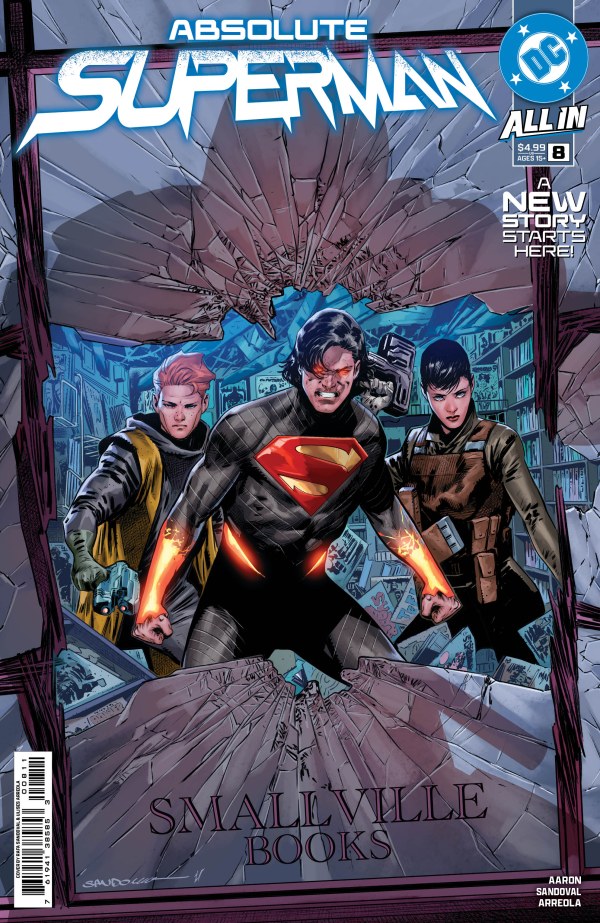
Absolute Superman #8 begins the second story arc of the series. Visiting Martha Kent in Smallville, Kal-El is approached by Lois Lane…unfortunately, she’s followed by the rest of Lazarus, the Peacemakers, the Omega Men, and – oh yeah – a sniper with Kryptonite bullets. Jason Aaron keeps mixing up the DC Universe here, taking familiar pieces and putting them in unfamiliar positions, like plucking a Lego brick from a castle set and using it to build a spaceship. It’s a fun exercise, though, and I keep enjoying the stuff they’re doing.
We also get the first issue of Justice League Vs. Godzilla Vs. Kong 2. Picking up a few years after the end of the previous miniseries, it’s Barry Allen’s wedding day! Unfortunately, he still hasn’t told Iris his secret identity. As the League tries to coax him into doing so, Amanda Waller reactivates Task Force X to deal with a resurgence of Titans (not the Teen ones – that’s what they call Kaiju in the Legendary Monsterverse). I love these crossovers, and I think it’s very interesting that, for the next few months at least, Godzilla is going to feature in comics from no less than THREE American publishers: the Monsterverse version here, the Toho version fighting the Marvel Universe over there, and all the wild iterations in the regular Godzilla comics from IDW Publishing.
Thur., June 5
Comics: Legion of Super-Heroes Vol. 3 #37, Superman Vol. 2 #8, Action Comics #591, Legion of Super-Heroes Vol. 3 #48, Secret Six Vol. 5 #3 (Super Son)

Notes: I’ve written at length about John Byrne’s Man of Steel in 1986 and how that reboot changed the Superman mythos. But one aspect I haven’t talked about that much is the Legion. As a team who not only had Superboy and Supergirl as members, but whose entire existence was INSPIRED by Superboy, after DC changed their continuity to declare that Superboy and Supergirl never existed, how could they explain the Legion? The solution came in this four-part story from 1987, beginning in Legion of Super-Heroes Vol. 3 #37.
Cosmic Boy, having recently returned from a visit to the 20th century (in his own self-titled miniseries) reports that the past has been altered, and the Legion has to investigate. A time storm hurls them to the past, to a Smallville populated by Superboy – a time that Cosmic Boy has reported no longer exists. Arriving in Smallville, the team splits in half – one group making contact with Superboy, the others staying with the time bubble. Superboy ambushes the team, though, trapping them in a stasis-beam. When Pete Ross (an honorary Legionnaire) warns the others what Superboy has done, they attempt to flee. And in the distant future, the Legion’s old enemy the Time Trapper revels in the chaos he is sewing. Part two comes in Superman #8, set in the “present day” of 1987, where we begin with John Byrne’s Clark Kent using his powers to help Lana fix up the farm she is returning to after years away. His super-senses detect a time bubble with four super-powered teenagers appearing across Smallville, and they get into one of those required “heroes fight heroes over a misunderstanding” situations before Brainiac 5 calls an end to hostilities. Brainy tells Superman about their history with Superboy, a history he has no memory of, and as they prepare to seek answers, Superboy appears and captures the five of them in his stasis ray.
Action Comics #591 gives us part three of the story: Superboy is being forced to attack his friends by the Time Trapper, who reveals that Superboy’s entire existence is part of a trap laid for the Legion. Over the centuries, stories of Superman’s legend had been changed, making the Legion believe in a “Superboy” era that never existed. When they first decided to time travel and meet Superboy (back in Adventures #247), the Trapper created an entire pocket universe that matched their skewed legends of Clark Kent. It was THIS Superboy that the Legion befriended, who joined them, and who they visited every time they traveled to the past. But unable to betray his friends, Superboy altered the stasis beam so Superman would escape and chase them, ultimately landing in the pocket universe. Superboy and the Legion reconcile and go to the future, returning Superman to his own universe – but this wouldn’t be his last encounter with the Pocket Universe.
We’ll get to that some other week.
The story ends tragically in Legion #38. As Superboy and the Legion confront the Time Trapper, he reveals that one of his machines has protected the Pocket Universe from the multiversal devastation that happened in Crisis on Infinite Earths. In the skies above Smallville, Superboy sacrifices his life to save his universe from destruction. The Legion brings his body back to the 30th century to mourn…with an eye towards revenge against the Time Trapper once and for all.
Paul Levitz, longtime Legion writer, had a tough task here. Remove Superboy from the board, recognize that the “real” Superman was never Superboy and never a member of the Legion, but do so in a way that was still respectful to the Legion’s history. I think he did as good a job as anybody possibly could. The “Pocket Universe” conceit manages to keep every story where Superboy, Supergirl, or the Super-Pets encountered the Legion canonical, even if they’re only canon to the Legion and not the rest of the DC Universe. Furthermore, even though Superboy may never have been “real” in the first place, Levitz gave him a sendoff worthy of the Man of Steel that he would never grow up to be — sacrificing himself to save his world is the kind of thing members of the House of El do. Kara did it in the Crisis, The Post-Crisis Superman would do it on the streets of Metropolis a few years later. Self-sacrifice is hardwired in the DNA of the Superman family, and this story demonstrated that nicely.
Which makes it a little frustrating that six years later, Zero Hour would throw it all out the window.
Fri., June 6
Comics: “Future Tense” storyline: Superboy Vol. 3 #21, Legion of Super-Heroes Vol. 4 #74, Legionnaires #31; The Legion #25-33, Legion Secret Files 3003, Teen Titans Vol. 3 #16, Teen Titans/Legion Special

Notes: The Crisis was intended to streamline the DC Multiverse, and while it was largely successful, there were loose ends that just…dangled. It caused problems for a while, and in 1993 Dan Jurgens tried to close off those issues in Zero Hour: A Crisis in Time. It was a good story, and one of the changes it wrought was a reboot of the Legion of Super-Heroes. As Man of Steel did for Superman, the Legion reboot started the characters over from page one – they were teens again, the names and costumes were made a little less “Silver Age-y” (Lightning Lad, for instance, became Live Wire, Triplicate Girl became Triad, and so forth), and in this continuity, the Legion was inspired generally by the heroes of the past, and not Superboy or Superman specifically. Our new Superboy, the one we met in “Reign of the Supermen,” had his own title by now, and first encountered the Legion in a three-part story called “Future Tense” from 1995.
The Legion travels back in time to rescue Valor, a rebooted version of their own Mon-El (it’s a long story) that Superboy had encountered a few issues ago in his title. After the requisite “fight over a misunderstanding” happens, Superboy tells the Legion how Valor had nearly died from lead poisoning until he entered a “zone where time stands still,” because there was NO way they would be allowed to call it the “Phantom Zone.” Brainiac 5 tries to reopen the zone until, frustrated by the technology of the time, he warps all of them – Superboy included – back to their home in the 30th century. Things get more complicated when Superboy accidentally lets it slip that Valor – who, in the past millennia, has become a religious figure – is returning, causing a massive upheaval among the millions of Valorites across the galaxy. The Legion makes it look as though their attempt to rescue Valor fails, getting his devotees to back off, then rescue him for real in private before sending Superboy home.
This story was pretty emblematic of both the Legion and Superboy of the time. They’re young and they’re highly emotional. In this version, for instance, Triad’s three different bodies each have different parts of her personality, and one of her immediately gets the hots for Superboy. Superboy, meanwhile, was in his hotheaded stage, and certain members of the Legion took severe umbrage to that, specifically Leviathan (this incarnation’s version of Colossal Boy) and Brainiac 5 himself. Still, he does manage to prove his worth, and at the end of the three issues Cosmic Boy (whose name did NOT get updated) makes him an honorary member of the Legion. The kid and the team would encounter each other occasionally over the next few years, through assorted time travel shenanigans, but we wouldn’t see Superboy as a full member until 2003.
At this point, both the Legion and Superboy had gone through some dark times, the former having its series restarted as just The Legion, and the latter having his series cancelled and being jutted over into Teen Titans. So it was surprising to see him show up on the cover to The Legion #25, wearing a classic Superman costume rather than his own uniform, no less. The story was a bit different – after an issue largely spent recapping their recent tragedies and stacking the new status quo, they found Superboy drifting inexplicably through space. This kicks off the six-part “Foundations” storyline, in which Superboy and the Legion face off against Darkseid and wind up meeting a time-tossed Clark Kent, still a teenager, before he ever put on a superhero costume. It’s a great story, really, although it is HEAVILY mired in the stuff that had happened in the Legion in the last few years, and it would probably be unadvisable to read on its own – I feel like it would be really confusing to anyone who wasn’t familiar with “Legion of the Damned” or the stories that followed it.
The important thing is that it showed Superboy maturing, becoming a better person and a better hero, and that’s all to the good. Superboy stuck around with the team for the rest of the run, which was all well and good…except that he was also appearing concurrently in Teen Titans with no explanation. After Legion ended with issue #38, we got a two-part story wrapping everything up. In Teen Titans #16, Conner is having lunch with Cassie (Wonder Girl) when he’s plucked up by the Stargate that sent him to the 31st Century. He reappears a moment later, now wearing his Legion uniform, telling Cassie that he needs the Titans to help save the future. So his entire tenure in the Legion, presumably, takes place between those two panels: pencil that in, continuity nerds. Anyway, they’re attacked by the Persuader, and Superboy brings the Titans to the 31st Century, where the Fatal Five have created a Legion of their own to attack Earth: an army of Fatal Fives from throughout the multiverse. Fortunately, Brainiac 5 has a plan, but it requires the work of TWO speedsters: the Legion’s XS and her cousin, Bart Allen, aka Kid Flash. They manage to defeat the Five, but the Legion is lost in the timestream, all except for Shikkari, who finds herself in another world, where the Legion is…different.
Yep. Time for another reboot.
This iteration of the Legion lasted 10 years, and it’s the first one I ever read as a regular reader. As such, I have great affection for it. The stories were solid, with a classic flavor that still felt modern, and the art was wonderful. I was really sorry to see it end, but I’m glad that when it went, at least there was a member of the House of El standing with them in what looked – at the time – like their final moments. But we would see this Legion again.
Just not yet.
Sat., June 7
Graphic Novel: Supergirl and the Legion of Super-Heroes: Strange Visitor From Another Century (Collects Legion of Super-Heroes Vol. 5 #14, Supergirl and the Legion of Super-Heroes #16-19)
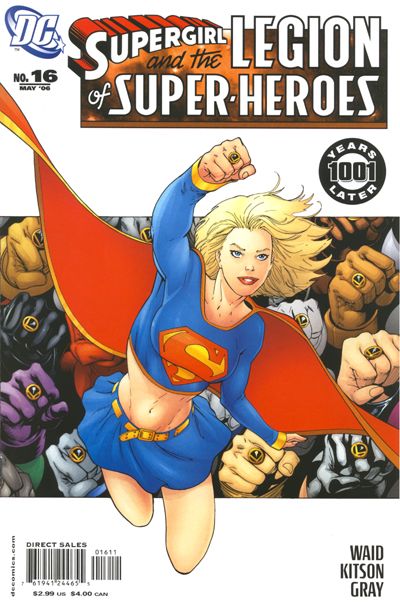
Notes: The “Threeboot” Legion that followed the Titans/Legion special was an interesting beast. Written by Mark Waid, with art by Barry Kitson, this newest iteration gave us a Legion inspired by stories of the heroes of the past that much of the population believed to be mere legends – nobody really BELIEVED that the likes of Superman, Batman, or Wonder Woman had ever existed. Society had grown increasingly distant and oppressive – people stayed home, alone, communicating electronically but rarely seeing one another in person. What’s more, the youth of the galaxy were particularly downtrodden, with free thinking suppressed to make sure everyone conformed. In this universe, the Legion were a group of super-powered teens who rejected this system. They adopted costumes and code-names inspired by the heroes of the past and started a movement, with other young people from across the galaxy joining them.
The volume I read today picks up after their first few adventures, where they’ve proven their worth and the United Planets has reluctantly deputized them as a peacekeeping force. As the Legion licks their wounds from a recent loss, things are tossed into upheaval when a young woman professing to be the legendary Supergirl appears. Much of the galaxy believes that she’s a hoax, because they think Supergirl is a fictional character. As for Supergirl herself, this is the Kara Zor-El who climbed out of a rocket in Gotham Harbor only a few months ago (by her reckoning, but not much longer in real time). Between her adventures with her cousin, Batman, and Wonder Woman, the devastation of the Crisis, and now finding herself 1000 years in the future, the trauma has begun to affect her mind and she believes that everything that has happened to her – including her existence in the Legion’s time – is a dream, and that any minute she’s going to wake up back on Krypton.
Waid had already created a world for the Legion dissimilar from the previous two, and this was a Supergirl that was different from any other Superman family member who’d ever joined the Legion. Despite that, though, it all worked. While the WORLD was different, the Legionnaires were staunchly themselves: Cosmic Boy was the consummate leader, Lightning Lad was impulsive, Brainiac 5 an arrogant jerk who was mainly tolerated because he actually WAS the smartest one in the room as opposed to just somebody who thought he was. There were some revisions, of course – previous iterations of Shrinking Violet had often been quiet and timid, but Waid reimagined her as the ass-kicking master of espionage that somebody with her power set would logically have the ability to be.
Meanwhile, we’ve got this traumatized Supergirl floating around with this crew, somebody who doesn’t believe that anything happening around her is actually real. Which makes it all the more impressive, I think, that she continues to act every inch the hero. She saves lives, stops disasters, fights villains, even though she believes that it’s all a dream and that nothing around her will have any consequences. Perhaps it’s the level of her consciousness that knows it’s NOT a delusion, perhaps it’s just that Kara Zor-El can’t help but help people no matter the circumstances. Whatever it is, it made for a unique dynamic. Supergirl stayed with the book for a couple of years, going home in issue #36, and the series itself ended at issue #50.
But even before this version of the Legion went away, we got glimpses of what was next.
Sun., June 8
Graphic Novel: Superman and the Legion of Super-Heroes, collects Action Comics #858-863

Notes: I don’t mind telling you that Geoff Johns is one of my favorite comic book writers. His strengths, as I think he proved with his tenures on Flash and Green Lantern, come when he takes the framework of the past and expands upon them. He’s the writer, for instance, who used the existence of Sinestro’s yellow ring to extrapolate an entire Sinestro Corps, and from there, a different corps of Lanterns for each color of the spectrum. His runs on Superman have been short, but what he did with the six issues of “Superman and the Legion of Super-Heroes” from 2007 and 2008 is one of my favorite examples of his work. Although it was running concurrently with the Supergirl and the Legion series, in this storyline Johns brought back something that had been lost from Superman’s past, much as earlier writers had brought back Krypto, the Phantom Zone, and Supergirl: he was restoring Superman’s history with the Legion.
Johns and artist Gary Frank, who would reunite in 2009 for Superman: Secret Origin, kick things off with a bang. Superman is contacted by a probe from the future sent by Brainiac 5 reactivate suppressed memories of his past with the Legion. Suddenly, Superman remembers meeting the Legion founders, being invited to join the team, and losing contact with them after the Crisis. (I know there have been a LOT of Crises in the DCU – typically they’re referring to the original Crisis on Infinite Earths when they use the definite article, i.e. THE Crisis.) The probe brings him to the future where things have gone horribly wrong: Something has turned the sun red, diminishing Superman’s powers. Earth is being run by a xenophobic “Justice League” led by a fascist calling himself Earth-Man that has made the Legion, with its many alien members, outlaws. Oh yes – and Brainiac 5, the Legionnaire who brought Superman to the future, is missing. Earth-Man, as it turns out, is a Legion reject who can absorb powers from others. He built a following claiming that Superman was a human, not an alien, and in fact was staunchly opposed to the presence of aliens on Earth. He’s been capturing the non-human Legionnaires and stealing their powers in his quest for conquest.
Superman and the few remaining Legionnaires manage to escape Earth and track Brainiac 5 to his homeworld of Colu, the only planet in the galaxy more xenophobic than Earth. They gather Brainy and a few others, including the Legion of Substitute Heroes, and together launch an assault on the Justice League on Earth, where they learn that Earth-Man has been using the captive Sun Boy to make our sun red, weakening Superman. In the climactic battle, a powerless Superman faces an Earth-Man with the power of the entire Legion flowing through him…but there’s one thing that Superman has that Earth-Man never will.
His friends.
I cannot express enough how much I love this story. There are plenty of stories of Superboy with the Legion, and those are great, but this is one of the few stories of the Legion fighting with an adult Superman, and that’s a dynamic I want to see more of. (Recent hints in the current Superman comic books are giving me hopes that we’ll see more of that soon, but I digress.) Like I said earlier this week, Superman with the Legion is a group of friends. The tone feels more like the Titans than the Justice League, a found family standing together rather than a group of disparate heroes united for a common cause. That “found family” trope is always something that resonates with me, and I love seeing Superman as a part of it.
It’s also good to see a story that makes its points without preaching or turning into a polemic. There’s a definite message here, with Earth-Man’s hatred of anyone not from Earth, but that message is secondary to the story. Not that Johns and Frank were subtle about it – Earth-Man’s costume is as close to a Nazi uniform as you can get without actually applying swastikas, and his real name is the egregiously German Kirt Niedrigh, juuuuuuuuuust in case we didn’t get what they were going for. But parallels to World War II aside, the story also has a point to make about being an outsider. Bringing the Subs in makes it even better, having them act as a foil for Earth-Man – they were rejected from the Legion just as he was, but rather than turning into monsters, they used their disappointment as fuel to become something good.
There are plenty of questions raised by this story, of course. First of all, which Legion is this, exactly? It’s an older Legion: despite still having words like “Boy,” “Lad,” Kid,” and “Girl” in their code-names, they all appear to be roughly the same age as Superman. But the costumes and past they share with Clark seem to indicate this is a continuity that continued the characters from some point prior to the controversial “Five Years Later” era (which was the final era of the original Legion before the reboot in 1993, beginning between their second and third encounters with the time-traveling Superman in Time and Time Again). If that’s them, how are they coexisting with Supergirl’s Legion, which I remind you, was being published in their own series at this point? Who, or what, was the “real” Legion of Super-Heroes?
To answer that question, DC again turned to Geoff Johns, in what is my single favorite Legion story of all time.
Mon., June 9
Comics: Final Crisis: Legion of 3 Worlds #1-5

Notes: In 2008, Geoff Johns and George Perez teamed up for this five-issue miniseries. While ostensibly a spin-off of Grant Morrison’s Final Crisis event, it really has nothing to do with the larger storyline of that series and can be read independently of it. I still may get to the main Final Crisis story at some point, since the conclusion is pretty Superman-centric, but for today I’m just going to focus on this Legion story.
Superboy-Prime, insane survivor of Earth-Prime (see Crisis on Infinite Earths and Infinite Crisis for the full backstory if you don’t already know it) is plucked by the Time Trapper and hurled to the Legion’s time period. Finding the Superman Museum in Smallville, Prime is horrified to discover that he’s only a footnote in Superman’s Hall of Villains, and even worse, is pushed further over the edge by the veneration of Conner Kent, the Superboy that Prime murdered in Infinite Crisis. In Metropolis, meanwhile, the United Planets is turning against the Legion, whose members are in disarray. Brainiac 5 has been stripped of his Brainiac title by his home planet, Mon-El is suffering from the lead poisoning that plagues all Daxamites, and Sun Boy’s powers haven’t returned since his torture at the hands of Earth-Man. Things get progressively worse as Prime springs all of the Legion’s enemies from prison, creating an entire Legion of Super-Villains. The real Legion brings Superman back to their time to aid them, and Brainiac 5 reveals his plan: fight a Legion with a TRUE Legion – by summoning the Legions of two other worlds in the multiverse.
Brainy uses the Crystal Ball that the Justice League and Justice Society used for their very first team-up in the Silver Age to summon the other two Legions – the Reboot Legion that Conner had been a member of, and the Threeboot Legion that had welcomed Kara. Superman and the assembled Legions battle Prime’s army as Brainy enacts Stage Two of his plan: assembling all the electrical-powered Legionnaires to charge up XS and use her to pull her cousin, the presumed-dead Bart Allen, from the Speed Force to rejoin them as Kid Flash. Finally, the Brainiacs use Time Travel to implement Phase Three of their plan: a version of Starman in the 21st century robs a certain grave and transports its inhabitant to the Antarctic. A thousand years later, the Brainiacs unearth the body, which has been slowly healing and rebuilding for a millennia in the same Kryptonian device that brought Superman back after his battle with Doomsday. The final piece to restore him is a hair from one of his genetic donors – Lex Luthor (taken, naturally, from a point in the past BEFORE he went bald). After a thousand years, Conner Kent lives again.
The battle rages on two fronts – Superboy, Kid Flash and the Legions versus Prime in the Arctic, Superman and the original founders versus the Time Trapper in deep space. It turns out the two battles are really one: this iteration of the Trapper is a future version of Superboy-Prime himself. But for all his power, all his anger, in the final battle, the Legion lives.
Ever since Man of Steel, the Legion’s continuity had become a mess, with two reboots failing to make things simpler, since their interactions with the heroes of the present kept contradicting each other. Legion of 3 Worlds finally solved the problem by establishing that each of the three Legions was from a different world of the Multiverse. The original Legion, the one that Clark had been a member of in his youth, was from the future of DC’s main universe. The Reboot Legion, Conner’s Legion, was from Earth-247, a world that had been destroyed in a Crisis, but not one of the ones that was restored when the Multiverse was brought back. And Kara’s Threeboot Legion, amazingly, was from the future of Earth-Prime, the world where all of the DC Comics heroes exist as fictional characters. All those times in Waid’s run when people had insisted to the Legion that the ancient stories about Superman and the Justice League weren’t real? In their universe, they were right.
So not only was the Legion clarified in a way that made sense, but Johns used it to bring back two of the Teen Titans he’d written in an immensely satisfying way, and even used this miniseries as a springboard for the return of the Green Lantern Corps in the 31st century. The Legion was finally clear, established in a way that made sense, and ready for action. And it was done in a way that made all three Legions legitimate and viable, and set each of them up so that they could be used in different ways across the tales of the DC Multiverse. He even managed to codify the importance of the Legion in Superman’s history, explicitly stating (via R.J. Brande) that it was his interactions with Cosmic Boy, Saturn Girl, and Lightning Lad that taught young Clark Kent what it meant to be a hero, and that he would in turn become the inspiration for heroes for the next 1,000 years. It was the perfect fix and the perfect fit.
Why, DC? WHY THE HELL DID YOU DECIDE TO REBOOT THEM YET AGAIN???
Tue., June 10
Comics: Superman Vol. 5 #14, 15
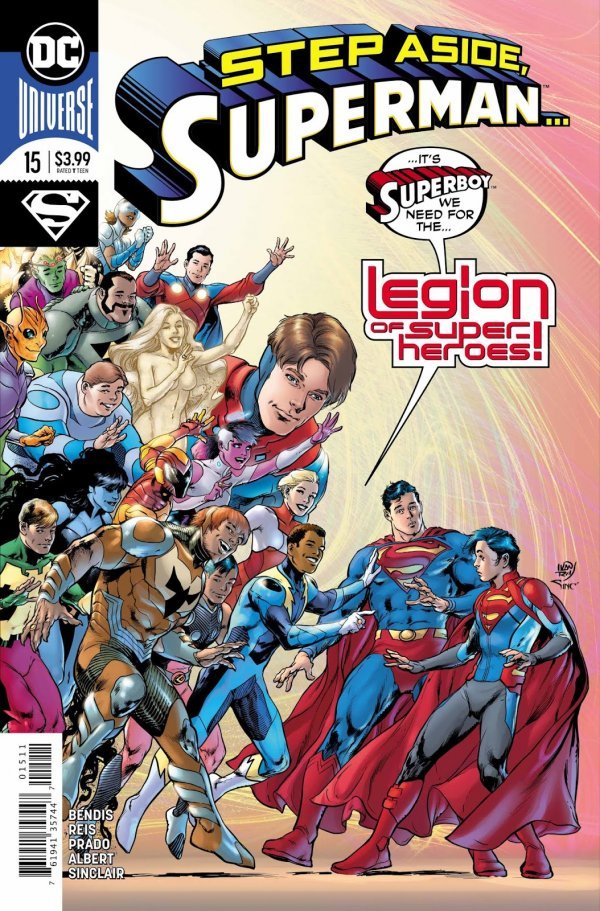
Notes: A few years post-Final Crisis, as we all know, DC rebooted their entire universe in the New 52 relaunch, including both Superman and the Legion. Once again, Superman was divorced from the roots of the Legion, but other than that, the Legion was one of the properties that was relatively unchanged. But it didn’t set sales on fire, either, and the New 52 version was quietly cancelled after two years. After that, their appearances became sporadic for a while until 2018, when Marvel superstar Brian Michael Bendis was hired by DC to take over the Superman comics.
I’m going to be blunt, guys, I’m not typically a fan of Bendis’s work. I don’t want to spend all day explaining the reasons why, but I don’t think I’ll need to, as my Legion-specific criticisms will make it clear. The biggest issue I had with his run was his treatment of Jon Kent. Lois and Clark’s son had been around in comics for a few years, and was about 10 years old. The stories of Clark raising his son were magnificent. They were fresh, they were original, they were something that we rarely saw in comics: an adult superhero teaching his child what it means to BE a hero is a dynamic that, somehow, had gone almost ignored in the 80 years that the superhero genre had been around. So when Bendis took over, of course, the first thing he did was have Jon fall into a spacehole with his grandfather and come out as a teenager.
It’s more complicated than that, but the gist of it was that sweet and joyful Jon was now an angst-filled teenage superhero, of which we have thousands, and like most teenage superheroes his stories quickly began to drift towards “adults screw everything up, but kids MY age know better.” It’s a tired, stale trope that we’ve seen a billion times. But there is one good thing I can say about Bendis’s Superman comics: compared to his work on Legion of Super-Heroes, his Superman looks like Watchmen.
It started in issue #14 of his Superman run, the tail end of a story arc about Superman, Supergirl, and Superboy teaming up with General Zod to capture an alien who has responsible for the destruction of Krypton. At the end of the story, the Kryptonians are brought before a coalition of alien races who were caught up in their battle, and Jon says something along the lines of, “On Earth, we have a thing called the United Nations…” Then, after his dad gives a brief speech about working together, a time portal opens. And the new, re-re-rebooted Legion of Super-Heroes spills out of it and offers Jon membership because he just invented the United Planets by saying ten words that point out something that already exists, and thus he’s the most important historical figure of the past 1,000 years.
I’m getting a headache.
In issue #15 of Superman, the word of Jon’s AMAAAAAZING insight starts to spread. Adam Strange even says “I can’t believe I’ve been out here this entire time and I didn’t think of it.” (Neither can anyone else, Adam – didn’t you ever watch Star Trek? For that matter, are we really supposed to believe that NOBODY had ever thought of this idea before in the ENTIRE GALAXY?) Then the Legion offers to take Jon to the future with them, because he’s so smart and awesome and cool and they wanna be friends with them. He winds up going and joins them for Bendis’s 12-issue Legion series which…I should read it again today. In the interest of fairness, I should read it again for this blog, but I just can’t bring myself to do it. It…it just wasn’t the Legion.
Yeah, the character names were mostly the same. So were the powers. And they were in the 31st century. But everything that makes the Legion entertaining was entirely absent. The characterizations were…I can’t even say they were WRONG, they were GONE. The members of this team had no life, no personality, other than being ASTONISHED that the GREAT JONATHAN KENT WAS THERE. It was like reading about Jon and the Legion of Sycophants. That’s another Bendisian trait, by the way – he introduces a younger version of the hero, then all of the other characters walk around and talk about how much better the new version is than the old one. (If you think I’m exaggerating, I offer the following as evidence: Miles Morales, Ironheart, and the teenage X-Men who were brought forward in time because Beast thought their adult versions sucked.) It was in full force here, with the Legion telling us how Jon – not Clark – would be remembered as THE Superman, as THE character who saved the galaxy. And I’m sorry, if you’re going to make a claim like that, you gotta convince me of it.
There were also a ton of arbitrary changes that drove me crazy, such as making Mon-El a Kryptonian descendant of Superman rather than a Daxamite like he’s been for his entire existence. And as usual, Bendis included his own characters (which is fair) like a new version of Dr. Fate (oooookay) and a Gold Lantern whose powers and history were ill-defined and didn’t really seem to add anything to the story. I made it through the 12 issues of his run, but when he closed it off with a six-issue Justice League Vs. the Legion of Super-Heroes miniseries I couldn’t even bring myself to buy the comics, reading it instead when it came to DC Universe Infinite and still feeling as though I’d overpaid.
Since that miniseries ended, again, the Legion has returned to sporadic appearances. Some of them have reflected the Bendis Legion, but others evoke Legions of the past. Mark Waid himself went on the record recently to tell us that DC has plans for the Legion that he thinks will make everyone happy, and we’ve already seen glimpses of that in the DC All In Special and (appropriately) the Superman titles. We’ve been promised that Superman #29 (coming out in August) will feature Superman and a “mysterious ally” searching for the lost Legion of Super-Heroes. I’m anxious and I’m optimistic. For the most part, DC’s “All In” titles have been very satisfying, and if the new Legion (whatever it is) has Mark Waid’s stamp of approval, that gives me reason to hope. Because the Legion, at its best, is not JUST a team of heroes from the future. It’s about hope for the future, just as much as Superman is. And it’s a fundamental part of who and what Superman is. It’s one of the greatest concepts in comics, and it deserves to be treated as such.
So here’s hoping that, whatever begins in August, it ends with a story that leaves us all ready to slip on our flight rings, thrust our fists into the air, and join with a battle cry that will echo back ten centuries:

But you know, I can’t end it here. I can’t conclude my look at one of my favorite pieces of the entire Superman mythology with a discussion of their worst version. So how about a little bonus? Let’s join hands, hop in Brainiac 5’s Time Bubble, and zip back to 2006 so we can watch the first episode of the Legion of Super-Heroes animated series together, shall we?
TV Episode: Legion of Super-Heroes Season 1, Episode 1: “Man of Tomorrow”

Notes: Young Clark Kent is about to leave home. He’s packing up and heading away from Smallville to go to Metropolis, where he’s got a job as a copy boy at the Daily Planet. On the night before he’s supposed to head to the big city, though, he’s approached by a group of super-powered teenagers from the future, teens who know about the powers he’s kept hidden his entire life. He won’t miss a thing, they promise, they can return him to the moment he left – and tantalized by the idea of not having to hide himself, he goes with them. Arriving in the future, he discovers that they need his help combatting their foes, the Fatal Five. In the end, Clark takes the costume he learns he’ll have someday and, as Superman, joins the Legion.
I love this cartoon. It’s the purest expression of my favorite thing about the Legion, namely that it helps shape Clark Kent into Superman while, at the same time, being inspired BY Superman. It’s a bit more literal in this version than others – the Clark that joins this Legion hasn’t ever really been in a fight and hasn’t learned how to use all of his powers yet. The Legion has plenty to teach him, and over the first season of the show, we see him grow and blossom. The second season takes place after a time skip, returning to the future after a few years away. It was an interesting retool, but ultimately the show only lasted for those two seasons. If you love the Legion like I do, though, it’s well worth seeking them out and watching them.
After all, we Legionnaires need SOMETHING to keep us occupied between now and August.
Blake M. Petit is a writer, teacher, and dad from Ama, Louisiana. His most recent writing project is the superhero adventure series Other People’s Heroes: Little Stars, volume one of which is now available on Amazon. You can join in the Kryptonian Konversation every day in the Year of Superman Facebook Group!
 Blake M. Petit