
Over the last few weeks, I’ve found myself dipping into stories of Supermen of Other Worlds. Not just Elseworlds, although those certainly apply, but other stories of other Supermen as well…books that were published during the time that DC wasn’t using the Elseworlds imprint or special event comics such as Just Imagine or the Tangent universe. This week, I decided it would be fun to get in and explore some of those other worlds. So for Week 18 – with a slight detour coming on Saturday – we’re going to spend some time with these Other Supermen.
I’ve kind of had the “other worlds” in my head since I read the first volume of Earth One a few weeks ago. Reading that sent me towards Origin Week, which was fun, but it didn’t quite scratch the itch I have in my mind right now. I want to dig into the stories of Supermen from different worlds, reimagined from the ground up. Some of them, naturally, will be similar to our own, but not all of them.
Wed., April 30
Comics: Superman: Earth One Vol. 2-3, DC Comics Presents #71, Secret Six Vol. 5 #2, Batman/Superman: World’s Finest 2025 Annual

Notes: Since Earth One is what started me on this little trek, I decided to begin the Supermen of Other Worlds week by finishing that particular trilogy. At the end of volume one, if you’ll recall, Superman had driven off an invasion by the same force responsible for the destruction of Krypton, and Clark Kent used his exclusive ties to the Man of Steel to write an interview that landed him his job at the Daily Planet. In Volume 2, Clark finds a new apartment with a particularly friendly neighbor named Lisa LaSalle (because it doesn’t matter where in the multiverse you are, Kal-El is a magnet for L.L. names). As she tries to cozy up to him, Lois begins a deep dive into the past of her mysterious new coworker, the military makes plans for how to deal with an invulnerable man, and the Parasite is on the rise.
Volume 3 continues these stories – Lisa and Clark get closer, the fallout of Superman’s geopolitical actions in Volume 2 begin to reverberate, the most unique version of Lex Luthor in the entire multiverse is developed, and…oh yeah. Zod.
Reading these two books in tandem, it really strikes me how J. Michael Straczynski structured the graphic novels the way you would a season of a TV show. That shouldn’t be surprising, of course. Straczynski has a long history in television, including creating and writing most of the episodes of one of my favorite science fiction series of all time, Babylon 5. And although he’d written a great number of comic books at this point and brought some of those storytelling habits over, this is his work that most clearly feels like television. Each volume has an A-plot (the invasion of Earth in Vol. 1, the Parasite in Vol. 2, Zod in Vol. 3). Also, just like a TV show, there are several running B-plots of a more personal nature, such as Clark’s relationship with Lisa and Lois’s pursuit of Clark’s past. Then there are the ongoing subplots that build and develop along with the A-plot, such as the way the world’s governments are trying to figure out the “Superman Problem.” In a seasonal TV show format, it’s these third types of plots that run concurrently which usually wind up comprising the main arc of the season, gaining in prominence until they become the primary focus of the last episode or two. And I feel like this is exactly what Straczysnki had planned, had this series continued past Vol. 3.
That’s the tragedy of it, I think. I really enjoyed all three of these books. And each of them was satisfying in the way that a single episode of a television series is satisfying. But Strazynski’s TV-writing style is evocative of the current style of longer arcs and stories (in truth, he pioneered that style with Babylon 5). There’s so much left to explore in this universe. I genuinely want to see what becomes of Clark’s relationship with Lisa. I want to know what this universe’s Lex Luthor has up her sleeve (yes, that’s the correct pronoun). And – given the sort of world-building Straczynski has proven himself capable of time and time again, not just with Babylon 5, but with his comic book work like Rising Stars, I want to see just how far this particular corner of the DC Multiverse diverges from the worlds we’re all more familiar with.
After volume three of this book, Straczynski stepped away from comics for a while. He’s back now, and doing work for AWA and Marvel, and I hope that the prospects of him returning to this series are still there, because I fully believe there’s more story left to tell.
In terms of new comics, hitting stores today, we have Batman/Superman: World’s Finest 2025 Annual, part three of the “We Are Yesterday” crossover with Justice League Unlimited. In this one, Grodd has gone back in time to gather up younger, purer versions of the Legion of Doom to help him combat the new unlimited Justice League of today, but winds up fighting the League in two different timelines. Mark Waid is the co-plotter of this issue, along with scripter Christopher Cantwell. Together, they progress the story well, leading up to a great cliffhanger ending. I’m really excited for the second part of this crossover, the first in DC’s “All In” era.
Thur., May 1
Comics: Just Imagine Stan Lee Creating Superman #1, Superman #9, Supergirl Vol. 2 #23

Notes: Back in 2001, the comic book world was shocked by the news that Stan Lee, the public face and most effusive promoter of Marvel Comics, was going to do his first-ever work for their Distinguished Competition. Lee, along with co-writer Michael Uslan and a plethora of top-notch artists, produced 12 one shots under the Just Imagine banner. In each one-shot, Lee took a different DC property and – using the name as inspiration – did his own take on the concept. Some of the new versions weren’t all that different from the original, while others had nothing in common except for the title. Stan Lee’s Superman was kind of in the middle.
In Lee’s Superman, with art by his long-time legendary collaborator John Buscema, we are introduced to an alien police officer named Salden. When Salden’s wife, Lyella, is murdered by an escape convict, Salden chases the killer onto a hijacked spacecraft. The two of them crash on Earth, and Salden realizes that the planet’s lesser gravity has given him great strength, speed, and endurance. Trying to blend in, he takes a job at a circus using names he pulled off an ice cream truck and street sign: “Clark Kent.” “Clark”’s circus act is such a hit that he’s approached by a talent agent, Lois Lane, who dubs him “Superman” and begins booking him gigs. With his spacecraft destroyed, Salden has no way off Earth, and decides to use his abilities to fight the injustices of the world that he sees as distractions from the pursuit of science, hoping that if he can bring about world peace, the world will advance to the point where it can invent a craft capable of bringing him home.
Like I said, as far as the Just Imagine books go, this one is about halfway between the “fairly similar” books like Wonder Woman and those that are utterly unrecognizable, like Green Lantern. This new Superman carries over his human name, and a new version of Lois Lane comes with him. His powers are very similar to the earliest Golden Age Superman, diluted compared to the Superman we’re all familiar with, but incredible to a populace that would have never seen such a thing before. And he’s still an alien, although the name of his planet is never revealed (Grant Morrison would later declare it to be this universe’s version of Krypton in the Multiversity series).
Other things, however, are quite different. His motivation, first of all, starts with the very Stan Lee-ish goal of avenging his dead wife. (And although the people of Salden’s world don’t seem to have surnames, it’s worth noting that even Lee couldn’t resist the lure of the multiple-L supporting characters with Lyella.) His motive to become a hero is because he can’t think of any other way to get home. And his dialogue and behavior is kind Ben Grimm-ish in presentation. If Ben had gotten the strength of the Thing without his orange, rocky exterior, I think he would have been very close to Salden’s Superman.
The Just Imagine characters haven’t turned up as often as some of the others we’ll glimpse this week, although they turned up here and there in various multiverse stories. In fact, I think Salden and several of this world’s other inhabitants were killed in one of them – Death Metal, maybe? I’m honestly not sure, and considering that the multiverse has been jerked around a few times since then, it may not even be relevant anymore. I do know that all of these characters turned up once more after that, in a special tribute edition DC published after Stan Lee’s death. He’s not the most memorable version of Superman, to be fair, but if I was the kind of person who dealt in puns the way an artist deals in paint, I might say he is the most “Marvelous” of all Supermen in the multiverse.
Okay, I’m exactly that kind of person.
In addition to the “Year of Superman” reading I do for this blog, I’ve also got several old and new comic book series I’m reading through via the DC and Marvel apps. I mentioned them in the log here, if there’s a Superman-family character involved, but I don’t always write about them. Today brought me to Superman #9, a Golden Age issue which I’m only bringing up for one reason. In the final story in this issue, Lois is captured by criminals, but they don’t immediately recognize her for who she is? Why not? Because she’s wearing a pair of glasses.
Man, whoever wrote that issue got jokes.
Fri., May 2
Comics: Tangent Comics: The Superman #1, New Adventures of Superboy #34, Legion of Super-Heroes Vol. 2 #313, Superman’s Girl Friend Lois Lane #13

Notes: I didn’t think about this before I began this whole “Year of Superman” project, but in retrospect, I suppose I should have. It seems inevitable that, over the course of an entire year, somebody that we all closely relate to Superman would leave us. It happened a few months ago with Gene Hackman, and it happened again on May 1 with Jackson “Butch” Guice. Guice was a great artist, with work for lots of publishers over the years. He co-created Resurrection Man for DC Comics, and was doing variant covers for the current miniseries featuring the character. To Superman fans, though, he’ll be remembered most warmly for his run on Action Comics in the 90s, a run that included the Death of Superman saga.
Guice’s artwork was pretty unique among Superman artists. His work tended to have a more photographic quality to it – poses and angles that looked like they had been pulled from the walls of a gallery. His men – Superman in particular – had a hardness to them. It was as if John Buscema’s characters somehow came to life and were captured on camera. It was a darker, harsher style than many of the other artists of the day, and that turned out to be perfect for the book documenting the Last Son of Krypton, aka the Eradicator.

I’d already planned on reading this book for Supermen of Other Worlds Week, but when I found out that Guice had passed away, I thought that moving Tangent Comics: The Superman to the front of the line was appropriate. Tangent Comics was a DC event in 1997 and 1998, each wave producing a series of nine one-shots set in an alternate universe in which the names of the DC characters, places, and various hangers-on still existed, but virtually everything else was different. The Superman starred Harvey Dent, a cop who had been born in a secret facility built by the spy agency known as Nightwing. Part of an experiment, Dent’s mother died in childbirth and he grew up an orphan. He eventually became a cop and led a fairly ordinary life until the day he tried to stop a jumper named Carter Hall from taking a plunge off a skyscraper. Dent failed to save Hall and, in fact, was pulled off the building WITH him. Rather than dying on impact, though, crashing to the ground unlocked something in his mind. As he recovered, he found he was developing mental powers – telepathy, telekinesis, precognition, and an intelligence that, once normal, was now skyrocketing off the charts. As his powers grew stronger, Dent grew colder, divorcing himself more and more from the humanity of which he had once belonged.
The idea behind Tangent was that only the name would be the same, and damned if that doesn’t live up to the concept here. THE Superman is absolutely nothing like OUR Superman. He strikes me more as a sort of Dr. Manhattan from Watchmen – a man whose power sets him apart from humanity instead of making him learn to respect it. By the end, he’s still acting as a hero, but there’s a darkness to him. This would become clearer in the later Tangent: Superman’s Reign miniseries, in which the Tangent heroes and the main DCU characters would collide and The Superman became the main antagonist. In truth, the Superman he resembles most closely is the one from Jerry Siegel’s original short story, “Reign of the Superman,” about a villain with great mental powers, before he came back and gave the name to a hero.
Mark Millar wrote the issue (more with him in a few days), with art by Guice, and the team was perfect. The dark story played to both of their sensibilities, creating a Superman that doesn’t match with any other in the multiverse, but still makes for a compelling read. I may have to dip my toes back into Superman’s Reign at some point.
For now, though, RIP, Mr. Guice.
Sat., May 3
Comics: Free Comic Book Day Specials: DC All In 2025 Special Edition, Superman’s Good Guy Gang

Notes: Today is one of my favorite days of the entire year, Free Comic Book Day. My local shop, BSI Comics, graciously hosts me along with several other local writers and artists. I sell a few books, I talk to fellow nerds, I’ve made a lot of friends at FCBD. It’s the best. And also – free comics! DC’s offerings this year include a pair of Superman-related comics, so why don’t we take a look at them?

First up is the DC All In 2025 Special Edition, a flipbook that gives us a look at DC’s Absolute Universe on one side and a preview of the upcoming Superman Unlimited on the other. The Absolute story is a devilish tease, as we watch a mysterious figure observing the heroes of this new universe, specifically Batman, Superman, and Wonder Woman. There are cryptic comments about some major danger approaching, then we get one of those double-page spreads DC loves to do from time to time where we see lots of notes and scribbles that all seem to point towards future storylines. DC’s been doing this kind of thing at least as far back as the 52 series in 2007, and it’s always fun, but also kind of frustrating. I feel like they overreach with these, often teasing stories that wind up never happening. Time will tell if these play out for us, but the final panel is a great little surprise that promises an upcoming major story.
The other side of the book is the one I’m more excited about, the preview of Dan Slott and Rafael Albuquerque’s upcoming Superman Unlimited series. The story opens up with the news of a massive expansion of the Daily Planet. There’s a new boss over the company that owns it, and she’s planning to expand the Planet from a “great Metropolitan newspaper” into a massive global media enterprise. This happens every so often – has been happening as far back as the Bronze Age, really, when Clark began to split his time between reporting for the Planet and being a news anchor for WGBS. Newspapers have had to evolve constantly since Siegel and Shuster chose that profession for Clark Kent back in 1938, and every few years DC tries to modernize the concept while still keeping true to the core of who Clark Kent is. I’ve got no problem with them handling it the way they’re doing here, but that’s not what’s most interesting to me.
I’m really here for the middle part of this story, which is where we get a feel for Slott’s take on the character. And I have to say, I like it. We see several vignettes of Superman averting disasters, saving lives, and making people simply feel better. He captures a crook who stops to thank him for saving Star City from Titano because his aunt lives there. A pilot in a plane that’s falling out of the sky tells his passengers that everything is going to be okay, and all they need to do to know that is look out the window. Little things that show the pureness of the character and the effect he has on people. It’s sweet, and it’s a great start. The story ends with a cliffhanger that leads into the first issue of the new series coming later this month and, as if there was any doubt, I’m there for it.

DC’s other offering this year, as usual, is a preview of one of their all-ages graphic novels. This time, it’s Rob Justus’s upcoming book Superman’s Good Guy Gang. In this one, child incarnations of Superman and Green Lantern (Guy Gardner) find a strange winged woman stealing puppies and swoop in to stop her, unaware that a much bigger problem is looming. It’s a super quick read (no pun intended), and full of silly moments like Superman and Guy arguing over what the name of their superhero team is going to be. It is absolutely no coincidence that the characters chosen for this book also happen to be the ones who are going to be in James Gunn’s Superman movie, but that’s fine. This is a book for beginning readers, and it’s great that they’re doing it, but it would be foolish to ignore the characters that are going to be in their next huge media event. It’s a charming little read, and I’ll be happy to pick up the full version for my son when it comes out in July.
Sun., May 4
Comics: Superman: Red Son #1-3
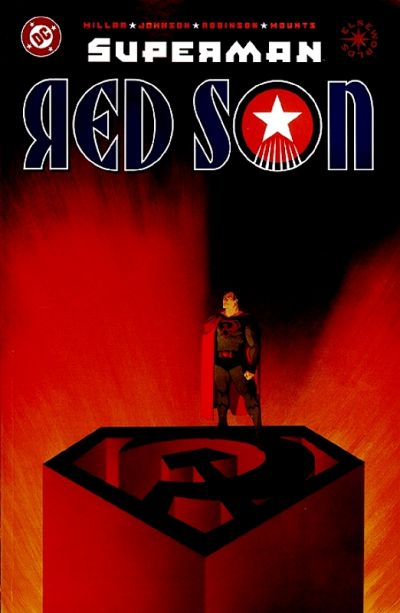
Notes: I admittedly have a complicated relationship with the work of writer Mark Millar. When he does his own characters, with comics like Kick-Ass or Wanted, I find him hit or miss. When he works with established characters, I find that I rarely care for his stories. He often completely disregards characterization in favor of whatever story he’s planning to tell, and while that approach is okay when dealing with your own, original characters and you have the freedom to shape the characterization how you please, I am far less charitable when the work throws away decades of who a character is in favor of a plot point, the most egregious examples of which can be found in Marvel’s Civil War.
However, I find that he often does a good job with Superman. Early in his career he did a very entertaining run on Superman Adventures, the comic book based on Superman: The Animated Series. He wrote the aforementioned Tangent one-shot. And then there’s Superman: Red Son, perhaps the most acclaimed Superman Elseworlds series of all time. The supposition here is that the rocket that brought Superman to Earth landed not in the Kansas heartland, but somewhere in the Soviet Union. The child who would become Superman grew up indoctrinated with Socialist values, rather than American ones, and the world is rocked to its core as a result.
Millar does a lot of interesting things here. With Superman as a Soviet, the US government recruits its brightest mind – Dr. Lex Luthor, of course – to try to create some sort of countermeasure. With the U.S.S.R. completely ascendant, Princess Diana of Themiscyra makes contact with the outside world via the Russians rather than the Americans. And although we don’t know if there’s a little boy in America named Bruce Wayne, in Russia we see a tragedy that turns one of her citizens into this world’s version of the Batman.
The thing I find most fascinating is Millar’s take on who Superman is. In the prime DC Universe – and in most other iterations of the character – his personality boils down to someone who will always try to do what’s right, always stand up for injustice, and never turn his back on a cry for help. The Red Son Superman shares these traits, with the major difference being that his perspective on what is “right” is colored by socialist values rather than democratic ones. He’s still going to be there to save anyone – even an American – from a disaster like the falling globe from the top of the Daily Planet building, but when he sees the injustice of children standing in bread lines, he decides to use his power to put a stop to that by taking the control of the government that had been offered him after the death of Stalin, but that he had heretofore resisted.
This whole thing is especially interesting to me from a sociological perspective. Superman at first rejects the notion of succeeding Stalin as the Soviet Premier because he knows people only want him because of his abilities, and the idea that his powers make him special goes against Socialist doctrine. But just like in the real world, he sees the inequities that have happened under Soviet rule and decides at the end of issue one to use his powers to fix them anyway.
Book two takes the idea further. Superman has been in charge of the USSR for 20 years, and its influence has swallowed nearly the entire world. Only the USA and Chile remain holdouts, and both are hanging on by a thread. But there’s a mysterious Batman fighting against Superman’s rule, while back in the USA, Dr. Luthor is introduced to an alien power source that crashed on American soil decades before – a green one. While good-intentioned, Superman’s influence is beginning to atrophy human progress. People are growing careless, expecting their super-savior to take care of everything. Seatbelts go unused in cars, ships stop providing live preservers, all predicated on the idea that President Superman is going to take care of everything. When someone in his own government approaches Batman with an opportunity to take Superman down, Batman recognizes that the humans who would fill the void might be worse, but stopping him now may be the only way to prevent Super-rule that would last thousands or even millions of years.
There’s another time skip to book three. The Soviets have grown even more powerful and America is on the verge of collapse – until it elects Dr. Luthor President of the United States. Luthor’s unparalleled genius turns the country around overnight and Superman, who has been waiting for the US to finally collapse under its own weight and join their Soviet collective, realizes that it’s not going to happen. The climax of the story comes in a battle between Superman’s forces, Wonder Woman’s Amazons, and the American Green Lantern Corps, all of which coalesce in a turnaround for Superman that proves, even in this corner of the multiverse, he’s still the same man at his core.
In a way, this entire story is a rebuttal to the whole “Nature versus Nurture” argument, demonstrating that BOTH aspects are of importance to the arc of a person’s life. And honestly, if that’s what Millar was trying to say here, it’s a sentiment I’ve always agreed with. Using Superman to put that idea forth works for me, and very well.
The end of the story is the real genius part of it though, and if you’ve never read Red Son, I don’t want to spoil it for you. Suffice it to say, it’s one of those conclusions that leaves you laughing ironically and calling the writer a magnificent bastard for coming up with such a thing. This isn’t my FAVORITE Superman of another world, but it’s hard to argue that it’s not, objectively speaking, one of the best stories of that sort that has been told.
Mon., May 5
Comics: Superman: Secret Identity #1-4

Notes: I’ve talked quite a bit in this blog about Mark Waid and how great a superhero writer he is, but although I eagerly place him at the top of the pyramid, he’s not there alone. Right up there, in my estimation, is Kurt Busiek. He’s the author of the phenomenal series Marvels and the creator of Astro City, which you’ll hear about again later when I do the week on heroes inspired by Superman. He also had a run on Superman’s regular title and he’s done work with the Justice League, most notably the JLA/Avengers crossover, in which Superman got to wield Thor’s hammer. Man, I should read that again before this year is out.
But his greatest work with Superman isn’t with “our” Superman at all, but rather the miniseries Superman: Secret Identity. An Elseworlds comic in all but name, this 2004 series was done with former Adventures of Superman artist Stuart Immonen, and was about a young man named Clark Kent from a small town in Kansas, but in a world where there are no superheroes and Superman is a fictional character. Whereas Waid is better than anybody at showing the wild, fun, grandeur of a superhero universe, Busiek’s greatest strength comes in humanizing superhero stories. Marvels was the history of the Marvel Universe through the perspective of a bystander. Astro City shows what it’s like to live in a superhero universe from a different perspective in every story. And Secret Identity is about being a hero in a world that doesn’t have them.
The concept is almost identical to the original version of Superboy-Prime, who showed up during Crisis on Infinite Earth as an inhabitant of Earth-Prime, which in the older DC Comics had ostensibly been the “real” world where the readers and creators of DC Comics live. This was before he changed to become a meta-commentary on toxic fandom, which I have to admit, was actually a pretty clever take. But Secret Identity takes the initial concept and keeps it contained, pure.
Clark Kent’s parents gave him the name because their last name was “Kent,” they lived in Kansas, and they thought it would be cute. Clark is not as enamored of his name as they are, having grown up being taunted for the famous name and spending every birthday getting laden with Superman-themed presents he couldn’t be less interested in. The boy grows up introverted, without any close friends and preferring to spend time alone. It’s on a solitary hiking trip that he suddenly, inexplicably begins to manifest the powers of his namesake. He begins using his powers to help people in secret, but it doesn’t take long before word of the flying “Superboy” begins to leak out.
The four issues track Clark’s entire life story – growing into becoming a writer, although not a reporter, falling in love with a woman (naturally) named Lois, becoming a father. The government tries to track him early on, even capturing him at one point, before they settle into an uneasy alliance and “Superman” becomes a hidden force for good. Slowly, we watch how the world changes under his influence. More importantly, though, we see how HE changes over the course of a lifetime.
This is a beautiful book. It’s almost not even accurate to call it a “superhero” comic. Yes, he has powers, and yes, he even wears the costume, but there are no supervillains, no world-threatening cataclysms…there’s not even really an antagonist. It’s a story about a life, with ups and downs and pitfalls and triumphs and success and tragedies. It’s a story about someone who is just like everybody else, with the obvious exception of being faster than a speeding bullet. It’s Busiek doing what Busiek does best.
It’s also Immonen at his peak. I was always a fan of his work on the mainstream Superman, but this version is different. It’s still unmistakably his work, but there’s a softness to it that you don’t usually see when he’s drawing a mainstream story about Superman punching out Metallo or something. Looking at these panels, you see a different quality, a lighter touch. It looks almost like a fantasy world, which is rather fitting from the perspective of this Clark Kent, living what must seem to him to be a fantasy life.
And unlike some of the other alternate Supermen we’ve looked at over the last few days, this is a Superman who hasn’t shown up again. In fact, I’m not even certain that this “world” has a specific designation in the current DC Multiverse the way the others we’ve looked at has. And if it doesn’t, that’s okay. There’s room for more stories of the Earth-One Superman, the Just Imagine Superman, or the Tangent Superman. But the Secret Identity Superman’s story is complete in these four volumes – complete and beautiful. This is one of my favorites.
Tues., May 6
Animated Feature: Justice League: Gods and Monsters

Notes: Here’s a REALLY different Superman of another world. Bruce Timm, one of the architects of the DC Animated Universe that began with Batman: The Animated Series, returned to the characters with this film. It too was essentially an Elseworlds, even though it didn’t have the brand and wasn’t based on any pre-existing story. In this world, in the minutes before the destruction of Krypton, Jor-El and Lara are prevented from sending Kal-El into space by the sudden interruption of General Zod, who places his own son in the spacecraft bound to Earth. It is the Zod child, not Kal-El, who makes the journey across the stars, and the world becomes a very different place.
In this world, the Justice League is comprised of Zod’s son, now called Superman; Kirk Langstrom, a vampire Batman; and the New God Bekka, who has taken the name Wonder Woman. This Justice League is more brutal and far less forgiving than the League we’re accustomed to, and public opinion on the team is tearing the public down the middle. Things get worse when top scientists such as Victor Stone, John Henry Irons, Ray Palmer, and others are targeted by mysterious assassins with methods that seem to imitate those of the Justice League.
In a lot of ways, I’m surprised that this movie was even made. Granted, the whole “multiverse” concept has become mainstream now, but this is SUCH a different take on the concept that I feel relatively certain only Bruce Timm’s sway with Warner Bros Animation ever got this one off the ground. And it follows the classic Elseworlds pattern perfectly: it begins by showing what makes this world diverse from ours, it continues with an exploration of that world, and then it it follows a main plot that both tells a strong story and reveals corners of the world that are both similar to and very different from the one we’re accustomed to.
Benjamin Bratt voices Superman in this one, with an edge that the Clark Kent versions of the character usually doesn’t have, but it works quite well in this one. We also get Tamara Taylor as Wonder Woman and, in what I have to assume was a meta joke in the casting department, we get Dexter star Michael C. Hall once again obsessed with blood as the vampire Batman.
As this is the Year of Superman, though, rather than the Year of the Justice League, let’s focus on this movie’s version of our hero. Baby Zod lands in Latin America rather than Kansas, and is named Hector Guerra. As he grows up, he knows very little of his heritage on Krypton, unaware of where exactly he came from. And while he’s darker and more brutal than our Superman, he’s not his father either. Knowing more about his true parentage than he does, it’s natural for the viewer to expect some sort of face-heel turn, becoming the bad guy before the film ends. Well, spoiler alert – he doesn’t. He’s not OUR Superman, but he is A Superman, and like most of them, he’s there to protect people. It’s actually refreshing that he DOESN’T become the bad guy at any point.
The film ends on a hook that clearly leaves the door open to revisit this universe, but to date, it hasn’t happened yet. There were a few prequel comic books and a webseries that preceded it, but unless I missed something somewhere, we’ve yet to explore this world following the conclusion of the film. While I’m not exactly itching for more of the Gods and Monsters universe the way I am Earth-One, I wouldn’t be opposed to it either. It’s an interesting place, and there are more stories to tell.
This was a fun week, looking at different, non-mainstream versions of our hero. And you know, there are an awful lot of other worlds out there in the multiverse. I may do this again before the year is up.
Blake M. Petit is a writer, teacher, and dad from Ama, Louisiana. His most recent writing project is the superhero adventure series Other People’s Heroes: Little Stars, volume one of which is now available on Amazon. You can subscribe to his newsletter by clicking right here. You can join in the Kryptonian Konversation every day in the Year of Superman Facebook Group!
 Blake M. Petit