Geek Punditry #30: Summer Reading

Summer reading. The phrase calls up different memories, different emotions, depending on how old you are. If you’re my age (or you’ve seen the memes), it may bring you back to those halcyon days when you were tracking each book you read in the pursuit of a free personal pan pizza. Depending on what school you went to, it may cause you to recall those last few hours before a new school year began, binging A Tree Grows in Brooklyn or Of Mice and Men, even though you had two months with virtually no responsibilities in which to get it done. For a lot of people, it brings to mind the beach or the pool, where you set up on a towel or a chair and pull out a romance novel, a potboiler mystery, a spy thriller, or whatever it is that you connect to. Whatever the specifics of your personal relationship with books, it seems very curious to me that people have settled on the summer as the time to read.

Of course, if you’re just trying to SOUND smart, this sucker is available on Amazon and can tell you everything you need to know.

And we can blame teachers and Pizza Hut all we want, but there’s something that makes us all reach for that to-be-read pile during the summer months. Any book lover will tell you that we add to that pile constantly, most of us have stacks and shelves (or files bursting with digital downloads) of books that we know we have no hope of finishing in our lifetime, barring one of those Twilight Zone scenarios and minus the poor eyesight. That doesn’t stop us from piling new books on, of course, as we constantly tell ourselves and our partners that we need to be grateful it’s books and not, for example, meth. As that pile gets bigger and bigger, summertime is the only time where it seems to dip a little (or at least grow more slowly). 
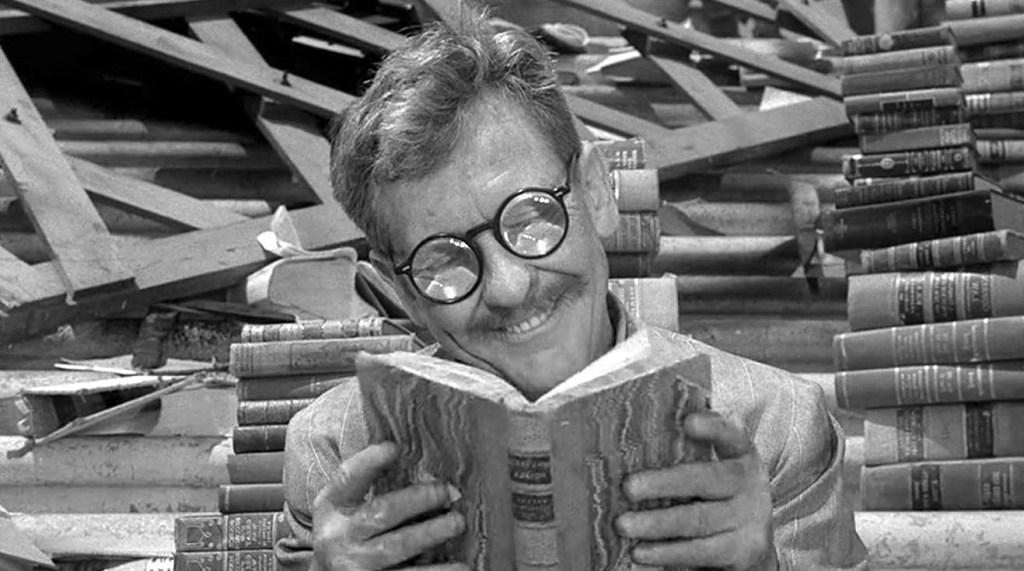
Me on June 1.

This is even true for those of us who, through a terrible confluence of biology and neurochemistry, happen to love both books and our own children. In my entire life, there has never been a single event that slowed down my reading more than the birth of my son. And he’s worth it, of course. I love him to death, and I make sure to tell him that every time I look at the 17 books Stephen King has published since his last haircut that I haven’t gotten around to consuming yet.

The good news, parents, is that kids get older, and eventually they do reach a point that makes it a little easier to start reading again, and this summer seems to have finally gotten my family to that sweet spot. Of course, we did need a little help. Our local public library, as they always do, has issued a “summer reading challenge” to its patrons, both children and adults. There are prizes (no pizza, sadly), and of course, bragging rights, and the weird thing is that having this carrot dangling in front of us has really worked for my family.

Not quite as well as this, of course.

The St. Charles Parish Public Library is affiliated with a reading app called “Beanstack,” which allows you to track your reading time, track books you’ve read, even track the number of pages read (although I personally have not taken advantage of this feature, as most of the books I read these days are eBooks, and tracking the pages isn’t always easy). You can write reviews as well, and share your reading with others. You earn points and badges. I got a free umbrella. It’s kind of goofy that a grown ass adult (or whatever I am) would need to treat reading books like accumulating a high score on a video game, but by God, it worked.

My summer ends next week, when the teachers at my school report back for a few days of professional development in advance of the avalanche of students the week after, but when it comes to reading, I’ve really taken advantage of this summer. Since school let out in May, I’ve recorded 80 different reading sessions, 20 different books, and a whopping 2578 minutes of reading time, most of that at night before bed, because knowing I don’t have to wake up at 5 am makes me feel a little more free to stay up late with a book like I did when I was a kid. My wife – who is not a teacher and thus does not have the summer away from work – hasn’t quite matched my numbers, but she’s also found herself reading more thanks to the use of the app. There’s something oddly communal about the experience, knowing that other people in the system are reading as well, trying to stack up their numbers, and having fun doing it.

Um…just ignore that second stat.

The communal aspect, I think, is one of the things that makes it work. I can see how many reading minutes everybody signed up for the Library system has accumulated over the summer (currently hovering at about 2.1 million, which means some of you people have been slacking), and there’s something about knowing that other people are reaching for the same goal as you are at the same time that makes it a little bit easier and a little bit more exciting. It’s the same reason people share their steps from a Fitbit, the same reason so many of us jump into NaNoWriMo every November. You’re aiming for a goal that you always have on some level. It’s easier to go after that goal when you know you’re not doing it alone.

Those 20 books that I’ve dug into, by the way, are also in pursuit of various smaller goals. Most of them are in series or by authors I enjoy, but that I’ve never gotten around to finishing. I’ve started a re-read of all of L. Frank Baum’s Oz novels (in case you were wondering why I wrote about that back at the beginning of summer) with the intention of continuing on and reading the other books in the “Famous Forty” that weren’t written by him, most of which I’ve never read before. I’ve read a few Star Trek novels. I’ve read books in George R.R. Martin’s Wild Cards series and Hugh Howey’s Silo saga. I’ve even tackled two of those Stephen King books that I hadn’t gotten around to yet. He wrote four more in the time that it took me, but baby steps. 
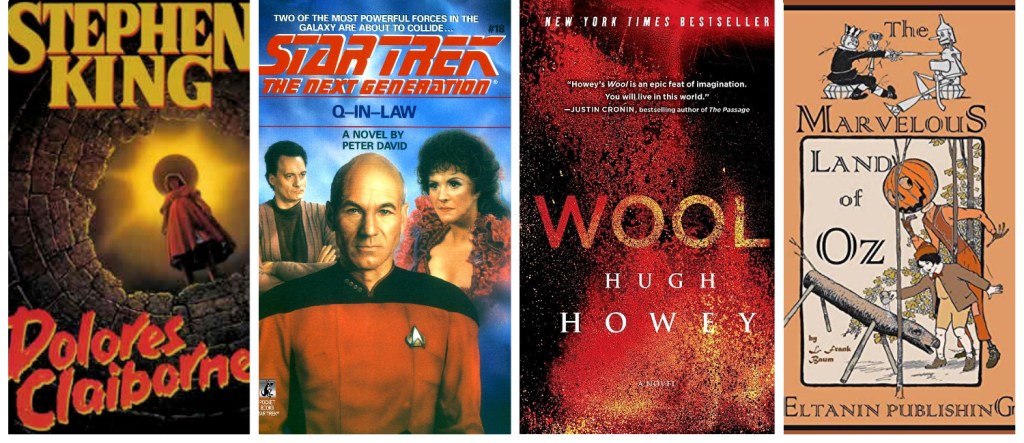
If you can think of a better way to spend the summer, I’d love to hear what it is.

The only problem I’ve got with Beanstack is that I don’t think you can add friends from outside your own library system, so I don’t know that all of you fine folks out there could link up with me there – although if anybody knows of a similar app that’s not geographically-locked, by all means let me know. And while you’re at it, let me know how your own summer reading has gone. What have you read on the beach, what books have finally escaped your-to-read pile, and do you too feel like you read more when the heat is on?

Blake M. Petit is a writer, teacher, and dad from Ama, Louisiana. His current writing project is the superhero adventure series Other People’s Heroes: Little Stars, a new episode of which is available every Wednesday on Amazon’s Kindle Vella platform. Blake is also considering doing a total read-through of Rick Riordan’s Percy Jackson universe, but that dang Stephen King keeps adding other books he need to get to first. 

Geek Punditry #29: Can Barbenheimer Save Cinema?

Without getting into the politics of it all, no one can deny that the COVID lockdowns changed things in many aspects of our lives, and by “many aspects,” I mean movies. Streaming services like Netflix and Disney+ were already ascendant, but the inability of fans to go to movie theaters to watch new films drove movies earmarked for theaters right to digital, and for many people, there’s been no looking back. In fact, as theaters everywhere are struggling, it’s becoming a cause for celebration when ANY movie convinces audiences to put down the remote and drive to the theater. Last year’s golden calf was the long-gestating and often-delayed Top Gun: Maverick, a movie any cinemagoer could be forgiven for dismissing as a cheap money grab, but which wound up garnering both audience and critical acclaim. In fact, no less a personage than Steven Spielberg made a video for Tom Cruise thanking him for “saving Hollywood’s ass.”

“Got the Spielberg call! BOO-YAH!”

But it’s been a minute since Top Gun, and this summer’s “blockbuster” season has proven to be anything but. Tentpole movies have collapsed as families choose to skip the theater and wait for streaming, as the erratic behavior of certain stars turn off audiences, and as people in a dismal economy look for excuses to cut corners. To put it simply, movies need their ass saved again already.

Is it possible that this salvation may come in the unlikely team-up of Robert Oppenheimer and Barbara Millicent Roberts?

Let’s pretend for a minute that you know nothing about movies so I can explain “counter programming” to you. This is when one studio, network, or content provider puts out some form of content (a movie, a TV show, a licensed breakfast cereal) and their competitor – realizing they are unlikely to sway the audience for that work – instead schedule a work intended to appeal to a totally different audience at the same time. It’s the reason they do things like the Puppy Bowl on Super Bowl Sunday, or why Vegans hold a Sproutfest every time McDonald’s brings back the McRib.

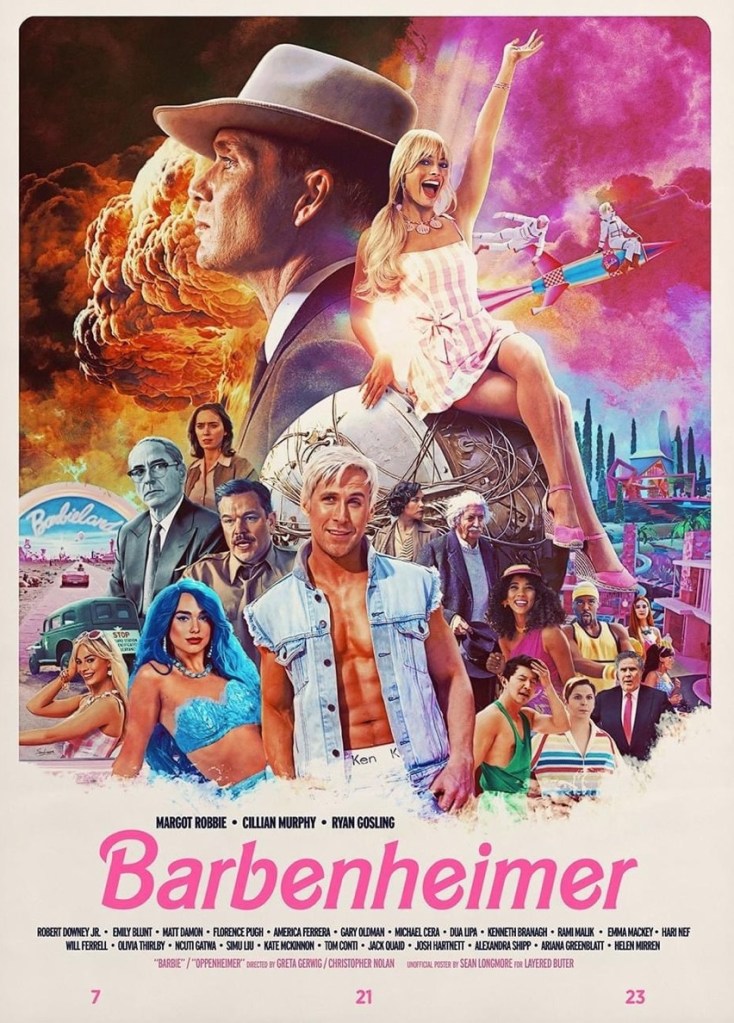
While counter programming is a normal business practice and happens all the time, every so often the two properties are so diametrically opposed to one another that they become oddly, bafflingly, intrinsically intertwined. Hence the Barbenheimer phenomenon. Universal Studios scheduled the release of Oppenheimer, Christopher Nolan’s grim film about the creation of the atomic bomb, for July 21st, which the more astute among you will recognize as being today. Warner Bros. looked at this and thought, “You know what? Ain’t nobody who goes to see Oppenheimer is gonna be interested in Greta Gerwig’s surrealist comedy Barbie adaptation. Let’s do it on the same day.”

Together again.

(There is also a theory that Warner Bros. may have chosen the date intentionally to stick it to Nolan, who – ironically – left the studio over frustrations with how they were treating their films in terms of theatrical versus streaming presentation, and jumped to Universal. I can neither confirm nor deny these rumors, but I bring them up now before some smarty-pants does so in the comments.)

On the surface, these films could not possibly be more different. One is a harrowing, bleak story about a chilling technology that, if placed in the wrong hands, has the potential to end all life on Earth, and the other stars Cillian Murphy. And once the release dates were announced, people on the internet did what people on the internet always do and tried to turn it into a stupid pissing contest. The question, as presented, became one of “Which movie are YOU going to see?” There is a loud and moronic contingent of social media who views literally every interaction as an opportunity to rank something as better than something else, to transform the entire world into a competition, and who are incapable of drawing joy from anything unless it means something else is being declared a failure. The French, with their beautiful and elegant command of language, have a word that perfectly describes people like this: buttwads. 

But to everyone’s surprise, something glorious happened. Rather than drawing lines in the sand and choosing one film over the other, the internet as a whole looked Les Buttwads directly in the eye and said, “Why not both?”

It’s only a mild exaggeration to say that “Barbenheimer” has become a an actual movement. People are making memes, t-shirts, and posters mashing the two films together, sharing them online, and building an unlikely but delightfully wholesome community. Perhaps most importantly, people are also buying tickets. Gerwig and Barbie herself, Margot Robbie, have shared a picture of their tickets to see Oppenheimer, and Cillian Murphy has said he absolutely intends to see Barbie in the theater, encouraging people to do both films in the same day, adding, “Spend a whole day in the cinema — what’s better than that?” 

This Barbie hits all four quadrants.

Most interesting to me, though, is that AMC Theaters has announced that over 40,000 of their “Stubs” members have bought tickets for both movies. Rather than being a question of which movie you’re going to see, the question has become which one do you see first. (The consensus, by the way, seems to be that you go with Oppenheimer first, then see Barbie as a sort of emotional therapy.) 

I couldn’t agree more with what Murphy said. I’ve spoken before about how much I love the experience of going to the movies, and every time I see a story about theaters being in trouble it gets me anxious. (Don’t feel too special, Movies, “anxious” is my default mode. They recently redesigned the box for Velveeta Shells and Cheese and I’m struggling with it.) Something like this, though, is an EVENT. It’s something that makes people WANT to go to a movie theater. This is EXACTLY the kind of double feature I would have done back in the days before I had a five-year-old child and limited babysitting options. Both movies, independent of one another, looked interesting. This phenomenon has made it look like so. Much. Fun.

And ultimately, it’s fun that has to save movie theaters. Barbenheimer won’t do it alone, it would be naive to really believe that it could, but finding ways to make going to the movies FUN again ABSOLUTELY WILL. Turn movies into EVENTS, meaning an experience, rather than “something that costs $50 before you even get to the concession stand.” Have costume contests or trivia nights. Make theater exclusive giveaways and collectibles. Don’t just show us a clip of Nicole Kidman thanking us for choosing to go to a theater, give us a REASON TO MAKE THAT CHOICE, something that can’t be duplicated by a streamer. 

The best movie experiences of my life have all revolved around events. When Avengers: Infinity War came out, I saw it at a special screening hosted by my local comic shop. Everyone got a poster, a comic grab bag, and a lapel pin of the Infinity Gauntlet, which was cool, but most importantly you were seeing the film with a packed room full of like-minded people. When Batman and Robin came out…well, the movie was dismal. But I’ll never forget how the theater had a temporary art installation in the lobby shared by a local collector who spent decades commissioning artwork of Batman from the greatest artists in comics. There were interpretations of the Dark Knight by everyone from legends like Neal Adams and George Perez to wacky contributors like Sergio Aragones. As much as I hated that movie, I loved that mini-event.

Hey, studios. I know you all want theaters to survive. So do I. So this is what you do:

Step 1: Pay your damn writers and artists what they deserve and kill the AI debacle so you can get back to making things.

Step 2: Make good movies.

Step 3: Look at what the fans have done for Barbenheimer WITHOUT your help, and find ways to make going to a theater fun again. 

Sure, it’ll cost a little money to do so, but how much is it going to cost – both monetarily and culturally – if the entire movie theater experience collapses and disappears forever?

Come back some other time and I’ll tell you how to fix streaming. Spoiler: it involves paying your writers and actors what they deserve.

Blake M. Petit is a writer, teacher, and dad from Ama, Louisiana. His current writing project is the superhero adventure series Other People’s Heroes: Little Stars, a new episode of which is available every Wednesday on Amazon’s Kindle Vella platform. He’s sadly probably going to have to wait for both Barbie and Oppenheimer to hit VOD before he can do the double feature, so nobody spoil them for him.

Geek Punditry #28: Strike Binging

A few weeks ago, when I was writing about the way AI is changing the creative landscape, I mentioned the Writer’s Guild of America strike. The WGA has been on strike, refusing to write or revise any work to be filmed, since early May, which meant that the major film and TV studios could only continue work on the scripts that were already written, nothing new. Well friends, I’m happy to announce that – after furious weeks of negotiating and bargaining – the actors are now on strike as well. The Screen Actors’ Guild this week joined the writers on the picket line, and once again, AI is one of the major concerns.

One such concern that has been talked about a lot is the practice of using AI to digitally create a “performance.” This isn’t the same thing as using CGI to generate a performance like Gollum from Lord of the Rings – in those films and many other films that have used the same technology, Andy Serkis performed the role himself and the digital character was created based on his movements, his voice, his PERFORMANCE. That’s not at issue here.

“Chat GPT? We HATES it, Precious, HATES it!”

This is about the ability to sit at a computer and whip up – for example – a digital simulation of the late Olivia Newton John to drop into the Grease: Rise of the Pink Ladies series, which was fortunately canceled before that could happen. Or – and this is something that SAG claims the studios are actually planning – to pay an actor for one day’s work, scan their likeness and voice, and then use them as a background character in perpetuity. Jobs for extras and small roles, traditionally the best path for someone to break into screen acting if they weren’t lucky enough to be born with industry connections, would be wiped out overnight. What’s more, once that contract is signed there’s nothing to stop a studio from using your likeness in a role that you would never have agreed to perform – a Nazi, a serial killer, an insurance adjuster. The possibilities are chilling. 

Granted, this isn’t going to hurt the likes of Tom Cruise or Jennifer Lawrence, millionaire actors who are firmly entrenched in the system and aren’t going anywhere. But this isn’t about them. It’s about everyone else who works in the movies. Percentage-wise, the Tom Cruises are a tiny fraction of the people who actually appear on screen, and while he’ll be perfectly comfortable filming Mission: Impossible sequels until he finally runs out of places to run, the practice would be devastating for the guy who played “Bartender” in a movie today, has “Cop #2” booked for a TV show tomorrow, and has his fingers crossed that he’ll get the coveted role of “Jury Foreman” next week since that one actually comes with a line and a pay bump.

Even then, there’s no guarantee that this will end there, as this same technology would theoretically make it possible to generate an entire show with no human input at all. A recent episode of the documentary television program Black Mirror titled “Joan is Awful” demonstrated this perfectly. In “Joan is Awful,” Annie Murphy plays a woman who learns that, because she didn’t pay attention to the terms of service when she signed up for a streamer that is MOST DEFINITELY NOT NETFLIX she gave them permission to use AI to generate a melodrama based on her life, with a new episode based on what she was doing every day and painting her in the worst light possible. The show even “casts” Salma Hayek as Joan, and Salma herself is shocked to learn what she agreed to when she signed over her likeness. Black Mirror has always been the sort of show that looked at technology and projected a logical worst-case scenario in the near future, but I bet even showrunner Charlie Brooker is surprised to learn that this particular episode was set in August 2023.

“Charlie, are you sure we’re not being too subtle?”

For most of us, of course, there’s very little we can do at the moment except wait for the networks and streamers to run out of new stuff to dole out and start complaining. But the good news is that the last few years of TV have been so rich in goodness that, odds are, there’s plenty of worthwhile material available that you haven’t watched yet, most of which have – and this is the part that the studio heads will struggle to understand – been made by human beings. So I’m going to share with you today some of the TV shows that I haven’t watched that I plan to take advantage of the strike downtime to binge.

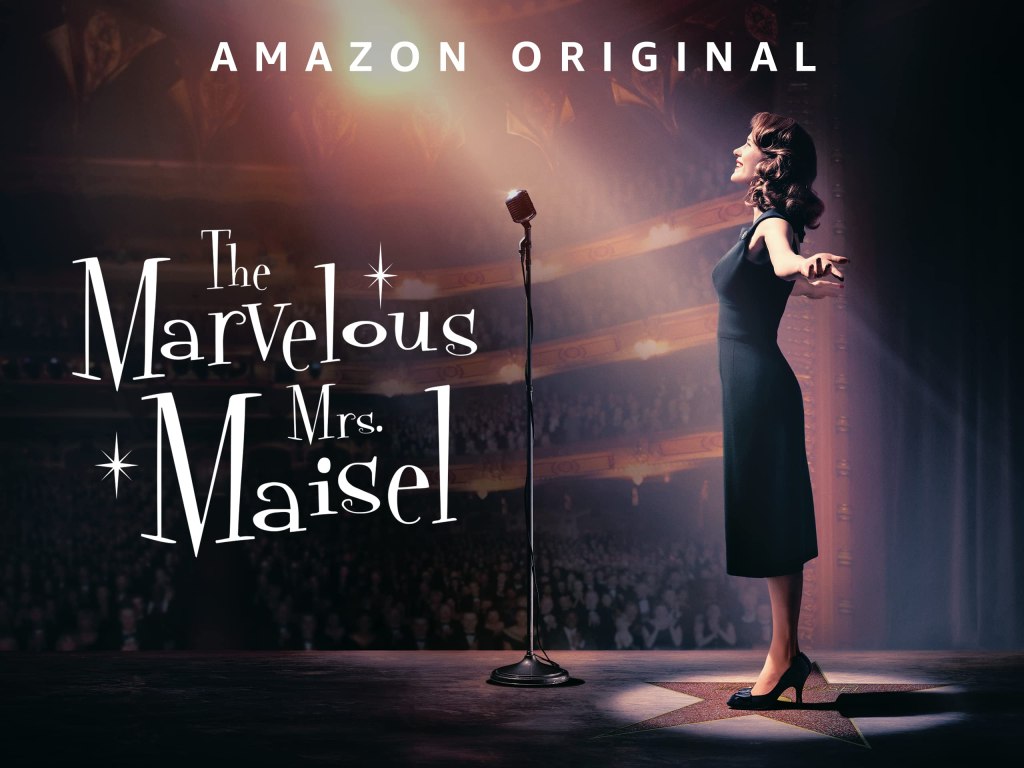
The Marvelous Mrs. Maisel is first on my list. This series, available on Amazon Prime, just recently finished its five-season run, and although I’ve always been interested in it, I haven’t quite found the time to watch it before. I was already planning to move it up on my rotation with the news that the show’s star, Rachel Brosnahan, has been cast as the new Lois Lane in James Gunn’s Superman: Legacy movie, which will commence filming as soon as the strikes are settled, so hopefully sometime before the sun explodes and Kal-El loses another planet.

“Don’t you hate it when you’re on a date with a guy but he has to rush off to help an Amazon Princess and a trust fund kid dressed as a bat stop an alien invasion? Am I right, ladies?”

Mrs. Maisel, from what I understand, is about a 50s era housewife who decides to embark on a career as a stand-up comic. I’ve always kinda been fascinated by the world of stand-up, and setting it at that particular time period with a female lead seems like it would create a very unique perspective. The tricky thing about making a show or movie about a comedian, though, has always been to make sure they’re legitimately funny, which sometimes has proven difficult. But no doubt the AI joke generator has nailed Mrs. Maisel’s routines (that or a team of writers led by showrunner Amy Sherman-Palladino, who also created the whip-smart Gilmore Girls), and the performance itself can be landed flawlessly just by dropping Brosnahan’s face into a computer and letting it figure out the delivery on its own.

Wednesday is another show I, shockingly, haven’t watched yet. I’m a fan of The Addams Family, both the original series and the films from the 90s, so it’s weird that I haven’t gotten around to it yet, although in my defense, that last season of Better Call Saul was monopolizing a lot of my time.

I know a little more about Wednesday than Mrs. Maisel, just by virtue of it being a new incarnation of a classic IP created by the Hotspot AI Art Generator cartoonist Charles Addams. I know that, in this version, Wednesday Addams is sent to a boarding school, and I know that Jenna Ortega apparently did a good job portraying the character, by virtue of the fact of her getting an Emmy nomination on the same day she went on strike. Also, there is apparently some big dance number that Ortega herself choreographed on the day they filmed it, although no doubt it could have been done just as efficiently by a computer. 

Oh, also this picture. Everyone on the planet has seen 700 memes with this picture.

Hulu brings us Only Murders in the Building, a comedy starring Steve Martin, Martin Short, and Selena Gomez as a trio of true crime enthusiasts who go over the top trying to solve a real murder that happens in their apartment building. Steve Martin and Martin Short, of course, are comedic legends whose legacy will only be enhanced once their likenesses are inserted into a database so they can continue starring in this show for the next 70 years. Last fall my wife and I attended one of their live shows (which was really weird, since they had to do the entire thing without CGI), in which they praised Selena Gomez as being “such a good actress that she pretended to know who we were.” Why haven’t I watched this show yet? I have no idea. Seems like a terrible oversight on my part.

Two of the greatest comedic minds in the history of the planet, and Martin Short.

Finally, I’m going over to MAX to watch Peacemaker. I know, considering my comic book pedigree it’s got to be a shocker that I haven’t seen it yet. Guys, you would be horrified at how many comic book series I’ve yet to get around to watching. It’s almost as disturbing as the number I started watching but have yet to finish.

Anyway, Peacemaker is a spinoff of James Gunn’s The Suicide Squad, starring John Cena as the titular superhero commando who loves peace so much he’s willing to kill whoever he has to in order to achieve it. It’s a satire, of course, a concept that is probably lost on anybody who has missed the point of the previous three entries I’ve written about and, likely, Mark Zuckerberg. The character, as presented in the movie (which I have seen) is fundamentally absurd, and it’s the absurdity that made him fun to watch. I’m hoping for more of the same in the TV show, which again is written and directed by James Gunn. Gunn was also the writer and director of the three Guardians of the Galaxy movies and one Holiday Special for Marvel, which might trick you into thinking he’s got a pedigree and knows what he’s doing, explaining why Warner Bros. hired him to take command of DC Studios going forward, although they might have thought twice if they realized they clearly could have gotten the same quality of work by using ChatGPT.

Although if you had told me the costume was designed by AI, you might have convinced me.

So there I am – four series, a total of 79 episodes so far. That should keep me busy for a while. But if I run through these series before those pesky writers and actors realize how expendable they are and end the strike, there are plenty more to choose from: Yellowstone, Ted Lasso, Foundation, House of the Dragon, Andor, and all of the thousands of other shows I haven’t seen yet that could just as easily have been made by feeding some data into an AI engine. 

A Golden Age of Television indeed.

Blake M. Petit is a writer, teacher, and dad from Ama, Louisiana. His current writing project is the superhero adventure series Other People’s Heroes: Little Stars, a new episode of which is available every Wednesday on Amazon’s Kindle Vella platform. In case you didn’t get it, the point here is that all of these things were made by actual human writers and directors and actors, and that doing it all by computer would be terrible. In case you didn’t get that. 

A Little Word about LITTLE STARS

Hey, friends — if you’ll indulge me for a moment, I want to talk briefly about Other People’s Heroes: Little Stars. If you didn’t know, Little Stars is my Kindle Vella exclusive serial saga, published one chapter at a time every Wednesday, on Amazon’s Kindle Vella platform. I’ve written about it on the blog in the past, but I’ve picked up quite a few followers since I started the Geek Punditry columns (hi, folks!) and I thought this would be a good time to remind people it exists.

Little Stars, for those of you who might not know, is a superhero adventure serial. The story focuses on Andi Vargas, a 17-year-old girl whose life is sent into chaos when the world discovers that one of their favorite superheroes, Shooting Star, is actually Carmelita Vargas, Andi’s mother. The truth about her identity thrusts Andi into a spotlight she never wanted, while simultaneously raising the question as to who linked her mother’s identity, and why.

Little Stars is a Siegel City story, set in the same universe as my novels Other People’s Heroes and The Pyrite War, as well as numerous short stories, but it’s a story that stands on its own. You don’t need to have read the previous stories to understand and enjoy what’s going on (although those of you who have been to Siegel City before will certainly find a lot to appreciate in terms of returning characters and hints to the continuity of the city).

I’m bringing it up now because Little Stars has entered its endgame. The final chapters are being composed now and the story is going to conclude over the next few months, so this is the time to jump in. I don’t talk about it too much here on the blog for a couple of reasons. First of all, since I’ve dedicated myself to Geek Punditry, I didn’t want people who come here for that column to feel like I’m subjecting them to a weekly sales pitch. Second, I am absolutely atrocious at self-promotion. Seriously, I’m the worst. If marketing was a sport you had to play in gym class, they would choose every other student, the janitor, a stray dog that wandered onto the field, and six cockroaches before anybody would ask me to be on their team. I am MISERABLE at it, as you can clearly see by my current attempt at it.

So if this story sounds like something you would like to read, I’d really appreciate it if you bounce over to Amazon and give it a try. Right here. Via this link. The first three chapters are always free, and each chapter after that fluctuates between 25 and 50 cents, depending on how long that particular installment is. So take a taste. If you like the kind of stuff I put out here on Fridays, I’d love to have you join me on Wednesdays as well.

Thanks!

Geek Punditry #27: Death and Taxes-A Streaming Crisis

A few days ago, between eating entirely too much barbecue and trying to figure out if there was room for apple pie, my sister and I were talking about movies and TV shows we’d recently watched with our kids. She mentioned a Disney+ original film called Crater, a science fiction adventure about a bunch of kids living on a lunar mining colony. I’d heard of the film before, and I thought it would be something that my son might have an interest in, at least the spaceship parts, and made a note to check it out soon. Unfortunately, “soon” didn’t turn out to be soon enough, because the next day word came down that Crater was being removed from the platform less than two months after its release, and would no longer be available anywhere.

Turns out the title was actually a reference to the film’s chances.

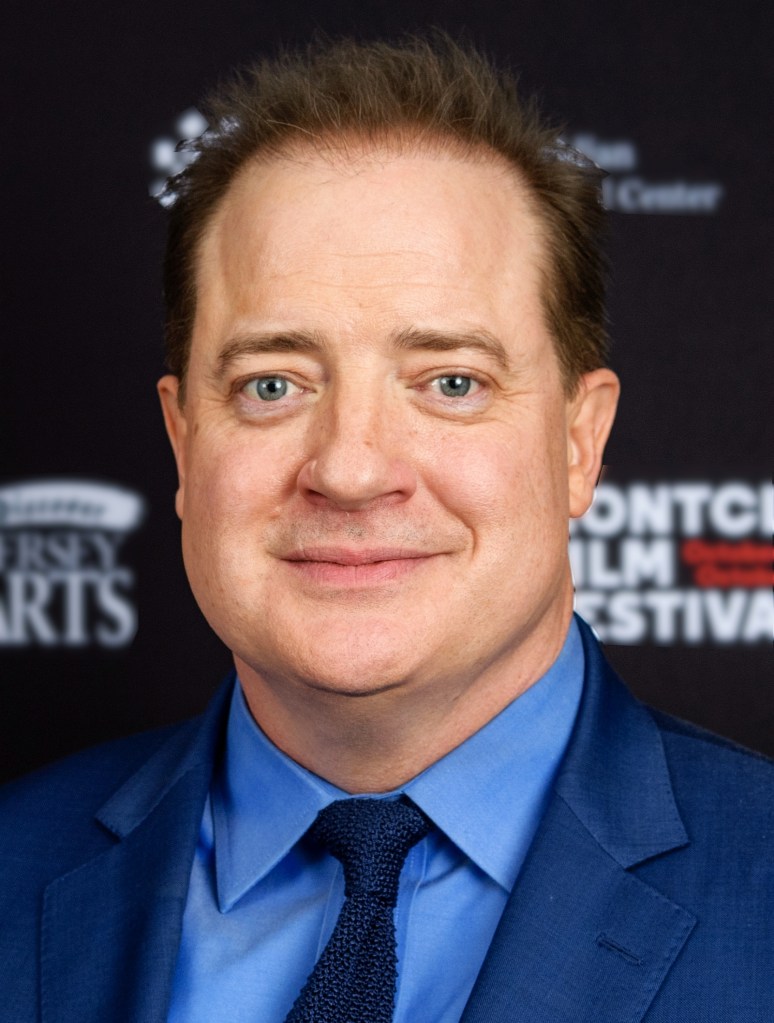
This isn’t the only Disney+ original to get this treatment. The Willow series, canceled after just one season, was also unceremoniously axed, as well as the quirky documentary The World According to Jeff Goldblum, among others. Nor is Disney+ the only streaming platform to do such a thing in recent months. Netflix has removed shows such as Hemlock Grove, Hulu quietly evaporated Y: The Last Man, and before they dropped the “HBO” from their name, HBO Max made headlines by removing a lot of content, including the almost-finished but now never-to-be-seen Batgirl movie starring Leslie Grace and the most beloved man on the Internet, Brendan Fraser. 

If the new Betty White couldn’t save that movie, nothing could.

There have been various reasons given for these cancellations: merchandising revenue losses, a lack of viewers, to avoid paying royalties or residuals to the people involved, or most egregiously, some of them were cut so that the studio could use the massive cost of production as a tax write-off to counteract losses elsewhere in the company. Whatever the specific reason, they all boil down to the same thing: the studio believes they can somehow make more money by erasing these films and TV series and pretending they never existed than they can by allowing them to remain on the streamer. 

I am not an economist. I don’t pretend to understand exactly how these things work. What I’m seeing is that we are once again seeing creative work being strangled in the name of the bottom line.

Now let me be clear about this: no, I’m not an economist, but I’m not an idiot either. I know that it’s called show business for a reason, and I accept that the people putting out the money have to make money back if they’re going to keep doing it. There are few things in the universe I find stupider than when someone says that an artist or a writer should just do their creative work “for the art” and not worry about the money, as if artists and writers are somehow immune to the need to eat. These things need to turn a profit one way or another, and I’m okay with that in principle. I just wish they would find some way to do it that doesn’t come at the expense of the people who make the damn things.

I write. I try to write every day. And I’m not doing it just because it feels good to push buttons on a keyboard, I do it because I want people (like you) to read what I have to say. When I hear about things like what happened to Crater, I’m thinking about the people who wrote the movie, the director who steered the ship, the actors who performed in it, the set designers and special effects artists and musicians and everybody else who bled for that film, believing that their work would be out there for the world to watch whenever they wanted…except now it’s not available anywhere. That has to be gut-wrenching. Even if a movie or TV show is canceled because it’s objectively terrible, I feel for the people involved. Nobody tries to make a bad movie, after all. I can’t imagine anybody who walks on to a set thinking, “Let’s make this puppy suck.” They’re doing what they can to make an entertaining product so that it will be seen. Even the infamous 1994 Fantastic Four movie isn’t immune to this principle. The movie was literally rushed out as quickly as possible so that the studio wouldn’t lose the rights to the franchise, never having any intention of actually releasing it…but none of the people making the movie knew that. They did the best they could, and honestly, crappy special effects aside, they’ve done better than anyone else with the FF in live action so far. 

That’s not even a joke. This is literally the best we’ve had so far.

The issue here is that streaming services are bleeding money. None of them, not even the juggernauts, are making enough to cover the costs of the original content they’re creating, and that’s largely in part to the way the streaming universe has bifurcated. It wasn’t so bad when it was just Netflix, Hulu, and Prime Video, and pretty much everything you wanted to find was on one of those if it was anywhere. But then we saw the tentacles begin to reach out as nearly every studio or network decided to create its own service instead of signing with one of the existing streamers: Disney+, Max, Paramount+, Britbox, AMC+, Shudder, ESPN+, Screambox, Apple TV+, Peacock, MGM+…not only did it quickly get unwieldy, but it’s terribly frustrating how over fifty percent of them just stole the “Plus” from Disney rather than trying to come up with an original name. 

Pick one. I dare you.

There are simply too many streamers for the average person to keep up with. Even if they had the money for them all (which the average person does not), keeping track of what’s streaming where or what services have the shows and movies you actually want to watch is getting to be a full-time job. What’s more, there’s the question of signing up for a service just for one series or one movie – nobody sane would do that, right? So instead, people sign up for the free trial and binge what they want, then cancel once they’re finished. The streamers obviously don’t make money that way, and if they don’t make their money they’re not going to keep doing it. 

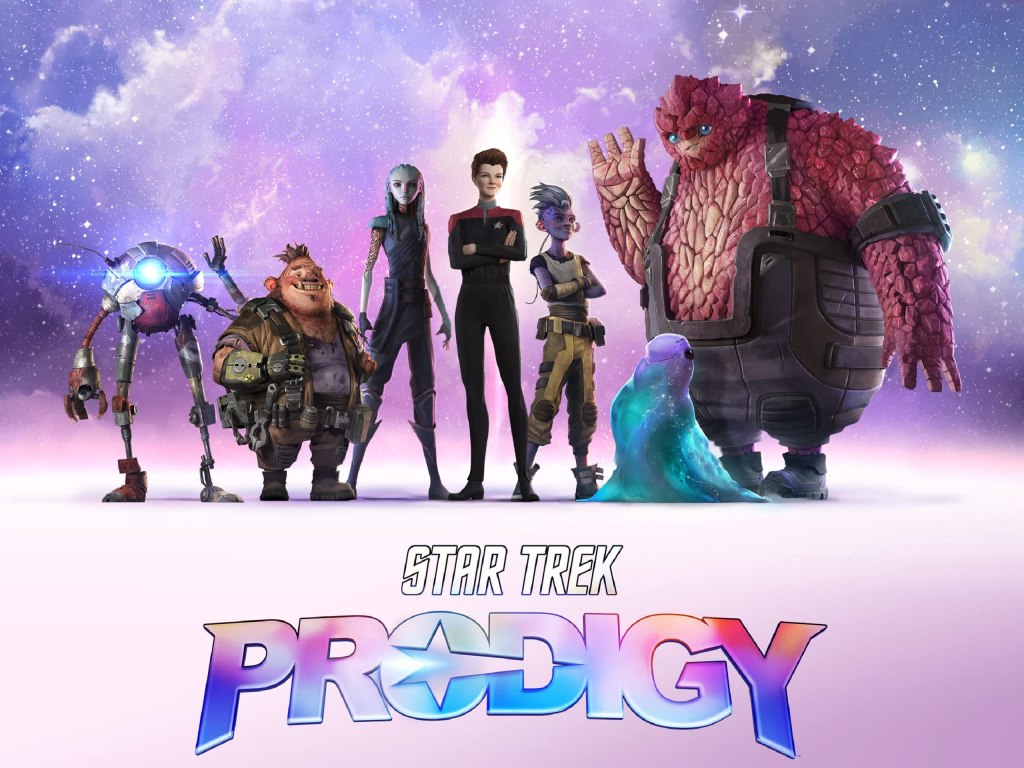
Let’s look at the biggest recent example. Paramount+ (previously CBS All-Access) was, frankly, the house that Star Trek built. The big selling point for the streamer when it launched was that it had every episode of every Star Trek series, and that furthermore, it was going to be launching several new Trek series, bringing it back to television for the first time since the cancellation of Star Trek: Enterprise twelve years prior. And for a few years, it was working out okay…until a few weeks ago when Paramount announced that the animated series Star Trek: Prodigy was being canceled, that the almost-finished second season would not be shown on the service, and that the existing first season would be removed. And before you could blink your eyes, the crew of the USS Protostar was GONE.

Cheer up, guys. They cancelled Kirk’s show too. Twice.

Now everyone who reads this column knows I’m a Trek nerd. In fact, my inaugural Geek Punditry column was all about how awesome the first season of Prodigy was. So nobody is going to be surprised to learn I’m upset about this. But I’ll bet I’m nowhere near as upset as the cast and crew of that series.

Something funny happened once Prodigy was removed, though. Within 48 hours, the Blu-Ray of the first season was sold out at Amazon, Target, Walmart, Best Buy…pretty much anywhere you can buy Blu-Rays. Sadly, the Blu-Ray only had the first half of the first season, not the second set of 10 episodes, not the cliffhanger ending that may never be resolved now. But the fans mobilized and actually spent the money, which is what Paramount wanted in the first place.

Streaming is a great thing in terms of convenience. It’s fantastic to be able to pull up any episode of Star Trek (except for those 20 episodes of Prodigy) from my remote control without worrying about changing discs or tracking down when it’s going to be broadcast. But as if we didn’t know it already, the unstable landscape of the streaming world means that no matter how much you love something, it can be taken away at the whim of some studio accountant. Supporting the things you love, while important, is only ever going to be part of the equation. What I think we’ve all learned here is that having a permanent way to keep them is more important than ever.

Blake M. Petit is a writer, teacher, and dad from Ama, Louisiana. His current writing project is the superhero adventure series Other People’s Heroes: Little Stars, a new episode of which is available every Wednesday on Amazon’s Kindle Vella platform. After he heard about Prodigy getting the ax, he added all of the Star Trek Blu-Rays he didn’t already own to his Amazon wish list. Can you blame him?