My little Geek Punditry column is about pop culture, especially pop culture that I’m personally interested in. I tried writing about pop culture I wasn’t interested in once, but as it turns out, I found that really boring. Anyway, my pop culture awareness tends to have four quadrants, all of which have been frequent subjects of conversation here: books, movies, television, and comic books. These are the four ways I tend to consume stories, and I’m happy with them. There’s one major area of American pop culture where my awareness remains relatively low, though: video games. I’ve never been a huge gamer. The only video game console I’ve ever owned was one-third of the Sega Genesis my parents got for my brother, my sister, and me to share one Christmas. I play a few mobile games, but those are mostly in the genres of “tell this guy to do a job for 16 hours” or “put the red 5 on the black 6.” I’ve never Called a Duty, I don’t Halo, and whenever people start talking about “the new Madden” I get confused because he died in 2021 and I didn’t know they were planning to reboot him. In other words, I don’t video game much.
But there was a game, many years ago, that I got really into for a while. It was a hell of a game, one that crossed over into my “comic book” quadrant and appealed to me on that level. It was a game that allowed me to conjure up my own superheroes (something I had been doing since I was approximately seven years old anyway) and insert them into a world full of hundreds of other players, fighting alongside them in defense of the peaceful citizens of Paragon City. The game was City of Heroes, and I loved it.
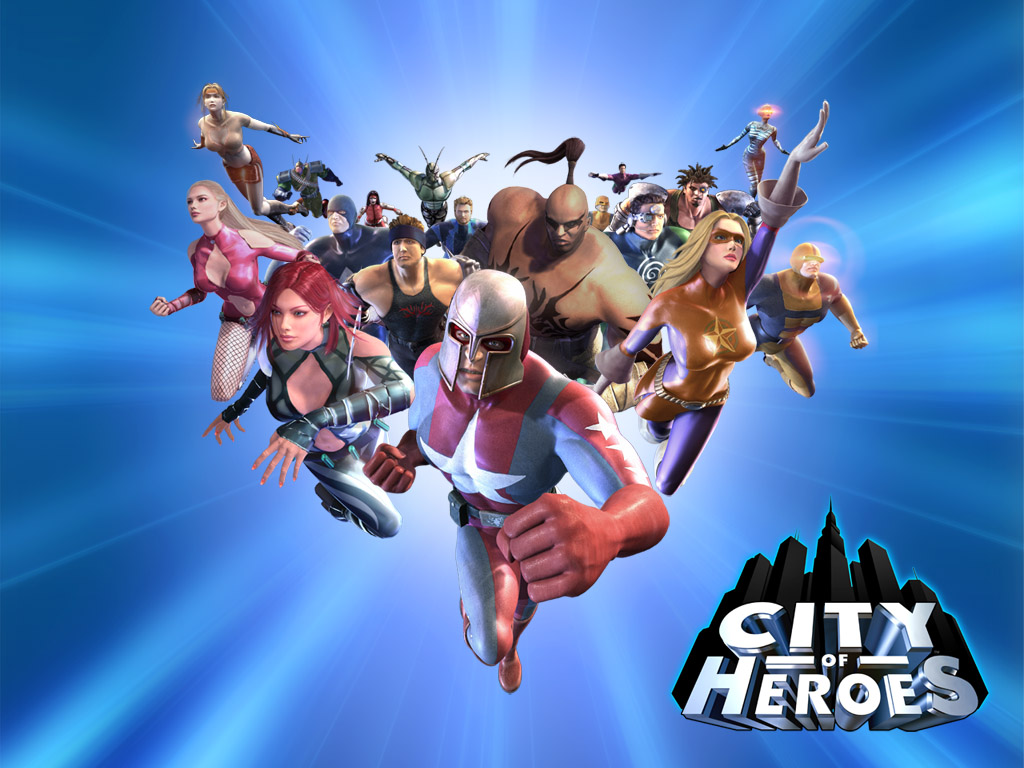
City of Heroes was an MMORPG (massively multiplayer online roleplaying game) that launched way back in 2004. The appeal of the game was that, rather than playing as Superman or the X-Men or any of the superheroes that had scored their own video games over the years, players could create their OWN characters, live their OWN stories. The creation engine was pretty impressive, too – there was a decent array of power types to choose from, and lots of different body types, uniform templates, and colors. You could make a character that looked like pretty much anything you could imagine. At first, I made versions of my own pre-existing characters (my first main character was based on Lightman, a character I’d created back in high school and who later made brief appearances in the world of my novel Other People’s Heroes). I later branched out and made new characters, some of which I enjoyed so much that they stayed with me and made their way into my writing. The often-mentioned but little seen hero STAT from Little Stars was my healer character from City of Heroes. It was a name and visual I really liked, and I wound up writing an entire backstory for him. It was too much work to go to waste. (He’s got his own book in my head somewhere, and I hope to write it some day.)

The city lasted for several years, and I played a lot – sometimes with friends with whom I had formed a Supergroup, sometimes with random characters I encountered wandering around the massive server. The game kept putting out new content and new stories, eventually expanding into a spinoff game called City of Villains. My main character from THAT game was Malefactory, a villain whose power allowed him to create robotic drones – and if you’re reading Little Stars like all people who are good of heart and statistically likely to win a large amount of money in the lottery next week, you may recognize that Malefactory followed STAT to Siegel City and became that story’s main antagonist.

Anyway, I loved the game. I loved the lore behind it. I loved the fact that a subscription to the game included a subscription to the Top Cow comic book series with stories featuring the game’s legendary NPC heroes like Statesman and villains like Lord Recluse. The comic even included work from some of my favorite writers and artists like Mark Waid, Dan Jurgens, and Troy Hickman (whose Common Grounds is still one of the most inventive and entertaining superhero comics I’ve ever read, and I wish it would come back). The world of City of Heroes just kept getting bigger and bigger, and I was enjoying it and more.

And then, like an asshole, life happened.
When City of Heroes first launched I was in my twenties with no family of my own and few responsibilities that really demanded my time. A few years later, things had changed. I became a teacher, a job which you may famously remember was the point of a joke when Richard Dreyfuss said he thought teachers had a lot of free time in the motion picture Mr. Holland’s Opus. I became more active in my local theater company, with rehearsals four nights a week, and more in the last few weeks before a show. I launched a podcast with a friend who lived 90 minutes away, which in those pre-Skype days turned recording a couple of episodes on a Sunday into an all-day affair. I found myself spending less and less time in Paragon City, not because I wasn’t still enjoying the game, but because that time just wasn’t there anymore.
In early 2011, City of Heroes took an even bigger hit – the launch of DC Universe Online. It was another MMORPG, another game that allowed you to design and play your own superhero characters, but now you could have your characters fight alongside the likes of Batman, the Flash, or Harley Quinn. There were even in-game events that corresponded to stories currently happening in the DC Comics. How could a nerd like me resist? I played DCU Online for almost a year…and then the same time constraints that drew me away from City of Heroes ended that avenue for me as well.

Even though I hadn’t played in ages at that point, I was sad when NCSoft announced that they were going to shut down City of Heroes in November of 2012. It really was a great game, one that I had always hoped to return to someday, and the knowledge that I wouldn’t have that chance was pretty depressing. But life went on – after all, November of 2012 was also the month I got engaged, and that resulting marriage led to the current little time-eater in my life, my son Eddie. Having a family is the best thing that ever happened to me, make no mistake about that, but it would be dishonest if I didn’t admit there are some things from my younger days that I sometimes miss, like having a quiet place to record a podcast or the free time to be Max Bialystock in The Producers.
If parenthood effectively ended my podcasting and stage acting careers, how could I possibly play video games with a small child in the house? No, seriously, I’m asking. I know people who both have children AND an active video game profile, and I don’t know how the hell they can do it. Sure, as Eddie has gotten older I’ve been able to do more reading and writing, or watch more movies, but those are all things that have either a literal or metaphorical pause button that allows me to stop at a moment’s notice if the boy needs attention. That doesn’t work in an MMORPG – how am I supposed to tell my teammates that their healer is abandoning them to fight Lord Recluse without him because the kid just asked me if I wanted to guess how many Uncrustables can fit in the tank on the back of the toilet?
But even though I knew I had no opportunity to play, the fact that it wouldn’t be an option kind of sucked.
Last year, I was made aware that superfans of the game had created their own little outlaw servers to host clones of the game unofficially. Some of those servers had even united as City of Heroes: Homecoming, and were adding in content from the various official editions and updates of the late, lamented game. The servers were funded entirely by donations, and the game was free to play for everyone. When I heard about it, I thought about jumping in, but I hesitated. Time, of course, was still my primary concern, but there was also the fact that the game was unofficial. At any point, I knew, NCSoft could discover the existence of the rogue server, demand it be shut down, and all would be lost. It would be just my luck to find my way back to the game, get really into it again, and then immediately have it taken away. So while I tipped my hat to the heroes who were keeping City of Heroes alive, I stepped aside.
Last week, that changed.
On January 4, NCSoft announced that they were granting an official license to City of Heroes: Homecoming, legally allowing the servers to continue to host the game and add new content. What’s more, this resurrected City of Heroes is STILL funded only by donations and remains free to play.

This is awesome.
It was awesome that there were people who loved Paragon City (and who, unlike me, are tech-savvy) enough to bring it back.
It was awesome that the community survived and spread the word of something that they loved, looking for other people who loved it like they do, instead of just whining and complaining about its absence.
And it was especially awesome that the company which would have completely been within their legal rights to shut the whole thing down, even though it’s a property that they are not currently using and seem to have no intention of resurrecting, decided instead to make a deal with the fans to allow their project to continue to exist.
Everything about this story is awesome to me.
Nothing has changed about my life, of course. As I type this I’ve got a six-year-old sitting on my hip, bouncing up and down and cheering at a hockey game, so this isn’t a good time to fire up the portal and dive into Paragon City for my triumphant return. I don’t know if that time will ever come, if I’m being totally honest.
But it’s awesome to know that if that time DOES come, the City of Heroes will be there waiting for me. If you’re ever wandering around Paragon City and you happen to run into STAT, the Medical Marvel, that means I’ll have found my way back.
Say hi. Maybe we can save the world together some time.
Blake M. Petit is a writer, teacher, and dad from Ama, Louisiana. His current writing project is the superhero adventure series Other People’s Heroes: Little Stars, a new episode of which is available every Wednesday on Amazon’s Kindle Vella platform. If any superfans of City of Heroes happen to read this and notice that he got some of the details of the game or the history wrong, go easy on him. Hell, he had to Google the game to remember that it was even CALLED “Paragon City.” It’s been a decade, peeps.
 Blake M. Petit