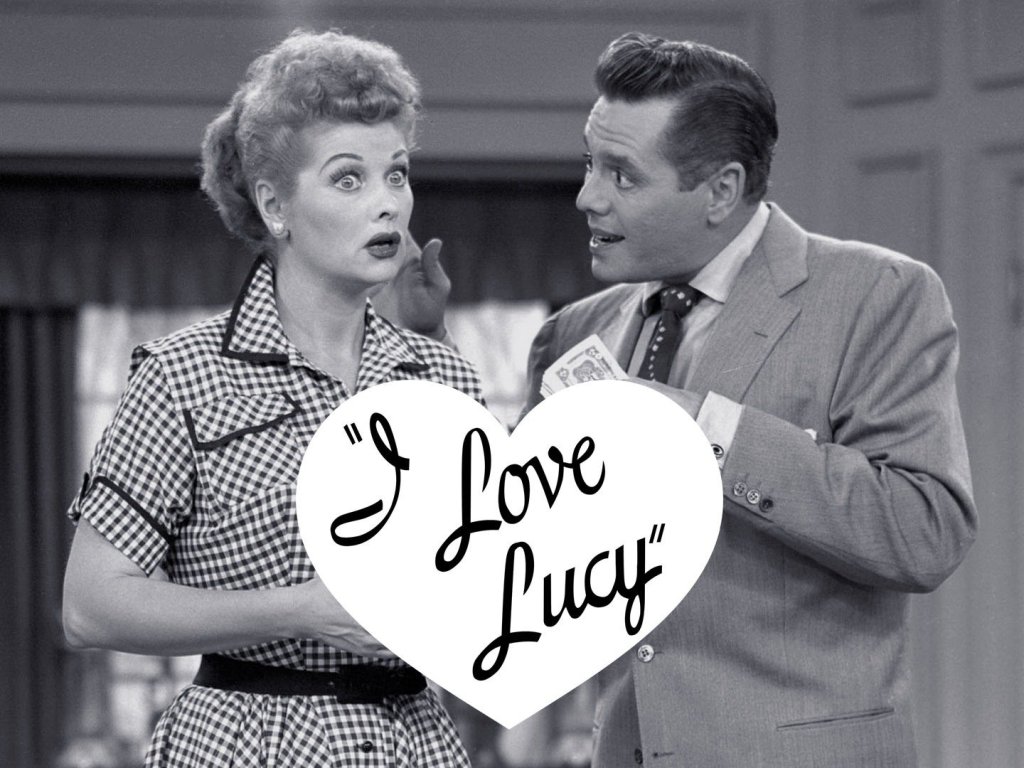
It’s Desi Arnaz’s fault. As the story goes, when Lucille Ball got pregnant during the run of their legendary sitcom I Love Lucy, it was Desi who suggested to the network that they run some older episodes again to fill in the weeks when she would be out of work. The idea was bizarre. Run episodes again? Re-run them? Who would want to watch an episode of a TV comedy that they had already seen?
The answer, as it turned out, was everyone. There’s a comfort in returning to something that made you happy the first time you watched it, like finding an old friend or reminiscing about the good old days. It’s something that we all need at some time or another.
The rerun became a standard television feature and changed the landscape of entertainment. Not only could they run the same show for an entire year without having to make quite as many episodes or skipping a week, but this eventually led to the concept of syndicating reruns of old episodes to show outside of their original timeslot. And it is syndication, I believe, that has allowed TV shows to become iconic parts of our culture. Think about it: were it not for syndication, if the shows were not still available after their initial airing, would anyone today still know the theme to The Brady Bunch, or be able to tell you how many castaways were stranded on Gilligan’s Island? Who would remember the man named Jed, a poor mountaineer who barely kept his family fed? Could a gentle whistle conjure up the image of Andy Griffith and Little Ronnie Howard carrying their fishin’ poles down to the fishin’ hole?
And although it isn’t a sitcom let’s not forget that Star Trek (arguably the font from which all modern fandom springs) is only remembered today because people kept watching the reruns after the series was canceled. It was in syndication that the show’s popularity truly boomed, syndication that led to things like Star Trek conventions, merchandise, novelizations, comic books, and fanfiction…and it was those things that fueled the fire and ultimately led to the revival of the franchise. That’s huge even if you’re not a Trekker, because the fandom of virtually every major franchise since then has followed that template.

When I was younger, I would get home from school and gorge myself on a diet of sitcom reruns. Shows like Cheers, Night Court, or Mama’s Family were staples for me. The 90s came and Home Improvement, Seinfeld, and Friends joined my education. And no matter how many times I watched any given episode, I faithfully watched them again, to the point where I can remember minute details of ancient TV shows better than I remember things like the current whereabouts of my social security card. Because of syndication, I can throw out an obscure joke or comment about virtually any topic, then watch my wife roll her eyes at me when I tell her it’s a classic Simpsons reference.
The streaming revolution has changed things, of course. Once, these reruns were a way to fill time on the air before new series start. Today, fewer and fewer people are using “air time” in their television viewing at all. With the exception of sports, weather, and Svengoolie on Saturday nights, I virtually never watch any live television anymore.
This does not mean the end of reruns, of course, it just means that you have to seek them out instead of turning on whatever Channel 26 was showing at 5 p.m. In fact, for many people seeking out these older shows has become a lifestyle choice. Whereas once someone would have to content themselves with the seventeen or eighteen episodes of The Big Bang Theory that TBS shows on any given weekday, now the option exists to literally watch it 24 hours a day on HBO Max, and you can choose any episode you wish. If you go to a Bob’s Burgers group on Facebook and ask what shows the fans watch when they aren’t watching Bob on Hulu, you will be greeted by several quizzical faces that fail to comprehend such a time could exist. There are people who watch The Office on constant repeat, people who never turn off Family Guy, and folks who will spend their entire lives immersed in Pawnee, Indiana with Parks and Recreation.

I’m not entirely sure this is a good thing. Oh sure, it’s great to be able to go back and revisit your favorite shows, but I think it’s making it more difficult to find new shows, especially comedies. There’s plenty of talk about “prestige” television, but most of the time this refers to genre shows like Stranger Things or dramas like Yellowstone. The conversation doesn’t really center on blockbuster comedies the way it used to. Would it even be possible, in the current TV climate, for a show with the level of cultural penetration as Friends or Seinfeld to come into being?
As much as I love the sitcoms of my youth, I’m also the sort of person who is constantly on the lookout for new characters, new stories, and new worlds to explore. Even now, I sometimes feel a strange guilt if I watch something I’ve already seen, faced with the knowledge that I could be using this time on new entertainment. I get over it, though, and since streaming really took off in force there are many classic comedies and shows of my youth that I’ve gone back and watched in their entirety: Cheers, Frasier, Wings, The Office, Head of the Class…part of it is because I like to watch new shows with my wife (hi, Erin), and I used to go back to older shows as something to watch while she’s at work. That didn’t quite work out, though, as she would get home while I was in the middle of an episode of Everybody Loves Raymond, she would get into it, and I then I had to wait to watch the old shows with her too. Now I just make her tell me explicitly which shows I am and am not allowed to watch without her to avoid confusion.
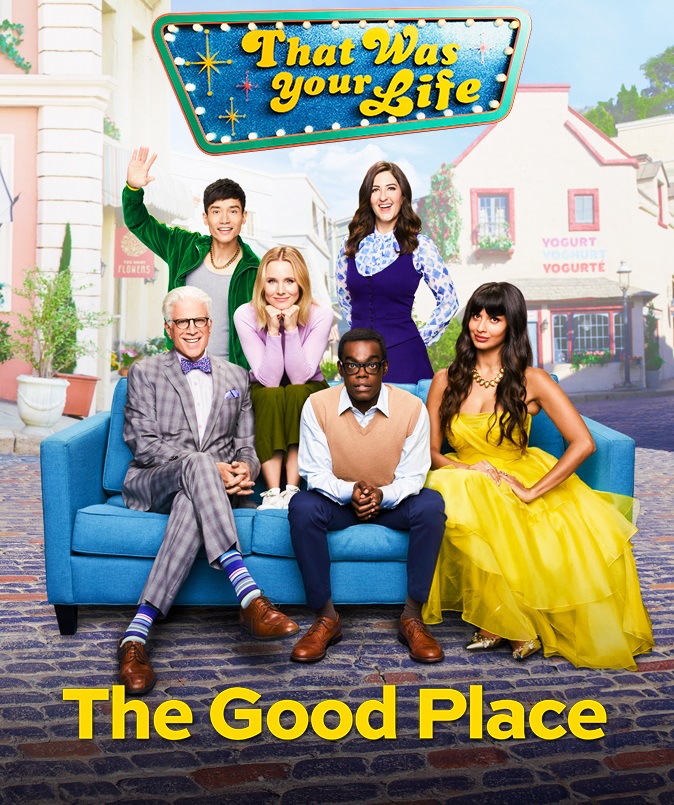
Anyway few years ago, I realized it had been quite some time since I found a new comedy that I really got into, and I made it a point to start seeking them out. I began with The Good Place, which was both a wonderful choice and also completely antithetical to what I was trying to do. If you’ve never seen it, The Good Place is about a kind of scuzzy woman (played perfectly and adorably by Kristen Bell) who dies and, through a sort of cosmic clerical error, winds up in Heaven, which turns out to be run by Ted Danson.
I refuse to say any more about the story because to do so would rob new viewers of one of the most sublime television series ever made, but I will say that I never thought I would see a show that could blend together philosophy, spirituality, religion, and deep, complex contemplations on the meaning of life and the nature of existence itself with a fart joke and make it all seem utterly perfect. It is both hilarious and one of the most profoundly thoughtful and emotionally-compelling TV shows I’ve ever seen. And it’s for that reason that it’s not a show I can re-watch too often, because there are only so many times you can cry on a random Tuesday afternoon.
So The Good Place is an excellent show and I urge everyone to watch it immediately…but it wasn’t the sort of thing that made me want to put it on constant repeat the way I could Frasier. The search would continue.

The next comedy that really got my attention was Abbott Elementary. Upon the suggestion of friends of mine from work (I am, in case you didn’t know, a high school English teacher), I checked out the first few episodes of the show, then I stopped and made my wife sit down and watch them with me, because it’s so good. On the surface, it feels like one of dozens of Office clones – a faux documentary set in an American workplace, this time an elementary school. There’s a wacky boss! There’s a new guy in the first episode to act as the audience surrogate! There’s a will they/won’t they couple that the audience is clearly supposed to root for! All the fingerprints are there!
What sets Abbott apart for me, at least, is the authenticity. There have been a number of TV comedies set in schools, but the majority of them have focused on the students (Saved By the Bell), or on the class of one influential teacher (Welcome Back Kotter, Head of the Class). This is the first show I’ve ever seen where the faculty are the stars of the program. What’s more, it’s the most realistic show set in a school I’ve ever seen. You’ve got the young teacher (played by show creator Quinta Brunson), eager to please and determined to be the best that she can be. You’ve got the grizzled veteran teacher (Lisa Ann Walter) who does what she wants and doesn’t care what anyone thinks of her. The awkward teacher (Chris Perfetti) who is determined to be thought of as cool despite the fact that he clearly is not. The teacher who has been at that school forever (Sheryl Lee Ralph), is perfect in everything she does, and is both intimidating and nurturing to everyone around her. I’ve taught with every one of these people. I have been many of them at some point or another.
It also shows the repercussions of events in a school in a way that most shows don’t. Budget cuts, classroom size, getting adequate parental support – all of these are issues that have turned up on the show in a realistic way. Well…semi-realistic. It is still a TV show, after all. Count the number of times in Saved By the Bell students are left in a classroom with no adult supervision, and know that every one of those offenses could (and depending on the severity of that episode’s hijinks, should) have resulted in somebody getting fired. Abbott actually shows consequences to even well-intentioned mistakes, (the Egg Drop episode is a wonderful example of this) and does so with relatable, enjoyable characters. Best of all, it doesn’t reduce every teacher to a useless buffoon. In fact, unlike most shows in a school setting, every faculty character — even Janelle James’s seemingly-useless principal — has moments where they show their worth as a teacher, as a friend, or as a mentor. It is the first school-focused TV show I’ve ever watched that didn’t make me ask if anyone involved had ever set foot in an American school in their lives. It’s really lovely.
It’s not perfect. The teachers do seem to have absurdly long lunch periods and planning times where their students are in someone else’s care, but I accept that as a necessity when you’re telling stories about the adults and not the kids. Those minor problems are easy for me to get past when I go back and put the show on repeat…which is where I stumble, since we’re only in the second season, and with modern TV the first season had a measly 13 episodes. While I eagerly await each new episode, there’s not enough Abbott for a good binge…not yet.
So I keep looking for more comedy.

The most recent show to get my attention, like Abbott, is only in its second season, but it has a few more episodes and I haven’t quite gotten through them all yet. I started watching CBS’s Ghosts on the advice of my brother (which I mention mainly because if he should happen to read this he will immediately jump in the comments and demand credit for it), and I’m enjoying it a lot. Ghosts, a remake of a British show of the same name, is about a young couple (Samantha and Jay, played by Rose McIver and Utkarsh Ambudkar, respectively) who inherit an old mansion from a distant relative, unaware that the ghosts of numerous people who have died on the property are trapped there. In the first episode, Sam has a near-death experience and wakes up with the ability to see and hear the ghosts, and the sudden connection between the ghosts and the “livings” changes things for all of them.
It doesn’t sound like the premise of a wacky sitcom, but it’s really great. The ghosts cover a wide range of character types, from someone who died 1000 years ago (a Viking exploring the Americas played by Devan Chandler Long) to a dudebro businessman who died in the early 2000s without any pants on (Asher Grodman). The premise allows for characters with a variety of perspectives from different time periods, which makes for a fun blend of types: the former mistress of the house (Rebecca Wisocky) has attitudes about women’s roles stuck in the 1800s, while the hippie who got killed trying to hug a bear in the 1960s (Sheila Carrasco) tries to help her break out of them. The scout leader who was killed in an archery mishap in the 1980s (Richie Moriarity) wants to be best friends with Sam’s husband Jay, but it’s tough to be pals with someone who can’t see or hear you.
The first season of the show is a fun one that sets up the premise very well, but the second season is even better as it starts to explore the world more fully. Sam encounters more ghosts beyond her own property, we get more information about the lives of the deceased, and an ongoing plotline begins to build around the 20s songstress Alberta (Danielle Pinnock), who always claimed she was murdered. Her insistence that she had an exciting demise was considered just a symptom of her hubris until evidence starts to accumulate that suggests she may be right. There’s even a great meta joke in the second season where the ghosts learn they cannot pass through the walls of a vault in the house and Jay quips that he appreciates the expansion of the mythology.
The only problem with Ghosts is, like Abbott, there’s just not enough of it yet. I’ve only got four more episodes until I’m caught up, and then what?
Time to watch the British original, I suppose.
The point is, I’m still on the lookout. The great sitcoms of the past aren’t going anywhere, and thank goodness for that. I know I can turn on Cheers or Everybody Loves Raymond or Night Court any time I want, and I frequently do. (In fact, I haven’t started watching the Night Court reboot yet because Erin and I have to finish our binge of the original series first.) But I still crave new entertainment. So I’m open for suggestions, friends. What are the current comedies that are worth watching?
Blake M. Petit is a writer, teacher, and dad from Ama, Louisiana. His current writing project is the superhero adventure series Other People’s Heroes: Little Stars, a new episode of which is available every Wednesday on Amazon’s Kindle Vella platform. He’s also a big fan of Star Trek: Lower Decks, but he doesn’t consider that a sitcom so much as a way of life.


 Erin recently discovered a show on Hulu’s “baby” channel called Tiny Beats. In this show, bugs hear a strange sound and investigate it. Wordlessly. Every episode. While the same music plays. Over and over again. I am certain that when a sinner arrives in Hell, they hear the music from Tiny Beats on a permanent loop.
 On the show — and I must warn you, there are spoilers here — Henry went to a restaurant where the menu only has pictures and ordered “hot corn.” The chef then prevaricated for a few minutes until he confessed that — this was the dramatic act one turn — he had no corn. Henry, undaunted, set out on a quest to discover where corn comes from and bring it back to the restaurant instead of just going home and making it himself.
 Blake M. Petit