I don’t know if I’ve ever mentioned it in this column before, but I’m a bit of a Star Trek fan. I know, I hide it well, but it’s the truth. I love the characters, I love the worlds, I love the alien races and the starships. If I had a holodeck like they have on the USS Enterprise, I would just use it to pretend I was a crewmember on the USS Enterprise.

There have been many iterations of Trek over the years, of course, some that I’ve connected with more than others, but most of them have had something that draws me back and keeps me engaged. Never has there been a version of Star Trek that didn’t at LEAST make me say, “Okay, I’ll give it a shot.” But that’s not true of everyone. There are some folks out there, some alleged fans, who had that attitude when the franchise crept tentatively from the extended television hiatus that it underwent after Star Trek: Enterprise went off the air in 2005. Trek returned in 2017 with the launch of a new series, Discovery, and the promise of two more shows: Star Trek: Picard, and Star Trek: Lower Decks. Without delving too deeply into the ups and downs of the first two shows, it’s the third one that seemed to be dismissed by most fans. Lower Decks, you see, was not only an animated series, was not only a comedy, but it was created by Mike McMahan, a writer whose previous credentials included shows like Drawn Together, South Park, and Rick and Morty. And no matter what your feelings may be on those particular shows, it would be difficult to argue that someone who claimed those as his pedigree would be the right choice for a new iteration of Star Trek.
But people who said the guy who created Pickle Rick was bad for Star Trek have NEVER been so wrong. Lower Decks turned out to be a sincere love letter to the franchise, a show that was steeped in the lore and history of Trek, a show that used humor to enhance the story and characters rather than as a substitute for them. Truth be told, of all the versions of “NuTrek” that we’ve gotten since the franchise was brought back to life, it is Lower Decks that is my favorite, Lower Decks that has stolen my heart, Lower Decks that is most dedicated to the finest tradition of Star Trek, even with the bleeped-out swear words and occasional pixelated area covering an ensign’s nether regions. If you dismissed Lower Decks because it’s “just a cartoon,” then buckle up, because I’m about to tell you what you’ve been missing out on. I’ll try not to spoil every story beat from the first four seasons, but it’ll be impossible to talk about what makes the show so great without some spoilers, so from here on out, read at your own risk.

McMahan originally sold the show as being about the least-important crew on one of Starfleet’s least-important ships. The Cerritos is the sort of vessel that comes in after a flagship like Enterprise establishes first contact with an alien race, then does all the dull administrative work that would inevitably come along with such a mission. “Second Contact” is important, you see, but not sexy, and the same would seem to be true for the crew that mans the vessel. Rather than focusing on Captain Carol Freeman (Dawnn Lewis) and her senior staff, the show’s stars are four ensigns who get the crappiest jobs available: the wild and self-destructive Beckett Mariner (Tawny Newsome), high-strung rule-follower Bradward Boimler (Jack Quaid), science nerd cyborg Sam Rutherford (Eugene Cordero), and newly-minted and extremely eager Orion science officer D’Vana Tendi (Noel Wells). The first season introduces the characters and lets us learn a bit more about them, and in that first season there’s a lot of fun to be had. There are a lot of gags derived from classic Star Trek bits like the crew succumbing to an alien virus, parasites controlling crew members, and bizarre medical conditions happening as the result of upgrades to the ship’s transporter system. It was as if the writers had watched hundreds of hours of Trek and decided to do the funny version of some of the franchise’s most time-honored bits. There have been many, many times while watching this show that I’ve laughed so hard at a gag that my wife – who hasn’t watched nearly as much classic Trek as me – has hit pause and asked me to explain the reference.

It was also great for bringing in actors from the old shows. Over the four seasons of the show we’ve seen actors from The Next Generation, Deep Space Nine and Voyager all show up to reprise their characters, which is perfectly in keeping as Lower Decks takes place right after that era of Trek ended. We’ve seen William Riker and Deanna Troy (Jonathan Frakes and Marina Sirtis) on Riker’s ship Titan, we visited with Kira Nerys and Quark (Nana Visitor and Armin Shimmerman) on Deep Space Nine, and Tom Paris (Robert Duncan MacNeill) made a stop where Boimler geeked out and tried to get him to sign one of his Voyager collector’s plates.
Oh yeah – that’s something else the show does extremely well. The characters are Star Trek fans like us. Not in a fourth wall breaking way, it doesn’t go quite that far, but they’re all as aware of the heroes and the legendary ships of Starfleet as we are. They know the stories that we’ve spent decades watching because they’ve studied the logs the stars of those respective series recorded at the beginning of each episode, and they have their favorite characters. Mariner is an Uhura fangirl, Boimler once dressed as Christopher Pike for Halloween, and Tendi – upon learning that Dr. T’Ana was recommending she train as a science officer – excitedly asked, “Like Jadzia Dax?” (Lower Decks, never missing a chance for a joke, has T’Ana say she doesn’t know who the hell Tendi is talking about, she was thinking more like Spock.)
The show was fun. Callbacks to obscure aliens or worlds was fun. Bringing in elements from the original Star Trek: The Animated Series was FUN. But somewhere in the show’s second season, it became much more than just “fun.”

Once the characters and the tone of the show were established, the stories started to get more intense and we began to see a larger tapestry build up around the stalwart crew of the Cerritos. The Pakleds – a goofy race of space scavengers from a single episode of The Next Generation – not only returned to the franchise but were upgraded to a legitimate threat without becoming any less funny. We began to see hints that the sweet, kindhearted Sam Rutherford had a darker past that even HE didn’t seem to know about. We saw Tendi struggle to get out of the shadow of her race’s reputation of piracy, while at the same time being determined to fight against the bigoted notion that ALL Orions were pirates. The show was touching on larger, deeper themes much the way that classic Trek always did. If there’s one problem with efforts of modern Trek to replicate the socially-conscious tone of the franchise it’s that they will often beat you in the face with a theme instead of weaving into the story. (Discovery in particular is bad about this.) In this regard Lower Decks is better about capturing the feel of the universe of Gene Roddenberry than any of the other shows of the modern era.
But that’s not all. The show doesn’t only bring in themes in a classic sci-fi fashion, they also started to use stories that felt like old-school Trek, not just because they’re recycling aliens or plot devices, but because they’re finding new ways to tell the stories that feel perfectly in keeping with the versions of Star Trek that I grew up with. For example, in the season two finale, the Cerritos is assisting the USS Archimedes (captained by Sonya Gomez, another short-lived TNG character redeemed by this show), when the “more important” ship is disabled by a plasma wave and is in danger of falling into the gravity well of a planet. The only way Cerritos can get through the wave to save them is to detach the outer hull and fly defenseless through an asteroid field. This is NOT the stuff of comedy, this is the kind of badass space adventure that Trek in the 90s would have done if it wouldn’t have cost too much to do it in live action. The rescue sequence is intense, thrilling, and full of magnificent moments for our crew to demonstrate their worth. Boimler risks his life on an underwater mission to help detach the last piece of hull (it’s in the long-discussed but never-before-seen Cetacean Ops section of the ship). Rutherford’s cybernetic implants nearly cause a disaster because he’s been making triple backup files of all his memories after losing his memories of his “best friend” Tendi in a previous episode. Every single beat feels like it was pulled from a season of the old-school Star Trek…and then made funny on top of being made awesome.

When a comedy series runs for a long time, one of two things tends to happen. Some shows just get progressively sillier than they already were. Take The Simpsons, for example. In the golden era of that show, Homer Simpson was a dimwitted but basically good-hearted cartoon dad. Now, three decades in, he’s become a character so ridiculously inept that the only possible explanation for his continued survival is the highly forgiving nature of cartoon physics and biology.
The other possibility is that the show grows and matures. That doesn’t mean it stops being funny, but that the characters transcend the stereotypes they were in their embryonic forms and become truly developed and compelling creatures. By the end of season four, there can be no doubt that this is what’s happening to Lower Decks.
The two sweetest characters on the show, Rutherford and Tendi, each has a darkness to overcome. Rutherford had to face his earlier self – a bitter, nasty version of himself he didn’t even remember existed – and fight to remain the man he wants to be. Tendi, on the other hand, has had to learn to embrace the darkness of her Orion heritage rather than try to pretend it doesn’t exist, reconciling with her family and using her past as a tool to help save the day in the season four finale…but not without paying a steep cost that will certainly help propel the show into season five. (Tendi and Rutherford, by the way, have a “will they/won’t they” relationship that is utterly delightful. Rather than the antagonistic form such relationships often take, their friendship is so innocent and charming that neither of them seems to entertain the notion of anything else happening, while at the same time demonstrating so clearly that both of them have deeper feelings than friendship. Watching them dance around their attraction is one of the most rewarding and, simultaneously, most frustrating parts of the show.)

Bradward Boimler, as we were introduced to him in the first episode, was the overeager and terribly anxious young ensign who was desperate to do anything to move up the ranks. He was something of a sycophant, once even lying about being from Earth’s moon in an effort to ingratiate himself with the ship’s first officer, Jack Ransom (Jerry O’Connell). At the end of season four he’s gained confidence and learned to trust more in his friends than in regulations. He even gets a chance, in the season finale, to temporarily serve as CAPTAIN of the Cerritos, and he acquits himself – as any Klingon could tell you – with honor. At the end of season one Boimler is given a chance to serve on Riker’s Titan and jumps at it, something that made perfect sense for the character at the time. If that same offer were made to him at the end of season four? I don’t believe for a second he would leave the Cerritos behind again.
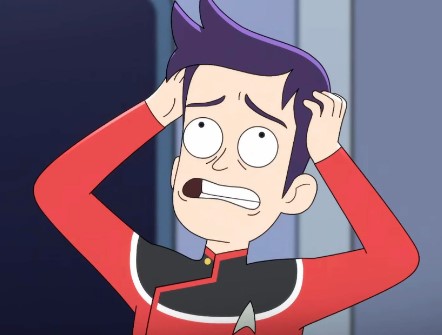
And then there’s Beckett Mariner. From the beginning of episode one she seems to be the most stereotypical of the crew – she’s got a bad attitude, a distaste for authority, and it’s implied that she’s been around much longer than the other ensigns, constantly sabotaging her own career and getting busted down in rank. At the end of episode one we even learn that the only reason she’s even on the Cerritos is that Captain Freeman is her mother, and the only one left in the fleet who’ll give her a chance.
Holy crap, does Mariner grow.

Over four seasons we watch as she builds bonds of loyalty with the other ensigns and restores her relationship with Freeman. Her attempts to sink her career are themselves sunk when it turns out that her superior officer, Ransom, has true faith in her and won’t allow her to ruin her life any further. And then, towards the end of season four, we actually learn why she’s been so self-destructive. She’s been suffering from years of survivor’s guilt over the death of a friend, someone who died as an ensign, and who she doesn’t want to surpass. The realization is made all the more powerful when we realize the friend in question is also OUR friend, TNG character Sito Jaxa, who only appeared in two episodes but left a powerful impact before her tragic death in the episode…wait, lemme look it up…
Aw, you clever goose, Mike McMahan. Sito died in the Star Trek: The Next Generation episode “Lower Decks.”

With the way each of these characters has grown and evolved, even being promoted from ensigns to Junior Grade Lieutenants this season, it has become increasingly clear that Mike McMahan lied to everybody when he said that this was the show about the least-important crew members on the least-important ship in the fleet. Far from it – this show is about people able to start from nothing, find their purpose, find themselves, find each other, and become more than they ever imagined, even if nobody else in the galaxy believes they have what it takes. The least important officers? Oh no. This series is the origin story of the next legendary Star Trek crew.
And yet, in all that, the show has never stopped being funny as hell.
If you decided to not watch Lower Decks because it was a cartoon or a comedy, all I can say, my friends, is that you were wrong to do so. If you watched an episode and said it wasn’t for you, can I recommend you jump ahead to the season one finale and give it a try? Because that’s when the show really begins finding itself and starts the transformation into the sublime work of storytelling that it actually is.
Lower Decks isn’t “good for a Star Trek parody.” It’s not even “good Star Trek.”
It’s GREAT Star Trek.
And I’ll follow the heroes of the Cerritos – I BELIEVE in the heroes of the Cerritos – with all the passion and fervor that I devoted to the Enterprise or station Deep Space Nine.
McMahan caused a little bit of a stir a few weeks ago when he said on Twitter that the show’s future is not secured past the upcoming season five, and fans panicked with the belief that it was being canceled. He had to come back a few days later and clarify: he wasn’t saying he’s been told the show is on the chopping block, just that he doesn’t KNOW yet if it will be renewed beyond season five. But the best way to keep it going, in this age of streaming, is to keep watching it and keep talking about it on social media, because the guys with the checkbooks actually do pay attention to that sort of thing. So check it out and let Paramount+ know how much you love it.
It’s already prospering. Now let’s help it live long.

Blake M. Petit is a writer, teacher, and dad from Ama, Louisiana. His current writing project is the superhero adventure series Other People’s Heroes: Little Stars, a new episode of which is available every Wednesday on Amazon’s Kindle Vella platform. 2800 words about this show and he didn’t even get around to talking about what a great addition T’Lyn was in season four.







 Blake M. Petit