Geek Punditry #160: The Difficulty of a Kingamatic Universe

“Hey,” one of my students whispers to the kid sitting next to him. “He’s reading It.”

And I smile.

On the wall in my classroom is a small whiteboard. At the top of the board is written “What is Mr. Petit reading?” Underneath, I regularly update the board with the title and author of whatever book has most recently been removed from my To-Be-Read pile and is actually in the process of being read. Currently, that book is Stephen King’s It. I’ve had that board up for a few years now, and I update it whenever I begin a new book, and having it visible has led to lots of really great questions such as “Are you still reading that one?” and “How many books do you read, anyway?”

“Not to put too fine a point on it, but I read more books yesterday than some people in here will read in their entire lives. Please don’t take that as a challenge.”

Occasionally, though, the board can lead to an actual conversation if a student happens to have read the book, is curious about it, or didn’t know that a book even existed (for properties they’re only familiar with as movies, such as Ready Player One). It is the book currently on the board, and it’ll probably stay there for a little while, because even for Stephen King, it’s kinda long. Some students are horrified when I tell them that I’m reading a book that’s in the ballpark of 1100 pages. They are even more baffled when I tell them that this is not the first time I’ve read it. I don’t recall, honestly, if this is the third or fourth time I’ve taken this particular trip to Derry, Maine, but I know exactly when the LAST time I read it was – it was late August and early September of 2017, and I remember it because it happened to be the book I was reading the week my son was born. I recall sitting there, scrolling through the pages on my tablet as Erin and Eddie slept, each of them rather exhausted after recently undergoing the most dramatic moving day in the history of a human being. 

Don’t worry, I didn’t whip out my book and start reading as soon as the kid popped out – this was some time later, as we had to stay in the hospital a little while as they treated him for some blessedly minor things that prevented us from going home for about five days. If you’ve ever spent time in the hospital, no matter how serious the condition may be, you’ll know that after a few days you start crawling up the walls if you don’t have something to do. My something was to visit with my friends in the Losers Club.
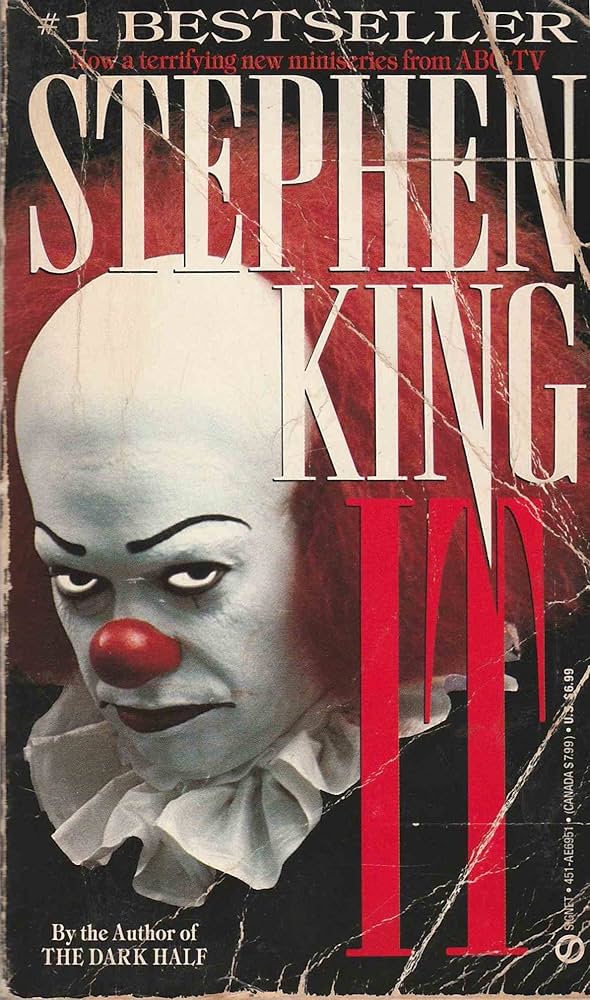
In retrospect, this may not have been the best choice for a new father’s reading material.

The specific reason I started reading It again this week, though, is because I finished the first season of HBO’s TV series Welcome to Derry, a prequel to the film adaptations of the novel from 2017 and 2019. The series is produced by Andy Muschietti, who directed the films and half the episodes of the show as well.  I thoroughly enjoyed the series, and it made me thirst to go back and revisit the source material again. As I’m reading it, I’m noticing the little bits and pieces, the tidbits the writers and showrunners planted in the show that help build out the world with water from the original font. 

To be clear, this TV series is a prequel to the MOVIES, not the book. There are some important differences that prevent it from working as an adaptation of the novel, chiefly the time period. The original novel is set in two eras: 1958 (when the protagonists are children) and 1985 (when they return to Derry as adults to finish what they started). The creature they do battle with has a cycle of about 27 years in hibernation, after which it returns to wreak havoc on Derry once again. 1985 was contemporary when the book was written, but Muschietti decided to keep the story set in the “present” when the films were released, meaning the events were shifted to 1989 (for the kid portions) and 2016 (for the adult portions). Welcome to Derry details the previous cycle of It in 1962. The point is that the movie universe cannot fit the timeline of the book universe, and that’s honestly not a bad thing.
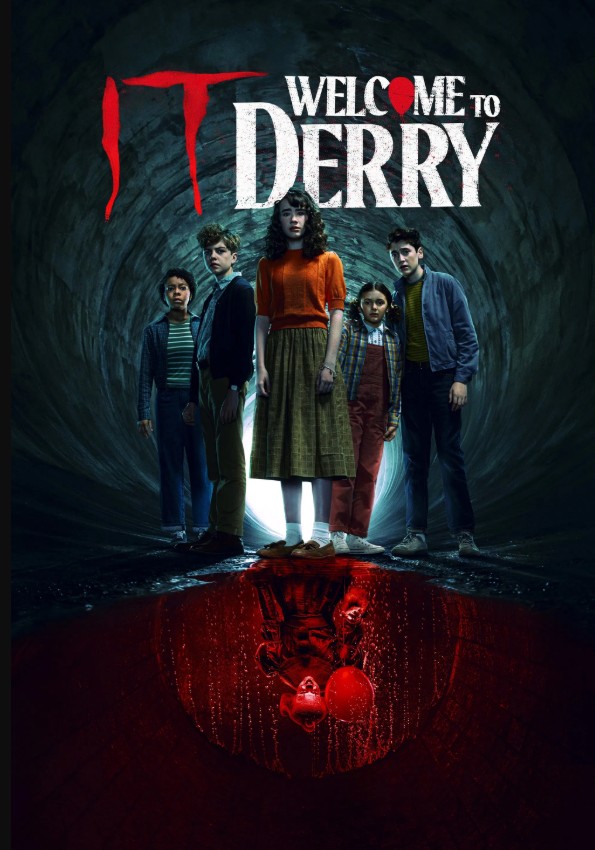
People who saw the show know just what a dirty trick this poster is.

Since the show, from the outset, cannot be a direct prequel to the novel, Muschietti and the writers are playing a little more fast and loose with the story, while still paying respect to it. For example, in the original novel Veronica Grogan is the name of one of the countless victims of Pennywise during the monster’s 1958 cycle. The TV show elevates her to one of the main characters fighting against the clown in the generation BEFORE the Losers’ first encounter with the monster. The names of many other characters from the book are peppered throughout the show, some of them characters mentioned in the novel, others with names that imply (and in a few cases, make abundantly clear) that they are relatives or ancestors of characters from the original in this version of the story. 

But the connections to the works of Stephen King don’t end with elements strictly from It. At one point, a character is sent to Shawshank Prison, the setting of King’s classic novella (and its classic movie adaptation) The Shawshank Redemption. Shawshank is frequently referenced in King’s Maine-centric stories, which is to say a little more than half of them, so it’s not a surprise when it turns up here. An even bigger link, though, is the character Dick Halloran. Halloran is one of the principal characters in his novel The Shining, which was written before It, and the original novel reveals that he was somehow involved in the tragically violent events that concluded a previous cycle of It. Welcome to Derry expands upon that, showing those events in full and giving Halloran a much more significant role. What’s more, they don’t even stop there, referencing elements of Halloran’s character that come neither from It OR The Shining, but rather from the latter’s sequel, Doctor Sleep. 

“Honestly, we’re just glad somebody remembered we were here.”

What I’m getting at here is that Welcome to Derry feels like it’s inching closer and closer to something that Stephen King fans have wanted to see for a very long time: a true cinematic universe.

Yeah, we’re going to that well again. Marvel has its cinematic universe. DC is on take two. We’ve got one for Star Wars and John Wick and even horror franchises like The Conjuring. But the thing you need to remember is that none of these franchises INVENTED the idea of a shared universe. It’s been around for a very long time. William Faulkner linked several of his novels and short stories together via the inhabitants of the fictional Yoknapatawpha County, Mississippi. James Joyce’s Dublin serves as the backdrop for several of his stories and, inasmuch as it’s possible to understand anything Joyce wrote, several of them link together. And King, much like many other contemporary writers, delights in dropping in Easter Eggs, hints, clues, and references that tie his various stories to one another. 

Now not ALL of his stories can be said to definitively take place in the same universe. The Stand, for example, is a novel about a virus that kills most of the population of the world, which clearly precludes most of his later works from being set in the same universe. Cell isn’t exactly a zombie story, but it’s close enough that this world is incompatible with most of King’s other work. And it’s hard to reconcile the bleak, horrific vision of the afterlife from Revival with several of his other stories which feature good, even friendly ghosts on occasion, such as Bag of Bones. Then there are the Stephen King books that explicitly reference other King books – or their movie adaptations – as fiction. That’s a bit of a roadblock.

On the other hand, King himself has provided us with a handy device that can explain away any discrepancy via his Dark Tower series: a multiverse. The Tower itself is a sort of central hub around which all reality converges, and that includes many different worlds and dimensions that are similar to, but distinct from, one another. The Dark Tower provides links not only to It and The Stand, but to multiple other books and short stories. And lots of the other stories he’s written drop in casual references that remind us that yes, their universe is one of the countless that are connected to the Tower. 

If ever there was a scene that MUST be committed to film, it’s this.

So all that said, why HAVEN’T we gotten a proper Stephen King cinematic universe before? The biggest obstacle, frankly, is licensing. King’s first novel, Carrie, was published in 1974, and he’s been turning out book after book and story after story since then. The most recent count I can find credits him with 67 novels and novellas and over 200 short stories over his 52-year career, and he’s been selling off the rights to them to different players all along. I don’t begrudge the man this – Lord knows I wish I could get that kind of payday – but the result is that the film and television rights to his works are all over the place. Dozens of studios and even individual filmmakers own bits and pieces of him, and getting all of them together to play nice and collaborate seems like a pretty impossible prospect. It’s the same reason that Marvel characters didn’t start meeting each other on screen until Marvel Comics stopped selling the rights to anybody who offered them twelve dollars and half a Fruit Roll-Up and started making the movies themselves. 

It’s not like King isn’t still a significant player in the entertainment game. People who don’t follow him may think of his work primarily as the grist for a huge slate of horror movies from the 1980s, but they’ve been coming out regularly since then – and they’re not all horror. 2025 brought us no less than four big-screen adaptations of his work: The Monkey (which turned a straight horror short story into kind of a bizarre black comedy), The Life of Chuck (a beautiful and faithful adaptation of a semi-fantasy by director Mike Flanagan), and two adaptations of books he wrote under his Richard Bachman alias, The Long Walk and The Running Man. These last two are both dystopian science fiction rather than horror, but they’re radically different from one another, despite the fact that they both have the same hook of characters competing in a lethal game in the hopes of a life-changing prize. But while The Long Walk is a dark, nihilistic societal commentary, The Running Man is a slam-bang action film. 

There have been attempts in the past to create a sort of King universe. Most notably, in 2018 Hulu produced Castle Rock, a series “inspired” by elements from a great number of King’s various works and set in that OTHER town in Maine that seems like it must be a nightmare to actually live in. The show was okay and it lasted two seasons, but I don’t think it actually gave fans what they wanted: a world in which the stories they love (or at least versions of those stories) could coexist. In Castle Rock, it was more like they took chunks of King’s books – characters, names, places – and pieced them together into something different. That’s a legitimate storytelling technique, of course. Mike Flanagan did it with Edgar Allan Poe for his exquisite miniseries version of Fall of the House of Usher. But it wasn’t quite what we were looking for.

In Welcome to Derry, the events of the two It movies are canonical, and the things we’ve seen so far make it quite easy to link that world with The Shawshank Redemption and the Shining/Doctor Sleep duet – if not exactly the movies we’re familiar with, then at least some version of those events. All of those movies, it should be pointed out, were released by Warner Bros., which is no doubt why they could play with those toys so easily. The show has not officially been renewed for a second season, but it has achieved real critical acclaim (although, typical for a streaming service, we have no idea what its numbers are), and Muschietti has been quite vocal about his plans for the next two seasons of the show. Future seasons would tell stories of two earlier iterations of the It cycle, in 1935 and 1908. This, I think, would be the perfect opportunity to build out the universe and add more parts of the Stephen King world. In fact, I think in some ways it would be almost REQUIRED to do that.

I loved season one of Welcome to Derry. The story was tense and compelling, the performances were great, and even though King wasn’t directly involved, the new characters all felt like the sort of characters that we get attached to in his books – ordinary people who get swept up in something far beyond their comprehension. If there is one legitimate complaint about the show, though, it’s probably that about half of the plot (the half that focuses on the child protagonists rather than the adults) is a bit TOO similar to the original It: a bunch of outcast children band together to stand against the evil of Pennywise the Clown. If we’re going to do another two seasons, they can’t just be two still-earlier stories about kids teaming up and fighting the monster. They need to bring something else to the table.

Andy Muschietti, I think, has proven himself an able enough storyteller that he is no doubt aware of this fact. The way he’s talking, it seems like he already knows what the story will be in 1935 and 1908. What I’m hoping is that he finds ways to tie in to other King stories. Could there potentially be references to John Coffey or the other characters from The Green Mile (set in 1932 in the novel, but it wouldn’t be outlandish of them to drag it forward in the timeline a few years)? Could we see the immortal vampires of ‘Salem’s Lot or the origins of the mysterious government project called “The Shop” from books like Firestarter? All of these, of course, would depend on rights issues in various ways, but I don’t think any of them are impossible either. 

Then there’s The Dark Tower itself, the rights to which currently reside with the previously mentioned Mike Flanagan. There was an earlier attempt to put the story of Roland of Gilead to film, a 2017 movie that foolishly tried to condense seven novels (all but one of which fall into doorstopper territory) into a 90-minute feature, and fans were not pleased. Flanagan, who already has several well-received King adaptations under his belt, has expressed the desire to use The Dark Tower for a television series of about five seasons, with a pair of movies to conclude the story. This is a much smarter approach to the material, and Flanagan has proven himself time and again to be someone perfectly suited to bringing Stephen King’s stories to life. 
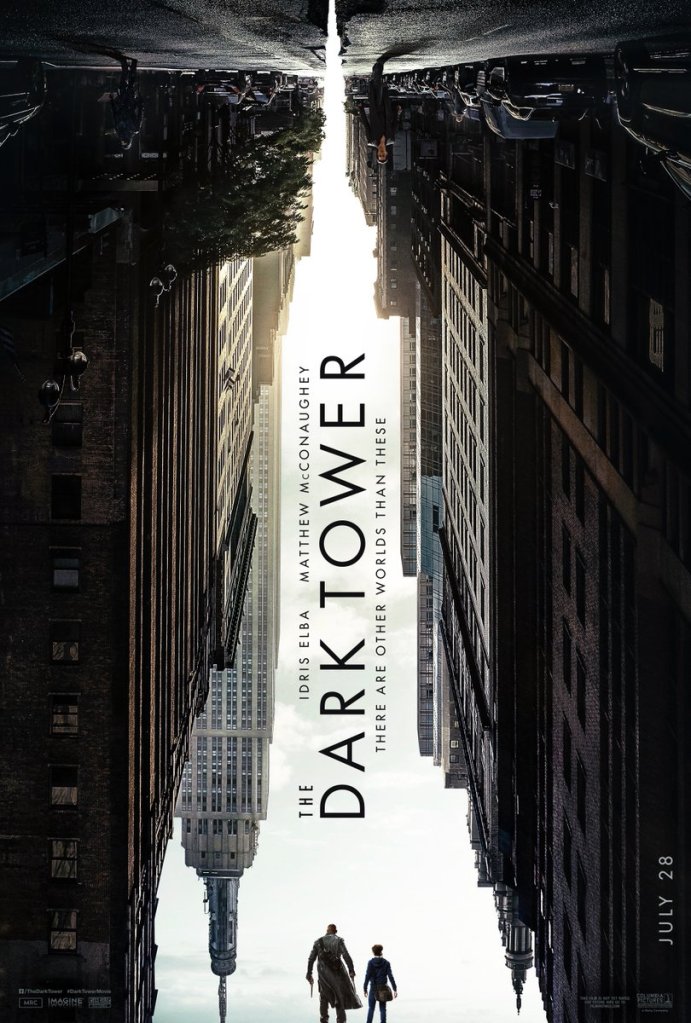
This…was NOT perfectly suited.

The optimal version of this, for me at least, would be for Flanagan’s Dark Tower to share fabric with Muschietti’s series. Characters common to both projects could be played by the same actors, the stories could be woven in concert with one another – separate, but linked. Could it happen? Well, Warner Bros. owns the rights to It and Welcome to Derry, so for this to happen, Flanagan would have to produce his series in cooperation with Warner Bros. It’s not out of the question. His previous development deal with Netflix is over, and his current deal with Amazon does not include The Dark Tower. He could take the story anywhere he wants. And he’s got a relationship with Warner Bros. as well – he directed their adaptation of Doctor Sleep and wrote the upcoming Clayface movie from DC Studios, which coincidentally, is ALSO in the Andy Muschietti business, as he’s been signed to direct their upcoming Batman movie, Brave and the Bold.

I’m not saying that this will happen. I’m not saying that Flanagan and Muschietti and Stephen King and Warner Bros. will join forces and finally begin to create the Kingamatic Universe that Constant Readers have been craving for the better part of five decades.

I’m not saying it’s going to happen.

I’m just saying it would be pretty damn cool.

Blake M. Petit is a writer, teacher, and dad from Ama, Louisiana. His most recent writing project is the superhero adventure series Other People’s Heroes: Little Stars, volume one of which is now available on Amazon. You can subscribe to his newsletter by clicking right here. He’s also started putting his LitReel videos on TikTok. He also hopes that somewhere in there they find a way to tell us what happened to the Girl Who Loved Tom Gordon…specifically, does she still love Tom Gordon, or has she moved on to – say – Shohei Ohtani?
Geek Punditry #78: In the Name of the Faithful

I think the movie Holes is pretty good.

I know, it’s unusual for me to kick off one of these columns with something so overtly political, but bear with me here.

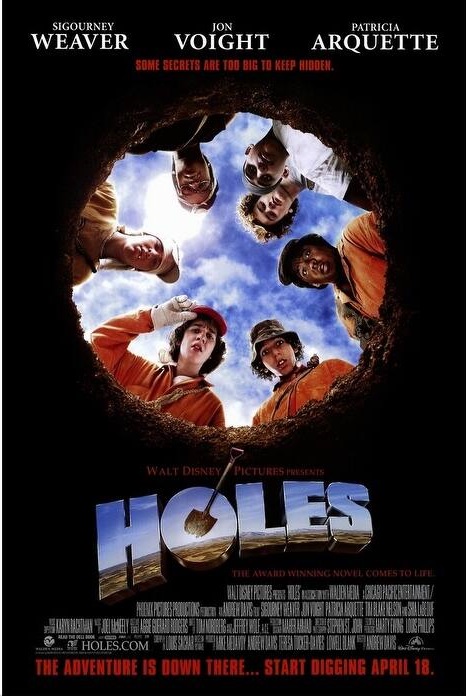
Holes, which came out in 2003, is an adaptation of Louis Sachar’s young adult novel of the same name. The story is about a kid named Stanley Yelnats who is falsely accused of stealing a pair of very expensive celebrity shoes from a charity auction and sentenced to 18 months at a juvenile detention facility called Camp Green Lake. As it turns out there’s nothing green about the camp, nor is there a lake there anymore – just the desert remains of a dried lakebed where the detainees are forced to dig five-foot holes day after day in an effort to “build their character.” The film bounces around three different timelines: Stanley’s story is intercut with that of his great-great-grandfather, who accidentally brought a curse down on five generations of his family, and the origin story of a brutal outlaw named “Kissin’” Kate Barlow, who terrorized the Green Lake community a century ago. 

Trigger warning: may offend people with holes.

I remembered enjoying the movie when it first came out, but a few days ago I watched it for the first time in several years and I was really impressed by how tightly plotted the film is. Even with juggling three timelines there is virtually no fat in the plot. Everything in the story turns out to be significant in the end, either to revealing the truth about the two timelines that take place in the past or to bringing the storyline of the present day to a satisfying conclusion. It’s a really good movie, and I’m not even kidding when I say that screenwriters could do worse than to study it when it comes to learning how to put a story together.

Part of the reason for the tightness of the story, I think, is because the screenplay was written by Louis Sachar himself, adapting his own novel. True, sometimes when this happens the original writer can be a tad too precious about keeping their favorite bits or not understand the necessities of adaptation, but Sachar did a stellar job. However, as I often do when I watch a movie I really enjoy, I spent a little time online afterwards looking into the history of the film and learned something I hadn’t known before: Sachar’s script was NOT the first attempt to adapt the book. The first attempt at adapting the story was written by Richard Kelly, who is probably best known as the writer and director of Donnie Darko, which film scholars among you will recognize as being one of the last movies one would think about when drawing comparisons to Holes. Furthermore, that Kelly script – as it turns out – is freely available online, and I clicked on it to take a look.

The beloved children’s classic reimagined by…this guy.

Kelly’s version begins with a narrator described as an “elderly voice” saying – and I swear, I am transcribing this verbatim: “Once…when it was still early in the twenty-first century…there existed a prison in a sea of sand.”

Holy crap.

It continues. 

“All signs of life in this place had been destroyed by something terrible…and that something had dried up into the earth…and the earth was a prison for all mankind.”

HOLY.

CRAP.

Had Kelly even read the book?

Incidentally, the ellipses you’re seeing in these passages were there originally, I didn’t omit anything. This is HOW IT IS WRITTEN.

At this point I saved the link so I could go back and read it later, because something this completely bonkers has to be examined slowly, carefully. When Stanley “Kramer” shows up later on the page, the narrator continues by telling us “He did not feel sorry for what he had done…but feeling sorrow is not adequate punishment for such a crime. Feeling sorrow does not absolve the crime from the memory of the victims…if the victims are still breathing.”

Was Kelly even aware of the fact that there is a book?

Adaptations are not a new art form, guys. The Greeks borrowed from existing myths and legends when they invented modern theater. Virtually all of Shakespeare’s most famous plays are based on history, mythology, or earlier poetry that he expanded in his own way. The Lego Movie was based on the works of Eudora Welty. So it’s not that I have any objection to adapting a work from one medium to another. But at SOME point, it seems like someone has to ask the question: if I’m changing the story this much, is it even still really an adaptation?

Change is inevitable when changing from one medium to another, and for any of a thousand reasons. In The Hunger Games, for instance, the novel is written from the first-person point of view of Katniss Everdeen and is heavily loaded with her internal monologue. This is difficult to do well in a movie, and thus the information we learn in monologue – whether it’s plot-driven or character-driven – has to be imparted to the audience in a different way. Sometimes the changes are pragmatic. Back to Holes for a moment – in the novel, Stanley begins the story as a fat boy who gradually loses weight due to the physical labor he’s forced to undergo. The filmmakers decided to drop this and cast the relatively slim Shia LaBoeuf under the reasoning that it would be too difficult to make a 14-year-old actor gain and lose weight so drastically over the course of filming, not to mention potentially dangerous to his health. That is a 100 percent acceptable change. 

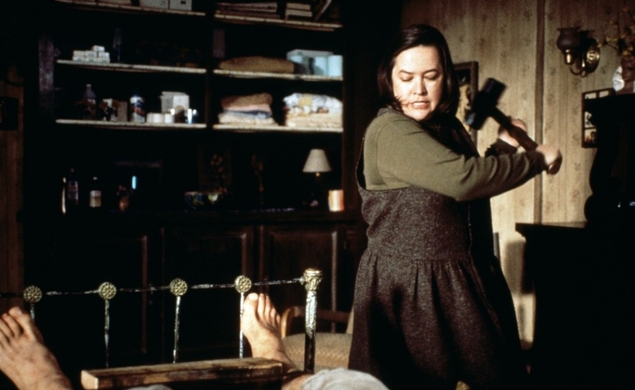
Sometimes changes are just a matter of understanding what the audience can handle. I’ll give you two examples from Stephen King. Cujo is a book about a mother and her child trapped in an increasingly hot car by a violent and rabid St. Bernard. In the book – spoiler alert here for a 43-year-old novel – the child dies of heatstroke. But in the movie, the filmmakers let the kid live, thinking his death would be too much for the audience. There’s a similar change in the film version of Misery, about a writer who gets in a terrible car accident and is rescued by his “biggest fan,” who turns out to be a deranged lunatic. In the book, to prevent Paul Sheldon from escaping, the insane Annie Wilkes cuts off his feet. If that sentence shocked you it’s probably because you are more familiar with the famous scene in the movie, where she “only” hobbles him by breaking his ankles with a sledgehammer. Reportedly, the producers felt like audiences would never forgive the actress, Kathy Bates, if she went so far as to actually cut his feet off. And if you think that audiences are smart enough to know the difference between the actor and the behavior of their character, look up the way “fans” treated Anna Gunn for the things Skyler White did on Breaking Bad.

If social media had existed in 1990, Kathy Bates might still be in hiding for this.

When it comes to these changes, the filmmakers chose to lessen the tragedy of the book. I don’t think that we’re saying that book readers are more accepting of gore or death than people who watch movies, though. I think the lesson here is that it is more difficult – more disturbing – to watch certain tragedies than to read about them. On the other hand, there’s the adaptation of King’s novella The Mist, which is a book with an ambiguous ending. The film, however, goes in the OPPOSITE direction, making the ending OVERTLY tragic. In this case, though, making the ending far worse than the original actually works. Stephen King himself has reportedly said he prefers the ending of the movie to the that of the story he wrote. 

Time is also a big factor when it comes to adaptation. If you’re adapting a doorstopper novel, especially into a film intended for theatrical distribution, it’s virtually impossible to squeeze in everything. Lord of the Rings fans have elevated the absence of Tom Bombadil from the film version of the beloved trilogy to meme status. To a lesser degree, the same is true for the Scouring of the Shire. As much as I appreciate those sequences in the book, though, when we’re talking about movies that already have a running time that’s longer than the first marriages of certain people I went to college with, I can forgive Peter Jackson for laying those pieces aside.

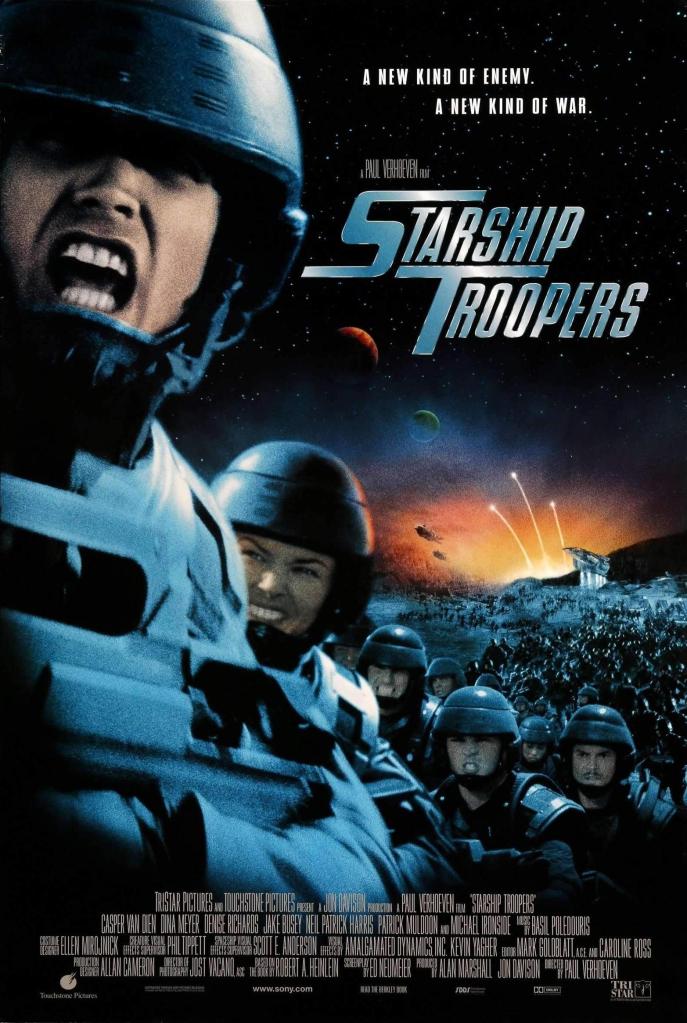
Changes from one medium to another are a necessity, because no two types of storytelling have exactly the same requirements or demands. I don’t mind changes, provided that making the change does not alter or pervert the spirit or intent of the original work, and here’s where I’m going to piss some people off, because Starship Troopers. It’s one of those movies that flopped when it came out but has grown a devoted following in recent years. That seems to happen a lot – something people disliked when it came out is rediscovered years later and lauded or, conversely, something that was once popular is hit with backlash and people suddenly declare that they never thought it was that good in the first place and they only saw it in the theaters 27 times “ironically.” I don’t do that a lot, honestly. I’ve certainly reevaluated movies after the fact, sometimes enjoying them more, sometimes less, but I don’t think I’ve ever done a complete 180 on a film. Which brings us back to Starship Troopers. 

My friends, I’m here to tell ya that I thought it sucked then and I think it sucks now. 

I’m going to pause here so the type of person who writes angry responses without bothering to read my point can write an angry response without bothering to read my point.

Fans of the movie praise Paul Verhoeven for making a witty sci-fi anti-war satire, a movie in which the entire human military is thinly painted as Nazis in training. However, none of this is applicable to the book, which is most certainly not anti-war, nor is it in the practice of making the humans into the bad guys. In fact, the book – which I should admit I was already a fan of before the movie was made – isn’t really plot-driven at all, but is more of an examination of the life of a soldier in a hypothetical science fiction future. The war against the insectoid aliens is there, but it’s more of a backdrop, a way of examining the world that author Robert Heinlein created. It’s no surprise, then, to find out that Verhoeven admittedly never even finished reading the book, finding it too “boring” and “militaristic.” 

Sir, I must say this: if you can’t even finish reading the source material of an adaptation, I submit that you are not the right person to adapt it. 

Here’s the thing, folks: I have no objection to Verhoeven making an anti-war movie, or a satire, or a movie in which humans are thinly-disguised bad guys. This is his right as a filmmaker, and there are plenty of good movies that do just this. I do, however, have a strong objection to him doing so by trading in on a novel by Robert Heinlein which is none of those things. I simply don’t think it’s fair, either to readers of the novel or to Heinlein himself, and in disputes of this nature I’m pretty much always going to side with the original author’s intent. If Verhoven had made a virtually identical movie, changing the names and calling it something like Spaceship Soldiers instead, we would not be having this conversation right now…but it’s also possible that we wouldn’t be talking about the movie AT ALL, that without the connection to Heinlein, the film would have been forgotten entirely.

It’s not a question of which of these men I agree with more, it’s a question of whether it is ethically right of Verhoven to use Heinlein’s story to espouse views that Heinlein’s story clearly disagreed with. Personally, I don’t think it is. I know that this is an area in which a lot of people will disagree with me. Hell, maybe Heinlein himself would disagree with me. But I ask you this: Arlo Guthrie’s 18-minute song “Alice’s Restaurant,” which was essentially a protest against the Vietnam war, was made into a similarly anti-war film. Had Guthrie not been involved in the film, but rather it was made by somebody else who painted Guthrie’s character as a fool and his protest against the war as misguided, would that have been fair to Guthrie?

What I’m getting at, friends, is this: if you’re a fan of Starship Troopers, is your acceptance of the adaptation process based on which political viewpoint you agree with? If that’s the case, I’m afraid that we will not be able to meet halfway on this one, and I hope that we can still be friends and that you’ll still come back next week when I’m writing about how awesome the theme from DuckTales is or something.

Adapting a story from one medium to another should be done for one of two reasons. First, if it is an exceptionally good story and you want to retell it for a different audience. Great! Do it! But if it IS an exceptionally good story, then why do you want to change it?

The second, more cynical reason, is because the story is popular, and you’re hoping to make money by appealing to the pre-existing audience. Okay, I can live with that. But if the story IS already popular and has a pre-existing audience, WHY DO YOU WANT TO CHANGE IT?

The answer, by the way, is because writers can be a vain bunch (yes, I am including myself in that number) and a good number cannot resist the urge to put their own stamp on something. This is what Richard Kelly did (remember him?) in his Holes adaptation. He wasn’t writing an adaptation of Louis Sachar’s novel Holes, he was writing a Richard Kelly movie that was vaguely suggested by a novel by Louis Sachar. And for a fan of Louis Sachar’s novel, that would have been MASSIVELY disappointing. 

But writers do this anyway, because for some people it’s more important that something is “theirs” than it is that they treat the source material faithfully. Sometimes that means they’ve created a brand-new breakout character, like the people who gave us Scrappy Doo. Sometimes that means “updating” a story for a whole new audience, the way the smash hit film Barb Wire “updated” the story of Casablanca to become beloved by the ages. And sometimes it’s because the author is just trying to trade on somebody else’s work to spread their own message to the masses, which makes me wonder how strong a storyteller you actually are if you can’t get your message out without borrowing somebody else’s name.

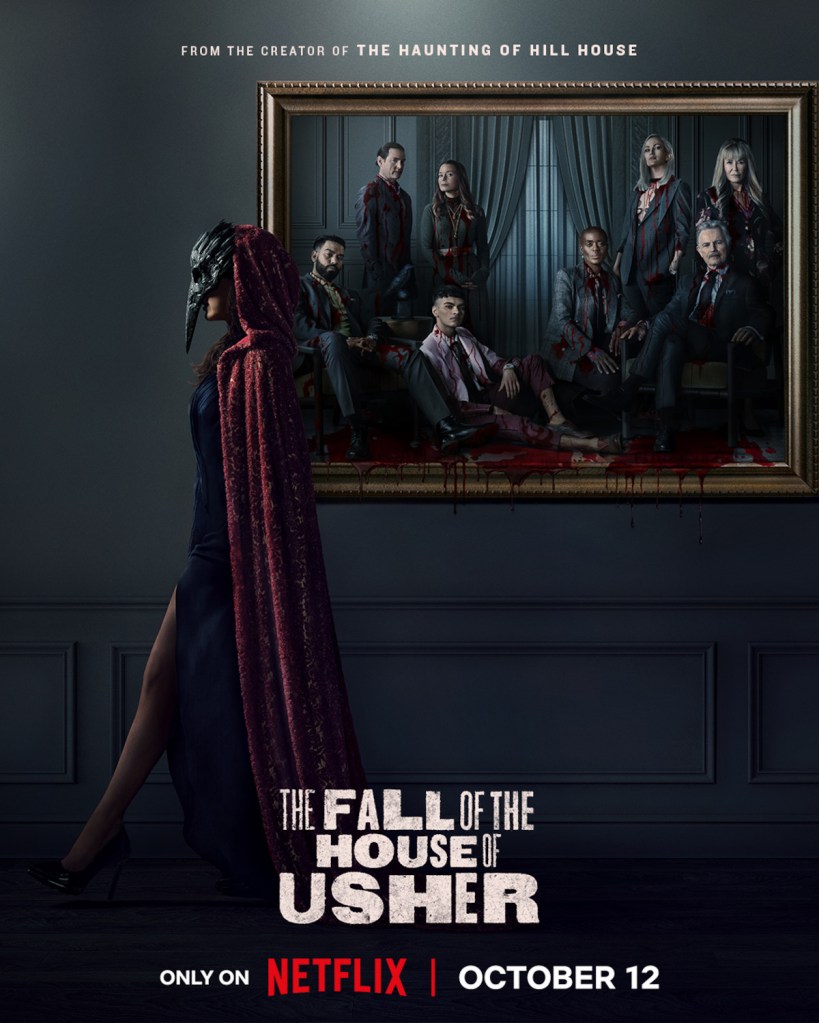
I’m not saying it’s impossible to do a complete re-imagining of a work and do it well. The Netflix miniseries Fall of the House of Usher is an excellent example. Writer/director Mike Flanagan didn’t even TRY to do a straight adaptation of Edgar Allan Poe’s short story. Instead, what he did was grab bits and pieces of dozens of DIFFERENT Poe stories and reassemble them into something totally original and unique. It was as if he had gotten his hands on ten different Edgar Allan Poe Lego kits, threw away the instructions, and used the bricks to create his own thing. It was fantastic, and is one of the projects I point to when I say that Flanagan is, in fact, the right man to adapt Stephen King’s The Dark Tower if anyone ever has the guts to give him the money to do it. But he didn’t do it by twisting or changing Poe’s work into something unrecognizable. Quite the opposite – he did something that was totally his and slipped in recognizable elements to help us see the larger picture. 

Definitely the weirdest Lego movie.

Then there’s the wild movie that actually gets its name from the process we’re talking about, Adaptation, which is ostensibly an adaptation of Susan Orlean’s nonfiction book The Orchid Thief. The book is a portrait of a horticulturalist who was arrested for poaching flowers, but that’s not the movie screenwriter Charlie Kaufman wrote. Instead, he wrote a movie about how he (Kaufman himself, as a character in the movie) struggled with adapting the book. He fictionalizes Orlean and John Leroche, the subject of the book, and creates a fictional twin brother for himself – both Charlie and “Donald” Kaufman are played by Nicolas Cage in one of those movies that earns him his reputation of doing kind of insane movies. Orlean herself was understandably taken aback when she read the script, but in more recent interviews has said she’s come around and now loves the movie, which was in no way a literal adaptation of her work but still successfully communicated the book’s themes of longing and obsession. Also there’s a car chase.

Most adaptations, I think, usually fall somewhere in-between the highly faithful Holes and the bonkers left turns of Adaptation. I always point to The Wizard of Oz here – most people’s version of Oz is the one we saw in 1939, the Judy Garland movie that has become a legitimate cultural classic. It’s a lovely movie, it’s beautifully filmed, and the music is timeless. As an adaptation, though, it’s mid. The film leaves out lots of sequences from the book, compresses two good witches into one (making Glinda seem like kind of a jerk for not telling Dorothy that the Ruby Slippers could send her home at the beginning, whereas in the original book those are two entirely different witches and the first apparently doesn’t know), and changes a few things – most egregiously the ending, which implies that Dorothy’s journey to Oz was just a dream. This is not at all suggested by the book, but the ending of the film has become so iconic that it’s inspired a thousand other “all just a dream” endings, which – speaking as a writer – is a crime I consider only slightly worse than lighting an orphanage full of puppies on fire and chaining the doors on your way out. But even then, the sense of wonder and awe that the film gives us DOES successfully communicate the wonder and awe of the book, and for that reason I can still love it. 

A good adaptation has the potential to breathe new life into an existing work. A bad one, though, has the power to choke a work to death. If it ever comes down to a choice between one or the other, I know which side I’m going to be on.

Blake M. Petit is a writer, teacher, and dad from Ama, Louisiana. His most recent writing project is the superhero adventure series Other People’s Heroes: Little Stars, volume one of which is now available on Amazon. You can subscribe to his newsletter by clicking right here. He’s not kidding about the theme from DuckTales, you know. As TV themes go, he dares you to name more of a banger.