Week eight of my Year of Superman was another one that kind of went all over the place. I revisited a few classic stories, checked in on a couple of “imaginary” tales, and looked at some of the more recent releases as well…then there’s that Christmas podcast. Don’t worry, I make it make sense.

Wed., Feb. 19
Comics: Power Girl Vol. 3 #16-17

Notes: After a busy day without much time to read, I went to my bag of recent comics that I haven’t gotten around to reading yet to see if there was any Superman-related content to include this week. Not surprisingly, there wasn’t much, but I found that I hadn’t yet read issues #16 and 17 of the current Power Girl series. This is a Superman family book, of course, but it comes to Superman via a sort of tangent. Power Girl (for those who may not know) was the Kara Zor-L of the old Earth-2, from the pre-Crisis DC Universe. She made her way to the current DCU, after various multiversal crises and reboots, and for years they’ve struggled a little to figure out exactly where she fits in. In essence, she’s an older version of Supergirl from an alternate reality – part of the family, but with trouble finding her identity.
Issue #16, the first of the two that I read, is the end of a recent storyline where Power Girl is facing someone called Ejecta. Ejecta, as a villain, hasn’t really grabbed me, but I do like the end of the fight where Power Girl takes her to the Fortress of Solitude and makes a point of what it takes for a Kryptonian like her to fight the good fight, that it’s actually harder NOT to kill their enemies. It’s a concept that makes so much logical sense, but doesn’t really come up all that often.
I like issue #17 better. It kicks off a new storyline, beginning with Power Girl and her best friend Lilith (aka Omen of the Titans) moving into a new place along with Natasha Irons, niece of my old buddy John Henry, who happens to share his Steel identity. Also on board is Streaky the Super-Cat and Power Girl’s boyfriend, Axel, who happens to be from Asgard. That would be a really weird sentence if I was writing about anything but a superhero universe, but there you go. While I’ve found this series to be somewhat uneven at points, I’ve enjoyed the way Leah Williams has assembled a solid supporting cast for Power Girl that feels pretty organic for the most part. I know why these characters are all together, and I like it.
The one thing I’m really NOT wild about is how Power Girl has abandoned her old identity of Karen Starr in favor of a new name, Paige Stetler, but call her Peej. Get it? “Peej?” P.G.? AAAAAH? I dunno, the book has never done a good job of convincing us that the switch was necessary or based on anything other than the internet not liking the name “Karen,” and the whole “P.G.” thing is just a bit too twee for my tastes.
Thur., Feb. 20
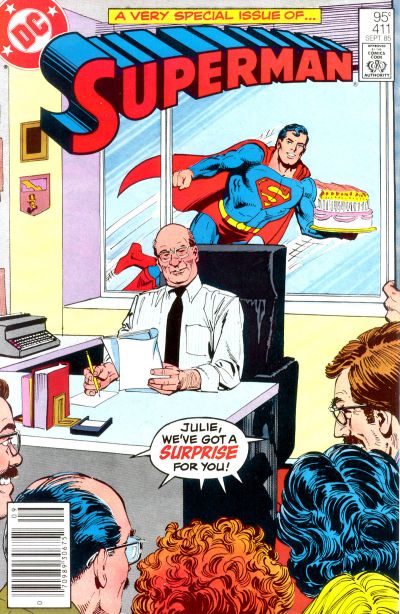
Comic: Superman #411
Notes: Another busy day and another somewhat random choice, I decided to read the classic Superman #411 today. This is an odd little issue that I’ve always found rather charming. Perry White’s old friend, the incredible editor Julius Schwartz, is in trouble, and his only salvation may come from Earth-Prime.
Julie Schwartz was, of course, one of the most prominent comic book editors of all time, with runs on various books that lasted years and even decades, including a long tenure on the Superman comics. This comic was produced as a surprise for Schwartz on the occasion of his 70th birthday, created behind his back and released as a surprise, even splitting up a three-part storyline to do it. The story in and of itself is standard for the time, even if it was not – as promised – “The Last Earth-Prime” story, but I’ve always appreciated this comic for the backstory behind it.
Fri., Feb. 21
Comic: Action Comics #314, Superman #149

Notes: When I was doing my research to prepare for “Superman Vs. the Flash” week, Action Comics #314 kept turning up in my searches. And although it didn’t really fit into the criteria of what I was looking for in that project, it was such a bizarre story that I kept it on my list of books to read when I’m looking for a random Superman comic, because it’s just so strange. And I LIKE strange.
First of all, despite the cover, this is NOT an issue about Superman ONLY becoming the Flash, but rather about alternate worlds in which he became five different members of the Justice League…sort of. While swimming around the bottom of the ocean – y’know, like you do – Aquaman uncovers a message for Superman sent to Earth from his father, Jor-El. On the recorded message (it’s interesting to note that the vastly advanced civilization of Krypton still used magnetic tape to record things) Jor-El tells his son that he originally considered several different worlds to send him to before choosing Earth, and presents him with a computer simulation of what his life would have been like on each of those five worlds. I’ll save you from the suspense: on these different worlds he would have grown up to be their versions of the Atom, Aquaman, Green Arrow, Batman, and finally, the Flash.
Each of these different lives has its charm, although I think my favorite has to be the first one, where he’s an Atom expy. In this version, Jor-El sent him to a planet of giants where he lived among them as what appears to be a three-inch visitor from another world. He’s still got powers, though, and he uses them to fight crime, wearing a mask. WEARING A MASK. SO THAT NO ONE WILL SUSPECT HE’S THE ONLY OTHER THREE-INCH PERSON ON THE PLANET. It’s such a hellaciously preposterous idea that it could only have worked in the Silver Age – and make no mistake, it worked. One person actually says, “He’s as small as Kal-El…but it can’t be Kal-El, for this one has terrific powers!”
For real.
This is a silly story, but a fun one. There was a point where DC did lots of stories like this, “what if X happened?”, with the conceit usually being that the heroes were told the stories of their other lives by computer simulations or some other means. (There was a whole series of stories about Dick Grayson growing up to become Batman II and taking Bruce Wayne Jr. as his Robin, which eventually turned out to be fanfiction written by Alfred.) Later these would become “imaginary” stories, and eventually the concept evolved into Elseworlds. If this story were told today, each of these different lives would be assigned a different number and said to take place somewhere in the DC Multiverse, and while I do like a good Multiverse story, there’s a charm about the old days, where the stories were a bit simpler. It does, however, give me a thirst to read more such tales. I think it’s safe to say that more Elseworlds and Imaginary Stories will be coming to the Year of Superman in the future.
The back-up story in this issue – as was usually the case at the time – starred Supergirl. Her Kryptonian parents, Zor-El and Allura, had been revealed at this point to be alive and sent to live in the bottled city of Kandor, but Allura is growing ill with heartbreak over the separation from her daughter. You’d think Kara could visit more often. Anyway, they send word of Allura’s condition to Kara, but she’s away on a mission and it is instead received by her foster parents, the Danvers, who decide that the only thing to do is make their adopted daughter decide to leave them and go back to her original parents in Kandor by acting like jerks.
WHY DIDN’T ANYBODY IN THE SILVER AGE JUST HAVE A CONVERSATION?
If you look at other stories from this time period, it’s not really that out of place. Watch virtually any comedy (and a good number of the dramas) from the 30s to the 50s and you see one cascade of misunderstandings after another, dozens of catastrophes that could have been averted and hearts that would have been left unbroken if only people were straightforward with one another instead of coming up with ridiculously convoluted schemes to manipulate their loved ones into doing things “for their own good.” I get WHY the stories were like this – a comic book where someone tells somebody the truth and the dilemma is resolved in a page and a half would be kind of boring. But I am very glad that – for the most part – we’ve moved beyond this kind of storytelling crutch. Ridiculous misunderstandings should remain the providence of Shakespeare and Fawlty Towers reruns. For anybody else, it’s just frustrating.
The story ends with Kara’s Earth parents and her Kryptonian parents swapping places, then a cliffhanger where we the readers are forced to question if this will be a permanent change. Once again, I’ll spare you the angst of wondering: it was not. Status quo was the king in comic books of the time, and permanent changes were as rare as diamond. Supergirl had already used hers up for the entire decade when she was adopted by the Danvers, putting an end to the stories of her life in Midvale Orphanage.

The main story, though, got me thinking about one of the two most famous “Imaginary” stories of all time…both of which, coincidentally, became “real” stories in the 90s (albeit in very different forms). Like I’ve said, I’ve pledged to read only two of the extended 90s storylines during this year, and the first of those is actually next on my list of 90s stories to revisit. So before I move on to the “real” Death of Superman, I thought today I would look back at the ORIGINAL Death of Superman, the “Imaginary Story” from Superman #149 in 1961.
The setup for this one is simplicity itself: prison inmate Lex Luthor discovers an element from outer space that allows him to invent a cure for cancer. Providing that cure to the world, he convinces everyone that he’s gone straight, including Superman. It’s all a ruse, though, and instead he sets up a trap for the Man of Steel. And for the first time, that trap succeeds, with Luthor slaying Superman with green kryptonite.
I’ve always liked this story and, revisiting it today, I’m struck by how unique it really is for Superman stories of the time. In an era where most stories were a bit silly and often overdramatic, this takes the opposite track. It still uses all the tropes of a Silver Age story, including misdirection and secrets kept when there’s really no reason to do so (Supergirl disguising herself as Superman for all of 12 seconds at the end, for example) but they’re put together in a somewhat bleak configuration. Unlike Marvel’s What If? comics, it was pretty rare for even DC’s imaginary stories to end in so dark a place. There’s no lie, no secret hidden from the audience, no last-minute reprieve that saves Superman: when this story ends he is most assuredly dead, and even though Luthor will spend the rest of eternity in the Phantom Zone for his crime, nothing is bringing him back. It’s unlike any other such story of the time, and that makes it remarkable.
Other Comics: World’s Finest Comics #304, Legion of Super-Heroes Vol. 2 #312 (Clark as Superboy)
Sat., Feb. 22
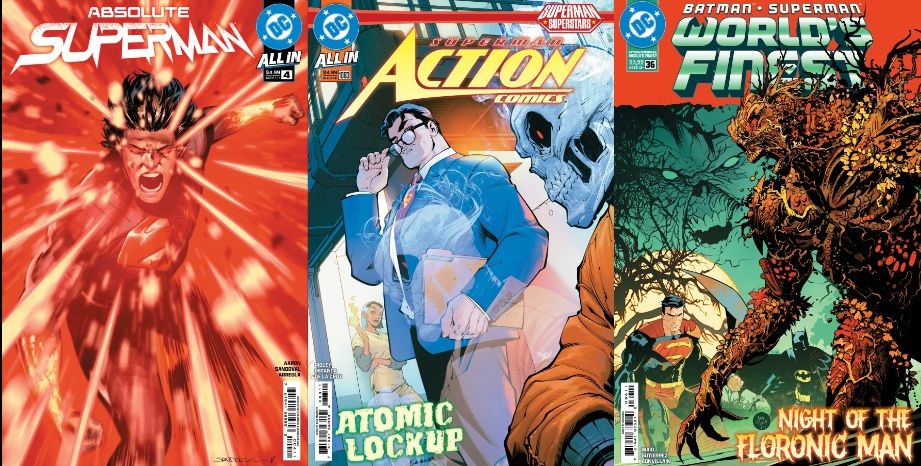
Comics: Absolute Superman #4, Action Comics #1083, Batman/Superman: World’s Finest #36
Notes: It’s been a few weeks since I made it into the comic shop to pick up my pulls, so today I’m hitting the new Superman comics that have come out since then. Absolute Superman #4 is more of a spotlight issue on Lois Lane, who in this new Absolute Universe is an agent of Lazarus rather than a reporter, although she’s still got her investigative skills, as in this issue we see her tracking down the elusive “Superman.” Good issue, and I’ve really enjoyed the Absolute stuff so far. Action Comics #1083 continues the Major Distaster/Atomic Skull storyline from last issue, which still isn’t a favorite of mine, but I do really like the scenes where Superman wakes up in the Batcave, where Bruce has brought him to recuperate after a fight with someone who could negate his powers knocks him for a loop. Mostly, though, I’m really looking forward to Mark Waid taking over this book full time this summer, as was recently announced.
Speaking of Waid, he also writes Batman/Superman: World’s Finest #36. It’s a grand story set in the past, including a team-up with Aquaman and Swamp Thing, plus Clark’s old girlfriend, Lori Lemaris. Lotta LL names in Superman’s life. I should go back and read her first story soon, it’s a good one.
Sun. Feb. 23
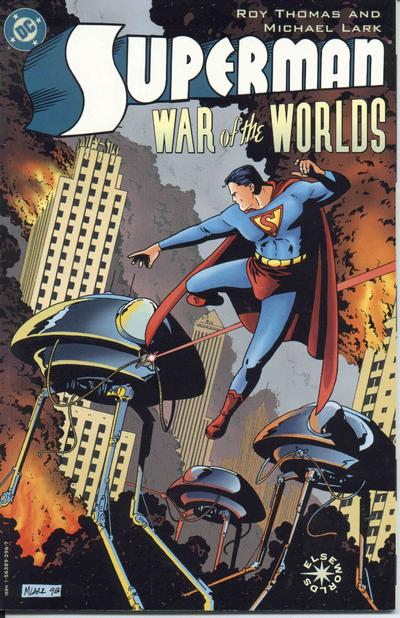
Comic: Superman: War of the Worlds #1
Notes: Still searching for random comics to fill in the gaps before I begin the next BIG project next week, my recent reading of “The Death of Superman” gave me a taste for more Elseworlds, and that led me back to this gem from 1998. Written by Roy Thomas with art by Michael Lark, Superman: War of the Worlds is a mashup of the original Golden Age Superman with the alien invaders from H.G. Welles’s classic novel.
Roy Thomas is probably the greatest Golden Age comic book writer who didn’t actually work in the Golden Age. But through his long and illustrious career, he turned out one story after another that paid tribute to that era, including DC’s All-Star Squadron and Marvel’s Invaders, among countless other projects. This one-shot is not only a quintessential Elseworlds, it’s also quintessential Thomas. The story plays out pretty much exactly like the Golden Age Superman we all know and love right up until the day he arrives in Metropolis and tries to land himself a job at the Daily Star (where Clark Kent originally worked before the Daily Planet became the home of our favorite reporters). On that same day, though, what is believed to be a meteor strike unleashes an invasion of tripod-piloting aliens from the planet Mars, here to devastate and take over our world.
Thomas simply does a perfect job of blending the two stories. The characters feel absolutely true to their Golden Age incarnations, while reacting to the story that adheres as closely to the Welles original as is practical. Lois Lane, for instance, is introduced when Clark gets to the Star, furious that the editor is about to give this newcomer off the street a chance at a major story while she’s been stuck scribbling a “Miss Lonelyhearts” type of column just because she’s a woman. Even in the Golden Age, Lois was someone who would always stand up for herself and never tolerate that kind of nonsense, and Thomas plays her up perfectly. I also really like the way they depict Lex Luthor, initially just a scientist investigating the alien meteor strike, but then turning collaborator when it seems that the aliens’ victory is inevitable.
Thomas layers in World War II parallels that fit perfectly with both of the properties that he marries in this book, and the end – although heartbreaking – is compelling and appropriate for the story being told. When we talk about Elseworlds, everybody points to books like Kingdom Come and Superman: Red Son, and with good reason. Those books are classics. But there are a lot of other gems that were produced as a result of that line that we don’t remember nearly as well, and that’s a shame. I’m definitely going to pepper the rest of this Year of Superman with visits to some of the ones that we’ve forgotten about.
Mon., Feb. 24

Comics: Superman Vs. Aliens #1-3
Notes: A few days ago at ComicsPro, it was announced that Marvel and DC Comics are planning two new crossover one-shots later this year, DC/Marvel and Marvel/DC. Stale naming conventions aside, I’m excited. There hasn’t been any crossover between the two publishers since JLA/Avengers twenty years ago, except for the collected omnibi that were released last year. I finished up reading the first one early in January, although I didn’t talk about them much here in the blog, and the knowledge that there’s more coming makes me want to hurry up and pencil in the second omnibus into my reading rotation soon.
But not today. Today I decided to look at a different Superman crossover, one with Dark Horse Comics, back when they had the Aliens license and were pairing them off with everybody and their cousin, like Ocean Spray finding new flavors to mix with cranberry. Superman Vs. Aliens was the first such story featuring our own Man of Steel, and written as it was by Dan Jurgens, it fit into the Superman comics of the time better than a lot of these crossovers do. This is the era when Lex Luthor isn’t running LexCorp anymore, when Lois and Clark are engaged but not married yet, and when Supergirl was not a Kryptonian, but rather the Matrix shapeshifter from an alternate Earth.
The story kicks off when an alien probe plummets to Earth, a craft with markings that Superman recognizes as being Kryptonian. The probe leads Superman to a distant city floating through space under a dome. Once there, the distance from a yellow sun causes his powers to begin to dwindle, even as he finds himself partnered with one of the city’s few remaining survivors, a girl named Kara, as they face the menace of the Xenomorphs. The story was so deliberately reminiscent of the original Supergirl that it was almost as if Dan Jurgens and DC were trolling us, and for years after this book was released there were rumors that Kara would return to the regular Superman titles, but it never happened. As it turned out in the end, this Argo wasn’t actually a Kryptonian city after all, but from another planet which suffered a similar fate as Krypton and learned about its language and culture from the Cleric, a character from the earlier Exile storyline.
Jurgens finds a few ways to really make the story an interesting character piece for Superman. First of all, they need to reduce his powers to actually make the Xenomorphs a threat. Second, he treats Kara like long-lost family, and in a time where there were no other surviving Kryptonians in the DC Universe, it’s an impactful event, even if it only lasted for three issues. We’ve also got Dr. Kimble on the LexCorp station doing a darn good impression of Paul Reiser’s character from Aliens, while Xenomorphs are running wild on the station and Lois is trying to hold them off.
But I think the best thing about this story, the thing that really shows the contrast between the two franchises, is how heavily Jurgens leans on Superman’s no-killing policy. It was a policy he broke exactly once, in the pocket universe that Matrix originally came from, and doing so nearly destroyed him. (I’ll have to look at that story before this year is over.) Having him face off against the Xenomorphs is fun – they are literally killing machines. They have no function other than death, and historically speaking, the only way to stop them is to kill them FIRST. But Superman refuses to do that. If there’s even a chance that these creatures may be sentient, he refuses to use lethal force. Some people would call that naive, but it’s a fundamental element of the character, and it’s the thing that makes this so different from so many other Aliens stories where the focus is to nuke them all from orbit. (It’s the only way to be sure.)
I remember when this story came out, how excited I was for it, and although the status quo of Superman’s universe has changed a lot over the years, I’m glad to see that it still holds up.
Other Comics: Superman #7
Podcast: Totally Rad Christmas, Episode, “Superman (w/Tim Babb)”
Notes: A few years ago, my brother introduced me to the Totally Rad Christmas podcast, a podcast that is – in the words of host Gerry D – “about all things Christmas in the 80s.” However, Gerry isn’t particularly strict about that requirement. They often have episodes about Christmas movies and specials from outside of the 80s, as well as other things that Gerry associates with Christmas and just feels like waxing nostalgic. For instance, Superman was released on Dec. 15, 1978, and that’s enough to get it on the show. This episode was released back in 2020, but I’d never listened to it before, so this seemed like a good excuse to dust it off. Gerry and his guest for the episode, Tim Babb, discuss the film itself and – as is common for this podcast – their personal memories surrounding the film from childhood. As someone who has watched this movie countless times and who lives, eats, and breathes Superman, it’s actually nice to listen to a couple of guys who are FANS, but perhaps not the fanatic that I can be in my more eager moments. I don’t know if I would hunt this episode down as a Superman fan if I weren’t already a listener of this podcast, but as someone who’s already a fan, the overlap on this particular Venn Diagram is pleasing to me.
Tues., Feb. 25

Comic: Superman #257
Notes: Sometimes you just choose by cover. You scroll through the DC app, looking at the issues available and, for one reason or another, something jumps out at you. This one, for instance – Superman in the woods with two children. He’s calming them down, assuring him that there’s nobody around to harm them, but in a cutaway view underground we see a guy in armor with green skin and what looks like some sort of science fiction bazooka about to blast the ground right out from underneath him. They say you’re not supposed to judge a book by its cover, and that’s probably true, but a good one is sure as hell more likely to get you to pick it up.
The story in question isn’t quite as engaging. An alien has come to Earth hoping to steal our nitrogen using the “bazooka” from the cover – which he calls a war-horn – to create a variety of effects. Superman fights him, as per usual, but the alien’s military code refuses to allow him to concede defeat unless killed in battle. Superman winds up tricking the war-horn into leaving the planet by attempting to strike a fatal blow, which it automatically avoids and retreats, which to me seems antithetical to the whole military code aforementioned.
The main story isn’t great, but the back-up in this issue IS. The story begins on the planet Oa, home of the Green Lantern Corps, where Lantern Tomar-Re is about to retire from active duty and join the Corps’ honor guard. Before he does so, though, the Guardians must reconcile the one failure on his record. Fans have long asked why the Green Lanterns didn’t do something to prevent the destruction of Krypton, and this issue answers that question: Krypton was in Tomar-Re’s sector, and the then-rookie GL failed to stop the planet’s doom. Tomar was tasked with collecting a rare element that would delay (but not stop) Krypton’s destruction, but a burst of yellow radiation left him blind and unable to save the world in time. His sight was restored just in time to witness Krypton’s explosion. The Guardians had been watching Krypton for some time, suspecting that the offspring of their scientist Jor-El and his wife Lara would create someone exceptional, a “titan among the stars.” Now, years later, the existence of Superman has proven their suspicion correct, and Tomar’s failure is forgiven.
Man, can you imagine being so important that they decide your existence is more important than your entire planet? That’d be a lot to live up to. Fortunately, Superman doesn’t have an ego about this sort of thing.
Okay, I’ve waited long enough. Tomorrow I’m going to start the big one, the saga that defined this character for so many. Be back next week for my thoughts on – at least the first stages of – The Death and Return of Superman.
Blake M. Petit is a writer, teacher, and dad from Ama, Louisiana. His most recent writing project is the superhero adventure series Other People’s Heroes: Little Stars, volume one of which is now available on Amazon. You can subscribe to his newsletter by clicking right here. You can join in the Kryptonian Konversation every day in the Year of Superman Facebook Group!
 Blake M. Petit