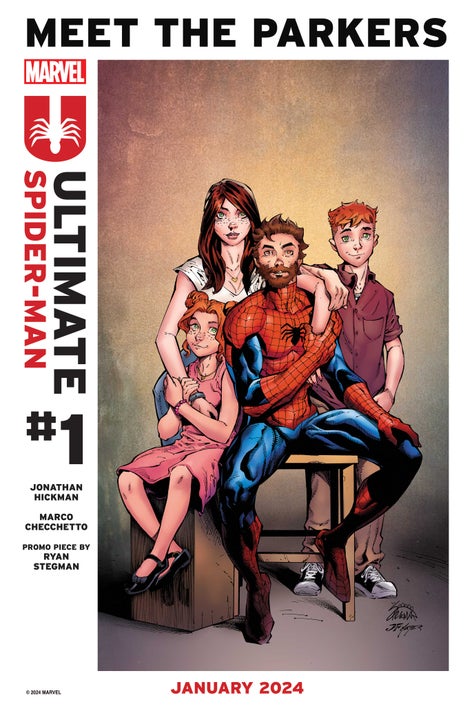
Last week in a shocking announcement, Marvel Comics revealed it will be publishing a new Spider-Man series in which Peter Parker and Mary Jane Watson are (hold your horses, folks) – married.
I know, that’s probably a total stunner to you, possibly because you think it’s impossible to tell compelling stories with a married couple. Perhaps it’s even MORE shocking when you find out that they will have children, because as we all know, anybody who is married or a parent is clearly too old to be an engaging protagonist. No, these characters are now either relegated to supporting roles as their offspring take over as the primary character, or they must be made the subject of a traumatic domino chain that is the emotional equivalent of watching all 10 Saw movies in immediate succession, possibly preceding it with The Human Centipede as an aperitif. After all, the only characters capable of maintaining an interesting narrative are young and have no familial attachments, with the possible exception of an aunt whose death is a foregone conclusion that may be teased and waved in front of our hero for years as an additional piece of mental torment.
It would only be logical if that were your reaction. After all, that’s been more or less the official stance of Marvel Comics for a couple of decades now.
Don’t you tell him his jokes are bad…”🎵
Okay, at this point I imagine the regular comic book readers out there are all nodding their heads in understanding, while those of you who only know Spider-Man as Tom Holland (or possibly Andrew Garfield or Tobey Maguire) are somewhat confused, so for the sake of that latter group, let me explain. First of all, the comic in question is a new version of Ultimate Spider-Man, written by Jonathan Hickman and explicitly set in an alternate universe than the mainstream Spider-Man. That’s right, thanks to the marvels of the multiverse, we can have that book coexisting with the “normal” Spider-Man, whose adventures will continue to be chronicled in The Amazing Spider-Man, where he remains childless, spouseless, joyless, and probably has had a puppy taken away from him in the last 15 minutes just to make sure he is constantly being beaten up by the universe.
The thing is, Peter Parker and Mary Jane Watson were married once, and for a long time. Their wedding took place in Amazing Spider-Man Annual #21, published in 1987, and it was the status quo for my formative years. I was a child when they married. I was a teenager when I read the books voraciously. And although I never once, in all that time, thought it was difficult to relate to a character who had a wife and stable family life, apparently former Marvel Comics Editor-In-Chief Joe Quesada disagreed with me. Quesada spent years after becoming Marvel’s EIC in 2000 teasing fans, talking about his distaste for the marriage and expressing his belief that it “aged” Spider-Man too much. Finally, after 20 years of having Peter and MJ as a married couple, Quesada gave us “One More Day,” a storyline in which Peter traded his marriage away to Mephisto, Marvel’s equivalent to Satan, in exchange for May Parker’s life.

This will require a little more explanation, so buckle up: the reason Aunt May’s life was in jeopardy in the first place was because of the Civil War storyline, written by Brian Michael Bendis. This was one of those crossover storylines that involved virtually every Marvel comic being published at the time, but a lack of communication among the other writers about what was actually going on made it a garbled mess. In this story some of the Marvel Heroes began supporting a “Superhero Registration Act,” requiring superheroes to register with the government or become outlaws. Despite nearly 40 years of stories showing heroes standing up against measures such as this, many characters sided with the Pro-Registration side, led by Iron Man, as opposed to the Anti-Registration side, fronted by Captain America.
Let’s take a moment to try to parse the fact that anybody – any damned person – in the Marvel Universe would for even a split second side with Iron Man over Captain America in any question of an ethical nature, let alone a question of government overreach. Let’s parse that.
Spider-Man, for reasons, took Iron Man’s side. Then, just to prove how much he agreed with the Pro-Registration side, he revealed his secret identity to the world. This proved how great Registering was, even though several books specifically said that nobody who registered would be forced to reveal their identities to the public. Even though it said that. Spider-Man did it anyway. To support the government.
Parse that too.
And then, after 40 years of stories demonstrating that superheroes revealing their identities to the world would put their loved ones at risk, Spider-Man’s revelation shockingly put his loved ones at risk, and May Parker was shot by a bad guy.
If only someone could have predicted such an outcome.
Finally, in order to save his aunt’s life – something that apparently was beyond medical science, the machinations of Dr. Strange, or even Disney’s in-staff physician Doc McStuffins – Peter cut a deal with Totally Not Satan: save May’s life and make everyone forget his secret identity. In exchange, Mephisto didn’t even want Pete’s soul. He just wanted to make everyone in the world forget that Peter and Mary Jane had ever been married. Even Peter and Mary Jane themselves. He wanted this for reasons.
If this whole story sounds unfathomably stupid to you there’s a good reason for it: it was. Even J. Michael Straczynski, the writer tasked writing with the story, tried to have his name taken off it. Although to be clear, he was still willing to write a story that would wipe out the marriage, he just thought this particular method of doing it was weak. I’m sure that his version would have been better, even if I personally find the planned outcome distasteful, because Straczynski is a great writer. And certain elements clearly COULD have worked, because the movies Captain America: Civil War and Spider-Man: No Way Home both borrowed select elements of that storyline and made great movies, disproving the old adage that you can’t polish a turd.
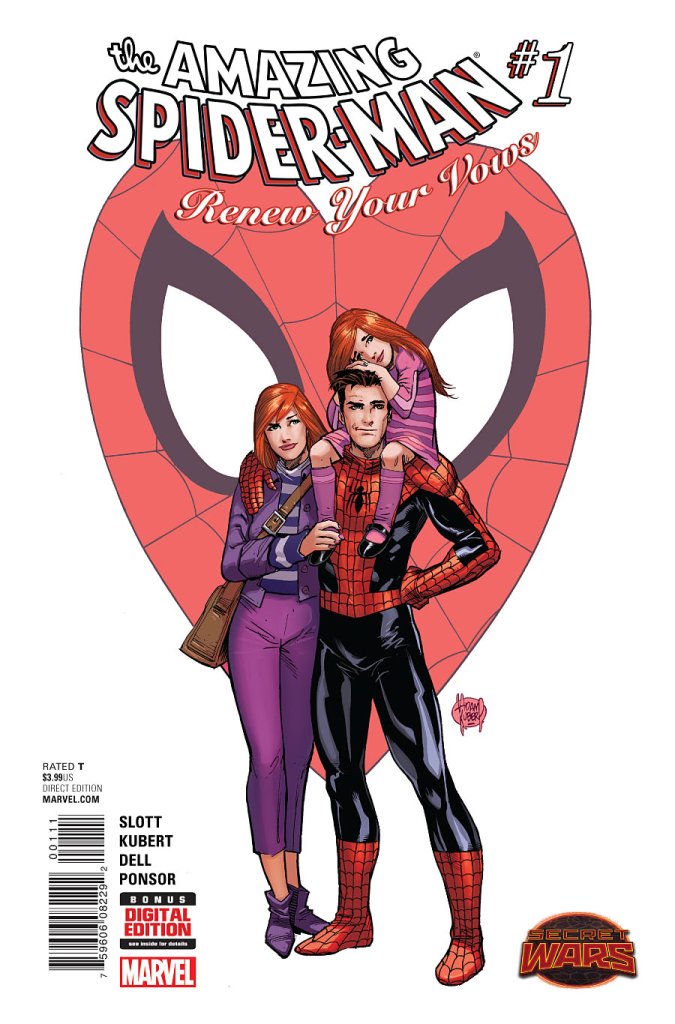
Anyway, fans were not happy, but Marvel has persevered with this new status quo. Over the years since then Peter and Mary Jane have been together and been apart, but the marriage has never been restored. Dan Slott, who wrote Spider-Man for a long time in this period, has said that people higher up the corporate chain than even Quesada (who is no longer with the company) don’t want Peter and Mary Jane to be married again, ever. And while that may be true, that just makes it crueler how often assorted writers have teased a reconciliation over the years. This teasing even included an earlier alternate reality series, Amazing Spider-Man: Renew Your Vows, which was good, but has been somewhat forgotten.
The most recent run of Amazing Spider-Man ended with Peter and Mary Jane together again (if not married) and it left them in a good place. Then came a new writer for the current run, which started with a six-month timeskip, everybody hating Spider-Man for reasons that went unexplained for a year, and Mary Jane having school-age children with another man. I stopped reading the book at this point, something I had only done once before: after “One More Day.” I have not returned, although I’ve read the explanation for everything we didn’t know in the timeskip, and the explanation this time is so egregiously stupid that it makes “One More Day” almost seem quaint by comparison.
I’m sorry if it sounds like I’m ranting, but this is important. Spider-Man is an iconic character, one that means a lot to a lot of people, including myself, and the way Marvel seems bound and determined to make him permanently miserable is, frankly, a source of real frustration to me. That’s why I was so excited when I heard about Hickman’s new Ultimate Spider-Man series. The fact that it’s set in a different universe is barely even significant at this point, as Multiverses now shoot out in pop culture like candy from a Pez dispenser. It’s a married Peter and MJ, something I have wanted to see return for 16 years. It would almost be hypocritical of me to not read this series.
Hickman is probably my favorite writer who has done consistent, long-running titles at Marvel in the past decade or more, but he’s never done a long run with Spider-Man before. Giving him the character, even as part of the new Ultimate Universe, is something that excites me. That doesn’t mean I expect the book to be all sunshine and rainbows – Hickman is too good a writer for that. But I am hoping for stories that use the dynamic of a family to tell compelling, interesting stories that use the family as part of the tapestry instead of viewing it as a nuisance that needs to be brushed aside.
But the existence of this book still doesn’t address the fundamental problem – this baffling notion that there are no good stories to be told with a family. DC Comics ran into a similar stumbling block with Superman and Lois Lane, who married in 1996 after nearly 60 years of courtship. (Pete and MJ had a comparatively brief 20 years before they tied the knot.) In 2011, as part of the “New 52” relaunch, the characters were made younger and the marriage was dissolved. It only took DC a few years to realize the mistake, though, as fans were vocal about preferring the Lois and Clark dynamic. DC eventually played along by not only restoring the marriage to canon, but by giving Lois and Clark a child, Jon.
Plenty of heroes have had long relationships. Barry Allen (the second Flash) and Iris West were together and married for quite some time before Iris’s death (which was later reversed). His protege Wally West, a character who had been around for about three years when Peter Parker was created, married Linda Park and they recently welcomed their third child. Both Flashes have had their relationships wax and wane and occasionally disappear via comic book-style reboots, but they’re back these days. (Well, Barry and Iris aren’t currently married, but they are together.) The first Flash, Jay Garrick, has similarly been married for decades, and DC even recently introduced his own daughter as part of a group of new characters who were previously “erased” from the timestream, opening up new avenues for storytelling. Elongated Man and Sue Dearbon-Dibney were a married couple for decades before falling into comic book limbo – and hey, DC, bring ‘em back. We love them. And of course, over in Marvel Comics we have Reed and Susan Richards, the prototypical comic book parents, with their children. They’ve been married for nearly 60 years now.

But the argument, I suppose, is that having a family makes a character seem “older,” and most of these previous characters I mentioned were already older than Spider-Man. Fair point, but my contention that new, exciting stories can still be told with them as married couples still stands. In fact, adding Jon Kent to the Superman mythos gave the characters a welcome new dynamic that produced some fantastic stories before Civil War’s Brian Michael Bendis took over the series and screwed it up. Wally West’s children are pretty much co-leads of his comic book, and his daughter Irey has even become besties with Maxine Baker, daughter of Wally’s sometime Justice League teammate Animal Man, yet another married superhero. And let’s not forget about Batman – while no one has got him down the aisle yet (he almost took that walk with Catwoman, but she bailed), he’s been a dad pretty much since he adopted the first Robin back in 1940. And in recent years, it’s been literal, with the addition of Damian Wayne to the family.
And the thing is, the Clark and Jon stories are nothing like the Bruce and Damian stories, and neither of those have anything in common with the stories about Wally and his kids Irey and Jai (or the newborn Wade). Because – here’s the shocking part – children are people. They’re not all identical. And when you put an interesting, developed individual into the mix with another interesting, developed individual, you’re going to get an interesting, developed story. This isn’t even counting the thousands of stories outside of comic books that have successfully told tales of parents with children.
But what about the other argument, that being married or a parent it makes it difficult for young readers to “relate” to Peter Parker? Let’s say that, just for a second, I actually believed that. (Spoiler: I don’t.) The thing is, there are two important factors that make that argument irrelevant.
First: the notion that an older Spider-Man might be a turnoff for young readers is dumb because there aren’t any younger readers. American comic books are in something of a crisis. Older readers have always drifted away, but in the past newer readers would come in and fill the void. That isn’t happening now, at least not in numbers significant enough to concern ourselves with. It’s absurd, because thanks to the success of Marvel Studios over the last decade and a half, Marvel characters are more popular than ever. But there has been approximately zero success at drawing in the kids watching those movies and getting them to read the comic books. Meanwhile, many of the strategies they’ve employed in an effort to get new readers (such as constant reboots or replacing classic characters with younger “legacy” versions) have only served to drive off the readers who have been around for years. It’s been a lose/lose situation, and comics have to admit that those “fixes” aren’t working before anything else they do is going to matter. This is a major problem in the industry, and it’s worth discussing, but preventing Spider-Man from growing as a character is not the solution.

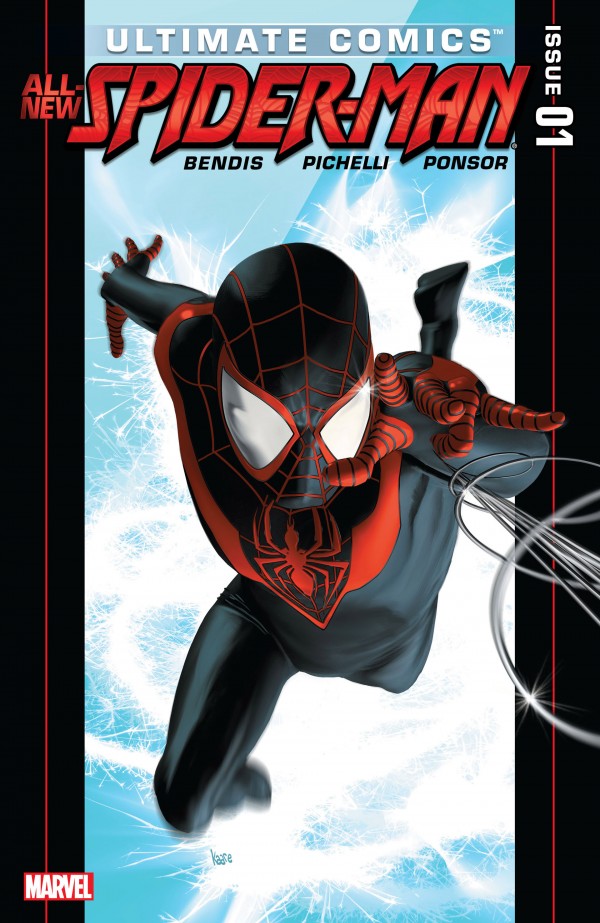
Second: if the goal actually is to have a Spider-Man that younger readers can relate to, MARVEL ALREADY HAS ONE AND HIS NAME IS MILES MORALES. Miles is one of the few new “legacy” characters that has actually taken off and found mainstream popularity, being the star of two incredibly successful and extremely well-made animated movies. Hell, Miles Morales’s first movie won the Oscar for best Animated Feature. If Marvel’s argument is “we need a young Spider-Man,” congratulations! You’ve got him! Do the “young guy” stories with Miles and stop torturing Peter by trying to force him back into a box he outgrew in the 1980s!
(In the interest of total fairness, I should point out that Miles Morales was co-created by Brian Michael Bendis.)
I no longer harbor any hope for the “mainstream” Peter Parker and Mary Jane actually getting a happy ending, at least not until the next editorial overhaul at Marvel. That’s the thing about comics, everything is cyclical. The people in charge now won’t be in charge forever, so if you’re unhappy with the direction of a book, there are two things you can do. Cross your fingers and hope the next creative team is better, and – far more importantly – stop buying it. And since there seems to be a Spider-Man on the horizon that does seem a better fit for my tastes, I choose to support that book, rather than the one that leaves a sour, spidery taste in my mouth.
Help us, Jonathan Hickman. You’re our only hope.
Blake M. Petit is a writer, teacher, and dad from Ama, Louisiana. His current writing project is the superhero adventure series Other People’s Heroes: Little Stars, a new episode of which is available every Wednesday on Amazon’s Kindle Vella platform. He realizes that he may have some of the behind-the-scenes details incorrect in his dissertation on comic book history, but in his defense, he’s never pretended to be a journalist in this column. Which frankly gives him far greater integrity than anybody working – for example – at the New York Times.
 Blake M. Petit