
Superman is often credited as being the “first superhero,” and as big a Superman fan as I am, I don’t know if I can necessarily agree with that. Admittedly, the word “superhero” didn’t exist before him, and there’s little doubt that the term borrowed the superlative from his name specifically, but when you think of the things that MAKE a superhero, there are definitely earlier examples. I started the year, if you’ll recall, reading Philip Wylie’s novel Gladiator, which many believe was an influence on Superman himself and definitely had several of the elements we attribute to Superman: superhuman powers that he kept a secret, which he attempted to use to do good (at least sometimes). Other elements, like the costume or the secret identity, could be found in characters that were around pre-Superman as well, such as Zorro or the Phantom. By most definitions of the term, there are a lot of characters prior to Action Comics #1 that you can rightly call a superhero.
That said, Superman is the character that first brought together most of these elements, and that started establishing “superhero” as a specific genre. Prior to Superman, and even after him for a while, characters that fit the bill of a superhero were considered an extension of other genres – adventure, science fiction, westerns, and so forth. In fact, I think that’s the reason that even now, you can select virtually any genre of storytelling and find an example of a superhero story that crosses over with it.
Once Superman was there, though, he became THE big name in the genre, and as such, he quickly became imitated. Some imitators just took the bare bones of the concept (costume, secret identity) and did something totally different with them, like Batman or Captain America. Later imitators would start to copy his powers and appearance with characters like the original Captain Marvel. Eventually, once the superhero genre was firmly established, we reached a point where kids who grew up reading them started to do their own twists on it, giving us characters that don’t even PRETEND they’re not a version of Superman. Sometimes they’re created for one-off stories or parodies, as in The Pro. Other times they’re populating an entire world of characters that pay tribute to earlier heroes, as we’ll see in a few of the books I read this week. In any case, these are the characters that we’re going to focus on this week: those heroes who are…almost Superman.
And as always, you can check out earlier blogs in the Year of Superman Archive!
Wed., Nov. 5
Comics: Invincible #1, Astro City #1
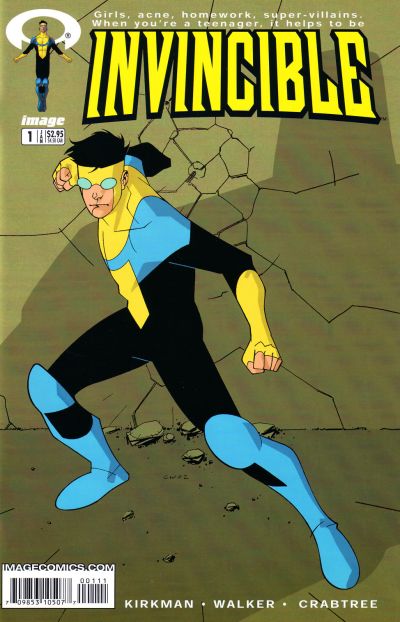
Notes: I’m going to kick off this week with two of my favorites. First up, Robert Kirkman’s Invincible. The first issue starts off with a bang – a young man in a black, blue, and yellow uniform flying through the air carrying someone with a bomb strapped to his chest. He throws the man into the air and the bomb explodes, killing the bearer (something, it should be noted, that Superman would never do) and the young hero expresses slight exasperation at his lot in life. Then the “how did we get here” flashback kicks in, introducing us (in the bathroom) to high schooler Mark Grayson. He’s going about his day, getting ready for school, attending class, going to work at a burger joint – when he accidentally hurls a sack of garbage into the stratosphere. He smiles and says “It’s about time.” Mark’s father, Nolan, is secretly Omni-Man, one of Earth’s mightiest heroes, and after years of waiting for it to happen Mark has finally inherited his dad’s powers. At school, Mark is unable to contain himself when he sees a kid getting bullied and steps in, nearly putting the assailant through a locker. Although the principal understands his actions, he cautions Mark not to get into fights with people so much bigger than him. “You’re not invincible,” he says.
He’s wrong, of course, and later on a bank robbery introduces Mark Grayson to the world with his new costume and his new name.
I’ve read the entire Invincible series, but I’m only dabbling in the first issue today (because there’s not time to read 143 of them). That said, like I did with Irredeemable in “Superman Gone Wrong” week, I’m going to talk about the broad scope of the series, complete with spoilers. If you’re watching the TV show and aren’t familiar with the comics, you may want to skip down to the next comic I’m reading today.
Invincible is an interesting way to start off this week. On the surface, of course, we’ve got Omni-Man, the obvious Superman analogue in Mark’s world, and it feels in this first issue that we’re reading about what it would be like to be the son of Superman. (This was in a pre-Jon Kent world.) In a few issues that’s all turned on its head with the big reveal of the series: Omni-Man, like Superman, is an alien hero sent to Earth. Unlike Superman, though, he is the point man for an invasion force, sent ahead to prepare Earth to one day be conquered by his people, the Viltrumites. When he learns about this, Mark turns on his father and, following a particularly graphic battle, Nolan flees Earth.
For a time, I considered using this book for “Superman Gone Wrong” week, since Nolan seems to fit that template perfectly. I decided to use it here instead, though, for two reasons. First, later in the series Nolan goes through a redemption arc, wins back his son’s trust, and joins him in the defense of Earth against their own people. And it’s a testament to the talent of Robert Kirkman that the redemption arc lands – eventually, the reader comes around to accepting Nolan as one of the good guys again, despite some of the terrible things he does early in the series.
The other reason I saved it for this week is because Omni-Man, although the clear Superman analogue, isn’t the actual star of the series, Invincible is. And Invincible is a different sort of character: Superman-like powers but with a tone that’s more evocative of Spider-Man. At least, that’s how it is at the beginning of the series. As it goes on, he sort of grows out of that template and becomes his own kind of thing, a character very different from either of his respective “parents,” and one of the few characters in modern times to break into the mainstream, thanks to that series on Prime Video.
And the show is very good, don’t get me wrong. But as is so often the case, I like the book better.
The other character I’m going to get into comes from one of my favorite series, from the first issue of that series, and from one of the finest comic books I’ve ever read: the Samaritan from the first issue of Kurt Busiek’s Astro City.

Coming off the wild success of Marvels, in which he and artist Alex Ross showed the Marvel Universe through the eyes of a bystander, Busiek launched Astro City in 1995. The idea this time is that the main character of the title is the city itself, a fully-realized world populated with superheroes and villains, many of whom are quite similar to those that we are familiar with. However, there’s no single anchor character – every issue or arc shifts perspective. Sometimes the main character is a hero, sometimes a villain, sometimes a loved one or a victim or a bystander. You never know quite what you’re going to get in any given issue of the book, and for that reason among any others, it’s one of my favorite comic book series of all time, and I eagerly anticipate its promised return.
The first issue, “In Dreams,” introduces us to the Samaritan, and it does so in a simple “day in the life” format. The Samaritan is woken up by an emergency alert early in the morning, popping him out of a dream in which he is flying. He suits up and rushes off to use his considerable powers to prevent a tidal wave in the Philippines from destroying a city, a trip that takes him 6.2 seconds from his hometown. As the day goes on, we see him take care of other assorted disasters, thwart assorted crimes and supervillain schemes, and have a meeting with the Honor Guard (if Samaritan is the Superman of this world, the Honor Guard is the Justice League or Avengers equivalent). We see him at work, as a fact-checker and proofreader for a magazine rather than a reporter. We also get a recap of his origin: he was sent back in time from a dying Earth to prevent the tragedy that led to its sad current state – the destruction of the space shuttle Challenger. In saving the world, the future he came from no longer existed, and he resigned himself to staying in the modern day and acting as one of Astro City’s superheroes. We see his life, and we see how incredibly lonely he is.
Throughout the issue, Busiek seeds little bits and pieces that begin to build the world of Astro City. We meet assorted other heroes and villains, get references to others. We learn that Honor Guard member MPH has an extraterrestrial nervous system for some reason, and learn a little of the story of a villain called the Living Nightmare. All of these little things make the world feel more lived in, and a lot of these little elements would pay off in later stories over the years.
The other thing that happens is that as Samaritan zips from each scene to the next, he keeps a running tally of how much time it takes to fly from one place to another. When he gets home that night, he calculates a total of 56 seconds of flight time for the day, “the best since March.” And then he goes back to sleep and resumes his dream of flight.
There are a lot of stories about Superman (or his copycats) that focus on the loneliness of the character, about how alienating it would be to be the last of your kind, to live in a world where there’s nobody else quite like you. That’s a legitimate take, of course. But too often, I find that stories that use this approach do so at the expense of Superman’s humanity. They treat him as an alien first, and to me, that misses the core of the character. Busiek’s Samaritan leans on the loneliness, but does so in a remarkably, beautifully human way. The story is sweet and sad and perfect, and it’s kept me a fan of the series ever since.
Both Invincible and Astro City are available in massive compendium editions (called “Metrobooks” in the case of Astro City) from Image Comics. If you’ve never read them, do it. There are few comics out there – besides Superman, of course – that I can give a higher recommendation to.
Thur., Nov. 6
Comics: Icon #1-3, New Adventures of Superboy #36, Blue Devil #4 (Guest Appearance), Justice League of America #37, DC KO: Knightfight #1 (Cameo)

Notes: When Milestone Comics was launched in 1993, an entire imprint of DC featuring characters and creators that were predominantly people of color, it was a pretty big deal. It shifted assumptions and preconceptions about how comics work and opened up the world of comics to audiences that would never have been interested before. Of course, like most storytelling experiments, it wouldn’t have worked if the stories being told weren’t actually GOOD. Fortunately, they were. And my favorite of the original line – this should surprise virtually no one – was Icon by Dwayne McDuffie and M.D. Bright.
The story opens in outer space in the year 1839, but in deep space, as we see an alien escape a doomed ship in an escape pod. The ship crashes to Earth and the alien shifts his form to imitate an infant form of the first Earth creature it encounters – who happens to be a slave in the American south. The alien takes the form of a human baby and is taken in by the woman who found him.
Time skips ahead to 1993, where the alien has been living on Earth for a century and a half under the guise of Augustus Freeman and his various similarly-named ancestors. Now living as Augustus IV, he’s become a highly successful lawyer in the city of Dakota, but finds himself dwelling on a recent encounter with a teenage girl. Raquel Ervin got drawn into some criminal activities with friends of hers who tried to rob Freeman’s house. When they ran into the man himself, he flew after them, shrugging off their bullets and warning them never to commit another crime. Raquel was astonished by what she saw and returned to Freeman later, urging him to use his powers to help people. She even designed a uniform for him and insisted she make him her sidekick, calling the two of them “Icon and Rocket.” Her words sway Freeman, and he gives her a belt to give her force field-based powers. They test out their new paradigm by responding to the news of a situation at city hall. Unfortunately, the cops don’t see a pair of heroes show up – just a strange pair of African-Americans in weird costumes, and they place them under arrest.
In issue two we get more information as to the situation: the mayor of Dakota has been taken hostage, and the cops were there to handle the situation, but the building is full of men with guns. The cops, with a unit called SHRED (Special Heavy-Equipment Rapid Emergency Deployment) are there to take the bad guys down, and they DON’T want help. Icon attempts to comply with the police request and explain themselves, but Rocket begins fighting the cops. Ico is stuck in the unenviable position of preventing Rocket from hurting the police and vice-versa. Once he gets Rocket to safety, he surrenders himself to the police to quell the situation, but he’s forced back into action by an explosion in city hall. He and Rocket save some of the police, then make it into City Hall where they learn that the man holding the Mayor hostage is one of the “Bang Babies,” people given powers by a strange gas during a recent event in some of the other Milestone titles, and he turns himself into a monster.
In issue three, Icon and Rocket face the monster – calling himself Payback, whose claws are capable of cutting Icon’s skin. Payback flees into the sewers and Rocket follows while Icon, injured, stays behind to clean up the rest of the human gunmen. He catches up to Rocket and Payback in time to hear the latter plead his case, how the mayor used the tear gas to prove she was “tough on crime” but wound up mutating innocent people. Icon promises that if he turns himself in, he will see to it that there’s an investigation into the “Big Bang” incident, and the people responsible will be held accountable. Bringing Payback in convinces the authorities that Icon and Rocket are on their side. At the end of the issue, though, he tells Rocket that she’s going to have to work from the sidelines for a while – with his super-senses he’s discovered something that she has not: Raquel is pregnant.
Such a great title. Amazing, unique characters and beautiful art made Icon stand out from other books on the stands, even from other Milestone titles. But that’s one of the things that made Milestone great – each title had a different perspective and point of view. Icon wasn’t like Static wasn’t like Hardware wasn’t like Blood Syndicate, and that was all to the good. What I particularly like about this title is the bait-and-switch, though. Icon is the title character. He’s the obvious Superman analogue. His powers, origin, and costume are all deliberately evocative of the man of steel. But it’s Raquel who’s actually the protagonist of this comic. She’s the main point-of-view character, she’s the one who starts Augustus on his journey, she’s the one who makes everything happen. And in fact, in the most recent iteration of the Milestone universe, they finally shared billing on their title: Icon and Rocket.
Like many of the books I’ve read so far this week (and it’s only Day Two) I find myself wanting to go back and read more. Maybe 2026 will have to be the Year of Characters Who Are An Awful Lot LIKE Superman.
Fri. Nov. 7
Comics: Love and Capes #1, DC Vs. Vampires: World War V #12 (Supergirl, Steel Appearance)
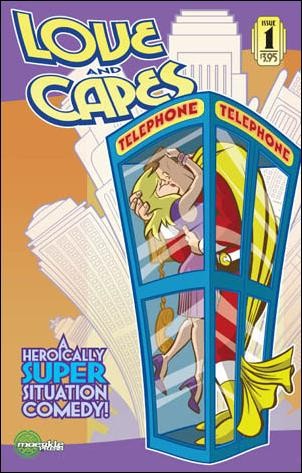
Notes: I don’t know if I’ve mentioned it lately, but I am a geek lucky enough to be married to another geek. My wife doesn’t share all of my geekdoms, nor I hers, and where there IS overlap they’re usually at different levels (she’s more into Star Wars, for instance, whereas I prefer Star Trek, but we watch ‘em both together). All that is to say that, as she isn’t AS big into comics as I am, she never lets me forget that she’s the one who first introduced me to Thom Zahler’s Love and Capes.
Mark Spencer is the Crusader, the big, strong, flying guy with the cape. He hangs out with a shadowy avenger of the night called Darkblade. He used to date a powerful warrior woman called Amazonia. And as we soon learn in issue #1 of this delightful series, he’s head-over-heels in love with a perfectly ordinary bookstore owner named Abby Tennyson. In this issue, Mark decides to tell his girlfriend that he loves her, but also, share with her the secret of his dual identity.
And thus begins the series that Zahler refers to as “a heroically super situation comedy.” Love and Capes is the superhero romcom you never knew you needed. While Abby isn’t exactly a Lois Lane, Mark is clearly his world’s Superman (down to the glasses he wears to protect his identity), and this first issue explores a lot of the questions that would naturally arise in any such a pairing. Once Abby learns his secret we see her struggle (and fail) to keep her sister from finding out, feel her bristle with insecurity when she learns that Mark and Amazonia used to date, and sit with her on the couch in quiet horror as she watches the Crusader fighting a supervillain on TV, realizing that she’s never seen him bleed before.
The wonderful thing about Love and Capes is just how naturally Zahler weaves the superhero story in with the kind of real life drama (and comedy) that comes in any relationship. Over the course of this series we see Abby deal with all sorts of things that would naturally come along with being a superhero’s girlfriend – evil doppelgangers, time-travel, meeting the rest of the superhero team and so forth. We also see Mark deal with simple, common relationship stuff, like trying to find time for one another when one of you is a workaholic, blending your friend groups, and ultimately (spoiler warning here) the challenges of marriage and parenthood.
Interestingly, Zahler leans away from the superheroics of the universe. Sure, we see Mark using his powers all the time, but we virtually never see any superhero fights or adventures, merely the aftermath, as the relationship between Mark and Abby is what’s actually important. That gives this series a perspective that completely sets it apart from every other not-quite-Superman on the market.
It’s only fair to admit that I’m an enormous fan of this book. In fact, for the Mark and Abby’s nuptials in issue #13, I took advantage of a “wedding” package Zahler made available to fans to get yourself drawn onto the wedding scene on the cover, so if you’ve got that issue, you can actually find me with (my then-girlfriend, now wife) Erin attending Mark and Abby’s wedding. What’s more, Zahler and I have struck up a friendly acquaintance over the years, and he even name-dropped me as the owner of a po-boy shop in New Orleans in his series Cupid’s Arrows. I say this not to brad, but to be quite clear that am not unbiased in my praise for this series.
But I hope you believe me when I tell you that I would be just as effusive a fan even if it weren’t for any personal connections we have. It’s just a sweet, lovely book, and every so often when he brings out a new miniseries or special, I’m as gleeful to pick it up as I was the first time.
Sat., Nov. 8
Comics: Adventures of Superman: Book of El #3, Absolute Superman #13
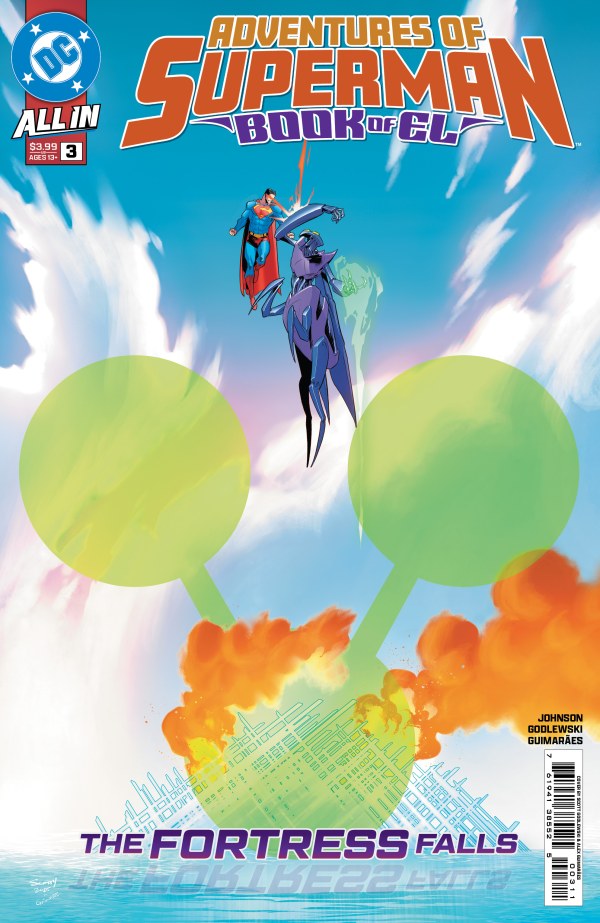
Notes: I’m going to hit this week’s new Superman comics today – only two of them, but they still count. And I’m starting with the third issue of Adventures of Superman: Book of El. Trapped in a future that believed him to be lost, Superman and his last descendant, Ronan Kent, return to the Fortress of Solitude to find a way home. Unfortunately, Brainiac’s legion is on his trail, and determined to keep him in this distant future instead of allowing him to go home and prevent this world from happening. There’s also a nice reveal at the end, a hope spot that’s subverted and sets the stage for the rest of this miniseries.
Reading this book is a little frustrating to me. I should like it. I honestly should. There are tons of little elements that work well – a time machine that looks like it was dropped out of H.G. Welles, a giant turtle Jimmy Olsen…and Phillip Kennedy Johnson completely understands the characterization of Superman. There’s a point where he tells Ronan “As long as you wear that symbol, your strength doesn’t belong to you. It belongs to those who NEED you.”
And yet somehow…I’m just not engaged. I think it’s the nature of the project – Superman is stuck in a future where he was lost. He wants to go home to prevent that future from happening. And since we know that DC isn’t going to allow him to stay in the future forever, his successful return is a foregone conclusion. It doesn’t matter how high the stakes get, in the end, it still feels so inconsequential. At least in an Elseworlds story you know that the consequences for THAT universe are real. I don’t get that here, and that’s dulling my enjoyment considerably.
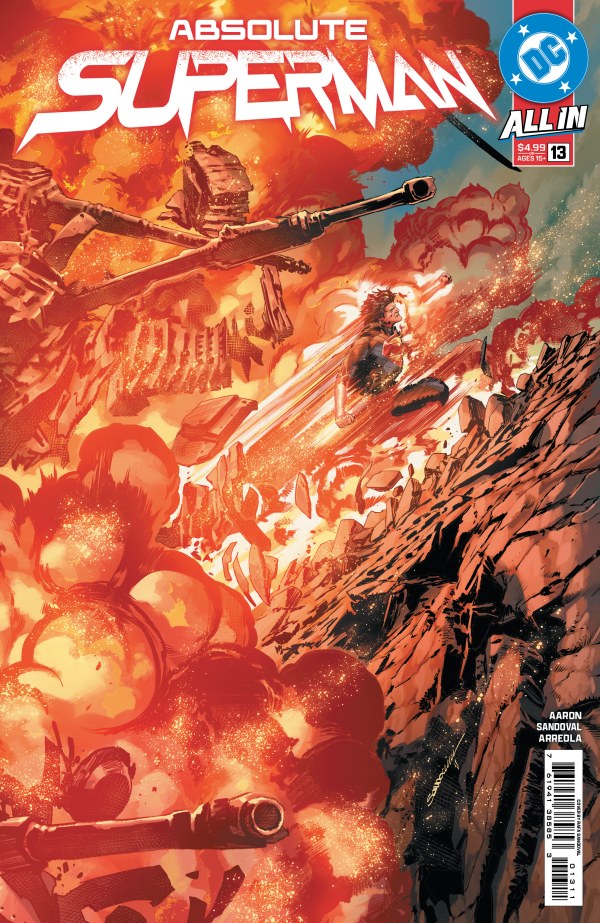
Absolute Superman, on the other hand, not only feels like the consequences are real, but also that – in this Absolute universe – virtually anything can happen. As Lazarus begins its attack on Smallville, Kal-El orders Sol to override its original programming to protect him and, instead, expend its energy becoming a shield surrounding Smallville. But the resources of Lazarus and its Peacemakers are too much, even for Kal-El, and the small town is overrun. As he struggles against their forces for weeks, Lois and Jimmy try to broadcast the truth about what’s happening in Kansas to the rest of the world.
Most of the issue bounces around non-linearly from the beginning of the war to the “present,” six weeks later, showing different conflicts and encounters both on and off the battlefield. Jimmy and Lois reflect on how the appearance of Kal-El is what made them turn against Lazarus, which is just one of the things I really like about this issue. The thesis of the Absolute Universe is that this is a world fueled by Darkseid, where “hope” is always the underdog…and yet this is where the hope shines through. Kal-El, Superman, even in this dark world is held up as a beacon. There’s a scene where he confronts someone who – well, did him wrong, let’s just say – and for a moment you wonder just where Jason Aaron is going to take the scene, but in the end, he does the Superman thing. And I just love it.
Feature Film: The Iron Giant (1999)

Notes: Anyone who loves The Iron Giant knows already why I’m watching it for this week’s theme. Anyone who hasn’t seen it – I envy the fact that you’ll get to experience this for the first time. Because of all the stories that do NOT actually feature Superman, there is none that more fully captures the Superman ethos than Brad Bird’s 1999 animated masterpiece.
In 1957 Maine, a lonely boy named Hogarth finds an enormous robot alone in the woods. Hogarth befriends the Giant, who has a dent in his head that seems to have damaged his programming, leaving it with no memory of its origin or purpose. Hogarth begins to teach the Giant about humanity, playing games with it and showing him his comic book collection – including classic issues of Action Comics, and the robot finds a role model. But the military, naturally, is searching for the Giant as well, fearful of what it may represent. An agent named Kent Mansley tracks him down, but is unable to convince his superiors that the threat is real.
Playing with the Giant, Hogarth points a toy gun at him, temporarily causing his original programming to kick back in and it reveals him to be a weapon of some sort of alien civilization. Broken-hearted at learning the truth about itself, the Robot flees, and Hogarth follows. When a pair of boys fall off a roof in town, the Robot reveals itself and saves their lives. The town watches him in awe, but Mansley and the army turn back around to combat the threat. They open fire on him in the middle of the town while he’s holding Hogarth, and he flees. Each attack continues to bring his programming to the surface, but he fights against it until they hit him with a missile, blasting him from the sky. Hogarth is knocked unconscious in the crash and the Giant’s programming takes over, turning on the army and attacking with the full force of his weaponry. Mansley convinces the general to target the Giant with a nuclear weapon, then in his panic hijacks a walkie-talkie to order a strike that will wipe the small town and all its innocent citizens off the map. But the Giant overcomes his original programming, remembering the lessons Hogarth taught him. In the end, he makes a decision that proves him not only worthy of the “S,” but that – like Superman himself – his alien origins are irrelevant. His soul may be among the most human of us all.
I can’t tell you how many times I’ve watched this movie, but I can tell you how many times I’ve watched it without crying, and that number is zero. Director Brad Bird, who would go on to much greater acclaim at Pixar with movies like The Incredibles and Ratatouille, uses the era of the Red Scare as a backdrop here. It’s a shorthand to amplify the fears of the townspeople of the Giant, making the concerns put on display a bit more justifiable and somewhat removing the need for a more traditional antagonist. To be certain, the military in this movie are the ones who are acting against the Giant, even threatening his life, but none of them are doing it from a place of evil. Mistrust, misunderstanding, sometimes even arrogance, but everyone who tries to destroy the Giant does so out of a sincere belief that he’s dangerous. Mansley is the most villainous character, lying to the general, telling him that the Giant has killed Hogarth (as far as he knows, the Giant is merely CARRYING Hogarth) in order to get them to continue their attack, and generally being a jerk. Even he, though, sincerely believes that this giant alien robot is dangerous, and it’s hard to disagree with the logic behind that fear. Honestly, it’s not even like they’re wrong – had his original programming not been subverted when he came to Earth, it seems quite likely that he WOULD have laid waste to the entire planet. So yeah, this is one time where the antagonists kinda have a point.
That said, what makes this work so beautifully is the way the Giant grows beyond what he was originally built for. Anyone who’s seen this movie can remember two lines from Vin Diesel (voicing the Giant in his most lifelike performance outside of Groot). One, when Hogarth tries to make him the bad guy in his game, is the adamant declaration: “I AM NOT A GUN.” The other comes at the end, as he makes the choice to sacrifice himself for the lives of the people below him – not only Hogarth, but the very ones who chased and attacked him. As he takes to the air to save them all, he closes his eyes and smiles and whispers the name he has chosen for himself: “Superman.”
There’s another line that echoes in the film: “You are what you choose to be.” Harry Connick Jr.’s character says it to Hogarth, and later Hogarth says it to the Giant. Then, 26 years later, Jonathan Kent says something very similar in James Gunn’s Superman. It may be a coincidence, but only in that two storytellers who intimately understand the Man of Steel chose to use the same sentiment to get that idea across.
I don’t like pop culture gatekeepers. I don’t think anybody has the right to dictate what a “real” fan is to anybody else. That said, I find it very difficult to conceive of anybody who truly understands Superman without being utterly in love with this movie. It’s one of the greatest superhero movies ever made.
TV Show: Superman and Lois Season 3, Ep. 2, “Uncontrollable Forces”
Sun, Nov. 9
Comics: Supreme #1-6
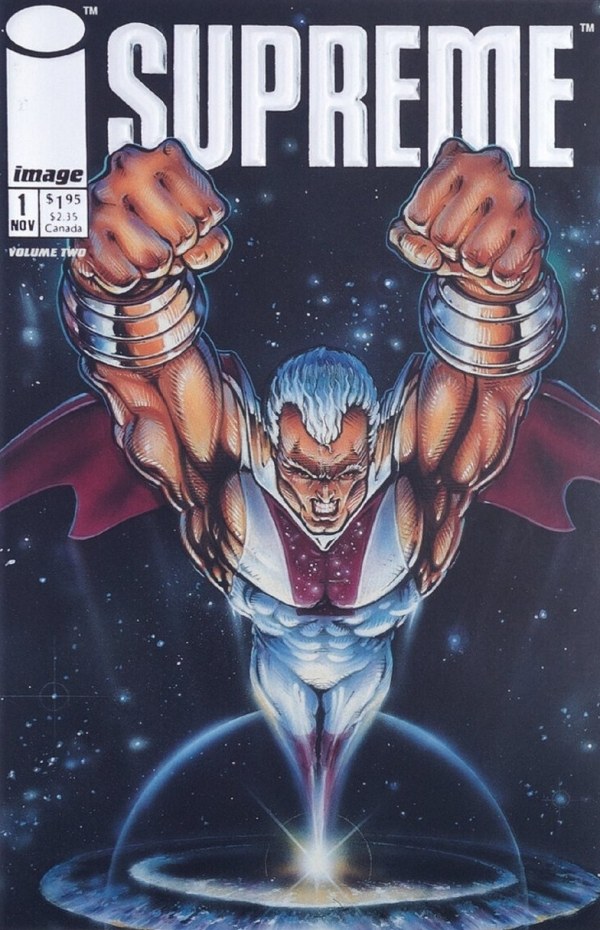
Notes: The works of Rob Liefeld can sometimes be…well…divisive. And to be perfectly blunt, I’ve never been a fan. But this summer, I happened to come across the first six issues of Liefeld’s Superman pastiche, Supreme, while rummaging in a dollar bin in a comic shop in Mississippi. Knowing that “Almost Superman” was on the docket for later in the year, I decided it would be worth the six bucks to get a taste of it. Now I know that most people say that the best Supreme stuff came later, when Alan Moore wrote the title, and would probably suggest it’s more beneficial to read THAT run than Liefeld’s original. To those people, I simply say: the Moore stuff wasn’t in the dollar bin.
Liefeld shared both the writing and art chores with Brian Murray for this book, which oddly enough is labelled as “Volume Two” even though, as far as I can tell, there was never a “Volume One.” In “Second Coming,” Liefeld’s premiere superhero team Youngblood is summoned to outer space when a strange figure approaches Earth. He claims to be Supreme, a hero who apparently vanished 50 years ago, and after a very 90s scuffle, they accept him as who he claims to be and return him to Earth. Although offered a place with Youngblood, he leaves and returns to orbit, looking down on Earth and crying. Issue two begins with Supreme lamenting the loss of the heroes he fought with 50 years prior and looking down at the heroes that exist on Earth now: Youngblood, Spawn, Savage Dragon, Cyberforce, WildC.A.T.S (it’s a “Who’s Who” of early Image). He’s upset that the heroes of today seem to be created and funded by corporations (this is clearly NOT true of Spawn), then drops in to a prison to murder somebody named Grizlock. Grizlock seems to be his arch-enemy, his “Lex Luthor” if you will, who killed Supreme’s equivalents of Jimmy and Lois some 50 years prior. Before he can get his revenge, he winds up fighting some superhumans called Heavy Mettle who appear from that magical space between panels, because nothing else makes sense. After several pages of Supreme battling characters that I could swear were designed to deliberately lose a bet, they convince him to hear out their boss, Jason Temple, explaining why Grizlock should get to live.
At this point, friends, I’m going to give up on the play-by-play, because any attempt to continue with that exercise would be to imply that anything that happens in this comic book series makes the slightest bit of sense. I read six issues of this nonsense, and here’s what I can tell you: Supreme spends several issues fighting some guy called “Khrome.” Yes. “Khrome.” Who apparently was formerly his ally, but now they’re trying to kill each other, because it was the 90s. Khrome is as boring and generic a villain as you can imagine, which means he fits in with the rest of this comic book like a jigsaw puzzle with a picture of a dog peeing on a fire hydrant. Every character is dull and generic, with designs that look like somebody spilled a box of Lego minifigs and assembled the pieces entirely at random. The names and powers are forgettable, and the motivations are nonexistent. It’s a lot of punching and blowing things up at the expense of anything resembling a plot or characterization.
My intention, this week, has always been to compare the kinda-Supermen to the real deal, but there’s not even enough of Supreme to do that. He seems sad to have lost people in his past, but his callous disregard for the lives of the bystanders to his pointless battles defies anything that could be considered Superman-like. There simply isn’t anything THERE. This is one of the worst things I’ve ever read, and I don’t just mean in comics. This is the first time I’ve ever read the letter column of an old comic book and felt the urge to seek out the people who wrote in and praised the book to ask them if they ever sought out the psychiatric help they so clearly deserved.
From what I can tell, Alan Moore’s run on this comic started with issue #41. It is a testament to the money-printing machine that was the earliest years of Image Comics that this book ever even made it that far, because it was an utter, absolute, incomprehensible mess.
All that said, it’s still better than anything AI could make.
Mon., Nov. 10
Comic: Big Bang Comics #2, Mr. Majestic #1, Jon Kent: This Internship is My Kryptonite #18, Infinity, Inc. #6 (Team Member Power Girl)
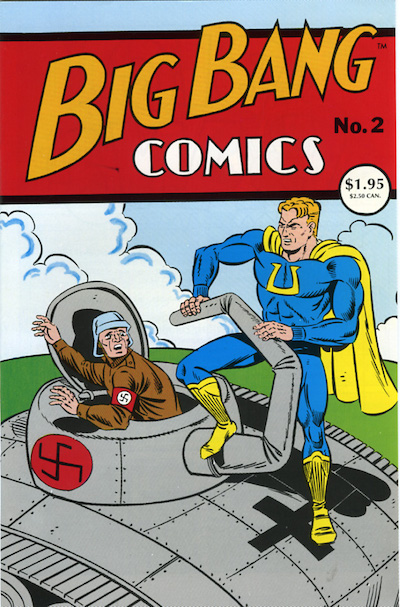
Notes: Today I’m going to move on to a series that’s as delightful as Supreme was frustrating: Big Bang Comics. Big Bang is a publishing imprint created by a revolving group of writers and artists who have crafted a shared world that pays tribute to all eras of comic books. Their universe is populated by thinly-veiled homages to the all-stars of DC and Marvel Comics, with stories set in – and emulating the styles of — the Golden, Silver, Bronze, and Modern ages of comics. There are legacy heroes and names passed down from one generation to another, and in the 30 years of its publication they have played host to numerous ongoings, specials, and miniseries featuring their assorted heroes, such as the Knight Watchman (their Batman analogue) and the Round Table of America (no points for guessing what that might be). They were originally published by Caliber Press, then had a nice run at Image Comics. These days, they self-publish, and new installments are still released a few times a year.
To represent this world I’m digging into 1994’s Big Bang Comics #2, the first comic with a story starring their Superman representative, Ultiman. (This issue also contains stories of their Flash substitute the Blitz, and the Human Sub, who’s kind of a mashup of Aquaman/Sub-Mariner and Bulletman, but Ultiman is what we’re going to focus on.) Writer Gary Carlson and artists Jon Schuler and Don Simpson craft this Golden Age-style tale of Ultiman, “the Ultimate Human Being,” as he battles the “Sub-Oteurs.” The Nazis, it seems, have developed a drilling craft with the ability to tunnel underground, which they are using to attack freight trains delivering supplies for the war effort. When he hears about the attack, Ultiman (who apparently sits around his house in full uniform listening to a radio with his emblem on it) leaps into action from his home in Empire City. Just as Golden Age Superman couldn’t fly, Ultiman hitches a ride on the outside of a passenger plane that takes him to the scene of the attack, then rushes to save miners trapped in a nearby cave-in. Rescuing the miners, he discovers an odd tunnel with tank treads on the ground, following it to the German “submarine” that’s attacking a dam. Ultiman uses a car and his “thermal vision” to seal the cracks in the dam, then sets out to tackle the Sub-Oteurs. He captures the Nazis and sends the empty sub on a trajectory to drill straight to the center of the Earth.
This is an almost flawless representation of the Golden Age of comics. All it would take is redrawing Ultiman and maybe adding a page of him as Clark Kent hanging out around the Daily Planet and it would be virtually indistinguishable from the real thing. That’s the charm of Big Bang, the way they so lovingly recreate the worlds of classic comics. This isn’t a parody or a satire, nor is it a deconstruction. It’s just a new world that mimics the classics.
Later Big Bang stories would develop Ultiman’s world much more, giving him a secret identity and an origin, related characters, and even using the multiple Earths concept to have two Ultimen (those of Earth-A and Earth-B) come into contact with one another. I wish there was some sort of omnibus of the entire universe, but alas, no such thing yet exists. Still, if Gary Carlson or anybody at Big Bang is listening, there are at least some of us who would be really happy if here was an easy guide to buying and reading the entire universe, even digitally. (The new stuff is available digitally, I should mention, it’s the older stuff that’s harder to find.)
The most important takeaway here is that if you’re trying to find classic stories in the style of Superman from various ages (or Batman or Captain America or any of a dozen others), Big Bang Comics has what you’re looking for.

Moving on, let’s look at Mr. Majestic #1, from Wildstorm Comics. Wildstorm began at Image Comics before Jim Lee sold the company to DC and became one of its executives, and it was at DC that their one of their Superman analogues, Mr. Majestic, got his first miniseries. (The other analogue would be Apollo of The Authority, but Majestic is more “classically” Superman.) As Wildstorm became more integrated into the DC multiverse, Majestic met Superman several times and even temporarily took his place in Metropolis during one of those periods when Superman went missing for one reason or another. I’m going to look at the first issue of his first series for today’s entry.
Written by Joe Casey and Brian Holguin with art by frequent Superman artist Ed McGuinness, “Cosmology” begins at some point earlier in the 20th Century with the alien hero Mr. Majestic in space, taking care of the sort of extraterrestrial menace that superheroes have to take care of, before returning home to his secret lair inside of Mt. Rushmore. With the help of a boy genius named Desmond, Majestic determines the probe he fought in space was engaged in the task of mapping Earth’s solar system in exquisite detail, for a purpose that he fears goes even beyond a simple alien invasion…something, he says, that is likely to occur within a century. He gathers a braintrust and begins making preparations, spending decades seeking a way to somehow hide the entire solar system, ultimately deciding upon moving various heavenly bodies and altering the appearance of others in a sort of camouflage. In the end, the thing the probe was summoning arrives, and Majestic can only watch to see if his decades of effort have been worth it.
I very much enjoyed this one. Majestic is like Superman in a lot of ways, not only in his power set, but in his sheer determination to protect Earth, which comes across very much as a Superman sort of thing to do. And while the editors of DC Comics would never have approved a story where Superman sets himself forth on a single task that lasts for decades (at least not without some sort of timey-wimey reset button at the end), it’s very much the kind of thing he WOULD do if he deemed it necessary. This first issue of Mr. Majestic is a perfectly encapsulated standalone story that showcases a Silver Age style problem and response with a Modern Age execution. Like Astro City and Icon, I’m left wanting to continue and read more of his adventures.
Tues., Nov. 11
Comics: Squadron Supreme #1, Justice League of America #38 (Team Member), Superman’s Girl Friend Lois Lane #15

Notes: To close out this week, I wanted to end with arguably the most successful otherworld Superman in comics – Marvel’s Hyperion of the Squadron Supreme. The Squadron was first introduced in the pages of Avengers in a story by comics legend Roy Thomas, who reportedly just wanted to do a story in which the Avengers fought the Justice League. This was before the era of crossovers though (and even once that era arrived it still took over two decades for JLA/Avengers to come out), so Thomas had the Avengers cross over to another universe where they met the Squadron, a team of characters who were an awful lot LIKE the JLA. Nighthawk was their Batman, Power Princess was Wonder Woman, Golden Archer was Green Arrow, and so forth. Their leader, Hyperion, was in reality Mark Milton, the final member of his universe’s race of Eternals, which obviously calls into question the name of the species.
Anyway, the struggle I had with this was figuring out which story to read for Hyperion. In most of their appearances, the Squadron has usually appeared as a team, with little focus on solo stories for the individual members. There was eventually a Hyperion miniseries or two, but those were part of the Supreme Power line, which was essentially the Ultimate version of the Squadron, and honestly not the one I’m interested in. After a bit of prevarication I decided to go with the first issue of the legendary Squadron Supreme limited series from 1985, which is almost certainly the best story ever told with these characters, even if it isn’t Hyperion’s story specifically.
Squadron Supreme #1, by Mark Gruenwald and Bob Hall, opens in a very Supermanly way: Hyperion in outer space, struggling to prevent the collapse of the Squadron’s satellite headquarters as it’s falling to Earth, and ultimately steering it to the ocean where it won’t hurt anyone. He meets up with his fellow Squadron members, Amphibian (Aquaman), Dr. Spectrum (Green Lantern), and the unfortunately-named Whizzer (the Flash) to bring it from the ocean and find a resting place for it. The destruction of their satellite turns out to be symbolic – the entire world has crumbled around the Squadron in recent years, and things on their Earth are getting worse and worse. We see the other Squadroners dealing with things like riots, blackouts, and a refinery on the brink of an explosion. How could things have gone so wrong?
The next few pages give us the recap. Nighthawk, in his secret identity of Kyle Richmond, had decided that he could do greater good in politics, running first for congress, then president. And it was President Kyle Richmond who was taken over by an alien invader called the Overmind, who then proceeded to take control of the rest of the Squadron – save Hyperion – and use them to conquer the world. Hyperion, with the help of “other heroes” (notably some he brought over from Marvel’s Earth-616) defeated the Overmind, but the world is still in dire straits after what happened to it. Hyperion reflects on the human parents who raised him, and how they taught him to use his powers for good, but not to interfere too much in the development of humanity. His parents, Hyperion decides, were wrong. At his urging, the Squadron decides that the only way to clean up their mess is to take control and do it themselves – in other words, superheroes taking over the world. All of the Squadron agree to his proposal, except for Amphibian and Nighthawk, and Nighthawk quits in protest.
A series of vignettes shows each of the Squadroners reconnecting with their civilian loved ones – in the case of Hyperion, letting down his Lois Lane analogue by telling her he “used to masquerade” as Mark Milton, he’s abandoning his human identity, and he’s sorry about leading her on for all those years. The next day, Richmond resigns as president and, moments later, Hyperion steps up and announces his plan for the Squadron to save the world by taking it over themselves. They ask the people of Earth to give them one year to conquer “hunger, poverty, war, crime, disease, pollution, and oppression,” and swear to voluntarily give up power if they cannot do so in 12 months. Then together, the Squadron removes their masks and promises a “new age of trust and friendship and unity for all the Earth!”
Spoiler alert: it didn’t go that well.
Coming out in the mid-80s as it did, Squadron Supreme is often overshadowed by the likes of Watchmen and The Dark Knight Returns in the conversation about great deconstructions of the superhero genre, but I’ve always felt like it belonged right on that same tier next to them. In fact, in some ways I think it’s even more reflective of what superhero comics actually WERE at the time. Watchmen was an alternate history and Dark Knight was set in the future, but Squadron Supreme was in the here and now (or at least the now) and showed what the consequences in the modern world would be of having a superhero team that actually followed through on the logical fear that critics of the genre have about superheroes – what if they just decided to take over?
Hyperion comes off as much colder than Superman here. His ideals are similar, but the way he dismisses his human parents and the woman who apparently loved him (who I’m pretty sure never shows up again in this series, although it’s been some time since I read the entire thing) is very harsh. Even in the Silver Age, when Superman treated Clark Kent as a disposable disguise, even when he would put Lois Lane through ridiculous turmoil in order to “teach her a lesson,” it came from a place of genuinely wanting to make her better, with at least a token effort made to protect her feelings. Hyperion has no such concerns for Lonni, and in fact, shows far more emotion about the defection of Nighthawk, who even crafts a bullet out of Hyperion’s local equivalent of Kryptonite, but can’t bring himself to pull the trigger
This is a great look at a different type of world, and it’s one that would come back and be relevant to the Marvel Universe again many times and in many ways over the years. Plus, it’s just an excellent story.
It was a fun week, guys. I’ve taken a look at a lot of cool, interesting variations on the Superman theme, and I also read six issues of Supreme. But as great as many of these stories are and as interesting as the faux Supermen have been, I’m going to be happy tomorrow to get back to the original, because when you get right down to it, there’s nothing like the real thing.
The Iron Giant comes close, though.
Blake M. Petit is a writer, teacher, and dad from Ama, Louisiana. His most recent writing project is the superhero adventure series Other People’s Heroes: Little Stars, volume one of which is now available on Amazon. You can subscribe to his newsletter by clicking right here. You can join in the Kryptonian Konversation every day in the Year of Superman Facebook Group!
 Blake M. Petit