This weekend is Father’s Day, the one day a year in which people pretend to appreciate all the things that fathers do for their family. But I mean, it’s tough – after all, where are our role models in the world of pop culture? If you look in the annals of fiction, the number of truly good, successful fathers is completely overwhelmed by the gargantuan number who act like buffoons. There was a 20-year stretch from around 1990 through 2010 when it was federally mandated that at least 47 percent of all television comedies feature a father who was an absolute idiot married to a woman who treated him like he was an absolute idiot, but it was acceptable because she was hotter than he was.
But even though these lousy dads get the focus, is that really fair? There ARE good fathers in fiction, just like there are bad ones. Just like real life. So today, in Geek Punditry, I’m going to choose some fictional dads and rank them on a scale from the best to the worst.
(In the interest of completion, I should mention that we here at Geek Punditry Global Headquarters and While-U-Wait Notary Services are, of course, aware of the exploits of one Theodore Huxtable. Had this column been written a decade ago, he most assuredly would have been ranked among the top dads in fiction. However, through no fault of the character, Cliff’s legacy has been tarnished by the actor who PLAYED him, so we’re going to pass on further comment.)

BEST: Bandit Heeler.
It’s been a minute since I talked about Bluey here in this column, but that’s mostly because it’s been a year since the last new episode, so I’ve had to content myself with reruns. But let’s make no mistake – of all the fathers in the annals of popular fiction, it’s hard to argue that anyone is more devoted than Bandit Heeler. Bandit’s daughters are two little balls of chaos, full of life and energy, and also constantly dragging their dad into their games. And Bandit steps up every time – he plays along, he expands the world of the game, and he occasionally uses it to teach a lesson.
But he makes mistakes, of course. He does – on rare occasions – show his exasperation with his kids. And his attempts at teaching a lesson can sometimes fall on deaf ears, such as in the episode “Magic Claw,” in which he persuades the girls to do chores to get money for a “claw machine,” played by Bandit himself. “They’re learning a valuable lesson, and we’re getting the house clean!” he says. His wife Chili, simply shakes her head and says “Neither of those things are happening.” But when the lesson fails, Bandit rolls with the punches, accepting that sometimes the lesson that needs to be learned is his own.
When he is offered a chance to move to another town for more money, in “The Sign,” he takes that job not because he wants to leave his home in Brisbane, but because he thinks it will make a better life for his wife and kids. And when he realizes that neither his wife nor his kids actually WANT to leave, that they are perfectly content with the good life they already have, Bandit wisely steps back from the transfer. He sees they don’t need money to chase happiness, as they already have it.
Bandit is the dad that every dad in the world wants to live up to. It’s not just a meme. It’s the truth.

WORST: Victor Frankenstein
He may not be a biological father, but every bit of tragedy that can be wrung out of the pages of Mary Shelley’s Frankenstein can be boiled down to parental abandonment. In his thirst to conquer death, Victor creates a creature out of the corpses of the dead and uses an arcane process to infuse it with life. He brings a new, intelligent being into the world, and by any reasonable definition of the word, that makes him the creature’s father. So what’s the first thing Victor does upon achieving parenthood?
He abandons his son.
He is so horrified by seeing this collection of corpses come to life that he runs in terror, leaving it alone. And at this point, it should be noted, the creature is analogous to a baby – his mind is a blank slate. He knows nothing, understands nothing. He wanders into the woods where he spies on a family long enough to learn things like language, then when he tries to join them, he is rejected again. He grows understandably angry and bitter, and decides (less understandably) to take his rage out on the entire human race, but ESPECIALLY on dear ol’ dad.
Had Victor taken half a second to stop, to THINK, it all may have been avoided – the death of his brother, the death of his fiancé, the deaths of all the other people who crossed the creature’s path at the wrong time. Had he actually attempted to RAISE his creature, as a father should, things may have been very, very different. But he was weak, he was foolish, and he ran, leaving an embryo to turn into an abomination. Short of direct abuse, abandonment is as low on the scale of parenthood as you can get.
So there’s our rating scale, friends. At the top, Bandit Heeler at 100 percent. At the bottom is Victor Frankenstein with a big honkin’ zero. Let’s grab a few other dads from the world of fiction and see where they measure up. This isn’t a comprehensive list, mind you, just the first few fictional dads that occurred to me (and that I thought would be interesting to write about).
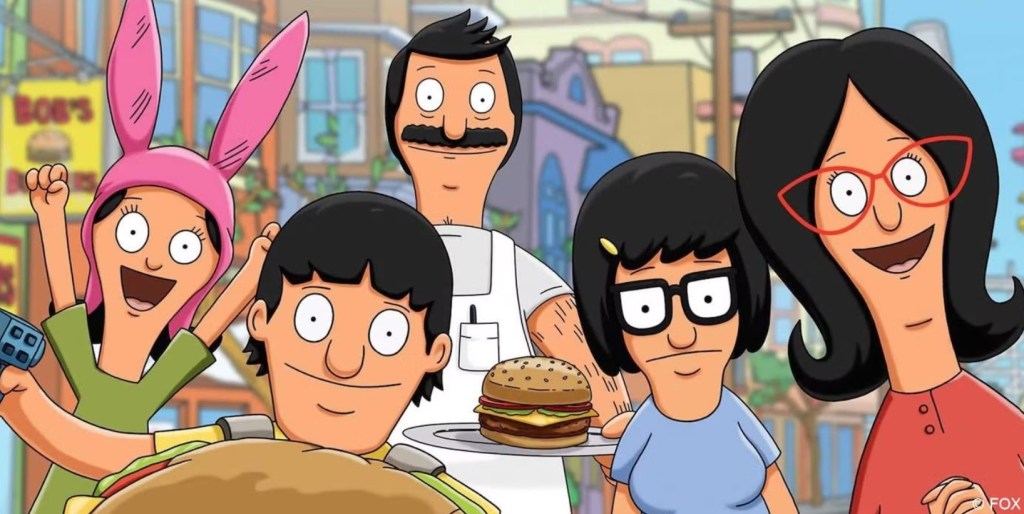
Bob Belcher, Bob’s Burgers
Bob Belcher is the father of three children, plus his wife Linda, who can at times be the equivalent of two more. Plus his best friend (or best “customer” depending on when you ask him) Teddy, so that’s like eight. And while Bob is constantly worried, anxious, and long-suffering with a restaurant that barely seems to break even, there’s one thing that you can never say about Bob, and that’s that he doesn’t love his kids. Tina, Gene, and Louise would each be a handful on their own. They are, respectively, a neurotic boy-crazed preteen girl who seems to share his anxiety issues, a middle child who has taken the middle child hunger for attention to an absurd extreme, and a little demon more devoted to pandemonium than anything else. Any ONE of Bob’s kids could wear a parent to the nub.
But although Bob’s frustration is constant, he does his best to keep from taking it out on the kids. He supports them. He cares about them. No matter how bizarre or incomprehensible their latest obsession may be, Bob never once shames them or even tries to talk them out of it, unless it’s a situation where he feels they may be in actual danger (physical or emotional). When Tina is swindled out of a beloved Equestranauts toy, Bob not only spends days memorizing every tidbit of Equestranauts errata that he can get his hands on in an effort to con the con man, he goes to a convention in a horse costume and even subjects himself to GETTING A TATTOO to get it back. When a rock and roll laser show he loved as a child is about to close forever, he moves Heaven and Earth to bring Gene with him to see it one last time, because he wants to share it with his son. And no matter how many pranks she pulls or ulcers she may cause him, it is evident in every episode just how much Louise adores her father – even if she’d never admit it.
On the Good Dad Scale of Victor to Bandit, Bob Belcher is about a 90.
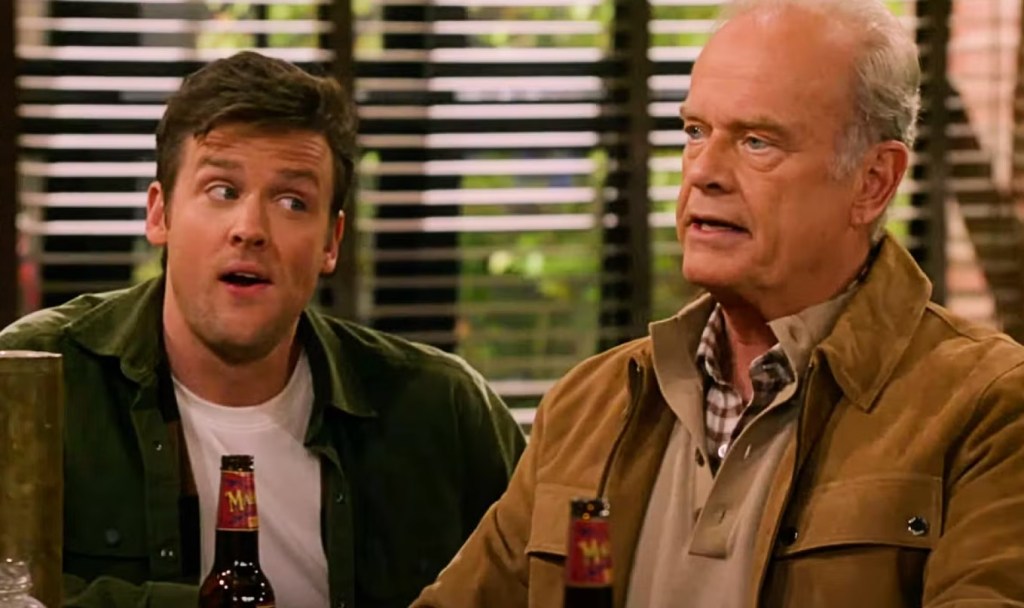
Frasier Crane, Cheers & Frasier & Frasier (again)
Kelsey Grammar’s Frasier Crane started out as a pretty good dad. After his son, Fredrick, was born, in the last few seasons of Cheers we see several episodes that show him as a loving and devoted father, even (and especially) after his wife leaves the two of them in the final season. Remember, abandonment is an automatic failing grade. But when he got his own spinoff, the tailored Italian loafers were on the other foot – Fredrick stays with his ex-wife in Boston, while Frasier moves across the country to Seattle. It was a practical decision for the producers of the show – they wanted to get the character as far away from any elements of Cheers as they could to allow the show to stand on its own. But in doing so, they made Frasier come across as a very absent father. Once or twice a season we’d get an episode where Freddy comes to visit his dad or Frasier goes back to Boston to visit Freddy, and in those episodes we usually see a loving relationship, but for the most part Frasier isn’t there.
In fairness, the character eventually recognizes his mistake, and in the Frasier reboot that hit a couple of years ago, after the death of his own father, Frasier moves BACK to Boston to live with Freddy, hoping to forge the bond that he neglected for far too long. It wasn’t a case of “too little, too late,” as Freddy does, in fact, show that he loves his father. But the new dynamic demonstrates so clearly that Frasier and Freddy don’t really understand each other that he simply can’t get a high score.
On the Good Dad Scale of Victor to Bandit, Frasier Crane is about a 40. Ironically, by the end of the first Frasier run, his dad Marty had climbed up to about 75.

Tim “The Toolman” Taylor, Home Improvement
Tim Allen’s character on Home Improvement didn’t INVENT the trope of a bumbling husband and long-suffering wife, but I would argue that the two decades of adherence to it are in large part to the popularity of his show. Tim plays Tim, the host of a TV home improvement show obsessed with juicing up every gadget he can get his hands on in the quest for “more power.” He’s also the father of three young boys (who, over the course of the show, become three teenage boys). His efforts at parenthood are the main plot of around half the episodes and a B-plot in most of the others.
Tim can be oblivious at times, often getting so caught up in whatever his current project is that he misses the obvious cues that people around him aren’t enjoying his tomfoolery. But I think it’s important to recognize that Tim never deliberately sets out to harm anyone. And in fact, the only person who usually gets hurt by his antics is Tim himself. What’s more, he genuinely enjoys spending time with his sons, although he can get frustrated when they don’t necessarily share his own interests (these stories are usually played out with his middle son, played by Jonathan Taylor Thomas) and has trouble connecting with the things they want that he doesn’t. But there can never be any doubt that Tim loves his boys, something he tries to make clear as his own father died when he was a child and he’s felt a gaping void his entire life. And whenever Tim realizes his mistakes (usually thanks to the wisdom of Wilson, the Neighbor Behind the Fence) he tries his best to make amends.
On the Good Dad Scale of Victor to Bandit, Tim Taylor is about a 65. He passes, just not with flying colors.

Peter Griffin, Family Guy
In the early days of Family Guy, Peter Griffin was kind of a less-loveable Homer Simpson. He was a dolt, he screwed up all the time, and he often behaved selfishly. But while Homer usually came around and realized his mistakes, genuinely loving his wife and kids, over the years Peter has doubled down on his stupidity, selfishness, and mean-spiritedness. He ignores his youngest child, leaving him to spend all his time with the dog, and Peter and – frankly – the entire rest of the family are frequently cruel and even abusive to his daughter, Meg. It’s an awful, toxic relationship, and despite an occasional episode that tries to show a bond between the members of the Griffin family, the formula of the show always drifts back to the fact that these are people who pretty much hate each other and would have no reason to associate with one another were they not related.
On the Good Dad Scale of Victor to Bandit, Peter Griffin is a 10, and that’s the ONLY time you’ll ever call Peter called a ten.

Jeff Morales, Spider-Man: Into the Spider-Verse
Jeff is the father of Miles Morales, a teenage boy who becomes the new Spider-Man after the original dies in battle. He’s also a cop, and he’s also kind of a dork. And that’s one of the things that makes him a great father. Jeff’s establishing character moment comes early in Into the Spider-Verse, where he drops Miles off at school. He tells Miles that he loves him, but when Miles starts to leave without reply, Jeff blares his police siren and tells him over his loudspeaker, “You’ve gotta say I love you back.”
At first, it seems like a typical parent trying to embarrass his kid, but I always thought this scene was more important, more indicative than that. If you just want to embarrass your child, there are thousands of different ways to do it, and every dad on this list (even the good ones) has found his own unique spin on that concept. Jeff is playing his dad card to embarrass Miles a little, yes, but more importantly, he wants his son to know two things.
- He loves him.
- It’s okay to SAY it.
There are SO MANY dads – not just in fiction, but sadly, in real life – who seem to think those words are something to shy away from. That it’s somehow unmanly to express that emotion, that a “real” dad would NEVER say such a thing to his child, especially his son. What utter nonsense. If Peter Griffin’s dad had told him he loved him once in a while, maybe his own family wouldn’t be the human equivalent of a cesspool.
Jeff wants Miles to know that he loves him and that he’s not ashamed to express it, and that’s a lesson that more dads in the world need to know. For that, if nothing else, he gets a very high score. On the Good Dad Scale of Victor to Bandit, Jeff Morales is an 85.

Heinz Doofenshmirtz, Phineas and Ferb
Yes, I’m bringing up Phineas and Ferb. Yes, AGAIN.
Dr. Heinz Doofenshmirtz is a supervillain. He spends his days working on one invention after another in an effort to conquer or bring humiliation to those who he believes have wronged him. He is funded by an absurdly generous alimony agreement with his ex-wife, Charlene. He gets beaten up by a platypus every single day.
And he loves his daughter, Vanessa, with such total devotion that you can’t possibly hate him.
Doof usually has some sort of preposterous backstory to explain his scheme of the day, and a great many of them deal with just how awful his own parents were. They made him stand out in the yard because they couldn’t afford a garden gnome. His father named the dog “Only Son.” When his mother’s second child turned out to be a boy, they made Heinz wear the girl’s clothes she had mistakenly made for an entire year, while showing blatant favoritism to the new kid, Roger. They abandoned him to be raised by ocelots. And even before any of these other indignities, NEITHER of his parents bothered to show up for his birth.
Doof will be damned if he EVER allows his daughter to feel anything less than complete adoration from him.
This isn’t to say that he’s the PERFECT dad, of course. He wants Vanessa to follow him into the family business, which is “Evil.” He’s overprotective and occasionally intrusive, such as when he pretended to be a teenager to accompany her on a campout. He spends YEARS trying to hunt down a toy she wanted as a child, never considering that as a teenager she may not actually want it anymore. When some dude on a motorcycle catcalls his daughter, he zaps him into another dimension. (Okay, that one actually should go in the plus column.) But everything he does is done with sincere love and a desire to give his daughter the happy childhood he never had, even recruiting his arch-nemesis Perry the Platypus to help throw Vanessa a birthday party.
On the Good Dad Scale of Victor to Bandit, Heinz Doofenshmirtz is about an 80. He’s the most inept supervillain on the planet, but he just may be the greatest dad in the ENTIRE TRI-STATE AREA!!!
We could do this much longer, friends – there are countless other fictional dads we could bring up and debate and find their place on the scale, but I think I’ve gone through enough to make my point. Have a great Father’s Day, and make sure your own dad knows you’d put him at the top of the list.
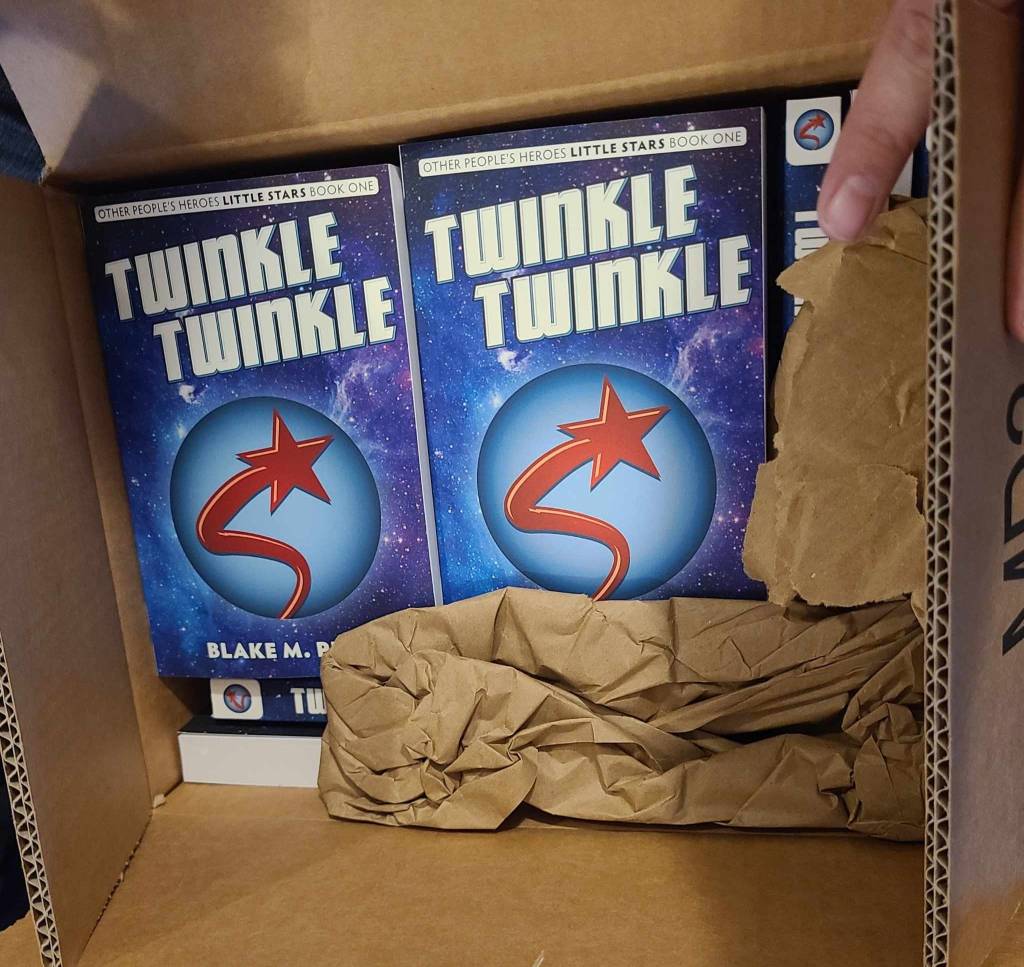
Blake M. Petit is a writer, teacher, and dad from Ama, Louisiana. His most recent writing project is the superhero adventure series Other People’s Heroes: Little Stars, volume one of which is now available on Amazon. You can subscribe to his newsletter by clicking right here. He’s also started putting his LitReel videos on TikTok. On his best days as a dad, he knows he’s not at Bandit standards, but if he can hit Dr. D, he feels like he’s done all right.



 Blake M. Petit