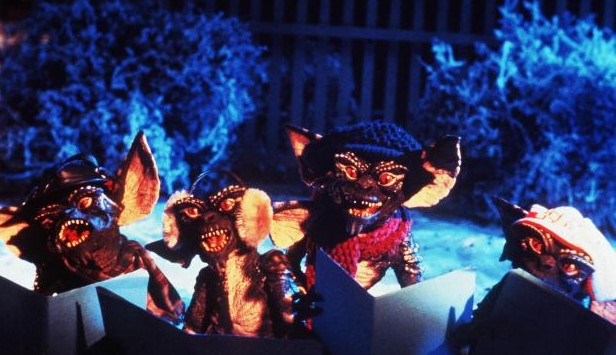
Geek Punditry #92: The Spectrum of Horror and Comedy

If there need be any further evidence that Hollywood executives frequently don’t have the slightest idea what they’re doing, let’s talk about the fact that they seem to be afraid of horror/comedy hybrid movies. ‘It’s confusing,” they will tell you, pulling their hair out over a movie like Behind the Mask or Happy Death Day. “We don’t know how to market this! Who is it for? Is it supposed to be a horror movie or a comedy?” Whereas the answer is obvious to anyone smarter than a movie executive, which is a very large part of the Venn Diagram, and includes virtually all horror movie fans: it’s both. Horror and comedy BELONG together. They are a natural combination, the peanut butter and chocolate in the Reese’s Peanut Butter Cups of the movie industry, and the notion that there are people who don’t understand that is maddening to me.

Admittedly, humor and terror seem to be on the two extremes of the emotional spectrum, but that’s one of the reasons they compliment each other so well. Another reason is that, structurally speaking, they are very similar to one another. Both of these styles of storytelling are built upon creating an emotional response in the audience, and both of these responses are constructed through the careful buildup and release of tension. In fact, if separated from context, it might be impossible to tell if a scene is intended to be funny or scary until the punchline hits and the audience either laughs or screams, because until that point they can be virtually identical. A funny movie can turn on a dime if an expected laugh turns into a scare, and the dread of a scary movie can be decreased to a manageable level by a well-timed joke. 

The horror/comedy combo is one of my favorites in all of storytelling, but there is a spectrum that these movies and stories exist on. Some of them lean heavier towards the comedy side, some more on the horror, and it’s fair if you prefer one side more than the other. But for the sake of discussion, this week I thought it would be useful to go over what I think of as the five levels on the horror/comedy spectrum and give some examples of each. We’ll start on the more comedy-heavy side.
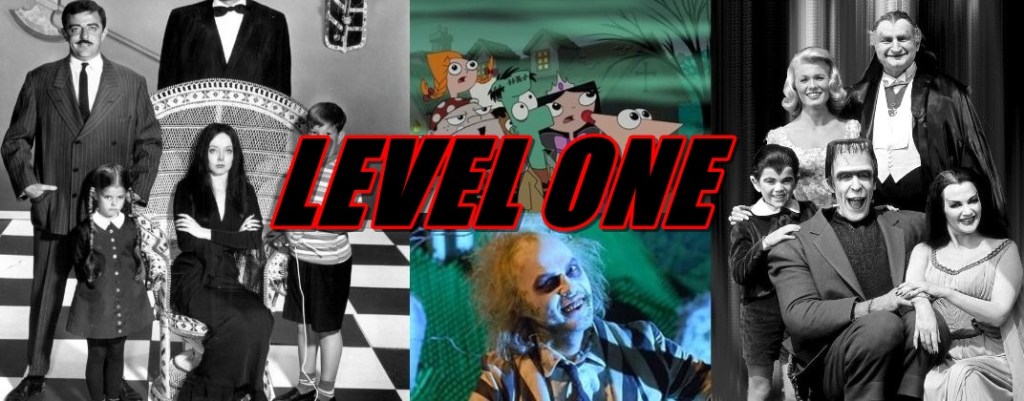
 Level one is where I place the mildest iteration of horror/comedy, where the emphasis is on the comedy. This is usually pretty lighthearted, and more often than not it’s family friendly. It usually has the TRAPPINGS of horror: haunted houses, ghosts, monsters, and pretty much anything else you would consider acceptable in an elementary school Halloween decoration, but there is rarely (if ever) a legitimate attempt at scaring people with this. The classic examples here are the legendary sitcoms The Addams Family and The Munsters. People will argue until the end of time as to which one was better (as far as the original TV show goes, that is – there can be no debate that the Addamses have superior movies), but whether you’re a Gomez Guy or a Lilly Lover, these two franchises are about as close to G-rated as horror gets. There are more recent entries into the category as well, like the Hotel Transylvania movies and underrated movie Igor, and a lot of family cartoons and sitcoms shift into this for Halloween episodes, often seen on the likes of Roseanne, Home Improvement, or Phineas and Ferb.

It’s worth pointing out here that, again, I’m calling this a spectrum, and even these five subcategories have different levels. Technically, I would place Beetlejuice here as well (the original, at least, I haven’t seen the sequel yet), because I don’t think that the movie is ever actually intended to be scary. However, it’s obvious that the movie is more intense than the adventures of the Addamses and the Munsters, and thus if it IS a Level One, it’s towards the high end of the spectrum. A 1.9, perhaps.

On the second level, I place those stories in which the situations are relatively serious, but the characters themselves are funny and react to the scary moments in funny ways. Ghostbusters is the classic example of this. The ghosts aren’t played for laughs (not usually, at least, especially not in the first film), and some of the things could actually be legitimately frightening, such as the first appearance of the Library Ghost. But the behavior and antics of Bill Murray, Dan Aykroyd, Harold Ramis, and Ernie Hudson are very funny and keep you from feeling any legitimate terror. Even when it looks like a Sumarian Deity is about to curb-stomp the city of New York, you know that Venkman is going to have a wisecrack to defuse the situation. Another of my favorite films, Abbott and Costello Meet Frankenstein, falls into this category. The classic Universal Monsters are there, and Lon Chaney Jr. (the Wolf-Man), Glenn Strange (Frankenstein’s Monster) and Bela Lugosi (Count Dracula himself) all play their roles perfectly straight, as if they’re in one of their solo adventures and trying to chill the spines of the audience. But with Lou Costello freaking out over a candle and Bud Abbott doing his impression of everybody who never sees Michigan J. Frog singing, there’s no real sense of danger. The blend of master monster performers and master comedians is never more evident than in this film.

Other works that are typically family-friendly but where the villains have the POTENTIAL to cause actual harm fit in here as well. Hocus Pocus and The Nightmare Before Christmas fall into that category, as do certain classic cartoons such as the Bugs Bunny short Transylvannia 6-5000. I struggled a bit with one of my other favorite Halloween movies, Ernest Scared Stupid, trying to figure out if it belongs here or level one. Ultimately, I’m placing it here, because there are kids (the intended audience) who might find the trolls actually frightening, and they’re trying to do bad things. It’s only through the intercession of American hero Ernest P. Worrell that they’re stopped in time. Yes, that means I’m giving Ernest a higher rating than Beetlejuice, but my metric is how scared the INTENDED audience might be, and I’m sticking with it.
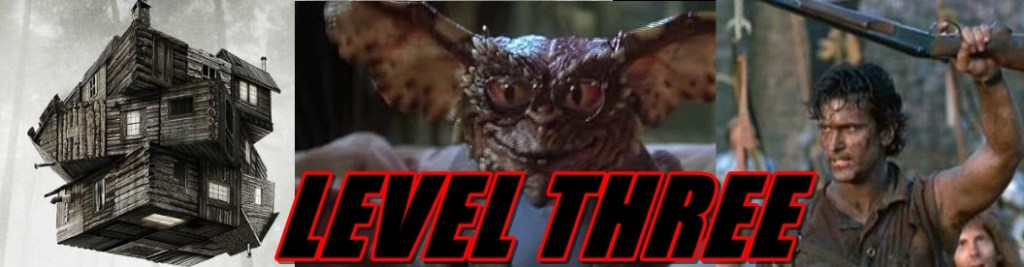
Level three stories have a fair balance between the horror and the comedy. Parts of the film may feel like you’re watching a scary movie, other parts feel like a pure comedy, and when this is done well there is no discrepancy felt by the audience. These two styles of storytelling just match each other very well. Drew Goddard’s The Cabin in the Woods is a great example of this. We start out with what looks like some sort of bland, white-collar office comedy, then cut to a bunch of teenagers getting drawn into what appears to be a very stereotypical slasher movie. But the creeps start to claw their way into the office setting, while the events in the titular cabin turn out to be funnier than you would expect, and by the time we get to the full-on collision of the two settings and you come to understand what one has to do with the other, we’ve got a great blend of the two that maintains pretty much throughout the rest of the film.

We often see this type of balance, by the way, in later films in a franchise. It’s not unusual to see a relatively serious horror movie get zanier in the sequels. Gremlins 2 is one of my favorite examples of this. The first film has its humorous moments, but the sequel really leans into absurdity, with the monsters taking different forms and playing out scenes as though they fell out of a Looney Tunes cartoon. The result is a movie that many fans even prefer to the original. Another good example of this is Army of Darkness, the third movie in the Evil Dead trilogy. The first movie is pure horror, almost nothing funny about it. The sequel, Evil Dead 2, is still very dark, but brings in enough comedic elements to earn it a spot on my spectrum. (That spot is in Level Five, and we’ll get to that soon enough.) But in Army of Darkness, Sam Raimi decided to let Bruce Campbell’s comedic skills and charm really shine through, resulting in a movie that is very different, tonally, from the rest of the franchise, but like Gremlins 2 is a favorite of a large number of fans.

Level Four is where things are getting a lot darker. These are films that are primarily horror movies, but movies that have a twisted sense of humor, and that often comes down to the villain of the franchise. We see this most clearly, I think, with A Nightmare on Elm Street. You’ve got a dead child killer who has the ability to enter and attack you through your dreams, which is not funny at ALL. But the child killer in question also has a wicked funny bone, which manifests itself both in what he says and in the scenarios that he traps his victims in – scenarios that can go from bitterly ironic to just plain goofy. I think it’s the reason that Freddy became such a breakout star in the 80s. There were lots of slashers at the time, but in an era when most of them were imitating Michael Myers and acting as the Strong, Silent Type, Freddy was blazing a trail as a new kind of killer. There have been efforts to imitate him, but few have succeeded.

Probably the most successful imitator, tonally at least, is Chucky from the Child’s Play series. In this franchise, we’ve got a child’s plaything, a three-foot doll, inhabited by the spirit of a serial killer. Making a kid’s toy creepy is a fairly common occurrence in horror (the idea of something that’s supposed to be wholesome and nurturing turning dangerous is frightening), but again, it’s the wit and cleverness of the Chucky character and Brad Dourif’s performance that made the franchise successful and allowed it to grow into so much more than it was in its origins. Oddly enough, later films in the franchise and the follow-up television series do drift, but not lower on the scale of comedy, but towards having a bit more melodrama. It’s a weird, unique transmogrification of the concept, but it never loses its sense of humor.

The Cryptkeeper from Tales From the Crypt and other assorted horror anthology hosts often fall into this category as well. Whether we’re talking about a TV series, movie, or comic book, the format is usually the same: they present to you a scary story, popping in before and after (or sometimes during, if it’s a format that has a commercial break) to drop in a few witticisms about the hapless characters marching stoically to their doom, and the audience loves them for it. The truth is, fans tune in as much for the Cryptcreeper’s ghoulishly ghastly puns as we do for any of the scares that are coming our way.
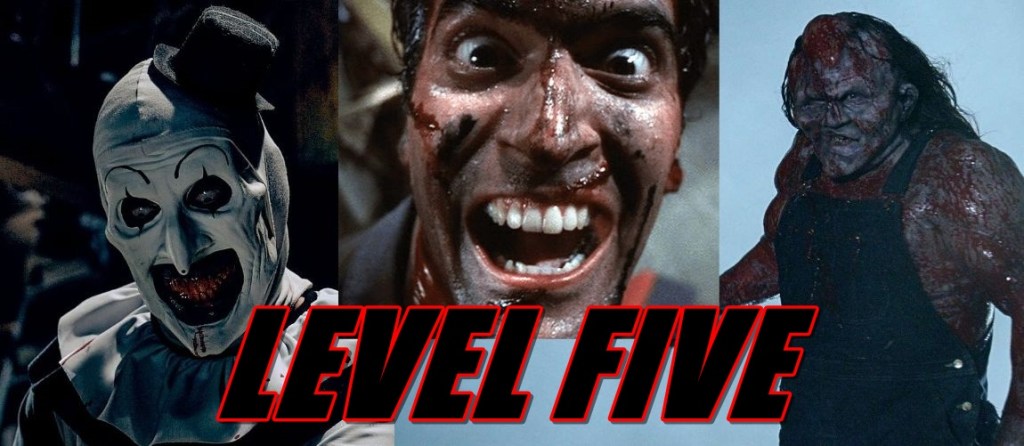
Finally, we arrive at the top tier, that level of horror that’s furthest away from comedy while still, at the same time, having some funny beats. In this category, I place movies that are primarily horror films, but that have a pitch-black sense of humor. Evil Dead 2, again, is a prime example. Bruce Campbell and his girlfriend are under assault by the horrific “Deadites,” demonic creatures that are out to torture and mutilate. Not funny. They take his girlfriend and turn her into one of them. Not funny. One of them possesses Campbell’s hand and he’s forced to cut it off with a chainsaw. Not –

–actually, that part is kinda funny. And that’s how movies on this level go. They take things that SHOULD be horrible and graphic and terrifying, but elevate them to a level that’s almost too cartoonish to take seriously, allowing some laughter. Campbell is great at this. We also see it done to good effect in Adam Green’s Hatchet series. The characters who are NOT undead revenant Victor Crowley are often pretty funny, but Crowley himself is the unspeaking sort of horror. The kills he pulls off, though, are so ridiculously gruesome that the realism is drained away, giving the audience permission to laugh a little bit. To a lesser extent, the same is true of the hugely popular Terrifier films, where the silent Art the Clown brutally tortures his victims. Early screenings for the third film (opening soon) are reporting people walking out during the first ten minutes, with one audience member allegedly even throwing up in the theater. If this is the reaction filmmaker Damien Leone is going for (and I believe it is), then you have to believe he is intentionally going way over the top. 

So there you have it, friends, the levels of horror/comedy. Keep in mind that this scale is meant to determine INTENSITY and in no way is indicative of the QUALITY of a film. Every level has great movies and awful movies that belong there. But if you’re trying to figure out how intense a movie you’re looking for this spooky season, think of the scale and make sure you’re not in a Level Two mood when your friend shows up recommending a Level Five.

Blake M. Petit is a writer, teacher, and dad from Ama, Louisiana. His most recent writing project is the superhero adventure series Other People’s Heroes: Little Stars, volume one of which is now available on Amazon. You can subscribe to his newsletter by clicking right here. The only movie on his scale to ever achieve a Level Six? Babe 2: Pig in the City. Weird, huh?

Geek Punditry #49: Playing Favorites With Christmas Part One

Ah, Christmas. My favorite time of year. The time of lights and tinsel, candy canes and egg nog, and most relevant to this blog, movies and stories. I love Christmas in general, but perhaps my favorite thing about it is the surfeit of wonderful stories set around the season, which I indulge in almost to the exclusion of everything else between Thanksgiving and the 25th of December. The thing is, most of my favorite movies and books are evergreen. I can watch Back to the Future in June, I can read Ender’s Game on St. Patrick’s Day, and nothing feels wrong about it. But a great Christmas story just doesn’t feel right unless I’m consuming it sometime after Santa rides in the Macy’s parade and some time before that ball drops in Times Square on New Year’s Eve. So in this window, I have to take in a LOT of stuff.

This week I’m Playing Favorites with Christmas. I asked my friends on social media to suggest different categories relating to Christmas movies, books, TV shows, etc., and like I did with horror movies at Halloween, this week I’m going to examine these categories and talk about some of my favorites in each one. And if you’ve got suggestions for more categories – drop ‘em in the comments! There’s still a few movie nights left before Christmas!

“They said this one is about the Donnor Party. I hope it’s good, I love reindeer.”

Christmas Comedies

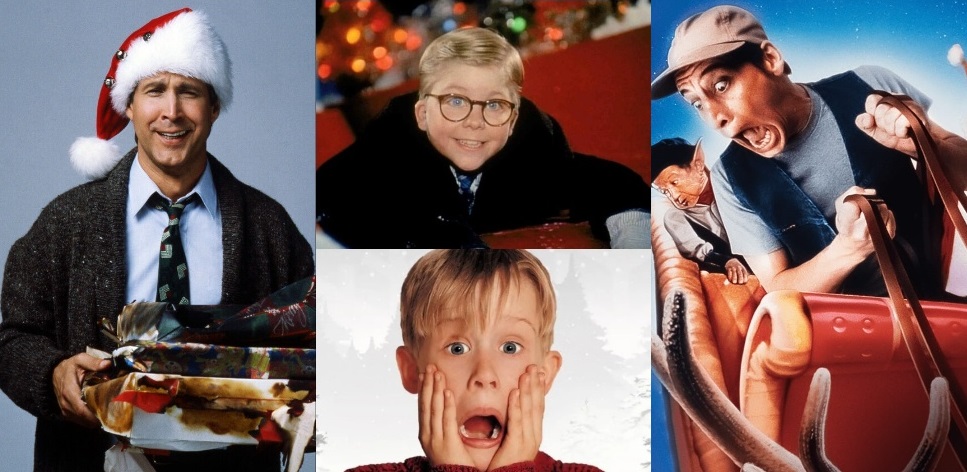
Lew Beitz is going to kick us off this week by asking for some of my favorite Christmas comedies. A lot of great Christmas movies have funny parts, of course, and I think the trifecta that most people will turn to when asked this question are – in order of release – A Christmas Story (1983), National Lampoon’s Christmas Vacation (1989), and Home Alone (1990). 

In A Christmas Story, Bob Clark blended together several semi-autobiographical short stories by Jean Shepherd (who narrates the story) and turned out a timeless movie that captures the essence of childhood at Christmas while still being unceasingly funny. There can be no doubting the iconic status of a movie that has turned a plastic lamp shaped like a woman’s leg in fishnet stockings into a traditional Christmas decoration. 

Christmas Vacation is the third and greatest of the Vacation films, about a dad (played by Chevy Chase) who desperately tries to recreate the magic of his youth for his own family, but struggles against a more cynical age. This is not only the best Vacation film, but the best movie Chevy Chase ever made. It was SO good that afterwards a federal judge ruled he was legally prohibited from being funny for the next 20 years. The ban was lifted in 2009, and Chase joined the cast of the show Community

Home Alone has Joe Pesci and Daniel Stern getting hit in the face with paint cans.

So those, I think, are the big three. But I don’t just want to leave you with the obvious answers, so I’m giving an honorable mention to another beloved Christmas comedy, the 1988 epic Ernest Saves Christmas. I am an unabashed fan of Jim Varney and his Ernest P. Worrell character (go ahead, try to abash me, I dare ya), and this is possibly the purest expression of what Ernest was. Sure, at this point he had already gone to camp, but in that film he was sort of a sweet-hearted, simple agent of chaos in a relatively realistic world. This is the movie where the Ernestverse really started to spiral into screwball comedy. In this film, Ernest is a cab driver that falls in with a guy who tells him he’s Santa Claus. He’s about to retire and needs to find the man who’s been chosen to take his place, an actor on a kids’ TV show, before it’s time for his Christmas Eve run. There’s some wacky stuff with a pair of elves and reindeer caught up in a shipping mishap, but that’s not the real draw of this movie. Seeing the golden, childlike heart of Ernest as he does his best to help Santa is one of the best reasons to love this character, even as he presents us with his funniest film. Choosing a favorite Ernest movie, frankly, is like trying to select a single rose petal as the most beautiful, but there you are.

And if you prefer your Christmas movies with a religious connotation, you’ve got the father, the sons, and the holy ghost right here.

Christmas Songs From Movies

Rachel Ricks has asked me for some of my favorite songs written specifically for a Christmas movie, differentiating them (I assume) from those pre-existing songs that are incorporated into holiday classics, like “Rudolph the Red-Nosed Reindeer,” “Frosty the Snowman,” and “Human Centipede.” 

Again, I’ll mention the most iconic example first, then talk about some others. The most famous – and arguably the best – Christmas song ever written for a movie is probably “White Christmas,” written for the 1942 film Holiday Inn and then used as the title and centerpiece number for the semi-remake of the movie as White Christmas in 1954. It’s a lovely song that I’m sure many people today don’t even realize was from a movie, and those that do know its cinematic origin probably misattribute it to the later, more famous film.

It’s not my personal favorite, though. Two other songs edge it out. For pure fun, you can’t beat “The Snow Miser Song/The Heat Miser Song” from 1974’s The Year Without a Santa Claus. In this Rankin and Bass classic, as you know, Mrs. Claus has to entreat these two thermally-opposed brothers to cooperate with one another in a convoluted plot to save Christmas. They both eventually agree, but not before performing this absolute banger of a musical number about how awesome they each are compared to their brother and how much better it is when Christmas is cold or hot, depending on which one of them is singing at the time. (The Snow Miser happens to be correct, by the way.) Even though neither song is particularly Christmasy (except for the lines where the brothers proclaim themselves Mr. White Christmas or Mr. Green Christmas, respectively), it’s so catchy and so much fun to sing along to that it’s become a staple on my Christmas playlist.

If you’re Team Heat Miser, you’re just wrong.

But my absolute favorite Christmas song originally written for a movie is “Silver Bells.” This song made its debut in 1951 in the Bob Hope movie The Lemon Drop Kid, about a silver-tongued con artist (Hope, naturally) who winds up owing a massive gambling debt to a gangster and has to come up with a contrived scheme to pay it back by Christmas Eve. The movie is charming and deserves a place with the other great films of its era, but never seems to be mentioned alongside the likes of White Christmas, It’s a Wonderful Life, or Miracle on 34th Street.

“Children laughing, people passing, something something joke, about the shape of my nose…”

As far as WHY I love that song so much…odd as it may sound, I love it because it feels to me like a love letter to New York. The song mentions “city sidewalks” without ever specifying the city, but New York is where much of the film is set and it’s where Hope is wandering when he sings the song. I’ve never really been to New York. (Spent a night in a hotel there once when a flight was canceled, but all I saw was the airport, the hotel, and the shuttle in-between so I don’t count that.) Despite that, though, decades of cultural osmosis has indelibly given me a vision of New York in December as being the most Christmasy city in the world. God knows the city has its problems, but the movies have done a truly magical job of painting it as the place to be for the holidays. It’s the setting for Miracle on 34th Street, Home Alone 2, Elf, and plenty of other classics. From the Macy’s Parade on Thanksgiving to the tree lighting in Rockefeller Center to the Times Square ball drop on New Year’s Eve, there is an intangible yuletide magic associated with New York City that this song captures perfectly. Frankly, if I ever DO go to New York, I hope it’s NOT at Christmas, because I’m pretty sure that the reality would fall very short of the snowglobe fantasy I’ve built up in my mind, in which “Silver Bells” is the background music.

Christmas IPs

Adam Santino asked about my favorite Christmas movies based on a pre-existing intellectual property, such as National Lampoon’s Christmas Vacation or He-Man and She-Ra: A Christmas Special. To clarify, for the sake of anyone unfamiliar with the term, Adam is basically asking for my favorite films based on an established brand that happened to have a Christmas-themed special or installment. Christmas Vacation, as I’ve already mentioned, is the gold standard, but there are a lot of possibilities to choose from here, and I think the correct answer is obvious.

Project ALF.

That’s right, the running gag didn’t end on Halloween.

No, but seriously, it will not surprise anyone to find out I’m a devotee of the classics: A Charlie Brown Christmas, Disney shorts like Pluto’s Christmas Tree, and the epic Star Wars Holiday Special. But there are two productions that immediately spring to mind, and they’re both courtesy of the Jim Henson people. The Muppets and their cousins at Sesame Street have each shared the joy of Christmas with us many, many times, but for my money there’s nothing finer than 1992’s A Muppet Christmas Carol. The first major Muppet production after the death of Jim Henson was something of a risk for the studio. Nobody was really sure if the magic would still be there without the man who gave his soul to Kermit the Frog. But the results were remarkable: by casting Michael Caine as Scrooge (as perhaps my favorite Ebenezer Scrooge of all time) and having Gonzo the Great stand in as Charles Dickens to serve as the narrator, they managed to make a film that is not only one of the most textually-faithful adaptations of Charles Dickens’s novel out there, but is still full of the humor, music, and heart that make the Muppets so special. It’s such a shame that Disney has lost the plot on these characters, because one need look no farther than this movie to see just how much potential the Muppets have, how much the Muppets matter, and how perfect they can be.

The other film that comes to mind is from 1978: Christmas Eve on Sesame Street. In this special, Big Bird is horrified when Oscar the Grouch tells him there’s no way Santa can fit down the little chimneys in the apartments on Sesame Street, and Big Bird sets out on a quest to figure out how Santa can do his job. There are a few subplots as well, with Cookie Monster struggling to write a letter to Santa and Bert and Ernie doing their own charming twist on The Gift of the Magi, but it’s the main plot that sets this special apart. 

It is said that, when Sesame Street was being developed, the idea was that Big Bird would play the part of the naive younger sibling, while Oscar would be the grumpy older sibling with a bit of an attitude. (Not relevant to this story, but Grover was intended to be the neglected middle child, and DANG does that make things make sense.) The dynamic between Big Bird and Oscar is wonderfully authentic, a fact made even more impressive when you remember that the late Caroll Spinney was the performer for both characters. Near the end, when Big Bird has gone missing due to his Santaquest, Maria (played by Sonia Manzano) lays into Oscar in a way that’s less like the mother figure she would eventually become and more like a big sister angry at someone picking on her little brother. It’s her performance in this special that I think explains why she was the first crush for a hell of a lot of viewers (and, if we’re being honest here, of Oscar himself). Finally, the special features Sesame Street’s lovely holiday anthem “Keep Christmas With You” performed by Bob McGrath, a scene that has even more resonance since his passing last year. 

The magic of Christmas is best expressed through the power of felt.

Christmas Horror

We’re gonna wrap up Part One of the yuletide “Playing Favorites” column with a suggestion from my wife Erin, who (staying 100 percent on brand) wants to know about my favorite Christmas horror movies. I know that a lot of traditionalists don’t care for scary movies at Christmas, but I think that’s a bit short sighted. The truth is, there is a long tradition of horror taking place at Christmastime, a tradition that goes back much, much farther than even the era of cinema. Before Halloween really took off, weaving creepy yarns next to the fire at Christmas was a longstanding tradition. It’s the reason the song “It’s the Most Wonderful Time of the Year” includes the line “There’ll be scary ghost stories and tales of the glories of Christmases long, long ago.” And lest we forget, the most famous Christmas novel of all time is about a miserable bastard who is tormented by ghosts until he accepts the fact that he is, in fact, a miserable bastard and swears to get his act together.

All that said, I love a good scary story at Christmas – but I do have my limits. I like ghost stories. I like monsters. But I’m not as big a fan of human monsters at Christmas, and what I’m getting at here is that I’m not really fond of Christmas slasher movies. They’re a whole subgenre that I respect for its place in the canon, but the likes of Silent Night, Deadly Night or Black Christmas aren’t really my cup of tea. I like my Christmas stories with a shot of hope and redemption, and you don’t really get that with the bleaker kinds of horror movies. No, my Christmas horror movies have to offer at least a chance at a happy ending, which is why the greatest of them all is obviously Gremlins. Supposedly Chris Columbus’s original script for the 1984 classic was much darker and more violent than what was put on screen, and while I think that darker version of the story may be interesting, I’m really quite glad they changed focus before the cameras rolled. The movie nicely balances the adorable (Gizmo) with the abominable (all of his Gremlin offspring) in a way that has plenty of jumpscares and just a teeny dash of gore, but at the same time, isn’t so terrifying that I couldn’t show it to my 13-year-old niece. It’s also really funny, which is never a bad thing.

Maybe I spoke too soon about my favorite Christmas song.

The other horror movie that comes to mind this time of year is more recent, 2015’s Krampus. Directed by Michael Dougherty, who also co-wrote it, the film features a family very much at odds with one another: an obnoxious brother-in-law, a pair of bully cousins, a judgmental and overbearing aunt, until finally young Max (played by Emjay Anthony) loses his Christmas spirit and wishes them all away. That night a horrible blizzard cuts the power and traps the family in the house…and then the fun begins. 

Dougherty is also the writer and director of the phenomenal Halloween anthology Trick ‘r Treat, which is implied to take place in the same cinematic universe as Krampus, and he brings the same sensibility to the project. Just like Trick ‘r Treat, the evil forces come after characters who have violated the spirit of the holiday and are – in one way or another – due some sort of karmic punishment. Unlike the Halloween film, though (and far more in keeping with Christmas) even the worst characters in Krampus have moments where they show that maybe they’re not irredeemable after all. The ending is a bit of a mind screw and there’s some debate as to what it actually means, although an official graphic novel tie-in Dougherty contributes to gives a bit of information that seems to support the slightly optimistic interpretation of the movie’s finale.

Pictured: optimism.

Whew, that’s plenty of Christmas goodness for you guys to seek out, and we’re just getting started! I’ve got several other suggestions that I just don’t have room for this week, so come back next Friday and look for some more of your categories in Playing Favorites With Christmas Part Two! And if you’ve got a suggestion of your own, there’s still time! Drop it in the comments right here, or on whatever social media post you followed to get here!

Blake M. Petit is a writer, teacher, and dad from Ama, Louisiana. His current writing project is the superhero adventure series Other People’s Heroes: Little Stars, a new episode of which is available every Wednesday on Amazon’s Kindle Vella platform. He is desperately awaiting the suggestion that allows him to discuss 1982’s Christmas Comes to Pac-Land, so we’re begging you, don’t give him that chance.