
Welcome to the first week of my grand “Year of Superman” experiment. Over the next 12 months, I’m going to do my best to read, watch, or listen to at least one piece of Superman-related media every day. As I go along, I’ll keep a journal of each day’s entries as well as thoughts on some of the stories I’ve read or watched, then I’ll try to share them here with you on Wednesdays. Please keep in mind that my thoughts on these pieces of Superman history are likely to contain spoilers, so if there’s anything you’re trying to remain spoiler-free on, you may want to skip that specific entry.
As the year began, I wanted to focus a bit on the earliest days of Superman. I read the first Superman story as it appeared in the first two issues of Action Comics (and thank goodness for the DC Universe Infinity app for making that possible). I also read Gladiator, the 1930 novel that many people believe was a direct influence on Jerry Siegel and Joe Shuster when they created Superman. And I re-watched the movie that started my love affair with Superman, the first Christopher Reeve movie from 1978, directed by Richard Donner. Here, then, are my thoughts on Week 1 of the Year of Superman.

Wed., Jan. 1
Comics: Action Comics #1, 2, 1079
Notes: (On Action #1, 2) The embryonic Superman is so different from who he eventually becomes. He’s snarkier than usual, and much more ruthless, doing things like throwing an abusive husband against a wall, carrying a man along electrical poles, and forcing a munitions manufacturer to join the army and put his own life at stake. But even here, with methods that would seem very out of place in today’s stories, the moral core is there — a steadfast belief that, as Mark Waid wrote sixty years later in Kingdom Come, “There is a right and a wrong in the universe, and that distinction is not difficult to make.” The real world, of course, is infinitely more complicated than that, and there are a great many times when it IS difficult to figure out the right thing to do for mere mortals like you and me, but Superman doesn’t — and shouldn’t — have that problem.
Thur., Jan. 2
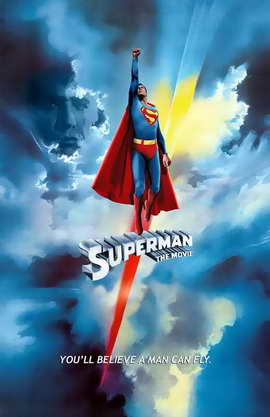
Movie: Superman (1978)
Notes: The 1978 film with Christopher Reeve will always be the gold standard, won’t it? The tagline was “You’ll believe a man can fly,” but that’s hardly the most impressive thing about the movie. In his performance, Reeve created a Superman that was warm, compassionate, and kind, all of which are things that we need even more today than when this movie was first made. This movie still has one of my single favorite moments in film history: the part where Lois falls from a helicopter. Superman reveals himself to Metropolis for the first time, gliding into the air and catching her in one hand and the helicopter in the other. He places them both on the roof of the Daily Planet building and Lois, in her shock, asks him, “Who are you?”
His reply is simple, elegant, and perfect: “A friend.”
And although my steadfast belief is and will remain that Clark Kent is the real person, that Superman is just another name that he uses and that the reason he is the greatest hero in the world is because of the upbringing of Jonathan and Martha Kent…despite that, there is a moment in this movie that shows Jor-El knew who his son was destined to be as well. The line in the Fortress of Solitude, during the tutelage montage: “They can be a great people, Kal-El, they wish to be. They lack only the light to show them the way.”
That’s who Superman is. They knew it in 1978. And if nothing else with this little experiment, I hope to remind people of that today.
Comics: Black Canary: Best of the Best #1 (Lois, Clark, and Krypto cameo), Superman/Fantastic Four, Absolute Superman #3, Incredible Hulk Vs. Superman
Notes: (On Absolute Superman #3) Young Kal-El refuses to use generative AI to write. Further evidence that he’s the greatest hero there is.

Fri., Jan. 3
Omnibus: DC Versus Marvel Omnibus
Comics: Detective Comics #1091 (Guest appearance), Action Comics #1080
Notes: (On Detective #1091) A surprisingly Superman-relevant guest spot in this issue. Batman has been offered an experimental medical treatment with the potential to greatly increase his lifespan, so he does something he very rarely does: he turns to Superman for advice. Assorted comics over the years have established that Superman ages very slowly and is, compared to the humans around him, functionally immortal, but it’s not something they talk about much in the mainstream comics. Writer Tom Taylor brings that to the forefront with a lovely speech about how Clark carries that knowledge, with an emphasis on the fact that he trusts Bruce Wayne to find a way to use this gift for the greatest good. Frank Miller was wrong. The world is better when Superman and Batman are friends.
Movie: Music by John Williams (Documentary, includes segment on Superman ’78)

Sat. Jan. 4
Novel: Gladiator (1930) by Philip Wylie
Notes: In the late 19th century, a reclusive scientist develops a treatment that gives incredible power to his unborn son. As the child, Hugo Danner, grows to manhood, he develops remarkable strength and speed, finds himself impervious to injury, and must then go out into the world to discover what place – if any – he will have in it.
This is the first time I’ve read this book, although I’ve long heard it cited as being a likely inspiration for Superman. Jerry Siegel and Joe Shuster – to my knowledge – never confirmed that this book was on their minds when they were conceiving the character, but the similarities are too striking to ignore. Hugo Danner’s powers are virtually the same as those of Superman in the early days, before he developed flight or super-senses or some of the more outlandish abilities he has today. What’s more, the sort of ethical struggles he faces are virtual mirrors of those that later writers would apply to the man of steel. Hugo is a one-of-a-kind human being, Clark Kent is a last-of-his-kind alien. Hugo has to learn lessons about the danger of his powers, if they go unchecked, which is a lesson that we frequently see in Superman origin stories. Hugo has to deal with the fact that, despite all of his power, there are some things in the world he simply cannot change, which of course is a typical theme in Superman’s stories.
What really sets things apart is how the two characters deal with the circumstances of their lives. In many ways, the way Wylie develops Hugo Danner is the opposite of what happens with Superman. As Clark learns to believe in and have faith in humanity, Hugo finds himself growing increasingly cynical and bitter as the story goes on. Clark transforms himself into a hero, but Hugo has thoughts of anger and rage that, at times, tread the line of outright villainy. We’ve seen so many stories with “evil” versions of Superman in recent years – things like The Boys or Irredeemable, which show the consequences of a character with Superman-like power but without the Superman ethos. The odd thing about Gladiator is that it feels very much like it could have served as an origin story for Homelander or Plutonian, rather than our own Superman.
I’m impressed by the writing style in some ways. Wylie is sharper and snappier, less consumed with fluff than other writers of his time, and the book is a very easy read. That said, “easy” doesn’t always mean “pleasant.” The book is a novel only in the technical definition of the term. There’s no singular antagonist, save perhaps for Hugo’s powers themselves, and there’s not a singular plot, either. Rather, we get the story of Hugo’s life, from his childhood, to his college years, to his exploits during World War I, and then beyond. We don’t get cohesion, except for a throughline of seeing how the world wears him down to the point of turning against humanity as a whole. The end of the book is particularly unsatisfying – it seems as though Wylie felt like he’d said everything he had to say and then found a quick (and, frankly, unbelievable) way to end things without actually having to resolve the ethical questions he’d addressed in the book.
It’s interesting, particularly from a historical standpoint, to see this prototypical Superman, but I’m very glad that the writers who helped turn Clark Kent into the hero he is didn’t draw quite as much from this early version as they might have.
Comic: DC Vs. Vampires: World War V #5 (Supergirl appearance)
Article: “Superman’s Editor Mort Weisinger” by Will Murray, essay in The Krypton Companion

Sun, Jan. 5
Graphic Novel: Superman: Dark Knight Over Metropolis. (Collects Action Comics Annual #1, Adventures of Superman #466, Action Comics #653, Superman Vol. 2 #44, Adventures of Superman #467, Action Comics #654.)
Notes: Having read the scene in Detective Comics #1091 a few days ago, today I decided to go back to one of the early encounters between Superman and Batman in the post-Crisis continuity. The 90s was the era when I got into Superman comics big-time, the era that I still feel represents some of the best storytelling the character has ever had, and it’s always fun to revisit it. Oddly, one of the few things I’m NOT crazy about is the somewhat antagonistic relationship between Superman and Batman at the time. In this story, a former employee of Lex Luthor who has found evidence that Clark Kent is Superman confronts him with the knowledge, as well as Luthor’s Kryptonite ring. She flees and is murdered, and the ring makes its way to Gotham City and Batman, who comes to Metropolis to unravel the mystery.
The story is solid – Dan Jurgens, Jerry Ordway, and Roger Stern were the writers of the three Superman books at the time and they had already seamlessly forged the flow that would come to define what we now call the “Triangle Era” of Superman, with the story moving from one title and creative team to another seamlessly. It still jars me to see a Superman and Batman that don’t quite get along and constantly question one another’s methods. On the other hand, this book DOES start to forge a respect between the two of them. The two of them recognize that their respective methods work for their respective cities. Most importantly, at the end of the story Clark visits Bruce in Gotham, giving him the Kryptonite ring with the reasoning that he’s worried that someday someone may take control of him and turn him against humankind, and if that ever happens he wants the only sure way to stop him to be in the hands of someone he trusts. It would be some time before Superman and Batman regained the Super BFF status that they enjoyed in the Silver and Bronze ages, but I feel like it began here.
Also of note, the issues collected in this graphic novel include a bit of a relationship upgrade for Lois and Clark, who had flirted (literally and figuratively) with being a couple for some time. In these issues, Clark pushes to make it official. One of the many things I love about the 90s Superman is what they did with the relationship between these two. Lois Lane, when written properly, is a powerful and dynamic character in her own right, and it suits the couple much more to have this version, where she falls in love with Clark Kent BEFORE she knows he’s Superman. It’s far, far preferable to the stories of the 50s, where she’s out to trick the Man of Steel into marrying her or – failing that – revealing his secret identity. This is the genesis of MY Lois and Clark, and it’s the pairing that we still see in the comics today.
Mon., Jan. 6
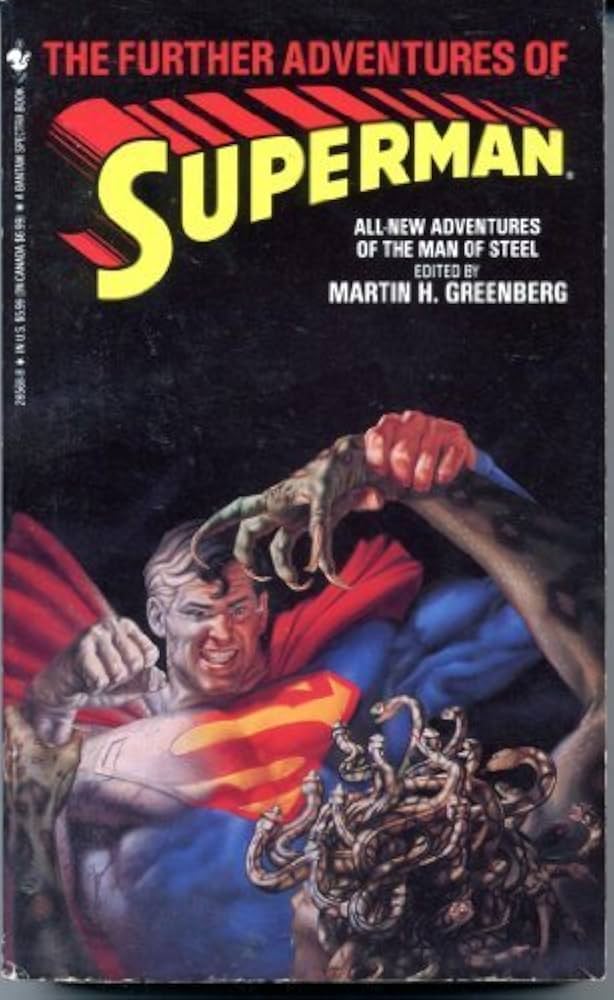
Short Story: “Lucifer Over Lancaster” by Elizabeth Hand & Paul Witcover (from the 1993 anthology The Further Adventures of Superman)
Notes: It’s been ages since I read this book, full of short stories about Superman, many of them by writers you don’t usually associate with the character. This one, for example, is about a doctor who experiments with a strange alien creature that residents of his home in Lancaster begin to suspect of being the Devil himself. I have to admit, I’m not wild about this one. The story has a long diatribe about how Superman and Clark Kent are both disguises and Kal-El is the “real” personality, associating himself more with Krypton than Earth. I don’t get this take on the character at all. Granted, he’s the last son of Krypton, but in virtually every incarnation of the character, he’s sent to Earth as a baby. It just doesn’t make sense that he would identify that strongly with his alien heritage to the point of considering his other two identities secondary. The character is a little cold in this story, too, speaking to a clearly remorseful Dr. Rule with what feels like unnecessary aggression. I’ve set myself up for a long journey this year, and I suppose it’s inevitable that I’ll run across versions of Superman that don’t quite jive with me. I guess this is the first.

TV Episode: Superman and Lois Season 1, Episode 7, “Man of Steel”
Notes: I know it’s going to shock people, but I totally missed out on Superman and Lois when it was on the air. It wasn’t deliberate. I watched the first two episodes and I enjoyed it, but then other things started to steal my attention and I just got further and further behind, always intending to come back and give it a chance. I finally made it back a few months ago, when every other Superman fan I knew was talking about how amazing the series finale was. Well, I figured, if the show is over, what better time to start binging the entire thing? I made it through the first six episodes before the end of 2024, and now that the Year of Superman is upon me, I’m getting back in with the intention of getting through the rest of the show this year.
Anyway, in this episode we see Lois and Clark’s son Jordan struggling to control his newfound hearing powers, while Lois tries to unravel the mystery of this mysterious visitor called “Captain Luthor,” who seems to hail from another universe in which he and Lois were a couple and where Superman turned bad. I know a lot of people have gotten burned out on the multiverse concept in the last few years, but I’ve always been a fan of it when it’s done well. This one is pretty interesting – as Lois and Clark are certain that this stranger is an alternate version of Clark’s arch-nemesis, but as we see flashbacks to this stranger building a suit of daughter with his and Lois’s daughter “Nat,” it becomes increasingly clear (long before Lois finds his actual name) that this is REALLY an alternate of one of Clark’s greatest ALLIES, Steel.
The DC Universe Steel, John Henry Irons, has been one of my favorite Superman spinoff characters ever since his debut back in 1993 during the “Death of Superman” arc. Steel in the comics is a good man with a great mind who uses Superman as an inspiration to redeem a mistake. This John is different – just as smart, and with what seem to be good intentions, but his experience with an evil Superman has turned him into an antagonist. It’s a pretty surprising take on a character I love, but I’m not upset at all. John is opposed to Superman here, but there’s a long way to go in this series, and I feel like this character, somehow, is going to lead to a version of the John Henry Irons that I’m such a fan of.
Nobody tell me if I’m right or not. I’m looking forward to finding out for myself.
It’s particularly nice to see Clark’s sons, especially the powerless Jonathan, get to play the cavalry in this episode. The relationship between Clark and Jonathan Kent in the comics is the best addition to the Superman mythos since he and Lois finally got married back in the 90s. This show adds a second son and changes the dynamic between the two considerably, but I’m really enjoying seeing where they go with it.

Tue. Jan. 7
Comic: Superman #76
Notes: Having read Dark Knight Over Metropolis a few days ago, I got the idea to go back to the first story showing Superman and Batman discovering one another’s identities. Although they had been shown as partners in stories prior to 1952’s Superman #76, this is the story that showed HOW they discovered one another’s identities and…well, it’s baffling that this is the sort of storytelling they got away with in that time period. Having basically eradicated crime in Gotham City, Batman decides to take a vacation, booking a spot on a cruise ship. Meanwhile, Clark Kent is booked on that same ship because…well, because he had accrued time off. In one of those wacky coincidences, Bruce Wayne and Clark Kent are assigned one another as roommates. In an even wackier coincidence, an emergency breaks out on the ship and they both decide to change into their superhero uniforms after turning off the lights. And then, wackiest coincidence, a light shines through the porthole, revealing their true identities to one another.
It’s the most ridiculous secret identity reveal of all time, and I read Marvel’s Civil War.
The rest of the story is pretty standard 50s fodder. The two of them team up to thwart a criminal on the ship, Lois Lane happens to be along for the ride, and Superman – I swear to you, they did this kind of stuff all the time in the 1950s – convinces Batman to flirt with her as a distraction so she wouldn’t try to solve the crime herself and put herself into danger. I don’t know what’s crazier, that Superman would come up with a plan so bafflingly stupid or that the world’s greatest detective went along with it.
But I do have a soft spot for this story. I first read it when I was a kid, when I feverishly checked out the book Superman: From the 30s to the 70s from my local library over and over again, and I remember this story fondly. Does it hold up? No. But I can forgive that, as a relic of the time.
Speaking of relics, the way they depicted Lois Lane back then is mad. This is just one of many stories from the era where Superman straight-up gaslights her either to “protect her from harm” or to prevent her from getting too close to him, even though they were publicly dating. (Lois and Superman, that is, not Lois and Clark.) In fact, the last story in this issue is another Lois Lane Lovetrap, where SHE comes up with the brilliant plan to get Clark Kent to marry her friend Lorraine because…that…will make Superman…marry Lois? I know it doesn’t make any sense. I read the story two minutes ago and I can’t make it make sense. All I can say is, thank God for Margot Kidder, because she really was the blueprint for how Lois has been depicted from the 80s on, and the world is so much better for it.
Thus ends Week One of the Year of Superman. I wanted to tell you that, although I have a list of stories I plan to revisit, it’s not nearly extensive enough to last a whole year. So I’m open for requests! Do you have a specific Superman comic book, story, or TV episode you’d like me to weigh in on? Go ahead and drop your requests in the comments!
Blake M. Petit is a writer, teacher, and dad from Ama, Louisiana. His most recent writing project is the superhero adventure series Other People’s Heroes: Little Stars, volume one of which is now available on Amazon. You can subscribe to his newsletter by clicking right here. He’s also started putting his LitReel videos on TikTok.
 Blake M. Petit