For some time now I’ve had the novelization of the TV show Charles in Charge sitting in my eBay searches, contemplating whether or not I should jump on it.
The first thing they teach you in blogger school is to start a column with a sentence that will compel the reader to continue in the hopes of making sense of what you’re saying. How am I doing?
You see, we live in a time when people like me (nerds) often go back and recapture things from our youth – things that we remember fondly or that tickle a nostalgic button somewhere in our soul. Often these things take the form of toys, but just as popular are other collectibles like trading cards, comics, vintage video games, and – of course – books. So the reason I’m thinking about getting this book, which is oddly enough a novelization of the opening episodes of the SECOND SEASON of Charles in Charge (I later learned that there is a novelization of the pilot I’ve never seen in person), is because I remember getting it at one of those glorious Scholastic Book Fairs that we used to anticipate with the same excitement and fervor as we would Christmas morning. It’s purely a nostalgia thing, friends.

Eh?
Oh, you mean you were wondering why the hell there was a Charles in Charge novel in the first place, aren’t you?
That also goes back to the time period in which I grew up, a magical, halcyon time known as the 1980s. It was a heck of a time to grow up. We had the best music, sodas were clear sometimes, and cigarettes had only been bad for you for like 20 minutes. But that doesn’t mean everything was perfect. This was in an era before streaming services, an era before you could pull up popular entertainment on demand from your remote control without even having to get off your couch and look for clean pants. If you saw a TV show you liked, the only way to experience it again was hope for a rerun. If you loved a movie, you had to wait for it to come on HBO (if you had it) or rent it from these ancient temples that we called “video stores.” You couldn’t even just go out and BUY the VHS tape the way you later could the DVD, because in the early days of home video the studios made the movies prohibitively expensive (nobody in their right mind would – or should – have paid $120 for a VHS copy of The Land Before Time 2) so that most people couldn’t afford to build a home library and, instead, the studios made their money using the video stores as the middleman. Eventually, the prices of VHS tapes dropped and home libraries became a thing, but for much of my childhood if there was a movie you really loved, there was only one surefire way to experience it again whenever you wanted: buying the novelization.

Novelizations have been around almost as long as film, going back to the silent era. In 1966 Isaac Asimov was hired to novelize the film Fantastic Voyage. (He was so disappointed with the result that he came back years later with a “sequel” called Fantastic Voyage II: Destination Brain, which just used the premise of miniaturized scientists going into a human body and otherwise was completely independent). One of the most interesting examples, I think, is 2001: A Space Odyssey. Author Arthur C. Clarke and director Stanley Kubrick collaborated on the story, then Clark wrote the novel WHILE Kubrick worked on the film, so which of them technically is the adaptation of the other? If you ever figure it out, let me know.
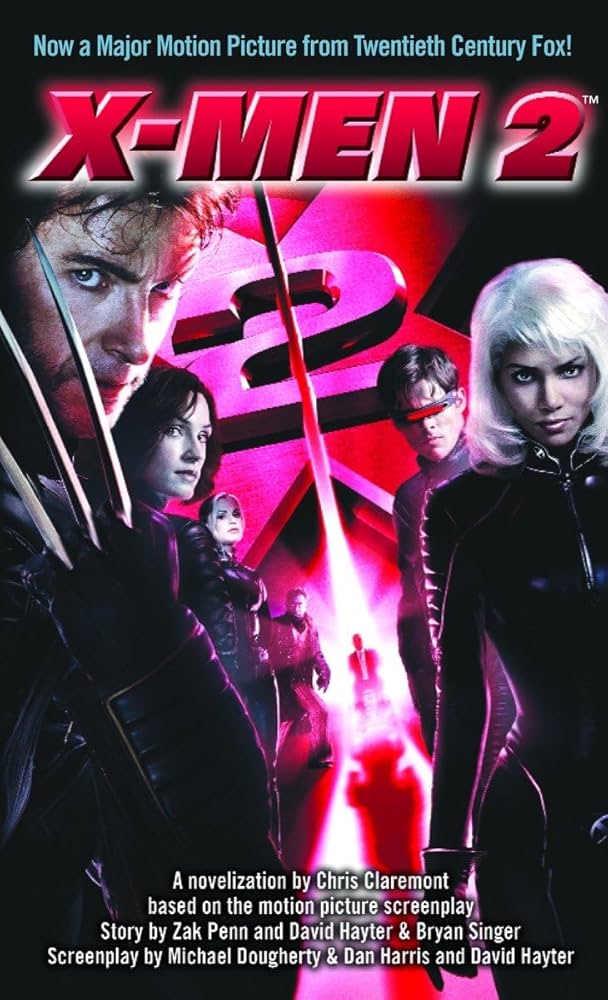
But in the 80s, the novelization was huge. I had stacks of them for the formative movies of my youth: E.T.: The Extra-Terrestrial, Batman, Dick Tracy, Back to the Future…not to mention the requisite Star Trek and Star Wars books. Not all of them were very good, of course. Some of them were downright terrible. But there was something interesting about reading these books, which were often based on early drafts of the film’s script. The novels had to be written quickly, usually while the film was still in production, in order to have them printed and on the shelves when the movie came out, so if things changed during the production, the novel would sometimes be based on the original version rather than the change. The novelization of the second X-Men movie, for example, is so different (up to which characters lived and died) that you’d be hard-pressed to believe the writer even KNEW anything about the X-Men…if it weren’t Chris Claremont, whose work on the characters in the 70s and 80s is pretty much the main reason that those characters survived past the 70s and 80s without falling into obscurity.
Screenplays often lack the detail that you get in a novel as well, and as such the authors had to conjure up a lot of the characters’ backstory, inner monologue, and other elements that wouldn’t have room to go into in a feature film. Goonies is a phenomenal example of this. It’s a movie that everybody my age grew up idolizing, that we watched over and over again, that became a fundamental part of our psyche. So we all know that the reason Josh Brolin’s character Brandon has to steal a child’s bicycle after his brother Mikey (Sean Astin) lets the air out of his own bike tires is because he flunked his driver’s test. But the novel tells us that the REASON Brand flunked his test is because he suffers from claustrophobia and freaked out about being the car with the driving instructor, a stranger. Overcoming his claustrophobia in the caves becomes an interesting running element through the novel. It also gives us a little insight into what happens to the characters after the movie ends – for instance, Chunk’s parents officially adopt Sloth and give him the name Jason Sloth Cohen at his Bar Mitzvah. It’s adorable.

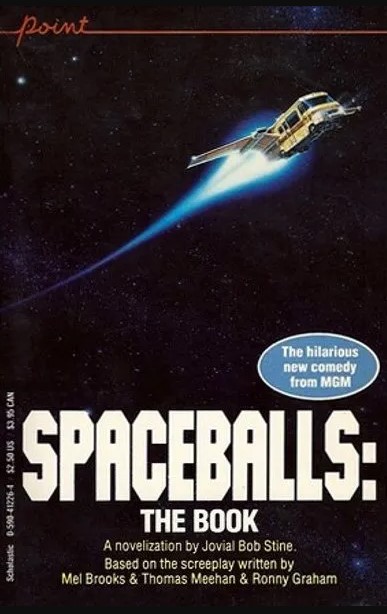
And of course, these novelizations were turned out in large numbers, especially the ones for kids. The Charles in Charge book I mentioned before is only one of many such novelizations I got from a Scholastic imprint called Point, which specialized in middle grade books. This resulted in a lot of those aforementioned novelizations, plus an avalanche of the kind of kiddie horror books that would turn so many people into lifelong horror fans, such as the Goosebumps line. It got to a point (no pun intended) that I would actually look for that Point logo at the Scholastic Book fair, as I knew those were books for people like me. In fact, a while back I finally DID jump on eBay to snag one of those old Point books from my youth, their novelization of the Mel Brooks comedy Spaceballs. When I got the book I saw, to my surprise, that it was written by “Jovial Bob Stine.” This name meant nothing to me when the movie came out in 1987, but looking back on it now I realize that this was one of the various pen names used by someone who would soon become a Scholastic legend – R.L. Stine, creator of those Goosebumps novels I mentioned before.
Some of these books have become real collector’s items. If you look up the original novelizations of some of the 80s horror movies like Halloween, Friday the 13th, or A Nightmare on Elm Street, you see them going for hundreds of dollars now. Considering the demand, it’s actually really surprising to me that you don’t see them reissued more often, or at least offered digitally. In some cases, I suppose it’s a rights issue (the rights for Friday the 13th are notoriously complicated at the moment), but some are less understandable. DC Comics recently announced a new novel, Batman: Resurrection, which will serve as a direct sequel to the 1989 Batman movie. That sounds cool – but why not reissue the novelization of the original movie to go with it?

Novelizations are still produced today, but not as many as there were back in the 80s and 90s. A lot of sci-fi movies still get them, but the odds of seeing a novel based on, for instance, the premiere of Abbot Elementary seems fairly remote. Obviously, with the streaming era, it’s not as necessary to have a book to get your hands on the story the way it was when I was a kid. More than that, though, I think that the streaming era has broken down the audience so that these things aren’t part of the cultural conversation the way they used to be. When something like the first few Star Wars movies came out, they were a phenomenon that EVERYBODY had to talk about, had to experience. They lingered in theaters for months, even years, before finally filtering out and making way for something new. That doesn’t happen anymore. A movie lives or dies based on its opening weekend. TV series dump an entire season at once and everybody has forgotten about it a week later. It’s a sad thing, I think, a change that I’m not fond of, but it’s the world we live in now.
So I’ll keep my eye on eBay and keep my finger over that “buy it now” button. I’m not saying I’ll get every old novel I see, of course. I’m just saying that if I COULD, I WOULD.
Blake M. Petit is a writer, teacher, and dad from Ama, Louisiana. His most recent writing project is the superhero adventure series Other People’s Heroes: Little Stars, volume one of which is now available on Amazon. You can subscribe to his newsletter by clicking right here. If you ever see a decent price for the novelization of Howard the Duck, let him know.
 Blake M. Petit