
Last week, as I alluded to in that blog post, was a chaotic mess for me that left me a little bit of a wreck. I’m a little better as I write this, on the afternoon of Feb. 5, but the things that have been dragging me down since last Friday haven’t subsided entirely. As a result, I didn’t have time to really read or watch anything Superman-related today, and for a moment I was afraid my streak would end in only week six. But on the way home from work, an angel appeared in my podcatcher app in the form of good old Michael Bailey.
Wed., Feb. 5
Podcast: It All Comes Back to Superman Series 2, episode 8, “Moving Kryptonian Images Part One: Superman and the Mole Men”
Notes: Like myself, Michael’s got plans leading up to the release of the Gunn Superman movie, including an examination of 25 different feature films starring the Man of Steel, and he starts with this one. I’m not going to attempt any sort of recap when I listen to these episodes – in fact, in the future I may have no notes at all – but I really do enjoy them and I’m glad I’ve got him riding shotgun while I drive to keep my mind on the good things in this world…specifically those that come in the form of a strange visitor from another planet.
Thur., Feb. 6
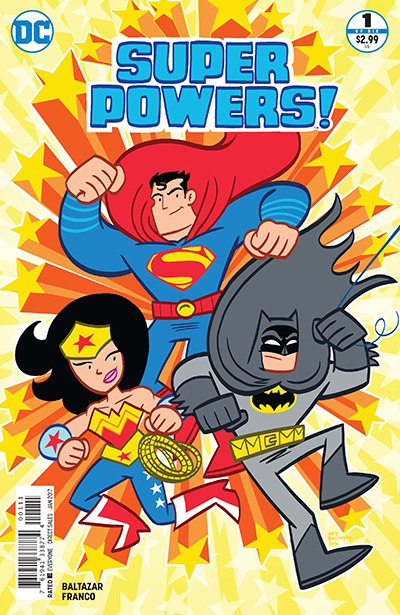
Comic: Super Powers Vol. 4 #1
Notes: It’s a busy week for me, so once again, I need something quick. The Super Bowl is coming to New Orleans this Sunday and my son is a ravenous football fan. While there’s no way we could possibly afford a trip to the Big Game, the NFL Fan Experience they’re hosting at the New Orleans Convention Center is considerably more affordable, and something Eddie will have fun with, so after school on Thursday we hustle him off to New Orleans for a few hours of gridiron fun. It’s a great time, but it does limit my Superman reading time to finding a quick comic on the DC Infinite app to read before bed. The winner is Super Powers #1 from 2016. This comic is by the amazing team of Art Baltazar and Franco Aureliani, and is set in the same world as some of their other kid-friendly comics Tiny Titans and Superman Family Adventures. In this first issue, Batman has mysteriously gone missing from Gotham City and it’s up to Superman and Wonder Woman to find him.
Art and Franco have a wonderful sense of humor and a delightfully free style that makes for some of the best comics for kids published in decades. And like most TRULY great works for children, it’s still fun for adults to read. The stories often have silly angles and even the occasional euphemism for some of the more adult concepts, but in a winking-at-the-camera way. This series was one of the few times they tried an extended storyline rather than a one-off or a series of shorts in a single issue, and I’m going to have to make it a point to finish the rest of the six-issue series this weekend.
Fri., Feb. 7
Comics: Super Powers Vol. 4 #2-6
Notes: Today I decided to finish up the Art Baltazar and Franco Aurelani miniseries I started yesterday. I read this comic when it was released back in 2016, but it turned out to have far more Superman relevance to it than I remembered. For instance, I’d forgotten that in this very kid-friendly continuity, Jor-El and Lara are alive and living in Kandor. And, in fact, in this series they give Superman a baby brother, Prym-El…who, as it turns out, also has plenty of connection to one of Jor-El’s other “children,” the computer intelligence Brainiac. The Brainiac story actually works really well. It’s presented in a format that is intended for children, obviously, but if you took the bare bones of the plot and re-told it for an adult audience it would work perfectly well. On the other hand, that would cause us to lose a lot of the tongue-in-cheek humor and delightful continuity gags intended for the older people who they knew were reading the books as well. After all, there aren’t a lot of elementary school kids who read this book and would have gotten the joke about “Superboy Prym.” (If you don’t get the joke either, “Prym” is pronounced with a long “y”.)
I really do love this creative team. They’ve done some of the funniest and most welcoming comics for young readers this century, and that’s something we can always use more of. They still dip their toes back into the DC Universe occasionally, although they spend more time these days doing their own thing or working on other properties, such as some of the recent graphic novels based on the works of Dr. Seuss, but I will always welcome their return to the Superman family.
Sat., Feb. 8

Comics: Superman #250, Superman #281.
Notes: Coming down from a stressful week, I decided to spend this afternoon finally reading the two new Superman comics I picked up at Fan Expo New Orleans back in Week Two. First up was the double-sized anniversary issue, Superman #250 from 1972. In this issue, Superman faces the Terra-Man, a villain that the narration has the audacity to refer to as “the most dangerous man in the world.” Although to be fair, he DOES almost manage to take out Superman with a device that causes the man of steel to get older every time he uses his powers. But still, Terra-Man has never quite made the upper echelon of Superman foes – the idea of a cowboy riding a flying horse and using high-tech weapons was maybe a wee bit too “high concept” to really catch on. And the end of the issue doesn’t really help. If you don’t mind spoilers for a 50 year old comic, here goes: Superman realizes that since using his powers makes him older, NOT using them will make him young again. This is an utterly ludicrous supposition and there’s no reason to assume that such a thing would be true, which makes it even more infuriating that it works. Even sillier is the notion that, once he’s young again, the mark that Terra-Man put on him to cause the aging just…vanishes. This is why you’re a D-list villain, Terra-Man. Stuff like this.
But if you really wanna talk silly, let’s look at Superman #281 from 1974. This is the first appearance of Vartox, a character who – like Terra-Man – never quite cracked the A-list, but also has had a bit of a lingering fan base, which I think is mostly attributable to his ludicrous costume, clearly inspired by the Sean Connery movie Zardoz, which came out earlier that year. HE’s not even a villain, actually. He’s a superhero from another planet, who comes to Earth when his wife mysteriously dies. Turns out her “bionic twin” – an exact doppleganger on Earth – was murdered, which somehow triggered her death as well. He comes to Earth to catch the man who killed the twin (and, consequently, Vartox’s wife), but he knows he’ll have to reckon with Superman.

Why the hell doesn’t it ever occur to these aliens to just ask Superman for help instead of coming up with some goofy, ludicrous, Fawlty Towers-level scheme?
Still, silly as he is, there’s something fun about Vartox, and it’s nice that he hasn’t been totally forgotten.
Sun., Feb. 9
Graphic Novel: Superman: Panic in the Sky (Reprints Action Comics #674-676, Adventures of Superman #488-490, Superman Vol. 2 #65-67, & Superman: The Man of Steel #9-11)
Comic Book: Justice League Spectacular #1

Notes: As I mentioned a few weeks, ago I became a regular reader of the Superman comics with the Krisis of the Krimson Kryptonite storyline. That made Panic in the Sky, which came out a little more than a year later, my first “major” event story. It’s wild to look back at it now – eight issues, entirely self-contained in the Superman comics. If a story like this were attempted today, it would be its own miniseries with dozens of spinoffs and crossovers into every other DC title, but this compact little story was handled with ease. There was even room, in the most recent graphic novel edition, to add the next four issues of the weekly Superman books, which dealt with the fallout in various ways.
In this storyline, Brainiac has gained control of Warworld, as well as taken over the mind of the alternate universe refugee called Matrix, who also became this era’s Supergirl. Along with Draaga and Maxima (both of whom we last saw during the Krypton Man story), Brainiac set out to use Warworld to conquer the Earth. At the time, following the “Breakdowns” storyline, the Justice League was disbanded, so Superman put together a team of all the heroes of Earth (or at least the most popular ones they could get editorial permission to use over this two month period) to drive them off.
I have a deep affection for this story for several reasons. First of all, it was my first “big” storyline as a Superman reader, and it was also my first exposure to some of the lesser-known DC characters that would eventually grow to be favorites of mine. It was also pretty unique in that it brought Superman to the forefront of the superhero community, something that wasn’t being done much at the time. This was early 1992, and ever since John Byrne revamped Superman in 1987, he hadn’t been incorporated much into the greater DCU. He made appearances, especially in big crossover events, but he had never been a member of the Justice League and he didn’t have the close ties to Batman and Wonder Woman that are considered so fundamental to the character today.
This was a rare story, to see him step up and take command of so many heroes. It’s also odd that the first person he recruited to defend Earth was, of all people, Deathstroke. Deathstroke had mostly been a villain in the Teen Titans’ book, but he’d become popular enough to warrant his own title and, as happened to most villains who got their own book, there was a bit of an effort being made to rehabilitate him into more of an anti-hero. It worked to some extent, but eventually he broke bad again, and frankly, it works better for him.
Reading it again today, it feels a little off in some places. Some of the various characters don’t always sound quite like themselves, which was no doubt a consequence of the four writers playing Round Robin with them. Another such result was that it was hard to keep track of the minor characters – people like Valor, Starman, and Dr. Fate would appear in the invasion force on Warworld without having appeared previously or having been set up as part of the story at all. But damn, it was fun to see artist Jon Bogdanove do his best C.C. Beck impression whenever he got to draw Captain Marvel.

The weirdest thing, though, is the Supergirl/Draaga relationship. In the first chapter, Draaga battles a Supergirl who is still wearing Superman’s form. As soon as she becomes herself again, Brainiac takes over her mind, and he maintains that hold for several issues. Then, once she’s free of Brainiac’s control, she’s apparently in love with Draaga. When did this happen? When did this relationship develop? And did they have to save the entire thing for the issue where Draaga makes a heroic sacrifice, giving his life to save her? I don’t mind the heroic sacrifice bit, it just feels like it comes out of nowhere. Although it does nicely set up how the naive Matrix was the sort to really fall into her emotions, which would become pretty important to her character in upcoming storylines involving Lex Luthor.
There are a few major components to this story that make it pretty significant, historically speaking. First, this was the story where Matrix/Supergirl finally came to Earth permanently and joined the Superman supporting cast, pretty much until Peter David launched her own ongoing title a few years later. Second, this is the story that broke the post-Crisis Superman of his “loner” status. Not long after this, he was part of the re-formed Justice League in the Justice League Spectacular one-shot (which I also read today, for funsies) where he’d stay until his battle with Doomsday.
There’s one last bit that’s not so much a significant fact as an amusing footnote. In the climactic battle, just before he’s defeated in Superman #66, Brainiac launches a device of some sort into Earth’s atmosphere. Several months later, when the Death of Superman storyline was announced, that issue got a temporary spike in popularity as speculators (they’re not a new phenomenon, folks) began to theorize that the probe was the point of origin for Doomsday, which no doubt would make that a super valuable book in the future. It wasn’t a bad theory, if not for the fact that anybody who read the VERY NEXT ISSUE (Superman #67) already knew EXACTLY what the probe was, a weapon to scourge a planet if Warworld was defeated, and that probe was beaten just 30 real-world days after it launched. It’s so important to read EVERYTHING, people.
As a storyline, Panic in the Sky has a few rough edges, but it’s an adventure I still think mostly holds up.
Mon., Feb. 10
Comics: DC Power: Rise of the Power Company #1 (Steel Cameo), Justice League America #61-64

Notes: The world in general needs more John Henry Irons. He only has one quick scene in the DC Power special, but it seems that DC is planning to bring back the Power Company in a larger way. As this scene shows he’s got a relationship with Josiah Power, I’m hoping that when that “big way” hits, Steel has a big role to play in it.
I also continued reading Superman’s time in the Justice League in the 90s. That wasn’t originally on my bingo card, but reading the Justice League Spectacular issue yesterday made me want to continue. In these first four issues, Dan Jurgens decided to get classic, bringing in some old Justice League foes in the form of Weapons Master and Starbreaker. Jurgens, who was writing and drawing both this book and Superman at the time, faced an interesting challenge with this. You see, in this Post-Byrne universe, Superman had never been a member of the Justice League before, however, Jurgens was referenced old Justice League stories in which Superman had played an active part. He sidestepped it by having Superman refer to “one of the times I helped the old Justice League.” It’s not the worst way to avoid the issue, mind you. In the early days of the comic book, despite being full members, Superman and Batman didn’t always play an active part. They would be missing for an issue or most of an issue, giving space to the less-popular members, and occasionally pop in for a finale. In at least one issue that I’ve read this year, Superman shows up on the last page and the League starts to tell him about their latest adventure. So saying that he just “helped” the League a lot in the old days doesn’t really take a ton of mental gymnastics to accept.
On the other hand, both in Panic in the Sky and in these issues, a big deal is made out of the fact that Superman has always been a loner. He’s not a team player, they say, he’s someone who is most effective flying solo (excuse the pun). So how do you explain the fact that he was “helping” the Justice League every other month in the old days?
The character stuff in these issues is better once you manage to ignore the continuity snarls. There are a couple of major sources of conflict for Superman outside of the villains, both of which help form the shape of the book. Superman does not get along with Maxwell Lord, who seems like a smug opportunist even before the later Infinite Crisis turn the character would take. As Max is the one who first assembled this version of the League, he thinks that makes him in charge, a stance that Superman staunchly opposes. Similarly, he clashes with the League’s current Green Lantern, Guy Gardner. Part of the clash is because Guy, too, thinks he should be in charge, but even moreso, Guy is angry because his on-again off-again girlfriend Ice clearly has a crush on Superman. The Guy/Ice relationship was always an odd one. It only really makes sense in an “opposites attract” context, and works best in more of a humorous book, like the Giffen/DeMatteis Justice League book was before Jurgens took over and it became more of a straight superhero series. After that, having Ice together with a boorish lout like Guy didn’t really click.
Not to say I dislike Guy. The character is entertaining as anything – he is the living embodiment of “He’s an asshole, but he’s OUR asshole,” and the way he clashes with Superman in these issues feels perfectly in character for both of them at the time. The fact that Guy is going to be in the James Gunn movie, where he’ll be played by Nathan Fillion and, evidently, drawn by Kevin Maguire. There’s been nothing to indicate that Ice will be in the movie, of course, but I wonder if this is the dynamic Gunn is planning between the two characters. It could be a lot of fun if it is.
TV Episode: Superman and Lois, Season Two, Ep. 5, “Girl…You’ll Be a Woman, Soon.”
Notes: Lana’s daughter (and Jordan’s girlfriend) Sarah has her quinceanera, which is majorly ruined when Sarah’s dad makes a confession. Jonathan is juicing. Bizarro kills a character who got her name from the comics, but not much else. This is another episode that feels more like a CW soap opera than – as so many of my friends have told me – the best Superman ever. To be fair, when they say that they’re talking about Tyler Hoechlin’s performance and not the show itself, and this episode is a little light on Hoechlin. I still feel like the series is in a sophomore slump. I’m not giving up though, guys. Promise.
Tues., Feb. 11
Comics: Justice League America #65-68

Notes: I try not to pay too much attention to criticism for the upcoming Superman movie, mostly because I find that anybody who spends that much criticizing something they haven’t even watched yet is a troll, but there’s one element in particular that comes to mind as I read these issues of Justice League America: people worried that the film is introducing too many superheroes too fast. We know for certain that at least four other characters (not counting the usual Superman supporting cast) appear in the movie: Mr. Terrific, Metamorpho, Hawkgirl, and Guy Gardner. Some people seem to think that the movie will spend a lot of time on them to the detriment of Superman himself.
Let me explain why that’s not a logical argument: are you equally worried about the fact that the cast includes Perry White, Jimmy Olsen, Cat Grant, and Steve Lombard?
The way I see it, our hero has two workplaces: as Clark Kent he works at the Daily Planet and as Superman he works with the Justice League, and while I don’t want any of those characters to be cardboard, none of them require an entire movie’s worth of development either. If Hawkgirl doesn’t have any more screen time than Jimmy, I don’t think that’s going to be a bad thing.
I bring this up because I get a similar feeling reading these issues of Justice League America. Dan Jurgens took over after the legendary Keith Giffen/J.M. DeMatteis era of the book and made it more of a traditional superhero comic. The result is that Superman himself is mostly a side character. We spend a lot of time on the returning characters (Guy, Fire, Ice, Blue Beetle, and Booster Gold). A lot of the focus also falls on two of the new members of the League: the enigmatic Bloodwynd, whom Beetle becomes obsessed with investigating, and Superman’s former foe Maxima, who is trying to rehabilitate herself on Earth after the loss of her homeworld. Superman shows up, but for the most part he’s there to clash with Guy and Max and give Ice someone to moon over. He doesn’t even appear at all in issue #67, and when #68 begins the rest of the team is stomping around Metropolis on a kaiju-sized Guy Gardner ring construct trying to hunt him down because he never bothered to pick up his JLA signal device.
All of this makes it even more baffling when you realize the ten issues collected in the Superman and the Justice League America graphic novel (the Spectacular one-shot and issues #60-68) are pretty much his entire tenure with the team, because you know what happens in issue #69?
Doomsday happens.
I remember when these books came out. A huge deal was made of the fact that Jurgens was taking over the comic and that Superman was joining, so the fact that his tenure ended with his death about a year later is really bizarre. Jurgens himself didn’t stick with the book much longer after the Death of Superman storyline, and I have to wonder what the internal discussions were at the time. I can’t imagine the death had been mapped out at the time that the decision was made to add Superman to the JLA, so what happened when they realized he was going to be bumped from the book by virtue of not being alive?
Reading these issues like this, collected together for the first time in many years, it really feels like Jurgens was building up a lot of story points that he never got to resolve. I love the original Death and Return of Superman storyline. I think it’s an epic story and one of the most important touchstones in the character’s history. But I really wish I could get a VPN that lets me access the DC Universe Infinite app from an alternate universe where Superman wasn’t killed, the Jurgens Justice League run lasted longer, and these stories unspooled as originally intended.
Next week, it’s another theme! It’s time for Superman Vs. the Flash! I’m going to try to read and watch as many of the races between the Man of Steel and the Scarlet Speedster as I can find, and if there’s one in particular you want me to cover – either in comics or TV – make sure you let me know in the comments or in the Year of Superman Facebook Group!
Blake M. Petit is a writer, teacher, and dad from Ama, Louisiana. His most recent writing project is the superhero adventure series Other People’s Heroes: Little Stars, volume one of which is now available on Amazon. You can subscribe to his newsletter by clicking right here. You can join in the Kryptonian Konversation every day in the Year of Superman Facebook Group!
 Blake M. Petit
“But I really wish I could get a VPN that lets me access the DC Universe Infinite app from an alternate universe where Superman wasn’t killed, the Jurgens Justice League run lasted longer, and these stories unspooled as originally intended.”
Darn it, Blake! I’m busy. I just do not have time to create an interdimensional VPN right now…
Tempting as it might be…
Hmm, I’d be able to watch check out that universe where my favorite shows weren’t cancelled, wouldn’t I?
No! I have other things to work on. I’ll just put a basic sketch of the idea for an interdimensional VPN into my notebook so that I can get to it later, if I have the time. It will go right next to my idea for a holographic stop motion animated movie.
LikeLiked by 1 person