Geek Punditry #75: The Pixar Moment

It isn’t that long ago that Pixar was perhaps the single most reliable name in family entertainment. One movie after another was not only a box office smash, but the recipient of nearly universal critical acclaim. The Toy Story films, The Incredibles, Wall-E, Up…there hasn’t been a track record of animated success like this one since the Disney Renaissance days. But over the last few years, these fortunes faltered and the one-time juggernaut has become almost a bit player in the House of Mouse. With Inside Out 2 coming out next week, the sequel to one of Pixar’s last truly great movies, there’s a chance to course correct. I have no idea if they’ll pull it off, but this seems like a good time to look back at the Golden age of Pixar in the hopes that they can find it again.
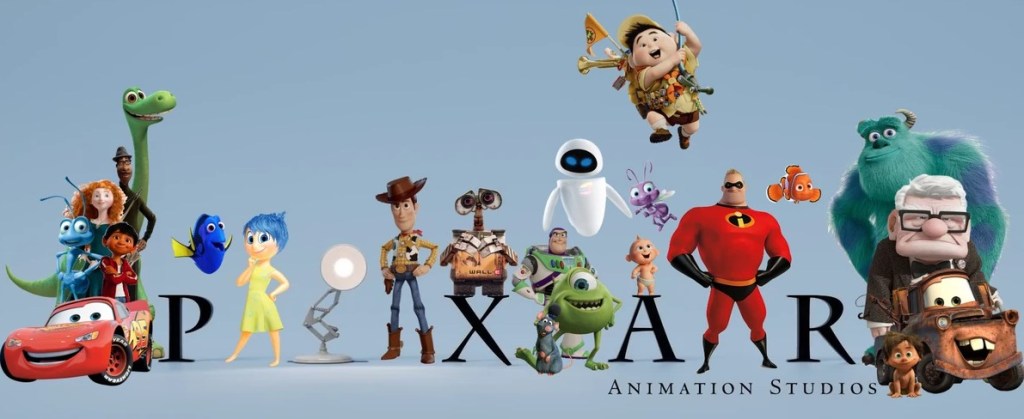
“Okay, guys, he’s talking about us, everybody line u– oh for…WHO LET THE DINOSAUR IN HERE?”

The best Pixar movies have always been allegories, presenting universal experiences in a way that kids can understand. The Toy Story movies, for instance, form a magnificent triptych about growing up using a cowboy toy as a surrogate for the audience. In the first movie, Cowboy Woody (Tom Hanks) is upset when his owner Andy gets a new, flashy Buzz Lightyear action figure (Tim Allen). Woody is forced to confront the fact that he’s no longer the center of Andy’s universe, a lesson that every child has to learn at some point or another. In Toy Story 2 Woody is shown evidence of his former glory, and ultimately must choose between chasing this sort of false promise of fame and the family he has worked so hard to cultivate. It may not be as universal a situation as the original, but it’s still a good message. The third is an outright masterpiece: Andy is all grown up and about to leave for college, and our old friends are mistakenly tossed into a donation bin. The movie is a beautiful story about growing up and letting go, but done in a way that doesn’t make it frightening for children, not to mention remarkably powerful for the grown-ups who went through it all with Andy in real time.

It’s rare that the third movie in a series is the best one. Pretty much just this and Police Academy, I guess.

Which is why Toy Story 4 was such a damned disappointment. After a crystalline metaphor for childhood, the fourth film loses all of that, having Woody abandon the rest of the toys largely because Bonnie – the child Andy bequeathed him to – doesn’t love him the way Andy did. There’s no true core here, nothing to connect the movie to that extended storyline about life that the first three made up. One could argue that it’s about letting go, except that part 3 already used that as its message, and was infinitely more effective.

Up is perhaps my favorite Pixar film. After the tragic loss of his wife, Carl Fredricksen (Ed Asner) becomes a recluse, holing up in the house he shared with her and refusing to budge. When told he has no choice but to vacate his home by a land developer, he instead hooks up the house to a buttload of helium balloons and takes it with him. The premise is ludicrous, but the movie is sublime: a fable that is ultimately about the need to move forward after a loss. It is a reminder that we will all experience tragedy in our times, but we can’t allow that to stop us from living our lives. Lots of Pixar movies can make you cry at the end. Up is the only movie I’ve ever seen that moves me to tears in the FIRST ten minutes. 

The reason behind it may be tragic, but haven’t we all wished we could do this at some point or another?

If Up is my favorite Pixar movie, then Wall-E is a very close second. A pure science fiction film, the movie is set in a future in which the Earth became so uninhabitable that humanity was forced to flee into outer space. Over the centuries, one little robot who was tasked with cleaning up the garbage left behind has kept up with his assigned task, even though it seems an exercise in futility until a probe droid from one of the human ships returns to Earth to seek signs of life. Then the remarkable happens: Wall-E falls in love.
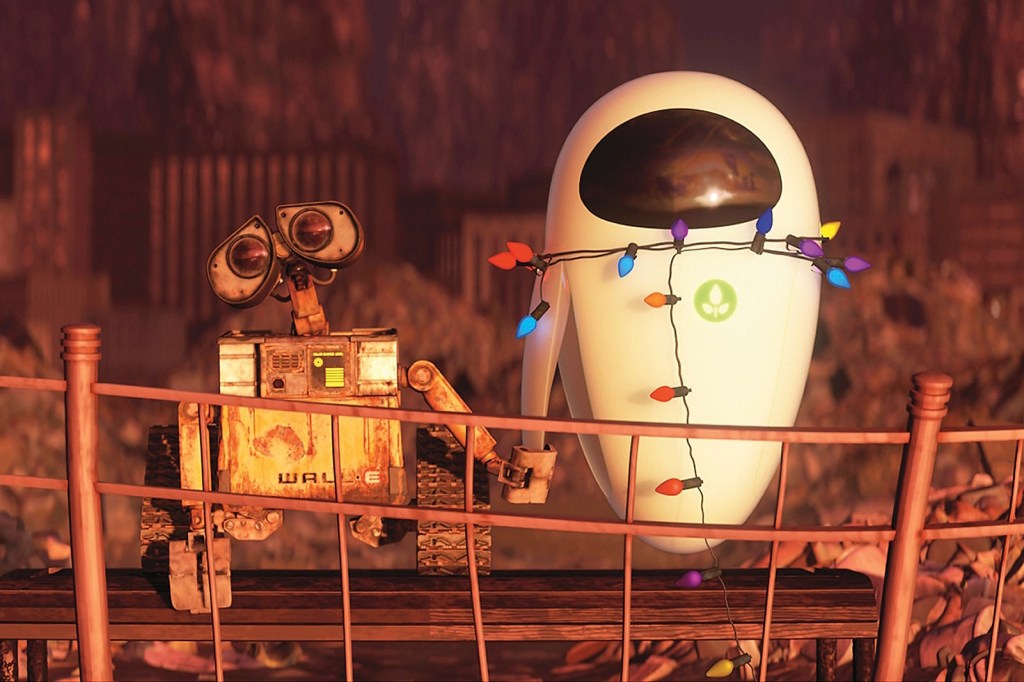
A better love story than Twilight, and it’s not even close.

The movie is unbearably sweet, but never in a sickening or saccharine way. When you watch the interaction between Wall-E and EVE (the robot from the human ship Axiom) there is never even a second when you doubt the utter sincerity of emotion put on display. Wall-E is in love. EVE falls in love with him as well. With all the debate surrounding AI at the moment, I find it pretty incredible that 16 years ago Pixar showed us an AI with an actual soul, which is what all of the AI “art” and “writing” being churned out by the likes of ChatGPT completely lacks. Pixar made us believe in Wall-E by making him – a tiny robot with almost no dialogue and a design that (let’s be honest here) was totally ripped off of Johnny 5 from the Short Circuit movies – into a hero that displayed the best parts of humanity. Wall-E is kind, curious, and utterly devoted, not just to EVE but also to his assigned task.

Let’s talk about that task, though, because that’s where the allegory in this film comes to light. Wall-E has spent centuries gathering up garbage, compressing it into cubes, and stacking up those cubes into increasingly elaborate structures. And yet the volume of garbage barely seems to have been dented and the reason for his task (to make the world livable for humans) is long gone, seemingly forever. Why is he doing it? What’s the point? This question is echoed later when we actually arrive on the human ship, the Axiom. On this ship, the surviving humans have their every need catered to by machines, and have turned into fat, sedentary blobs who can barely even walk, let alone show the ability to make a decision on their own. But this is their life, this is all they have ever known, and thus they keep going.

And then there’s the ship itself, controlled by a computer voiced by Sigourney Weaver and cleverly designed to evoke the treacherous HAL 9000 from 2001: A Space Odyssey. (There’s a unit in my 12th grade English class where I show clips of 2001, and I’m always impressed when a student picks up on the fact that Pixar was doing a shout-out here). The Axiom hides the evidence that Earth may again be capable of sustaining life and tries to keep her charges in outer space. Why? Because it doesn’t seem possible. Because her task is to keep the humans alive, and bringing them to Earth poses too great a risk. While the Axiom computer is ostensibly the movie’s villain she, like HAL 9000, isn’t strictly evil in the way that you think of a villain being evil. She is doing what she believes is best, and her actions are only viewed as villainous because we – as the audience – have personally seen the evidence that she is wrong. 

“If you’re gonna steal, steal from the best.” –Pixar’s official motto.

The point is, Wall-E, the Axiom, and the humans on board have all spent their existence in a state of unbroken trajectory, doing the same thing over and over again for no real purpose. Purpose is not found until they all collide and discover that there is a greater potential in the universe than what they have been experiencing. Again, this is the brilliant message of the film: don’t just keep doing something useless because it’s the way that it’s always been done. Find something better. 

And it actually makes you care about a cockroach. Come on, that’s a damned magic trick.

Finding Nemo is probably my son’s favorite Pixar movie, or at least the one he talks about the most, even pointing out fish at the aquarium we took him to last week and indicating which ones were Nemo and Dory. This movie (directed, like Wall-E, by Andrew Stanton) is about a young fish who is taken away from his overprotective father, captured by a scuba diver and brought to a tank in a dentist’s office. The dad, Marlin (Albert Brooks) teams up with a fish who suffers short-term memory loss (Ellen Degeneres) in a desperate chase across the ocean to bring his boy home. Here’s the remarkable thing about this movie: from the description, it sounds like it would be the story of a child learning to obey his parent and not venture out into dangerous territory. If anything, though, it’s the opposite. Nemo is the title character, but the character arc belongs to his father, Marlin, who has been so protective of Nemo since the catastrophe that took his wife and other children that he has not allowed the child to grow. It’s MARLIN who has to learn the lesson in this movie, that a parent has to be willing to let their child swim on their own eventually. (Like so many movies about parents and children, this hits me totally differently today than it did when it was first released in 2003.)

Then there’s Coco from 2017, a movie I will defend as being the last truly great Pixar film (hopefully just “so far”). Coco is about a young man who dreams of being a musician, but is part of a family that hates music because of how his great-grandfather abandoned the family to chase a musical dream. The boy, Miguel (Anthony Gonzales), winds up trapped in the Land of the Dead, and must gain the blessing of his own ancestors to return home…but they want him to give up music. Like many of Pixar’s best films (especially Toy Story 3), Coco features a brilliant twist that turns the movie on its ear, but ultimately, this story is about the toxicity of anger and how holding on to resentment hurts not only you, but everyone you love. And like Nemo, the idea of letting your children find their own way is very present in the film. Was Pixar even TRYING to make these movies for kids?
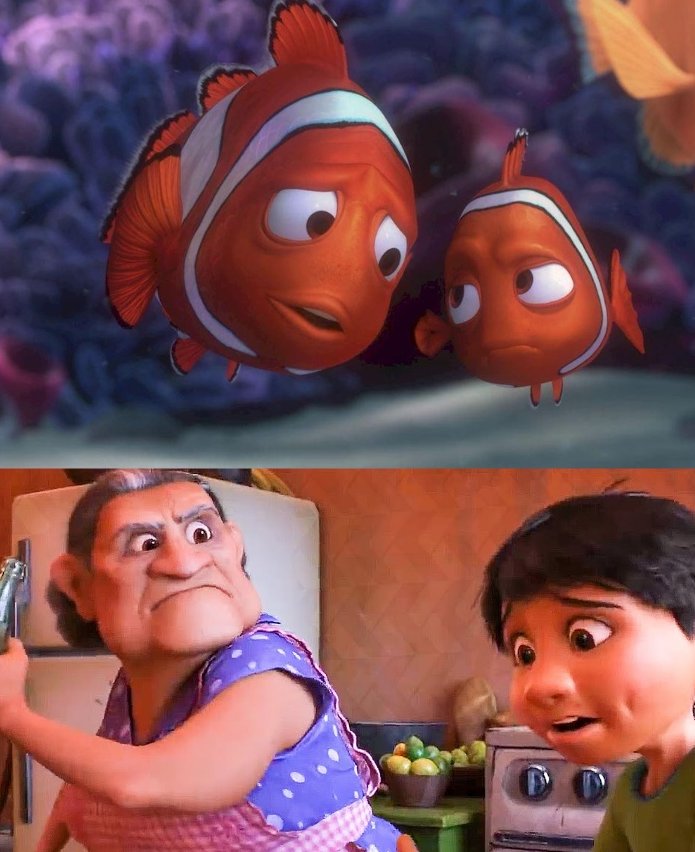
The two horsemen of “You gotta let your kids make their own choices.”

I’m not saying that everything Pixar has done since 2017 is awful. Onward was pretty good, and had a good message about family, but it wasn’t groundbreaking the way earlier Pixar films have been. Luca was okay…but when you’re the studio that gave us Wall-E, a movie that’s just “okay” is a huge step backwards. I liked both Soul and Elemental much more than Luca, but again, it felt like Pixar was covering a lot of the same ground that they’ve covered in the past. Then there’s stuff like the Toy Story spinoff Lightyear, ostensibly the movie that Toy Story’s Andy loved so much that he needed the action figure. This movie has pretty much NO emotional framework, being a sci-fi movie about alternate timelines and the military. There’s nothing wrong with any of the elements individually, but not only do they never come together, the conceit that this was the favorite film of an 8-year-old boy is patently absurd. 

But let’s get back to Inside Out, since that’s the film that sent me down this train of thought in the first place. Inside Out is about a young girl named Riley whose family moves from Minnesota to San Francisco, and all the accompanying emotional baggage that comes along with that sort of move. However, the majority of the film is actually set inside of Riley’s head, with those emotions themselves – or rather, anthropomorphic personifications of the emotions – being the stars of the film. Joy (Amy Poehler) has been the de facto leader of Riley’s emotions since birth, but when the trauma of the move hits her, Joy and Sadness (Phillis Smith) get jaunted out of their control room on an odyssey across Riley’s mindscape in an attempt to re-establish her core emotions. 
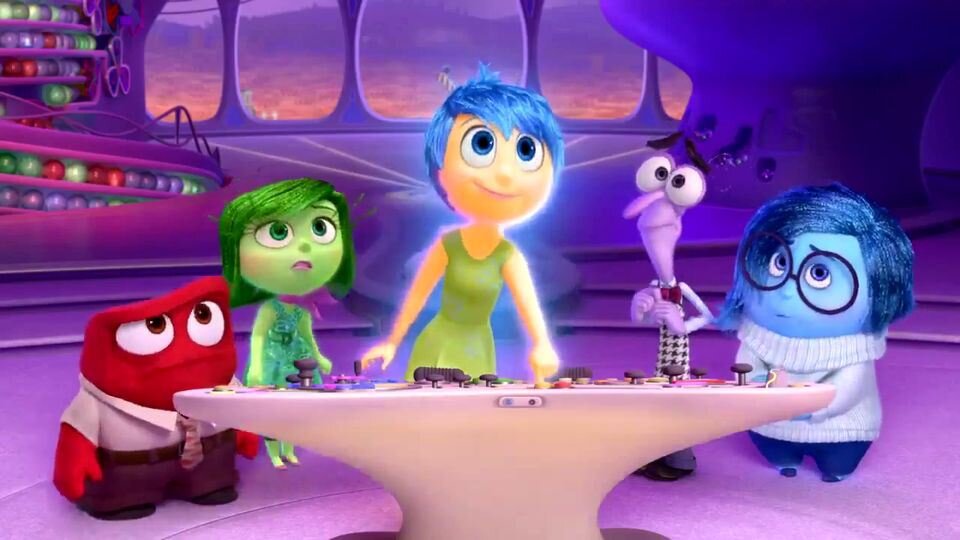
It’s not a coincidence that the face of Toxic Positivity has the voice of Leslie Knope.

It’s a cute film with cute characters. The animation – like even the worst of Pixar’s movies – is fantastic. But what really elevates this film is the way it so perfectly creates a framework for the struggles of a child dealing with a life-changing event. On her first day at a new school Riley seizes up and the “islands” that represent the parts of her personality begin to break down because she doesn’t know how to deal with the way she feels. Memories that previously had been only associated with Joy begin to be touched by Sadness – memories of friends and places that she had to leave behind, once a source of happiness, are now cause for sorrow as she realizes those places and people are lost. 

The incursion of Sadness into Joy’s memories is, at first, treated as a tragic (almost hostile) act, and Joy is willing to do whatever she has to do to make Riley go back to the way she was. The need for growth in this movie, then, is not ONLY something that Riley has to do, but a vital task for Joy herself. In the climax of the film, when Riley is planning to run away in a quest to return to Minnesota (a task that any terrified parent in the audience will recognize as being both hopeless and life-threateningly dangerous), it is not Joy who saves the day, but Sadness. Allowing for sadness to creep into the older emotions is NECESSARY for Riley to really process what has happened to her, something that Joy has to come to accept. In the end, the message of the film is that it’s impossible to be happy all the time, and that true mental health isn’t possible if you ignore your sadness, but only if you learn how to cope with it.

 Hell of a thesis for a “kids’ movie,” right?

How good is this movie? Real mental health professionals have taken to using it to help younger patients learn how to deal with their emotions. And how many times have you used the term “core memory?” Right? It’s part of the lexicon. But it wasn’t before 2015, because as far as anyone can tell, this is the movie that coined what has become a VERY common term. It’s a film that works PERFECTLY because it takes a process that every human being has to go through at some point in their lives and turns it into a fantasy that we can all understand. 

And yet despite all of that, it’s STILL really funny.

Early Pixar understood that great storytelling is great storytelling whether it’s the parents or the kids watching it. Modern Pixar has sort of lost that thread. I’m hoping that Inside Out 2 will help bring it back. The conceit this time is that Riley is getting older and, as such, her emotions are getting more complex, with the likes of Anxiety, Embarrassment, and Ennui showing up in headquarters for Joy and company to deal with. As someone with his own anxiety struggles, I would be THRILLED if there’s a Pixar movie that can help me figure out how to sort them out.

Pixar: Meet Anxiety!
Me: Thanks, but we’ve been living together since 1987.

But I am, I must admit, nervous. Pete Docter, the co-writer and director of the first film, isn’t involved this time around. Kelsey Mann directs this one, making his feature film debut. What’s more, the only member of the original writing team that’s back is Meg LeFauve, whose only non-Inside Out writing credit for Pixar is The Good Dinosaur, which you may recall as the first Pixar movie to actually flop. I am hoping very sincerely that we get Inside Out LeFauve. 

I am bolstered somewhat by the knowledge that, although Pixar’s feature film division has struggled in recent years, the magic HAS still been there in the form of their shorts. People forget about short film and what a difficult type of storytelling that actually is. I mean, it’s never easy to tell a truly great story, but it’s arguably even harder to do it in five minutes rather than an hour and a half. Go to your Disney+ account and look at some of the recent Pixar shorts like Burrow, Bao, or my personal favorite, Float. They’ve got that old Pixar magic. Last year even gave us the delightful Carl’s Date, a short about the grouchy old man from Up trying to enter a new stage of life. It was wonderful and bite-sized enough not to undercut the original film.

The magic is still there. Pixar just has to figure out how to bring it back to the big screen. I hope with all my heart that Inside Out 2 is the movie that pulls it off.

But if it isn’t, here’s hoping that the spark of Joy riding around in my own head is able to take it in stride.

Blake M. Petit is a writer, teacher, and dad from Ama, Louisiana. His most recent writing project is the superhero adventure series Other People’s Heroes: Little Stars, volume one of which is now available on Amazon. You can subscribe to his newsletter by clicking right here. He didn’t even get around to talking about how The Incredibles is actually the best Fantastic Four movie ever made. Ah well, maybe next time.


Geek Punditry #18: The Animation Hole

J. Michael Straczynsi is an accomplished storyteller, a phenomenal writer, and a little bit of a troll when it comes to teasing his fans with the promise of upcoming content. Among his other achievements, Straczynski is the creator of Babylon 5, which a lot of people consider one of the finest science fiction shows ever made, and which is in many ways a precursor to the current model of long-form storytelling that we enjoy on television. But while B5 is acclaimed, it’s obviously not as well known as the likes of Star Wars and Star Trek. Aside from the series itself, the universe has only enjoyed a few TV or direct-to-DVD movies, a spinoff series that lasted a single season, and a relative handful of novels, comic books, and short stories which are all long out of print and not even available digitally. Last week I told you guys how fans always want “more.” By that metric, Babylon 5 fans have been starving for a long time.

This week's news that Babylon 5 is going to return with a new movie should be met with joy -- but some fans are put off because the film will be animated. Why, in 2023, are we still looking down on animation?
But lunchtime is coming…

This week, though, we were finally promised a meal when JMS announced an upcoming Babylon 5 animated movie. Although we don’t yet know the plot, the title, or the release date, Straczynski told us the following: the film includes the voices of most of the surviving members of the original cast, the movie is already finished and will be released “very soon,” and it is – in his opinion – the best thing they’ve done with Babylon 5 since the original series ended. And as with most news announced to a group of starving genre fans, the reaction had two phases:

1: YES! New Babylon 5 content! FINALLY! The prophecy has been fulfilled!

Followed shortly thereafter by…

2: Pfft. 

Any time a popular franchise makes an announcement, there is a “Pfft” contingent, and while that contingent is usually small, it is extraordinarily vocal. One “Pfft” is capable of raising his voice on the internet above approximately 5,000 fans who are genuinely happy and excited about the project, and he does so in such a manner to indicate that the news is nothing to get excited about, and anyone who is excited is beneath him. These people have existed since the dawn of  civilization, the first recorded practitioner expressing their displeasure with a cave painting of a pack of wildebeest made by Hector “Ugg” Gutierrez, but which was clearly inferior to the one made by his arch-rival, Andy Warhol.

But back to the Babylon 5 announcement, specifically. The “Pfft” people usually latch on to a few key elements to fuel their derision, such as the cast or writing. In this case, though, since it’s almost all the original people involved in the new project, they have focused their spite on the medium: animation.

“Pfft. It’s a cartoon?”

“Pfft. I’ll wait for the real show to come back.”

“Pfft. Look at what happened to Star Wars.”

(That last one is the most perplexing to me, actually, since many of the Star Wars animated projects have been widely acclaimed, but it does demonstrate the phenomenon of cross-fandom “Pffting,” an activity that has always existed but which has become much more prevalent in this age of the internet.)

Look, I’m not here to tell anybody what to like. I’m not telling anyone they have to enjoy something, and I’m not telling anyone their opinions are invalid. I am, however, going to say that if your argument against a project is based solely on the fact that it’s animated, an opinion formed before even a single frame of the project has been seen by the public, then you’re kind of a dink.

“Come on, you don’t think anyone actually liked this, do you?”

The idea that animation is strictly a medium for children is a stupid one, and one that’s never made much sense to me. It certainly wasn’t the intention when it was invented. Early cartoons were made for a mass audience, with references to popular culture that would often go over the heads of children and plenty of double entendre that definitely wasn’t intended for the little’uns. It’s hard to watch classic Looney Tunes shorts with a discerning eye and think that bits like Bugs Bunny’s Clark Gable imitation were intended for kids even in the 1940s, or that the leggy girls the male toons would often chase after weren’t there for a little bit of grown-up fanservice. The people who made those cartoons were really trying to entertain themselves, and the fact that their work also entertained everybody else just showed how talented they were.

After my standard “I am not a historian” disclaimer, I’m going to say that I think the (largely American) perception of animation being strictly a medium for children probably is due to television. Once TV became more prolific and turned into a fixture in most American homes, content for every member of the family became a requirement, and cartoons became the preferred delivery system for the kids. Saturday morning cartoons blossomed, and they were glorious. They eventually migrated to weekday afternoons so kids had something to watch after school. And then, even older works (like the aforementioned Looney Tunes) were repackaged and shown during these children’s blocks, cementing them as kid stuff in the tightly-closed mind of the public. It’s a stigma that was set firmly, and while I think the last few decades have started to chip away at that mindset, things like the reaction to the Babylon 5 announcement prove that it’s still real for a lot of people. 

The thing is, none of the arguments for animation being only for kids hold up to even minimal scrutiny. Let’s break them down, shall we?

“Animation is childish.”

Sure, it can be. It can be a realm of crude humor and slapstick comedy and lowbrow jokes and goofy gags, just like the Three Stooges – who (although they did have a cartoon in their later years) were decidedly human. The things that people call “childish” are elements of the way the story is written or presented, not the medium. Animation can be mature and serious, and I’m not just talking about raunchy humor like South Park. I’m talking about things like the razor-sharp satire of early seasons of The Simpsons. I mean experimental films like Batman: Death in the Family. How about Isao Takahata’s Grave of the Fireflies, a story about two Japanese children surviving an American firebombing during World War II? It’s a transcendent film, but most definitely not something that any reasonable parent would show a small child.  

To call something “childish” derisively seems to mean that the content is not worthy for consumption by adults. And to be certain, there are kids’ shows that fall under that category. But even shows that are aimed at kids don’t necessarily lock out parents altogether. Bluey is the most current example of this – this Australian show ostensibly for preschoolers is a favorite among kids, but has been embraced by parents all over the world for portraying a loving mother and father (sure, they’re dogs, but so what?) who do their best with their children, fall short sometimes, but keep on going. The characters have become inspirational, role models even. Animated dads have far too often been cast in the mold of Peter Griffin. The truth is, every dad should aim to be a Bandit Heeler. 

Bluey is an instructional video on parenting disguised as a show for preschoolers.

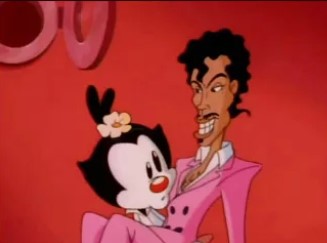
And there are far more examples. The original Animaniacs series came out when I was in middle school, and it was a show my father actually enjoyed as well. It was part of the Fox Kids lineup, but like the Looney Tunes shorts that were their true parents, it had layers of satire and entendre that kids never would have understood. I was in college before I realized the episode “King Yakko” (which you may just know as “the Anvilania episode”) was a full-plot reference to the 1933 Marx Brothers’ movie Duck Soup. Yeah, that was a joke for kids in the 90s. 

How you make something does not determine the proper audience. What you make does. 

If you’re anywhere close to my age you know EXACTLY which joke this is.

“It’s just a cartoon, I can’t feel anything like I do for human actors.”

That’s a failure of the viewer, not the film. Animation can be deep, powerful, meaningful, and personal, and it all depends on the story you’re telling. If somebody came up to me and said that the saddest 60 seconds of television ever made came at the end of the Futurama episode “Jurassic Bark,” I would be utterly incapable of arguing against it. After a full episode about Fry, trapped 1000 years in the future, coming to terms with losing the dog he left behind but finding comfort in the fact that he had a full life without him, the viewer learns that Seymour, the dog in question, literally spent the rest of his life waiting for his master to return before quietly passing away in front of the pizza parlor where Fry worked. Even somebody who hates dogs has to feel something for that.

97 percent of you got a lump in your throat when you saw this picture. The other three percent are assholes.

“But Futurama is adult animation,” you say. “Not all animation is like that.” I’m going to ignore the fact that you just utterly shattered your own argument that animation is all for kids and move on to examples that are for children, but which are still deeply moving for adults. How about the Pixar film Up? As a teacher, there are occasionally days where we show films because of reasons, such as having a room full of standardized testers who have finished early and I need to kill time before we return to our normal classes. On days like that I have a strict rule to never show the movie Up, because I may have to teach some of these 9th graders when they become seniors and I don’t need them remembering that time I sobbed like an infant in front of them. The beginning of Up tells the story of a boy and girl who grow up, fall in love, marry, discover they cannot have children, and grow old together before the woman, Ellie, leaves her husband Carl as a widower, and utterly alone. It’s a powerful story and it’s told, after their initial meeting as children is over, completely without words. It’s entirely visual, requiring the viewer to infer what has happened to them at each stage, and causing their souls to crumble as the reality sets in. I admit, I’m a softie. I cry at movies. At TV shows. Whenever I heard the John Williams anthem from Superman. But this was the only time in my life a movie made me cry in the first ten minutes.

I’m gonna make you people cry before the end of this column.

Emotion is an intended byproduct of art, all art. Whether it’s a film, a poem, a painting, or a concerto, art is created for the express purpose of evoking an emotional response from the audience. And great animation can nail it just as much as live action.

“Animation is just a cheap way to tell the story.”

First off, buy a calculator. The price tag on rendering animation can be pretty staggering. But I’ll give you the benefit of the doubt here – maybe you mean that animation looks cheap. Sure. Sometimes. It’s hard to imagine that anyone involved in the 2012 magnum opus Foodfight! is particularly proud of what they have loosed onto an unsuspecting world. But that’s bad animation. Bad live action sucks too. So does bad writing, bad acting, bad special effects. If your argument is that “animation is bad,” you’re choosing to ignore the mountains of good animation that exist or the mountains of bad everything else you had to wade through to get there.

If Futurama and Up didn’t get a tear out of you, the existence of this abomination should do the trick.

Let’s go back to Babylon 5 for a second. Although very few details have been released, and everything I am about to say is speculation, the fact that Warner Bros. owns the property makes it reasonable to assume that the animated film is the work of the Warner Bros. Animation studio, the company whose history goes back to those magnificent Looney Tunes I keep bringing up. For a more recent example, and one that is thematically much closer to what the B5 movie will likely be, this is also the studio that has made the collection of DC Comics animated films that have come out over the last several years, movies like All-Star Superman, Batman: Under the Red Hood, Superman Vs. the Elite and Justice League Vs. the Fatal Five. The current unit is also responsible for many films featuring the likes of Scooby Doo and other Hanna-Barbera properties, Tom and Jerry, and…you guessed it! The Looney Tunes. And while people may debate the relative quality of any of those productions – they may dislike the story, the casting, the character design – one thing they rarely complain about is the quality of the animation itself. WBA knows what it’s doing.

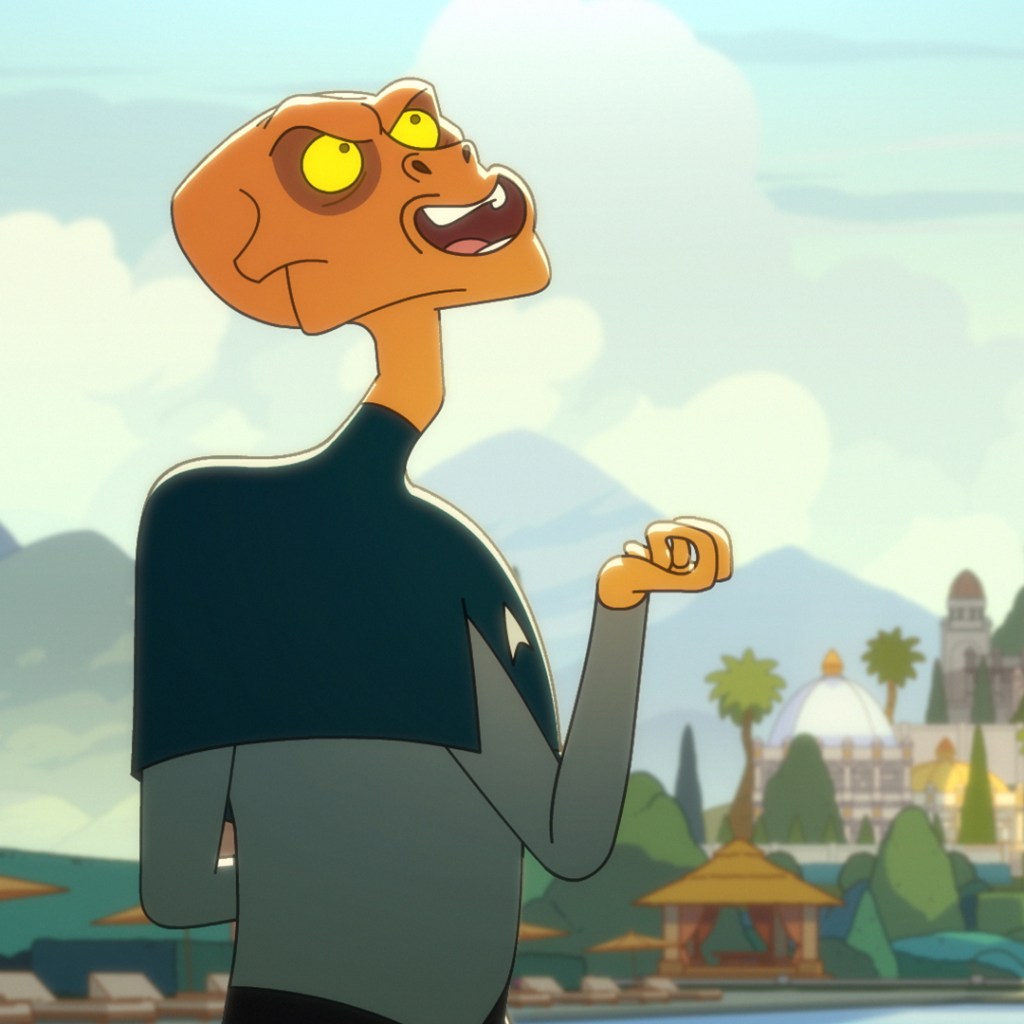
And frankly, the notion of using animation for science fiction just plain makes sense. When you’re telling a story in a world beyond our own – be it sci-fi, fantasy, horror, or superheroes – the special effects are often make-or-break. The filmmakers have to convincingly create something that does not exist in the world and put it in front of an audience in a way that it appears real. Some people are great at this. Some people are not. Animation removes that requirement. Star Trek is often derided for its reliance on “rubber forehead aliens” – in other words, alien species that are created by slapping some prosthetics on human actors. Well what else were you supposed to do, especially with the budget and technological limitations of television in the 1960s? When the Star Trek animated series was created, for the first time, there were recurring alien creatures who were not wholly humanoid, such as the tripedal Edosian officer Arex. Even in modern times, where improved effects make it easier to show things that are less human, we still see a much wider variety of alien species on the animated series Lower Decks and Prodigy than we do on any of the live-action Treks, and you never hear anyone say that they look “fake”.

I mean, in live action this guy might look silly.

What about superhero movies? Since Marvel Studios changed the way blockbusters are made, the “Pfft” crowd has come out in force to complain about the overabundance of special effects that are used. “Did you see the new Ant-Man movie?” they say, ignorantly forgetting that the Wasp receives equal billing with her partner. “It’s just a couple of people in CGI suits in front of a green screen for two and a half hours.”

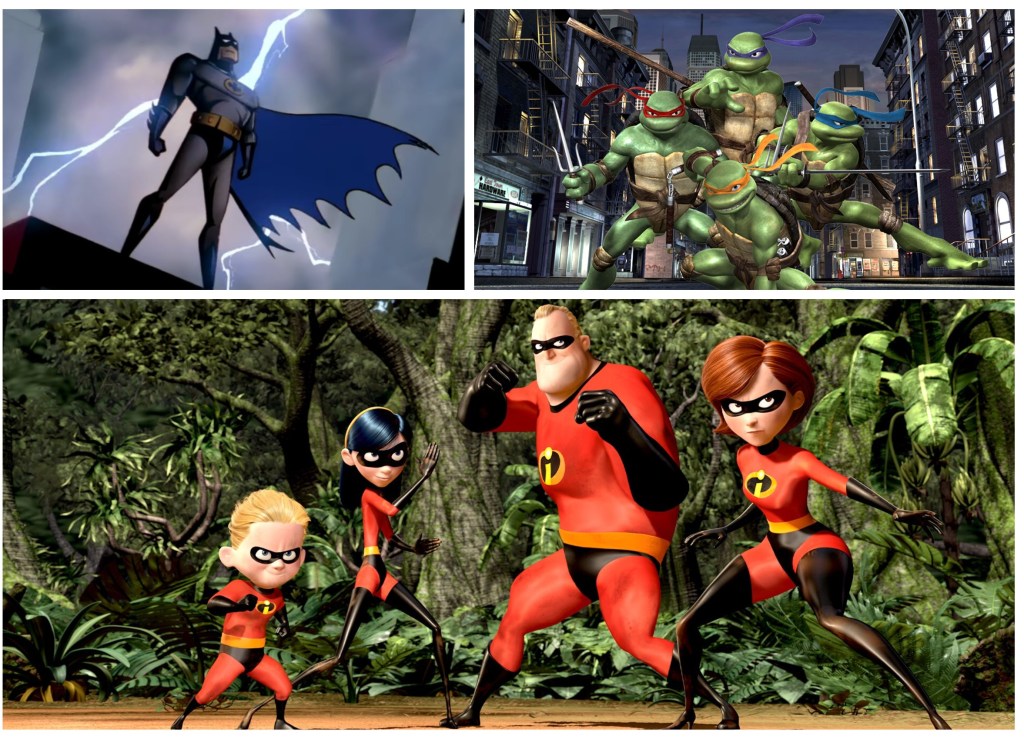
You know what movie they never say that about? The Incredibles.

In fact, after The Incredibles and the largely-forgotten but highly-enjoyable TMNT (an animated feature starring the Teenage Mutant Ninja Turtles that you likely didn’t know existed) I came to the opinion that animation is the perfect medium for superhero movies. I’m not saying that animating a huge action sequence is easy, but when literally the entirety of the universe is created digitally or on a drawing board, there are fewer limitations. The live action Marvel movies recognize this, which is the reason they’re so heavily reliant on CGI these days. And while their live action features have been a mixed bag, DC’s animated superhero projects have been a hallmark of quality ever since Batman: The Animated Series. Even non-superhero, non-science fiction movies do this these days. I’ll never forget the hilarious moment when Disney’s “live action” remake of The Lion King had so little live action that the Golden Globes nominated it for Best Animated Feature. I still laugh about that.

Superheroes and animation go together like ham and eggs, peanut butter and jelly, sauteed sea bass and rum raisin ice cream…

Animation is a medium. It’s a method of telling a story, and dismissing an entire medium because of what you perceive it to be is a kind of ignorance. If the Babylon 5 animated film comes out and underwhelms…well, that would suck. I love B5 and I want more stories in that universe, and I think that the success or failure of this film will impact the odds of that happening in the near future. But if it turns out to be a dud, there’s one thing I’m sure about: it won’t be because it was “just a cartoon.”

Blake M. Petit is a writer, teacher, and dad from Ama, Louisiana. His current writing project is the superhero adventure series Other People’s Heroes: Little Stars, a new episode of which is available every Wednesday on Amazon’s Kindle Vella platform. Thanks to his wife, Erin, for reminding him to include the Futurama example when he told her what this week’s column would be about.