If you teach for a while, you start to learn certain things that students like and dislike. For example, they usually like stickers. Even fully-grown high school seniors have a nigh-childlike reaction if you offer them a sticker for something. On the converse, they dislike when you use certain phrases, such as “please take your earbuds out before class” or “hey, remember when I told you to take out your earbuds?” or “I know you still have your earbuds in, nobody sits casually with their ear pressed against their shoulder at a 60-degree angle.”
I don’t know who invented wireless earbuds, but I guarantee they were not a classroom teacher.
Anyway, something else students tend to not like are unanswered questions. This isn’t a bad quality, in and of itself. Education is the pursuit of knowledge, and asking questions is the best way to gain knowledge. However, some kids take it to an extreme, with an almost pathological hatred for any question that doesn’t have a clear-cut, inarguable answer. This can be difficult when you’re teaching literature, because a lot of great works of literature deliberately leave unanswered questions. For example, I’ve seen kids walk away from the short story “The Lady or the Tiger?” with a harsh, bitter hatred of Frank Stockton. You probably read it in school yourself – it’s the story about a kingdom where an accused criminal’s guilt or innocence is determined by a random test. He chooses between two doors: behind one is a beautiful woman, behind the other a ravenous tiger. If he chooses the one with the woman, he is declared innocent and is allowed to take her for his wife. If he chooses the tiger, he is declared guilty and the tiger is rewarded with a very fresh meal. Of course, the accused has no way of knowing which fate lies behind each door. The story ends before the door is opened, and the reader is left wondering whether the character they’ve been following is going to be devoured or be sent off on his honeymoon.
The kids HATE this.

“That’s not an ending!” they will shout, and to be fair, they’re right. It’s a story that is famous for its lack of an ending. In fact, Stockton even wrote a far less-known SEQUEL to the story, “The Discourager of Hesitancy,” which is about people trying to find out the ending of the first story. Not only do they NOT learn the answer, though, but they are left with ANOTHER unanswered question at the end of THAT story.
If you’re the type of person who demands closure, this sort of thing will drive you up the wall.
The questions don’t have to be quite that dramatic to draw their ire, either. In act IV of Hamlet – and here I apologize for spoiling a 400 year-old-play – Ophelia drowns. However, her off-stage death is framed in such a way that it’s not entirely clear whether it is accidental or whether she – stricken with grief over the murder of her father by the man she loved – intentionally allowed herself to die. The play does not offer an easy answer to this question. Even the characters IN the play have a debate over it. And when a student asks me to clarify it for them, begs me to tell them if Ophelia’s death was an accident or not, they get really mad when I reply, “Well, what do YOU think?”
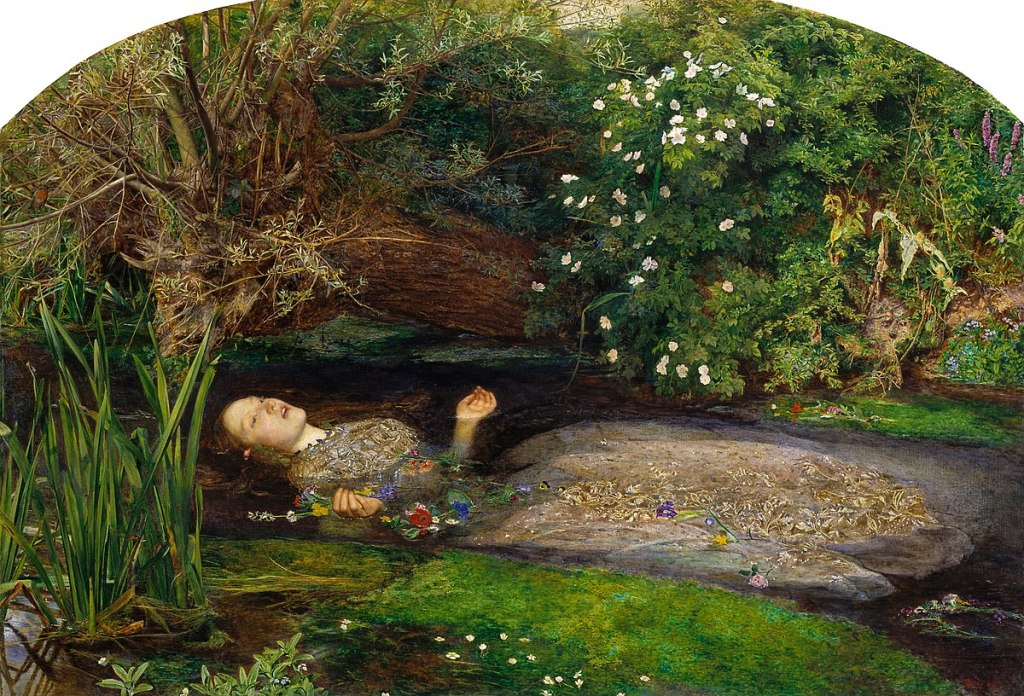
The thing is, there are cases (especially in fiction) where the act of ASKING a question is more important than the answer itself. There is more value, I believe, in debating the nature of Ophelia’s character than there would be had Shakespeare given her a soliloquy before her death explaining her intentions to the audience. And had Stockton told us what came out of that door in “The Lady or the Tiger?”, the story would have been reduced to a rather unremarkable fairy tale, one that would no doubt be mostly forgotten today.
This isn’t to say that solid endings aren’t important. You’ve no doubt read my diatribe against spoiler culture and why I hate so, so much the way social media devalues the ability of the audience to be surprised. When I say that sometimes it’s okay if a story doesn’t have an ending, that sometimes it’s the journey that matters, it may seem contradictory to that earlier rant. But the truth is, they both come from the same place: a desire to allow a storyteller to tell the story that they intend. If the story is structured in such a way that it builds up to some sort of powerful twist ending, then the polite thing to do is shut up about that ending and let them tell it. However, if a story is NOT intended to build towards a specific ending and, instead, is about exploring the ideas and questions that the story presents, it’s okay if some questions – even MOST of the questions – are left unanswered.
The reason I’m thinking about all this today is because I recently finished re-reading a novel that demonstrates this idea wonderfully, Stephen King’s 2005 book The Colorado Kid. It’s a fantastic book that so, SO many of my students would despise. Published by the Hard Case Crime imprint, The Colorado Kid has none of the trappings of horror or the supernatural that people often associate with King’s work. It is, as the name of the imprint implies, a crime drama, a mystery, but it is a mystery that is left unsolved at the end. If you pick up that book hoping to unravel the clues and decipher the ending, you’re going to be left disappointed. Despite that, I love this little book.

The story, such as it is, focuses on a young woman with an internship at a small-town newspaper, and an afternoon she spends with two much older gentlemen, the paper’s editor and owner, during which they tell her all about the greatest unsolved mystery they ever came across. Back in 1980, a dead body was found on the beach, propped up against a barrel, its previous occupant having choked to death on a piece of steak. His identity was a mystery, why he was on the beach was a mystery, even the piece of steak turned out to be a mystery.
The entire book is a conversation between these three people, the two old men telling the girl about their investigation, the girl asking questions, and the discovery of one clue after another that led only to more questions. There are theories, but nothing definitive or convincing, and when you finish the book you’re no more certain about what really happened to the “Colorado Kid” than the old newspapermen are.
What, then, is the point of the book? It’s the obvious question to ask – why would you read a mystery novel with no solution?
Because in this case – and it’s an exceptionally rare case, for a mystery novel – finding the answer is not the point. The death of the Colorado Kid is not the point. The question of how and why he crossed the country in only a matter of hours, abandoning his life on the west coast for what turned out to be his death on the east, is not the point. The point of the story, and the lesson that the young reporter has to learn, is that even when life doesn’t supply us with answers, there’s still a virtue in just ASKING the questions and seeking the truth. You might not always find the answer – and even if you do, the answer you find may not be the one you wanted – but there’s still satisfaction inherent in searching for them.
Not everybody appreciates that. Many of my students wouldn’t. Even die-hard Stephen King fans I know found the book disappointing because of its lack of ending, even though no effort is made to hide the fact that it is left unresolved. The old men tell us at the very beginning of the book that the mystery is unsolved, we know that going in, but STILL people got angry. And I suppose I understand why – we’re so used to genre conventions that it’s hard to accept a book that subverts them this way. I’m sure a great many people picked up this book expecting some sort of brilliant insight at the end. Maybe the young reporter would suddenly ask a question that the two old men had never considered, maybe her perspective of time and distance would shed light that would reveal a clue that had gone unnoticed in a quarter of a century, and suddenly we would spiral headlong to the resolution of the mystery, finally tying things up in a neat little bow like we expect from a mystery novel.
But that doesn’t happen. That isn’t this novel.
Like I said, it’s a book about an IDEA, not a book about a plot, and it’s an idea that I happen to really like.
If you’ve never read this one, give it a try. It’s one of the shortest books King ever wrote – the paperback printing comes in at a brisk 184 pages, and I know a lot of dedicated readers who could get through it almost in real time, spending the afternoon with the newspaper trio. And even if Stephen King isn’t the kind of writer you usually read, this one is so atypical of his usual output that I think a whole different audience can tap into it and enjoy it.
Provided you go into it looking for the right things, of course.
Blake M. Petit is a writer, teacher, and dad from Ama, Louisiana. His most recent writing project is the superhero adventure series Other People’s Heroes: Little Stars, volume one of which is now available on Amazon. You can subscribe to his newsletter by clicking right here. He’s also started putting his LitReel videos on TikTok. He knows that some people can’t handle leaving something unfinished, but the thing to remember is
 Blake M. Petit