Geek Punditry #161: To Reread or Not to Reread?

One of my favorite contemporary authors, Scott Sigler, dropped a new book this week. Voidstrike is the second novel in his series The Crypt, about the crew of a starship in deep space embroiled in the grip of a war. The series follows the P.U.V. James Keeling, a ship that has been nicknamed “The Crypt” because of the absurdly high mortality rate among its crew. In fact, posting to the Keeling is typically given as an alternative to prison time or even execution for people convicted of crimes. The book is military sci-fi with a dash of horror with plenty of violence and gore. You should not allow yourself to get overly attached to any of the characters, because any of them can – and will – be brutally slaughtered at any moment. It’s fun for the whole family, and naturally, I preordered it immediately.

“You see it’s SCARY, see, because…because VOID. But it’s even SCARIER because STRIKE. See? Get it?”

I haven’t started reading it yet, though, because I’ve got to finish the book I’m currently reading first (that being a re-read of Stephen King’s It for those of you who somehow missed last week’s post). Here’s the question I’m currently grappling with though: although I know that after my sojourn in Derry, Maine is over, my next stop is going to be aboard the Keeling, I can’t decide if I should jump right into Voidstrike or go back and re-read the first book in the series again. Book one, Shakedown, came out about two and a half years ago, and as anyone with kids can tell you, one of the side effects of parenthood is a memory that erodes like a urinal cake during halftime at the Super Bowl. I remember the broad strokes of the book, but I’m fuzzy on the details. So should I go back and read Shakedown again?

Let me make one thing clear at the jump: I am NOT asking whether or not re-reading books in GENERAL is okay, because of COURSE it is. In any given year, I would guess at least half of the books I read are books that I’ve read before because they make me happy, or comfort me, or because I’m doing research for something that requires me to make a return visit. And all of those things are perfectly legitimate. In fact, there is only one reason for re-reading a book that matters at all: do you WANT to re-read it? If the answer is “yes,” then you’re good.

What I’m asking, instead, is whether a re-read in this particular case is justified. Yes, I re-read a lot of books, but it’s rare that I return to one that I read as relatively recently as Shakedown. Most of the books I return to have at minimum a five year gap before I pick them up again. It’s not a rule or anything, but I’m actually quite anxious to get to Voidstrike, so should I just check out a Wiki recap of Shakedown and get to it, or should I take the long way around?

If it was a movie, there would be no question. I frequently re-watch a movie if I intend to watch an upcoming sequel, and most of the time, I feel like it’s time well spent. When Ghostbusters: Afterlife hit theaters, I made it a point to carve out time to watch the first two movies in the series again, and as such a lot of the little beats and references landed in a way that they wouldn’t have had the older movies not been fresh in my mind. When my son told me he wanted to see Zootopia 2 back in November, I sat down with him and I watched the first one again, and that made the jokes funnier and the story more enjoyable. And in truth, the only reason I haven’t watched Tron: Ares now that it’s on Disney+ is because I haven’t had a chance to revisit the first two movies in the franchise yet. 

I would never have understood the Twinkie reference in Afterlife if I hadn’t just watched this.

For the most part, I think this practice is rewarding. Having the earlier installments fresh in your mind can make the new ones more fun – callbacks are easier to notice, the characterization and worldbuilding gels better…it’s like polishing the rust off a bumper before you take a car out for a drive.

With books, though, although all of the same things are true, it’s much more of a time commitment than it is with a movie (unless we’re talking about something like Lord of the Rings, of course — the books are about a half-million words total, but legend has it that the last movie is still finding new endings to append out there somewhere). In the case of The Crypt it would be relatively easy, I’d only have to read one book over again. But what about those longer-lasting series? Think about something like Jim Butcher’s The Dresden Files. The 18th book in that series dropped earlier this month, and that’s to say nothing of the assorted short stories and novellas also set in the same universe. If there are any Dresdenheads out there, tell me, did you go back to Storm Front (the first book, published way back in 2000) and march your way through the next 16 in order to have everything right there are the forefront of your mind before you dove into Book 18, Twelve Months?
It’s called Twelve Months because that’s how long it would take to catch up for this one.

That wouldn’t matter if the books are episodic. Series like the Hardy Boys or Nancy Drew have continuing characters but rarely have continuing plots, so you can pick up any volume at any time and feel like it’s more or less complete. But one Harry Dresden adventure carries over to the next, and if it’s been a while since you visited him, would you feel like a return visit was necessary? Would you just read a Wiki recap? Would you return to the high points of your favorite books and do a cursory refresher on the others? 

And what about books that have a substantial gap between installments? Not long ago I was poking around TV Tropes (like you do) and I came across a reference to Jasper Fforde’s Thursday Next series. I remember reading – and enjoying – the first book in that line several years ago. The Eyre Affair was originally published back in 2003, and focused on a special “literary detective” who investigates crimes in the worlds that exist inside of books. It’s a neatly metafictional concept, one that allows for a lot of humor and a lot of satire about the way that stories are written, which is the kind of thing that holds a lot of appeal to me. So it’s kind of baffling that I only ever read the first book in the series, because I enjoyed the first one quite a bit. I decided to see if the series was still going, and discovered that the eighth book, Dark Reading Matter, is scheduled for publication in June of 2027. 
The bright colors say “kidnapping mystery.”

Fforde also claims that this will be the last book in the series, which means if I want I can spend the next year and a half catching up on the six books that I never read (after probably re-reading the first one, of course). Out of curiosity, I looked at the most recent book, The Woman Who Died a Lot, to see when it was published, only to learn that it was way back in 2012. That means that there will be a 15-year gap between the final two books of this series. I have to wonder why that is. Did Fforde think he was done with the series back then, only to decide relatively recently that he had one more Thursday Next book in him? Or is this something that was planned that just kept getting pushed back for one reason or another, a process known in literary circles as “Pulling a Martin”?
Oh yeah. We gonna go there.

Ah yeah, you know I have to mention George R.R. Martin and A Song of Ice and Fire. The series that inspired Game of Thrones released its most recent volume back in 2011, and there are reportedly two more to come to finish the series. In that time, the books spun off into a TV series that became a global phenomenon, the TV series passed up the books and had to cobble together an ending presumably based on Martin’s notes for the unwritten books, a spinoff of the TV series premiered and finished its run, and a SECOND spinoff has now begun airing. And there’s STILL no telling when book six of the series is going to come out. 

I’m not going to speculate as to the reason for this decade-and-a-half span of radio silence. I’m not going to try to guess as to what has prevented Martin from finishing the books in this time, nor am I going to try to imply that he “owes” his readers anything, because as disappointing as it may be for his most fervent fans, the truth is that he doesn’t. What I WILL say, however, is that if he were to announce tomorrow that Winds of Winter is finally going to be published this August, the sales of the first five books would skyrocket overnight as readers realize that in the past 15 years they have lost, loaned out, donated, or hurled their books through a window in frustration and they need new copies if they’re going to refresh their memories before book six hits the bestseller lists. 

Sometimes in these Geek Punditry posts, I’m addressing some problem that needs to be solved. Sometimes I’m just throwing out wish lists for things that I would like to happen. And sometimes, like today, I’m just taking some element of storytelling that I find interesting and rolling it around in my brain, here on the internet, where anybody can read it. My question, friends, is this: do you re-read books, especially before the next book in the series drops? How often do you do it? And which books do you think you’ve re-read the most often? I’d love to hear your answers in the comments.

Blake M. Petit is a writer, teacher, and dad from Ama, Louisiana. His most recent writing project is the superhero adventure series Other People’s Heroes: Little Stars, volume one of which is now available on Amazon. You can subscribe to his newsletter by clicking right here. He’s also started putting his LitReel videos on TikTok. He is aware of the irony of posting about this when volume two of Little Stars is somewhat overdue, but compared to George R.R. Martin, it still ain’t a drop in the bucket. 

Geek Punditry #36: On a Gridiron Far, Far Away

I haven’t listened to the radio in years. I know this is no longer a novel position. Most people in this digital age ignore the radio in favor of populating their own playlists on Spotify, Pandora, Amazon Music, Heimdall’s Jockstrap, or whatever app is en vogue at the moment. But even before the rise of such services, podcasts had long since become my entertainment of choice while driving. One such podcast I discovered years ago helped turn me on to “podiobooks” (audiobooks delivered in podcast form, in case you couldn’t decode the term), and that in turn directed me to the new pantheon of writers that were riding the wave that came at the time that medium was burgeoning: people like Mur Lafferty and J.C. Hutchins and, most pertinent to our discussion today, the Future Dark Overlord himself, Scott Sigler.

Clearly the creation of an evil genius.

So as not to bury the lede, the reason I’m writing about Sigler this week is because a new podcast series is launching that presents his most popular series of stories starting over from the beginning. So right now I want you to open your chosen podcasting app (yes, that includes Spotify) and subscribe to “Scott Sigler’s Galactic Football League Series.” Then, while the first three episodes are downloading, I’m going to tell you why this series is awesome and you should be giving Sigler your attention.

Sigler, as you could probably guess from the inclusion of the word “Galactic,” is a science fiction writer. He has developed a complex and fascinating universe with intriguing characters, wild and bizarre alien species, and a degree of worldbuilding that could make Tolkien and Rowling take notice. Sigler has laid out thousands of years of history (both before and after the present day) that he feeds his audience a little bit at a time. The individual novels or series stand on their own, but when read together you get a rich and textured science fiction tapestry that plays out over 2000 years.

Let’s start with the Galactic Football League stories, since that’s what the podcast is going to cover. The stories in the GFL era take place about 700 years in the future, in a universe where humanity has spread out to the stars, encountered several sentient species of alien, and bifurcated into many different worlds and governments. Football – American-style football, also known as “Gridiron” – has been adopted as a sort of de facto peacekeeping event in a galaxy in turmoil. Football, you see, is no longer played only by humans, but by the massive and powerful Ki, the swift and agile Sklorno, and the brutal Quyth, among others. By forcing these different races to work together on the field, conflicts between them have been mitigated, even as most of them are under the rule of an alien empire of small, batlike creatures that rule through sheer force of numbers. The story focuses on Quentin Barnes, a young quarterback raised in the xenophobic Purist Nation, who has to learn how to cooperate with these bizarre alien species if he wants to achieve his goal of winning a Galaxy Bowl. 

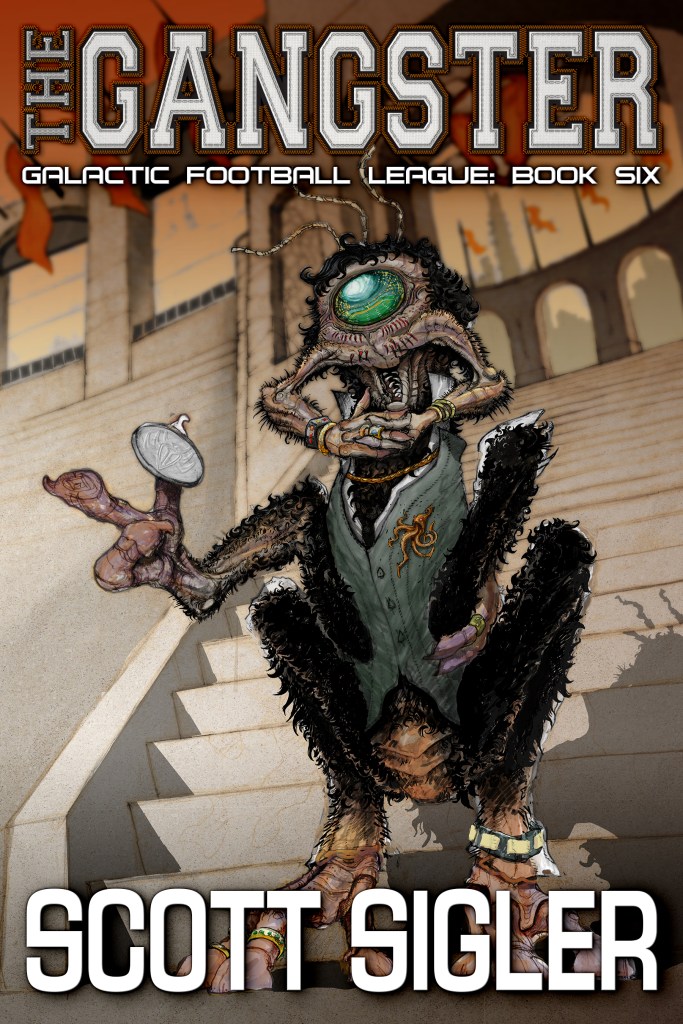
So right off the bat, the GFL series has aliens and sports, which are both a lot of fun. But that’s not all. In the time of the GFL, Gridiron Football has largely come under the control of massive organized crime syndicates, with teams owned by actual criminals, illegal substances smuggled on the team transport ships, and players doubling as strongarm enforcers for their leaders. That’s right: it’s also a gangster series. (In fact, that’s the title of the sixth book: The Gangster.) And as the story goes on, although football never leaves, it becomes increasingly clear that the story is about more than just football, that Quentin is more than just a quarterback, and that the stakes they’re really playing for are much, much higher than a championship ring. Sigler has developed an intricate and fully fleshed-out universe that is completely engrossing on multiple levels. 

One of the most impressive things about it, for me, is the degree of work he has put into crafting his various alien species. There are none of the “rubber forehead” aliens that we see in Star Trek or most TV and movie sci-fi franchises, a fact that’s made easier because these are novels and Sigler doesn’t have to worry about budgetary concerns. Every alien species in Sigler’s universe is imagined from the ground-up with their biology, life cycle, and culture carefully crafted, many of them in ways very unlike what we’re used to. The species that is most like humans, the Quyth, are really only like us in that they are bipedal and experience a similar emotional range. Unlike humans, the Quyth have a biological caste system that divides the species, which is covered in either fur or chitin depending on which caste they belong to. They also have a pair of dexterous pedipalp arms protruding under their head and their one massive eye, which changes color to indicate their mood. Quyth leaders gain their dominance by castrating their siblings while still in the womb. Quyth females are never seen by outsiders at all. This is the CLOSEST alien species to humanity in this universe, and it’s a species that in real life would be virtually unthinkable, except perhaps in southern California.  

See? Just like us.

But I digress – the GFL is probably Sigler’s most popular work amongst his fans. It’s certainly the era that is discussed the most and for which we are most eager to see new installments. But it’s not the ONLY era. 200 years before the GFL comes The Crypt, a military drama about a crew assigned to a ship with the reputation of being a deathtrap for anybody who is put on the duty roster – usually as a sentence for some crime. Then there are the modern stories, such as Ancestor, Earthcore, and the Infected trilogy. While the GFL stories are suitable for young readers, these other books are (even) more violent and brutal, and definitely not intended for kids. They are, however, part of the same universe, something that becomes clear in the second Infected book when the characters are given a glimpse of an alien race that is terrifying to them, but that readers of Sigler’s other work will quickly recognize as a familiar species in the GFL era. And then he does it again with the Generations trilogy, a series set a millennia after the GFL about a group of teenagers who wake up on a distant spacecraft with no memories of their past. I don’t want to get too spoilery, but I will reveal that eventually the series, again, starts to share familiar species with the reader.

Rated TV-KSD: Not approved for people with Kitchen Scissors or the city of Detroit.

The point I’m getting at is that Sigler has a universe that is complete, complex, intricate, and really entertaining, and is so in various time periods, which is a trick that very few writers have managed to pull off. So I respect and admire Sigler for that as much as I am a fan of the writing itself.

But that’s not all. There are lots of writers whose work I admire and respect. What sets Sigler apart, why I’m writing about him today, is the way he has masterfully crafted a community around himself. From the early days when he branded himself the Future Dark Overlord of the world to the way he has cultivated relationships with the many “Sigler Junkies” that populate the internet, I am in awe of the way he’s built out his fan base. Sure, there are highly devoted fans of Harry Potter, Lord of the Rings, Twilight, and plenty of other book series, but most of those have been built over many years or were done with the help of a major publishing empire or movie studio to enhance the brand. Sigler has done it without those things. Oh, he’s had some mainstream success: he’s published books through Crown, hit the New York Times list, and he’s even contributed licensed novels and short stories to the Alien and Predator franchises…but for the most part, his community and his fervent, devoted fanbase was cultivated by himself and his small support staff. 

You know you’ve arrived when there’s a Geiger monster holding a bloody helmet on your resume.

When I look at what he’s done and how effectively he’s done it, I know that Scott Sigler is who I want to be when I grow up. He’s the reason I did audiobook versions of Other People’s Heroes and A Long November back in the day when podcasting was still young and easy to get into if you didn’t have any resources. (Most people don’t know this, but the name “Blake” is actually from an obscure Peloponisian dialect and translates roughly to “lacks both resources and the wisdom to use them correctly.”) While the new media landscape has changed dramatically since the days when he was starting, and I don’t know if his techniques could work today, that doesn’t matter. It already worked for him, and he’s allowed to enjoy the fruits of his incredible amount of hard work and talent.

Plus, in every interaction I’ve had with the guy online, he’s seemed to be a really cool and stand-up dude. 

So I’m saying all this to give back to him just a little bit for the hours of audio entertainment he’s provided me over the years. If anything I’ve said sounds interesting to you – if you’re into sci-fi or sports, if you’re looking for your next audiobook, if you’ve got a middle-grade kid in your life that you’re trying to get into reading, check out the GFL saga. The first three episodes dropped this week, and there literally years worth of content coming down the line. Hopefully enough that the podcast won’t wrap up before the FDO finishes writing the series.

Don’t worry. I’ve got faith that he’s not going to George R.R. Martin us. If there’s one thing that I believe is true about Scott Sigler, it’s that he doesn’t know how to stop working.

Blake M. Petit is a writer, teacher, and dad from Ama, Louisiana. His current writing project is the superhero adventure series Other People’s Heroes: Little Stars, a new episode of which is available every Wednesday on Amazon’s Kindle Vella platform. Hopefully, before you get too far into the GFL series, you’ll understand why Blake is constantly looking at some fool doing something foolish and muttering, “This kid needs a Ma Tweedy in his life.”