Welcome to The Narrative Chain, the newest of my many column-within-a-columns here at Geek Punditry Global Headquarters. In The Narrative Chain, I’m going to take a look at a story that has been told multiple times and examine some of the different versions, whether this be books that have been turned into movies, comics that have been adapted to television, remakes, reboots, or adaptations, we’re going to pick into them here. And I thought that, for October, we would start with the second published novel by Stephen King, as well as the various adaptations thereof (including the one that dropped just last week): the vampire drama ‘Salem’s Lot.

The original novel, published in 1975, tells the story of an old-world European vampire named Kurt Barlowe (no, really) who comes to the little town of Jerusalem’s Lot, Maine, and begins to worm his dark tendrils into the citizens thereof. The novel focuses mostly on a small group of citizens who come together to fight back against the vampire, including Ben Mears (a novelist, because as early as his second book Stephen King was establishing patterns), local woman Susan Norton, 12-year-old Mark Petrie, Father Donald Callahan of the local Catholic Church, and a few more. But interspersed between the scenes with our heroes are many chapters detailing the activities of the other citizens of the ‘Lot as they fall prey to the darkness.
Although his first novel, Carrie, was a hit in his own right, I feel like this is the book where we really started to see the Stephen King who would become a literary juggernaut. It’s much longer (although still a drop in the bucket compared to the likes of The Stand or It), and the first of his books to establish a large cast of characters that he bounces between as he tells the story of a community under siege. These are things that King does better than almost anyone, and you really see it as he paints the citizens of Jerusalem’s Lot, warts and all.
In an introduction to an anniversary edition of the book years later, King said that his goal with this novel was to create a sort of marriage between the storytelling of Bram Stoker’s Dracula and the American style of horror he grew up with in EC Comics like Tales From the Crypt. In practice, I’m not sure that he completely succeeded in that particular goal. Although not utterly hopeless, the ending of ‘Salem’s Lot is considerably bleaker than the ending of Stoker’s novel (and King himself says that the story ends in a more hopeful place than he originally intended). Similarly, it doesn’t quite have the sort of bitter sense of humor or twisted concept of justice that the EC Comics brought to the table, both elements that would be more visible in some of King’s later works. There’s also an odd sentimentality to the book – the characters seem to meet and immediately form lifelong bonds (not that “lifelong” is a particularly lengthy period in a vampire novel) in just hours. It’s a way to drive up the tension and make you feel for the characters a bit more, but there are times where it feels a tad unearned.
That said, I don’t want you to give the impression that I don’t like this book. I very much do – the atmosphere King creates is magnificent, and the way he treats his vampires is as evocative as anything Stoker does, even though he DOES borrow some non-Stoker elements that really gained prominence thanks to vampire MOVIES, such as the vampires’ vulnerability to sunlight. I re-read the book last month in anticipation of the new movie, and I found it just as engaging as I did the first time I read it years ago. It’s not my favorite Stephen King novel – heck, it probably wouldn’t make my Top Five. But when you consider just how many books the man has written, Top Ten is nothing to sneeze at.
There have been three adaptations of ‘Salem’s Lot to date, all of which I watched (or re-watched) after reading the book, and I’m going to break them down in order to discuss the pros and cons of each, beginning with the original CBS miniseries from 1979. This version starred Starsky and Hutch’s David Soul as Ben Mears, Die Hard’s Bonnie Bedelia as Susan Norton, and…um…Enemy Mine’s Lance Kerwin as Mark Petrie. Directed by Texas Chainsaw Massacre director Tobe Hooper, this is the version of the story that a lot of people grew up with and most of the old-school fans consider the best. I have to say, though, I was only two years old when this miniseries came out. I didn’t watch it until I was an adult, and the nostalgia glasses weren’t on, and I have to say…to me it’s just kind of okay.
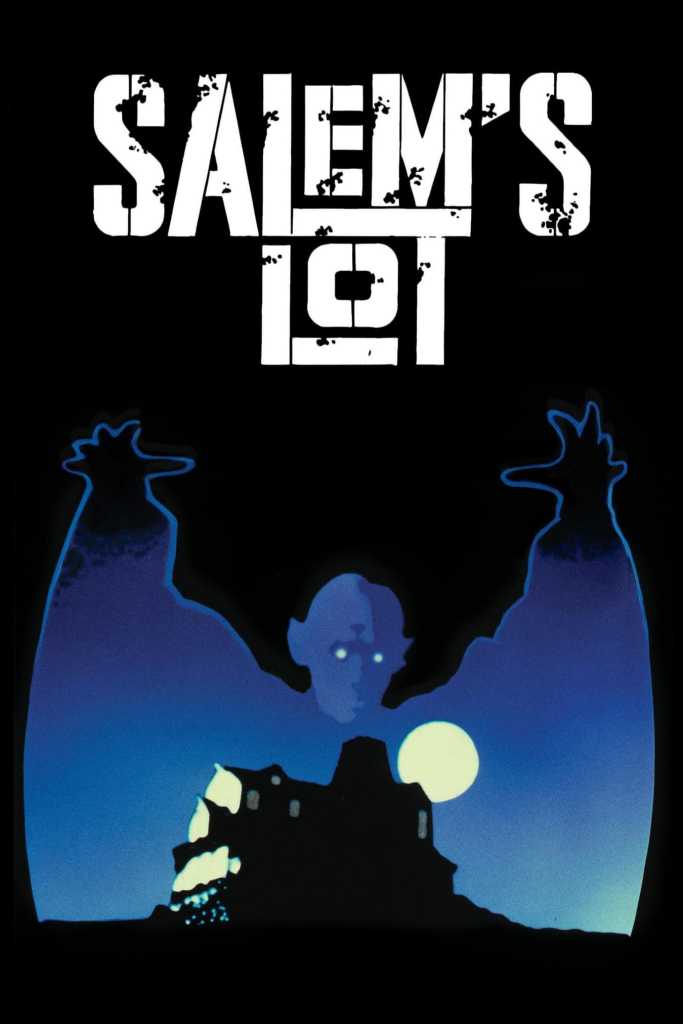
You have to take into account that it’s a TV movie from the 70s, and by the standards of a TV movie from the 70s, it’s not bad. The vampire makeup is pretty effective, especially that of Reggie Nadler, who plays Barlow. Beefy David Soul doesn’t quite pull off the skinny, contemplative Ben Mears of the novel, but if you aren’t trying to reconcile him with the character from the book he gives a pretty solid performance, with appropriate dread on his face during his encounters with the undead. Bonnie Bedelia is absolutely charming as Susan as well, and it’s easy to see why John McClai– I mean, Ben Mears would fall in love with her so quickly.
This miniseries, with its three-hour run time, just goes to prove something that’s true of a lot of Stephen King adaptations, and not just of this book. When he creates a world full of rich, engaging characters, trying to squeeze them into three hours or less just doesn’t cut it. Father Callahan’s role in this film is reduced to little more than a cameo, and several of the other characters are merged or done away with entirely. I understand the demands of different media, and I know that you’ll never be able to translate a book to a movie with 100 percent accuracy. I’m okay with most changes, provided that the spirit of the original work is left intact. But when so much of what makes the book work is the enormous cast and the way King shows life in all the different corners of the ‘Lot, the way the story and characters are pruned becomes a serious disadvantage to the film. Worst of all is Barlow himself – while he LOOKS scary enough, this version never speaks, losing all the sly, hideous charm of the character in the novel and becoming more of an analogue for Nosferatu than Dracula.
Another issue comes in the prologue to the story. In the novel, we open with a “boy” and a “man” on the run in a flash-forward to the time after the main events of the story. It isn’t until much later in the book that it becomes clear exactly which two members of our sizable cast they are. In a movie, though, you see them on screen from the first minute, completely erasing the question as to which characters are going to survive the vampyric rampage that consumes the town and losing the thing that makes the prologue worthwhile.
There’s a sequel to this miniseries, A Return to ‘Salem’s Lot (1987), which I’ve never seen – and from the comments of even the most stringent of admirers of the ‘79 version, I don’t think I’m missing anything. I’m not immune to nostalgia. If you get me started talking about cheesy movies and TV shows of the 1980s, I can wax poetically for hours about the things I love in films that – objectively speaking – really aren’t that great. So I appreciate the deep affection a lot of people have for this rendition of ‘Salem’s Lot. But I don’t SHARE that nostalgia, and the warts stand out to me a little bit more. This first attempt at adapting the story isn’t disappointing, but it’s not a sacrosanct film that should never be attempted again, so I wasn’t particularly upset when a new version was announced in 2004.

This remake, a TNT miniseries, stars Rob Lowe as Ben Mears, Donald Sutherland as Richard Straker (Barlowe’s familiar), and James Cromwell as Father Callahan, so already it’s off to a better start than the version from the 70s. It takes far more liberties with the original story, but I feel like some of them are for the better. For example, the original prologue is done away with for one that is more effective in leaving the viewer questioning what’s going to happen next, with a nice misdirect that Constant Readers may believe is pointing towards another King novel where one of these characters appears.
Mears is, once again, quite different from his portrayal in the book, taking on a dark detective persona early on in a quest to seek out the truth about the ‘Lot. He’s changed from a novelist to a journalist, with a thirst that makes him more proactive (if a bit of a cliche). His relationship with Susan Norton (Samantha Mathis) is also different – not as fairy tale/star-crossed tragic lovers as the older version or the novel. Rutger Hauer’s Kurt Barlow, however, is a bit more in keeping with the original. He may not look like he spilled out of the pages of an EC Comic, but neither did Barlowe in the book. They sacrificed his “European-ness” for the sake of the actor they wanted, but the result was a more interesting character. One of the more positive changes in this version is the greatly increased role of Father Callahan – not just compared to the original miniseries, but even in comparison to the book. James Cromwell isn’t somebody who should be wasted on five minutes of screentime, and screenwriter Peter Filardi and director Mikael Salomon make very good use of him.
One of the best things about this version, though, is that it does a much better job of bringing in the expansive cast of the book. It’s not a perfect adaptation, of course. There are still some merged and missing characters, as is pretty much always the case in an adaptation, but for the most part I feel like it captures the “town” aspect of the novel much better than the 1979 iteration.
I’m not wild about the ending, which doesn’t really fit the novel at all, but I at least have to concede that it fits this particular adaptation. If I hadn’t read the book or watched the earlier miniseries, I probably would have thought it was appropriate. As such, though, while I liked this better than the first miniseries, I was hopeful for the new version, a movie that dropped on the Max streaming service earlier this month.
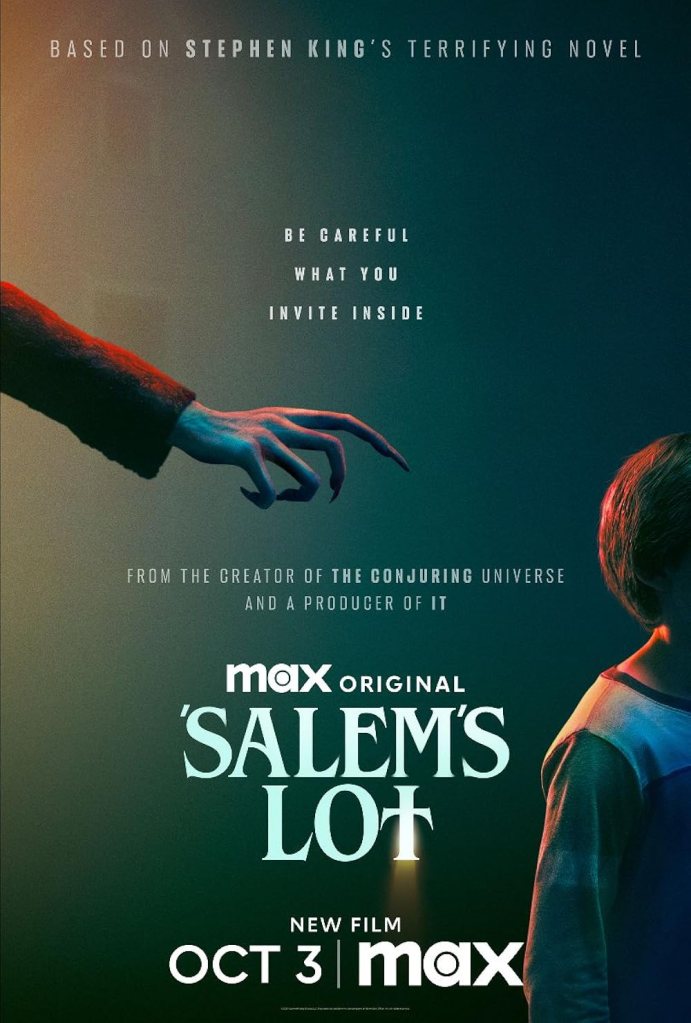
The 2024 movie has had a bit of a troubled pedigree. Originally slated for theatrical release in 2022, it seemed to get caught up in the chaos of the Warner Bros/Discovery merger and tossed around in the same cataclysmic atmosphere that led to the loss of the Batgirl and Acme Vs. Coyote movies. As it sat on the shelf for two years, many people were skeptical that it would ever see the light of day, and when it was finally announced that it would be released on Max, many people were skeptical that it SHOULD. As soon as it premiered it seemed like half the internet came out in force to hate it, but that doesn’t actually mean anything. Half the internet hates EVERYTHING. It can’t help it, it’s a reflex action like breathing or screwing Oreos open to eat the creme first, so I didn’t put any stock in the initial reaction, determined to make up my own mind.
The cast for this movie, I must say, is effective. Lewis Pullman as Ben Mears and Makenzie Leigh as Susan Norton both feel quite natural in the roles, and while I wouldn’t go so far as to say they have great chemistry, the stark atmosphere in director Gary Dauberman’s telling doesn’t really demand the gooey, doe-eyed love of the book anyway. Alfre Woodard as Dr. Cody gives a solid performance because she’s not capable of any less, and it’s always nice to see Stephen King adaptation veteran William Sadler, this time as Sheriff Parkins Gillespie. But the standout in this cast is Jordan Preston Carter as Mark Petrie. He’s not only the first actor to play Mark that’s actually a child instead of a teenager, but he’s also the first that has the sort of cool disposition and intensity that the character has in the book. Novel Mark Petrie is wise and level-headed beyond his years. Neither of the other two adaptations pulled that off, but Carter lands it perfectly.
I also appreciate the mood Dauberman has created. While the 2004 version was a little too clean and the 1979 version was a little too…well, “70s TV movie,” this version of ‘Salem’s Lot really has a good atmosphere, a dark tone, with some great effects as the townspeople turning into vampires delve into the shadows or attack an unsuspecting victim. Dauberman doesn’t shy away from some of the more spiritual aspects either – in the book, crosses and crucifixes actually glow with power when used against a vampire. This is the first version of the story to do that, and we get a fantastic visual when it does. This version of Barlow (Alexander Ward) again has a very Nosferatu-like style, but he’s got more life and animation than the ‘79 version, including a — sadly abbreviated – version of the novel’s epic face-off with Father Callahan (John Benjamin Hickey).
The ending, like the 2004 version, is greatly changed from the book, but I like this one better. There’s a fun set piece that I don’t want to spoil because it’s just nicely creative idea for how to stage the finale, although some of the special effects are wanting (we’re in the age of CGI artists being rushed instead of given the time to do the job properly, my friends). It also seems like the sun sets abnormally fast…but come on, am I really gonna complain about a scientific inaccuracy in a vampire flick? There’s a lot to like about this movie.
Unfortunately, in one vital aspect, the internet is correct: this movie is clearly chopped to hell. The pacing is a mess and there are huge gaps in the narrative as the story leaps from one high point to another without taking the time for the slower character moments in-between that make the best of Stephen King’s stories so good. Most of the intriguing side characters are missing altogether; the few that remain are reduced in scale to minor cameos, and it’s only our Vampire Squad that gets any attempt at development at all. And at 113 minutes – less than two hours – it can’t really be a surprise. Even the two miniseries, with three hours each (after commercials, of course) didn’t feel like there was enough time to tell the story properly. Perhaps the most frustrating thing, though, is that there is reportedly a three-hour cut of this film that New Line Cinema whittled down to the dismally insufficient running time. And for the love of Father Callahan: WHY? I could at least understand the financial incentive – if not the creative one – when the movie was slated for a theatrical release. The shorter the movie, the more times it can be shown per day, the more money the movie will theoretically make. But none of those factors apply to a movie on a streaming service. There are so many good PARTS to this movie, that I have to think a longer version with proper pacing would be the best of the adaptations to date. I’m not the sort of guy to start a website and start demanding the studio “Release the Dauberman Cut,” but if somebody else starts doing that, I’m not gonna disagree with them.
As it stands, the best version of this story is still the book – which honestly should come to no surprise to anybody: I’ve only ever seen two movies I feel definitely improve upon the book they were based on, and neither of those were Stephen King adaptations. As far as the film version goes – people will hate me for this, but I honestly place the 1979 version at the bottom of the pile. It’s harder to choose between the other two. The 2024 version has better pieces, the 2004 has a better construction. Flip a coin – either way you’ll get some good things and some bad. But to date, I don’t think we’ve had a definitive ‘Salem’s Lot on film. We’ve gotten enough chunks to prove that it’s possible, but it hasn’t happened yet. I can only hope, after he finishes his adaptations of The Dark Tower, that Mike Flanagan continues on his obvious life’s calling of adapting all of Stephen King’s works the way Kenneth Branaugh tried to do with Shakespeare. If anybody can really nail this story, he’s probably our best hope.
Blake M. Petit is a writer, teacher, and dad from Ama, Louisiana. His most recent writing project is the superhero adventure series Other People’s Heroes: Little Stars, volume one of which is now available on Amazon. You can subscribe to his newsletter by clicking right here. The Godfather and Jaws. He knows you were wondering what the two movies were that are better than the book they were based on. It’s those two. But he’s never read Psycho, which is currently in his to-be-read pile, so he’ll let you know if that changes.
 Blake M. Petit