There’s a relatively new trend among teachers – English teachers, at least – that I’ve grown quite fond of: the “What am I reading?” board. There aren’t enough kids out there who read just for the pleasure of it, and it seems like that number dwindles every day. Sure, talking about books all day is one of the best parts of my job, but I think kids get the idea that I spend all my time marinating in Shakespeare or F. Scott Fitzgerald. And while I certainly enjoy many things about both of those authors, that ain’t what I read for fun. So teachers have started making signs or bulletins that declare that we’re reading for our own recreation in the hopes of stirring some conversation. I never draw attention to the board, or let them know when I’m changing it up, but in the past year or so that I’ve kept the board in my room it has spurred a few questions like, “How many books DO you read?” and “Why do you draw that little star next to so many of them?”
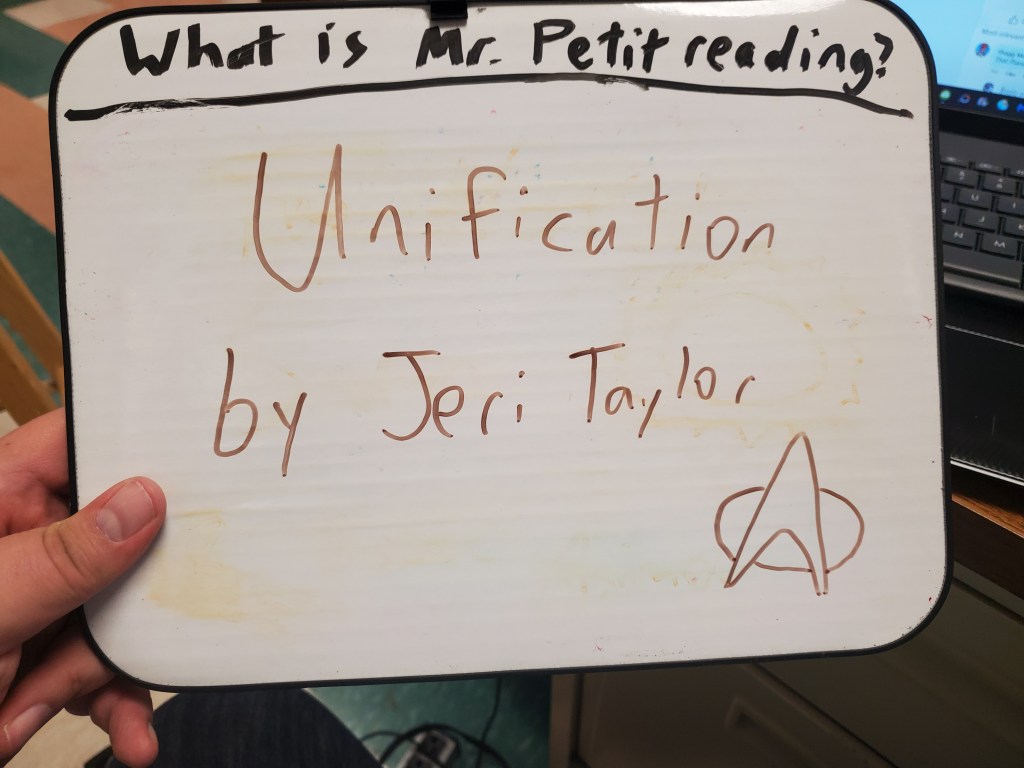
Anyway, another thing that this board has been good for is keeping me reading at a relatively brisk pace. The last thing I want is a kid asking me why I’ve spent the last month and a half on the novelization of Spaceballs. So I carve out a little time to read each day, usually before I go to bed, and I keep that board updated as often as possible. It’s been really helpful to me, giving me an impetus to read more often, and I thought today it may be fun to look back on a few recent reads that I’ve enjoyed.
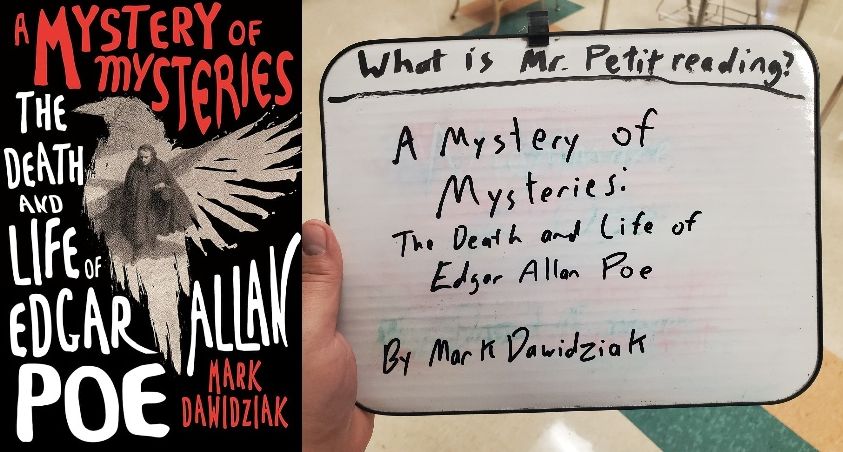
A Mystery of Mysteries: The Death and Life of Edgar Allan Poe by Mark Dawidziak
I picked this book up at Barnes and Noble on my birthday, part of my Rear Window date night with my wife, and I finished reading it a couple of days ago while riding out Hurricane Francine. I like to think Edgar Allan Poe would have approved. This is a great biography of Poe, with an emphasis on the unsolved mystery surrounding his death, found wandering the streets of Baltimore in a haze, drunk, possibly rabid, and dying a few days later crying out for an unknown person called “Reynolds.”
Or so the reports say.
Dawidziak alternates chapters between telling the story of Poe’s life and the story of Poe’s death, and in both cases he spends a lot of time unraveling a lot of the scandalous tales that have plagued the widest-read author in American history ever since his death. Was he actually an opium addict? (No.) Was he an alcoholic? (He had his troubles with alcohol, but at the time of his death he had taken – and adhered to – a temperance pledge.) Did he die of rabies? (The water he drank on his deathbed seems to rule that out.) Granted, I haven’t read a LOT of books about Poe’s life, but Dawidziak definitely paints the most balanced portrayal of the man that I’ve ever read. There’s a clear admiration of Poe in his words as well. This is obviously the work of an author who holds Poe in high regard, so it’s not surprising how much work he does to rehabilitate Poe’s reputation. At the same time, though, the writing is clear and engaging, and the book left me feeling like I know much more about the man who we all imagine hunched over a shadowed writing desk, an ominous raven perched on his shoulder. If you’re at all a fan of Poe, I can’t recommend this book enough. It’s the perfect way to pregame for Spooky Season

A Nightmare in Oz by David M. Keyes
I’ve written before – frequently – of my abiding love for L. Frank Baum’s Oz in all its forms, and when I encountered author David M. Keyes on Threads discussing his series called the “New Oz Chronicles,” I decided to give it a chance. I’m really glad I did.
A Nightmare in Oz is set in the modern day, 120 years after Dorothy Gale’s first journey to Oz and almost as long since she and her Aunt Em and Uncle Henry came to Oz to live permanently (which happened in Baum’s sixth book, The Emerald City of Oz, in case you didn’t know). But in Oz, nobody ages or dies, so Dorothy is still a young girl here in the 21st century. The story begins with Dorothy having a nightmare – her first since coming to Oz over 100 years ago. As she seeks an answer to her dark visions, she discovers that many of the residents of Oz that, like her, originally came from the non-fairy world are having nightmares of their own: Em, Henry, the Wizard of Oz (who also came back – really people, read the original books) and even her little dog Toto. The mystery of where the nightmare comes from brings back an ancient threat and opens up the doors for an engaging new fantasy series.
Since the Oz books went into public domain, dozens of authors (maybe even hundreds) have tried to put their own stamp on the world of Baum’s creations. Some, like Eric Shanower, do their best to create a world that seems like it could have spilled from the pen of L. Frank Baum himself. Others, such as Gregory Maguire of Wicked fame, use the skeleton of Oz to do something quite different that doesn’t strictly fit in with anything that Baum has done or would have done with his stories.
But Keyes has found a marvelous balance between these two extremes. He is taking Baum’s works as canon, and Dorothy and the other characters have the same inherent goodness and sweetness that readers of the Famous Forty would find familiar and comforting. But by bouncing the action forward a century, he also adds a layer of modernity and sophistication that many contemporary writers don’t attempt. It’s the same old Dorothy, but she’s got a century of experiences that are belied by her childlike exterior. The danger in this book feels more real and more layered than most of the old stories, while not going to the extreme of some other modern writers. I really enjoyed this book, and I’m looking forward to digging into the rest of the books in this series.

The Naked Sun by Isaac Asimov
But this accelerated reading schedule isn’t only reserved for new books. I’ve taken advantage of it to dive back into some old favorites as well, such as Isaac Asimov’s robot series. Most recently I read the second book in the series, The Naked Sun. In a future in which the citizens of Earth are limited to lives in huge, domed cities without ever facing the outside world, Detective Elijah Baley is summoned by an old partner – Robot Daneel Olivaw – to help solve a murder on a distant planet where the sky is open to all, but is so sparsely populated that people live solitary lives without ever seeing one another in person.
Asimov was renowned as a science fiction master, and the world-building in this series has always impressed me. We’re all familiar with the Three Laws of Robotics and all the stories that have been written trying to thwart them, but that’s just the beginning. The projected future of the human race and how Earth is made subservient to its own colonies is fascinating, as are the different types of worlds explored throughout these stories. But I don’t know that people give Asimov enough credit for how good he was as a mystery writer. This is by no means the only mystery novel Asimov wrote, and not even the only mystery/sci-fi hybrid, but the unique circumstances of the world in which the story takes place adds an additional level of complexity to the mystery that makes this one a joy to unravel.
Of course, not every book that I’ve read in the year since I started keeping my board has been a winner, but as I always do with this column, I’m doing my best to focus on those things that I love. You’re not going to hear about the clunkers. At any rate, these are just a few of the stories that I’ve dug into lately that have helped me jumpstart my love of the written word. Hopefully, you’ve been having fun with books lately too.
Blake M. Petit is a writer, teacher, and dad from Ama, Louisiana. His most recent writing project is the superhero adventure series Other People’s Heroes: Little Stars, volume one of which is now available on Amazon. You can subscribe to his newsletter by clicking right here. The toughest thing about Blake’s new reading routine? Figuring out what book to read NEXT. There’s a…sizable list of candidates.
 Blake M. Petit