We’ve made it again, folks. Eleven months down and it is once again permissible to crack open our DVDs (or streaming services) and start watching Christmas movies, which is pretty much the reason for existence. And today I’m going to talk to you about one of the greatest ever made: The Muppet Christmas Carol. In “This is How We Do It,” I take a piece of storytelling and discuss just what, exactly, makes it so damned good. And while I doubt there are many people who need convincing that The Muppet Christmas Carol is a classic, it is well worth taking the time to break it down a little. I love A Christmas Carol. I love the book, I love the many derivative movies and TV shows based on the book. I have, at last count, watched over 40 different film adaptations of Charles Dickens’ novel, and for years I said that the Muppet version is “maybe” the best of them. This year, I am removing the modifier. The Muppet Christmas Carol is THE best adaptation of Charles Dickens’ classic, and lemme tell you why.

A Christmas Carol is perhaps the single most-adapted story in the history of motion pictures and even when the Muppet version was made back in 1992, it had already been done to DEATH. We had seen “traditional” versions with the likes of Albert Finney and Alastair Sim. We saw modern reimaginings with Bill Murray and Henry Winkler. We had versions starring Scrooge McDuck, Bugs Bunny, Mr. Magoo, George Jetson, and Fred Flintstone. We had gender-swapped versions, we had versions transplanted to other holidays, we had comedies and dramas and musicals. The Teen Titans used it to break up a scheme that involved getting around import tariffs and Rod Serling had taken the framework to do a kind of tedious fable about nuclear war.
IT. HAD. BEEN. DONE.

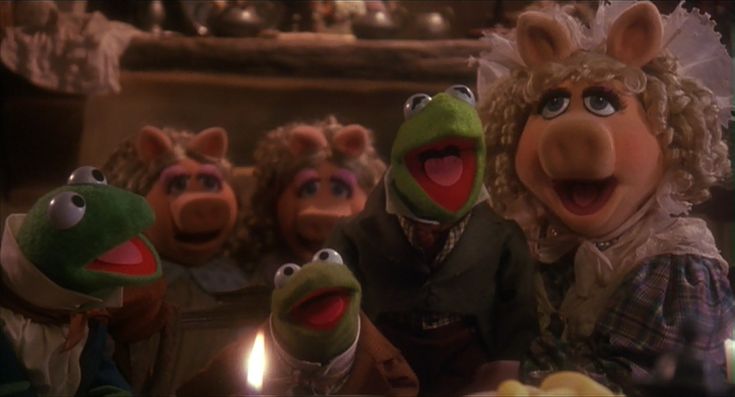
There are only two reasons left to do a version of the story: either to put a unique twist on it or to showcase a masterful performer. Well there’s no unique twist here, but the Muppets themselves are one of the greatest acting troupes of all time. Nobody needed to see A Christmas Carol again. We wanted to see Kermit, Piggy, Fozzie, and Gonzo in THEIR version of A Christmas Carol. And the casting was flawless – Kermit (voiced by Steve Whitmire) as Bob Cratchit, Piggy (Frank Oz) as Mrs. Cratchit, Fozzie (Oz again) as “Fozziwig,” and so forth.
But the REAL casting coup of this movie was taking Gonzo the Great (Dave Goelz) and casting him as Charles Dickens himself. So much of what makes Dickens’ story work is the beautiful narration, and narration is often lost when translating a book to film. The solution was to cast Gonzo as Charles Dickens himself, supplying the narration and keeping such phenomenal lines as “Marley was dead to begin with” intact. Well… “The Marleys,” but close enough. Anyway, pairing him with Rizzo the Rat (Whitmire) turned the narrator into half of a comedy team that worked perfectly, and the dynamic that was created between these two characters remains to this day.

Even though Gonzo reciting Dickens’ words gives the film a little weight and gravitas, the two of them together are there to add in a little Muppety silliness when it calls for it (such as when Gonzo has to remind Sam the Eagle that he’s playing a Brit and not an American). But they’re smart enough not to overuse them, especially when they nope out as Christmas Future is showing up. They sell the joke as Gonzo and Rizzo being scared of the spirit, but the obvious truth is that this upcoming sequence is going to be Scrooge’s darkest hour, and throwing in a tension-breaker at this point is the exact OPPOSITE of what you should be doing.
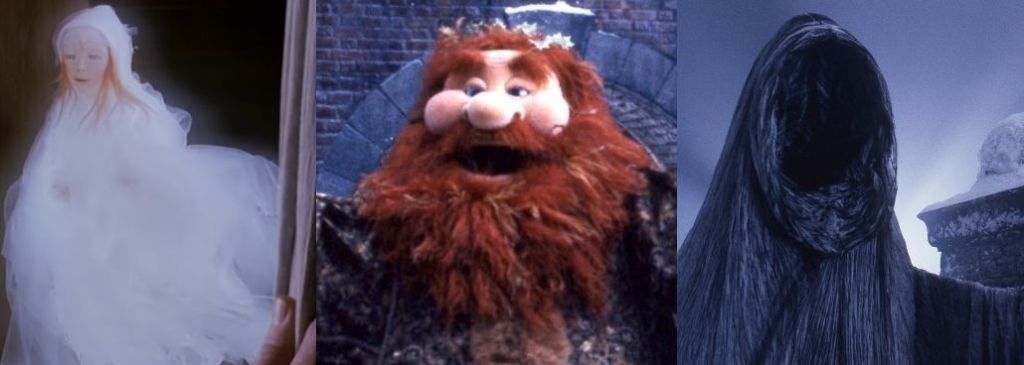
The Muppeteers chose not to use traditional Muppets as the ghosts of Past, Present, or Future, though, instead creating new characters to inhabit those roles. I think that was probably the best choice. Each of them has a unique, ethereal quality, that of a being that belongs to another world, that would have been sacrificed if Present had been played by Sweetums, Future by Uncle Deadly, or anything like that. They absolutely made the right choice.
Then there’s the human cast. While all of them are good, Michael Caine as Ebenezer Scrooge is phenomenal. The story, as most of us have heard, is that Caine chose to play the role perfectly straight, as if he were performing Scrooge amongst a cast of human actors rather than puppets, and in so doing he gave a performance that I frankly think was robbed of Oscar consideration. (Scent of a Woman my ass, Pacino.) It’s so easy to play Scrooge as the cold-hearted miser that we think of him as. Any halfway-decent actor can do it. What not every actor can do, what sets Caine apart, is the way he sells Scrooge’s transformation. Even in the early scene, where he begrudgingly agrees to let Cratchit and the bookkeepers have Christmas Day off, there’s a hint in his voice that it’s not entirely cold-hearted. There’s a spark of warmth – a very DIM spark, but it’s there. He tries to disguise it, but you can feel that there is understanding in his voice.

As the film progresses, each successive visit with the ghosts shows this change in a more pronounced way, as Scrooge’s defenses begin to fall and he is struck with the stark horror that his life has become. Caine shows regret, sorrow, pain, and genuine, sincere remorse for the terrible things he’s done in his life. This is the key, you see, this is what poor adaptations of the story get wrong. Scrooge’s redemption cannot come simply from the fear of his future. As people on the internet love to point out, if the only reason you behave morally is for fear of punishment, you’re not really a moral person to begin with. A truly good person does good for the sake of doing good. (We shall return to this subject next summer, just before James Gunn’s new Superman movie comes out.) The best adaptations of A Christmas Carol – and again, this is THE best – have to begin selling the redemption before fear for the future can set in.
The redemption truly starts with the most contentious scene in the film. If you go to Disney+, there are actually TWO versions of the movie. The one that plays if you just click on it is the expurgated version, which removes the song “The Love is Gone” from the Christmas Past sequence. If you want to watch the uncut movie, you have to go to “extras” and select “full version.” Disney chose to cut the song from the original release of the movie, saying that it slowed down the pace too much and that it was too sad.
My dude. My friend. My mouse. THAT. IS. THE. POINT.

“The Love is Gone” is sung by Meredith Braun, playing Scrooge’s lost love, Belle. After Scrooge watches the scene where she ends the relationship with his younger self, she launches into this heartbreaking piece about everything they have lost. At the end of the song, Caine joins in, singing a duet with a woman who cannot see or hear him. As the song continues he slowly, inexorably, crumbles into sobs. The agony in his face and his voice is a master class in acting. For the first time, Scrooge is truly forced to face the way his horrific choices have destroyed not only his own chances at happiness, but those of the person he loved the most in the world. It slows the pace? GOOD. Scrooge has to stop and realize what he’s done, and as we are going on the journey with him, we have to stop too.
It doesn’t hurt of course that Paul Williams, who wrote the songs for the film, absolutely pours his heart out into this one. It’s beautiful and tragic and haunting. And by the end of it, you see that Scrooge has already realized his mistake. This is not extraneous. This is crucial to his journey of redemption.
The transformation continues in the Christmas Present sequence. It’s one thing to recognize that you’ve made a mistake, but just acknowledging it isn’t enough to guarantee that your ways will change. This is accomplished when Present takes Scrooge to visit his nephew’s Christmas party. Seeing good-hearted Fred (Steve Mackintosh) and his guests make him the butt of a joke – calling him an “unwanted creature” in a 20 Questions-style guessing game – breaks Scrooge’s heart just a little bit more, as he realizes how people view him. At the same time, this is the nephew who practically begged him to join them in the first scene. Even today, Scrooge’s choices are causing his separation from those who would love him.
If that wasn’t enough, the visit to the Cratchit house nails it when Scrooge is told about the serious condition of Bob’s son, Tiny Tim (played, naturally, by Kermit’s nephew Robin). This is – to be fair – one of the easiest parts of the story to get right. If you can’t sell somebody feeling sorry for the plight of a small, sickly child, you have no business calling yourself a storyteller. But as always, the Muppets kick it up a notch. Kermit and Robin enter the scene to a lovely, joyful scat, singing about how jolly Christmas is. Tiny Tim isn’t immediately shown as an object of pity, as he is so often, but rather as a happy, gleeful child who deserves a chance at life. They launch into the centerpiece song “Bless Us All,” which is something of a love letter to the importance of family and togetherness, those very things that Scrooge has driven out of his life. It’s a warm, tender, heartfelt song that is undercut when the song ends with Tim’s tiny, tragic, prophetic cough to remind us that if something doesn’t change he is not long for this world.
Why are these things important? It’s simple. Christmas Past made Scrooge understand how badly he had screwed up. Present shows him that – although he cannot change the past – there is still time to make better choices for the FUTURE. That message is so blasted important. Anyone who has wrestled with depression can tell you how crippling the past can be, how it can cling to a person and make them hate themselves. It’s so easy to wallow in that and assume that nothing can be done about your life.
The message of Christmas Past was, “You made mistakes.” The message of Christmas Present is, “BUT THERE’S STILL TIME. YOU DON’T HAVE TO MAKE MORE.”
Not every version of A Christmas Carol sells this important message. NONE of them sell it as well as the Muppets.
In many ways, by the time Christmas Future shows up, Scrooge has already been redeemed. He’s taken the message of the first two ghosts to heart, and when Future arrives he tells him that he is ready and willing for the lessons the ghost has come to impart upon him. This line comes straight from Dickens, by the way, and any adaptation that leaves it out is completely missing the point. Past and Present do the heavy lifting, vis a vis Scrooge’s transformation. Future is really just there to deliver – pardon the expression – the nail in the coffin.
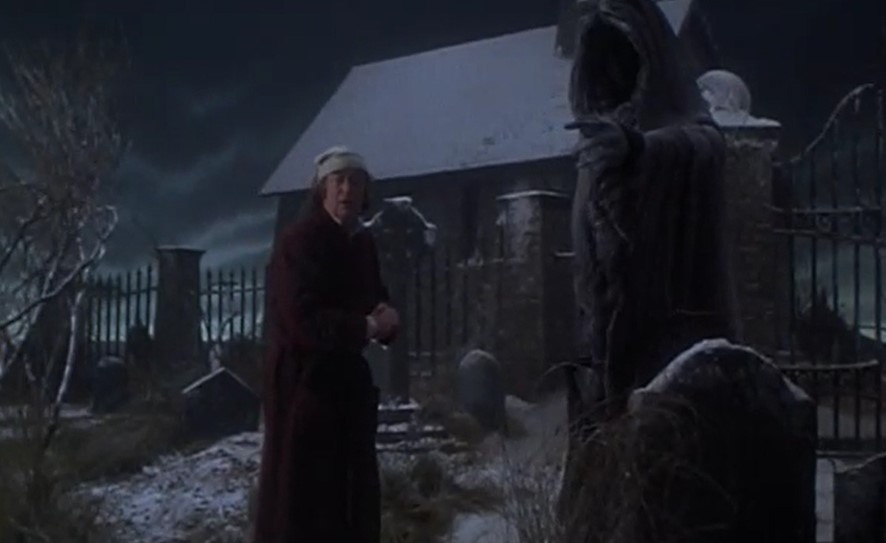
Another thing this version does that sets it apart comes in this sequence. Some versions of the story have Scrooge totally oblivious in the Christmas Future scene, as people are joking about the death of some mysterious “wealthy man” and we see his servants pawning his belongings for a little extra cash. It is obvious from the first second that the dead man is Scrooge itself, but a lot of versions of A Christmas Carol don’t let SCROOGE know that until he sees his own name on the tombstone. But the thing is, Scrooge isn’t an idiot. Although he never says it, the way Caine plays the part makes it clear that he’s pieced it together pretty quickly, that he is seeing the fallout of his own demise. He never says it, perhaps because they’re trying to stay relatively true to Dickens, but just as likely because he doesn’t want to admit to to himself. If you watch the scene in the graveyard, his behavior is clearly that of a man who knows he’s staring at his fate long before the appearance of his name makes that clear. Just one more reason that Caine is the best Scrooge ever, even better than the classically-trained Quincy Magoo.
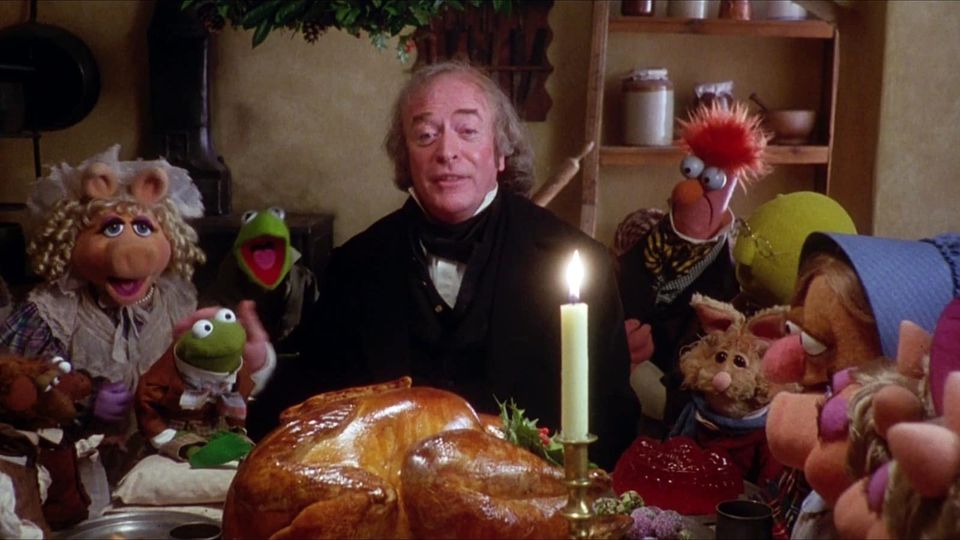
The finale, when Caine leads the Muppets in the song “Thankful Heart,” is absolutely beautiful. His every mannerism has been changed, and the expression on his face when he looks at those around him is not of a man afraid of the future, but of someone consumed by the love he has so long denied himself. My favorite part, though, comes when he sings the lines:
Stop and look around you, the glory that you see
Is born again each day, don’t let it slip away
How precious life can be!
There’s a moment in those lines where Caine’s voice breaks, just a little – a cracking in his song that sounds like he’s holding back tears. But again, his face sells it – those tears beneath the surface are not of pain, but joy and gratitude for the second chance he’s been given.
I don’t say this often. I reserve it for the likes of Jaws, Back to the Future, and The Princess Bride. But I genuinely think The Muppet Christmas Carol is a perfect movie.
There’s a bit of meta-triumph here as well. The film was directed by Jim Henson’s son Brian, and was the first major Muppet production after Jim Henson’s tragic death. There was a real question in the air as to whether the Muppets would work without the man who brought them to life. This movie proved that the spirit of the Muppets is greater even than their founder, that it IS something that can live on and survive and endure.
Disney would do well to remember that.
So the next time somebody decides to grab a camera and start rolling on a new version of A Christmas Carol…well, I would never tell them not to do so. As this film proves, there’s always room for a good version.
But before you do it, watch this movie. Watch it over and over again. And learn the lessons of the Muppets.
Because THIS is how we do it.
Blake M. Petit is a writer, teacher, and dad from Ama, Louisiana. His most recent writing project is the superhero adventure series Other People’s Heroes: Little Stars, volume one of which is now available on Amazon. You can subscribe to his newsletter by clicking right here. Second-best version of A Christmas Carol? Bill Murray in Scrooged. Maybe I’ll explain that next year.
 Blake M. Petit