Geek Punditry #89: What is Mr. Petit Reading?

There’s a relatively new trend among teachers – English teachers, at least – that I’ve grown quite fond of: the “What am I reading?” board. There aren’t enough kids out there who read just for the pleasure of it, and it seems like that number dwindles every day. Sure, talking about books all day is one of the best parts of my job, but I think kids get the idea that I spend all my time marinating in Shakespeare or F. Scott Fitzgerald. And while I certainly enjoy many things about both of those authors, that ain’t what I read for fun. So teachers have started making signs or bulletins that declare that we’re reading for our own recreation in the hopes of stirring some conversation. I never draw attention to the board, or let them know when I’m changing it up, but in the past year or so that I’ve kept the board in my room it has spurred a few questions like, “How many books DO you read?” and “Why do you draw that little star next to so many of them?”
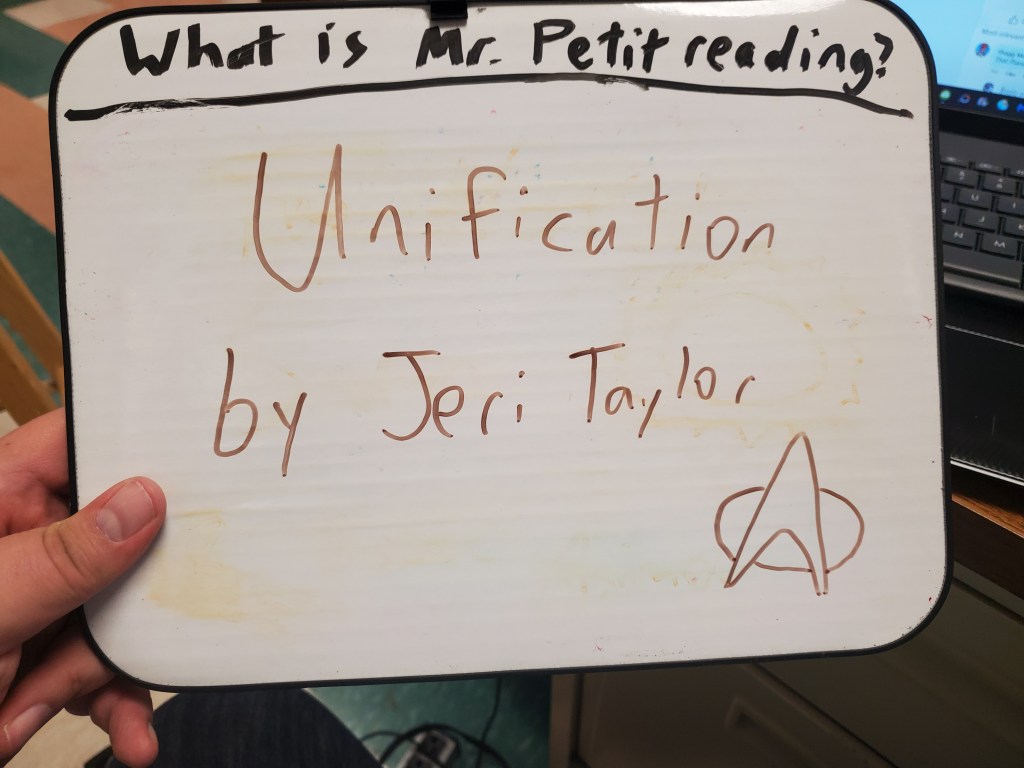
It’s a Starfleet delta, you heathens.

Anyway, another thing that this board has been good for is keeping me reading at a relatively brisk pace. The last thing I want is a kid asking me why I’ve spent the last month and a half on the novelization of Spaceballs. So I carve out a little time to read each day, usually before I go to bed, and I keep that board updated as often as possible. It’s been really helpful to me, giving me an impetus to read more often, and I thought today it may be fun to look back on a few recent reads that I’ve enjoyed.
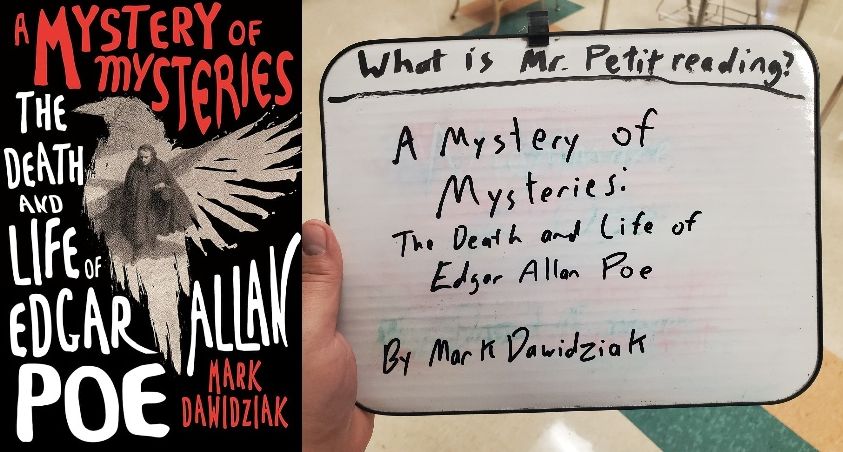
A Mystery of Mysteries: The Death and Life of Edgar Allan Poe by Mark Dawidziak

I picked this book up at Barnes and Noble on my birthday, part of my Rear Window date night with my wife, and I finished reading it a couple of days ago while riding out Hurricane Francine. I like to think Edgar Allan Poe would have approved. This is a great biography of Poe, with an emphasis on the unsolved mystery surrounding his death, found wandering the streets of Baltimore in a haze, drunk, possibly rabid, and dying a few days later crying out for an unknown person called “Reynolds.”

Or so the reports say. 

Dawidziak alternates chapters between telling the story of Poe’s life and the story of Poe’s death, and in both cases he spends a lot of time unraveling a lot of the scandalous tales that have plagued the widest-read author in American history ever since his death. Was he actually an opium addict? (No.) Was he an alcoholic? (He had his troubles with alcohol, but at the time of his death he had taken – and adhered to – a temperance pledge.) Did he die of rabies? (The water he drank on his deathbed seems to rule that out.) Granted, I haven’t read a LOT of books about Poe’s life, but Dawidziak definitely paints the most balanced portrayal of the man that I’ve ever read. There’s a clear admiration of Poe in his words as well. This is obviously the work of an author who holds Poe in high regard, so it’s not surprising how much work he does to rehabilitate Poe’s reputation. At the same time, though, the writing is clear and engaging, and the book left me feeling like I know much more about the man who we all imagine hunched over a shadowed writing desk, an ominous raven perched on his shoulder. If you’re at all a fan of Poe, I can’t recommend this book enough. It’s the perfect way to pregame for Spooky Season

A Nightmare in Oz by David M. Keyes

I’ve written before – frequently – of my abiding love for L. Frank Baum’s Oz in all its forms, and when I encountered author David M. Keyes on Threads discussing his series called the “New Oz Chronicles,” I decided to give it a chance. I’m really glad I did. 

A Nightmare in Oz is set in the modern day, 120 years after Dorothy Gale’s first journey to Oz and almost as long since she and her Aunt Em and Uncle Henry came to Oz to live permanently (which happened in Baum’s sixth book, The Emerald City of Oz, in case you didn’t know). But in Oz, nobody ages or dies, so Dorothy is still a young girl here in the 21st century. The story begins with Dorothy having a nightmare – her first since coming to Oz over 100 years ago. As she seeks an answer to her dark visions, she discovers that many of the residents of Oz that, like her, originally came from the non-fairy world are having nightmares of their own: Em, Henry, the Wizard of Oz (who also came back – really people, read the original books) and even her little dog Toto. The mystery of where the nightmare comes from brings back an ancient threat and opens up the doors for an engaging new fantasy series.

Since the Oz books went into public domain, dozens of authors (maybe even hundreds) have tried to put their own stamp on the world of Baum’s creations. Some, like Eric Shanower, do their best to create a world that seems like it could have spilled from the pen of L. Frank Baum himself. Others, such as Gregory Maguire of Wicked fame, use the skeleton of Oz to do something quite different that doesn’t strictly fit in with anything that Baum has done or would have done with his stories. 

But Keyes has found a marvelous balance between these two extremes. He is taking Baum’s works as canon, and Dorothy and the other characters have the same inherent goodness and sweetness that readers of the Famous Forty would find familiar and comforting. But by bouncing the action forward a century, he also adds a layer of modernity and sophistication that many contemporary writers don’t attempt. It’s the same old Dorothy, but she’s got a century of experiences that are belied by her childlike exterior. The danger in this book feels more real and more layered than most of the old stories, while not going to the extreme of some other modern writers. I really enjoyed this book, and I’m looking forward to digging into the rest of the books in this series.  

The Naked Sun by Isaac Asimov

But this accelerated reading schedule isn’t only reserved for new books. I’ve taken advantage of it to dive back into some old favorites as well, such as Isaac Asimov’s robot series. Most recently I read the second book in the series, The Naked Sun. In a future in which the citizens of Earth are limited to lives in huge, domed cities without ever facing the outside world, Detective Elijah Baley is summoned by an old partner – Robot Daneel Olivaw – to help solve a murder on a distant planet where the sky is open to all, but is so sparsely populated that people live solitary lives without ever seeing one another in person. 

Asimov was renowned as a science fiction master, and the world-building in this series has always impressed me. We’re all familiar with the Three Laws of Robotics and all the stories that have been written trying to thwart them, but that’s just the beginning. The projected future of the human race and how Earth is made subservient to its own colonies is fascinating, as are the different types of worlds explored throughout these stories. But I don’t know that people give Asimov enough credit for how good he was as a mystery writer. This is by no means the only mystery novel Asimov wrote, and not even the only mystery/sci-fi hybrid, but the unique circumstances of the world in which the story takes place adds an additional level of complexity to the mystery that makes this one a joy to unravel.

Of course, not every book that I’ve read in the year since I started keeping my board has been a winner, but as I always do with this column, I’m doing my best to focus on those things that I love. You’re not going to hear about the clunkers. At any rate, these are just a few of the stories that I’ve dug into lately that have helped me jumpstart my love of the written word. Hopefully, you’ve been having fun with books lately too.

Blake M. Petit is a writer, teacher, and dad from Ama, Louisiana. His most recent writing project is the superhero adventure series Other People’s Heroes: Little Stars, volume one of which is now available on Amazon. You can subscribe to his newsletter by clicking right here. The toughest thing about Blake’s new reading routine? Figuring out what book to read NEXT. There’s a…sizable list of candidates. 

Geek Punditry #13: What IS Geek Punditry, Anyway?

In the first week of January, I challenged myself to carve out a little time, once a week, to write something in this new “Geek Punditry” space I created. I’ve been using the term for years, calling myself a “Geek Pundit” in various online bios because I thought it was a clever phrase that, to the best of my knowledge, nobody else was using. (But to be honest, I never really looked, either. I could be wrong.) But as we finish up the first quarter of 2023 (motto: No, it’s not getting any better), it occurred to me that I never quite explained what I mean by Geek Punditry. What is this space about? What qualifies something for this kind of discussion? And most importantly, why should you care?

Would you listen to this man?

I’ll answer the last question first: you shouldn’t. Not unless you want to, that is, and that’s what makes my task challenging. A pundit, by definition, is an expert on a given topic that is called upon to present opinions on the subject. So clearly, as a title, it’s ridiculous, and that’s why I like it. It’s a title that sounds slightly pretentious, but hopefully is silly enough to communicate the fact that I’m trying to mock pretention rather than indulge in it. I don’t consider myself an expert on anything, but I think a lot about everything, and putting those thoughts down helps me to declutter my horrifically unorganized mind. As for the second part, “called upon to present opinions”…what is there to say? I’m well aware of the fact that nobody is asking me what I think of anything. I’m the living embodiment of those memes that start with “Nobody: [Blank space]. Nobody at all: [Blank Space],” and then a picture of SpongeBob blurting out something about Squidward. And since nobody has any compelling reason to give a damn what I have to say, the burden falls upon me to make what I have to say interesting. If you’ve read this far, I flatter myself by assuming that I at least haven’t bored you silly yet.

So back to the first part of the question: what does “Geek Punditry” mean? In simple terms, it’s talking and opining about geeky things. It’s not a new concept, of course, but there’s another term that’s been used pretty much since the invention of art: critical analysis. It’s about the discussion and dissection of art of all kinds, and it’s an ancient art all its own. I have no doubt that the first time some caveman picked up a stick and drew a picture of a saber-toothed tiger in the dirt, some other guy scoffed at it and kicked it aside so as to indicate that his blind 32-year-old great grandmother could draw a better tiger than him. The first guy then began to wildly gesticulate, which the second guy took as him being angry over the analysis. The second guy then laughed and communicated, through grunts and hoots, “What, can’t you take a joke?” Then he laughed a little more and then the first guy took a swing at him, at which point, both of them were eaten by the tiger that the first guy was trying to warn the second guy about in the first place. Which brings me to one of the central rules of MY version of Geek Punditry: Being critical is one thing, but being mean about it is just stupid.

“Did you see what Ug calls a buffalo? I’m gonna discover fire so I can tell him to go die in one.”

That’s not to say one can’t have a negative opinion, of course. It’s almost impossible to have any kind of intelligent analysis without criticism of some kind. But there’s no reason to be a dick about it. If you have ever – to give a totally hypothetical example that could never, ever happen in real life – bullied an actress on social media to the point where she deletes her account, I don’t care how bad the movie may be, you’re the bad guy. If you’ve ever threatened violence against someone because they wrote something you didn’t like, you’re the bad guy. If you’ve ever harassed, threatened, or wished violence against somebody because they’re married to/the parent of/the child or/the dog groomer of a celebrity that you have some sort of personal grudge against – and I cannot believe I have to say this – you are the bad guy. If your posts include the words “cancer” or “kill yourself,” I don’t even want to know you.

But those are just the most obvious examples of people being awful human beings and attempting to shield themselves by calling it “criticism.” There are other forms that are less obvious and far more insidious, and most of these fall under the general category of “clickbait.” How many times have you seen some online “think piece” that explains in great detail why a movie or TV show that you enjoyed as a child is actually awful, terrible, and something you should be ashamed of yourself for ever indulging in? I saw three of them today before I even got dressed to go to work. What the hell is the point of that?

“Today on Buzzfeed: 12 Muppets who totally would have given Mengele asylum in Brazil.”

Well, the point is obvious, actually, it’s about getting clicks. Websites like that run off of advertising, and every time you click on a link their ads generate some fraction of a cent, so it’s in their best interest to write things that will make you click. And the sad truth , my friends, is many people are far more likely to click on something if they find it infuriating. Otherwise, there would be absolutely no point to publishing these things. This is not to say that everything we loved when we were younger was perfect. A lot of us look on the movies and TV shows of our youth through rose-colored glasses, and more than once I have gone back to something I used to watch over and over as a child only to realize, as an adult, that it ain’t that great. But most of it is also harmless, something that has been largely left in the past and gives people fond memories, so why dredge it up just to upset people about something that previously brought them joy? The advantage I have here, I suppose, is that I have absolutely no expectation of making money off this blog, so I have no incentive to piss people off solely in the name of getting them here. I’d rather talk about the things that I love with other people that love them too.

The sad state of modern criticism both depresses and fascinates me, because people have been making a living as critics for a very long time. In high school, we used to go to the library and use these massive encyclopedia-sized sets of books of literary criticism for use in research papers and annotated bibliographies. These volumes contained thousands of articles published in journals over a couple of hundred years of writers writing about writing that other writers had written. It was full of analysis of every significant writer from Chaucer to Faulker. There was stuff both about and by the likes of Edgar Allan Poe and Mark Twain. There were entire spinoff volumes devoted specifically to writers of science fiction. And one can only imagine how many such articles were left uncollected because either the critic or the object of their criticism had faded into obscurity. Doesn’t that sound amazing? If ever there was evidence that I was born in the wrong century, it’s the existence of these books. 

Then there are film critics, which is probably the form of criticism that most of us are more familiar with. Guys like Siskel and Ebert made their names not by trashing everything they didn’t like (although they were not above doing that from time to time) but by explaining their opinions in a concise, intelligent way. I loved their TV show back in the day, I looked forward to watching it almost as much as I looked forward to watching the movies themselves. It’s because of them, as much as anything else, that I try my damndest to explain what I like or dislike about something, and why I try not to offer an opinion on something I haven’t seen or read personally. As a policy, the majority of social media would find this position baffling. 

I included this bit mostly so I could draw your attention to the hilarious Newsradio joke about these guys.

And when it comes to critical analysis, let us not forget the man with the mutton chops, Isaac Asimov. The good professor wrote or contributed to over 500 books in his lifetime, or roughly two and a half Stephen Kings. Most people today know him as a science fiction writer who also wrote about science or a scientist who also wrote science fiction. But he also wrote mystery novels. He wrote a guide to the Bible. He wrote jokebooks in which he broke down and analyzed the jokes, breaking the cardinal rule of not explaining why something is funny, and yet doing so in an entertaining fashion. He wrote one of the most intriguing guides to Shakespeare I’ve ever read! My wife found Asimov’s Guide to Shakespeare on eBay for me years ago because she’s awesome (there’s some advice, young people – if you plan to get married, marry someone awesome) and it’s actually making me a better teacher. Asimov not only explains his personal feelings about the plays, but also provides some interesting and, in some cases, essential context that makes it a lot easier to understand the more perplexing moments in the bard’s work. For example, I could never adequately explain to my students why it was so easy for Claudius to take his brother’s throne even though Hamlet quite clearly was old enough to become king. It never quite made sense to me, either. Asimov explains: at the time in which the play was set, succession did not automatically go from father to son, but rather a new king was selected from the members of the royal family. Claudius (with a little help from Polonius) managed to convince the nobles that he was the best choice before Hamlet could get his Danish butt back in the country, no doubt furious that televised campaign ads wouldn’t be invented until the 20th century. Now I know, and it’s because of the greatest Geek Pundit of all time. If Western Civilization has ever produced a bigger Geek than Isaac Asimov, I don’t know who it is. And I say that with the utmost respect.

This is what I was going for in that first picture, actually.

As with so many things, though, the digital revolution has largely eroded the ability to actually make a living with criticism of any kind. The number of full-time film and book critics has dwindled dramatically as newspapers and magazines go out of business, and while any of them can easily make a home for themselves on the web, the internet isn’t paying out for that sort of thing in a substantial way. The advent of AI-generated content is only making it worse. If you’re the type of person who sees a website as a revenue generator first and a place for intelligent discourse second (and placing it second is being extremely generous for most of these sites), it doesn’t make sense to pay an intelligent critic for well-constructed criticism. Just whip up an algorithm that can turn out a 10-point listicle that attacks someone’s childhood and BAM! You’re rolling in microtransactions. You’re the Scrooge McDuck of awfulness.

What happens at the “Inside the Magic” website office every time you click on an article about 37 ways to get a venereal disease in the Disney parks.

Here’s why I do this, folks. I like things. And I like liking things. And I like discussing the things I like. That’s why I wrote for Comixtreme for years, that’s why I hosted a podcast until parenthood took away both my time and my ability to have a single room in the house quiet enough to record. And that’s why I’m here now. I’ve come to realize that discussing these things, analyzing these things…it makes me happy. It gives me a place to channel all those thoughts that otherwise barge into my skull at 2 a.m. It gives me somewhere to share all of my ideas about these things that I love without randomly having to turn to my wife in the middle of the grocery store and explain the entire history of Firestorm because something on a box of Rice Krispies made me think of the first time he fought Killer Frost. This column isn’t just me babbling narcissistically. This is my therapy.

Except for my wife and son, I don’t know if there’s anything I enjoy more than talking about things that I enjoy. It’s why I go to comic shops and conventions, why Free Comic Book Day is the best day of the year, why seeing a movie with friends is better than watching it on my phone. It’s why I’m here.

And if you enjoy that sort of thing too, you’re my kind of people. Pull up a chair, I’m happy to have you. It’s just a shame that, in the world we’ve got today, the table feels so empty sometimes. 

Blake M. Petit is a writer, teacher, and dad from Ama, Louisiana. His current writing project is the superhero adventure series Other People’s Heroes: Little Stars, a new episode of which is available every Wednesday on Amazon’s Kindle Vella platform. He apologizes in advance if any of the ads that WordPress places on this site fall under the categories of awfulness he mentioned in the column, and he strongly encourages you not to click on anything. Except for his aforementioned Amazon links.