Matt Groening, creator of The Simpsons, famously said he believes one of the keys to an iconic cartoon character design is whether the character is recognizable just from their silhouette. Think about it – if you show pretty much anybody anywhere in the world the mouse-ear shape, they’ll instantly recognize Mickey Mouse. The same can be said for characters like SpongeBob Squarepants, Phineas and Ferb, Bugs Bunny, and a lot of the other cartoon all-stars. And Groening himself is legendary for utilizing this tactic with the signature nine spikes on Bart Simpson’s head or the trademark antenna on the top of Futurama’s robot character Bender Bending Rodriguez. But as insightful as this piece of wisdom is, I don’t think it applies only to cartoons. In truth, any truly great design should have elements that make it instantly recognizable. And with Halloween only three weeks away, this week I’m going to help you all make your costuming decisions by applying this reasoning to horror movie icons.
Of course, the silhouette isn’t the only thing that makes for a horror icon. There are several factors to take into consideration. The overall design, in addition to just the silhouette, needs to be memorable. The characters themselves should be interesting and unique. A character should be popular enough that people will recognize them and you won’t have to spend the entire Halloween party explaining what your costume is. And when you’re talking about Halloween costumes, above all else, they should be fun to play. So let’s go over some of the all-time great horror movie icons and see just how they stack up to this metric before you suit up for your Halloween party.

We’re gonna start old-school with the Universal Monsters. The great thing about these characters is that they are all INSTANTLY recognizable, even to children who were born 90 years after the movies were released and have never seen any of them. Characters like Dracula, the Frankenstein Monster, and the Invisible Man are all based on classic literature and are not Universal originals, but when you ask somebody to picture them, they invariably envision the versions popularized by Bela Lugosi, Boris Karloff, and Claude Rains, respectively. In fact, those designs are all copyrighted (at least for the next few years). If you were to make a movie about Frankenstein, you couldn’t give your monster the flattop or neck-bolts, because those are all owned by Universal Studios even though the monster himself isn’t. So these classic horrors all meet the standard of memorability and recognizability. The only caveat comes with the Mummy and the Wolfman. Although those are, of course, classic monsters, the designs here (while still amazing for the time) aren’t as immediately attributable to the Universal designs specifically. It’s very easy to mistake Im-Ho-Tep or Larry Talbot for a generic mummy or werewolf. And of course, there’s nothing wrong with being a generic werewolf. But if you want to be the Lon Chaney Jr. Wolfman specifically, you may need something like a silver wolf-headed cane as an accessory to drive the point home.

The 70s and 80s gave us our next great wave of horror movie icons, and many of them have persevered. Leatherface, the killer from Texas Chainsaw Massacre, was probably the first great iconic character of the era. He’s got an easily-identifiable apron, a mask made of human skin, and – of course – a chainsaw to whip around his intended victims. He arguably started the trend of slasher movie icons that would explode in popularity in later years. He wouldn’t necessarily be my first choice to cosplay as, however. To be blunt, his appearance is a lot scarier than some of his successors. That’s not always a deal-breaker, of course, but you have to consider your audience. I’m a dad, and if I’m going to any sort of Halloween event there’s a 99 percent chance that there will be children in attendance. Leatherface is immediately frightening in a way that even the likes of Freddy and Jason are not. Of course, if you’re going to an adults-only event or to something like a horror convention, that’s less of a concern, but you should always keep in mind who’s going to see your costume. There’s also his signature weapon to consider. Having a prop to use as part of your costume is a plus, but you have to remember that you’re going to be keeping track of the thing all night long. Do you really want to spend the entire party looking for places to put your chainsaw?

Michael Myers from Halloween is a really simple costume – all you need is a jumpsuit and a mask. A bladed weapon is recommended, but optional. And that’s all it will take to be a character that 99 percent of people will recognize whether they’ve ever seen one of his movies or not. The question now becomes: how dedicated are you to staying in character? Michael is a silent killer. He stalks and he tracks you like an unstoppable monolith, and he never says a word. The closest thing you get to an emotion from him is when he tilts his head quizzically to look at the victim he’s just pinned to the wall. If you’re the type of costumer who enjoys not only dressing up, but also embodying the character that you’re playing (minus the actual murder part, of course), you have to be prepared to spend the evening being very restrained, slow, and deliberate with your movements. It’s not a dealbreaker, but you should definitely check if four out of five dentists recommend Michael Myers or somebody else.
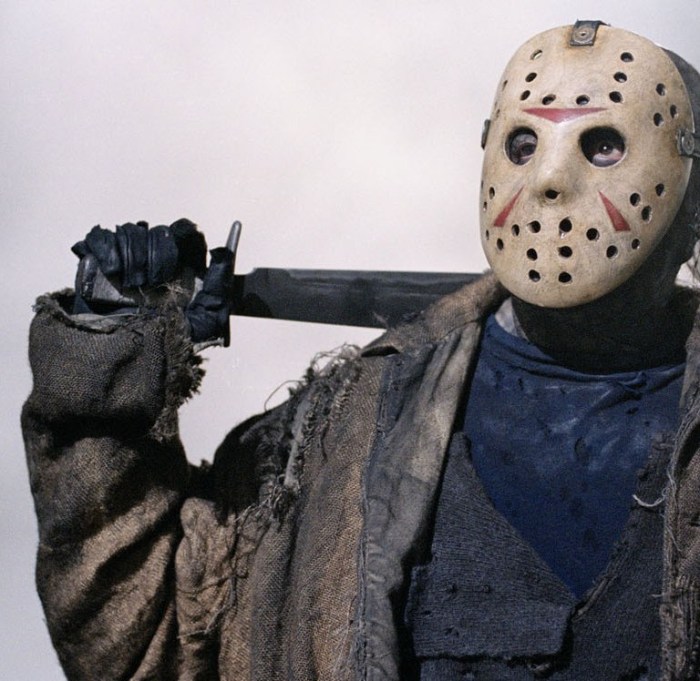
Jason Voorhees of Friday the 13th has a similar concern. Again, the costume is pretty simple – virtually any ragged, ratty slacks and shirt will be suitable as his clothing, and an easy-to-aquire mask and machete will complete the ensemble. And as far as iconic characters go, I would say that Jason is perhaps even more recognizable to the general public than Michael Myers is. Michael has a William Shatner mask that’s spray-painted white, but almost ANY hockey mask will evoke feelings of Jason. Like Michael, Jason doesn’t talk. Unlike Michael, though, he’s much faster and more brutal, expressing his emotion through his actions rather than words. It can be a fun part to play depending on how willing you are to commit.

The great slasher triumvirate is completed with Freddy Krueger of A Nightmare on Elm Street. Iconic, indeed. Everybody knows Freddy on sight, with his classic red-and-green sweater, fedora, and bladed glove. The tricky thing with Freddy is his face. The character is a burn victim, and although he’s so ubiquitous in pop culture that I don’t really have the same concerns about him being too scary for kids that I have with Leatherface, the burns present a different problem. You see, Freddy – unlike Jason or Michael – is a talker. His quick, dark sense of humor is integral to the character, and if you’re gonna dress up like Freddy you’re going to want to throw out bon mots all night long, with an emphasis on extra “bitch”es should you encounter anybody at the party dressed like Rick and Morty. If you wear a Freddy mask, though, that talkiness becomes more difficult and cumbersome. Wearing a rubber mask makes it more difficult for people to understand what you’re saying, and actually speaking under the mask increases the temperature beneath the rubber roughly ten degrees per “bitch.” If you live in a climate like I do in Louisiana, that ten degrees may be the difference between life or death. The alternative to a mask is makeup, which can be time-consuming, difficult to apply, and easy to mess up. Please understand, I’m not saying any of this to discourage someone from playing Freddy – I just want to point out some of the possible concerns that come with such a costume.
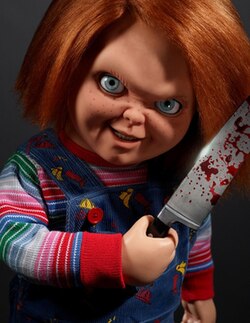
The last great slasher icon of the 80s is probably Chucky from the Child’s Play franchise. When my son was five years old, we took him to Spirit Halloween and we toured all the costumes before finally asking him which one he wanted. He jumped in delight and exclaimed “CHUCKY JUMPSUIT!” I actually took out my phone and recorded him saying it because I knew nobody would ever believe he picked it on his own.
My wife Erin and I are both horror movie fans, but we’re not idiots – our five-year-old son had never seen any of the Child’s Play movies, and the 8-year-old he is now STILL hasn’t seen any of them. But that doesn’t matter – Chucky is one of those ubiquitous characters that even kids recognize. His bright blue overalls and multicolor sweater, a shock of red hair, and freckles across his nose all give us a nice, friendly image that kids enjoy. That is, of course, the point of the character – he’s a child’s doll that is possessed by the spirit of a serial killer, so of COURSE his image is something that would be appealing to children. However, this also leads to a problem: it’s hard to wear this costume as an adult without coming across as creepy, and not in the right way. Five-year-old Eddie was the most adorable little serial killer ever, but if a 35-year-old puts on the jumpsuit, he needs to be DARN sure he’s got a receptive audience before he shows up, or he’s going to be getting strange looks all night.
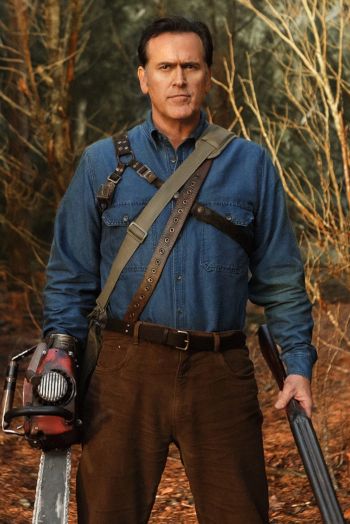
Not every horror icon is a villain, of course. Ash Williams, Bruce Campbell’s hero from the Evil Dead franchise, is another solid costume choice. Most of the costume is relatively simple too – slacks, a blue shirt, a bandolier, and some blood splattered across your face. The most iconic part of Ash’s appearance, though, is the most difficult: in Evil Dead 2, Ash’s hand becomes possessed by a Deadite and he is forced to amputate it, then top off the stump with a chainsaw. Now you’ve got all the same problems as cosplaying Leatherface with the added difficulty of finding a way to keep a chainsaw attached to your hand all night. Alternatively, you could go with Ash from the third film, Army of Darkness, in which he replaces the chainsaw with a mechanical hand. It’s certainly easier than the chainsaw, but it’s FAR less iconic and less likely to be recognized. And honestly, even WITH the chainsaw, Ash doesn’t have the cultural penetration of a Freddy or a Jason. If you’re wearing the costume to a horror convention, people will know you immediately, but for the office Halloween party, be prepared to explain your costume over and over again.

Of course, as far as 80s monster movie heroes go, there’s nothing more iconic than the Ghostbusters. This has become a classic choice for a Halloween costume because it ticks all the boxes: it’s simple, it’s recognizable, and it’s fun. You need two things: a jumpsuit with a Ghostbusters patch and a name tag, and a proton pack. The jumpsuit is readily available in any costume shop and easy to make if you’re so inclined. The proton pack is more difficult, but there are inflatable ones that are lightweight and are usually included with commercial costumes, or more expensive and detailed ones that you can buy or assemble yourself. It’s also a highly adaptable costume. There are the classic khaki jumpsuits from the first movie, the gray variants from Ghostbusters II, the 2016 jumpsuits, multicolored costumes from The Real Ghostbusters cartoon, the red parkas from the Frozen Empire movie, versions from other cartoons, video games, toys…the list goes on. And fans often come up with their own original variants and designs. In fact, similar to the 501st Stormtrooper Legion (a Star Wars fan collective that has expanded far beyond just cosplay to things like public appearances and charity work), there are Ghostbusters chapters all over the world of fans who enjoy this sort of thing. I don’t have the time, talent, or money to be a really good cosplayer, but I’ve always said that if I DID have the opportunity to join such a group, it would be the Louisiana Ghostbusters.
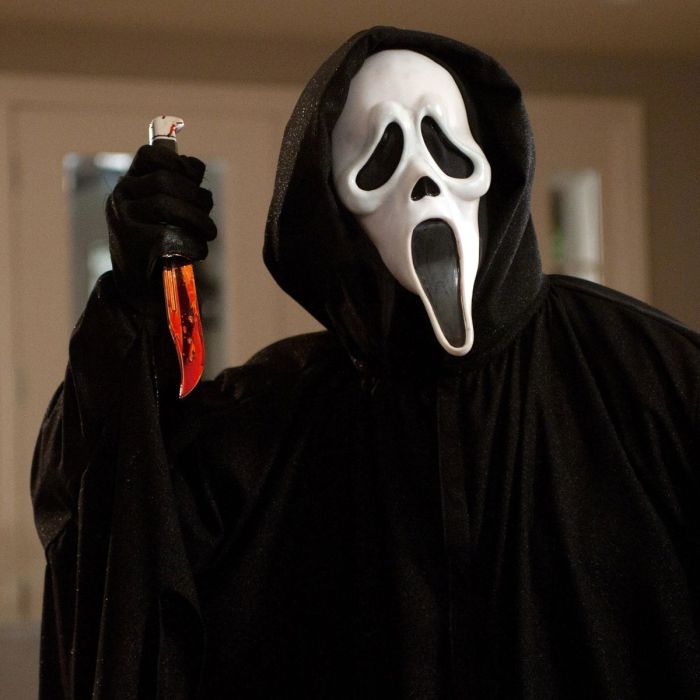
Moving on from the 80s, let’s look at the most iconic horror character of the 90s: Ghostface. The killer from the Scream movies is unique in that the costume is the only constant – a different set of villains wears it in every movie. In fact, over the six Scream movies to date, over a dozen different characters have donned the mask to engage in murderous shenanigans. But this lack of uniformity hasn’t been an obstacle for Ghostface becoming an icon – in fact, it’s probably the STRENGTH behind it. More so than any other character, anybody can wear the Ghostface mask.
It’s also unique in that the costume itself didn’t actually originate with the movies. It was part of a line of Halloween masks produced by a company called Fun World. Director Wes Craven liked the mask, put the character in black robes, and entered into a licensing deal with Fun World that has had them rolling in cash for nearly 30 years now. Not everybody may know the name “Ghostface,” of course, but we all recognize “the guy from Scream.” A few weeks ago my sister told me that my 11-year-old nephew – who is even less likely to have seen the movies than my 5-year-old was, because my sister is NOT a horror fan – has declared his intention to be Ghostface for Halloween this year. I’m very proud as an uncle and I can’t wait to see him when my sister and I take our kids trick-or-treating together. I just wish the boys had collaborated on being movie killers in the same year, because that would have been cute. (Eddie isn’t going as a murderer this year – he wants to be Superman. This is the proudest moment of my entire life.)
Since the turn of the century there have been several efforts at creating new horror icons. And while characters like Victor Crowley of the Hatchet franchise, Trick ‘r Treat’s Sam, and Leslie Vernon of the woefully underrated Behind the Mask are great and have many of the trademarks that make for a classic icon, the only recent monsters that have reached the degree of cultural penetration that the classics enjoy are a pair of clowns.

In 2017 we got a theatrical version of Stephen King’s It. The first dramatization of It, a TV miniseries from 1990, featured Tim Curry as Pennywise the Clown, and he was magnificent. Curry in general is magnificent, of course, and his makeup as Pennywise is suitably creepy when Tim Curry is wearing it. But Bill Skarsgard from the 2017 version – let’s be honest here – has broken into the mainstream in a way that Tim Curry’s never quite did. The design of the makeup is creepier, and Skarsgard’s performance is unsettling in a more insidious way. A lot of people would recognize you if you dressed as Tim Curry’s Pennywise, but EVERYBODY recognizes the Skarsgard version. Either version is relatively easy to cosplay – you need the costume and the wig, which are readily available. Skarsgard’s makeup is more complicated, though, and if you don’t want to subject yourself to the same masking problems you’d have with Freddy, make sure that you – or someone you trust – is capable of making that transformation.

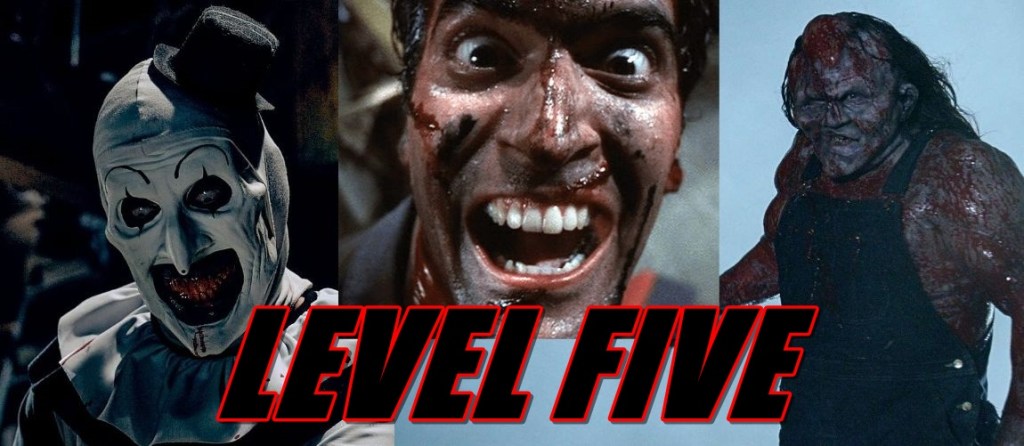
The most recent character to break into the echelon of horror icons, though, is probably Art the Clown of the Terrifier franchise. Art was originally played by Mike Giannelli in a series of short films and anthology segments, but Giannelli retired from acting and the role was taken over by David Howard Thornton for the first full-length Terrifier film in 2016. A malevolent clown with a stark black-and-white costume and makeup that is immediately recognizable, Art has risen to iconic status faster than anybody since Ghostface. As far as horror icons go, Art is perhaps the darkest, most brutal, most sadistic character ever to crack into the public consciousness. He’s more violent, more aggressive, and while the voiceless beast DOES still have a sense of humor, it’s so dark that it makes the likes of Freddy Krueger look like an episode of Bluey by comparison.
Naturally, he’s become a huge favorite among horror fans.
In terms of costuming, again, Art is relatively easy. Costumes and masks are available, and since Art doesn’t talk you don’t have to worry about being muffled. On the other hand, makeup is more expressive and less restrictive than a mask, so if you’ve got the skill (or someone with the skill to help you) I would always prefer the makeup approach. Something else to consider is that Art – while huge among horror fans – is not necessarily someone that the average person on the street will recognize, at least not YET. On the other hand, even if your audience doesn’t know ART the Clown, the general appearance of the character is more than sufficient to give the idea that this is NOT a funny clown, and the mystique is preserved.
There are plenty of other characters that we didn’t quite touch on, of course, and you should always go with whatever is comfortable and fun for you. Hopefully I’ve given you a few tools you can use to evaluate your own costume choices when you’re making the decision. You’ve got three weeks left, folks – get started.
Blake M. Petit is a writer, teacher, and dad from Ama, Louisiana. His most recent writing project is the superhero adventure series Other People’s Heroes: Little Stars, volume one of which is now available on Amazon. You can subscribe to his newsletter by clicking right here. He’s also started putting his LitReel videos on TikTok. Since Eddie is Superman this year, he’ll be wearing his own Kryptonian pajamas come Halloween night. Scary can wait.


 Blake M. Petit