When I started putting this retrospective together, my goal was to look back at each story and give you a little background or insight as to what was going on when I wrote it. But alas, for the first time, I’m stymied. It’s been a long time, guys, and in truth, I really don’t have the slightest idea what I was thinking about or going through that led me to the composition of this story. It’s a shame, too, I really like this one, and it seems to be one of the ones that my readers connected with the most. Wish I remembered how I got the idea. In the original Long November eBook, I wrote that this story was a way to sort of double down on my notion that Christmas Eve is the best night of the year for a miracle, and I’ve gotta admit, that feels pretty on-brand for me.
Writing Life
Ghosts of Christmas Stories Past 2004: Promise
This story is officially the first story from the world of The Curtain (even though that term wouldn’t come in until several stories later). It links to my novel The Beginner, although to say any more would be to give away either too much about this story or about that book. If you’ve read that book, this story will have more meaning for you. If you haven’t I hope you enjoy it anyway.
Back in the day, ghost stories were a Christmas thing more than Halloween. This was my first attempt at a holiday ghost story. It wouldn’t be the last.
By the way, here’s a little tip for any writers out there: think really hard about your titles. If you type The Pyrite War into Amazon, I’m the first thing to come up. You know what you get if you do a search for The Beginner? Eighty thousand self-help books, that’s what. Learn from my mistakes, kids.
Ghosts of Christmas Stories Past 2003: JLZX622
I am extremely proud of this story, for which the International Federation of Holiday Weirdness gave me the trophy for “Most Unusual Title Ever Given to a Christmas Story.” It is an honor I take very seriously, and a legacy I hope to pass down to my son some day.
This is another story that links to something else I was working on at the time, although unlike the story referenced in “Pencil Sketches,” this one was actually finished. Some of the characters in this story also appear in my young adult novel Lost in Silver. If you’re saying to yourself, “Wait, Blake, I thought I’d read all of your stuff, and I’ve never HEARD of Lost in Silver…” well, I said the story was FINISHED, not PUBLISHED. I serialized that story on the old Evertime Realms website many years ago, but it’s kind of lost on the internet now. It’s odd that I have something completed just sitting on a hard drive that I haven’t done anything with, and every so often I think about dusting it off and putting it on Amazon, but I haven’t pulled the trigger yet. YA has changed SO much in the time since I wrote it that I don’t know that there would be a place for it anymore. But if you’re one of the few people who remember the story and would like to see it again – or if you’re someone who’s NEVER seen it and you’re wondering what it’s all about, drop me a line and let me know. Never say never, right?
By the way, this is the second story to mention “Timberton Parish, Louisiana,” the first being “Clarence Missed.” There is no such place. It’s a fictional place I conjured up for a story and then used for several other stories, then I stopped. If Stephen King can fill up half the state of Maine with fictional locations, dang it, I should get one parish.
Ghosts of Christmas Stories Past 2002: Pencil Sketches
This is another story that came about as a result of a bigger story I was working on. I’d kicked around a novel about a pair of best friends, two young men who each desperately needed a brother and found them in each other, one of whom was carrying around a major chip on his shoulder over feeling cheated out of his grandfather’s legacy, but I realized at some point that this wasn’t a story that had an ending. In fact – this being the early 2000s – I thought it would work much better as a webcomic. I never found a partner to work on with it (I cannot draw), but this short story – the origin of Matt and Bixby’s friendship – remains as a reminder to me of what might have been.
This story also canonically links to two of my novels, The Beginner and Opening Night of the Dead, through the existence of Climax Pictures. Those two books are part of my world of “The Curtain,” so I suppose this story technically is as well, although none of the supernatural trappings of those books appear here.
Kids, ask your parents what “Waldenbooks” was.
Ghosts of Christmas Stories Past 2001: Clarence Missed
Like I said, the idea of writing a Christmas short story came from my love of It’s a Wonderful Life, and this is the story that draws on that most directly. I wanted to preface each of these stories with a little tidbit about what inspired it or where it came from, but the truth is it’s been a long time and I honestly don’t remember how I came up with it. I DO know that I dropped in a few links to stories I’d been working on that never quite materialized, although one of them will be turning up again in a few days. In the meantime, I do think this stands by itself. Enjoy and share…
Ghosts of Christmas Stories Past 2000: Lonely Miracle
As I mentioned yesterday in the introduction to this little project, I got the inspiration to write a Christmas short story as a gift to my friends back in 2000. I was fresh out of college, working at a newspaper, and scribbling away at a story that had grabbed me about a reporter who discovers he has super powers, and thus wants to become a superhero himself. Originally intended to be a short story, when “Capes and Masks” reached 25,000 words and I realized I wasn’t even halfway through, I understood that I was actually working on my first novel. The book was eventually finished and given a slightly catchier title, Other People’s Heroes, and it’s kind of been the hub of my writing ever since.
As I was working on the book when the idea to do a Christmas story came to me, I wound up incorporating that universe I was building into the story in question, a habit that would become more and more pronounced for me over time. You will find, over the next few weeks of this time capsule project, that a great number of these Christmas stories are linked either to Siegel City, to my other fictional world which I refer to as “The Curtain,” or to various other projects that were in the works at the time and may or may not have ever been completed. (Mostly have not.)
But for now, my friends, please enjoy — and feel free to share — the first story in my annual tradition, the Siegel City tale called…
Coming in December: The Ghosts of Christmas Short Stories Past!
I am a nerd for Christmas.
Ask anybody, I’ve been a huge fan of the entire Christmas season for as long as I can remember. I love the music, I love the movies, I love the TV specials, and lord knows I love the food. I love the stories, too – tales of redemption and hope, ghosts and angels…there’s something that makes any story a little more precious when it’s part of the Christmas season.
Way back in 2000, a year that was before any of the students in my current 12th grade class were even born, I learned an interesting bit of information about my favorite Christmas movie, It’s a Wonderful Life. The tale of George Bailey and Clarence the Angel, the beautiful story of a man who is given the gift of seeing a world where he never existed, did not actually begin life as a movie. The movie was a loose adaptation of the short story “The Greatest Gift,” a story that was written by Philip Van Doren Stern in 1943 and given to friends as a Christmas card after being unable to find a publisher for it. The story was passed around and eventually made its way to Hollywood, where Frank Capra and James Stewart transformed it into one of the most iconic films of the season. The thing that stuck with me, though? The notion of a short story as a Christmas card.
The idea lodged in my brain, inescapable, and it took root. I decided to do something similar that year, writing a short story that included characters from the novel I was working on, a weird little thing about superheroes that was, at the time, called Capes and Masks before I finally settled on the marginally-superior title Other People’s Heroes. The story featured two side characters from that novel and was set on the Christmas immediately before the events of the book. I was pleased with the story, I sent it out, and when I published the revised version of the novel several years later I included the story, “Lonely Miracle,” as a sort of special feature in the back.
The thing is, that first story wouldn’t sit still, and in 2001 I sat down and wrote a second story, this one directly inspired by Capra’s film. In 2002 I did it again. Then again. And here we are, 23 years later, and I have never failed to put a new story into the world every Christmas.
This year, I’ve decided it would be nice to dig back into the archives and once again share all these ghosts of Christmas stories past. Starting tomorrow, I’ll be re-presenting most of those stories to you, every day except Wednesday (because on Wednesdays the only thing you need to worry about reading will be the newest installment of Other People’s Heroes: Little Stars). I’ll once again share every short story with you, free of charge. That will make 20 of the 24 Christmases – the other four Christmases are accounted for with the three short Christmas novels I’ve written. I’ll give you those links now, since two of them are on Amazon.
First was A Long November, from Christmas 2005 (which also happened to be my first year attempting National Novel Writing Month). Duncan Marks is just like you: sick and tired of Christmas getting earlier and earlier every year. And just when you thought it couldn’t get worse, Duncan finds himself targeted by a strange pixie intent on rescuing his Christmas spirit – on the DAY AFTER HALLOWEEN. A Long November is available as an eBook collection from Amazon, which also happens to include several other of my earliest Christmas stories, the ones I’ll be sharing here for the next few weeks.
The second short novel was from 2013, a tale called Making Santa: Advent. Nicholas Grace is one of 200 men abducted by a bizarre alien race called the Yool, aliens who are testing their captives…training them for a very important task: to become the most famous figure in history. One of these men will become the new Santa Claus. Like A Long November, Making Santa: Advent is available as an Amazon eBook. This story, you may notice, has a few sequel hooks…I had thoughts at the time of doing a series with these characters. It hasn’t materialized yet, but never say never.
The third longer work is Santa’s Odyssey, an experiment that began on Christmas 2017 and lasted until Christmas 2018, counting as the story for both of those two Christmases. In this story, as Santa returns to the North Pole on Christmas Eve he is attacked by a coalition of angry holiday icons who feel his holiday has gotten out of control. Over the next year, Santa is forced to see the task of each of the other major holidays. This was a challenging story to write, turning out a chapter every month as the year progressed and covering two Christmases. It’s never been put out for sale, but you can download the PDF of it for free right here.
And with those three stories up front, the stage is set. Come back tomorrow for the first of these Ghosts of Blake’s Christmas Stories past, one every day (except Wednesdays) until we reach Dec. 23, when this year’s all-new story will make its debut! Hope you enjoy this trip through my development as a writer, guys. Merry Christmas!
And in case you missed any of the stories, they’ll be indexed right here!
- Christmas 2000: Lonely Miracle
- Christmas 2001: Clarence Missed
- Christmas 2002: Pencil Sketches
- Christmas 2003: JLZ6X22
- Christmas 2004: Promise
- Christmas 2005: A Long November (full novella, available on Amazon)
- Christmas 2006: Helper
- Christmas 2007: Circle
- Christmas 2008: Return to Sender
- Christmas 2009: Turn Right at the Sign
- Christmas 2010: Toyetic
- Christmas 2011: Lucky Penny
- Christmas 1827: Stowaway
- Christmas 2012: The Ghost of Simon Tower
- Christmas 2013: Making Santa-Advent (Full novella available on Amazon.com)
- Christmas 2014: An All-American Christmas
- Christmas 2015: Akkis’s First Christmas
- Christmas 2016: Daisy’s Tree
- Christmas 2017-Christmas 2018: Santa’s Odyssey (Free full novella)
- Christmas 2019-I Can Explain
- Christmas 2020-Warmth
- Christmas 2021-Vic Saves Christmas
- Christmas 2022-The Release
- Christmas 2023-Good Choices
- New Year’s Eve 2014-Baby New Year
Geek Punditry #2: A Well-Paved Mile
If you have children, one of the best things you can do with them is read together. It teaches them early on to love books and love learning, it’s quality parent-and-child time spent together, and it is likely the only chance you’ll get to read anything longer than the directions on a bottle of Children’s Imodium for several years. Kids are a joy, but they do tend to make demands of your time. For example, I’m a big fan of Stephen King. I have been ever since my uncle first introduced me to The Stand when I was in high school. I met my wife on a message board dedicated to The Dark Tower. And by the time my son was born in 2017, there were only four or five books in his lengthy catalog that I had not yet read. However, after Eddie was born, my reading time was curtailed drastically but King’s writing time was not, so those four or five unread books have expanded to approximately eleventy trillion.

But my son is a little older now, and it’s finally starting to become a little easier to squeeze in something longer than your average comic book for my reading pleasure. I recently looked at the vast array of new King that has been produced in the last six years, carefully weighed the options, communed with the spirits of the literary world for how to begin, and finally decided to hell with it, I’m gonna read The Green Mile again.
If you’re not familiar with The Green Mile, either through the novel or the top-notch film, I have to say it’s not what people usually think of when they think of Stephen King. There are no child-munching clowns, no apocalypse viruses, not even a writer from Maine. The story is told from the perspective of an old man who was a prison guard in the 1930s, and it centers on one of his death-row inmates who turns out to be harboring a fantastic secret. It’s a character drama with a little magical realism in it, and although there are certainly intense moments, there’s nothing in the book that could really classify it as horror. It is, I say without hyperbole, one of his finest works. Also, there’s a mouse.
It’s been years since I last read the book, but dipping into it again was like visiting old friends who happened to be convicted murderers. I was immediately plunged into the world of Paul Edgecombe and John Coffey (“like the drink, only not spelled the same”). I hated Percy Wetmore all over again, I sympathized with Eduard Delacroix all over again. But as I read this time, I noticed something that had not occurred to me in previous readings of this story: namely how perfectly plotted this story is.
Conventional wisdom says there are two types of fiction writers: architects and farmers. Architects meticulously plan out every scrap and detail of a story ahead of time, decide every beat and turn, and only then, once the blueprints are done, do they write. Farmers plant some seeds with only the vaguest idea of what shape the story will eventually blossom into, but pruning and cultivating that plotted plant is part of the joy of being a writer. By all accounts (including his own), Stephen King is a farmer, and sometimes it shows. As magnificent as he is at character and concept, more than a few of his books suffer from deus ex machina endings that seem to come out of nowhere. (Read The Girl That Loved Tom Gordon some time – you can pick out the exact moment where the writer decided this kid had been wandering aimlessly through the woods long enough and it was time to wrap this puppy up.)
Even King’s best books usually include long segments of backstory or subplots which, although enjoyable to read as they help flesh out the world he is creating, are ultimately unnecessary to the plot and could easily be excised if Reader’s Digest got their hands on it. But not The Green Mile. I was actively looking for the fat when I read the book this time, and I could find none. Each and every piece feels crucial to the overall puzzle. Arlen Bitterbuck’s execution? It’s there to demonstrate how executions are supposed to go, so that what happens later has the necessary context. The Brad Dolan subplot in the framing sequence? It steers Paul’s retelling of the story to its final revelation (which itself resolves a lot of the lingering questions left behind over the course of the book). The brief mention of the only woman who ever served time in E Block? Seems extraneous at first, as her sentence is commuted and she quickly leaves the story.
However, it turns out that this woman is really there to set up another device that turns out to be important: Death by Finale. After her brief appearance in the book, Paul mentions how she eventually died of natural causes several decades later. Again, it seems like a nothing detail, but it’s really there to establish a pattern: afterwards, King tells us of the final fate of almost every named character during the last scene in which they appear. It’s easy enough to miss the first few times. Her fate and that of another inmate whose sentence was commuted (murdered in the prison laundry 12 years later) are incidental. But the pattern becomes clearer as the story goes on, especially in the final chapters, where the fates of Paul’s fellow guards and the other key figures are all stacked on top of each other. It also lends weight to a scene midway through the book where Paul, as the narrator, is somewhat apologetic to the reader for not knowing the fate of the reverend who visits with the prisoners before their executions. It’s an odd moment on first reading, but you realize later that Old Paul is telling these stories to illustrate a point about what has happened to him, so the scene with Reverend Shuster is recontextualized – Paul is sorry that he’s unable to do so this time.
Even minor details come back in an essential way later. In Part One, Paul learns about the crime for which John Coffey has been convicted and throws out little tidbits such as the tracking dogs getting confused at one point and Coffey having a lunch wrapped in paper and tied up with twine. Both are details that are seemingly there just to add flavor to the scene. Both turn out to be crucial later.
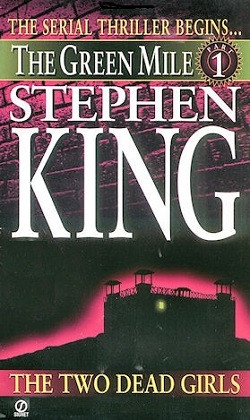
“But Blake,” you’re saying, “Isn’t that just how stories are written? It’s good writing, sure, but is it that surprising from an old pro like King?” Normally I would agree with you, but it is the circumstances under which this book was written that makes all of this so impressive to me. Those of you who weren’t reading King in 1996 (or weren’t even born yet – yikes) may not know it, but The Green Mile was not originally published as a single novel. In an experiment to recreate the serialized works of folks like Charles Dickens, King wrote and released the book in six installments, published in slim paperback “chapbooks,” and by his own admission, did not yet know how the story would end when the first part was published.
I knew about the chapbook part, of course. I was there in ‘96, eagerly awaiting each installment. I still remember sitting in the lobby of the band hall at Nicholls State University gorging myself when a new part was released. But the fact that he hadn’t finished the book when Part One was released is something I only learned recently, and frankly, it blew my mind. Did he know how Melinda Moore’s illness would factor in? Did he know the awful secret of Wild Bill Wharton? King says his wife, upon reading an early draft, asked him what happened to the mouse that disappeared halfway through the book, and from my perspective as a reader, I cannot even fathom what the ending of this story would be without Mr. Jingles. This is arguably one of King’s best works, and inarguably one of the tightest, most fat-free novels in his bibliography…and he didn’t know the ending yet when I read Part One?
That’s a straight-up magic trick.
Writers always go back and edit their work to help it flow better. Even the architects don’t always finish things exactly as intended, so a certain amount of adjustment is expected, especially in the earlier chapters. Taking that tool away is like putting a writer on a tightrope and daring them not to screw it up. I’m doing something similar now on Kindle Vella, with my series Other People’s Heroes: Little Stars (gotta get that plug in), except I’m doing a chapter a week instead of a hundred pages or so a month. And I know for damn sure that I haven’t pulled it off as perfectly as King did. Early chapters of my story set things up for a character who has turned out to be far less important than I originally planned. (Blip, if you’re reading OPH and you really want to know whose part got reduced.) Meanwhile, a character who was introduced literally just to fill a desk in one scene has become my favorite in the whole story and will be crucial to the ending. (To no one’s surprise, this character is Keriyon Hall.) None of this is unusual, especially for farmers like the King and I, but that inability to go back and adjust will make for what TV Tropes calls “early installment weirdness” for people who read it later.
All of this is to say that when one is attempting art of any kind, one tends to learn from those who have done it before and done it well. And some snooty scholarial types may take issue with this, but I don’t care: damned if there are many people in the world who do what I want to do better than Stephen King.
Blake M. Petit is a writer, teacher, and dad from Ama, Louisiana. His current writing project is the superhero adventure series Other People’s Heroes: Little Stars, a new episode of which is available every Wednesday on Amazon’s Kindle Vella platform. “Attempted art” kind of sounds like a criminal charge, doesn’t it? Like The Room or Troll 2.
The Best Superhero Books Outside of Graphic Novels
Not long ago, I was contacted by the editors of Shepherd.com and asked if I would be interested in contributing a list. It’s a cool site where authors curate short suggested reading lists in various categories, and based on my current (and best-known) works, I asked if they’d be interested in my picks for five great books that feature superheroes OUTSIDE of their typical home in the world of the graphic novel. Take a few minutes and look at my recommendations, then poke around the site to see some of the other great lists they’ve collected!
Shepherd.com: The Best Superhero Books Outside of Graphic Novels

Christmas 2022: The Release
Christmas is here again, friends, and those of you who have been with me for a while knew this was coming: my annual Christmas short story! Stories aren’t always easy. You need both a WHAT and a WHY for the story to make sense, and I’ve found that a great number of weak stories nail the WHAT without giving enough time to the WHY. I came up with the WHAT for this story about three weeks ago, but I struggled with it until last week, when the WHY finally came to me and made it all make sense.
This story features the return of some friends from previous Christmas stories, but you don’t need to have read them to enjoy it. It stands on its own, with a protagonist that’s quite unlike any of my previous Yuletide yarns.
And I don’t usually do this with my Christmas stories, but I’m going to do it this year. 2022 was rough on a lot of people, and the last few months in particular have really weighed me down. Without getting into details, it’s been one thing after another that just started to feel crushing after a while, and without my wife, Erin, I don’t know how I would have made it. So “The Release” is dedicated to her.
Merry Christmas, all.
THE RELEASE
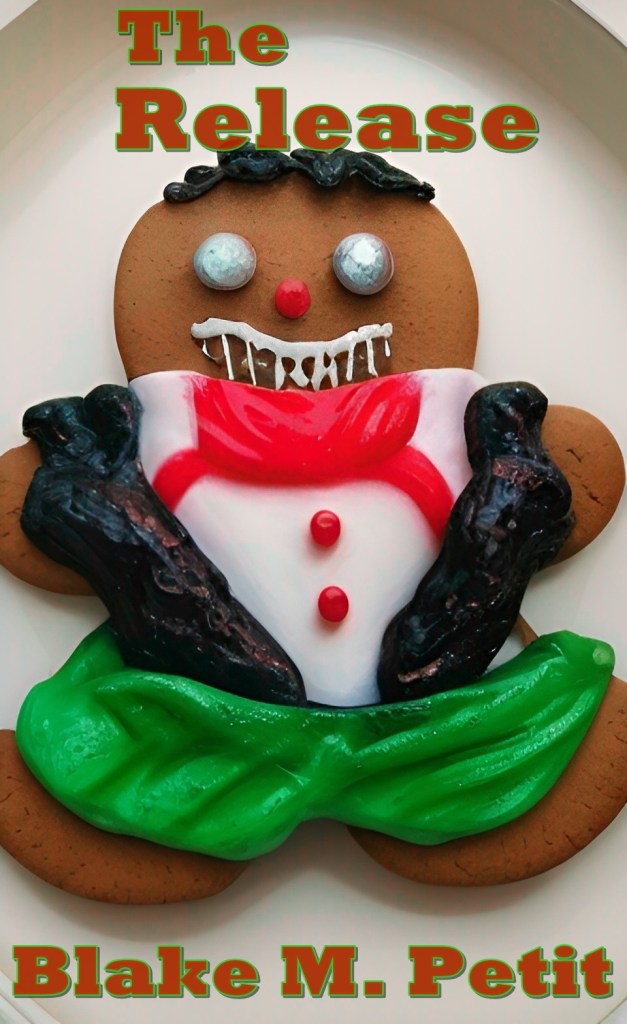
He needed to get out. It had been years of loneliness, isolation, and frustration, but he had grown accustomed to it. It was something he had learned to live with. But something was calling him this year, something was urging him, and he knew he was almost out of time. He needed to get out.
There was not much to be said for his confinement. It was long and dark, it was solitary, and he was fed sporadically with stock that clearly was the product of livestock, cattle…not the premium nutrients he craved so deeply. From beyond the walls of his cell he could see glimpses of the light – brief glimpses, quick ones that seared his eyes and made him want to scurry back into the darkness like vermin. He resisted the urge, though – he was not vermin, he was not filth. He was the apex predator on this planet, even if his captors refused to recognize that fact. It was, he supposed, the fact that he was so far above them that had kept him here for so long. For the first few years of his captivity he had fought – attacked the jailers, tried to break free from his cell at any opportunity. But the cattle were resourceful, he had to admit that, and they were ready for any move he made.
It took years before it finally occurred to him that the only escape may be to simply give them what they wanted…to cooperate. To be a good little boy.
A clanging came from outside his cell and he heard the guard bellow: “Suit up, inmate! We’re opening the cell door in two minutes!”
A garment bag appeared in the slot beneath the door, the suit within probably the same one he wore in September when transferred to this facility. Typically he wore it only twice a year, during the September and March transfers, but this year was different. This year he had behaved exceptionally well. This year he had been granted his work release, a chance to be allowed out of this infernal land of perpetual daylight and go somewhere his kind could flourish – into a night that extended as long as necessary. He took the suit from the bag and pulled it on: a full black bodysuit that covered him from head to toe in thick, impermeable fabric through which no light could penetrate, not even here. Across the chest, in white letters, the initials of his captors: CPC. Over his eyes were a pair of polarized lenses to filter out the deadly rays of the sun and still permit him the ability to see. Beneath the lenses, the portion of the mask that covered his mouth was reinforced with Kevlar. Not even his teeth would be able to slash their way through. The suit was one piece, but there was another item in the bag as well: his handcuffs. He knew those were coming, but was not particularly glad to see them.
“Put it on, inmate!”
But he did. Because he had planned this too long, waited too patiently to lose his opportunity now. He picked up the handcuffs and clamped them first on his left wrist, then the right. Then, finally prepared, the door to his cell opened to the blazing white waste outside.
Even through the polarized lenses, his eyes stung at the light. He squinted, tried to adjust. Before his capture he had gone ages without seeing sunlight directly. To see it even twice a year had been a drastic change, but the light to which he was exposed was so brilliant as to be almost blinding.
“Can you see me, Al?” the guard asked. His neck twitched at the nickname, but he had resigned himself to be cooperative.
“I can see you.”
“Walk slowly. Follow me.”
He stepped out of the cell into the unfathomable glare of light. The facility was to his back, but his cell opened directly to the outside, another security measure. He did not feel the bitter wind the way the human guards would, were it not for their heavily insulated suits, which themselves served as further protection against him should he ever attempt escape. Not that he would, of course. Where would he go? The concept still frightened him a bit, if he was being honest with himself: a place where the sun did not set for six months, here at the bottom of the world. And in March, they would take him from his cell here in Antarctica and bring him north once more, to its equivalent facility at that pole, forever chasing the perpetual daylight. The Coalition for Paranormal Containment had finally found the perfect prison for his people, the perfect way to contain a vampire.
“Alrighty, Al,” the guard said. “You’re gonna be on your best behavior, right?” Beneath his heavy clothing he wasn’t sure which one it was – Barnes? Avery? His voice was muffled and the wind cut across his ears, making identifying his voice as impossible as his face. It didn’t matter. They were all the same, he told himself, convinced himself. All cattle.
“Of course, guardsman,” he said. “I have fully reformed, and I embrace the opportunity to demonstrate my contrition.”
“Whatever,” the guard said. He was led around the facility to the helipad, where the vehicle that was to take him to his work release was waiting. The pilot, he presumed, was sitting in the craft, green and red clothing draped loosely around his body in a manner that looked positively chilly. If the little man felt the biting cold, he didn’t show it. He smiled at their approach.
“Is this the lucky fella?” he said.
“Yes sir,” the guard said. Clearing his throat, he recited the necessary doctrine to officiate transfer of authority. “The Coalition for Paranormal Containment, as of zero hundred hours, December 21, officially remands Inmate #5261897 to the authority of North Pole Operations, Inc., for a period of time not to exceed five days, standard time, internally variable based on the temporal adjustments necessary to the task required.”
“On behalf of North Pole Operations, I accept custody,” the little man said.
He looked back at the inmate. “Now be nice, Al. He knows if you have.” Clapping him on the shoulder and chuckling, the human guard turned and rushed back towards the facility, and the inmate looked down at his wrists.
“Wait! My handcuffs–”
“Don’t worry about that.” The little man grabbed the cuffs and jerked them just a little, causing them to fall onto the ice at their feet. “You’re not going to be needing them the next few days, bud.” He hopped into the craft and gestured to the seat next to him. “Hop in, Al.”
“The name is Alastair,” the inmate snarled. “Address me with the proper respect, small human.”
“First of all, not a human. The name is Binky,” said the little man. “Head of security, and the only reason you’re not in your cell right now. So unless you want to march back there, do me a favor, lighten up, and climb in.”
“In that?”
“I know she doesn’t look like much, but the boss’s model is getting its final tune-up for Christmas. And I know the engines are a little scrawny, but they’re in training. May take over the big job someday. And it’s only the two of us, not a mountain of toys, so I think they can handle the weight.”
“No, I meant–”
“Meant what?”
Alastair looked at the craft that sat on the helipad – a miniature sleigh, red paint scratched and dented, the brass runners oiled but otherwise looking like they had seen better days. As for the “engines” – the three reindeer lashed to the front of the sleigh stamped their hooves and looked back at him impatiently.”
“Nothing,” he said. “I meant nothing.”
“Great, then. Hop aboard, Al. We’ve got to get clear to the other end of the planet, lickety-split.”
* * *
Alastair had made the journey between North and South Poles seventeen times now, every six months, and he was used to the long and frustrating transit between the two of them. The Coalition’s aircraft tended to take a long, circuitous route that mostly went down over the Pacific Ocean, with stops to refuel on mid-sea platforms near the respective coasts of Japan and Australia, but that kept them out of any heavily-used trade routes or over any populated areas that could catch a glimpse of the plane. Sometimes that meant staying on the refueling platform while they waited for ships or other aircraft to make their own passage. The journey had taken anywhere from 36 hours to a full week in the past, depending on a series of factors.
The sleigh Binky piloted got him to the other side of the world in less than twelve seconds.
At first he wasn’t even certain anything had happened. Binky cracked the whip and the reindeer began to rush across the ice. He felt the sleigh lift, felt a sensation of rising in the air, and then there was a rush he couldn’t explain followed by a feeling of moving down. In that blink of an eye, the world around him swirled from dazzling sunlight to the pitch of midnight.
As the sleigh skidded to a stop on another ice-covered field, Binky looked over at him. “You can take the mask off now. There won’t be any sunlight here for another three months.”
“I thought you had some sort of facility here,” Alastair said. “This is just empty Arctic waste.”
Binky chortled. “Trust me, Al. Take the mask off.”
He swallowed the urge to lunge at the little man, to rip his throat out and drink the sweet elixir within, both sustenance for himself and punishment for his continued insistence at diminishing his name. But he had his goals, and killing Binky the Elf would not accomplish them. He unzipped the neck of his mask and pulled it away from his head.
Again, he was blinded.
Where seconds ago there had been nothing but a dark waste of ice, the world was now brilliant and beautiful. A huge settlement appeared – homes and workshops, walking paths decorated with candy canes and gingerbread men, a gargantuan Christmas tree that towered over everything and, in the distance beyond the tree, an enormous mansion covered in garland and tinsel. He almost fell back into the sleigh, as startled as he was by the sudden appearance of the town, and he instinctively covered his face to protect himself from the light.
“It’s all artificial light,” Binky said. “Fire, electricity, stardust…it’s not sunlight. You’re fine.”
“It’s so bright,” he said. “I haven’t seen anything this bright in…”
“A long time.”
“Where did this come from? It wasn’t here a moment ago.”
“Look through your mask again.”
He was hesitant to comply with the little man’s orders, but he did so. When he raised the mask and looked through the light-killing lenses, he again saw only ice and night sky. Taking the lenses away from his eyes, the village returned.
“Our facility cannot be detected by any technological means. We put that safeguard in place because of satellites and telescopes, but it works on any device that’s used to capture an image. Guess that includes your little lenses there.”
“Remarkable.”
“My pal Duffy invented it. I’ll have to tell him you said so. Come on. I’ll take you to meet the big guy.”
Binky started walking down the path, dodging rushing elves with packages, carts of toys, rolls of wrapping paper, and other various effluvia of the holiday season. None of them seemed to pay attention to him at all – they simply had too much to do. Binky led him to the steps of the mansion, a place that looked even larger up close, and pulled open a set of twenty-foot doors with candy cane handles and a reindeer-face door knocker. As they stepped inside beneath a three-foot ball of mistletoe, Alastair saw that inside was even more chaotic than the town square. Dozens of elves rushed around with clipboards and charts, some with electronic tablets, one carrying a doll shouting that somebody better figure out why this darn thing wasn’t urinating or there would be serious trouble coming their way. Everyone had a task, a job. He supposed it made sense. This was the busy season.
Binky took him up an ornate flight of stairs to a wooden door with OFFICE carved into it beneath a wooden bas relief of holly and poinsettia. He gave the door a perfunctory knock before popping it open and looking inside.
“He’s here boss.”
“Excellent. Bring him in.”
Binky stepped aside and waved Alastair through the door. On the other side was a smaller room than he would have expected, the walls painted green and adorned with portraits and photographs of an older couple in red and white clothing. There were schematics everywhere, plans for constructing toys of all kinds. There were maps of the globe with routes marked in red, scratched out, amended, and scratched out again. There was a scroll – an absolutely gargantuan scroll – that tapered off at the end with what appeared to be a series of names. And sitting at the desk was the man from the pictures, wearing a pair of green trousers and a yellow shirt covered in polka dots, a pair of simple brown suspenders crossing his chest and holding up his pants. He had a pen in one hand, a mug of hot cocoa in the other, and a pair of reading glasses sat obediently on the end of his nose.
“Hello, Alastair,” said Santa Claus. “I’m so glad that you’ve decided to try to get back on the nice list.”
“I don’t know if I’d go quite that far,” Alastair said. “This is a work release opportunity. I’m here to prove I’m not dangerous to humans anymore.”
“Are you now?” Santa looked down at a clipboard in front of him. “Alastair Bonaventure, born 1842. Always on the nice list until 1867, which is when…” Santa looked up at him, his eyes falling on Alastair’s neck. “Well, you know what happened, don’t you?”
He froze for a second, not knowing what to say. Born 1842, exactly what it said on his documents for the CPC. And the nice list…well, that was the history of Alastair Bonaventure.
Honestly, he wasn’t even sure he had expected to get this far. He had his plan, but if this man was really who he said he was, he would know, wouldn’t he? Know his plan, know his desperation, know that he was biding his time in this work release situation until he saw an opportunity to escape and then–
“Hey, Al? The boss asked a question.”
He blinked back to the present. “Yes. I know what happened.”
“In custody of the CPC for the last eight and a half years, captured while attempting to devour a nun in Milan, Italy. Now Alastair, was that right?”
“I was hungry, Santa. Everyone has to eat. Even vampires.”
“Yes, I suppose so. Well, we’ve got a little more than two days before takeoff. Binky is going to acquaint you with all of our security procedures and regulations. He’s going to be your commanding officer while you’re in our custody, but since we’ll be working together on Christmas Eve, I wanted to welcome you here to the Pole in person.” He held out a chubby hand and Alastair took it for a respectable amount of time before withdrawing it again. “Any questions before you get started?”
“I…”
“Go ahead, son, spit it out.”
“I didn’t believe them at first, when they told me about this particular work release assignment. It seemed…”
“You didn’t believe in Santa Claus? Too silly? Too incomprehensible for the rational mind?”
“I’m a vampire, sir. From the day I was bitten, I realized that the world is full of things that rational people don’t believe in. No, it’s not that.”
“What then?”
“I was told you needed security for your rounds this year. Protection.”
“That’s why you’re here, yes.”
“Okay, but…why? You’re Santa Claus. Who would want to attack you?”
Santa nodded. “The world is a dangerous place, Alastair. I’m here to make it a little nicer and for some reason, there are creatures out there who just hate that idea. Binky will explain the rest.”
“All right, then. I suppose we should get to work.”
“Now that’s the attitude we want to hear in these parts. Alastair, I think we’ll get along just fine.”
* * *
The hours raced by, as those in the holiday season always tended to do. Alastair spent most of his time at the Pole in Binky’s company, in preparation. Some of the time was used going over routes and procedures, learning the logistics of how Claus zoomed from one spot to another, if not the actual means of propulsion. The same went for the details of his rapid activities inside the homes of the children he meant to visit and the way he would leap from one spot to another in the blink of an eye.
“It’s gonna seem like it’s going really fast and taking forever at the same time,” Binky said. “We move like lightning, you have to understand, but there are still literally millions of homes to visit all over the planet. Time is on our side, thanks to a little magical shenanigans the boss is privy to, but you’re still going to think it seems like an extraordinarily long night.”
“Will it be?”
“For you and me. For anyone who’s on the sleigh. Except for maybe the boss, I’m honestly not sure what it feels like to him. But for everyone on the outside, it’ll be the standard 24 hours a day.”
The logistics were only a small part of Alastair’s tutorial, however. The rest of it was a crash course on the various creatures that existed across the globe, and how to deal with them.
“If we’re attacked by a golem?” Binky asked.
“Wipe the command word from its forehead or take the scroll from its mouth.”
“A mummy?”
“Their bodies are very dry – fire is the most effective deterrent.”
“Zombies?”
“Cut off the head or destroy the brain.”
“Werewolf?”
“Christmas isn’t a full moon this year so it’s unlikely we’ll encounter one, but silver weapons are best.”
“Evil Kaiju?”
“Hold it off until a good Kaiju can arrive to fight him.”
“Vampire?”
Alastair raised his eyebrow, but answered the question. “Since the night will be a long one, evading it until daylight is not an option. Stake through the heart is simplest. You can also remove the head and bury it backwards with garlic in its mouth, but if it comes to that somebody else is going to have to do it, because I won’t.”
“You don’t like Italian food, huh?”
He asked a few more times about the reason for his enlistment. After thousands of years of Santa making his Christmas rounds, why was he suddenly in need of protection? It made no sense, and Binky’s answer only raised more questions.
“A few years back, some misguided people went after the boss right when we were finishing up his rounds. They learned the error of their ways, but when word got out about what happened the legit evil types in the world decided they would try it on their own. Elves are nimble, Al, but we weren’t made for fighting. Well. Not North Pole elves, anyway, but I’ve got some cousins in–”
“Your point, Binky?”
“Point is, eventually the boss decided we needed to be ready for anything. And if there’s anything we’ve learned from the movies, it’s that the best way to fight a monster is with another monster.”
It made a kind of logical sense, Alastair had to admit. And he had certainly seen his share of battle over the decades. It was his history as much as his record of good behavior that had made his name turn up when this assignment was offered. Still…
“There are good monsters in this world, though. Benevolent ghosts. Sea creatures who rescue sailors. That fellow that Shelley wrote about.”
“So why didn’t we call on one of them?”
“It’s a fair question.”
“It’s Christmas, Al. You’re gonna be more powerful than any of them tonight.”
‘Why on Earth would Christmas make me more powerful?”
“Because on Christmas, the smart money is on somebody in need of redemption.”
Redemption? Alastair had never thought of it that way. He was a monster, of course, by human standards. He had feasted on mortals, enthralled others. He may not have relished it, but it was the way of his kind. Did humans need redemption for feasting on cows or using dogs to help them hunt?
And what’s more, the other thing that weighed on him was far worse, something for which he didn’t believe redemption was even possible. But it was still something that had to be addressed. And addressing that very old business was going to be the crux of his journey this Christmas Eve.
* * *
As morning dawned on December the 24th (metaphorically, of course – the sky was still black as pitch here at the North Pole), preparations went into high gear. The flow of presents and parcels into the launch bay had reached a frenzy, and he occasionally caught himself wondering what some of the packages contained: a game, a doll, a bicycle, a baseball glove? It had been a very long time, but Alastair had been a child once, and although the sundries may have changed, the spirit of longing was no doubt the same as it had been two centuries ago.
The one thing that did surprise him was the outfit Binky provided him with when he approached the sleigh. It was woven from a weighty black fabric that covered everything up to his neck. Instead of a mask, a helmet accompanied the suit, but other than that it was almost identical to the one that he wore during his prison transfers. “I don’t understand,” he told Binky. “I thought this trip took place exclusively during the night.”
“It does. That suit isn’t for protection against sunlight.”
“Then what is it supposed to protect me from?”
“Everything else.”
He turned the fabric over in his hands, felt its weight, and had to question Binky’s point. It was heavy, to be sure, but relatively thin. “Is this supposed to stop blades? Or bullets?”
“Rated for both, yep. Not to mention fire, claws, teeth, and unicorn horn.”
“And what?”
Binky laughed. “Just wanted to make sure you’re paying attention. Naw, the chance of a unicorn attack is…well, it’s relatively low.”
He patted the sides of the costume, pointing to a series of latches and snaps. “Cargo pouches,” he said. “Loaded up with knives, wooden stakes, and assorted other things that may come in handy if there’s an attack. Don’t worry, I left out the Holy Water. Don’t want to chance the bottle breaking and dripping on our bodyguard, do we?”
He waved Alastair into a dressing room where he pulled himself into the costume, cradling the helmet under his arm when he marched out into the frigid hangar. The sleigh was moored at the end of a long runway, and elves were strapping down an octet of reindeer to the front while another legion of them harnessed a gargantuan sack in the bed. It was enormous – he and Santa both could fit inside the thing with room for an elf or two left over – but at the same time, was it really large enough to carry the gifts of an entire world? It was not, Alastair decided, but in the last few days he had encountered enough “North Pole Magic” to chalk it up to another instance of that. The sack was larger on the inside, and that’s all there was to it.
“Quite a sight isn’t it?” Santa stepped out onto the runway, putting a hand on Alastair’s shoulder. “We’ve gone to quite a lot of trouble to make sure it lives up to expectations.”
“I thought everyone was supposed to be asleep when you were on duty.”
“Everyone is supposed to be asleep. How better to guarantee that a few of them stay up and spread the word every year?” Santa bellowed, a hefty “Ho! Ho! Ho!” that felt like it rolled out of a cartoon, and climbed into the sleigh. Binky bounded in after him, and indicated the empty spot on the seat next to him.
“Alrighty, Al. Time to get this show on the road.”
Bristling, the vampire took a seat on the sleigh next to Binky, then started looking around. “Where are the seat belts?” he said. “The harness? Isn’t there some way to–”
“NOW DASHER! NOW DANCER! NOW PRANCER AND VIXEN!”
Alastair hadn’t really known fear for a very long time. Real fear, true mortal fear, was alien to his kind, and he had grown accustomed to the idea that any damage he incurred would heal in time. But as the fat man’s throat boomed with “ON COMET! ON CUPID! ON DONDER AND BLITZEN!” he suddenly felt its grip. He had known, intellectually, what was going to happen. He knew the reindeer would run, the sleigh would be pulled behind them, and that they would fly around the world at astonishing speeds. He had not known that there would be nothing to keep him on the seat except his clenched buttocks.
As soon as “BLITZEN!” escaped Santa’s lips, the sleigh lurched forward, Alastair plastered to the back of his seat. The hangar sped past him, the sconces on the walls rushing by and vanishing in seconds, replaced by the midnight black of the sky. He saw stars for a moment, then he saw streaks of light. The staggered light of distant suns was not usually intense enough to cause discomfort for his kind, but as they turned into beams in the sky he felt fear once again. Somewhere from below his throat a chilled howl escaped and he closed his eyes, shrieking.
When the shrieks ended, he realized that the quiet night was filled by another sound: Binky’s laughter.
“Open your eyes, Prince of Darkness,” he said.
Alastair did, preparing to see the stars racing past, the relief of the Earth below appearing on the horizon and evaporating just as fast behind them, the clouds parting for them and transforming into streaks in their wake.
He was not prepared to see the sleigh at a dead stop, the reindeer casually digging their hooves into the roof beneath them. There was a chimney nearby, and snow on the shingles, the rails of the sled cutting through and leaving trails behind them.
“Are you alright there, Alastair?” Santa asked.
“I…How…”
“Wonderful. Let’s get to work.”
* * *
The first few stops were uneventful. They landed somewhere, the three of them whisked out of the sleigh down into a home, and Alastair watched as Santa and Binky went to work. This happened several times, in fact, before it started to dawn on him that thinking of it as a “few” stops had suddenly become relative. How many homes had they gone into already? Dozens? Hundreds? He was relatively certain they were in the same country their first stop had brought them, but he was not entirely certain what country that was.
What’s more, moving from house to house happened like lightning, but watching Santa and Binky lay out their gifts did not. He was conscious and aware the entire time, standing around like a shopping center security guard, with the closest thing to an intruder being the occasional dog that yipped at them or cat peering out from beneath the Christmas Tree.
After a few stops, Santa held out a plate to Alastair. “Cookie?” he asked.
“Not to my taste.”
“Of course. Perhaps you’ll like the U.K. better – they leave me mincemeat pies over there.”
It was a habit of this Santa Claus, he realized, this conversation, this small talk. Santa was the sort of person who never met a silence he didn’t feel the need to fill with words, ironic considering the stealthy nature of his work. Alastair’s wife had been the same way, the sort who always needed to be talking about something, and–
He forced the thought aside as Santa signaled for him to join them by the fireplace. It was the standard procedure: he and Binky flanked Santa as the fat man put a finger aside his nose, then they were whisked up through the chimney and back onto the roof. Something else that had occurred to Alastair after a while was that not every roof had a chimney when they returned to the sleigh. What’s more, every roof they landed on was covered in snow, even if the air outside was in the 60s and there wasn’t another flake in sight. All of it: the chimney, the fireplaces, the snow…they were all manifestations of Santa’s own talents. How powerful was he?
“Tonight, I’m as powerful as I need to be,” Santa said.
“What? But–”
“You didn’t say anything, you just thought it. I know. Tonight I know everything, Alastair.” He smiled and his eye twinkled. “I know everything.”
If Alastair’s blood was still warm, the emphasis in the fat man’s voice would have cooled it.
* * *
Alastair wasn’t certain how many stops it took before it happened, but he was sure the first sign of trouble came in Australia. As Santa laid out gifts for three children – a pair of swim fins for the oldest, stuffed animals that looked like blue dogs for the two younger – Alastair caught notice of a shuffling motion from the fireplace. He’d grown accustomed to small disturbances like pets or motorized vacuum cleaner, and they’d had more than one close call with children who were up late in anticipation or parents who were up late assembling toys. This was different, though. This time, the stonework on the fireplace itself seemed to be peering at them.
He nudged Binky, then tossed his head gently in the direction of the fireplace. Binky looked quickly and got the picture.
“Rock Troll,” he whispered.
It was like he’d given the assassin a cue.
The top layer of stone on the fireplace leapt up, arms appearing in the masonry, and reached out towards Santa Claus. Alastair assessed his options, but it didn’t take long. Allowing the troll to take Claus would be counter-productive. He was too far away, he still needed the fat man to get him where he was going. Besides, he had agreed to do a job, and he had never been the sort to welch on that.
As Claus continued to casually lay down the tracks for a train set around the Christmas tree, Alastair put himself in front of the troll, catching it by the wrists. The troll was strong, incredibly so, and for a moment he was afraid that he had already overstepped his capabilities…but the way the troll moved gave him his cue. The troll did not move like a normal animal, bones attached to tendons attached to flesh. With the troll, it was as if each component of his body was a separate stone, held together by nothing more than a little magic and a lot of stubbornness. As the troll tried to grab at Alastair’s throat, he kicked his leg out and, with his own vampire’s strength, dislodged the stone that made up the monster’s left knee.
“And a new football for Jamie,” Santa said, oblivious to the chaos behind him.
With his knee gone, the troll fell to his side and Alastair moved into action. He went for the joints first – elbows, wrists, the other knee – and pulled away the stones that represented those vital components of the rock troll’s anatomy. With those gone, the troll began to try to flip and flail on the ground, howling in some language that sounded eldritch and childlike at the same time. Alastair grabbed at the thing’s neck, but the troll jerked its head down and crushed his left hand. As he shouted in the surprise pain, he shot out his right hand and grabbed the monster’s jaw, yanking it off the rest of its skull.
With that, the fight seemed to go out of the creature, but its eyes stayed open as Alastair continued disassembling its body and hurling the stones away. When finally there was nothing left but the cranium, he looked back at his companions. Santa carefully slid a candy cane into each of the three hanging stockings, while Binky gathered up the stones he’d tossed around and reassembled them in their customary places in the fireplace.
“A little help would have been nice,” he snarled.
“What for?” Binky said. “You seemed to have it covered.”
“Here.” Santa held a thermos out to Alastair, who waved it away.
“I don’t need any of your hot chocolate.”
“It’s not chocolate,” Santa said. “It’s for your hand.”
He looked down at his left hand – crushed, the bones splintered, a thin trickle of the dark ichor that passed for vampire blood trailing down his arm…then he looked at the thermos. There was only one thing that could heal him, but…
“Just drink it,” Santa said, removing the lid from the thermos and holding it out again. Alastair took the thermos and took a deep sniff, his lungs filling with a warm smell of copper.
“A little AB negative,” Santa said. “That should get you patched together again.”
“How did you–”
“Alastair, really. Do I need to show you my resume?”
Chastened, Alastair lifted the thermos to his lips and drank. The warmth flowed into his body – it was one of the few things that made him feel warm these days, really – and he felt the bones in his hand snap back into place, the shredded fibers of his muscle knitting together, and the skin resealing itself as if being pulled by a zipper.
“Well done,” Santa Claus said, sincerely. “Just try a little harder to keep it down next time, eh?”
* * *
House after house, country after country, the three of them moved through the night faster than Alastair would have believed possible – yet at the same time, the night seemed endless. How long had he been on this journey, relatively speaking? Days? Weeks? Time didn’t seem to apply anymore. By the time they arrived in England, even the battle with the rock troll in Australia felt like a distant memory, like something that had happened years ago to someone else entirely.
His memories before the journey began, however, were as fresh and crisp as they ever were…even the ones from decades past. When Santa began laying out a plastic fashion doll for a small British girl, an image pricked at Alastair’s mind. These “fashion” dolls…what had been wrong with the baby dolls or rag dolls of days gone by? Somewhere in the depths of his mind he saw a brown-eyed little girl on Christmas morning pulling green tissue paper away from such a doll, a simple thing made of scrap fabric, but hand-sewn with greater love than these mass produced carbon copy playthings would ever know.
“Somethin’ wrong with the doll, Al?” Binky said, noticing his staring.
“I’m just thinking about how much toys have changed since…”
“Since what?”
“Since I was…young.”
“Hey, you’re talking to a guy that’s got six or seven hundred years on you. I know what you’re talking about. When I first started working for the boss we mostly delivered clay marbles and oranges. Now I don’t even know what half this stuff is.” He tucked away a video game console and looked back at Santa. “Are we done, boss?”
“Just about. I’ll just have a nip of this sherry and–”
Santa reached out for the glass of sherry, the traditional gift for Father Christmas in the UK, Alasair had learned, and lifted it to his lips. As he did so, though, Alastair saw a slender trail of thread attached to the glass. He knocked the glass from Santa’s hand, but somewhere a click announced that the glass’s trigger had already been tripped. A closet door opened up and from within stumbled a shuffling, moaning trinity of creatures with empty eyes, gray and lifeless skin, and bared teeth. They moaned as they reached their hands out and stumbled towards Father Christmas himself.
“Zombies?” Binky said. “Someone actually set up a zombie trap?”
Alastair had no hesitation at this point. In the endless night with Santa he’d already fought a troll, a banshee, a small pack of gremlins, and uncounted ghosts who seemed to take to the Christmas air the way Alastair himself took to darkness. He was beyond surprise.
Dispatching the zombies was quick work. It always was – the only real threat a zombie brought came in numbers, and three was too small for Alastair to even flinch. He drew a knife from one of the cargo pockets in his uniform and drove it into the forehead of the first zombie, pushing it in up to the hilt. The ghoul stumbled and twitched, and Alastair gave his knife a twist to be certain the damage was done. As the zombie fell to the ground, Alastair pulled his blade free and turned to repeat the process on the next zombie.
“Doin’ good, Al,” Binky said.
“Binky! Behind you!”
Binky turned at Alastair’s words, only barely missing the teeth of a fourth creature that had come from another room. The house was full of the beasts, Alastair said, and as he killed the third of them he realized he was in for a more substantial battle than he had experienced previously.
Binky pulled a gun from his pocket and held it up to the zombie that had stumbled out behind him. It made no sense – it was a toy gun, with orange plastic and a series of LED lights blinking along the casing. Even when he pulled the trigger, it was accompanied by a canned “ZAP!” noise that Alastair was certain thousands of toys over the years had emanated. But along with the fake sound effect, a glimmering spiral of light twirled from the barrel and into the zombie’s head. It zipped through its head, punching a hole between its eyes and bursting from the other side like a corkscrew. The creature fell back even as a crash came from upstairs.
“I’ve got this one,” Santa said, placing a finger aside of his nose. When Alastair had seen him do that previously, the three of them had all been whisked up into the fireplace. This time, only Santa vanished, but the swirl of glitter that accompanied his disappearance went not into the chimney, but down the hall and up a flight of stairs.
“What’s he doing?” Alastair asked.
“Taking care of someone who just went to the top of the naughty list.”
The ceiling cracked above them and Alastair pulled Binky back as it creaked and snapped, falling down into the room. The Christmas tree was knocked to the floor, a heavy piece of ceiling landing on it. On that piece, Santa Claus was still on his feet, holding up a tiny man with a white lab coat, wild eyes beneath a thick pair of glasses.
“If there are zombies,” Santa said, “You’ll usually find a cause. Evil sorcerer, alien invader…or this one. The good old-fashioned mad scientist.”
“Willing to ruin Christmas for the whole world just so you can have the bragging rights of saying you got Santa Claus, huh?” Binky leapt up into the man’s face. He kicked and flailed, but Santa shook him into submission. Binky grabbed the lapels of the lab coat and pulled himself up to look the man in the eye.
“Okay, Sparky, you’re going to tell me what you did with the family that lives here. And if you tell me they’re zombies, I’m shoving a holly branch so far up your you-know-what that you’re gonna convert to Judaism just so you never risk seeing me again!”
His hand shaking, the mad scientist pointed at the floor, then at a door across the room. Alastair opened the door up to reveal a flight of stairs heading downwards. “The cellar,” he said. He ran down to find five people tied up, their lips covered with duct tape, wailing. Two adults, three children…they matched the photographs in the living room upstairs. The smallest child, a little girl no more than seven years old, looked up at him with eyes turned to glass by tears.
“Children,” he hissed. “There were children.”
He didn’t remember bolting back into the room. He didn’t recall jerking the man in the lab coat from Santa’s grasp and shoving him against the wall. He barely remembered putting his hand around the man’s throat and pulling aside his shirt, revealing a pink, pulsating stretch of neck. He did recall later, though, the way he felt his fangs extend in the front of his mouth, and how badly he felt the thirst at that moment.
“You would endanger children. Terrify children just because you hate Santa Claus?” He pulled his lips up, his fangs exposed to the air. He saw their reflection in the man’s glasses. The man saw them too.
“No! Let me go! Put me down!”
Every part of Alastair wanted to rip this man’s throat out. It went beyond the thirst – this creature was vile, was despicable, deserved none of the comforts of light or family that humans were allowed to enjoy. And he was ready to end the man’s life, as he had so many before…until a gloved hand fell on his shoulder.
“You saw what he did, Santa,” Alastair said.
Santa said nothing.
Alastair put the man down.
“Binky?”
“Already got the CPC on the phone, boss. They’ll be here to clean up in minutes.”
Altastair felt the rage subside, pushed down the urge to rend flesh with his own teeth, and looked at Santa. “The family?”
“They’ll be all right. The CPC has certain ‘techniques’ to make sure they won’t remember this, except perhaps as the Christmas the whole family had some bad dreams.”
“They’ll clean up the mess, too,” Binky said. “We should get going, boss. We’re behind schedule.”
“Are you certain you want to continue on, Alastair? You could stay here, rejoin the CPC now, if this has been too much.”
“I’m fine. Come on. Let’s go.”
“You did well here.”
Despite himself, Alastair felt a tiny well of pride at Santa’s praise. “You did well yourself. Makes me wonder why you even needed me.”
“Hey, the Big Guy can’t take care of everything,” Binky said. “Come on. Let’s go.”
* * *
There was no snow on the ground in Nebraska when Santa’s sleigh landed on the roof of the Pratt house, but as he had grown to expect, the snow appeared beneath the runners of the sled of its own accord. The house was large, but modest – not particularly ornate or fancy in and of itself. But the decorations! It was one of the most dazzling displays Alastair had seen since they left the North Pole, and they had quite literally seen them all. A thirty-foot Christmas tree made of an aluminum pole and strings of lights was the centerpiece. Surrounding it on all sides were inflatables, blow molds, wooden cutouts, animatronic figures, and every other conceivable permutation of Christmas decoration. And each and every one of them was in the shape of or paying homage to the man driving the sleigh.
“Gracious, Claus,” Alastair said. “This must be your biggest fan’s house.”
“It’s definitely in the top three. Come on.” He climbed from the sleigh and strode towards the chimney, Binky behind him. Alastair looked back at the sleigh, where Santa’s sack was still at rest.
“Wait! You forgot the presents!”
“No children at this home, Alastair,” Santa said. “I’m just here to pay a quick visit to a very old friend.”
The light of the decorations was so great that Alastair would almost have believed it was daytime, the brilliance of the sun somehow rising up from below rather than down from the sky. It was so bright, in fact, that he didn’t notice at first that a shadow had moved across the moon.
The first attack hit Alastair in the back, knocking him down to the rooftop and popping off his helmet, which rolled off the edge into a bush below. Someone grabbed at his collar, pulling it back and exposing his skin beneath. He felt a stabbing in his neck, one that felt horribly familiar, then it immediately retracted and a voice behind him began hacking and spitting.
“You’re one of us?” the voice shouted.
Alastair shoved himself backwards, flipping the person on his back away and onto the rooftop. He rolled and leapt at the same time, landing on his feet and looking down at the vampire beneath him. It was a young man – at least, he looked young, but such things were deceiving when it came to the Nosferatu – and he looked up at Alastair with black trickles of blood at the sides of his mouth. “What are you doing with him?” the vampire asked.
As answer, Alastair pulled a wooden stake from a cargo pouch. He moved faster than even the other vampire could react, leaping forward and driving it straight into his undead heart. They locked eyes for a minute, the younger one clawed at Alastair’s face, and he toppled over. It wasn’t like the movies, where he turned to dust and evaporated. Only one thing could do that, and on Santa Claus’s endless nighttime journey, sunlight was not a commodity they could rely upon.
He looked up to see that the vampire that landed on his back was not alone. Santa grappled with one, while Binky had pulled a toy bow and arrow from his pouch and was using it to fire wooden bolts into the hearts of a trio that had assaulted him.
“Santa, look out!” Alastair pulled another stake and jumped, driving it into the vampire that was on top of Santa Claus. As it fell away, another came from the sky, hacking at the fat man.
“We knew you’d be here, Claus,” she hissed at him. “Didn’t know that you’d have a human-lover with you. Why are you helping this old fool? You should be with us.”
Should he? They were in Nebraska now. Could they get him where he needed to go before the sun rose? It wasn’t impossible. He wasn’t sure what time it technically was here, but vampires could travel quickly. And if they couldn’t, they must have somewhere to hide during the daytime. It could work. It could–
She turned to Santa, her mouth open, and bent towards his neck. Alastair didn’t even hesitate to send his next stake right into her back. When she rolled off, shrieking at him, he pulled it out and sent it through the front of her body, right into her heart.
Santa looked at Alastair, grinning. “Nice list,” he said.
Alastair looked around – a half-dozen vampires all lay dead at their feet, but there were at least as many still crawling across the rooftop, charging towards them. In the sky, black shapes seemed to indicate even more were coming. For a moment, he felt a pang of regret. He hadn’t taken this job out of any sort of affection, but the idea of Santa Claus perishing in such a way was horrible. He wished he could do something else. He wished he had been better prepared. He wished–
A pair of massive hands jammed his helmet back on his head and shoved him into the sled. “Get down!” boomed a voice the size of a mountain, and Alastair did. He covered his head with his black-clad arms, and couldn’t see any of what happened next, but the sounds made it easy for him to imagine what was going on. There was an electrical sound, like a generator roaring to life. Afterwards, shrieks, then sizzles. Those lasted a while – probably not as long as it seemed, but like everything else this night it seemed as though it went on for a very long time.
Then the generator died, the big hands patted him on the shoulder. “You can look up now, my friend,” said a voice that was terribly old, but somehow, still gentle and kind. He looked up to see an enormous man, one of the tallest people he’d ever seen in his interminable life, smiling down at him.
“I’m prepared for every eventuality,” he said. “Solar lights. They replicate the UV rays of the sun, which apparently is the wavelength that proves cataclysmic to your kind.”
He was right. The vampires were gone from the roof, even the ones he and Binky had staked before their new friend had turned on the UV lights. In their places were piles of dust, each of which was slowly being eroded by the wind.
“Who are you?” Alastair asked.
“James Pratt, at your service.” He held out a hand and Alastair took it, trying very hard not to notice the intricate scars that traced his wrist, so similar to the ones across his face. They were stitches, Alastair realized. Very old stitches, but stitches indeed were what held Mr. James Pratt of Bellevue, Nebraska in one piece. His skin was a strange color, somewhere between light green and gray, with a texture that seemed to indicate death itself had long since gripped this man. There were no bolts on the side of his neck (any why would there be, Alastair knew such things were a conjuration of the movies), and the Santa hat upon his head prevented him from seeing the exact shape of his skull, but there was no mistaking just whose home they were visiting here, over two hundred years since his creation.
“You’re…you’re–”
“You’re very welcome,” Pratt said.
Pratt ushered them into his home where he and Santa Claus each raised a glass of milk and toasted one another. In his life Alastair had seen all manner of creatures, all sorts of monsters. He had seen humans killed in brutal ways, creatures from realms undreamt of by humanity, the horrible emptiness of the void itself. Nothing compared to the sight of Santa Claus sharing a glass of milk with the kindly giant of Bellevue.
He held his tongue until Pratt had returned to his bed and the three of them returned to the sleigh. “Santa,” Alastair said, “That was…I mean – was that who I think it was?”
“That was my friend James Pratt,” Santa Claus said. “A good man who enjoys the company of the few people in this world older than he is.”
“But he’s–”
“A man who made mistakes in his past, and wishes to leave his past behind him. You understand that, don’t you Alastair?”
The way he punctuated his name made Alastair clamp his mouth shut. What was he saying? Did he know?
Of course he knew, he was Santa Claus, you don’t keep a secret from Santa Claus.
But if he knew, why hadn’t he said anything before now?
The question weighed on his mind as they lifted into the sky, leaving James Pratt of Bellevue, Nebraska in Alastair’s past.
* * *
California, at last. And northern California at that. His goal was a city called Redding, but he tried to decide if it would be wise to abandon the sleigh while they were there. It would be too obvious to look there. Perhaps he should wait – let Claus take him further south and backtrack. Would Sacramento be too far?
The sleigh landed on a rooftop and the now-familiar explosion of snow appeared beneath them. Binky and Santa exchanged a look, and Santa nodded.
“Ready, Alastair?”
“As always, Santa.” For now. But not, he knew, for much longer. With a wave of Santa’s hand, the chimney appeared on the roof of a home that normally had none, and the three of them whipped downwards.
The room was dim, dimmer than most. Most of the homes they had visited had some form of decoration – a tree, of course, or lights, or candles. Very few had been totally dark, but this one was close. The tree was a small one, less than 18 inches, sitting atop a kitchen counter. Beneath it, dangling from the counter were a series of Christmas cards: photographs of children, greetings for the new year. Next to them, a series of what looked like get-well cards.
There were photographs as well, and even in the darkness, he could see them. There were families there – dozens of smiling people, and in one frame they stood around an elderly woman with bright eyes.
Familiar eyes.
“Where are we?” he said.
“Your last stop,” Santa said.
“Last stop? What about the rest of the state? What about Alaska and Hawaii? What about–”
“Your last stop, Al.” Santa pointed at the photos, and Alastair’s eyes traced them. They showed the same family in various permutations. Different groups of children with their spouses and their own children…even grandchildren. Many of them had the same eyes as the old woman in the first photograph.
“Whose home is this?” Alastair asked. “There aren’t any children here. I don’t see any stockings or toys or–”
He saw the picture on the mantle, a photograph of a young girl decades past. A girl with brown hair and brown eyes, those same eyes that looked out at him from the elderly woman in the other photos. In this one, she lay with her head against the chest of a man who looked to be in his thirties, smiling, beaming down at her. Alastair knew the face. Except for the smile, it was a face he carried with him every day.
“It was hard, wasn’t it, Allen?”
“What did you call me?”
“I’m not the CPC. Allen Bernard. Originally of Corpus Cristi, Texas. Married. One child. Always on the good list. Until 1956, when…well. You know what happened.” His eyes fell on Al’s neck, and the vampire felt his own hands tracing the spot where a pair of fangs had ended his mortal life decades ago.
“It was hard, wasn’t it?” Santa said again.
“What was?”
“Leaving them. Leaving your girls, leaving them behind.”
“I had to. Santa, I couldn’t control myself. I needed to drink, and they–”
“Were too convenient. You needed to learn control.” Santa smiled, a mixture of sadness and understanding. “You’ve learned, Allen.”
“Do you mean to tell me that this…this house…”
“Her name isn’t Bernard anymore. It hasn’t been for decades. But her first name hasn’t changed.”
Vampires didn’t cry. It was something he had learned somewhat early, something about the tear ducts no longer functioning in the bodies of the dead. But Allen felt a heaving in his chest that hadn’t been there for years. “She’s sick, isn’t she?” he said. Santa nodded. “I could feel it. I knew. I had to–”
“Had to find some way out before it was too late. I know.” He looked over at Binky. “Ready?”
“But what about the CPC?”
“Oh, we’ll let them know what happened. How you valiantly gave your life in defense of the personification of Christmas. Your slate will be wiped clean.”
“Do you think they’ll believe that?”
He beamed, and this time the smile was full of nothing but light.
“They believe it every year, Allen.”
Binky put a small package wrapped in tissue paper into Allen’s hands. “Here ya go, Allen.”
Shaking, the vampire looked at the elf.
“Call me Al,” he said.
Santa raised his finger to his nose, and they were gone.
The man who was once Allen Bernard (and now was again) tore away the tissue paper to reveal a simple doll, one made of rags, lovingly stitched. It was exactly the way he remembered it, each scrap and stitch like the one his wife had put into the doll she made over 70 years ago. He was one of the undead, but as he walked down the hallway into the bedroom of a sleeping old woman, he was shaking.
“Francis?” he whispered. “Francis?”
In her sleep, the woman turned over. Her eyes fluttered and her hand reached out. He took it. It was old, liver spots along the back of it, wrinkled with the toil and memory of a lifetime she had gone through without him. He held the hand as he had so long ago and kneeled by the bed, tucking the doll under her arm and peering at her beautiful face..
Without opening her eyes, the woman in the bed whispered at him. “Is that you?” she asked.
“It’s me, baby,” he said. “It’s me. Daddy’s home.”
Blake M. Petit is a writer, teacher, and dad from Ama, Louisiana. His current writing project is the superhero adventure series Other People’s Heroes: Little Stars, a new episode of which is available every Wednesday on Amazon’s Kindle Vella platform. Special thanks to Lew Beitz and Amber Foret for help beta reading and copy editing this year’s story. That’s how you get on the nice list, folks.
 Blake M. Petit