It’s probably going to be another random week friends. The first full week of summer vacation is upon me, but that really just means it’s time for me to get work done that I haven’t been able to get around to while school was in session. So the Superman blog this week, rather than following any theme, is just going to be whatever I’m in the mood for on the day, beginning with the new Superman-related comics that hit the stands on May 28.

And as always, you can check out earlier blogs in the Year of Superman Archive!
Wed., May 28
Comics: Superman Vol. 6 #26, Justice League Unlimited Vol. 2 #7, Green Lantern Vol. 8 #21 (Superboy guest appearance)

Notes: The Joshua Williamson era continues in the main Superman title with part one of “Superman Red.” Following the chaotic events of issue #25, things are in upheaval in Superman’s world. Lois’s Superwoman powers are gone, burned out, and while she says she’s accepting returning to a normal life, she’s hiding a private struggle. Superman, meanwhile, is in trouble – the emotional turmoil he’s been in lately has activated the Red Kryptonite that’s been lying dormant in his system for some time (seriously, I’d actually forgotten about it), and as is always the case with Red K, there’s no telling what can happen. We also get a series of “interludes” showing various other characters and how they connect to what’s going on, such as Supergirl returning to Midvale (I assume this takes place immediately before issue #1 of her new series, although it doesn’t specifically say so), a powerless General Zod in space fighting to save his ship from a Khund invasion, and Darkseid’s Legion of Super-Heroes (from the DC All In Special) having a little nasty fun.
This first chapter of the storyline seems intended mainly to restack the characters and where we are. We get glimpses of just about everybody, a confirmation of the current status quo, but little forward momentum until the final few pages. As such, it’s not quite as gripping as the previous issue. It also doesn’t help that we cycle through three different artists in the book. Last issue did the same, but it felt more like an All Star lineup, whereas this issue feels more like “we’re running out of time, who’s available?” None of the artists are BAD, but their styles are too distinct from one another, making it a bit jarring to read.
But Williamson’s run has been really good and earned a lot of good will from me. One misstep isn’t going to shatter my enjoyment of this series.
“We Are Yesterday” continues in Justice League Unlimited #7. Grodd has used Air Wave’s powers to toss the members of the JLU throughout time, hurling some of them to the distant past, others to the far future. As they fight in small pods to stay alive, in the present day Grodd’s time-plucked Legion of Doom is poised to use the Watchtower in his bid to absorb the energies left behind in the wake of Darkseid’s destruction (once again, from the DC All In Special. Really, folks, if you haven’t read that one, I feel like you’re gonna be struggling to understand a LOT of DC Comics right now.)
Despite this storyline being an explicit crossover with World’s Finest, the focus here isn’t on Batman and Superman. In fact, if anything, Grodd is the main character, making his play while we only glimpse the heroes in the various eras in which they’ve been thrown…that is, until a voice somehow begins to link these heroes across time.
In the first issue of this book, Mark Waid set up the obscure character Air Wave as being a traitor to the League. In this crossover we found out why the young man had turned on our heroes, and this issue continues his story. I absolutely love the way that Waid has not only made a character who was barely even a footnote in DC history into a major player, but also the work he’s doing to rehabilitate him. It all builds up to a last page that should be exciting to anybody who’s a fan of DC in ANY time period. I eagerly await the conclusion of “We Are Yesterday.”
Thur., May 29
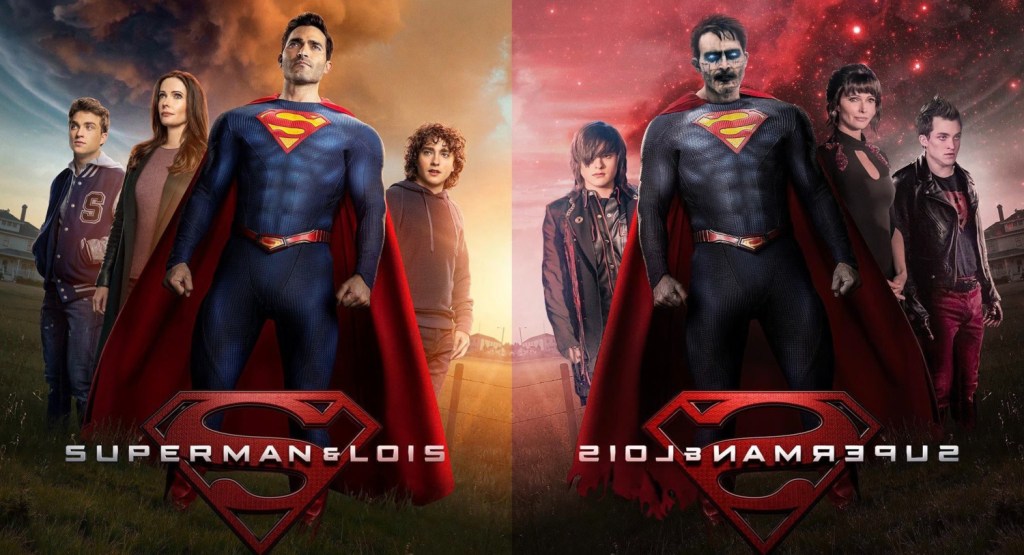
TV Episodes: Superman and Lois Season 2, Ep. 10, “Bizarros in a Bizarro World”, Ep. 11, “Truth and Consequences.”
Notes: Coming back to Superman and Lois today, it seems that episode 10 is here to show us what Clark was up to during the time he was missing, which we saw on our Earth in episode 9. After passing through the portal, he winds up on a bizarre (get it?) alternate world where everything is backwards and the planet itself is a cube. He goes to his counterpart’s fortress in the arctic, encountering a hologram of the other Kal-El’s mother. He teams up with Bizarro-Jon (who has powers on this world) to try to track down Ally Allston before she can merge with her counterpart in this universe, a task made more difficult by this world’s red sun sapping his powers. It gets worse when (in a series of flashbacks to the lives of the El family of Bizarro-World) we learn that Jon is actually working with Ally.
The way they turn the world on its ear in this episode is really unexpected. Kal-El is not just a hero, but a celebrity. Tal, his brother, is a part of his life, even as Lois and the boys have drifted away from him. Oh, and in this world, it’s Jon who has powers instead of Jordan. There are a lot of jumps to different points in the timeline, but it’s not particularly difficult to follow. Bizarro-Jon sports a look that echoes Conner Kent’s vibe from the 90s, and his attitude is similar – a little bit punk, but still seeming good-hearted until we discover the turn. And it’s interesting to turn the characters on their ear. It ends with Bizarro-Jon being sent to our Earth to merge with his other self, tying the end of this episode to the previous one.
If nothing else, I’ve gotta love this episode for the simple fact that we actually saw a square Bizarro World in a live-action Superman show. Never thought I would see the day.
Episode 11 starts with Bizarro-Jon trying to force a fusion with our Jon, but Clark makes it back through the portal to stop him just in time. Bizarro-Jon escapes and tries to figure out how to lure our Jon into a trap, leading up to him kidnapping Lana to use as bait. Sarah turns to Lois for help finding her mother, and Jordan chooses the absolute worst possible time to try to get back together with her. Superman tracks B.J. (callin’ him “B.J.” now, by the way) down to the slaughterhouse where he’s keeping Lana, but gets caught in his trap, defending Lana from an explosion full of what turns out to be Kryptonite debris. B.J. goes after Jonathan, leaving only Jordan to defend his brother.
The last act of this issue is a really great bit, split between three action scenes at once: Jordan vs. B.J. while Lois calls to Clark for help, Lana trying to pick the chunks of Kryptonite out of Superman’s flesh as he can hear his family in danger, and John Henry and Natasha – sans armor – facing off with a super-powered Bizarro Lana. (It’s a thing.) The episode cuts between these three scenes quickly, building out that tension. I think my favorite bit of it all is watching Jordan come into his own, defending his brother, fighting like a true son of Superman.
Oh – and it ends with Clark making a preeeeeetty big decision. Season two of this series started off slow, but the back half is really coming together.
Comics: Justice League of America #24, Superman #10, New Adventures of Superboy #35
Fri. May 30
Movie: Superman IV: The Quest For Peace (1987)
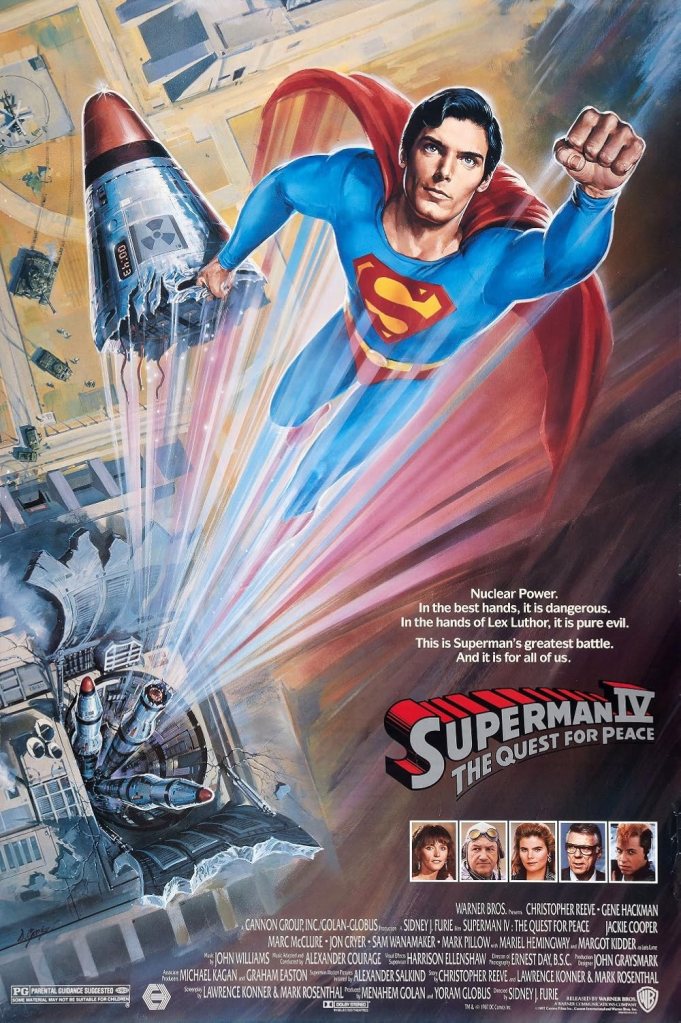
Notes: Well, I’ve watched all the other movies in this series – I suppose that I’ve got to complete the set, right? Let’s talk about The Quest For Peace.
In Superman IV, Lex Luthor is broken out of prison once again, this time by his bumbling nephew, Lenny (Jon Cryer), who he brings along in his latest effort to destroy Superman. In Metropolis, the Daily Planet has been bought out by an industrialist who puts his daughter, Lacy Warfield (Mariel Hemingway), in charge of turning the paper into more of a sensationalist tabloid. At the same time, a random kid worried about the nuclear arms race writes a letter to Superman asking him to do something about it. Superman decides to gather up the world’s nuclear arsenals and hurl them into the sun, because most governments are pretty cooperative when a private citizen tries to convince them to disarm themselves. Lex and Lenny, meanwhile, steal a piece of Superman’s hair from a museum display and attach a device to one of the rockets that creates an atomic-powered “Nuclear Man” that they pit against the Man of Steel.
There are few people, I think, who would argue that Superman IV is a good movie. (There are, oddly, some people who argue that it’s better than Superman III, but I contend that the junkyard fight alone is superior to any single frame of Superman IV.) It’s produced by Cannon Films, a studio that famously made wild movies on a low budget. Kind of like the Asylum today, only with more cocaine. The movie introduces a slew of new characters, none of whom work: Lex’s nephew Lenny (Jon Cryer, bizarrely, would actually grow up to play a pretty darn good Lex Luthor on the Supergirl TV show), Mariel Hemmingway as a totally superfluous fourth corner to the Superman/Lois/Clark love triangle, Mark Pillow as a villain who really should have been Bizarro, and so forth.
That said, Christopher Reeve is still Christopher Reeve. He still has the cool charm that he brought to the character and every moment we see him in costume is a treat. The most earnest part of the film, though, comes at the very beginning, when Clark returns to Smallville. Martha, it seems, has passed away, and he’s going to sell the family farm, but is refusing to sell it to a developer, instead wanting to hold out for a farmer. There’s no real relevance to the overall plot, but I suppose it fits in thematically with the larger story about the dangers of progress for the sake of progress. Whatever it is, I’m glad it’s there – it’s a nice little touchstone that feels more like it belongs in the same universe as the earlier films than much of the rest of it.
Unfortunately, Reeve is still working with a lousy script, full of unfunny jokes and out of character moments. The worst bit, to me, is when he reverses the erasure of Lois’s memories from the end of Superman II. It starts out as kind of a nice moment, taking her flying again and showing her the world. Then it falls apart when we realize he’s only done so to ask her advice, then promptly re-kisses her and wipes her memory again. I’ve never really liked that “amnesia kiss” power they cooked up for the movie, and I don’t particularly like the idea of Superman tampering with Lois’s mind, but I sort of accept it as the way to restore the status quo at the end of Superman II. The way it’s used here, though, messing with her memories over and over just to unburden himself, feels terribly unlike Superman. If all he wants is to talk to her, it seems like he could have done that – as Superman – without toying with her memory. But he does, and for the sake of pretty trite advice: “You always do the right thing.” It even makes me question if this is the FIRST time he’s done this to her, or if he would do so again. The whole process, knowing he’s just going to wipe her memory again, seems terribly cruel, and that one scene brings down a movie that already wasn’t flying very high.
Reeve himself helped write the story for this one, although he also conceded that the final film fell apart. And it’s a real tragedy, too, as this would be the last time he played Superman. As a kid I held out hope that he’d come back – especially since the first Michael Keaton Batman movie hit theaters only two years later, fueling hope for a World’s Finest – but the accident that put him in a wheelchair ended those hopes for good. Still, there was a majesty to Christopher Reeve that made him forever the Superman of my generation. Last year, DC Studios released a documentary about him, Super/Man: The Christopher Reeve Story, which I was lucky enough to catch during its brief theatrical engagement. If you’ve never seen it, it’s on Max now, and gets my highest possible recommendation. I’ll definitely be revisiting it before this Year of Superman is over.
Comic: Superman Family #208
Sat., May 31st
Comics: Superman’s Girl Friend, Lois Lane #14, Justice League of America #25, World’s Finest Comics #306

Notes: Can we, just, for a second?
Superman’s Girl Friend, Lois Lane #14.
Lois Lane. Hard-nosed, crusading reporter for the Daily Planet. The top of her profession. The pinnacle of her career. And yet all three stories in this issue – ALL THREE – revolve around “Golly, why won’t Superman marry me?”
In the first story, Superman takes her for a visit to the Fortress of Solitude, where she deliberately exposes herself to radiation that will make sunlight fatal to her, necessitating that she stay in the Fortress until it wears off. Her plan is to prove that she’s safe in the Fortress, and therefore, Superman will marry her. Because THAT’S what the obstacle has been.
In the second story, Lois pretends to fall in love with some random G.I. in the hopes of making Superman jealous. That’s just cruel, Lois.
And in the third story, Supergirl (because it’s not enough to paint ONE woman in a bad light) is still in the era where she’s living at Midvale Orphanage and lamenting the fact that she has no parents. Then she gets a brainstorm: if Superman marries Lois, the two of THEM can adopt her! So SHE starts trying to gaslight her cousin into marrying Lois Lane. Bafflingly, this includes sending Lois a Batwoman costume and pretending it was a gift from Batman.
I know it was the time period. I know this is just what comic book stories of the Silver Age were like. But Jehoshaphat, you’d think at SOME point, SOMEBODY would have said, “Guys, can we think of maybe a SECOND motivation for Lois for a few of these stories?”
Sun., June 1
Animated Short: Terror on the Midway (1942), Japoteurs (1942), Showdown (1942)
Notes: The Fleischer Superman shorts continued in 1942 with Terror on the Midway. For once eschewing the supervillains and natural disasters, in this short Lois and Clark are attending a local carnival when the sideshow’s bloodthirsty gorilla gets loose and begins causing havoc. He frees more animals, horrifies the audience, and begins chasing after a little girl that Lois rescues. (It’s a far more valiant Lois we see in these 1940s-era cartoons than we did in any of the comic books of the Silver Age.) Lois manages to save the girl, but now the gorilla has his sights on her.

This is one of my favorites of the Fleischer era. The animation on the animals is exquisite, with Superman tangling with realistic lions and panthers as Lois flees from a truly frightening gorilla. There’s even an odd moment where the elephants do a conga line – a typical circus stunt, but it still feels more in-line with a Looney Tunes short than Superman. Still, even then, the elephants maintain their basically realistic appearance.
The cartoon looks great, and it’s a nice departure for the Superman cartoons. I hesitate to call it the BEST of them, but it’s certainly one of the ones I enjoy the most.
1942 also gave us Japoteurs, however, probably the most problematic of the Fleischer shorts through modern eyes. In this one, the United States unveils the world’s largest bombing plane, a vital concern in the World War II-era in which this takes place. Lois and Clark board the enormous plane for its maiden voyage, but a group of Japanese saboteurs have a plan to hijack it. As the pretty stereotypical saboteurs take the plane, Clark is left on the ground, whereas Lois radios for help. Superman, naturally, takes to the skies and goes after the plane. (Incidentally, this cartoon CLEARLY shows him flying to catch up to the bomber – please explain to me all those previous cartoons where he took a TAXI to the scene of a disaster.) Superman saves Lois and thwarts the saboteurs, making the world safe for democracy.
I don’t like tearing down a movie, book, or anything else because it reflects the values of a different time. From the perspective of a 1942 audience, the cartoon is still lavishly, lovingly animated, one of the best-looking shorts ever made, and both Lois and Clark are portrayed well and in-character. I don’t even object to the portrayal of a Japanese enemy since, y’know, at the time they WERE. And while there are certainly cartoons of the era with WORSE portrayals of the Japanese, it’s unfortunate how the animators for this one leaned into the stereotypes instead of working as hard to make the characters as realistic as they did, say, the animals in Terror on the Midway.
Showdown, which was released later that year, is far better. A crook in a Superman costume begins committing a series of crimes, tarnishing the reputation of the Man of Steel, forcing him to step up and clear his name. The imposter makes the mistake of trying to rob the audience at the opera, in which Lois and Clark (lucky him!) are in attendance.
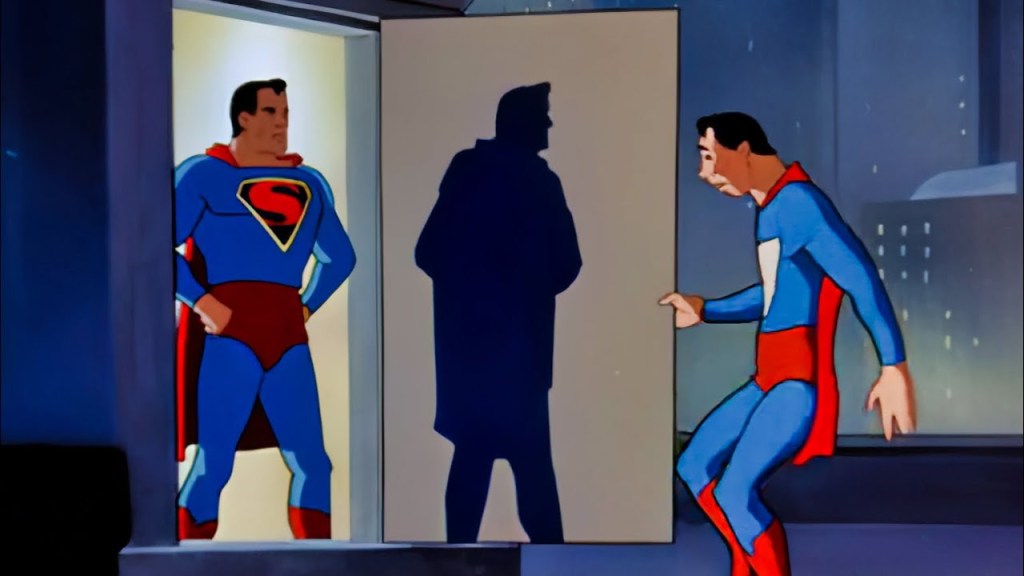
I love the attention to detail in these cartoons. If this short had been made in the 60s, the imposter would have looked EXACTLY like Superman, either because of a rubber Scooby-Doo type mask or because of the sort of ridiculously contrived duplicates that appeared in the Silver Age comics every other month. But here, the imposter has his own distinct look and facial structure – there’s no way anyone would mistake him for Superman up-close. When he’s in action, we usually see him from a distance, from behind…and even then, his hairline is very different from Superman’s, coming to a widow’s peak in the front.
The scene where Superman faces off against his imposter on the rooftop is fantastic – he marches on him slowly, imposingly, without saying a word. It’s as if the bad guy is being stalked by Michael Myers rather than Superman, and he continues babbling in fear the whole time. Then we get to the final scene, in which Superman forces him to take him to his boss, who has a convenient trap door beneath his mansion. As if that’s gonna stop him.
I almost wonder if Bud Collyer was unavailable to record for this short. He has almost no lines, even while chasing the villains. On the other hand, it’s not like Superman is always a chatterbox in the other Fleischer shorts either, so maybe it’s just a little more noticeable this time.
Whatever the case, I enjoy this cartoon a lot.
Mon., June 2
Graphic Novel: Superman: Kryptonite Nevermore (Reprints Superman #233-238, #240-242)
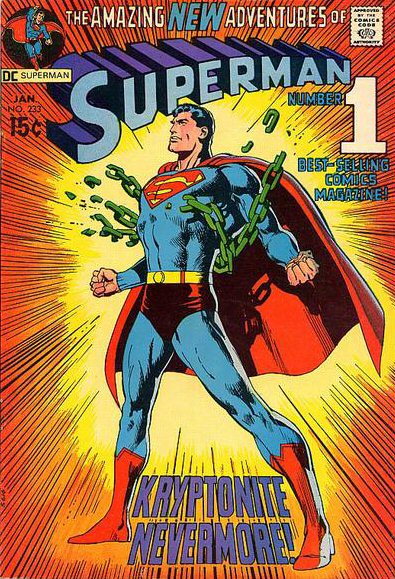
Notes: It’s been kind of light for me this week, so today I decided to dip into a longer storyline from the early Bronze Age, the classic “Kryptonite Nevermore” arc by Dennis O’Neil and the legendary art team of Curt Swan and Murphy Anderson, although for once a mention has to be made of the editor. I’ve talked about Julius Schwartz before, but this was the arc in which he took over Superman’s adventures, and with it, he brought some big changes. According to the introduction by Paul Levitz, Schwartz wanted to streamline the books, de-emphasizing the other Kryptonians like the Kandorians and the Phantom Zone criminals, moving away from sillier Silver Age accouterments such as the legion of Superman robots at the Fortress of Solitude, updating Clark Kent’s occupation from newspaper reporter to the more modern TV news anchor, and doing something about all those crazy colors of Kryptonite that had flourished under previous editorial administrations. Schwartz brought in O’Neil to do the task, along with a pretty legendary cover by Neal Adams, and while I never had a problem with any of the things that Schwartz blotted out and I’m quite happy that they eventually made their way back, the stories that reshaped Superman were pretty solid. I guess the boring Bronze Age I’ve mentioned before would come later.
Things kick right off in Superman #233 where, in the first few pages, an explosion somehow causes a chain reaction that transforms all the Kryptonite on Earth into harmless iron. Superman is thrilled, of course, that his one weakness has been eliminated, but what he doesn’t realize at first is that the same explosion has created a duplicate of himself, rising from the sand in the desert where the explosion took place. That same day, Galaxy Broadcasting’s president Morgan Edge (which recently bought The Daily Planet) reassigns Clark Kent from the print beat to covering news for WGBS-TV, a complication he doesn’t welcome. Clark became a reporter, in part, so that he would be able to swiftly escape without suspicion when Superman was needed. A newspaperman can do that – an on-air broadcast talent not so much. Things get more difficult in the second chapter, when a sudden weakness overcomes him while trying to save an island from an erupting volcano. Superman doesn’t know it yet, but his weakness corresponds to the sand creature beginning to use Superman’s powers itself. And that’s just the beginning.
For the early 70s, this story goes on quite a long time, from issue #233 through #242, nine issues in total (skipping issue #239, which was an issue of reprints). And while most of the stories are essentially self-contained, the arc regarding the sand creature slowly builds over time. Superman encounters it again and again, each time getting a little weaker, and each time watching the sand creature slowly become more “fully” him…with the exception of his utter apathy towards the betterment of humankind. Eventually, Superman and the Sand Creature face off, with a warning that were they to touch, it might trigger a catastrophic chain reaction. Wonder Woman’s mentor of the period, I-Ching, offers to remove that problem and the ensuing battle nearly destroys the world…until I-Ching reveals it was merely a hallucination he created, a warning about what would happen were the two of them to come to blows. (Take THAT, The Twilight Saga: Breaking Dawn Part II.) Realizing the futility of battle, the Sand Creature agrees to leave Earth and does so, taking half of Superman’s power with him.

This was the last part of the “streamlining” that Schwartz and O’Neil had orchestrated. Superman, they decided, had grown too powerful, and they wanted a story reason to explain the decrease in his power level, rather than just writing him as being less effective out of the blue. I appreciate that, and I’m sure most of the readers of the time did as well. Of course, just like the way they eliminated the other Kryptonians and Kryptonite and all the rest of it, over time his power levels started to crank up again. When John Byrne rebooted Superman in ‘86, once again, they ticked his power levels down a notch or two. These days, as I’ve said before, he’s probably about as powerful as he’s ever been, and I honestly have no problem with that. I know the mantra of the unimaginative – those who whine that Superman is “too powerful” and that somehow makes him boring. I’ve said it before and I’ll say it again: his power isn’t what makes Superman a great hero, it’s the exploration of character behind someone who has that power and still remains a hero that I find intriguing.
So ultimately, was this story strictly necessary? I have to contend that it was not.
But that doesn’t mean it wasn’t good.
Tues., June 3
Comics: Superman Special (1992) #1, Adventure Comics #103

Notes: Having read Kryptonite Nevermore yesterday, I thought that today it might be fun to revisit the “remake” of that story in the Post-Crisis, Post-Man of Steel era. In 1992’s Superman Special, Walt Simonson essentially writes and draws a condensed version of that epic, shrunk from nine issues to a single double-sized event, and updated for the Superman comics of the time. So we see things like Jimmy Olsen palling around with the Newsboy Legion at Cadmus and Lex Luthor in his businessman era. However, this story was clearly set in the “recent past,” as by the time it came out in 1992 Luthor was believed to be dead, having been replaced by his “son,” and Lois and Clark are not yet engaged, nor does she know his secret identity.
In fact, it seems like the story begins shortly after the end of the “Exile” storyline, which concluded in 1989. In that story, Superman left Earth after suffering a breakdown after executing three Kryptonian criminals in a parallel universe (we’ll be getting to that story sooner or later). Finally healing, he returned to Earth. As this special begins, we see him in his Fortress of Solitude, creating a monument to the criminals he put to death and vowing never to do such a thing again. From there, familiar beats start to show up: an odd energy experiment leaves Superman lying in the sand, an imprint of his body rising up and gaining sentience. Meanwhile, Lex Luthor (whose Lexcorp was behind the experiment this time) finds that his Kryptonite has been transformed to lead. Superman is thrilled at first, but then finds his powers beginning to fade one at a time. Simultaneously, the Sand Creature appears in Metropolis, gaining Superman’s powers. Luthor manipulates the Sand Creature into attacking Superman, seeing an opportunity to finally put his enemy to rest. The two of them eventually take the fight to the Fortress, where the Sand Creature continues to absorb Superman’s powers, eventually leaving him helpless and seemingly dead.
But this time around, the Creature is absorbing Superman’s personality as well as his powers – his memories, his respect for life, and the sight of the memorial to the criminals reminds him of Superman’s vow never to take a life. The creature breaks down in tears and there’s a brilliant (and ambiguous) flash of light. On the next page, Superman returns to Lexcorp, where he tells Luthor his latest plan was a flop.
The story is good, and I love Simonson’s art. He’s got a flair for sci-fi/fantasy, honed by his time on Thor, no doubt, that is a really good fit for this storyline. But to me the really interesting thing about this isn’t the comic itself, but rather the culture that briefly sprung up around it. I don’t know exactly how this book came about, but the story is that it was originally intended for an annual that kept getting delayed for some reason until it was eventually released as a standalone special. Whether that’s true or not, I don’t know. What I DO know is this: the book came out only months before the Death of Superman story (you may have heard of that one), and even had a “Doomsday is Coming!” logo in the UPC box on the direct edition copies.
The timing, plus the logo, fed a MASSIVE speculator rush around this book on the nascent internet (I was on Prodigy at the time, if you remember that one). Simonson – deliberately or not – ended the book on a kind of vague beat. In the original storyline, we actually see the Sand Creature, still with its sandy exterior visible, depart Earth for another world. In this book, though, by the end the Creature has COMPLETELY transformed into a Superman doppelganger and is absorbing his memories along with his powers. The last we see of him is the Creature cradling Superman’s unconscious body, then a flash of light. On the next page Superman – hale and hearty – shows up in Luthor’s office. The theory, as I’m sure you can imagine, was going to be that the Creature had REPLACED Superman, to the point where it actually believed it WAS the original, and that the Superman who died fighting Doomsday was going to turn out to be the Sand Creature. The real Superman, then, would be elsewhere – perhaps having no memories or powers, wandering the country or something, and we would have discovered we’d been following the adventures of the Sand Creature for the last few years.
It honestly wasn’t a bad theory, and it was a theory I fully supported for a time. It certainly made more sense than the people who rushed on Superman #66 (the end of “Panic in the Sky”) because they thought that Doomsday came from the device launched at the end, even though they would have known what the device REALLY was had they simply bothered to read Superman #67. There was nothing to dispute the Sand Creature theory until the comics finally made it clear that they weren’t going in that direction. But for a hot minute, this book was a must-have for the kind of people who only buy comic books in the hopes of reselling them for big bucks later. As I have a bit of distaste for those people, I do not feel sorry for them, being stuck with a book that would eventually become dollar bin fodder. But I hope that at least a few of them maybe wound up READING the comic, because it’s actually quite good.
As Week 22 comes to an end, I find myself feeling another theme. get ready, guys, because I’m going for a big one this time, my favorite Superman spinoff series, the heroes of the 30th (and 31st) century, and most importantly, the kids who taught Superman to be a hero. Next week, it’s the Superman Family and the Legion of Super-Heroes!
Blake M. Petit is a writer, teacher, and dad from Ama, Louisiana. His most recent writing project is the superhero adventure series Other People’s Heroes: Little Stars, volume one of which is now available on Amazon. You can subscribe to his newsletter by clicking right here. You can join in the Kryptonian Konversation every day in the Year of Superman Facebook Group!
 Blake M. Petit