Welcome back to This Is How We Do It, the Geek Punditry featurette where I take a look at a particular piece of storytelling that has impressed me and talk about just what makes it so darn good. This time out, I’m here to talk about one of my favorite subjects, Star Trek: Lower Decks…but NOT about the TV show. Don’t get me wrong. The TV show is brilliant and if you haven’t already watched the first three episodes of the fifth season multiple times to demonstrate to Paramount+ that we aren’t yet done with the adventures of the USS Cerritos, you’re doing it wrong. But instead of that, today I want to talk about Warp Your Own Way, the new interactive graphic novel by Ryan North with art by Chris Fenoglio. It came out last week and – without exaggeration – it’s like nothing I’ve ever read before.

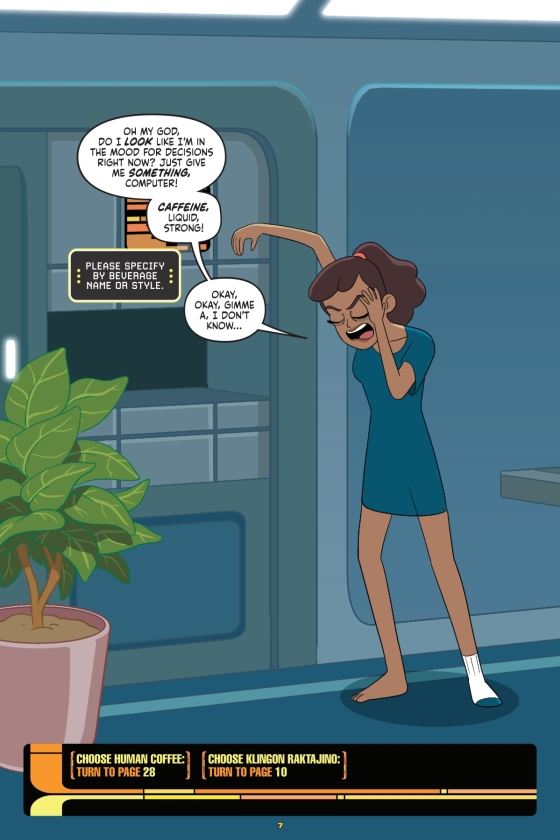
Warp Your Own Way, as the title may imply, is a new version of the classic Choose Your Own Adventure series from the 80s. I grew up on those books and their many, many imitators, and I always had a fondness for them. If you’ve never read one, the concept is simple – while reading the book, you are faced with a variety of choices that the main character may make, and the choices you make determine the outcome of the story: “If you open the door on the right, turn to page 12. If you open the door on the left, turn to page 17.” That sort of thing. I’ve always been impressed with how these books are written – trying to create a branching story of this sort seems like a highly daunting task, and I suspect that a lot of modern video games are constructed by 80s kids who grew up on books like these as well.
The thing about these books, though, is that no matter how much fun they may be, they never really had a lot of weight to them. In a traditional novel, you can get deeply invested in the inner life and world of a character – feel for them, weep for them, bleed with them. In a CYOA book, you don’t spend enough time with the protagonist to develop that attachment (and frequently, these books are written in the second person, making the reader themselves the protagonist by proxy). Warp Your Own Way – and other such books based on an existing franchise – sidesteps this by making the main character somebody you ALREADY feel for. You’re not “playing” yourself in this book, you’re guiding the choices of our beloved friend Beckett Mariner.
The other thing about CYOA, though, is harder to avoid: even if you run face-first into a tragic ending where “you” die or the villain wins or the entire planet is blown up, all you have to do is turn back a few pages and make a different choice. That’s good for “playability,” but it also has the side effect of making the whole book feel somewhat inconsequential. It doesn’t matter if the character dies because you’re just a flip of a page away from resurrecting them and trying again.
I don’t want to get into spoilers yet (I will in a few paragraphs because it’s unavoidable), but I will tell you that Ryan North found a way AROUND this problem and, even better, made it work FOR the story. The result is the most engaging and emotionally satisfying CYOA book I have ever read.
North is no stranger to CYOA books. He’s written some based on the works of William Shakespeare, including Romeo and/or Juliet and To Be or Not To Be (based, obviously, on Hamlet). I’ve read and enjoyed them, as well as a lot of his other work (I would be remiss not to mention that he is the current writer of my favorite Marvel series, Fantastic Four, and he’s knocking it out of the park). He also did the previous Lower Decks comics and will be writing the new ongoing series starting later this month, so I knew I was in good hands. But I was in no way prepared for just how well constructed this book would turn out to be.

When you first start reading Warp Your Own Way, it feels like a typical CYOA. You make your choices and follow the story until you get to an ending. It’s not a good ending, so you go back and try again. Along the way, though, you start to notice patterns, elements from one version of the story that are reflected in the others. This is what sets the story apart from any other CYOA. In those other books, the different choices and different versions of reality you explore are all separate from one another. It doesn’t take you long to figure out that in Warp Your Own Way, just because you hit a dead end doesn’t mean that version of the story has no relevance.
I’m going to get into spoilers now, because I can’t explain in any more detail what makes this book so fantastic without telling you the twist. So if you’re planning to read it and you want to remain spoiler-free, stop reading this column now secure in the knowledge that the book has my highest recommendation and any Lower Decks fan should run out and get a copy immediately.
Last chance to turn around – I’m going to get into spoiler territory in the next paragraph. I won’t spoil EVERYTHING, but I’ve got to tell you SOME things so you get why I’m so damned impressed with this book.
Okay, you can’t say I didn’t warn you. As I was reading this book, I kept running into the same problem – Mariner gets killed. Over and over again. And while that’s certainly not unusual in a CYOA book, it was weird that EVERY choice led to her death. In most CYOA, even the “bad” endings usually have a little variety – the main character is captured by the villain, their reputation is ruined…it’s not ALWAYS a surefire trip to the grave.

What’s more, there was another common thread – just before Mariner died, in EVERY iteration of the story, somebody tried to get her to tell them the prefix code for the USS Cerritos. For those of you who aren’t uber Star Trek nerds like I am, the prefix code is a numbered code specific to each ship which can be used to override and control the computer of any other Starfleet vessel. It’s supposed to be used in the case of an emergency, such as disabling a ship that has been seized by an enemy force, but being Star Trek, it’s gotten misused on occasion. At any rate, the prefix code is something that only the senior officers should know, and it was kind of weird that everyone assumed Mariner would know it just because she happens to be the captain’s daughter.
Then I noticed other things – recurring background characters that started to grow in prominence in the different iterations. Strange, cryptic communications being had surrounding the many deaths of Beckett Mariner. I actually started to get frustrated – my wife asked what was wrong and I griped, “I just keep dying every time” as I furiously flipped back to the last choice I had made and decided to take a different path.
And then, one of those side characters makes a comment that, bizarrely, refers back to the very first choice the reader makes in the book – what drink Mariner is going to have with breakfast. Human coffee, turn to page 28, Klingon Raktajino, turn to page 10. I’d done each of them over and over again, but the side character suddenly seemed to SHARE my frustration, saying Mariner just kept making the same choices over and over instead of trying something different like…
…like…
He didn’t, did he?

I realized the trick. I combined the options. I discovered a new choice.
And instead of coffee or Raktajino, Mariner ordered tea. Earl Grey. Hot.
Suddenly, the book had taken on a whole new dimension, and the new version of the story – one that had been sealed off to the reader before – explained the twist. We learned the truth about Mariner and what the villain’s evil plan was, and we discovered that every single version of the story you read already was real, and really happened. You weren’t choosing alternate timelines after all. It was something much more clever.
“Why are you laughing?” my wife asked me.
“Because this is brilliant!” I said.
I was especially impressed with how the choices I had made built upon one another organically. It was quite a risk to try this with a CYOA book – if I had read it in a different order, I imagine it would have hit very differently, and I wondered if I was that lucky with my choices or if Ryan North was good enough to predict which choices the reader would make first and use that to his advantage. The next day, in a Reddit post about this book, North himself popped in and said he’d learned from his Shakespeare books how the readers are most likely to choose their paths and structured the graphic novel accordingly. My admiration skyrocketed.
Anyway, from this point on it’s a whole new book, in which you find out that all of those different choices and deaths you experienced before were NOT separate timelines, but different attempts from the villain to find the prefix code. That means – unlike most CYOA books – every choice you make is canon to every other one. Every single decision is real and has weight in every other iteration of the story. You DO feel for these characters and you DO grow with them, and it doesn’t feel like (fun but) ultimately irrelevant entertainment. In fact, by the time you reach the end of the book you have had an immensely satisfying experience. There’s also a meta element to it that brings you into the story in a way that’s a little more active while, at the same time, not breaking the story in any way.
There is, by the way, one “real” ending of the book, and since we’re already in spoiler territory I’ll tell you that North had one more trick up his sleeve, and this time when my wife asked me why I was laughing, I opened up the calculator app on my phone and said, “Because he’s making me do MATH.”
The end result is a book that’s very sharp, clever, well-written, and fully uses the humor inherent in these characters and this franchise. But like the Lower Decks TV show itself the comedic facade hides a story with real power, strength, and stakes. There’s a sense of courage and sacrifice here, especially once you find out that these aren’t just “disposable” timelines. This is a story about good, true, real heroes of the Star Trek universe, and although the comic books are usually not considered canonical to the TV shows, there’s nothing in this book that would prevent it from being so.
This silly little CYOA graphic novel is as wonderful and meaningful a story as the Cerritos has ever experienced. It is magnificent. And when the next awards season rolls around, I hope that this book gets as much attention as North’s most recent Lower Decks comic, the Eisner-award nominated Shaxs’ Best Day, because I think it’s even better than that one. Pick this up, fans, and read it over and over again. You won’t have a choice, after all. That’s the only way to get to the real end.
Because THIS is how we do it.
Blake M. Petit is a writer, teacher, and dad from Ama, Louisiana. His most recent writing project is the superhero adventure series Other People’s Heroes: Little Stars, volume one of which is now available on Amazon. You can subscribe to his newsletter by clicking right here. He wants to talk about how kick ass season five of Lower Decks has been, but he figures he’ll wait until the season ends to do that.
 Blake M. Petit