I haven’t listened to the radio in years. I know this is no longer a novel position. Most people in this digital age ignore the radio in favor of populating their own playlists on Spotify, Pandora, Amazon Music, Heimdall’s Jockstrap, or whatever app is en vogue at the moment. But even before the rise of such services, podcasts had long since become my entertainment of choice while driving. One such podcast I discovered years ago helped turn me on to “podiobooks” (audiobooks delivered in podcast form, in case you couldn’t decode the term), and that in turn directed me to the new pantheon of writers that were riding the wave that came at the time that medium was burgeoning: people like Mur Lafferty and J.C. Hutchins and, most pertinent to our discussion today, the Future Dark Overlord himself, Scott Sigler.

So as not to bury the lede, the reason I’m writing about Sigler this week is because a new podcast series is launching that presents his most popular series of stories starting over from the beginning. So right now I want you to open your chosen podcasting app (yes, that includes Spotify) and subscribe to “Scott Sigler’s Galactic Football League Series.” Then, while the first three episodes are downloading, I’m going to tell you why this series is awesome and you should be giving Sigler your attention.
Sigler, as you could probably guess from the inclusion of the word “Galactic,” is a science fiction writer. He has developed a complex and fascinating universe with intriguing characters, wild and bizarre alien species, and a degree of worldbuilding that could make Tolkien and Rowling take notice. Sigler has laid out thousands of years of history (both before and after the present day) that he feeds his audience a little bit at a time. The individual novels or series stand on their own, but when read together you get a rich and textured science fiction tapestry that plays out over 2000 years.
Let’s start with the Galactic Football League stories, since that’s what the podcast is going to cover. The stories in the GFL era take place about 700 years in the future, in a universe where humanity has spread out to the stars, encountered several sentient species of alien, and bifurcated into many different worlds and governments. Football – American-style football, also known as “Gridiron” – has been adopted as a sort of de facto peacekeeping event in a galaxy in turmoil. Football, you see, is no longer played only by humans, but by the massive and powerful Ki, the swift and agile Sklorno, and the brutal Quyth, among others. By forcing these different races to work together on the field, conflicts between them have been mitigated, even as most of them are under the rule of an alien empire of small, batlike creatures that rule through sheer force of numbers. The story focuses on Quentin Barnes, a young quarterback raised in the xenophobic Purist Nation, who has to learn how to cooperate with these bizarre alien species if he wants to achieve his goal of winning a Galaxy Bowl.
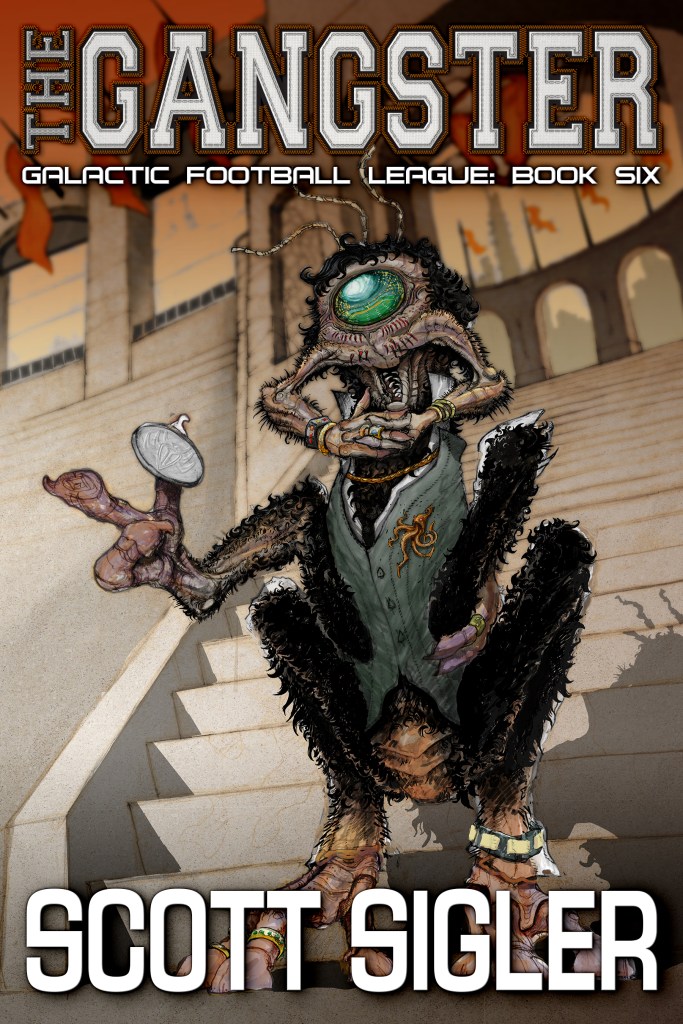
So right off the bat, the GFL series has aliens and sports, which are both a lot of fun. But that’s not all. In the time of the GFL, Gridiron Football has largely come under the control of massive organized crime syndicates, with teams owned by actual criminals, illegal substances smuggled on the team transport ships, and players doubling as strongarm enforcers for their leaders. That’s right: it’s also a gangster series. (In fact, that’s the title of the sixth book: The Gangster.) And as the story goes on, although football never leaves, it becomes increasingly clear that the story is about more than just football, that Quentin is more than just a quarterback, and that the stakes they’re really playing for are much, much higher than a championship ring. Sigler has developed an intricate and fully fleshed-out universe that is completely engrossing on multiple levels.
One of the most impressive things about it, for me, is the degree of work he has put into crafting his various alien species. There are none of the “rubber forehead” aliens that we see in Star Trek or most TV and movie sci-fi franchises, a fact that’s made easier because these are novels and Sigler doesn’t have to worry about budgetary concerns. Every alien species in Sigler’s universe is imagined from the ground-up with their biology, life cycle, and culture carefully crafted, many of them in ways very unlike what we’re used to. The species that is most like humans, the Quyth, are really only like us in that they are bipedal and experience a similar emotional range. Unlike humans, the Quyth have a biological caste system that divides the species, which is covered in either fur or chitin depending on which caste they belong to. They also have a pair of dexterous pedipalp arms protruding under their head and their one massive eye, which changes color to indicate their mood. Quyth leaders gain their dominance by castrating their siblings while still in the womb. Quyth females are never seen by outsiders at all. This is the CLOSEST alien species to humanity in this universe, and it’s a species that in real life would be virtually unthinkable, except perhaps in southern California.
But I digress – the GFL is probably Sigler’s most popular work amongst his fans. It’s certainly the era that is discussed the most and for which we are most eager to see new installments. But it’s not the ONLY era. 200 years before the GFL comes The Crypt, a military drama about a crew assigned to a ship with the reputation of being a deathtrap for anybody who is put on the duty roster – usually as a sentence for some crime. Then there are the modern stories, such as Ancestor, Earthcore, and the Infected trilogy. While the GFL stories are suitable for young readers, these other books are (even) more violent and brutal, and definitely not intended for kids. They are, however, part of the same universe, something that becomes clear in the second Infected book when the characters are given a glimpse of an alien race that is terrifying to them, but that readers of Sigler’s other work will quickly recognize as a familiar species in the GFL era. And then he does it again with the Generations trilogy, a series set a millennia after the GFL about a group of teenagers who wake up on a distant spacecraft with no memories of their past. I don’t want to get too spoilery, but I will reveal that eventually the series, again, starts to share familiar species with the reader.

The point I’m getting at is that Sigler has a universe that is complete, complex, intricate, and really entertaining, and is so in various time periods, which is a trick that very few writers have managed to pull off. So I respect and admire Sigler for that as much as I am a fan of the writing itself.
But that’s not all. There are lots of writers whose work I admire and respect. What sets Sigler apart, why I’m writing about him today, is the way he has masterfully crafted a community around himself. From the early days when he branded himself the Future Dark Overlord of the world to the way he has cultivated relationships with the many “Sigler Junkies” that populate the internet, I am in awe of the way he’s built out his fan base. Sure, there are highly devoted fans of Harry Potter, Lord of the Rings, Twilight, and plenty of other book series, but most of those have been built over many years or were done with the help of a major publishing empire or movie studio to enhance the brand. Sigler has done it without those things. Oh, he’s had some mainstream success: he’s published books through Crown, hit the New York Times list, and he’s even contributed licensed novels and short stories to the Alien and Predator franchises…but for the most part, his community and his fervent, devoted fanbase was cultivated by himself and his small support staff.

When I look at what he’s done and how effectively he’s done it, I know that Scott Sigler is who I want to be when I grow up. He’s the reason I did audiobook versions of Other People’s Heroes and A Long November back in the day when podcasting was still young and easy to get into if you didn’t have any resources. (Most people don’t know this, but the name “Blake” is actually from an obscure Peloponisian dialect and translates roughly to “lacks both resources and the wisdom to use them correctly.”) While the new media landscape has changed dramatically since the days when he was starting, and I don’t know if his techniques could work today, that doesn’t matter. It already worked for him, and he’s allowed to enjoy the fruits of his incredible amount of hard work and talent.
Plus, in every interaction I’ve had with the guy online, he’s seemed to be a really cool and stand-up dude.
So I’m saying all this to give back to him just a little bit for the hours of audio entertainment he’s provided me over the years. If anything I’ve said sounds interesting to you – if you’re into sci-fi or sports, if you’re looking for your next audiobook, if you’ve got a middle-grade kid in your life that you’re trying to get into reading, check out the GFL saga. The first three episodes dropped this week, and there literally years worth of content coming down the line. Hopefully enough that the podcast won’t wrap up before the FDO finishes writing the series.
Don’t worry. I’ve got faith that he’s not going to George R.R. Martin us. If there’s one thing that I believe is true about Scott Sigler, it’s that he doesn’t know how to stop working.
Blake M. Petit is a writer, teacher, and dad from Ama, Louisiana. His current writing project is the superhero adventure series Other People’s Heroes: Little Stars, a new episode of which is available every Wednesday on Amazon’s Kindle Vella platform. Hopefully, before you get too far into the GFL series, you’ll understand why Blake is constantly looking at some fool doing something foolish and muttering, “This kid needs a Ma Tweedy in his life.”
 Blake M. Petit